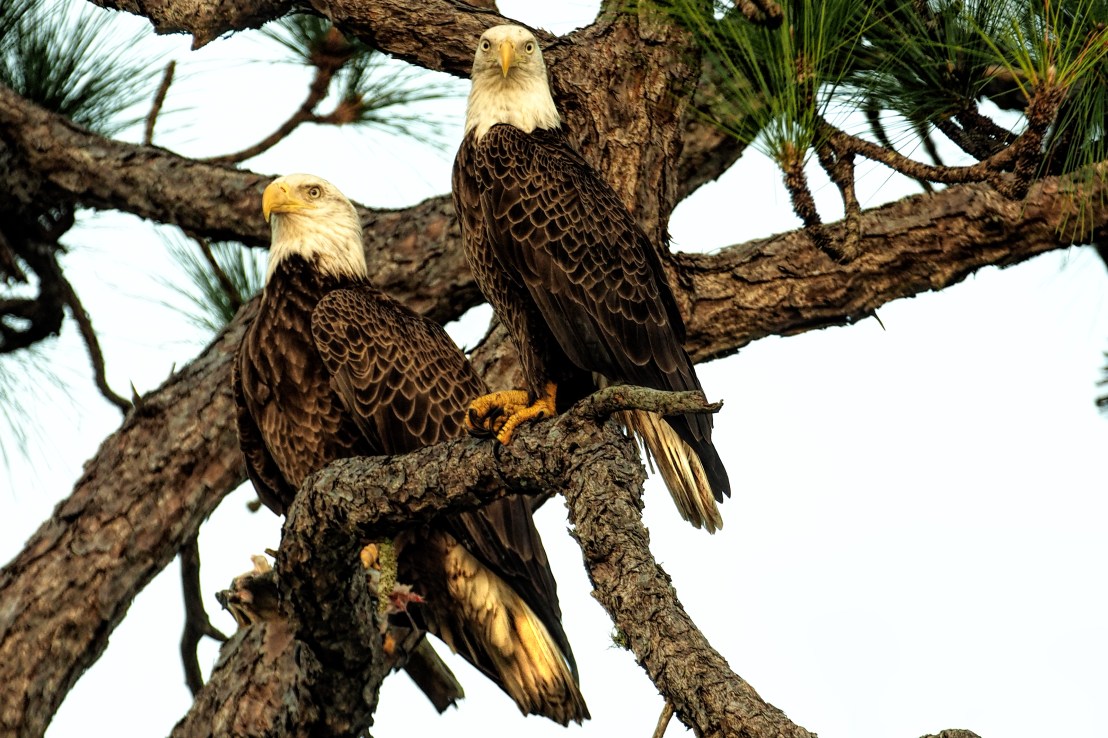
I took Lili (my faithful photo dog buddy) for her usual evening walk up in the back of my house by the golf course. Fortunately, that is where the eagles hang out.
They have been pretty boring, albeit, beautiful.
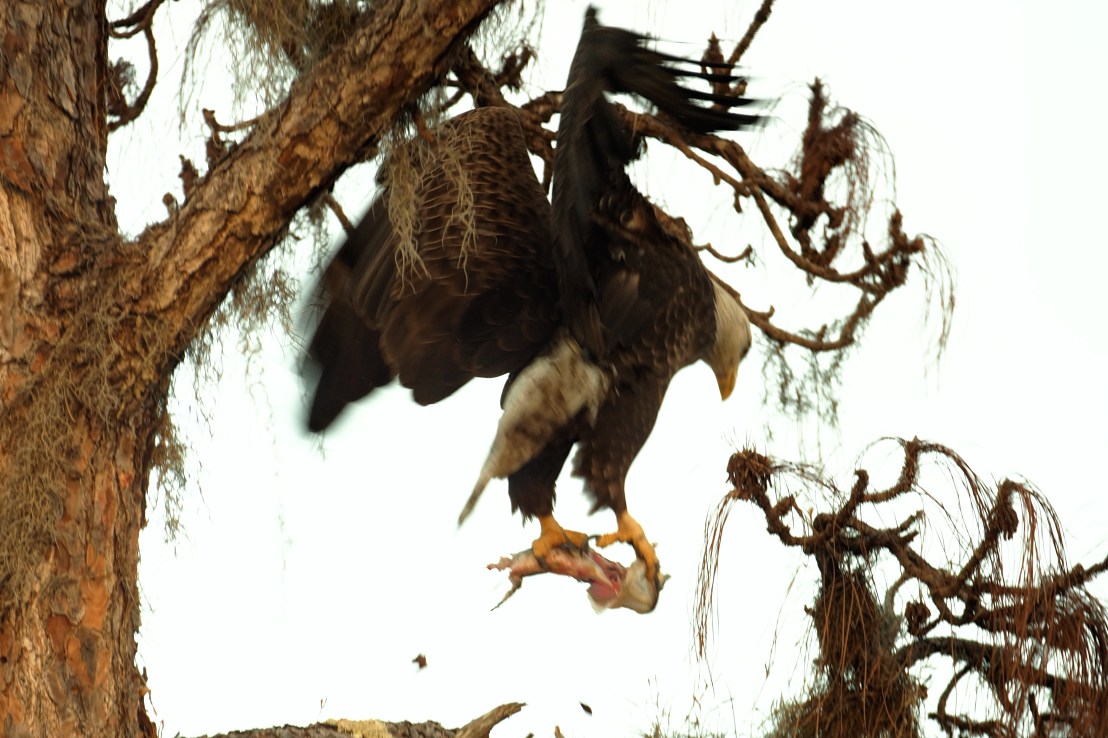
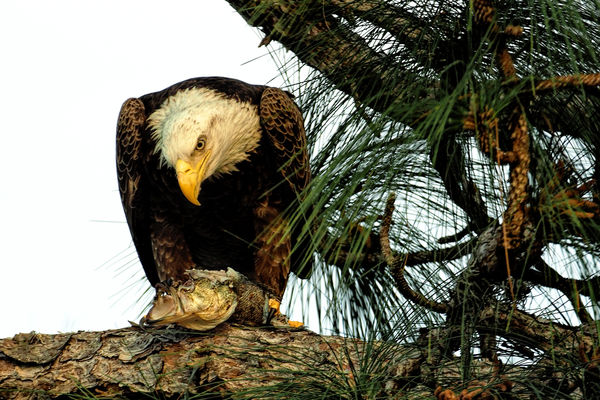
Tonight they had a very large bass that they were sharing.
I took a bunch of pictures and we went for our walk.
They don’t pay much attention to Lili and I any more which is cool. On our way back to the car, we had to pass under the tree they were now in.
I took a few more pictures, and as we passed under the tree, they dropped the fish and it landed about 3ft from our feet.
Lili is off leash.
I told her to stay and lie down, she did and we both stood still.
The big female flew down and walked over to get it. Looked at us, and took it back up into the tree and continued eating. It was soooooo exciting!!!
Val included some photographs.
I sent Val a private message asking if I could republish her story. Val said ‘Yes’. But even better than that Val included a short video and some additional news. In that Lili was found by a dumpster four years ago. Then Lili was just 5 weeks old. Since then “I have been taking her everywhere with me since.”
Val went on to say:
As soon as it gets dusky, I keep Lili on a leash too for the same reasons.
She is pretty big, 80# but I don’t trust the eagles.
Who knows what they would/can do?
Here are those photographs.
OLYMPUS DIGITAL CAMERA
oooo
oooo
OLYMPUS DIGITAL CAMERA
oooo
oooo
And one of Lili!
And there’s a short video but I don’t have time today to turn it into a YouTube.
It is now ten days since I last reported on Tom and Chica’s great walk; so much for my couple of postings a week!
But they continue to walk the GR7 path in Spain and I will continue to republish their posts of this great trip.
So now, so far as republishing goes, we are up to Day Two.
ooOOoo
Day 2: La Pena to Embalse de Almodovar 16k
By Tom and Chica, 13th January, 2020
Written by Tom’s wife.
Human breakfast!
All walking days will start with the full monty for Tom. He is a very practiced breakfast chef so I leave him to it. It did seems to take a while this morning so I think we may have to start getting up a bit earlier. For this week, at least, I will be dropping him off and picking him up so he doesn’t have to carry the full pack with the tent etc, giving him time to get some fitness back first after the flu virus.
The start
So it was 10am before we got to the start at La Pena (What Three Words location: crafted.indecisive.barbecued.) and already a really glorious day; full sun and a gentle breeze. The route wound up into the hills giving wonderful views back down to the sea and across to the Moroccan coast. The path continued on a variety of surfaces, some tarmac, some sand and some stony tracks. The latter proved a bit uncomfortable and Tom now thinks that his more sturdy boots might be better, despite being a bit heavier. He has metal rods in both his feet, the result of a climbing accident about twenty years ago. So it’s extra important that his feet are well supported.
Goats on the moveVery spiny cactus with fruit – name anyone?
The landscape was quite rocky with olive and other hardy shrubs and trees, and lots of cacti too. Not much wildlife spotted but plenty of goats with their melodic bells. The route ended at a large lake on a inaccessible track so they walked back to the road where we met, conveniently close to a bar for a much appreciated cold beer (for Tom)and long drink of water (for Chica).
Meanwhile, back at the campsite, there was a minor crisis as a neighbour discovered a number of processionary caterpillars. These are nasty critters with highly irritant hairs that can cause a painful rash in humans but are even more dangerous for dogs. As the name suggests, the caterpillars form a chain when they move and, of course, most dogs want to investigate but if they ingest the hairs it can cause real problems. The nests can easily be spotted as dense webs on the tips of pine branches. The site maintenance staff were very prompt in coming along to remove the nests but we will remain vigilant. It was probably a bit daft to choose a plot under the pines and it’s a lesson learned for the future. One of many to come, no doubt.
ooOOoo
This is such an amazing trip. Words hardly express my admiration for what Tom.
There really is no end to the sense of smell that a dog has.
I was browsing online The Smithsonian magazine and came across a long article that was all about the dog’s sense of smell in terms of sniffing out citrus greening disease.
There’s no end of articles about the dog’s sense of smell and I have written about it before. But first I’m going to reproduce the article on Animal Planet because it gets to the point.
Dogs rule. Or, at least, they do when it comes to their sense of smell, which crushes that of humans. According to the Alabama Cooperative Extension System (ACES), a dog’s sense of smell is about 1,000 times keener than that of their two-legged companions — and many dog experts claim it’s millions of times better — thanks to the construction of their often-slobbery, wet schnozzes. So what, exactly, is going on in there?
A dog sniffs at scents using his nose, of course, and also his mouth, which may open in a sort of grin. His nostrils, or nares, can move independently of one another, which helps him pinpoint where a particular smell is coming from. As a dog inhales a scent, it settles into his spacious nasal cavity, which is divided into two chambers and, ACES reports, is home to more than 220 million olfactory receptors (humans have a measly 5 million). Mucus traps the scent particles inside the nasal chambers while the olfactory receptors process them. Additional particles are trapped in the mucus on the exterior surface of his nose.
Sometimes, it takes more than one sniff for a dog to accumulate enough odor molecules to identify a smell. When the dog needs to exhale, air is forced out the side of his nostrils, allowing him to continue smelling the odors he’s currently sniffing.
Dogs possess another olfactory chamber called Jacobson’s organ, or, scientifically, the vomeronasal organ. Tucked at the bottom of the nasal cavity, it has two fluid-filled sacs that enable dogs to smell and taste simultaneously. Puppies use it to locate their mother’s milk, and even a favored teat. Adult dogs mainly use it when smelling animal pheromones in substances like urine, or those emitted when a female dog is in heat.
Top Sniffers
What all of this sniffing and processing really means is that a dog’s sense of smell is his primary form of communication. And it’s a phenomenal one, because dogs don’t just smell odors that we can’t. When a dog greets another dog through sniffing, for example, he’s learning an intricate tale: what the other dog’s sex is, what he ate that day, whom he interacted with, what he touched, what mood he’s in and — if it’s a female — if she’s pregnant or even if she’s had a false pregnancy. It’s no wonder, then, that while a dog’s brain is only one-tenth the size of a human brain, the portion controlling smell is 40 times larger than in humans.
So, who’s top dog when it comes to sniffing? While all canines have an incredible sense of smell, some breeds — such as bloodhounds, basset hounds and beagles — have more highly refined sniffers. This is a result of several factors. Dogs with longer snouts, for example, can smell better simply because their noses have more olfactory glands. Bloodhounds, members of the “scent hound” canine group, also have lots of skin folds around their faces, which help to trap scent particles. And their long ears, like those of Bassets, drag on the ground, collecting more smells that can be easily swept into their noses.
Of course, dogs are individuals as well, so it’s certainly possible to find a non-scent-hound who can outperform one. And as Dr. Sandi Sawchuk, a clinical instructor at the University of Wisconsin School of Veterinary Medicine, notes: “There are lots of breeds that can be trained to sniff out certain items — for example, cadaver-sniffing dogs, drug-sniffing dogs, etc.”
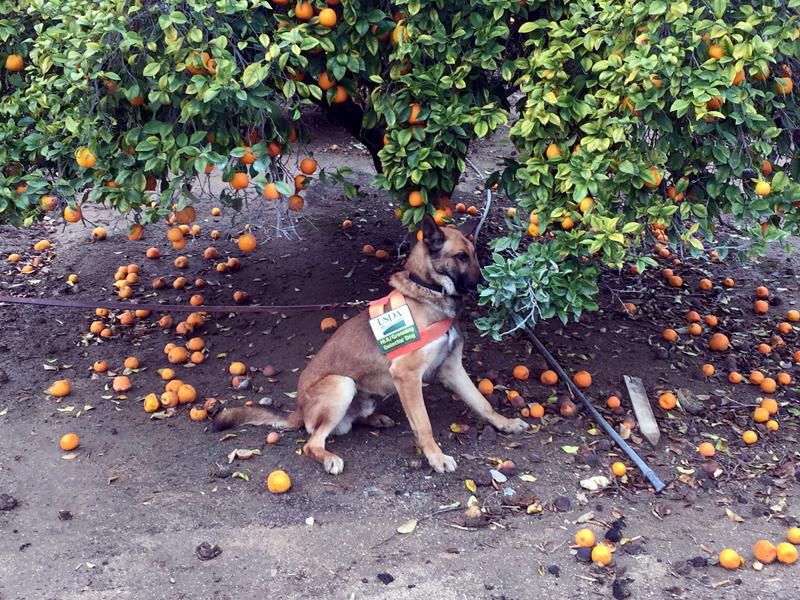
A detector dog named Szaboles, trained to sniff out the bacterial pathogen Candidatus Liberibacter asiaticus in a citrus orchard. (Courtesy of Tim R. Gottwald)
Tim Gottwald will never forget the sight: the mottled yellow leaves, the withered branches, the small, misshapen fruits, tinged with sickly green. These were the signs he’d learned to associate with huanglongbing, or citrus greening—a devastating and wildly infectious bacterial infection that slashed the United States’ orange juice yields by more than 70 percent in the span of a decade.
“It’s like a cancer,” says Gottwald, a plant pathologist with the United States Department of Agriculture. “One that’s metastasized, and can’t be eradicated or cured.”
Once they’ve begun to sport splotchy foliage and stunted fruit, trees can be diagnosed with a single glance. A symptomatic plant, Gottwald says, is a diseased one. Unfortunately, the converse isn’t true: Infected trees can appear normal for months, sometimes years, before visibly deteriorating, leaving researchers with few reliable ways to suss out sick citrus early on—and giving the deadly bacteria ample opportunity to spread unnoticed.
Now, Gottwald and his colleagues may have a creative new strategy to fill this diagnostic gap—one that relies not on vision, but smell. They’ve taught dogs to recognize the telltale scent of a huanglongbing infection—an odor that eludes the attention of humans, but consistently tickles the super-sensitive schnozz of a mutt. Once trained up, canines can nose out the disease within weeks of infection, trouncing all other available detection methods in both timing and accuracy, the researchers report today in Proceedings of the National Academy of Sciences.
“This is a major step in the development of what could be a really important early detection tool,” says Monique Rivera, an entomologist and citrus pest expert at the University of California, Riverside who wasn’t involved in the study. “It could give growers information about potential exposure … to the causative bacteria.”
First described in China in the early 1900s, huanglongbing has now crippled orchards in more than 50 countries around the globe. Fifteen years ago, the scourge took hold in Florida, where infected trees are now the norm; the state’s $9 billion citrus industry, once the second largest in the world, is now on the verge of collapse. From oranges to grapefruits to lemons, no variety of citrus is immune.
As the disease continues to creep into new regions, researchers worldwide are scrambling to contain it. But the task has proved difficult: No effective treatments, cures or vaccines exist for huanglongbing, the product of a bacterium called Candidatus Liberibacter asiaticus (or CLas, pronounced “sea lass”) that’s ferried from tree to tree by winged insects. Scientists have also found the microbes to be extraordinarily difficult to grow and study in the lab.
The 20 canines in the study trained to detect CLas-infected citrus trees. (Gottwald et al., PNAS, 2020)
Currently, the only surefire way to curb citrus greening’s spread is to extract and eliminate infected trees. This strategy depends entirely on early detection—“one of the biggest problems in the field right now,” says Carolyn Slupsky, a plant pathologist at the University of California, Davis who wasn’t involved in the study. Spotting an asymptomatic infection by eye is essentially impossible. And though genetic tests can sometimes pinpoint microbes in apparently healthy trees, their success rates are low and inconsistent, due in part to the patchiness with which CLas distributes itself in plant tissue.
In many ways, huanglongbing is “the perfect storm of a disease,” Slupsky says.
But canines may just be the perfect candidates to lend a helping paw. With a sense of smell that’s 10,000 to 100,000 times more powerful than a human’s, dogs are superstar sniffers, capable of nosing out everything from bombs to drugs. In recent years, they’ve even been deployed to detect pathogenic diseases like malaria. Infections, it turns out, stink—and dogs definitely take notice.
To see if pooches’ powers of perception might extend to huanglongbing, Gottwald and his team taught 20 dogs to pick up on the smell of citrus plants with known infections, rewarding the pups with toys when they identified the correct trees. After just a few weeks of training, the newly-minted citrus sniffers were picking out infected trees with about 99 percent accuracy. Put in pairs to corroborate each other’s results, the dogs got close-to-perfect scores.
Gottwald was floored. “I wasn’t surprised [the dogs] could do it,” he says. “But I was surprised by how well they could do it. It was pretty amazing.”
The team then pitted the pups against a common but expensive laboratory test that’s often used to verify the presence of CLas DNA in suspicious-looking citrus. After spiking the microbes into 30 trees, the researchers mixed the newly-infected plants into rows of healthy ones and allowed the dogs to inspect them on a weekly basis. Within a month, the canines had collectively homed in on every single CLas-positive plant.
The DNA test, on the other hand, had no such luck: Seventeen months into the infection, it was still failing to identify a third of the diseased trees.
If Gottwald’s team sees continued success, “this could be very exciting for [citrus] growers,” who could someday keep dogs around as a fast and relatively inexpensive way to survey their orchards, says Phuc Ha, a microbiologist at Washington State University who wasn’t involved in the study. For now, the most immediate applications lie in disease prevention. But, she adds, should researchers develop treatments for huanglongbing, canines could eventually play a role in curing the condition as well.
Gottwald and his team have already begun to send small teams of citrus-sniffer dogs to inspect vulnerable trees in California and Texas. In both locations, the canines have alerted the researchers to trees that have yet to test positive in the lab.
This, however, evokes the double-edged sword of early detection research: The dogs are so much faster at finding potentially diseased trees that their picks can’t actually be confirmed, Slupsky points out. Maybe they’re more sensitive than the molecular test, and the disease is more widespread than researchers feared. Or maybe the canine’s noses are leading them astray. “Specificity is always an issue,” Slupsky says, “because you’re comparing them to an imperfect test.”
Dogs also come with their own drawbacks. They can tire; they can be distracted. They’re not machines. And while they can make fast work of orchards where infections are rare, their performance will probably plummet in heavily afflicted groves. In an ideal world, Slupsky says, the dogs would serve strictly as a first line of defense, screening trees for further monitoring or testing in the lab. She and her colleagues are hard at work on one such diagnostic, built to detect the unique suite of chemicals infected leaves produce early on.
Many questions remain unanswered. Gottwald still isn’t sure what exactly the dogs are smelling on the plants, though a series of experiments indicate the scent is probably coming from the CLas bacteria themselves. That theory may be tough to test: Though researchers like Washington State’s Ha have now grown CLas in the presence of other microbes, no one has yet managed to isolate the strain in a pure culture, hampering efforts to understand its basic biology and develop precise treatments.
While exciting, the team’s dog-nostic developments ultimately underscore “just how distant we still are from understanding a lot of the mechanistic processes that are going on [with this disease],” Rivera says. But with more collaboration and multidisciplinary work, she adds, “I think we’ll keep heading toward solutions.”
ooOOoo
When one watches a dog closely it’s very clear that their nose is their primary sense. At least a thousand times better than our human sense of smell and some people put it much higher. That is impossible to understand. The best we can do is to wonder at the sort of world that dogs ‘see’ with their noses.
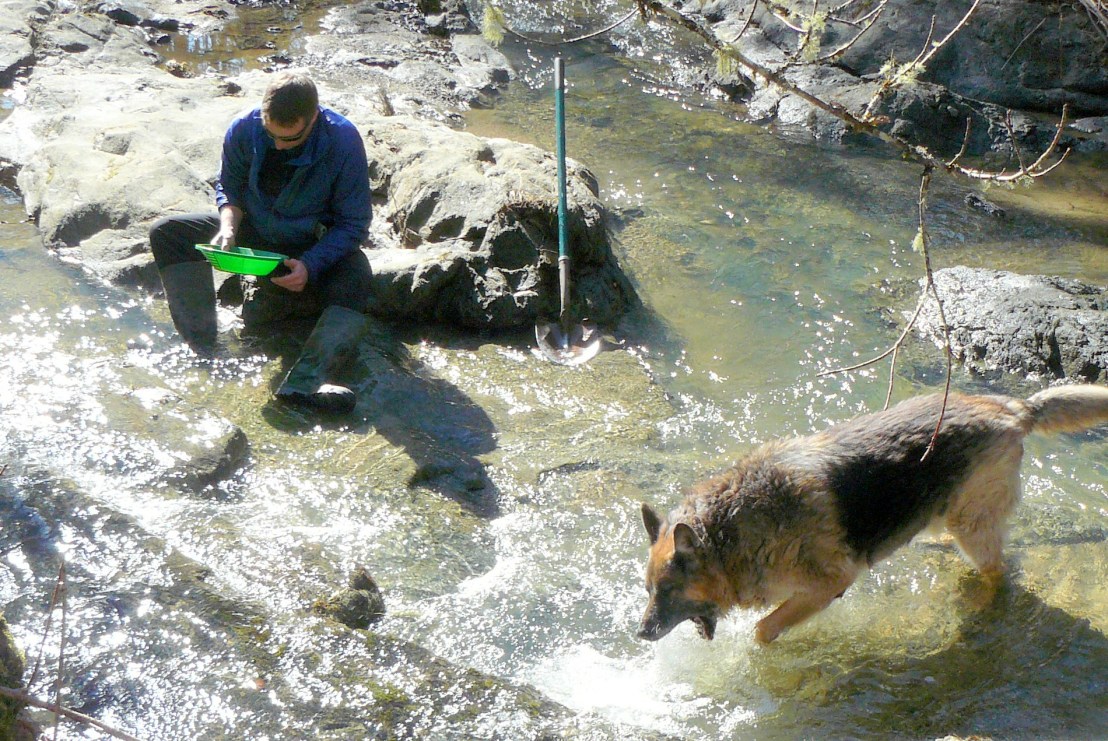
I will close with an old photograph of Pharaoh helping a prospector look for gold in our creek.
Pharaoh, instinctively, thought that a dog’s nose would raise the odds of a find.
I have long been a subscriber to The Conversation. They seem to be politically neutral as well as giving permission for their essays to be republished elsewhere.
This particular essay chimed with me because for some time, one or two years sort of time-span, the number of people agreeing with the statement, “It’s a strange world“, has measurably grown. At first I thought it was a question of politics, both sides of The Atlantic, but I have recently come to the opinion that it is deeper than that.
This encapsulates the idea perfectly.
ooOOoo
How CEOs, experts and philosophers see the world’s biggest risks differently
We live in a world threatened by numerous existential risks that no country or organization can resolve alone, such as climate change, extreme weather and the coronavirus.
But in order to adequately address them, we need agreement on which are priorities – and which aren’t.
As it happens, the policymakers and business leaders who largely determine which risks become global priorities spent a week in January mingling in the mountainous resort of Davos for an annual meeting of the world’s elite.
I participated in a global risk assessment survey that informed those at the Davos summit on what they should be paying the most attention to. The results, drawn from experts in a broad range of disciplines including business, happen to be very different from what company CEOs specifically see as the biggest threats they face.
As a philosopher, I found the differences curious. They highlight two contrasting ways of seeing the world – with significant consequences for our ability to address societal risks.
Wildfires in Australia have destroyed more than 3,000 homes and razed more than 10.6 million hectares since September. AP Photo/Noah Berger
Two perspectives on the biggest risks
The World Economic Forum’s Global Risk Report consolidates the perceptions of about 800 experts in business, government and civil society to rank “the world’s most pressing challenges” for the coming year by likelihood and impact.
In 2020, extreme weather, a failure to act on climate change and natural disasters topped the list of risks in terms of likelihood of occurrence. In terms of impact, the top three were climate action failure, weapons of mass destruction and a loss of biodiversity.
The specific perspective of corporate leaders, however, is captured in another survey that highlights what they perceive as the biggest risks to their own businesses’ growth prospects. Conducted by consultancy PwC since 1998, it also holds sway in Davos. I’ve been involved in that report as well when I used to work for the organization.
In sharp contrast to the World Economic Forum’s risk report, the CEO survey found that the top three risks to business this year are overregulation, trade conflicts and uncertain economic growth.
President Trump’s trade war and other economic concerns tend to be the focus of corporate CEOs. AP Photo/Evan Vucci
Economic or ethical
What explains such a big difference in how these groups see the greatest threats?
I wanted to look at this question more deeply, beyond one year’s assessment, so I did a simple analysis of 14 years of data generated by the two reports. My findings are only inferences from publicly available data, and it should be noted that the two surveys have different methodologies and ask different questions that may shape respondents’ answers.
A key difference I observed is that business leaders tend to think in economic terms first and ethical terms second. That is, businesses, as you’d expect, tend to focus on their short-term economic situation, while civil society and other experts in the Global Risk Report focus on longer-term social and environmental consequences.
For example, year after year, CEOs have named a comparatively stable set of narrow concerns. Overregulation is among the main three threats in all but one of the years – and is frequently at the top of the list. Availability of talent, government fiscal concerns and the economy were also frequently mentioned over the past 14 years.
In contrast, the Global Risk Report tends to reflect a greater evolution in the types of risks the world faces, with concerns about the environment and existential threats growing increasingly prominent over the past five years, while economic and geopolitical risks have faded after dominating in the late 2000s.
A philosophical perspective
Risk surveys are useful tools for understanding what matters to CEOs and civil society. Philosophy is useful for considering why their priorities differ, and whose are likelier to be right.
Fundamentally, risks are about interests. Businesses want a minimum of regulations so they can make more money today. Experts representing constituencies beyond just business place a greater emphasis on the common good, now and in the future.
When interests are in tension, philosophy can help us sort between them. And while I’m sympathetic to CEOs’ desire to run their businesses without regulatory interference, I’m concerned that these short-term economic considerations often impede long-term ethical goals, such as looking after the well-being of the environment.
An uncertain world
Experts agree on at least one thing: The world faces dire risks.
This year’s Global Risk Report, titled, “An Unsettled World,” depicts on its cover a vulnerable earth in the shadow of a gigantic whirlpool.
The cover photograph of the Global CEO Survey, which reported the lowest CEO confidence in economic growth since the Great Recession, shows an incoming tide beneath looming dark clouds, with the words: “Navigating the Rising Tide of Uncertainty.”
Between the covers, however, the reports demonstrate a wide gap between two influential groups that need to be on the same page if we hope to resolve the world’s biggest threats.
Last century, in the same year that World War II drew to a close, Bertrand Russell proclaimed that
Bertrand Russell. Naci Yavuz/Shurterstock.com
the purpose of philosophy was to teach us “how to live without certainty, and yet without being paralyzed by hesitation.”
In the 21st century, philosophy can remind us of our unfortunate tendency to let economic priorities paralyze action on more pressing concerns.
Bertrand Russell was a great philosopher. Well he was that and much more. Wikipedia remind us that he “was a British philosopher, logician, mathematician, historian, writer, essayist, social critic, political activist, and Nobel laureate.”
He died at the age of 97 on the 2nd February, 1970; fifty years ago as of yesterday.
I’ll close with another quote from the great man:
“The whole problem with the world is that fools and fanatics are always so certain of themselves, and wiser people so full of doubts. …”
Another republication of the Spanish walk by Tom and Chica.
There was such a wonderful response to the post on the 28th January that I decided to republish another one. This time I have started at the beginning.
ooOOoo
The GR7
The road less travelled…..
If you tell someone you’re planning a long walk in Spain, they will mostly assume you’re talking about the Camino de Santiago pilgrim trail across northern Spain. Tom being a bit of a misanthrope said he’d rather go somewhere less crowded.
We are familiar with a part of the GR7 as it runs through the Serrania de Ronda where we have spent a few recent winters. After more research it was decided that this would be the most interesting.
The GR7 starts on the south coast at Tarifa, near Gibraltar, and then runs up through the Los Alcornocales, a beautiful forest of cork oaks, then into the Grazalema National Park before reaching the city of Ronda. Dramatically perched above a deep gorge, Ronda is our favourite city.
From there the route turns eastwards towards Antequera and passes through the Parque Natural del Torcal whose bizarre rocky outcrops form one of the most impressive karst landscapes in Europe.
Shortly beyond, the route splits and Tom and Chica will be taking the southern variation through many small villages into Las Alpajarras. Then it heads up into the Sierra Nevada and there it may get tricky depending on the snow level. Chica isn’t keen on being belly deep in snow!
As the route heads north inland from the east coast, it is all new territory for us. There should be a couple of visits to both our charities near Alicante and Valencia and then due north to the border with Andorra. The final stop for recuperation will be with good friend, Kate, in the Pyrenees.
At last, after a fair few hitches and glitches, Tom and Chica took their first steps on a journey that will take them right across Spain to Andorra on the GR7 route. The start is at the aptly (and purely coincidentally) named Playa Chica, which is the most southerly point of mainland Europe. From here, you have the Med to the east, the Atlantic to the west and Africa on the horizon. It’s an epic trip and one that only around five people complete every year. It should cover a variety of landscapes, starting today with the beautiful beaches of Tarifa and the surrounding area. As it’s a Saturday, with a good strong breeze, the kite surfers were out in force. It’s quite a sight!
Kite surfers at Valdavaqueros
Today was a short toddle, by comparison with what will follow – just 11k in about 2.5 hours. The route was almost entirely on the beach and Tom shed his shoes and walked barefoot. It might be the only time that will be possible.
Given that he is recovering from flu an easy start seemed a good plan – definitely so as it’s now raining! Chica, however, needs to understand that stopping to investigate every interesting smell would mean the walk would take several years.
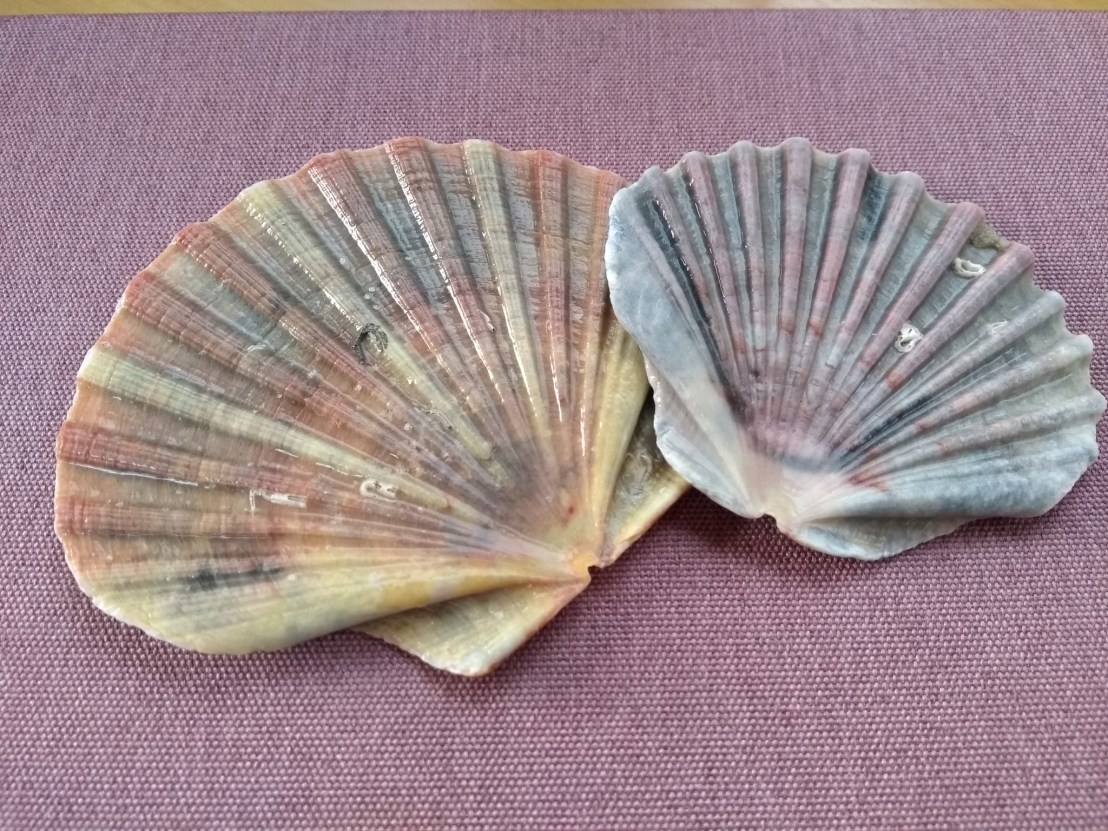
We will be posting a blog every day of the walk, with information on the route, the scenery and the flora and fauna. Tom isn’t able to carry field guides – too much extra weight – so identification from any of our followers would be appreciated, starting with these shells found on the beach today. These pics will be posted on our instagram page too.
Shells found on the beach at Valdevaqueros
As well as posting our position, hopefully using Viewranger (we’re working on this) we will also give our position using What Three Words. Tonight’s are: tigress, asked, varies. This is fun and will be another way of ensuring that the back up team (me) can hook up with them.
Stay with us!
Just this far to go….
ooOOoo
This is an incredible journey and I’m so pleased that Tom is happy for me to share it with you.
Tom came to Learning from Dogs a short while ago and signed up to follow the blog. As is usual, I went across to his blog in order to leave a thank-you note. I was flabbergasted at what I saw. Tom and his two dogs were walking across Spain. He called his blog Chica’s Challenge and this is what he wrote on his home page.
First, Tom decided he wanted to do a long walk.
Then he thought Spain would be nice as it has to be in winter.
And he’d like to take Chica, our podenco.
As an afterthought, he said, “Maybe we could raise some money?”
“Who for?” I asked.
“Well, as I’m taking Chica and it’s in Spain, I guess for Spanish podencos.”
“Great idea! I’ll write the blog!”
I wanted to follow his posts and did so.
Then I wanted to republish a post and asked Tom if I had his permission to so do.
One dog and her man walking across Spain, raising money for their podenco friends.
Day 7: Jimena de la Frontera to Cerra de la Fantasia 20k
The last two days were non-walking days, one for bad weather and another to move base again. Now we have the luxury of being in a house for a while in Jimera de Libar, a village we know well.
So the day started with the drive back to Jimena and the weather looked reasonable. Again, Merlin refused to be left so the three of them set off up the path, climbing steadily for the first hour and a half.
Climbing pathSpanish Fir / Pinsapo (Abies Pinsapo) in the background
The path eventually levelled out and passed beneath the rocky outcrops of the Altos de Paneron and Cerro de Marin. After a bare rocky sections where the route was harder to determine, they went into dense forest of oak and Spanish fir (we love these and call them lollipop trees because of their shape). Both dogs in great form, but Tom was mean and moody :).
Dark clouds were gathering from all directions but the view to the coast was still impressive. However, it wasn’t long before the rain began and the temperature dropped.
Looking south – you can just see the sea
Fortunately the rest of the route was on a well-defined and signposted track, winding down through the cork oaks in the midst of the Los Alcornacales. It was here deep in the forest that I eventually picked them up. I had forgotten that smaller Spanish roads aren’t always roads as I know them and the last five and a half miles I was driving along a rough track with no mobile signal, not at all sure I was in the right place. Even though we have a 4×4, I made very slow progress and it was with considerable relief that I found them, damp but completely unconcerned.
ooOOoo
In the original some of the photographs were side-by-side but in copying them across I chose to enlarge them.
The start of Tom’s walk may be seen here and I thoroughly recommend that you read it in full.
I shall continue to follow Tom’s walk and may republish another post.
Playing a game of fetch with a dog means they are following a human social cue to recover the ball. But fetch isn’t just for dogs, wolf puppies are down to play too, which means they can also understand human communication cues, according to a new study.
Credit Wikipedia Commons
The findings, published in the journal iScience, were made after researchers put 13 8-week-old wolf puppies from three different litters through a series of tests usually used to assess dog-puppy behavior. Three of the pups were interested in playing fetch with a stranger, which included bringing a ball back when encouraged to.
The discovery was quite a surprise for the team as it was believed that the cognitive abilities necessary to understand communication cues given by a human were presented in dogs only after humans domesticated them 15,000 years ago. Dogs differ from wolves physically, genetically and behaviorally.
“When I saw the first wolf puppy retrieving the ball, I literally got goosebumps,” said Christina Hansen Wheat of Stockholm University in a press release. “I immediately knew that this meant that if variation in human-directed play behavior exists in wolves, this behavior could have been a potential target for early selective pressures exerted during dog domestication.”
Wanting to learn more about the effects of domestication on behavior, Hansen Wheat and her team raised wolf and dog puppies from the age of 10 days and put them through various behavioral tests. In one of them, the pup was thrown a ball by an unknown person, encouraging the wolf to get it and bring it back.
Expectations of the wolf pups catching on weren’t high, with the first two litters showing no interest in the balls, let alone of playing fetch. But everything changed with the third litter. A few of the puppies went for the ball and even responded to the social cues and brought it back.
“It was very surprising that we had wolves actually retrieving the ball,” said Hansen Wheat. “I did not expect that. I do not think any of us did. It was especially surprising that the wolves retrieved the ball for a person they had never met before.”
In the past, other research showed that domesticated and non-domesticated species will follow human gestures if a food reward is given, Hansen Wheat and her team said. But in those cases, the animals were previously trained to follow the cues or knew the person conducting the study.
While the new research has a limitation over the size of its sample, it could reassess our interpretation that understanding human social cues came from domestication. Instead, it could be possible that this behavior can be traced back to an ancestral population before wolves were domesticated into dogs.
ooOOoo
Despite this being the twenty-first century there are still things being discovered that cause us humans to be amazed.
Such as this story about the young wolves, way before they evolved into dogs.
On last Thursday morning, at 02:30, in the middle of a huge storm the electricity was lost. So was the telephone and the internet.
The electricity was restored at 04:30 on Friday, the telephone later in the morning but no internet.
Finally, the internet was restored at 21:00 last night, too late to do anything useful.
So that explains the absence of yours truly over the last three days. Hopefully, if it remains on there will be a normal post at midnight tonight. All times are Pacific Time.
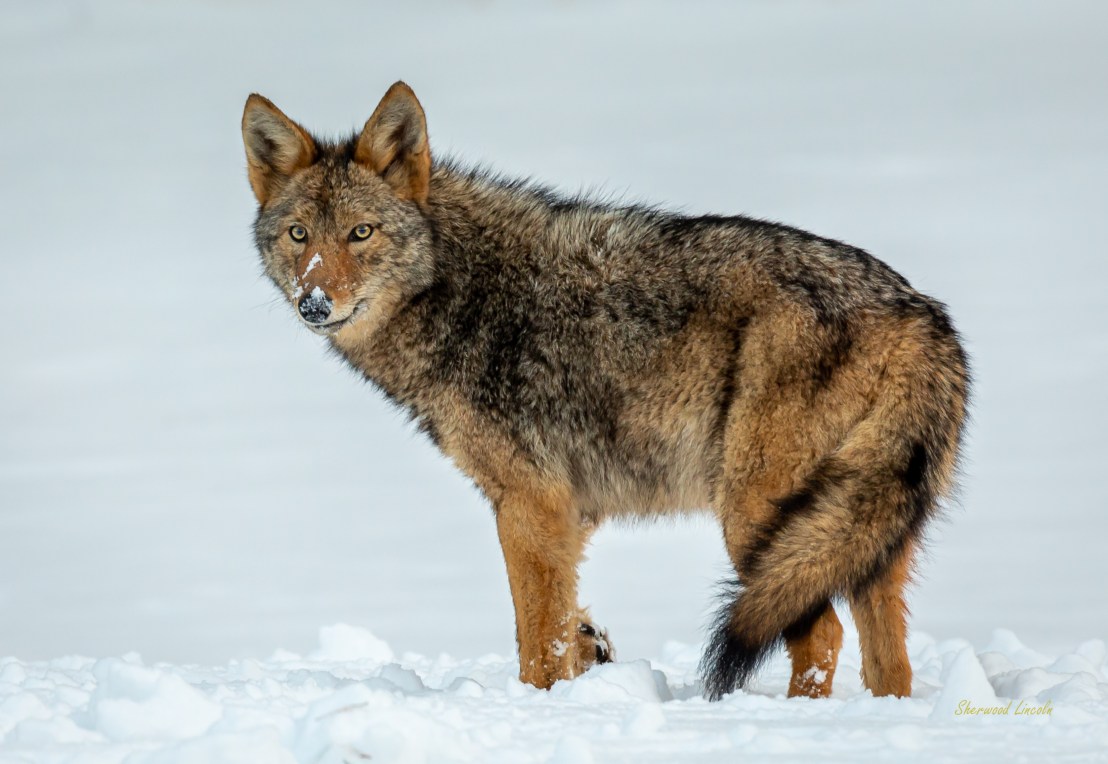
Good boy! Call it what you will; Coydog, Eastern Coyote, or Coymolf. Up close and personal, Taken in East Lyme Ct.
Ecologist and evolutionary biologist Javier Monzón analyzed the DNA of eastern coyotes and found the genes contain all three canids — dog, wolf, and coyote.
According to Monzón’s research, about 64% of the eastern coyote’s genome is coyote (Canis latrans), 13% gray wolf (Canis lupus), 13% Eastern wolf (Canis lycaon), and 10% dog (Canis familiaris).
Later on he added:
All my bird and nature photos are taken in South Eastern Ct. most with a Canon 7D Mark II or 5D Mark IV and Canon 100 to 400II THANK YOU. About 20 yards.
Then followed in response to my request for permission to republish:
Feel free, no problem!
Whatever happens to me in the next year, I truly hope I can continue to share such incredibly photographs with you.
Nature in all her glory!
Tomorrow is Christmas Day and I will be taking a short break, probably back on December 27th.
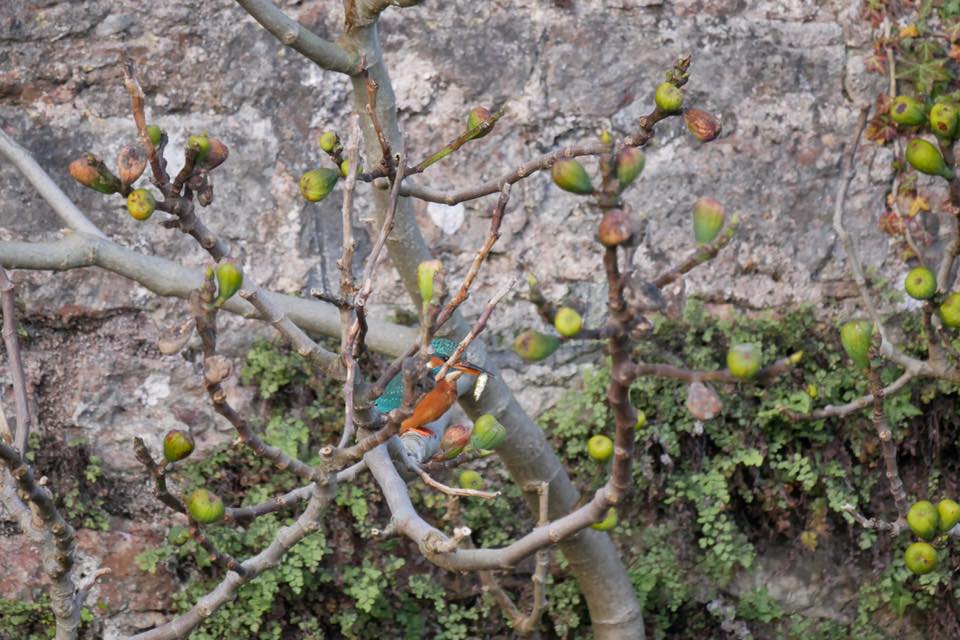
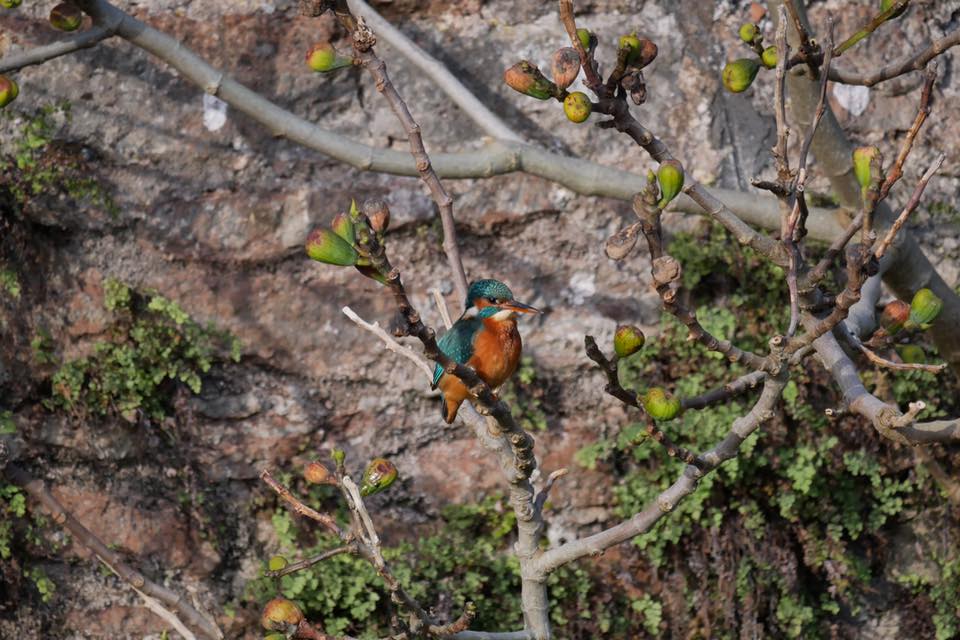
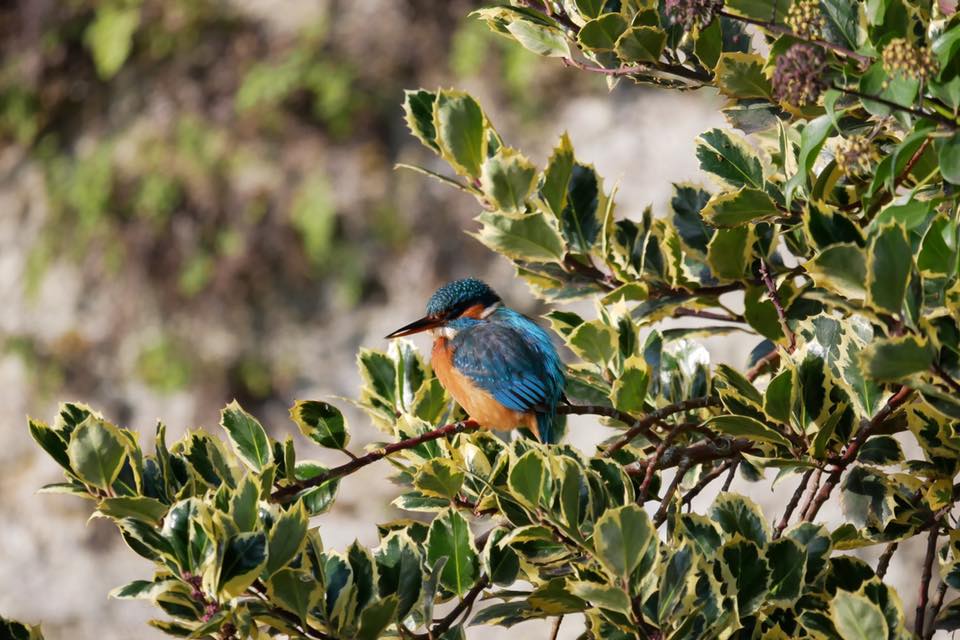
Kingfishers have stout bodies, very short tails, short, rounded wings, large heads and long, dagger-like bills.
Their feet are very small, with the two outer toes partly fused together. They nest in holes tunnelled into earth banks. There is only one UK species, but many more worldwide, most of which are dry-land birds rather than waterside ones like the UK kingfisher.