I subscribe to Ugly Hedgehog, a forum about all things photographic.
It is a mine of information, people share incredible photographs, and much more.
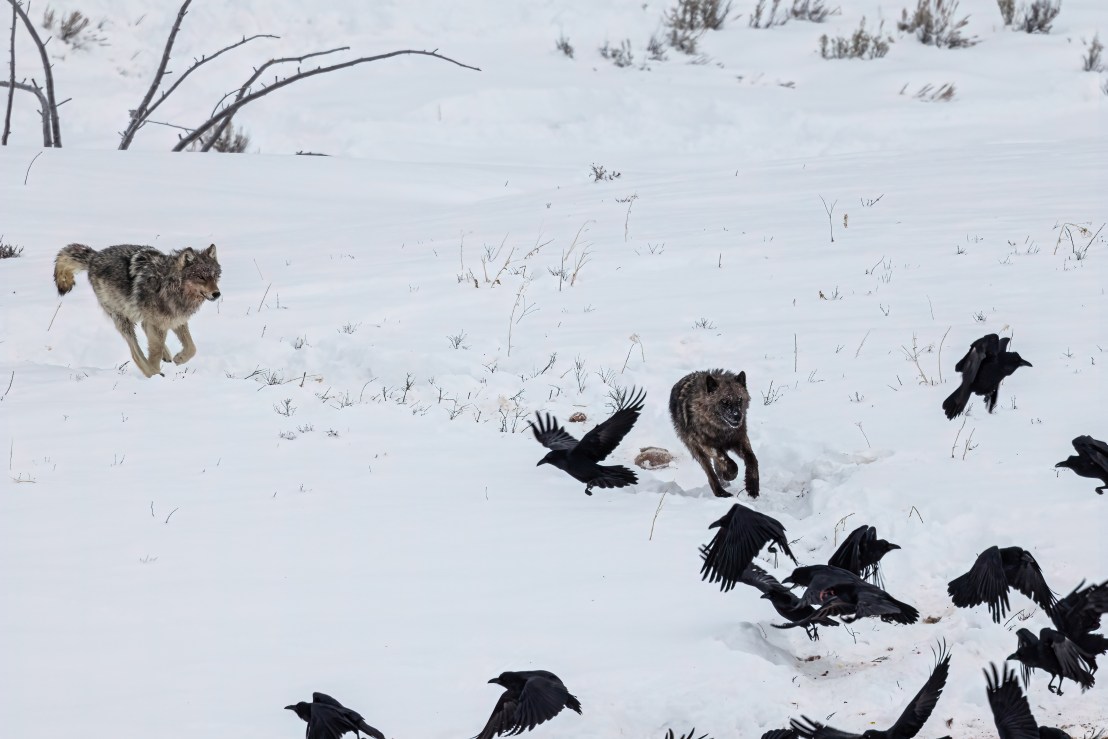
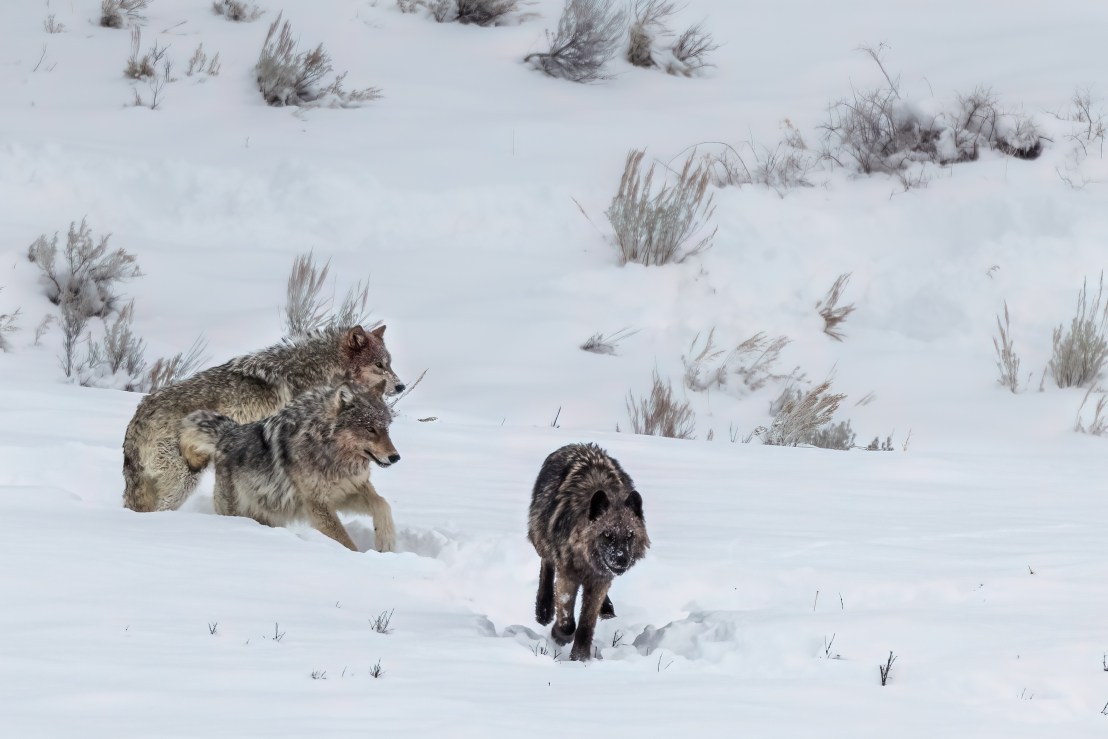
On February 17th this year Photolady2014 published a set of photographs of wolves that were just gorgeous.
This is how she introduced the pictures:
So I am still on cloud 9 seeing wolfs rather close. They were about 150 feet away. Not the quality that the pros were getting who were there. I have seen their photos and well I still have a lot to learn. But, for someone who just started wildlife a couple of years ago, I will take these! If you do the download you will see they are not all bad. I have had to do some sharpening and noise reduction. The pros were all using the 600mm F4 with 2x extenders.
Me: Canon R5, 100-500 & 1.4 extender. All are at 700mm.
I asked if I could share them on Learning from Dogs and said Photolady2014 of South West Colorado said ‘Yes’.
Here they are:
oooo
oooo
oooo
oooo
oooo
oooo
Photolady went on to report:
This is the Wapiti pack in Yellowstone.
We sat in below 0 weather for about 4 hours watching them and the coyotes who were patiently waiting their turn to eat!
Fabulous pictures and one can’t help thinking that some 23,000 years ago there started the long journey of domestication, and the bonding between humans and wolves brought about the dog.
But to be honest the answer is just as interesting for those a tad older than a kid!
ooOOoo
When dogs bark, are they using words to communicate?
By Clive Wynne
Professor of Psychology, Arizona State University
February 8th, 2021
When dogs bark, do they have words? – Sarah W., age 9, Clinton, New York
Does your dog bark a lot? Or is he one of those quiet pooches who barks only when things get really exciting? Most dogs bark at least a little.
Dog barks are not words. But although your dog will never tell you about his parents or the weather or the amazing bone he had yesterday, his barks still communicate important information.
Dog barks are much closer to the noises people make when they accidentally hit their thumb with a hammer – “Ow!” – or open a fantastic present – “Wow!” These sounds convey how someone feels, but not why they feel that way. When other people hear these kinds of sounds, they often come over to see what has happened: How did you hurt yourself? What is this wonderful gift you received?
Dog barking also brings groups together – but it’s not a beautiful sound. It is a much more urgent noise, just like the sounds you make when you are hurt or very pleased. Many smaller animals, like scrub jays, meerkats and California ground squirrels, make such noisy sounds. They do this when they feel frightened by something. In dogs, barking can bring a group together to defend against a danger that can’t be coped with alone.
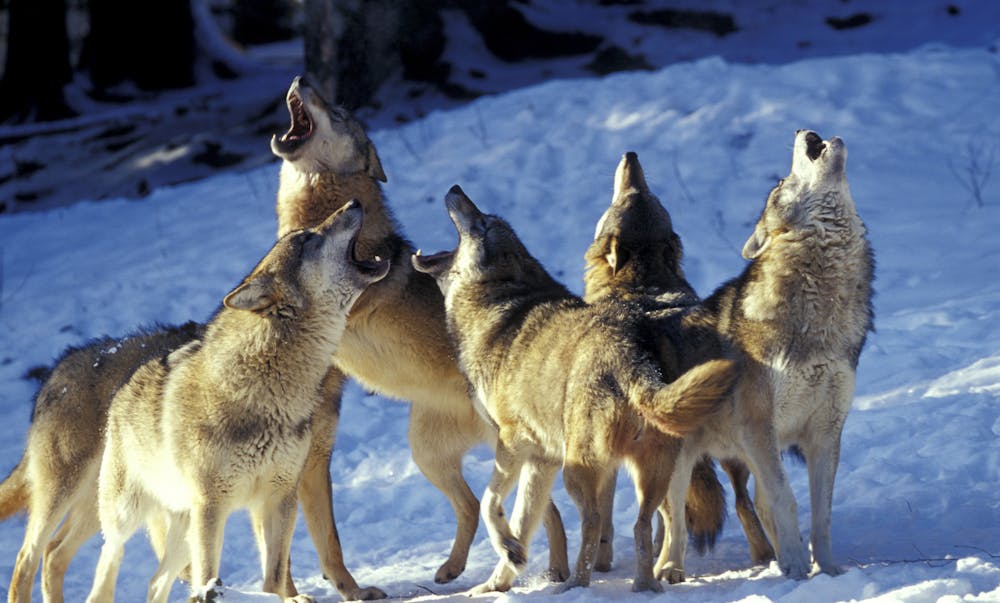
Wolves don’t need to make sounds like this because they are big and fearsome and don’t often feel threatened. Dogs, on the other hand, are much smaller and weaker than their wolf ancestors – and often need to call the group together.
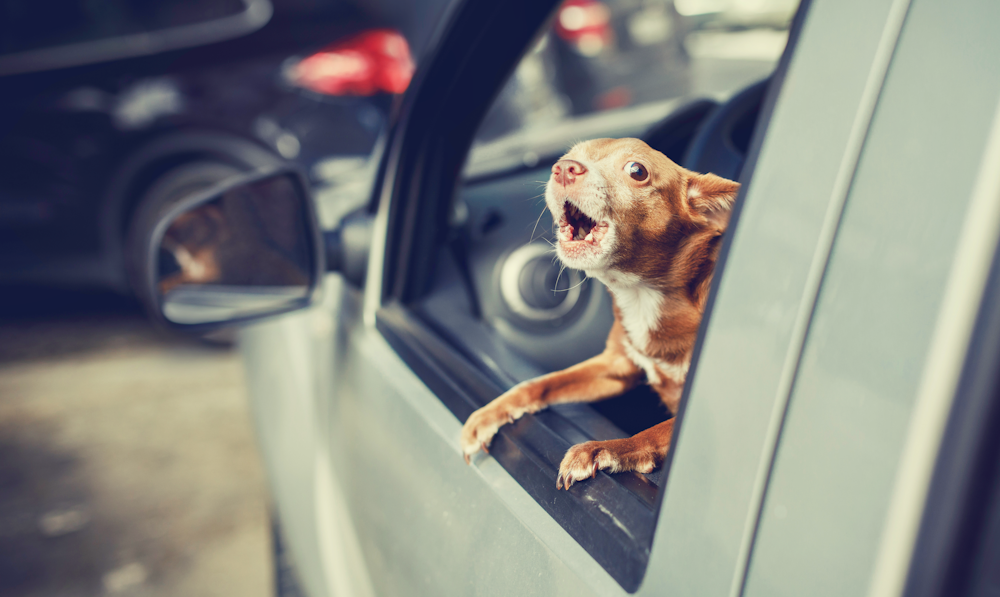
A call for assistance. Seregraff/iStock/Getty Images Plus
This is why dogs bark. They are calling their group to get help with something they are not confident they can handle on their own. This doesn’t mean a barking dog is always frightened. He may just be very excited. He badly needs the family to know that there is a stranger coming to the door, or another dog coming close to the house.
Your dog’s barks may not be words, but he probably barks a little differently depending on what kind of thing has got him excited. If you listen closely, you may find you can tell the difference between a bark directed at a package deliverer and one directed toward a friend at the door. The bark to a passing dog may be different than the bark at a passing car.
Your dog doesn’t understand much of what you say, but he listens hard to try to make sense of human language. If you return the compliment and listen hard to his sounds, you may find you can also understand him better, and the two of you will have a richer life together.
ooOOoo
This touches on something that I saw elsewhere; the business of dogs having emotions (which they really do!).
I will try and find the article and see if I have permission to republish it.
Ancient DNA shows that dogs probably came from Siberia.
There has been much discussion recently that Siberia may have been the site of dog domestication. In that a research team examining the origins of the domestic dog via the genetic past found that all American dogs carried a genetic signature.
This signature, dubbed A2b, in dogs descended from a canine ancestor that lived in Siberia some 23,000 years ago. An article in the January 2021 issue of Science went on to say:
That ancestral dog probably lived with people who belonged to a genetic grouping known as the ancient north Siberians, the team speculates. The group, which appeared more than 31,000 years ago, lived in a relatively temperate part of northeastern Siberia for thousands of years, and they shared this refuge with the gray wolf, the direct ancestor of today’s dogs.
The assumption being that this group of people brought the dogs with them when, about 15,000 years ago, they splintered into four groups as they spread around North America and Europe.
Dingo relative discovered in remote highlands of New Guinea. From abc.net.au
I wish I could say more but all the texts and pictures that I have come across have all been protected by copywrite.
I was thinking yesterday morning that it was about time for me to publish a post.
Tuesday was a busy day with us in the morning going to collect the tractor from Runaway Tractors where it had been in for a service. Then in the afternoon I decided to go for a bike ride, something I try and do every other day. It was grand and I clocked up 18 miles.
The forecast for Wednesday was grim. And we awoke to a morning with much land covered in snow.
Looking to the North-East.
So my item that I wanted to republish from The Smithsonian Magazine seemed apt. It is about the history of dogs.
ooOOoo
How Dogs Migrated to America From Ice Age Siberia 15,000 Years Ago
Northern Siberians and ancestral native Americans may have traded pups at the time
All dogs with the genetic signature A2b descended from the same Siberian canines roughly 23,000 years ago (Jim Peaco; Photo has been cropped for article purposes by ZeWrestler, Public domain, via Wikimedia Commons)
Dogs have been companions to humans for many millennia, but exactly when this relationship started is highly debated among scientists.
A study published this week in the Proceedings of the National Academy of Sciences reveals that canine domestication may have first occurred in Siberia 23,000 years ago when humans and wolves were isolated together during the Last Glacial Maximum. After this initial domestication event, dogs most likely followed humans when they migrated across the Bering Land Bridge from East Asia to the Americas 15,000 years ago, reports Megan Marples for CNN.
“Wolves likely learned that scavenging from humans regularly was an easy free meal, while humans allowed this to happen so long as wolves were not aggressive or threatening,” Angela Perri, an archaeologist at Durham University and lead author of the study tells CNN.
The study was brought to fruition after Perri and her co-authors—David Meltzer, an archeologist at Southern Methodist University, and Gregor Larson, a scientist from Oxford University—were brainstorming how DNA evidence tells the story of migrating humans and dogs, reports James Gorman for the New York Times. After the authors scribbled down ideas on a whiteboard, they saw that both humans and canines had similar migration patterns and divergence that could explain how dogs and humans began their bond, reports the New York Times.
To see if the similarities between the timelines linked up with archeological evidence, Perri and her team analyzed the genome of 200 ancient dogs from around the world. They found that the canines had one genetic signature, A2b, in common. Once they reached the New World 15,000 years ago, they dispersed into four groups, reports David Grimm for Science.
The researchers found this dispersal matched a similar migration pattern of ancestral Native Americans that descended from Northern Siberia about 21,000 years ago. Connecting these timeline events between humans and dogs, the researchers concluded that humans must have brought dogs into the Americas somewhere around 15,000 years ago.
“Dogs are not going to go to the new world without people,” Meltzer tells the New York Times.
Further exploring the dogs’ genetic evidence, the team found all dogs with the genetic signature A2b descended from the same Siberian canines roughly 23,000 years ago, Science reports.
Looking back at human’s ancestral timeline and genetic evidence, the researchers found that ancient Northern Siberians intermingled with ancestral Native Americans before crossing the land bridge into the Americas. These meetings could have resulted in the two groups of people trading pups.
“People are exchanging information, they’re exchanging mates, they’re maybe exchanging their wolf pups,” Meltzer tells the New York Times.
While there is strong evidence that the initial domestication event occurred 23,000 years ago, the study relied only on mitochondrial DNA and could be missing the complete picture of domestication events, explains Pontus Skoglund, an ancient canine DNA expert from Crick Institute in London who was not involved in the study, to the New York Times. Likewise, Peter Savolainen, a geneticist at the Royal Institute of Technology, tells Science that the A2b signature has been found in other places in the world and is not unique to dogs in the Americas as the researchers suggested.
Still, the study reveals how the relationship between humans and dogs may have begun and how it may have dispersed across the globe. Perri and her team plan on looking at older dog fossils to gather more evidence.
“We have long known that the first Americans must have possessed well-honed hunting skills, the geological know-how to find stone and other necessary materials and been ready for new challenges,” Meltzer tells Peter Dockrill for Science Alert. “The dogs that accompanied them as they entered this completely new world may have been as much a part of their cultural repertoire as the stone tools they carried.”
ooOOoo
There is a huge number of dogs throughout the world. The exact figure is impossible to determine. Here’s an extract from WoofDog’s piece on the global population:
Determining the exact number of pups that inhabit our planet is a bit of a challenge. The fact that many of them live on their own, rather than side by side with people, presents the main obstacle to providing accurate figures.
According to 2012 data, there were around 525 million canines in the world. This figure has grown considerably until the present day, so today, it is estimated to be about 900 million pooches.
And from the same website, here is an estimate of the global population of owned dogs:
Statistics related to canine ownership vary across different countries. Nevertheless, the task of calculating the number of canines owned by people around the globe is far less complicated than it is the case with free-range ones.
The reason for this lies in the fact that many countries have introduced legal regulations on mandatory registration of household animals.
My analysis is that the USA is second in the league of owned dogs.
But wherever there are dogs they are a rich and bountiful addition to the ambitions of humans.
Their main job is to guard livestock, but wildlife benefits too.
The puppies will grow up alongside the livestock they will one day protect. WCS Argentina
A new litter of livestock dogs was just delivered by Wildlife Conservation Society (WCS) Argentina. Currently cuddly and very cute, the puppies will be specially trained to protect goats and sheep from predators. Not only will this help save the livestock, but these dogs will help limit conflicts between herders and the pumas and other native carnivores living around them in the Patagonian Desert.
The puppies are a mix of Great Pyrenees and Anatolian shepherd — large, working breeds trained to guard livestock. In the early weeks of the project, the puppies bond with the livestock to form protective relationships. WCS representatives work closely with herders to provide care and training for the puppies and the livestock during what’s known as this key “imprinting” period.
“During the first eight weeks of life, puppies will create a very strong bond, first with their mother and then with their social group. During the first 40 days, puppies remain with their mother, but livestock is kept in the same pen or corral with the dogs so they can smell them, see them, and progressively make physical contact with livestock,” Martín Funes, project manager of WCS Argentina, tells Treehugger.
“Progressively, during three months the bond between puppies and livestock will get stronger, and dogs will start to show a protective behavior. After this period they will recognize a certain species (we work with sheep and goats) as their social group, and that will remain for the rest of its life.”
For many years, WCS Argentina has been working with area herders to come up with new ways to stop conflicts with area predators. In the past, herders have resorted to shooting, poisoning, or trapping wildlife that have threatened their flocks.
WCS Argentina places the puppies with herders based on their location, the amount of conflict they’re having with carnivores, and their willingness to participate in the program, which includes proper care of the dogs through adulthood.
The dogs become a very powerful tool, says Funes.
“Livestock guarding dogs (LGD) stay with livestock 24/7, which is impossible for the other methods [of predator control]. They behave as part of the flock, and they will protect it against any threat,” he says.
“They tend to be very protective but they don’t have the hunting instinct of wolves or some other dog breeds (i.e., greyhounds or lebrels). However we should always consider a basic principle for reducing livestock losses by carnivores: The more methods you use, the safer your livestock will be. Combining different strategies is always an efficient approach to reduce attacks by carnivores.”
The dogs are raised alongside the sheep and goats. WCS Argentina
In the Patagonian Desert, also known as the Patagonia Steppe, livestock face threats from several wild cats including pumas, Geoffroy’s cat, pampas cat, and the threatened Andean cats. Other predators include Patagonian foxes and Andean condors.
“Even though we have been hunting, trapping, and killing carnivores, it has never been effective in reducing our losses,” said Flavio Castillo, a herder participating in the program, in a statement. “It is our hope that [the dogs] will be a very useful tool to stop predation. With the dogs, we can co-exist with carnivores and protect our production. Wildlife belongs here and we have to protect and co-exist with it.”
In addition to saving the lives of the flocks and their predators, the presence of the guardian dogs also can have a positive impact on habitat restoration.
“As attacks from carnivores diminish, producers tend to stop trapping, hunting and poisoning of wild animals, which is an outstanding benefit for the entire ecosystem,” says Funes.
“A secondary benefit, as producers perceive a reduction in annual livestock losses, is that herders might adjust livestock stocking rates density and improve soil and vegetation conditions and its performance, reducing overgrazing and desertification, a major and widespread environmental problem in arid Patagonia for the last two centuries.”
ooOOoo
This is a powerful story of the many ways that dogs may be used to help humans.
Dogs are by far the longest domesticated animal that has bonded to humans and I’m trying to receive permission to republish a wonderful article that John Zande sent me to read. It is about the Neanderthals and homo sapiens and the relationship with dogs.
I was speaking two days ago to my friend Dan of many, many years, and also my best man when Jeannie and I were married in 2010, and we were talking of our dogs. In the conversation Dan said this:
You know that Lexi and I are always together for practically twenty-four hours a day!
Dan went on to say that Lexi followed him everywhere and that, literally, they were together for ninety-nine percent of their time.
I asked Dan to send me a photograph of the two of them. Here it is!
Beautiful beyond words.
(And call by tomorrow for some special words about close friends.)
An essay about the 2020 winter solstice!
Winter solstice 2020 in the Northern Hemisphere will be at 2:02 AM on Monday, December 21. That is our local Pacific Time which is 8 hours behind UTC.
So in UTC terms that is 10:02.
For some reason I have always regarded the Winter solstice as special, no doubt because in the Northern Hemisphere it is the time for the shortest day! It is the start of the new year!
What you need to know about this year’s winter solstice and the great conjunction
December 18, 2020
By William TeetsActing Director and Astronomer, Dyer Observatory, Vanderbilt University
Editor’s note: Dr. William Teets is the director of Vanderbilt University’s Dyer Observatory. In this interview, he explains what does and doesn’t happen during the winter solstice on Dec. 21. Another cosmic phenomenon is also going to occur on the same day called “the great conjunction,” where Saturn and Jupiter, both of which can be seen with the naked eye, will appear extremely close to one another.
What happens on the winter solstice?
The winter solstice this year happens on Dec. 21. This is when the Sun appears the lowest in the Northern Hemisphere sky and is at its farthest southern point over Earth – directly over the Tropic of Capricorn. For folks living at 23.5 degrees south latitude, not only does this day mark their summer solstice, but they also see the Sun directly over them at local noon. After that, the Sun will start to creep back north again.
The sequence of images below shows the path of the Sun through the sky at different times of the year. You can see how the Sun is highest in the Northern Hemisphere sky in June, lowest in December, and halfway in between these positions in March and September during the equinoxes.
The winter solstice is the shortest day in the Northern Hemisphere but not the day with the latest sunrise and earliest sunset. How is that possible?
The winter solstice doesn’t coincide with the latest sunrise or the earliest sunset. Those actually occur about two weeks before and two weeks after the winter solstice. This is because we are changing our distance from the sun due to our elliptical, not circular, orbit, which changes the speed at which we orbit.
If you were to look at where the Sun is at exactly the same time of day over different days of the year, you would see that it’s not always in the same spot. Yes, the Sun is higher in the summer and lower in the winter, but it also moves from side to side of the average noontime position, which also plays a role in when the Sun rises and sets.
One should also keep in mind that the seasons are due to the Earth’s axial tilt, not our distance from the Sun. Believe it or not, we are closest to the Sun in January.
What is ‘the great conjunction’?
Saturn and Jupiter have appeared fairly close together in our sky throughout the year. But on Dec. 21, Saturn and Jupiter will appear so close together that some folks may have a difficult time seeing them as two objects.
If you have a pair of binoculars, you’ll easily be able to spot both planets. In even a small telescope, you’d see both planets at the same time in the same field of view, which is really unheard of. That’s what makes this conjunction so rare. Jupiter and Saturn appear to meet up about every 20 years. Most of the time, however, they’re not nearly as close together as we’re going to see them on Monday, Dec. 21.
For a comparison, there was a great conjunction back in 2000, but the two planets were separated by about two full-Moon widths. This year, the orbits will bring them to where they appear to be about one-fifth of a full-Moon diameter.
We have been encouraging folks to go out and look at these planets using just their eyes between now and Dec. 21. You’ll actually be able to see how much they appear to move over the course of a single day.
The next time they will get this close together in our sky won’t be for another 60 years, so this is going to be a once-in-a-lifetime event for many people. In fact, the last time they got this close together was in the year 1623, but it was really difficult, if not impossible, to see them then because they appeared much closer to the Sun and set soon after it. Go back another 400 years to 1226 and this would have been the last time that we would have had a good view of this type of conjunction.
What advice would you give to people who want to see the great conjunction?
If weather permits at Dyer Observatory, we’ll be streaming a live view of the conjunction from one of the observatory’s telescopes, and I’ll be available to answer questions. Even if you don’t have a telescope or a pair of binoculars, definitely go out and check out this very rare alignment with your own eyes. Remember that they set soon after sunset, so be ready to view right at dusk!
ooOOoo
From the introduction that was received by email:
I want to include another piece on the conjunction. It comes from the introduction to that item above: It’s been a tough year. To many of us, every day during the coronavirus pandemic has felt incredibly long. Perhaps it will come as a relief that Monday will be the shortest day of the year. December 21 will also bring a rare cosmic phenomenon. If the sky is clear over the next few nights, look out just over the southwest horizon. You may see Jupiter and Saturn coming together and then drifting apart in an event known as “the great conjunction.” Although this occurs once every two decades, the last time they came this close, and we Earthlings got such a clear view, was in 1226.
I also want to include a copy of an article on the website belonging to KRCC that talks of the Great Conjunction.
Why The Jupiter And Saturn Conjunction During The 2020 Winter Solstice Is Extra Special
The conjunction of Jupiter and Saturn appears over Cheyenne Mountain in Colorado Springs. Jupiter appears brighter and to the lower right of Saturn. Saturn, to Jupiter’s upper left, has a slightly golden hue. Photo taken December 5, 2020. The planets will be closer than they have been observed from earth in over 800 years on the Winter Solstice
A rare celestial event will help mark the Winter Solstice in the northern hemisphere on Monday, Dec. 21.
Jupiter and Saturn are currently appearing very close together from an earthly vantage point. These two gas giants are in conjunction, an occurrence that happens every 20 years or so.
This one though, is extra special.
“Really, really close conjunctions like this one are quite rare,” said Hal Bidlack with the Colorado Springs Astronomical Society. “We haven’t been able to observe Jupiter and Saturn this close since the year 1226. And we won’t see them again this close for decades and decades to come.”
The two planets were last about this close together in the year 1623. But the pairing occurred while the planets were close to the sun from earth’s perspective, Bidlack said, and the sight was basically washed out in the sun’s glare.
In reality, Saturn and Jupiter are hundreds of millions of miles apart.
“On the 21st they will appear so close that if you held a dime on edge at arm’s length, that’s how close they would be together,” Bidlack said.
From Colorado Springs, sky gazers only need to look toward Cheyenne Mountain to catch a glimpse. Elsewhere in Colorado, Bidlack said folks can look to the southwestern skies, low near the horizon.
The pair sets around an hour and a half after the sun does, about 4:39 p.m. on Monday.
The planets will begin to separate when viewed from Earth, and will eventually disappear altogether from the night sky until reappearing in the morning sky in early 2021. See more skywatching tips from NASA.
If you have managed to stay on today’s post until near the end you would have seen the following: “We haven’t been able to observe Jupiter and Saturn this close since the year 1226. And we won’t see them again this close for decades and decades to come.”
Just about 800 years ago since this last happened.
If you can, go outside with a telescope or a pair of binoculars and watch the sight! That time of the sunset is 4:39 PM Pacific Time. I think that wherever you are in the world starting to watch as soon as it is dark would be a good idea.
Yesterday’s post about the loyalty of dogs brought to mind a post that I published way back in 2013. Let me take an extract from yesterday’s post:
It’s no secret that domesticated dogs are descendants of wolves. Even today, modern dogs continue to share similar genes to wolves that live in the wild. The idea of “the loyal dog” is both a cultural and biological construct, as humans have created the dog over years of selective breeding and domestication to be this way. Essentially, humans picked and chose the wolf characteristics that would best serve their own benefit, transforming a wolf’s hierarchical structure and social bond to their packs into obedience and loyalty to humans.
The fact that is key is that dog packs are hierarchical. They have three status roles and the rest of the pack are all pack members. The three roles are Alpha dog, always a female, the Beta dog, always a male, and the Omega dog that could be either male or female.
The role of the alpha dog is to have first pick of the eligible males and to move the whole pack if in her analysis the territory becomes unsuitable for the pack. The role of the beta dog is to keep the pack under control and not to let fights get out of hand. The omega dog is to keep the pack happy and playful.
So to the post that was first published on the 10th April, 2013.
ooOOoo
Yearnings for a new start!
You may wonder about the title of this post? Stay with me for a moment.
As has been written before on Learning from Dogs, when dogs were living in the wild just three animals had pack roles. The leader of the pack, always a female animal, was the alpha dog. Second in command was the beta dog, always a dominant male, and the third role was the omega or clown dog. The wild dog pack was thought to have consisted, typically, of about 50 animals.
The wisdom of thousands of years showing clearly in Pharaoh’s eyes, our very own beta dog. Beloved Pharaoh. Born: June 3rd., 2003 – Died: June 19th., 2017. A very special dog that will never be forgotten.
As leader of her pack an alpha dog had two primary functions . One was having first choice as to the male dog she was going to mate with – thus demonstrating how women always choose! 😉
Her second important duty was deciding that her pack’s home range was insufficient for the needs of her ‘family’. As wolves still do, wild dogs lived within small, well-defined territories when food was abundant. When food became less abundant then it was time to move to more fertile grounds. As an aside, research in South Africa as to the area requirements for a small pack of African wild dogs (Lycaon pictus) shows they require from 65 square kilometers (25 square miles) to 150 sq. km. (58 sq. mi.). (See footnote.)
Dogs, like all wild animals, instinctively live in harmony with nature. So the call from the alpha dog to find a new range didn’t mean they left their old one as a barren disaster area. You can see where this is heading!
Wild dogs were in contact with early man at least 50,000 years ago. (Just reflect for a moment on the length of that relationship between man and dog.) So each specie has had plenty of time to learn from the other.
Thus, as mankind is on the verge of discovering that our existing ‘territory’ is becoming unsustainable for the healthy life of the species, one fundamental learning point from dogs appears to have escaped us: Mankind doesn’t have a new range available to our species.
This preamble came to mind when I recently read a short but powerful essay on Alex Jones’ blog The Liberated Way. The essay was called A global leaky bucket. Alex has very kindly given me permission to republish it.
A global leaky bucket
Global weather extremes will force people to hard choices.
Nature will have the last word in the debate over sustainability.
I write this in despair, it is snowing again here in Colchester UK. I admit envy for those of you who live in California or Hong Kong area, I see your photographs where the seasons always seem to be warm and sunny. The northern Jet Stream refuses to move, Greenland enjoys growing strawberries as the lambs die in the fields of Britain from the winter that refuses to let go.
The extremes of weather are noted in the South of the world as well as the North. Argentina has had the worst floods in decades last week. The cause is that the systems such as the Jet Stream are paralysed in one place, thus everyone suffers flood, drought or winter in excess. Nobody is sure why this paralysis is going on with systems like the Jet Stream, some say it is climate change, the point is that we are experiencing this, and it appears to be more than a temporary issue.
My opinion is that these weather extremes are here to stay for the long duration. One is then left with a harsh reality of does one seek to control the weather or adapt to the weather? How does one control the weather, a chaotic energy system where even a small change can have great consequences? Perhaps adaptation is the better option, but does one know how huge those adaptations will have to be where drought and flood could be lasting decades?
Lets say food, water and energy are all contained in a bucket. We take a jug and scoop out from the bucket what we need. There is a tap that is constantly running filling the bucket with the food, water and energy. We waste those resources so the bucket leaks. We disrupt or destroy the renewal systems in the ecosystems so the tap is no longer running as fast as it should. We are greedy consumers so we take more than we need from the bucket with our jug. How will the bucket look now? Is this a sustainable future to you?
If our global weather extremes continue as they are it will be like a storm rocking the bucket spilling its contents, will our bucket future look even less sustainable? Extreme weather destroys harvests, kills animals, sends already distressed ecosystems into the abyss. What happens when the bucket is so empty that people can no longer enjoy their lifestyle of wasteful excess, or worse that people grow cold, hungry and thirsty? Do they sit there and do nothing but die? Will they fight? Who will fight who? As the bucket contents get ever smaller, who will win in the fighting for what is left?
Copyright (c) Alex Jones 2011-2013.
Colchester has a place in my past as I started and ran a business there between the years of 1978 to 1986. More about that some other day.
Back to Alex’s essay. It strongly resonated with a recent item on Peter Sinclair’s excellent blog Climate Denial Crock of the Week which I will refer to tomorrow.
So I will leave you with this tragic, emotional thought – where, oh where, is our alpha dog?
Footnote: The figures for the ranges of wild dogs were taken from a fascinating paper published by Lindsay, du Toit and Mills that may be read here.
ooOOoo
One thing that has become clearer over the years and with the advent of DNA analysis is that the process of wolf and man coming together, and wolf becoming dog, was in the timeframe of 25,000 to 40,000 years ago. It’s a very wide band of time but there’s no scientific method, certainly at the moment, to refine the years down to a shorter number.
But even taking the lower limit, 25,000 years ago, it is still an indescribably long time back in the past.
Despite the gloom and real stress for many people it’s not wall-to-wall pessimism.
The reason I was prompted to write about this was a couple of connections made in the last few days and the power they have to keep this elderly chap still bouncing along.
Recently on the forum Ugly Hedgehog there was a gentleman who posted some photographs of some dogs that he had seen at the dog park. It was in a post called Today at the dog park.
They were lovely and I thought what a good idea it would be if I was able to republish them for next week’s Picture Parade. So I asked!
Well I was not disappointed and indeed said gentleman emailed me with a short bio and a photograph of him and his dog by way of an introduction. This is what he wrote:
I was born on Long Island and spent the first 60 years of my life there except for my Naval service for four years during the Vietnam war. I was a Naval Aviator, and after my active duty was over I returned to Long Island and got into a career in law enforcement that lasted 31 years. I made thousands of arrests during my career and many of those who were incarcerated threatened to “get me” some day, so I would prefer that you don’t use my real name.
When I retired at age 60 I moved to Tampa, FL because my daughter lived there and I have two granddaughters and now my son lives here too. It’s great for photographing flora and fauna all year round. My love for dogs has worn off on my kids as my daughter has two of them and my son three! Photography has been a hobby of mine for over 60 years. Here is a casual photo of me and my buddy Ollie (a three year old golden doodle).
Ollie and Nimbushopper
You will have to wait until Sunday to view his photographs!
At the end of November Jean and I wanted to join the local camera club. It was clear that I had a camera, a Nikon D750, that was way more advanced than I thought and, frankly, I didn’t know my way around it.
So we joined the Caveman Camera Club in Grants Pass, Oregon. Although at the moment the pandemic puts a halt on physical meetings, twice a month ‘zoom’ meetings are held. Also mentors were available. I took advantage of the opportunity to work under a mentor and last week I went the short distance of nine miles to meet with Gene. Gene had so much knowledge and had regularly taught photography for a number of years. I came away very inspired and very motivated to become better in my photographic and composure skills. Gene’s area of interest is landscapes.
What was clear was that for my whole life, and I have been taking photographs for a very long time, I had been taking pictures and not composing photographs.
It’s going to be a long journey but one that fills me with delight
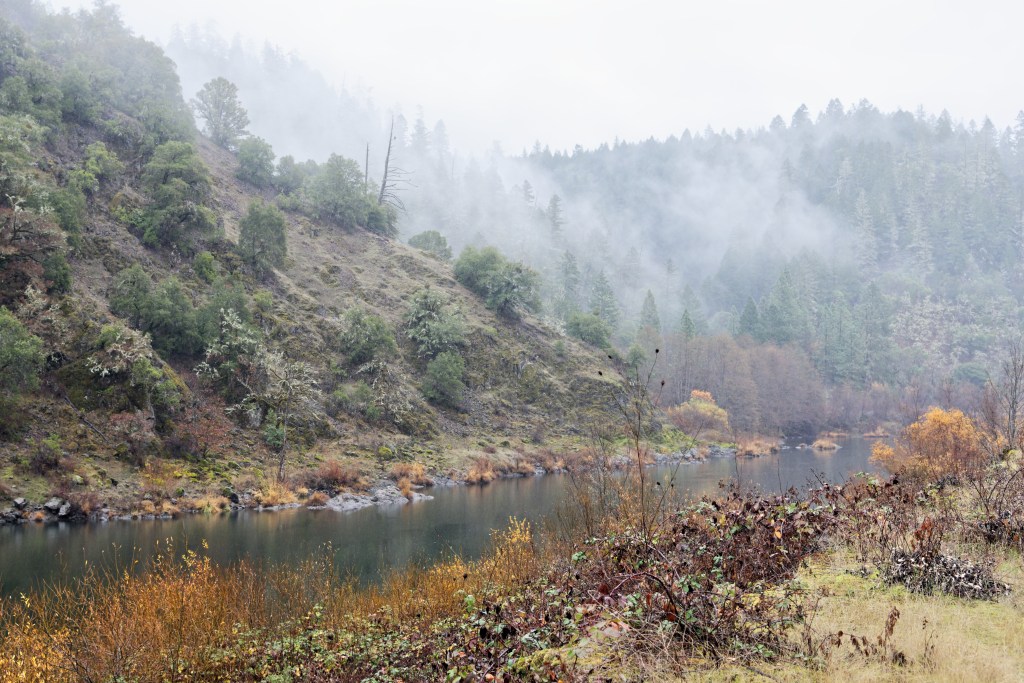
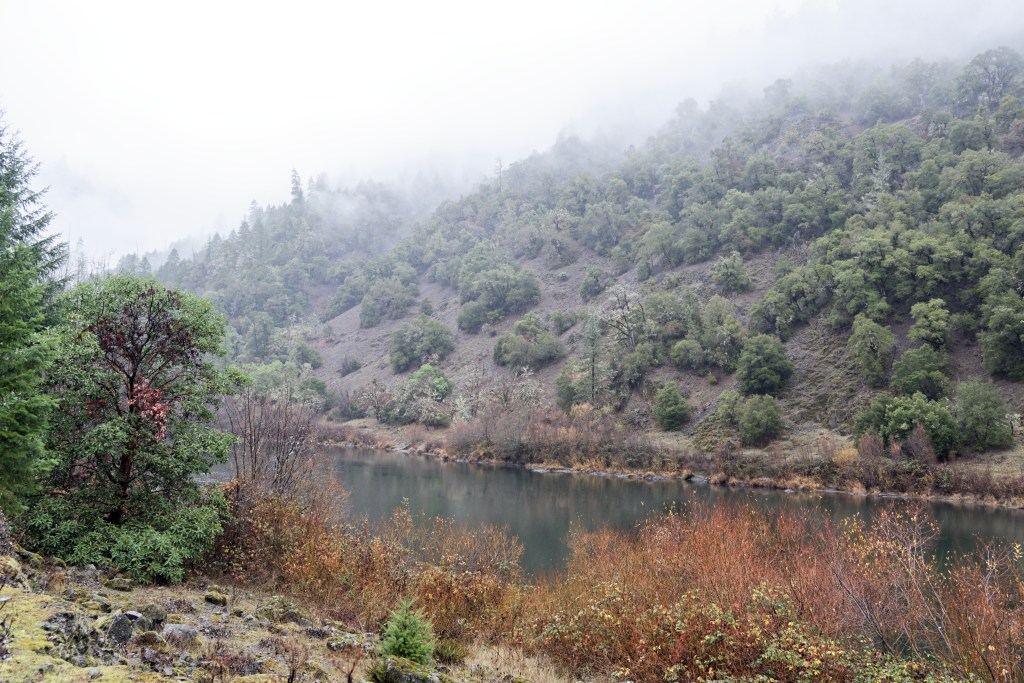
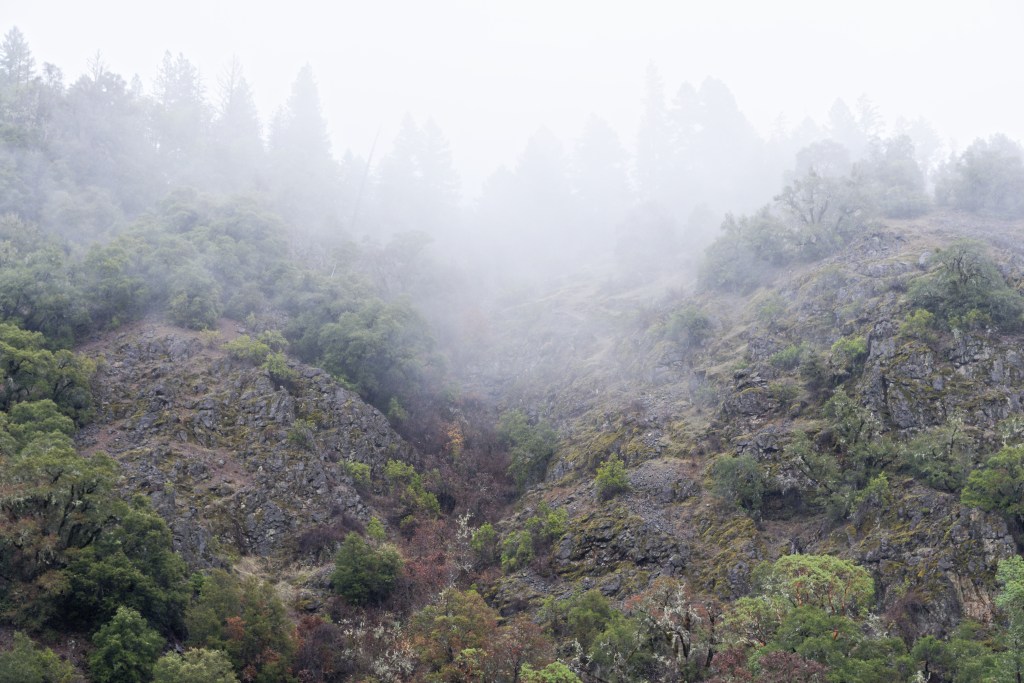
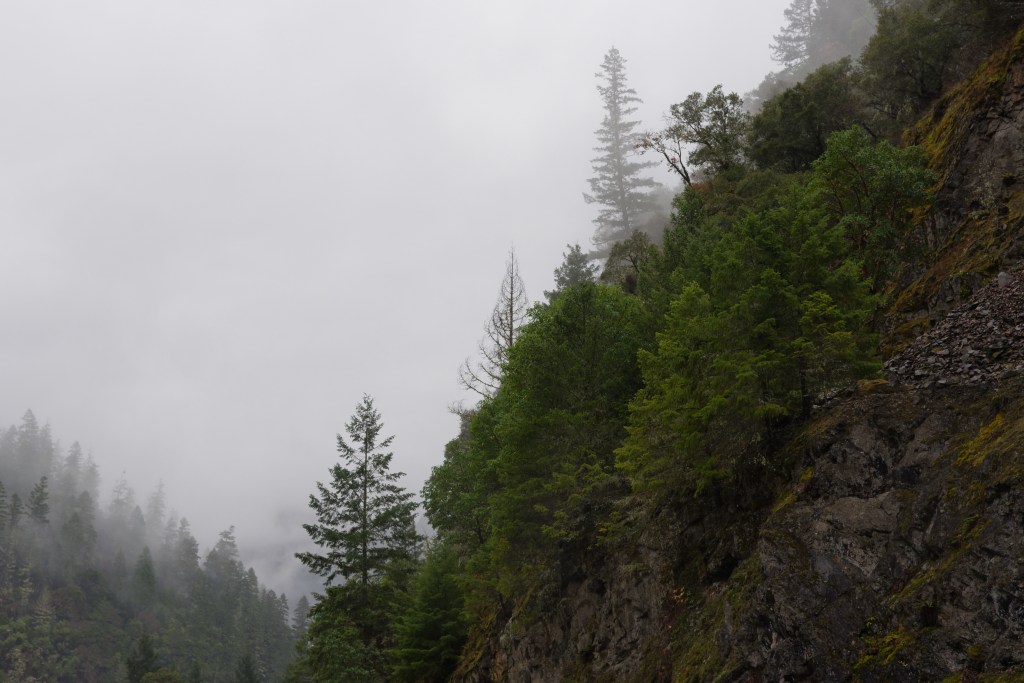
Here are some of my very first attempts, taken yesterday along the Rogue River in the rain and mist.
The Rogue River looking downstream.
oooo
The Rogue River looking upstream from the same point.
oooo
Looking towards the top of the opposite bank.
oooo
Trees in the mist.
Well it’s a start!
But I just wanted to reiterate that staying local both literally and virtually is very rewarding.
It really is delightful when someone comes along and reliably offers to submit a guest post or two, or three, or more. That person is John Brooks and he has submitted many posts; the last one being Ageing Gracefully Applies To Our Dogs As Well. It may be found here.
But before going on I would just like to say thank you to the very helpful comments about Pedi and his diabetes.
So without any further ado here is John’s latest:
ooOOoo
Pigs, Dogs, and Other Pets: Do They Get Along?
By John Brooks, December 3rd, 2020
Pigs are extremely intelligent animals, and this intelligence makes them great, loving and attentive pets. Most people opt for American miniature pigs as pets. This breed is a descendant of potbelly pigs and other small feral pig breeds. Breeders have specifically created miniature pigs to be smaller and lighter than full-sized pigs, so they can trot around the house like a dog or cat would. Most American miniature pigs will weigh between 50-75 pounds and stand 12-15-inches tall.
Ultimately however, it does not matter whether you have a full-sized or miniature pig, their ability to interact with other animals remains the same. Bringing a pig into a situation with other pets or bringing home a new pet when you already have a pet pig can be a stressful time. Pigs are prey animals. They typically react to new situations with fear.
But, you can cut down on your pet pig stress by choosing the right companion animal for them. Pigs can get along with other pets, you just need to make the introduction and relationship as safe and healthy as possible. Here we explain how to do just that.
Pigs and Dogs
Pigs and dogs living together in harmony is a big concern for most pet owners. There are plenty of photos online of pigs and dogs as best friends. But, do not count on your pig and dog getting along. Pigs are prey animals and dogs are predators. It is very easy for instinct to take over for both animals, especially if you are not there to supervise the interaction.
In addition to their instinctual behaviors, pigs and dogs have different social cues. Both are playful and intelligent animals, but their body language will be completely different. Your pig may annoy your dog and vice versa because they are unable to understand that the other animal needs a break.
These complications do not mean a pig and dog can get along. You just have to take precautions. If you do have a dog and pig together in the same household, it is essential that you supervise all of their interactions. Ultimately, if you are going to let your piggy roam free, your dog will need to be in a crate while you do so, or in another room or outside.
Pigs and Other Pets
As far as other pets are concerned, pigs will do well with almost any other prey animal. If you are searching for a friend for your piggy, here are the most common pig and pet relationships, and tips for making these relationships work:
Cats
In general, pigs and cats do well together. Despite cats being predators, the website All About Cats state that pigs have similar personality traits to cats. Additionally, cats are much less likely to hurt a pig than a dog. Even miniature pigs weigh from 50-100 pounds. It will be very hard for a common housecat to injure this size animal.
As with all animals, you will need to ensure the personalities of your cat and pig work well together. A lazy cat and playful pig will not be a good combination. However, a cat and pig with complementary personalities will likely get along just fine.
Farm Animals
Personality will come into play when introducing pigs to other farm animals. Animals that tend to buck or head-butt can hurt a pig. Similarly, pigs can bite if they feel threatened. Always test out a farm animal with a pig under supervision before putting them in a pasture together.
Farm animals that work well with pigs include sheep, goats, cows, donkeys, horses, and llamas. Obviously, you will need a lot of property to house any of these animals. Pigs work well in the same pasture as other farm animals, but it is better to give them their own living quarters in a barn or lean-to.
Conclusion
Pigs can be an amazing pet. They are trainable and affectionate. You can even teach them to walk on a harness. But, you will need to take some care in finding them a friend. Pigs can become close to many different species of animals. Some just work better than others.
Keep the personality of your pig in mind when looking for a companion. You will also want to keep early interactions short. Finally, supervision is key when it comes to successful relationships between your pig, dog, and other pets.
ooOOoo
Another brilliant essay.
Thank you to John and I write on my own behalf and, I am certain, on behalf of many, many other people.






 Acting Director and Astronomer, Dyer Observatory, Vanderbilt University





 Learning from Dogs