The terrible shooting here in Oregon back on the 1st October doesn’t need to be reminded of. Or does it?
For there was a beautiful story that came out of that terrible event that I want to share with you, some three weeks after that tragic day. The story was sent to me by Dan Gomez and appeared on AKC News.
ooOOoo
OREGON SHOOTING VICTIM’S SERVICE DOG STAYED BY HER SIDE UNTIL THE VERY END
By: Mara Bovsun
Sarena Moore’s dream was to someday open a ranch where she would train horses as therapy animals for handicapped children.
She was pursuing that dream as a business student at Oregon’s Umpqua Community College on October 1, when Christopher Harper-Mercer, 26, burst into her classroom and started shooting, killing nine. Moore, 44, was among them.
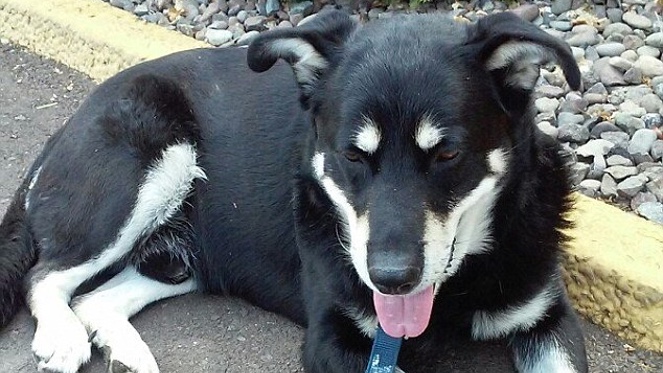
She was in her wheelchair, which she needed for debilitating back pain, and her service dog, Bullet, was by her side, when Harper-Mercer burst into their classroom. He ordered the teacher and students to get on the floor. When Moore complied, eyewitness Tracy Heu told the New York Times, the gunman told her to climb back into the chair. She then became his first victim.
Travis Dow, Moore’s fiancé, learned that Moore was among the dead in the massacre, and assumed the dog was gone, too. The next day, he learned that the killer had spared Bullet when police came to his door with the bewildered dog on a leash.
Bullet stayed by Moore’s side through the ordeal, witnesses said, as he had been trained to do.
“He knows she ain’t coming home because he was there when the fatal day happened,” Dow told CNN. Bullet had lived with the couple for seven months and she had trained him to be her helper.
In a statement released by her family, Moore was remembered as a lifelong animal lover. During her teens, she practiced gymnastics on horseback. At the same time, she also raised money to help disabled people learn to ride. “She had a caring heart that was bigger than life itself,” the family wrote. Her Facebook page was filled with images of animals, most recently there were many pictures of her new service dog.
Now, as Dow and Bullet face the world without the kind woman with the bright smile, they’ll lean on one another for strength. “[Bullet] was her world. He was not only her dog, [but] her best friend, beside me” Dow told CNN.
In the wake of the tragedy, other canine comforters traveled to Roseburg, Oregon, to help the community cope. Here’s their story.
ooOOoo
I can do no better than to close today’s post with a photograph of Bullet.
The vastness of the seas and the immensity of their influence over all of us.
This is an introduction, a rather long one I’m warning, to a republication of a recent post by Patrice Ayme. An introduction that offers a deeply personal memory of the Atlantic ocean.
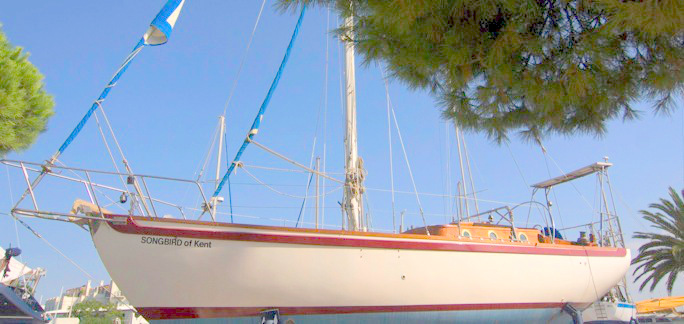
Many years ago, I spent 5 years living on a boat; a wonderful heavy-displacement ocean-going yacht of a type known as a Tradewind 33.
My home for five years – Tradewind 33: Songbird of Kent.
There is a place in my mind to which I can so easily travel; a memory of a dark night out in the Atlantic ocean one time in the Autumn of 1969. But first let me set the scene from almost fifty years ago.
The call of the open ocean
Those first few hours were utterly absorbing as I went through the whole business of clearing the yacht harbour at Gibraltar and heading out to the South-West hugging this unfamiliar coastline of Southern Spain. It was tempting to move out to deeper waters but the almost constant flow of large ships through the Straights of Gibraltar soon quashed that idea. Thankfully, the coastal winds were favourable for me and my single-masted sailing yacht.
After such a long time sailing in the relatively confined waters of the Mediterranean, it was difficult for me to imagine that in a few hours time the southern-most point of Spain would pass me by and the vastness of the Atlantic ocean would be my home for the next few weeks.
Soon the city of Tarifa was past my starboard beam and the Spanish coastline was rapidly disappearing away to the North-West. The horizon ahead of me was already approaching 180 degrees of raw, open ocean. There was just a flicker of a thought that whispered across my mind: “Oh Paul, what have you gone and done” as slowly but persistently the coastlines of Spain to the North and of Africa to the South became more and more distant and fuzzy. It was at 15:30 that I made an entry in my yacht’s log: “No land in sight in any direction!”
Now was the time to make sure that my bunk was made up, flashlights to hand, and my alarm clock ready and set. Alarm clock? Set to go off every twenty minutes during the night! For this was the only way to protect me and my yacht from being hit by one of those gigantic container ships that seemed to be everywhere. It took at least twenty minutes from the moment a ship’s steaming lights appeared above the horizon to crossing one’s path!
It was in the early hours of my first morning alone at sea, when once again the alarm clock had woken me and I was looking around an ocean without a single ship’s light to be seen that more of Les’ words (see footnote) came to me. I remembered asking Les: “What’s the appeal of sailing?” Les replied without a moment’s hesitation: “It’s the solitude. When you’re out at sea on your own, there’s no government or bankers to worry about. You’re not responsible to anyone but yourself.”
Yes, I could sense the solitude that was all around me but it was an intellectual sense not an emotional one. That would come later. Inside, I was still afraid of what I had let myself in for.
Remarkably quickly however, the pattern of solo life aboard a thirty-three-foot yacht became my world. Frankly, it staggered me as to how busy were my days. Feeding myself, navigating, trying to forecast the winds, staying in touch with other yachties via the short-wave radio, keeping the boat tidy and a zillion other tasks meant the first few days and nights just slipped by.
But it was a sight on my fourth night at sea that created the memory that would turn out to remain with me for all my life. The memory that I can go to anytime in my mind.
That fourth night I was already well into the routine of waking to the alarm clock, clipping on my harness as I climbed up the three steps that took me from my cabin into the cockpit, scanning the horizon with my eyes, checking that the self-steering had the boat at the correct angle to the wind and then, if no ships’ lights had been seen, slipping back down into my bunk and sleeping for another twenty minutes. Remarkably, I was not suffering from any long-term tiredness during the day.
It was a little after 3am that fourth night when the alarm clock had me back up in the cockpit once again. Then it struck me.
Songbird was sailing beautifully. There was a steady wind of around ten knots from the south-east, almost a swell-free ocean, and everything set perfectly. Not a sign of any ship in any direction.
Then I lifted my eyes upwards. There was not a cloud in the night sky, not a single wisp of mist to dim a single one of the million or more stars that were above my head. For on this dark, moonless night, so far removed from any shore-based light pollution, the vastness, yet closeness of the heavens above was simply breath-taking. I was transfixed. Utterly unable to make any rational sense of this night splendour that glittered in every direction in which I gazed. This dome that represented a vastness beyond any meaning other than a reminder of the magic of the universe.
This magic of the heavens above me that came down to touch the horizon in all directions. Such a rare sight to see the twinkling of stars almost touching the starkness of the ocean’s horizon at night. A total marriage of this one planet with the vastness of outer space.
I heard the alarm clock go off again and again next to my bunk down below. But I remained transfixed until there was a very soft lightening of the skyline to the east that announced that another dawn was on its way.
I would never again look up at the stars in a night sky without being transported back to that wonderful night and the memory of a lonely sea and sky.
I did warn you it would be a long introduction!
ooOOoo
Non-Linear Cold Blob Rising Over North Atlantic
The reason life survived on Earth for so long, and blossomed into animals, and now mind, is that the planet is equipped with homeostatic mechanisms (homeo means similar in Greek, and stasis, standing still). However, those mechanisms tend to be geological.
Human civilization is now having an impact on the biosphere of a violence probably never seen before. The changes are faster than what geology, or even life, can accommodate.
Some will brandish the impact of the Yucatan asteroid, and claim that was worse; however that’s just a theory: the biosphere was clearly under stress at the time from the Deccan Traps eruptions, and had been under that stress for hundreds of thousands of years, if not millions. At its worst, the Asteroid was just the straw which broke the Camel’s back.
2015 will be the warmest year since the end of the Eemian, 115,000 years ago. So why are record low temperatures appearing just south of Iceland? Yes, record lows, lower than ever recorded.
While The Rest Of Planet Is At Record Warmth, Off Iceland, Record Colds Are Achieved!
That was fully expected, and a demonstration of Non-Linearity of the incipient global warming. A phenomenon is linear when it looks like a line. Global warming is not going up like a line, as some places are warming at a rate ten times higher than the average, and some regions are cooling (and some are cooling spectacularly, off Iceland and some seas around Antarctica, for reasons related to warming).
The Dryas events were extremely fast and pronounced cooling events which happened several times during the period 10,000 years to 15,000 Before Present. Some lasted around a millennium, others, just a century. They vanished as fast as they came. They are named after a tundra flower, the Dryas. In Scandinavia forests were replaced by tundra graced with Dryas (hence the name). In Britain, average temperature collapsed to minus 5 degree Celsius, and glaciers formed at elevation.
These spastic events of drastic cooling, while, overall, de-glaciation was going on, long remained a mystery. Overall, the great glaciation which had brought glaciers down to New York, was on its way out, the planet was globally, irresistibly warming. So why would temperatures collapse in some places around Greenland by 15 degrees Celsius? The solution to the Dryas events’ spastic glaciation riddle? The same as always! Warming is non-linear.
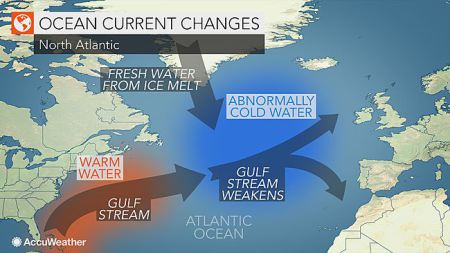
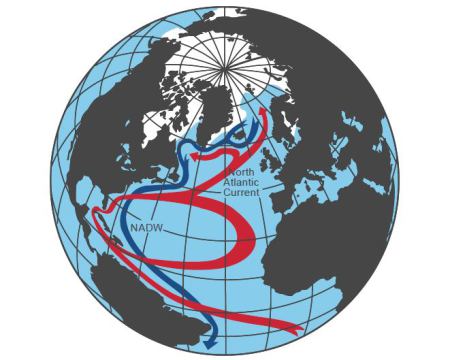
What’s the theory? The details are uncertain, but we know that the Gulf Stream (aka the North Atlantic “Conveyor”) shorted, literally: analyses of deep sea sediments have shown this. The conveyor sends an enormous current of warm tropical waters northward.
When the warm tropical waters become very cold between Iceland and Spitzbergen, they sink to the bottom of the sea, and head south. This sinking, plus the pushing by trade winds in the tropics, is what provides the energy of the Gulf Stream.
However, if the warm tropical waters are capped by a very cold, but light sweet(er) water lid, they will get cold early, and sink before Iceland. This is what happened in the Dryas events.
And It Is Happening Again, Albeit On A Smaller Scale.
Was it in response to a sudden influx of fresh water from Lake Agassiz and deglaciation in North America, and Greenland? Sudden freezing there would have removed the freshwater lid, hence the brutal switchback to warming after the brutal cooling. By the way, the sea level rising speed responded quickly, by a factor of three. After the typical Dryas cooling, oceanic rise rebounded to 18 millimeter per year right away (this shows that those who expect a slow rise of sea level rise are deluding themselves, or, more to the point, are trying to delude us!)
Nowadays a Dryas-like mechanism would have to rest on the melting of Greenland alone (that’s the only place with significant ice). This is, of course, insufficient, but summer 2015, cool and rainy over the northern North Atlantic is evidence that the effect is on. Scientific analysis confirms it. See: “Exceptional Twentieth Century Slow Down of Atlantic Ocean Overturning Circulation” (Nature, 23 March, 2015).
The exact nature of what is going on at this point is a matter of debate among experts. What is sure is that something is going on.
The Atlantic Conveyor Is A Subtle Thing, Yet Dominates Glaciation In The Arctic.
A similar situation beckons in Antarctica, where ice shield melting creates a freshwater lid all around which in turn freeze, extending the ice cap in the Austral winter.
When considering nonlinearity, subtlety and surprises are of the essence. This is true in physics, as it is in psychology, history, or politics.
And the morality in all this? The USA has played god. The European Union made a honest to goodness effort to reduce CO2 emission, while the USA, paying lip service to the opposite of what it was doing went right ahead, with its factory, the Plutocratic Republic of China, to use and abuse fossil fuels as never before.
So now what? Is god still American, as usual? At first it seems so: the USA started to frack massively and massive amounts of fossil fuels were extracted from the USA’s generous soil. When American companies tried the same in Poland, it failed: the underground god (Pluto?) did not cooperate: Polish soil is adverse to fracking.
Here comes the punchline: sea level has been rising fast along the Eastern seashore of the USA. Actually, three to four times faster than the world average. That’s more than one centimeter per year.
Why? Imagine a traffic jam. Or rather a crash ahead: things come to a halt, cars, water piles up behind. Maybe the Washington politicians will soon have to learn to swim, and not just against the tide of world public opinion.
The USA is going to be punished with its own instruments. Meanwhile 20 countries formed the V20, a group of twenty countries whose existence is immediately threatened by global warming, although they caused it not.
Footnote: The Les referred to is Les Powells, the yachtsman who sailed solo three times around the world. He and I became good friends when we met up at Larnaca Marina in Cyprus.
Exploring the range of emotions felt and displayed by our dogs.
Like so many bloggers, I subscribe to the writings of many others. Indeed, it’s a rare day when I don’t read something that touches me, stirring up emotions across the whole range of feelings that we funny humans are capable of.
Such was the case with a recent essay published on Mother Nature Network. It was about dogs and whether they are capable of complex emotions. Better than that, MNN allow their essays to be republished elsewhere so long as they are fully and properly credited.
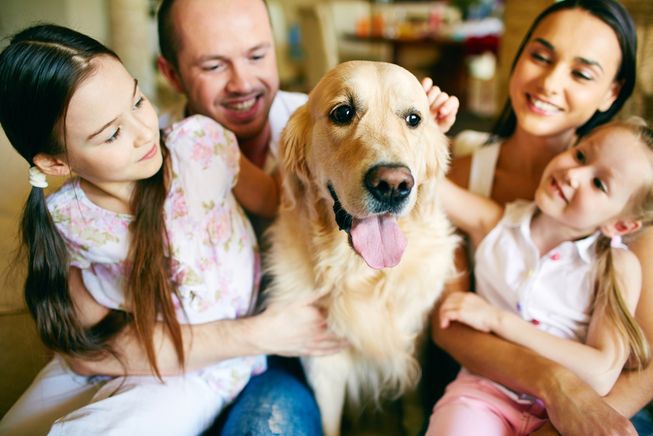
Exactly what emotions do dogs feel, and are they capable of all the same emotions as humans? (Photo: Pressmaster/Shutterstock)
Joy, fear, surprise, disgust, sadness. These are the basic emotions dogs feel that are also easy enough for humans to identify. But what about more complex emotions?
Many dog owners are convinced their dogs feel guilty when they’re caught misbehaving. In the same way, many owners are sure their dogs feel pride at having a new toy or bone. But it gets tricky when you assign these sorts of emotions to a dog. These are definitely emotions felt by humans, but are they also felt by dogs?
(see footnote)
Why we question the presence of complex emotions is wrapped up in the way we get to those emotions. The American Psychological Association explains, “Embarrassment is what’s known as a self-conscious emotion. While basic emotions such as anger, surprise or fear tend to happen automatically, without much cognitive processing, the self-conscious emotions, including shame, guilt and pride, are more complex. They require self-reflection and self-evaluation.”
Essentially we’re comparing our behavior or situation to a social expectation. For instance, guilt comes when we reflect on the fact that we’ve violated a social rule. We need to be aware of the rule and what it means to break it. So, can dogs feel guilt? Well, exactly how self-reflective and self-evaluative are dogs?
Among humans, children begin to experience empathy and what are called secondary emotions when they are around 2 years old. Researchers estimate that the mental ability of a dog is roughly equal to that of an 18-month-old human. “This conclusion holds for most mental abilities as well as emotions,” says Stanley Coren in an article in Modern Dog Magazine. “Thus, we can look to the human research to see what we might expect of our dogs. Just like a two-year-old child, our dogs clearly have emotions, but many fewer kinds of emotions than found in adult humans.”
In other words, if 18-month-old children can’t yet experience these emotions, and dogs are roughly equal to them in cognitive and emotional ability, then dogs can’t feel these self-reflective emotions either. At least, that’s what researchers have concluded so far.
Is that guilt or fear?
This little puppy might feel guilty for chewing on clothes, or he could just be worried about getting in trouble. The two aren’t the same emotion. (Photo: InBetweentheBlinks/Shutterstock)
The evidence for primary emotions like love and happiness in dogs abounds, but empirical evidence for secondary emotions like jealousy and guilt is sparse. And this is partially because it’s difficult to create tests that provide clear-cut answers. When it comes to guilt, does a dog act guilty because she knows she did something wrong, or because she’s expecting a scolding? The same expression can come across as guilt or fear. How do we know which it is?
“In wolves, it is thought that guilt-related behaviors serve to reinforce social bonds, as in primates, by reducing conflict and eliciting tolerance from other members of the social group. The same could be true of dogs, though their social groups would primarily include humans. The problem is that the display of the associated behaviors of guilt are not, themselves, evidence of the capacity to emotionally experience guilt… It may still be some time before we can know for certain whether dogs can experience guilt, or whether people can determine if a dog has violated a rule prior to finding concrete evidence of it.”
Guilt, and other secondary emotions, are complicated. That’s exactly why cognitive awareness and emotional capacity in dogs is still a topic under study. In fact, it’s an area that has grown significantly in recent years. We may discover that dogs have a more complex range of emotions than we’re aware of today.
Dogs are highly social animals, and social animals are required to navigate a range of emotions in themselves and those around them to maintain social bonds. It wasn’t so long ago that scientists thought that dogs (and other non-human animals) didn’t have any feelings at all. Perhaps our understanding of dog emotions is simply limited by the types of tests we’ve devised to understand their emotions. After all, we’re trying to detect a sophisticated emotional state in a species that doesn’t speak the same language.
There’s a lot we don’t know
Dogs experience a range of emotions, but researchers are still trying to figure out exactly what those emotions are. (Photo: Hysteria/Shutterstock)
Marc Bekoff makes the argument for leaving the possibility open. In an article in Psychology Today he writes, “[B]ecause it’s been claimed that other mammals with whom dogs share the same neural bases for emotions do experience guilt, pride, and shame and other complex emotions, there’s no reason why dogs cannot.”
Keeping the possibility open is more than just an emotional animal rights issue. There is a scientific basis for continuing the research. A recent study showed that the brains of dogs and humans function in a more similar way than we previously thought.
Scientific American reports that “dog brains have voice-sensitive regions and that these neurological areas resemble those of humans. Sharing similar locations in both species, they process voices and emotions of other individuals similarly. Both groups respond with greater neural activity when they listen to voices reflecting positive emotions such as laughing than to negative sounds that include crying or whining. Dogs and people, however, respond more strongly to the sounds made by their own species.”
Until recently, we had no idea of the similar ways human and dog brains process social information.
So do dogs feel shame, guilt and pride? Maybe. Possibly. It’s still controversial, but for now, there seems to be no harm in assuming they do unless proven otherwise.
ooOOoo
Footnote: At this point in the MNN article there was a link to a series of gorgeous photographs of dogs. If you dear readers can wait, then I will publish them this coming Sunday. If you can’t wait, then go here!
Because you signed up on our website and asked to be notified, I’m sending you this special recall alert.
On October 2, 2015, K-9 Kraving Dog Food of Baltimore, Maryland, announced the recall of its Chicken Patties dog food because the product has the potential to be contaminated with Salmonella and Listeria mitocytogenes.
Salmonella and Listeria are bacteria that can affect the health of both pets and humans.
Please be sure to share the news of this alert with other pet owners.
Mike Sagman, Editor
The Dog Food Advisor
P.S. Not already on our dog food recall notification list yet? Sign up to get critical dog food recall alerts sent to you by email. There’s no cost for this service.
Late yesterday evening, I loaded onto a memory stick the final version of my manuscript, 32 black & white photographs, and a list of the captions to said photographs.
Around 4pm this afternoon (Tuesday PDT), that memory stick will be passed to Deborah Perdue of Illumination Graphics. It is Deborah who designed the cover of the book, as shown above, and is handling all the interior design work to ensure that the book is visually attractive, and that the final print file is perfect. Once there has been a final check for any typos, then the print file will go to IngramSparks, who I am using for my Print on Demand requirements plus other services, as their website fully describes. (There will be an eBook version as well.)
Deborah Perdue
I met Deborah the first time I was invited to a monthly meeting in nearby Grants Pass of AIM, an acronym for Authors Innovative Marketing: a group of authors who work together to help sell their books. Deborah is an author in her own right and an AIM member.
However, this post is much less about me promoting my book than me applauding the incredible, professional talents of Deborah and Joni Wilson, my editor, who was recommended by Deborah. If there is anyone out there thinking of writing their first book, or has another one in the pipeline, I couldn’t recommend too strongly Deborah and Joni.
Joni has spent dozens of hours, literally, going through my manuscript time and again recommending changes. Her degree of attention to detail simply beggars belief. Here’s a tiny example of that showing my marked-up draft, followed by Joni’s recommended amendments:
In March 2013 there was a study published in the PLOS ONE10 scientific journal that revealed, according to lead author Dr. Robert Losey(1) talking with Discovery News:
Dog burials appear to be more common in areas where diets were rich in aquatic foods because these same areas also appear to have had the densest human populations and the most cemeteries. . . .(2)
If the practice of burying dogs was solely related to their importance in procuring terrestrial game, we would expect to see them in the Early Holocene (around 9,000 years ago), when human subsistence practices were focused on these animals. . . .
. . . .(2) Comment [JW7]: These ellipses indicate that the text was left out of the original article—it is not quoted verbatim here.
I wanted Joni to share a few words with you and this is what she wrote.
ooOOoo
Joni Wilson
Words to Share
While I was an advisor for a college nursing program, I met many older adults who often lamented that they wished they could have had become students when they were younger. To them, it seemed a bit awkward to be going back to nursing school in their later years. I shared with them that their life experiences and what they had learned would serve them well to become better nurses. Everything that had occurred in their lives to this point had prepared them for the next part of the journey.
Those words struck home with me, as I too have had a wealth of experiences to prepare me for where I am now. From nursing to religion to liberal arts degrees; from single life to married life to parenting, and then back to single life; from working with hospitals, corporations, religious institutions, and celebrities, I have learned a lot from the people who have crossed my path.
I am now a fulltime freelancer, providing professional editing and formatting services for individuals and businesses, sharing what I’ve learned during a lifetime of interacting with others in various situations. I have met the most incredible people from around the world who have written their thoughts and feelings and want to share their expertise and wisdom through writing fiction or nonfiction, usually ebook or print books, but also websites, blogs, brochures, and manuals.
How envious I am of authors who are able to express themselves—to tell a story, to share a passion, or to express a concern! It’s incredible the way that words can be used! I do not consider myself a writer, but instead I help mold the words to help the author say what they really mean to say in the most acceptable, reader-friendly manner. I’ve found that my talents include attention to detail; knowledge of spelling, grammar, and punctuation; and a perception to discern if things just seem a bit off. I offer suggestions for revisions of words, phrases, or formatting, always remembering that these are the author’s words and I’m helping to fine tune the finished product.
I love what I do—the people I meet through their words, the new concepts that I’m introduced to that help me grow to create a better life, and the knowledge that our paths intersect because we have something to share with one another.
ooOOoo
I consider myself very fortunate to have Deborah and Joni alongside me.
But that was then, and this is now! This is a moment that is difficult to define in emotional terms. But I am aware that it won’t be long before the marketplace votes with their feet, so to speak, as to whether they like the book or not.
I would be less than human if I didn’t admit to a slight fear of failure. Hence the title to today’s post!
Previously, I have mentioned the authors’ group AIM, that meets monthly in Grants Pass.
One of the authors is Frank Morin and he and I have a monthly chit-chat lunch together. Not so long ago, Frank posted a link on his Facebook page to the following video that shows the truth about Pit Bull dogs.
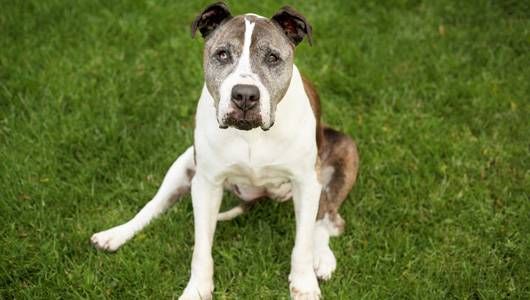
We have a Pit Bull here at home. His name is Casey and he is the perfect gentleman. You would never know that he was in a care centre for over a year because no one would give him a home, for there is not an emotional scar on him!
Casey, in the foreground, sharing Ruby’s bed as they are great friends.
Please ensure you and your dogs have a great weekend.
There was a comment left on yesterday’s post that seemed a delightful reason to stay with the topic; more or less! This was the comment left by Tony.
“at the age of 70, I am already noticing the creeping onset of reduced verbal IQ, cognitive decline, and worry about the onset of dementia….”
Paul, I am 75 and lost an aunt to Alzheimer’s and a mother to dementia. I consider myself to also be at risk. There seems no defense, yet, against Alzheimer’s, but cardiovascular exercise is absolutely one against dementia. Cardio sends oxygen molecules to the brain which actually create new neurotransmitters. Check out my Page – Important Facts About Your Brain (and Exercise Benefits).
Nine days ago, dear friend Bob Derham from my UK days, emailed me the following (in turn, it had been sent on to Bob):
ooOOoo
I’m only sending this to the brightest of my older friends
This test will keep that dreaded disease that effects your memory at bay!
New Senior’s Exam, you only need 4 correct out of 10 questions to pass.
1) How long did the Hundred Years’ War last?
2) Which country makes Panama hats?
3) From which animal do we get cat gut?
4) In which month do Russians celebrate the October Revolution?
5) What is a camel’s hair brush made of?
6) The Canary Islands in the Pacific are named after what animal?
7) What was King George VI’s first name?
8) What color is a purple finch?
9) Where are Chinese gooseberries from?
10) What is the color of the black box in a commercial airplane?
Remember, you need only 4 correct answers to pass.
You may recall that back on the 15th of this month, I posted a Note to Readers that spoke about my need to be focused on the editing of my manuscript. Here’s part of that note:
Dear readers, we are talking hours of revisions that I need, and want, to make.
All of which is my way of saying that if my posts over the next couple of weeks more strongly lean on the republishing of other material then you will understand why. In all cases I will endeavour to republish articles that are likely to interest you, of course!
Late yesterday, I completed the many revisions to the manuscript recommended by Joni Wilson but still have more days of formatting changes ahead.
Thus another republication of an item, this time an article that appeared on the Smithsonian website.
ooOOoo
Domestication Seems to Have Made Dogs a Bit Dim
Thanks to their relationship with us, dogs are less adept at solving tricky puzzles than their wolf relatives
It’s OK, buddy. We’re here to help. (stelo/iStock)
By Rachel Nuwer, smithsonian.com, September 15, 2015
Dogs are considered some of the most intelligent animals on the planet. Thanks to a relationship with humans that dates back tens of thousands of years, dogs can respond to emotions, recognize numerous words and be trained to follow commands.
Notably, these seemingly smart accomplishments all hinge on the partnership between our two species. Now, however, tests of canine problem-solving skills indicate that dogs rely on humans so much that we actually seem to be dumbing them down.
Most studies that investigate dog intelligence assume that certain interactions with humans are indicative of higher cognitive function. In one experiment, for example, dogs and human-socialized wolves were presented with a canine version of the Kobayashi Maru — an unopenable box that contained food.
When confronted with a difficult task, dogs often turn to us—their human masters—for guidance, indicating their puzzlement with a cock of the head and eyes that seem to implore for help. Indeed, the dogs in the study quickly gave up and simply stared at the nearest human. The wolves, on the other hand, sought out no such help and persisted at trying to solve the impossible puzzle on their own.
Researchers usually interpret such findings as a sign of dogs’ intelligence; the wolves kept trying to win the no-win scenario, while the dogs knew that humans could help out with tasks they themselves could not solve.
But depending on humans for help is not necessarily a cognitive asset, points out Monique Udell, an assistant professor of animal and rangeland sciences at Oregon State University.
If dogs only turn to humans when presented with an impossible task—not a solvable one—then their “look back” behavior would indeed be advantageous. On the other hand, if they simply throw their paws up at the slightest hint of cognitive challenge, then that could indicate “a conditioned inhibition of problem-solving behavior,” as Udell puts it. Like a child whose parents always give away the answers to homework, dogs may be overly reliant on us, she surmised.
To test this hypothesis, Udell presented ten pet dogs and ten human-socialized wolves with a solvable puzzle. Sausage was placed inside a sealed plastic tub with a lid that included a bit of rope. With some paw and mouth finagling, the lid could be opened.
She also included ten shelter dogs in the study, because past research shows that shelter dogs are initially less responsive to humans compared to established pets. These animals acted as a sort of intermediary between hyper-socialized dogs and wolves.
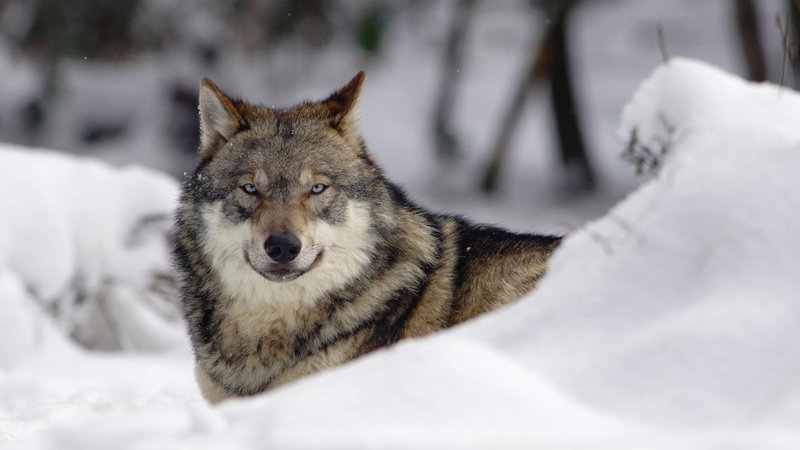
Crazy smart, like a wolf. (Kaphoto/iStock)
Udell presented the canines with the puzzle box both in the presence of humans—an owner, caretaker or familiar person—and without any person nearby. Each time, the animals had two minutes to figure out how to get at the sausage. Subjects that failed in both trials were given a third and final try in which they also received verbal encouragement from their human friend.
Udell’s findings, reported today in the journalBiology Letters, were telling. In the presence of humans, just one pet dog and none of the shelter dogs managed to open the box. Eight out of ten of the wolves, however, succeeded in enjoying the sausage treat inside.
Wolves also spent more time chipping away at the problem and more time staring at the box, as if working out how to open it. Both pet and shelter dogs, on the other hand, did the opposite—they gave up more quickly and stared at humans instead of the box, seemingly asking for help.
When humans were not around, the findings were similar—nearly all of the wolves figured out how to open the box, while just one shelter dog and no pet dogs succeeded. In the third and final trial, dogs that had failed in both of the prior tests performed a bit better when humans encouraged them.
With some human cheerleading, four of nine shelter animals and one of eight pet dogs opened the box, and all spent more time trying to open the box and looking at the box than they did when they were either alone or when their human friends remained silent.
Udell’s results indicate that dogs do seem to be overly dependent on us compared to their wild relatives, although the cause of this—whether biological, environmental or both—still needs to be worked out.
Lucky for pet pooches, however, we humans will no doubt always be there to help them navigate all of life’s tricky plastic containers.
Picking up on that last sentence, luckily for us humans our dogs will always be there to help us in innumerable ways, especially giving us unconditional love.
We have always adopted dogs on the basis of their need, never letting age come into it. In the years before I knew Jean she was rescuing dogs off the streets of Mexico, again without regard to breed, age, condition or temperament.
So this recent article on Mother Nature Network struck me as important. Please share it.
ooOOoo
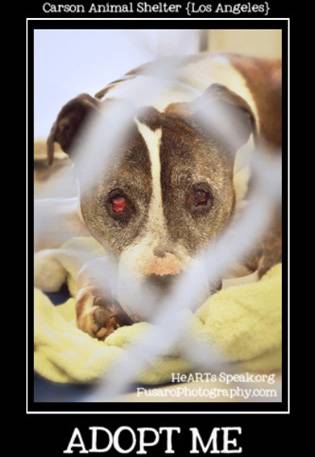
Don’t be afraid to adopt an older dog, says photographer
An abandoned dog named Sunny made Lori Fusaro realize that ‘no dog should die alone’ and inspired her to start a photography project to benefit senior pets.
By: Laura Moss, July 22, 2013
Photo: Lori Fusaro
The hardest part of loving a pet is having to say goodbye. That’s why the idea of adopting an older animal made dog lover Lori Fusaro so uneasy.
“I thought it would just be too sad and painful,” Fusaro told Today.com, “I didn’t think my heart could take it, so I wasn’t willing to open myself up.”
But that all changed in June 2012 when Fusaro met Shady while she was photographing dogs at the South Los Angeles Animal Shelter. Shady was 16 years old with infected eyes and a large cancerous tumor on her leg.
“She was so sad and depressed. She wouldn’t even lift her head for a treat. I didn’t think I could adopt her and I left the shelter without her. But her face never left my mind. She kept popping into my thoughts.”
As she contemplated adoption, Fusaro sought out more information on the dog.
“I thought Shady was a stray that found her way into the shelter,” she wrote on her blog. “Turns out I was wrong. Living her entire life with a family and then dumped because she was too old. With this new information, her face haunts me even more.”
Fusaro couldn’t stand the idea of the gentle dog dying alone, so she took her home and changed her name to Sunny.
“I always come back to the idea that no dog should have to die alone. Even if she got just two months of joyous, happy life, it’s worth it for my heartbreak,” she said.
Watching Sunny transform from an anxious shelter dog into the happy family member she is today inspired Fusaro to start Silver Hearts, a photography project that showcases senior pets and the joy they bring to people’s lives.
“When I realized that there were probably hundreds of Sunnys languishing in shelters, I knew I had to do something about it. Silver Hearts became a way that I could use my photography to show these dogs as loving, happy souls that have a zest for living and deserve to spend their golden years in a loving home.”
Fusaro visited families across the United States to photograph their dogs and share their compelling stories. Many of the dogs were taken to shelters because they got sick or old or because the families could no longer afford to care for them.
Although older dogs are often calmer — and already house-trained — they’re typically the highest-risk animals in a shelter. Fusaro hopes her photographs can help change that.
She launched a Kickstarter campaign to try to raise money to self-publish the book, but failed to make the fundraising goal. Fusaro is now considering other methods of publication.
“When I look back at my unwillingness to adopt an older dog, it was more about my own selfishness — about not wanting to feel that pain, not wanting to make hard decisions,” Fusaro said. “But every dog is important. Every dog deserves a home. I finally just boiled it down to love. That’s the most important thing.”
Lori explains why she photographs senior dogs in the video below.
ooOOoo
Abandoned and homeless dogs so desperately need the love of caring owners.




 Learning from Dogs