Huge thank you to Producer John Letz and the whole crew.
A week ago last Saturday Jean and I travelled down to Ashland and to the studios of Rogue Valley Community Television (RVTV). This is how RVTV describe themselves:
Based at the Southern Oregon Digital Media Center, RVTV provides access television and streaming media services for the citizens and local governments of Jackson and Josephine Counties. Please visit rvtv.sou.edu for more information.
John Letz, the Producer for Adventures in Education and Ramping Up your English, had read my book and thought it might make a good programme.
I’m both delighted and flattered to say that the programme is now available and published under a Commons Creative Licence. Here it is!
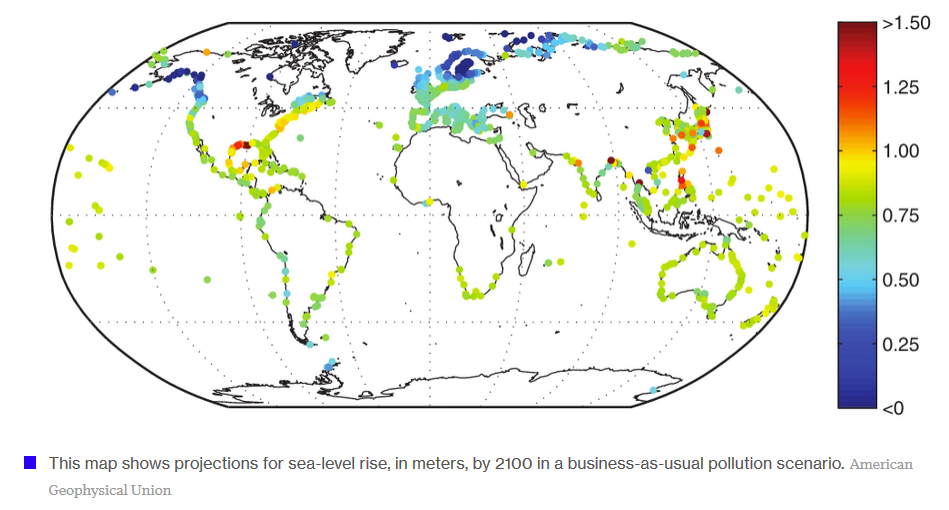
6. Sea levels could rise another 1.3 meters (4.3 feet) in the next 80 years.
This map shows areas that would flood (marked in red) due to 1-meter sea-level rise. (Photo: NASA)
In another study published this month, scientists report that global sea levels will likely rise 0.5 to 1.3 meters (1.6 to 4.3 feet) by the end of this century if greenhouse gas emissions aren’t rapidly reduced. Even if last year’s Paris Agreement does spur ambitious climate policy, sea levels are still projected to rise 20 to 60 cm (7.8 to 23.6 inches) by 2100. Taken with the longer-term effects from melting ice sheets in Greenland and Antarctica, that means any strategy to endure sea-level rise must involve adaptation plans as well as efforts to slow the trend.
7. Up to 216 million people currently live on land that will be below sea level or regular flood levels by 2100.
Higher sea levels can exacerbate storm surges, like this 2013 flood in Wenzhou, China. (Photo: STR/AFP/Getty Images)
Of the estimated 147 million to 216 million people in harm’s way, between 41 million and 63 million live in China. Twelve nations have more than 10 million people living on land at risk from sea-level rise, including China as well as India, Bangladesh, Vietnam, Indonesia and Japan. Bangladesh is especially vulnerable, identified by the U.N. as the country most in danger from rising seas. Once the ocean rises by 1.5 meters (4.9 feet) next century, it will affect 16 percent of Bangladesh’s land area and 15 percent of its population — that’s 22,000 km2 (8,500 mi2) and 17 million people.
The situation is also urgent for low-lying island nations like Kiribati, the Maldives, the Marshall Islands and the Solomon Islands, where land is already so close to sea level that a few inches make a world of difference. Some are even mulling mass relocations — the government of Kiribati, for one, has a web page outlining its strategy for “migration with dignity.” A town on Taro Island, the capital of Choiseul Province in the Solomon Islands, is also planning to move its entire population in response to rising seas. The small community of Newtok, Alaska, has already begun the difficult process of transplanting itself away from the encroaching coast.
8. Sea-level rise can contaminate water used for drinking and irrigation.
Sea-level rise can aid saltwater intrusion of freshwater aquifers, as seen in this schematic illustration. (Image: NRC.gov)
In addition to surface flooding, sea-level rise can both push up the freshwater table and contaminate it with seawater, a phenomenon known as saltwater intrusion. Many coastal areas rely on aquifers for drinking water and irrigation, and once they’re tainted by saltwater they may be unsafe for humans as well as crops.
It is possible to remove salt from water, but the process is complex and costly. San Diego County recently opened the Western Hemisphere’s largest desalination plant, for example, and several other sites are proposed in the state. Yet that may not be practical for many coastal communities, especially in less wealthy nations.
9. It can also threaten coastal plant and animal life.
Floods fueled by rising seas may harm baby sea turtles, like these South African loggerheads. (Photo: Jeroen Looyé/Flickr)
Humans aren’t the only ones who’ll suffer as sea levels rise. Any coastal plants or animals that can’t quickly move to new, less flood-prone habitats could face dire consequences. As one 2015 study noted, sea turtles have a long-established habit of laying eggs on beaches, which need to stay relatively dry for their babies to hatch.
Inundation for one to three hours reduced egg viability by less than 10 percent, the study’s authors found, but six hours underwater cut viability by about 30 percent. “All embryonic developmental stages were vulnerable to mortality from saltwater inundation,” the researchers write. Even for hatchlings that do survive, being starved of oxygen in the egg could lead to developmental problems later in life, they add.
Other beach life may also be at risk, including plants. A recent study found that some salt marshes can adapt, both by growing vertically and by moving inland, but not all flora will be so fortunate. “Trees have to work harder to pull water out of salty soil; as a result, their growth can be stunted — and if the soil is salty enough, they will die, a common sign of sea-level rise,” Climate Central explains. “Even trees that are especially suited to salty soil can’t survive repeated flooding by seawater.”
10. Global flood damage for large coastal cities could cost $1 trillion a year if cities don’t take steps to adapt.
This Google Earth simulation shows a Tokyo neighborhood with 1.3-meter sea-level rise. (Image: Google Earth)
The average global losses from flooding in 2005 were about $6 billion, but the World Bank estimates they’ll rise to $52 billion per year by 2050 based on socioeconomic changes alone. (That means things like increasing coastal populations and property value). If you add the effects of sea-level rise and sinking land — which is happening even faster in some places — the cost could surge to $1 trillion per year.
11. It’s too late to stop sea-level rise — but not too late to save lives from it.
A full moon shines over an iceberg that broke off Greenland’s Jakobshavn Glacier. If the entire Greenland ice sheet melted, sea levels would rise about 6 meters, or 20 feet. (Photo: Joe Raedle/Getty Images)
Unfortunately, CO2 emissions linger in the atmosphere for centuries, and today’s CO2 levels have already committed Earth to dangerous sea-level rise. About 99 percent of all freshwater ice resides in two ice sheets: one in Antarctica and one in Greenland. Both are expected to melt if humanity’s CO2 output isn’t curbed quickly, but the question is when — and how much damage we still have time to prevent.
The Greenland ice sheet is smaller and melting more quickly. If it completely melted, sea levels would rise by about 6 meters (20 feet). The Antarctic ice sheet has been more buffered from warming so far, but it’s hardly immune, and would raise the ocean by 60 meters (200 feet) if it melted. (Estimates vary widely on how long these ice sheets might survive — while most expect they’ll take centuries or millennia to melt, a controversial 2015 paper suggested it could happen much more quickly.)
Sea levels have naturally risen and receded for billions of years, but they’ve never risen this quickly in modern history — and they’ve never had so much human help. It’s unclear what effect they’ll have on our species, but what is clear is that our descendants will still be dealing with this problem long after we’re all gone. Giving them a head start on a solution is the least we can do.
“With all the greenhouse gases we already emitted, we cannot stop the seas from rising altogether, but we can substantially limit the rate of the rise by ending the use of fossil fuels,” says Anders Levermann, a climate scientist at Columbia University and co-author of the new study on future sea-level rise. “We try to give coastal planners what they need for adaptation planning, be it building dikes, designing insurance schemes for flooding or mapping long-term settlement retreat.”
As another recent study pointed out, any policy decisions made in the next few years and decades “will have profound impacts on global climate, ecosystems and human societies — not just for this century, but for the next ten millennia and beyond.”
ooOOoo
Tomorrow, in the final part of this three-part posting I will look at some positive things that we can all be doing now.
But let me leave you with a rather beautiful consequence of these changing times. As seen over on Grist:
ooOOoo
Incredible glacier art pays homage to our disappearing ice
Diane Burko has a penchant for glaciers. Her paintings and photographs of frozen landscapes evoke the sensation that you’re standing on ice that could soon melt away — as ice these days is wont to do.
“I always say that I think ice is a real indicator of climate change,” Burko says. “It’s sort of my niche.”
ooOOoo
Now go across to here and admire Burko’s wonderful images (that for copyright reasons are not shown here).
The Butterfly Effect is a concept that small causes can have large effects. Initially, it was used with weather prediction but later the term became a metaphor used in and out of science.[1]
In chaos theory, the butterfly effect is the sensitive dependence on initial conditions in which a small change in one state of a deterministic nonlinear system can result in large differences in a later state. The name, coined by Edward Lorenz for the effect which had been known long before, is derived from the metaphorical example of the details of a hurricane (exact time of formation, exact path taken) being influenced by minor perturbations such as the flapping of the wings of a distant butterfly several weeks earlier. Lorenz discovered the effect when he observed that runs of his weather model with initial condition data that was rounded in a seemingly inconsequential manner would fail to reproduce the results of runs with the unrounded initial condition data. A very small change in initial conditions had created a significantly different outcome.
We all live in an interconnected world. Frankly, it’s such an obvious statement that one presumes that very few would not agree with the sentiment expressed within it.
But (and you knew there was a ‘but’ coming, didn’t you!) very few of us (and I include Jean and me to a very great extent) really understand, “A very small change in initial conditions had created a significantly different outcome.”
Take these few items; more or less randomly read over the last few days.
Abstract: update on Sea Level Rise. The meat of the essay is at the end, in the section “THE SITUATION IS ACTUALLY CATACLYSMIC“.
Heard of The Flood? As in the Bible? Sea level rose 120 meters (400 feet), in the period centered around 10,000 years ago. The cause? More than half of Earth’s ice melted in a few millennia, During the rest of the early Holocene, the rate of rise of the world’s ocean reached peaks as high as 60 millimeters (2.5 inches) per year. The melting of the ice happened because Earth’s positional and orbital parameters had made northern hemisphere’s summers too warm (most of the ice shields rested on the large continents of the north). Nowadays only two enormous ice shields are left: Greenland and Antarctica.
Those who enjoy catastrophes will love it: we have 75 meters of further sea rise to enjoy pretty soon, on our way to a Jurassic climate (the Jurassic was characterized by gigantic warm shallow seas on top of the continents). Here was the situation in the Miocene, when CO2 was at 500 ppm (where we will be at in ten years, see conclusion below).
Patrice said that the essence, the meat, of his essay was at the end. Here are his closing words:
Three scientific papers published in the last two months support my, admittedly drastic, point of view. One observed the collapse of a colossal glacier in northwest Greenland, eaten by a current at one degree C. It was a miniature reproduction of what to expect for entire ice shields. Two others observed the past, and that Antarctica was unstable at 500 ppm CO2. What they did not say is how dramatic the situation was. Indeed, sounding moderate is how they get funded by a benevolent, plutocratically ruled government (and by government, I also mean the corrupt Supreme Court, not just the latest elected buffoons). The scientists who evoked the 500 ppm of CO2 omitted two significant details, where the devil lurks. They claimed that it would take 30 years to get there. That’s not correct; at the present rate, we will add 100 ppm of CO2 within 25 years. But not just that: there are other man-made GreenHouse Gases (GHG): CH4, NOx, Fluorocarbons, etc. All these gases warm up the lower atmosphere much more than CO2. So the correct measurement is not CO2 ppm, but CO2 EQUIVALENT ppm.
We are right now ABOVE 450 ppm in EQUIVALENT CO2, and will be at 500 ppm within ten years. Let’s hope there will be more boats than on the Titanic.
Patrice Ayme’
P/S: If anything, the preceding is a conservative estimate. Indeed very serious scientists evaluated already the man-made greenhouse gases at 478 ppm in 2013. This means we will be above 500 ppm in CO2 equivalent within six years, in line with my previous analyses, such as “Ten Years To Catastrophe“. See:
Now it’s not all ‘doom and gloom’ and there is much that each and every one of us can do. More of that in Interconnections Three on Thursday.
But to continue with this ‘wake up call’ I’m going to republish in full an item that was recently published over on Mother Nature Network: 11 alarming facts about sea-level rise. To stop today’s post being excessively long, I’m going to split that MNN article over today and tomorrow. Here are the first 5 alarming facts. (Don’t read them just before turning the light out when going to bed tonight!)
Up to 216 million people currently live on land that will be below sea level or regular flood levels by 2100. (Photo: Shutterstock)
The ocean is coming for us. Global sea levels are now rising by 3.4 millimeters per year, up from an average rate of 1.4 mm per year last century. In just 80 years, the ocean could be a full 1.3 meters (4.3 feet) taller than it is today.
That kind of planetary sea change can be hard to fathom — unless you live in a low-lying place like Miami, the Maldives or the Marshall Islands, where the effects of sea-level rise are already apparent. But within just a few decades, the problem will become unavoidable in major coastal cities around the world, from New Orleans, New York and Amsterdam to Calcutta, Bangkok and Tokyo.
We all know why this is happening. Rising seas are one of the most salient effects of man-made climate change, triggered by thermal expansion of seawater as well as the influx of melting glaciers. Yet many people still see it as a distant risk, failing to grasp how (relatively) quickly the sea is swallowing shores worldwide. And since half of all humans now live within 60 kilometers (37 miles) of a coast, this isn’t a niche issue.
To help put things in perspective, here’s a deeper look at the problem:
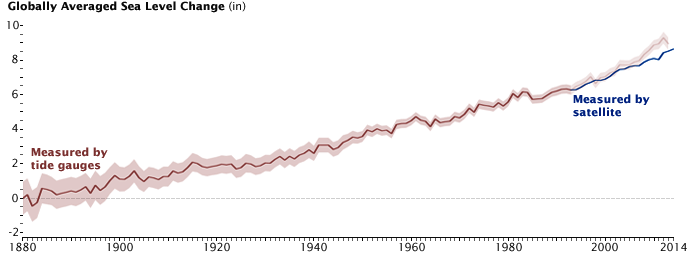
1. Global sea levels have already risen by 8 inches (200 mm) since 1880.
The chart above was produced by NASA’s Earth Observatory, based on data from the U.S. National Oceanic and Atmospheric Administration (NOAA) and Australia’s Commonwealth Scientific and Industrial Research Organization (CSIRO). Most of those historical data come from tide-gauge measurements, which are now complemented by satellite observations.
2. Not only are sea levels rising; the rate of their rise is rising.
Average global sea-level rise is now 3.41 mm per year, but the rate varies widely by location. (Image: NASA GSFC)
On average, sea levels rose by 1.4 mm from 1900 to 2000. The yearly pace had surpassed 3 mm by 2010, and now it’s up to 3.4 mm per year.
3. That’s the fastest sea-level rise Earth has experienced in 3,000 years.
If not for surging carbon dioxide in the atmosphere, sea levels should have only risen about an inch or two last century, and might have even fallen. Instead, thanks to the highest CO2 levels at any point in human history, global sea levels rose by 5.5 inches (14 cm) between 1900 and 2000. That’s the fastest oceanic advance in 27 centuries, according to a study published Feb. 22, and it’s still speeding up.
“The 20th century rise was extraordinary in the context of the last three millennia — and the rise over the last two decades has been even faster,” says lead author Robert Kopp, a climate scientist at Rutgers University, in a statement.
“Scenarios of future rise depend upon our understanding of the response of sea level to climate changes,” adds co-author Benjamin Horton. “Accurate estimates of sea-level variability during the past 3,000 years provide a context for such projections.”
4. Every vertical inch of sea-level rise moves the ocean 50 to 100 inches inland.
Rising seas worsen regular flooding — like this 2015 high tide in Miami Beach — for many coastal cities. Miami is in the midst of a five-year, $400 million effort to upgrade its stormwater pump program. (Photo: Joe Raedle/Getty Images)
5. That’s already causing flood problems in many big coastal cities.
As the ocean invades coastal cities, the first signs of trouble are often urban saltwater floods. These can also happen naturally, though, so to determine the influence of rising seas, a new report by Climate Central models “alternative histories simulating the absence of anthropogenic climate change” at 27 U.S. tide gauges.
Out of 8,726 days since 1950 when unaltered water levels exceeded the National Weather Service thresholds for local “nuisance” floods, 5,809 didn’t exceed those thresholds in the alternative histories. “In other words,” the report explains, “human-caused global sea level rise effectively tipped the balance, pushing high-water events over the threshold, for about two-thirds of the observed flood days.”
Coastal flooding days have more than doubled in the U.S. since the 1980s, according to the report, in places ranging from Miami, Virginia Beach and New York to San Francisco, Seattle and Honolulu. According to a 2014 report, at least 180 floods will strike Annapolis, Maryland, during high tides every year by 2030 — sometimes twice a day. The same will be true for about a dozen other U.S. cities by 2045, not to mention many other low-lying urban areas around the world.
Professor of Physics and Analytics, University of the Pacific
The number 2016 divided by 4 equals 504, exactly – with no remainder, which makes the year 2016, like the upcoming years 2020, 2024 and 2028 (and beyond), a leap year. We will get an “extra” day, February 29.
This pattern will repeat until 2100, when the cycle breaks. Though 2100 is exactly divisible by 4, there is an exception – for years whose number is exactly divisible by 100. (On top of that, there’s another exception – for years exactly divisible by 400. So 2400 will be a leap year. Mark your calendars now.)
Where do these quadrennial liberties with our calendar originate?
In the stars, of course.
Celestial rhythms
One of the simplest joys of life is to watch the stars, night after night, month after month, year after year. They become old friends. They spend a season, and then move on. Or rather, it is we who move on – ever advancing around the sun toward next week’s deadlines, new constellations, new fashions and new ideas.
I imagine myself late one night, eight months from now, remembering the overfull recycling bin, at midnight on trash day. As I try to quietly dump wine bottles into the yellow-topped container, there striding over the eastern skyline is Orion. Back again is my ancient friend, telling me that winter is near, and that I have ridden this miraculous rock almost another full lap around my home star. Rigel shimmers its blue-white light, the twinkle in the eye (the knee, actually) of a companion who has visited me, annually, every place on Earth I have lived since childhood. Even to the Southern Hemisphere, the steady Orion came for a summer visit – cartwheeling upside down, feet over hands.
It is from these celestial cycles that our concepts of time originate, and, ultimately, from which we gain the leap day.
The sidereal year is the length of time it takes for the Earth to return to the same place with respect to the “fix’d” and “constant” stars, so that Orion appears exactly in the same place in the sky, at exactly midnight, 365.2563 days later. Stellar friends like that don’t stand you up; they keep their appointments to seven-digit precision (and more).
Right over the equator: A diagram showing the sun’s position relative to the Earth at the vernal equinox.Tfr000, CC BY-SA
Our Western calendar is tied to the tropical year – the time between successive vernal equinoxes. At that moment, the sun’s position in the sky is exactly where the ecliptic (the plane of the solar system and the path that the planets take as they move through the constellations) crosses the celestial equator (the projection of the Earth’s own equator onto the celestial sphere). Straddling the celestial equator, the sun splits its time exactly between the day side and the night side of the Earth. It returns to that place again in roughly 365.24219 days. Roughly.
Now you can see where those alternating “divisible by 4, 100 and 400” leap year rules originate.
Making up the differences
At the end of 365 days, there are still 0.24219 days (just shy of six hours) to go before Earth gets back to the equinox line.
After four years, however, this fractional 0.24219 of a day adds up to 0.96876, which is pretty close to one full day. If we were using only a 365-day calendar, the stars, and more importantly the months, corresponding to the seasons – crucial for agricultural societies – would slip behind. This was apparent to the Romans in the first century, as well as to the Olmecs and the Maya on the other side of the world.
Thus decreed Julius Caesar in 46 B.C.: that every four years an extra day would be added to February. It was called the Julian calendar. But adding one day every four years, in order to make up for that 0.96876 of a day in orbital spare change, is overcompensating. Caesar’s “every four” leap year prescription adds 0.03124 of a day too much. This makes the Julian calendar run fast by just over 600 seconds per year.
Exception after exception: Christopher Clavius, in a line engraving by E de Boulonois.Wellcome Trust, CC BY
Like with the spare coin jar in our house, small change like that takes a while to add up. It wasn’t until the age of Pope Gregory XIII, in 1582, that this mismatch was becoming a problem. After consultation, presumably with God, but particularly with his astronomer, Christopher Clavius, the pope adopted Clavius’ clever solution.
The Julian calendar runs fast by 0.03124 of a day every four years; multiply both sides by 100, and see an excess of about three days after 400 years. Clavius’ solution was to make centuries exceptions – but that would lose too much, four days in 400 years, not three. So Clavius added one back, once every 400 years, starting in 1600.
This Gregorian calendar, which we use today, has the following rules:
Every year divisible by 4: add February 29
Every century (1800, 1900, 2000, 2100): do not add February 29
Every century divisible by 400: add February 29
Still finer measurements
Even with this refinement, there is still orbital change left over. But now we are talking about temporal shavings that are quite small. At this level of precision, other wobbles in the relation of the Earth’s rotational period (the day) and its revolution period (the year) have to be taken into account.
When a leap second is added, digital clocks tick past 23:59:59 but don’t go directly to 00:00:00.Twid
Personally, I think we should make February 29, leap day, a global holiday. It should be considered a gift to ourselves, like taking that accumulated spare change to the grocery store coin-counting machine, and trading it for some easier-to-spend bills. It should be a day of celebration, a reward for saving that quarter of a day over the last four years, to be spent on something frivolous. Or it could be a special day to realign our sense of hourly routines, weekly trash pickups, the race to fulfill monthly quotas, to the celestial schedule.
Without that extra day every fourth year, our ancient friends would begin to miss their annual appointments, and start to fall behind in wishing us prompt birthday greetings, like forgetful Facebook friends. Without February 29, roughly, every four years, the “constant stars” would cease to be constant.
ooOOoo
So there! Now you know!
You all spend this extra day peacefully and happily.
Those of you who follow this place on a regular basis know that last Friday I published a post under the title of Friday Fondness. You will also know that later that same day I left this comment to that post:
Sue, and everyone else, we returned from seeing Dr. Lee, the neurologist, a little under two hours ago. Dr. Lee’s prognosis is that Jean is showing the very early signs of Parkinson’s disease, and Jean is comfortable with me mentioning this.
Everyone’s love and affection has meant more than you can imagine. I will write more about this next week once we have given the situation a few ‘coatings of thought’.
Jean sends her love to you all!
Thus, as heralded, I am going to write some more.
You would not be surprised to hear that the last few days have been an emotional roller-coaster, for both Jean and me. Including on Monday Jean hearing from our local doctor here in Grants Pass, OR, that a recent urine test has shown that Jean has levels of lead in her bones some three times greater than the recommended maximum. While our doctor is remaining open-minded it remains to be seen whether Jean is exhibiting symptoms of lead poisoning, whether the lead is a possible cause of the Parkinson’s disease (PD), see this paper, or whether it is a separate issue to be dealt with.
However, I want to offer some more from the consultation that Jean had with the neurologist Dr. Eric Lee last Friday. Shared with the full support of Jean who has read the whole of today’s post yesterday evening; as she does with every post published in this place.
But before so doing, please understand that while I was present throughout the complete examination of Jean, what you are about to read carries no more weight than that of any casual onlooker. If you are at all affected by any of the following make an appointment to see your own doctor!
Jean’s examination lasted for about an hour. It consisted of a great number of checks and tests on how her body responded to many different tests and stimulations. At the end of the examination Dr. Lee said that while he wasn’t 100% certain the balance of probability was that Jean was demonstrating the very early signs of PD. For example, showing such signs as walking and not swinging both arms in a normal, balanced manner. Or having a very slow blink rate. Then she was exhibiting some difficulty with rapid finger-to-thumb taps.
However, Dr. Lee did say that Jean was at the very early stages of PD and that we would have to wait another six months to see if the PD indicators were firming up. He also said that he had PD patients who had had the disease for twenty, even thirty years. Some of the general indicators that PD is progressing include a stooped gait, decreasing size of handwriting, and a quieter speaking tone. The NINDS website has more information on this. Here’s a little of what they explain about PD:
What is Parkinson’s Disease?
Parkinson’s disease (PD) belongs to a group of conditions called motor system disorders, which are the result of the loss of dopamine-producing brain cells. The four primary symptoms of PD are tremor, or trembling in hands, arms, legs, jaw, and face; rigidity, or stiffness of the limbs and trunk; bradykinesia, or slowness of movement; and postural instability, or impaired balance and coordination. As these symptoms become more pronounced, patients may have difficulty walking, talking, or completing other simple tasks. PD usually affects people over the age of 60. Early symptoms of PD are subtle and occur gradually. In some people the disease progresses more quickly than in others. As the disease progresses, the shaking, or tremor, which affects the majority of people with PD may begin to interfere with daily activities. Other symptoms may include depression and other emotional changes; difficulty in swallowing, chewing, and speaking; urinary problems or constipation; skin problems; and sleep disruptions. There are currently no blood or laboratory tests that have been proven to help in diagnosing sporadic PD. Therefore the diagnosis is based on medical history and a neurological examination. The disease can be difficult to diagnose accurately. Doctors may sometimes request brain scans or laboratory tests in order to rule out other diseases.
But here’s the good news regarding my darling wife – there are three things that Dr. Lee strongly recommends:
Hang on to a positive mental attitude for the body actively produces dopamine when in a positive mental state.
At least 30-minutes of good aerobic exercise three times a week,
And physiotherapy.
In addition, Dr. Lee said to always THINK BIG! Big in voice, big in attitude, big in stature.
Finally, let me share with you what was posted on the Visible Procrastinations blog back in 2009. Reposted with the author’s permission.
Some notes from My Change Journey: This workshop is designed to help you understand your emotional and psychological needs during times of change and strategies you can use to take control of your own change journey. It also focuses on creating opportunities and seeing possibilities in the new world of work.
change – an event that occurs when something passes from one state or phase to another;
transition – the act of passing from one state or place to the next
The Big Picture
You are not always seeing the bigger picture;
Experiencing Transitions
When change is implemented at any level in an organisation, people typically respond by moving through a series of phases. People will spend different times in each phase.
William Bridges (1995) Bridges’ three-phase transition framework: The first phase, the Ending phase, is about letting go of an old identity, an old reality or an old strategy. The Neutral Zone is akin to crossing the wilderness between the old way and the new. The final phase is making a new beginning and functioning effectively in a new way.
The Process of Transition
John Fisher’s model of personal change – The Transition Curve – is an excellent analysis of how individuals deal with personal change.
John Fisher’s transition curve – the stages of personal transition – and introduction to personal construct psychology. http://www.businessballs.com
“You should only worry about things that are within your sphere of influence.”
From The Seven Habits of Highly Effective People – you should only worry about things in your “sphere of influence.” If you have no control over certain aspects of your life, why bother worrying about them?
Mental Models: our way of seeing the world
Mental models are usually tacit, existing below the level of awareness – they should be tested, examined and evaluated.
Joel Barker pioneered the concept of paradigm shifts to explain profound change and the importance of vision to drive change within organizations. View The Power of Paradigms [SWF].
Take 1000
add 40 to it
Now add another 1000
Now add 30
Add another 1000
Now add 20
Now add another 1000
Now add 10
What is the total?
Did you get 5000 ? The correct answer is actually 4100 .
Ethical work and life learning (Free online education for ethical work, business, career and life learning; training materials for entrepreneurs, organizations, seflf-development, business management, sales, marketing, project management, communications, leadership, time management, team building and motivation) www.businessballs.com
Let me close today’s post with the opening and closing paragraphs from Chapter 25 of my book: A Way into Our Own Soul.
“Happiness resides not in possessions, and not in gold, happiness dwells in the soul.”
So wrote the philosopher Democritus who was born in 460 BCE (although some claim his year of birth was 490 BCE). He acquired fame with his knowledge of the natural phenomena that existed in those times and history writes that he preferred a contemplative life to an active life, spending much of his life in solitude. The fact that he lived to beyond 100 suggests his philosophy didn’t do him any harm.
………..
In humans, that part of the brain in which self-awareness is thought to arise is called the ventromedial prefrontal cortex. Apparently, that just happens to be located behind the eyes. Ergo, we learn[1] to associate the identity of others with our eyes. Then as we mature, our eyes take on more importance because we develop awareness and a better understanding of the social cues that other people convey with their eyes.
Therefore, is it any surprise that dogs, being the intuitive creatures that they are, soon learn to read us humans and the feelings and emotions that we transmit from our eyes? There’s a knowing in my mind, albeit an unscientific knowing, that dogs, too, give out emotions and feelings from their own eyes.
That loving a dog and being loved back by that dog truly does offer us a way into our own souls. No better put than in the exquisite words of Anatole France,
“Until one has loved an animal, a part of one’s soul remains unawakened.“

[1] Refer to Christina Starmans and Paul Bloom of the Mind and Development Lab at Yale University.
ooOOoo
Oh, and a postscript. Having a loving contact with another person or your dog also releases dopamine within the body – so go and hug your partner or your dog! Now! 🙂
A reposting of an item from this place some three years ago.
On Sunday, in recognition of Valentine’s Day, I posted a selection of articles under the post title of Loving Relationships.
Then yesterday my day that should have been quiet and uneventful turned out to be anything other than that! So it was well after 3pm that I sat down in front of my PC wondering what to publish today. I thought that as there had been a steady flow of new readers signing up to follow this place (and a huge thank you – it really does mean a lot to me) I might see what I published three years ago.
To my surprise it was a post about the most important relationship of all; the one with ourself.
So please do enjoy what was published on February 15th, 2012.
ooOOoo
Do you or I really know who we are?
The strangeness of this species Homo sapiens.
My writings of the previous three days have explored the nature of man. The many ways that we struggle to understand so many issues in our lives. In particular the biggest issue of them all since we abandoned the life of the hunter-gatherer. Our very survival.
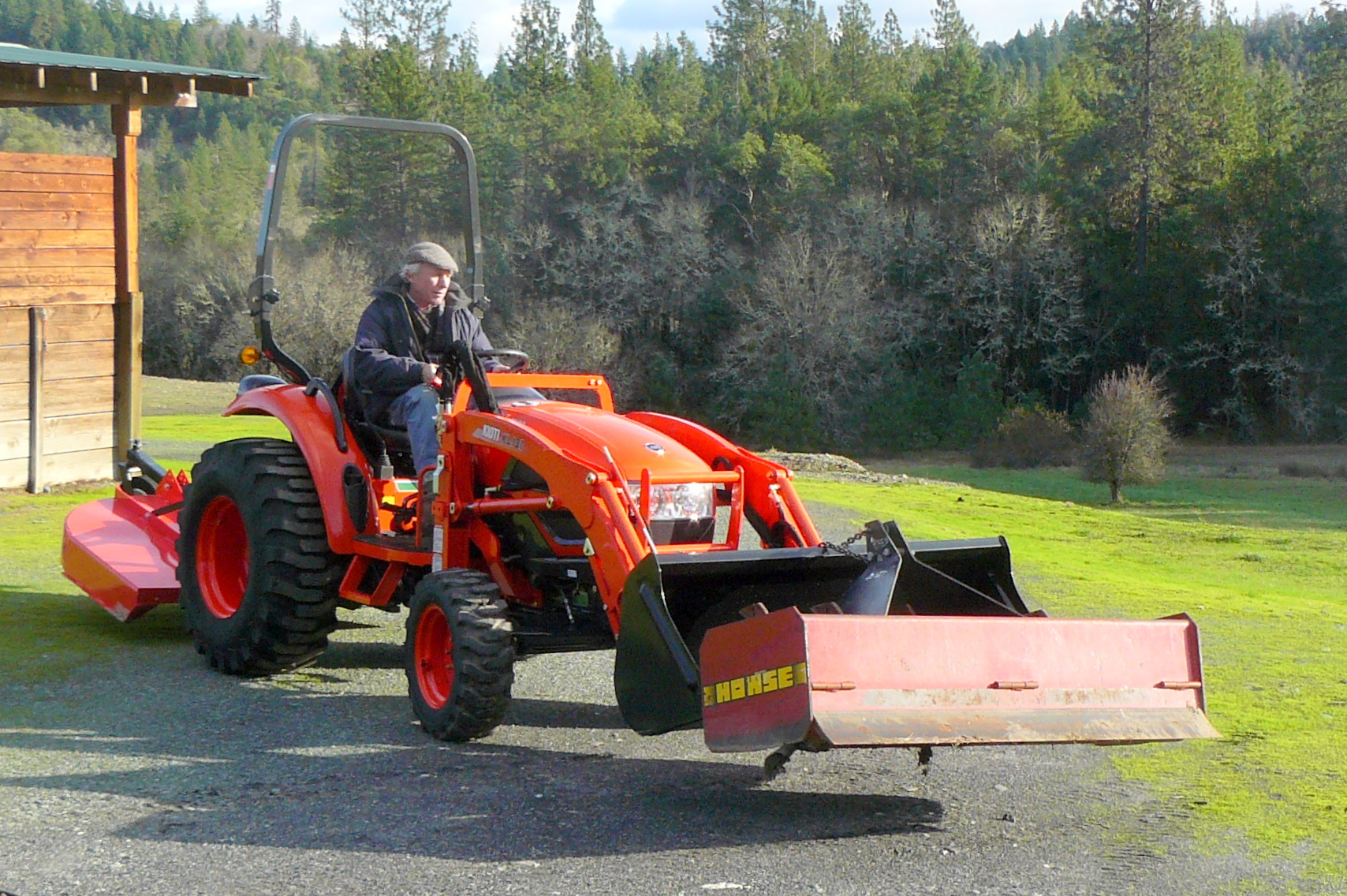
It would be so easy to beat oneself up. To stare in the mirror and despair at all the unfinished ideas that one has about being ‘sustainable’ shortly before jumping on one’s shiny new tractor, yet another symbol of our industrial civilisation. The hypocrisy, the double standards!
New tractor delivered last December.
But the mistake in any attempt at self-awareness is the assumption that you know who you are! Therein lays the problem.!
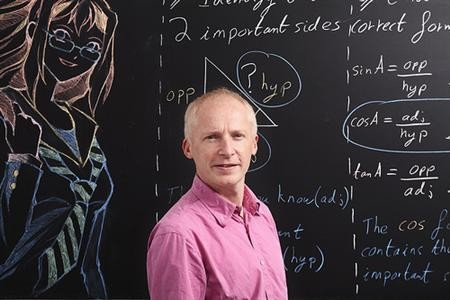
Marcus Peter Francis du Sautoy is a very smart person. This is how WikiPedia describes him.
Prof. Sautoy came to the realisation that the thoughts that make us feel as though we know ourselves are easy to experience. But where do those thoughts come from? Marcus Sautoy acknowledged that they are notoriously difficult to explain.
So, in order to find out where they come from Marcus subjects himself to a series of probing experiments. With the help of a hammer-wielding scientist, Jennifer Aniston and a general anaesthetic, Professor Marcus du Sautoy goes in search of answers to one of science’s greatest mysteries: how do we know who we are?
He learns at what age our self-awareness emerges and whether other species share this trait.
Next, he has his mind scrambled by a cutting-edge experiment in anaesthesia. Having survived that ordeal, Marcus is given an out-of-body experience in a bid to locate his true self. And in Hollywood, he learns how celebrities are helping scientists understand the microscopic activities of our brain.
Finally, he takes part in a mind-reading experiment that both helps explain and radically alters his understanding of who he is.
All of this is covered in a fabulously interesting episode from Horizon, the excellent and long-running BBC TV science and philosophy series. Thankfully, it made its way onto YouTube.
(NB: In the intervening period, that BBC Horizon programme has been removed from YouTube for copyright reasons. That’s a great shame. However, the following documentary from the good Professor will, I am sure, be equally fascinating.)
The Secret Rules of Modern Living Algorithms
Published on Oct 30, 2015
Without us noticing, modern life has been taken over. Algorithms run everything from search engines on the internet to satnavs and credit card data security – they even help us travel the world, find love and save lives.
Mathematician Professor Marcus du Sautoy demystifies the hidden world of algorithms. By showing us some of the algorithms most essential to our lives, he reveals where these 2,000-year-old problem solvers came from, how they work, what they have achieved and how they are now so advanced they can even programme themselves.
As Confucius reportedly wrote: Real knowledge is to know the extent of one’s ignorance.
One Common Thing That is More Toxic Than Chocolate for Dogs!
Note: This is a repeat of the Xylitol warning that appeared in a LfD post on the 4th. January. It is being repeated to ensure the maximum awareness of all my readers and followers.
Deborah Taylor-French is an author and also has the blog Dog Leader Mysteries. It was on her blog that I saw a reference to the acute dangers on Xylitol for dogs, and for cats. So please read and share the following.
ooOOoo
One Common Thing That is More Toxic Than Chocolate for Dogs!
Actually, I didn’t know the answer until I did the research. The startling fact that thousands of
Dog ill or sleeping?
products contain this substance stymied me. There are no warning labels for pet owners. Because these products are made for people, hundreds of dogs and cats suffer when adults or children leave these foods and productswhere pets can ingest them.
This substance naturally develops in grapes and onions. Is also an ingredient often added to gum, candy, mouthwash, toothpaste, and ear medications for children, plus it is added to many prepared foods.
Gum, candy, peanut butter all harmless, right?
WRONG! What is okay for people to eat, proves toxic for pets. Chocolate and nuts are two examples of what people can eat, yet can be lethal for pets. Xylitol damages dogs’ livers. In both people and canines liver failure often means the end of life.
A Tiny Bit Could Kill Your Dog…
In an article in The Wall Street Journal, Mark Maremont reported that,“Besides gum, xylitol is used by manufacturers in products including mints, gummy vitamins, toothpaste, specialty peanut butter and melatonin sleep aids—in part because it has about two-thirds the calories of sugar and is safer than sugar for diabetics. Some gum makers cite studies showing dental-health benefits.”
“A type of sugar alcohol extracted from plants, xylitol is well-tolerated by humans, but in dogs causes a sudden release of insulin, resulting in low blood sugar and potentially leading to seizures and brain damage. It also can cause liver failure.” Xylitol has been added to literally thousands of products. It is safe in these many products for people, but it kills dogs and cats.”
Toxin Levels for Pets in Xylitol Products
Hershey’s Ice Breakers contain 10 times the pet toxic Xylitol level per piece
“Xylitol makes up more than half the weight in certain Ice Breakers flavors, about 1.2 grams of xylitol per piece, according to Hershey’s consumer helpline. That’s about 8 to 10 times the amount of xylitol in some other popular gums. A pack of the brand, introduced in 2006, contains 40 pieces.”
Hard candies, breath mints, toothpaste, tooth whiteners, mouthwash, some jams and jellies all contain xylitol. The U.S.A. Federal Drug Administration does not require warning labels on any of these sweet treats.
As reported in the Wall Street Journal article, “A toxic dose of xylitol—enough to potentially cause low blood sugar or other symptoms—is 0.1 grams per kilogram of the dog’s weight.”
one piece of Xylitol could be toxic for a 26-pound dog
one piece is 12 times as toxic as a piece of dark chocolate the same weight
“Xylitol is extracted from plant material and is available as an ingredient (additiive) in more and more foods, but the amount naturally occurring in foods is very small. In addition to gum, xylitol can now be found in some hard candies, chocolate, table syrup, jams, and jellies.”WebMD.com/ supplements/xylitol
What other health risks does xylitol pose for pets?
“…some animal studies have shown tumor growth resulting from high doses of xylitol over long periods.…” – WebMD Warning for Dog Owners
“If you are a dog owner, be aware that xylitol can be toxic to dogs, even in small amounts”
chewable vitamins
Nicorette Gum
IceBreakers
Peanut Butter (some brands)
chocolate
tooth paste
Xlear Nasal Spray
Note: This list is far from complete.
Please read the labels on anything you put on pet level in your car and home. Dogs love sweets.
Keep these foods containing xylitol away from pets:
onions
garlic
onion like shallots, green onions, etc.
peanut butter
grapes
raisins
chocolate
anything baked with xylitol
Xylitol Poisoning Affects Canine and Feline Livers
Xylitol may kill pets that ingest it. If you suspect your dog of eating any items made with this toxin, immediately rush you pet to a veterinarian.
Symptoms of Poisoning
loss of balance
difficulty breathing
difficulty walking
refusal to drink
refusal to eat
unconsciousness
Please help dog lovers and cat lovers by sharing.
Here’s hoping all dog lovers will receive benefit from my second guest post on 4Knines’ blog. Ready to save pets’ lives? Please share this with dog and cat lovers everywhere. Spread the word about this naturally substance, artificially introduced to our homes in dozens of products. Please share and discuss the threat to pets’ health and lives from ingesting even a small amount of xylitol.
ooOOoo
As I mentioned in my introduction, do share this vital information.
And stay safe! (That applies to you and your wonderful animals!)
The challenges facing the European Union ripple out across the whole of the free world.
I note that this is the second Friday where there is an abrupt change from the run of posts during the previous few days. For last Friday I republished a George Monbiot article on Rigging the Market and today there is another Monbiot article that I want to share with you; shared with you with the kind permission of Mr. Monbiot.
Unlike last Friday’s Monbiot article that clearly had global implications, at first sight this article about the European Union has no relevance to those of us not living with EU boundaries. But that would be wrong. For the importance of protecting a country’s sovereignty and the democratic processes within that country is supreme across all democratically elected governments.
ooOOoo
The Lesser Evil
10th February 2016
I am starting to hate the European Union. But I will vote to stay in.
By George Monbiot, published in the Guardian, 10th February 2016
By instinct, like many on the left, I am a European. I recognise that many issues – perhaps most – can no longer be resolved only within our borders. Among them are grave threats to our welfare and our lives: climate change and the collapse of the living world; the spread of epidemics whose vectors are corporations (obesity, diabetes and diseases associated with smoking, alcohol and air pollution); the global wealth-grab by the very rich; antibiotic resistance; terrorism and conflict.
I recognise that the only legitimate corrective to transnational power is transnational democracy. So I want to believe; I want to belong. But it seems to me that all that is good about the European Union is being torn down, and all that is bad enhanced and amplified.
Nowhere is this clearer than in the draft agreement secured by David Cameron. For me, the most disturbing elements are those which have been widely described in the media as “uncontroversial”: the declarations on regulations and competitiveness. The draft decisions on these topics are a long series of euphemisms, but they amount to a further dismantling of the safeguards defending people, places and the living world.
What David Cameron described in parliament as “pettifogging bureaucracy” are the rules that prevent children from being poisoned by exhaust fumes, rivers from being turned into farm sewers and workers from being exploited by their bosses. What the European Commission calls reducing the “regulatory burden for EU business operators” often means increasing the costs the rest of us must carry: costs imposed on our pockets, our health and our quality of life. “Cutting red tape” is everywhere portrayed as a good thing. In reality, it often means releasing business from democracy.
There is nothing rational or proportionate about the deregulation the European Commission contemplates. When Edmund Stoiber, the conservative former president of Bavaria, reviewed European legislation, he discovered that the combined impact of all seven environmental directives incurred less than 1% of the cost to business caused by European law. But, prodded by governments like ours, the Commission threatens them anyway. It is still considering a merger and downgrading of the habitats and birds directives, which are all that impede the destruction of many of our precious places and rare species.
Alongside such specific threats, the European Union is engineering treaties that challenge the very principle of parliamentary control of corporations. As well as the transatlantic trade and investment partnership (TTIP), it has been quietly negotiating something even worse: a trade in services agreement (TISA). These claim to be trade treaties, but they are nothing of the kind. Their purpose is to place issues in which we have a valid and urgent interest beyond the reach of democratic politics. And the European Commission defends them against all comers.
Are such tendencies accidental, emergent properties of a highly complex system, or are they hardwired into the structure of the European Union? The more I see, the more it seems to me that the EU’s problems are intrinsic and systemic. The organisation that began as an industrial cartel still works at the behest of the forces best equipped to operate across borders: transnational corporations. The European Commission remains a lobbyists’ paradise: opaque, sometimes corruptible, almost unnavigable by those without vast resources.
So should those who seek a decent, protective politics vote to stay or vote to leave? If you wish to remain within the European Union because you imagine it is a progressive force, I believe you are mistaken. That time, if it ever existed, has passed. The EU is like democracy, diplomacy and old age. There is only one thing to be said for it: it is not as bad as the alternative.
If you are concerned about arbitrary power, and the ability of special interests to capture and co-opt the apparatus of the state, the UK is in an even worse position outside the European Union than it is within. Though the EU’s directives are compromised and under threat, they are a lot better than nothing. Without them we can kiss goodbye to the protection of our wildlife, our health, our conditions of employment and, one day perhaps, our fundamental rights. Without a formal constitution, with our antiquated voting arrangements and a corrupt and corrupting party funding system, nothing here is safe.
The government champs and rears against the European rules that constrain it. It was supposed to have ensured that all our rivers were in good ecological condition by the end of last year: instead, lobbied by Big Farmer and other polluting businesses, it has achieved a grand total of 17%. On behalf of the motor industry, it has sought to undermine new European limits on air pollution, after losing a case in the Supreme Court over its failure to implement existing laws. Ours is the least regulated labour market in Europe, and workers here would be in an even worse fix without the EU.
On behalf of party donors, old school chums, media proprietors and financial lobbyists, the government is stripping away any protections that European law has not nailed down. The EU’s enthusiasm for treaties like TTIP is exceeded only by David Cameron’s. His defence of national sovereignty, subsidiarity and democracy mysteriously evaporates as soon as they intrude upon corporate power.
I believe that we should remain within the union. But we should do so in the spirit of true scepticism: a refusal to believe anything until we have read the small print; a refusal to suspend our disbelief. Is it possible to be a pro-European Eurosceptic? I hope so, because that is what I am.
Two things come to mind by way of finishing today’s post.
The first is that quotation by Douglas Adams:
To give real service you must add something which cannot be bought or measured with money, and that is sincerity and integrity.
“.. sincerity and integrity.” As we see day after day in the behaviour of our dogs.
The second is Section 1 of ARTICLE 1 of The Constitution of The United States of America.
All legislative Powers herein granted shall be vested in a Congress of the United States, which shall consist of a Senate and House of Representatives.
Jim and Janet are good friends here in Merlin and live just a short distance away. Jim is also a Doctor of Veterinary Medicine (DVM) and he emailed me following my post on Saturday about being more aware of dog flu. This is what Jim said:
Hey Paul …..
I saw on your blog that you had already posted info regarding canine influenza. I don’t know if you needed any more material, but, if you are interested, attached is a client information sheet and a couple maps indicating the spread of the DZ as of 11/15.
That client information sheet explained these important details.
ooOOoo
Canine Influenza H3N2
Authored by: Dr. Mark Rishniw, ACVIM VP Client Information Sheets
What is canine influenza? Influenza in dogs is caused by canine influenza viruses (CIVs). The two main CIVs in circulation internationally are H3N8 and H3N2. Dogs are occasionally infected with human influenza viruses. These viruses are extremely contagious.
When did the current U.S. outbreak of H3N2 start? The outbreak began in the Chicago area in March, 2015.
Where have cases been reported? Geographic locations expanded in the months after the initial outbreak. To see the latest news on where it has been seen, see regularly updated information from Cornell University College of Veterinary Medicine.
What strain of influenza caused this outbreak? The 2004 outbreak, which was caused by the H3N8 strain, has remained circulating in the U.S. dog population, causing sporadic disease since that time. However, the current outbreak has been identified as a H3N2 strain of influenza A virus. This strain is closely related to an Asian strain that is circulating in China and South Korea.
Will the influenza vaccines against the H3N8 (old) strain protect against the H3N2 strain involved in the current outbreak?
Probably not. The current commercially available vaccines are not likely cross-protective against the H3N2 strain involved in the current outbreak.
What about the new H3N2 vaccines?
These should reduce the clinical signs if a dog becomes infected. They will also decrease the time that a dog remains “infective” to other dogs. They will not protect against the old (H3N8) strain.
Should I vaccinate my dog with the new vaccine?
That’s a decision for you and your veterinarian. Any place where dogs unknown to you congregate in large numbers confers an increased risk to your dog, such as boarding kennels, shows, traveling, going to dog parks, training classes, and performance competitions. Dogs that have diseases or treatments that suppress the immune system (e.g. corticosteroids, cancer etc.) are at higher risk. The virus does not survive well in the environment, so there is little risk of infection if a dog is mostly at home.
Prevention
For dog owners living in the affected areas, the best prevention is to minimize contact with other dogs. Consider avoiding places such as dog parks, dog day care, grooming facilities, boarding, training classes, and group gatherings. Walking your dog should be fine, but avoid socializing with other dogs.
If your dog in the affected areas has respiratory signs, such as coughing, hacking, gagging or difficulty breathing, call your veterinarian before your appointment to let them know your dog has respiratory signs so that they can take appropriate precautions to minimize the possibility of contaminating the facility. When you get to the clinic, leave your dog in the car and have the veterinary team meet you at the car so they can figure out how to best handle the dog.
What are signs of infection? Clinical signs range from subclinical infection, or mild fever and malaise to severe, life-threatening pneumonia; however, most clinically affected dogs have signs that are typical of kennel cough. Of approximately 1000 dogs recognized to be infected in the Chicago area, about five have died from the infection. Clinically, influenza infection is not distinguishable from kennel cough caused by other pathogens, such as Bordetella bronchiseptica.
How is canine influenza diagnosed? Tests that broadly detect influenza A virus (e.g., broadly targeted influenza A real time RT-PCR) should effectively detect both H3N8 and H3N2. However, tests targeted directly at H3N8 are unlikely to identify H3N2 infection because of limited cross-reaction between H3N8 and H3N2 antibodies.
Can other animals or people become infected with this strain? Currently, there is no evidence that people can contract this virus. However, studies in Asia have shown limited transmission to cats. Whether this can happen with the strain currently involved in the U.S. outbreak is unknown. In Asia, the H3N2 strain that infected cats (and caused disease) was considered to be of avian origin. Current information about the U.S. H3N2 strain suggests that it might be of porcine origin.
How are the dogs treated? The mild form requires minimal supportive treatment, as is the case with ANY mild upper-respiratory infection (kennel cough). Cough suppresants may be provided. Antibiotic therapy is restricted to high-risk patients. With the severe form, treatment is largely supportive. A rapid onset of disease (4-6 hours) is matched by an equally rapid improvement in clinical signs if treatment is instigated. Fluid support and broad-spectrum antimicrobials that cover both gram-positive and gram-negative bacteria are generally required.
Copyright 2015 – 2016 by the Veterinary Information Network, Inc. All rights reserved.
Most dogs in the U.S. don’t have the immunity to fight off the Asian-based dog flu. (Photo: Lindsay Helms/Shutterstock)
As animal experts around the country amplify their warnings about dog flu outbreaks, pet owners are scrambling to understand the illness and learn how they can protect their pets. Here’s what you need to know about this potentially deadly disease.
What is the dog flu?
Dog flu — or canine influenza — is an infection caused by one of two virus strains: H3N2 and H3N8. Of the two, H3N2 is more commonly seen in pets in the U.S. It is thought that the strain came from Asia, possibly originating as an avian flu that was transferred to a dog.
Dog flu symptoms
Like the flu that affects humans, the symptoms of the dog flu hit the respiratory system causing coughing, a runny nose, watery eyes and a sore throat. It’s also usually accompanied by a high fever and loss of appetite. But unlike with humans, your dog won’t be able to tell you how bad she is feeling, and you may not notice the symptoms right away. Animal experts say to watch your dog for changes in behavior. If your normally hyper dog seems lethargic or if your pup who is usually enthusiastic about eating starts skipping meals, it’s time to take a closer look.
Dogs who spend a lot of time around other dogs are more likely to be exposed to the virus. (Photo: Dalibor Sosna/Shutterstock)
How does the dog flu spread?
The dog flu virus spreads just like the human flu virus does — through bodily fluids that are released into the air via a sneeze or cough or by touching objects or surfaces that have been contaminated. The dog flu virus can live in the environment for two days.
Dogs that spend a lot of time around other dogs — in dog parks, kennels, shelters, groomers or veterinary clinics — are the most likely to contract the illness.
What to do if your dog gets the flu
Older dogs, younger dogs and dogs that are already sick are the most vulnerable when it comes to the dog flu, not because of the virus itself, but because these dogs are the most likely to develop complications, like pneumonia, that could be fatal. If you think your dog may have the flu, it’s important to check in with your vet to make sure he isn’t getting any worse.
At home, you can keep track of your dog’s temperature by placing a thermometer under her armpit, or for a more accurate reading, in her backside. According to the American Kennel Club the normal range for a dog’s temperature should be between 101 and 102.5 degrees Fahrenheit (38.3 to 39.2 degrees Celsius.)
Keep the fluids going as much as possible and try to entice your pooch to keep eating. Check with your vet about foods that may prompt him to eat without giving him a stomachache.
More than anything, give your pet plenty of time for R&R. Give her a week or so off from running, walking and other forms of exercise and just let her rest and sleep as much as she needs. Just make sure that she is still drinking, eating a little, and relieving herself.
How you can keep your dog from getting the flu?
The best way to minimize your dog’s risk of getting the flu is to keep her away from other dogs. If you spend time with other dogs, be sure to wash your hands and even change your clothes before interacting with your own dog. While humans can’t contract canine influenza, we can carry the virus on our hands and clothing for up to 24-hours after handling an infected dog.
You could also talk to your vet about a dog flu vaccine, although there is some question about its effectiveness as the vaccine for H3N8 may not offer protection from H3N2 and vice versa.
ooOOoo
If any readers have anything to add to this article, I would love to hear from you.







Sue, and everyone else, we returned from seeing Dr. Lee, the neurologist, a little under two hours ago. Dr. Lee’s prognosis is that Jean is showing the very early signs of Parkinson’s disease, and Jean is comfortable with me mentioning this.
Everyone’s love and affection has meant more than you can imagine. I will write more about this next week once we have given the situation a few ‘coatings of thought’.
Jean sends her love to you all!