Mixed emotions about those other worlds out there.
In recent times, Learning from Dogs has been reflecting on the magic, and fragility, of the planet we all live on.
There was the photograph of the Earthrise that attracted quite a few comments. That was followed up by the amazing photograph of the Earth from Voyager 1 taken in 1990 from 3,762,136,324 miles away! Then the lovely poem from Sue.
So it was interesting to note my mixed emotions to a piece on the BBC News website yesterday. Here’s a flavour.
Worlds away
Astronomers have identified some 54 new planets where conditions may be suitable for life.
Five of the candidates are Earth-sized.
The announcement from the Kepler space telescope team brings the total number of exoplanet candidates they have identified to more than 1,200.
The data release also confirmed a unique sextet of planets around a single star and 170 further solar systems that include more than one planet circling far-flung stars.
Read the rest of the item here. (and there’s a fuller version on NetworkWorld)
So here are those mixed emotions.
Man has been, and still continues to be, wonderfully curious to the point of spending huge sums of money on projects that appear to do nothing more than satisfy that curiosity. (The (Kepler) mission‘s life-cycle cost is estimated at US$600 million, including funding for 3.5 years of operation, from here.) That’s a beautiful trait, in my humble opinion.
Homo Sapiens is a wonderfully innovative and creative species, as so wonderfully presented by Alan Alda on a recent PBS Programme called The Human Spark. (See the YouTube intro at the end of this Post.)
Look at all the inventions and incredible advances to our species that are all around us – including the PC I am using and the World Wide Web that is aiding this message!
For such an intelligent species as us, why is it that we are treating Planet Earth in such a suicidal manner through greed, pollution and over-consumption!
As was reported yesterday, we could be on the verge of total and utter chaos in terms of food. Then also yesterday was a small item about food prices reaching a new global record.
It always struck me as absurd to conclude that this planet is the only habitable planet in the universe – ‘Astronomers estimate there are 1021 stars in the universe. With a conservative estimate of three planets per star (some could have many more, some would have none at all) this puts the estimated number of planets into millions of billions.‘ From here.
So the data coming in from Kepler is truly astounding and, personally, underlines this era as a great time to be alive.
But there simply is no choice in that for decades ahead, if not centuries ahead, Planet Earth is all there is for us. So why do we do it so much harm!
Our civilisation is likely to go to the very limits of survivability before the message that the existing ‘model’ is broken is picked up by every major political party in the world. That is very, very scary to contemplate.
So it looks as though, soon, mankind will face the ultimate decision of all time. Give up and let the chaos overwhelm us all, or … or what? In other words millions of us will have to live with the consequences of our greed.
The ‘or what?’ can only be a faith that it will be OK.
A faith that mankind will use the power of dreams, imagination and energy to create a new future that will, at long last, be a new dawn of democratic and just, integrous existence.
And maybe, just maybe, that could be the Second Coming and maybe, just maybe, the world’s Churches and religions will be our saving grace.
But of that day and hour knoweth no man, no, not the angels of heaven, but my Father only. Matthew 24:36
Fascinating times – a Chinese proverb, ‘It’s better to be a dog in a peaceful time than be a man in a chaotic period.’
Finally, here’s that video of the series preview to The Human Spark.
More close to man for more years than one could ever imagine.
A week ago, there was an article on Learning from Dogs entitled What is the dog? It was primarily based on the work of Dr. George Johnson; his details are here.
Anyway, last Thursday Pete N who is incredibly helpful in passing me items of interest, passed me a link to a series of videos that come under the collective name of Dogs Decoded. They were on the website Top Documentary Films itself an interesting site.
It looks as though the videos are due to be released as a single film later on this year, as this link suggests. Here’s how the three videos are introduced.
Dogs Decoded reveals the science behind the remarkable bond between humans and their dogs and investigates new discoveries in genetics that are illuminating the origin of dogs – with surprising implications for the evolution of human culture.
Other research is proving what dog lovers have suspected all along; dogs have an uncanny ability to read and respond to human emotions.
Humans, in turn, respond to dogs with the same hormone responsible for bonding mothers to their babies. How did this incredible relationship between humans and dogs come to be? And how can dogs, so closely related to fearsome wild wolves, behave so differently?
No more from me. Just find a quiet corner and watch the three videos by clicking on each link in turn. They will blow your mind.
Time to attempt an answer to this fundamental, well for this Blog, question!
Like wolves, the Dingo is smarter than pet dogs.
(The above photograph comes from an article on ImpactLab – see foot of Post for more details.)
When putting together the Blog ahead of the publication of the very first Post on July 15th, 2009, some 820 Posts ago, I prepared some additional material that set out to justify the Raison d’être for the venture. Included was a piece regarding Dogs and integrity. There I wrote:
Dogs are part of the Canidae, a family including wolves, coyotes and foxes, thought to have evolved 60 million years ago. There is no hard evidence about when dogs and man came together but dogs were certainly around when man developed speech and set out from Africa, about 50,000 years ago. See an interesting article by Dr. George Johnson.
Anyway, I revisited the article written by Dr Johnson and thought it worthy of being published in full, as a separate article in Learning from Dogs. I requested permission to reproduce the article in full and Dr. George Johnson was very gracious in quickly coming back to me giving his agreement. Thank you. The original article can be read here, the ONSCIENCE home page is here and Dr. Johnson’s details are here.
Evolution of the family dog
I first suspected that Boswell would have a short life when he bit my wife on our nuptial bed.
Boswell was my dog, a feisty Toto-like terrier who shared my bachelor bed and resented the intrusion of a woman where he felt a dog — Boswell — ought to be. As it turns out, my suspicion was correct, and he did not live out the year, which was 1982. Staying with others while I and my bride were overseas, Boswell resented being denied chicken bones, ate them anyway, and died of the consequences. To this day I miss him.
This week I found myself wondering about Boswell’s origins. From what creature did the domestic dog arise? Darwin suggested that wolves, coyotes, and jackals — all of which can interbreed and produce fertile offspring– may all have played a role, producing a complex dog ancestry that would be impossible to unravel. In the 1950s, Nobel Prize-winning behaviorist Konrad Lorenz suggested some dog breeds derive from jackals, others from wolves.
Based on anatomy, most biologists have put their money on the wolf, but until recently there was little hard evidence, and, as you might expect if you know scientists, lots of opinions.
The issue was finally settled in 1997 by an international team of scientists led by Robert Wayne of the University of California, Los Angeles. To sort out the evolutionary origin of the family dog, Wayne and his colleagues used the techniques of molecular biology to compare the genes of dogs with those of wolves, coyotes and jackals.
Wayne’s team collected blood, tissue, or hair from 140 dogs of sixty-seven breeds, and 162 wolves from North America, Europe, Asia, and Arabia. From each sample they extracted DNA from the tiny organelles within cells called mitochondria.
While the chromosome DNA of an animal cell derives from both parents, the mitochondrial DNA comes entirely from the mother. Biologists love to study mitochondrial DNA because of this simple line of descent, female-to-female-to-female. As changes called mutations occur due to copying mistakes or DNA damage, the mitochondrial DNA of two diverging lines becomes more and more different. Ancestors can be clearly identified when you are studying mitochondrial DNA, because clusters of mutations are not shuffled into new combinations like the genes on chromosomes are. They remain together as a particular sequence, a signature of that line of descent.
When Wayne looked at his canine mitochondrial DNA samples, he found that wolves and coyotes differ by about 6% in their mitochondrial DNA, while wolves and dogs differ by only 1%. Already it smelled like the wolf was the ancestor.
Wayne’s team then focused their attention on one small portion of the mitochondrial DNA called the control region, because it was known to vary a lot among mammals. Among the sixty seven breeds of dogs, Wayne’s team found a total of 26 different sequences in the control region, each differing from the others at one or a few sites. No one breed had a characteristic sequence — rather, the breeds of dogs share a common pool of genetic diversity.Wolves had 27 different sequences in the control region, none of them exactly the same as any dog sequence, but all very similar to the dog sequences, differing from them at most at 12 sites along the DNA, and usually fewer.
Coyote and jackal were a lot more different from dogs than wolves were. Every coyote and jackal sequence differed from any dog sequence by at least 20 sites, and many by far more.
That settled it. Dogs are domesticated wolves.
Using statistical methods to compare the relative similarity of the sequences, Wayne found that all the dog sequences fell into four distinct groups. The largest, containing 19 of the 26 sequences and representing 3/4 of modern dogs, resulted from a single female wolf lineage. The three smaller groups seem to represent later events when other wolves mated with the now-domesticated dogs. Domestication, it seems, didn’t happen very often, and perhaps only once.
The large number of different dog sequences, and the fact that no wolf sequences are found among them, suggests that dogs must have been separated from wolves for a long time. The oldest clear fossil evidence for dogs is 12,000 – 14,000 years ago, about when farming arose. But that’s not enough time to accumulate such a large amount of mitochondrial DNA difference. Perhaps dogs before then just didn’t look much different from wolves, and so didn’t leave dog-like fossils. Our species first developed speech and left Africa about 50,000 years ago. I bet that’s when dogs came aboard, when our hunter-gatherer ancestors first encountered them. They would have been great hunting companions.
As so often happens, for reasons quite beyond me, when I am pursuing an article idea something else crops up that is highly relevant to my musings. This was no exception.
A recent article in the Christian Science Monitor describes finding a fragment of dog bone in North America dating back some 9,400 years. Here’s a flavour of that article.
PORTLAND, MaineNearly 10,000 years ago, man’s best friend provided protection and companionship — and an occasional meal.
That’s what researchers are saying after finding a bone fragment from what they are calling the earliest confirmed domesticated dog in the Americas.
University of Maine graduate student Samuel Belknap III came across the fragment while analyzing a dried-out sample of human waste unearthed in southwest Texas in the 1970s. A carbon-dating test put the age of the bone at 9,400 years, and a DNA analysis confirmed it came from a dog — not a wolf, coyote or fox, Belknap said.
Because it was found deep inside a pile of human excrement and was the characteristic orange-brown color that bone turns when it has passed through the digestive tract, the fragment provides the earliest direct evidence that dogs — besides being used for company, security and hunting — were eaten by humans and may even have been bred as a food source, he said.
Belknap wasn’t researching dogs when he found the bone. Rather, he was looking into the diet and nutrition of the people who lived in the Lower Pecos region of Texas between 1,000 and 10,000 years ago.
The article then, a little later, goes on to say:
Dogs have played an important role in human culture for thousands of years.
There are archaeological records of dogs going back 31,000 years from a site in Belgium, 26,000 years in the Czech Republic and 15,000 years in Siberia, said Robert Wayne, a professor of evolutionary biology at UCLA and a dog evolution expert. But canine records in the New World aren’t as detailed or go back nearly as far.
Darcy Morey, a faculty member at Radford University who has studied dog evolution for decades, said a study from the 1980s dated a dog found at Danger Cave, Utah, at between 9,000 and 10,000 years old. Those dates were based not on carbon-dating or DNA tests, but on an analysis of the surrounding rock layers.
“So 9,400 years old may be the oldest, but maybe not,” Morey said in an e-mail.
Morey, whose 2010 book, “Dogs: Domestication and the Development of a Social Bond,” traces the evolution of dogs, said he is skeptical about DNA testing on a single bone fragment because dogs and wolves are so similar genetically.
My last extract is as follows:
Darcy Morey, a faculty member at Radford University who has studied dog evolution for decades, said a study from the 1980s dated a dog found at Danger Cave, Utah, at between 9,000 and 10,000 years old. Those dates were based not on carbon-dating or DNA tests, but on an analysis of the surrounding rock layers.
“So 9,400 years old may be the oldest, but maybe not,” Morey said in an e-mail.
Morey, whose 2010 book, “Dogs: Domestication and the Development of a Social Bond,” traces the evolution of dogs, said he is skeptical about DNA testing on a single bone fragment because dogs and wolves are so similar genetically.
Fascinating.
Finally, going back to the photograph at the top of the page, this came from an article here in ImpactLab. It’s well worth a read.
I have received quite a few emails in response to a mailing sent out by me yesterday promoting the fabulous work being done by a dog rescue centre near Payson, here in Arizona. Thank you for letting me know you are adding your support to this great effort by Tara’s Babies to win $250,000 from Pepsi!
c. Have a Facebook page?
1. Click here
2. Click on “Vote for this Idea”
3. Click on “Login with Facebook account”
4. Click on “Vote for this Idea” again!
A rare request from Learning from Dogs asking if you will vote on behalf of a dog rescue centre.
Many who follow this Blog will know that my beautiful wife, Jean, is totally devoted to dogs, especially rescue dogs. Over the years that she and her previous husband Ben, who died in 2005, lived in Mexico, Jean must have rescued at least 70 dogs. Even today, we have 11 ex-rescue dogs enjoying a fabulous life in our mountain home here in Payson, Arizona.
So it was a big surprise to come across a dog rescue organisation called Tara’s Babies and find that their sanctuary is in our neighbourhood.
Photo by Wib Middleton
Here’s a description of the organisation taken from the local newspaper from September 9th, 2009.
By Alan R. Hudson
Gazette/Connection Correspondent
It has been nearly five years since Tara’s Babies Animal Welfare began rescuing animals displaced by Hurricane Katrina. Tara’s Babies operates a no-kill animal rescue and sanctuary “off the grid” at the Ellinwood Ranch, near Young.
A few dogs from the dark days of Katrina still remain and many more have been added since. This is no normal animal rescue however: It is operated by three very dedicated and compassionate ordained Buddhists.
Kunzang Drolma, a Buddhist Nun and the director of Tara’s Babies, graciously invited the Connection to spend the afternoon at the facility. When we arrived, she was (as we had anticipated) wearing her Shamtab—the traditional Buddhist robe—as she fed her canine adoptees.
From that article Drolma explains:
“Katrina was a catastrophe that threw it in everyone’s faces but ultimately, every day, hundreds of dogs and cats are being euthanized in shelters because there’s not enough space for them—just because they were abused, homeless, old or sick. And so that’s when we just moved straight into this process of being a no-kill rescue and sanctuary. We will never euthanize.”
What’s needed, explained Drolma, is a paradigm shift. One that is so profound that shelters will become a thing of the past. While euthanasia is something that Tara’s Babies does not agree with, the solution lies at a higher cultural level.
Frankly, my view is that we need solutions to so many of life’s problems to come from a ‘higher cultural level’ but this Post is about helping Tara’s Babies raise more funds to help their mission. It’s easy for any of you to help. You can do it now from your computer.
Go here – http://www.tarasbabies.org/pepsi_refresh.html and read. If you need convincing of the purpose watch this video (the one at that last web page or direct from YouTube as below).
And from that web-link you can read:
Feel free to copy and personalize the following paragraph to send to your friends:
“Have you heard about Tara’s Babies Animal Welfare, a No-Kill Dog Rescue and Sanctuary in Arizona? They started rescuing dogs left homeless and injured by Hurricane Katrina, after their founder, Jetsunma Ahkon Lhamo, felt compelled to act on seeing the devastation and suffering in the Gulf. They have continued rescuing dogs on death row in overcrowded shelters ever since.
Tara’s Babies Animal Welfare is working to win a $250,000 Pepsi Refresh grant by receiving the most votes for their project in the month of January. The grant will allow them to improve the care they provide to dogs at their beautiful, off-the-grid Sanctuary.
I am going to help Tara’s Babies Animal Welfare by voting for them daily in the Pepsi Refresh grant program and hope that you will too. Please visit www.tarasbabies.org to check them out. You will be able to sign up from their website to support their application to Pepsi Refresh.
The dogs need your vote!”
Here, here! It’s very quick to initiate and then each day all you need to do is to add your daily vote – a few seconds of your life exchanged for the rest of the life of a dog that, otherwise, would have nowhere to go!
This originally came in as a comment to the recent Post published on the 16th Postscript on dear Corrie. I decided that it deserved a more prominent position than as a comment to a previous article. This is what Suzann wrote:
My husband and I and our 3 rescue dogs were living at the time in an RV park in San Carlos, Sonora, Mexico, while waiting for our newly purchased lot to become available where we were going to base the ‘bus’.
I had just walked my dogs and saw a pack of dogs running down the side of the main road into town toward me. After quickly returning my dogs to our RV across the road, I gathered some food together and hurried back to the road to feed this pack of street dogs.
I noticed one of the dogs had such a distinctive coat; the coloring and configuration was unique.
I put several food dishes down and stepped back to let the dogs eat. As I was standing there, the dog with the distinctive, white with brown markings all over her, came up to me.
Unusual for most street dogs, her manner was quite friendly. I led her back to the food and waited whilst she ate. I gradually turned and walked back across the street to the RV park. I got to the middle of the road and felt something bump my leg. I looked down and there was this lovely dog, gazing at me with friendly, caring eyes; I was amazed! She had practically glued herself to my leg!
I turned and walked back to the food and she followed me. But when I tried to cross the street again, she was right there, walking right next to me, leaning against my leg! My goodness I thought to myself…now what do I do?
I was instantly drawn to her….she was so friendly and had a very caring look in her eyes as she looked up at my face. Now what was I going to do? It’s 5-ish in the evening, I can’t take her to my coach as I have 3 dogs sitting there, and I did not know what to do.
I called to my husband to bring my cell phone to me, and dialed my best bud, Jeannie, and told her the story…..she had a packet of dogs herself, and we talked about it for several minutes about what the options were.
I asked, nay begged her, to drive over and see if we could take the dog somewhere and perhaps find a place to house her for the night….
The long and short of it was we drove around for a half hour, finding no one who could take her, and Jeannie finally said….”Oh heck, I will take her home!”
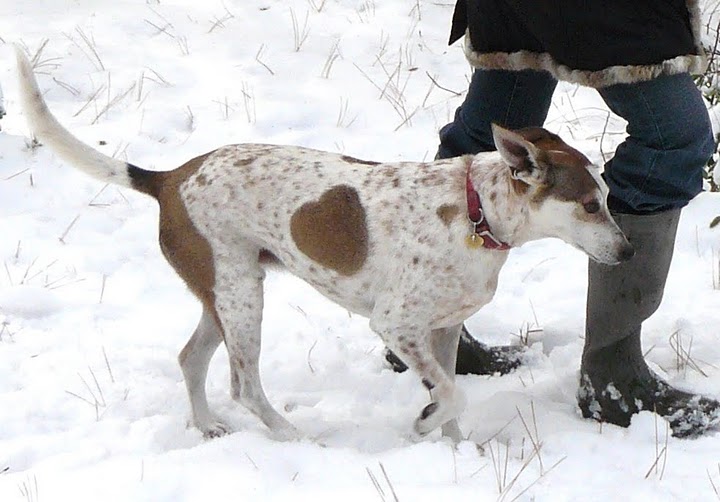
What will we call her? Well, that wasn’t too difficult, as she had hearts all over her!! It had to be Corazon as corazón is the Spanish word for heart!
We both fell in love with that dog, and thanks to Jeannie taking her in, Corrie has had good years of love, good food, a loving home and a wonderful life.
I will never forget that dog. She was always bright and cheery, always had a kiss for me, such a sweet heart. I will always love our little Corazon….I miss her so much.
Suzann
Here are three pictures that Suzann sent.
Heart dog, CorrieAnd a larger heart!And yet more hearts!
I had the privilege of being with Corrie from September 2008 until the moment she died last week. Everything that Suzann wrote is true; she was a lovely, gentle and trusting dog.
This demonstrates so powerfully the many things that we can ‘learn from dogs’!
A lovely and unexpected result from seeing Dr David R. Hawkins last Saturday.
Jean and I drove across to Cottonwood, just South-West of Sedona in Arizona, last Saturday to attend a Question and Answer meeting hosted by Dr David R. Hawkins. It’s described on the website thus:
Question & Answer Sessions
These Saturday sessions open with a few remarks by Dr. Hawkins. He then receives and answers questions from the audience that relate to information presented in his books and lectures, as well as other spiritual matters and current events.
To my mind, apart from the pleasure of seeing this famous man in the flesh, so to speak, the event was not as inspirational as I might have hoped. Largely, in my view, because so many of the people lining up to sit opposite the great man and ask their question seemed more motivated by hero worship than in a search of their personal truth. In fact, many did not wish to ask a question, just to sit there in silence or shake his hand.
However, that isn’t the point of this piece. The point is that Jean realised, deep in her heart, what really can be achieved through the power of love. Jean had been reflecting, sitting there in the audience, about how quickly our sweet Corrie had died last Tuesday night.
Corrie was a young dog and despite the injuries she received having been fatal, Jean was still surprised that Corrie went from being conscious of her name and responding to touch to dead in about 45 minutes. She was in a great deal of pain during the last 20 minutes or so. Jean’s significant experience is that young, healthy dogs take many more hours to die from the sort of wounds that Corrie had sustained.
The epiphany that came to Jean on Saturday was that the love and comfort that Corrie was receiving from both Jean and me, gave Corrie the permission to stop fighting for her life and just go gracefully and peacefully. It doesn’t in any way lessen the tragedy of losing Corrie but from that has come the revelation that our unconditional love for that small animal made a difference, a real tangible difference during the last few moments of her physical life.
It was an unexpected but very beautiful outcome from the day.
“To understand everything is to forgive everything” Buddhist quote
Learning from Dogs has been running since July 15th, 2009. Between all of the authors and contributors there have been 813 Posts presented. None has had more comments than the Post published on the 12th January, 2010 about the loss of our dear Mexican rescue dog, Corrie. So for all our sakes, I just wanted to highlight the love that Corrie’s death has mirrored by reproducing the comments added to that article.
Corrie in Winter snow - January 2nd 2011
From Rosemarie and Joe (see the poem later on).
We are so sorry to hear of your loss of beloved Corrie. This is a beautiful picture of Jeannie with her girl! Our thoughts are with you both!
Corrie… so beautiful. I’m very sorry for your loss. Bless your hearts with peace.
From Gloria and Barry.
Sorry you lost your darling dog – today has been full of tears for us Australians so much lost in so short a time can only be thankful our family is all safe – our thoughts are with you.
I know only too well the grief of losing such a beloved friend of our most loyal of animal kingdoms.. My heartfelt thoughts are with you both. Her soul goes on, and she will be forever faithfuland stay close to those who gave her back the unconditional love she gave you.
From Becky Bains.
Our love and thoughts go out you guys. When we lost Susie we were heartbroken. One of our friends posted this to us. I hope it brings some comfort. Love to you. xx
Just this side of heaven is a place called Rainbow Bridge.
When an animal dies that has been especially close to someone here, that pet goes to Rainbow Bridge. There are meadows and hills for all of our special friends so they can run and play together. There is plenty of food, water and sunshine, and our friends are warm and comfortable.
All the animals who had been ill and old are restored to health and vigor. Those who were hurt or maimed are made whole and strong again, just as we remember them in our dreams of days and times gone by. The animals are happy and content, except for one small thing; they each miss someone very special to them, who had to be left behind.
They all run and play together, but the day comes when one suddenly stops and looks into the distance. His bright eyes are intent. His eager body quivers. Suddenly he begins to run from the group, flying over the green grass, his legs carrying him faster and faster.
You have been spotted, and when you and your special friend finally meet, you cling together in joyous reunion, never to be parted again. The happy kisses rain upon your face; your hands again caress the beloved head, and you look once more into the trusting eyes of your pet, so long gone from your life but never absent from your heart.
Dear Paul,
I just wanted to say my girl Free is there, running in the meadows and playing with her cousin.
I saw her many times after she left this earth. She was happy in my very clear visions until one day when I was so sad. I was crying over missing her. I saw her that day in my living room. Her head was leaning to one side, as if to say she didn’t understand, and I heard her spirit questioning me. I didn’t hear words out loud, but I heard her message –”I thought you promised you would be okay.”
That day, I met my girl Ruthie. I’ve never seen Free again, not so clearly, not like I did in those weeks before I found Ruthie. I know it sounds off the wall, and it is, but it sure happened.
Sometimes, I still see a picture of Free in my mind. She is always smiling and happy. I promised her I would remember our good times and as hard as I imagined that would be, every time I think of her, I nearly laugh, just like I am as I write about her.
She continues to give, even though she had to cross that bridge.
Peace to you and your family.
A poem sent in the mail to us from Rosemarie and Joe.
When God had made the earth and the sky,
The flowers and the trees,
He then made all the animals
And all the birds and bees.
And when His work was finished,
Not one was quite the same.
He said, “I’ll walk this Earth of mine,
And give each one a name”,
And so He travelled land and sea,
And everywhere He went,
A little creature followed Him,
Until its strength was spent.
When all were named upon the earth,
And in the sky and sea,
The little creature said, “Dear Lord,
There’s not one left for me.”
The Father smiled and softly said,
“I’ve left you to the end,
I’ve turned my own name back to front,
And called you Dog my friend.” Author unknown.
That’s all for today, but tomorrow I want to add a further thought about the power of love that has come out of Corrie’s sad but meaningful death.
This is not the time to engage in deep philosophical thoughts about death, dogs and what we can learn from them. I shall leave that for later.
Just to hold dear in our minds what dogs offer humanity. Dear friends, Rosemarie and Joe, who lunched with us yesterday gave us the following poem and it seems a very apt way to send out prayers into the universe.
Corrie, just 10 days ago.
With eye upraised his masters look to scan,
The joy, the solace and the aid of man.
The rich man’s guardian and the poor man’s friend,
The only creature faithful to the end. George Crabbe
Corrie died at 01:30 this morning with Jean and me holding her tight in our arms and our prayers. She was a good dog. Her loving and faithful soul will return.
Did you watch the video of Sheldrake discussing The Morphogenetic Universe? If not then you may want to start here, at yesterday’s Post.
Rather than crowd that article, here is more to provide you with a broader perspective of Sheldrake’s work.
Firstly, Rupert Sheldrake’s very interesting website is here.
Secondly, there is a video here of a talk given by Rupert Sheldrake about animal telepathy. The talk was given to an audience at Schumacher College in South Devon, England. Well worth settling down to watch – and be amazed.
Finally, there are many videos on YouTube for those that wish to explore this in more detail. Here’s a taste.


 Compassion community innovation