A fascinating talk by Rupert Sheldrake on Morphic Fields, Morphic Resonance and ESP
In 1981 Rupert Sheldrake outraged the scientific establishment with his hypothesis of morphic resonance. A morphogenetic field is a hypothetical biological field that contains the information necessary to shape the exact form of a living thing. A presentation at the Biology of Transformation Conference in 2007.
If the sub-heading means as little to you as it did to me when I was introduced to this speaker and his ideas, then hang on for a small while. But thanks to Peter N, I have had my eyes opened big time about a number of concepts. Such as have you ever wondered how at times you ‘sense’ who is ringing you before you answer the phone? Or how your pet cat or dog, especially your dog, knows when you are returning home even outside a normal pattern of your behaviour?
Rupert Sheldrake is a serious scientist, indeed a Fellow of Clare College, Cambridge University. He is a Research Fellow of the Royal Institute.
So if you trust what is presented on Learning from Dogs, then trust this one and settle down and watch the video. It will truly open your eyes in a way that you won’t anticipate. The video is 1 hour 20 minutes long but within 10 minutes you’ll be hooked!
think about dogs, whether you have one, or not, whether you like them or not; think what we learn!
Much of it best described in the words and poetry of others.
Take this, for example:
If you can resist treating a rich friend better than a poor friend,
If you can face the world without lies and deceit,
If you can say honestly that deep in your heart you have no prejudice against creed, color, religion or politics,
Then, my friend, you are almost as good as your dog.
On 15th February 1858, in the city of Edinburgh, a man named John Gray died of tuberculosis.Gray was better known as Auld Jock, and on his death he was buried in old Greyfriars Churchyard.
Bobby, a wee Skye Terrier, belonged to John, who had worked for the Edinburgh City Police as a night watchman, and the two were virtually inseparable for approximately two years.
Bobby led his master’s funeral procession to the grave at Greyfriars Cemetery, and later, when he tried to stay at the graveside, he was sent away by the caretaker.
But the little dog returned and refused to leave, whatever the weatherconditions. Despite the efforts of the keeper of the kirkyard, John’s familyand the local people, Bobby refused to be enticed away from the grave for any length of time, and he touched the hearts of the local residents.
Although dogs were not allowed in the graveyard, the people rallied round and built a shelter for Bobby and there he stayed, guarding Auld Jock.
For fourteen years Bobby lay on the grave, leaving only for food.
Here’s another well-known saying from an unknown author.
“He is your friend, your partner, your defender, your dog. You are his life, his love, his leader. He will be yours, faithful and true, to the last beat of his heart. You owe it to him to be worthy of such devotion.”
I could go on and on but let me close with this eulogy for the dog, delivered at the Old Courthouse in Warrensburg by Attorney, George C Vest sometime around 1870:
The best friend man has in the world may turn against him and become his enemy. His son, or daughter, that he has reared with loving care, may prove ungrateful. Those who are nearest and dearest to us, those whom we trust with our happiness and good name may become traitors to their faith. The money a man has he may lose. It flies away from him, perhaps when he needs it most. A man’s reputation may be sacrificed in a moment of ill-considered action. The people who are prone to fall on their knees when success is with us may be the first to throw the stone of malice when failure settles its cloud upon our head.
The one absolutely unselfish friend that man can have in this selfish world, the one that never deserts him, the one that never proves ungrateful or treacherous, is his dog. A man’s dog stands by him in prosperity and poverty, in health and in sickness. He will sleep on the cold ground when the wintry winds blow and the snow drives fiercely, if only to be near his master’s side. He will kiss the hand that has no food to offer, he will lick the wounds and sores that come in encounters with the roughness of the world. He guards the sleep of his pauper master as if he were a prince.
When all other friends desert, he remains. When riches take wing, and reputation falls to pieces, he is as constant in his love as the sun in its journey through the heavens.
If fortune drives his master forth, an outcast in the world, friendless and homeless, the faithful dog asks no higher privilege than that of accompanying him, to guard him against danger, to fight against his enemies. And when that last scene of all comes, and death takes his master in its embrace and his body is laid away in the cold ground, no matter if all other friends pursue their way, there, by the graveside will the noble dog be found, his head between his paws, his eyes sad, but open in alert watchfulness, faithful and true, even in death.
Senator George Graham Vest, speaking to a jury about Old Drum, shot in 1869
So here’s a nice distraction- thanks to Sherry Jarrell who sent them to me.
Learning from dogs!
There are about 23 or 24 pictures on the theme of what dogs mean to humans and every odd day or two over the Christmas period, you can enjoy one of them.
This is a guest Post from Chris Snuggs, a good friend of Learning from Dogs.
Dog Pack Attacks Alligator In Florida
At times nature can be cruel, but there is also a raw beauty, and even a certain justice manifested within that cruelty. The alligator, one of the oldest and ultimate predators, normally considered the “apex predator”, can still fall victim to implemented ‘team work’ strategy, made possible due to the tight knit social structure and “survival of the pack mentality” bred into the canines.
See the remarkable photograph below courtesy of Nature Magazine.
Note that the Alpha dog has a muzzle hold on the gator preventing it from breathing, while another dog has a hold on the tail to keep it from thrashing. The third dog attacks the soft underbelly of the gator.
This is not corny, this is at the heart of everything in life.
Nearly a month ago, I wrote a piece called The Power of Love. It was offered as a logical argument in favour of love – read it if you want to see what was written.
In line with the general Blog theme on here that we have much to learn from dogs and unconditional love is the BIG lesson we should take from these noble animals, here’s a lovely story that was sent to me by a dear friend.
WHOEVER DID THIS IS A VERY BEAUTIFUL PERSON
The ‘whoever’ being someone at a dead letter office within the US Postal System.
Here’s how it goes.
Our 14 year old dog, Abbey, died last month. The day after she died, my 4 year old daughter Meredith was crying and talking about how much she missed Abbey.. She asked if we could write a letter to God so that when Abbey got to heaven, God would recognize her. I told her that I thought we could so she dictated these words:
Abbey and Meredith
Dear God,
Will you please take care of my dog? She died yesterday and is with you in heaven. I miss her very much. I am happy that you let me have her as my dog even though she got sick.
I hope you will play with her.. She likes to play with balls and to swim. I am sending a picture of her so when you see her You will know that she is my dog. I really miss her.
Love, Meredith
We put the letter in an envelope with a picture of Abbey and Meredith and addressed it to God/Heaven. We put our return address on it.. Then Meredith pasted several stamps on the front of the envelope because she said it would take lots of stamps to get the letter all the way to heaven. That afternoon she dropped it into the letter box at the post office. A few days later, she asked if God had gotten the letter yet. I told her that I thought He had.
Yesterday, there was a package wrapped in gold paper on our front porch addressed, ‘To Meredith’ in an unfamiliar hand.. Meredith opened it. Inside was a book by Mr. Rogers called, ‘When a Pet Dies..’ Taped to the inside front cover was the letter we had written to God in its opened envelope. On the opposite page was the picture of Abbey &Meredith and this note:
Dear Meredith,
Abbey arrived safely in heaven.
Having the picture was a big help. I recognized Abbey right away.
Abbey isn’t sick anymore. Her spirit is here with me just like it stays in your heart. Abbey loved being your dog. Since we don’t need our bodies in heaven, I don’t have any pockets to keep your picture in, so I am sending it back to you in this little book for you to keep and have something to remember Abbey by..
Thank you for the beautiful letter and thank your mother for helping you write it and sending it to me. What a wonderful mother you have. I picked her especially for you.
I send my blessings every day and remember that I love you very much.
By the way, I’m easy to find, I am wherever there is love.
Love,
God
[The book is available on Amazon here. I have no financial interest in providing you with the link. Ed.]
Thanks Julie for sending that in – it’s a very moving example of unconditional love and generosity.
Your task is not to seek for love, but merely to seek and find all the barriers within yourself that you have built against it.Jala ad-Din Rumi 1207 – 1273
One would suspect that readers of this Post title would have many different responses to the word ‘love’. Perhaps in this harsh, economically challenged world, it seems a little quaint to think about love in anything other than a romantic sense.
But, trust me, there’s nothing quaint or ‘away with the fairies’ about reminding us all of both the power of love and the urgent need to bring that power further up the scale of human consciousness. Let’s even try and aim for where dogs are. Dogs intuitively demonstrate unconditional love to those around them that they trust.
Dog love!
Before we look at the effects of love, let’s remind ourselves of some of the outcomes from the stress and trauma generated by present times. A news item from the London School of Hygiene and Tropical Medicine published in July, 2009, said this:
Researchers at London School of Hygiene & Tropical Medicine and Oxford University estimated that soaring stress brought on by job losses could prompt a 2.4% rise in suicide rates in people under-64 years of age, a 2.7% rise in heart attack deaths in men between 30 and 44 years, and a 2.4% rise in homicides rates, corresponding to thousands of deaths in European Union countries, such as the UK.
Nor is the impact just economic. The sudden flipping from the wild optimism of the boom to the personal gloom and self-doubt of recession and system-wide financial crisis is bad for health and well-being.
So it appears as if there’s no shortage of reasons why engaging the power of love offers infinite possibilities for us all.
The BBC recently reported on research that shows that people in love can lower their levels of pain.
Love hurts, at least according to many a romantic songwriter, but it may also help ease pain, US scientists suggest.
Brain scans suggest many of the areas normally involved in pain response are also activated by amorous thoughts.
Stanford University researchers gave 15 students mild doses of pain, while checking if they were distracted by gazing at photos of their beloved.
He said: “One example is a footballer who has suffered quite a painful injury, but who is able to continue playing because of his emotionally charged state.”
He added that while the effect noticed by the Stanford researchers might only be short-lived in the early stages of a love affair, it may well be replaced by something similar later in a relationship, with a sense of comfort and wellbeing generating the release of endorphins.
“It’s important to recognise that people who feel alone and depressed may have very low pain thresholds, whereas the reverse can be true for people who feel secure and cared for.
Prof Gilbert states on his web page that “After years of exploring the processes underpinning shame and its role in a variety of psychopathologies,
Prof. Gilbert
my current research is exploring the neurophysiology and therapeutic effectiveness of compassion focused therapy.” (My italics.)
The old adage that you can’t love another if you don’t love yourself is based on very high levels of awareness. So the starting point to gaining the power of love is self-awareness. Here’s something from MIND:
Good mental health isn’t something you have, but something you do. To be mentally healthy you must value and accept yourself. This means that:
You care about yourself and you care for yourself. You love yourself, not hate yourself. You look after your physical health – eat well, sleep well, exercise and enjoy yourself.
You see yourself as being a valuable person in your own right. You don’t have to earn the right to exist. You exist, so you have the right to exist.
You judge yourself on reasonable standards. You don’t set yourself impossible goals, such as ‘I have to be perfect in everything I do’, and then punish yourself when you don’t reach those goals.
Finally, back to romantic love. The most glorious feeling in the world.
Again expressed so beautifully by Rumi: “The minute I heard my first love story I started looking for you, not knowing how blind that was. Lovers don’t finally meet somewhere. They’re in each other all along.”
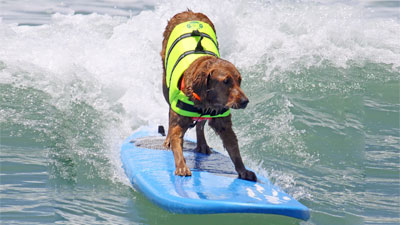
Yesterday, Learning from Dogs published a Post about Ricochet, the surfing dog.
Ricochet - follow this dog!
I was delighted to receive a ‘reply’ from this wonderful canine which is reproduced in full here.
Thank you for posting about my work. It really helps raise awareness of my causes, and I appreciate it!
Here is the latest video of me & little Ian with the brain injury. He experienced a huge milestone in this video, during the session. http://www.youtube.com/watch?v=-iIv5t2qKL4
Indeed, I have to offer my thanks for the reply from Ricochet because my travels over the last few days made it impossible to keep the Blog posts running. This reply, turned into a Post, prevented a day being missed which, if it would have happened, would have been the first missed day since the Blog started on July 15th, 2009!
This story has spread far and wide but, nonetheless, deserves a Post on Learning from Dogs because it is the essence of what dogs offer the world – unconditional love.
To gain the trust of a dog and enter the special relationship that humans have with dogs is to understand the significance of taking people at their face value and expect nothing in return, as dogs do.
Ricochet was born as a service dog and entered into the appropriate training. But there was a hic-cup in her learning, fortuitous as it happened and …. no, that’s enough from me. Watch it yourself ….
Now take a few minutes and understand what Ricochet and Ian McFarland demonstrated to the world.