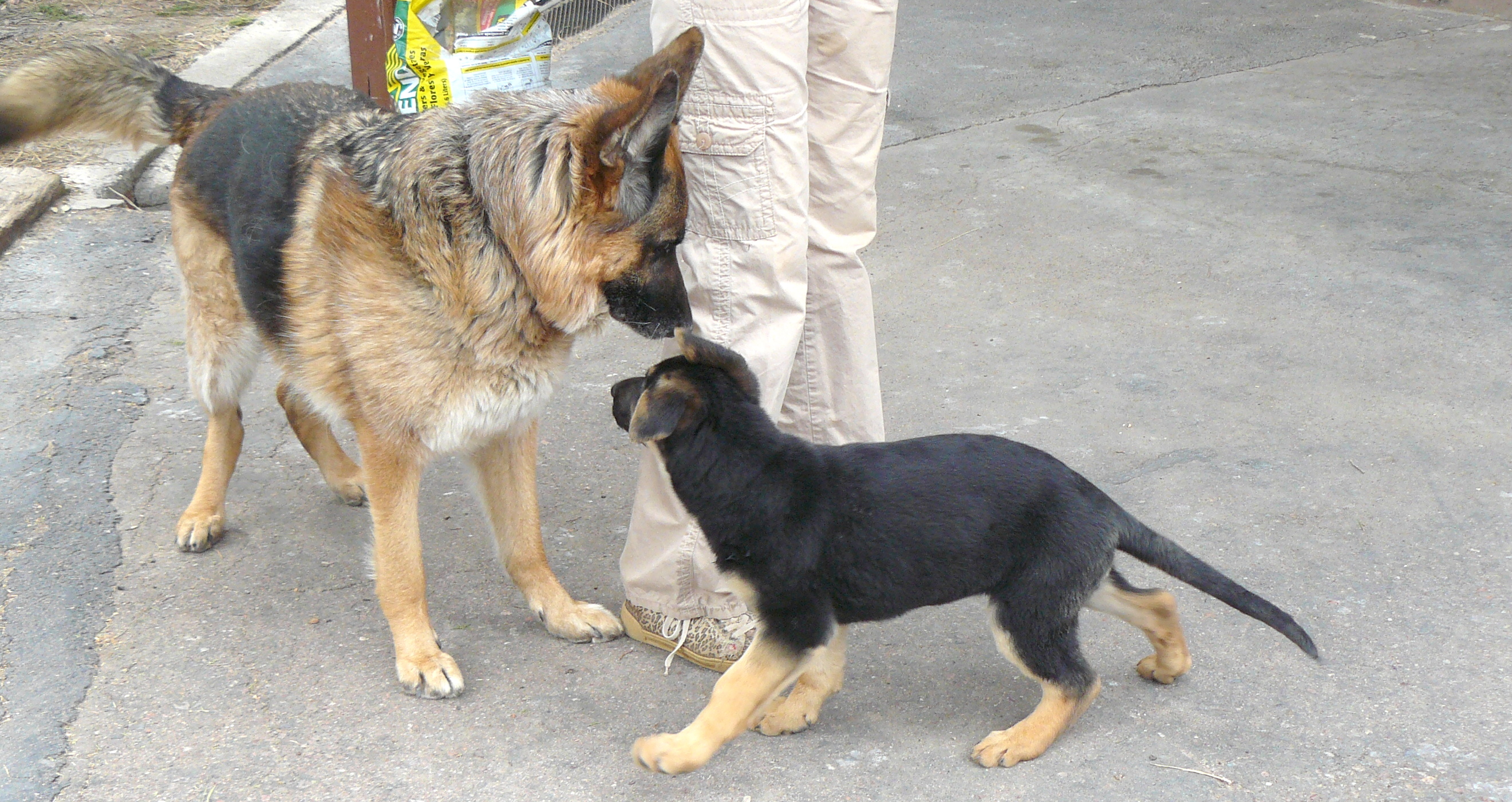
Among our group of nine dogs we have two German Shepherds. Dear old fellow Pharaoh and his much younger female playmate Cleo.
First meeting between Pharaoh and Cleo; April 7th, 2012.
Cleo was born in January, 2012 and came to us in early April that same year. From the start, Cleo has been a warm, loving and friendly dog.
For a long time, Jean has treated our dogs by giving them sawn sections, about 3/4 in thick, of beef leg bones. They love gnawing on the bone and the marrow at the centre is very good for dogs.
Thus it was on Saturday that all the dogs were enjoying their treat.
I was working outside the house and Jean and the dogs were inside.
All of a sudden Jean was calling to me, clearly stressed out, to come into the house straightaway.
I went in and found that Cleo had jammed her lower jaw through her piece of bone and that it was stuck hard behind her lower canines. Jean and I led Cleo outside so she was clear of all the other dogs.
We quickly discovered that once Cleo’s jaw was trapped in the bone, it had started rubbing against her gums, quickly creating a painful area. This made it very difficult to hold Cleo still, prise her jaw apart to try and gently remove the offending bone. The more we tried, the more agitated became Cleo.
In the end, I went inside the house to telephone a close neighbour who is also a veterinary doctor at the clinic in town where we take our dogs. Jim G. dropped everything and promised to be over in a few minutes.
As it happened, when I returned outside Jean had managed, somehow, to remove the trapped bone. I called Jim back immediately but he was already at our front gate and suggested he just take a quick look at Cleo
Here is the piece of bone after it was removed from Cleo’s jaw.
Smaller hole is about 1 & 5/8 in (4 cms) diameter.
Innocent mistake but, nevertheless, seemed like one that should be promulgated in this place just to make other dog owners aware of this tiny risk.
Cleo cautiously eying both me and the bone.
So you all take care out there!
And thank you Jim for being so responsive on what was your week-end afternoon at home.
New studies indicate the complex language used by animals.
There is so much of interest ‘out there’ that one could spend every hour of the day just reading and learning. Here’s a wonderful example.
Via a route that now escapes me, recently I came across a report entitled, The ABC’s of animal speech: Not so random after all. It was published on the PHYS.ORG website and knowing the leanings of readers of Learning from Dogs, I am confident that republishing it will be of interest to many.
The calls of many animals, from whales to wolves, might contain more language-like structure than previously thought, according to study that raises new questions about the evolutionary origins of human language.
The study, published today [August 20th] in the journal Proceedings of the Royal Society B, analyzed the vocal sequences of seven different species of birds and mammals and found that the vocal sequences produced by the animals appear to be generated by complex statistical processes, more akin to human language.
Many species of animals produce complex vocalizations – consider the mockingbird, for example, which can mimic over 100 distinct song types of different species, or the rock hyrax, whose long string of wails, chucks and snorts signify male territory. But while the vocalizations suggest language-like characteristics, scientists have found it difficult to define and identify the complexity.
Typically, scientists have assumed that the sequence of animal calls is generated by a simple random process, called a “Markov process.” Using the Markov process to examine animal vocalization means that the sequence of variables—in this case, the vocal elements—is dependent only on a finite number of preceding vocal elements, making the process fairly random and far different from the complexity inherent in human language.
Yet, assuming a Markov process exists raises questions about the evolutionary path of animal language to human language—if animal vocal sequences are Markovian, how did human language evolve so quickly from its animal origins?
In this Science Minute from NIMBioS, Dr. Arik Kershenbaum explains new research that suggests the calls of many animals might contain more language-like structure than previously thought. Credit: NIMBioS
Indeed, the study found no evidence for a Markovian process. The researchers used mathematical models to analyze the vocal sequences of chickadees, finches, bats, orangutans, killer whales, pilot whales and hyraxes, and found most of the vocal sequences were more consistent with statistical models that are more complex than Markov processes and more language-like.
Human language uses what’s called “context-free grammars,” whereby certain grammatical rules apply regardless of the context, whereas animal language uses simple or “regular” grammar, which is much more restrictive. The Markov process is the most common model used to examine animal vocal sequences, which assumes that a future occurrence of a vocal element is entirely determined by a finite number of past vocal occurrences.
The findings suggests there may be an intermediate step on the evolutionary path between the regular grammar of animal communication and the context-free grammar of human language that has not yet been identified and explored.
“Language is the biggest difference that separates humans from animals evolutionarily, but multiple studies are finding more and more stepping stones that seem to bridge this gap. Uncovering the process underlying vocal sequence generation in animals may be critical to our understanding of the origin of language,” said lead author Arik Kershenbaum, a postdoctoral fellow at the National Institute for Mathematical and Biological Synthesis.
More information: Kershenbaum A, Bowles A, Freeburg T, Dezhe J, Lameira A, Bohn K. 2014. Animal vocal sequences: Not the Markov chains we thought they were. Proceedings of the Royal Society B. rspb.royalsocietypublishing.or… .1098/rspb.2014.1370
If you wanted a reminder to be careful about what you say in front of the animals, then that study underlines that in spades, as does the closing picture!
I’m delighted to announce a new feature for Learning from Dogs, a feature that will be close to many of your hearts; of that there is no doubt.
The background.
Those who have been long-term readers of this place will have been aware that Jean and I first met in San Carlos, Mexico in December, 2007. The result of a very generous invitation from Suzann and Don Reeve for me to spend Christmas with them. Suzann being the sister of Californian, Dan Gomez, whom I have regarded as a close friend for over 35 years. I have known Suzann and Don for nearly the same time.
Suzann and Jean, Mexico, December, 2007.
Anyway, long before I came on the scene, Suzann and Jean had been working together caring for the countless feral street dogs that roam so many Mexican streets. In many cases that caring included finding new, loving homes for them in the USA. When Jean and I moved away from San Carlos in 2010, eventually ending up here in Southern Oregon almost 2 years ago, Suzann didn’t hesitate to continue caring for these Mexican dogs and, wherever possible, finding new homes for them.
Thus came the idea of promoting a wonderful dog ready for a new home here on Learning from Dogs. Who knows, maybe a reader somewhere may know of a family or a person looking for a dog and as a recent post highlighted, rescued dogs are life-savers.
Suzann caring for a feral Mexican street dog.
Thus starting today I will be promoting a particular dog that Su has sent me the details of and, hopefully, we can keep promoting a new dog every two weeks or so.
oooo
Diamonte
by Suzann Reeve
Diamonte
Each day I travel to La Manga, a part of San Carlos, Mexico, to feed at least a dozen dogs, frequently more; plus two old men every day! I need to stop off at the market several times a week for food for both species!
One day, about five weeks ago, I happened to see a Mommy dog and her teenaged pup in the middle of the road. I got out of my car and called them over, hoping they would get clear of the flow of traffic. Thankfully that happened and they quickly came close to take advantage of a bowl of food and some water that I put in front of them. It was wonderful to see the mother move away so her pup could eat first.
A few days later I returned and was delighted to see the mother and puppy again. Once more I put down food and water and, again, the mother dog held back to let her puppy feed before her.
Several days later, yes, you guessed it! Once more I put out food and water, although this time I never actually saw Momma dog eat.
A further two weeks went by before I saw them both. But this time, Momma dog was not well. She crept over to lay under a car while her daughter ate the food I put out. Then a few days after noticing the unwell mother dog, I returned and knew there was a problem. There was a message I was picking up from the mother dog. She seemed to be saying to me that she wanted me to take her puppy. So I did.
I picked up the young puppy and put her in my car. As I did so, Momma dog slowly lifted herself up, went over to my car, sniffed one door and then went around to the other side and sniffed that other door. She then looked at me as if to say thank you.
Momma dog then wandered off and lay down in the shade on the other side of the door, never eating a thing. She watched me drive out of the parking lot and I have never seen her there again.
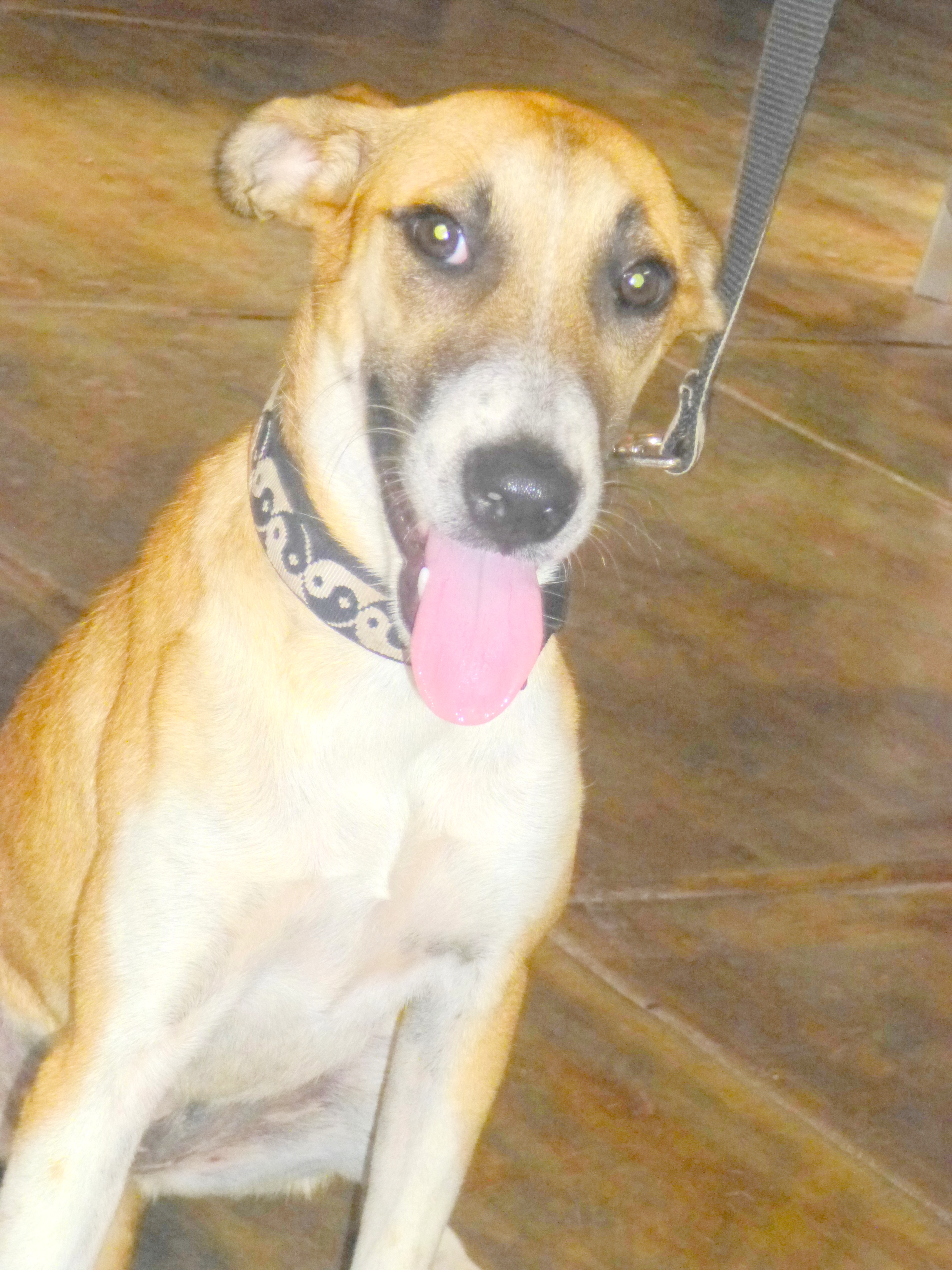
Who could resist such a lovely open, happy face! Please find a home for Diamonte.
Diamonte is a happy, bouncy little girl, presently at about 30 lbs and my guess is that she will be around 40lbs at full growth. She is a very sweet dog, always wanting to please and I regard her as a sunny and bright little girl. Diamonte is as cute as a button, with a dash of freckles over her nose. She is a quick learner and would be a lovely pet for a family or an active single person or couple.
She will receive her 2nd puppy vaccination on the 20th August and hopefully before then she will be spayed.
Note from Su:
With any dog that is ready for a new home, I always try to get the dog spayed or neutered here in San Carlos together with any necessary vaccinations.
Regarding getting the dog to you, the new owner, there are a few regular people who drive to AZ that could hook up with you or with someone who could take it on another leg in it’s journey.
There are some pilots who also fly dogs from point A to point B as well as people who would transport a dog by car in a similar manner. It all depends on networking, trying to find the right person at the right time, activities that must be done by the rescuer as well as the adopter. In other words, a joint effort to try to find a way to get the dog to you. It can be done with people who are tenacious.
oooo
If Diamonte pulls at your heartstrings or you know of someone who may feel likewise, leave a short response to this post and I will put you in direct contact with Suzann. Thank you.
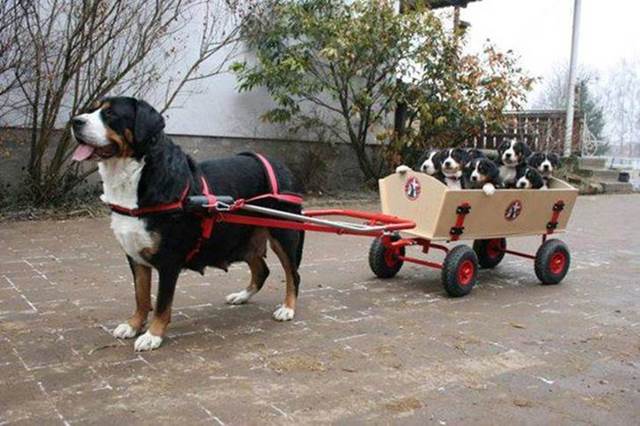
Oh, just to help those heartstrings along, here’s a repeat of a picture from last Sunday.
I am referring to politicians; but you probably guessed that.
Just my way of a lead-in to a wonderful item seen recently over on ABC Eye Witness News.
Namely:
DOG ELECTED MAYOR IN CORMORANT, MINNESOTA
Duke, the mayor of Cormorant, Minnesota.
Tuesday, August 12, 2014
CORMORANT, Minnesota (WLS) — Duke, a 7-year-old dog, was elected mayor of Cormorant, Minnesota.
“He won by a landslide,” Tricia Maloney said of the Great Pyrenees. “He’s used to coming to the pub and getting some burgers and some fries or something.”
The 12 people who live in Cormorant all paid $1 to vote.
“Poor Richard Sherbrook that owns the Cormorant store, he didn’t even have half as many votes as Duke did,” Maloney said.
The farm dog is all bark, no bite. His term lasts one year.
oooo
A quick web search found a longer version of the news item over on the CBS News website:
Duke The Dog Sworn In As Mayor Of Cormorant, Minn.
(credit: CBS)
MINNEAPOLIS (WCCO) – Every dog has his day and Saturday is it for Duke the dog.
Duke was elected mayor of the northwestern Minnesota community of Cormorant, and he was sworn in Saturday. Organizer Tammy Odegaard says Duke got gussied up Friday night, his second trip to the groomer since his election.
“He spends a lot of time at the dairy farm next door,” Odegaard said, who notes she’s now a member of Duke’s staff. “So, twice in, like, seven days for him is, like, it’s never happened. So I’m sure he’s wondering what’s going on with just that.”
His first grooming took five hours and came after the majority of the town’s 12 voters backed him in the balloting. The town pulled out all the stops for the 10 a.m. ceremony during Cormorant’s annual fair.
“We’ll have him put his little paw on the bible, going to have him have the little oath,” Odegaard said. “Of course, he’s not going to repeat it. It would be awesome if he would bark, but who knows? He’s a country dog, so he’s not used to performing on cue.”
During the two-minute inauguration ceremony, Steve Sorenson, chairman of Cormorant Township, greeted Duke and set forth his duties.
“You are about to em-bark upon a great time of service, tremendous personal and professional growth,” Sorenson said. “If you accept this challenge and these responsibilities, please bark or pant.”
Duke panted.
“I think that qualifies,” Sorenson said.
As for the mayor’s salary, a pet food store is donating a year’s supply of kibble to reward him for his service.
The village of Cormorant is located in northwestern Minnesota, near Pelican Rapids.
Duke is a seven-year-old, big, white, shaggy Great Pyrenees that loves to roll around in the dirt. Odegaard would not say if that activity qualifies Duke for a career in politics.
“You said it, not me,” Odegaard laughed.
oooo
That inauguration ceremony was captured on video; see below. Warning, the first seven minutes are a little slow! But it is worth watching, trust me!
Sorry, folks, the headline was half-designed to set you off down the wrong road. Because the television series Antiques Roadshow is well known both sides of the Atlantic.
No, today’s post is a lovely silly story sent to me by dear friend Richard Maugham back in England. Prompted by the guest post on Tuesday about the risks to dogs of throwing sticks for them.
This is what he sent me:
Antique Road Show.
Paddy took two stuffed dogs to the Antiques Roadshow.
”Ooh”, said the presenter. “This is a very rare set produced by the celebrated Johns Brothers taxidermists who operated in London at the turn of the last century.
Do you have any idea what they would fetch if they were in good condition?”
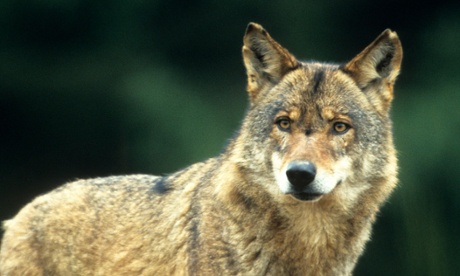
Hot on the heels of yesterday’s post The power of hope comes this wonderful story about the increasing population of wolves in Europe. I can’t recall what led me to the item in the UK’s Guardian newspaper but this is what I read:
Incredible journey: one wolf’s migration across Europe
Slavc is a wolf. In 2011, he began an epic 2,000 kilometre migration across Europe from Slovenia to Italy via the Austrian Alps. Several months earlier, he had been fitted with a collar that allowed his movements to be tracked in incredible detail. I talked to Hubert Potočnik, the biologist whose work made this possible.
It has been estimated that there are now around 10,000 wolves in Europe. Photograph: tbkmedia.de/Alamy
Every year, Hubert Potočnik and his colleagues at the University of Ljubljana in Slovenia capture and collar a number of wolves in order to get a handle on the movements of these much-misunderstood creatures. In July 2011, he collared a young male that became known as Slavc. In June, I spoke to Potočnik for a feature that appears in New Scientist this week and he told me about Slavc’s extraordinary journey across Europe. What follows is an edited transcript of the interview …
HN: After you captured and collared Slavc in July 2011, he stayed with his pack for several months. Then, on 19 December 2011, he began to move. How did you know?
HP: We knew something was different because the GPS points showed that he had crossed two large motorways far outside of his natural territory.
Tell me about these collars. How do they work?
The collar is equipped with three types of different technology. It has a GPS receiver, a GSM modem to send SMS and also with a VHF radio transmitter as a back-up. We programme all our wolves to send a GPS signal every three hours, so we get about seven locations a day to give us continuous location sampling data.
Hubert Potočnik fits Slavc with the collar in July 2011, a device that will reveal the wolf’s incredible 2000-km migration from Slovenia to Italy. Photograph: Nina Ražen
To read the rest of this fascinating article then you will need to go here. Please do so as the article is breathtakingly interesting. It closes, thus:
HN: How would you sum up this experience?
There are lots of data about long-distance dispersal of wolves but there are very few cases where we have had the opportunity to follow an animal in such detail. Following Slavc across Europe offered a rare insight into the secret life of the wolf. It was one of the most amazing events in my life.
A quick web search came across this short but wonderful video; albeit without sound.
Published on Aug 26, 2013
Two wolf cubs were documented in Lessinia Regional Nature Park on August 7, 2013. At the end of the video it is possible to partially see an adult wolf, the mother of the cubs, that was recognized as Giulietta. Giulietta and Slavc became famous because they brought together two wolf populations that were separated for over 150 years. Wolf Slavc originates from the Dinaric-Balkan wolf population and was collared in Slovenia. He travelled over 1500km over Austria to Italy, where he met Giulietta, originating from the wolf population from the western Alps (Piemonte region).
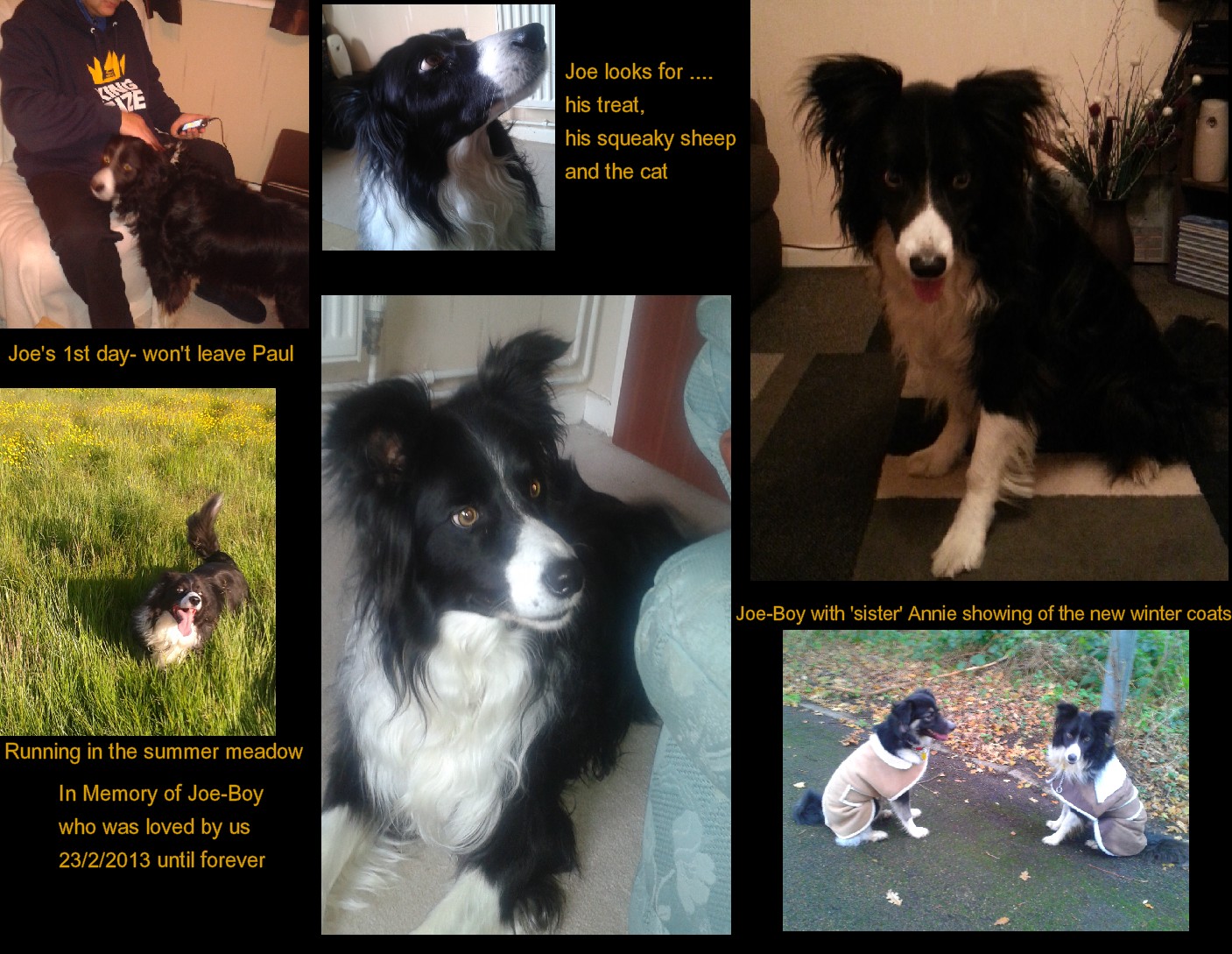
Yesterday, the guest post published by Suzan from Romania touched many of you. In that guest post there was mention of the dog Joe.
Take Joe. Joe had been sold on Facebook and bought by dog-baiters, bitten so severely vets thought he would die. You’d think that’s turned him off to humans? But no! He was a beautiful 6yr-old Collie. He was awesome. He obeyed, loved and cherished us, giving cuddles, playing gently … I’ve never had such a beauty under my roof.
I also wrote that I would publish more today. Taken directly from Mrs Skeats’ blog.
ooOOoo
Joe died but his death is still carrying a message.
It’s 19th June 2014. Joe died 6 months ago on 23rd December 2013.
Joe was a 6 year old beautiful boy taken from us after only 10 months by a cruel twist .. an accident due to a lack of information .. so I started a mini campaign. And I’ve just read about another poor soul, a friend of a friend, having to wait to see if his dog will survive a stick injury. Heartbreaking.
Ok so writing about it channelled my grief but the whole thing goes beyond that.
What was to be thought a rare, freak accident turned out to be all too familiar to vets and families worldwide. What was thought to be a personal kick in the nuts turns out to be a case of ignorance that is most definitely not bliss.
I received hundreds of comments on my first post after Joe died. I received hundreds of facebook and twitter comments too. The current ‘WordPress’ views are at over 139,000 which is great, and yet not enough. Dogs are still being treated for nasty stick injuries, vets see a few each month. I can’t preach and say stop it, but I can let anyone and everyone who cares know what a potential danger stick throwing is: better than being totally ignorant of the risks.
What happened to Joe, and happens to dogs all over the world at a frighteningly too-often rate, was borne of ignorance, stupidity, even years of “that’s what we do with dogs”. We simply never thought about the consequences it could bring.
Historically, when man decided to have dogs as pets and not merely working companions (not all that long ago in the UK) chasing a stick was a favourite game. We’ve all seen the old adverts in faded yellows and reds with a boy, stick in hand and his faithful dog panting happily as he waits for the ‘toy’ to be thrown. Why should we think it’s dangerous? We see things like celebs on the One Show with their dog, happily throwing it a stick, or in videos…. Dogs and stick throwing seems synonomous.
These are but a few stories of reasons why we should try and change this ……………..
Please think twice before you throw a stick for your dog to chase.
In memory of a beautiful dog, whose life will not ever have been in vain, but will mean so much more if we save others from pain.
ooOOoo
Please follow those links that Suzan included and read the articles. The message is clear. If you are the owner of a dog or play with dogs, don’t ever throw them a stick to catch.
As with yesterday’s post, please share this as widely as you can.
Jealous wags: Dogs show envy is ‘primordial’ emotion
By Matt McGrath – Environment correspondent, BBC News
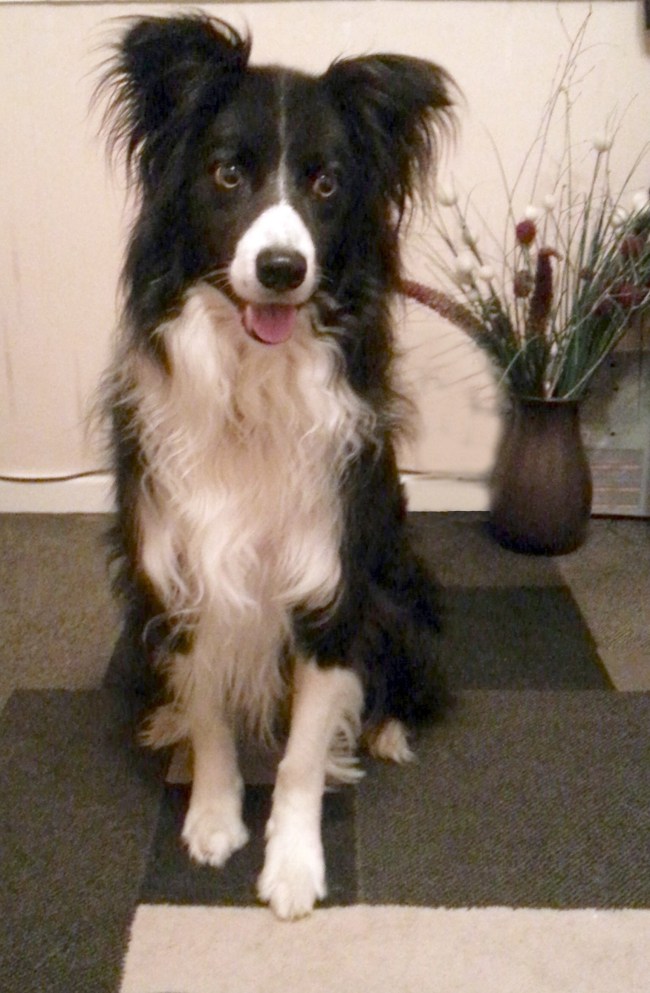
These border collies inspired the study on jealousy in dogs.
Jealousy is not just a human condition according to researchers, as it appears to be hard wired into the brains of dogs as well.
Scientists in California found that canines succumbed to the green eyed monster when their owners showed affection to a stuffed dog in tests.
Some experts have argued that jealousy requires complex cognition and is unique to people.
But the authors say their work shows it may also come in a more basic form.
These findings probably won’t be a major surprise to anyone who’s ever owned a dog, but the team say this is the first experimental test of jealous behaviours in man’s best friend.
Human jealousy is a complicated emotion, requiring a “social triangle” and usually arising when an interloper threatens an important relationship.
It is said to be the third leading cause of non-accidental homicide across cultures.
Building on research that shows that six month old infants display jealousy, the scientists studied 36 dogs in their homes and video recorded their actions when their owners displayed affection to a realistic-looking stuffed canine.
Faux fido
Over three quarters of the dogs were likely to push or touch the owner when they interacted with the decoy.
The envious mutts were more than three times as likely to do this for interactions with the stuffed dog compared to when their owners gave their attention to other objects including a book.
Around a third tried to get between the owner and the faux fido, while a quarter of the put-upon pooches snapped at the dummy dog.
“Our study suggests not only that dogs do engage in what appear to be jealous behaviours but also that they were seeking to break up the connection between the owner and a seeming rival,” said Prof Christine Harris from University of California in San Diego.
“We can’t really speak to the dogs’ subjective experiences, of course, but it looks as though they were motivated to protect an important social relationship.”
The researchers believe that the dogs understood that the stuffed dog was real. The authors cite the fact that 86% of the dogs sniffed the toy’s rear end, during and after the experiment.
Jealousy, according to the authors, may have evolved in species that have multiple dependent young that concurrently compete for food and affection.
The argue that jealousy might give an advantage to a young animal that is not only alert to the interactions between its siblings and its parents but is motivated to intervene.
“Many people have assumed that jealousy is a social construction of human beings – or that it’s an emotion specifically tied to sexual and romantic relationships,” said Prof Harris.
“Our results challenge these ideas, showing that animals besides ourselves display strong distress whenever a rival usurps a loved one’s affection.”
As I have been intimating previously, today is the start of my mother from London visiting us here in Oregon. Thus, as one would expect, time for blogging is going to be restricted. Then in a week’s time, we are also joined by my sister, Elizabeth, who lives in Tokyo. So, dear reader, you will understand if there is a deficit of creative writing, assuming you find some of it creative, why that is.
Thus today, I’m leaning heavily on a recent item I read on the EarthSky blogsite. It’s all about pronking! Yes, I hadn’t come across the word before.
ooOOoo
Does your dog pronk?
Among wild animals, pronking may be a way of avoiding predators. But when you see an animal pronk, you can’t but think it’s leaping for joy.
Alpacas, gazelles, some deer and baby lambs are all known to pronk. That is, they leap into the air as if leaping for joy, lifting all four feet off the ground at once. The fact that – in some species like sheep – young animals do it more than older ones does suggest playfulness. But, among wild animals, pronking may be a way of avoiding predators. It means something like, “Hey, I’m very fit so don’t bother chasing me.”
But how about dogs? I didn’t find much online discussion about true dog-pronking, although many of us, at one time or another, may have seen our dog leaping for joy. I recall my own dog Snoop (rest his soul) released from the car in a South Dakota meadow, leaping and running like crazy through the long grass for maybe 20 minutes, until we called him back. It was one of the most joyful things I’ve ever seen, and definitely one of my best memories of Snoop.
So enjoy the videos below. And, by the way, although it is a survival strategy for some, the very word pronk comes from an Afrikaans verb pronk-, which means show off or strut. It has the same linguistic derivation as our English verb prance.
“Pronking” seems to occur when an animal gets excited and jumps around his field, leaving the ground with all four feet simultaneousl, almost as though he had springs attached to his feet..Often these jumps can be high in the air.No-one really knows why llamas pronk. Certainly it is the response to some sort of excitement or disturbance. It is often infectious; sometimes my entire herd will take off. I am told that it isn’t only llamas but sheep and goats. Those of you old enough to remember BBC’s Magic Roundabout may well recall that Zebedee was a “pronker”. We never had a telly as kids, but I believe Zebedee was a dog (??).
Okay, well, maybe some sheep and wild animals like this young springbok – in Etosha National Park, Namibia – are the only true pronkers. Maybe true pronking has to have the downward-pointing head and stiff-leggedness. But if you ever see your dog do what the dogs in these videos do … you’ll feel happy. Image via Wikipedia.
Bottom line: Among wild animals, pronking seems to be a way of avoiding predators. But when you see an animal pronk, you can’t but think it’s leaping for joy.
ooOOoo
So there you go. Don’t say that Learning from Dogs doesn’t teach you some new words from time to time!