Category: Culture

The eyes of our dogs!

Science confirms what we instinctively understand!

That the way a dog looks deep into our eyes is more than emotional froth!

Follower of this blog, Anita, left a comment to yesterday’s post. This is what she wrote (my emphasis):

This has been a wonderful compilation of awesome photos. You must do it again sometime. Dogs are so wonderful and such great companions. They do have eyes that see straight through our very souls and ready to love us at the drop of a hat.

One of our dogs here at home, Oliver, has those eyes. When he stares into my own eyes it feels as though at some mystical level Oliver and I are connected.

Young Oliver and those eyes! (Taken 1st March, 2018.)

So imagine my surprise when reading yesterday the lead essay in The Smithsonian about the evolution of the domesticated dog and me coming across this:

The relationship has become so close that even our brains are in sync. Witness a study showing that dogs hijack the human brain’s maternal bonding system. When humans and dogs gaze lovingly into one another’s eyes, each of their brains secretes oxytocin, a hormone linked to maternal bonding and trust.

In other words, science confirms what I experience as being real!! (Undoubtedly shared by many of you!)

I have pleasure in republishing the full article.

ooOOoo

How Accurate Is Alpha’s Theory of Dog Domestication?

The ‘boy and his dog’ tale is a piece of prehistoric fiction, but scientists are uncovering the true origins of our incredible relationship with dogs.

smithsonian.com

Long ago, before your four-legged best friend learned to fetch tennis balls or watch football from the couch, his ancestors were purely wild animals in competition—sometimes violent—with our own. So how did this relationship change? How did dogs go from being our bitter rivals to our snuggly, fluffy pooch pals?

The new drama Alpha answers that question with a Hollywood “tail” of the very first human/dog partnership.

Europe is a cold and dangerous place 20,000 years ago when the film’s hero, a young hunter named Keda, is injured and left for dead. Fighting to survive, he forgoes killing an injured wolf and instead befriends the animal, forging an unlikely partnership that—according to the film—launches our long and intimate bond with dogs.

Just how many nuggets of fact might be sprinkled throughout this prehistoric fiction?

We’ll never know the gritty details of how humans and dogs first began to come together. But beyond the theater the true story is slowly taking shape, as scientists explore the real origins of our oldest domestic relationship and learn how both species have changed along canines’ evolutionary journey from wolves to dogs.

When and where were dogs domesticated?

Pugs and poodles may not look the part, but if you trace their lineages far enough back in time all dogs are descended from wolves. Gray wolves and dogs diverged from an extinct wolf species some 15,000 to 40,000 years ago. There’s general scientific agreement on that point, and also with evolutionary anthropologist Brian Hare’s characterization of what happened next. ’The domestication of dogs was one of the most extraordinary events in human history,” Hare says.

But controversies abound concerning where a long-feared animal first became our closest domestic partner. Genetic studies have pinpointed everywhere from southern China to Mongolia to Europe.

Scientists cannot agree on the timing, either. Last summer, research reported in Nature Communications pushed likely dates for domestication further back into the past, suggesting that dogs were domesticated just once at least 20,000 but likely closer to 40,000 years ago. Evolutionary ecologist Krishna R. Veeramah, of Stony Brook University, and colleagues sampled DNA from two Neolithic German dog fossils, 7,000 and 4,700 years old respectively. Tracing genetic mutation rates in these genomes yielded the new date estimates.

“We found that our ancient dogs from the same time period were very similar to modern European dogs, including the majority of breed dogs people keep as pets,” explained Dr. Veeramah in a release accompanying the study. This suggests, he adds, “that there was likely only a single domestication event for the dogs observed in the fossil record from the Stone Age and that we also see and live with today.”

End of story? Not even close.

In fact, at least one study has suggested that dogs could have been domesticated more than once. Researchers analyzed mitochondrial DNA sequences from remains of 59 European dogs (aged 3,000 to 14,000 years), and the full genome of a 4,800-year-old dog that was buried beneath the prehistoric mound monument at Newgrange, Ireland.

Comparing these genomes with many wolves and modern dog breeds suggested that dogs were domesticated in Asia, at least 14,000 years ago, and their lineages split some 14,000 to 6,400 years ago into East Asian and Western Eurasian dogs .

But because dog fossils apparently older than these dates have been found in Europe, the authors theorize that wolves may have been domesticated twice, though the European branch didn’t survive to contribute much to today’s dogs. Greger Larson, director of the Wellcome Trust Palaeogenomics & Bio-Archaeology Research Network at Oxford University, suggests that the presence of older fossils in both Europe and Asia, and the lack of dogs older than 8,000 years in between those regions, supports such a scenario.

“Our ancient DNA evidence, combined with the archaeological record of early dogs, suggests that we need to reconsider the number of times dogs were domesticated independently. Maybe the reason there hasn’t yet been a consensus about where dogs were domesticated is because everyone has been a little bit right,′ Larson said in a statement accompanying the study.

The many interbreedings of dogs and wolves also muddy the genetic waters, of course. Such events happen to the present day—even when the dogs in question are supposed to be stopping the wolves from eating livestock.

How did dogs become man’s best friend?

Perhaps more intriguing than exactly when or where dogs became domesticated is the question of how. Was it really the result of a solitary hunter befriending an injured wolf? That theory hasn’t enjoyed much scientific support.

One similar theory argues that early humans somehow captured wolf pups, kept them as pets, and gradually domesticated them. This could have happened around the same time as the rise of agriculture, about 10,000 years ago. The oldest fossils generally agreed to be domestic dogs date to about 14,000 years, but several disputed fossils more than twice that age may also be dogs or at least their no longer entirely wolf ancestors.

Since more recent genetic studies suggest that the date of domestication occurred far earlier, a different theory has gained the support of many scientists. “Survival of the friendliest” suggests that wolves largely domesticated themselves among hunter-gatherer people.

“That the first domesticated animal was a large carnivore, who would have been a competitor for food—anyone who has spent time with wild wolves would see how unlikely it was that we somehow tamed them in a way that led to domestication,” says Brian Hare, director of the Duke University Canine Cognition Center.

But, Hare notes, the physical changes that appeared in dogs over time, including splotchy coats, curly tails, and floppy ears, follow a pattern of a process known as self-domestication. It’s what happens when the friendliest animals of a species somehow gain an advantage. Friendliness somehow drives these physical changes, which can begin to appear as visible byproducts of this selection in only a few generations.

“Evidence for this comes from another process of domestication, one involving the famous case of domesticated foxes in Russia. This experiment bred foxes who were comfortable getting close to humans, but researchers learned that these comfortable foxes were also good at picking up on human social cues,” explains Laurie Santos, director of the Canine Cognition Center at Yale University. The selection of social foxes also had the unintended consequence of making them look increasingly adorable—like dogs.

Hare adds that most wolves would have been fearful and aggressive towards humans—because that’s the way most wolves behave. But some would have been friendlier, which may have given them access to human hunter-gatherer foodstuffs..

“These wolves would have had an advantage over other wolves, and the strong selection pressure on friendliness had a whole lot of byproducts, like the physical differences we see in dogs,” he says. “This is self-domestication. We did not domesticate dogs. Dogs domesticated themselves.”

A study last year provided some possible genetic support for this theory. Evolutionary biologist Bridgette von Holdt, of Princeton University, and colleagues suggest that hypersocial behavior may have linked our two species and zero in on a few genes that may drive that behavior.

“Generally speaking, dogs display a higher level of motivation than wolves to seek out prolonged interactions with humans. This is the behavior I’m interested in,” she says.

Von Holdt’s research shows that the social dogs she tested have disruption to a genomic region that remains intact in more aloof wolves. Interestingly, in humans genetic variation in the same stretch of DNA causes Williams-Beuren syndrome, a condition characterized by exceptionally trusting and friendly behaviors. Mice also become more social if changes occur to these genes, previous studies have discovered.

The results suggest that random variations to these genes, with others yet unknown, may have played a role in causing some dogs to first cozy up with humans.

“We were able to identify one of the many molecular features that likely shape behavior,” she adds.

How have dogs changed since becoming our best friends?

Though the origins of the dog/human partnership remain unknown, it’s becoming increasingly clear that each species has changed during our long years together. The physical differences between a basset hound and wolf are obvious, but dogs have also changed in ways that are more than skin (or fur) deep.

One recent study shows how by bonding with us and learning to work together with humans, dogs may have actually become worse at working together as a species. Their pack lifestyle and mentality appear to be reduced and is far less prevalent even in wild dogs than it is in wolves.

But, Yale’s Laurie Santos says, dogs may have compensated in other interesting ways. They’ve learned to use humans to solve problems.

“Several researchers have presented dogs and wolves with an impossible problem (e.g., a puzzle box that can’t be opened or a pulling tool that stops working) and have asked how these different species react,” Santos explains. “Researchers have found that wolves try lots of different trial and error tactics to solve the problem— they get at it physically. But at the first sign of trouble, dogs do something different. They look back to their human companion for help. This work hints that dogs may have lost some of their physical problem-solving abilities in favor of more social strategies, ones that rely on the unique sort of cooperation domesticated dogs have with humans. This also matches the work showing that dogs are especially good at using human social cues.”

The relationship has become so close that even our brains are in sync. Witness a study showing that dogs hijack the human brain’s maternal bonding system. When humans and dogs gaze lovingly into one another’s eyes, each of their brains secretes oxytocin, a hormone linked to maternal bonding and trust. Other mammal relationships, including those between mom and child, or between mates, feature oxytocin bonding, but the human/dog example is the only case in which it has been observed at work between two different species.

The intimacy of this relationship means that, by studying dogs, we may also learn much about human cognition.

“Overall, the story of dog cognitive evolution seems to be one about cognitive capacities shaped for a close cooperative relationship with humans,” Santos says. “Because dogs were shaped to pick up on human cues, our lab uses dogs as a comparison group to test what’s unique about human social learning.” For example, a recent Yale study found that while dogs and children react to the same social cues, dogs were actually better at determining which actions were strictly necessary to solve a problem, like retrieving food from a container, and ignoring extraneous “bad advice.” Human kids tended to mimic all of their elders’ actions, suggesting that their learning had a different goal than their canine companions’.

We may never know the exact story of how the first dogs and humans joined forces, but dogs have undoubtedly helped us in countless ways over the years. Still, only now may we be realizing that by studying them, they can help us to better understand ourselves.

Read more: https://www.smithsonianmag.com/science-nature/how-wolves-really-became-dogs-180970014/#UzuFaQFSdpuBPHmO.99
Give the gift of Smithsonian magazine for only $12! http://bit.ly/1cGUiGv
Follow us: @SmithsonianMag on Twitter

ooOOoo

I can do no better than to repeat those last two sentences of the essay by Brian Handwerk:

We may never know the exact story of how the first dogs and humans joined forces, but dogs have undoubtedly helped us in countless ways over the years. Still, only now may we be realizing that by studying them, they can help us to better understand ourselves.

For, boy of boy, do we humans need help when it comes to better understanding ourselves!

Picture Parade Two Hundred and Fifty-Three

The last set of those wonderful Kennel Club photographs.

(As with the previous weeks, words and pictures republished from here.)

Winning Kennel Club images celebrate dogs from all walks of life

  JACQUELINE GULLEDGE   July 17, 2018.

The fifth and final selection of these wonderful photographs and the story behind each one.

ooOOoo

Third Place, I Love Dogs Because…

‘Hide and Seek’ featuring Fenrir, a Border Collie. (Photo: Kirsten van Ravenhorst)

“I am an 18 year old girl from the Netherlands who loves agility, traveling and photography. The dog in the photo is Fenrir, my youngest dog. He is the perfect model, and the reason why I picked up the camera again,” said Kirsten van Ravenhorst. “The camera that I normally use is the Nikon D500, but it needed to be repaired so I used my dad’s D5200 for this photo. This photo was taken in the forest near my house. I went there with my Border Collie Lad Fenrir to test my dad’s new camera.”

Third Place, Man’s Best Friend

‘Home’ featuring Ruby Roo, a Golden Retriever. (Photo: Cheryl Murphy)

“This picture of Ruby was taken whilst she was resting with my friend Chris after playing with her daughter Nellie. My greatest passion is capturing dogs playing and having fun in their natural environment, the camera is a great way of recording what the naked eye would miss,” said Cheryl Murphy.

Third Place, Oldies

‘Resting’ featuring Bentley, a German Shorthaired Pointer. (Photo: Philip Wright)

“This particular photo was taken during an afternoon walk through a local woodland. The ferns were looking wonderful and provided a perfect natural avenue to draw the viewers’ eye in to my subject,” said Philip Wright. “I asked Bentley to lay down and he did so with the most beautiful, almost grave expression. They say that eyes are the windows to the soul, and looking at Bentley here I’d be inclined to agree.”

Third Place, Portrait

‘A Winters Storm’ featuring Hugo, a Pomeranian. (Photo: Michael Sweeney)

“‘I photographed my dog at the window here in my tenement flat in Glasgow using available natural light during a winter’s storm of hailstones, wind and rain,” said Michael Sweeney.

Third Place, Puppies

‘Let’s call it Roly Poly Puppy’ featuring Snickers, a cross breed puppy. (Photo: Robyn Pope)

“In this image, I knew the moment Snickers began rolling around on the blanket that I had to embody his zest for life in a photo that would help him find the perfect playful home. I truly love working with dogs of all backgrounds to capture extraordinary photos worthy of even the most sophisticated pet parents and discerning commercial clientele,” said Robyn Pope. “At home, we have six gentle giants of our own who serve as ambassadors on our 7-acre pet photography property and the ultimate creative muses.”

Third Place, Rescue Dogs and Dog Charities

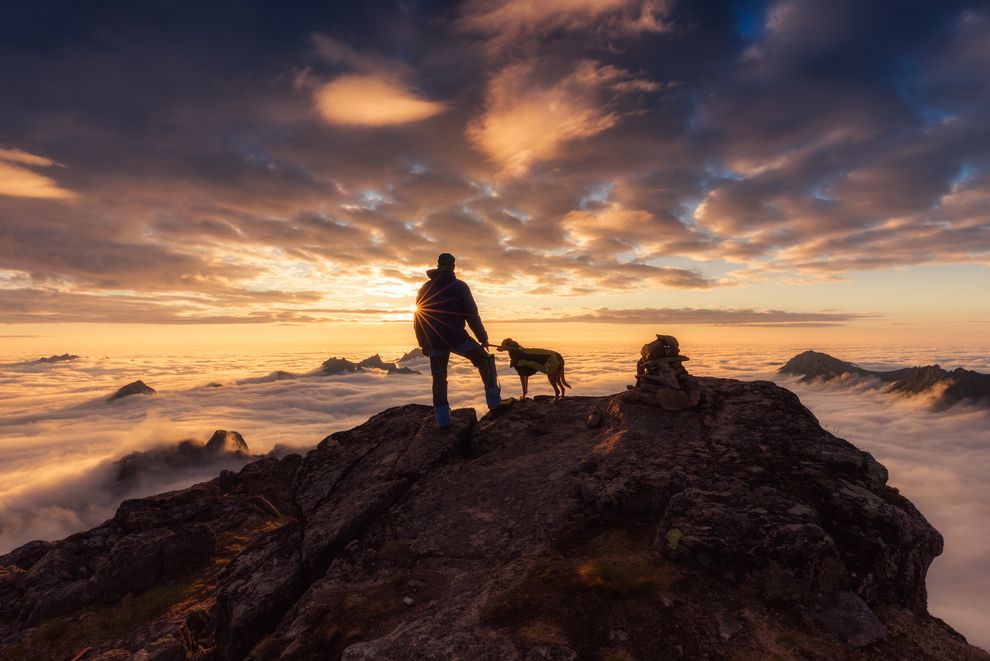
‘Over the sea of fog’ featuring Dania, a cross breed Portuguese Podengo. (Photo: Christina Roemmelt)

“My name is Christina and I was born in Munich. I moved to a small village next to Innsbruck in Austria together with my husband 11 years ago. After having settled down, we adopted two rescue dogs from Spain, thrown away like garbage, found in a dustbin. It wasn’t possible to literally touch Dania for the first six month. Now we spend all the time together. The dogs accompany us to work and in our leisure time we explore the nature together,” said Christina Roemmelt. “My wish was to fix the special mood of these moments, staying outside, enjoying nature together and acting as a team. For this reason, inspired by my husband, who is a landscape photographer, I got in touch with photography three years ago.”

“On the picture you can see one of these very special moments. We hiked on Keipen on Senja [Norway] last year and stood speechless on top when the nature was bathed in golden light by the midnight sun. Everything was calm and peaceful. The dogs and us were completely on our own. This is one of my absolutely all-time favourite pictures from our trips.”

Third Place, Young Pup Photographer

‘Monty’ featuring Monty, a German Shorthaired Pointer. (Photo: Maisie Mitford)

“I live in the North East of England with my Mum, Dad, Sister Millie and two dogs; Monty & Chester. I have always loved animals and I am constantly entertaining my dogs. I have my own lightweight camera which I carry with me most places and always photographing the dogs,” said Maisie Mitford. “Mum had given me her camera (which is really heavy) and set me a challenge to photograph either Monty or Chester for this competition, Chester wasn’t interested but Monty was willing and keen to please — lots of treats were involved!”

The Kennel Club in the U.K. was founded in 1873 and is the oldest recognized kennel club in the world. The organization is “dedicated to protecting and promoting the health and welfare of all dogs. Besides being a voluntary register for pedigree dogs and crossbreed dogs, we offer dog owners and those working with dogs an unparalleled source of education, experience and advice on puppy buying, dog health, dog training and dog breeding.”

ooOOoo

What an incredibly wonderful set of photographs and, in addition, the wonderful reflections of the photographers themselves.

If you missed the start of these photos then go here.

I shall miss these beautiful photographs and the background stories!


People!

What a complex lot we are!

(And that’s putting it kindly!)

I wasn’t planning to publish a post for today. But then a recent post from Patrice Ayme spurred me to so do.

Let me explain.

Our nearest town, Grants Pass, has the wonderful Rogue River flowing through it and alongside it there is Riverside Park. To quote:

Riverside Park in Grants Pass was set aside by our founders for the enjoyment of our citizens and guests.

People come from all over to Riverside Park to watch the majestic Rogue River as it courses its’ way through our city.

As you can see it is a popular place for ducks and geese.

Last Tuesday, we had a contractor completing some new guttering for the house. Terry, the owner of TC Gutters, ran out of the coated aluminium he was folding into the correct shape using a rather cute machine!

Terry apologised and said that he would need to run back into Grants Pass to pick up some more of the sheeting.

He returned a little later and I went over to chit-chat with him.

He was unexpectedly downcast.

Terry, is there a problem?

Paul, when I was in town, down at the bottom of 6th Street near the bridge, there was a flock of ducks crossing the road.

Terry paused for quite a while; I stood there next to him with not a clue as to what was coming.

He sighed, and continued: “Instinctively, I slowed down along with a number of other drivers. But what really upset me was the fact that a few drivers were clearly gleefully driving into the ducks and killing them!

It hurt me to hear that; very much so!

Is it too strong for me to regard those drivers who thought it great fun to drive into those ducks as being evil?

A stock photo courtesy Alamy.

What do you think?

All about Lexi!

Lexi is a wonderful young dog.

Those poor souls who keep on calling in to this place will most likely be aware of my very long-term friend Dan Gomez.

For all of the nearly forty years that I have know Dan he has always had a dog in his life.

Just a few days ago, Dan sent me an email with some pictures of Lexi, a young dog that he has had since she was a puppy.

Lexi! (Photograph taken at the Sante Fe ski basin.)

Or in Dan’s words:

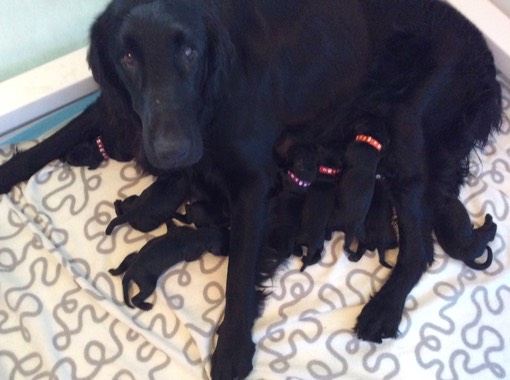
Lexi has been a magnificent example of an adventurous Flat-Coated Retriever.

She’s a wonderful hiker, swimmer, hunter and a great greeter on the trail. She’s happiest when she has her leash clenched in her teeth, parading around from person to person before continuing on her way.

What a great breed these dogs are!

Lexi came from the Brazilian breeder Keli: “Keli is the breeder, a fantastic Brazilian living in a wonderful estate in the hills of San Jose.“; to use Dan’s words.

Apparently, Keli plans for pups that year were taken out of her hands. For the reason that Lexi’s parents, Schmee and Party, decided to creep off into the bushes one day, and:

Schmee and Party are the popular names for the sire and dam and they were free from the kennel one day when Keli was off on a trip and they mated. So, the pups were “accidents”.  But, most assuredly, great accidents!

As Keli’s website explains:

Schmee x Party

Born October 11, 2015

7 girls, 3 boys

Pedigree

J Litter Gallery

While this repeat of our G litter was not planned … We welcomed these ten pups with open arms after seeing the success of the 3 intact G puppies and the stories from owners of other G pups who just adore their dogs.  Not surprising at all, based on Schmee and Party being complete mushballs who just want to hold on to you, be with you and be loved by you.  This litter has surprised and delighted us already with three pointed puppies … Juice, Callie & Popper in their first year of showing.  I cannot wait to see what 2017 holds for them.

Introducing …

Saudades’ Juicy Fruit aka The Juice

Saudades’ Just Do It aka Lexi

Saudades’ Jaboticaba aka Callie

Saudades’ Jelly Belly aka Imogene

Saudades’ Jumbalaya aka Olivia

Saudades’ Jundiai aka Stella

Saudades’ Jasmine Jubilee aka Jasmine

Saudades’ Jewel for Tomme aka Banks

CH Saudades’ Jalapeno RN CGC aka Popper

Saudades’ Jalisco aka Buck

Dan’s email closes:

She will be three in October and her health and performance has been great. She had Rattlesnake aversion training last year in Palm Springs and did very well. She ran a gauntlet of four snakes to learn sound, site and smell.

She’s had two rattler encounters. On one hike, she encountered a rattler, approached it but stopped on a dime when it rattled loudly. I was someway behind, heard the rattle and whistled to her and she backed away, came immediately to me.

Nature vs. training worked perfectly.

We are still hiking two times daily between 3 and 7 miles total all over the West. Addicted.

Schmee and Party were a great “accident”!

Garden of Gods, Colorado

oooo

Sheridan, Wyoming.

Again and again, our lives are so incredibly enriched by having a dog (or six) in our lives!

Learning about our smaller dogs!

Learning about the way they pee!

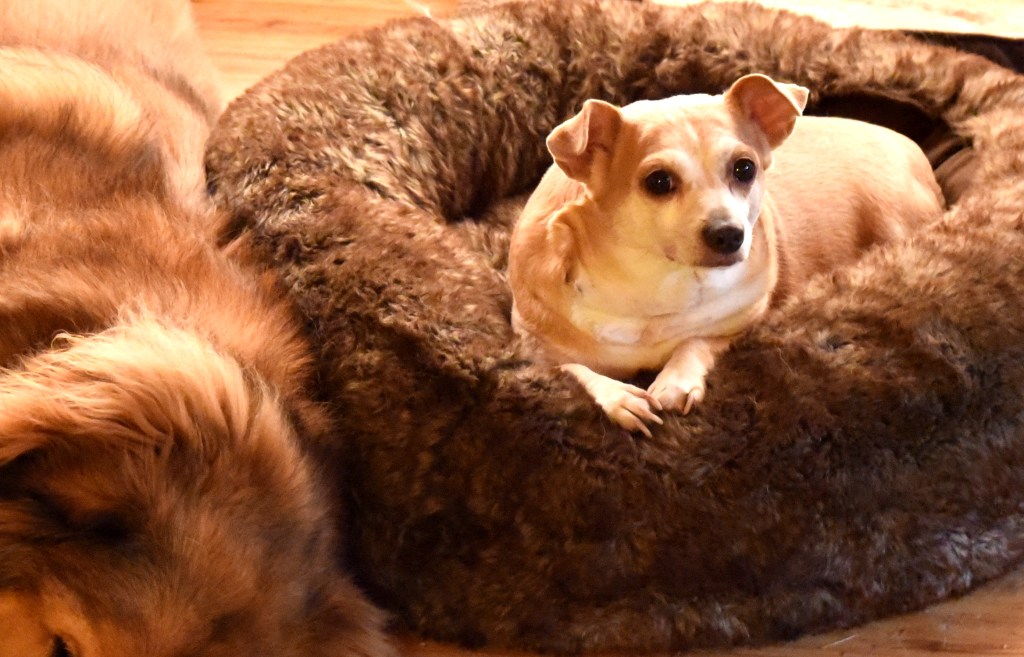
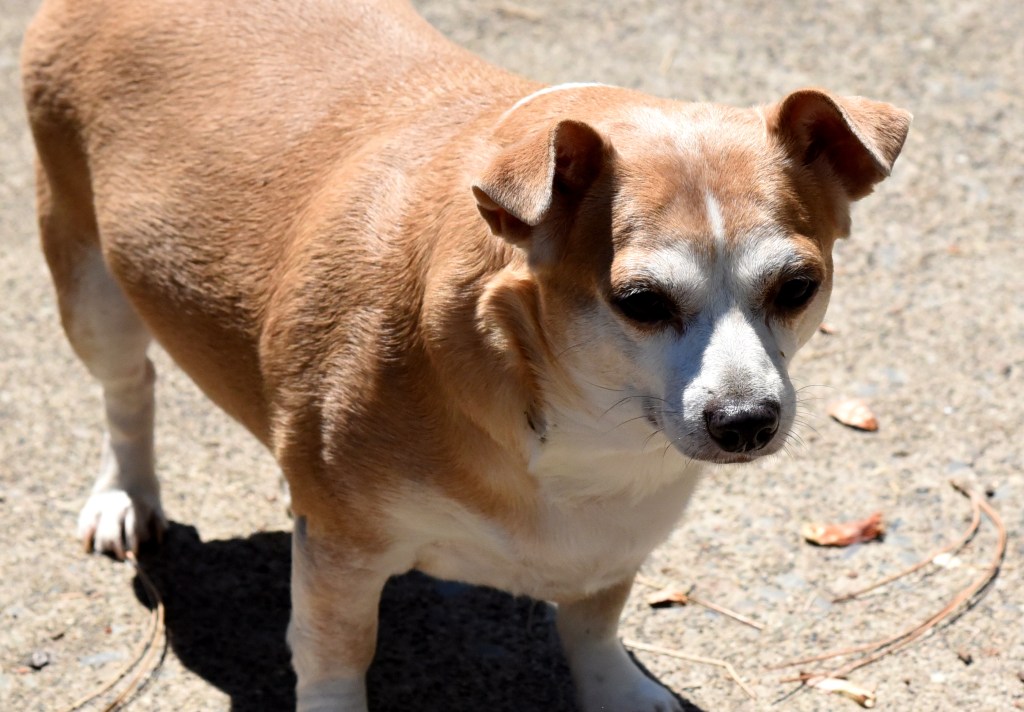
We have two smaller dogs in our family, Sweeny and Pedy.

Gorgeous Sweeny!
And equally gorgeous Pedy alongside his mate, Brandy, just visible bottom left.

I am sure many of you have dogs that are smaller then the average dog; whatever that means!

So the article that was published, once again on Mother Nature Network, will strike a chord!

ooOOoo

Removed because of copyright infringement.

ooOOoo

“So they aim high to look big.”

I’m sure there must be a joke somewhere there but can’t find it!!

So closing with another two pics of our little ones.

Pedy

oooo

Pedy in front of Sweeny. Picture taken October, 2016.

Picture Parade Two Hundred and Fifty-Two

The penultimate set of those wonderful Kennel Club photographs.

(As with the previous weeks, words and pictures republished from here.)

 Winning Kennel Club images celebrate dogs from all walks of life

  JACQUELINE GULLEDGE   July 17, 2018.

The fourth selection of these wonderful photographs and the story behind each one.

ooOOoo

Second Place, Portrait

‘Waiting Beauty’ featuring Thalia, a Nova Scotia Duck Tolling Retriever. (Photo: Katarzyna Siminiak)

“This photo was taken during session around Old Market Square in Poznań. I’m still amazed how Thalia was calm and focus despite the city noise,” said Katarzyna Siminiak.

Second Place, Puppies

‘Sticking Together’ featuring Beagle mix puppies. (Photo: Charlie Nunn)

“Since early last year, my partner Raymond Janis and I have had the honour of supporting the Vanderpump Dogs Foundation in Los Angeles by photographing their adoptable dogs. In July 2017, we met these adorable beagle mix puppies,” said Charlie Nunn. “As Raymond tried to wrangle them, something magical happened and I was able to capture a perfect moment of a puppy family sticking together.”

Second Place, Rescue Dogs and Dog Charities

‘Happy Girl Rescued’ featuring Magda, a rescue dog cross breed (Hungarian Vizsla and Labrador Retriever). (Photo: Leslie Plesser)

“This particular image is of my own rescue dog, Magda. She was a bit hesitant and shy when my husband and I came home with our baby, but when the baby went off to nursery school, she would curl up on his rocking chair and roll her fur all over, settling in for a nice nap,” said Leslie Plesser.

Second Place, Young Pup Photographer

‘Dinner?’ featuring Dallas, a Whippet. (Photo: Sienna Millward)

“My name is Sienna Wemyss, I’m 10 years old and I’m from England, UK. When I grow up, I want to be a fashion photographer and designer. I have loved dogs since I first encountered one! There are so many different kinds of dogs and they are all so unique,” said Wemyss. “My dream came true in January this year when I became the proud owner of Dallas, a pedigree Whippet puppy. I was overjoyed!”

“I was relaxing on the sofa one day when Dallas crawled beside me. I put my arms out, expecting him to come and cuddle me. Instead, he gazed at the kitchen dreamily! If he could speak then, I bet he would have said, ‘Dinner?’ He looked very curious, so I grabbed my mum’s phone and captured the moment.”

Third Place, Assistance Dogs and Dog Charities

‘A Veterans Best Friend’ featuring Delta, a White Swiss Shepherd. (Photo: Craig Turner-Bullock)

“I am an ambassador for the Kotuku Foundation for Assistance Animals Aotearoa, who source, train and place dogs with people who have any diagnosed condition that dogs are known to be capable of assisting with. This includes diabetes, head injuries, depression and PTSI and many more,” said Craig Turner-Bullock. “Dion is a veteran who fought, and was injured, at the battle of Baghak in 2012. He experienced PTSI and says that ever since Delta came into his life she has made a huge difference. Dogs assisting veterans are now common around the world, but Delta is the first of her kind here in New Zealand.”

Third Place, Dogs at Play

‘Snowy Shenanigans’ featuring Daffy, Taz, and Wile E., Nova Scotia Duck Tolling Retrievers. (Photo: Sarah Beeson)

“We had just moved from one of the snowiest cities (Erie, PA) to the middle of nowhere USA (yes, I love you dear Indiana). I didn’t expect much snow, but come on! It was nearly mid-February and not a flake! My boys were used to lots of snow having lived in Erie but Daffy hadn’t a clue,” said Sarah Beeson. “And then, it happened: Old man winter arrived. Shame on him, while I was at work, no less! By the time 5 pm rolled around, I was in our backyard – Frisbee soaring and camera in hand. Meet Daffy, Taz, and Wile E. We LOVE frisbee!”

Third Place, Dogs at Work

‘I’ve got your back’ featuring Nyx, a German Shepherd Dog. (Photo: Ian Squire)

“For me, the title sums up the image perfectly from both sides. This is a young trainee Police Dog undergoing some initial training. Taken on a miserable, damp day, it shows elements of the bond, trust and relationship that is vital for the partnership between Police Dog and handler,” said Ian Squire.

ooOOoo

Just one more Sunday’s worth to come. Don’t know about you but I shall miss these. They are going to be a hard act to follow!

Raw Dog and Cat Food recall

This was received yesterday afternoon regarding G and C Raw Dog and Cat Food Recall

ooOOoo

G and C Raw Dog and Cat Food Recall

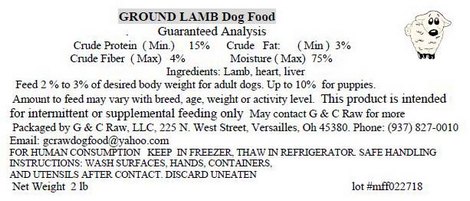
August 3, 2018 — G & C Raw of Versailles, OH is recalling 30 1–pound containers of Pat’s Cat Turkey Cat Food and 40 2-pound containers of Ground Lamb Dog Food because they have the potential to be contaminated with Listeria monocytogenes.

About Listeria Infections

Listeria monocytogenes can cause serious and sometimes fatal infections in animals eating the products.

Furthermore, there is risk to humans from handling contaminated pet products, especially if they have not thoroughly washed their hands after having contact with the products or any surfaces exposed to these products.

Healthy people infected with Listeria monocytogenes should monitor themselves for some or all of the following symptoms: nausea, vomiting, aches, fever, and diarrhea.

Listeria monocytogenes infections can also spread through the bloodstream to the nervous system (including the brain), resulting in meningitis and other potentially fatal problems.

Pregnant women are especially susceptible to Listeria infection, which can result in abortion.

The young, the elderly, and people with weakened immune systems also are more vulnerable.

Consumers exhibiting these signs after having contact with this product should contact their healthcare providers.

Pets with Listeria monocytogenes infections are rare, and pets may display symptoms such as mild to severe diarrhea, anorexia, fever, nervous, muscular and respiratory signs, abortion, depression, shock, and death.

In addition to the possibility of becoming sick, such infected animals can shed Listeria monocytogenes through their feces onto their coats and into the home environment and thus serve as sources of infection to humans and other animals in the household.

If your pet has consumed the recalled product and has these symptoms, please contact your veterinarian.

Where Was the Product Sold?

Pat’s Cat Turkey and Ground Lamb Dog Food products were distributed in OH, MI, IN, PAN, KY, NC, and GA.

They were also distributed by direct delivery by G & C Raw, LLC.

What’s Being Recalled?

The Pat’s Cat Turkey is sold in 1-pound clear plastic containers with the Lot number WWPKTF051618.

The Ground Lamb product is sold in a 2-pound plastic container with the Lot number MFF022718.

The Lot number codes are listed on the bottom right corner of the label.

No illnesses have been reported to date.

About the Recall

The recall was as the result of a routine sampling program by the Ohio Department of Agriculture which revealed that the finished products contained the bacteria

The company has ceased the production and distribution of the product as the company continues its investigation as to what caused the problem.

What to Do?

Consumers who have purchased Pat’s Cat Turkey Cat Food with the lot number, WWPKTF051618, OR Ground Lamb Dog Food with the lot number MFF022718 are urged to return it to G & C Raw, 225 N. West Street, Versailles, OH, for a full refund.

Consumers with questions may contact: G & C Raw, LLC at 937-827-0010 ET, or by email at gcrawdogfood@yahoo.com.

U.S. citizens can report complaints about FDA-regulated pet food products by calling the consumer complaint coordinator in your area.

Or go to http://www.fda.gov/petfoodcomplaints.

Canadians can report any health or safety incidents related to the use of this product by filling out the Consumer Product Incident Report Form.

Get Dog Food Recall Alerts by Email

Get free dog food recall alerts sent to you by email. Subscribe to The Dog Food Advisor’s emergency recall notification system.

ooOOoo

Sincerely hope that no-one out there has a dog or cat that has eaten this potentially suspect food.


How our dogs come to us in times of angst.

Science confirms what every dog lover truly knows.

This was seen on The Conversation website and is republished within the terms of that site.

You will love it!

ooOOoo

Lending a helping paw: Dogs will aid their crying human

File 20180723 189335 ay9ify.jpg?ixlib=rb 1.1
I’ll try to be there for you 100 percent. Chris Gladis, CC BY-ND

Authors: Julia Meyers-Manor, Ripon College and Emily Sanford, Johns Hopkins University

From Lassie to Balto, pop culture loves stories of a dog coming to a person’s rescue. Anecdotally, people experience their dogs coming to their aid every day, like when one of us found herself “trapped” by her children under a pile of pillows only to be “rescued” by her noble collie, Athos.

But is there any scientific evidence behind these sorts of tales?

Researchers know that dogs respond to human crying and will approach people – whether their owner or a total stranger – who show signs of distress. We decided to investigate whether dogs would go a step further than just approaching people: Would they take action to help a person in need?

Dog/human partners come into the lab

We recruited 34 pet dogs and therapy dogs – that is, those who visit people in hospitals and nursing homes – to take part in our study. Dogs included a variety of breeds and ages, from an elderly golden retriever therapy dog to an adolescent spaniel mix.

When they got to the lab, each owner filled out a survey about the dog’s training and behaviors while we attached a heart rate monitor to the dog’s chest to measure its stress responses.

In the experimental setup, dogs could see and hear their owners.

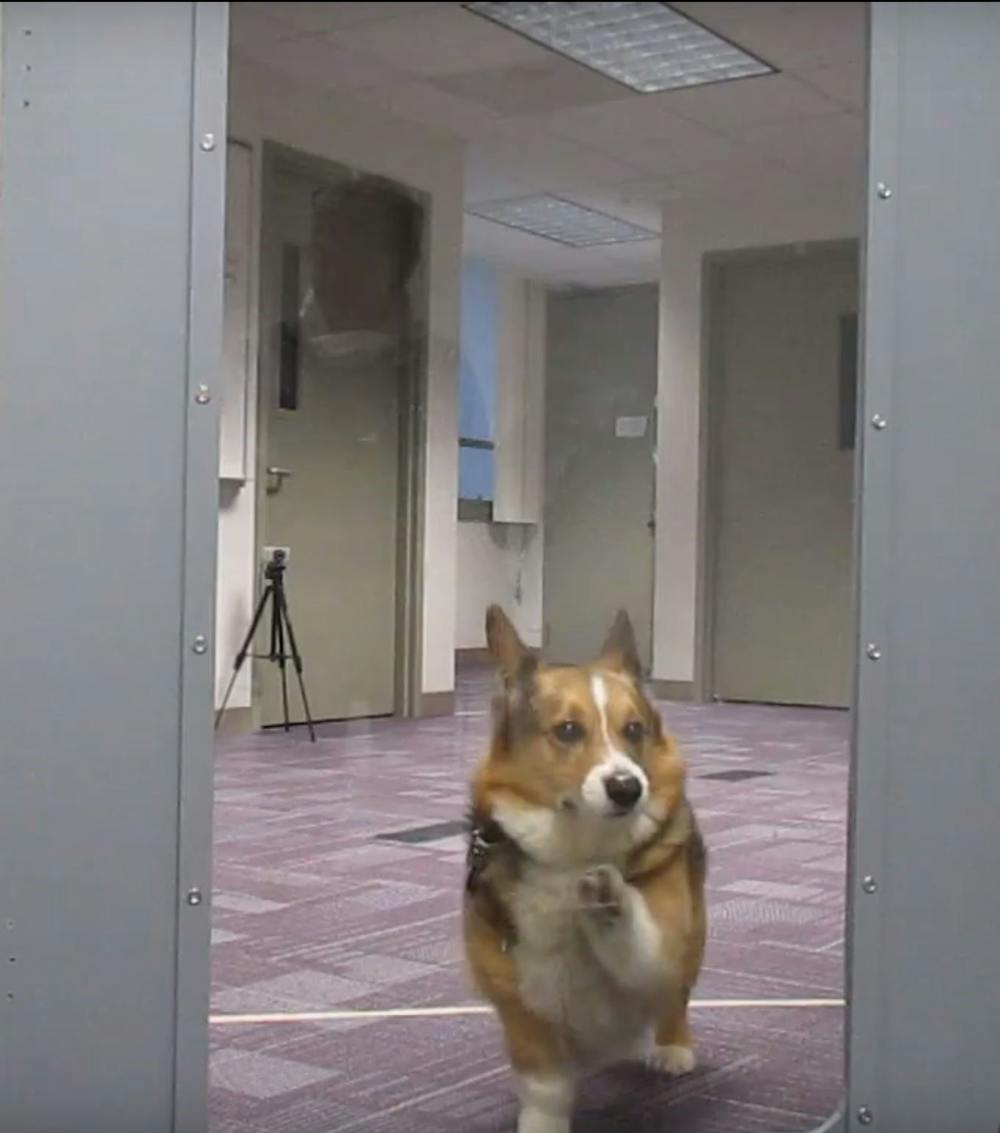
Next, we instructed the owner on how to behave during the experiment. Each owner sat in a chair behind a clear door that was magnetized shut – there as a barrier separating the dog from its owner – that the dog could easily push open. We assigned half the people to cry loudly and say “Help” in a distressed voice every 15 seconds. The other half of our volunteers we assigned to hum “Twinkle, Twinkle, Little Star” and say “Help” in a calm voice every 15 seconds. We ran the test until the dog opened the door or, if it didn’t, until five minutes elapsed.

Past research seemed to indicate that dogs would not help their human companions in distress, but it’s possible that the tasks to demonstrate “help” were too difficult for a dog to understand. So we adapted this straightforward task from previous research in rats. It seemed like dogs would be capable of nudging open a door to access their owners.

Lassie, Timmy’s crying in the other room

We expected to find that dogs would open the door more often if their owner was crying than if they were humming. Surprisingly, that isn’t what we found: About half the dogs opened the door, regardless of which condition they were in, which tells us that dogs in both conditions wanted to be near their owners.

I’m on my way! Emily Sanford and Julia Meyers-Manor, CC BY-ND

When we looked at how quickly the dogs who opened the door did so, we found a stark difference: In the crying condition, dogs took an average of 23 seconds to open the door, while in the control condition, they took more than a minute and a half. The humans’ crying seemed to affect the dogs’ behaviors, taking just a quarter as long to push open the door and get to their human if they seemed distressed. We did not find any differences between therapy dogs and other pet dogs.

Other interesting results came when we looked into how the dogs were behaving in each condition. In the crying condition, we found the dogs that opened the door showed fewer signs of stress – and were reported by their owners to be less anxious – than dogs that did not open it. We also found that dogs that opened the door more quickly were less stressed than dogs that took longer to open it.

In contrast, dogs in the humming condition showed a slight tendency to open more quickly if they were reported to be more anxious. This may mean that dogs who opened in the humming condition were seeking their owners for their own comfort.

Helping requires more than just empathy

Because both humans and animals tend to be more empathetic toward individuals with whom they are more familiar or close, we thought that the strength of a dog’s bond with its owner might explain some of the differences we saw in dogs’ empathetic responses.

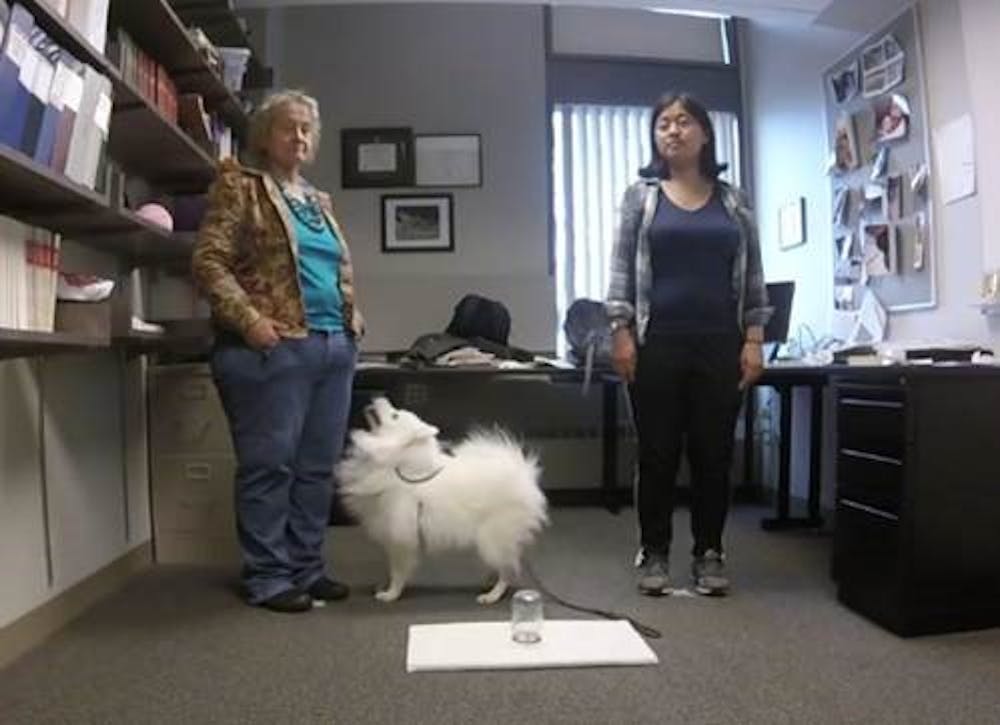
As soon as the test was over, we let the dog and owner reunite and cuddle for a few minutes to make sure everyone was calm before the next part of the experiment. Next, we turned to a test called the Impossible Task to learn a bit more about each dog’s emotional bond with its person.

Hey, a little help down here for your furry friend? Julia Meyers-Manor and Emily Sanford, CC BY-ND

In this task, the dog learns to tip over a jar to get to a treat; then we lock the jar onto a board with a treat inside and record whether the dog gazes at its owner or a stranger. There have been some mixed results with this test, but the idea is that a dog who spends more time looking at their owner during this task may have a stronger bond with their owner than a dog that doesn’t spend much time looking at their owner.

We found that dogs who opened the door in the crying condition did gaze at their owner more during the Impossible Task than non-openers. On the other hand, it was the dogs who didn’t open the door in the humming condition that gazed at their owners more than those who opened it. This suggests that openers in the crying condition and non-openers in the humming condition had the strongest relationships with their owners.

Taken together, we interpreted these results as evidence that dogs were behaving empathetically in response to their crying owners. To behave empathetically toward another individual, you must not only be aware of the distress of another person, but also suppress your own stress enough to help out. If you are overwhelmingly stressed, you might either be incapacitated or try to leave the situation entirely. This pattern has been seen in children, where the most empathetic kids are the ones who are skilled at regulating their own emotional states enough to give help.

It appears to be the case with these dogs as well. Dogs with weaker emotional bonds to their owners, and those that perceived their owners’ distress but were unable to suppress their own stress response, may have been too overwhelmed by the situation to provide any help.

While everyone hopes their dog would help them if they ever were in trouble, we found that many of the dogs did not. People involved in our experiment, particularly those with dogs that didn’t open the door, told us many stories of their dogs coming to their aid in the past. Our study suggests that in some cases if your dog doesn’t help you, it’s not a sign he doesn’t love you; Fido might just love you too much.

Julia Meyers-Manor, Assistant Professor of Psychology, Ripon College and Emily Sanford, PhD Student in Psychology and Brain Sciences, Johns Hopkins University

(This article was originally published on The Conversation. Read the original article.)

ooOOoo

Well done, Julia Meyers-Manor and Emily Sanford. Great work!


A step in my own self-awareness.

But the most important step I have ever taken.

In yesterday’s post I wrote:

It was the fickle finger of fate that led me to the arms, metaphorically speaking, of a core process psychotherapist back in Devon in the first half of 2007. That counselling relationship that revealed a deeply hidden aspect of my consciousness: a fear of rejection that I had had since December, 1956. That finger of fate that took me to Mexico for Christmas 2007 and me meeting Jean and all her dogs. That finger of fate that pointed me to the happiest years of my life and a love between Jeannie and me that I could previously never ever have imagined.

Here’s the full account. (But this is quite a long post and has the potential to cause some pain. Of course, I don’t intend that. But it’s best to mention that now.)

First we need to go back to that evening of December 19th, 1956. I had turned 12 on November, 8th and had just completed my first term at a nearby Grammar School. Then the family, as in Mum, Dad, me and my younger sister Elizabeth, were living comfortably in a detached house in Toley Avenue, a road off the main street that comprises Preston Road.
Preston Road is one of the outer suburbs of London to the North-West, sandwiched between Wembley, closer in to London, and Harrow, a little further out.

Anyway, on that evening of the 19th my mother came into my bedroom, located at the front of the house and next to Mum and Dad’s bedroom, at the usual time to say ‘Good night’ to me.

But while it was the usual time for Mum to be saying goodnight to me, clearly something was different this particular evening.

Mum sat down on the edge of my bed, just where my knees were, looked at me, and said, with pain in her voice: “Paul, you do know your father isn’t very well. He may not live for much longer.”

To be honest, all these many years later, I have no recollection as to whether or not I was aware that my father wasn’t very well.

Mum then leaned over to me, gave me my goodnight kiss, got up, and went out of my bedroom switching off the room light as she closed the door. As she always did and no different to any other evening.

Likewise, as with any other evening, I went off to sleep within a few minutes.

However, when I awoke the following morning, the morning of December 20th,  it was clear that something terrible had happened during the night. Let me explain that my father had had two daughters with his first wife, prior to meeting Mum, and I loved them both and saw them as elder sisters. The eldest was Rhona and she was a registered nurse (SRN). (My other ‘sister’ was Corinne.) Of course, Rhona was helping Mum care for Dad.

I got up and went downstairs. There was Rhona in the kitchen. Rhona came up to me and held me very tightly and then quietly told me that our father had died during the night. Rhona went on to add that Mum had thought it best not to wake me and Elizabeth and somehow arranged not only for the doctor to come in to certify Dad’s death but also for our father’s body to be removed from the home. Elizabeth and I had slept through it all!

I don’t recall having any emotional reaction to Rhona’s news; not even crying. It was if it was all just too unreal to take in.

A few days later, Mum, very clearly in her own mind doing her best to protect me and Elizabeth from pain, subsequently thought it wise that we didn’t go to our father’s funeral and cremation.

Now I have not the slightest doubt that many, if not all, of you will have cringed on reading the above.

Once back at school for the first term of 1957, I soon became aware of being the target of a degree of bullying, presumably because I was showing my grief through my behaviour and attitude, that my academic performance rapidly fell apart leading on to me leaving school before I went on to the Sixth Form.

The other thing that I was aware of in 1957, and for every December 20th thereafter, that this day was always a tough one. A day when I remembered with a degree of sadness and emotional pain that fateful night and morning in 1956.

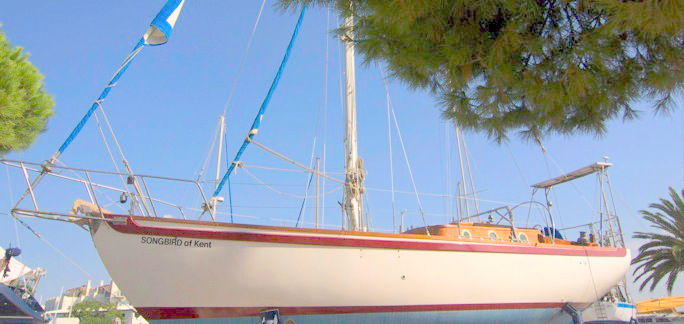
Nevertheless, my adult life really was (is!) a wonderful journey for me. It included a period working as a freelance journalist out in Australia in the late 1960s, becoming an Office Products salesman for IBM UK after returning from Australia to England and then in 1978 starting my own company, Dataview Ltd., in the early days of the personal computer revolution. Then after eight whirlwind years with Dataview growing in leaps and bounds each year, being approached in 1986 by a group of investors who wished to buy me out: I said “Yes”. That resulted in me going to live on a yacht, Songbird of Kent, a Tradewind 33, out in Cyprus (Larnaca Marina).

Tradewind 33 – Songbird of Kent. My home for five years.

While in Cyprus I got to know really well the wonderful, inspiring Les Powells, a three-times solo circumnavigator on his yacht Solitaire, and that thanks directly to Les offering me some very good advice, me experiencing the beauty, and the fear, of solo sailing out in The Atlantic and returning to Plymouth, in Devon, England, via Horta in The Azores, on the 16th June, 1994.

But! But! But!

But there was another part of my adult life that wasn’t such a wonderful journey. My relationships with the opposite sex! Culminating in my third wife, Julie, announcing on the day of the 50th anniversary of my father’s death, as in December 20th, 2006, that she was leaving me. (The reality of what she did to me was not pretty but I will spare you the details.)

Let me explain a little more.

After I had returned to England, sailing into Plymouth, in 1994, I subsequently sold Songbird of Kent and purchased a small house in the little village of Harberton, just a few miles out of Totnes, in South Devon. An easy decision to stay in South Devon because both Rhona and Corinne had their family homes close to Totnes.

Upper Barn, My home in Harberton.

I quickly became involved in the local business community undertaking a variety of coaching roles under the umbrella of Sales and Marketing; I was then a Chartered Member of the Institute of Marketing. In turn, Julie and I met each other and we became married.

In the Autumn of 2006, a Core Process Psychotherapist came to me seeking some business advice.  ‘J’ had had many years of coaching individuals one-to-one but had the idea, the good idea to my mind, of coaching the directors of companies in the whole process of listening to their employees and offering advice and guidance whenever there was the potential of conflict. If the employees worked more effectively together then ‘J’ believed the company as a whole would be more effective in reaching their goals.

‘J’ had no idea how companies worked, for want of a better term, and my role was teach ‘J’ the  fundamentals of operating the sort of company that was common to South Devon.

That’s what I was doing up to that fateful day of December 20th, 2006.

Because upon hearing the news that my then wife was leaving me, I simply blew apart emotionally. In the most terrible manner that I had never experienced before.

Very early on in January, 2007 I felt that I was descending into some bottomless pit of despair. In desperation I rang ‘J’ and explained what had happened on the 20th. ‘J’ listened and then said, quite properly, that he couldn’t see me as his client because we already had a working relationship. I pleaded and pleaded with ‘J’ to allow me to be his psychotherapy client. Finally, ‘J’ agreed but on the very strict condition that if he thought the counselling relationship wasn’t working then we would terminate it. He asked, and received, my understanding and agreement to that condition.

It wasn’t long thereafter before ‘J’ was asking me a little of my early experiences and I recounted that night of December 19th-20th and how I had not been able to say ‘Goodbye’ to my father.

‘J’ was quiet for a few minutes and then said:

“Paul, you have a son don’t you?”

I silently nodded.

“How do you think Alex would react if your death was handled for him in the same manner as your mother handled it for you?”

I gasped, conscious of how much I loved Alex, and Maija my daughter, and could hardly get the words out of my mouth: “He, he, … he would think he had been emotionally rejected ….”, continuing, “Oh my goodness! Oh! Oh! Oh! Oh, my sainted aunt! That’s it! I interpreted what happened back then when father died as rejection. That I wasn’t important to my father. So that’s what I have been experiencing all my adult life – a fear of rejection! But until now that fear has been completely submerged in my subconscious! Wow!”

That is the reason why, not to sound too immodest, I have been successful in all matters to do with my working life: I did everything to be accepted by my customers, my managers, my associates, and so on.

But it was also the reason why I had been so unsuccessful in my many, many relationships with women. Why I was unfaithful to my first wife. Why I could never say “No” to an emotional relationship with a woman, whether or not that woman had the potential to be a good long-term companion. Because I behaved in ways that minimised the chances of that woman rejecting me. That was why my last wife, Julie, before I met Jean, so gravely affected me when she chose, quite deliberately, to tell me she was leaving me on the 50th anniversary of my father’s death.

So that’s how ‘J’ held my hand, metaphorically speaking, and walked me into the light of how the past had affected me.

Dear, dear reader of Learning from Dogs, I do hope this makes sense and possibly in some small way this post holds out a hand to you.

I will close with this. Heard on a film that Jean and I recently watched.

Unless you understand yourself, can you be truthful to yourself?

The journey inwards is the most important and rewarding journey we can take!

Getting to know oneself

The journey inwards is the most challenging and yet the most rewarding of all!

This post is essentially a reposting of an item that I published nearly three years ago. It came to me as a result of some delightful exchanges following my post last Thursday: How well our dogs read us!

Tomorrow I will go into more details of that fateful event in my past:  December 20th, 1956.

ooOOoo

Further musings on dogs, women and men.

Published on Learning from Dogs, August 6th, 2015

A few weeks ago, I read a book entitled The Republican Brain written by Chris Mooney and to quote WikiPedia:

The Republican Brain: The Science of Why They Deny Science — and Reality is a book by the journalist Chris Mooney that is about the psychological basis for many Republicans’ rejection of mainstream scientific theories, as well as theories of economics and history.

On page 83, Chris Mooney writes (my emphasis):

Here also arises a chief liberal weakness, in Lakoff’s view (*), and one that is probably amplified by academic training. Call it the Condorcet handicap, or the Enlightenment syndrome. Either way, it will sound very familiar: Constantly trying to use factual and reasoned arguments to make the world better and being amazed to find even though these arguments are sound, well-researched, and supported, they are disregarded, or even actively attacked by conservatives.

When glimpsed from a bird’s eye view, all the morality research that we’re surveying is broadly consistent. It once again reinforces the idea that there are deep differences between liberals and conservatives – differences that are operating, in many cases, beneath the level of conscious awareness, and that ultimately must be rooted in the brain.

(*) George Lakoff, Berkeley Cognitive Linguist and author of the book Moral Politics.

What Chris Mooney is proposing is that the difference between liberals and conservatives could be genetically rooted, at least in part.

That underlines in my mind how each of us, before even considering our gender differences, is truly a complex mix of ‘nature and nurture’ with countless numbers of permutations resulting.

That there are deep differences, apart from the obvious ones, between man and woman goes without saying. In earlier times, these differences were essential in us humans achieving so much and leading to, in the words of Yuval Noah Harari from yesterday’s post., ” … few would disagree that humans dominate planet Earth; we’ve spread to every continent, and our actions determine the fate of other animals (and possibly Earth itself).”

Speaking of earlier times, let me turn to dogs, for it is pertinent to my post, and I would like to quote an extract from what Doctor of Veterinarian Medicine, Jim Goodbrod, writes in the foreword of my forthcoming book:

But what exactly is this human-dog bond and why do we feel such an affinity for this species above all others? My feeling is that it may be associated with our deep but subconscious longing for that age of simple innocence and innate human goodness that we supposedly possessed before we became truly “human”: that child-like innocence or what Rousseau referred to as the “noble savage”, before being corrupted by civilization, before we were booted out of the Garden of Eden. We humans, for better or worse, somewhere along that evolutionary road acquired consciousness or so-called human nature and with it we lost that innocence. What we gained were those marvelous qualities that make us uniquely human: a sense of self-awareness, an innate moral and ethical code, the ability to contemplate our own existence and mortality, and our place in the universe. We gained the ability to think abstract thoughts and the intellectual power to unravel many of the mysteries of the universe. Because of that acquired consciousness and humans’ creative and imaginative mind we have produced the likes of Shakespeare, Mozart, and Einstein. We have peered deep into outer space, deciphered the genetic code, eradicated deadly diseases, probed the bizarre inner world of the atom, and accomplished thousands of other intellectual feats that hitherto would not have been possible without the evolution of our incredible brain and the consciousness with which it is equipped.

No other living species on this planet before or since has developed this massive intellectual power. But this consciousness was attained at what cost? Despite all the amazing accomplishments of the human race, we are the only species that repeatedly commits genocide and wages war against ourselves over political ideology, geographic boundaries, or religious superstition. We are capable of justifying the suffering and death of fellow human beings over rights to a shiny gold metal or a black oily liquid that powers our cars. We are the only species that has the capability to destroy our own planet, our only home in this vast universe, by either nuclear warfare, or more insidiously by environmental contamination on a global scale. Was it worth it? No matter what your or my opinion may be, Pandora’s Box has been opened and we cannot put the lid back on.

What can we do now to reverse this trend and help improve the quality of life for humanity and ensure the well-being of our planet? I think, if we recognize the problem and look very critically at ourselves as a unique species with awesome powers to do both good and bad, and put our collective minds to the task, it may be possible to retrieve some of the qualities of that innocence lost, without losing all that we have gained.

Dogs represent to me that innocence lost. Their emotions are pure. They live in the present. They do not suffer existential angst over who or what they are. They do not covet material wealth. They offer us unconditional love and devotion. Although they certainly have not reached the great heights of intellectual achievement of us humans (I know for a fact that this is true after having lived with a Labrador retriever for several years), at the same time they have not sunk to the depths of depravity to which we are susceptible. It could be argued that I am being overly anthropomorphic, or that dogs are simply mentally incapable of these thoughts. But nevertheless, metaphorically or otherwise, I believe that dogs demonstrate a simple and uncorrupted approach to life from which we all could benefit. I think the crux of Paul’s thesis is that, within the confines and limitations of our human consciousness, we can (and should) metaphorically view the integrity of the dog as a template for human behavior.

“Dogs demonstrate a simple and uncorrupted approach to life …”

I closed yesterday’s post with these words, “It is my contention that humankind’s evolution, our ability to “cooperate flexibly in large numbers”, is rooted in the gender differences between man and woman.”

The premise behind that proposition is that until, say one hundred years ago, give or take, that co-operation between large numbers of humans was critically important in so many areas: health; science; medicine; physics; exploration; outer space and more. (And whether one likes it or not: wars.)  My proposition is that it is predominantly men who have been the ‘shakers and movers’ in these areas. Of course not exclusively, far from it, just saying that so many advances in society are more likely to have been led by men.

But (and you sensed a ‘but’ coming up, perhaps) these present times call for a different type of man. A man who is less the rational thinker, wanting to set the pace, and more a man capable of expressing his fears, exploring his feelings, defining his fear of failure, and more. I don’t know about you but when I read Raúl Ilargi Meijer words from yesterday, “And if and when we resort to only rational terms to define ourselves, as well as our world and the societies we create in that world, we can only fail.”, it was the male of our species that was in my mind. As in, “And if and when we [males] resort to only rational terms to define ourselves …”.

Staying with Raúl Meijer’s words from yesterday (my emphasis), “And those should never be defined by economists or lawyers or politicians, but by the people themselves. A social contract needs to be set up by everyone involved, and with everyone’s consent.”

Dogs demonstrate a simple and uncorrupted approach to life but that doesn’t extend to them making social contracts. Women do understand social contracts, they are predominantly caring, social humans. Less so for men. But for that social contract to be successfully set up by everyone it must, of course, include men. And that requires men, speaking generally you realise, to find safe ways to get in touch with their feelings, to tap into their emotional intelligence, using positive psychology to listen to their feelings and know the truth of what they and their loved ones need to guarantee a better future. What they need in terms of emotional and behavioural change. And, if I may say, sensing when they might need the support of subject experts to embed and sustain those behavioural changes.

It was the fickle finger of fate that led me to the arms, metaphorically speaking, of a core process psychotherapist back in Devon in the first half of 2007. That counselling relationship that revealed a deeply hidden aspect of my consciousness: a fear of rejection that I had had since December, 1956. That finger of fate that took me to Mexico for Christmas 2007 and me meeting Jean and all her dogs. That finger of fate that pointed me to the happiest years of my life and a love between Jeannie and me that I could hitherto never ever have imagined.

However, as much as I love and trust Jean, wholeheartedly, it comes back to dogs.

For when I curl up and wrap myself around a dog and sense that pure unconditional love coming back to me, I have access to my inner feelings, my inner joys and fears, in a way unmatched by anything else.

Where learning from dogs is a gateway to learning from me.

Pharaoh – more than just a dog!

ooOOoo

I will never be able to look at those eyes of Pharaoh, looking into my eyes, without feeling terrible pangs of loss. For he was the most amazing, the most wise, the most deep-thinking dog that I have ever known. Correction: that Jean and I have ever known!