Category: Culture

Dichlorodiphenyltrichloroethane (DDT) all over again?

The terribly worrying bee crisis.

Yesterday, I wrote about the growing awareness of a major crisis affecting bees in a number of countries.  Coincidentally, when researching the various articles for that post, into my email ‘inbox’ came the latest essay from George Monbiot published both in the UK Guardian newspaper and on his own blog.  The title was DDT 2.0.  I emailed Mr. Monbiot requesting permission to republish his essay in full on Learning from Dogs and promptly received his approval to so do.

But for those who for whatever reason, don’t recall clearly the history of DDT, here’s some background.

Wikipedia’s entry opens, thus:

DDT (dichlorodiphenyltrichloroethane) is an organochlorineinsecticide which is a colorless, crystalline solid, tasteless and almost odorless chemical compound. Technical DDT has been formulated in almost every conceivable form including solutions in xylene or petroleum distillates, emulsifiable concentrates, water-wettable powders, granules, aerosols, smoke candles, and charges for vaporisers and lotions.[2]

First synthesized in 1874, DDT’s insecticidal properties were not discovered until 1939, and it was used with great success in the second half of World War II to control malaria and typhus among civilians and troops. The Swiss chemist Paul Hermann Müller was awarded the Nobel Prize in Physiology or Medicine in 1948 “for his discovery of the high efficiency of DDT as a contact poison against several arthropods.”[3] After the war, DDT was made available for use as an agricultural insecticide, and soon its production and use skyrocketed.[4]

Then goes on to mention Rachel Carson (1907 – 1964) and her mind-boggling expose of DDT in the famous book Silent Spring.

The legacy of Rachel Carson.

The Natural Resources Defense Council (NRDC) website explains:

The Story of Silent Spring

How a courageous woman took on the chemical industry and raised important questions about humankind’s impact on nature.

Although their role will probably always be less celebrated than wars, marches, riots or stormy political campaigns, it is books that have at times most powerfully influenced social change in American life. Thomas Paine’s Common Sense galvanized radical sentiment in the early days of the American revolution; Uncle Tom’s Cabin by Harriet Beecher Stowe roused Northern antipathy to slavery in the decade leading up to the Civil War; and Rachel Carson’s Silent Spring, which in 1962 exposed the hazards of the pesticide DDT, eloquently questioned humanity’s faith in technological progress and helped set the stage for the environmental movement.

Carson, a renowned nature author and a former marine biologist with the U.S. Fish and Wildlife Service, was uniquely equipped to create so startling and inflammatory a book. A native of rural Pennsylvania, she had grown up with an enthusiasm for nature matched only by her love of writing and poetry. The educational brochures she wrote for the Fish and Wildlife Service, as well as her published books and magazine articles, were characterized by meticulous research and a poetic evocation of her subject.

You can read the rest of that NRDC article here.

So with all that in mind, here’s the essay from George Monbiot.

oooOOOooo

DDT 2.0

August 13, 2013

We’re just beginning to understand the wider impacts of neonicotinoids.

By George Monbiot, published on the Guardian’s website, 5th August 2013

It’s the new DDT: a class of poisons licensed for widespread use before they had been properly tested, which are now ripping the natural world apart. And it’s another demonstration of the old truth that those who do not learn from history are destined to repeat it.

It is only now, when neonicotinoids are already the world’s most widely deployed insecticides, that we are beginning to understand how extensive their impacts are. Just as the manufacturers did for DDT, the corporations which make these toxins claimed that they were harmless to species other than the pests they targeted. Just as they did for DDT, they have threatened people who have raised concerns, published misleading claims and done all they can to bamboozle the public. And, as if to ensure that the story sticks to the old script, some governments have collaborated in this effort. Among the most culpable is the government of the United Kingdom.

As Professor Dave Goulson shows in his review of the impacts of these pesticides, we still know almost nothing about how most lifeforms are affected. But as the evidence has begun to accumulate, scientists have started discovering impacts across a vast range of wildlife.

Most people who read this newspaper will be aware by now of the evidence fingering neonicotinoids as a major cause of the decline of bees and other pollinators. These pesticides can be applied to the seeds of crops, and they remain in the plant as it grows, killing the insects which eat it. The quantities required to destroy insect life are astonishingly small: by volume these poisons are 10,000 times as powerful as DDT. When honeybees are exposed to just 5 nanogrammes of neonicotinoids, half of them will die. As bees, hoverflies, butterflies, moths, beetles and other pollinators feed from the flowers of treated crops, they are, it seems, able to absorb enough of the pesticide to compromise their survival.

But only a tiny proportion of the neonicotinoids that farmers use enter the pollen or nectar of the flower. Studies conducted so far suggest that only between 1.6 and 20% of the pesticide used for dressing seeds is actually absorbed by the crop: a far lower rate even than when toxins are sprayed onto leaves. Some of the residue blows off as dust, which is likely to wreak havoc among the populations of many species of insects in hedgerows and surrounding habitats. But the great majority – Goulson says “typically more than 90%” – of the pesticide applied to the seeds enters the soil.

In other words, the reality is a world apart from the impression created by the manufacturers, which keep describing the dressing of seeds with pesticides as “precise” and “targeted”.

Neonicotinoids are highly persistent chemicals, lasting (according to the few studies published so far) for up to 19 years in the soil. Because they are persistent, they are likely to accumulate: with every year of application the soil will become more toxic.

What these pesticides do once they are in the soil, no one knows, as sufficient research has not been conducted. But – deadly to all insects and possibly other species at tiny concentrations – they are likely to wipe out a high proportion of the soil fauna. Does this include earthworms? Or the birds and mammals that eat earthworms? Or for that matter, the birds and mammals that eat insects or treated seeds? We don’t yet know enough to say.

This is the story you’ll keep hearing about these pesticides: we have gone into it blind. Our governments have approved their use without the faintest idea of what the consequences are likely to be.

You might have had the impression that neonicotinoids have been banned by the European Union. They have not. The use of a few of these pesticides has been suspended for two years, but only for certain purposes. Listening to the legislators, you could be forgiven for believing that the only animals which might be affected are honeybees, and the only way in which they can be killed is through the flowers of plants whose seeds were dressed.

But neonicotinoids are also sprayed onto the leaves of a wide variety of crop plants. They are also spread over pastures and parks in granules, in order to kill insects that live in the soil and eat the roots of the grass. These applications, and many others, remain legal in the European Union, even though we don’t know how severe the wider impacts are. We do, however, know enough to conclude that they are likely to be  bad.

Of course, not all the neonicotinoids entering the soil stay there indefinitely. You’ll be relieved to hear that some of them are washed out, whereupon … ah yes, they end up in groundwater or in the rivers. What happens there? Who knows? Neonicotinoids are not even listed among the substances that must be monitored under the EU’s water framework directive, so we have no clear picture of what their concentrations are in the water that we and many other species use.

But a study conducted in the Netherlands shows that some of the water leaving horticultural areas is so heavily contaminated with these pesticides that it could be used to treat lice. The same study shows that even at much lower concentrations – no greater than the limits set by the European Union – the neonicotinoids entering river systems wipe out half the invertebrate species you would expect to find in the water. That’s another way of saying erasing much of the foodweb.

I was prompted to write this article by the horrible news from the River Kennet in southern England: a highly protected ecosystem that is listed among the few dozen true chalk streams on earth. Last month someone – farmer or householder, no one yet knows – flushed another kind of pesticide, chlorpyrifos, down their sink. The amount was equivalent – in pure form – to two teaspoonsful. It passed through Marlborough sewage works and wiped out most of the invertebrates in fifteen miles of the river.

The news hit me like a bereavement. The best job I ever had was working, during a summer vacation from university, as temporary waterkeeper on the section of the Kennet owned by the Sutton estate. The incumbent had died suddenly. It was a difficult job and, for the most part, I made a mess of it. But I came to know and love that stretch of river, and to marvel at the astonishing profusion of life the clear water contained. Up to my chest in it for much of the day, I immersed myself in the ecology, and spent far more time than I should have done watching watervoles and kingfishers; giant chub fanning their fins in the shade of the trees; great spotted trout so loyal to their posts that they had brushed white the gravel of the river bed beneath their tails; native crayfish; dragonflies; mayflies; caddis larvae; freshwater shrimps and all the other teeming creatures of the benthos.

In the evenings, wanting company and fascinated in equal measure by the protest and the remarkable people it attracted, I would stop at the peace camp outside the gates of the Greenham Common nuclear base. I’ve told the strange story that unfolded during my visits in another post.

Campaigners seeking to protect the river have described how, after the contamination,the river stank from the carcases of the decaying insects and shrimps. Without insects and shrimps to feed on, the fish, birds and amphibians that use the river are likely to fade away and die.

After absorbing this news, I remembered the Dutch study, and it struck me that neonicotinoid pesticides are likely, in many places, to be reducing the life of the rivers they enter to a similar extent: not once, but for as long as they are deployed on the surrounding land.

Richard Benyon, the minister supposed to be in charge of protecting wildlife and biodiversity, who happens to own the fishing rights on part of the River Kennet, and to represent a constituency through which it passes, expressed his “anger” about the chlorpyrifos poisoning. Should he not also be expressing his anger at the routine poisoning of rivers by neonicotinoids?

Were he to do so, he would find himself in serious trouble with his boss. Just as they are systematically poisoning our ecosystems, neonicotinoids have also poisoned the policies (admittedly pretty toxic already) of the department supposed to be regulating them. In April, Damian Carrington, writing in the Observer, exposed a letter sent by the ministerin charge of the Department for Environment, Food and Rural Affairs (Defra), Owen Paterson, to Syngenta, which manufactures some of these pesticides. Paterson promised the company that his efforts to prevent its products from being banned “will continue and intensify in the coming days”.

And sure enough, the UK refused to support the temporary bans proposed by the commission both in April and last month, despite the massive petitions and the 80,000 emails on the subject that Paterson received. When Paterson and Deathra were faced with a choice between the survival of natural world and the profits of the pesticides companies, there was not much doubt about how they would jump. Fortunately they failed.

Their attempt to justify their votes led to one of the most disgraceful episodes in the sorry record of this government. The government’s new chief scientist, Sir Mark Walport, championed a “study” Deathra had commissioned, which purported to show that neonicotinoids do not kill bees. It was not published in a peer-reviewed journal, nor could it be, as as any self-respecting scientist, let alone the government’s chief scientist, should have been able to see in a moment that it was complete junk. Among many other problems, the controls were hopelessly contaminated with the pesticide whose impacts the trial was supposed to be testing. The “study” was later ripped apart by the European Food Safety Authority.

But Walport did still worse, making wildly misleading statements about the science, and using scare tactics and emotional blackmail to try to prevent the pesticides from being banned, on behalf of his new masters.

It is hard to emphasise sufficiently the importance of this moment or the dangers it contains: the total failure of the government’s primary source of scientific advice, right at the beginning of his tenure. The chief scientist is not meant to be a toadying boot-licker, but someone who stands up for the facts and the principles of science against political pressure. Walport disgraced his post, betrayed the scientific community and sold the natural world down the river, apparently to please his employers.

Last week, as if to remind us of the extent of the capture of this government by the corporations it is supposed to be regulating, the scientist who led the worthless trials that Walport and Paterson cited as their excuse left the government to take up a new post at … Syngenta. It seems to me that she was, in effect, working for them already.

So here we have a department staggering around like a drunkard with a loaded machine gun, assuring us that it’sh perfectly shafe. The people who should be defending the natural world have conspired with the manufacturers of broad-spectrum biocides to permit levels of destruction at which we can only guess. In doing so they appear to be engineering another silent spring.

oooOOOooo

Frankly, there are more and more occasions when I think that if homo sapiens becomes virtually extinct there will be no queries as to why it happened.  Then again, a much more positive muse would be to see the ever-increasing madness going on in today’s world as the crumbling death throws of a materialistic and consumptionist era that is past its time.


It’s not music; yet it is and more so!

The polyphonic me: Just be amazed.

Published on Aug 2, 2013

Frustrated by not being able to sing two notes at the same time, musical inventor Beardyman built a machine to allow him to create loops and layers from just the sounds he makes with his voice. Given that he can effortlessly conjure the sound of everything from crying babies to buzzing flies, not to mention mimic pretty much any musical instrument imaginable, that’s a lot of different sounds. Sit back and let the wall of sound of this dazzling performance wash over you.

Enjoy!

On being honest.

A reposting of an article by Jon Lavin, first published on the 3rd July, 2010.)

Conscientiousness isn’t all it’s cracked out to be!

(Foreword from Paul.)

Jon is one of those rare individuals who not only has been committed to a path of self-awareness for more than 30 years but who has also studied incredibly hard so as to be able to help others and do so from a base of real competence, as his own Blog describes.

But then I realised the great strength in what Jon has written.  It is this.

There are many notable teachers to whom thousands upon thousands have turned to for a deeper understanding of what life is all about.  As far back as time itself, teachers have surfaced and given spiritual guidance to those that come in need.  But it’s very difficult to read or listen to these great teachers and connect with the fact that they were born, as we are all born, with nothing.  And all of them, like many of us, went through Hell on wheels to come out the other side with a greater self-awareness and a deeper understanding of the real truths in nature.  Like all of us who wish to rise above our present place they first acknowledged their own frailties. It is the starting point.

So, let me get to the point.  Jon has the awareness and understanding to offer real help to those that seek answers that are currently beyond reach.  Jon’s article is an wonderful illustration that he experiences the same fears and feelings of helplessness that you and I feel.  You and I and Jon and all of humanity are much more closely connected than we realise.

Paul H.

oooOOOooo

To see in is to see out!

I’ve been running my own business for about 12 years now. In the beginning it started because I had a thirst for wanting to make a difference in small business in our local area and a passion for wanting to do it through working with people directly, on their behaviours. Still have, really.

I think this came as a form of acknowledgement to the few exceptional people managers I experienced while I was employed, and the all too common, terrible ones.

I was also mentored by a group of people to whom no developmental tool was barred. My eyes were well and truly opened to how a change of view could change outcomes.

The final boot up the backside was redundancy in the late 90s. I was all ready to go and just needed a kick.

My work ethic, trained at home and then through an engineering apprenticeship, was to conscientiously work hard and try hard and to treat people the way you want to be treated. Nothing wrong with that. I assumed automatic reward would follow as long as I did those things.

Over time I wised up and became a bit less idealistic and a little more politically aware but carried on in much the same way.

Much later I found myself embarking on a whole new adventure, with a lovely wife and family, all dependent on me, with a few contacts to start getting work from!

It took a year before the first jobs came in that didn’t necessitate robbing the almost non-existent savings and redundancy payment just to keep food on the table. Then, work slowly picked up and it started to get quite good for a one-man band. We were able to go on holiday once a year, camping, but still great, and then abroad.

All the time, I beavered away, trying hard, being very conscientious, as I’d been brought up to be, but slowly getting very stressed.

Time was when it took Friday night to de-stress, then 3 days, then 10 days and recently, not at all.

So faced with this present downturn, which is likely to go on for much longer than any of the others I’ve seen and survived, I’m wondering just what new strategy to adopt. Money is already getting very tight and everything is feeling very ‘hand to mouth’. Can’t really see one month in front of the other.

I notice our local farmer who I went to school with but didn’t really know.

I’ve got degrees, lived abroad, can speak Finnish fluently, (what use is that, I hear you say!), and can turn my hand to most things, but I still feel quite dis-empowered and at a bit of a loss.

My farmer friend is always smiling, he’s got a flock of geese he’s fattening up, the same with his beef cattle, does livery for half a dozen horses or so, has fields planted with various cereal crops, and has his finger in lots of different pies – and definitely does not look stressed. He is also renting his land plus another farm.

I honestly don’t know what to make of this all except for a few really important things – the importance of diversification, relationships and appreciating what you’ve got, especially people things, here, in the now.

I have also come to the realisation that I still haven’t cracked the main thing with being self-employed, and that is replacing fear with trust.

It’s been said by various enlightened people that we see a reflection of the world we hold in mind. Going forward into this brave new world I would like to see opportunities rather than fear, I will diversify into things which make more use of my wide range of talents, and I will swap fear for trust.

By Jon Lavin

Journey into (inner) space

(A reposting of an article by Jon Lavin, first published on the 11th September, 2009.)

The journey into inner space is just as fascinating as the one into outer space.

Tony Buzan
Tony Buzan

Many, many years ago, 1973 to be precise, an English author, Tony Buzan, was involved in presenting a series on BBC television called Use Your Head.  Tony released a book to accompany the television series.  There is not a lot that I remember about that book but one thing I never forgot.  That was the number of neurons in the brain, 10 to the power 200, give or take.  I will return to this aspect in a later Post but now to the main point of this, my introductory Post.

I was working with a telephone coaching client this week who I’ve been with for over a year now.

He differs from my normal clients in that he’s paralysed from the shoulders down. About 8 years ago he was involved in a horrendous car accident which 99% of us would probably not have survived. He was in hospital for 18 months and now with the aid of his PAs (Personal Assistants), as he calls them, who get him up in the morning and put him to bed in the evening, he manages on his own.

He’s been working on a novel for sometime now and his optimism and faith in his own inherent sense of well-being is truly inspirational. He works at the novel every moment he can.

He has had to overcome many other setbacks in life but still manages to live a life which is far fuller than most able bodied people.

He frequently gives motivational talks and says things to me that wake me up from the trance state that I seem to occupy too much of the time, generally worrying about things that statistically are highly unlikely to happen. He is one of the most awake people I have ever come across.

I’m reading a book at the moment called, “Journey of Souls”, by Michael Newton, Phd. His research carried out on numerous clients under hypnosis has shown that we choose the conditions of our lives.

In order to learn the maximum amount in life, we might opt to experience life in a body that only barely functions in order to learn to overcome extreme difficulties and gain a fresh insight into what is really important.

The book is analytical to a certain extent so suits my engineer’s mind but certainly encourages reflection on decisions we make, their impact on others and the level of integrity of those decisions. The book reminds me frequently of my coaching client.

By Jon Lavin

(John may be contacted at jon.lavin (at) peopleworkshop(dot)co(dot)uk – PH)

Footnote: Recently we were driving back after being a week away.  We were on the motorway (Freeway to North Americans), quite relaxed and looking forward to being home soon.

Out of nowhere, a car 70 to 100yds in front suddenly swerved violently to the left then back to the right, hit the central metal reservation, bounced off again and, as we drove past, missed the side of our car by a few yards. This whole drama unfolded in a matter of an instant in time.

As if in slow motion, I steered the car to the inside lane and drove past – at 75mph. We were so shaken up that we were 1/4 of a mile on before I looked in the rear-view mirror and saw cars stopping and people getting out. The few seconds that this all happened in are now etched in my mind.

I wonder if it has to be like this to truly wake us from our trance?

Share

How normal is it to be normal!

But first off this is not going to be a normal couple of weeks!

My daughter, Maija, son-in-law, Marius, and grandson, Morten, aged two, are staying with us over the next couple of weeks, arriving tomorrow.

So being able to offer a daily fresh post on Learning from Dogs will be a challenge.  As indeed, it should be: Family should always be the top priority.

However, rather than leaving you with blank pages, I shall be regurgitating some earlier posts, starting tomorrow.  In wandering through rather a large number of posts (1,775 as of today!), I was reminded that at the start one of my fellow authors was Jon Lavin.  He wrote a number of posts before deciding that his ‘day job’ was too demanding of him and something had to go.  It wasn’t just writing for Learning from Dogs that Jon had to let go, even his own website, The People Workshop, is a tad out-of-date!

But even so, there’s an article on Jon’s website that I wanted to share with you and, with Jon’s permission, here it is.

oooOOOooo

Normal!

10 AUGUST 2011 BY 

Constant.
Constant.

Normal – it’s not a particularly challenging word; or is it?

The fact is that for most people their ‘normal’ business day is far from being effective.

What I do, indeed my passion, is to work with people and allow them to see the huge benefits that come from bringing ‘mindfulness’ into their everyday working environments. What do we mean by mindfulness?

Generally, anything that brings us into a state of mind where we are making decisions, interacting with people, communicating in the here and now, not away somewhere where we are controlled by what happened in the past and our fears of what might happen in the future.

Bringing change into business requires many qualities and if ever there was a time for displaying the qualities of integrity and compassion, it is now.

I believe we are on the cusp of an enormous change that will affect us all – it already is, we’re just hoping that it will go away and we’ll be able to carry on as before after this unpleasant recession is over. It’s more likely we are living through a core change in society.

I’ve realised that I can no longer rely on ‘out there’ for support, instead, it has to come from within.

By knowing myself and having a different relationship with myself, I encourage a balance in my life and recognise what ‘resources’ I need. Being out in the fresh air, in the woods and fields ‘resources’ me.

So when I work with my troubled clients who may be reeling from the latest batch of redundancies, I am able to be in a state of calm rather than the anxiety which is such a familiar friend.

Have you ever noticed how people are attracted to calm people when insecurity and uncertainty are around? From calmness and balance, options in the here and now present themselves to us. We are aware that we are connected together and working together in an atmosphere of integrity and trust to do the best for all.

My clients use me when they are dealing with circumstances that demand the very best from their employees, and when those employees demand the very best from my client company.

I would be interested to hear your comments!

oooOOOooo

Do please offer your thoughts to Jon’s essay; I will pass them back to him without delay.

What Jon underlines is the power of relaxation, of taking time off at regular intervals during the day, the dangers of overload; as I recently highlighted in this recent post.

Thus proving, once again, that old adage – less is more!

Wildlife Photo Tips

A response to the many who enjoy the regular Sunday photo parade.

Jean and I have recently joined the National Wildlife Federation partly because there are times when it really does seem ‘wild’!  Anyway, I was trawling the NWF website the other day and came across this very helpful advice: 7 Wildlife Photo Tips to Never Forget. In view of the popularity of Sunday’s regular Picture Parade on Learning from Dogs, it seemed appropriate to dip into that section for today’s post. [Note: you will have to go to the website to read the full article as it would be wrong to republish the entire item without permission.]

7 Wildlife Photo Tips to Never Forget

This guest post by Jim Goldstein is sponsored by BorrowLenses.com.

I’ve always felt great wildlife photography mapped well to the Chinese proverb “the journey is the reward.” While I obviously enjoy seeing the end result of my wildlife photography outings I get a great deal of satisfaction in the crafting of those images. My best images often rise to the top because of one of the following maxims:

1. Backgrounds are Equally Important as Your Subject

2. Embrace Serendipity When Photo Editing

3. Challenge Viewers with Anthropomorphism

4. Employ Non-Standard Compositions

5. Capture Your Subjects at Their Eye Level

6. Factor in Form and Pose

7. Utilize Negative Space

I am going to republish just one of these tips to give you an idea, because the advice is stunning, in my humble opinion.

2. Embrace Serendipity When Photo Editing

Arctic Hare. Canon 1D Mark II, Canon 500mm f/2.8 + 1.4x teleconverter, 1/640 sec, f/7.1, ISO 400

When behind the camera, focus carefully on your subject. But when photo editing look for unique and subtle differences that might enhance or transform the story within your image. Case in point: this example image of a mosquito biting the nose of an Arctic Hare. My attention was on obtaining a razor sharp image and composing carefully, but when photo editing I found a couple frames that captured the biting mosquito that had been invisible to me at the time I took the photo.

Arctic Hare Being Bitten By Mosquito on the Nose

Jim Goldstein is a San Francisco-based professional photographer and author who has been in numerous publications, including Outdoor Photographer, Digital Photo Pro, Popular Photography and has self-published a PDF eBook Photographing the 4th Dimension – Time covering numerous slow shutter techniques. Follow Jim Goldstein on Google+ | Twitter | Facebook | 500px

Do take a few moments and go across to the website and read the full set of tips.  If you have any interest in photographing nature and wildlife this is unmissable good advice.  Want to know more about the National Wildlife Federation?  More information here.

Just about water.

Having no drinking water puts every other aspect of living in the shade!

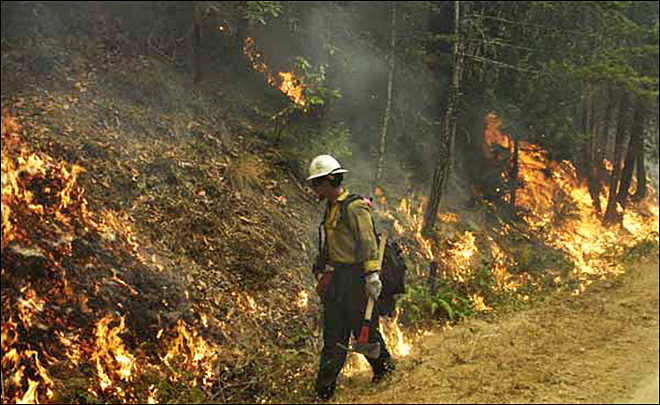
Yesterday afternoon, around 4pm, local thunderstorm activity produced some rain.  Not much but sufficient to wet the ground.  It brought to an end several weeks of intense drought complicated by what is now more than 55,000 acres of fires burning in southwest Oregon: more details here.

Oregon Wildfires
A Redmond Hotshots crew on the Douglas Complex conducts a burnout operation to create a barrier to the wildfire’s advance by removing fuel in its path.

Anyway, this is not about fire, irrespective of how potentially dangerous it can be in this part of the world, it is about water. So with that in mind, here’s a recent ‘Tomgram‘ from William deBuys, with introduction by Tom Engelhardt; republished with Tom’s generous permission.

oooOOOooo

Tomgram: William deBuys, Goodbye to All That (Water)

Martha and the Vandellas would have loved it.  Metaphorically speaking, the New York Times practically swooned over it.  (“An unforgiving heat wave held much of the West in a sweltering embrace over the weekend, tying or breaking temperature records in several cities, grounding flights, sparking forest fires, and contributing to deaths.”) It was a “deadly” heat wave, a “record” one that, in headlines everywhere, left the West and later the rest of the country “sweltering,” and that was, again in multiple headlines, “scary.”  The fire season that accompanied the “blasting,” “blazing” heat had its own set of “record” headlines — and all of this was increasingly seen, in another set of headlines, as the “new normal” in the West. Given that 2012 had already set a heat record for the continental U.S., that the 10 hottest years on record in this country have all occurred since 1997, and that the East had its own sweltering version of heat that wouldn’t leave town, this should have been beyond arresting.

In response, the nightly primetime news came up with its own convenient set of new terms to describe all this: “extreme” or “severe” heat.  Like “extreme” or “severe” weather, these captured the eyeball-gluing sensationalism of our weather moment without having to mention climate change or global warming.  Weather, after all, shouldn’t be “politicized.”  But if you’re out in the middle of the parching West like TomDispatch regular William deBuys, who recently headed down the Colorado River, certain grim realities about the planet we’re planning to hand over to our children and grandchildren can’t help but come to mind — along with a feeling, increasingly shared by those in the sweltering cities, that our particular way of life is in the long run unsustainable. Tom

Never Again Enough

Field Notes from a Drying West 

By William deBuys

Several miles from Phantom Ranch, Grand Canyon, Arizona, April 2013 — Down here, at the bottom of the continent’s most spectacular canyon, the Colorado River growls past our sandy beach in a wet monotone. Our group of 24 is one week into a 225-mile, 18-day voyage on inflatable rafts from Lees Ferry to Diamond Creek. We settle in for the night. Above us, the canyon walls part like a pair of maloccluded jaws, and moonlight streams between them, bright enough to read by.

One remarkable feature of the modern Colorado, the great whitewater rollercoaster that carved the Grand Canyon, is that it is a tidal river. Before heading for our sleeping bags, we need to retie our six boats to allow for the ebb.

These days, the tides of the Colorado are not lunar but Phoenician. Yes, I’m talking about Phoenix, Arizona.  On this April night, when the air conditioners in America’s least sustainable city merely hum, Glen Canyon Dam, immediately upstream from the canyon, will run about 6,500 cubic feet of water through its turbines every second.

Tomorrow, as the sun begins its daily broiling of Phoenix, Scottsdale, Mesa, Tempe, and the rest of central Arizona, the engineers at Glen Canyon will crank the dam’s maw wider until it sucks down 11,000 cubic feet per second (cfs). That boost in flow will enable its hydroelectric generators to deliver “peaking power” to several million air conditioners and cooling plants in Phoenix’s Valley of the Sun. And the flow of the river will therefore nearly double.

It takes time for these dam-controlled tidal pulses to travel downstream. Where we are now, just above Zoroaster Rapid, the river is roughly in phase with the dam: low at night, high in the daytime. Head a few days down the river and it will be the reverse.

By mid-summer, temperatures in Phoenix will routinely soar above 110°F, and power demands will rise to monstrous heights, day and night. The dam will respond: 10,000 cfs will gush through the generators by the light of the moon, 18,000 while an implacable sun rules the sky.

Such are the cycles — driven by heat, comfort, and human necessity — of the river at the bottom of the continent’s grandest canyon.

The crucial question for Phoenix, for the Colorado, and for the greater part of the American West is this: How long will the water hold out?

Major Powell’s Main Point

Every trip down the river — and there are more than 1,000 like ours yearly — partly reenacts the legendary descent of the Colorado by the one-armed explorer and Civil War veteran John Wesley Powell. The Major, as he preferred to be known, plunged into the Great Unknown with 10 companions in 1869. They started out in four boats from Green River, Wyoming, but one of the men walked out early after nearly drowning in the stretch of whitewater that Powell named Disaster Falls, and three died in the desert after the expedition fractured in its final miles. That left Powell and six others to reach the Mormon settlements on the Virgin River in the vicinity of present-day Las Vegas, Nevada.

Powell’s exploits on the Colorado brought him fame and celebrity, which he parlayed into a career that turned out to be controversial and illustrious in equal measure. As geologist, geographer, and ethnologist, Powell became one of the nation’s most influential scientists. He also excelled as an institution-builder, bureaucrat, political in-fighter, and national scold.

Most famously, and in bold opposition to the boomers and boosters then cheerleading America’s westward migration, he warned that the defining characteristic of western lands was their aridity. Settlement of the West, he wrote, would have to respect the limits aridity imposed.

He was half right.

The subsequent story of the West can indeed be read as an unending duel between society’s thirst and the dryness of the land, but in downtown Phoenix, Las Vegas, or Los Angeles you’d hardly know it.

By the middle years of the twentieth century, western Americans had created a kind of miracle in the desert, successfully conjuring abundance from Powell’s aridity. Thanks to reservoirs large and small, and scores of dams including colossi like Hoover and Glen Canyon, as well as more than 1,000 miles of aqueducts and countless pumps, siphons, tunnels, and diversions, the West has by now been thoroughly re-rivered and re-engineered. It has been given the plumbing system of a giant water-delivery machine, and in the process, its liquid resources have been stretched far beyond anything the Major might have imagined.

Today the Colorado River, the most fully harnessed of the West’s great waterways, provides water to some 40 million people and irrigates nearly 5.5 million acres of farmland. It also touches 22 Indian reservations, seven National Wildlife Reservations, and at least 15 units of the National Park System, including the Grand Canyon.

These achievements come at a cost. The Colorado River no longer flows to the sea, and down here in the bowels of the canyon, its diminishment is everywhere in evidence. In many places, the riverbanks wear a tutu of tamarisk trees along their edge. They have been able to dress up, now that the river, constrained from major flooding, no longer rips their clothes off.

The daily hydroelectric tides gradually wash away the sandbars and beaches that natural floods used to build with the river’s silt and bed load (the sands and gravels that roll along its bottom). Nowadays, nearly all that cargo is trapped in Lake Powell, the enormous reservoir behind Glen Canyon Dam. The water the dam releases is clear and cold (drawn from the depths of the lake), which is just the thing for nonnative trout, but bad news for homegrown chubs and suckers, which evolved, quite literally, in the murk of ages past. Some of the canyon’s native fish species have been extirpated from the canyon; others cling to life by a thread, helped by the protection of the Endangered Species Act. In the last few days, we’ve seen more fisheries biologists along the river and its side-streams than we have tourists.

The Shrinking Cornucopia

In the arid lands of the American West, abundance has a troublesome way of leading back again to scarcity. If you have a lot of something, you find a way to use it up — at least, that’s the history of the “development” of the Colorado Basin.

Until now, the ever-more-complex water delivery systems of that basin have managed to meet the escalating needs of their users. This is true in part because the states of the Upper Basin (Colorado, Wyoming, Utah, and New Mexico) were slower to develop than their downstream cousins. Under theColorado River Compact of 1922, the Upper and Lower Basins divided the river with the Upper Basin assuring the Lower of an average of 7.5 million acre-feet (maf) of water per year delivered to Lees Ferry Arizona, the dividing point between the two. The Upper Basin would use the rest. Until recently, however, it left a large share of its water in the river, which California, and secondarily Arizona and Nevada, happily put to use.

Those days are gone.  The Lower Basin states now get only their annual entitlement and no more. Unfortunately for them, it’s not enough, and never will be.

Currently, the Lower Basin lives beyond its means — to the tune of about 1.3 maf per year, essentially consuming 117% of its allocation.

That 1.3 maf overage consists of evaporation, system losses, and the Lower Basin’s share of the annual U.S. obligation to Mexico of 1.5 maf. As it happens, the region budgets for none of these “costs” of doing business, and if pressed, some of its leaders will argue that the Mexican treaty is actually a federal responsibility, toward which the Lower Basin need not contribute water.

The Lower Basin funds its deficit by drawing on the accumulated water surplus held in the nation’s largest reservoir, Lake Mead, which backs up behind Hoover Dam. Unfortunately, with the Lower Basin using more water than it receives, the surplus there can’t last forever, and maybe not for long. In November 2010, the water level of the lake fell to its lowest elevation ever — 1,082 feet above sea level, a foot lower than its previous nadir during the fierce drought of the 1950s.

Had the dry weather held — and increasing doses of such weather are predicted for the region in the future — the reservoir would have soon fallen another seven feet and triggered the threshold for mandatory (but inadequate) cutbacks in water delivery to the Lower Basin states. Instead, heavy snowfall in the northern Rockies bailed out the system by producing a mighty runoff, lifting the reservoir a whopping 52 feet.

Since then, however, weather throughout the Colorado Basin has been relentlessly dry, and the lake has resumed its precipitous fall. It now stands at 1,106 feet, which translates to roughly 47% of capacity.  Lake Powell, Mead’s alter ego, is in about the same condition.

Another dry year or two, and the Colorado system will be back where it was in 2010, staring down a crisis.  There is, however, a consolation — of sorts.  The Colorado is nowhere near as badly off as New Mexico and the Rio Grande.

How Dry I Am This Side of the Pecos

In May, New Mexico marked the close of the driest two-year period in the 120 years since records began to be kept. Its largest reservoir, Elephant Butte, which stores water from the Rio Grande, is effectively dry.

Meanwhile, parched Texas has filed suit against New Mexico in multiple jurisdictions, including the Supreme Court, to force the state to send more water downstream — water it doesn’t have. Texas has already appropriated $5 million to litigate the matter.  If it wins, the hit taken by agriculture in south-central New Mexico could be disastrous.

In eastern New Mexico, the woes of the Pecos River mirror those of the Rio Grande and pit the Pecos basin’s two largest cities, Carlsbad and Roswell, directly against each other. These days, the only thing moving in the irrigation canals of the Carlsbad Irrigation District is dust. The canals are bone dry because upstream groundwater pumping in the Roswell area has deprived the Pecos River of its flow. By pumping heavily from wells that tap the aquifer under the Pecos River, Roswell’s farmers have drawn off water that might otherwise find its way to the surface and flow downstream.

Carlsbad’s water rights are senior to (that is, older than) Roswell’s, so in theory — under the doctrine of Prior Appropriation — Carlsbad is entitled to the water Roswell is using. The dispute pits Carlsbad’s substantial agricultural economy against Roswell’s, which is twice as big. The bottom line, as with Texas’s lawsuit over the Rio Grande, is that there simply isn’t enough water to go around.

If you want to put your money on one surefire bet in the Southwest, it’s this: one way or another, however these or any other onrushing disputes turn out, large numbers of farmers are going to go out of business.

Put on Your Rain-Dancing Shoes

New Mexico’s present struggles, difficult as they may be, will look small-scale indeed when compared to what will eventually befall the Colorado. The U.S. Bureau of Reclamation expects the river’s 40 million water-users to grow to between 49.3 and 76.5 million by 2060. This translates into a thirst for Colorado River water of 18.1 to 20.4 maf — oceans more than its historical yield of 16.4 maf.

And that’s not even the bad news, which is that, compared to the long-term paleo-record, the historical average, compiled since the late nineteenth century, is aberrantly high. Moreover, climate change will undoubtedly take its toll, and perhaps has already begun to do so. One recent study forecasts that the yield of the Colorado will decline 10% by about 2030, and it will keep falling after that.

None of the available remedies inspires much confidence. “Augmentation” — diverting water from another basin into the Colorado system — is politically, if not economically, infeasible. Desalination, which can be effective in specific, local situations, is too expensive and energy-consuming to slake much of the Southwest’s thirst. Weather modification, aka rain-making, isn’t much more effective today than it was in 1956 when Burt Lancaster starred as a water-witching con man in The Rainmaker, and vegetation management (so that trees and brush will consume less water) is a non-starter when climate change and epidemic fires are already reworking the landscape.

Undoubtedly, there will be small successes squeezing water from unlikely sources here and there, but the surest prospect for the West?  That a bumper harvest of lawsuits is approaching. Water lawyers in the region can look forward to full employment for decades to come. Their clients will include irrigation farmers, thirsty cities, and power companies that need water to cool their thermal generators and to drive their hydroelectric generators.

Count on it: the recreation industry, which demands water for boating and other sports, will be filing its briefs, too, as will environmental groups struggling to prevent endangered species and whole ecosystems from blinking out. The people of the West will not only watch them; they — or rather, we — will all in one way or another be among them as they gather before various courts in the legal equivalent of circular firing squads.

Hey, Mister, What’s that Sound?

Here at the bottom of Grand Canyon, with the river rushing by, we listen for the boom of the downstream rapids toward which we are headed. Sometimes they sound like a far-off naval bombardment, sometimes more like the roar of an oncoming freight train, which is entirely appropriate. After all, the river, like a railroad, is a delivery system with a valuable cargo. Think of it as a stream of liquid property, every pint within it already spoken for, every drop owned by someone and obligated somewhere, according to a labyrinth of potentially conflicting contracts.

The owners of those contracts know now that the river can’t supply enough gallons, pints, and drops to satisfy everybody, and so they are bound to live the truth of the old western saying: “Whiskey’s for drinkin’, and water’s for fightin’.”

In the end, Powell was right about at least one thing: aridity bats last.

William deBuys, a TomDispatch regular, irrigates a small farm in northern New Mexico and is the author of seven books including, most recently, A Great Aridness: Climate Change and the Future of the American Southwest.

Copyright 2013 William deBuys

oooOOOooo

The stuff of life: literally.

If readers will forgive me, I will continue the theme tomorrow with a rather more personal perspective.

The habit of doing nothing!

Last word for a while on the power of meditation.

This is not a single topic blog. But the last few days have brought such a wealth of marvellous stuff that I couldn’t resist this final, for the time being, post on the benefits of slowing down, of taking a break – meditation, in other words.

First, and I wish I could remember from whence it came, I found this essay by Bertrand Russell In Praise of Idleness It’s a wonderful piece of writing from one of the great masters of the art.  Take this extract from just the first paragraph, (and the photo insertion is from me!):

Bertrand Russell (18 May 1872 – 2 February 1970)

I think that there is far too much work done in the world, that immense harm is caused by the belief that work is virtuous, and that what needs to be preached in modern industrial countries is quite different from what always has been preached. Everyone knows the story of the traveler in Naples who saw twelve beggars lying in the sun (it was before the days of Mussolini), and offered a lira to the laziest of them. Eleven of them jumped up to claim it, so he gave it to the twelfth. This traveler was on the right lines. But in countries which do not enjoy Mediterranean sunshine idleness is more difficult, and a great public propaganda will be required to inaugurate it. I hope that, after reading the following pages, the leaders of the YMCA will start a campaign to induce good young men to do nothing. If so, I shall not have lived in vain.

Then from out of the Transition Network stables came this interview by Rob Hopkins with Sophy Banks on the Power of Not Doing Stuff.  Just going to pick out a couple of exchanges that really struck me.

Sophy, I’m sure you get asked the question lots of times, but how would you describe Inner Transition ? What’s Inner Transition for you?

I gave a talk about Inner Transition in Canada just recently, and someone said “what I want from the talk is, what’s the most succinct story? What’s the E=mc² of Inner Transition?” The way that I’m talking about that at the moment is to say the absolute core of Inner Transition is that in our groups, within ourselves, in our relationships, in what we’re doing in our communities, how can we be creating a culture that supports us to be in a state of feeling resourced, feeling empowered, feeling seen and appreciated? With the understanding that when we have those kind of external conditions, we find ourselves in a state where we’re the most open to new ideas, the most open to connection, the most able to build relationships with people who are different from us.

That’s the core of it, to understand that internally we can be in different inner states, we can be in a state where we feel stressed and closed and driven or whatever, or we can be in a state where we’re open and creative and learning and available. That’s one way of framing Inner Transition, how do we keep recreating that?

Part of it, I think, is when we’re all in that state of being open and creative and connected with each other and with ourselves, we make the best decisions. We’re able to take the longest and the widest view, we’re able to see the consequences of what we do, so there’s also something which has really been resonating for me. That’s not only the process we need for Transition, that’s the end-state we want to get to. Part of what’s not working in our culture is that lots of the people with a lot of power who are making really key decisions are in a state of constant stress and pressure and having to make very narrow decisions, decisions based on very narrow viewpoints.

oooo

One of the expressions you’ve been using increasingly over the last couple of years is “healthy human culture” and this idea that that’s ultimately the aim of Transition, to enable that and to create that. What does that mean? Can you define “healthy human culture”?

This is where my enquiry took me. I got really interested in seeing polarities and dualities – people have been doing that for centuries – about our culture and calling it dualistic. I came across Riane Eisler’s work. She talks about basically two kinds of human culture. One is based on partnership and one is based on domination. I got really interested in that and the question what if that’s true? It’s a big proposition.

If that’s true, what’s underneath that and what is it about what goes on inside us that we’re constructed, the way we’ve evolved, that causes that to be so, that there are these two stable states? I feel like I’ve been looking at lots of different territories, I’m really interested in trauma and how that affects us in the creation of the unconscious that comes through trauma.

This whole thing about how we create unintended consequences. The idea that anybody could have sat down and designed the consequences that we’re living with is inconceivable. However dysfunctional people were and however much they’re interested in wealth or power or anything, I just don’t believe that anybody intended it to be like this. How do we get this as a by-product of something that’s natural and…just who we are, who we’ve evolved to be.

So for me, the question around “healthy human culture” is one of the inner. What’s the inner state of a culture that creates partnership, learns to live within its resources, that’s oriented towards joyful, pleasurable existence, that has a belief about ourselves as humans that we’re trustworthy and generous and want good things for the future, good things for our children. What I see very very strongly: in a lot of the depth work that I’ve done, what I see is when you peel away a lot of the damage, what you find is a profound and I could say universal. In my experience (I haven’t worked with the psychopaths and the most damaged people) but that sense that if we’re healed and whole what we want is to love each other and do good in the world.

Then there’s another state we could be in, which comes back to your first question, where we feel under-resourced, disempowered, under attack. There’s not enough and I’m taught that other people are selfish, violent and greedy so I need to fight for what I can get. In order to have status I’ve got to have stuff, I’ve got to prove myself. With that goes a whole lot of very difficult feelings.

I’m very interested in that idea, that in unhealthy culture we have a whole lot of unmanageable feelings centred around shame and not being good enough that we then disown – I can’t deal with that in myself, I’ll put it on to you, I’ll find somebody else to have that experience and then I’ll watch it in them and feel OK about myself. It’s really interesting to look at cultures of domination and colonialism and capitalism and power-over as being driven by the need to not feel stuff myself, but grab enough power so that I can do it to somebody else.

The whole driver for those things is a psychological state of splitting and projection. When I bring that back to me and what culture I create in my relationships and my groups, you see it out in those big systems in the world but it’s also a very precise way of understanding and discerning what culture do I make in this room with these people, around splitting and projection or unity.

That’s quite a big answer! The short answer is “healthy human culture” is that one where we reel resourced, empowered, connected, appreciated and safe. Those seem to be the 5 things. If we have those, we are in that state of openness and availability and connection and learning and receptivity and then taking good action instead of action that creates a problem somewhere else in the system.

It really is a fascinating and thought-provoking interview.  Go and read it in full, or better still, find somewhere to sit and relax, close your eyes and listen to it.

Moving on.

There was an article in Nature about the BrainNeuroscience: Idle minds – Neuroscientists are trying to work out why the brain does so much when it seems to be doing nothing at all.

For volunteers, a brain-scanning experiment can be pretty demanding. Researchers generally ask participants to do something — solve mathematics problems, search a scene for faces or think about their favoured political leaders — while their brains are being imaged.

But over the past few years, some researchers have been adding a bit of down time to their study protocols. While subjects are still lying in the functional magnetic resonance imaging (fMRI) scanners, the researchers ask them to try to empty their minds. The aim is to find out what happens when the brain simply idles. And the answer is: quite a lot.

Again, a very important read so do go across and read it in full.  Because, you will come to this:

Zen and the art of network maintenance

Raichle favours the idea that activity in the resting state helps the brain to stay organized. The connections between neurons are continually shifting as people age and learn, but humans maintain a sense of self throughout the upheaval. Spontaneous activity might play a part in maintaining that continuity. “Connections between neurons turn over in minutes, hours, days and weeks,” says Raichle. “The structure of the brain will be different tomorrow but we will still remember who we are.”

Or perhaps the activity is part of the reshaping process, tweaking connections while we idle. Several teams have reported changes in resting connectivity after language and memory tasks and motor learning. Chris Miall, a behavioural brain scientist at the University of Birmingham, UK, and his colleagues have shown that spontaneous activity at rest can be perturbed by what has just happened. The team scanned volunteers at rest, and then asked them to learn a task involving using a joystick to track a moving target. When the participants were scanned at rest again, the team could see the effects of motor learning in the resting networks. That study, and subsequent work along the same lines, suggests that “the brain is not only thinking about supper coming up, but it’s also processing the recent past and converting some of that into long-term memories”, says Miall. The network changes are specific to the tasks performed.

So, hopefully, anyone who has read this post and who would like to slow down, to practise the art of doing nothing, will be eager to learn how. Well, keep reading!

Yesterday, I referred to Leo Babauta’s website.  Thanks to Leo’s wonderful ‘uncopyright‘ offer, I am free to republish his ‘How To Meditate‘ guide.

How to Do It Daily

There are lots and lots of ways to meditate. But our concern is not to find a perfect form of meditation — it’s to form the daily habit of meditation. And so our method will be as simple as possible.

1. Commit to just 2 minutes a day. Start simply if you want the habit to stick. You can do it for 5 minutes if you feel good about it, but all you’re committing to is 2 minutes each day.

2. Pick a time and trigger. Not an exact time of day, but a general time, like morning when you wake up, or during your lunch hour. The trigger should be something you already do regularly, like drink your first cup of coffee, brush your teeth, have lunch, or arrive home from work.

3. Find a quiet spot. Sometimes early morning is best, before others in your house might be awake and making lots of noise. Others might find a spot in a park or on the beach or some other soothing setting. It really doesn’t matter where — as long as you can sit without being bothered for a few minutes. A few people walking by your park bench is fine.

4. Sit comfortably. Don’t fuss too much about how you sit, what you wear, what you sit on, etc. I personally like to sit on a pillow on the floor, with my back leaning against a wall, because I’m very inflexible. Others who can sit cross-legged comfortably might do that instead. Still others can sit on a chair or couch if sitting on the floor is uncomfortable. Zen practitioners often use a zafu, a round cushion filled with kapok or buckwheat. Don’t go out and buy one if you don’t already have one. Any cushion or pillow will do, and some people can sit on a bare floor comfortably.

5. Start with just 2 minutes. This is really important. Most people will think they can meditate for 15-30 minutes, and they can. But this is not a test of how strong you are at staying in meditation — we are trying to form a longer-lasting habit. And to do that, we want to start with just a two minutes. You’ll find it much easier to start this way, and forming a habit with a small start like this is a method much more likely to succeed. You can expand to 5-7 minutes if you can do it for 7 straight days, then 10 minutes if you can do it for 14 straight days, then 15 minutes if you can stick to it for 21 straight days, and 20 if you can do a full month.

6. Focus on your breath. As you breathe in, follow your breath in through your nostrils, then into your throat, then into your lungs and belly. Sit straight, keep your eyes open but looking at the ground and with a soft focus. If you want to close your eyes, that’s fine. As you breathe out, follow your breath out back into the world. If it helps, count … one breath in, two breath out, three breath in, four breath out … when you get to 10, start over. If you lose track, start over. If you find your mind wandering (and you will), just pay attention to your mind wandering, then bring it gently back to your breath. Repeat this process for the few minutes you meditate. You won’t be very good at it at first, most likely, but you’ll get better with practice.

And that’s it. It’s a very simple practice, but you want to do it for 2 minutes, every day, after the same trigger each day. Do this for a month and you’ll have a daily meditation habit.

Now to the close.

Beautifully rendered thanks to Terry Hershey.  For on his website there is this:

When I pause, I put myself in a new or different environment.
When I pause, I create spaces–or sanctuaries–in which renewal can be born.
When I pause, I allow my soul to savor, relish, value, honor, welcome, see, celebrate, wonder, and to experience grace.

Enough said!

Overload and rescue!

Starting to look like a bit of a theme!

Over the last few weeks there have been a number of posts touching on the role of meditation and the huge potential benefits of taking a little time out each day.  For those new to Learning from Dogs or to this particular thread, here are links to previous posts.

On the 19th June, there was a post called Maybe home is found in our quietness. In that post there were three references to the power of meditation, that is in a curative sense.  Here’s a small extract from that post:

A few weeks ago when meeting our local doctor for the first time since we moved to Oregon, I had grumbled about bouts of terrible short-term memory recall and more or less had shrugged my shoulders in resignation that there was nothing one could do: it was just part of getting older, I guessed!

“On the contrary”, responded Dr. Hurd, continuing, “There’s growing evidence that our information-crowded lives: cell phones; email; constant TV; constant news, is pumping too much for our brains to manage.”

Dr. Hurd continued, “Think about it! Our brains have to process every single sensory stimulus. The research is suggesting that our brains are being over-loaded and then the brain just dumps the excess data. If that is the case, and the evidence is pointing in that direction, then try thirty minutes of meditation each day; give your brain a chance to rest.”

Just hang on to what Dr. Hurd said, “There’s growing evidence that our information-crowded lives: cell phones; email; constant TV; constant news, is pumping too much for our brains to manage.

The second post was on the 25th June,  Unlocking the inner parts of our brain.  It included this:

The second was a recent science programme on the BBC under the Horizon series. The programme was called,The Truth About Personality.

…….

Within the programme came the astounding fact that even ten minutes a day meditation can help the brain achieve a more balanced personality (balance in terms of not being overly negative in one’s thoughts).

You will not have failed to note, “even ten minutes a day meditation can help the brain achieve a more balanced personality“.

So let me move on!

Not sure how I came across the website Natural health news but on July 03, 2013, Zach Miller wrote a piece under the title of Information Fatigue Syndrome (IFS): What it is and how it affects you.  I’m hoping it’s OK to republished Zach Miller’s article.  Because it so perfectly supports those referred posts.

oooOOOooo

Information Fatigue Syndrome (IFS): What it is and how it affects you

Wednesday, July 03, 2013 by: Zach C. Miller

(NaturalNews) These days, we’re living in an increasingly connected, electronic world. Every day we use the internet, computers, cell phones, Blackberries, and Bluetooth devices. We read newspapers, watch TV and listen to internet radio (and even read ads on billboards as we drive down the freeway). While all our media and technology is convenient and useful (we’re always just an internet search away from the answer to any question that pops into our heads, especially if our cellular phone has mobile internet), being connected so much results in something called “Information Overload”, a term coined by futurist Alvin Toffler back in 1970. The term refers to our inability to absorb and process all the information we’re exposed to, and this information is literally everywhere these days.

The problem defined

Information Overload, or “Information Fatigue Syndrome (IFS),” occurs when we over-expose ourselves to media, technology and information. Our brains have trouble keeping up with everything that we are feeding them, and the distorted-spin EMF energy fields we’re being exposed to don’t help the case (generated by cell phones and wi-fi). We end up having headaches and being exhausted and end up making mistakes and wrong decisions. The main point is, when exposed to too much information and technology, we tend to shut down.

Causes

Information Overload is now commonplace around the world, at work, at home and during leisure time. Some of the causes include:

– Widespread and easy access to the Internet

– Social networking sites such as Facebook and Twitter

– Cheap and accessible use of cell phones, texting, and mobile internet

– Online and offline news, media, and advertising: TV, newspapers, magazines, and billboards

Simple solutions

The only upside to these problems is that they have a relatively simple solution; take a day off occasionally from being connected to any media and the internet, and set limits on your internet in terms of hours per day. These restrictions may sound scary for us web-addicted techno-humans, but it’s absolutely imperative if we want to regain control of our energy levels, mental health, and life in general in an increasingly information-infused modern era.

Take a full day off from all media and electronic devices (including cell phones; this may be nearly impossible for some), and go out into nature and pursue outdoor interests. If you feel better, which you likely will, take a day off occasionally whenever you need one. If you’d rather a set schedule, take one day per week and set it aside as a internet-free day. If this is too often, make it bi-monthly. Pick a schedule that fits in with work or school. A key point being that even good things need to be used in moderation, including useful techo-goodies as the internet, Facebook, and Twitter updates.

Sources for this article include:

http://www.wnd.com

http://www.infogineering.net/understanding-information-overload.htm

http://psychcentral.com

https://en.wikipedia.org/wiki/Electromagnetic_field

About the author:
Zach C. Miller was raised from an early age to believe in the power and value of healthy-conscious living. He later found in himself a talent for writing, and it only made sense to put two & two together! He has written and published articles about health & wellness and other topics on ehow.com and here on NaturalNews. He holds a Bachelor’s degree in Applied Science.

oooOOOooo

The problem, I’m sure, is that the vast majority of readers of this post will give a sage nod because they intuitively  agree and …… do nothing about it!  Trust me, I’m just as guilty.  My short-term memory is really crap and it feeds my worry that this may be early stage dementia. (My sister’s recent death from dementia doesn’t help!)

So even though my doctor spoke about the benefits of meditation, even though there have been other articles recently posted on this blog, even though I would, supposedly, do anything to arrest or reverse my memory problems, guess what; I’m pathetic!  Kept up taking 30 minutes away from everything for a week and then the good intentions crumbled.

If this verbal slap across my wrists is resonating out there, dear reader, then that’s good.  Because, I am going to try harder!  From today!

So how to close this! Obviously with more advice about meditating! None better than from Leo Babauta over on Zen Habits.  It’s called How to Meditate Daily.  Starts thus:

The habit of meditation is one of the most powerful things I’ve ever learned.

Amazingly, it’s also one of the most simple habits to do — you can do it anywhere, any time, and it will always have immediate benefits.

How many habits can you say that about?

While many people think of meditation as something you might do with a teacher, in a Zen Center, it can be as simple as paying attention to your breath while sitting in your car or on the train, or while sitting at the coffee shop or in your office, or while walking or showering.

It can take just one or two minutes if you’re busy. There’s no excuse for not doing it, when you simplify the meditation habit.

So, go on, take a couple of minutes to read the rest of the article!

And then realise there’s yet another wonderful lesson we learn from dogs – chilling out!

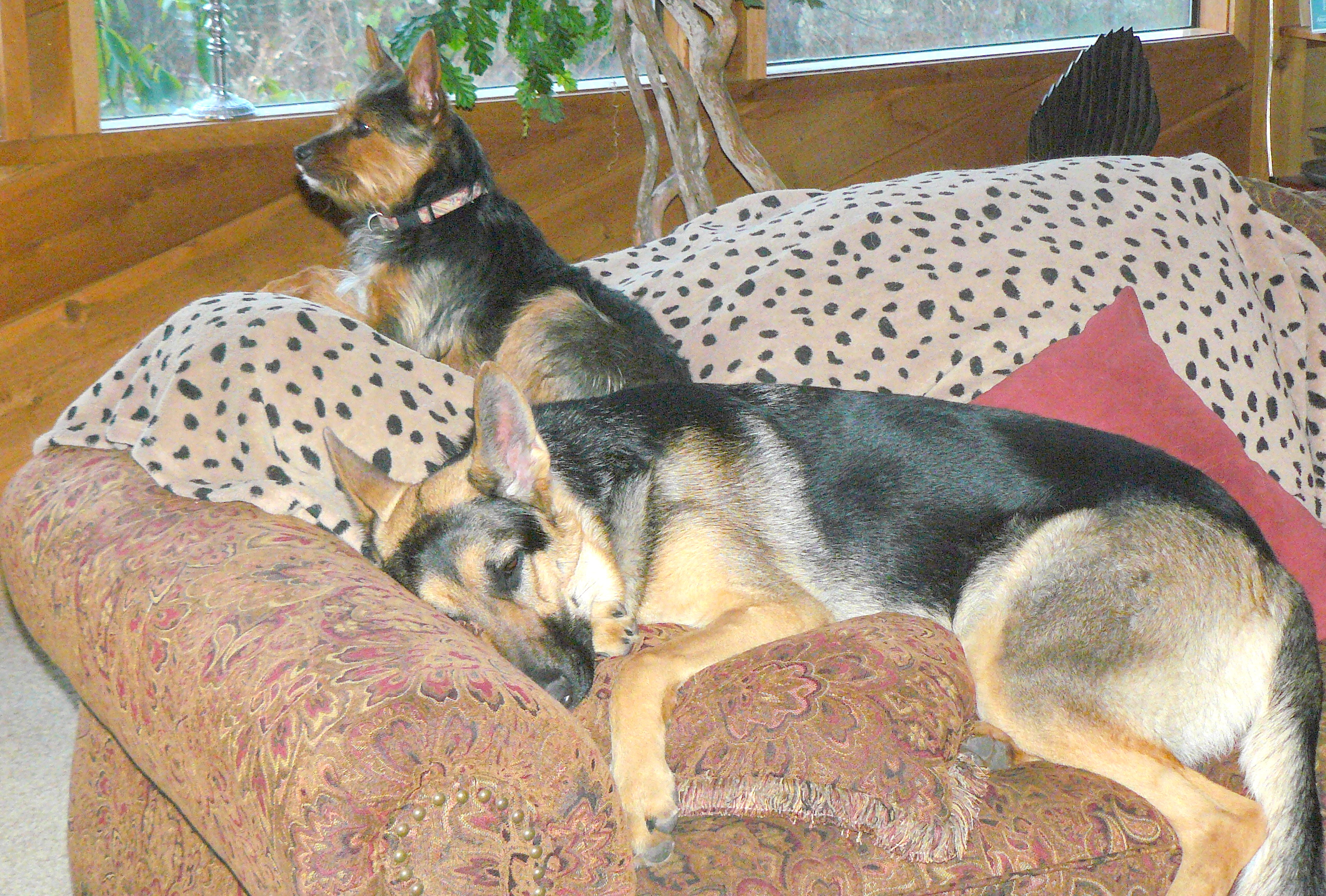
Cleo and Sweeny - just chilling out!
Sweeny and Cleo – just chilling out!

Animal love

“Until one has loved an animal, a part of one’s soul remains unawakened.” Anatole France

This gorgeous video has been doing the rounds and came to me thanks to Suzann.

Enjoy!

Very Talented Russian Bear and His Awesome Friend

This unbelievably talented and cute Russian bear can roll over, play the trumpet, sit on a lawn chair, play the trumpet, you name it. Leave it to a random Russian guy to train such an awesome bear.