Our new young puppy is consuming a great deal of attention and time!
As regular readers will know (and your readership is so much appreciated) last Tuesday I published the news that we had taken on a new puppy. He is settling in incredibly well but consuming heaps of attention; as well he should.
So rather than struggle to be creative with today’s post, I’m cheating by going back to the last time I wrote about a new arrival to our flock; namely puppy Cleo. If you will forgive me, I’m going to republish the post I wrote for puppy Cleo back on April 8th, 2012.
But before so doing, let me explain that our latest arrival has gone through a name change. The previous owners had named the young pup Smokey but we were not comfortable with that name; Jean especially so. So Smokey is now Ollie!
ooOOoo
The arrival of Cleo brings us back to eleven dogs.
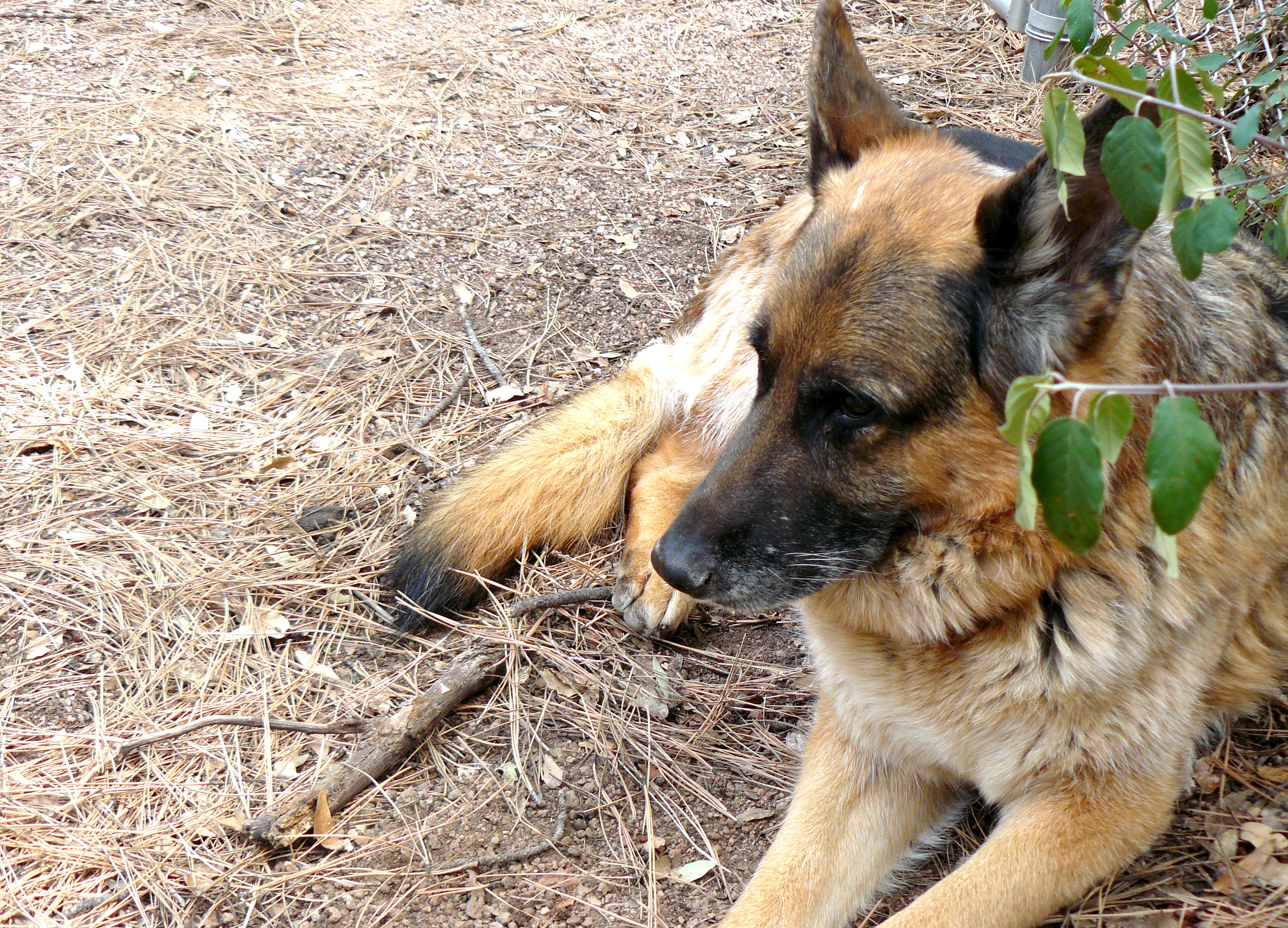
Way back in 2003 when I became the proud ‘Dad’ of Pharaoh, my German Shepherd dog that you see on the home page of Learning from Dogs, Sandra Tucker who ran the GSD Breeders Jutone, where Pharaoh was born, gave me some advice. Sandra said that when Pharaoh was getting on in life, then bring in a German Shepherd puppy. Apparently, there were two solid reasons why this made sense. The first was that Pharaoh would teach the new puppy many of the skills and disciplines that Pharaoh had learnt as a young dog and, secondly, the puppy would keep Pharaoh active.
Now we know this to be true because years later when Pharaoh had his own mini pack here in Payson, we introduced a new ‘rescue’ puppy called Sweeny. Pharaoh took an instant like to him and became very tolerant to Sweeny’s ‘games’.
Hi! I’m Pharaoh, going to be my buddy? (February, 2011)
But as adorable as Sweeny is, Jean understood the deep reasons why I always wanted a German Shepherd in our lives. So when a chance encounter in Payson Feed Store between Jean and Brendon S. revealed that Brendon had a litter of German Shepherd puppies for sale, just a couple of miles outside Payson, the temptation was irresistible!
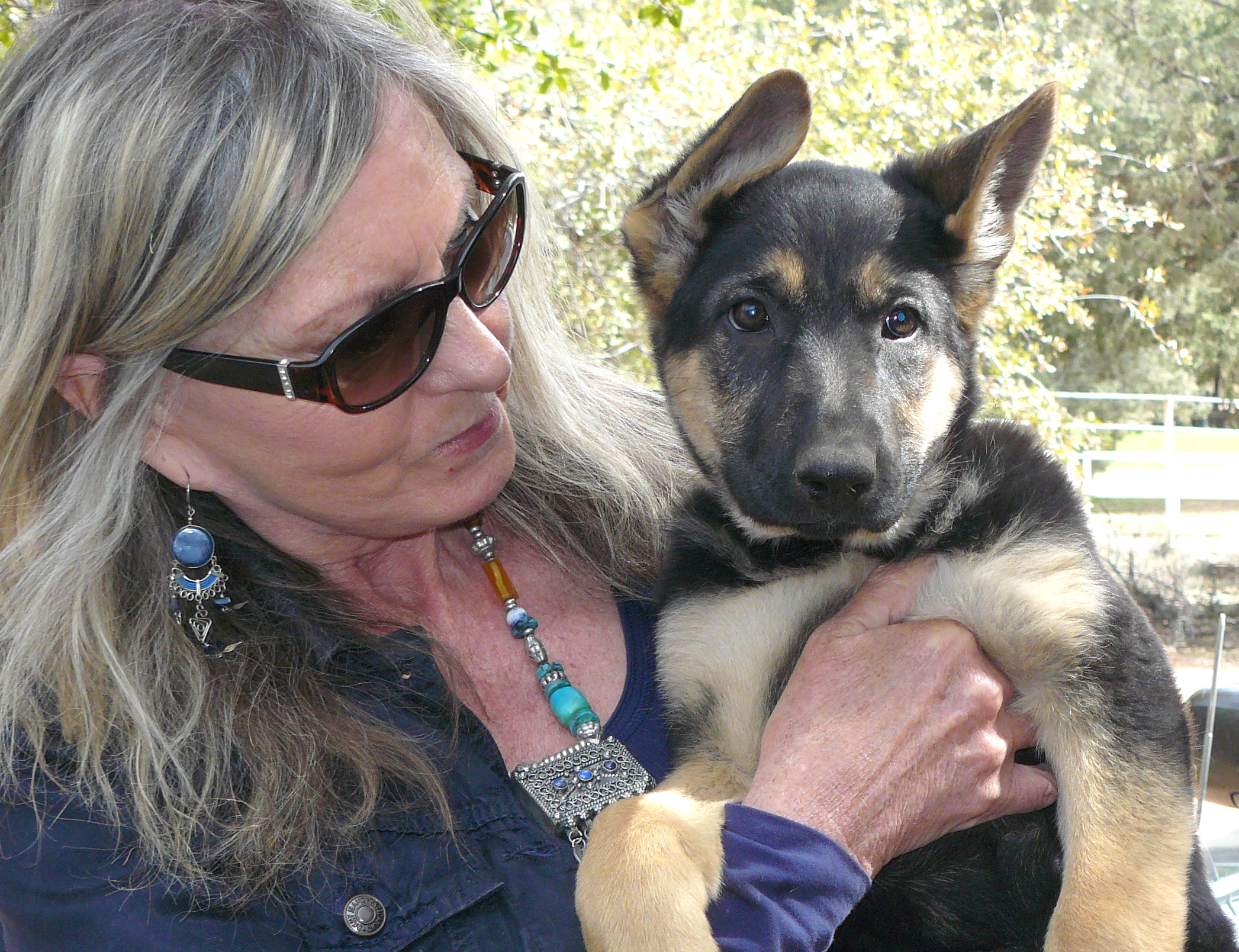
Thus a few days ago, Jean and I went round to Brendon’s home and spent a couple of hours mingling with the puppies and their GSD mother. They all looked excellent dogs and a review of their blood lines showed that their genetic background included German stock not too far back. It was difficult to select any one pup as they were all wonderful animals. But one youngster seemed to catch Jean’s eye.
Little bit of bonding going on!
Then the next test was to introduce Pharaoh to the puppies. That took place last Friday and it was wonderful to see how well he coped with the onslaught of puppies!
More puppies that one could shake a stick at!
In the end, we ran out of reasons not to follow Sandra’s advice from all those years ago and we agreed terms on a young female GSD that, inevitably, was christened Cleopatra (Cleo) by Jean!
Cleo meet your new Mum!
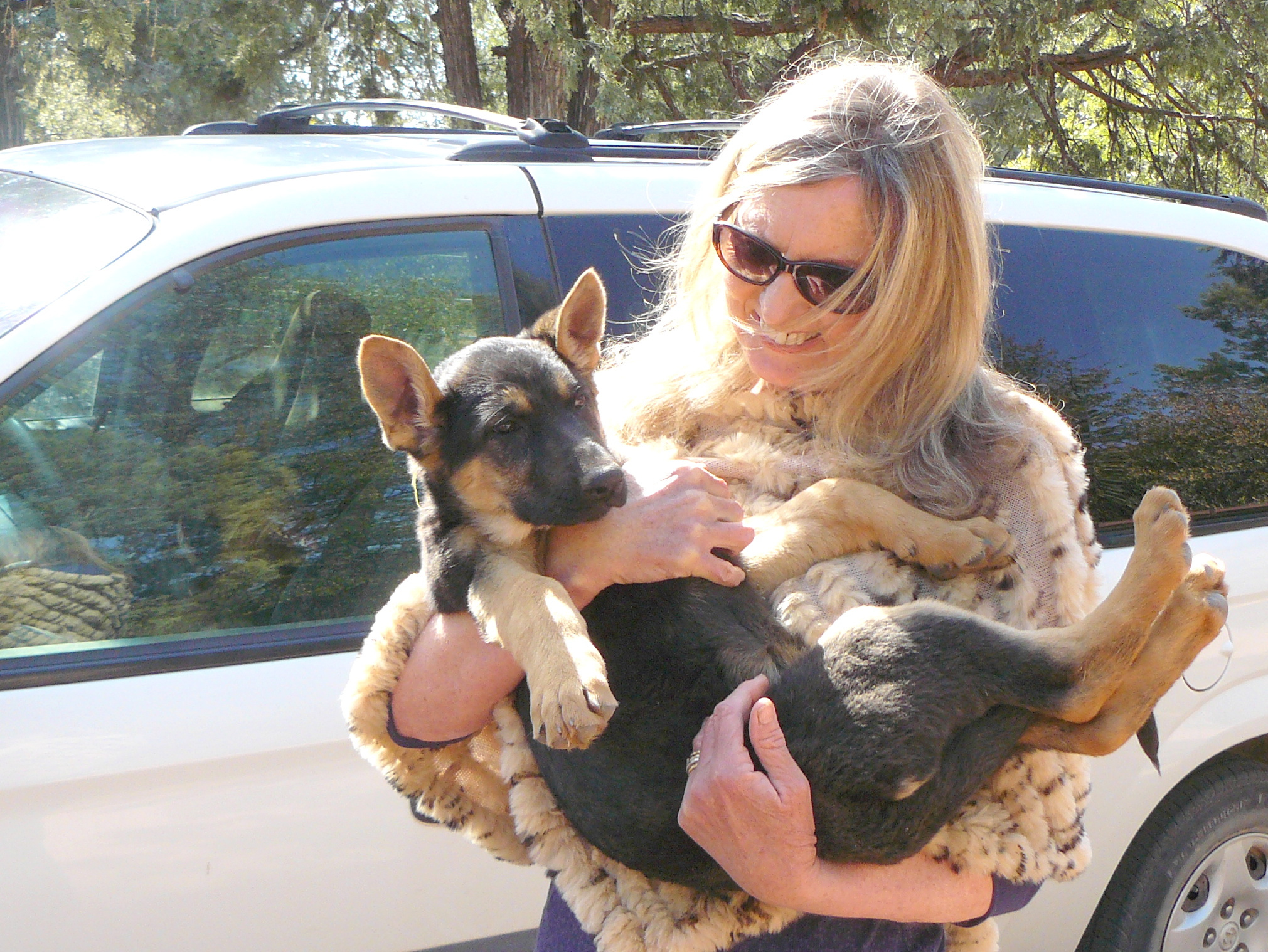
Then yesterday, Saturday, we went back round to collect young Cleo, meeting Brendan’s wife Ebony in the process. The following photographs record some of the key moments.
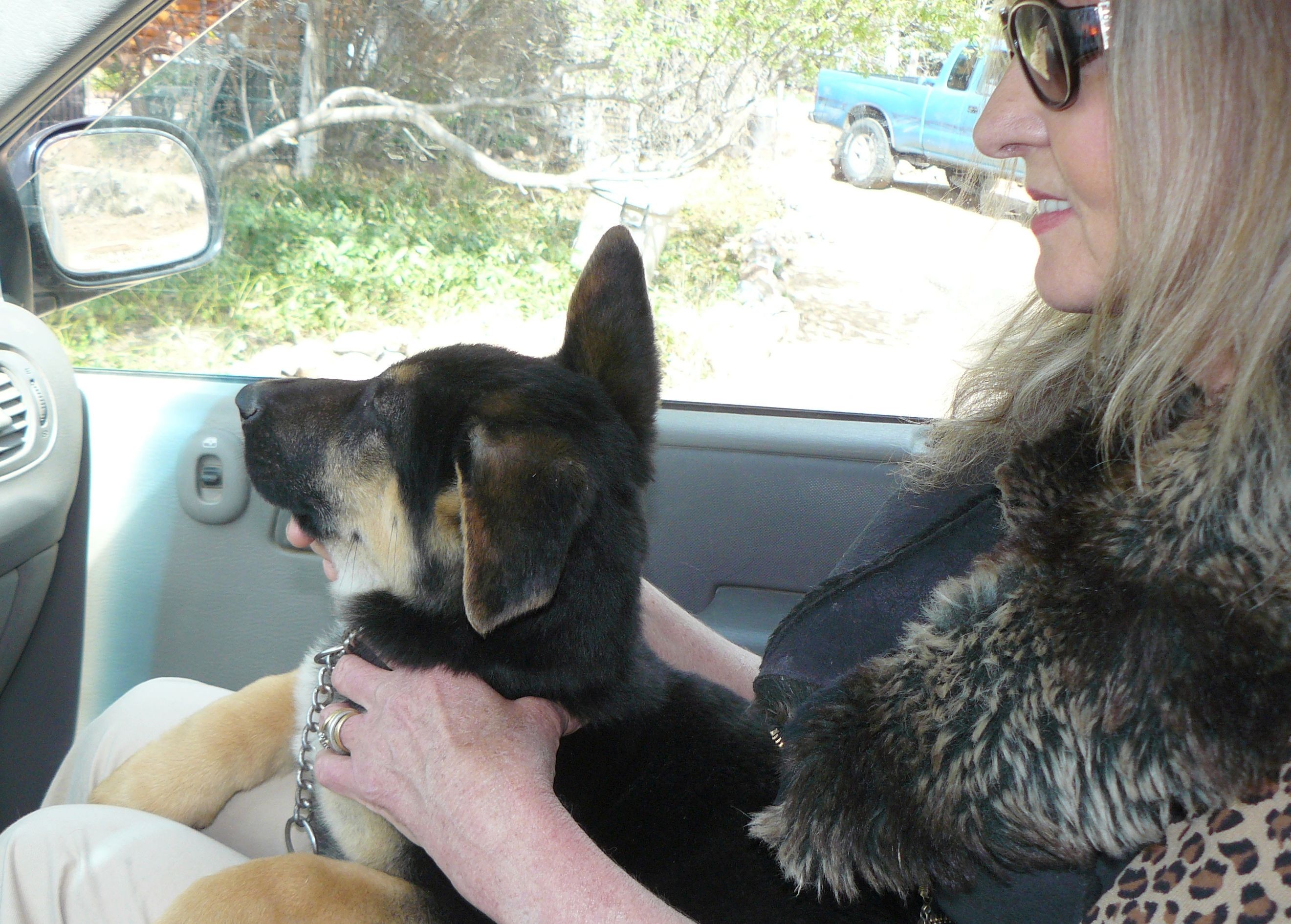
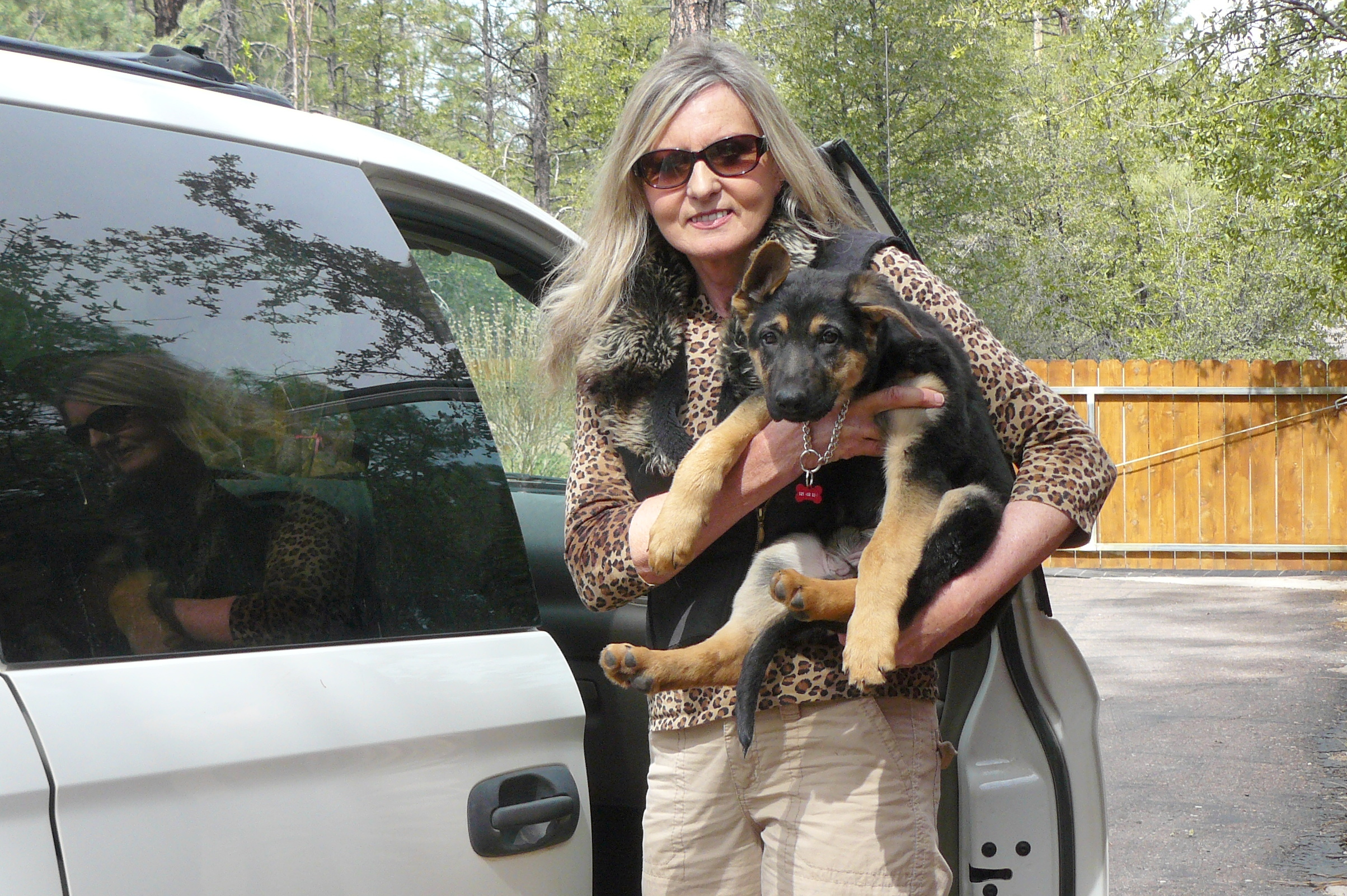
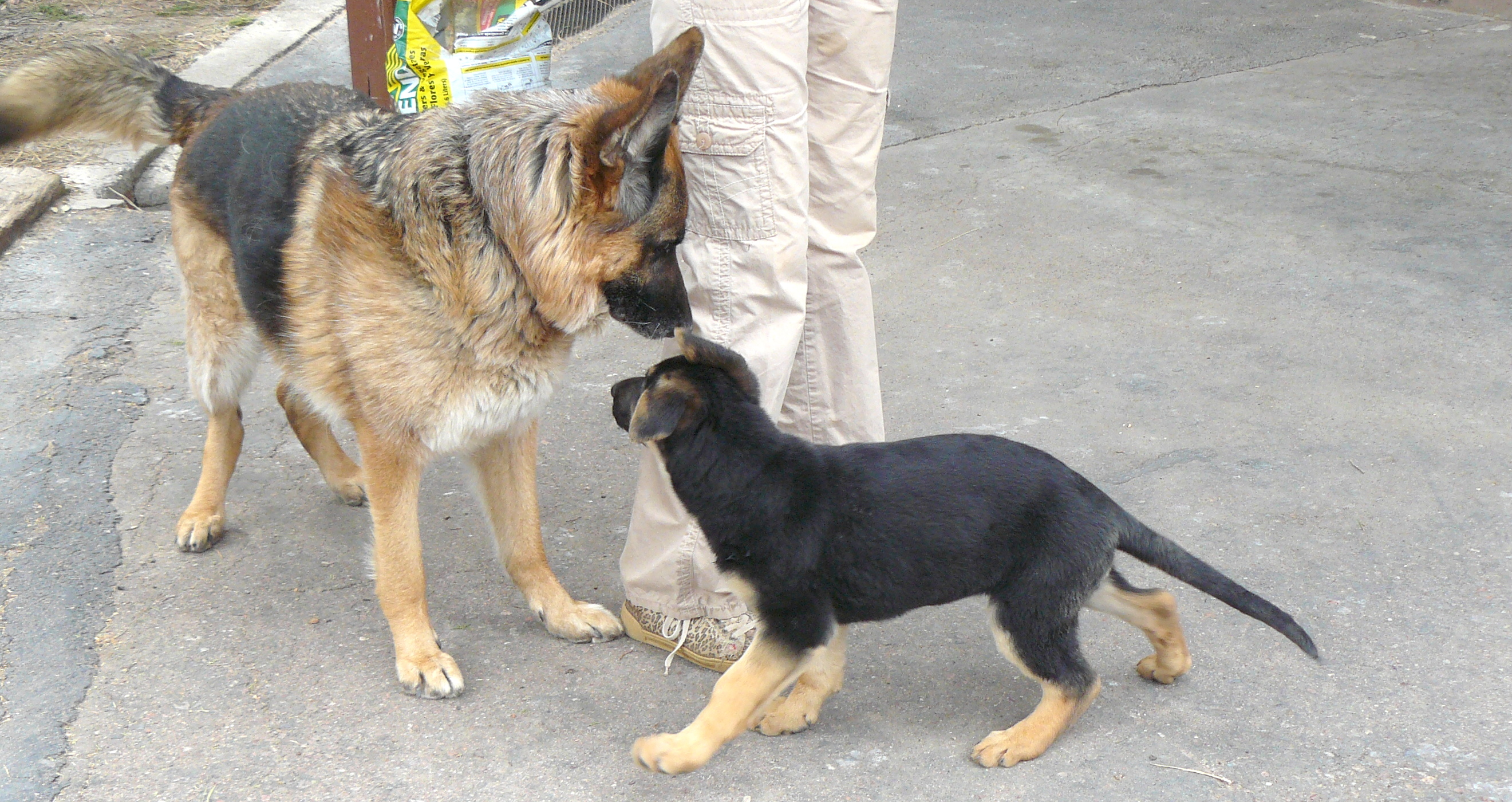
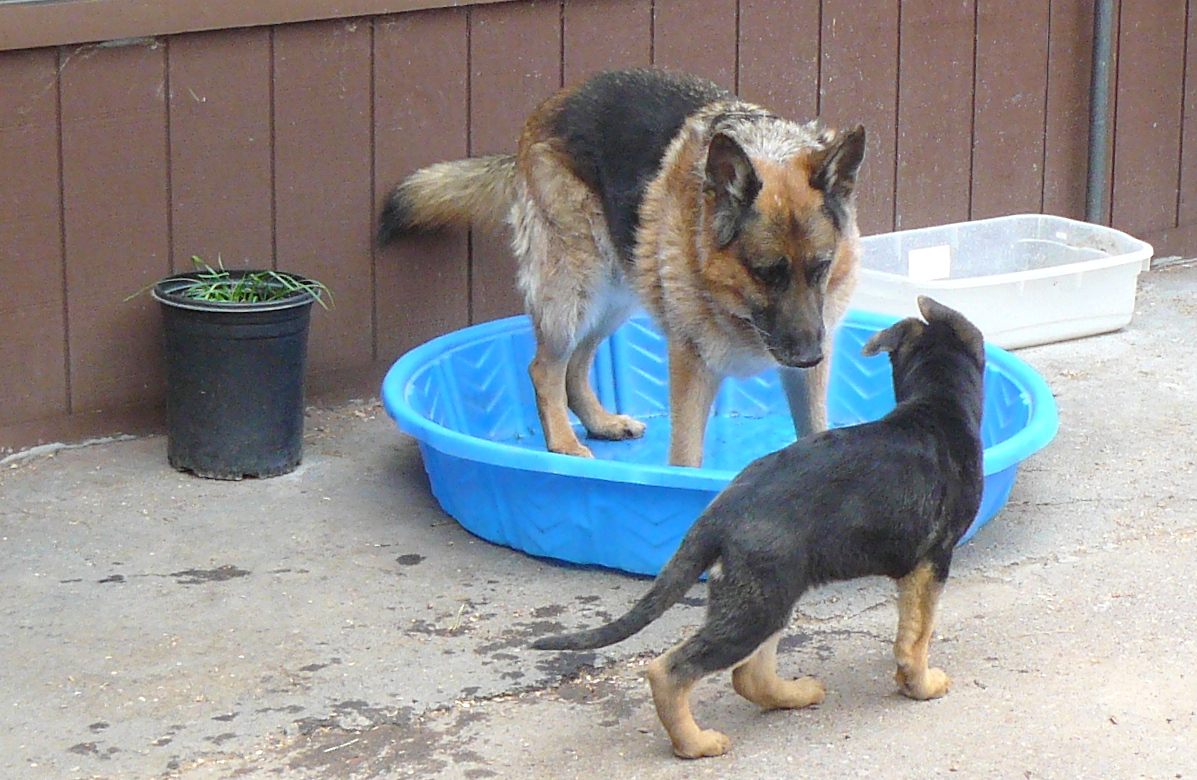
Homeward bound to a new life!Next step is to meet the gang!Welcome, young lady. I’m the boss around here!It’s my pool but you can use it!Hey Sweeny, fancy having one’s own woods to play in!She’ll do! Nice addition to my family!
So there we are. Back up to eleven dogs, five chickens, six cats, and a fish!
Finally, a big thanks to Sandra of Jutone for her guidance in the last few days.
ooOOoo
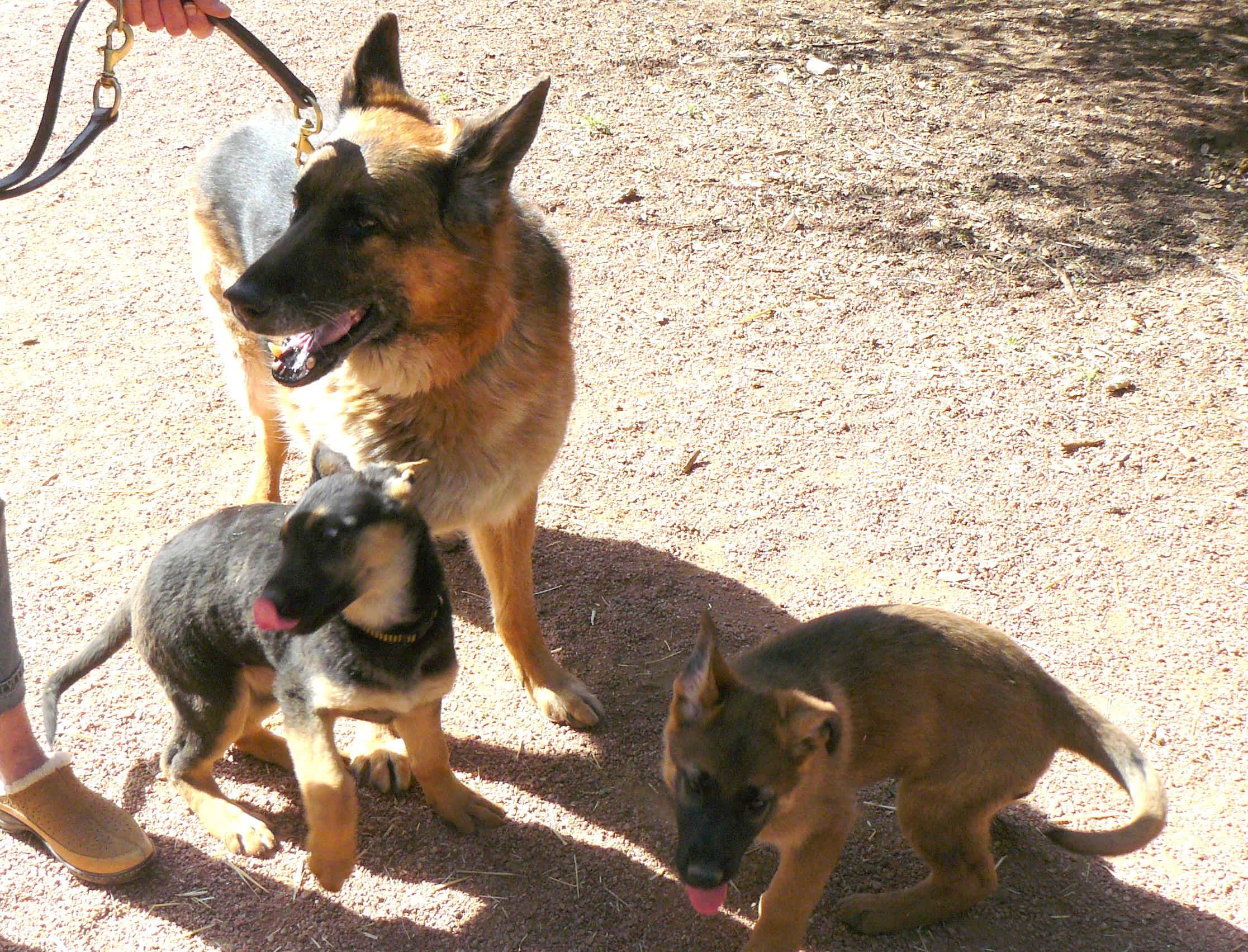
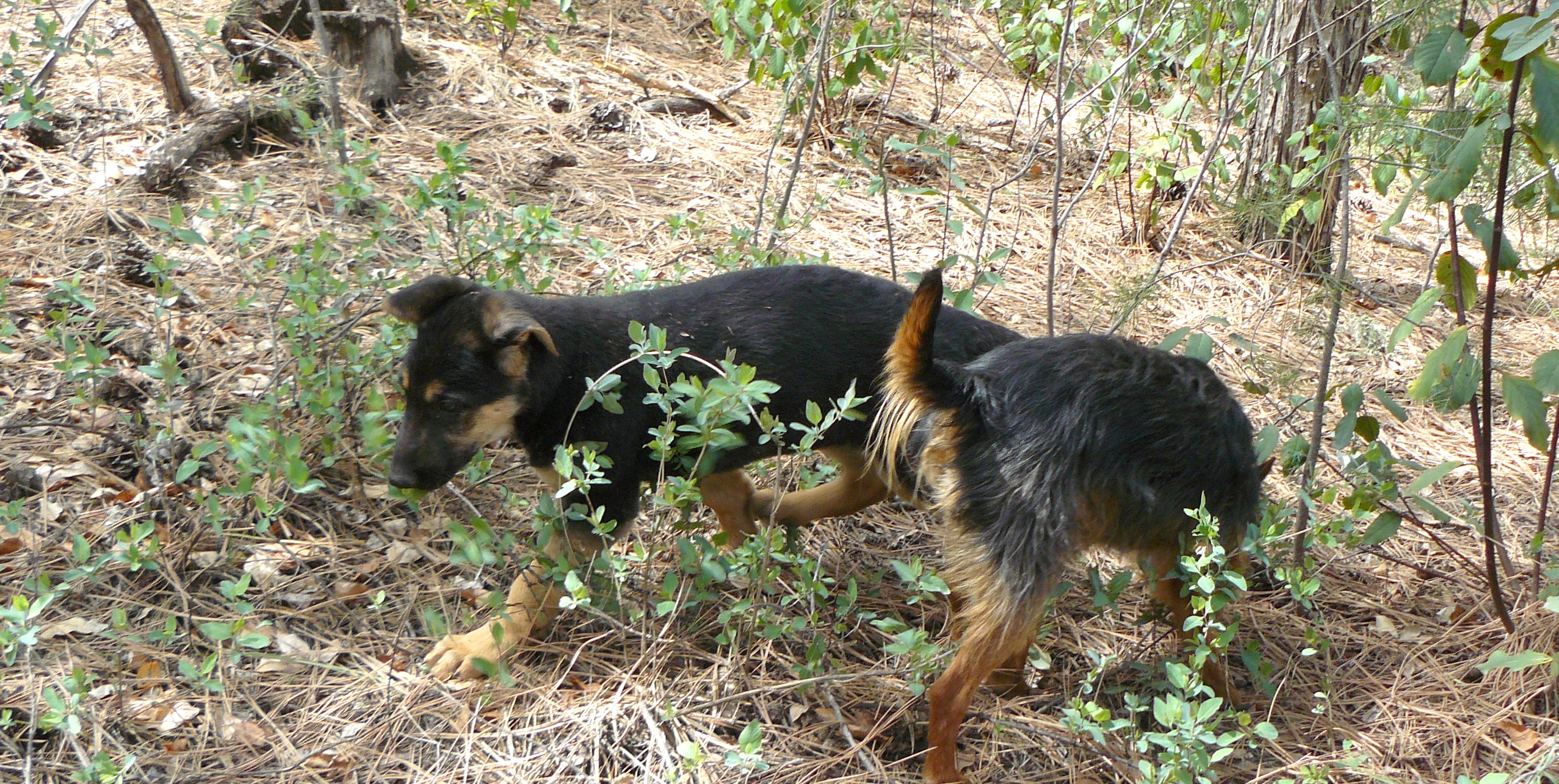
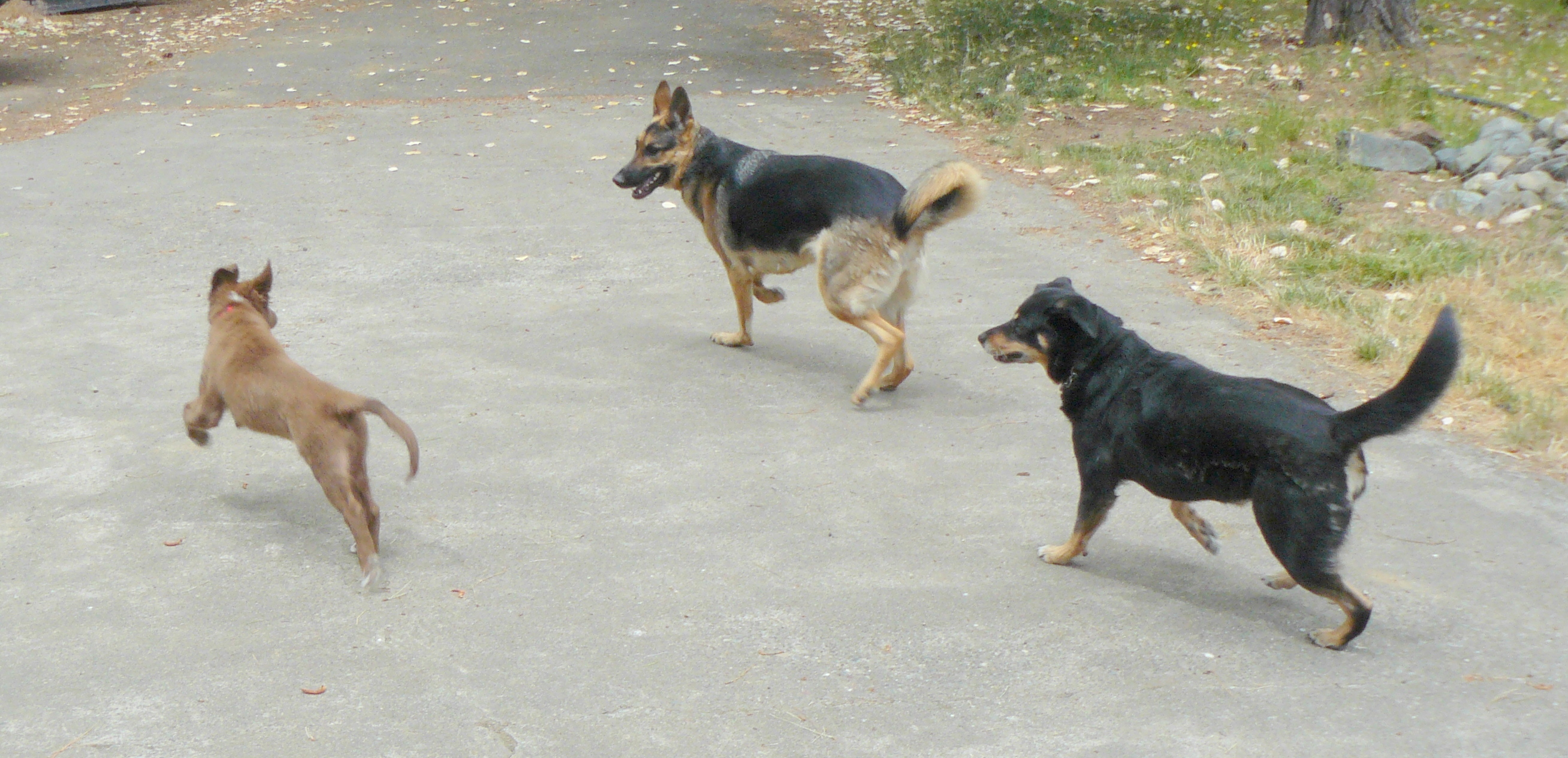
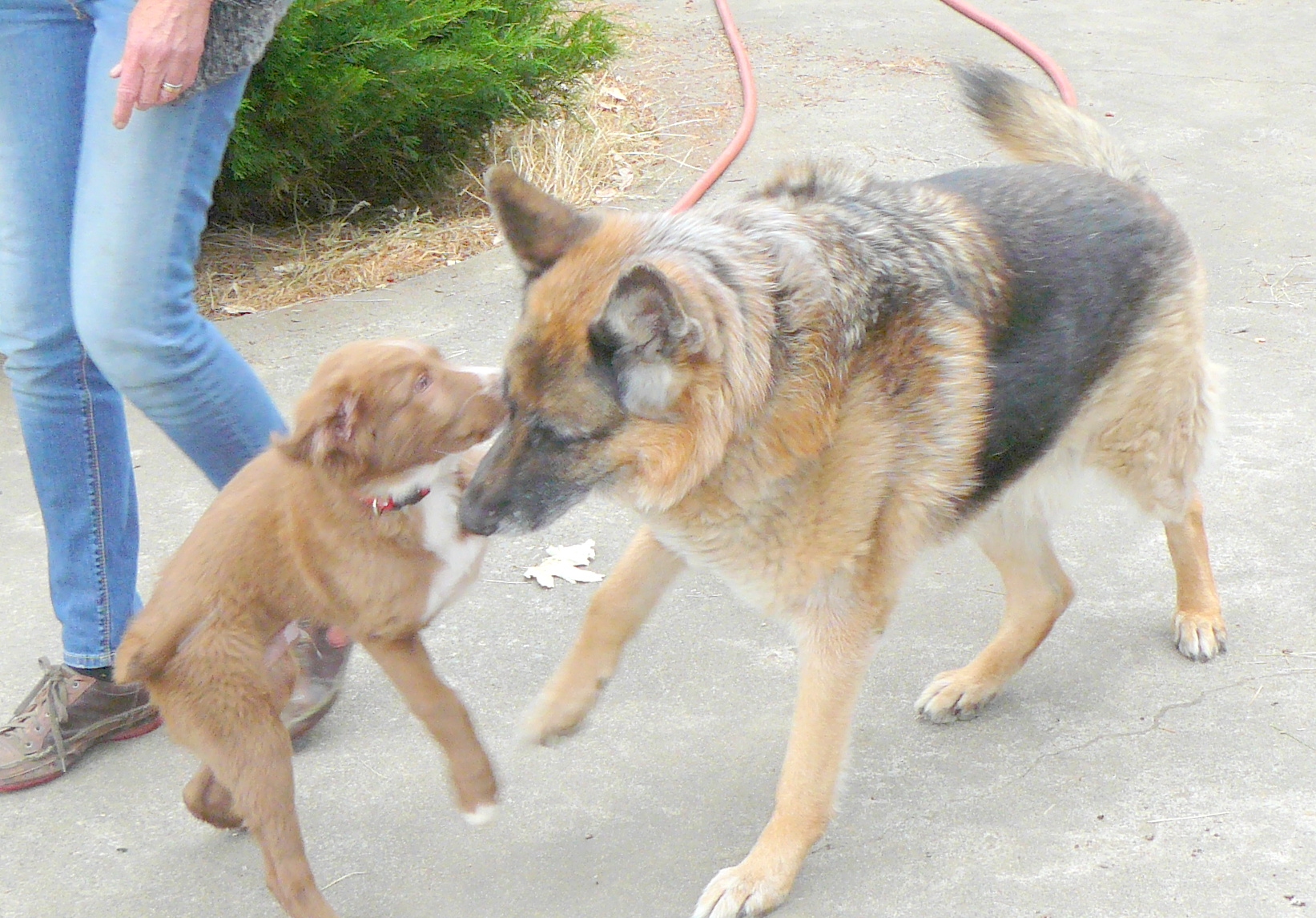
Back to the present to leave you with a picture of puppy Ollie happily playing with Cleo and Hazel. More pictures of Ollie on Sunday.
A run of essays that, collectively, deeply disturb me.
My seventieth birthday is fewer than six months away. Indeed, it will be just a little over two weeks after we celebrate the second anniversary of our arrival to this beautiful homestead back on October 25th, 2012. Two years: Seventy years! Time seems to run through one’s fingers like the proverbial sand. It’s difficult to avoid the irony that comes with recognising the two journeys. The one journey bringing me to living here on our rural Oregonian acres, with stunning scenery, wonderful animals and so much love in the air. The other journey bringing me to the realisation that this is the Autumn of my life and the sense, the keen sense, of my own mortality.
What, may you ask, has brought this feeling, these words, to the surface?
Well, I’ll tell you.
It’s been the coincidence of essays from three authors across the ‘blogosphere’ that I have recently read. Taken together, they paint a picture that disturbs me. Very much so. They sing out to me that mankind is spiralling ever downwards to oblivion and that the dark forces of greed, power and control will never be stopped; well not by man that is!
Here are the links to those essays.
The first was from Tom Englehardt. It was an essay entitled: A Record of Unparalleled Failurepublished on June 10th. That opened:
The United States has been at war — major boots-on-the-ground conflicts and minor interventions, firefights, air strikes, drone assassination campaigns, occupations, special ops raids, proxy conflicts, and covert actions — nearly nonstop since the Vietnam War began. That’s more than half a century of experience with war, American-style, and yet few in our world bother to draw the obvious conclusions.
Given the historical record, those conclusions should be staring us in the face. They are, however, the words that can’t be said in a country committed to a military-first approach to the world, a continual build-up of its forces, an emphasis on pioneering work in the development and deployment of the latest destructive technology, and a repetitious cycling through styles of war from full-scale invasions and occupations to counterinsurgency, proxy wars, and back again.
The second was from another American, Jim Wright, who is the author of the blog Stonekettle Station. Jim describes himself as:
I’m a retired US Navy Chief Warrant Officer. Nowadays I live in Alaska where I spend most of my time working in my woodshop or fishing. I occasionally consult for the Military. I have delusions of becoming a full time writer – or conquering the universe, whichever is easier…
Thanks to Yves Smith’s Naked Capitalism, I followed a link to a recent essay from Jim under the title of Absolutely Nothing, published on the 14th June.
I’m not going to quote from it, not because I don’t approve of his essay, far from it, but because there are many tough, profane words and I do not wish inadvertently to upset my readers. But it is very strongly recommended.
The third essay is from fellow Englishman, George Monbiot, whose work has been regularly republished on Learning from Dogs.
While his essay is not specifically about war, unlike the other two, it does, nonetheless, contribute to my feelings of not wanting to engage with anything that is outside being a better husband, landowner and animal lover. It is called The Values Ratchet and is republished here with the generous permission of George Monbiot.
ooOOoo
The Values Ratchet
June 10th, 2014
How to ensure that nations slide ever further into selfishness, and ever further to the right.
By George Monbiot, published in the Guardian 11th June 2014
Any political movement that fails to understand two basic psychological traits will, before long, fizzle out. The first is Shifting Baseline Syndrome. Coined by the biologist Daniel Pauly, it originally described our relationship to ecosystems(1), but it’s just as relevant to politics. We perceive the circumstances of our youth as normal and unexceptional – however sparse or cruel they may be. By this means, over the generations, we adjust to almost any degree of deprivation or oppression, imagining it to be natural and immutable.
The second is the Values Ratchet (also known as policy feedback). If, for example, your country has a public health system which ensures that everyone who needs treatment receives it without payment, it helps instil the belief that it is normal to care for strangers, and abnormal and wrong to neglect them(2,3). If you live in a country where people are left to die, this embeds the idea that you have no responsibility towards the poor and weak. The existence of these traits is supported by a vast body of experimental and observational research, of which Labour and the US Democrats appear determined to know nothing.
We are not born with our core values: they are strongly shaped by our social environment. These values can be placed on a spectrum between extrinsic and intrinsic. People towards the intrinsic end have high levels of self-acceptance, strong bonds of intimacy and a powerful desire to help other people. People at the other end are drawn to external signifiers, such as fame, financial success, image and attractiveness(4). They seek praise and rewards from others.
Research across 70 countries suggests that intrinsic values are strongly associated with an understanding of others, tolerance, appreciation, cooperation and empathy(5,6,7). Those with strong extrinsic values tend to have lower empathy, a stronger attraction towards power, hierarchy and inequality, greater prejudice towards outsiders and less concern for global justice and the natural world(8,9). These clusters exist in opposition to each other: as one set of values strengthens, the other weakens(10,11).
People at the extrinsic end tend to report higher levels of stress, anxiety, anger, envy, dissatisfaction and depression than those at the intrinsic end of the spectrum(12,13,14). Societies in which extrinsic goals are widely adopted are more unequal and uncooperative than those with deep intrinsic values. In one experiment, people with strong extrinsic values who were given a resource to share soon exhausted it (unlike a group with strong intrinsic values), as they all sought to take more than their due(15).
As extrinsic values are strongly associated with conservative politics, it’s in the interests of conservative parties and conservative media to cultivate these values. There are three basic methods. The first is to generate a sense of threat. Experiments reported in the journal Motivation and Emotion suggest that when people feel threatened or insecure they gravitate towards extrinsic goals(16). Perceived dangers – such as the threat of crime, terrorism, deficits, inflation or immigration – trigger a short-term survival response, in which you protect your own interests and forget other people’s.
The second method is the creation of new frames, structures of thought through which we perceive the world. For example, if tax is repeatedly cast as a burden, and less tax is described as relief, people come to see taxation as a bad thing that must be remedied(17). The third method is to invoke the Values Ratchet: when you change the way society works, our values shift in response. Privatisation, marketisation, austerity for the poor, inequality: they all shift baselines, alter the social cues we receive and generate insecurity and a sense of threat.
Margaret Thatcher’s political genius arose from her instinctive understanding of these traits, long before they were described by psychologists and cognitive linguists: “Economics are the method; the object is to change the heart and soul.”(18) But Labour and the Democrats no longer have objects, only methods. Their political philosophy is simply stated: if at first you don’t succeed, flinch, flinch and flinch again. They seem to believe that if they simply fall into line with prevailing values, people will vote for them by default. But those values and baselines keep shifting, and what seemed intolerable before becomes unremarkable today. Instead of challenging the new values, these parties keep adjusting. This is why they always look like their opponents, with a five-year lag.
There is no better political passion killer than Labour’s Zero-Based Review(19). Its cover is Tory blue. So are the contents. It promises to sustain the coalition’s programme of cuts and even threatens to apply them to the health service(20). But, though it treats the deficit as a threat that must be countered at any cost, it says not a word about plugging the gap with innovative measures such as a Robin Hood tax on financial transactions, a land value tax, a progressively-banded council tax or a windfall tax on extreme wealth. Nor does it mention tax avoidance and evasion. The poor must bear the pain through spending cuts, sustaining a cruel and wildly unequal social settlement.
At the end of last month, Chris Leslie, Labour’s Shadow Chief Secretary to the Treasury, promised, like George Osborne, that the cuts would be sustained for “decades ahead”(21). He asserted that Labour’s purpose in government would be to “finish that task on which [the Chancellor] has failed”: namely “to eradicate the deficit”. The following day the shadow business secretary, Chuka Umunna, sought to explain why Labour had joined the political arms race on immigration. In doing so, he revealed that his party will be “radical in reforming our economy” in support of “a determinedly pro-business agenda”(22). They appear to believe that success depends on becoming indistinguishable from their opponents.
It’s not quite as mad as the old tactic among some Marxist groups of promoting inequality and injustice in the hope that popular fury would lead to revolution, but it’s not far off. Quite aside from the obvious flaw (what’s the sodding point of voting for a party that offers no substantial change in policy?), it evinces a near-perfect psychological illiteracy. When a party reinforces conservative values and conservative ideas, when it fails clearly to expound any countervailing values, when it refuses to reverse the direction of the Values Ratchet, what outcome does it expect, other than a shift towards conservatism?
1. Daniel Pauly, 1995. Anecdotes and the Shifting Baseline Syndrome of Fisheries. Trends in Ecology and Evolution 10. 10:430.
2. Stefan Svallfors, 2010 Policy feedback, generational replacement, and attitudes to state intervention: Eastern and Western Germany, 1990-2006, European Political Science Review, 2, 119-135.
5. Shalom H. Schwartz, 2006. Basic Human Values: Theory, Measurement, and Applications. Revue Française de Sociologie, 47/4. http://bit.ly/1hL1JFJ
6. Frederick Grouzet et al, 2005. The structure of goal contents across fifteen cultures. Journal of Personality and Social Psychology, 89, 800-816. http://psycnet.apa.org/journals/psp/89/5/800/
9. Kennon M. Sheldon and Charles P. Nichols, 2009. Comparing Democrats and Republicans on
Intrinsic and Extrinsic Values. Journal of Applied Social Psychology, 2009, 39, 3, pp. 589–623.
12. Tim Kasser, 2014. Changes in materialism, changes in psychological well-being: Evidence from three longitudinal studies and an intervention experiment. Motivation and Emotion, 38:1–22. doi: 10.1007/s11031-013-9371-4
20. “We will be cutting departmental spending in 2015-16 and not raising it, with no more borrowing to cover day-to-day spending”
“The fundamental principle of the Zero-Based Review is that all spending is in scope and all budgets will be challenged. The review will cover all areas of public spending, including those that have been protected in the current Spending Review such as health”.
A few weeks ago Jean and I were invited to a social gathering with a couple who live about a mile further along Hugo Road. We couldn’t help admiring their young dog; a delightful puppy by the name of Smokey. Smokey appeared to be about ten weeks old and, despite being very puppy-like was, nevertheless, a sweet, friendly, young male dog. Apparently, a mix of a Labrador and a Bordie Collie.
Anyway, last week there was a call from them to say that they were finding the puppy to be too much of a handful and were looking to find Smokey a new home: Did we want first refusal?
Thus it came about that yesterday morning Jean and I drove the short distance to collect Smokey and introduce him to the dog’s circus that is home for us all!
Naturally, the key question would be how would Pharaoh take to Smokey.
A few pictures to tell the tale.
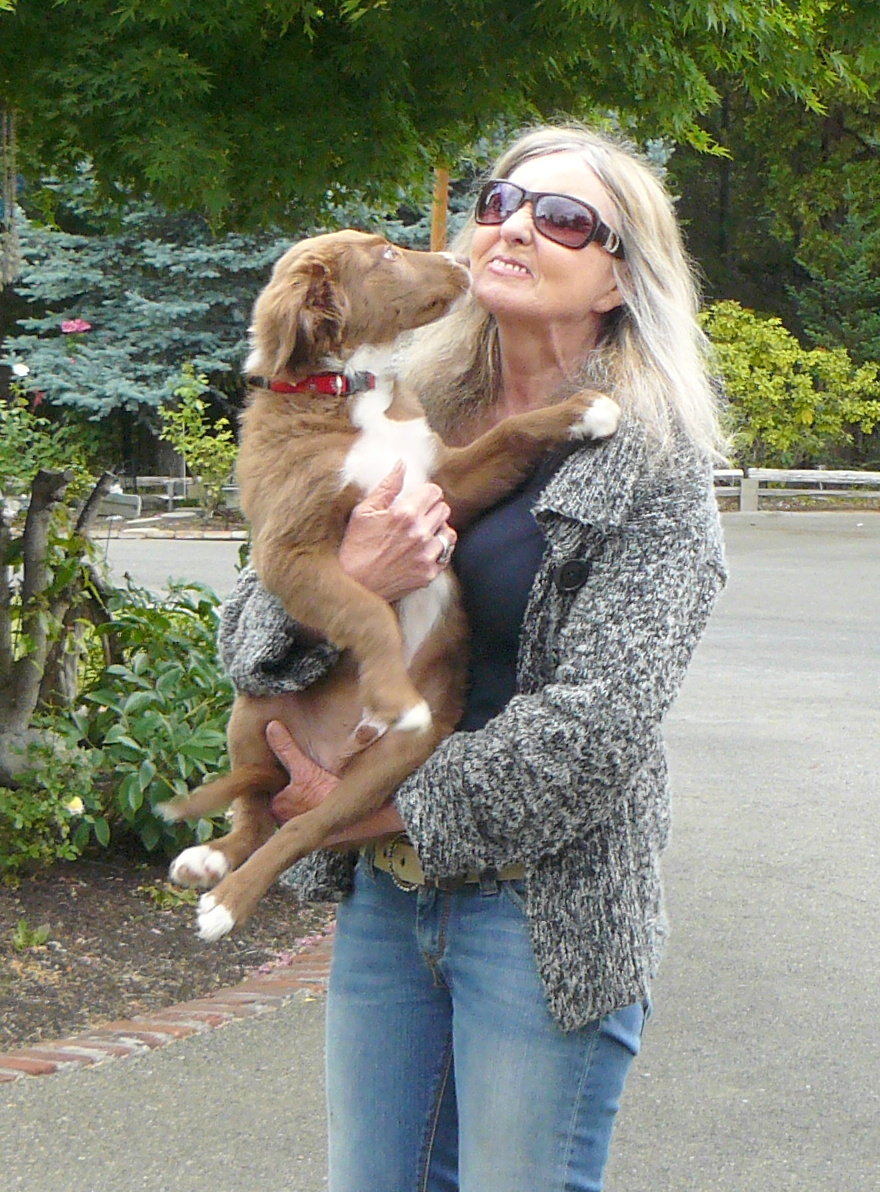
Hello Smokey, I’m Jean and we are hoping you will come home with us and be part of our family.
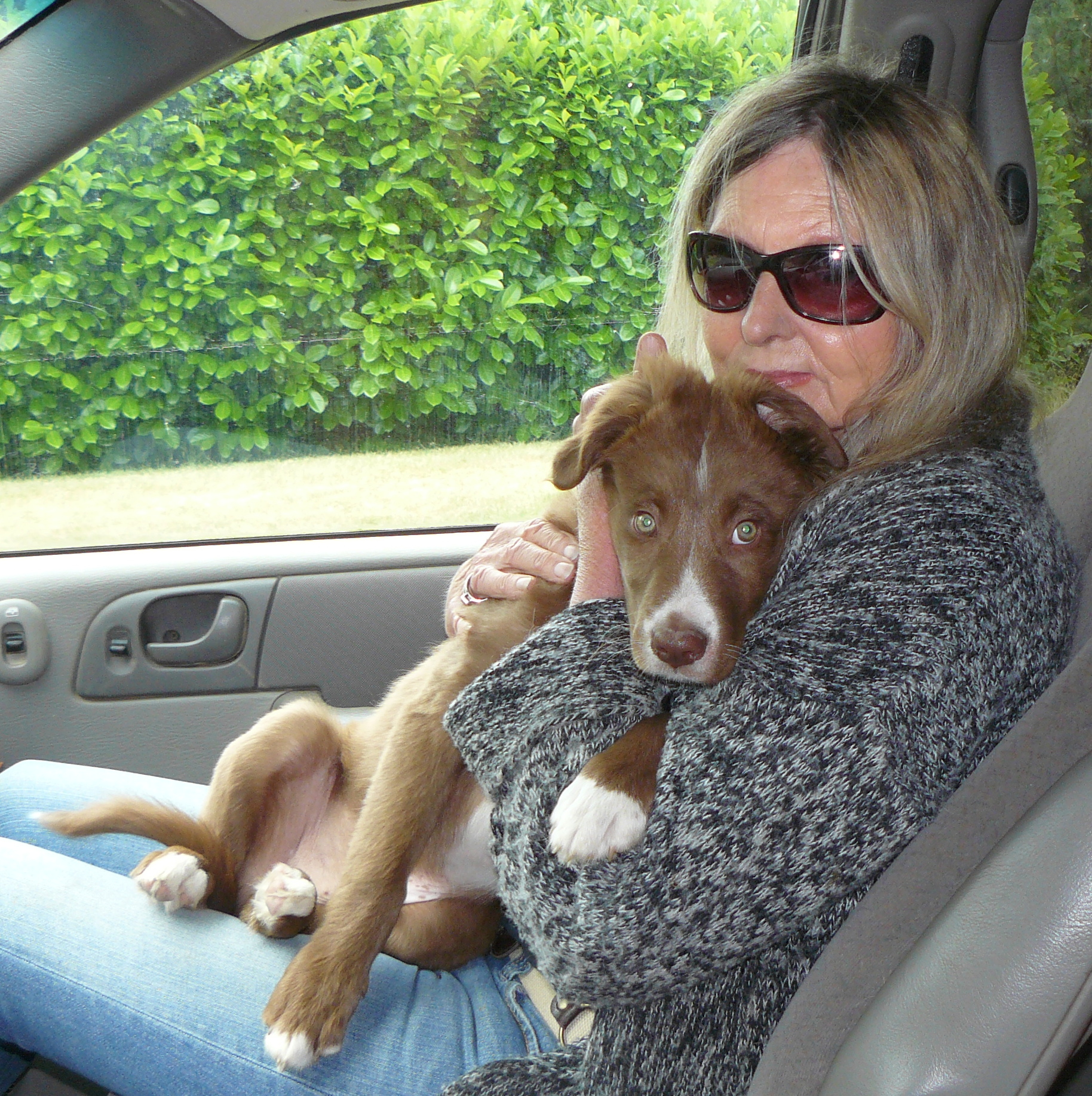
Well, you certainly seem like a friendly little chap. Let me carry you across to the car.
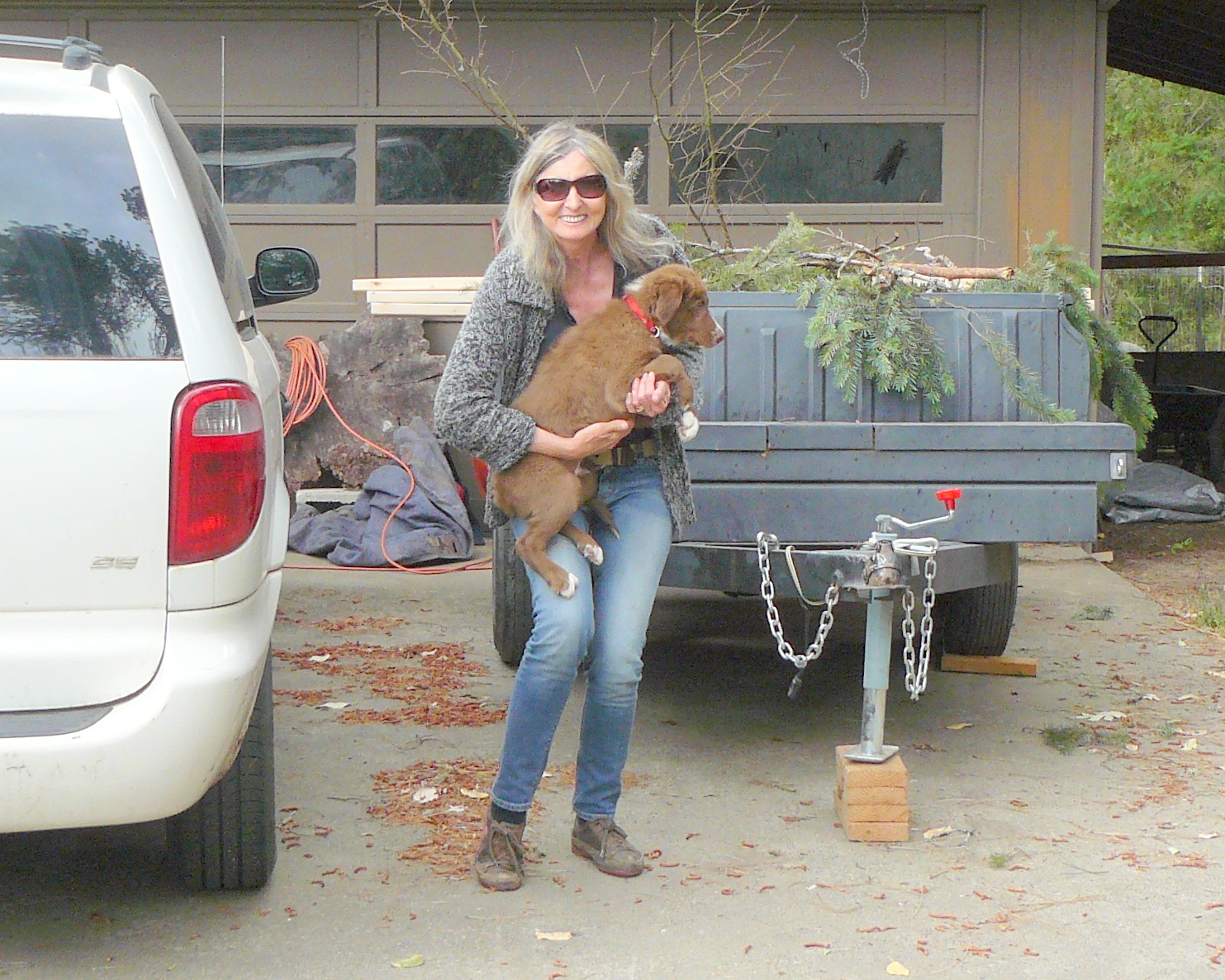
That’s Paul, your new Daddy! Hold on tight; it’s only for ten minutes.
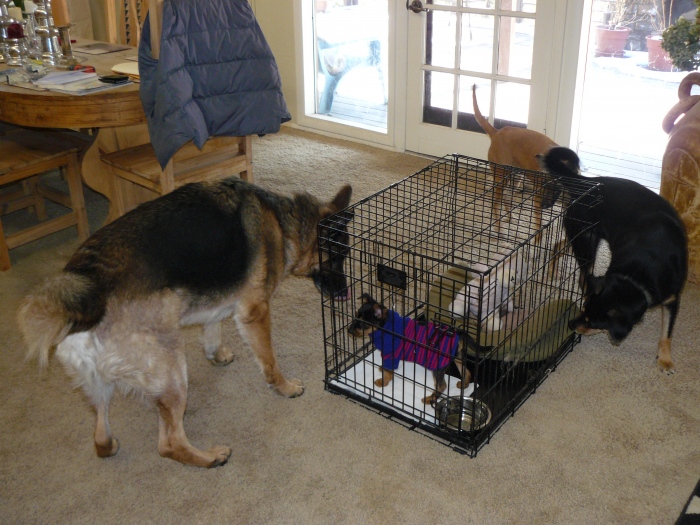
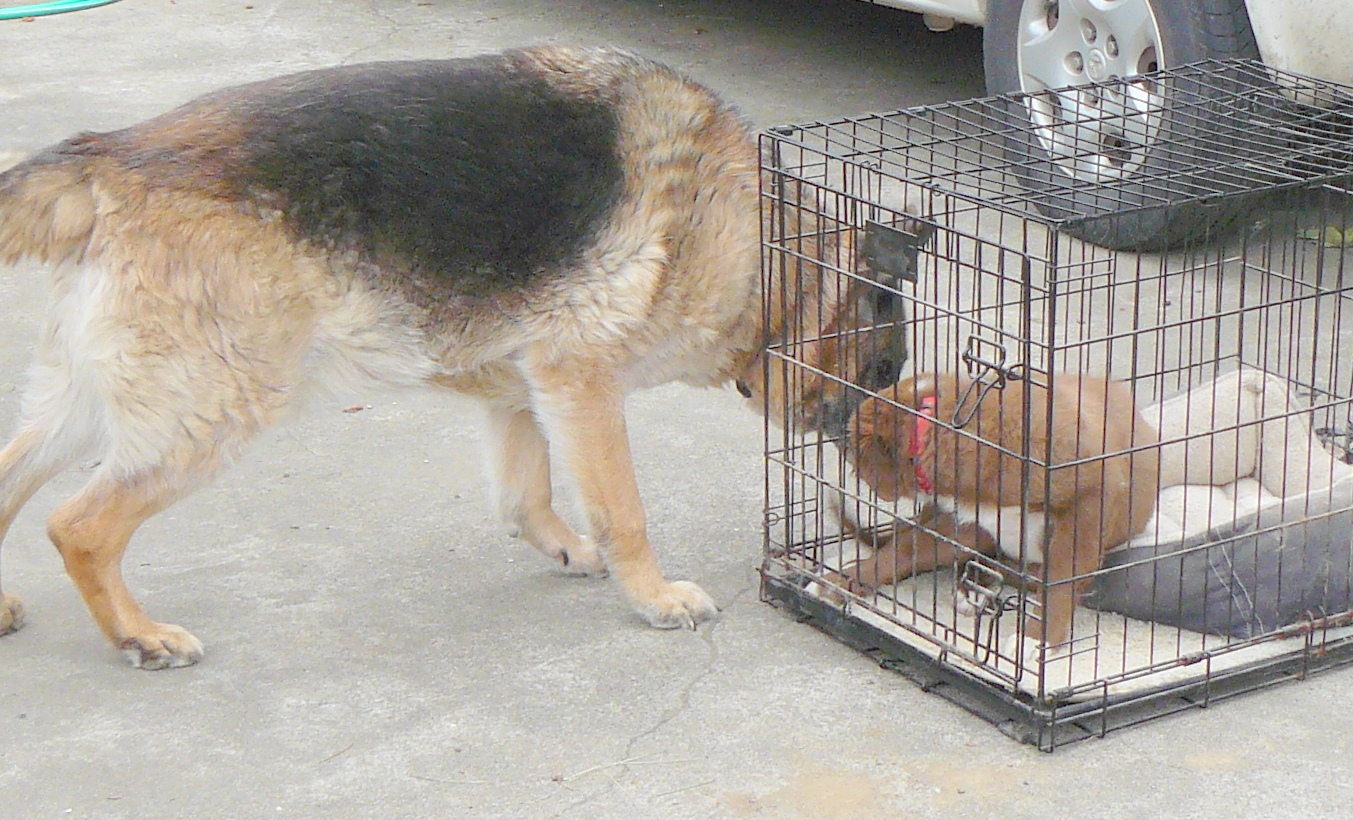
And here we are at your new home. Going to pop you into a dog crate so Pharaoh can come out and meet you.
So what do we have here? I’m Pharaoh and despite my age, I’m still the boss around here! M’mm, you seem to pick things up quickly!
Ah, that’s good my little friend. You may be young but you seem like a smart puppy. Welcome to the clan!
Many more pictures of Smokey successfully meeting the rest of Pharaoh’s ‘team’ but I will make those a special ‘Smokey’ set of pictures for this coming Sunday.
Let me close this by saying that as I write this post at 2pm yesterday afternoon, Jean is reading a book and about her, in perfect silence and contentment, are Pharaoh, Hazel, Cleo, Sweeny ….. and Smokey!
Last Saturday, I published a post called Are you grounded?The essence of that post was that grounding our bodies on a very regular basis, as in daily, was the primary means of avoiding a wide range of illnesses. In that post was included the first part of a speech given by Dr. Stephen Sinatra M.D. and I promised to include today the full speech.
So here are the videos including that Part One that was included on Saturday. (I do hope I have them in order!)
Part One
Part Two
Part Three
A simple heart-healing exercise
Sharing the “secret” for living longer
The healing modality
ooOOoo
These further items also could be of interest to you.
Dr. Sinatra has his own website that may be found here.
There’s a 90-minute interview of Dr. Sinatra by Dr. Mercola; see below.
And much more if you spend a short while exploring the internet.
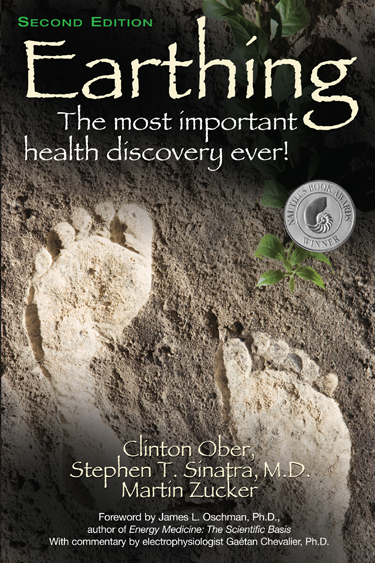
I have just finished reading a book with the title of Earthing.
It has been an absolutely fascinating read and one, I’m bound to say, that seems entirely plausible.
That is that our modern lifestyle that has us disconnected from Mother Earth for much of our time is the cause of many ailments. As the associated website explains:
CONNECT TO THE EARTH AND FEEL BETTER!
Just as the sun gives us warmth and vitamin D, the Earth underfoot gives us food and water, a surface to walk, sit, stand, play, and build on, and something you never, ever thought about—an eternal, natural, and gentle energy. Think of it perhaps as vitamin G: G for ground. What does that mean to you? Maybe the difference between feeling good and not so good, of having little or a lot of energy, or sleeping well or not so well.
You can’t see the Earth’s energy but some people can feel it as a warm, tingling, and pleasant sensation when they are out walking barefoot along the water’s edge at the beach or on a stretch of dew-moistened grass.
Throughout history humans walked barefoot and slept on the ground. But modern lifestyle, including the widespread use of insulative rubber, or plastic-soled shoes, has disconnected us from the Earth’s energy and, of course, we no longer sleep on the ground. Fascinating new research has raised the possibility that this disconnect may actually contribute to chronic pain, fatigue, and poor sleep that plague so many people.
The remedy for the disconnect is simple. Walk barefoot outdoors whenever possible and/or sleep, work, or relax indoors in contact with conductive sheets or mats that transfer the energy to your body. People who do so on a regular basis say they sleep better, feel better, and have more energy during the day. This simple practice is called Earthing, also known as grounding, and it is both a technology and a movement which is transforming lives across the planet.
Were you aware, for example, that the sole of our foot has more nerve endings per square inch than any other part of our body! And more sweat glands! All from thousands of years of being connected to the Earth.
Curious?
Then watch Part One of a conference video by Dr. Stephen Sinatra, one of the authors of the book:
(The remaining parts of Dr. Sinatra’s talk will be presented in a post on Monday!)
Jean and I have just ordered the half-sheet and I shall be delighted to write more of our experiences over the coming weeks.
And I don’t need to remind you that dogs have been in bare-foot contact with Planet Earth for some time now!
Having our good friends, Andy and Trish, with us for a few days means, quite rightly, that time with them is top of our list; so to speak.
Thus I want to republish a recent post from Paul Gilding that seems to me to be right on the mark.
But first an apology. About 10 minutes ago (07:40 US PDT yesterday) I pressed the ‘reblog’ key over on Paul Gilding’s posting in error. Subscribers to Learning from Dogs will have been sent an email to that reblog and then discovered that I had deleted it, in favour of this approach!
Mr Paul Gilding.
ooOOoo
THE GLOBAL ENERGY MARKET’S MOMENT OF TRUTH
If you want to know what addressing climate change will really be like for business and investors, then take a look at today’s electricity and energy markets. Driven by climate policy, technology development, business innovation, NGO campaigns and investment risk analysis, creative destruction is inflicting itself upon the sector with a vengeance – and the process has just begun.
Value is being destroyed at an incredible scale with just one example being European utilities losing $750 billion in market cap in recent years. Another is the huge losses in value for coal companies and the cancellation of a large number of new coal mining projects around the world as the forecast growth in China and India evaporates. As I argued in my last Chronicle, Carbon Crash Solar Dawn, this is not a temporary market blip but a fundamental shift. Company strategies and business models that have been working for generations are collapsing. In parallel we see the creative side of the process, with new industries being built, entrepreneurs flourishing and massive wealth being created. Now the market is working, as it should, allocating capital to the places where risk and return are best aligned. It is at once a beautiful and brutal process to observe.
This is an important inflection point to acknowledge, with significant implications that should reframe our thinking about these issues.
For a start it means, climate policy and its economic consequences have now shifted from future forecasts to present reality. This reality, with all its brutality for existing businesses, give us important insights into what to expect as the world wakes up to climate change. Business is already waking up to what that means in a market economy – creative destruction unleashed to destroy slow responders.
This suggests that traditional corporate responsibility, which argued sustainability was good for all businesses, is outmoded and not helpful. We have moved into an era of win/lose rather than win/win, and with that, sustainability is shifting from ‘environmentalists vs business’ to ‘business vs business’ as I covered in this earlier Chronicle.
Taken together this means we need to change the way we talk and think about climate change and business. Sustainability is not good for many businesses – in fact it means they’ll have to go out of business. This is what sustainability at its core is all about – things that are unsustainable will stop.
While on the one hand this is blindingly obvious, it is a conversation many in business and politics don’t want to acknowledge. So when the previous Australian government brought in its carbon pricing scheme, it went to great lengths to argue that Australia would still have a healthy coal industry. And President Obama’s new regulations on CO2 emissions in the US power industry are likewise being positioned as being as much about health and air pollution as climate policy.
But as Michael Grunwald argues in this Time Magazine piece on “Obama’s War on Coal” – a phrase used by the coal industry to suggest this is unfair and unreasonable – it’s time to face up to the reality of climate action. It is a war on coal, pure and simple. Grunwald calls it the “just but undeclared war ”. But rather than “just” with its moral overtones, we could simply argue it is “necessary” based on any objective analysis of what’s good for the economy and for society. What is necessary is to move a range of companies out of the economy and replace them.
Coal is first in the firing line. As a major cause of CO2 emissions and with the lack of market support for Carbon Capture and Storage suggesting “clean coal” is either a delusion or at best an expensive PR campaign, coal simply has to go. That means coal companies will go out of business, and then oil companies and gas companies will follow them.
This is not a problem at all for the economy, as they will be replaced with new companies and new industries, which will create new jobs, new wealth and new innovations. But it is a major problem for the incumbents who will cease to exist and for their owners who will lose their money. Unless we have that conversation honestly and openly, we are setting ourselves up for pain and suffering we can easily avoid or at least minimise by thinking through the consequences and being better prepared for their departure.
Of course the best way to minimise the pain would be for fossil fuel companies to transition to new areas of business, to use the great wealth they have created to diversify into sustainable sources of profit. But most of them won’t. It’s not that they couldn’t – it’s just that they won’t. And it’s not just coal but also oil and gas who are, for the most part, in strong denial about what’s coming and so won’t be prepared, as well explained in this article by Giles Parkinson at RenewEconomy.
We shouldn’t be surprised. History shows how rare it is for companies to transform and survive major market and technology shifts. That’s why the average life expectancy of a successful multinational is only 40-50 years. And that’s why the financial markets – who act without ideology based on looking at the data – are rapidly responding. They are stripping value from fossil fuel exposed utilities and the resource companies that provide their fuel. They are also downgrading credit risk, with Barclays recently issuing a warning the investors should no longer see utilities as a “sturdy and defensive subset of the investment grade universe”. The report concluded: “We see near-term risks to credit from regulators and utilities falling behind the solar plus storage adoption curve.” No doubt Deutche Bank considered these risks when they recently announced they wouldn’t consider funding a major new coal port next to Australia’s Great Barrier Reef.
So while the idea of “war on coal” is in some ways an accurate summary of the momentous threats the industry faces from a range of forces that are consciously and deliberately coming after them, we could also just see this as how markets work.
Fossil fuels provide us with energy, but they also destroy value across the economy – by driving climate change, damaging health and increasing costs for taxpayers while imposing unmanageable risks on other companies who rely on a stable climate for their business success. So the market is simply doing its job, pricing in some of these costs using the proxies of regulatory, credit and technology risk.
The market is working …. and fossil fuels are losing.
ooOOoo
Hope you agree with me that it’s a great essay and, also, I hope you followed the links – they are all very interesting.
Those of you who are not familiar with Paul Gilding can find out more about him here. Plus the following TED Talk by Paul is highly recommended viewing.
We have good friends arriving today to spend a week with us and I knew time would be tight for long, introspective blog posts.
Then yesterday, around 2pm, we dropped everything to race up to a farmer at Wolf Creek, just a dozen miles North of us, to inspect some hay that was for sale. It was great quality and at $5 a bale the deal of the century. So by the time we had loaded up some bales onto the trailer and returned, unloaded them into the hay loft, organised a bigger trailer from neighbours Dordie and Bill, and I had recuperated under a shower, there was no time at all for today’s post.
I took the ‘executive’ decision to republish what was presented on Learning from Dogs four years ago, to the day. Trust this is fresh to the majority of you.
I’ve been working with most of my clients recently through painful transformations brought about by the economic downturn.
An interesting metaphor really because since the first wave of uncertainty triggered panic, first noticed in the UK banking system, I have been picking up on that uncertainty that feels like it’s stalking the globe at the moment.
Interestingly, I, too, have been aware of an underlying fear that was difficult either to name or source.
It has been rather like a deep river in that whilst the surface feels slow moving, currents are flowing powerfully below.
So this ‘fear’ has caused a few household changes.
We are now the proud owners of 9 chickens. Our youngest son, Sami, and I have dug up the back lawn and planted vegetables and built a poly-tunnel.
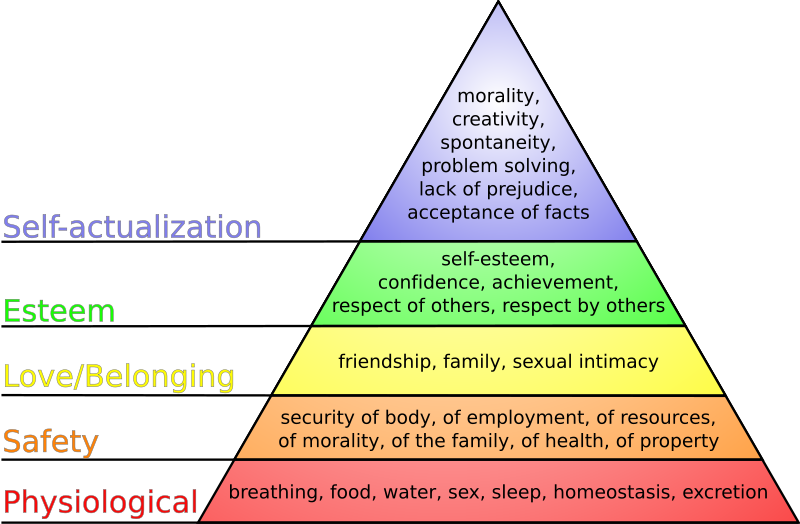
We have also installed a wood burning cooker. Right back down to the base of Maslow’s triangle really!
Maslow’s triangle of needs
These feelings have brought about such change everywhere and I wonder seriously whether we will ever return to what was; indeed would we want to?
I might not have mentioned it in previous blogs but as well as an engineering background, in latter years, I have focused on how interpersonal success in business is linked directly to relationships, integrity and vitally, self-awareness.
To inform this, some 7 years ago, I embarked on an MA in Core Process Psychotherapy, primarily to work on myself so that I could be the best I could be in my relationships, in and out of work.
The point I’m trying to make is that the same panic I notice in many of the companies I work in, and in me, is based on fear of the unknown and on a lack of trust in all its forms. I’ve deliberately underlined that last phrase because it is so incredibly important.
The truth is that we get more of what we focus on.
So we can choose to focus on the constant news of more difficulties, hardship and redundancies, or we can focus on what is working.
In the workplace this positive focus has been pulling people together across functions and sites and pooling resources and ideas.
A farm evening
When we realise we’re not doing this alone it’s amazing how much lighter a load can feel and how much more inspired we can be.
I also notice how humour begins to flow and what a powerful antidote for doom and gloom that is.
Transformation is never easy but the rewards exceed the effort put in ten fold.
So what is it going to be? Are we all going to bow down to the god of Doom & Gloom, fear and anxiety, heaping more and more gifts around it, or are we going to start noticing and focusing on the other neglected god – that of relationship, joy, trust, abundance and lightness?
Whatever the future holds for us all a belief in our inherent ability to adapt and change and focus on the greater good rather than fear, anxiety, greed and selfishness is the only sustainable way forward.
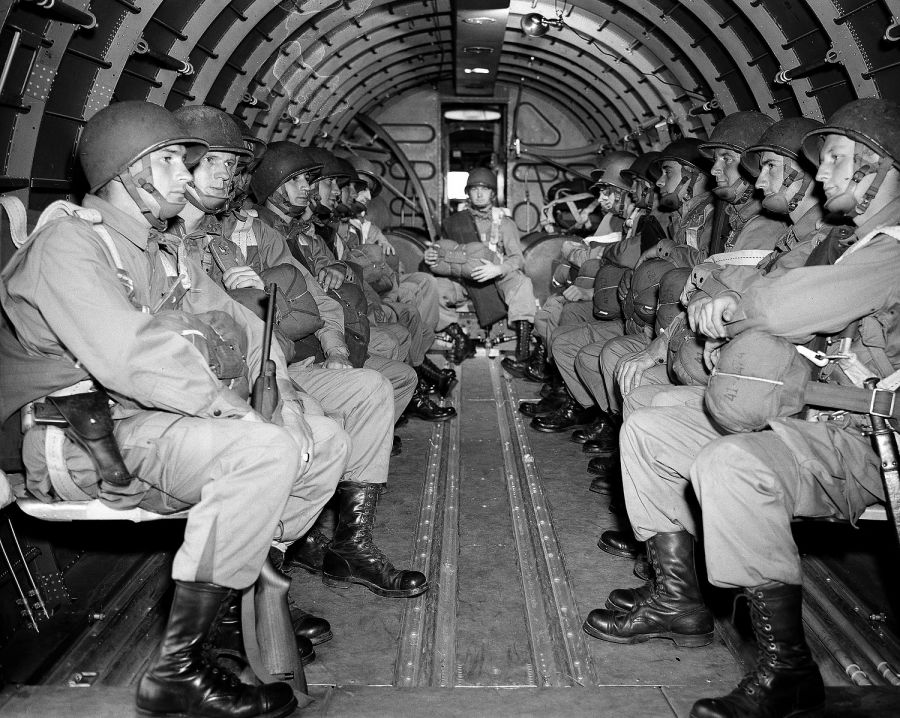
American paratroopers, heavily armed, sit inside a military plane as they soar over the English Channel en route to the Normandy French coast for the Allied D-Day invasion of the German stronghold during World War II, June 6, 1944. (AP Photo)
Seventy years ago, to this day, as the whole world now knows, the start of the end of World War II swung into action. As this website put it (from where this photograph came),
On D-Day, June 6, 1944, Allied troops departed England on planes and ships, made the trip across the English Channel and attacked the beaches of Normandy in an attempt to break through Hitler’s “Atlantic Wall” and break his grip on Europe. Some 215,000 Allied soldiers, and roughly as many Germans, were killed or wounded during D-Day and the ensuing nearly three months it took to secure the Allied capture of Normandy.
On this day, seventy years ago, my mother was living in London four months pregnant with yours truly. I was born in November, 1944.
The USA frequently gets a hammering in the media, including blog sites, for a whole range of activities.
But the 6th June, 1944 reminds me that when the American people turn their hand to helping others across the world, they can be a most powerful force for good.
That I have lived my almost seventy years in an environment that has allowed me freedom and opportunity and that I write this as a relatively new resident of the United States of America, living happily in rural Oregon, is a testament to that force for good.
A recent newspaper article offers yet more learning from dogs.
I can’t recall how I came across the article but so what! What I do recall was reading a recent item in The Washington Post and thinking that has to be reported here on Learning from Dogs.
A shaggy brown terrier approaches a large chocolate Labrador in a city park. When the terrier gets close, he adopts a yogalike pose, crouching on his forepaws and hiking his butt into the air. The Lab gives an excited bark, and soon the two dogs are somersaulting and tugging on each other’s ears. Then the terrier takes off and the Lab gives chase, his tail wagging wildly. When the two meet once more, the whole thing begins again.
Watch a couple of dogs play, and you’ll probably see seemingly random gestures, lots of frenetic activity and a whole lot of energy being expended. But decades of research suggest that beneath this apparently frivolous fun lies a hidden language of honesty and deceit, empathy and perhaps even a humanlike morality.
Now I don’t have permission to reproduce the entire article but will draw your attention to this further piece:
All of this suggests that dogs have a kind of moral code — one long hidden to humans until a cognitive ethologist named Marc Bekoff began to crack it.
A wiry 68-year-old with reddish-gray hair tied back in a long ponytail, Bekoff is a professor emeritus at the University of Colorado at Boulder, where he taught for 32 years. He began studying animal behavior in the early 1970s, spending four years videotaping groups of dogs, wolves and coyotes in large enclosures and slowly playing back the tapes, jotting down every nip, yip and lick. “Twenty minutes of film could take a week to analyze,” he says.
The data revealed insights into how the animals maintained their tight social bonds — by grooming each other, for example. But what changed Bekoff’s life was watching them play. The wolves would chase each other, run, jump and roll over for seemingly no other reason than to have fun.
Few people had studied animal play, but Bekoff was intrigued. “Play is a major expenditure of energy, and it can be dangerous,” he says. “You can twist a shoulder or break a leg, and it can increase your chances of being preyed upon. So why do they do it? It has to feel good.”
Suddenly, Bekoff wasn’t interested just in behavior; he was interested also in emotions and, fundamentally, what was going on inside these animals’ heads.
Marc Bekoff’s name rang a bell with me and, sure enough, I found that previously he was mentioned here. It was a post called Daisy offers a lesson for all,:
Animal Emotions
Do animals think and feel?
by Marc Bekoff – Professor Emeritus of Ecology and Evolutionary Biology at the University of Colorado, Boulder.
Daisy: The Injured Dog Who Believed She’d Walk Again and Did
Often, a simple video captures the essence of the deep nature of the incredibly close and enduring bonds we form with other animals and they with us. As a case in point, my recent essay called “A Dog and His Man” showed a dog exuberantly expressing his deep feelings for a human companion he hadn’t seen for six months. Another essay titled “My Dog Always Eats First: Homeless People and Their Animals” dealt with the relationship between homeless people and the animals with whom they share their lives.
Daisy: An unforgettable and inspirational symbol of dedication and hope
I just saw another video called “Daisy – the Little Pup Who Believed” that is well-worth sharing widely with others of all ages. There is no way I can summarize the depth of five-month old Daisy’s resolve to walk again after she was injured or of the devotion of the woman, Jolene, who found her on the side of a road – scared, malnourished, unable to walk or wag her tail, the people who contributed money to help her along, or the wonderful veterinarians and staff at Barrie Veterinary Hospital in Ontario, Canada, who took care of her. You can also read about Daisy’s remarkable and inspirational journey here.
Please take five minutes out of your day to watch this video, read the text, listen to the song that accompanies it, and share it widely. I am sure you will get teary as you watch Daisy go from an injured little ball of fur living in a ditch on the side of a road with a broken spine to learning to walk in water to romping around wildly as if life had been that proverbial pail of cherries from the start.
I’ve watched Daisy’s journey many times and every single time my eyes get watery. Among the many lessons in this wonderful video is “stay strong and never give up”. Clearly dogs and many other animals can truly teach us about traits such as trust, friendship, forgiveness, love, and hope.
Back to that Washington Post article.
Bekoff’s recent work suggests another remarkable canine skill: the ability to know what another animal is thinking — a so-called “theory of mind.”
Dogs seem to display a rudimentary form of this skill during play. He has noticed, for example, that one dog won’t begin trying to play with another dog until he has her attention. To get her to notice, he may nip the other dog or run into her field of view. That, Bekoff says, shows that the one wanting to play knows that she’s not paying attention to him. Though this may seem like a simple skill, it’s incredibly important to our species. Without it, we can have a hard time learning or interacting with the world around us.
So will leave you with this video and return to the theme tomorrow.
This may seem like a bit of an ‘odd-ball’ after Celebrating Ben and Ranger on Monday and Celebrating Pharaoh yesterday. Indeed, when I had in mind those two posts, writing about self-awareness was nowhere on my mental horizon. Then along came Shakti Ghosal after Monday’s post who left this comment:
Hi Paul,
Just came a visiting and was halted by these glorious photographs. Horses embody such great qualities of trust, grace and power don’t they? What is it that makes them such a great friend of Man, I wonder? Specially when the latter species, as we know it (and we should know!), can choose to behave quite contrary to those Equine qualities above….
Shakti
As Shakti was a new visitor inevitably I went across to his blog site, ESGEE musings, and then to the About page. Where I read, in part,
About Shakti Ghosal
Born in New Delhi, India, Shakti Ghosal is an Engineer and Management Post Graduate from IIM, Bangalore. Apart from Management theory, Shakti remains fascinated with diverse areas ranging from World History, Global trends to Human Psychology & Development.
I was intrigued and starting reading some of Shakti’s posts. That is how I came across The Audacity of Who I am and a day later had been offered permission to republish it.
However, before going on to Shakti’s post let me recap a little from yesterday’s post Celebrating Pharaoh. This section:
The biggest, single reward of having Pharaoh as my friend goes back a few years. Back to my Devon days and the time when Jon Lavin and I used to spend hours talking together. Pharaoh always contentedly asleep in the same room as the two of us. It was Jon who introduced me to Dr. David Hawkins and his Map of Consciousness. It was Jon one day who looking down at the sleeping Pharaoh pointed out that Dr. Hawkins offered evidence that dogs are integrous creatures with a ‘score’ on that Map of between 205 and 210. (Background story is here.)
So this blog, Learning from Dogs, and my attempt to write a book of the same name flow from that awareness of what dogs mean to human consciousness and what Pharaoh means to me. No, more than that! From that mix of Jon, Dr. David Hawkins, and experiencing the power of unconditional love from an animal living with me day-in, day-out, came a journey into my self. Came the self-awareness that allowed me to like who I was, be openly loved by this dog of mine, and be able to love in return. As is said: “You cannot love another until you love yourself.“
I will speak a little more about this but, first, to Shakti’s post.
ooOOoo
The Audacity of Who I am
“High above the noise and fear mongering of critics and cynics softly speaks your true self.”
– Mollie Marti, Psychologist, Lawyer & Coach, USA
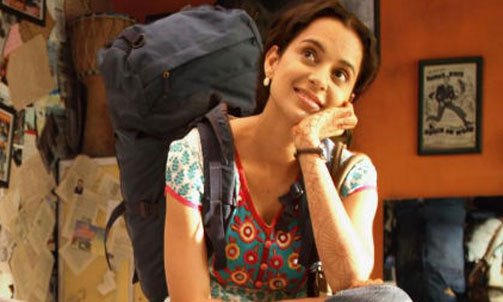
The other day, I watched the Bollywood movie Queen. In it Rani, a girl from Delhi, travels to Europe after being spurned by her fiancé. The movie then goes on to explore Rani’s ‘World view’ as dictated by her Indian middle class values and how that alters, as her biases and prejudices fall away, as she is confronted by radically different value systems and perspectives. A journey of self discovery in surroundings where she is no longer weighed down by others’ expectations and diktats. As she morphs, she confuses and pisses off many people including herself. Rani emerges from this crucible of experience as a more authentic human being. As she chooses to be ‘who she is for herself and for others’, she symbolises courage as well as resistance. Walking out of the theatre, I could not help but acknowledge how Rani’s awareness and acceptance of ‘who she is for herself and for others’ left her more empowered and in control of her destiny.
Kangana Ranaut in Queen
Who I am for myself and for others? How many of us are willing to make this query a daily practice as we loosen the constraints imposed by our world-view, let go of who we believe we should show up as and embrace who we really are?
What is it that makes me avoid being who I am for myself and for others? I can see this stemming from my desperation to be admired, liked and looking good. My life experiences have conditioned me to avoid being straightforward and veer towards being diplomatic if I perceive it is the latter which makes me look good. I have also been guilty of the corporate lie. On occasions I have stretched the truth about my company and its services, hidden what could have been embarrassing. On other occasions I have manipulated situations and people. All this to succeed, be admired, look good.
I muse. Have my efforts to gain admiration and look good empowered me to greater heights? Have I succeeded in engaging in my life from a place of worthiness? I remain increasingly unsure.
So if avoiding ‘who I am for myself and for others’ has not worked for me, how could I embrace it? As I think of this, I begin to see what being who I am for myself and for others could mean for me.
It would mean the audacity to show up as the ‘imperfect me’ that I am and the willingness to be vulnerable.
It would mean the audacity to let my hair down and allow myself to truly belong with the folks I choose.
It would mean the audacity to be compassionate and loving even when I hold the fear of not being good enough.
It would mean the audacity to be authentic about my own inauthenticities.
Am I committed to being this audacious?
***
“Real isn’t how you are made,’ said the Skin Horse.’ It’s a thing that happens to you. When a child loves you for a long, long time, not just to play with, but REALLY loves you, then you become Real.’
‘Does it hurt?’ asked the Rabbit.
‘Sometimes,’ said the Skin Horse, for he was always truthful. ‘When you are Real you don’t mind being hurt.’
‘Does it happen all at once, like being wound up,’ he asked, ‘or bit by bit?’
‘It doesn’t happen all at once,’ said the Skin Horse. ‘You become. It takes a long time. That’s why it doesn’t happen often to people who break easily, or have sharp edges, or who have to be carefully kept. Generally, by the time you are Real, most of your hair has been loved off, and your eyes drop out and you get loose in the joints and very shabby. But these things don’t matter at all, because once you are Real you can’t be ugly, except to people who don’t understand.”
Excerpt from ‘The Velveteen Rabbit’ by Margery Williams
In Learning….. Shakti Ghosal
ooOOoo
Now Shatki’s post is spot on. But it assumes one thing. That is that each of us has sufficient self-awareness “to show up as the ‘imperfect me’”. Sometimes, as in my case, that ‘imperfect me’ was well-hidden from the self. Stay with me a little longer.
My father died of cancer in 1956. Just 5 days before Christmas, 1956. He was 55 and I had turned 12 just 6 weeks previously. I had completed my first term at the local (Preston Road, Wembley) grammar school.
For many reasons that do not need to be shared here, the effect of my father’s death and my subsequent decline in my school performance, left me with a long-term psychological ‘dysfunction’; namely a feeling that I had been emotionally rejected. But that feeling was deeply hidden from me. In fact, that hidden belief remained with me until 2007 when Jon Lavin brought it to the surface. (Jon is a UKCP accredited therapist and NLP Practitioner).
Reflect on that for just a moment. For the thick end of fifty years, this psychological characteristic remained totally below my consciousness yet, nonetheless, influenced me in very real and tangible ways.
The negative influence was that I was drawn to any woman who offered me love and affection and, therefore, was emotionally unable to understand how good a partner she might or might not be for me. (Jean is my fourth wife!)
The positive influence was that I tried very hard to please others, to avoid their rejection, and had successful careers in selling for IBM UK, starting and building a successful business in the early days of personal computing and, later, when my company was sold in 1986 becoming a freelance journalist and business coach.
So back to Shakti’s essay.
I agree one-hundred-percent with what he says. With the proviso that in certain cases, spending time with a qualified counsellor could be your best investment ever.
How to round this off.
If you have been influenced by any of this then do give yourself time and space to counsel yourself. Let your inner person reach out in peace to your outer person.
If that inner person suggests you could be a happier, more peaceful person then reach out to someone properly qualified to hold your hand as you open up to your inner feelings.
Which is why loving a dog and being loved in return by that beautiful creature means so much. For in that private bond that animals offer us lays the truth.
I can do no better than offer this personal reason why being audacious about who you are is the supreme ‘investment’ of all in yourself.
A few months after Jon Lavin brought my fear of emotional rejection to my conscious surface, I met Jean in Mexico, Christmas 2007. I have never loved a person as I love Jean. I have never been loved by a person as Jean loves me.
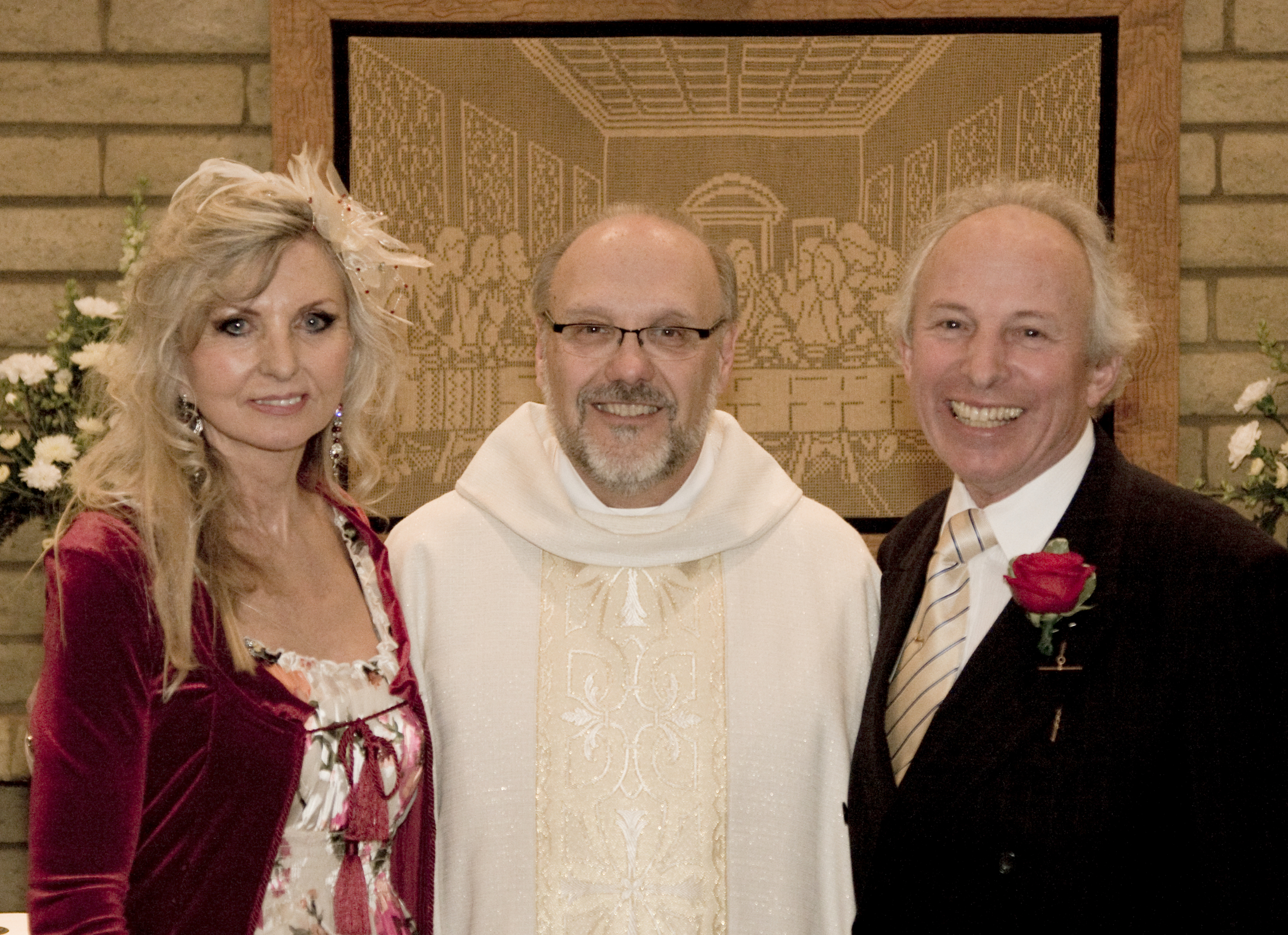
Jean, Father Dan and yours truly. St Paul’s Episcopal Church, Payson, AZ. November 20th, 2010.
Being at peace with who you are is the most important celebration.






 Learning from Dogs