Category: Core thought

Happy Endings!

All we all want is more good news than the other variety!

My sub-heading offers a great introduction to this recent essay over on The Conversation site. Republished within the terms of that site.

I don’t need to waffle on!

You all have a wonderful weekend.

ooOOoo

Will optimistic stories get people to care about nature?

By    David H. Smith Conservation Research Fellow, Georgia State University

May 7, 2017

Nature doesn’t make the news often these days. When it does, the story usually revolves around wildlife on the brink, record-setting climate extremes or ruined landscapes. However, that is not the whole story. There is also good news, but it often receives little attention.

It is easy to see how bleak accounts of the state of the planet can overwhelm people and make them feel hopeless. What is the point of even trying if the world is going down the drain anyway?

To muster public and political support on a scale that matches our environmental challenges, research shows that negative messaging is not the most effective way forward. As a conservation scientist and social marketer, I believe that to make the environment a mainstream concern, conservation discussions should focus less on difficulties. Instead we should highlight the growing list of examples where conservation efforts have benefited species, ecosystems and people living alongside them.
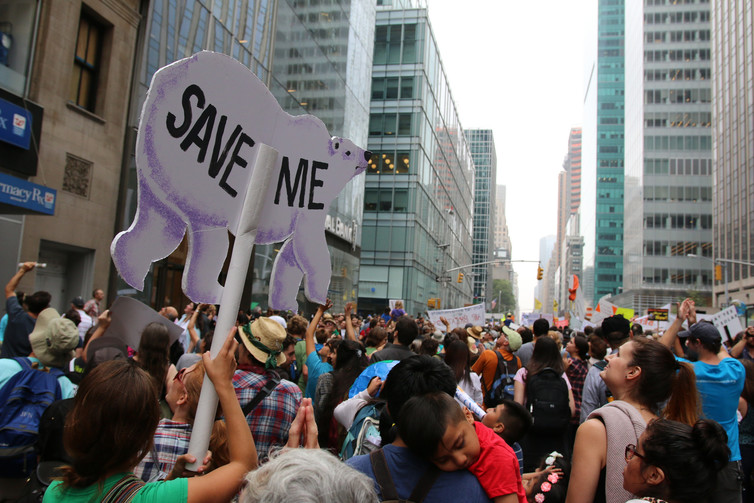
People’s Climate March, New York, New York, Sept. 21, 2014. CIFOR/Flickr, CC BY-NC-ND

The power of positive messages

This question is not new. Professionals in many fields have to consider how to frame their messages to maximize their impact. For example, public health agencies can make positive recommendations that emphasize benefits of being disease-free, or use negative messages that focus on the consequences of disease. A 2008 meta-analysis of 60 health communication studies concluded that messages focused on loss were less likely to be effective than positive messages.

Another study examined ads designed to persuade income support recipients to report their incomes. It concluded that messages focused on fear, shame or guilt could generate emotional backlash, in which people rationalized decisions to protect themselves from feeling ashamed of their behavior. This approach also caused emotional saturation that led people to “switch off” from the message because of its negativity.

Environmental advocates also confront this challenge. Much discussion has centered on the issue of climate change, where a number of scholars and advocates assert that doom-and-gloom messaging has not been effective. Yet until recently, we have not asked the same question about how we frame nature conservation.

Lost and found species

Today a growing number of scholars and activists are working to create a positive vision for protecting wildlife and wild places. One key effort started in 2014 with the launch of a marine conservation movement called Ocean Optimism, which works to “create a new narrative of hope for our oceans,” and by doing so, to help move towards “a sustainable future for our seas.”

In April 2017 the Earth Optimism Summit, organized by the Smithsonian Institution, brought together environmentalists, scientists, industry and the media to shift the global conservation movements focus away from problems and toward solutions. What started as a single event in Washington, D.C. soon turned into a truly global movement, with about 30 sister events in countries including Colombia, New Zealand and Hong Kong.

Lost & Found – Author provided

This effort has kick-started a range of initiatives that are all about communicating conservation bright spots to as many people as possible. One, which I co-founded, is the Lost & Found project, sponsored by the Society for Conservation Biology and the British Ecological Society. This online storytelling initiative focuses on a particularly inspiring kind of good news: rediscovering species that once were thought to be long extinct. After all, what can be more rousing than recovering something unique that you thought was lost forever?

Every year numerous species thought to have disappeared are rediscovered. Over the past century more than 300 species have been rediscovered, mostly in the tropics. On average, these species were missing for about 60 years before being rediscovered. Most rediscovered species have restricted ranges and small populations, which means they are usually highly threatened.

Lost & Found – Author provided

Our goal is not only to tell good stories, but also to showcase the dedication and determination of adventurers who lead these improbable quests and rewrite the history of species they care deeply about. While not every reader may be interested in a red-crested tree rat or a golden-fronted bower bird, all humans are curious about other people.

Lost & Found is making content available in various formats, including text, comics and soon, video animations. This helps make the stories more accessible to people who are not instinctively inclined to read about nature. Currently we have 13 stories freely available online that feature diverse species, from squirrels and toads to bats and birds. They cover a wide geographic range, from Latin America and Oceania to North America and Southeast Asia.

The response has been tremendously positive. More than 1,000 people from over 50 countries visited the website in its first 10 days. Some of our more popular stories, such as the Bulmer’s Fruit Bat and the Cave Splayfoot Salamander, are animals that would commonly not be considered particularly charismatic.

Getting these inspirational rediscoveries into the hands of as many people as possible is a first step toward creating a more positive vision for Earth’s future. The timeless principles of storytelling seem like the right place to start. After all, who doesn’t love a happy ending?

ooOOoo

Did you note the name of that website!!

Lost & Found. Go visit it and enjoy these wonderful happy endings!


Onwards and upwards for socks!

The dog, that is, not what we wear on our feet!

On the 26th April I published a post promoting the Vista Verde Help Fund for Strays. (And well done! That fund is very close to achieving the goal.)

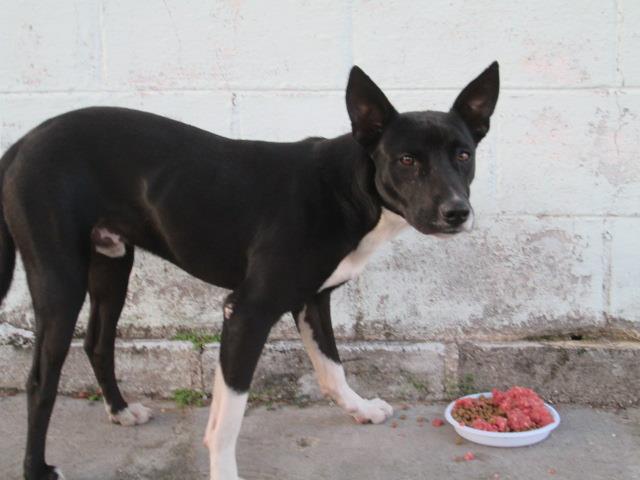
That post in April also included a picture of a recent stray supported by the Fund. He was named Socks by Jean.

Socks starting a new and better life.

Anyway, a few days ago Dionete sent me an email that I wanted to share with you.

Hello Paul – how’s things with you & Jean & dogs? Fine, I hope.

We’ve got some news: Socks has just been neutered. We picked him up at the clinic an hour ago and took him to a temporary shelter. Unfortunately it is just for a couple of nights but at least he is safe and can recover from the grogginess tonight.

Here are the pics we’ve taken.

Thank you very much (again) for allowing it to happen.
All the very best,

Here are those photographs of Socks.

oooo

oooo

Socks has a really gentle look in those eyes. Hopefully, he will find a new loving home before too long.

Little by little!

It takes so little good news to uplift one’s heart!

For reasons I can’t readily put my finger on it’s been feeling like a bit of a struggle recently. But that’s enough of that! For our gorgeous dogs have yet another lesson for me: How little it takes for a dog to wag it’s tail!

I so frequently share stuff that I read over on the Care 2 site and why not because as the home page declares:

40,107,687 members: the world’s largest community for good

Just three days ago there was a wonderful article shared on the Care 2 site about some dogs being rescued from a so-called backyard breeder. Better than that, it highlighted the wonderful consequence of a donation from George and Amal Clooney.

Here’s the story.

ooOOoo

9 Dogs Successfully Rescued From Backyard Breeder Thanks to George and Amal Clooney

By: Alicia Graef May 5, 2017

About Alicia Follow Alicia at @care2

Nine lucky dogs have just had their world turned upside down in the best way possible.

Camp Cocker Rescue, based in California, just took in the “Mojave 9″ who were being kept by a backyard breeder. They’ll be getting all the love and veterinary care they desperately need thanks to a generous donation made by George and Amal Clooney.

The nine dogs have had little human contact, and are all in need of extensive veterinary treatment for health issues ranging from mammary tumors and dental disease to skin and ear infections to ingrown toenails. The organization relies on donations, and expenses for this rescue operation were quickly rising.

“We literally didn’t know how we were even going to begin to start paying for all of these new dogs that we took in on the same day,” Camp Cocker’s founder Cathy Stanley told PEOPLE.

Now, the organization is celebrating a generous and unexpected donation of $10,000 made by George and Amal Clooney, who are parents to two adopted cocker spaniels from Camp Cocker — Einstein and Louie.

Their donation is going to help cover the cost of care for these dogs, who have never been to a vet. The Clooney’s will also be matching donations up to $10,000 for the rest of May.

“After we all did happy dances and cried with happiness for this unbelievable matching donation offer – we then asked the donors if (and only if they gave us their permission) . . . if we could reveal their names to our supporters in order to help us reach our big goal this month. They were so very gracious to give us permission to reveal their names,” Camp Cocker wrote in an update.

While this was a huge boost for them, Camp Cocker is quick to point out that no donation is too small to help.

“We have a philosophy where we want to be very inclusive of all of our supporters and it’s important to us that no matter how small of a donation, every person feels like their donation is meaningful and that we appreciate them,” Stanley added.

Hopefully news about the Mojave 9 and the attention it’s getting will help raise awareness about rescue and inspire more people to get involved … and will help find each of these precious dogs their perfect forever home.

For more on how to help, and info on how to adopt one of these dogs, check out Camp Cocker Rescue and follow updates on Facebook.

Photo credit: Thinkstock

ooOOoo

Here’s the video that accompanied that story.

And there’s only one way to close.

By thanking George and Amal for their wonderful generosity and their love for ex-rescue dogs!

Thanks, you two!

So little good news makes such a huge positive difference!

Loyalty with a capital ‘L’.

This is almost too beautiful for words.

Recently Jean was sent a link to an item on Mother Nature Network by Trish, a close friend living down in Tucson, AZ. It shows the strength of character of one particular dog but easily serves as a reminder of the power of love, commitment, endurance and loyalty that thousands of dogs exhibit so many times. Qualities that we humans may so easily overlook because our dogs fit so comfortably into the relationship with us.

The article, on Mother Nature Network, was originally published in 2014 and, as the Editor explains:

Editor’s note: This story has been updated since it was originally published in November 2014.

The article is also presented with the enclosed video at the end of the text. But when Jean and I watched the video last night we were so taken by it that I am making an ‘executive’ decision to present the article slightly differently.

In that I think that watching this beautiful, incredible, video first is better.

Now on to the full article that was published on Mother Nature Network.

ooOOoo

Stray dog follows adventure race team for 430 miles

The harrowing story of how the dog finished the race with his adopted companions will melt your heart

Bryan Nelson    March 6, 2017

A stray dog named Arthur made an amazing trek with his new companions. (Photo: TrendingVideos/YouTube)

The Adventure Racing World Series might be the most fraught and challenging sports event in the world. It usually involves teams of four navigating through a vast wilderness terrain while utilizing adventure skills from a range of disciplines including trekking, adventure running, mountain biking, paddling and climbing.

During the 2014 competition, for the first time ever, an exception was made so that one team could finish the race with five members instead of four. That fifth member? A stray dog, named Arthur by his adopted companions, who decided to follow one team for 430 harrowing miles through the Amazon jungle, according to the Daily Mail. If this story doesn’t warm your heart, you don’t have one.

Team Peak Performance, hailing from Sweden, happened upon Arthur while sharing a meal in advance of a 20-mile race stage through rough terrain in Ecuador. Mikael Lindnord, one of the team’s members, felt sorry for the scruffy, lonely stray, and decided to share a meatball with him. It was an innocent gesture — Lindnord had no intention but to lift the poor pooch’s spirits — but it was a gesture that would earn him a friend for life.

As the team got up to continue their race, Arthur tagged along. The team suspected he would eventually turn back around, but Arthur kept following them. He trailed them through muddy jungle, across vast distances of the Amazon river, all the way to the finish line.

The sport of adventure racing is not for the faint of heart — no more for dogs than for humans. During the most harrowing stages of the race, the team tried to shrug off their canine companion over concerns for his safety, but Arthur would have none of it. He was determined to stick with his adopted companions.

For instance, one crucial stage of the race requires the team to kayak along the coast for 36 miles. Understandably, the team was required to leave Arthur behind on the shore. But as they paddled away, Arthur broke free and leaped into the water and began swimming after the team. Realizing that the dog was willing to drown in order to stay with his friends, the team lifted Arthur onto the kayak so the dog could complete the race with them, to sounds of ovation from bystanders watching from the shore.

Arthur’s loyalty paid off in the end; Lindnord was able to adopt him and bring him back to his home in Sweden, where the dog is currently living, healthy and happy.

“I almost cried in front of the computer, when receiving the decision from Jordbruksverket (Board of Agriculture) in Sweden!” reported Lindnord when he first heard that his request to adopt Arthur was granted. “I came to Ecuador to win the World Championship. Instead, I got a new friend.”

ooOOoo

Loyalty with a capital “L”.

Love with a capital “L”.

This picture of Arthur speaks for itself.

The Month of May!

For all my life this has felt like a very special month.

And, dear friends, at the risk of repeating myself to many of you, this is why the month of May is special for me.

Simply that I was born in London during the closing months of the Second World War. Inevitably, I was unaware of the number of German bombs that were falling on London during those last few months. But there were thousands.

On May 8th. 1945, the day that WWII ended and six months to the day from when I was born, my mother looked down at me and said aloud to me: “You are going to live”. Despite the fact that I don’t recall my mother saying that, it was verified many times later when I was growing up.

Now here we are approaching May 8th. 2017 and in a very real sense it seems that we are in another war.

A war of consequence.

A war that we have been engaged in for many, many years.

A war where we are inadvertently fighting on a global battlefield.

A war where 99.99% of us don’t consciously identify the weapons we are using. Weapons that are incredibly effective. So much so that we are in sight of winning the last battle; winning the war.

Yet a war where winning is no win at all. Indeed, where winning this war, this global war, spells the end. The end of life for 99.99% of us humans (and much else besides).

Now what on earth has got me so fired up?

Two things have:

The first is that I am living in my 73rd year of life. I have no idea of when my life comes to an end. But that death is a guarantee. Indeed, if one takes note of the average life expectancy of a male today in the USA (75.6 years) , it may not be that far away.

The second thing is that before my death I truly want to know that humankind has laid down its weapons of war against our planet and that there really is an unstoppable mission, a united wave of passion, to live in peace on this planet. Perhaps better put to live in peace with this planet.

Or in the words of an organization that I now want to introduce:

A mission which will require the hard work and dedication of each and every one of us as we do everything in our power as individuals, but also as we galvanize businesses, entrepreneurs, innovators, city planners, communities, people and politicians—all those who share our purpose.

OK! Thank you if you are still reading this! (Someone give Fred in that soft arm-chair over there a nudge; I can hear his snores from here!)

In the last Smithsonian electronic newsletter that I was reading yesterday morning there was a reference to an organization that I hadn’t previously come across. Here is the link to that item on The Smithsonian website. I am republishing it in full in this place. As you read it you will understand why I am republishing it.

ooOOoo

Using a New Roadmap to Democratize Climate Change

A new tool aims to bypass governments and put the power of climate action in the people’s hands

By Anne Glusker    Smithsonian.com     April 28, 2017

Olafur Grimsson, who was president of Iceland from 1996 to 2016 and saw his country through the worst economic crisis in its history, making headlines all over the world as banks collapsed and the country fell into a depression, is the very picture of an urbane statesman. Collected and poised, with a striking full head of white hair, as comfortable in English as in his native Icelandic, he seems an unlikely revolutionary, not the sort of person you’d look at and immediately find yourself thinking: “Power to the People.”

 But Grimsson is one of the primary architects of a quietly radical new idea whose aim is to facilitate action on climate change without any of the usual suspects—governments, countries, international bodies, negotiating parties.

He and several other veterans of the historic 2015 Paris Agreement on climate change were in Washington, D.C., last year, just before COP22, the climate meeting held in Marrakesh in 2016. They were pondering next steps when the conversation took a new and interesting turn, Grimsson says, addressing the question: “Was it possible to have the success of Paris without governments necessarily being in the leading role?”

The group included movers and shakers such as Peter Seligmann, the chairman of Conservation International; Laurene Powell Jobs, president of the philanthropic organization the Emerson Collective; and Andy Karsner, an assistant energy secretary during the administration of George W. Bush. Galvanized by their own query, they decided to try to answer it—to set about creating a new tool to aid in achieving the goals of the Paris accord.

At the Smithsonian’s Earth Optimism Summit, a gathering this past weekend of conservation-minded citizens, scientists and activists, Grimsson explained: “You get governments that are opposed or even hostile to climate action. We decided to bring together in Marrakesh a gathering of thinkers and scientists and innovators and policymakers from different countries in order to discuss a new model of securing the success of the future of the climate movement.”

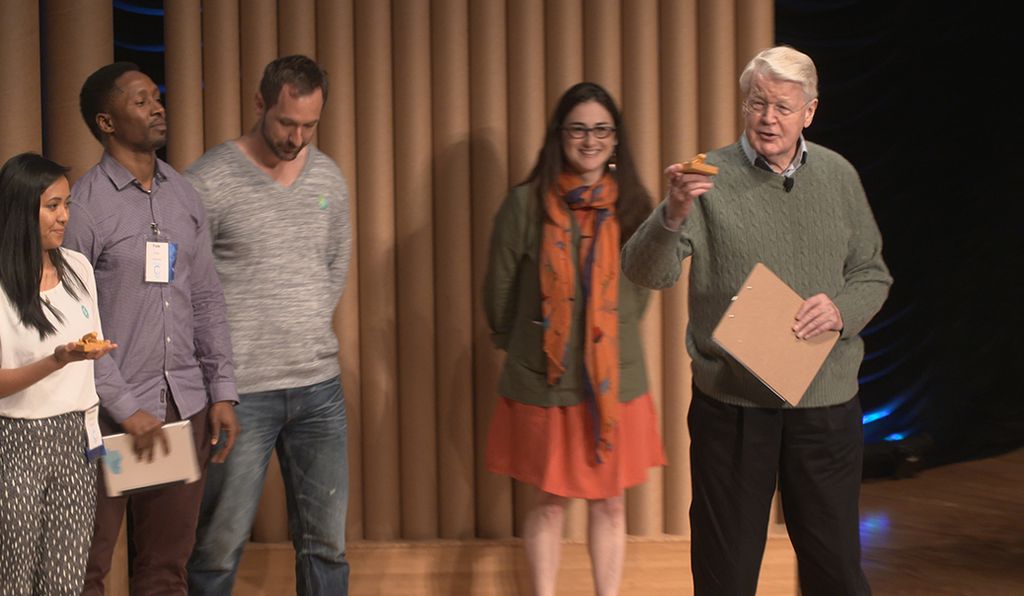
At the Smithsonian’s Earth Optimism Summit, the former president of Iceland Olafur Grimsson encouraged new solutions to climate change, awarding cash prizes to the winners of the “Make for the Planet” challenge. (The Roadmap)

Grimsson’s group felt that due to changes in information technology and social transformations, the large organizations and structures that used to be necessary to effect change were now not needed. And thus was born Roadmap, a new crowdsourcing tool for anyone and everyone interested in climate action. Still in its very early stages, Roadmap’s founders envision it as a platform for those working on climate issues—from scientist and policymaker to farmer and fisherman—to facilitate the sharing of knowledge and ideas, methods and techniques.

“A new political model is possible—where everyone can be a doer, where you no longer need big government or big enterprises to bring about success,” Grimsson says.

This new model for social change that skips the usual cumbersome channels and processes has been seen everywhere from public health, where the Bill & Melinda Gates Foundation has redefined the sector, to the hospitality industry, which is working to combat the human trafficking that plagues its businesses, to perhaps most famously the Arab Spring, where the role of social media in bringing about political change is still being debated today.

And this new model is complemented by technological changes. “The innovation in energy technology is such that we no longer have to wait for the big energy breakthrough,” Grimsson says. “We already have the available technologies. Every individual, home, village, community, town and region can execute change. The good news from the climate point of view is that, in addition to the information technology revolution, there has now also taken place an energy revolution. A house can be a power station: If the people who live in that house have extra energy, they can sell their energy through the smart grid. The notion that every house can be a power station is as revolutionary as saying that every mobile phone can be a media company.”

Grimsson admits that it may seem odd for someone in his position to be advocating that ordinary citizens take action apart from the conventional corridors of governmental power.

“For me to say that these traditional political organizations and positions are somewhat outdated is perhaps a strange statement: I was a professor of political science, I’ve been a member of parliament, I’ve been a minister of finance, I was president for 20 years,” he says.

It was during Iceland’s financial meltdown that he first experienced this new kind of social change: “I saw this very strongly through the financial crisis in my own country, which led to a big social economic uprising. All those activities were engineered by unknown people, people who were not part of a big organization, who used Facebook and the information media to bring thousands of people together in one day.”

Right now, Roadmap consists of a website and a lofty manifesto that speaks of raising the value of “moral currency” and creating a “best practices warehouse.” Visitors to the site can fill out a form if they want to become part of its community of “doers.” The practical part of the manifesto speaks of identifying the best methodologies and models; implementing a “real-time system of measurement” and a way to “gauge and understand what is working, what is not, and exactly what is being achieved.” As the platform develops, it will be interesting to see exactly what form these gauges, measurement systems, and warehouses take.

After the Paris Agreement, Grimsson says of himself and his Roadmap co-founders, “We were all optimistic, but we are all also realists.” It is his belief that if you “give people the tools, they can execute the transformation and the change—without governmental leadership.” Perhaps Roadmap will be one of those tools.

 ooOOoo

Here’s a video that spells it out in ways that I find impossible to ignore. (And, yes, I signed up, as in joining, yesterday afternoon.)

Because in hundreds of years time I want others to look at the following picture of Troutbeck Valley in England and know how precious is this one and only planet we live on.

Or in the words of Sue Dreamwalker that I read yesterday evening:

We are witnessing more storms, more unseasonal weather patterns, and I just hope that we wake up soon to the damage we are doing to our beloved Mother that has held us in her eternal arms for so long..

Photo credit: Getty Images

Enjoy the month of May wherever you are in the world!

Closing by repeating a key pronouncement in that RoadMap video above:

Why We? Who Else!

The Vista Verde Help Fund for strays.

A return to such an important story.

Last week, under the post title of Group Goodness, I put out a plea for anyone who felt so minded to make a donation to this fund. That donate page for this fund being here.

Now it’s very fair to say that there wasn’t a rush of donations. It would be more accurate to say that there were no donations for several days. In fact it is only in the last twenty-four hours that the amount donated has gone from 216 to 244 Australian dollars. (The fund will be transferring those Aussie dollars across to assist John Zande and his lovely wife soon. The currency being used is because it is the sister of John’s wife who is raising the money and she lives in Australia.)

Now it would be very wrong of me to seek the reasons why not a single follower or reader of this place chose not to make a donation. But I will offer this perspective. In that Jean and I wanted to make a second donation and it has taken several days to figure out why our gift wasn’t being processed; the reason being a rather cautious (our) bank attitude to debit card payments being made overseas. So if anyone else has tried to make a donation and the system has got in the way then please do find a solution.

Here’s why!

Because John and his wife, Dionete, are totally immersed in doing their best to help the homeless and abandoned dogs in Sao Paulo, Brazil.

Here are copies of recent emails that John  and Dionete have sent me over the last few days.

20th. April

Morning Paul, I took a camera this morning just to show you the new boy I’m helping. Gorgeous fellow, and young. It never stops. They never stop showing up… which is something I’m sure Jean understands all too well from her work in Mexico.

Again, thank you for your help and posting the campaign.
I queried if this new boy had a name?

No name yet. Can you think of one? I found him on the corner of a street where I feed two (sometimes 3) cats every morning. G’s mum and dad used to live in that street and her dad would feed them. He loved cats, and after he died (and G’s mum moved closer to us) I’ve kept going back. It’s been over a year now that I go there every day, and despite every effort to capture them, I’ve failed. They’re quite feral, but I can’t bring myself to letting them to fend for themselves.

And these are those photos.

oooo

John then continued that same day:

Anyway, the boy showed up about 9 days ago, so on my daily run I feed and water him. G put his pictures on Facebook this morning and a girl (Luiza) responded saying she knows of another lady who’s also feeding him. I saw food there once, on day 2 I think, but none since, so I’m not sure what that’s all about. The girl who actually responded is a part of this loose Vista Verde group. I’ve never met her, but I know of her. We’re helping her as she took in a dog a few months ago that had been hit by a car and is paralysed, but, to her credit, she’s refused to give in and has him in physio (including water treadmills), which is actually showing some positive signs. That’s sort of how it all works. Here’s some pictures and video of that case. Gorgeous dog.

Go here to view those pictures & videos.

The boy is relatively safe where he is. He has shelter, and doesn’t appear to be in any mood to move on, which is good. If he stays put we can help. Finding a home for him is not easy, but after we can find some place as a temporary shelter we’ll get him into the vet, neutered, treated for whatever, then settled. The huge problem is, there simply aren’t any shelters we can just take him to, so we can’t get him off the street and into the vet immediately. Every shelter is over-full, and that makes rescues just that much harder. It’s not the case of simply finding a dog (or cat) and getting them to safety… which is heartbreaking. You just have to hope they stay put. A few times I’ve put a dog in the car and taken them from danger (like near a main road) and brought them up to our area where there are parks and plenty of shelter and people to help. It’s a safe place, and if they stay put we often have successes… But that takes time. But, as I said, he doesn’t seem to want to move on, and he’s starting to put on weight. He was desperately thin, but 500g of mince and a big bowl of dry food every day seems to be doing the trick.

Here’s hoping to a good ending for him.

In speaking with Jeannie about this poor dog she very quickly suggested the name of Socks. John happily went with Jean’s suggestion.

21st April

Hi Paul, just a quick update on socks. Luiza (the girl I mentioned yesterday) has found temporary shelter for Socks for one month. It’s not long, but will give us the chance to neuter him and do all necessary blood work. Finding him a home is the next hill, but I spent time with him this morning, just sitting with him, and he’s really a lovely, gentle fellow, so here’s hoping.

24th April

Socks update: His shelter home is ready today, we’ve been told. That, however, might now not be needed. Sunday I saw he now has a huge dog house on the footpath, with blankets, food and water. He wasn’t interested in the mince I brought him, so I just left some chewing treats. Same thing this morning (I’ve just gotten back). So, we’ll go back later today just to speak (again) to the people in the street (we don’t know who exactly put the dog house there), and it might be the case that he just goes straight to the vet for neutering, maybe a few days in the shelter for recovery, then back to his house while (if still needed) we look for a permanent home/family.

April 25th.

Hello Paul – I can see you’ve been playing “email tennis” with the gofundme staff  –  good to read they (finally) managed to sort it out.

We saw Socks today. Apparently a bunch of neighbours got together to feed and take care of him, albeit on the street (he was given a 2nd-hand doghouse & doona (oops, duvet)). One of the guys has been thinking of taking him to his country house; an acquaintance of mine knows of somebody who might adopt him. Yes, everything’s still in the air, but he has it much much better than other dogs we’ve found and helped.
Now we can book his neutering/vaccine.

As for me, I don’t have enough words to thank you & Jean. Truth to be told it feels a bit weird to be the beneficiary of a campaign. We’ve always helped others and suddenly seeing ourselves in this position is a tad uncomfortable, actually – which doesn’t mean this money is not welcome, considering all the cases we’ve had so far this year.

Fingers crossed it all works out for Socks. We’ll keep you posted.

So, good people, this is why I beseech you to please support what John, Dionete and his close group are doing on behalf of those dogs down in Brazil. Please make a donation!

Dogs are saving our lives!

Literally, not just emotionally!

Over on my website, under My Writings, I mention my recently published booklet, The Amazing World of Dogs.

Here’s an extract from pages 17-18 of that booklet.

Finally, Dr. Morten Kringelbach of the Department of Psychiatry at Oxford University1 explains that the need to nurture is very deep in us humans and that dogs produce an instinctive parental response in us that is very similar to our nurturing instinct for our children.

If the magic of having dogs in our lives for such a long time ended there it would still be breathtakingly wonderful. But dogs could now be offering us humans the capacity to understand many human diseases. Literally, our dogs could be saving our lives!

The challenge in understanding human diseases is that within our ‘breed’ there is a great variability of genes. Not surprising when one considers the incredible diversity and variation within us humans.

But when we turn to dogs then we have a bonus. For despite there being, as mentioned earlier, 400 or more different breeds of dog, within each breed dogs are very similar to each other. In other words, that narrow gene pool within a specific dog breed makes if far easier to pinpoint genetic mutations than it is in humans.

Elinor Karlsson is the director of the Vertebrate Genomics Group at the Broad Institute of MIT and Harvard.2 As a geneticist, Dr. Karlsson has identified, “hundreds of diseases common to dogs and humans”. In 2005, the dog’s genome was fully mapped; all 2.4 billion letters of the dog’s genome

Among those common diseases between us humans and our wonderful dogs are diabetes, cardiac diseases, epilepsy, many cancers especially bone cancers, and breast cancer and even brain tumours.

So it was an obvious thing to do to republish the following article that appeared on the Care2 site a few days ago.

ooOOoo

 Could a Dog Vaccine Help Save Kids With Brain Cancer?

By: Laura Goldman April 17, 2017

About Laura Follow Laura at @lauragoldman

The statistics are grim: About 60 to 70 percent of children who have glioblastoma, a form of brain cancer, do not survive more than two years. This fast-growing cancer is resistant to traditional treatments like radiation and chemotherapy.

For dogs, cancer statistics are also grim. More than 6 million dogs are diagnosed with cancer every year, and one out of four dogs will get cancer during their lifetime. It’s the leading cause of death for dogs after the age of two.

But there could be hope for both dogs and kids. A vaccine being developed that destroys cancer cells in dogs could also be successful in fighting glioblastoma in children.

Researchers at Children’s Mercy Hospital in Kansas City, Mo., have started a partnership with ELIAS Animal Health, a company that’s testing treatments for osteosarcoma (bone cancer) and B cell lymphoma in dogs.

“If we take advantage of the resources we have in this region and get behind those collaborations, this could be a mecca for advanced, exciting, innovative therapies for cancer and lots of other diseases,” Dr. Doug Myers, an oncologist at Children’s Mercy, told the Kansas City Star.

ELIAS Cancer Immunotherapy (ECI) uses the dog’s own immune system to destroy the cancer. “Research has shown that ex vivo activated T cells have the machinery to effectively kill cancer cells, including cancer stem cells,” according to the company’s website. “ELIAS Cancer Immunotherapy utilizes adoptive cell therapy to deliver an army of activated T cells.”

The dog is vaccinated with his own cancer cells to produce an immune response, then the generated white blood cells destroy the cancer cells.

“Personalized T cells are then safely obtained from the patient through apheresis [the removal of blood] and then ‘super charged’ to produce a large population of killer T cells that are reinfused into the patient to kill the cancer,” the company explains.

ELIAS Animal Health is currently conducting clinical trials of ECI at Kansas State University, the University of Missouri-Columbia and a few animal hospitals across the country. The success rates of using ECI along with surgery on dogs with cancer are being compared with those of patients that are treated with surgery alone.

“Early clinical study results already show positive outcomes,” Tammie Wahaus, CEO of ELIAS Animal Health, said in November 2016.

Among the ECI success stories is that of Dakota, a German shorthaired pointer who continues to survive a year after she was diagnosed with osteosarcoma. This is twice as long as her original prognosis. X-rays taken during a follow-up examination showed no signs of the cancer spreading.

Could ECI also successfully treat children with glioblastoma? Dr. Kevin Ginn, a pediatric oncologist at Children’s Mercy, and other researchers are currently developing protocols for trials. They’re planning to apply for a Phase II clinical trial with the U.S. Food and Drug Administration, using the results of ECI’s studies on safety and effectiveness as far as dogs are concerned. The Phase II trial would give ECI to a large group of children to see if it’s effective and further evaluate its safety.

Animal health trials are regulated by the U.S. Department of Agriculture. They are less expensive and proceed faster than FDA-regulated human trials, the Kansas City Star reports, “but successful human health treatments often bring a larger return on investment.”

In this case, a larger return on investment could be a win-win for children as well as dogs with cancer.

Photo credit: cgordon8527

ooOOoo

My booklet closes thus:

Many would extend that proficiency of dogs to include their sense of loyalty and forgiveness, to and of us humans, but that all pales into insignificance when compared to what our understanding of dogs is giving us.

No less than the capacity to help cure many of our diseases, to deeply understand the workings of the human mind, and above all else, to offer insight into our very existence.

That’s quite a relationship!

Quite a relationship indeed!

No place for amateurs!

Offering up a tribute to the work of a professional.

Many, many years ago when I was in business on my own account (1978-1986) I had the pleasure of getting to know Frank Tijou. He was running his own very successful business. But more important than that, Frank had this wonderful ability to explain what he had learned over his years of being an entrepreneur. One such learning was stick to what you really know and don’t try and do things that are best left to other professionals. In other words, don’t be an amateur when it comes to important matters.

Thus when some weeks ago I was strongly recommended by some local authors to have an author website, I looked around for a professional. I quickly came to find Christy Kiltz of Design! by Kiltz Internet Solutions.

Talk about finding a true professional.

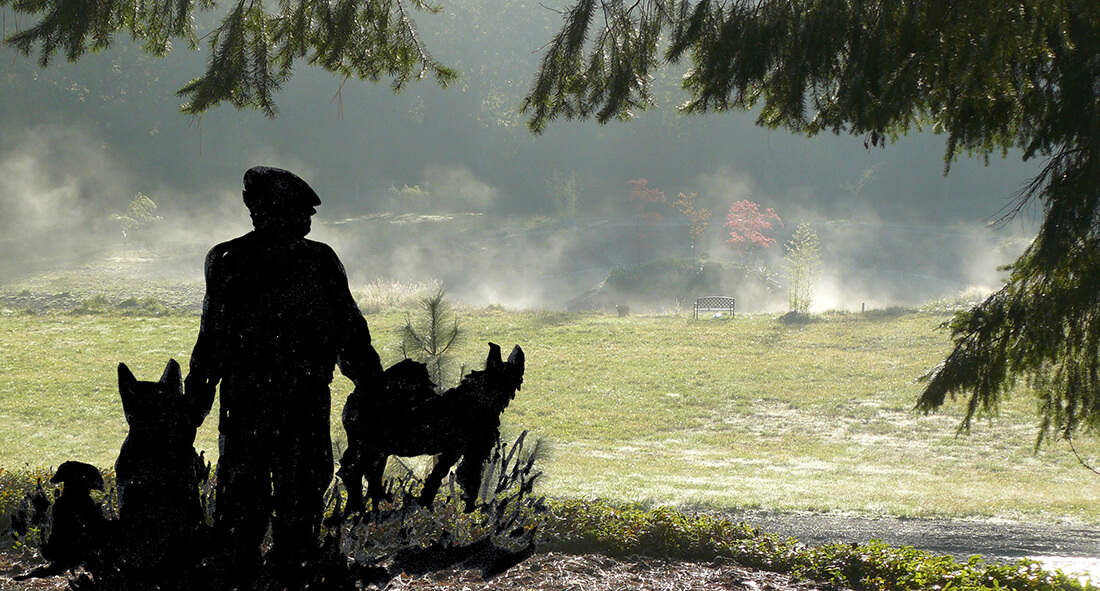
Forgive me, I’m not coming at this in terms of an ego trip. I just want to promote what a wonderful job Christy did. (And not forgetting Emily’s grand design work.) (And most certainly not forgetting my darling Jeannie who did the image of the man in a flat cap with the dogs!)

Please go across to my new website: Paul Handover – Life Traveller.

The home page banner image from my website.

So in the words of American playwright Garson Kanin:

“Amateurs hope, professionals work.”

Thank you, Christy!

Out of this world!

Forgive my indulgence!

I wish I understood where my fascination with the night sky came from. Not that I am anything other than an amateur gazer (of the night sky, I should hasten to add!). I have never taken the trouble to gain any real knowledge.

Yet, some of the most serene moments of my life have been when I have been alone at sea under a night sky.

OK, that’s enough wallowing for anyone!

The last week has been an important one for those that take an interest in the planets in our solar system, or to be specific, take an interest in Jupiter.

For as EarthSky reported on the 8th April:

Today – April 8, 2017 – the planet Jupiter is closest to Earth for this year.

Yet yesterday was Jupiter’s opposition, when Earth flew between Jupiter and the sun, placing Jupiter opposite the sun in our sky. You’d think Jupiter was closest to Earth for 2017 yesterday as well … and yet it wasn’t. It’s closest to Earth for 2017 today, April 8, coming to within 414 million miles (666 million km).

EarthSky also included this image:

Jupiter at its April 7, 2017 opposition with the Great Red Spot and moons Io, Europa, and Ganymede (L to R). Photo by Rob Pettengill in Austin, Texas.

Then, Mother Nature Network yesterday presented more information:

Jupiter strikes a pose for Hubble portrait

April 12, 2017

During the month of April, Jupiter will be in opposition, meaning the planet is at its closest point to Earth. Thanks to the sun, it’s during this window that astronomers can enjoy a particularly close-up photo session that can help reveal how the planet’s atmosphere has changed over time by comparing it with previous such photos of the gas giant.

This photo of Jupiter was taken on April 3 by the Hubble Space Telescope when the enormous planet was 670 million kilometers (or about 416 million miles) from Earth. The photo shows the Great Red Spot, but it also shows something new: a weather feature called the Great Cold Spot, which is almost as large as its more well-known cousin.

“The Great Cold Spot is much more volatile than the slowly changing Great Red Spot, changing dramatically in shape and size over only a few days and weeks, but it has reappeared for as long as we have data to search for it, for over 15 years,” Tom Stallard, a planetary astronomer at the University of Leicester in the U.K. and lead author of the study, said in a statement.

The cold spot is nearly 15,000 miles by about 7,500 miles in size, and it’s dubbed the “cold” spot because it’s 200 degrees Kelvin (about 400 degrees Fahrenheit) cooler than the surrounding atmosphere.

The article included this stunning image of Jupiter.

Photo: A. Simon (GSFC)/NASA, ESA

Jaymi went on to write:

Here’s what some of the other details in the image mean:
The NASA/ESA Hubble Space Telescope reveals the intricate, detailed beauty of Jupiter’s clouds as arranged into bands of different latitudes. These bands are produced by air flowing in different directions at various latitudes. Lighter coloured areas, called zones, are high-pressure where the atmosphere rises. Darker low-pressure regions where air falls are called belts. Constantly stormy weather occurs where these opposing east-to-west and west-to-east flows interact. The planet’s trademark, the Great Red Spot, is a long-lived storm roughly the diameter of Earth. Much smaller storms appear as white or brown-coloured ovals. Such storms can last as little as a few hours or stretch on for centuries.

The Great Red Spot is an anticyclonic storm that is so large that Earth would fit inside it. That stormy spot — which is actually shrinking, though astronomers don’t know why — gives us a great perspective for understanding just how huge Jupiter is compared to our own blue dot in the solar system.

Finally, I’m taking the liberty of republishing in full an item that appeared on The Smithsonian site on April 7th.

ooOOoo

Hubble Snags Splendid Snapshot of Jupiter

The perfect photographic conditions make for a grand view of the gas giant

This snapshot shows Jupiter’s swirling, banded atmosphere and signature vortices. (NASA, ESA, and A. Simon (GSFC))
smithsonian.com
April 7, 2017

It’s been 27 years since the Hubble Space Telescope went into orbit, and the geriatric observatory is still going strong. When the telescope recently trained its sights on the solar system’s largest planet, the results were spectacular—proof that for the stellar spectator, age is but a number.

The image above is the latest picture of Jupiter. The snapshot was taken by Hubble on April 3 with the help of the telescope’s Wide Field Camera 3, a high-res instrument that lets the telescope observe using different wavelengths. It combines light on the visible, ultraviolet, and infrared spectrum to create an image of a massive planet in constant atmospheric flux.

In a press release, the European Space Agency, which co-runs Hubble with NASA, said that Hubble was able to take advantage of the planet’s current opposition with Earth to take the close-up. At the moment, Jupiter is lined up perfectly with the sun, and Earth is lined up with both the sun and Jupiter. Think of it as a truly heavenly photographic opportunity—a chance to look at the planet head-on. Better yet, Jupiter’s position relative to the sun means that it’s brighter than at any other time of year, which lets telescopes trained on the gigantic planet see even more detail than usual.

As The Washington Post’s Amy B. Wang notes, there were no new discoveries in the picture per se, but that doesn’t mean there’s nothing to look at. As ESA explains, scientists will compare the photo to previous views of the planet to hopefully learn more about the atmosphere. And for the rest of us, there’s a strangely soothing view of Jupiter’s layered cloud bands and impressive vortices.

The gas giant is thought to have sucked up most of the space debris left over after the sun formed, grabbing dust and gas with gravity. Scientists think it has two times as much debris as all of the other bodies in the solar system combined—and all of that material swirls through cloud layers in its quickly-rotating atmosphere.

Since Jupiter doesn’t exactly have a surface, it has nothing to slow the spots and vortices that appear in its atmosphere. The most famous, the Great Red Spot, is thought to have been swirling around for more than 150 years, and even though it’s unclear which gases give it that red hue, it’s the planet’s most recognizable feature. As NASA writes, the cloudiness of Jupiter’s atmosphere makes it hard to understand what might be contributing to it. But that doesn’t decrease its allure.

Want to delve even further into the mesmerizing bands of a huge planet’s atmosphere? A high-res version of the snapshot is available online. And if you prefer seeing things live, it’s a great time to check out Jupiter through in the night sky. You can find Jupiter in the east right after the sun goes down—a massive mystery that’s brighter than any star.

Read more: http://www.smithsonianmag.com/smart-news/hubble-snags-splendid-snapshot-jupiter-180962832/#2QLP7buDDb5PJaGK.99
Give the gift of Smithsonian magazine for only $12! http://bit.ly/1cGUiGv
Follow us: @SmithsonianMag on Twitter

ooOOoo

Let me finish up with another incredible fact.

Namely, that the universe came into existence some 13.82 billion years ago. The power of natural evolution that came with that event eventually brought along homo sapiens some 200,000 years ago. 200,000 is 0.0000145 of 13.82 billion.

Or to put it another way, we humans have only been a part of this universe for 1/10th of 1% of the life of said universe! (Oh, and dogs came along 100,000 years ago!)

Another Firefighters’ Dog Rescue

Stories like this make my toes curl with pleasure!

Less than two weeks ago I shared an item that I had read about the firefighters of Santa Monica, CA, saving the life of a ten-year-old dog.

When Santa Monica firefighters were called to a burning apartment, they found the lifeless body of a tiny dog overcome by the heat and smoke on the floor of a bedroom. They pulled out the dog, named Nalu, but he wasn’t breathing and didn’t have a pulse.

Then two days ago, courtesy of the Care2 Causes blogsite, along comes another fabulous example of the care, love and generosity shown by firefighters.

ooOOoo

Firefighters Rescue Golden Retriever From Icy Pond

By: Laura S. April 9, 2017

About Laura

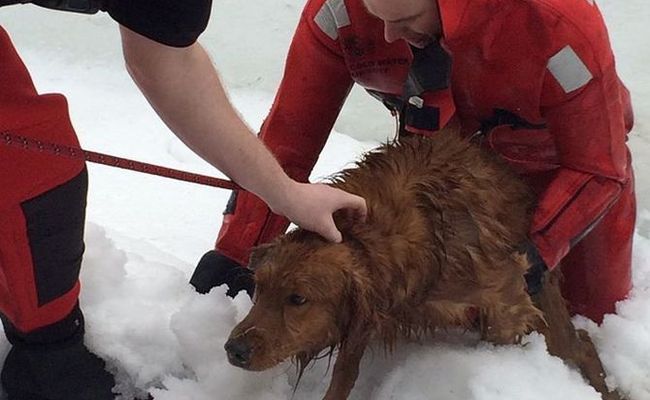
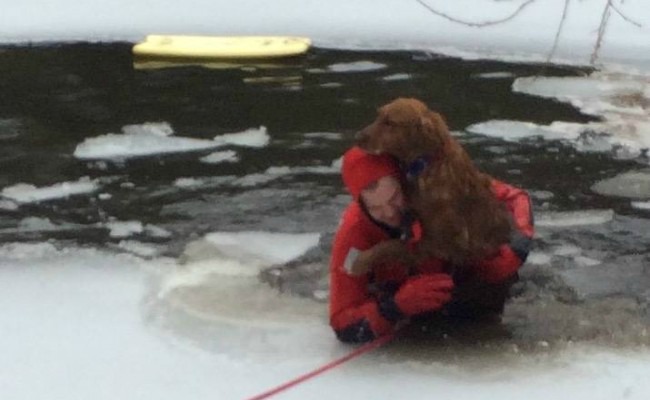
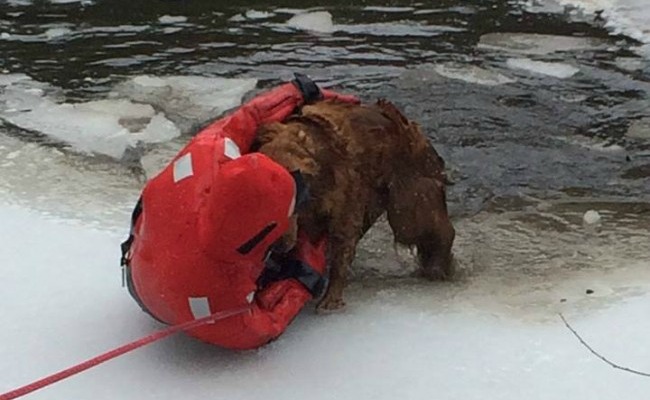
With perhaps just seconds to spare, North Hampton firefighter Will Taber barreled toward a dog who was barely clinging to thin ice last week in New Hampshire.

Photo Credit: North Hampton Professional Fire Fighters

Three-year-old Emmett ran out onto his family’s frozen backyard pond, suddenly falling through the ice. Although homeowner Kacey Eddinger started into the pond to rescue him, she had to turn back when she realized the water was simply too cold. Eddinger and her toddler son waited anxiously for help to arrive.

Photo Credit: North Hampton Professional Fire Fighters

The family isn’t certain exactly how long their golden retriever was in the water before they realized he’d fallen through, but by the time firefighters arrived, Emmett was exhausted and close to drowning.

In thermal ice rescue gear, firefighter Taber held a tethered line as he crossed the ice and entered the water. Once he reached Emmett, the other firefighters pulled the pair back to shore.

Photo Credit: North Hampton Professional Fire Fighters

“The canine was exhausted and scared and minutes from going completely under water and carried by the current under the ice,” the Fire Department posted on Facebook. “The rescue was made just in time where he was then immediately warmed, carried to a police cruiser and transported to North Hampton Animal Hospital.”

Though spring has officially arrived, ice rescues have escalated due to the thin ice that remains on some bodies of water.

Photo Credit: North Hampton Professional Fire Fighters

ooOOoo

Again and again, I find myself rating actions such as these from the North Hampton Fire Fighters (and not forgetting the Santa Monica Fighters) so gloriously uplifting. Again and again, they serve as a reminder that real people all around the world are so very often wonderful, generous and loving real people!