Category: consciousness

Approaching the New Year!

Part One of reflections on where we are today.

Depending on just where in the world you are, the New Year of 2014 is anything from a few to twenty-four hours away.  How that year turns out will, to a very great extent, depend on millions and millions of behaviours.  In other words, the behavioural choices each of us makes. Because, as millions of us already understand, our world on this, our only, Planet is facing changes potentially beyond our imagination.  Caring for our Planet and all of life upon it is meaningless without those behavioural choices being the right ones for our Planet.

A couple of days ago, I read the following on Facebook.  It seemed an appropriate tale for the start of 2014.

ooOOoo

Now what?
Now what?

One day a farmer’s donkey fell down into a well. The animal cried piteously for hours as the farmer tried to figure out what to do. Finally, he decided the animal was old and the well needed to be covered up anyway; it just wasn’t worth it to retrieve the donkey.

He invited all his neighbors to come over and help him. They all grabbed a shovel and began to shovel dirt into the well. At first, the donkey realized what was happening and cried horribly. Then, to everyone’s amazement he quieted down.

A few shovel loads later, the farmer finally looked down the well. He was astonished at what he saw. With each shovel of dirt that hit his back, the donkey was doing something amazing. He would shake it off and take a step up.

As the farmer’s neighbors continued to shovel dirt on top of the animal, he would shake it off and take a step up. Pretty soon, everyone was amazed as the donkey stepped up over the edge of the well and happily trotted off!

MORAL :

Life is going to shovel dirt on you, all kinds of dirt. The trick to getting out of the well is to shake it off and take a step up. Each of our troubles is a steppingstone. We can get out of the deepest wells just by not stopping, never giving up! Shake it off and take a step up.

Remember the five simple rules to be happy:

  1. Free your heart from hatred – Forgive.
  2. Free your mind from worries – Most never happens.
  3. Live simply and appreciate what you have.
  4. Give more.
  5. Expect less from people but more from yourself.

You have two choices … smile and close this page, or pass this along to someone else to share the lesson.

ooOOoo

Part Two of these reflections is tomorrow.

A very Happy New Year to you.

Animal rights.

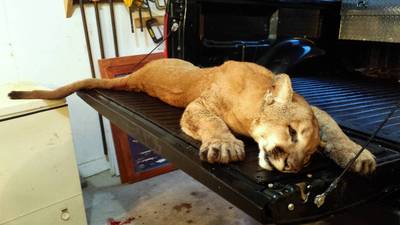
This cougar was looking for love.

I forget how I came across this editorial in the Chicago Tribune but it was published a month ago, to the day.  What is more to the point is that the editorial was inspiring and I vowed to republish it.  With the absence of any formal permission to republish the editorial I thought it best to leave it for a few weeks.  When you read it you will realise just why it needed to be shared with you.

ooOOoo

Editorial: The cougar killed in Illinois was looking for love

ILLINOIS DEPARTMENT OF NATURAL RESOURCESThis cougar was shot last week by a state conservation officer in Whiteside County. The animal needn’t really have been killed.
ILLINOIS DEPARTMENT OF NATURAL RESOURCES.
This cougar was shot last week by a state conservation officer in Whiteside County. The animal needn’t really have been killed.

He was lean, athletic and had traveled hundreds of miles, most likely from the Black Hills of southwestern South Dakota. He had attacked no one as he passed hundreds of towns and many more farms, each of them a lethal threat to his mission. Yet for lack of a better wildlife management plan in Illinois, the young cougar couldn’t get past a conservation officer armed with a state-issued rifle.

The necropsy says the cougar killed last week as he hid near Morrison, 130 miles west of Chicago, died of gunfire. In truth he died of official neglect: Even though more cougars and possibly wolves likely will be visiting Illinois, state lawmakers and the Department of Natural Resources haven’t forged policies that could allow the tranquilization, capture and survival of animals whose ancestors blissfully roamed the Midwest long before humans intruded on their turf.

Given his hunting skills, the young male could have homesteaded anywhere in the Upper Midwest and dined on the bountiful deer population for the rest of his life. Instead, his four huge paws carried out the imperative that drove him: With larger, older males driving him away from the females on their home ranges, this cougar came looking for love.

A farmer called authorities to report a large cat running from a cornfield toward his farmstead and, sure enough, a responding conservation officer found the cat under a corncrib, probably hiding until darkness would allow it to flee.

We won’t second-guess the officer, who consulted with law enforcement and wildlife personnel before killing the cougar. That said, this was an outcome that didn’t have to be. A magnificent creature might well be headed back to South Dakota if Illinois had learned lessons after Chicago police shot and killed a cornered cougar in the Roscoe Village neighborhood five years ago.

What all of us, legislators included, have to understand is that the return of feline or canine predators to their traditional realms doesn’t mean the animals want to hurt anyone. Even as this episode unfolded, millions of National Geographic readers were receiving the magazine’s December issue, with an 18-page spread: “Ghost Cats … Cougars are quietly reclaiming lost ground.” The relevant passage: “Cougars have attacked humans on about 145 occasions in the U.S. and Canada since 1890. Just over 20 of those assaults — an average of one every six years — proved fatal.”

Yet in this case, with an animal that had threatened no one while bypassing thousands of Midwesterners, a DNR spokesman rationalized that, “Public safety is what we’ll make the decision on every time.” The rest of DNR’s explanation is similarly lame: The department otherwise would have had to find someone to capture and move the animal. This officer thought the situation too unsafe to call a veterinarian to tranquilize the cat. Conservation officers don’t carry tranquilizer guns. That thinking led the DNR to the specious excuse that if the officer had shot the cougar with the wrong dosage of tranquilizer, the animal could have been harmed or killed accidentally. That excuse evokes the February 1968 explanation from a U.S. major to an Associated Press correspondent about the Vietnamese provincial city of Ben Tre: “It became necessary to destroy the town to save it.”

We were struck by sensible comments last week from Bruce Patterson, curator of mammals at Chicago’s Field Museum, who wonders why this animal had to be shot when it evidently was hiding during daylight and hadn’t threatened anyone: “It’s possible to manage wildlife while still keeping it around.”

When we editorialize about humans slaying wild predators, some readers say our concern should be — as it constantly is — directed instead to the needless killings of young people, and not toward one lost, probably frightened animal.

Fair enough, although it’s possible to think about both. Just as we know there will be more homicides, we know that more big predators likely are coming to Illinois. So we’ll look back to what we expressed after the 2008 killing of the cougar in Roscoe Village: We hope Illinois comes away from last week’s episode with more than one dead cougar and a communal sadness. Illinois should develop a reliable protocol that errs on the side of trying to preserve the life of the lost animal — not of making the ad hoc decision to kill it and then resolving the ambiguities in favor of that decision.

That’s what happened here. A logical first step now: Give cougars protection under the Illinois Wildlife Code; they lack that protection now only because there is no known breeding population in this state. But with trail cameras capturing photos of one or more cougars in Jo Daviess, Morgan, Pike and Calhoun counties last fall, the animals evidently are re-establishing themselves in a state where they haven’t been known to live since 1870. In recent years, wolves have dipped into Jo Daviess, the state’s northwest corner. A black bear even visited there, evidently for a few days.

Lawmakers, DNR officials, you can do better. So can the rest of us, first by using sites such as cougarnet.org to offset our visceral fear with scientific knowledge.

Wild animals roam this state. Always have and, we hope, always will. As we urged here in 2008: The same Illinois that was unprepared for the last cougar had better get ready for the next. He’s probably en route.

ooOOoo

As you contemplate your New Year resolutions for 2014 please resolve to protect our animals.

Words fail me!

But there is a very good ending!

There was an item in a recent set of links from Naked Capitalism that caught my eye.

It was a link to a story on Huffington Post that I am taking the liberty of republishing.

ooOOoo

Left To Die In A Trash Heap, Abandoned Dog Gets Remarkable Second Chance

The Huffington Post  |  By  Posted: 12/13/2013 5:19 pm EST

A moving video of the extraordinary recovery — and resilience — of an abandoned dog who was left to die in a trash heap is reminding us this week of the healing power of love, friendship and second chances.

On Nov. 15, when Eldad Hagar first laid eyes on Miley, an abandoned dog living among piles of trash on the outskirts of Los Angeles, his heart broke.

“When I got there, I almost couldn’t believe what I was seeing,” Hagar, the co-founder of animal rescue organization Hope For Paws, told The Huffington Post of his first encounter with the pup. “It’s almost as if this place was struck by a tsunami.”

Miley, covered in mange and infections, was so lifeless and defeated that Hagar, who recorded the dog’s rescue on camera, says she “didn’t even have the energy” to run away from him as he approached her.

Mileytrash1

Hagar says he rushed to Miley’s side after he heard about the pooch’s plight from a local resident. The tipster told him that Miley had been living in the trash heap for at least a few months. It is believed that she was abandoned by her owners.

Though he knew that Miley wouldn’t be in good shape, Hagar says he was still shocked when he finally made contact with her. Her physical deterioration was “definitely one of the worst cases” he’d ever seen, he said.

He knew he had to get Miley to a hospital right away.

Gaining the pup’s trust was no easy feat, however. Hagar says he offered her food and sat with her in the pile of trash for an hour before she was finally ready to leave with him. Then he got her into his car to be brought to the vet.

“She was very lucky we rescued her when we did, because her condition would have continued to deteriorate until she would have died a miserable and painful death,” Hagar said.

After examining Miley, veterinarian Dr. Lisa Youn discovered that the pooch wasn’t just suffering from mange and bacterial infections, but parasites and malnutrition, as well.

“She was in so much pain,” Hagar said.

Mileytrash2

Over the next two weeks, Miley got intensive medical care and was treated with antibiotics, medicine for parasites and frequent medicated baths. Slowly but surely, her spirits began to lift.

It wasn’t, however, until Miley found a best friend that her recovery took a dramatic turn for the better.

Miley met Frankie the chihuahua after he was rescued from a sewer tunnel by Hagar and a friend. The tiny dog had almost drowned, Hagar said, because of a spell of heavy rain.

“He was so scared of everything,” Hagar wrote of Frankie in the video. “Miley took Frankie under her wing and they quickly became really good friends.”

Mileytrash3

Miley and Frankie, who are wonderfully affectionate with each other, are said to be doing well.

The “worst part is behind [them],” Hagar told the HuffPost, adding that Miley should be “100 percent” in a few months.

Watch the adorable duo playing with each other in the video above. To find out more about the work that Hope For Paws does, visit the organization’s website andFacebook page.

ooOOoo

That first YouTube video also had the following comment:

Published on Dec 12, 2013

Please make a small donation to Hope For Paws and help us start 2014 strong with many more rescues. A $5 donation from many people would make all the difference to so many animals: HopeForPaws.org
Hope For Paws took care of Miley’s vet care, but she is now fostered by our friends from The Fuzzy Pet Foundation. Please visit their website to fill an application to adopt her: fuzzyrescue.org
Little guest star – Frankie was also rescued by Hope For Paws (with help from Lisa Chiarelli), and is now being fostered by our friends from The Forgotten Dog Foundation. If you would like to adopt him, please fill an application here: theforgottendog.org
Thanks 🙂
Eldad

The Hope For Paws website is here.  Please, please make a small Christmas donation.  It makes such a difference.  Chapter Twenty-Three of The Book comes out in thirty minutes and, I hope, goes a long way to demonstrate the value of our relationship with dogs over thousands upon thousands of years.

The power of self.

Confidence in what you and I can achieve is our salvation.

Yesterday, I wrote about just a few of the things going on in our world that have the power to destroy us.  Destroy us in the sense of making us feel powerless, irrelevant and insignificant.  Trust me, there were plenty more examples that I could have mentioned.

But so what!

The vast majority of the humans on this planet have control over what they think.  Untold numbers of those self-same people have control over what they do with their lives.

Take Dr Peter Pratje.  I suspect that you, as with me, hadn’t heard of Dr Pratje before.  But he is a Project leader with the Frankfurt Zoological Society and he holds an MSc in Biology and a PhD in Conservation biology.  This may be learned not from the website of that Frankfurt Society but from the website of the Orangutan project.  Bet you hadn’t heard of that project either.  The Orangutan Project (TOP) is described:

The Orangutan Project (TOP) is the world’s foremost not-for-profit organisation, supporting orangutan conservation, rainforest protection, local community partnerships and the rehabilitation and reintroduction of displaced orangutans back to the wild, in order to save the two orangutan species from extinction.

Back to the good Doctor. This is what he says, “What we do for orangutans, we do for ourselves.”

Now settle down for a tad less than twelve minutes and see the power of self, see what we can do for ourselves.

Published on Dec 4, 2013

Peter Pratje, of the Frankfurt Zoological Society, introduces us to our orangutan family and reveals how we, as individuals, can help prevent their imminent extinction.

The eleven minutes long video accompanies Peter Pratje and his team working with young orangutans at the jungle school. The apes have been confiscated after illegally being held as pets. In daily training sessions they now learn the survival skills they need for a life of freedom – how to climb trees, build nests, find food and generally behave like wild orangutans. The project aim is to re-introduce the great apes into the Bukit Tigapuluh national park in central Sumatra.

Taking matters into their own hands, the young orangutans were most supportive – snatching the small and robust cameras and filming themselves climbing up and down trees.

Music Courtesy of ExtremeMusic, http://extrememusic.com

Special Thanks: Frankfurt Zoological Society (http://www.zgf.de)

The book! Chapter Eighteen.

Learning from Dogs

Chapter Eighteen.

The day before Philip’s appointment with Jonathan, he suddenly realised that if they had set a time he hadn’t made a note of it.  He called Jonathan.

“Jonathan, it’s Philip.”

“Hallo Philip, is there a problem for tomorrow?”

“No, not at all. It’s just that if we made a time, I screwed up and didn’t note it down.”

He could hear Jonathan’s laugh over the phone. “Ah, and there I was thinking I hadn’t made a note of the time.  Luckily, I was going to be in all day so was pretty relaxed about when you came across.”

Philip replied, “Ah, that’s a welcoming attitude.  But how about me coming over early to mid-morning? How does that suit you?”

“Ten-thirty, Philip?”

“Done, I’ll see you at ten-thirty.” He was just about to ring off when he added, “Jonathan, I could leave Pharaoh here at the flat but as it’s not become home to him yet, would it be alright if I bring him with me?”

“Not a problem. Would be lovely to see him again.”

“Thanks Jonathan, see you in the morning.”


The room at Jonathan and Helen’s house was ideal.  Ideal, that is, for a large dog. However, just in case Pharaoh couldn’t settle, before leaving the flat Philip had stuck a couple of dog biscuits in his bag.  But there had been no need to worry because as soon he and Jonathan sat down and started to talk Pharaoh curled up behind Philip’s chair.

Jonathan opened the conversation by asking Philip, “Why don’t you tell me a little about your life, pick out the things that more often than not come to you when you think back over the years?”

Philip settled back in his chair and allowed his memory of the last fifty or so years to bubble up into his consciousness.  The key moments were easy to speak about.  His father’s death, his subsequent failure to get any decent exam results at school, then managing to enrol as a graduate electrical engineer at the Faraday House of Electrical Engineering so long as he passed two ‘A-levels’ within the first year; which he failed to do. So he had to leave Faraday House but, miracle of miracles, somehow managed to gain a commercial apprenticeship at the British Aircraft Corporation’s manufacturing plant in Stevenage.

A quiet snoring from Pharaoh showed that he was now solidly asleep. Philip guessed he had heard all this before!

He continued with this snapshot of his past years. Going on to recall how he loved so much his first year at BAC because all apprentices had to spend their first year learning a whole range of engineering skills: cutting, shaping, welding, riveting, and much more. He mused how those skills had given him confidence later on in life to tackle most construction projects; well small ones anyway.  Then on to the second year at BAC and the deadly boredom of the commercial office undertaking such gripping tasks as pasting typed amendments over the top of the pages of current Government contracts for hours upon hours.  Only made bearable by the kindness of Malcolm Hunt, who was his oversight manager.  Leading to Philip offering to cut Malcolm’s grass at his home in the Summer evenings because Malcolm had to constantly wear a neck brace due to severe problems with his upper spine. Then him meeting Malcolm’s lovely Scottish wife, Sadie, and often being invited to have an evening meal with them.

On to that fateful day when he was sitting at his desk, his desk next to Malcolm’s, when Malcolm said, “Philip, Sadie wondered if you could give her a call at work.” He passed Philip a slip of paper on which he had written down Sadie’s office number, a local Stevenage number. He had gone over to the main canteen where there was a public phone box in the lobby.

“Hallo, British Visqueen, how may I help you?”

“Yes, my name is Philip Stevens and I have been asked to call Mrs Sadie Hunt.”

It was but a moment before Philip heard Sadie’s lovely Scottish accent. “Philip, how nice of you to call.  Listen we have a vacancy in our sales office, the team that manage the sales of our polythene film products to UK companies, and I wondered if you would like to be interviewed for the vacancy?”

“Oh Sadie, thank you so much for thinking of me.  I would love to have a try at the position.”

“Well, that’s grand, Philip.  Both Malcolm and I were thinking that your present job was leaving you unfulfilled and something closer to selling would match your skills and personality.  I’ll arrange for the usual letter inviting persons to interview to be sent to you in tonight’s post.”

He became conscious that he had drifted away and looked up at Jonathan with some embarrassment.

“Whoops, got a bit carried away there, didn’t I.”

Jonathan replied gently, “You obviously got the job at British Visqueen.”

“Yes, I did and in a funny way that job set me up for life.  Of course, that’s only clear to me now looking backwards. But all my life I’ve loved the interaction that selling inevitably requires, and, without wanting to blow my own trumpet, I have been good at it.”

The hour with Jonathan flew by.  They agreed the next appointment for a week’s time and he and Pharaoh went out to the car and made their way back to the flat.

Despite that hour with Jonathan almost entirely taken up with him speaking of past times, it had still left its mark on him.  He was aware for much of the rest of that Friday that there was something about the atmosphere in Jonathan’s room that made him feel totally safe even though he had no idea as to how that had been achieved. That was fascinating, he pondered.  It was not as if he was a stranger to being one-on-one with another person nor disliked meeting and talking with others, far from it. But still it felt so different.  He looked forward to next Friday morning.


The morning was soon upon him and, again, much of that next session continued with him talking about the key events in his life, not just in his working life but, for example, the circumstances of his first marriage and how that failed.  By the end of the second session he was up to present times.


The third session, a further week on, started very differently because Jonathan started to talk about consciousness.  In particular about David R. Hawkins who, apparently, is an internationally renowned psychiatrist and researcher into human consciousness.  This all felt a little strange to Philip but as Jonathan showed him a chart, for want of a better term, of the different states of consciousness, a map of consciousness as the title described it, then it did start to fall somewhat into place.

Apparently, David Hawkins had found a way of measuring the human body’s reaction, using kinesiology, to a range of life’s circumstances. Leading to Dr. Hawkins proposing that those reactions were really a window into a person’s consciousness. Hawkins then went on to create a numerical value for those measurements and proposed a mid-way value.  Mid-way, as it were, between positive and negative human reactions. Philip found this fascinating from an intellectual perspective.  He still struggled to embrace the meaning and relevance of it as part of his counselling.  However, from what he had come to observe about Jonathan’s approach to psychotherapy he expected the emotional significance of this to appear pretty soon.

He tuned back into Jonathan explaining how those measurements of the body that scored above the mid-way level of 200 described a range of positive, strong levels of human consciousness and below a corresponding range of negative, weak levels. It was all a little baffling; he had to admit.

Jonathan could see that Philip was struggling a little with the whole idea of human consciousness having levels, let alone that those levels could be measured.

“Philip, think of it as two very broad categories.  From a mid-way level of 200 all the upper states of consciousness are described in the general terms of truth, integrity and supportive of life.  Whereas, from 200 and down those states of consciousness are described as false, lacking integrity and unsupportive of life.”

Jonathan paused and went on to add, “And did you know that the consciousness of dogs has been mapped?”

That brought Philip immediately to the edge of his seat, the suddenness of his reaction causing Pharaoh to open his eyes and lift up his head.

“Yes, the consciousness of dogs has been mapped as between 205 and 210.  They are creatures of integrity.”

Philip knew in that instant that something very profound had just occurred.  He slipped forward out of his chair, got down on his hands and knees, crawled behind his chair, and gave Pharaoh the most loving hug of his life.  Dogs are creatures of integrity.  Of course! So utterly and profoundly obvious. Wow, what a revelation.

He sat back up in his chair, now truly engaged in the subject. Jonathan continued to outline more of David Hawkins’ findings, closing their session by offering to lend Philip the Hawkins’ book Power vs Force.

“See you same time next Friday, Philip?”

“No question.  And thank you for a fascinating session.”


On the drive back to Diptford, Philip couldn’t take his mind off the idea that dogs were creatures of integrity and truthfulness.  What was that third quality that Jonathan had mentioned?  Ah, yes. Integrity, truthfulness and supportive of life. He had no doubt that all Nature’s animals could be seen in the same light but what made it so powerful in terms of dogs was the scale of the unique relationship between dogs and man.  A relationship that had been running for thousands upon thousands of years.

As he made himself his usual light lunch of a couple of peanut butter sandwiches and some fruit and then sat enjoying a mug of hot tea, he just couldn’t take his mind off what Jonathan had revealed.  Dogs are examples of integrity and truth.  No, examples is a pathetic word.  Dogs are beacons of integrity and truth.  Yes, that’s it.  Wow.

Then from a place that he knew not from where, it came to him.  Some day he would write about this. About these qualities of man’s best friend. How we should be comparing the integrity of dogs to this modern, dysfunctional world, a world that seems to be descending deeper and deeper into corruption, lies, greed, selfishness and depravity.  My goodness, how much there is for man to learn from dogs.

As that last thought passed across his mind, he was hit by a force, a force that was beyond question.  He would write not some time in the future but now.  Write about how we must, for the future sake of mankind, learn from dogs.

He shuffled his chair across to his computer, toggled it back to life and started looking at available internet domain names.  Bingo, it hadn’t been taken! Thus a few minutes later he was the registered owner of the domain name learningfromdogs.


Friday the 22nd came round as regular as clockwork and Philip, once again, was settled into his chair in Jonathan’s room. Pharaoh likewise settled in to the corner of the room behind his chair.  He had been looking forward to this next hour with Jonathan because so much had flowed from the revelations of last week’s session.

“Philip, when we had our first session and I asked you to relate the key life events that came to you, the first event you spoke of was the death of your father.  Tell me more about that time in your life.”

“To be honest, I don’t have clear memories of my father much before he died that year. He was a lot older than my mother, some eighteen years, and I had been the result of an affair between them; my father being married at the time.  They met when they were both members of an amateur orchestra in London during the height of the Second World War.  Apparently, my father had had two daughters with his wife and longed for a son.  I came along just six months before the end of the war.  At first, my father couldn’t decide to leave his wife leading to my mother eventually giving him an ultimatum that if he wished to continue to see his son then he would have to marry her.  So despite me being born in November 1944 it wasn’t until 1946 that my parents became married.”

He paused for a few moments, as if having to dip back to that December in 1956 was going to stir up pain.

“I had turned twelve-years-old in early November 1956.  Just finished my first term at Grammar School.  To be honest, I can’t recall when my father became ill and how long he had been bed-ridden. But on the evening of December 19th, after I had kissed my father goodnight and jumped into my bed in the room next door, my mother came in, closed my bedroom door, sat on the edge of my bed and told me that my father was very ill and may not live for much longer.

It clearly didn’t register with me at any significant emotional level because I went off easily to sleep. But when I awoke in the morning, I was told that my father had died during the night, the family doctor had attended and my father’s body had been removed from the house. I had slept through it all.”

Jonathan quietly looked at him.  Nothing was said; not for a long time. Philip was aware of a strange, yet peaceful, presence in the room.  Pharaoh softly stood up, came over and laid his head across Philip’s leg. All remained still and quiet in the room.  He lost any notion of the passing of time, no idea of how long it was when there was a gentle movement from Jonathan.

“What are you experiencing at this moment?”

“Jonathan, it’s strange but there’s almost a complete absence of feelings.  I’ve often tried to reflect on what I truly felt at the time or, indeed, what I feel all these years later whenever I am drawn back to that time.  But the best I have ever been able to come up with is that I was never able to say goodbye.  You need to know, Jonathan, that it was decided that because it would be too upsetting for me, I wasn’t even at the funeral and cremation thus reinforcing my sense of not saying goodbye to my father.”

Minutes passed afresh before Jonathan asked his next question. “Philip, you have a son and daughter.  What are their ages?”

“My son, William, is now thirty-five and my daughter, Elizabeth, thirty-four.”

Jonathan put his hands together fingers-to-fingers and lent his chin against them. “So your son would have been twelve in 1984.  That was when you were very busy running your own business, if I recall.”

Philip nodded in reply.

“So Philip let’s say that during that year of 1984 you had been diagnosed with some terminal illness, say cancer, as with your father.  You were given a life expectancy of six months or less. What thoughts come to mind?”

“You mean in the sense of what it would have meant for William and Elizabeth?”

Jonathan nodded.

“Wow, what a truly terrible thing to reflect upon.”

He idly stroked Pharaoh’s head as he tried to put himself in the position of knowing he was dying back when his children were eleven and twelve.

He looked up. “What comes to mind without any doubt is that I would have walked away from my business immediately. After all, very soon it wasn’t going to be my business.  My kids were still living at home, of course. I would have wanted to share every minute of my life with them. Try to let them understand as much about me, who I was, what I believed in, what made Philip Stevens the person he was.”

Jonathan almost breathed the next question into the air of the room, “Translate the circumstances of the death of your father across to your son experiencing the same circumstances from your death. What’s your reaction to that situation? Admittedly one we know didn’t take place, thank goodness.”

Philip felt the passion rise from within. He almost cried out,  “To know that I was terminally ill and to have that kept from my son and daughter; that’s terrible, it’s beyond comprehension. Then to compound it by having everything associated with my death and the disposal of my body kept secret from William and Elizabeth.”

He left the sentence unfinished before adding, the pain so clear in his voice, “It’s cruel beyond description.  My poor children wouldn’t have had a clue as to why they had been excluded. No, not excluded; denied. Denied from telling their father how much they loved him and, in turn, denied not hearing from their father how much he loved them. Denied for ever more.”

Jonathan allowed Philip’s anger to reverberate around the room.

“Is there one word that says it all to you? If so, what’s the one word that comes to you?” Jonathan asked.

Philip hardly hesitated. “Rejection.  Yes, that’s the word.”

He went silent as he turned that word over in his mind. “No, can’t better the word.  William and Elizabeth losing their father that way shouts out that their feelings weren’t even considered.  No-one in the lives had stopped to think about how these two very young people were dealing with the severe illness, let alone the imminent death, of their father. Their feelings were not cared for. And not caring means not loving.  Yes, that’s it.  They would see it as a total rejection of them by their father. Not unreasonably, I might add.”


There was a further silence in the room that lasted for, perhaps, five minutes or more.  Then Jonathan said, “Philip, we are not quite up to the hour but I’m going to suggest you just sit here quietly with Pharaoh.”

Jonathan looked at Pharaoh who still had his head across Philip’s leg and said, “I was going to say just let yourself out when you are confident of being OK to drive home.  But, of course, Pharaoh will be the one to make it clear when you may go home.  Bet you anything on that one.  Either way, I’ll be next door; very close by.”

He added, “Just let today settle itself in your consciousness just however it wants to.  Don’t force your thoughts either way, either dwelling on today or preventing thoughts naturally coming to the surface of your mind.  As we have discussed before, pay attention to your dreams.  Maybe have a notebook by your bedside so you can jot down what you have been dreaming about.  I’ll see you next Friday same time, if that’s alright with you.”

Jonathan left the room whereupon Philip quietly laid his face down on Pharaoh’s warm head and wept.  He knew beyond doubt that he had been released from a long, dark, emotional prison.

A few minutes later, he lifted his head, wiped his eyes, just as Pharaoh lifted his own head and indicated clearly that it was time to go. They left the house a few moments later.


When a crossroads is neither a roadway, nor a choice of pathways in the woods or fields, when that crossroads is in our minds, we seldom know it’s there or the choice we made to take one path and not the other until it’s long past.  Sometimes, the best one can do is to look for the tiniest clues as to where one is really heading.


Philip had read that in a book a few weeks back although, typically, could no longer remember the name of the book.  It had spoken to him in a way that he couldn’t fathom out at the time, yet carried sufficient strength and clarity for him to feel the need to jot it down on a sheet of paper.  He had been sorting papers out on his desk on the Sunday following that last session with Jonathan when he came across the sheet of paper.  Much more than the first time he read the words, when he reread them now they were laden brim-full of meaning.

Because, to his very great surprise, his sleep on both Friday and Saturday nights had not only been dream free but had taken him to a place of such sweet contentment that it was almost as though he had been reborn.  Alright, perhaps reborn was a little over the top, but there was no question that he was in an emotional place quite unlike anything he could ever recall.  Almost as if for the first time in his life he truly liked who he was.

Earlier on that Saturday morning when he had taken Pharaoh over to James’ woods, he called in on his sister and shared a cup-of-tea with her.  As he was leaving, Diana asked him if he was alright.  In  querying why she had asked, she said, “Oh, I don’t know. There’s something different about you that I can’t put my finger on.  A happiness about you that I haven’t seen in ages, possibly never seen in you.”

He wrapped his arms around Diana and gave his sister a long and deep hug. He softly said, “I miss our father at times, don’t you?”

She answered, “Oh, I miss him too, miss him so much at times.  He was such a wonderful, gentle man who lived for his children.  He loved all three of us more than anything else. To die at such a young age.”


As the week passed by, Philip became aware of a truth that had been hidden from him for practically the whole of his life. He couldn’t wait to share it with Jonathan.  Thus, as he drove across to Torquay on what was the last Friday of June, he was full of what he wanted to say.

Jonathan could tell that Philip was fit to burst. They had hardly sat down when Philip said, “Jonathan, it’s been an amazing week.  I’ve at last understood some fundamental aspects of my life.”

“That sounds very interesting, tell me more.”

“Well, when I realised that the consequence of the way my father’s death had been handled was to bury in my subconscious the idea, the false idea, of having been rejected, something struck me smack in the face. Namely, that it explained two ways in which I have behaved since being a teenager.”

Jonathan remained silent.

“The first thing that came to me was the reason why I have been so unfortunate in my relationships with women.  This is how I figured it out.  Whenever a woman took a shine to me, I would do everything to come over as a potentially attractive spouse. Rather than rationally wondering if this woman had the potential to be a woman I would fall in love with and love as a wife, I have been driven by such a fear of rejection, that I oversold myself and, inevitably, made poor long-term relationships; Maggie being the classic example.”

Philip’s excitement had him out of breath.  He took a lung-full of air and continued, “But the positive aspect of my fear of rejection is that throughout the whole of my business and professional life, I have been successful. Because I have always put the feelings of the other person above my own. I can’t tell you what a release this has been for me.”

“Philip, that’s a fabulous example of how when we really get to know the person we are it gives us a psychological freedom, a freedom to be the person we are, to feel happy with ourselves.”

Jonathan continued, “One thing I should mention is this.  It’s likely that what happened to you back in December 1956 is not necessarily hard-wired but certainly is a very deep-rooted emotional aspect of who you are.  This new-found awareness will be of huge value to you but that sensitivity to rejection is not going to disappear.  The difference is that you are now aware of it. Quite quickly you will spot the situations, as they are happening, that stir those ancient feelings around.  Then you will be able to notice those feelings without having them pulling behavioural strings. You will be fine; of that I have no doubt.”

4,139 words. Copyright © 2013 Paul Handover

Daisy offers a lesson for all.

A heart-rending, true story of a puppy. (Has a very happy ending!)

Those of you who have read today’s Chapter Eighteen of ‘the book’ will not have escaped the central role played by Philip’s German Shepherd: Pharaoh.

Well a few days ago the following video was sent to me by a good friend, Ginger, from our Payson days.  Won’t say anymore until you have watched it.

Tried hard to find the Facebook page but failed.  However, I did find this article on the Psychology Today website that not only refers to Daisy but offers more on the subject of animal emotions.

Animal Emotions

Do animals think and feel?
by Marc Bekoff – Professor Emeritus of Ecology and Evolutionary Biology at the University of Colorado, Boulder.

Daisy: The Injured Dog Who Believed She’d Walk Again and Did

Anthrozoology, also called human-animal studies (HAS), is a rapidly growing and expanding interdisciplinary field. A recent and comprehensive review of this wide-ranging discipline can be found in Paul Waldau’s book titled Animal Studies: An IntroductionMany of the essays I write for Psychology Today have something to do with anthrozoology in that they focus on the wide variety of relationships that humans establish with nonhuman animals (animals). Some essays also discuss what we can learn from other animals, including traits such as trust, friendship, forgiveness, love, and hope.

Often, a simple video captures the essence of the deep nature of the incredibly close and enduring bonds we form with other animals and they with us. As a case in point, my recent essay called “A Dog and His Man” showed a dog exuberantly expressing his deep feelings for a human companion he hadn’t seen for six months. Another essay titled “My Dog Always Eats First: Homeless People and Their Animals” dealt with the relationship between homeless people and the animals with whom they share their lives.

Daisy: An unforgettable and inspirational symbol of dedication and hope

I just saw another video called “Daisy – the Little Pup Who Believed” that is well-worth sharing widely with others of all ages. There is no way I can summarize the depth of five-month old Daisy’s resolve to walk again after she was injured or of the devotion of the woman, Jolene, who found her on the side of a road – scared, malnourished, unable to walk or wag her tail, the people who contributed money to help her along, or the wonderful veterinarians and staff at Barrie Veterinary Hospital in Ontario, Canada, who took care of her. You can also read about Daisy’s remarkable and inspirational journey here.

Please take five minutes out of your day to watch this video, read the text, listen to the song that accompanies it, and share it widely. I am sure you will get teary as you watch Daisy go from an injured little ball of fur living in a ditch on the side of a road with a broken spine to learning to walk in water to romping around wildly as if life had been that proverbial pail of cherries from the start.

I’ve watched Daisy’s journey many times and every single time my eyes get watery. Among the many lessons in this wonderful video is “stay strong and never give up”. Clearly dogs and many other animals can truly teach us about traits such as trust, friendshipforgiveness, love, and hope.

OOOO

Daisy - a lesson for all!
Daisy – a lesson for all!

Two closing thoughts.

When you next want a dog please, please think of those dogs who are in shelters.  They must be our first priority.

If there is ever a time when we humans need to learn from dogs the qualities of trust, friendship, forgiveness, love and hope, it is now!

Picture parade eighteen.

Winter on its way.

We have had a run of cold days here in Southern Oregon going down to the mid-twenties Fahrenheit at night (-4 deg C.)

So this first picture sent in by John H. seemed appropriate for today.

wear a cat

oooo

Then continuing with the series that started last Sunday.

Hurl6

oooo

Hurl7

Wise words indeed.

oooo

Hurl8

oooo

Hurl9

oooo

Finally, to a short but inspiring video sent to me by Dan Gomez.

A man, a dog, a cat and a rat…

This is a video of a homeless man in Santa Barbara and his pets.
They work State Street every week for donations.
The animals are pretty well fed and are mellow.
They are a family.
The man who owns them rigged a harness up for his cat so she wouldn’t have to walk so much (like the dog and the man himself).
At some juncture the rat came along, and as no one wanted to eat anyone else, the rat started riding with the cat, frequently on the cat.
For a few chin scratches the dog will stand all day and, let you talk to him and admire him.

So the Mayor of Santa Barbara decided to film this clip and send it out as a holiday card.

Happy Thanksgiving in so many ways!

Sights and sounds.

Just a collection of items that I hope you will enjoy.

So enough of the book this week for you dear readers.

It’s the week-end and time to offer you some odds and ends that have come my way in recent days.

First up is some really glorious singing.

Rebecca Bains

Some years ago, I was working with a colleague and subsequently got to know that his wife was a brilliant singer/songwriter enjoying a good singing career.  Her name is Rebecca Bains and there is a website here although still under construction according to the home page.

So to Rebecca’s singing.

Now for something completely different.

It’s an advertisement for Volvo Trucks.  Sent to me by friend, Neil, from my Devon days. The short video has been seen over 45 million times! If you haven’t seen it, prepared to be wowed!

Now back to Rebecca’s singing.  But with this introduction from me.  Many know that here in Oregon we have nine dogs.  Four of those are dogs that were rescued by Jean from earlier days in Mexico and two from the shelter in Payson, Arizona where we were living before coming to Oregon.  There are many, many  others who adopt rescue dogs or care for homeless dogs in countless ways.

willloveforfood

So as we approach Christmas, the Season of Good Will, please do everything you can to help man’s best friend and companion for, literally, thousands upon thousands of years. If you are thinking of adopting a dog, or a cat, please visit your local shelter or the Pet Finder website.

OK, now to a short video with the singing from Rebecca Bains.

Trust me, this will rightly grab your heartstrings.

Well done, Rebecca.

Smart animals!

It’s not just dogs who can read us so well.

Millions of dog owners know how well their animals can read us humans; it’s been mentioned on Learning from Dogs many times before.

Try elephants.

There was a fascinating article on the BBC news website a few weeks ago that went on to explain:

10 October 2013

Elephants ‘understand human gesture’

By Victoria GillScience reporter, BBC News
African elephants have demonstrated what appears to be an instinctive understanding of human gestures, according to UK scientists. In a series of tests, researcher Ann Smet, of the University of St Andrews, offered the animals a choice between two identical buckets, then pointed at the one containing a hidden treat.

From the first trial, the elephants chose the correct bucket.

The results are published in the journal Current Biology.

The item included a short video that I am delighted to say is on YouTube.  Here it is:

Published on Oct 10, 2013

African elephants have demonstrated what appears to be an instinctive understanding of human gestures, according to UK scientists.

In a series of tests, researcher Ann Smet, of the University of St Andrews, offered the animals a choice between two identical buckets, then pointed at the one containing a hidden treat.

From the first trial, the elephants chose the correct bucket.

The results are published in the journal Current Biology.

The scientists worked with captive elephants at a lodge in Zimbabwe.

Prof Richard Byrne, a co-author on the research, said the elephants had been rescued from culling operations and trained for riding.

“They specifically train the elephants to respond to vocal cues. They don’t use any gestures at all,” said Prof Byrne.

“The idea is that the handler can walk behind the elephant and just tell it what to do with words.”

Despite this, the animals seemed to grasp the meaning of pointing from the outset.

Ms Smet added that she had been impressed by the animals’ apparently innate understanding of the gesture.

“Of course we had hoped that the elephants would be able to learn to follow human pointing, or we wouldn’t have done the experiment in the first place,” she said.

“But it was really surprising that they didn’t seem to have to learn anything.

“It seems that understanding pointing is an ability elephants just possess naturally and they are cognitively much more like us than has been realised.”

Prof Byrne said studying elephants helped build a map of part of the evolutionary tree that is very distant from humans.

“They’re so unrelated to us,” he told BBC News. “So if we find human-like abilities in an animal like an elephant, that hasn’t shared a common ancestor with people for more than 100 million years , we can be pretty sure that it’s evolved completely separately, by what’s called convergent evolution.”

The researchers said their findings might explain how elephants have successfully been tamed and have “historically had a close bond with humans, in spite of being potentially dangerous and unmanageable due to their great size”.

But the scientists added the results could be a hint that the animals gesture to one another in the wild with their “highly controllable trunks”.

Ms Smet told BBC News: “The next step [in our research] is to test whether when an elephant extends its trunk upwards and outwards – as they regularly do, such as when detecting a predator, this functions as a point.”

That BBC article goes on to highlight:

Prof Byrne said studying elephants helped build a map of part of the evolutionary tree that is very distant from humans.

“They’re so unrelated to us,” he told BBC News. “So if we find human-like abilities in an animal like an elephant, that hasn’t shared a common ancestor with people for more than 100 million years , we can be pretty sure that it’s evolved completely separately, by what’s called convergent evolution.”

The researchers said their findings might explain how elephants have successfully been tamed and have “historically had a close bond with humans, in spite of being potentially dangerous and unmanageable due to their great size”.

But the scientists added the results could be a hint that the animals gesture to one another in the wild with their “highly controllable trunks”.

Ms Smet told BBC News: “The next step [in our research] is to test whether when an elephant extends its trunk upwards and outwards – as they regularly do, such as when detecting a predator, this functions as a point.”

Now just where did I pack my old trunk.