Category: consciousness

The book! Part Three: Materialism

Money has never made man happy, nor will it, there is nothing in its nature to produce happiness. The more of it one has the more one wants.” Thus, it is reputed, spoke Benjamin Franklin, one of the Founding Fathers of the United States and who in many ways could be regarded as “the First American”.

In my previous chapter on short-termism, I quoted from an article by Larry Elliot, Economics Editor of The Guardian newspaper. The closing paragraphs of that article read:

“The premise of the Global Commission on the Economy and Climate is that nothing will be done unless finance ministers are convinced of the need for action, especially given the damage caused by a deep recession and sluggish recovery.

Instead of preaching to the choir the plan is to show how to achieve key economic objectives – growth, investment, secure public finances, fairer distribution of income – while at the same time protecting the planet. The pitch to finance ministers will be that tackling climate change will require plenty of upfront investment that will boost growth rather than harm it.”

“ …. the plan is to show how to achieve key economic objectives ……. while at the same time protecting the planet.” [My italics]

That those two paragraphs and the phrase “key economic objectives” seem perfectly reasonable statements to me and, I don’t doubt, many, many others, illustrates how deeply we are entrenched in the money, or materialistic, world.

I have spent my whole life hearing the term ‘Gross Domestic Product’, or GDP as it is commonly described, and never ever stopped to wonder about the history of this well-known measure. Thus I was genuinely surprised to learn that the term is not yet one hundred years old, by some years. On the website Foreign Policy one finds a brief history of GDP: “One stat to rule them all.” It offers the following:

Out of the carnage of the Great Depression and World War II rose the idea of gross domestic product, or GDP: the ultimate measure of a country’s overall welfare, a window into an economy’s soul, the statistic to end all statistics. Its use spread rapidly, becoming the defining indicator of the last century. But in today’s globalized world, it’s increasingly apparent that this Nobel-winning metric is too narrow for these troubled economic times.

1937: Simon Kuznets, an economist at the National Bureau of Economic Research, presents the original formulation of gross domestic product in his report to the U.S. Congress, “National Income, 1929-35.” His idea is to capture all economic production by individuals, companies, and the government in a single measure, which should rise in good times and fall in bad. GDP is born.

1944: Following the Bretton Woods conference that established international financial institutions such as the World Bank and the International Monetary Fund, GDP becomes the standard tool for sizing up a country’s economy.

1959: Economist Moses Abramovitz becomes one of the first to question whether GDP accurately measures a society’s overall well-being. He cautions that “we must be highly skeptical of the view that long-term changes in the rate of growth of welfare can be gauged even roughly from changes in the rate of growth of output.”

1962: But GDP evangelists reign. Arthur Okun, staff economist for U.S. President John F. Kennedy’s Council of Economic Advisers, coins Okun’s Law, which holds that for every 3-point rise in GDP, unemployment will fall 1 percentage point. The theory informs monetary policy: Keep growing the economy, and everything will be just fine. [My italics]

Keep growing the economy and everything will be fine! Thank goodness we have unlimited resources on this planet! Please forgive my irony!

Management thinker Peter Drucker is often quoted as saying that “you can’t manage what you can’t measure” but my understanding was that the saying came from William Edwards Deming; October 1900- December 1993. Deming was fundamentally an American statistician although his bio reveals many other talents: engineer; professor; author; lecturer; and management consultant.

Irrespective of the origins of the saying, it misses one fundamental point! That is of being certain that what you wish to manage is being measured appropriately. Not measuring pears if you wish to manage apples!

Stay with this idea for a while longer.

There is an organisation known as the Social Progress Imperative. The organisation is described on their website, as follows:

THE IMPERATIVE
Numerous studies have found a high correlation between economic growth and a wide variety of social indicators, yet there is growing awareness that economic measures alone do not fully capture social progress.

The Social Progress Imperative’s mission is to improve the quality of lives of people around the world, particularly the least well off, by advancing global social progress. The Social Progress Index provides a robust, holistic and innovative measurement tool to guide countries’ choices to enable greater social progress and foster research and knowledge-sharing on the policies and investments that will best achieve that goal. Social progress is defined as the capacity of a society to meet the basic human needs of its citizens, establish the building blocks that allow citizens and communities to enhance and sustain the quality of their lives, and create the conditions for all individuals to reach their full potential.

The Social Progress Index is a tool that we hope will be widely used to inform and influence policies and institutions around the world. The Index is founded on the principle that what we measure guides the choices we make. By measuring the things that really matter to people — their basic needs, their food, shelter and security; their access to healthcare, education, and a healthy environment; their opportunity to improve their lives — the Social Progress Index is an attempt to reshape the debate about development.

…. what we measure guides the choices we make.” Pretty flippin’ obvious when you think about it! As is understanding the “things that really matter to people”!

Michael Green is the Chief Executive Office (CEO) of the Social Progress Imperative. He gave a TED Talk in November, 2014 that is introduced:

The term Gross Domestic Product is often talked about as if it were “handed down from god on tablets of stone.” But this concept was invented by an economist in the 1920s. We need a more effective measurement tool to match 21st century needs, says Michael Green: the Social Progress Index. With charm and wit, he shows how this tool measures societies across the three dimensions that actually matter. And reveals the dramatic reordering of nations that occurs when you use it.

As Michael Green said at the October, 2014 TED Global conference: “GDP is imperfect and incomplete: The world urgently needs a measurement revolution.”

If now writing about the BBC radio show, The Goon Show, suggests I have lost the plot, just hang in with me for a few more moments.

The Goon Show ran from 1951 to 1960 and was broadcast by what was then known as the BBC Home Service. It was hilariously funny and became a comedy legend. It starred Spike Milligan, Peter Sellers and Harry Secombe, not forgetting the wonderful narratives from Wallace Greenslade. The Goon Show was an integral part of my ‘education’ during my formative years; I was seven in November of 1951 and the radio was the source of news, current affairs, education, and humour. Spike Milligan was an outstanding actor in The Goon Show and became a comedy legend in his own right.

A quotation from dear, dear Spike seems a very fitting way to round off this chapter on materialism. Namely: “All I ask is the chance to prove that money can’t make me happy.

1,272 words. Copyright © 2014 Paul Handover

oooo

Now although it is not part of the book, I was so impressed by Michael Green’s TED Talk, that it now follows. You will love it!

Published on Nov 11, 2014
The term Gross Domestic Product is often talked about as if it were “handed down from god on tablets of stone.” But this concept was invented by an economist in the 1920s. We need a more effective measurement tool to match 21st century needs, says Michael Green: the Social Progress Index. With charm and wit, he shows how this tool measures societies across the three dimensions that actually matter. And reveals the dramatic reordering of nations that occurs when you use it.

Seventy years – Just like that!

1944 to 2014 in what seems like the blink of an eye.

At 7:30am UTC on November 8th, 1944 in the antenatal ward of Hampstead Heath General Hospital,  North-West London, yours truly took his first lung-full of air.

It would be impossible to list all the memorable things that have happened in these last seventy years and, anyway, it would bore your pants off!

So all I want to reflect upon were those first six months, despite me not remembering any moment of them.

For on May 8th, 1945 World War II ended.

Here’s the historic announcement by Sir Winston Churchill.

The Allies accepted the unconditional surrender of the defeated Third Reich on May 8, 1945. This brought an end to the Second World War in Europe after 2074 days.

My mother, still very much alive at the age of 94, recalls that on hearing that announcement from Churchill she looked down at me and knew her young baby boy wasn’t going to be killed by a German bomb.

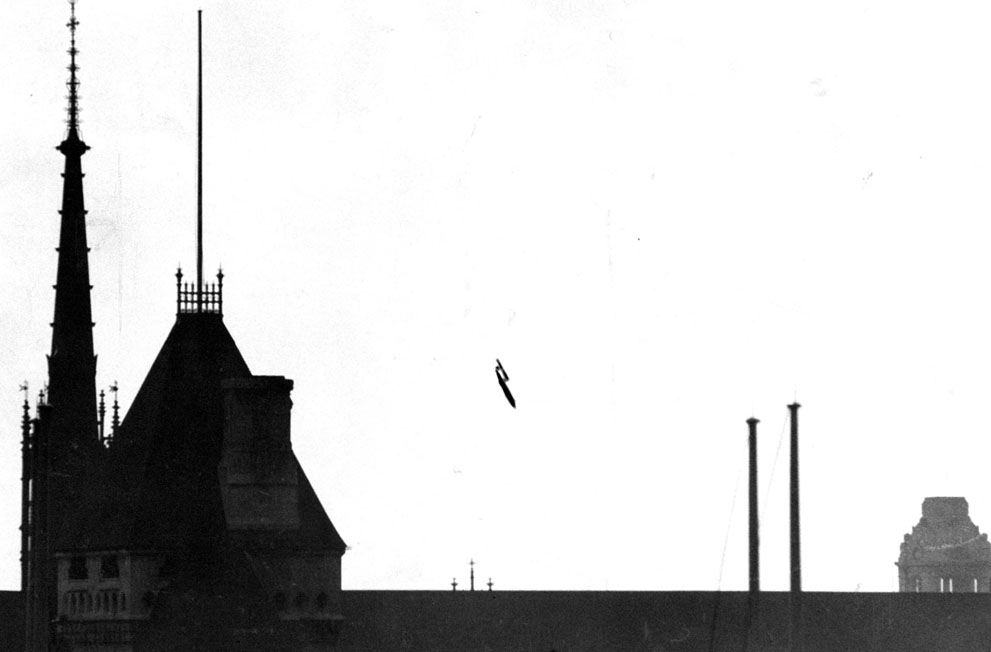
By no means was this a theoretical concern of hers. For in much of the preceding months the Germans had been hammering London with their V-1 “Buzz Bombs”. As this historic photograph shows.

A V-1, “buzz bomb”, plunging toward central London, 1945.


This bomb landed on a side road off Drury Lane blasted several buildings, including the office of the Daily Herald. Known as the Flying bomb, Buzz bomb or Doodlebug, V-1 was the first modern guided missile used in wartime and the forerunner of today’s cruise missile. The V-1 (and later V-2 ) added a new terror to an already terrible war – robot missiles. Once launched, these weapons flew without human intervention to strike distant targets.

Circumstances meant that my mother was living in North-West London when I was born and that’s where I was brought up for the first two years of my life.  Still remember the address: 17 Burnside Crescent, Alperton, North-West London.

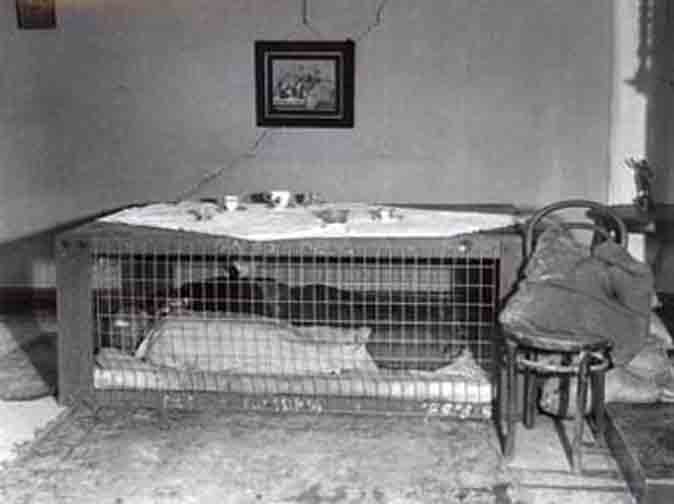
Burnside Crescent was close to factories that were being targeted by the Germans.  That meant that at night my mother and I slept in what was called a Morrison shelter.

An indoor Morrison shelter.

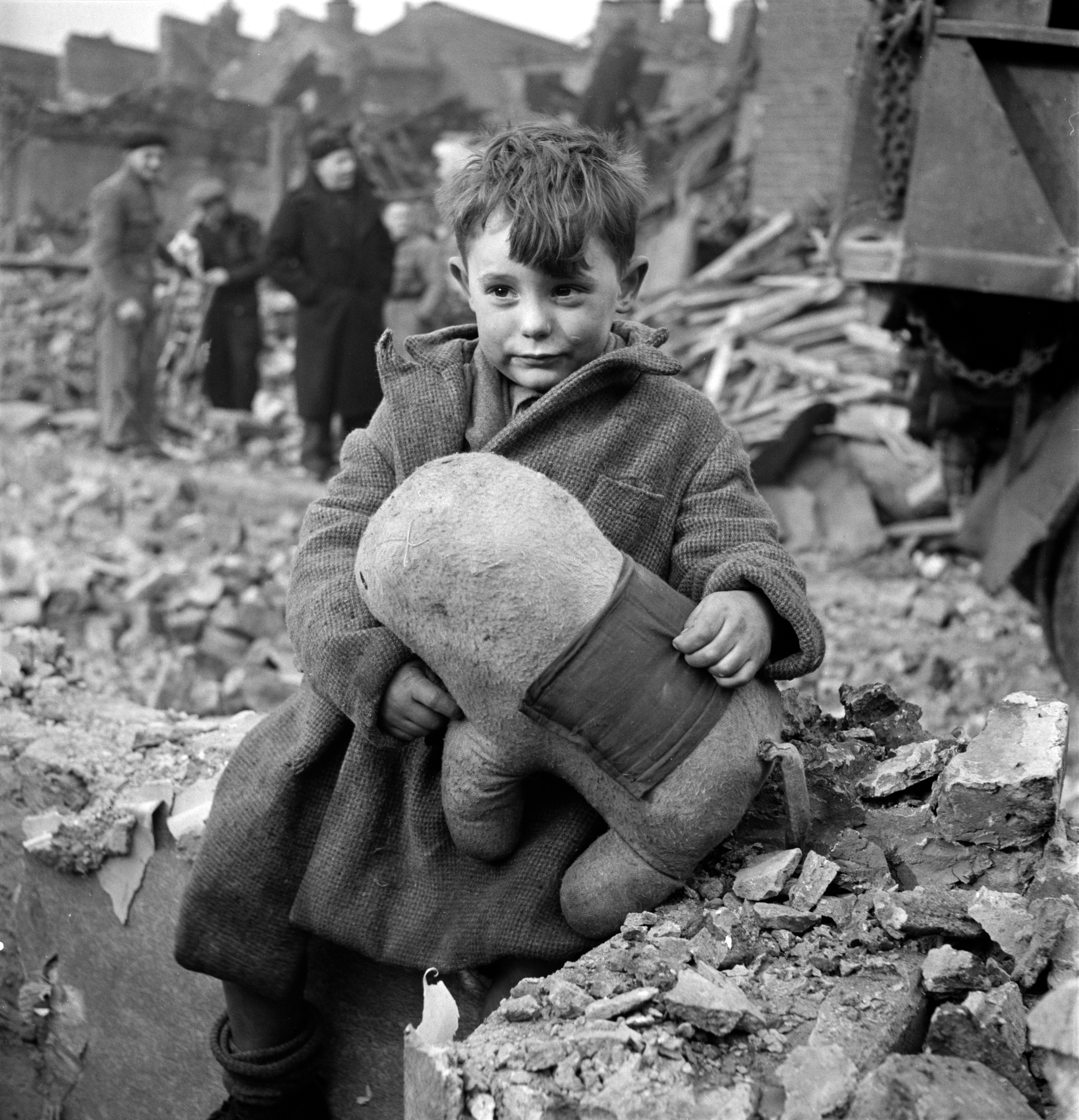
As if to underscore the hazards of early-1945 London, the photograph below is of a young boy, Toni Frisell, the sole family survivor from a V-1 bombing in 1945.

Toni Frissell London bombing 1945 wonder where he is now?
Toni Frissell – wonder where he is now?

So here I am still a living being and still loving my life.

How to close?

By coming all the way forward to modern times and the incredible technology that enables so much. Not just the world of blogging but such things as NASA’s Scientific Visualization Studio from where this compelling video was taken.

I wrote about my first six months that were not remembered one jot!

This quote, therefore, seems an apt statement for the end of today’s post.

“Time moves in one direction, memory in another.”

Quote from the author William Gibson

Returning to the land – a guest essay.

A question of a possible catastrophe

Note: As tomorrow’s post will explain, the next few weeks will be encroaching seriously on my blogging time. So it was very timely to receive this guest essay from John in the last couple of days and even more generous of him to give me permission to republish it.

It will make an interesting comparison to an item from Dan Gomez being published on Thursday.

ooOOoo

Notes on Dealing With Imminent Catastrophe

We know that our world economy is leveraged at least twenty-five times beyond any earthly material foundation. Regardless of this reality, we have made an artificial global economy more real than our physical world. This situation only makes sense when we recognize that we’re being encouraged to re-establish our awareness of reality. It’s a final exam time for a leading edge species of clever monkeys.

Nature has tolerated human activities for millions of years. Now that our demographics ravenously swarm the globe, belch poisons into the five mile band of air that sustains surface life on earth, dumps wastes and toxins into streams, rivers, lakes and oceans, and arrogantly refuses to understand obvious warnings; Nature is reacting.

For those who are inclined to either or choices, in accordance with the physical Law of Entropy, the decision is between pursuing constructive or destructive actions. For those who are more spiritually oriented, there is no question. In either case, we know what needs to be done.

Our first order of business is to stabilize our inclusive global economy through green initiatives that are operated for profit without damage to the eco-system. Yes, this sounds impossible the first time we think about it. Can we come up with a better plan? Not really, when we stop and honestly consider our situation. We’re poised on the brink of a material, economic and cultural collapse created by human beings.

Wars continue to be waged world wide over territory and rapidly diminishing fossil fuel resources. We have essentially lost trust in each other as equal members of a common community we call Earth. And, we are rapidly losing faith in the unsustainably inflated symbol of trust we call Money.

A green economy is our best solution for the multiple problems that plague us. Here’s why and a few suggestions about how we go about the process. Essentially, our critical need for renaissance is a process of education, formation and transformation.

When we return to the land as a global priority, the use of solar energy can replace massive industrial electrical generators running on fossil fuel derivatives. Most industrial generators may be easily converted to bio-diesel fuel. Industrial diesel generators worldwide can be converted to bio-fuel overnight. No mechanical adaptation is required.

Electric cars already set speed records at Europe’s classic racetracks. Solar electric cars are on the horizon. A bio-diesel engine to power a golf cart costs about $500 today and is available from Amazon.

There’s a natural need for co-operation when we return to the land and collectively re-establish our financial roots. First, we recognize that each of our actions affects the well being of the earth and its inhabitants. Second we realize that we are responsible for the well being of the Earth which sustains our being.

Third, we re-establish our natural connection with the unity of a living universe. We begin with the community gardens and farmer’s markets that are already operational, and rebuild accordingly.

When we are foolish, we act independently for our personal well being. When we are wise, we act together for the well being of the earth and each other. Growing our own food not only assures that what we eat will be free of chemical by-products; it also makes us aware of how fragile our consumer supply lines have become. Recycling our food waste as fertilizer completes a natural growth cycle.

By the way, a back yard greenhouse can produce enough bio-fuel to operate a diesel vehicle and a solar panel array can generate enough energy to charge your electric car. How much money does this save each year?

We don’t need nuclear reactors that sometimes melt down and sicken us with a continual stream of radiation carried by the tides and the winds of an integrated planet. We don’t need the wastes of nuclear reactors that poison the earth for millennium.

We don’t need nuclear weapons capable of destroying most, if not all, of the life on earth in an all out suicidal war. The only creatures to survive the holocaust of nuclear war would need to be radiation resistant; shielded deep underground or deep under the sea.

Harnessing wind, water and geothermal energy are wiser ways to keep our world energized in a green economy. A combination of habitats and communities powered by solar and geothermal energy will produce a new building boom as we shed the skin of our former infrastructure and a green architectural industry emerges.

Recycling the components of our technological world not only reduces our industrial waste, it decreases the cost of manufacture. Similarly, adapting and reusing what we already have decreases our personal expenses and reduces our demands on the earth.

These are only a few of the ideas which are already possible. Many more are already in the process of becoming our greater reality.

Still think such a massive transformation is impossible? If so, please know that you remain in our prayers.

There is hope for tomorrow. Science consistently opens new doors. Faith in the Nature of God of which we are each an infinitesimal part makes us unified and strong as a consciously aware biological species.

John Hurlburt

an old lamplighter

ooOOoo

Saturday special!

Enough of the world of spying and whistleblowing and back to stuff that is really important!

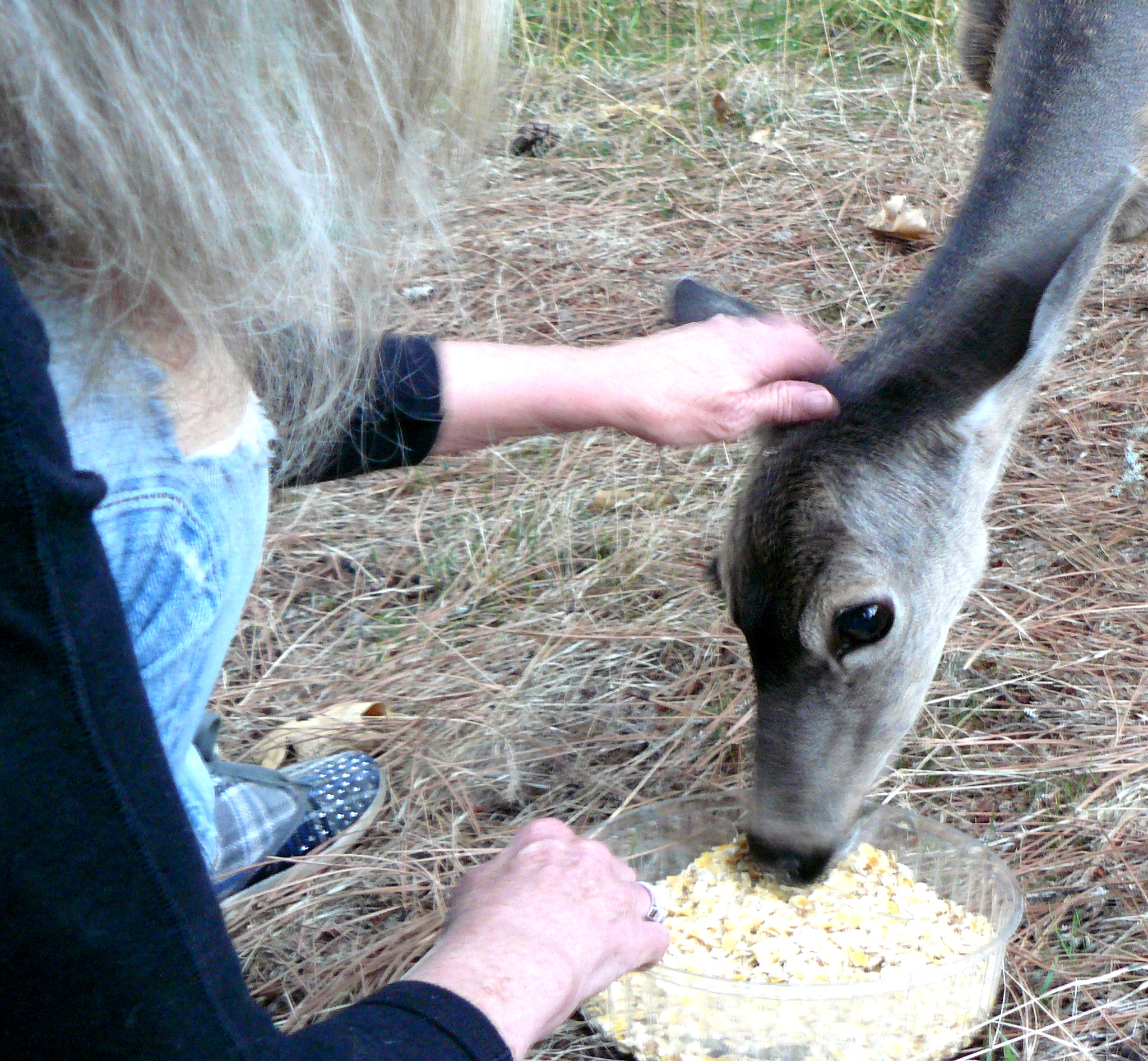
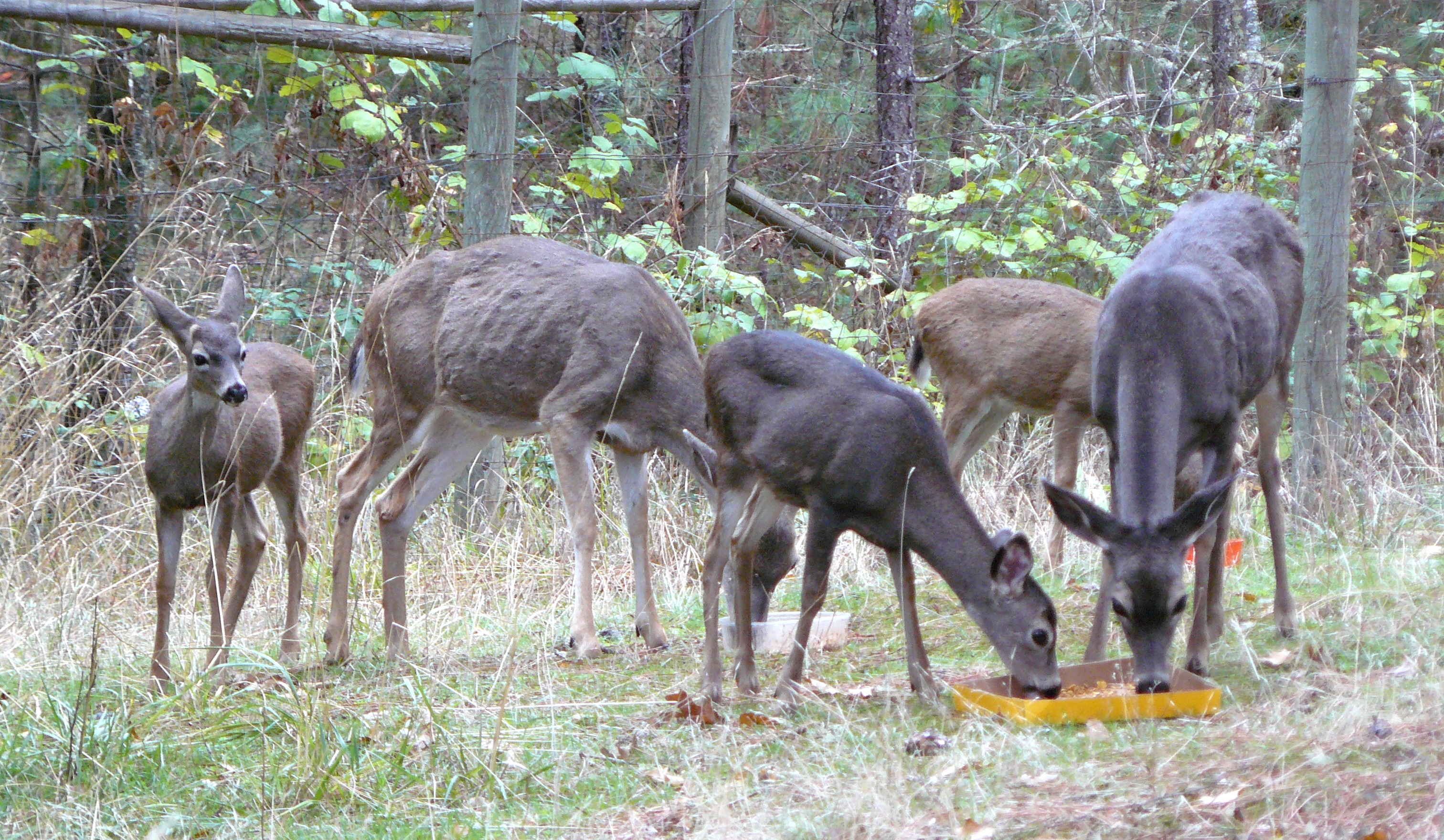
Many will recall that on the 10th October, under the heading of Utterly beyond words!, I wrote about a deer befriending us to the point that Jean was able to stroke its neck as it was feeding.  The post included this photograph.

Then, unbelievably, the wild deer continues feeding as Jean fondles the deer's ear.
Then, unbelievably, the wild deer continues feeding as Jean fondles the deer’s ear.

Inevitably, being the softies that we are, we have continued to put out feed, in the form of cob or cracked corn, most days.

The word among the local deer population clearly has been passed around!

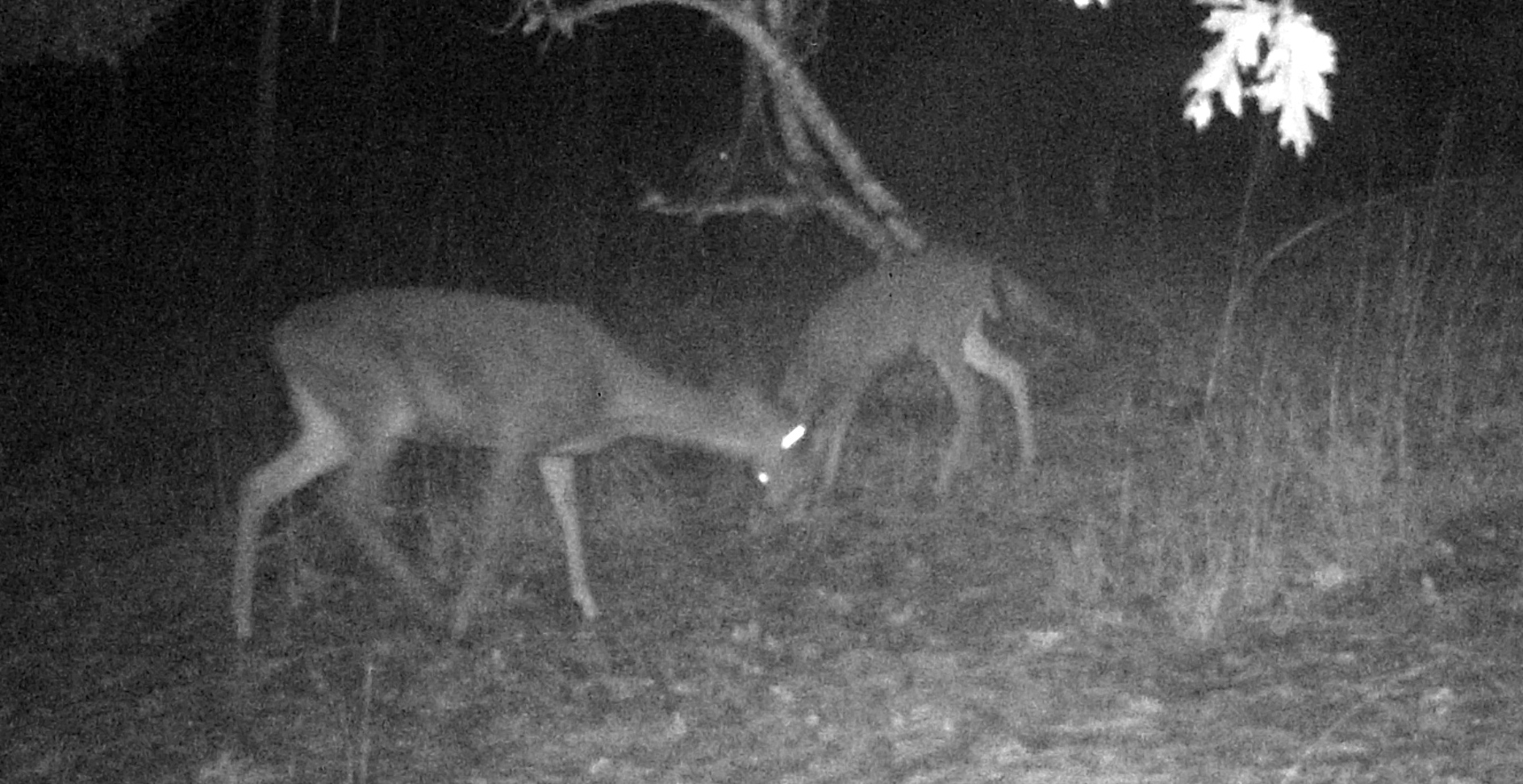
For here’s a photograph taken automatically on the night of the 19th October.

Time of the shot was a little before 5am.

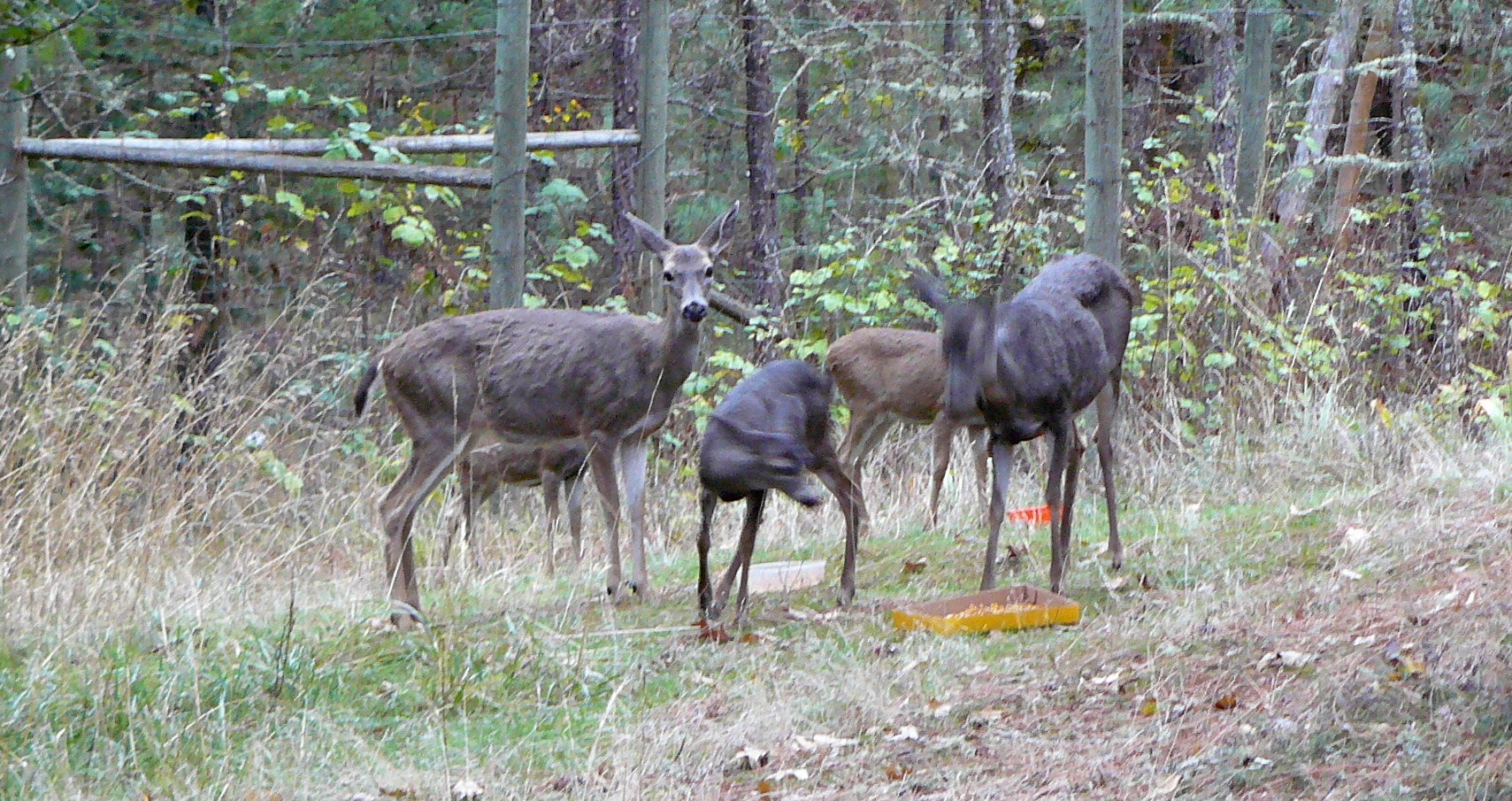
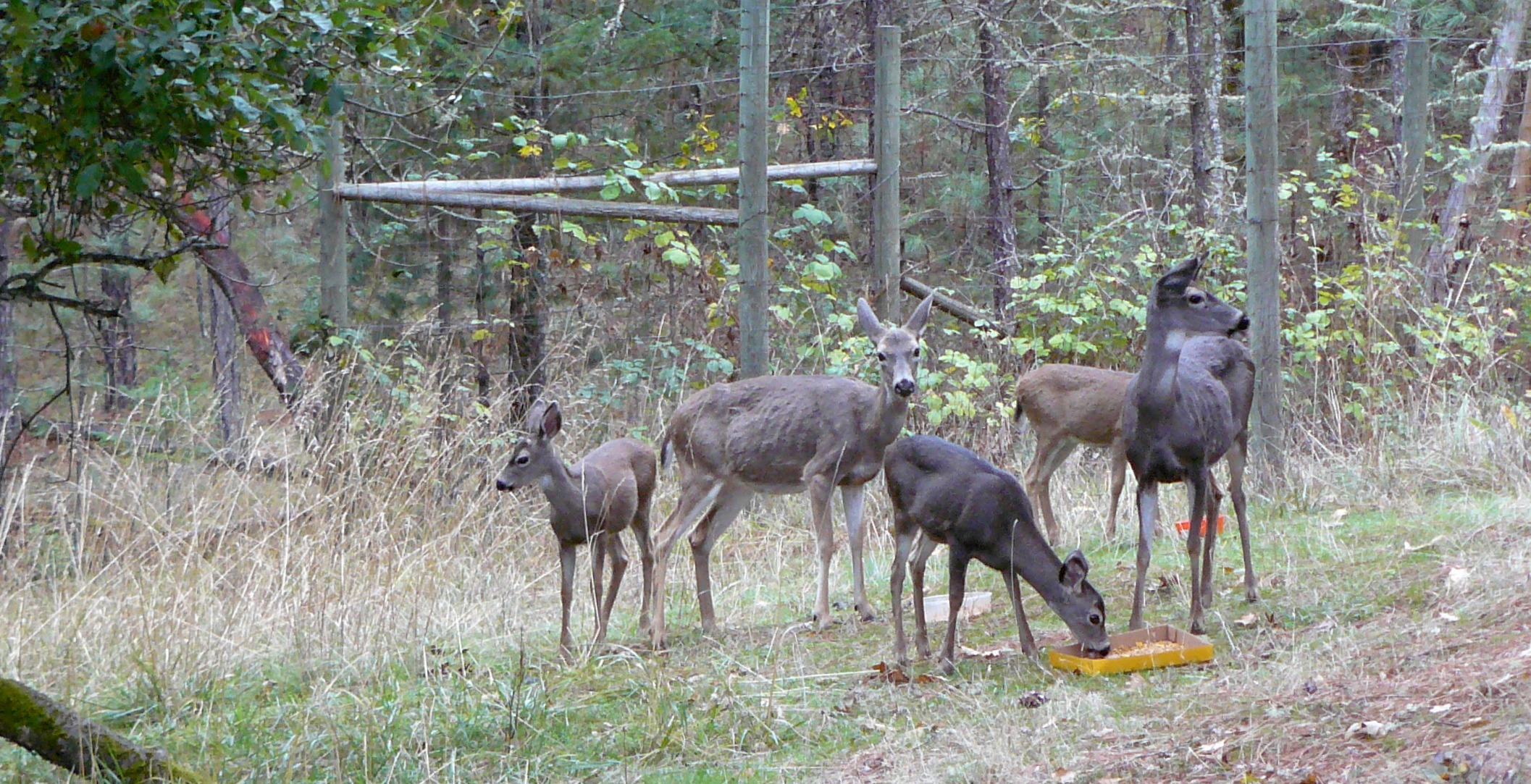
Then on the 22nd, just three days ago, these photographs were taken shortly after 10am.

Party time!
More food and it isn’t even supper time!

oooo

Come on ladies, eat up! You never know when a dog will charge around the corner!

oooo

P1150220
That’s more like it!

One fear that Jean and I had was that they would become vulnerable to an attack by our dogs.  But the deer have quickly wised up to when dogs are being let out of the front or kitchen doors and are off like darts into the forest just a few yards away.

We treasure seeing them each day.

A small step to inner peace.

That journey towards stillness.

I didn’t intend this to be a theme for the week but sometimes one gives in to the forces of fate!

For after Monday’s post about making that inner journey to better know oneself, itself prompted by Rick Hanson’s Power of Stillness, came yesterday’s post on the power of love between a dog and his elderly owner.

So I was wondering what to write for today and wandering around the web looking for inspiration and, serendipitously, came across the blogsite The Commoner Princess.  I had never heard of it before but there on the home page was a post published on the 21st October: Unlocking inner peace: forgiveness.

Here’s a flavour of that post.

Unlocking inner peace: forgiveness

POSTED ON 21 OCTOBER 2014

What hurts the most in life? Trying to make everybody happy. I think this is one of the ultimate life lessons. I remember having a specific unease when someone close to me wasn’t happy for some reason. Things got even more dramatic when I knew I was the cause in one way or another. Time taught me that this perspective wasn’t exactly the healthier approach to life. It is more than normal to care for the wellbeing of your loved ones, to stand by them in need or to try to have a zen relationship with them at all times. But oh boy, this is one of the hardest things to achieve. Detachment is hard enough when you are not directly involved, but when there are emotional ties, becoming the observer takes a lot of mindfulness, awareness, compassion and most importantly, a loooooot of restraint.

Even better, the post concluded like this:

Here is a beautiful meditation to send love and peace to the entire world. Sit in easy pose or any comfortable position of your choosing. Place your arms against your ribs, forearms in horizontal position, palms facing upwards. Start by taking long deep breaths. Breath in through the nose, exhale through your mouth. You can try the 5-5-5 technique as I call in. 5 seconds breathing in, 5 seconds holding, 5 seconds breathing out. Keep this cycle of breath for as long as you feel comfortable with it or until the end of the meditation.Thank you gabbyb.tv for your teachings.

May this be of service to you all!

Then closed with this video that you have to play in the background as you just think of stillness.

Wonder what tomorrow will bring?

The love of a dog – big time.

As post sequels go, it doesn’t get much better than this!

I was so pleased at how yesterday’s post was received and, serendipitously, the ‘add-ons‘ that appeared as comments to that post.

So how to follow that today?

Chris Snuggs came to the rescue in sending me a link to a recent item in the UK newspaper The Daily Telegraph: Touching moment sick elderly man is reunited with his dog.

Luckily, rather than republish the Telegraph item without permission, the video and background information were over on YouTube.

Here it is:

Watch heart-melting moment stricken patient makes shock recovery after being reunited with pet dog.

Published on Oct 18, 2014

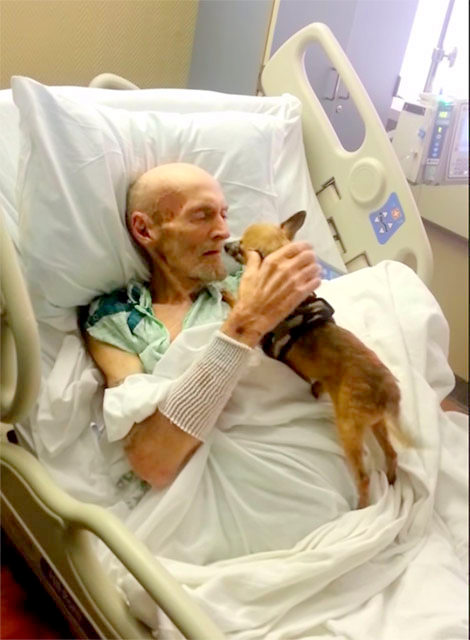
James Wathen, 73, and his beloved one-eyed Chihuahua, Bubba, both stopped eating for six weeks after they were separated.

This is the heartwarming moment a seriously ill elderly patient made a “tremendous recovery” thanks to an emotional reunion with his pet dog.

James Wathen, 73, looked doomed when his condition – related to an unknown illness – deteriorated after six weeks at Baptist Health Corbin hospital in Kentucky.

The pensioner was so ill he could barely speak and had stopped eating.

However, all that changed when he managed to whisper to nurses that he was missing his one-eyed Chihuahua Bubba.

His revelation sparked a desperate search for the beloved dog, which was being kept at the Knox-Whitely Animal Shelter.

Pets are banned at the hospital, but nurses managed to sneak Bubba in and then filmed the emotional reunion.

There wasn’t a dry eye in the room,” the hospital’s chief nursing officer Kimberly Probus told WKTV. In a further twist, Mary-Ann Smyth, from the animal shelter, said the dog had also stopped eating when the pair were separated.

They didn’t think James was going to make it,” she told NBC. “He [Mr Wathen] has done a complete turnaround. He’s speaking, he’s sitting up, he’s eating.

He doesn’t look like the same guy, and the dog is eating and doing better now, too.”

The hospital has allowed Bubba to visit his owner several times since, with staff saying they have both made a “tremendous recovery”.

It’s what this blog is all about. There is no limit to what our dogs offer us; love being at the top of the list.

James Wathen and his beloved dog Bubba.

The one journey we should take before we die.

I’m referring to the journey within.

Last Friday I offered a post under the title of The power of stillness.  It was founded on a recent essay seen in the newsletter called Just One Thing published, freely, by Dr. Rick Hanson.  Here’s the closing paragraph of that essay:

 Wherever you find it, enjoy stillness and let it feed you. It’s a relief from the noise and bustle, a source of clarity and peace. Give yourself the space, the permission, to be still – at least in your mind – amidst those who are busy. To use a traditional saying:

May that which is still
be that in which your mind delights.

There’s a very strong correlation between finding that stillness within and having the self-awareness and peace that comes from knowing who one is.  Seems such an easy ‘walk in the park’ to know ourselves but most times it is far from that.  Many are the ways that we hide who we really are! 😉

However the rewards are everything.  Knowing and liking oneself offers the richest scenery of any journey.

All of which constitutes my way of introducing a truly wonderful poem from Sue Dreamwalker, a great friend of this blog.

ooOOoo

Vicar’s Water. A Sanctuary for wild life.

Journey Within..

Come with me on a journey it starts inside my head

Create a place to dwell from all the Fear and dread

Close your eyes and behind them create a perfect vision

Build a garden full of beauty get ready for your transition

~

Sit upon the grass as sky lark sings above

Hold out your hand to feed the many cooing Doves

See the babbling stream as the young fawn drinks her fill

And listen to the Woodpecker’s distant woodland drill

~

Watch the tiny fishes as the light glistens from their scales

You’re now adrift in the ocean, as you watch the Humpback Whales

You listen to their song a lament as old as time

Each breath takes you deeper as your Spirit begins to climb

~

Now you are on a mountain its top all crisp and white

You fly among the Eagles suspended in effortless flight

Thermals take you higher as you travel within its ring

Higher yet you travel, more peace to feel and bring

~

Through the clouds you break into outer-space you speed

Looking back at a Blue Planet which provided all your needs

Weightless and suspended no longer feeling Form

You fly around the heavens exploring each star born.

~

Filled up now with knowledge no mortal Words could speak

You return back to your garden upon your grassy seat

A new sense of Peace surrounds you as you open up your eyes

You can return in an instant, just open up your mind.

We can travel anywhere we wish when we just close our eyes and allow our mind to relax in a meditation.. Breathe deep and create your perfect space…. The above poem I wrote last week as I recollected part of a meditation.. The view I have included is one taken on a regular walk we often take..Have a fabulous week.

Thank you for Reading

Sue

ooOOoo

What can one say? All that comes to mind is stay on your own journey and never stop enjoying the views.

Is it really the age of loneliness?

Much as I respect Mr. Monbiot’s views, I hope he is wrong in this respect.

I have long admired the writings of George Monbiot and, as often as not, have republished his essays in this place.

But an essay by George that was published in the UK Guardian newspaper yesterday portrays a frightening picture of modern-day Britain.  It was called Falling Apart and is republished, with George’s permission, today.

I want to offer a personal response to the essay, that immediately follows George’s piece.

ooOOoo

Falling Apart

October 14, 2014

Competition and individualism are forcing us into a devastating Age of Loneliness

By George Monbiot, published in the Guardian 15th October 2014

What do we call this time? It’s not the information age: the collapse of popular education movements left a void now filled by marketing and conspiracy theories(1). Like the stone age, iron age and space age, the digital age says plenty about our artefacts but little about society. The anthropocene, in which humans exert a major impact on the biosphere, fails to distinguish this century from the previous twenty. What clear social change marks out our time from those that precede it? To me it’s obvious. This is the Age of Loneliness.

When Thomas Hobbes claimed that in the state of nature, before authority arose to keep us in check, we were engaged in a war “of every man against every man”(2), he could not have been more wrong. We were social creatures from the start, mammalian bees, who depended entirely on each other. The hominims of East Africa could not have survived one night alone. We are shaped, to a greater extent than almost any other species, by contact with others. The age we are entering, in which we exist apart, is unlike any that has gone before.

Three months ago we read that loneliness has become an epidemic among young adults(3). Now we learn that it is just as great an affliction of older people. A study by Independent Age shows that severe loneliness in England blights the lives of 700,000 men and 1.1m women over 50(4), and is rising with astonishing speed.

Ebola is unlikely ever to kill as many people as this disease strikes down. Social isolation is as potent a cause of early death as smoking 15 cigarettes a day(5); loneliness, research suggests, is twice as deadly as obesity(6). Dementia, high blood pressure, alcoholism and accidents – all these, like depression, paranoia, anxiety and suicide, become more prevalent when connections are cut(7,8). We cannot cope alone.

Yes, factories have closed, people travel by car instead of buses, use YouTube rather than the cinema. But these shifts alone fail to explain the speed of our social collapse. These structural changes have been accompanied by a life-denying ideology, which enforces and celebrates our social isolation. The war of every man against every man – competition and individualism in other words – is the religion of our time, justified by a mythology of lone rangers, sole traders, self-starters, self-made men and women, going it alone. For the most social of creatures, who cannot prosper without love, there is now no such thing as society, only heroic individualism. What counts is to win. The rest is collateral damage.

British children no longer aspire to be train drivers or nurses, more than a fifth now say they “just want to be rich”: wealth and fame are the sole ambitions of 40% of those surveyed(9). A government study in June revealed that Britain is the loneliness capital of Europe(10). We are less likely than other Europeans to have close friends or to know our neighbours. Who can be surprised, when everywhere we are urged to fight like stray dogs over a dustbin?

We have changed our language to reflect this shift. Our most cutting insult is loser. We no longer talk about people. Now we call them individuals. So pervasive has this alienating, atomising term become that even the charities fighting loneliness use it to describe the bipedal entities formerly known as human beings(11). We can scarcely complete a sentence without getting personal. Personally speaking (to distinguish myself from a ventriloquist’s dummy), I prefer personal friends to the impersonal variety and personal belongings to the kind that don’t belong to me. Though that’s just my personal preference, otherwise known as my preference.

One of the tragic outcomes of loneliness is that people turn to their televisions for consolation: two-fifths of older people now report that the one-eyed god is their principal company(12). This self-medication enhances the disease. Research by economists at the University of Milan suggests that television helps to drive competitive aspiration(13). It strongly reinforces the income-happiness paradox: the fact that, as national incomes rise, happiness does not rise with them.

Aspiration, which increases with income, ensures that the point of arrival, of sustained satisfaction, retreats before us. The researchers found that those who watch a lot of television derive less satisfaction from a given level of income than those who watch only a little. Television speeds up the hedonic treadmill, forcing us to strive even harder to sustain the same level of satisfaction. You have only to think of the wall-to-wall auctions on daytime TV, Dragon’s Den, the Apprentice and the myriad forms of career-making competition the medium celebrates, the generalised obsession with fame and wealth, the pervasive sense, in watching it, that life is somewhere other than where you are, to see why this might be.

So what’s the point? What do we gain from this war of all against all? Competition drives growth, but growth no longer makes us wealthier. Figures published this week show that while the income of company directors has risen by more than a fifth, wages for the workforce as a whole have fallen in real terms over the past year (14). The bosses now earn – sorry, I mean take – 120 times more than the average full-time worker. (In 2000, it was 47 times). And even if competition did make us richer, it would make us no happier, as the satisfaction derived from a rise in income would be undermined by the aspirational impacts of competition.

The top 1% now own 48% of global wealth(15), but even they aren’t happy. A survey by Boston College of people with an average net worth of $78m found that they too are assailed by anxiety, dissatisfaction and loneliness(16). Many of them reported feeling financially insecure: to reach safe ground, they believed, they would need, on average, about 25% more money. (And if they got it? They’d doubtless need another 25%). One respondent said he wouldn’t get there until he had $1 billion in the bank.

For this we have ripped the natural world apart, degraded our conditions of life, surrendered our freedoms and prospects of contentment to a compulsive, atomising, joyless hedonism, in which, having consumed all else, we start to prey upon ourselves. For this we have destroyed the essence of humanity: our connectedness.

Yes, there are palliatives, clever and delightful schemes like Men in Sheds and Walking Football developed by charities for isolated older people(17). But if we are to break this cycle and come together once more, we must confront the world-eating, flesh-eating system into which we have been forced.

Hobbes’s pre-social condition was a myth. But we are now entering a post-social condition our ancestors would have believed impossible. Our lives are becoming nasty, brutish and long.

http://www.monbiot.com

References:

1. http://www.autodidactproject.org/other/hj1.html

2. http://oregonstate.edu/instruct/phl302/texts/hobbes/leviathan-contents.html

3. http://www.theguardian.com/lifeandstyle/2014/jul/20/loneliness-britains-silent-plague-hurts-young-people-most

4. http://www.independentage.org/isolation-a-growing-issue-among-older-men/

5. http://www.campaigntoendloneliness.org/threat-to-health/

6. http://www.theguardian.com/science/2014/feb/16/loneliness-twice-as-unhealthy-as-obesity-older-people

7. http://www.theguardian.com/lifeandstyle/2014/jul/20/loneliness-britains-silent-plague-hurts-young-people-most

8. http://www.campaigntoendloneliness.org/threat-to-health/

9. http://www.telegraph.co.uk/news/newstopics/howaboutthat/11014591/One-in-five-children-just-want-to-be-rich-when-they-grow-up.html

10. http://www.telegraph.co.uk/news/politics/10909524/Britain-the-loneliness-capital-of-Europe.html

11. http://www.campaigntoendloneliness.org/wp-content/uploads/downloads/2014/05/FINAL-Age-UK-PR-response-02.05.14.pdf

12. http://www.campaigntoendloneliness.org/loneliness-research/

13. http://boa.unimib.it/bitstream/10281/23044/2/Income_Aspirations_Television_and_Happiness.pdf

14. http://www.thetimes.co.uk/tto/news/uk/article4234843.ece

15. http://www.theguardian.com/business/2014/oct/14/richest-1percent-half-global-wealth-credit-suisse-report

16. http://www.theatlantic.com/magazine/archive/2011/04/secret-fears-of-the-super-rich/308419/

17. http://www.independentage.org/isolation-a-growing-issue-among-older-men/

ooOOoo

Our lives are becoming nasty, brutish and long.

As closing sentences go, that’s about as tough as it gets.

Nevertheless, I’m going to offer a perspective, something that George doesn’t mention.  That is the importance of community.

Back in 2008 BBC Timewatch screened a programme about the revelations that came from the latest archaeological dig at Stonehenge, near Amesbury in Wiltshire in England.  I wrote about the programme over four years ago: Stonehenge – a place of healing.

Stonehenge is one of Britain’s most famous historical sites, deservedly so because Stonehenge was one of the most important places in ancient Europe.

Stonehenge

But evidence from a dig that was authorised in 2008 has shown that not only is Stonehenge a much older site of human habitation but that it’s purpose is altogether different to what has been assumed.  It was, indeed, a healing place, possibly the most important in Europe.

Professors Tim Darvill and Geoff Wainwright are the world-renowned archaeologists who believe they have cracked the conundrum of Stonehenge’s original purpose.

If you would like to watch that Timewatch episode, and it is highly recommended, then someone has neatly uploaded it to YouTube.

The programme clearly offers evidence from the carbon-dating of seeds buried under the famous blue stones that dates this settlement to some 9,000 years BP. The detailed examination of ancient humans buried nearby indicates they came to Stonehenge with a range of diseases, many terminal in nature.

So back to George Monbiot’s essay and the element that screams out at me.

We have lost sight of the huge healing benefits that come from old-fashioned, shoulder-to-shoulder communities.

Not to mention the healing properties of a loving dog or two in one’s life!

Loving each other: woman and dog!

A dog’s love.

And the pain of loss.

Su Reeve is a good friend of Learning from Dogs as yesterday’s picture parade underlined.

She is also a passionate friend of the many needy feral dogs down in that part of Mexico where she lives with husband Don.

I write this to set the context of an email that came in yesterday from Su addressed to me and Jean.

Diamonte2

I found her July 2nd in a parking lot in San Carlos (Mexico). I fed her and her mom, who were looking for food. At least the mom was looking for food for her baby girl.

She was about 6 months old and a beautiful, darling little girl.

She came to live with me the 28th of July … and she was the light of our lives. I have written about her before, and at this time do not want to go into it again.

Because at around 9 am this morning, this wonderful, impish little baby girl died suddenly of Acute Pulmonary Edema. She was healthy, happy, fully alive and wonderful. Two minutes later, she was dead …. at 10 months old.

My gardener came in to the house and told me he had the worst news ever…..”please come with me“, he said. I went out to the garage and saw her lying there. I rushed up and pushed on her stomach area and rubbed her body and talked to her for 20 minutes, but she was gone. She had defecated and pee’d and then died.

Oh my dear God, I cannot stop crying. She was so precious. She now is buried in my lower garden with many of my and Jeannie’s dogs and cats, guarded over by a statue of Saint Francis, the Saint of all animals.

Now I must go on and I don’t know how.

Rest in peace, my little one.

Jean and I were aghast at the news and Jean felt the pain as if it had happened to her.  I wrote Su asking for permission to publish her email, which was granted promptly as Su’s reply explains.

Diamonte was the most fun-loving, active, playful dog of all of them put together. She was always smiling and happy. I just cannot believe it.

I thought at first she got her collar caught and expired that way, and I heaped all of the fault on myself … tough to bear …. but on second look, there was no movement in the puppy corral and it was not out of place. It was a lot quieter this morning, as she was also the most vocal of the lot …. but I’d give anything to hear her barking this morning ….. 😦

I just cannot believe she is gone. Can’t stop crying over her death.

Please post if you’d like.

Then a little later Su sent me this poem.

I EXPERIENCED A TERRIBLE LOSS YESTERDAY.

IN MY AMATEURISH WAY I WANTED TO LEAVE A TRIBUTE TO A WONDERFUL DOG, AND TO SHARE IT WITH ALL OF YOU.


Diamonte - just nine months old.
Diamonte – just nine months old.

I promised your mother I’d protect you, little one.
And now, the only thing I want to do is run.
You died from your heart not wanting to beat.
Your life was so short, but ever so sweet.
You were the one who made us all laugh,
and I am so devastated on your behalf.

I hope that I see you again some day,
And please know we miss you and oh, by the way,
We love you little one.
Even though your life is done,
You lie in my garden with Poncho and others,
along with sisters and brothers.

God wants you with Him to help people see,
That His name spelled backward on earth is the key.
Learning From Dogs is what we must do,
To know how to best live our lives ….. love Sue.

Goodbye little Diamonte,
I miss you so much.

The love we humans experience from our dogs is as close to perfect unconditional love as one can get. It is the one lesson above all others that dogs offer us.

The famous words from British poet Alfred, Lord Tennyson come to mind:

I hold it true, whate’er befall;
I feel it when I sorrow most;
‘Tis better to have loved and lost
Than never to have loved at all.

I know that everyone who reads today’s post will offer up thoughts of love and compassion to Su.

And we’re back!

My internet connection was restored late yesterday afternoon.

Thus, inevitably, the weight of my ‘in-box’ prevented quiet writing times.

So for today’s post I’m going to do no more than republish an extract from a recent Terry Hershey mailing.  I have included items from Terry before but for those new to him, do pop across to his website and catch up on what he writes.  To give you a flavour of what you may find, this is from his home page.

TERRY HERSHEY is an inspirational speaker, humorist, author, organizational consultant and designer of sanctuary gardens who has been featured on The Hallmark Channel, CNN, PBS, and NPR. Terry holds a mirror up to our fast-forward, disconnected lives, and offers us the power of pause—the wisdom of slowing down and the permission to take an intentional Sabbath moment to regain emotional and spiritual balance… to find the sacred in every single day.

I’m sure that touches many people in these interesting times.

So on to Terry’s item.  Written in Terry’s voice.

ooOOoo

Tell me the weight of a snowflake,” a coal-mouse (a small bird) asked a wild dove.

Nothing more than nothing,” was the answer.

In that case, I must tell you a marvelous story,” the coal-mouse said.

I sat on a fir branch, close to its trunk, when it began to snow–not heavily, not in a raging blizzard–no, just like in a dream, without a wind, without any violence. Since I did not have anything better to do, I counted the snowflakes settling on the twigs and needles of my branch. Their number was exactly 3,741,952. When the 3,741,953rd dropped onto the branch, nothing more than nothing, as you say, the branch broke off.

Having said that, the coal-mouse flew away.

You see, it takes just one snowflake to make a difference.

Just one.

Every once in a while we are all pestered by the question, “Does what I do, or give, or offer, make any difference? Does it mean anything?” Sometimes it doesn’t take much to make me wonder.

It’s been an odd week for me, six states in ten days (close to two thousand miles, not one on an airplane). Translation: I spent a boatload of time in a rental car, with a boatload of time to cogitate.

My week began in Northern Indiana (Victory Noll Retreat Center, Huntington), the landscape an endless horizon of cornfields, still unharvested, the stalks acorn brown. I pointed my rental car north, toward Michigan’s Upper Peninsula, drinking in the progression of autumn color along the way toward Lake Superior. I had time with my Father. We began each day with breakfast at deer camp (his home-away-from-home, heated with an antique wood-stove/oven), an ATV ride from his house into the woodland, and only a stone’s throw from the Ottawa National Forest. (I will concede that this menu is neither found nor endorsed by any diet book.) After a few days, like the flocks of Canadian geese who escorted me on the way, my rental car headed back south, down through Wisconsin (passing on the temptation to buy cheese trinkets) and to a reunion dinner with a friend in Chicago. Again through Indiana, this time in a driving rainstorm–a heavenly show and tell — with thunder and lightning, and the night sky erupting with a rippling light spectacle. On to my weekend in Cincinnati (Transfiguration Retreat Center) where we talked about living our days from sufficiency instead of scarcity.

In case I wasn’t clear, I’m not an enthusiast for road trips, so I confess that my attitude is dictated by an agenda — an impatience to cross another state line, and cross another milestone off the list.

No, it’s not easy to savor the scenery when you have an agenda.

And yes, I don’t always practice what I preach.

Which means that surprises are nice. Like the view from Brockway Mountain Drive, above Copper Harbor Michigan; below a sea of autumn color framed to the north by Lake Superior’s cobalt blue.

I discover that driving long distances creates an ideal container for musing, which, somehow, in a rainstorm deluge, morphs into existential angst, questioning everything about life and the pursuit of happiness; an opportunity to weigh and measure, and find some reason why I’ve come up short on this road toward success. Lord help us and down the rabbit hole we go … So, just before the precipice of self-pity, I crank up my friend Bruce, and sing along; This Little Light of Mine, and smile, and laugh out loud.

Have you ever asked yourself the same question: Do I make a difference?

I have found that this question messes with me only when I assume that something is missing from my life. Or that I need to prove something to someone. And it doesn’t help that we live in a culture that assumes “enough is never enough.” (Only insuring that we will respond to the question with an even more frenzied lifestyle.)

In the airport before returning home to Seattle today, this question about making a difference still dogs me, so I peruse an airport bookshop. One book offers inner peace, another balance, another wealth, another a renewed sense of urgency, and yet another some comprehension about life’s most pressing questions. The variety made it awfully difficult to choose, so I settled for a bag of Ghirardelli’s dark chocolate. That seemed to help.

In the Gospel of Luke, a 12 or 13-year-old girl is given an extraordinary assignment. Her response, “I am the Lord’s servant. May it be to me as you have said.”

In essence, Mary said to the angel, “I am willing to be one snowflake.

I am willing to do what I can, with what I have been given, with a full, grateful and willing heart.
I am willing to not worry about the outcome.
I am willing not to worry about what people think or say, or how it will be measured in the court of public opinion.
I am willing to literally, let it be.

So, why am I afraid to let this be enough?

To know that, even as a single snowflake, there is enough. In fact, there is abundance. The retreat group this weekend reminded me of this truth, and I gladly sent them forth, to know that one touch means the world.

You may doubt it if you wish. But know this, you still make a difference.

On the ferry ride home tonight, the sun is setting beyond the Olympic Mountain range. Back-lit, the entire range is art done in charcoal. And to the south, the moon–a day or two shy of full–shines down on Tacoma harbor. I breathe in the night air.

The scene is exquisite.

It is perfection.

Which takes me back to snowflakes.

The moon, after all, is just being the moon.

Here’s the deal: the journey to wholeness it not about me becoming something I am not. The journey toward wholeness is about reflecting what is already there. Inside.

It is about snowflakes, and making a difference by just being you.

ooOOoo

Do you recall Terry writing of singing aloud the Bruce Springsteen song This little light of mine? Here it is.

Wherever you are in the world, have a wonderful weekend, and if you have a dog or two in your life reflect on the example of wholeness that dogs offer us.