Category: consciousness

The book! Part Five: Forgiveness.

Dogs offer a multitude of examples of forgiveness that many of us probably don’t see. Well, do not see that quality of forgiveness of dogs in such a clear, specific way. Yet think of dogs that are treated cruelly, often over months or years, and then find a new, loving home. Think of dogs that have spent weeks and months in confinement at the local humane centre. Or more terrible to comprehend are those dogs that have simply been abandoned; just thrown away by a so-called human.

We take it totally for granted, when dogs find that new loving home, that they will adjust quickly and easily. For example, one of the dogs that we have here at home is Casey. He was found in the local dog rescue unit down in Payson, Arizona, when we were living in that part of America. Casey had been confined in the dog rescue unit for coming up to a year, and probably hadn’t found a new home because he was a Pit Bull mix, and looked it. Two weeks before he was due to be ‘put down’, classified as being unadoptable, Jean brought him home.

The speed at which he settled in to his new home including, not too much later, a house move from Payson to Southern Oregon, was just wonderful. Casey never for a moment displayed any cautiousness or nervousness towards Jean and me, or, even more importantly, didn’t reveal any anti-social inclinations towards visitors who came to the house. Casey has a wonderful temperament and is a happy, lively, affectionate dog. Clearly, Casey harbours no grudges from past experiences. His forgiveness of the way his life had been dominated by the actions of humans is flawless.

With Payson in mind, there’s another example of how a dog so quickly puts past experiences behind them and embraces their new life.

For in Payson we knew the author, Trish Iles, who has the blog Contemplating Happiness[1]. Here is a lovely story from Trish, in her own words:

What the dog knew!

I was pondering the eternal question: why does two weeks of relaxing vacation seem like so much more time than two weeks of working like my pants are on fire, here at my desk? My sweet husband and I talked about it a little bit, but came to no definitive answer. I chatted with friends about it. No insights. Google had no opinion, either.

Chloe came to us from a rescue organization. I think sometimes about what her experiences have been in her young life. She started out as an abandoned puppy on a reservation in New Mexico and was soon in the pound where she was on the euthanasia list. A kind woman rescued her and took care of her until she found us: just when Chloe was becoming at home with the rescue lady, she was uprooted again and sent home with two new people. What must she have been thinking?

Chloe didn’t close her heart to us, though. She watched for a few days. When she decided we weren’t going to make dinner out of her and that she was really staying with us, she threw her whole being into becoming one of the family. She let herself trust us.

I’m not sure I would have had the courage to trust a new set of people again. I’m doubly not sure that I give a rat’s patootie what those new people thought of or wanted from me. Chloe was willing not only to trust us, but to love us. She forgave us immediately for ripping her from the home she knew, and she adopted us right back.

Chloe was born knowing. She knows about joy. She knows about living a life in balance. She knows about forgiveness, trust, exuberance, a passion for learning and the power of a good nap. I think that when I grow up, I want to be just like her.

Chloe knows about forgiveness.

Moving on. Much too late to make me realise the inadequacies of my own parenting skills, I learnt an important lesson when training Pharaoh, a German Shepherd, who came into my life as a puppy back in 2003; the first dog I had ever had. What I learnt was that putting more emphasis into praise and reward for getting it right ‘trains’ the dog much more quickly than telling it off. The classic example being scolding a dog for running off when instead there should be lots of hugs and praise for the dog returning home. The scolding simply teaches the dog that returning home isn’t pleasant whereas praise reinforces the belief in the dog that home is the place to be. Summed up by a phrase that I read somewhere: “Catch them in the act of doing right!

Like so many things in life, so very obvious once understood! There is no doubt in my mind that this approach, this philosophy, works with youngsters in just the same positive way.

Let’s focus now on the nature of forgiveness in people; in us humans.

There are, essentially, two options that we can choose to act out when we are hurt by someone. We can hang on to those feelings of anger and resentment, and possibly have thoughts of revenge, or respond with forgiveness. The first leads to wounds of anger, bitterness and resentment. The second leads to healing, to the rewards of peace, hope, gratitude and joy.

H’mm – deciding upon the best option could be tough decision! Apologies, I couldn’t avoid that flippancy!

The powerfully positive outcome from acting with forgiveness is that the act that caused the hurt loses, or is denied, any real emotional force upon one. You quickly put it behind you and focus on other, more positive parts of your life. That’s not to say that a significant act of hurt is forgotten, possibly not so for some time, it’s just that it lessens its grip on us, often significantly so. Indeed, quite often, forgiveness can give birth to feelings of understanding, empathy and compassion for the one who hurt us.

Moreover, forgiveness doesn’t mean that you are blind to, or deny, the other person’s responsibility for causing you to be hurt, nor does it minimise, let alone justify, the wrongness of the act. The person can be forgiven, without excusing the act. Forgiveness brings a kind of peace that helps you and I get on with our lives.

Actually, the benefits of forgiveness are even more tangible than the subjective meaning of peace.

There is real evidence to show that the letting go of grudges and bitterness, of offering forgiveness can lead to:

◦ Healthier relationships
◦ Greater spiritual and psychological well-being
◦ Less anxiety, stress and hostility
◦ Lower blood pressure
◦ Fewer symptoms of depression
◦ Stronger immune system
◦ Improved heart health
◦ Higher self-esteem

Beats a few bottles of pills in spades!

Now, as I read back over those last few sentences it struck me as having the slight tone of a Sunday sermon. That what needs to be added to those stirring ideas is how does one learn to forgive, learn to forgive in a practical manner.

Psychotherapists, and others from similar backgrounds, say that forgiveness is the result of change; or more accurately put, a commitment to a process of change.

To put some flesh on the bones of that last idea, that forgiveness is the commitment to a process of change, what now follows are five recommendations. Resist the temptation to read on without pause, indeed just say to yourself that after you have read each of the five recommendations coming up, you will reflect for sufficient time for your head to embrace the meaning of each recommendation, and still remaining paused, give your heart time to engage with your head. I hope that’s clear.

Bring up in your mind an episode where someone else caused you hurt. It can be a recent episode or one from long ago that still has the potential to hurt you. Dwell on it for a while.

So to the first recommendation: Consider the values of forgiveness to you, not at a theoretical level, but to you in terms of where you are at this point in your life, and by implication, how important those values of forgiveness are to you at this given time.

Stop! Look away from the page! Reflect on what that means. Think it with your head, feel it with your heart.

So to number two: Reflect on the situation, the real facts of what happened, how it came about, how you reacted, and to what degree the situation has affected your life, health and well-being; or has the potential to so do.

Stop! Look away from the page! Reflect on what that means. Think it with your head, feel it with your heart.

Here is the third recommendation: Actively choose to forgive the person who hurt you. Possibly by re-reading this chapter down to this point. Actively chose to forgive that person now!

Stop! Look away from the page! Reflect on what that means. Think it with your head, feel it with your heart.

Number four, the penultimate recommendation: Stop seeing yourself as a victim of the hurtful event. Understand that by continuing to feel victimised, you are unable to release the control and power that the offending person, and/or the situation, has over you.

Stop! Look away from the page! Reflect on what that means. Think it with your head, feel it with your heart.

The final recommendation; number five: As you let go of the pain, of the hurt, of your grudges, your life is now no longer defined by how you have been hurt. Better than that, the letting go opens your heart to finding compassion and understanding for the other person.

Think it with your head, feel it with your heart.

There is no question that forgiveness can be challenging at times, especially if the person who’s hurt you doesn’t admit wrong or doesn’t ever speak of his or her sorrow. But never allow yourself to become stuck. Reflect on the times when you have hurt others and when those others have forgiven you. Share your burden of finding forgiveness, such as writing in a journal, or through pray or guided meditation; even better open up to someone you’ve found to be wise and compassionate, such as a spiritual leader, a mental health provider, or an impartial loved one or friend. Nearly forgot: share your burden with your dog! They are such great listeners!

Never forget that finding forgiveness is a process and even small hurts may need to be forgiven over and over again.

In the vast majority of cases, forgiveness can lead to reconciliation. Especially so when the hurtful event involved someone whose relationship you really value; for example someone emotionally close to you. However, there is one case where reconciliation is impossible. That is the case where the person who hurt you has died. However, even if reconciliation isn’t possible, forgiveness always is.

A quick afterthought tells me that there is a second case where reconciliation is impossible: when the person who hurt you refuses to communicate with you. As they say, it takes two to tango, and you always have the choice to walk away, to move on, to reflect that someone who hurts you and then stands in the way of reconciliation may possibly be better off disconnected from you; temporarily or permanently.

Never forget to respect yourself, to keep an open heart and mind and do what seems best for you in the specific situation.

The final thought for this chapter on forgiveness is not to think that it is about the other person needing to change; that isn’t the point of forgiveness. Forgiveness is about us, how it can change our lives through bringing peace, happiness, and emotional and spiritual healing. It also helps, enormously so, in allowing us to recognise our own faults, our own mistakes, and the times when we have hurt others, so that we can offer our apologies in an open and honest manner.

Forgiveness is one of the many precious qualities that we can learn from dogs.

2,036 words Copyright © 2014 Paul Handover

[1] http://contemplatinghappiness.blogspot.com/p/my-books.html

Happiness is a state of BEING..

A wonderful post from Sue Dreamwalker.

A couple of weeks ago, back on the 26th November, Sue published a post over on her blog, Dreamwalker’s Sanctuary, that ‘spoke’ to me in ways beyond words.  For when we turn inside of ourselves, when we try to listen to our own deepest experiences, the word ‘soul’ might not be out of place here, we frequently struggle to translate those feelings, those inner voices, into words.  Words seem far too crude! It’s how a beautiful vision of nature can never be perfectly transferred into a photographic image.

So I won’t blather on! Just let your eyes feast on the following:

ooOOoo

Resurrecting a state of BEing.

I am the Sky

I am the Sea

I am in all you see

I am the Wind

Within your breath

I am with you even in Death

I am the space between your thoughts

And nothing of me should scare you naught

I am in everything you do

And all I do is Love You.

I AM

ME..

I wrote that poem sometime ago now.. and I often find myself still searching for that BEing within.. Below is what I posted about BEing in 2011…

What is this “Being” inside of me? inside of ALL of us.. What is it that drives us, makes us tick.. I often talk to that ‘Being’ don’t you? as I search inside and question and listen for the answers.

We call ourselves Human BE-ings.. but what does that mean? Many I think have forgotten that “Being” within themselves as we search externally to IammeBE that something else.. We get bombarded with being told who we should aspire to ‘Be’ like, who to follow, how to pray, etc etc.. we are told what we should wear, what to eat, what products to buy.. and our BE-ing has got lost, swamped by all the exterior material diversions of being told how to live our lives….

We get disillusioned and search outside of ourselves for the Guru or saviour to come and make our lives more meaningful as we endeavour to find that missing part that makes us whole.. .. We are never satisfied with our lot, some even change their own appearances as they strive to BE this image of a person that to them is not the one who looks back at them through the mirror.

Do we really Look into that Mirror and Do we really SEE?

SD2We are divided in schools, Higher education , Top/Bottom of the class,Class distinction, Grades- Culture and Creeds.. We judge each other,we condemn those who have differing views… We look down on those who appear of lesser means — We Label people and we put limits upon ourselves telling ourselves we are not worthy, for society has made us think in terms of possessions and wealth as status symbols..

We become jealous of those whose lives seemed enriched and full, but as we look closer are they enriched? Are they content with that ‘Being’ within? It seems not, for many too are still searching outside of themselves to find that which makes them Happy.. and all that money and wealth shows that Happiness still cannot be bought…

We think ourselves as separate beings, alone, and yet we are all of us part of the Human Race… We are ALL of us HUMAN BEINGS… Something I think many forget as we race to gather yet more and more material ‘Things’ around our selves thinking they will BE the Key to happiness…

Happiness is a state of BEING..

Happiness is not found in any-‘Thing’ other than Within Ourselves…

When we look at the I AM when we really Seek that Inner BEING when we truly Love ourselves the inner core-self.. when we come to LOVE ourselves and stop trying to BE something that we are seeking to BE… only then will we find our True BEING..

We are all connected within that Family of Light

We are ALL BEINGS OF LIGHT ENERGY within this Human Form.

ALL OF US ARE LIGHT BEINGS COME TO EXPERIENCE

..all of us seeking the same thing and all of us forgetting how to connect to that most basic thing..

ONE’s SELF

TO BE- One’s SELF!

We need look no further to make ourselves feel whole and complete, than to

Look WITHIN our BEING.

For instead of seeking to ‘BE’ this or that, Instead of trying to ‘BE’ Wealthy, Wise, … ,searching to ‘BE’ what ever else you think you need to make you Happy

ALL we have to BE is —LOVE

And to ‘BE’- Happy..

‘BE’ Wise,…

To ‘BE’ ALL of these things.

Remember that there is nothing you need do except

‘BE’ in the ‘Moment’ of ‘NOW!’..

and ‘BE’ the Best you know how to BE.. Right now!..

And start BEING who YOU choose to BE..

Love and Blessings

Dreamwalker

And one more thought to add to BE-responsible for your thoughts and Actions.. And BE -aware that your thoughts contribute to the creation of either positive or negative outcomes in the world..

So BE-prepared for the outcomes..

Blessings

Sue

ooOOoo

Do yourself a favour; a big favour – go and read it all through again!

Sue, many, many thanks for letting me republish this!

One clever man and his dog!

A reposting of a fascinating item regarding Ra Paulette.

As is the way of our interconnected world, I clicked on a link in a recent post over on Sue Dreamwalker’s blog that then took me to an item on a new blog site from Vision Keeper called World Metamorphosis. The item was about an American, Ra Paulette, who …

The American artist Ra Paulette has spent the last 10 years carving wondrous creations in the walls of a cave located in Northern New Mexico. For many years now, Paulette has walked to work into the hot desert, with only his faithful dog by his side. After much hard work, Paulette has finally allowed the public to view the incredible masterpiece he has been working on all of this time.

It all began with a mile long walk into the wilderness where Paulette discovered the cave. He has since transformed the everyday limestone walls into gorgeous hallways and spaces that are surprisingly full of light. Learn more about the man behind the carvings and check out the magnificent cave artwork here! (Source: Phoenix is Risen)

Caves1


Then it was a ‘hop, skip and a jump’ to go across to Ra Paulette’s website, where one reads such glorious details as:

Process

Process

Manual labor is the foundation of my self expression. To do it well, to do it beautifully, is a “whole-person” activity, engaging mental and emotional strengths as well as physical strength.

When digging and excavating the caves I break down all the movements into their simplest parts and reassemble them into the most efficient patterns and strategies that will accomplish the task while maintaining bodily ease. Like a dancer, I “feel” the body and its movement in a conscious way.

I’m fond of calling this “the dance of digging”, and it is the secret of how this old man can get so much done.

Then words that are more poem than anything else:

The Present

LUMINOUS CAVES
the world within the earth and ourselves

My final and most ambitious project is both an environmental and social art project that uses solitude and the beauty of the natural world to create an experience that fosters spiritual renewal and personal well being. It is a culmination of everything I have learned and dreamed of in creating caves.

A mile walk in the wilderness becomes a pilgrimage journey to a hand dug, elaborately sculpted cave complex illuminated by the sun through multiple tunneled windows. The cave is both a shared ecumenical shrine and an otherworldly venue for presentations and performances designed to address issues of social welfare and the art of well being.

In social art, creating the work of art is not the objective in itself, as in an exhibit, but is a means to bring about social change. The response to the artwork is not merely left to its audience as an endpoint in the process but is an element in a larger encompassing creative process. In the analogy of art being one of the colors on the social artist’s palette, the canvas would be society itself, its social conditions in a particular location. In using the aesthetic to address societal suffering, social art is not content with merely decorating the world; its intent is to change it.

Changing the world is a tall order. Art doesn’t attempt to force change through direct action but to catalyze it by affecting the emotional basis from which change can occur.

Begging the question, “How can we change what we do before we change how we feel?” Its underlying premise is that when through wonder and the sense of beauty we move from the emotional realm of our desires and fears to the more expansive and deeper feelings of thanksgiving and appreciation of life with a sense of its sacredness, our actions will automatically be modified, creating a better world – ‘like magic’.

This is the magic of art, music, theatre, and of the beauty of the natural world. We need for that magic to play a more direct role in our lives.

Please, please read the rest of these wonderful thoughts and ideas

Will close with another photograph of Ra working inside the caves.

Cave2

In respect of life.

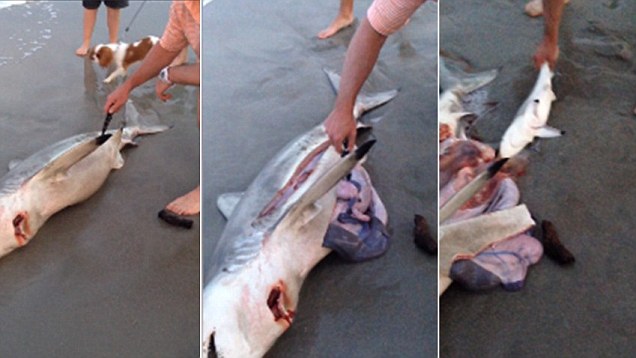
The now widely shared story of saving some baby sharks.

baby sharks

I read about this amazing rescue of these baby sharks from the Daily Mail newspaper online.  The wonderful story has now been widely circulated.  This is what I read:

Jaws of life: Extraordinary footage emerges of beachgoer slicing open a pregnant dead shark to save her pups and lead them to the ocean

  • Beachgoer slices open pregnant dead shark to rescue her unborn pups
  • Family found the deceased mother shark washed up on Cape Town beach
  • After seeing movement inside, the man cuts the creature open to free pups
  • Carefully avoiding their teeth, video shows him saving three baby sharks
  • Witnesses shout ‘congratulations’ as the pups are carried to the ocean

This extraordinary video shows the moment a beachgoer sliced open a pregnant dead shark to save her pups and lead them to the ocean.

An American family found the deceased mother shark on a beach in Cape Town, South Africa, but noticed that something inside the creature was still moving.

Realising there could be baby sharks inside, the gruesome but remarkable footage shows the man using a knife to perform a makeshift C-section on the animal.

Here is that video:

The Daily Mail article concludes:

The video’s description reads: ‘This video is a good example of respect to all forms of life… You cannot help but admire the beach goers that helped the baby sharks live a life in the ocean.’

Despite their unconventional entrance to the world, the sharks are likely to live normal, healthy lives. Pups, who stay inside the womb for up to two years, do not stick around for long after birth in case their mother eats them and are capable of independence from the moment they are born.

That’s a lovely story as I’m sure you will all agree.

The book! Part Five: Love

It is incredibly easy and, yet, so difficult to write about the love of a dog. Now if that isn’t a dysfunctional way to start this chapter on love, then I don’t know what would be!

Let me try to open this up to a more rational line of thought.

Dogs are so quick to show their love for a human. It could be the wag of a tail, the way a dog’s eyes connect with our eyes, a gentle lean of a head against our legs, curling up on our lap, licking our hands or our faces, and more; so much more. All of these ways make sense to us. For they are familiar to us humans from the point of view of how we show our love to our partner or to our children.

But there are a myriad of stories about a dog offering love to a human that go way beyond anything that we could emotionally understand. Let me offer one that was published on my blog back in January, 2011. It was the story of a Skye Terrier called Bobby.

Namely, that on the 15th February 1858, in the City of Edinburgh in Scotland, a man named John Gray died of tuberculosis. Gray was better known as Auld Jock and on his death he was buried in the old Greyfriars kirkyard situated on Candlemaker Row in Edinburgh.

Bobby had belonged to John Gray, who had worked for the Edinburgh City Police as a night watchman, and the two of them, John and Bobby, had been virtually inseparable for the previous two years.

When it came to the funeral, Bobby led his master’s funeral procession to the grave at Greyfriars Cemetery, and later, when this devoted Skye Terrier tried to stay at the graveside, he was sent away by the caretaker of the church.

But Bobby returned and refused to leave; whatever the weather conditions. Despite the efforts of the keeper of the kirkyard, plus John’s family and many local people, Bobby refused to be enticed away from the grave for any length of time and, as a result, he touched the hearts of the local residents.

Although theoretically dogs were not allowed in the graveyard, people rallied round and built a shelter for Bobby and there he stayed, guarding Auld Jock his late master.

There Bobby stayed for fourteen years, laying on the grave, leaving only for food.

To this day, close by Greyfriars Kirkyard, there is a Bobby’s Bar and outside the bar a cast metal stature of Bobby on a plinth.

The love that a dog shows us is a form of unconditional love that is not unknown in our human world but is not common. I would vouch that few people have truly ever experienced unconditional love or are even clear as to what it is. For although one might define unconditional love as affection without any limitations, or love without conditions, in other words a type of love that has no bounds and is unchanging, the reality of the love of one person towards another, a spouse, lover or child, is that there are limits to how that one person is treated and that going past those limits, regularly and persistently, eventually destroys that love.

Let’s turn to the world of novels. Some book authors make a distinction between unconditional love and conditional love. In the sense that conditional love is love that is earned through conscious or unconscious conditions being met by the lover. Whereas in unconditional love, love is given to the loved one no matter what. Loving is primary: an acting of feelings irrespective of will.

Yet there’s another aspect of unconditional love that relates commonly between individuals and their dogs. That is that our love for a dog encompasses a desire for the dog to have the very best life in and around us humans. Take the example of acquiring a new puppy. The puppy is cute, playful, and the owner’s heart swells with love for this adorable new family member. Then the puppy urinates on the floor. One does not stop loving the puppy but recognises the need to modify the puppy’s behaviour through love and training than, otherwise, continue to experience behaviours that would be unacceptable in a particular situation.

Having explored the concept of love and how dogs offer us the beauty of unconditional love, how should we adopt a loving approach to the world, and why?

It’s the little things that count is a famous truism and one no better suited to the world of love. Little things that we can do in countless different ways throughout the day. Sharing a friendly word and a smile with a stranger, dropping a coin or two into a homeless person’s hands or, better still, a loaf or bread or a chocolate bar. Being courteous on the road, holding a door open for someone at your nearby store, showing patience in a potentially frustrating situation. Continuing, perhaps, with such little things as never forgetting that we have two ears and one mouth and should use them in that proportion, or be more attentive when a loved one is speaking with us, possibly engineer periods of quiet contemplation, understanding that the world will not come to an end if the television or ‘smartphone’ is turned off for a day. The list of loving actions is endless. Or in the words of Nelson Mandela, “No one is born hating another person…People must learn to hate, and if they can learn to hate, they can be taught to love, for love comes more naturally to the human heart than its opposite.”

Why this need for love?

Because this world of ours so desperately needs a new start and that start must come from a loving attitude to each other, to the plants and animals, and to the blue planet that sustains us.

We need our hearts to open; open enough to tell our heads about the world of love.

1,001 words Copyright © 2014 Paul Handover

Faithful dog Masha.

Another wonderful dog story, courtesy of Chris Snuggs.

Over four years ago, I published a post under the title of Faithful dog Hachikō. It was the heart-wrenching story of a Japanese Akita dog called Hachi, Hachikō in Japanese, that continued to wait for his master’s return, Hidesaburō Ueno, for years after the professor’s death.  Here’s an extract from that post:

In 1924, Hidesaburō Ueno, a professor in the agriculture department at the University of Tokyo took in Hachikō as a pet. During his owner’s life Hachikō saw him out from the front door and greeted him at the end of the day at the nearby Shibuya Station. The pair continued their daily routine until May 1925, when Professor Ueno did not return on the usual train one evening. The professor had suffered from a cerebral hemorrhage at the university that day. He died and never returned to the train station where his friend was waiting. Hachikō was loyal and every day for the next nine years he waited sitting there amongst the town’s folk.

Hachikō was given away after his master’s death, but he routinely escaped, showing up again and again at his old home. Eventually, Hachikō apparently realized that Professor Ueno no longer lived at the house. So he went to look for his master at the train station where he had accompanied him so many times before. Each day, Hachikō waited for Professor Ueno to return. And each day he did not see his friend among the commuters at the station.

The permanent fixture at the train station that was Hachikō attracted the attention of other commuters. Many of the people who frequented the Shibuya train station had seen Hachikō and Professor Ueno together each day. They brought Hachikō treats and food to nourish him during his wait.

This continued for nine years with Hachikō appearing precisely when the train was due at the station

A few days ago, Chris sent me details of a faithful dog story that appeared in the English Daily Telegraph newspaper on the 26th November. The story was headed: Loyal dog waits for owner who will never return at hospital for two years. It opened, thus:

A loyal dog has shown up every day for two years at a hospital where her master passed away.

Masha appears at the Siberian hospital’s reception area every morning, the Siberian Times reports.

Her owner was admitted to the hospital in Novosibirsk region, south western Siberia, two years ago after falling ill.

Masha is well cared for by staff who make sure she has a warm bed and food every night. The faithful canine was the elderly man’s only visitor, staff say, and used to run home every night to stand guard before returning the next morning.

If we then go across to that Siberian Times story, we see that the wonderful Masha is linked to Hachikō.

Heartbroken little dog becomes Siberia’s own ‘Hachiko’

By Kate Baklitskaya and Derek Lambie – 24 November 2014

For past year devoted Masha has been waiting in a hospital for the beloved owner who will never return.

'One day, and we very much want this day to come soon, our Masha will trust somebody.' Picture: Svyatoslav Odarenko
‘One day, and we very much want this day to come soon, our Masha will trust somebody.’ Picture: Svyatoslav Odarenko

A little dog that waits in vain at a Siberian hospital for the owner who has already died has been dubbed Russia’s own Hachiko. Heartbroken Masha has been turning up looking for her beloved master every day since he passed away at the facility in Novosibirsk last year.

It is a tale mirroring that of the famously loyal Akita dog Hachiko in Japan, who arrived at a train station every evening for 10 years to greet its owner even though he had died.

Masha has become a well-known, and much loved, figure at the Novosibirsk District Hospital Number One, where patients and workers ensure she has a warm bed and food to eat.

But, aware of her obvious sadness at being unable to find her owner, staff are hoping an animal lover will come forward to adopt her and give her a new home.

Chief doctor Vladimir Bespalov told Novosibirsk Vesti TV: ‘You see her eyes, how sad they are – it’s not the usual shiny eyes for when a dog is happy. You can see this in animals in the same way as with people.

‘There is nothing medicine can do for her here, but we are still hoping that Masha will be able to find another owner. One day, and we very much want this day to come soon, our Masha will trust somebody.’

Masha, who looks like a dachshund with short legs, has been coming into the reception at the hospital in Koltsovo every day for the past two years since her owner was admitted. The man, a pensioner from the village of Dvurechie several kilometres away, had fallen ill and had turned up with his pet.

There are three heart-rending photographs of Masha that you really must look at. The article then concludes:

Whilst he was staying on the ward, Masha was his only visitor and she even trotted off home to guard the house before returning to the hospital in the morning.

Sadly he died a year ago but the loyal dog has continued to turn up every day, perhaps because she has nowhere to live, or because she believes her master is still there.

Nurse Alla Vorontsova said: ‘She is waiting for him, for her owner. Just recently a family tried to adopt her, but Masha ran away and returned to the hospital. She was taken on Friday evening, and at 3am on Saturday she was back here.’

Masha’s story is similar to that of the famous Japanese dog Hachiko, who used to greet his master on his return from work at the Shibuya train station in Tokyo.

When his owner, agricultural science professor Hidesaburo Ueno, died in 1925 he continued to visit the station every night for 10 years still expecting to meet him off his 4pm train.

In 1935 the dog’s body was found in a Tokyo street and his remains were stuffed, mounted and put on display in Japan’s National Science Museum, while a bronze statue was erected outside Shibuya. A Hollywood movie of the sad story, starring Richard Gere, was released in cinemas in 2010.

There are also similarities to Greyfriars Bobby, a little Scottish terrier who was unwilling to leave his dead master’s grave in Edinburgh, Scotland, for 14 years in the 19th century.

What wonderful, loyal, loving friends dogs are to us humans.

A Vision for Nature

Another powerful essay from George Monbiot.

Despite this now being December and NaNoWriMo is behind me, all 53,376 words of it, the next few weeks are still going to be demanding.

I have three more chapters to write plus adding a guest preface and an overhaul of Part One of the book.  In other words, December is still a busy book month, albeit without the word-count pressures of NaNoWriMo.

All a long-winded way of me saying that I will present articles seen elsewhere if I think they are of interest to all of you readers.

Which brings me to another powerful essay from George Monbiot that he published a few days ago and is republished here with George’s very kind permission.

ooOOoo

A Vision for Nature

November 27, 2014

As governments tear down the rules that defend our wildlife from extinction, here’s a positive attempt to stop the wreckage.

By George Monbiot. posted on the Guardian’s website, 21st November 2014

One of the fears of those who seek to defend the natural world is that people won’t act until it is too late. Only when disasters strike will we understand how much damage we have done, and what the consequences might be.

I have some bad news: it’s worse than that. For his fascinating and transformative book, Don’t Even Think About It: why our brains are wired to ignore climate change, George Marshall visited Bastrop in Texas, which had suffered from a record drought followed by a record wildfire, and Sea Bright in New Jersey, which was devastated by Hurricane Sandy. These disasters are likely to have been caused or exacerbated by climate change. He interviewed plenty of people in both places, and in neither case – Republican Texas or Democratic New Jersey – could he find anyone who could recall a conversation about climate change as a potential cause of the catastrophe they had suffered. It simply had not arisen.

The editor of the Bastrop Advertiser told him “Sure, if climate change had a direct impact on us, we would definitely bring it in, but we are more centred around Bastrop County.” The mayor of Sea Bright told him “We just want to go home, and we will deal with all that lofty stuff some other day.” Marshall found that when people are dealing with the damage and rebuilding their lives they are even less inclined than they might otherwise be to talk about the underlying issues.

In his lectures, he makes another important point that – in retrospect – also seems obvious: people often react to crises in perverse and destructive ways. For example, immigrants, Jews, old women and other scapegoats have been blamed for scores of disasters they did not create. And sometimes people respond with behaviour that makes the disaster even worse: think, for instance, of the swing to UKIP, a party run by a former City broker and funded by a gruesome collection of tycoons and financiers, in response to an economic crisis caused by the banks.

I have seen many examples of this reactive denial at work, and I wonder now whether we are encountering another one.

The world’s wild creatures are in crisis. In the past 40 years the world has lost over 50% of its vertebrate wildlife. Hardly anywhere is spared this catastrophe. In the UK, for example, 60% of the 3,000 species whose fate has been studied have declined over the past 50 years. Our living wonders, which have persisted for millions of years, are disappearing in the course of decades.

You might expect governments and officials, faced with a bonfire of this magnitude, to rush to the scene with water and douse it. Instead they have rushed to the scene with cans of petrol.

Critical to the protection of the natural world are regulations: laws which restrain certain activities for the greater public good. Legal restrictions on destruction and pollution are often the only things that stand between species and their extinction.

Industrial interests often hate these laws, as they restrict their profits. The corporate media denigrates and demonises the very concept of regulation. Much of the effort of those who fund political parties is to remove the regulations that protect us and the living planet. Politicians and officials who seek to defend regulation will be taken down, through campaigns of unrelenting viciousness in the media. Everywhere the message has been received.

The European Commission has now ordered a “review” of the two main pillars of the protection of our wildlife: the Birds Directive and the Habitats Directive. It’s likely to be the kind of review conducted by a large tracked vehicle with a steel ball on the end of a chain. The problem, the Commission says, is that these directives could impede the “fitness” of business in Europe.

But do they? Not even Edmund Stoiber, the conservative former president of Bavaria who was appointed by the Commission to wage war on regulation, thinks so. He discovered that European environmental laws account for less than 1% of the costs of regulation to business: the lowest cost of any of the regulations he investigated. “However, businesses perceive the burden to be much higher in this area.” So if these crucial directives are vitiated or scrapped, it will not be because they impede business, but because they are wrongly perceived to impose much greater costs than they do.

The UK chancellor, George Osborne, claimed in 2011 that wildlife regulations were placing ridiculous costs on business. But a review by the environment secretary, Caroline Spelman, concluded the claim was unfounded.

In the United Kingdom, whose leading politicians, like those of Australia and Canada, appear to be little more than channels for corporate power, we are facing a full-spectrum assault on the laws protecting our living treasures.

The Small Business, Enterprise and Employment Bill, now passing through the House of Commons, would oblige future governments to keep deregulating on behalf of business, regardless of the cost to the rest of society. The government’s Red Tape Challenge at first insisted that no new regulation could be introduced unless an existing one is scrapped. Now two must be scrapped in exchange for any new one.

Cameron’s government has set up what it calls a “Star Chamber”, composed of corporate executives and officials from the business department, before which other government departments must appear. They must justify, in front of the sector they regulate, any of the rules these business people don’t like. If they are deemed insufficiently convincing, the rules are junked.

Usually, governments go to some lengths to disguise their intent, and to invent benign names for destructive policies. Not in this case. A Star Chamber perfectly captures the spirt of this enterprise. Here’s how a website about the history of the Tudors describes the original version (my emphasis):

“The power of the court of Star Chamber grew considerably under the Stuarts, and by the time of Charles I it had become a byword for misuse and abuse of power by the king and his circle. … Court sessions were held in secret, with no right of appeal, and punishment was swift and severe to any enemy of the crown. Charles I used the Court of Star Chamber as a sort of Parliamentary substitute during the years 1628-40, when he refused to call Parliament. Finally, in 1641 the Long Parliament abolished the hated Star Chamber, though its name survives still to designate arbitrary, secretive proceedings in opposition to personal rights and liberty.”

Yes, that is exactly what we’re looking at. I suspect the government gave its kangaroo court this name to signal its intent to its corporate funders: we are prepared to be perfectly unreasonable on your behalf, trampling justice, democracy and rational policy-making to give you what you want. We are putting you in charge. So please keep funding us, and please, dear owners of the corporate press, don’t destroy our chances of winning the next election by backing UKIP instead.

Then there’s the Deregulation Bill, which has now almost run its parliamentary course. Among the many ways in which it tilts the balance even further against defending the natural world is Clause 83, which states this:

“A person exercising a regulatory function to which this section applies must, in the exercise of the function, have regard to the desirability of promoting economic growth.”

So bodies such as the Environment Agency or Natural England must promote economic growth, even if it directly threatens the natural wonders they are charged with protecting. For example, companies could save money by tipping pollutants into a river, rather than processing them or disposing of them safely. That means more funds for investment, which could translate into more economic growth. So what should an agency do if it is supposed to prevent pollution and promote economic growth?

Not that the government needs to bother, for it has already stuffed the committees that oversee these bodies.

Look, for example, at the board of Natural England. Its chairman, Andrew Sells, is a housebuilder and major donor to the Conservative Party, who was treasurer of the thinktank Policy Exchange, which inveighs against regulation at every opportunity. Its deputy chairman, David Hill, is also chairman of a private company called the Environment Bank, whose purpose is ”to broker biodiversity offsetting agreements for both developers and landowners.” Biodiversity offsetting is a new means of making the destruction of precious natural places seem acceptable.

The government has recently appointed to this small board not one but two Cumbrian sheep farmers – Will Cockbain and Julia Aglionby – who, my encounters with them suggest, both appear to be fanatically devoted to keeping the uplands sheepwrecked and bare. There’s also a place for the chief executive of a group that I see as a greenwashing facility for the shooting industry, the Game and Wildlife Conservation Trust. And one for a former vice-president of Citibank. The board members with current or former interests in industries that often damage the natural world outnumber those who have devoted their lives to conservation and ecology.

So what do we do about this? You cannot fight assaults of this kind without producing a positive vision of your own.

This is what the RSPB and the Wildlife Trusts have done with the publication of their Nature and Wellbeing Green Paper. It’s a proposal for a new act of parliament modelled on the Climate Change Act 2008. It obliges future governments to protect and restore the living world. It proposes targets for the recovery of species and places, a government agency (the Office for Environmental Responsibility) whose role is to ensure that all departments help to defend wildlife, and Local Ecological Networks, which devolve power to communities to protect the places they love most.

I have problems with some aspects of this proposal, not least its enthusiastic embrace of the Natural Capital Agenda, which seeks to persuade us to value nature by putting a price on it. This strategy is, I believe, astonishingly naïve. To be effective, you must open up political space, not help to close it down by accepting the premises, the values and the framing of your opponents. But I can see what drove them to do it. If the government accepts only policies or regulations that contribute to economic growth, it’s tempting to try to prove that the financial value of wildlife and habits is greater than the financial value to be gained by destroying them, foolish and self-defeating as this exercise may be.

But I’ll put this aside, because their proposal is the most comprehensive attempt yet to douse the bonfire of destruction on which the government is toasting our wildlife like marshmallows. The Climate Change Act and its lasting commitments are just about the only measures that oblige this government to restrict greenhouse gases. It remains a yardstick against which the efforts of all governments can be judged. Should we not also have similar, sustained protection for wildlife and habitats? Only lasting safeguards, not subject to the whims and fads of passing governments, can defend them against extinction.

The Nature and Wellbeing Act is a good example of positive environmentalism, setting the agenda, rather than merely responding to the policies we don’t like. We must do both, but while those who love wildlife have often been effective opponents, we have tended to be less effective proponents.

It will be a struggle, as the times have changed radically. In 2008 the Climate Change Act was supported by the three main political parties. So far the Nature and Wellbeing Act has received the support of the Liberal Democrats (so after the election both their MPs will promote it in parliament) and the Green Party. The Conservatives, despite the green paper’s desperate attempts to speak their language, are unreachable. And where on earth is Labour? So far it has shown no interest at all.

If you care about what is happening to the living world, if you care about the assault on the enthralling and bewitching outcome of millions of years of evolution for the sake of immediate and ephemeral corporate profits, join the campaign and lobby your MPs. The Nature and Wellbeing Act will succeed only through a movement as big as the one that brought the Climate Change Act into existence. Please join it.

www.monbiot.com

ooOOoo

Sometimes, I wonder if such essays, as powerful and well-written as they are, are not just too terrible a commentary on how things are just now.  My justification for republishing them is simply from the point of view that the more the awareness of good ordinary people is enhanced as to these present times, the better the odds that there will be a sufficient social and political reaction to bring this madness to a halt.

Removing the fear of the unknown

This was a post from Jon Lavin back in 2011.

I thought it would be nice to republish it today.

oooo

Removing the fear of the unknown

Seeing the light

I’ve been working with most of my clients recently through painful transformations brought about by the economic downturn.

An interesting metaphor really because since the first wave of uncertainty triggered panic, first noticed in the UK banking system, I have been picking up on that uncertainty that feels like it’s stalking the globe and has been for some time. Recent stock market crashes have simply exacerbated this and that, coupled with the riots taking place in major cities in the UK, make for pretty disturbing reading.

Interestingly, I, too, have been aware of an underlying fear that was difficult either to name or source.

It has been rather like a deep river in that whilst the surface feels slow-moving, currents are moving things powerfully below.

So this ‘fear’ has caused a few household changes.

1) We now are the proud owners of 12 chickens. Our youngest son and I have dug up the back lawn and planted vegetables and built a poly tunnel.

2) We have also installed a wood burning cooker. Right back down to the base of Maslow’s triangle really!

Maslow’s triangle of needs

These feelings have brought about such change everywhere and I wonder seriously whether we will ever return to what was; indeed would we want to?

I might not have mentioned it in previous blogs but as well as an engineering background, in latter years, I have focused on how success in business is linked directly to aspects of relationships and how we are in our relationships with others, so things like integrity, self-awareness and the ability to see the point of view of others, and modify our approach appropriately.

To inform this, some 7 years ago, I embarked on an MA in Core Process Psychotherapy, primarily to work on myself so that I could be the best I could be in my relationships, in and out of work.

The point I’m trying to make is that the same panic I notice in many of the companies I work in, and in me, is based on fear of the unknown and on a lack of trust in all its forms.  I’ve deliberately underlined that last phrase because it is so incredibly important.

The truth is that we get more of what we focus on.

So we can choose to focus on the constant news of more difficulties, hardship and redundancies, or we can focus on what is working.

In the workplace this positive focus has been pulling people together across functions and sites and pooling resources and ideas.

When we realise we’re not doing this alone it’s amazing how much lighter a load can feel and how much more inspired we all feel.

I also notice how humour begins to flow and what a powerful antidote for doom and gloom that is.

Transformation is never easy but the rewards far exceed the effort put in ten fold.

So what is it going to be? Are we all going to bow down to the god of Doom & Gloom, fear and anxiety, heaping more and more gifts around it, or are we going to start noticing and focusing on the other neglected god – that of relationship, joy, trust, abundance and lightness?

Whatever the future holds for us all a belief in our inherent ability to adapt and change and focus on the greater good rather than fear, anxiety, greed and selfishness is the only sustainable way forward.

By Jon Lavin

The book! Part Four: The process of change.

They didn’t bring us here to change the past!

That opening quote to this chapter comes from the blockbuster film Interstellar that was drawing in the crowds when I was up to my neck in the first draft of the book. Jean and I had taken an afternoon off, together with neighbours, Dordie and Bill, to go and watch it. It was the middle of November, 2014.

I’ll resist the temptation to include a review of the film in this place; this is meant to be a book about what we can learn from dogs! But there were two spoken lines that really jumped off the screen at me; one of them being the opening quote to this chapter.

Why did that opening quote strike me so forcibly?

Simply because when it comes to making deep, fundamental changes in who we are, how we see ourselves and, flowing from that, how we behave, or better put, how we wish to change how we behave, we have to change the past.

Sorry, I was being ‘tricky’; we can’t change the past in any real sense! But what we can change is our understanding of our past and how it made us the person we are; at this present moment in our life. That self-understanding is paramount before we set out along any journey of personal change. That was my motivation in recounting, in the opening chapter of Part Four, my discovery of my fear of rejection that for so many years had remained out of sight; albeit not quietly so within me.

Before continuing, I am minded to issue a ‘health’ warning. My writings and my conclusions are purely and solely my personal view of my life and the world as I see and experience it. Don’t empower me with talents and skills that I don’t have! Phew!

Moving on.

Anyone who has attempted a change in their behaviour, from a New Year’s Resolution, to a metaphorically large slap on the wrist for being dumb about some aspect of their life, will appreciate the difficulty of achieving a lasting change in behaviour. Changing our behaviour is rarely simple, straightforward or even, surprisingly, logical. Very often it requires a major commitment of time, effort and, perhaps most importantly of all, an emotional commitment.

The other vital thing to appreciate is that what works for one person, in all likelihood, will not work for another. Even trickier than that; what worked for you one time, may not work another time! That, just for the avoidance of doubt, is not me downgrading the need for change, when your intuition is saying to you that a change or two wouldn’t do any harm at all! Not at all!

So don’t worry about it not ‘speaking’ to you clearly in the first instance, in the sense of you not being clear as to how it is that you need to change, just embrace the fact that it is a process of trial-and-error, and keep reminding yourself why it is that you wish to change an aspect or two of your behaviour.

This important aspect of being relaxed about achieving change for yourself is more easily understood, as in understood rationally, when one takes an overview of the models (note the use of the plural) of change as used by therapists, physicians, and teachers. The researchers, that therapists and others base their knowledge and understanding upon, have multiple theories to explain how change occurs.
One of these theories, a popular one known as the Stages of Change model, demonstrates that change is rarely easy and often requires a gradual progression of small steps toward a larger goal.
In other words, only through understanding the elements of change, the stages of change, and the ways to work through each stage, can help one achieve a lasting behavioural change.

I’m not going to go much further because I’m conscious of potentially over-stepping boundaries. This is a book about learning from dogs, not an amateur self-help manual on change!

But I do want round off with the following; the product of my research and from speaking to a couple of professionals in the field of change.

Apparently, about 20 years ago, two researchers into alcoholism, Carlo C. DiClemente and J. O. Prochaska, proposed a multi-stage model of change. Their aim was to help professional ’change consultants’ understand their clients who had problems of addiction and how to motivate those clients to change. It was a model that was not based on theories but on the observations by DiClemente and Prochaska into how people tackled problem behaviours such as smoking, overeating and excessive drinking.

The multiple stages of the model were called: precontemplation; contemplation; determination; action; maintenance and termination. Six stages in all.

I’m only going to dip into that first stage: Precontemplation.

Precontemplation

Individuals in the precontemplation stage of change are not even thinking about changing their drinking behavior. They may not see it as a problem, or they think that others who point out the problem are exaggerating.

There are many reasons to be in precontemplation, and Dr. DiClemente has referred to them as “the Four Rs” —reluctance, rebellion, resignation and rationalization:

Right that’s enough from me. But for anyone that would like to read the full article by M. Gold (2006) Stages of Change, there’s a footnote [APA Reference Gold, M. (2006). Stages of Change. Psych Central.] that includes a link to a website that can offer you more detailed information about this multi-stage approach to change; indeed has the full article from Mark Gold, MD.

It’s never too late to change.

Oh, nearly forgot! I noted that the film Interstellar offered “two spoken lines that really jumped off the screen at me”, using one, “They didn’t bring us here to change the past!”, as the opening line of this chapter. The second spoken line couldn’t be more appropriate to close a chapter entitled: The process of change.

We all want to protect the world, but we don’t want to change.”

999 words. Copyright © 2014 Paul Handover

The book! Part Four: Of change in thoughts and deeds

Setting the scene

Well done for getting through Part Three: Mankind in the 21st century, and a number of the challenges of our present times! I don’t mean that to come over in a flippant manner but it must have been tough reading; it certainly was tough writing for this scribe! Then again, from way back yonder from my days of selling during the 70s and 80s, comes that old saw about not being able to embrace a new idea if one doesn’t really understand the issues, as in the strengths and weaknesses, of the existing situation.

Change is a fascinating subject and one that even the briefest trawl through the internet reveals a wealth of material. But the theme of change here in Part Four is about change at an individual level and not anything to do with organisations; let alone countries. And as such, in terms of how we understand the need for change as individuals, it seemed pertinent to offer this personal anecdote as a way of setting the scene.

You will recall that in Part One – Man and Dog, there was a chapter headed Unsettled times. In that chapter I wrote about learning that my previous wife informed me that she was having an affair with another man, this revelation taking place on December 20th, 2006, fifty years to the day of my father’s death on December 20th, 1956.
I also mentioned that earlier on in 2006 I had started mentoring a Jon Lavin as he was going through a major transition in his counselling practice. Jon was living a few miles from where I was living in South Devon and was, and still is, a psychotherapist, or to put it more accurately, a UKCP accredited therapist and NLP Practitioner.

Thus in a state of some emotional turmoil, I rang Jon early on in 2007 and asked if I might be his client! Jon was initially reluctant to agree to that, simply because he and I had started developing a relationship in another context, within a completely different perspective, as in me coaching him in the ways of developing his own business. As Jon made clear, he was worried that our existing relationship might get in the way of a very different relationship; one where I was trying to understand the catastrophe that had just taken place in my private life.

I was pretty insistent on wanting, needing, to see Jon; as you might imagine. Thankfully, Jon did agree after giving it some thought but on the strict understanding that if he was concerned about how the counselling relationship was progressing that I had to agree, agree before we started our sessions, that he had the right to terminate the relationship. Of course, I agreed. Without a moment’s hesitation.

Thus Jon and I started my personal counselling relationship soon after.

Naturally, Jon wanted to learn more about my emotional background and gently, when it felt right, asked me to explain the circumstances of my father’s death back in 1956. That was easy for me for the memories of that time had never dimmed.

That I had turned twelve back in November, 1956 and had started that previous September at my new secondary school; Preston Manor Grammar School. At the time of my birthday in November, 1956, I was only vaguely conscious of my father having been ill for a while. Not ill for months and months but bedridden for a few weeks. My father was fifty-five years old and had always been a gentle, caring father to me and my younger sister, Elizabeth.

Then just a few weeks further on, on the evening of the 19th December, when I was tucked up in bed, next door to my parent’s bedroom, my mother came into my bedroom to say goodnight to me; a perfectly ordinary and routine event. But on this particular evening, there was an unmistakeable sadness about her and rather than promptly coming up to me and kissing me goodnight, she sat down on the edge of my bed, just where my knees were under the sheet and bedspread.

I could still recall so clearly Mum giving a deep sigh, a sigh that seemed to confirm what I feared and, somehow, knew in my heart: that his illness might be serious. Mum turning and reaching out with her right hand so that she could hold my right arm that lay on top of the bedspread. “Paul, you do know that your father is not very well, not very well at all. I’m sorry to tell you that he may not live for very much longer.” Words that have never left me.

Mum then leaning forward, kissing me goodnight, and leaving my bedroom, turning the light out as she closed the door. Me falling asleep within moments of the closing of that bedroom door.

My father died that same night: my mother calling the doctor who attended, confirmed the death, issued the death certificate and arranged for my father’s body to be removed from our home.

It all taking place before daybreak. It all taking place as I slept on.

In the morning, my father was no longer part of my life.

As one could easily imagine, the following days were surreal, yet all of my life I have had no recollection of any emotions at all.

Going back to the death of my father, it was thought that my father’s funeral, a cremation, would be too upsetting for me and my sister so we didn’t attend the funeral.

The only other recollection from those times was being teased and bullied at my new school, the one that I had started a few months previously, because I was prone to bouts of crying. I also recall that one day in the playground, surrounded by a group of jeering and taunting boys, I had snapped and gone for the ring leader in a wild frenzied physical attack. Both he and I receive the cane from the headmaster but at least the teasing was brought to an end.

So all of this was spoken of to Jon in those early days of 2007!

Jon gently explored my feelings, wondering what were my emotional echoes from over fifty years ago. I’m not sure I voiced anything particularly revealing.

Then, in a change of tack, he asked me how my own son might have felt if he, my son, had endured the same tragedy at the same age and experienced the death of me, his father, in a similar fashion, and, in addition, not been able to go to the funeral.

It was a straightforward question but one that had me disappearing into my own inner thoughts for some time, Jon sitting quietly in his armchair just next to me, me only half aware that time seemed to have come to a halt. As if for the first time in my life since that dreadful day in 1956 I had the courage to listen to my deep inner voice, to sense my most inner feelings.

I stuttered, “My son would be angry, angry that one of the key events in the life of any person, the death of a parent, no more than that, the death of a son’s father, no that’s still not right; the death of his father, had been denied him.

Jon looked at me, in a way that seemed to connect with me very strongly. Then he quietly asked, “What other feelings might you expect your son possibly to have?

Again, another long silence, and then I said, feeling strongly that something very important was about to happen: “He would feel left out. Overlooked. Denied the experience of something irreplaceably important. He would feel emotional rejection; in spades!

As those last words, quietly and clearly, left my lips, the most incredible sensation overtook me, both without and within me, encompassing me totally, the awareness that for the first time in my life, with me now sixty-three-years old, something that had been emotionally and psychologically hidden from me for fifty-one years, was now out in the open.

The clear knowledge that the circumstances surrounding my father’s death and my subsequent decline in my school performance had left me with a long-term psychological ‘dysfunction’; a certainty that I had been emotionally rejected way back in the Winter of 1956-57. A certainty, for sure, yet an understanding of myself that, hitherto, had been out of sight of my conscious mind, hidden deep inside of me, until this moment, this precious moment, in time.

Jon remained still and quiet as I continued to turn over in my mind this inner discovery. The realisation that, incredibly, for fifty years, my emotional response to my father’s death had remained totally out of my consciousness yet, nonetheless, had influenced me in very real and tangible ways; ways both negatively and positively that came to me almost immediately.

That the negative influence was that I was drawn to any woman who offered me love and affection and, therefore, I was emotionally unable to understand, to judge as it were, whether she had the potential to be a match as a life-long partner, however good a person she might be. I was doing anything to avoid emotional rejection!

The positive influence was that I tried very hard to please others (still do) so as to avoid their rejection, and had successful careers in selling for IBM UK, later starting and building a successful business in the early days of personal computing and, then, when my company was sold in 1986 becoming a freelance journalist and business coach.

So it took a chance association with Jon in those early weeks of 2007 to make me understand a fundamental lesson, one that had its roots fifty years previously, back in those early weeks of 1957. The lesson that we may only fully embrace change when we fully know just who we are. In other words, if there’s the tiniest voice inside you telling you that there may be some hidden nooks and crannies within you, psychologically and emotionally speaking, then some time spent with the appropriate ‘mentor’ will be the best investment you ever made.

There was a second reward from that self-awareness that arose in 2007. Namely, that in the December of that year, while the guest of dear Californian friends, enjoying a Christmas vacation in their holiday home in San Carlos, Mexico, I met Jean. Jean had been married to an American, Ben, for many years, latterly the two of them living permanently in San Carlos. Ben had died in 2005. Jean was born an Englishwoman, born in Dagenham in Essex. I had been born in Acton, North London. As the crow flies, the distance from Dagenham to Acton is twenty-three miles.

Jean and I met on December 15th, 2007. I was now emotionally unencumbered and able to give my full love to her and receive her full love for me. Jean and I were married in Payson, Arizona on November 20th, 2010. Now we live in a rural part of Oregon with our dogs and horses. It is a life together that is everything that any man could ever dream of.

The power of change!

1877 words Copyright © 2014 Paul Handover

oooo

It is only right for me to mention that the above is entirely my own work and while it is my best recollection of a series of true events, the chapter has not been previously seen or endorsed by Jon.