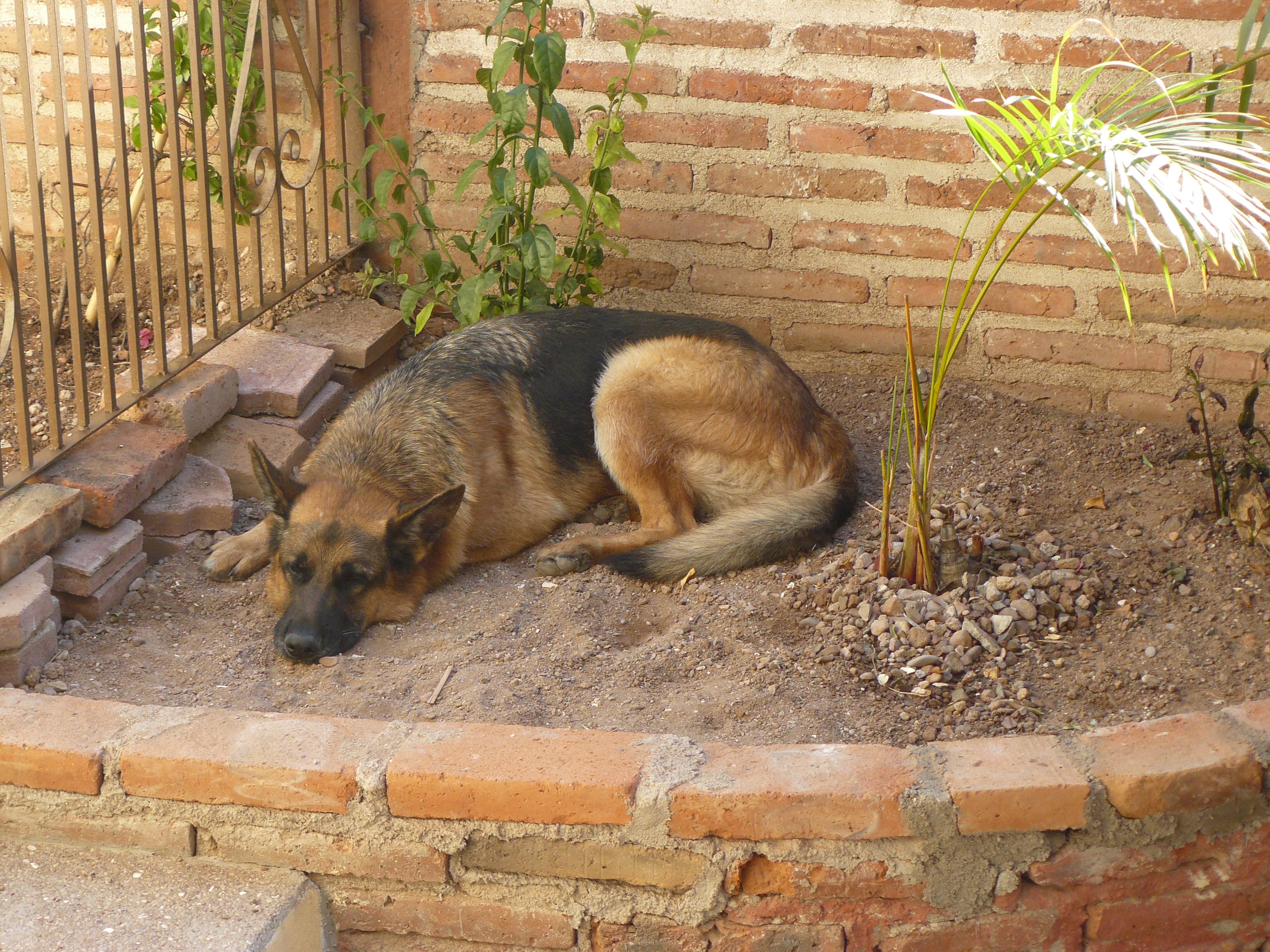
Author: Paul Handover

Relationships.

Everything comes down to our relationships.

It is not the first time that I have written on the theme of the importance of relationships. However, I am inspired by a number of separate and discrete outcomes in the last couple of days that compell me to return to this most important principle of all: We are what we think about most.

The first outcome was a lovely reply left by Hariod Brawn to yesterday’s post. This is what she wrote:

My GSD had hip dysplasia too, Paul – if that’s what you’re alluding to with Pharaoh. He still was able to die a natural death though, as his rear quarters became paralysed with the dysplasia and he felt no pain. There were plenty of other problems resulting from his immobility, but I wouldn’t have traded those difficulties and the incredible communication we shared as a result of them, for anything – his last few weeks were some of the most powerful and precious of my entire life.

Then after my response, Hariod went on to say:

It was a deeply profound time for me, and I honestly wouldn’t have believed anyone had they told me what I experienced, but experience it I did. It was not the product of fanciful imagination, much as it might sound so in words. The communication between the two of us was quite incredible, and which really was empathic in nature, in the deepest sense of the word. We always had great communication and understanding, which all dog lovers do with their charges, of course, but this was another level altogether. Some might call it ‘psychic’, as if that meant something mystical and woo-like, but it just means ‘of the mind’. The question is, does the mind have the psychical power to share in understanding across physical borders? You will doubtless know of J. Allen Boone:

I will return to that mention of J. Allen Boone at the end of the post.

Then later on there was a further reply to the post from Barb of Passionate About Pets :

Thanks for re-publishing Gina’s post here, I found it interesting because Poppy, my little shih-tzu is an old dame now – she will be 17 in two months time. She has developed serious separation anxiety in the last year and if I am working in the garden, she barks for me to get back inside even though my husband is inside with her – she wants us BOTH with her. She is weak in her back legs so her walks are shorter. All these signs of old age make me so sad. Just like you and Pharoah, old age is creeping up on us all.
A special thank you to Hariod for including that video clip of J. Allen Boone’s dog Strongheart and the very special connection they had; he was so wise about Strongheart’s qualities – they never die. It really resonated with me.
Thank you for a wonderful post.

You can see why I entitled today’s post Relationships!

Then earlier on in my day I had a call with Jon Lavin, a friend from my days when I lived in Devon, South-West England. Jon and I still speak on a regular basis and yesterday I was complimenting Jon on a wonderful post he had written on his own business blog The People Workshop.

Jon’s post was about relationships in the workplace, his area of professional experience, and I was struck by how far the messages were relevant to all of us, in all areas of our lives. But just as key it was another reminder of the importance of all of us who express themselves on blogs; both as authors and as commentators. Because those expressions make, build and maintain great relationships.

Jon’s post is republished here with his full permission.

ooOOoo

Relationships in the workplace

Posted on

Poppies and sea
Poppies and sea

When you look at how much of our lives we spend at work it’s really quite attention-grabbing. I did a very rough calculation based on 40 years and 40 hours a week – and I took out holidays and weekends. It works out approximately at 4900 hours. That’s a lot of hours, especially if you do lots of overtime and weekends. All of that time, you’re probably going to be mixing with people – usually, quite a large number of people.

We are ‘relationship seeking’, says Eric Berne, originator of Transactional Analysis. So for all of that time, we’re moving in and out of relationships with other people. So here, I’m categorising any interaction with another as ‘relationship’.

Then there’s what happens when we go home, another set of relationships, and where we came from – our parents and families.

So how we are in relationship with others is very important and has a major impact on the results we get generally and particularly in the context of this article, at work.

I hear a lot of talk about ’employee engagement’ at the moment. I believe that for employees to be ‘engaged’, so actively involved in what they’re doing, thinking about it, in the ‘here and now’, they’ve got to be in relationship with their manager and probably, the team they’re part of, at least, if the job is being done properly.

I see it as the role of the manager or team leader that they have the skills and ability to develop these relationships with as many team members as possible, any exclusions being the exception. This requires a lot of self-awareness and confidence, plus the ability to build high levels of trust with a wide range of character types. I think it also requires the ability to see the world from the view point of the other person – ‘putting yourself in somebody else’s shoes’, we say. That’s quite difficult to do in my experience. However, we can donate the time to get to know the people in our team and so increase the likelihood of all of us coming from the same angle.

I think this is about the ability to value the uniqueness of others in all the different forms and approaches that manifests in, and finding ways of harnessing those skills and abilities.

These are not easy things and I am aware of the relatively few, good people managers I come across in my work but it is possible to develop these skills. You need to have the intention to want the best from ALL relationships. Also, to be prepared to use the feedback we all get, especially when things don’t go to plan in a relationship, and be continually revisiting and adjusting your approach so that you get more of what works. This way, you automatically get less of what doesn’t work.

Never under estimate the power of intention.

Stormy seas
Stormy seas

ooOOoo

I am now going to close today’s post with those words of  J. Allen Boone that Hariod had in her second reply:

To echo Jon’s closing message, let us never cease our intention of having wonderful relationships; with our dogs, with others and, not least of all, with ourselves.

Embracing those senior years.

And I’m speaking of our dogs as well as me!

Whether we like it or not, time flows in one direction.

I find it almost as difficult to know that I shall be 72 years old in November as I know that dear Pharaoh will be 13 on June 3rd., a little over three weeks from today. Both of us most firmly now in our senior years.

This introspection was generated by something that was read recently over on the Care2 site: 7 Steps to Help Your Senior Dog Be Happy and Fulfilled

Knowing that dozens of you dear readers will have dogs that are also in their senior years was the motivation for me republishing the article; as follows:

ooOOoo

7 Steps to Help Your Senior Dog Be Happy and Fulfilled

1381516.largeBy: Lisa Spector May 8, 2016

About Lisa Follow Lisa at @throughadogsear

I can hardly believe that my yellow Labrador, Sanchez, is turning 13 next week. I count my blessings that he is in good health and still enjoys our twice daily walks. But, I’m also aware that he can’t keep up to his activity level from even a year ago, let alone in his prime. I’m always looking for ways to provide mental stimulation to his environment without physically taxing his body.

1. Alone Time Together Daily
It’s not always easy having a multi-dog household. But, it’s important to make a priority of having time alone with your pets daily. Since Sanchez was an only dog for the first seven years of his life, he particularly appreciates this. It means walks take longer (walking Gina separately), but it’s well worth the time when I see Sanchez’s smile of contentment.

2. Keep Training
Dogs love to learn, no matter their age. I still spend time training every night with Sanchez. If it gets late, he starts whining and begging for his training time with me. The bonding time is precious and it stimulates him to keep learning and being challenged. He has no complaints about his yummy rewards either.

3. Give Him Attention in Creative Ways
Gina is a high-drive dog. We spend a lot of time retrieving and tugging. While it helps alleviate her pent up energy, Sanchez used to look neglected when she was getting the extra attention. So, I started sneaking him small treats while tugging with her. At night time, I often play ball with her inside, having her run down and up the stairs, chasing and retrieving the ball. I include Sanchez in the game by discreetly tossing him small treats while she’s running back up to me to deliver the ball. It not only makes him feel included, but it also engages his senses as his nose has to search for the tossed treat.

http://www.youtube.com/watch?v=7pa3-wD5b-o

4. Reward. Reward. Reward.
In the video above, I am training both of my dogs together. Even though Gina is doing all of the physical activity, Sanchez is getting equally paid for staying calm and still while she jumps over and goes under him. Good Boy, Sanchez!

5. Pay Attention to New Behaviors
It’s not unusual for senior dogs to develop anxiety issues later in life that seemingly come out of nowhere. They can include sound phobias, separation anxiety or resource guarding. There are some that I just accept, such as tearing tissue out of the bathroom waste basket. I call it his puppy behavior returned. I just make sure that I don’t put anything in the trash that could be harmful when chewed. Other behaviors will only get worse if ignored, such as separation anxiety or food resource guarding. Tips for Separation Anxiety are here. For all anxiety issues, consult with your veterinarian and/or a positive reinforcement dog trainer. Ignored, they will only escalate.

6. Keep The Safe Physical Activity
Sanchez and I used to enjoy musical freestyle classes. He would weave between my legs, spin and jump on my arm on cue. While that would be too taxing on his body now, we have kept in what is safe for him. He still loves to “go back,” lift his left and right paw on cue, and show off his “downward dog.”  Of course, he is well paid for his behavior.

7. Engage The Senses
National Association of Canine Scent Work (NACSW™) is the official sanctioning and organizing body for the sport of K9 Nose Work. It is a growing popular sport, and it’s great for dogs of all ages. K9 Nose Work is built on scent work where dogs use their nose to search for their prize. Sanchez loved his K9 Nose Work class. Now, at home, I put pieces of liver into a mixed variety of cardboard boxes. He is told to “find” the liver. Boy, does his tail ever wag when he is searching!

Dog training should always be fun for both 4- and 2-leggeds. Get creative with your senior pup. Because you can teach an old dog new tricks.

Mark Holtuhusen

ooOOoo

This strikes me as very sound advice.

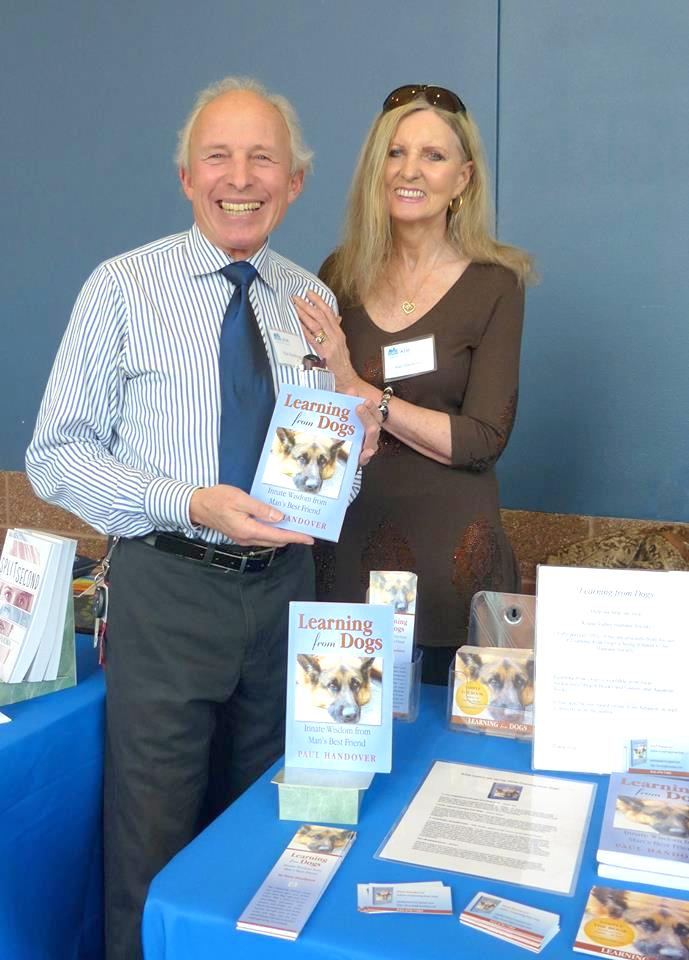
I will close today’s post with a photograph of dear Pharoah and me, both well into our senior years, taken just a few weeks ago demonstrating that both of us are old dogs learning new tricks!

TIMOTHY BULLARD/Daily CourierPaul Handover with Pharaoh, a 12year-old German Shepard that he uses on the cover of his new book about man's best friend.
TIMOTHY BULLARD/Daily CourierPaul Handover with Pharaoh, a 12year-old German Shepard that he uses on the cover of his new book about man’s best friend.

On second thoughts there’s a much better way to close this post that reflects on those precious years before the end of our days. That is by offering you the poem by John Oldham,  A Quiet Soul.

A Quiet Soul

Thy soul within such silent pomp did keep,

As if humanity were lull’d asleep;
So gentle was thy pilgrimage beneath,
Time’s unheard feet scarce make less noise,
Or the soft journey which a planet goes:
Life seem’d all calm as its last breath.
A still tranquillity so hush’d thy breast,
As if some Halcyon were its guest,
And there had built her nest;
It hardly now enjoys a greater rest.

John Oldham

History of the Pyrenean Mastiff

The breed background history of our Brandy.

P1150956
Our Brandy!

In yesterday’s post I wrote about how we determined that our Brandy was a Pyrenean Mastiff (Spanish Mastin del Pirineo). In that search, into both the breeder and the history of the breed, we came across the website of De La Tierra Kennels located in Quartz Hill, California who are Pyrenean Mastiff breeders. As they state on their website:

Tierra Alta were the first kennel to introduce the Mastin del Pirineo to the U.S.A. Our kennels have produced excellent show potential pups bred from the finest imported and now domestic stock available – Tajadera del Tio Roy, Castillo de Ali, Do Limoeiro, De Domus, El Bellotero, Rocaforte, Larresalkoak, Del Paso del Oso, Moralet, Wela Brillante, Springstrand, Iirismaan, Bondadoso and Farma Stekot, Murtoi’s, Del Mostin and Can Cabot. Our foundation mostines are imports directly from Spain, Italy, Finland and the Czech Republic. Our kennels have also exported to Canada, Europe and Mexico. Our kennel has the broadest bloodlines for the PM in the U.S.A. and the largest number of Pyrenean Mastiffs in the country.

and two paragraphs later:

A Moment In History!

Breeder of Pyrenean Mastiffs since 1996: Tierra Alta kennels were proud to announce the arrival of the first Pyrenean Mastiff litter born in the U.S.A. October 1st, 1997

It was then quickly discovered that there is a breed association for Pyrenean Mastiffs and almost as quickly revealed that the breed association shares the same telephone number as the breeders. Nonetheless, I’m going to republish the history of the breed as it is presented on the website of the PMCA Pyrenean Mastiff Club of America.

ooOOoo

Mastin de los Pirineos – Pyrenean Mastif

image12Statue of the Molossus Belonging to Olympias, daughter of the Molossian King Pyrrhus

Edited By Brian Vesey-Fitzgerald – “The Book Of The Dog

THE SPANISH MASTIFF & THE PYRENEAN MASTIFF THE HISTORY OF SPAIN

In the Middle Ages, the Christians in the north and the Moslems in the south of the Iberian peninsula were fighting against each other for the control of the land that would one day become known as Espana. In the Christian kingdoms, the business of wool and lambs was the livelihood of the people. At that time existed two hegemonic kingdoms in the yet unborn Spain, Castilla and Aragon. In these kingdoms, each having a very different way of life, were born two breeds of dogs.

In the wide and flat Castilla, the Mastin Espanol (Spanish Mastiff); in the heterogeneous and abrupt Aragon, the Mastin del Pirineo (Pyrenean Mastiff). The system of “trashumancia” in Castilla was completely homogeneous. The big herds had a lot of very detailed rules imposed by the “Honrado Concejo de la Mesta”. These rules included the way to treat the dogs, which was important, since these dogs defended the flocks from many risky situations across many thousands of miles. These big and valiant dogs are the breed we know today as the Spanish Mastiff.

In the kingdom of Aragon, the “Honrado Concejo de la Mesta” had no authority, and the herding rules differed from one valley to the next. The Pyreneans were home to many wolves and bears, and here another magnificent protector, the Pyrenean Mastiff or “Mostin”(from the old aragonish language) was employed.

As the centuries passed these systems continued. The river Ebro remained the border between these two excellent molosser breeds up until our day.

The Spanish Mastiff and Pyrenean Mastiff are both molossoid breeds. The Spanish Mastiff has a shorter coat, slightly bigger head and a little more skin on the throat. The Pyrenean Mastiff has a longer coat and his color is always white with an obligatory mask around the eyes and on the ears. In both cases, the texture of the coat is hard, not soft or wooly. In both breeds the head is important, the structure powerful, a wide chest and round ribs. The expression of the Spanish Mastiff is much “sweeter” than that of the expressive face of the Pyrenean Mastiff.

These two magnificent canine giants have conquered the hearts of many. They are both breeds of excellent temperament and indescribable charm. These Mastiff dogs do not require extensive care. They are healthy breeds that require to spend their days with someone who will be more of a friend and companion than just an “owner’. They are proud, strong and sure of themselves and a great piece of the history of Spain.

ASPECTS OF THE PYRENEAN MASTIFF

The dog we know as the Pyrenean Mastiff belongs to the breed of very big molosus dogs. These dogs were the guardians of the Aragonien sheep herds protecting them from predators such as the wolf and bear. The Mastiff from Navarra and Cataluna are included in the Pyrenean Mastiff of today. They were also used to protect houses, farms and castles.

In their work of protecting the herd they were assisted by the shepherd dog today known as Gos d’Atura Catala. In order to protect themselves while working the Pyrenean Mastiff used to wear a special collar called a “carlanca” generally made of iron with sharp protruding spikes. The collar was an extraordinary help in case of an attack from wolves or bears.

The time eventually came when the herds worst predators disappeared from the Pyreneas. This was around 1930 to 1940. The question of what to do with such a big dog with a large appetite was pondered by the farmers. Due to the lack of interest in this big dog it gradually began to disappear. This could have been disastrous for the breed had it not have been for a few big dog lovers who adopted the task of the breeds survival.

It was hard to feed such a big dog during the period just after the Spanish Civil War but it was obviously one that was accomplished. The great-great-grandchildren of these dogs are the seeds that have been used to revive the breed today. The Pyrenean Mastiff is part of the common origin of the molosus or molususlupoides to guard the livestock. It was distributed within different breeds in the southern part of Europe from Turkey to Portugal and from Caucaso to Sierra Morena.

In the Spanish breed the molosus factor dominates the lupoide one and its structure with a big skull, strong bones and round ribs makes it difficult to rest. The Pyrenean Mastiff is a rectangular dog, thick, big head and wide breast. The ears should be implanted over the eyes line and not too big. The eyes should be intelligent and dark. Overall the Pyrenean Mastiff shall show his power and his strength. The base color of the coat should always be white. The eyes and ears should always be colored. The hair should be long and thick. The Pyrenean Mastiff character is noble, tame with the children and with the people who get along well with the dog, but implacable with those who dare to challenge him.

Often people who are unfamiliar with the breed may say that these dogs are very big and very stupid. Those who refer to the breed in this context are usually more familiar with the barking-attacking anyone or anything without any reason type of dog. The Pyrenean Mastiff is and was a very calm dog possibly due to the fact that his function depended on that. It is a very self reliant dog and barks very little. However if necessary it can be extremely aggressive although it only comes to this point if there really is no other way out. The Pyrenean Mastiff is quiet, good and equilibrated in practically all circumstances. The Pyrenean Mastiff is a dog happy to put on a collar and walk patiently by the side of his owner.

“To each his own” as the saying is known. However in the case of the Pyrenean Mastiff there are some helpful points to look for in the breed: More importance should be placed on the massivity than the size, and to the head rather than the tail. A deeper breast than the elbows rather than shorter and poor. Preferably a too aggressive dog to a too timid one. A deep face profile to a “wolf- thin” profile. A dog with open toes, but extremely strong bones rather than one with perfect toes and too light in the bones or too flat of a breast and ribs. It is more important to seek maybe some incorrect teeth in a powerful and big head rather than some perfect teeth in a “wolfie” head. The ultimate dog is strong, rustic, powerful and full of typicity rather than an “elegant” or “harmonic” or “changed” one.

As previously noted ten to twelve years after the Spanish Civil War the breed was less abundant. With the onset of the seventies, lover of the Spanish dog breeds began to research dogs in the mountains and in the rest of Aragon for the dog that perhaps could belong to the beloved Spanish breed, the old and great molossus from Aragon. The Club del Mastin del Pirineo de Espana (Spanish Pyrenean Mastiff Club) was founded in 1977. It is an association where all breeders, owners and lovers of the breed united to become the most important club dedicated to a Spanish breed. Some years after their beginning the only *monographic book about the Pyrenean Mastiff was written by the club. The international history of the Pyrenean Mastiff is only beginning. Today there are about 4000 Pyrenean Mastiffs in their homeland of Spain.

ORIGIN

Origin: Spain.

The Pyrenean mastiff is a native of the southern slopes of the Pyrenees mountains. The mastiff was developed in the region of the Pyrenean Mountains that stretches from Aragon to Navarra. The breed was once known as the Navarra mastiff. The breed was at one time almost extinct but has gained new interest in recent years. It is still rare despite this. It is also known as the Mastiff of Navarre and the Mastin d’Aragon.

The Pyrenean mastiff should not be confused with its French counterpart, the Great Pyrenees.

The Phoenecian traders acquired mastiffs in Assyria and Sumeria. These dogs were sold in Spain where they were to be bred as working dogs and their heritage can be traced back to the great Asiatic mastiffs.

Description: It is a strong, powerful and tall dog of elegant beauty. Ideal height at the withers for males is 32 inches/81 cm and 29 1/2 inches/75 cm for females. Life expectancy is about 12 -14 years.

The Pyrenean mastiff has such a light step that it hardly leaves any footprints. It posesses a large, long and strong head and long muzzle with a black nose. The skull is slightly rounded, broad and convex, prominent occiput and a wide, deep muzzle. The head should be massive and broad. The neck is powerful and surrounded by loose skin and hanging double dewlaps. The face is symmetrical and the eyes are small and dark with the lower eye lid showing. The ears are pointed and pendant. Although the ears can be cropped and the tail docked, this is not recommended. The tail is carried low and has a fringe and should have a curl at the tip and although it stands up when active, is never carried over the back. The body should be rectangular, well muscled and with strong bone. The back is level, slightly hollow and more inclined toward the withers.

The Pyrenean mastiff has a thick, abundant and coarse coat that is medium long on the body but is slightly longer on the throat and neck. Coat colors most frequently seen are white with markings either golden, any shade of grey, black or badger, sand, red or marbling markings on the sides of the head and ears and the beginning of the neck. Markings may also be found on the posterior. Least prized dogs are those to have black and white markings. No matter what the markings the main body color is always white. A few large patches on the body are permissible but not in all white or tricolored dogs. The fore and hindquarters are strong with plenty of bone and muscle. The forefeet are not very large with toes that are closed and well arched. Double dewclaws on the hindlegs are typical but NOT obligatory in this breed.

TEMPERAMENT

Silent, friendly and intelligent

Uses: The Pyrenean mastiff is a flock guardian, hunter of wild game, personal guardian and working dog. It is an excellent sheep protector, resistant to cold weather and capable of fighting off predators such as wolves.

Every Spring, for many centuries, the shepherds of the Pyrenees would move their large flocks from the lower mountain plains to grazing areas in the high, mountain valleys. The Pyrenean mastiff aided in moving and protecting these flocks during the trip. Four or five dogs would take charge of up to a thousand sheep. The mastiff was equipped with a heavy spiked collar known as a “carlanca” in order to protect the neck during a wolf attack. The mastiff was regognized as a distinct breed in the latter part of the last century. It is a reliable, obedient and protective companion.

All along the southern third part of Europe, from Caucase to Sierra Morena and from Lisboa to Stambul, exist, and have existed during centuries past, molosoid and lupo – molosoid large breeds of dogs. These dogs are dedicated traditionally to guard the ewe herds, and have adapted both their physical and mental abilities to the different circumstances, countries, climates, etc., where their jobs have taken them.

We have known guarding breeds such as the Anatolian Karabash, the Komondor, the Ovtcharka, the Kuvasz, the Polish Tatra, the Maremma – Abruzzese, the Pyrenean Mountain Dog, the Mastin Espanol, the Rafeiro de Alentejo, the Estrela Mountain Dog and others. Among them, one of the more fascinating breeds is the Pyrenean Mastiff (Mastin de los Pirineos). This breed is one of the most primitive breeds of flock guardian dogs.

The Pyrenean Mastiff, like the Mastin Espanol (Spanish Mastiff) breed, was influenced in the past from the blood of molosser dogs coming probably to Spain through the South (Cadiz or “Gadir”) proceeding from Asia in the Phoenecian boats. This influence produced two different types of large and powerful dogs perfectly adapted for the job that would be required to do for so many centuries, protecting the lambs against the wolf and the bear.

There were two molossoid Spanish breeds, the Mastin del Pirineo and the Mastin Espanol. The first of these two lived in the north – east part of Spain and the latter in the center, in the area of Castilla and Leon. In the middle age times when both breeds became established, the lands of Aragon and Cataluna were independent and this was where the Pyrenean Mastiff was living. The Mastin del Pirineo can compare his history to that of the Pyrenean Mountain Dog because they have many breed similarities.

Imagine that the Pyreneans valleys direction was north-south and both sides belonged to the Navarra-Aragon-Cataluna crown or in essence to Spain. This situation changed in 1659, when Mazarino, the Regent of France and Philippe IV, King of Spain signed a decree through which France acquired the Northern side of the Pyreneans. From that time on, the French raised their dogs in their own direction and style, hence leading to a characteristic type that later became known as Chien de Montagne des Pyrenees (Pyrenean Mountain Dog/Great Pyrenees). In the Southern Pyrenees, the Spanish chose to remain with the traditional type dogs, working dogs that were more primitive and wide, less refined and homogeneous. During the international expansion that the official cynology has experienced in our twentieth century, both breeds have had opposite appeal.

The Pyrenean Mountain Dog (Great Pyrenees) has enjoyed great recognition due to the excellent selection efforts of the French breeders and those of other countries also. The Spanish Pyrenean Mastiff was barely surviving as a breed, still working in his traditional role as guardian of the lambs, until the middle of this century when the last wolf was killed off in the Spanish Pyreneans. In the forties and fifties Spain was in poor shape, still trying to recuperate from the effects of a civil war. A large breed such as this, that eats a lot and with no useful job to perform in its homeland became a heavier burden on the people during such hard times and with each passing year their numbers began to diminish as a pure breed. In the seventies, a new passion grew among many people who had an interest in the Spanish breed. Gradually the Pyrenean Mastiff began to make a comeback, although far from the wolves and lambs, but closer to a bigger friend, man.

Today people are beginning to once again take an interest in the Pyrenean Mastiff. If luck is on the side of this large and wonderful Spanish breed, it will this time enjoy the recognition that it rightfully deserves.

 Information provided by Rafael Malo

Story translated and edited by Karin S.Graefe

ooOOoo

 I closed yesterday’s post with these words:

Further research on this breed has turned up some very interesting information. Come back tomorrow to read that and what we discovered when we spoke to the breeder.

Well you have had the interesting information and later I had a wonderful conversation with Karin Graefe of that breeder; De La Tierra Alta Kennels in Oakdale, California. (See footnote.)

In a web search for other PM breeders I came across Pyrenean Mastiffs de Monte Sano based in Alabama. Here’s what you read on their website home page:

6728899Pyrenean Mastiffs de Monte Sano owner, Victoria Betterton, is an active member of the Pyrenean Mastiff Club of Spain (Club Del Mastín Del Pirineo De España (C.M.P.E)) and is the US representative for the club. 


Located in Huntsville Alabama, we have done a lot of research into the Pyrenean Mastiff breed and have worked hard to bring wonderful specimens to the USA.  Our dogs are the result of the vision of breeders that are among the best in Italy and Spain.  These breeders have become good friends as these dogs are now a loving part of our family.


The Pyrenean Mastiff has recently been added to the American Kennel Club’s (AKC’s) Foundation Stock Service (FSS).  Our breeding dogs are registered with FSS as well as with both the Federación Canófila de Puerto Rico (FCPR) for Fédération Cynologique Internationale (FCI) approved registry purposes, and the United Kennel Club (UKC) for show purposes.  All our dogs and their offspring can also be registered with all of the smaller clubs that accept FCI approved or UKC registrations such as the American Rare Breed Association (ARBA). 

I called them and it was Victoria who took the call. I explained the circumstances of Brandy coming into our lives and then sent her an email with some photographs of Brandy. This was her reply:

Hi Paul,

It could be that Brandy has Pyrenean Mastiff in him, but I doubt he is purebred. The jowls, and especially the coloring is not characteristic.  He doesn’t have near the droop in the lip of typical PMs, and he is missing way too much white, especially on the nose.  While there are PMs with darker muzzles, they always have some white or they are not considered correct for the breed.  I’d say he is definitely a mix of something and PM or GP.  If you could trace the owner by microchip, you may be able to find out.

He is a beautiful dog.  I wonder why they clipped him.  I never clip mine.  The hair protects from cold and heat both.

Best Regards, Vicki Betterton

Clearly more to find out!

Footnote:

Later in the afternoon I had a most delightful conversation with Karin Graefe of De la Tierra Alta Kennels in California who came up with another possible explanation of Brandy’s roots. More of that another day. But can’t resist telling you that in my call with Karin it was very quickly established that she joins me and Jean in being another Londoner as she was born in Kensington. Small world at times!

Our Pyrenean Mastiff

Now we understand who our Brandy is!

Back on the 11th April, I published a post A loving welcome to Brandy. I explained, with regard to a garage sale that Jean and friends had gone to that Saturday morning:

It turned out to be a couple and their daughter that were selling off stuff in advance of having to move to a much smaller house including needing to re-home their dog.

There in the garage was the dog, a beautiful tan coloured Great Pyrenees, as they are known in North America.

At that time, when Jean had been speaking to the mother of the house, Jean thought she heard the dog being described as: “He’s a Pyrenean with some Mastiff in him.” In other words, a Great Pyrenees crossed with a Mastiff.

Having never before come across either a Great Pyranees or a Pyrenean Mastiff, when I first laid eyes on Brandy a couple of hours later it never occured to me to query his breed. To the extent that just last Thursday I published a post where the sub-title explained: Looking into the history of the Great Pyrenees dog.

Then, quite by chance, we came across some photographs of other Great Pyrenees.

Such as this one:

great-pyreneesand this one:

GreatPyrenees_heroThen the penny dropped! Our Brandy didn’t even come close to looking like these dogs so he can’t be a Great Pyrenees (Pyrenean Mountain Dog in UK ‘speak’.).

P1150956
No question about it: Brandy is not a Great Pyrenees.

It then didn’t take us long to realise that most likely the woman had described Brandy as a Pyrenean Mastiff but hadn’t spoken sufficiently clearly for Jean to hear that.

So here are some pictures of the Pyrenean Mastiff from the web.

pyrenean-mastiff-02oooo

pyrenean-mastiff-pyrenean-mountain-dog-breedThe resemblance of our Brandy with these ‘web’ pictures is spot on: our Brandy is a Pyrenean Mastiff. Plus there is only one breeder in the USA located in Southern California. We will be speaking with them today (Monday).

Our Brandy is a Pyrenean Mastiff!

Further research on this breed has turned up some very interesting information. Come back tomorrow to read that and what we discovered when we spoke to the breeder.

Picture parade one hundred and forty-six

The third and final set of simply stunning photographs of the Grand Canyon.

These are from the website of Humbert & Shirley Fernandez and the first set was two weeks ago. The second set was last week.

21hermitrest
Hermits Rest

oooo

Colorado River
Colorado River

oooo

Muddy Water Rafting
Muddy Water Rafting

oooo

Marble Canyon
Marble Canyon

oooo

Winter
Winter

oooo

Sky Walk
Sky Walk

oooo

Havasu Falls
Havasu Falls

oooo

F5e Fighter Planes over the G. Canyon.

oooo

See what we can find for you for a week’s time.

You all take care out there!

All is takes is love!

Too easy to be very disheartened about us humans so this makes a wonderful contrast.

As seen on Mother Nature Network and republished to offer you all a ‘Saturday smile’.

Dolphin returns to the ocean with a helping hand from humans | MNN - Mother Nature Network
Dolphin returns to the ocean with a helping hand from humans | MNN – Mother Nature Network

ooOOoo

Dolphin returns to the ocean with a helping hand from humans

Noel Kirkpatrick May 4, 2016.

With a swish of his flipper, a dolphin named Octavius became the first to be rescued, rehabilitated and released back into the wild off Louisiana’s coast. The rescued dolphin returned to the Gulf of Mexico on April 29 after five months of rehabilitation and medical monitoring in Louisiana.

The process from rescue to release was spearheaded by the Audubon Nature Institute and the Louisiana Department of Wildlife and Fisheries (LDWF) with assistance from the NOAA’s National Marine Fisheries Service and Chicago Zoological Society’s Sarasota Dolphin Research Program.

After receiving a call from a private citizen regarding a washed up dolphin on Grand Isle Beach, biologists from the LDWF headed for the scene in October 2015 to see if the dolphin could be saved.

“We had a short window to diagnose whether the animal could be released or brought back to Freeport-McMoRan Audubon Species Survival Center (FMASSC) in New Orleans for treatment,” said Audubon’s Stranding and Rescue Coordinator Gabriella Vazquez. “He was lethargic and had short, shallow breaths. We attempted a soft release in the surf, but he showed no initiative to swim back into the Gulf.”

The dolphin was transported to FMASSC where the process to get him ready for reintroduction to the ocean began.

Determining if the dolphin — named Octavius in honor of the veterinarian working most with him — was ready for release was a multi-step process. Octavius was monitored for behavioral challenges, ranging from swimming and breathing to becoming reliant on and desensitized to humans. Octavius demonstrated no such issues.

“Dolphins are very intelligent animals. Over time, they can learn to associate humans and boats as a source for food, which is why it is illegal to feed them in the wild,” explained Mandy Tumlin, the Louisiana state stranding coordinator for marine mammals and sea turtles.

The next two steps Octavius had to clear dealt with his overall health. He demonstrated no signs of hearing impairment, a key component for dolphins’ survival. In addition to hearing, veterinarians checked Octavius’s blood for congenital defects or other medical problems that could make surviving in the wild more difficult.

Octavius passed all three of the steps related to release, but vets weren’t through just yet. Because of his potential age — vets estimated Octavius to be between 1 and 7 years old — Octavius was affixed with a tag to the dorsal fin by Dr. Randy Wells, director of the Chicago Zoological Society’s Sarasota Dolphin Research Program.

“The tag allows for satellite tracking as well as radio tracking. Since he could be a younger animal, this type of monitoring is necessary to ensure he is thriving back in the wild,” said Tumlin.

After all of this, Octavius was transported to Barataria Bay where he was released and swam back into the ocean of his own volition.

ooOOoo

Enjoy this video.

Published on May 2, 2016

A young dolphin has been released back into the waters off Louisiana’s coast after being found stranded on a beach a year ago. The Audubon Nature Institute believes that high waters and rough sears from Hurricane Patricia likely caused him to get stuck there. He was lethargic and short of breath. They named him Octavius and brought him back to their facility for rehabilitation. Before he could be released he had to reach milestones that include behavior and medical tests.

Foreign lands.

These seem like times where very little makes sense.

Blogger Patrice Ayme posted an item on Wednesday under the title of Doomed Dems. It was, inevitably, a commentary on the recent news regarding Donald Trump. Here’s how Patrice’s post opens:

So Donald Trump will be the Republican committee ( 😉 ) for the presidency. And Trump will, probably, be elected US president. Why? Because people want change, and they did not get it. Instead they got more of the drift down, after the reign of the teleprompter reading president. Average family income is DOWN $4,000 since (“Bill”) Clinton’s last year as president. According to a FOX News poll, 64% of Americans blame Wall Street. Meanwhile in a vast report in the New York Times, Obama celebrates, in May 2016, the alliance he said he made with Wall Street in 2008.

Later on in that same post, Patrice goes on to write about the horrific fire in Alberta, Canada, and the damage to trees in Yosemite National Park in California. At first sight those two events would appear disconnected. But not according to Patrice:

Meanwhile a friend of mine went to Yosemite ten days ago. She told me she could not believe the devastation of the forest. Most of it is fiery red. It is devastated by the Pine Bark Beetle. To kill the Beetle, one needs twenty days well below freezing. However, this hard freeze is now a memory. So the Beetle invades, and kills forest. Treating tree by tree is hopelessly expensive, and futile. Yes, the forests will burn soon, adding to CO2 in the atmosphere. And it is all the way like that to Alaska.

Fort McMurray, Alberta may not have seen the worst of a devastating wildfire.

Massive walls of flames prompted authorities to order the evacuation of all the city’s more than 80,000 residents last night. The blaze has been caused by un-naturally high temperatures. Such giant fires are our immediate future. Nobody said the Greenhouse crisis was going to be nice. More evacuations coming.

Anything to do with dogs? Well, yes!

For this coming Saturday I am giving a talk about my book, Learning from Dogs, to our local Rogue Valley Humanist and Freethinkers (both Jean and I are members) and it struck me that what Patrice wrote about and what we see all around us are part of the same big picture. That we need to be reminded of a few fundamentals. As I will be saying in my talk:

Dogs are creatures of integrity! Wow! Now you might see where this is leading to!

But more than that, much more than that, they offer us humans a model for a range of behavioural qualities that we ignore at our peril:

I then list the qualities that we see in our dogs, and continue:

Hold those values close to you for just a few moments. Imagine what would flow out across the world if those were the characteristics, the behavioural values, of us humans!

Finally, towards the end of that talk on Saturday I will be saying:

Nature will always have the last word regarding her natural world, to which we humans are so intricately linked. Standing alongside and respecting nature as the future comes to us will be so much wiser than pushing back against nature, and ultimately failing, trying to “convert” nature to some form of materialistic human resource. Because that route will only return those of us who survive to a life of hunting and gathering. Which, so many thousands of years previously, is where early dogs started humankind on the long journey leading to now.
Dogs have been the making of humans and a viable future for humankind on this beautiful planet depends on us never forgetting this oldest relationship of all, the one between dog and human.

Because if we, as a global society, don’t understand that when it comes to power all the plutocrats and all of their money come to naught in contrast to the power of nature then these present lands are going to become very strange indeed!

And nature is rapidly encroaching on these lands that we are now traversing.

So who is Brandy?

Looking into the history of the Great Pyrenees dog.

This coming Saturday will be one month since Brandy entered our lives and to say he has been a gorgeous addition to our family is an understatement!

I was looking at him yesterday afternoon at feeding time (usually 3pm) and just saw his size in comparison to the window ledge and the chair next to him: he is a large dog!

Two things raced through my mind, the first being to grab a camera and take the following shot,

P1160098and the second to research the history of this breed. (But I should immediately say that Brandy is not purebred Pyrenean and has a little Bull Mastiff within him.)

That second item was but a quick web search away for top of the list of returns was an article on the website of the Great Pyrenees Club of America. The article was appropriately headed: History of the Great Pyrenees. It is fully linked to the source website so, fingers crossed, it is OK to republish here. I hope you find it as interesting as we did.

ooOOoo

History of the Great Pyrenees

Dog of the Mountains

These dogs take their name from the mountain range in southwestern Europe, where they long bwdomhave been used as guardians of the flocks. In the United States they are called Great Pyrenees. In the United Kingdom and on the continent of Europe, they are known as the Pyrenean Mountain Dog. In their native France, they are Le Chien de Montagne des Pyrenees or Le Chien des Pyrenees. Whatever the name, it is a beautiful, primarily white dog with a “certain elegance” which for centuries has been the working associate of peasant shepherds high on the mountain slopes.

The breed likely evolved from a group of principally white mountain flock guard dogs that originated ten or eleven thousand years ago in Asia Minor. It is very plausible that these large white dogs arrived in the Pyrenees Mountains with their shepherds and domestic sheep about 3000 BC. There they encountered the indigenous people of the area, one of which were the Basques, descendants of Cro-Magnon Man. In the isolation of the Pyrenees Mountains over these millenniums, the breed developed the characteristics that make it unique to the group of flock guardian dogs in general and the primarily white members of that group.

The Great Pyrenees is a lupomolossoid as opposed to a molossoid. While there has surely been some cross-breeding over the many centuries, the Great Pyrenees is not a mastiff nor are its lupomolossoid ancestors principally from the mastiff family. There are other dogs of the region, such as the Pyrenean Mastiff, and the Spanish Mastiff that fill that description. It is no coincidence that the Great Pyrenees is approximately the same size as the European Grey Wolf.

A Peasant’s Dog

The Great Pyrenees is a mountain shepherd’s dog. Over this long period of time the Great Pyrenees developed a special relationship with the shepherd, its family, and the flock.

In 1407, French writings tell of the usefulness of these “Great Dogs of the Mountains” as guardians of the Chateau of Lourdes. In 1675, they were adopted as the Royal Dog of France by the Dauphin in the court of King Louis XIV, and subsequently became much sought after by nobility. Having a precocious sense of smell and exceptionally keen eyesight, each dog was counted equal to two men, be it as guard of the chateaux, or as invaluable companion of shepherds. While their royal adoption is interesting, the dogs main fame was from their ageless devotion to their mountain flocks, shepherds, and shepherds’ family. When not working the flocks, you would find “Patou,” as he is lovingly called, laying on the mat in the front doorway of the shepherds’ humble dwellings.

Across the Ocean

In 1662, dogs were carried to Newfoundland by Basque fishermen as companions and guardians of the new Settlement. Here it was they became mated with the black curly coated retriever, favorite of the English settlers. This cross resulted in the formation of the Landseer (black and white) Newfoundland. In 1824, General Lafayette introduced the first pair to America by bringing over two males to his friend, J.S. Skinner, author of “The Dog and the Sportsman”.

In 1850, Britain’s Queen Victoria owned a Pyrenean Mountain Dog, and in 1885-86, the first Pyrenean Mountain Dogs were registered with the Kennel Club in London and shown at the Crystal Palace.

In 1870, Pyrenean blood was used with that of other large breeds to help bring back the St. Bernard after that noble dog’s numbers had been so greatly depleted by avalanches and distemper at the hospice in Switzerland. It was not until 1909 that the first Pyrenean Mountain Dogs were introduced into England for breeding purposes by Lady Sybil Grant, daughter of Lord Roseberry. It was twenty-six years later (1935) that Pyreneans were again bred in a kennel in England. At that time, Mme. Jeanne Harper Trois Fontaines started her de Fontenay Kennel at Hyde Heath, Amersham, later becoming well known the world over and accounting for many exports to distant lands.

Reconstitution

By the late 1800’s and early 1900’s the state of the breed had deteriorated due to the vanishing of the natural predator foes in the mountains and the practices of many unscrupulous breeders selling to naive tourists through the region.

In 1907 Monsieur Dretzen from Paris, along with Count de Bylandt of Holland and Monsieur Byasson of Argeles Gazost, formed the Club du Chien des Pyrenées (CCP) a.k.a. Argeles Club in Argeles Gazost. They combed the mountains for a group of “faultlessly typical” specimens. Monsieur Dretzen took these dogs back to his kennel in Paris. Also in 1907, the Pastoure Club at Lourdes, Hautes Pyrenées, France, was organized to perpetuate interest in the breed. Each club wrote a breed standard.

After the decimating effects of World War I, the breed’s numbers and quality had been severely compromised. A few dedicated breeders, headed by Monsieur Senac Lagrange, worked to restore the breed to its former glory. They joined together the remnants of the two former clubs and formed the Reunion des Amateurs de Chiens Pyreneans which still exists today. It was this club that was responsible for the breed standard being published in 1927. This standard has served as a basis for all current standards for the breed. After World War II, it was again Monsieur Senac-Lagrange who took the lead in getting the breed back on its feet from the devastating effects of the German occupation.

First Kennel in the U.S.A.

In 1931, Mr. and Mrs. Francis V. Crane imported several specimens to seriously launch the breed in North America with the founding of the Basquaerie Kennels at Needham, Massachusetts. Their lifelong efforts on behalf of the breed provided the breed with an atmosphere in which it could thrive and prosper. They imported important breeding stock out of Europe just before the Continent was closed by World War II. The American Kennel Club accorded the Great Pyrenees official recognition in February, 1933, and beginning April, 1933, separate classification began for the breed at licensed shows.

Today the Great Pyrenees is a working dog as well as a companion and family dog. Most of our dogs never see a show ring, but they are trusted and beloved members in homes and may function as livestock guardian dogs on farms and ranches. The Great Pyrenees is proving itself very versatile, gaining fame as therapy dogs, rescue dogs, and many activities with its human companions. They are very social dogs in the family and get along extremely well with other animals that belong to the shepherd, farmer, or family. They are wary of strangers in the work environment (this includes the home). They adapt easily to other situations such as dog shows, and make extraordinary ambassadors for the breed in many settings such as hospitals, old age homes, with children, etc. They have a special ability to identify and distinguish predators or unwelcome intruders. They are nurturing of small, young, or sick animals.

A publication of the Great Pyrenees Club of America, Inc. revised 1991, 2005

ooOOoo

I must repeat a couple of sentences from that last paragraph (my highlighting):

The Great Pyrenees is proving itself very versatile, gaining fame as therapy dogs, rescue dogs, and many activities with its human companions. They are very social dogs in the family and get along extremely well with other animals that belong to the shepherd, farmer, or family.

Frankly, I don’t know how we would have coped with what Hazel has been suffering with if Jean and I hadn’t had the bountiful, unconditional love from Brandy.

Oh, and speaking of Hazel …..

P1160102

…. here she is tucking into her second meal of the day alongside Mr. Big!

Fingers tightly crossed dear, sweet Hazel may be beating the infection! (You see, I did say all your loving wishes were making a difference!)

Hazel’s sonogram.

Nothing life-threatening found!

I’m writing this post at 5pm yesterday (Tuesday) shortly after we returned home from collecting Hazel from Lincoln Road Vet Clinic following her earlier examination by Dr. Parker using his mobile sonogram.

Hazel at the clinic shortly before she was taken in by the staff.

The good news is that Dr. Parker did not find any sign of trauma or life-threatening illnesses in Hazel’s body especially focusing on her abdomen.

Dr. Parker to the left being assisted by clinic staff as he examines Hazel ultra-sonically.

(I should be quick to say that I left my camera with one of the technicians and wasn’t present. Indeed, Jean and I did not get to meet Dr. Parker.)

Dr. Parker, who is a board-certified veterinarian doctor, came to the conclusion that the most likely cause of Hazel’s illness was the fungal lung infection, as Dr. Codd and the radiologist supposed.

Nothing frightening seen!

To try and narrow down the exact fungal infection a further blood sample was taken and the lab results should be known in three or four days time.

Dr. Codd, in his briefing to Jean and me when we collected Hazel late afternoon, said that his recommendation based on the lack of any notable findings from the scan could be summarised as follows:

  • Regard treating the fungal infection as the number one priority,
  • Hold off from treating the tick fever in the interim,
  • Dose Hazel with 100mg of Fluconazole twice a day even if she is eating hardly anything,
  • The measure is whether Hazel, with a very small food intake, can take that dosage without vomiting,
  • Add a B12 tonic to her diet with immediate effect,
  • Give Hazel appetite stimulant medicine,
  • Consider the hemp oil (as queried by me) if the proper dosage can be determined.

(Petspeopleandlife: Hazel’s current weight is 53 lbs (24 kg). Any advice?)

Back home again albeit still feeling a little drowsy!

Thus while we have not yet got to the bottom of what precisely is the nature of Hazel’s infection at least we know there isn’t anything else silently killing her.

Thank you so much, dear readers, for taking so much interest in Hazel and for sending your love and caring wishes – it’s working! 🙂

We all need rescuing from time to time!

This rescued lovebird has found a friend for life in Jackson the dog — and unlimited free rides!

Yesterday was a rather stressful day what with worrying about Hazel and arranging for her ultra-sonic scan, and one or two other goings on.

So this short little video seemed the perfect offering for all of you good people.

First seen over on the Care2 site.