Tag: United States

Plus ça change – footnote

Plus ça change, plus c’est la même chose (“the more it changes, the more it’s the same thing”).

The final of three repostings from a year ago.  To recap, I wrote on Monday, “… out of curiosity I wondered what I had published a year ago, in early February 2012.  To my amazement what was published was as fresh and relevant as if it had been published today.

The second post from a year ago was reposted yesterday.  Today the footnote is from the 9th February, 2012.  (It reads in its original form with the links and references unchanged.)

oooOOOooo

So many vested opinions!

Regular readers will know that I published recently, in two parts, a post with the heading of Climate, truth and integrity, the first part being here and the second part here.

To me the arguments supporting the premise that mankind is engaged in the process of destroying our very being are powerful and convincing.  But if there is any serious scientific doubt, then I am reminded of that saying in aviation circles about a risk to the safety of an aircraft, “If there’s any doubt, there’s no doubt!”  Surely, that’s the stance the climate change skeptics should be taking!  Because when the evidence of global warming, pollution, natural resource depletion, species extinctions, and habitat destruction is drawn together and there are no skeptics left, then will the last person left alive please switch the lights off!

Anyway, I’m going to republish, with permission, a recent Post that appeared on Tom Engelhardt‘s powerful blogsite, Tom Dispatch.  It was written by Bill McKibben of 350.org fame.  Here it is,

Tomgram: Bill McKibben, Why the Energy-Industrial Elite Has It In for the Planet

Posted by Bill McKibben at 9:39am, February 7, 2012.

Introduction

Two Saturdays ago, I was walking with a friend in a park here in New York City.  It was late January, but I was dressed in a light sweater and a thin fall jacket, which I had just taken off and tied around my waist.  We were passing a strip of bare ground when suddenly we both did a double-take.  He looked at me and said, “Crocuses!”  Dumbfounded, I replied, “Yes, I see them.”  And there they were, a few clumps of telltale green shoots poking up from the all-brown ground as if it were spring.  Such a common, comforting sight, but it sent a chill through me that noticeably wasn’t in the air.  Even the flowers, I thought, are confused by our new version of weather.

Later that same week, as temperatures in the Big Apple crested 60 degrees, I was chatting on the phone with a friend in Northampton, Massachusetts.  I was telling him about the crocuses, when he suddenly said, “I’m looking out my window right now and for the first time in my memory of January, there’s not a trace of snow!”

Of course, our tales couldn’t be more minor or anecdotal, even if the temperatures that week did feel like we were on another planet.  Here’s the thing, though: after a while, even anecdotes add up — maybe we should start calling them “extreme anecdotes” — and right now there are so many of them being recounted across the planet.  How could there not be in a winter, now sometimes referred to as “Junuary,” in which, in the United States, 2,890 daily high temperature records have either been broken or tied at last count, with the numbers still rising?  Meanwhile, just to the south of us, in Mexico, extreme anecdotes abound, since parts of the country are experiencing “the worst drought on record.”  Even cacti are reportedly wilting and some towns are running out of water (as they are across the border in drought-stricken Texas).  And worst of all, the Mexican drought is expected to intensify in the months to come.

And who can doubt that in Europe, experiencing an extreme cold spell the likes of which hasn’t been seen in decades — even Rome had a rare snowfall and Venice’s canals were reported to be freezing over — there are another set of all-too-extreme anecdotes.  After all, in places like Ukraine, scores of the homeless are freezing to death, pipes are bursting, power cuts are growing, and maybe even an instant energy crisis is underway (at a moment when the European Union is getting ready to cut itself off from Iranian oil).

That’s just to begin a list.  And yet here’s the strange thing.  At least in this country, you can read the “freaky” weather reports or listen to the breathless TV accounts of unexpected tornadoes striking the South in January and rarely catch a mention of the phrase “climate change.”  Given the circumstances, the relative silence on the subject is little short of eerie, even if worries about climate change lurk just below the surface.  Which is why it’s good to have TomDispatch regular Bill McKibben, author of Eaarth: Making a Life on a Tough New Planet, take a clear-eyed look at American denialism and just what it is we prefer not to take in. Tom

The Great Carbon Bubble
Why the Fossil Fuel Industry Fights So Hard

By Bill McKibben

If we could see the world with a particularly illuminating set of spectacles, one of its most prominent features at the moment would be a giant carbon bubble, whose bursting someday will make the housing bubble of 2007 look like a lark. As yet — as we shall see — it’s unfortunately largely invisible to us.

In compensation, though, we have some truly beautiful images made possible by new technology.  Last month, for instance, NASA updated the most iconic photograph in our civilization’s gallery: “Blue Marble,” originally taken from Apollo 17 in 1972. The spectacular new high-def image [see below, Ed] shows a picture of the Americas on January 4th, a good day for snapping photos because there weren’t many clouds.

It was also a good day because of the striking way it could demonstrate to us just how much the planet has changed in 40 years. As Jeff Masters, the web’s most widely read meteorologist, explains, “The U.S. and Canada are virtually snow-free and cloud-free, which is extremely rare for a January day. The lack of snow in the mountains of the Western U.S. is particularly unusual. I doubt one could find a January day this cloud-free with so little snow on the ground throughout the entire satellite record, going back to the early 1960s.”

In fact, it’s likely that the week that photo was taken will prove “the driest first week in recorded U.S. history.” Indeed, it followed on 2011, which showed the greatest weather extremes in our history — 56% of the country was either in drought or flood, which was no surprise since “climate change science predicts wet areas will tend to get wetter and dry areas will tend to get drier.” Indeed, the nation suffered 14 weather disasters each causing $1 billion or more in damage last year. (The old record was nine.) Masters again: “Watching the weather over the past two years has been like watching a famous baseball hitter on steroids.”

In the face of such data — statistics that you can duplicate for almost every region of the planet — you’d think we’d already be in an all-out effort to do something about climate change. Instead, we’re witnessing an all-out effort to… deny there’s a problem.

Our GOP presidential candidates are working hard to make sure no one thinks they’d appease chemistry and physics. At the last Republican debate in Florida, Rick Santorum insisted that he should be the nominee because he’d caught on earlier than Newt or Mitt to the global warming “hoax.”

Most of the media pays remarkably little attention to what’s happening. Coverage of global warming has dipped 40% over the last two years. When, say, there’s a rare outbreak of January tornadoes, TV anchors politely discuss “extreme weather,” but climate change is the disaster that dare not speak its name.

And when they do break their silence, some of our elite organs are happy to indulge in outright denial. Last month, for instance, the Wall Street Journal published an op-ed by “16 scientists and engineers” headlined “No Need to Panic About Global Warming.” The article was easily debunked. It was nothing but a mash-up of long-since-disproved arguments by people who turned out mostly not to be climate scientists at all, quoting other scientists who immediately said their actual work showed just the opposite.

It’s no secret where this denialism comes from: the fossil fuel industry pays for it. (Of the 16 authors of the Journal article, for instance, five had had ties to Exxon.)Writers from Ross Gelbspan to Naomi Oreskes have made this case with such overwhelming power that no one even really tries denying it any more. The open question is why the industry persists in denial in the face of an endless body of fact showing climate change is the greatest danger we’ve ever faced.

Why doesn’t it fold the way the tobacco industry eventually did? Why doesn’t it invest its riches in things like solar panels and so profit handsomely from the next generation of energy? As it happens, the answer is more interesting than you might think.

Part of it’s simple enough: the giant energy companies are making so much money right now that they can’t stop gorging themselves. ExxonMobil, year after year, pulls in more money than any company in history. Chevron’s not far behind. Everyone in the business is swimming in money.

Still, they could theoretically invest all that cash in new clean technology or research and development for the same. As it happens, though, they’ve got a deeper problem, one that’s become clear only in the last few years. Put briefly: their value is largely based on fossil-fuel reserves that won’t be burned if we ever take global warming seriously.

When I talked about a carbon bubble at the beginning of this essay, this is what I meant. Here are some of the relevant numbers, courtesy of the Capital Institute: we’re already seeing widespread climate disruption, but if we want to avoid utter, civilization-shaking disaster, many scientists have pointed to a two-degree rise in global temperatures as the most we could possibly deal with.

If we spew 565 gigatons more carbon into the atmosphere, we’ll quite possibly go right past that reddest of red lines. But the oil companies, private and state-owned, have current reserves on the books equivalent to 2,795 gigatons — five times more than we can ever safely burn. It has to stay in the ground.

Put another way, in ecological terms it would be extremely prudent to write off $20 trillion worth of those reserves. In economic terms, of course, it would be a disaster, first and foremost for shareholders and executives of companies like ExxonMobil (and people in places like Venezuela).

If you run an oil company, this sort of write-off is the disastrous future staring you in the face as soon as climate change is taken as seriously as it should be, and that’s far scarier than drought and flood. It’s why you’ll do anything — including fund an endless campaigns of lies — to avoid coming to terms with its reality. So instead, we simply charge ahead.  To take just one example, last month the boss of the U.S. Chamber of Commerce, Thomas Donohue, called for burning all the country’s newly discovered coal, gas, and oil — believed to be 1,800 gigatons worth of carbon from our nation alone.

What he and the rest of the energy-industrial elite are denying, in other words, is that the business models at the center of our economy are in the deepest possible conflict with physics and chemistry. The carbon bubble that looms over our world needs to be deflated soon. As with our fiscal crisis, failure to do so will cause enormous pain — pain, in fact, almost beyond imagining. After all, if you think banks are too big to fail, consider the climate as a whole and imagine the nature of the bailout that would face us when that bubble finally bursts.

Unfortunately, it won’t burst by itself — not in time, anyway. The fossil-fuel companies, with their heavily funded denialism and their record campaign contributions, have been able to keep at bay even the tamest efforts at reining in carbon emissions. With each passing day, they’re leveraging us deeper into an unpayable carbon debt — and with each passing day, they’re raking in unimaginable returns. ExxonMobil last week reported its 2011 profits at $41 billion, the second highest of all time. Do you wonder who owns the record? That would be ExxonMobil in 2008 at $45 billion.

Telling the truth about climate change would require pulling away the biggest punchbowl in history, right when the party is in full swing. That’s why the fight is so pitched. That’s why those of us battling for the future need to raise our game. And it’s why that view from the satellites, however beautiful from a distance, is likely to become ever harder to recognize as our home planet.

Bill McKibben is Schumann Distinguished Scholar at Middlebury College, founder of the global climate campaign 350.org, a TomDispatch regular, and the author, most recently, of Eaarth: Making a Life on a Tough New Planet.

Follow TomDispatch on Twitter @TomDispatch and join us on Facebook.

Copyright 2012 Bill McKibben

This photo was taken on January 4, 2012.

Most Amazing High Definition Image of Earth – Blue Marble 2012

January 25, 2012

*Updated February 2, 2012: According to Flickr, “The western hemisphere Blue Marble 2012 image has rocketed up to over 3.1 million views making it one of the all time most viewed images on the site after only one week.”

A ‘Blue Marble’ image of the Earth taken from the VIIRS instrument aboard NASA’s most recently launched Earth-observing satellite – Suomi NPP. This composite image uses a number of swaths of the Earth’s surface taken on January 4, 2012. The NPP satellite was renamed ‘Suomi NPP’ on January 24, 2012 to honor the late Verner E. Suomi of the University of Wisconsin.

Suomi NPP is NASA’s next Earth-observing research satellite. It is the first of a new generation of satellites that will observe many facets of our changing Earth.

Suomi NPP is carrying five instruments on board. The biggest and most important instrument is The Visible/Infrared Imager Radiometer Suite or VIIRS.

To read more about NASA’s Suomi NPP go to: www.nasa.gov/npp

Credit: NASA/NOAA/GSFC/Suomi NPP/VIIRS/Norman Kuring

Don’t delay. In the EU sign now!

Reblogged, with permission, from Lack of Environment

It is nearly 50 years since Rachel Carson wrote here seminal book Silent Spring. Why are we humans so stupid that we do not learn even the most basic of lessons? It is time to put the environmental protection before commercial profit.

This email from Avaaz was sent to me almost 24 hours ago so, if you live in the EU, please sign the petition immedaitely. The politicians clearly want to do the right thing; please help ensure that big business (in this case Bayer) do not persuade them to fail to learn from the past.

——

Dear friends,


Bees around the world are dying off and Europe’s food watchdog just said certain pesticides are part of the problem.We’ve got 48 hours before key meetings – let’s get a 2-million-person swarm to save the bees.Click to take urgent action now:

Sign the petition

Quietly, globally, billions of bees are dying, threatening our crops and food. But in 48 hours the European Union could move to ban the most poisonous pesticides, and pave the way to a global ban that would save bees from extinction.

Four EU countries have begun banning these poisons, and some bee populations are already recovering. Days ago the official European food safety watchdog stated for the first time that certain pesticides are fatally harming bees. Now legal experts and European politicians are calling for an immediate ban. But Bayer and other giant pesticide producers are lobbying hard to keep them on the market. If we build a huge swarm of public outrage now, we can push the European Commission to put our health and our environment before the profit of a few.

We know our voices count! Last year, our 1.2 million strong petition forced US authorities to open a formal consultation on pesticides — now if we reach 2 million, we can persuade the EU to get rid of these crazy poisons and pave the way for a ban worldwide. Sign the urgent petition and send this to everyone – Avaaz and leading MEPs will deliver our message ahead of this week’s key meeting in Brussels:

http://www.avaaz.org/en/hours_to_save_the_bees/?bSkdncb&v=21422

Bees don’t just make honey, they are vital to life on earth, every year pollinating 90% of plants and crops — with an estimated $40bn value and over one-third of the food supply in many countries. Without immediate action to save bees, many of our favourite fruits, vegetables, and nuts could vanish from our shelves.

Recent years have seen a steep and disturbing global decline in bee populations – some bee species are already extinct and some US species are at just 4% of their previous numbers. Scientists have been scrambling for answers and now the European Food Safety Authority is saying that toxic chemicals called neonicotinoid pesticides could be responsible for the bee deaths. France, Italy, Slovenia and even Germany, where the main manufacturer Bayer is based, have banned one of these bee-killing pesticides. But Bayer continues to export its poison across the world.

Now the issue is coming to a boil. EU parliamentarians are stepping up their pressure on the European Commission and key governments to push new legislation to ban the deadly pesticides, and we can offer them the public support they need to counter the powerful pesticide lobby. Sign the urgent petition to Europe’s leaders, then forward this email widely:

http://www.avaaz.org/en/hours_to_save_the_bees/?bSkdncb&v=21422

Our world is beset with threats to what makes it habitable, and to what fills it with wonder. The Avaaz community comes together to defend both — large or small. Whether winning a battle to keep the International Whaling Commission from sanctioning the murder of these giants, or saving bees, the tiny creatures upon which so much depends, we will come together and stand up for the world we all want.

With hope,

Luis, Ari, Alice, Iain, Ricken, David, Alaphia, and the Avaaz team

SOURCES

Pesticides pose danger to bees (European Voice)
http://www.europeanvoice.com/article/2013/january/pesticides-pose-danger-to-bees/76158.aspx

Crop pesticides are ‘killing our bees’ – says MEP (Public Service Europe)
http://www.publicserviceeurope.com/article/3007/crop-pesticides-are-killing-our-bees-says-mep#ixzz2JGICse6a

Death knell for nerve agent pesticides in move to save bees (Independent)
http://www.independent.co.uk/environment/nature/death-knell-for-nerve-agent-pesticides-in-move-to-save-bees-8454443.html

Give Bees a Chance! (The Greens European Free Alliance)
http://www.greens-efa.eu/give-bees-a-chance-9012.html

Studies fault Bayer in bee die-off (Christian Science Monitor)
http://www.csmonitor.com/Science/2012/0406/Studies-fault-Bayer-in-bee-die-off

oooOOOooo

Do go to Martin’s post here if not only to read the comment from Lionel:

I get my honey from local producers it is has far more flavour and texture than the insipid brand names.

Talking to them I learned about their concerns, including vandalism which is sad, and quizzed them on CCD (Colony Collapse Disorder) having read this book:

A Spring without Bees on visiting the associated web site Plan Bee Central,

and this book:

A World Without Bees and a web site of the same name A World Without Bees. The local bee keepers bowered my copy for some time.

I saw a CountryFile (BBC) segment some two or more years ago and John Craven was very soft-footed with a Bayer rep’ as they talked in a field, I was rather disappointed as John let him off the hook rather.

I have taken an interest in photographing Bumble Bees and have an excellent reference on those common, or once common in the UK.

Interconnectedness

All and every thing is connected on Planet Earth.

I must share the feelings of millions of others across the world when I admit to going through periods of quiet despair about where ‘modern man’ has got himself. (I don’t intend to be gender specific!)

It goes way beyond the disbelief at some of the things happening today; way beyond the anger that is generated by so many examples of greed and corruption.  It goes to a point where I just want to snuggle down with Jean, curl up with the dogs and kiss the rest of the world good-bye!

The expression that comes to mind is the one about the last person to leave the planet please switch the lights off!

(As if to demonstrate how sensitive dogs are to the feelings of us humans, Cleo just came into the room where I am writing this and laid her head across my left thigh.  I stroked her head and then she wandered back to our bed next door – I then took the following photograph)

P1120525

So what’s feeding my feelings?

Well, as many of you know yesterday and Sunday had posts about saving the Ecuadorian Jaguar and the African Lion.  In the case of the former, it’s:

The president of Ecuador claims to stand for indigenous rights and the environment, but he has just come up with a new plan to bring oil speculators in to 4 million hectares of jungle.  (That’s 9.9 million acres in old money!)

In the case of the African Lion, it’s:

In the past fifty years, the African lion population declined by as much as 90%. Many of the lion prides that do exist today are so genetically weak from being small and isolated by international borders that they can’t promise a future for African lions ….. two thirds of the African lions killed by trophy hunters end up in the U.S. That’s thousands of lions!

Last Friday I wrote about how community living for wolves and dogs had given those species “group survival and well-being“ that we humans couldn’t even dream about.

Then over at Liberated Way, Alex Jones recently wrote:

I attended a lecture at Essex University Colchester last Wednesday on the plight of indigenous indians in Canada, specifically those in Labrador. The Canadian government has embarked on a scheme to disenfranchise the indians of all their land, wipe out all their rights forever, and place them in perpetual bondage. Underlying this horror was what has happened to the indians themselves, a people tainted with mental illness, alcoholism and high suicide rates.

I asked the lecturer why it is that it appears all indigenous people across the globe share this common trait of high levels of abuse, mental illness, suicide and alcoholism. The answer given was that outsiders desired to force their alien world views upon these people destroying their sense of personal identity. For example many of these people see land as a shared resource, the capitalist ideas of land ownership is at odds with their world view. All Native American problem solving is through talking, and everyone has choice, whereas outsiders prefer to impose solutions and intellectualise with clever words.

Just read that last paragraph carefully again and note “outsiders desired to force their alien world views upon these people destroying their sense of personal identity.”

Back closer to home, the struggles of the North American Indians are well-known.

So no nice, neat solution to this place that I’m in just now other than to put down my pen and let the music from the following two videos wash over me.

If you read this far, thank you for suffering the ramblings of this silly old fart!

—-

Staying with the African Lion

Listing African Lions as an endangered species – you have until 11:59 pm Eastern Time today to so do.

african lions

Yesterday, at 08:25 Pacific Standard Time, I published a second post under the title of  “Yet another vital cause – the African Lion“.

Rather than repeat the plea to support the petition please go here and do all you can to “Save African lions from extinction by listing them as an endangered species.”  As that petition explains:

We’ve lost more than 80-90% of the world’s lion population in recent decades due to massive habitat loss, disease, trophy hunters and the exotic animal trade. Two thirds of lion trophies have ended up in the United States over the last ten years! If listed as endangered, hunters will no longer be able to bring lion trophies into the US therefore saving a large number of the lion population.This is our chance to give these iconic animals the protections they need before they disappear forever.

We only have until the end of the day on Monday, January 28th to tell the government we support endangered species protections for lions!

Please sign my petition in support of listing lions under the Endangered Species Act. Once you’ve signed, I also encourage you to leave a comment on the official proposal at https://www.federalregister.gov/articles/2012/11/27/2012-28310/endangered-and-threatened-wildlife-and-plants-90-day-finding-on-a-petition-to-list-the-african-lion#table_of_contents You will find the comment area on the upper right hand of the page.

To pick up on the deadline again, from that Federal Register website one can read this:

To allow us adequate time to conduct this review, we request that we receive information on or before January 28, 2013. The deadline for submitting an electronic comment using the Federal eRulemaking Portal (see ADDRESSES section, below) is 11:59 p.m. Eastern Time on this date [my emphasis].

So the deadline is as follows:

11:59 pm USA Eastern Time

10:59 pm USA Central Time

9:59 pm USA Mountain Time

8:59 pm USA Pacific Time

4:59 am on the 29th UK time

You don’t have to be resident in the USA in order to sign the petition.

Thank you, good people!

Yet another vital cause – the African Lion

Please save the African Lion from extinction by listing them as an endangered species!

This came into my email in-box earlier this morning US Pacific time.  There is a deadline associated with the petition, hence me publishing this straight away.  While it is primarily aimed at those living in the USA, I believe that for those elsewhere there is still good to be had from supporting this urgent campaign.

First that email.

I think I’m starting to be known as “that Lion Lady”. First, I started a petition to get a restaurant in Kansas to stop serving lion meat (we won!), and then I started another to get the FDA to ban lion meat throughout the country. But I can’t help it — I do this all because lions’ very existence is at risk.

Now, I’m ecstatic: we have an unprecedented chance tosave African lions by getting them on the Endangered Species List. Listing them would not only keep lion meat off American plates but would save thousands of lions by addressing one of the biggest threats to the African lion population — trophy hunting. 

But just like restaurateurs opposed my petition to get lion meat out of a Kansas restaurant, wealthy American hunters are fighting to keep African lions off the Endangered Species List so they can continue to bring their bodies home as trophies. Our time is short — the government body in charge of the list is factoring public opinion into its decision and the public comment period ends on Monday.

In the past fifty years, the African lion population declined by as much as 90%. Many of the lion prides that do exist today are so genetically weak from being small and isolated by international borders that they can’t promise a future for African lions.

Legal trophy hunting is a major cause of African lions’ decline — and two thirds of the African lions killed by trophy hunters end up in the U.S. That’s thousands of lions!

Americans hold the key to saving the African lion. An Endangered Species listing would ban any lion parts or bodies from being imported into the U.S. — a huge deterrent to hunters who want to go on safari and bring back a trophy — as well as stop the sale of lion meat nationwide.

Click here to sign my petition, calling on the U.S. Fish and Wildlife Service to designate the African lion as an endangered species now before its public comment period ends on Monday.

Thank you.

Cheryl Semcer (aka “The Lion Lady”!)
Hoboken, New Jersey

That petition link takes you here.  Here’s what you will read:

African lion

Petitioning Ken Salazar

Save African lions from extinction by listing them as an endangered species

Petition by Cheryl Semcer

Many people already think African lions are protected as an endangered species, but they aren’t listed under the Endangered Species Act. That means the US government doesn’t protect them, and it’s legal to import lion trophies and lion parts and to serve lion meat at restaurants here in the states.

I’ve been to Africa to volunteer with these amazing, social and family oriented animals and it worries me that they might disappear in my lifetime. But there’s hope: Right now, the U.S. Fish and Wildlife Service is considering adding African lions to the endangered species list.

We’ve lost more than 80-90% of the world’s lion population in recent decades due to massive habitat loss, disease, trophy hunters and the exotic animal trade. Two thirds of lion trophies have ended up in the United States over the last ten years! If listed as endangered, hunters will no longer be able to bring lion trophies into the US therefore saving a large number of the lion population.This is our chance to give these iconic animals the protections they need before they disappear forever.

We only have until the end of the day on Monday, January 28th to tell the government we support endangered species protections for lions!

Please sign my petition in support of listing lions under the Endangered Species Act. Once you’ve signed, I also encourage you to leave a comment on the official proposal at https://www.federalregister.gov/articles/2012/11/27/2012-28310/endangered-and-threatened-wildlife-and-plants-90-day-finding-on-a-petition-to-list-the-african-lion#table_of_contents You will find the comment area on the upper right hand of the page.

To:
Ken Salazar, Secretary of Interior
US Fish and Wildlife Service
Dear USFWS,Thank you for reviewing the status of African lions. I strongly urge you to list the African lion as “endangered” under the U.S. Endangered Species Act. (Docket No. FWS-R9-ES-2012-0025)

African lions are among the most iconic animals on the planet and I worry that they might disappear in my lifetime. I’ve read about their devastating habitat loss and threats from disease and hunters. We have lost 80%-90% of the worlds lion population in less than 50 years. It’s especially disturbing to see lion parts and lion meat sold in the United States, when this species has lost so much of its wild population in recent years.

The United States has a huge role to play, as a world leader and a major market for lions and lion parts. Please give African lions the protections they deserve and need by granting them Endangered Species Act protections.

Thank you.

Sincerely,
[Your name]

oooOOOooo

So please, please don’t delay.  Go here and support this vital petition.  While I am unable to access the link, there is a link alongside the address panel for those living outside the US.

Thank you.

UPDATE

If you go to the Federal Register link, this one, you can enter a comment via a Comment button at the top right-hand corner of the webpage.  You will be required to leave your name and address and comments are being accepted from other countries.

So as well as signing the petition, please go to that link:

https://www.federalregister.gov/articles/2012/11/27/2012-28310/endangered-and-threatened-wildlife-and-plants-90-day-finding-on-a-petition-to-list-the-african-lion#table_of_contents

Support a good cause

Please help save the Ecuadorian Jaguar and the Amazon jungle

Today’s article is a complete reposting of what appeared on Lack of Environment last Friday.

oooOOOooo

Please help save the Ecuadorian Jaguar and the Amazon jungle and stop Ecuador’s President from being a total hypocrite!

Jaguar-14

This courtesy of Avaaz:
———–

Dear friends,

There is one area of the Ecuadorian Amazon that is so pristine that the whole ecosystem has been preserved and even jaguars roam free! But the government is now threatening to go in and drill for oil.

The local indigenous people have been resisting, but they are afraid that oil companies will break up the community with bribes. When they heard that people across the world might stand with them and make a stink to save their land, they were thrilled. The president of Ecuador claims to stand for indigenous rights and the environment, but he has just come up with a new plan to bring oil speculators in to 4 million hectares of jungle. If we can say ‘wait a minute, you’re supposed to be the green president who says no one can buy Ecuador’, we could expose him for turning his back on his commitments just as he is fighting for re-election.

He doesn’t want a PR nightmare right now. If we get a million of us to help this one community defend their ancestral land and challenge the president openly to keep to his word, we could start a media storm that would make him reconsider the whole plan. Sign the petition now and tell everyone — let’s help save this beautiful forest:

http://www.avaaz.org/en/oil_in_the_amazon_8/?tSkdncb

After Texaco and other oil companies polluted Ecuadorian waters and irreversibly devastated precious ecosystems, Correa led his country to be the world’s first nation to recognize the rights of “Mother Earth” in its constitution. He announced Ecuador was not for sale, and in Yasuni National Park promoted an innovative initiative where other governments pay Ecuador to keep oil in the ground to protect the rainforest rather than destroy it. But now he’s on the verge of selling out.

Shockingly, the Sani Isla Kichwa land is partly in Yasuni National Park. But even more shocking is Correa’s bigger plan — in days government officials begin a world tour to offer foreign investors the right to drill across 4 million hectares of forest (an area larger than the Netherlands!) Ecuador, as any country, may argue it has the right to profit from its natural resources, but the constitution itself says it must respect indigenous rights and its amazing forests, which bring millions in tourist dollars every year.

Right now, Correa is in a tough fight to win a second term as president. It’s the perfect time to make him honour his environmental promises and make this green constitution come to life. Sign now to stand with the Kichwa people and save their forest:

http://www.avaaz.org/en/oil_in_the_amazon_8/?tSkdncb

Our community has fought year after year to protect the Amazon in Brazil and Bolivia, and won many victories standing in solidarity with indigenous communities. Now it’s Ecuador’s turn — let’s respond to this urgent call for action and save their forest.

With hope and determination,

Alex, Pedro, Alice, Laura, Marie, Ricken, Taylor, Morgan and all the Avaaz team

More Information:

Ecuadorian tribe gets reprieve from oil intrusion (The Guardian)
http://www.guardian.co.uk/environment/2013/jan/17/indigenous-ecuadorian-tribe-oil-intrusion

Ecuador adopts rights of nature in constitution (Rights of Nature)
http://therightsofnature.org/ecuador-rights/

How oil extraction impacts the rainforest (Amazon Watch)
http://amazonwatch.org/news/2013/0107-oil-extraction-how-oil-production-impacts-the-rainforest

Drilling for oil in Eden: initiative to save amazon rainforest in Ecuador is uncertain (Scientific American)
http://blogs.scientificamerican.com/guest-blog/2012/03/17/drilling-for-oil-in-eden-initiative-to-save-amazon-rainforest-in-ecuador-is-uncertain/

Ecuador’s indigenous leaders oppose new oil exploration plans in Amazon region (Earth Island Journal)
http://www.earthisland.org/journal/index.php/elist/eListRead/ecuadors_indigenous_leaders_oppose_new_oil_exploration/
——————

I am not a pantheist or animist. However, I feel the Western world has much to learn from the attitude of the South American people towards their environment. Former CIWEM President, Nick Reeves, agrees:
http://ciwem.helixsoftware.co.uk/hot-topics/2011/jul/the-human-rights-of-mother-earth.aspx

oooOOOooo

tiger

Now there’s a set of eyes.  Up to so many of us to be able to look back into those eyes with honesty and love.

So please sign here:  http://www.avaaz.org/en/oil_in_the_amazon_8/?tSkdncb

Please Americans, set the lead.

Powerful words from President Obama; now we the people must act.

I’m taking the liberty of reproducing in full the item that was published by Bill McKibben of 350.org yesterday.  As I wrote on the 17th this year has to be the year that we make a difference, a call to every man, woman and child on the planet.  This is a snippet from that post.

With these in mind, Doherty proposes a new grand strategic concept: “The United States must lead the global transition to sustainability.
What a vision for the United States of America.  That this Nation will be the most wonderful example of how man can learn, adapt and change.

So to the call issued by 350.org.

oooOOOooo

Dear Friends,

Here’s what President Obama said about climate change during his address today:

barack-obama8_text_small

With words like that, it’s easy to let ourselves dream that something major might be about to happen to fix the biggest problem the world has ever faced.

But we know that even if the President is sincere in every syllable, he’s going to need lots of backup to help him get his point across in a city dominated by fossil fuel interests. And, given the record of the last four years, we know that too often rhetoric has yielded little in the way of results.

That’s why we need you — very badly — to take a trip to our nation’s capital on Feb. 17th. We’ll gather on the National Mall, in what is shaping up to be be the largest environmental rally in many years.

Click here to join us in DC: act.350.org/signup/presidentsday

Together we’ll send the message loud and clear: ‘If you’re serious about protecting future generations from climate change, stop the Keystone XL tar sands pipeline. If you can do that, Mr. President, we can all work together to help build a climate legacy that will be a credit to your critical eight years in office.’

Look — numbers count. If 20,000 of us show up on February 17th, it will be noticed. We need you in that number. The President may have given us an opening, but it’s up to us to go through it, and we need to do it together.

Thanks for all you’ve done to bring us this far, friends. Let’s keep it up — this is our chance.

Bill

oooOOOooo

Even if you are unable to be there in person on the 17th., do what you can to circulate this just as far and wide as possible.

This year of separation.

Ultimately, a message of hope.

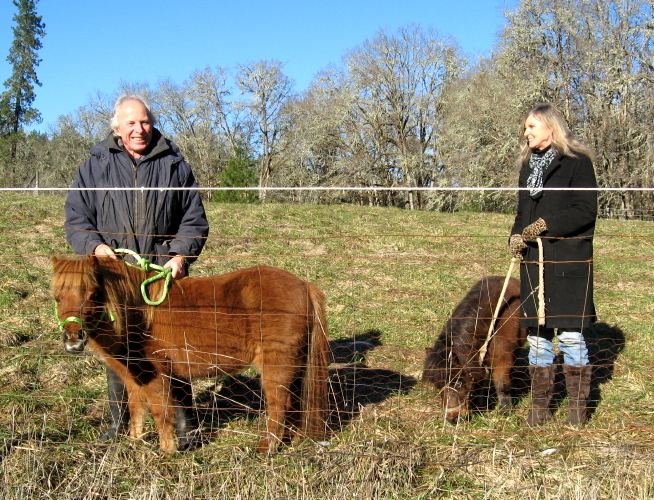
Today’s title came from a recent chat ‘across the garden fence’ with our neighbours, Dordie and Bill.  At their request we had walked our two horses over to the fence-line between our two properties so Dordie and Bill could meet and fondle them.  The warm afternoon sunshine was beautiful and while the horses munched the newly-found grass, we grown-ups talked about this and that and generally tried to put the world to rights!

Paul with Dancer; Jean with Grace.

We talked about the strangeness of present times.  Not just in the USA but across the world. Bill thought 2013 would be the year of separation.  I queried what he meant by that.

Bill replied, “I sense that by the end of the year, the vast majority of people will have decided if climate change is or is not a significant issue.”  There would be few who remained neither unconcerned nor undecided.

That resonated with me and neatly put the framework to today’s post.  Stay with me while I journey to the destination that this year will be the year of hope.

I am one of many who subscribe to the online magazine Grist.  They describe themselves, thus:

Laugh now — or the planet gets it.

You know how some people make lemonade out of lemons? At Grist, we’re making lemonade out of looming climate apocalypse.

It’s more fun than it sounds, trust us!

Grist has been dishing out environmental news and commentary with a wry twist since 1999 — which, to be frank, was way before most people cared about such things. Now that green is in every headline and on every store shelf (bamboo hair gel, anyone?), Grist is the one site you can count on to help you make sense of it all.

The weekly Grist digest that arrived in my in-box that same day as when we were chatting with Dordie and Bill included a number of key stories.

Here’s one that smacked me in the eye.

The 32 most alarming charts from the government’s climate change report

By Philip Bump

Just reading about the government’s massive new report outlining what climate change has in store for the U.S. is sobering. In brief: temperature spikes, drought, flooding, less snow, less permafrost. But if you really want to freak out, you should check out the graphs, charts, and maps.

Now I’m not going to republish all 32 charts but will include just these two, because the message is clear.

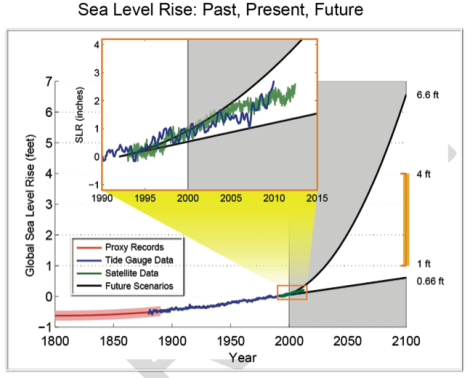
It’s possible that sea levels could only rise eight inches. It is also possible that they could rise over six-and-a-half feet.

sea-level-range

—-

7-sea-rises

Sea-level rise will affect different areas to different degrees — but note the map at lower right. On the Georgia coast, “hundred year” floods could happen annually.

OK, that first chart takes a while to absorb the full implications. The second one doesn’t!

The full range of charts is chilling.  While they refer to the USA, the messages apply to the whole world.

Then in that same Grist weekly summary was this story.

If you aren’t alarmed about climate, you aren’t paying attention

By David Roberts

There was recently another one of those (numbingly familiar) internet tizzies wherein someone trolls environmentalists for being “alarmist” and environmentalists get mad and the troll says “why are you being so defensive?” and everybody clicks, clicks, clicks.

I have no desire to dance that dismal do-si-do again. But it is worth noting that I find the notion of “alarmism” in regard to climate change almost surreal. I barely know what to make of it. So in the name of getting our bearings, let’s review a few things we know.

We know we’ve raised global average temperatures around 0.8 degrees C so far. We know that 2 degrees C is where most scientists predict catastrophic and irreversible impacts. And we know that we are currently on a trajectory that will push temperatures up 4 degrees or more by the end of the century.

David then works his way through those ‘things we know’ in a powerful manner.  Do read the full article, please!  This is his conclusion:

All this will add up to “large-scale displacement of populations and have adverse consequences for human security and economic and trade systems.” Given the uncertainties and long-tail risks involved, “there is no certainty that adaptation to a 4°C world is possible.” There’s a small but non-trivial chance of advanced civilization breaking down entirely.

Now ponder the fact that some scenarios show us going up to 6degrees by the end of the century, a level of devastation we have not studied and barely know how to conceive. Ponder the fact that somewhere along the line, though we don’t know exactly where, enough self-reinforcing feedback loops will be running to make climate change unstoppable and irreversible for centuries to come. That would mean handing our grandchildren and their grandchildren not only a burned, chaotic, denuded world, but a world that is inexorably more inhospitable with every passing decade.

Take all that in, sit with it for a while, and then tell me what it could mean to be an “alarmist” in this context. What level of alarm is adequate?

So am I stark staring mad for having hope in my mind?  Stay with me for just a little longer.  Then form your own judgment.

Recall the post that I published on Tuesday hitting out at the British newspaper The Daily Mail.  Towards the end of that post, in discussing the recently released American National Climate Assessment, I wrote this:

That’s why this report is to be encouraged, nay embraced.  Of all the nations in the world, the one that should be setting the lead is the United States of America.  As the banner on that globalchange.gov website proclaims: Thirteen Agencies, One Vision: Empower the Nation with Global Change Science

So go and read the report.  For your sake and all our sakes.

Because the more informed you and I are, the better the chances of real political leadership taking place in this fine nation.

Now with that in mind let’s go to the final Grist article.

A new grand strategy for the U.S., built around sustainability

By David Roberts

Let’s just accept it: America’s current political and economic systems are incapable of responding adequately to climate change. As things stand, reducing carbon emissions — or more broadly, shifting to sustainability — is a kind of add-on, a second-tier consideration, bolted onto systems and institutions that were built for other purposes.

A little later, David writes:

So what would a new U.S. grand strategy built around sustainability look like? That’s the question tackled by “A New U.S. Grand Strategy,” a piece in Foreign Policy by Patrick Doherty, director of the Smart Strategy Initiative at the New America Foundation.

It’s a hugely ambitious and wide-ranging piece, far too much to even summarize adequately here. Bookmark it. Instapaper it. Pinterest it to your iCloud, or whatever kids do these days. But let’s take a quick look.

Doherty identifies four central challenges facing the U.S.:

  • Economic inclusion: People are swarming out of poverty around the world (especially in China). Over the next 20 years, the global middle class will welcome around 3 billion new members. That’s going to put intense stress on natural, economic, and political systems that are already showing signs of strain.
  • Ecosystem depletion: Pretty sure Grist readers are familiar with this one.
  • Contained depression: Rather than a recession, the U.S. faces a “constrained depression,” with the full effects of low aggregate demand and high debt being masked by policy. No amount of fiscal or economic stimulus will revive a system that has exhausted itself.
  • Resilience deficit: Our industrial supply lines and value chains are efficient, but lack redundancy; they are brittle. Our infrastructure is old and crumbling, $2.2 trillion in the hole, and that’s just for the aging Cold War stuff, never mind building water, power, and transportation systems suited to an era of climate disruption.

“These four challenges,” Doherty says, “are the four horsemen of the coming decades.” And they are inter-dependent. They must be solved together. It’s a rough situation.

With these in mind, Doherty proposes a new grand strategic concept: “The United States must lead the global transition to sustainability.

What a vision for the United States of America.  That this Nation will be the most wonderful example of how man can learn, adapt and change.  David Roberts concludes:

Here are Doherty’s main suggestions for how to realign the U.S. economic engine:

  • Walkable communities: More and more Americans want to live in dense, walkable areas; get rid of regulations that hamper them and start building them.
  • Regenerative agriculture: Farmers can produce “up to three times the profits per acre and 30 percent higher yields during drought” with agricultural techniques that also clean water and restore soils. America must “adopt modern methods that will bring more land into cultivation, keep families on the land, and build regional food systems that keep more money circulating in local economies.”
  • Resource productivity: “Energy and resource intensity per person will have to drop dramatically.” That imperative can drive “innovation in material sciences, engineering, advanced manufacturing, and energy production, distribution, and consumption.”
  • Excess liquidity: Channel all the corporate cash that’s sitting around in funds into long-term investments in America by taxing waste and creating regional growth strategies.
  • Stranded hydrocarbon assets: Figure out how to devalue the immense amount of carbon that’s still sitting underneath the ground without unduly traumatizing the economy.

Obviously the devil is in the details on this stuff, but at a broad level, this is about as eloquent and forward-thinking as it gets. I love the idea of using sustainability in a muscular way, to revive regional economies and nurture the middle class. I recommend reading the whole thing.

I, too, recommend reading “A New U.S. Grand Strategy – Why walkable communities, sustainable economics, and multilateral diplomacy are the future of American power.” (NB: You will have to register with Foreign Policy before access to the report is possible, but it’s free.)

So, the wall-to-wall stream of information that is shouting out how quickly the planet is changing is the fuel that is going to feed the fires of hope.

Let me leave you with the most beautiful words of an ancient philosopher – Aristotle.

Hope is a waking dream.

The unacceptable face of The Daily Mail

The shocking distortions made by The Daily Mail newspaper.

On the 9th January, 2013 The Daily Mail published this item:

The crazy climate change obsession that’s made the Met Office a menace

  • The £200 million-a-year official weather forecaster often gets it wrong
  • This week it has admitted there is no evidence that ‘global warming’ is happening
  • The Met Office quietly readjusted its temperature projections on its website on Christmas Eve

By JAMES DELINGPOLE

PUBLISHED: 19:45 EST, 9 January 2013 | UPDATED: 02:56 EST, 10 January 2013

Was there ever a government quango quite so useless as the Met Office?

From its infamous ‘barbecue summer’ washout of 2009 to the snowbound winter it failed to predict in 2010 and the recent forecast-defying floods, our £200 million-a-year official weather forecaster has become a national joke.

But of all its recent embarrassments, none come close to matching the Met Office’s latest one.

Without fanfare — apparently in the desperate hope no one would notice — it has finally conceded what other scientists have known for ages: there is no evidence that ‘global warming’ is happening.

If you want to read the full article, it’s here.

Needless to say the UK Met Office published a detailed rebuttal.  One of the comments that I spotted following that rebuttal was this lovely one from MD Dalgleish:

The Daily Mail does not let the facts get in the way of a story! Nothing new there, they’ve been doing that since before the war. What baffles me is why so many people buy this paper.

Quite so!

It would all be a bit of a laugh if it were not for what follows.

Last Friday, Naked Capitalism, the fabulous blog run by Yves Smith published in her set of links this item, “Climate change set to make America hotter, drier and more disaster-prone.”  Newly living here in Southern Oregon, that obviously caught my eye!

The item referred to a detailed account in the British Guardian newspaper by Suzanne Goldenberg, the newspaper’s US Environment Correspondent.

Climate change set to make America hotter, drier and more disaster-prone

Draft report from NCA makes clear link between climate change and extreme weather as groups urge Obama to take action

The report says steps taken by Obama to reduce emissions are 'not close to sufficient' to prevent the most severe consequences of climate change. Photo: Saul Loeb/AFP
The report says steps taken by Obama to reduce emissions are ‘not close to sufficient’ to prevent the most severe consequences of climate change. Photo: Saul Loeb/AFP

Future generations of Americans can expect to spend 25 days a year sweltering in temperatures above 100F (38C), with climate change on course to turn the country into a hotter, drier, and more disaster-prone place.

The National Climate Assessment, released in draft form on Friday , provided the fullest picture to date of the real-time effects of climate change on US life, and the most likely consequences for the future.

The 1,000-page report, the work of the more than 300 government scientists and outside experts, was unequivocal on the human causes of climate change, and on the links between climate change and extreme weather.

“Climate change is already affecting the American people,” the draft report said. “Certain types of weather events have become more frequent and/or intense including heat waves, heavy downpours and in some regions floods and drought. Sea level is rising, oceans are becoming more acidic, and glaciers and Arctic sea ice are melting.”

Here’s a pithy question for Mr. James Delingpole of The Daily Mail, “Which part of this sentence are you having trouble with – The 1,000-page report, the work of the more than 300 government scientists and outside experts, was unequivocal on the human causes of climate change, and on the links between climate change and extreme weather.?” [my emphasis]

Suzanne goes on to say:

The report will be open for public comment on Monday.

Environmental groups said they hoped the report would provide Barack Obama with the scientific evidence to push for measures that would slow or halt the rate of climate change – sparing the country some of the worst effects.

The report states clearly that the steps taken by Obama so far to reduce emissions are “not close to sufficient” to prevent the most severe consequences of climate change.

“As climate change and its impacts are becoming more prevalent, Americans face choices,” the report said. “Beyond the next few decades, the amount of climate change will still largely be determined by the choices society makes about emissions. Lower emissions mean less future warming and less severe impacts. Higher emissions would mean more warming and more severe impacts.”

As the report made clear: no place in America had gone untouched by climate change. Nowhere would be entirely immune from the effects of future climate change.

One might argue that it won’t be very long before no sane person on this planet would swallow that crap from The Daily Mail.  But when we get to that stage of every person being aware of the forces at work upon our fair planet it will be a tad too late.

The only home we have.

That’s why this report is to be encouraged, nay embraced.  Of all the nations in the world, the one that should be setting the lead is the United States of America.  As the banner on that globalchange.gov website proclaims: Thirteen Agencies, One Vision: Empower the Nation with Global Change Science

So go and read the report.  For your sake and all our sakes.

Because the more informed you and I are, the better the chances of real political leadership taking place in this fine nation.

Download Chapters of the NCADAC DraftClimate Assessment Report!   
Download the Full Report (warning, 147Mb. Very large file)Between chapters, there are some page numbers that are not used. This is intentional and does not reflect missing pages.or download each chapter separately:

Cover page

Introduction: Letter to the American People

1. Executive Summary

2. Our Changing Climate

Introduction to Sectors

3. Water Resources

4. Energy Supply and Use

5. Transportation

6. Agriculture

7. Forestry

8. Ecosystems, Biodiversity, and Ecosystem Services

9. Human Health

10. Water, Energy, and Land Use

11. Urban Systems, Infrastructure, and Vulnerability

12. Impacts of Climate Change on Tribal, Indigenous, and Native Lands and Resources

13. Land Use and Land Cover Change

14. Rural Communities

15. Interactions of Climate Change and Biogeochemical Cycles

Introduction to Regions

16. Northeast

17. Southeast and Caribbean

18. Midwest

19. Great Plains

20. Southwest

21. Northwest

22. Alaska and the Arctic

23. Hawaii and the U.S. Affiliated Pacific Islands

24. Oceans and Marine Resources

25. Coastal Zone Development and Ecosystems

Introduction to Response Strategies

26. Decision Support: Supporting Policy, Planning, and Resource Management Decisions in a Climate Change Context

27. Mitigation

28. Adaptation

29. Research Agenda for Climate Change Science

30. The NCA Long-Term Process: Vision and Future Development

Appendix I: NCA Climate Science – Addressing Commonly Asked Questions from A to Z

Appendix II: The Science of Climate Change

Change, as far as the eye can see.

Of the matters of man for the coming year.

Like countless others, when we look back 12 months and recall what we thought 2012 had in store, we now realise that we didn’t have a clue!  As the silly expression goes, “I can predict anything except those things that involve the future!

So repeating the process is stupid; I have no doubt that 2013 will be brim full of surprises.  At all levels: personal, local, national and global.  But ….. (You knew there was a ‘but’ coming, didn’t you!)

But a conversation that I had with Peter McCarthy on the 27th December resonated with me to such a degree that I felt the urge to pen some thoughts.  I worked with Peter some years ago at Clevedon Hall, we shared an interest in flying a TB20 and both of us studied for our CAA Instrument Rating.  We became good friends.

Clevedon Hall, Somerset, England.
Clevedon Hall, Somerset, England

So come with me today for a stroll around the grounds of change, possibly an epochal period of change.

Let’s start with what may be the biggest catalyst of change heading our way – our broken political system.

Christine of 350orbust fame published this yesterday.

it-is-not-a-just-society-quote

The view that many western societies are a very long way from being fair is growing.  If you want to dig a little deeper into the appalling statistics of the USA, for example, dip into a recent essay written by Charles Hugh Smith that appeared on Chris Martenson’s Peak Prosperity blog.

It’s a long essay packed full of powerful facts and statistics.  Try this one:

6.  The assets that generate unearned income are highly concentrated, and as a result so is the unearned income.  The top 1% owns twice as much stock-market wealth as the bottom 90%.  This income-producing wealth enables the top 1% to act as a financial aristocracy, buying influence and favors from equivalently concentrated political Elites.

stock market wealth

Let me go to Charles’ conclusion:

What few dare admit, much less state publicly, is that the Constitutional limits on the financial Aristocracy and the Tyranny of the Majority have failed.  This guarantees a future Constitutional crisis as each political class – the financial Aristocracy, the top 24% who pay most of the taxes, the dwindling middle class and the bottom 50% who depend on Federal transfers – will battle for control as the Status Quo collapses under the weight of its unsustainable promises.

H’mmm!

Back to the conversation with Peter.  He felt that there was a massive failure of the democratic process in the UK, and by implication in the USA.

Peter continued by saying that many elected politicians, especially at the level of local politics,  weren’t smart people.  Smart, innovative, entrepreneurial people chose not to go into politics.  Those that were elected had too much power and too many vested interests for the good of the societies that they were meant to represent.  In the USA the involvement of private money in politics is nothing short of corruption of the highest order; my personal opinion, no less and no more.

In moderation, Churchill’s saying comes to mind. “It has been said that democracy is the worst form of government except all the others that have been tried.

Let’s move on.

No-one can deny that in so many areas of our lives, the degree of change seems unprecedented.  Whether we are speaking of the huge social changes at work, enormous technological changes, such as the way that we communicate with each other, medical practises, and on and on.  Then add in the consequences of the change in the Earth’s climate, whether or not one sees this as the outcome of man’s activities and …. well, you get the idea!

Here’s a lovely perspective from Alex Jones who writes the blog, The Liberated Way.  Just a few days ago, Alex wrote this:

As hard and gloomy as some of my blog posts on the future of humanity have been, I thought it time to offer good news as to where we are heading.  I shall call this the global realignment.  Few will disagree that the current activities and ideas of humanity in relation to the environment are unsustainable and point to our self-destruction.  History also shows that whenever a crisis occurs traumatic events and the ideas of new thinkers causes a paradigm shift in attitudes and thinking.

Contrary to the fantasy of many people, there will be no celestial champion on a white horse riding forward to save humanity from itself.  The change will come from a series of traumatic events and individual thinkers which will plant the seeds of change, which will ripple forward as a tsunami of changes of ideas and attitudes on a global scale.

So much change.  So much uncertainty.  Such a feeling of being lost in unfamiliar lands.

Or have we been here before?

Have you heard of the Kondratieff Wave?

The Kondratieff Wave (Kondratiev Wave or K-wave) theory is proposing the existence of the extra-long, 50+ years long cycles of growth in the modern market (capitalist) economy. The theory was proposed in 1920s by Russian economist Nikolai Kondratiev.

Wikipedia has a good summary available here.  A Google search will find much more material, such as this chart:

kwave

The Wikipedia entry has a simpler diagram, see below, that shows the four stages of each cycle.

Kondratieff_Wave.svg

So how to draw this to a close?

In a sense, in a very real sense, there isn’t a close.  The future has always been uncertain and as history shows change is the only constant.

Peter concluded that a better society was ahead and hoped that he would live sufficiently long to witness it.  That gets my vote!

Happy New Year to you.

Thank you for taking an interest in Learning from Dogs.