Tag: Business

Fed Funds Rate and Consumer/Business Costs

Looking more closely at the implications of changes in the Fed rate

Fed funds rate chart_img
Fed Funds rate influences consumer and business interest costs

Does the Fed Funds Rate, the rate charged by the Federal Reserve to make short-term loans to banks, directly influence the interest rate consumers and businesses pay on credit cards, mortgages, and consumer and business loans?  If you took the word of the average business news commentator, you would think not.  But the answer, of course, is yes.

One way to view the market rate of interest, although certainly not the only correct or useful way, is to think of it as a base rate that represents the risk-free rate, a rate that compensates the population for its impatience to consume the goods it would have consumed had it not lent the funds out in the first place. This risk-free rate is also influenced by the efficiency and functioning of the capital markets that bring borrowers and lenders together.

A risk premium is then added to this base rate of risk-free interest, one that varies depending on the degree of uncertainty of the lender getting repaid.  The risk of default, the risk of prepayment, the risk of political uprising, exchange rate risk, and many other sources of uncertainty — including the risk of inflation — raise the level of the risk premium commanded by lenders in the market.  As an example, over the last 100 years or so, the average annual risk-free rate in the U.S. has been about 4%, and the average annual risk premium for equity securities has been about 8%, bringing the average annual observed interest rate or rate of return to about 12% on these securities.

So what happens to the interest rate charged to consumers and businesses when the Fed raises the fed funds rate?  Basically, the level of the risk-free rate in the economy rises and, as debt contracts expire or new lending takes place, this higher base rate gets factored into the market rate of interest charged.

Overall, the demand for loanable funds falls, the aggregate demand curve for the economy falls, and equilibrium output and employment fall, RELATIVE to where they would have been without the rate increase. The bright side is that a reduction in the money supply that accompanies an increase in the fed funds rate is absolutely essential to curtailing inflation, which drives the risk premium, and represents a much greater cost to the economy.

By Sherry Jarrell

Free speech!

Hats off to some intrepid commentators

We are going through unprecedented troubled times and the way ahead looks very uncertain.  The whole world could be participating in the ‘lost decade’ that Japan experienced previously.

But this article is not about doom and gloom!  It is about recognising the commitment to open and honest reporting being undertaken by (at least) these three  individuals.  Three commentators that this author follows in admiration and awe.

Learning from Dogs has nothing like the following of James Kwak, Yves Smith and Karl Denninger but the LfD authors do have an inkling of the work involved in writing not one but often several articles each day.  It is a huge commitment.

James Kwak

First James Kwak of Baseline Scenario.  Simon Johnson is, perhaps, the more well-known of this duo that comprise Baseline Scenario but it is James that puts in the leg-work.  Here’s a taste of a recent article from James:

Radio Stories

I spend a lot of time in the car driving to and from school, so I end up listening to a lot of podcasts (mainly This American Life, Radio Lab, Fresh Air, and Planet Money). I was catching up recently and wanted to point out a few highlights.
Last week on Fresh Air, Terry Gross interviewed Scott Patterson, author of The Quants, and Ed Thorp, mathematician,  inventor of blackjack card counting (or, at least, the first person to publish his methods), and, according to the book, also the inventor of the market-neutral hedge fund.

Large chunk snipped ……

I finally got around to listening to Planet Money’s interview with Russ Roberts from December. Russ Roberts and I are pretty sure to disagree on almost any actual policy question. But what I liked about his interview was that he basically admitted that policy questions cannot be settled by looking at the empirical studies. On whether the minimum wage increases or decreases employment for example, he says that he can poke holes in the studies whose conclusions he doesn’t agree with, but other people can poke holes in the studies he agrees with. In Roberts’s view, people’s policy positions are determined by their prior normative commitments.

I don’t completely agree. I don’t think that these questions, like the one about the minimum wage, are inherently unanswerable in the sense that the answer does not exist. But I agree that empirical studies are unlikely to get to the truth, particularly on a politically charged question, because there are so many ways to fudge an empirical study. As one of my professors said, there are a million ways you can screw up a study, and only one way to do it right. But I agree with the general sentiment. We are living in an age of numbers, where people think that statistics can answer any question. Statistics can answer any question, but they can answer it in multiple ways depending on who is sitting at the keyboard.

By James Kwak

Read about Yves Smith & Karl Denninger

Humour is alive and well!

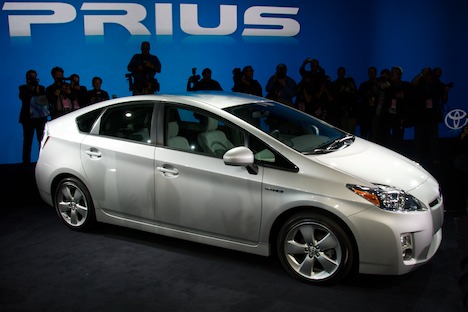
The Toyota Prius recall gets a few laughs.

2010 model Prius

Most of the readers of Learning from Dogs will be aware of the global embarrassment that Toyota is facing as a result of the recall of the Toyota Prius model.  As described partly on the UK website of Toyota:

Toyota have announced a recall on the latest, third-generation Prius built before 27 January 2010. This will involve 8,500 cars in the UK.

To date, there have been no accidents linked to this issue reported in Europe. No other Toyota or Lexus models are affected by this latest recall action in Europe.

Toyota GB would like to apologise to its customers for any concern this issue has caused.

The recall is being taken in response to reports of inconsistent brake feel during slow and steady braking on bumpy or slick road surfaces when the anti-lock braking system (ABS) is actuated.

Well a few days ago, a friend of mine sent me a text message on my cell phone.  It read, “Just driving my new Toyota Prius. Chat later, Can’t stop.

And I see the Jeremy Clarkson/James May team from BBC’s Top Gear programme are also having a little poke at Toyota.  James May was reported to have said:

‘You have to laugh a bit don’t you,’

‘Maybe if you’re going to try to save the world through your car you have to accept that some sacrifices have to be made and one of them is stopping.’

James May

Every Economist, Mr. President? No, Sir!

Here’s one person who doesn’t agree with the President.

The President seems to believe that he can say whatever he wants and no one will hold him accountable. He now claims that “every economist, from both sides of the aisle, believes that the stimulus program created jobs.”

I am an economist, Mr. President, and I know, based either on simple first principles of economics, or on a more rigorous controlled study of labor markets in each major sector of the economy, that the unemployment rate would have been much lower today had the stimulus program never occurred.

You are either woefully unaware of the facts, Mr. President, or are purposefully distorting the facts. Neither is good.  When are you going to realize that just because you say something does not make it so? The world does not contort itself to support your version of the truth.

Do not put words in my mouth, sir.

By Sherry Jarrell

Actual Unemployment is Worse

Unemployment statistics and the real world.

Keep in mind, even as the number of first-time claims for unemployment insurance rose again recently, that the 10% U.S. unemployment figure understates the actual number of unemployed. Even the 17% underemployment figure, which includes those who are either unemployed or who are working part-time but would like to work full-time, fails to include many of those who have lost their jobs but, because they fail to qualify for unemployment, are not being tracked.  I know several such people personally; one has been unemployed for over a year.

My point? Structural unemployment is a serious economic issue. But the solution is not to funnel more unemployment benefits to the unemployed.  The best thing the government can do is to reduce the barriers it has erected to a vibrant economy, including oppressive taxes, fees, paperwork, bureaucracy, and regulations that repress business productivity and raise prices.  By reducing these explicit and implicit costs, there is absolutely no doubt that the private economy will be able to employ more workers as it produces more output at lower prices.

The best thing we can do as private citizens and neighbors is to treat each other right.  Keep the economy moving.  Put in a good day’s work.  Volunteer or learn a new skill if you can’t find a job.  Fill a need.  Buy smart.  And, finally, elect business-friendly local and national politicians.  It matters.

By Sherry Jarrell


Craftsmanship and business in the modern age

Sally Ryan for the New York Times

Pizza and a business plan

Here is a wonderful story of craftsmanship in the modern age and its interaction with business expectations. There is a very small, but reportedly excellent, pizza place in Chicago called “Great Lake”; and I learnt about it when a friend referred me to an article about its culture, its success and the consequences published by the New York Times.

The effect of extremely good reviews has been that they have been overwhelmed by demand and some customers have reacted unfavourably as a result. I think that they should stick to their guns and not compromise their principles and standards. However, this does not mean that they could not be doing some other things too!

There also seems to be an interesting systems story here! Continue reading “Craftsmanship and business in the modern age”

The Engine of Economic Growth is Sputtering

Here’s a surprise!

The engine of world economic growth is sputtering.  The most clearSputtering engine evidence of this is the lack of new business formation in developed nations across the globe.  Over the last year, the number of entrepreneurs starting new businesses in the wealthiest of nations dropped 10% from the 2006-07 level; in the U.S., that number fell by 24%.

The contaminants in the fuel line are oppressive government policies that increase the cost of doing business, increase unemployment, and raise the risks to the current labor force of quitting their jobs to try to start new businesses.

At a time when government should be encouraging venture capitalists and the formation of new business, it is instead putting on the brakes to this source of economic growth in the form of cap and trade, compensation regulations, fees on banks, and myriad other explicit and implicit new taxes.  In 2009, nearly half of U.S. employment was generated by small businesses; U.S. companies started through venture capital employed more than 12 million people, or 11 percent of private sector employment, and generated $2.9 trillion in revenues, or 21 percent of U.S. GDP.

Fully 100% of economic growth is created in private industry.  Government simply redistributes that wealth, destroying some portion of it in the process.  Never have we needed non-interventionist government policies more.

By Sherry Jarrell

Fear!

Capitalising on people’s fears

I often feel that a situation is manipulated by fear. The word is regularly used on television and in the newspapers, and once the thought is planted it is easy to influence the masses!

I was not surprised to read that the Head of Health at the Council of Europe, Dr. Wolfgang Wodard, had said flu drug

Dr. Wodarg

makers had influenced the World Health Organisation to declare Swine flu as a pandemic so they could rake in millions.

Earlier virus outbreaks of Bird Flu, SARS, the Severe Acute Respiratory Syndrome and West Nile virus all had major news coverage lasting weeks, but despite the scare mongering, only six deaths, for example, were attributed to Bird Flu.  1.5 million chickens were slaughtered!

The initial “breaking news” regarding Swine flu warned of 65,000 possible deaths, however the campaign of panic provided a golden opportunity for representatives from the drugs companies to lay the golden egg.

To date only 251 deaths have been attributed to the N1H1 bug, and Dr Wodarg, who made the accusation, said it was just a normal flu. The swine flu scare was faked by greedy drug companies, he claimed.

I wonder how, as if by magic, the research, testing and the availability of millions of injections could be there ready for this unexpected outbreak.

In America a few years ago, the news about Anthrax being sent through the post to a government office lasted weeks. Cheap news, Scare mongering, Fear.

Have we moved on to a situation where we create commercial business at the expense of ourselves.

Big business? We wait now for the emergency debate on the issue at the end of the month.

By Bob Derham

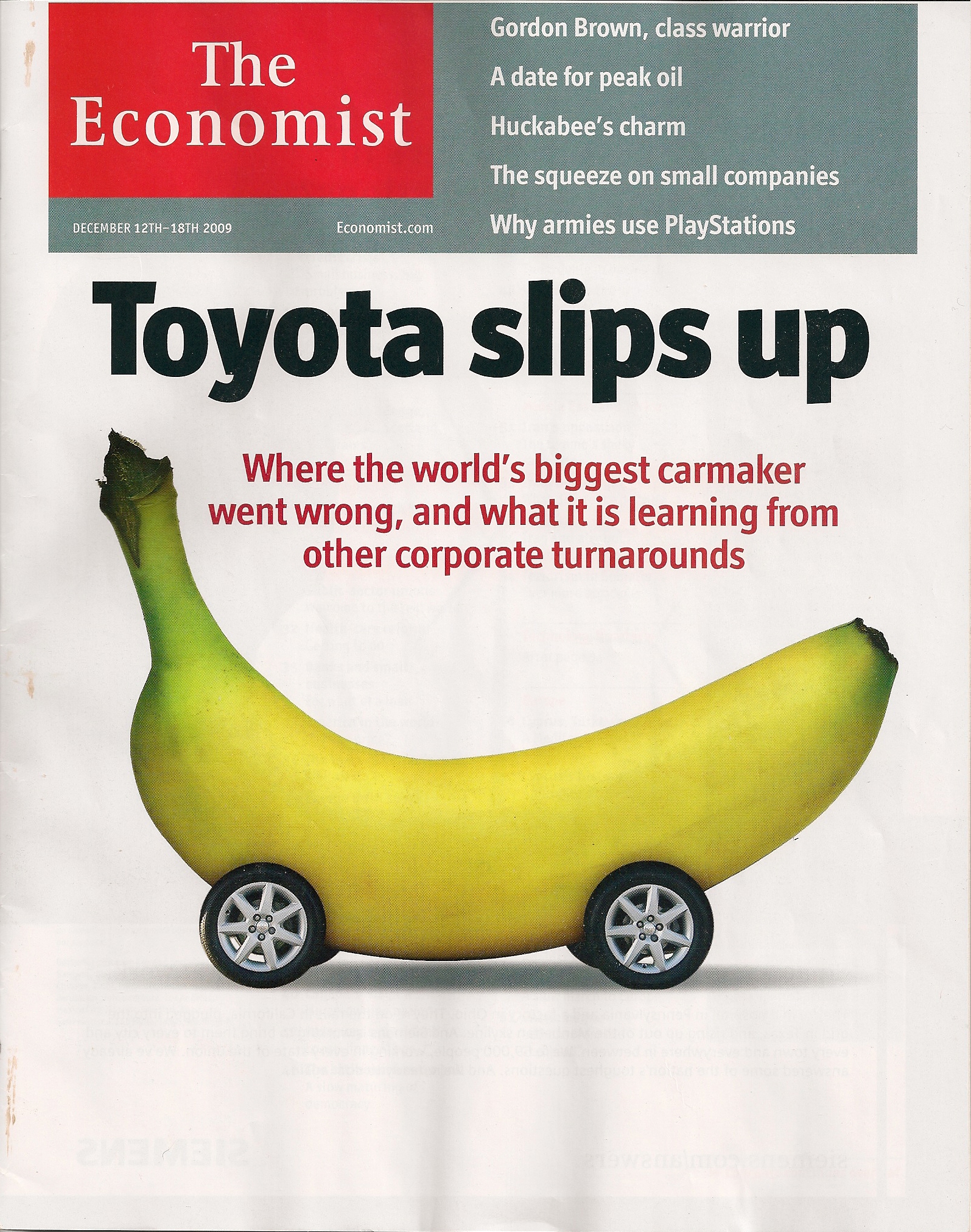
Bananas and common sense!

This is more than about the problems with Toyota.

The Economist is a newspaper.  It was first published in September 1843 which, of itself, makes it a notable newspaper.  Many years ago, more than I can recall just now, I became a subscriber to the newsprint version of this weekly paper.  It has become such a companion, so to speak, that when I left the UK in September 2008 to come to Mexico I made arrangements to continue receiving The Economist each week.

However, the Mexican postal system, despite being thoroughly reliable, is rather slow and, rather logically if you muse on it, the postman always only delivers when there is more than one item.  Thus the particular copy of The Economist that carried the story about Toyota arrived late and with three other editions!

Let me turn to the point of this article.

Read more of this Post

The Troubling U.S. Unemployment Rate

Grim news continues

This isn't funny!

The U.S. unemployment rate remains at a 26-year high.  This is troubling for two reasons. One, the struggle and suffering of the unemployed (and underemployed) and the impact on the world economy.

Two, the mixed signal it gives policy makers.  I worry that the White House will think that it needs to do “more” of what it’s been doing, and dismiss any negative comments about its economic policies as a knee-jerk reaction to the unemployment figure when I, in fact, would be saying the same things if the unemployment figures had improved.  It would be a harder sell, true, but that doesn’t change the facts.

The reason?  Because I believe we would be in a better position today, with lower unemployment — no matter what the current unemployment rate — and higher growth, had the stimulus program never been initiated.  I base this on my understanding of the fundamentals of how the economy works, how businesses create value, and how labor makes itself indispensable to industry.

And none of these areas were helped or improved by the economic policies of this President.

By Sherry Jarrell