Tag: Bill McKibben

Please Americans, set the lead.

Powerful words from President Obama; now we the people must act.

I’m taking the liberty of reproducing in full the item that was published by Bill McKibben of 350.org yesterday.  As I wrote on the 17th this year has to be the year that we make a difference, a call to every man, woman and child on the planet.  This is a snippet from that post.

With these in mind, Doherty proposes a new grand strategic concept: “The United States must lead the global transition to sustainability.
What a vision for the United States of America.  That this Nation will be the most wonderful example of how man can learn, adapt and change.

So to the call issued by 350.org.

oooOOOooo

Dear Friends,

Here’s what President Obama said about climate change during his address today:

barack-obama8_text_small

With words like that, it’s easy to let ourselves dream that something major might be about to happen to fix the biggest problem the world has ever faced.

But we know that even if the President is sincere in every syllable, he’s going to need lots of backup to help him get his point across in a city dominated by fossil fuel interests. And, given the record of the last four years, we know that too often rhetoric has yielded little in the way of results.

That’s why we need you — very badly — to take a trip to our nation’s capital on Feb. 17th. We’ll gather on the National Mall, in what is shaping up to be be the largest environmental rally in many years.

Click here to join us in DC: act.350.org/signup/presidentsday

Together we’ll send the message loud and clear: ‘If you’re serious about protecting future generations from climate change, stop the Keystone XL tar sands pipeline. If you can do that, Mr. President, we can all work together to help build a climate legacy that will be a credit to your critical eight years in office.’

Look — numbers count. If 20,000 of us show up on February 17th, it will be noticed. We need you in that number. The President may have given us an opening, but it’s up to us to go through it, and we need to do it together.

Thanks for all you’ve done to bring us this far, friends. Let’s keep it up — this is our chance.

Bill

oooOOOooo

Even if you are unable to be there in person on the 17th., do what you can to circulate this just as far and wide as possible.

No signs of intelligent life!

Sometimes one just has to scratch one’s head and wonder about life!

I can’t recall when and where I first heard the muse as to why Planet Earth has not been visited by aliens, but I recall the answer: “Because alien passers-by have not found any signs of intelligent life!

The reason that this comes to mind is that the damage that we are doing to our planet, nay to life on our planet, if we don’t embrace the reality of climate change is truly ‘gob-smacking’!

The evidence for this statement is over-powering.  Just last Friday, I republished a recent essay from Tom Engelhardt under the title of ‘The more it changes, the more it’s the same thing.”  Tom’s essay focused on the lack of any change that came out of the recent Presidential election.  That essay closed, thus:

But stop waiting for change, “big” or otherwise, to come from Washington.  It won’t.  Don’t misunderstand me: as the residents of the Midwestern drought zone and the Jersey shore now know all too well, change is coming, like it or not.  If, however, you want this country to be something other than its instigator and its victim, if you want the U.S. to engage a world of danger (and also of opportunity), you’d better call yourself and your friends and neighbors to the colors.  Don’t wait for a Washington focused on its own well-being in 2014 or 2016.  Mobilize yourself.  It’s time to occupy this country before it’s blown away in a storm.

An inciteful comment from reader Jules was this:

“Don’t count on anyone doing the obvious: launching the sort of Apollo-style R&D program that once got us to the moon and might speed the U.S. and the planet toward an alternative energy economy, or investing real money in the sort of mitigation projects for the new weather paradigm that might prevent a coastal city like New York — or even Washington – from turning into an uninhabitable disaster zone in some not so distant future.”

A pity. Americans can do some things very well, the kind of stuff that merits some of the hyperbole of being the greatest nation, the ability to mobilise a nation and lead the world being one of them. We need heroes maybe it’s time for you lot to don that cape and be one.

Americans have such a potential for positive change – I just can’t imagine why this Nation isn’t leading the world to a more Earth-friendly environment.

This then came into my ‘in-box’ on Friday: Could NDAA be the Death of Biofuels in America?  The article opened thus:

The US military is one of the most important developers of new technologies leading them to a point where they can be released onto the market for public and private use. Currently the Department of Defense, led by the Navy, is attempting to reduce its dependence on oil by as much as 50% by 2020, by producing US-made biofuels.

and the author concluded:

Nicole Lederer, the co-founder of E2, despaired that, “the military often leads major economic transitions in our country. Yet right now in Washington, some shortsighted lawmakers are poised to block a potentially major transformation of our national energy supply – and also hold back the significant economic growth and job gains that would come with it.”

Russ Teal, founder of the biorefinery builder Biodico, warned that, “the military is the biggest driver of the biofuels industry right now. If Congress stops the military from doing what the military knows is best, Congress also could threaten the growth of the Made-in-America biofuels industry.”

By. Joao Peixe of Oilprice.com

Then more or less the same time as I read the piece above, in came the latest from 350.org, an essay by Naomi Klein.

Naomi Klein: Do The Math, The Fossil Fuel Industry Is Destroying Our Future

Naomi Klein was out in the shattered neighbourhood of Rockaway Park Queens last weekend, participating in the Occupy relief efforts there. In this interview she underscores the importance of both increasing local resilience as a response to our changing climate and addressing the fossil fuel industry’s business model directly. As 350.org’s Do The Math campaign makes clear, the fossil fuel industry’s business plan will destroy the planet. Bill McKibben reminded the “Do The Math”audience in Seattle this month that the global warming math is quite simple: we can burn 565 more gigatons of carbon dioxide and stay below 2 degrees of warming. Anything more than that risks catastrophe for life on earth. The only problem? Fossil fuel corporations now have 2,795 gigatons in their reserves, 5Xs the safe amount. And they are planning to burn it all, unless we rise up & stop them.

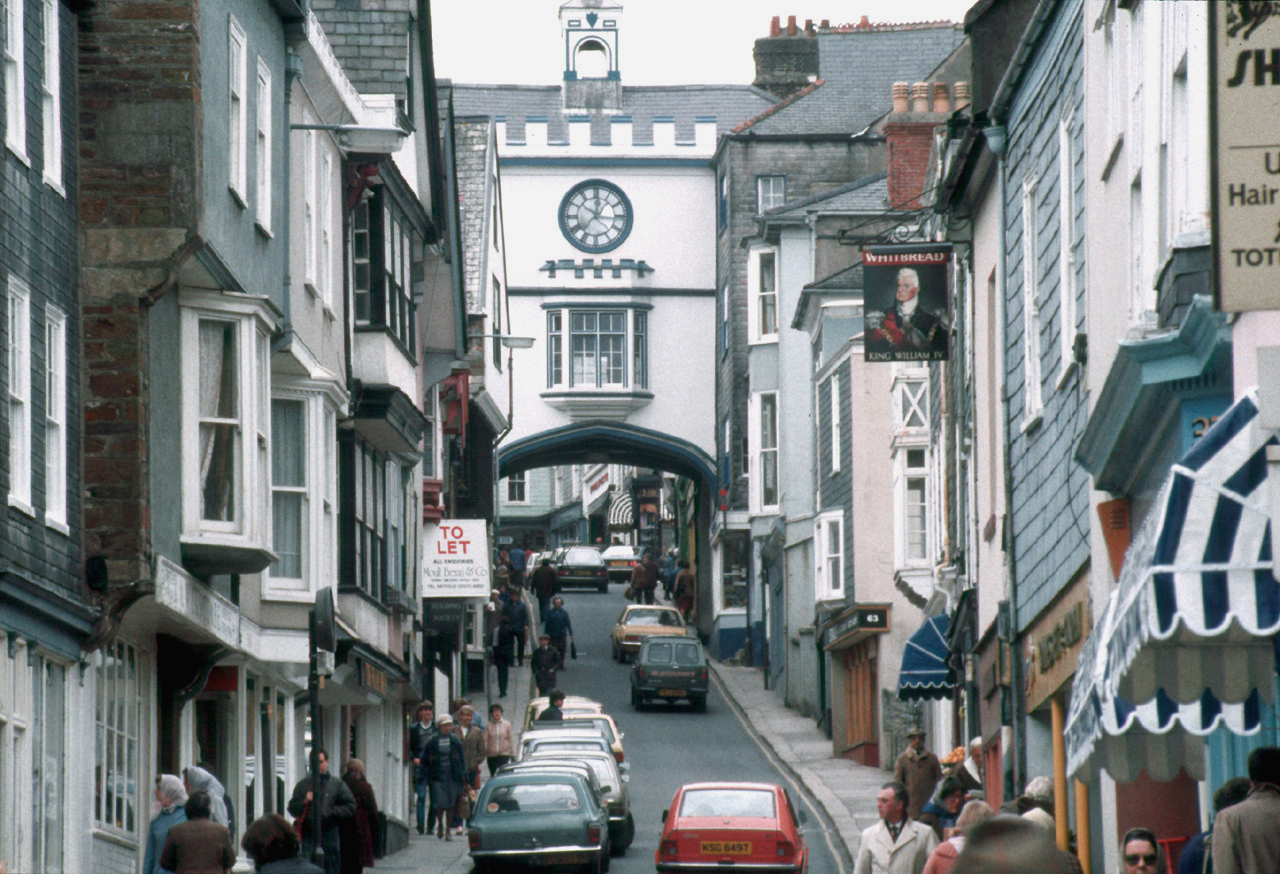
So is there any hope?  So easy to think not.  But in terms of hope the answer is “Yes, yes and yes!”  Because the decent peoples of the world are way ahead of their politicians.  Take the transition movement.  I used to live in the village of Harberton, just 3 miles from the town of Totnes, Devon, in the South-West of England.

Totnes High Street

Totnes was the site of the world’s first transition movement: Transition Town Totnes.  But as the Transition US website reveals, there are now:

126 official US initiatives
437 official initiatives worldwide
33 US states
34 countries
13 languages

One of the latest has just been formed in the city where Jean and I were living until just a few weeks ago, namely Payson, Arizona.  Here’s a reflection from John Hurlburt in Payson, one of a group of committed citizens who, like so many millions of others around the world, just can’t wait for governments to ‘lead’ and was one of the founding members of Transition Town Payson.

Keep it Simple

We share a living planet as a living species. Corporate finance fuels political hate and denial. The divisiveness of global and national politics reflects an unprecedented escalating global crisis. We live in a world of constant sorrow.

Our stubborn ignorance is the greatest threat to the objectives of peace and well-being. We have become so entrenched in the ‘ruts’ of our conditioned opinions that any semblance of balanced responsibility is immediately numbed by the deliberate stupidity of well-paid spin-doctors across a global electronic media.

The recovery process is truly simple. Surrender to the scientific facts of our inclusive reality, clean house, and have compassion for each other.  The good news is that a basic natural instinct of all life forms is to survive through adaptation.

John Hurlburt

So, on reflection, I was wrong to open with the degree of irony in my ‘voice’ that I had.  This is now a world of wonderful and amazing communication channels, many of them directly ‘person to person’.  The views of the world’s peoples are now so much louder than in previous times.  I am confident that right, rather than might, will prevail.

Changing the mathematics of the climate!

An important plea to support a major road tour by the 350.org team.

Bill McKibben

There are a number of key players in the movement to arrest the affects of man on the world’s future climate and one of those is Bill McKibben.  His organisation, 350.org, has been at the forefront of raising the public’s awareness as to the terrible consequences of not changing our ways pretty damn soon.

As Wikipedia puts it,

William Ernest “Bill” McKibben (born 1960) is an American environmentalist, author, and journalist who has written extensively on the impact of global warming. He is the Schumann Distinguished Scholar at Middlebury College. In 2010, the Boston Globe called him “probably the nation’s leading environmentalist”  and Time magazine described him as “the world’s best green journalist.”

Anyway, something came in to my ‘in-box’ the other day that I wanted to share with all Learning from Dogs readers.  This is what was said,

Friends,

The reaction to our announcement of our national “Do the Math” road tour has been utterly pheneomenal.

Case in point: the event in Boston sold out in 24 hours. We’re trying to find another, larger venue to seat everyone, but the main point is this: this tour is going to be huge, and you need to be part of it.

Get your tickets here (math.350.org), and please do spread the word to everyone you know.

See you on the road,

Bill for the 350.org team

P.S. If you haven’t gotten a chance to read our first announcement, I’ve included it below.

 oooOOOooo

Dear Friends,

We’re getting ready for our most ambitious venture yet.

From November 7th to December 3rd, I’ll be on the road, visiting 20 cities in 20 nights (with a few days for travel in between) to help bring together the movement we need to make sure this planet has a future that we can all appreciate.

We’re calling it the Do the Math tour, but it’s not (thank heaven) just going to be me standing in front of a microphone.The goal is to jump-start the kind of movement that I discussed in the article I wrote for Rolling Stone about the scary new math of climate change. We will bring together musicians, artists and voices from across the movement to work together on directly confronting the financial and political might of the fossil fuel industry.

If you are near one of our stops, I want to make sure you’re there with us. You’re exactly the people we need to be there — folks who understand the climate math already, have experience in the movement, and are willing to step up to do more.


Click to check out the tour and RSVP

These events will need to be big, and reach beyond our normal circle of friends. That’s why we need to make sure that everyone knows that something big is underway. Can you take a moment to share the Do the Math tour site with your social networks?

       
Click to share on Facebook                 Click to share on Twitter

Also, just a heads up — we’re going to be putting together a live web event so that everyone who doesn’t happen to be near a tour stop can still get together and get a campaign started in their community. Our team is still hammering out the details for the exact date and time, but please keep an eye out — we absolutely need you in this fight.

I do a lot of talks to big groups, but this is a new kind of undertaking for me, and for 350.org. We’re trying to quickly build up some serious momentum, which is why we’ve gone to great lengths to make this a very different kind of event.

Not only will we have music and guests like Naomi Klein, Jim Hansen, Desmond Tutu, in person and via video, this event is also the kickoff to some serious organizing in your community. This tour will launch our next big mission — a campaign to directly confront the economic power of the fossil fuel industry. Our message will be crystal clear: it’s not OK to sacrifice our future for the sake of one industry’s bottom line. Divestment is one important tool that we’ll discuss, but we’re ready for many other tactics as well.

Over the past few months our planet gave stark warning signs that humans have never seen before. The Arctic melted, breaking every record. The Great Plains sweltered. The West burned. This roadshow is the next big step — but the price of admission, besides the ticket, is a willingness to really go to work to change the world in the year ahead. That’s why we need you this November.

The stakes have never been this high, and I’ve never been more serious.

Please join us: math.350.org

–Bill McKibben for 350.org

So go across to that Tour site, where you will read this,

On November 7th, we’re hitting the road to jumpstart the next phase of the climate movement.

It’s simple math: we can burn 565 more gigatons of carbon and stay below 2°C of warming — anything more than that risks catastrophe for life on earth. The only problem? Fossil fuel corporations now have 2,795 gigatons in their reserves, five times the safe amount. And they’re planning to burn it all — unless we rise up to stop them.

This November, Bill McKibben and 350.org are hitting the road to build the movement that will change the terrifying math of the climate crisis.

and see the link to the Tour locations and dates.

TOUR DATES & TICKETS

***Click a city to sign up and buy tickets.***

Don’t see your town on the map? You can still get involved by signing up here.

ABOUT THE TOUR

This won’t be your typical lecture.

Each event will be a unique and interactive experience, unlike any talk you’ve been to before. It will pick up where Bill McKibben’s landmark Rolling Stone article left off — and everyone who comes will be asked to join a growing movement that is strong enough to stand up to the fossil fuel industry. Together we’ll mount an unprecedented campaign to cut off the industry’s financial and political support by divesting our schools, churches and government from fossil fuels.

This won’t be easy: we’re up against the most profitable, powerful, and dangerous industry in history. But we have our own currency: creativity, courage and if needed, our bodies.

Never let it be said that we, as in all of us, don’t have the power to change the world.  Oh, and feel free to circulate today’s post.

And now to do something.

The cumulative effect of millions of decisions brings about change!

Yesterday’s Post was about personal change.  It came on the back of a short series that was triggered by the Bill McKibben essay in Rolling Stone magazine that I republished on 31st July.  If you haven’t read it, do yourself a favour and read it soon.

The essay highlighted the challenge of how we change our ways, that is at a personal level, which is why I decided to devote a complete Post to the subject of change.  There was no doubt that the McKibben essay opened our eyes to the need for change, if they weren’t open already.  So being clear about the need for change and how, initially, it can make us feel less sure of ourselves, where do we go from here?  As John Fisher explains, within the change process, there is the stage where things start to happen.  This is what he writes about that stage,

Moving forward

In this stage we are starting to exert more control, make more things happen in a positive sense and are getting our sense of self back. We know who we are again and are starting to feel comfortable that we are acting in line with our convictions, beliefs, etc. and making the right choices. In this phase we are, again, experimenting within our environment more actively and effectively.

Keep this stage in mind as you journey along your individual path towards reducing your impact on the planet.  It really does act as a beacon for you, as a candle in the darkness.

OK, there’s an old saying in business ‘if you can’t measure it you can’t manage it!‘  So let’s start off by calculating the CO2 we are presently responsible for.

There are a number of CO2 calculators available on the Web but this one from The Resurgence Trust website seems as good as any.  Easy to use and it provides a starting point from which to plan your attack!  Make a promise to calculate your present CO2 output, soon!

Then to the plan of action!  A web search on reducing CO2 produces a huge number of results and I recommend that you undertake your own trawl to find the information that ‘rocks your boat’.  But on the Brave New Climate website there’s a summary that caught my eye, especially how it was introduced:

Top 10 ways to reduce your CO2 emissions footprint

Posted on 29 August 2008 by Barry Brook

Solving climate change is a huge international challenge. Only a concerted global effort, involving the governments of all nations, will be enough to avert dangerous consequences. But that said, the individual actions of everyday people are still crucial. Large and complex issues, like climate change, are usually best tackled by breaking down the problem into manageable bits.

For carbon emissions, this means reducing the COcontribution of each and every one of the six and a half billion people on the planet. But what can you, as an individual person or family, do that will most make a difference to the big picture? Here are my top ten action items, which are both simple to achieve and have a real effect. They are ranked by how much impact they make to ‘kicking the COhabit’.

Then follows ten solid recommendations:

  1. Make climate-conscious political decisions.
  2. Eat less red meat.
  3. Purchase “green electricity“.
  4. Make your home and household energy efficient.
  5. Buy energy and water efficient appliances.
  6. Walk, cycle or take public transport.
  7. Recycle, re-use and avoid useless purchases.
  8. Telecommute and teleconference.
  9. Buy local produce.
  10. Offset what you can’t save.

Each of these recommendations is supported by great web links and plenty of advice.  So don’t just skip through those 10 options, go here and commit to doing something!

And when you are ready to involve others beyond your family, 350.org has a great selection of resources for potential organizers.

We can make a difference!

Changing the person: Me!

It is better to light a candle than curse the darkness. – Chinese Proverb

Yesterday, in a post that picked up on the deep implications of Bill McKibben’s chilling essay on where the world is heading if we don’t change, I set out my understanding of what holds us back from that change.  I wrote, “ … the process of change cannot start until we  truly want to change; a total emotional commitment.  And the formation of those emotions, that realisation, requires a new understanding of the world around us, who we are and who we want to be.”

Previously on Learning from Dogs I have quoted Jon Lavin, “The best way to save the world is to work on our selves.”  I remember decades ago when working as a humble office-products salesman for IBM UK the well-worn saying, “Selling is 90% me and 10% the customer.”  Sort of reminds me of Woody Allen’s: “Eighty percent of success in life is showing up.”

OK, enough of these mental perambulations.  Let’s get on with the task of looking at change.  Because make no bones about it, if we rely on ‘them’, on others, to turn mankind back from where we are heading then it’s all over!  It comes down to each and every one of us deciding to change.

Think this is all melodramatic nonsense?  Go and read the first paragraph of Bill McKibben’s article where he states, “June broke or tied 3,215 high-temperature records across the United States. That followed the warmest May on record for the Northern Hemisphere – the 327th consecutive month in which the temperature of the entire globe exceeded the 20th-century average..

Want more reason to change?  Try this from a recent article on The Daily Impact:

From American Drought to “Global Catastrophe”

Some poet  invented the name “Arab Spring” as a label for the tsunami of public desperation that last year took down the governments of Tunisia, Egypt and Libya. Poets and Pollyannas saw the events as an upwelling of love for democracy. Realists related them to the spike in world food prices that threatened the survival of whole populations and made them desperate for change — any change.  Now, thanks in large part to events unfolding in the American heartland, get ready for another, worse, spike.

We are running out of superlatives with which to describe the Mid- and Southwestern drought and its effect on this year’s corn and soybean crops. According to this week’s USDA crop update the situation during the previous seven days went from “critical” to, um, worse than that. The drought is the worst in half a century. Of the largest US acreage ever planted in corn (industrial agriculture was crowing about that just a couple of months ago), only one-quarter is still in good condition. (Modest rainfall in drought-stricken areas early this week provided mostly emotional relief; the drought is forecast to continue unabated through October.)

Change really does seem like a ‘no-brainer’!

Here’s a lovely cartoon that summarises the steps of change, the process of transition, for you and me.

That diagram is from John Fisher’s model of personal change, full details of which are here.  It includes a link to the process of transition diagram, show above, here.

The most important thing to note, and this is why so many ‘change’ ambitions fail, is that change is deeply unsettling at first.  When change happens for the majority of us, often ‘forced’ on us as a result of unplanned life events, we are left deeply unsettled; a strong feeling of being lost, of being in unfamiliar surroundings.  Think divorce or, worse, the death of a partner or child, reflect on how many sign up for bereavement counselling in such circumstances.  Big-time change is big-time tough (apologies for the grammar!).

Stay with me for a short while while I reinforce this from my own experiences.

My previous ex-wife announced in December, 2006 that she was leaving me for a younger model!  It came as a complete surprise.  Subsequently, I was invited to spend Christmas 2007 out in San Carlos, Mexico with Suzann and her husband, Don.  Suzann is the sister of my dear, close friend of many years, Dan Gomez, hence the connection.  There I met Jean, a long-term friend of Suzann living in San Carlos and, coincidentally as I am, another Londoner by birth.  Jean and I fell deeply in love with each other and a year later I moved out from SW England with Pharaoh to Mexico.

Throughout 2008 I suffered from what was eventually diagnosed as vestibular migraine.  It involved partial loss of vision, vertigo, headaches and significant short-term memory disturbances; let me tell you it was pretty frightening!

Eventually, in 2012 well after we moved from San Carlos up to Payson, Arizona, I got so worried that I went to see a neurologist, convinced that I was heading down the road of dementia.  Dr. Goodell examined me thoroughly and said that there were no signs of dementia or early-onset Alzheimer’s disease.  His conclusion: I was showing the normal signs of forgetfulness that any person of my age (now 67) would show having been through similar life changes.  Dr. Goodell went on to explain that back in England 98% of my life was constant and familiar and therefore adjusting to a 2% change was unremarkable.  However, on moving my life out to Mexico and then on to Arizona, it was all reversed: 2% of my life was constant and 98% was change and that was a huge psychological hill to climb with all the associated mental stresses that I had been experiencing.

Interestingly, that diagnosis rapidly set me on the path of feeling so much better!

So, apologies for that personal diversion but I hope it underlined that life-change is a big deal!

In my trawl across the Web looking for change references, I came across a software engineer by the name of Dave Cheong.  Dave writes a blog.  In Dave’s blog was a piece about change.  Change as a result of a merger of his employer.  This is what Dave wrote:

As a result of the merger, lots of change is happening. Some folks are questioning where things are headed, what management have planned, how their lives will change, etc. Most certainly, there will be job losses as the two companies consolidate things, in particular administrative positions.

With the chaos that’s been unfolding, I’ve thought a bit about “change” in general. What is it? Why do people resist it? Is it always a good thing? What should I do?

And later he writes after referring to the Satir Change Process model, named after Virginia Satir, an American author and psychotherapist:

The diagram depicts several stages of accepting change. The first stage is known as Status Quo (Gray Zone), a state where everyone is generally comfortable with the way things are. The second stage is a point in time a Foreign Element, trigger or change agent is introduced. What follows is a period of Resistance and Chaos (Red Zone), personified as a result of people being scared of the uncertainties the change has brought about and how their lives will be impacted.

The level of performance generally drops off and fluctuates more greatly between the Gray and Red Zones. There are various reasons for this – people may reject the change to protect the status quo; are confused with the change and are unsure of what to do; or simply become less competent with the new tools and processes introduced.

This describes why people by nature resist change. They don’t want to become less useful than they already are.

Just reflect on that.  Dave calls it being ‘less useful’ but that downplays the emotional significance of partially losing one’s self-image, one’s self-identity, the undermining of who we think we are.  As I wrote earlier, life-change is a big deal!

Here’s my final example of how dealing with change is all about the self.  It’s from the Best Self Help website, and opens,

Self help, personal development and self-improvement are topics of considerable interest to pretty much everyone on the planet.

In 1975 my life was a total mess. I was depressed, unemployed and my 5 year marriage was ending.

I’m not going to quote it all but it really is worth a read.  However, I do want to quote the conclusion,

Finally, I Got It!!!

In the Western world, we are educated to look outside ourselves for validation. We want more money to acquire “things” with the mistaken belief this is the source of happiness.

The true source of love, health, happiness and financial success cannot be found outside of ourselves – each of these is already within us. The key is learning how to access and activate that which we already possess.

 “True wisdom comes to each of us when we realize how little we understand about life, ourselves, and the world around us.” ~Socrates~

So that’s enough for today. If you haven’t got the message about change coming from within, then not sure what else I can offer!  However, if you do want to explore changing the way you impact this beautiful planet (and it applies equally to me) then drop in tomorrow.

More on the ‘Act’ stuff!

The business of acting to make a difference.

The future depends on what we do in the present. – Mahatma Gandhi

Yesterday, I republished a long essay from Bill McKibben under my title of Stop, read, reflect and Act!    Bill’s essay was called Global Warming’s Terrifying New Math and terrifying the numbers are!

If you didn’t read it yesterday, I encourage you to do so as soon as you can.  Why?  Because the process of change cannot start until we truly want to change; a total emotional commitment.  And the formation of those emotions, that realisation, requires a new understanding of the world around us, who we are and who we want to be.  An outcome that is all part of being better informed, which is why the McKibben essay is so profoundly important.

Tomorrow, I want to explore that process of personal change.

But before then, let me go back and repeat some words in Bill’s essay that really jumped off the page and hit me between the eyes.

Writing of Germany, Bill said, “… on one sunny Saturday in late May, that northern-latitude nation generated nearly half its power from solar panels within its borders. That’s a small miracle – and it demonstrates that we have the technology to solve our problems. But we lack the will.

We lack the will!!

Then in the next paragraph, Bill went on to write,

This record of failure means we know a lot about what strategies don’t work. Green groups, for instance, have spent a lot of time trying to change individual lifestyles: the iconic twisty light bulb has been installed by the millions, but so have a new generation of energy-sucking flatscreen TVs. Most of us are fundamentally ambivalent about going green: We like cheap flights to warm places, and we’re certainly not going to give them up if everyone else is still taking them. Since all of us are in some way the beneficiaries of cheap fossil fuel, tackling climate change has been like trying to build a movement against yourself – it’s as if the gay-rights movement had to be constructed entirely from evangelical preachers, or the abolition movement from slaveholders.

This is what hit me between the eyes, “the iconic twisty light bulb has been installed by the millions, but so have a new generation of energy-sucking flatscreen TVs.”  That describes me to perfection.  OK, we have installed solar panels as well but I admit to a significant degree of ambivalence! ” tackling climate change has been like trying to build a movement against yourself

Let me remind you of Bill’s next paragraph,

People perceive – correctly – that their individual actions will not make a decisive difference in the atmospheric concentration of CO2; by 2010, a poll found that “while recycling is widespread in America and 73 percent of those polled are paying bills online in order to save paper,” only four percent had reduced their utility use and only three percent had purchased hybrid cars. Given a hundred years, you could conceivably change lifestyles enough to matter – but time is precisely what we lack.

So it comes down to change; change in a timely manner, to boot!

Let’s hold that until tomorrow and I will leave you with this: Put your future in good hands – your own.

Stop, read, reflect and Act!

The latest from Bill McKibben has to be read and shared.

Introduction

We live in a world where there’s a great fondness for shortness, whether it’s headlines, soundbites, Twitter length ‘conversations’, text messages, and the rest.  However, I’m introducing an essay from Bill McKibben that is long.  When I use the word long I mean both literally, the essay is a shade under 6,200 words, and subjectively, the essay is long, very long, on meaning.

It was published in the August 2nd, 2012 issue of Rolling Stone.  As Allyse of the 350.org team wrote in a widely distributed email,

Here at 350.org, we do a lot of our internal communication via online chat, and our written shorthand for “YES!” and “totally awesome!” and “you rock!” is “++”. Which is why I say to you: ++ Social Media Team, ++. You all rock.

Bill McKibben’s article in Rolling Stone—which we asked you to spread around the internet last week—has been shared on Facebook almost 100K times and seen by hundreds of thousands of people. Great work. If you haven’t read it yet, please do.

This article really lays out the intellectual framework for much of our work in the weeks, months, and years ahead. We want to keep pushing these ideas out there, especially this one: our objection to the fossil fuel industry is structural—these businesses are in fact planning to wreck the planet!

So we took a quote from Bill’s article and made it into a graphic that’s already been shared almost 2,500 times on Facebook. Will you help us push it past 5,000? Click here to share.

As you know if you’ve read the article, this is really an all-hands-on-deck moment for humanity. Thanks for doing your part—in ways both large and small.

Onward,

Allyse

Will you put aside some time, settle down in a comfortable chair, and read the article?  Please do!

It crossed my mind to split it over a couple of days but I decided against that.  But I have inserted a ‘click to reveal more’ about 1,100 words into the article – please do read on when you reach that point.  And just as important, do comment!

Oh, want to see that image on Facebook that has been shared so widely?  Here it is:

A’int that the truth!

Finally, feel free to share this as far and wide as you want.  Thank you.

oooOOOooo

(Apart from the first image from Edel Rodriguez, all the other photographs have been inserted by me and are not in the original Rolling Stone production – I decided to insert them to make reading the article more visually attractive on a screen.)

Global Warming’s Terrifying New Math

Three simple numbers that add up to global catastrophe – and that make clear who the real enemy is

Illustration by Edel Rodriguez

By Bill McKibben
July 19, 2012 9:35 AM ET

If the pictures of those towering wildfires in Colorado haven’t convinced you, or the size of your AC bill this summer, here are some hard numbers about climate change: June broke or tied 3,215 high-temperature records across the United States. That followed the warmest May on record for the Northern Hemisphere – the 327th consecutive month in which the temperature of the entire globe exceeded the 20th-century average, the odds of which occurring by simple chance were 3.7 x 10-99, a number considerably larger than the number of stars in the universe.

Meteorologists reported that this spring was the warmest ever recorded for our nation – in fact, it crushed the old record by so much that it represented the “largest temperature departure from average of any season on record.” The same week, Saudi authorities reported that it had rained in Mecca despite a temperature of 109 degrees, the hottest downpour in the planet’s history.

Not that our leaders seemed to notice. Last month the world’s nations, meeting in Rio for the 20th-anniversary reprise of a massive 1992 environmental summit, accomplished nothing. Unlike George H.W. Bush, who flew in for the first conclave, Barack Obama didn’t even attend. It was “a ghost of the glad, confident meeting 20 years ago,” the British journalist George Monbiot wrote; no one paid it much attention, footsteps echoing through the halls “once thronged by multitudes.” Since I wrote one of the first books for a general audience about global warming way back in 1989, and since I’ve spent the intervening decades working ineffectively to slow that warming, I can say with some confidence that we’re losing the fight, badly and quickly – losing it because, most of all, we remain in denial about the peril that human civilization is in.

When we think about global warming at all, the arguments tend to be ideological, theological and economic. But to grasp the seriousness of our predicament, you just need to do a little math. For the past year, an easy and powerful bit of arithmetical analysis first published by financial analysts in the U.K. has been making the rounds of environmental conferences and journals, but it hasn’t yet broken through to the larger public. This analysis upends most of the conventional political thinking about climate change. And it allows us to understand our precarious – our almost-but-not-quite-finally hopeless – position with three simple numbers.

Continue reading “Stop, read, reflect and Act!”

I feel a headache coming on!

A bit of a personal rant about complacency!

But before I get my blood up, let me reflect on a small passage of time.  I first started writing this Blog on July 15th, 2009, coming up to three years ago.  The idea came from a previous conversation with Jon Lavin of The People Workshop when we were chatting about Dr. David Hawkins’ Map of Consciousness and Jon pointed out that dogs had a ‘score’ of about 210, i.e. were positively above the boundary between truth and falsehood.  As I wrote here,

Dogs:

  • are integrous ( a score of 210) according to Dr David Hawkins
  • don’t cheat or lie
  • don’t have hidden agendas
  • are loyal and faithful
  • forgive
  • love unconditionally
  • value and cherish the ‘present’ in a way that humans dream of achieving
  • are, by eons of time, a more successful species than man.

That’s why the blog is called Learning from Dogs!

Stay with me just a little longer.

The picture of Pharaoh on the Home page, this one:

Dogs know better, much better! Time again for man to learn from dogs!

is a picture of a ‘beta’ dog.  The beta dog is the second-in-command, so to speak, in a wild dog pack.  A dog pack, about 40 to 50 dogs in the wild, has three dogs of special rank, although rank is not really the correct word, role is a better one.  The leader of the pack is the alpha dog; always a female dog.  The next role dog is the beta; always a male.  The third role dog is the ‘clown’ dog and can be either sex.

In reverse order, the clown dog is there to keep the pack happy (in dog terms), the beta dog’s role is to break up fights within the pack and to ‘teach’ the puppies their social skills (which is why a beta dog is always a dominant male) and the alpha’s primary role is to ensure that the pack’s territory is not compromised by other animals and that there is plenty of food for the pack.

Ergo, the single most important decision of the alpha dog is to move the pack to a new territory when she judges that the present one is unsustainable!

OK, to my ‘rant’!

Why isn’t mankind learning from dogs and realising that our present ‘territory’, Planet Earth, is not capable of sustaining mankind for very much longer.

I don’t believe that man is intrinsically stupid!  Many know the famous quotation from Einstein, “Insanity: doing the same thing over and over again and expecting different results.”  So if most of us ‘nod’ our heads when we read that quote, why are most of us seemingly content to keep doing the same thing?  Why isn’t there such a huge outpouring of anger at the complacency of the world’s leaders?  How far does the collapse of the conditions, both social and physical, as in biosphere, have to go before we get real, urgent change?

Last Thursday, in a post I called Denialists standing up for insanity, I quoted Tom Engelhardt in his introduction to an article by Bill McKibben thus,

It’s true that no single event can be pinned on climate change with absolute certainty.  But anyone who doesn’t think we’re in a fierce new world of weather extremes — and as TomDispatch regular Bill McKibben has suggested, on an increasingly less hospitable planet that he calls Eaarth – is likely to learn the realities firsthand soon enough.  Not so long ago, if you really wanted to notice the effects of climate change around you, you had to be an Inuit, an Aleut, or some other native of the far north where rising temperatures and melting ice were visibly changing the landscape and wrecking ways of life — or maybe an inhabitant of Kiribati.  Now, it seems, we are all Inuit or Pacific islanders.  And the latest polling numbers indicate that Americans are finally beginning to notice in their own lives, and in numbers that may matter.

Well it’s good that Americans are starting to get the picture but it’s all too gentile – we all have to get much more excited about making our leaders understand that we want action to curb CO2 emissions, and we want action NOW!

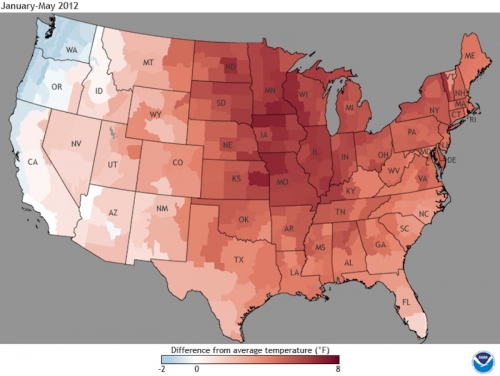
Just look at this chart from NOAA as seen on the Climate Central website:

Year-to-Date divisional temperature rankings from NOAA.

More about that tomorrow!

OK, only a short rant!  Which is immediately followed by an apology!  Because you will have to wait 24 hours before reading my next Post about fracking, about how some ‘leaders’ expect the CO2 emissions in the earth’s atmosphere to stabilise at 650 ppm and how very close we are to losing control!

Think I need to go and lie down!

Denialists standing up for insanity!

Bill McKibben spells it out that climate-change deniers are on the ropes — But So Is the Planet !

Once again, I am deeply indebted to Tom Englehardt of Tom Dispatch fame for his permission allowing me reproduce a recent post.

But before so doing, let me natter on for a few words about why I am motivated to write a daily post for Learning from Dogs.  As I say on the Welcome page, “Mankind is close to the edge of extinction, literally and spiritually. Dogs know better, much better! Time again for man to learn from dogs!

To expand on that, I write about the purpose of this Blog, “... if society doesn’t eschew the games, half-truths and selfish attitudes of the last, say, 30 years or more, then civilisation, as we know it, could be under threat.”  Which is why the quotation on that page is so powerful:

There is nothing to fear except the persistent refusal to find out the truth, the persistent

refusal to analyse the causes of happenings.” Dorothy Thompson.

Stay with me for just a little longer.  Here’s an article that was published on the BBC’s News website on Tuesday (I’ve taken just a small extract and slightly re-arranged the order),

Virginia’s dying marshes and climate change denial

By Daniel Nasaw

BBC News Magazine, York River, Virginia

Trees die as rising salt water soaks their roots, Watts says

Dying wetland trees along Virginia’s coastline are evidence that rising sea levels threaten nature and humans, scientists say – and show the limits of political action amid climate change scepticism.

Dead trees loom over the marsh like the bones of a whale beached long ago.

In the salt marshes along the banks of the York River in the US state of Virginia, pine and cedar trees and bushes of holly and wax myrtle occupy small islands, known as hummocks.

But as the salty estuary waters have risen in recent years, they have drowned the trees on the hummocks’ lower edges. If – when – the sea level rises further, it will inundate and drown the remaining trees and shrubs, and eventually sink the entire marsh.

That threatens the entire surrounding ecosystem, because fish, oysters and crabs depend on the marsh grass for food.

“These are just the early warning signs of what’s coming,” says avian ecologist Bryan Watts, stepping carefully among the fallen pines.

And a little later in the article comes this,

“Here in Virginia there is very little political will to address the mitigation side of things – reducing our carbon footprint, reducing greenhouse gas emissions,” says Carl Hershner, who studies coastal resources management at the Virginia Institute of Marine Science.

So you can see what I can see and what a majority of the US population can see – denying the truth of dangers to our biosphere is nothing more than insane!

OK, now that’s off my chest, on to the Tom Dispatch essay from Bill McKibben introduced, as always by Tom.

oooOOOooo

Tomgram: Bill McKibben, Climate-Change Deniers Have Done Their Job Well

Posted by Bill McKibben

Here’s the thing about climate-change deniers: these days before they sit down to write their blog posts, they have to turn on the AC.  After all, it might as well be July in New York (where I’m writing this), August in Chicago (where a century-old heat record was broken in late May), and hell at the Indy 500.  Infernos have been raging from New Mexico and Colorado, where the fire season started early, to the shores of Lake Superior, where dry conditions and high temperatures led to Michigan’s third largest wildfire in its history.  After a March heat wave for the record books, we now have summer in late spring, the second-named tropical storm of the season earlier than ever recorded, and significant drought conditions, especially in the South and Southwest.  In the meantime, carbon dioxide (and other greenhouse gases) continue to head for the atmosphere inrecord quantities.  And in case anyone living in a big city doesn’t know it, heat can kill.

It’s true that no single event can be pinned on climate change with absolute certainty.  But anyone who doesn’t think we’re in a fierce new world of weather extremes — and as TomDispatch regular Bill McKibben has suggested, on an increasingly less hospitable planet that he calls Eaarth — is likely to learn the realities firsthand soon enough.  Not so long ago, if you really wanted to notice the effects of climate change around you, you had to be an Inuit, an Aleut, or some other native of the far north where rising temperatures and melting ice were visibly changing the landscape and wrecking ways of life — or maybe an inhabitant of Kiribati.  Now, it seems, we are all Inuit or Pacific islanders.  And the latest polling numbers indicate that Americans are finally beginning to notice in their own lives, and in numbers that may matter.

With that in mind, we really do need a new term for the people who insist that climate change is a figment of some left-wing conspiracy or a cabal of miscreant scientists.  “Denial” (or the more active “deniers”) seems an increasingly pallid designation in our new world.  Consider, for instance, that in low-lying North Carolina, a leading candidate for disaster from globally rising sea levels, coastal governments and Republicans in the state legislature are taking action: they are passing resolutions against policies meant to mitigate the damage from rising waters and insisting that official state sea-level calculations be made only on the basis of “historic trends,” with no global warming input.  That should really stop the waters!

In the meantime, this spring greenhouse-gas monitoring sites in the Arctic have recorded a startling first: 400 parts per million of carbon dioxide in the atmosphere.  It’s an ominous line to cross (and so quickly).  As in the name of McKibben’s remarkable organization, 350.org, it’s well above the safety line for what this planet and many of the species on it, including us, can take in the long term, and heat-trapping gases in the atmosphere are still on the rise.  All of this is going to get ever harder to “deny,” no matter what resolutions are passed or how measurements are restricted.  In the meantime, the climate-change deniers, McKibben reports, are finally starting to have troubles of their own. Tom

The Planet Wreckers
Climate-Change Deniers Are On the Ropes — But So Is the Planet

By Bill McKibben

It’s been a tough few weeks for the forces of climate-change denial.

First came the giant billboard with Unabomber Ted Kacynzki’s face plastered across it: “I Still Believe in Global Warming. Do You?” Sponsored by the Heartland Institute, the nerve-center of climate-change denial, it was supposed to draw attention to the fact that “the most prominent advocates of global warming aren’t scientists. They are murderers, tyrants, and madmen.” Instead it drew attention to the fact that these guys had over-reached, and with predictable consequences.

A hard-hitting campaign from a new group called Forecast the Facts persuaded many of the corporations backing Heartland to withdraw $825,000 in funding; an entire wing of the Institute, devoted to helping the insurance industry, calved off to form its own nonprofit. Normally friendly politicians like Wisconsin Republican Congressman Jim Sensenbrenner announced that they would boycott the group’s annual conference unless the billboard campaign was ended.

Which it was, before the billboards with Charles Manson and Osama bin Laden could be unveiled, but not before the damage was done: Sensenbrenner spoke at last month’s conclave, but attendance was way down at the annual gathering, and Heartland leaders announced that there were no plans for another of the yearly fests. Heartland’s head, Joe Bast, complained that his side had been subjected to the most “uncivil name-calling and disparagement you can possibly imagine from climate alarmists,” which was both a little rich — after all, he was the guy with the mass-murderer billboards — but also a little pathetic.  A whimper had replaced the characteristically confident snarl of the American right.

That pugnaciousness may return: Mr. Bast said last week that he was finding new corporate sponsors, that he was building a new small-donor base that was “Greenpeace-proof,” and that in any event the billboard had been a fine idea anyway because it had “generated more than $5 million in earned media so far.” (That’s a bit like saying that for a successful White House bid John Edwards should have had more mistresses and babies because look at all the publicity!) Whatever the final outcome, it’s worth noting that, in a larger sense, Bast is correct: this tiny collection of deniers has actually been incredibly effective over the past years.

The best of them — and that would be Marc Morano, proprietor of the website Climate Depot, and Anthony Watts, of the website Watts Up With That — have fought with remarkable tenacity to stall and delay the inevitable recognition that we’re in serious trouble. They’ve never had much to work with.  Only one even remotely serious scientist remains in the denialist camp.  That’s MIT’s Richard Lindzen, who has been arguing for years that while global warming is real it won’t be as severe as almost all his colleagues believe. But as a long article in the New York Times detailed last month, the credibility of that sole dissenter is basically shot.  Even the peer reviewers he approved for his last paper told the National Academy of Sciences that it didn’t merit publication. (It ended up in a “little-known Korean journal.”)

Deprived of actual publishing scientists to work with, they’ve relied on a small troupe of vaudeville performers, featuring them endlessly on their websites. Lord Christopher Monckton, for instance, an English peer (who has been officially warned by the House of Lords to stop saying he’s a member) began his speech at Heartland’s annual conference by boasting that he had “no scientific qualification” to challenge the science of climate change.

He’s proved the truth of that claim many times, beginning in his pre-climate-change career when he explained to readers of the American Spectator that “there is only one way to stop AIDS. That is to screen the entire population regularly and to quarantine all carriers of the disease for life.” His personal contribution to the genre of climate-change mass-murderer analogies has been to explain that a group of young climate-change activists who tried to take over a stage where he was speaking were “Hitler Youth.”

Or consider Lubos Motl, a Czech theoretical physicist who has never published on climate change but nonetheless keeps up a steady stream of web assaults on scientists he calls “fringe kibitzers who want to become universal dictators” who should “be thinking how to undo your inexcusable behavior so that you will spend as little time in prison as possible.” On the crazed killer front, Motl said that, while he supported many of Norwegian gunman Anders Breivik’s ideas, it was hard to justify gunning down all those children — still, it did demonstrate that “right-wing people… may even be more efficient while killing — and the probable reason is that Breivik may have a higher IQ than your garden variety left-wing or Islamic terrorist.”

If your urge is to laugh at this kind of clown show, the joke’s on you — because it’s worked. I mean, James Inhofe, the Oklahoma Republican who has emerged victorious in every Senate fight on climate change, cites Motl regularly; Monckton has testified four times before the U.S. Congress.

Morano, one of the most skilled political operatives of the age — he “broke the story” that became the Swiftboat attack on John Kerry — plays rough: he regularly publishes the email addresses of those he pillories, for instance, so his readers can pile on the abuse. But he plays smart, too. He’s a favorite of Fox News and of Rush Limbaugh, and he and his colleagues have used those platforms to make it anathema for any Republican politician to publicly express a belief in the reality of climate change.

Take Newt Gingrich, for instance.  Only four years ago he was willing to sit on a love seat with Nancy Pelosi and film a commercial for a campaign headed by Al Gore.  In it he explained that he agreed with the California Congresswoman and then-Speaker of the House that the time had come for action on climate. This fall, hounded by Morano, he was forced to recant again and again.  His dalliance with the truth about carbon dioxide hurt him more among the Republican faithful than any other single “failing.”  Even Mitt Romney, who as governor of Massachusetts actually took some action on global warming, has now been reduced to claiming that scientists may tell us “in fifty years” if we have anything to fear.

In other words, a small cadre of fervent climate-change deniers took control of the Republican party on the issue.  This, in turn, has meant control of Congress, and since the president can’t sign a treaty by himself, it’s effectively meant stifling any significant international progress on global warming.  Put another way, the variousright wing billionaires and energy companies who have bankrolled this stuff have gotten their money’s worth many times over.

One reason the denialists’ campaign has been so successful, of course, is that they’ve also managed to intimidate the other side. There aren’t many senators who rise with the passion or frequency of James Inhofe but to warn of the dangers of ignoring what’s really happening on our embattled planet.

It’s a striking barometer of intimidation that Barack Obama, who has a clear enough understanding of climate change and its dangers, has barely mentioned the subject for four years.  He did show a little leg to his liberal base in Rolling Stoneearlier this spring by hinting that climate change could become a campaign issue.  Last week, however, he passed on his best chance to make good on that promise when he gave a long speech on energy at an Iowa wind turbine factory without even mentioning global warming. Because the GOP has been so unreasonable, the President clearly feels he can take the environmental vote by staying silent, which means the odds that he’ll do anything dramatic in the next four years grow steadily smaller.

On the brighter side, not everyone has been intimidated.  In fact, a spirited counter-movement has arisen in recent years.  The very same weekend that Heartland tried to put the Unabomber’s face on global warming, 350.org conducted thousands of rallies around the globe to show who climate change really affects. In a year of mobilization, we also managed to block — at least temporarily — the Keystone pipeline that would have brought the dirtiest of dirty energy, tar-sands oil, from the Canadian province of Alberta to the Gulf Coast.  In the meantime, our Canadian allies are fighting hard to block a similar pipeline that would bring those tar sands to the Pacific for export.

Similarly, in just the last few weeks, hundreds of thousands have signed on to demand an end to fossil-fuel subsidies. And new polling data already show more Americans worried about our changing climate, because they’ve noticed the freakish weather of the last few years and drawn the obvious conclusion.

But damn, it’s a hard fight, up against a ton of money and a ton of inertia. Eventually, climate denial will “lose,” because physics and chemistry are not intimidated even by Lord Monckton. But timing is everything — if he and his ilk, a crew of certified planet wreckers, delay action past the point where it can do much good, they’ll be able to claim one of the epic victories in political history — one that will last for geological epochs.

Bill McKibben is Schumann Distinguished Scholar at Middlebury College, founder of the global climate campaign 350.org, a TomDispatch regular, and the author, most recently, of Eaarth: Making a Life on a Tough New Planet.

Follow TomDispatch on Twitter @TomDispatch and join us on Facebook.

Copyright 2012 Bill McKibben

Planet Earth is whispering to us!

Just because it’s non-verbal doesn’t mean it isn’t clear!

This is another full republication of a recent Tomgram from Tom Engelhardt.  As I have said previously, I count myself as very lucky to have had Tom give me blanket permission to reproduce his excellent essays.  This one is no exception to the others that I have presented on Learning from Dogs.

But before I go to the Tomgram that was published on Tom Dispatch last Thursday, let me gently expand on what was on my mind when I wrote the sub-heading: Just because it’s non-verbal doesn’t mean it isn’t clear!

The animals that man forms close relationships with are able to ‘read’ us in many exquisite ways.  Dogs, in particular, seem to sense the mood and temperament of humans especially well.  Indeed, I am frequently open-mouthed at the way that Pharaoh senses, almost before I am conscious of it, that I am a little mentally ‘pre-occupied’.  Most of the dogs that live around me and Jean show very clearly that they know when life isn’t running normally.

The reason I have strayed into this rather subjective place is that it doesn’t take too much to drift away and imagine that our beautiful planet is ‘speaking’ to us that she is hurting.  OK, better stop there and let Tom and Bill McKibben speak better sense!

Oh, and because this was written ahead of the global day of action last Saturday, you will need to take that into account about two-thirds of the way through.

oooOOOooo

Tomgram: Bill McKibben, The Most Important Story of Our Lives

Posted by Bill McKibben at 9:39am, May 3, 2012.

By now, it’s already deep election season, the beginning of the culmination of a cycle that commenced the day after (or even the day before) the previous presidential election. In the meantime, the endless polls appear — you can check Obama’s approval rating or the state of the presidential horserace any time, night or day — and the media goes ballistic handicapping the odds or discussing the presidential cat fight.  Each side’s handlers take out after the other’s, and increasingly, the corporate dollars pour in (another form of handicapping, or maybe just plain old knee-capping).  You know the routine.  These days, with the election a mere six months away, Romney/Obama “analysis” and prediction is already in the stratosphere and no issue, from war to a blind self-taught Chinese lawyer escaping to the American embassy in Beijing, is election-proof.

It’s all grist for the mill and who in Washington isn’t reading the polls the way a New Ager might read Tarot cards?  So when President Obama suddenly starts talking — quite voluntarily — about global warming as a campaign issue, you know something’s up.  What’s up, it turns out, is public concern over climate change after years of polling in which Americans claimed to be ever less worried about the phenomenon.

No one should be surprised, given this overheated year in North America, as Bill McKibben points out in today’s post.  In fact, in the latest climate-change polling, 63% of respondents believe “the United States should move forward to reduce greenhouse gas emissions, regardless of what other countries do.”  In another recent poll, 65% of Americans backed the idea of “imposing mandatory controls on carbon dioxide emissions/other greenhouse gases” (as 75% now support regulating carbon dioxide as a “pollutant”).

This is something new in America.  Times, like the weather, are evidently a-changin’. And the president has noticed this, especially since he’s facing an opponent who, last fall, went on the record this way: “My view is that we don’t know what’s causing climate change on this planet.  And the idea of spending trillions and trillions of dollars to try to reduce CO2 emissions is not the right course for us.”

So this may be a bullish campaign season for climate change.  “I suspect,” said the president, “that over the next six months, this is going to be a debate that will become part of the campaign, and I will be very clear in voicing my belief that we’re going to have to take further steps to deal with climate change in a serious way.”  It could even help win him the election, if this summer and fall prove just as weather-freaky as our North American winter and spring have been, leaving Republican climate-change deniers and prevaricators in the dust.

If, in a far less propitious political moment, one person put climate change back on the White House agenda and made the president attend to it, that would be TomDispatch regular Bill McKibben.  The campaign of mass action he launched against the Keystone XL Pipeline and the particularly “dirty” form of energy it was slated to bring from Canada to the U.S. Gulf coast proved crucial. Let’s hope, like the cavalry, that he arrived in the nick of time. Tom

Too Hot Not to Notice?
A Planet Connected by Wild Weather 

By Bill McKibben

The Williams River was so languid and lovely last Saturday morning that it was almost impossible to imagine the violence with which it must have been running on August 28, 2011. And yet the evidence was all around: sand piled high on its banks, trees still scattered as if by a giant’s fist, and most obvious of all, a utilitarian temporary bridge where for 140 years a graceful covered bridge had spanned the water.

The YouTube video of that bridge crashing into the raging river was Vermont’s iconic image from its worst disaster in memory, the record flooding that followed Hurricane Irene’s rampage through the state in August 2011.  It claimed dozens of lives, as it cut more than a billion-dollar swath of destruction across the eastern United States.

I watched it on TV in Washington just after emerging from jail, having been arrested at the White House during mass protests of the Keystone XL pipeline.  Since Vermont’s my home, it took the theoretical — the ever more turbulent, erratic, and dangerous weather that the tar sands pipeline from Canada would help ensure — and made it all too concrete. It shook me bad.

And I’m not the only one.

New data released last month by researchers at Yale and George Mason universities show that a lot of Americans are growing far more concerned about climate change, precisely because they’re drawing the links between freaky weather, a climate kicked off-kilter by a fossil-fuel guzzling civilization, and their own lives. After a year with a record number of multi-billion dollar weather disasters, seven in ten Americans now believe that “global warming is affecting the weather.” No less striking, 35% of the respondents reported that extreme weather had affected them personally in 2011.  As Yale’s Anthony Laiserowitz told theNew York Times, “People are starting to connect the dots.”

Which is what we must do. As long as this remains one abstract problem in the long list of problems, we’ll never get to it.  There will always be something going on each day that’s more important, including, if you’re facing flood or drought, the immediate danger.

But in reality, climate change is actually the biggest thing that’s going on every single day.  If we could only see that pattern we’d have a fighting chance. It’s like one of those trompe l’oeil puzzles where you can only catch sight of the real picture by holding it a certain way. So this weekend we’ll be doing our best to hold our planet a certain way so that the most essential pattern is evident. At 350.org, we’re organizing a global day of action that’s all about dot-connecting; in fact, you can follow the action at climatedots.org.

The day will begin in the Marshall Islands of the far Pacific, where the sun first rises on our planet, and where locals will hold a daybreak underwater demonstration on their coral reef already threatened by rising seas. They’ll hold, in essence, a giant dot — and so will our friends in Bujumbura, Burundi, where March flooding destroyed 500 homes. In Dakar, Senegal, they’ll mark the tidal margins of recent storm surges.  In Adelaide, Australia, activists will host a “dry creek regatta” to highlight the spreading drought down under.

Pakistani farmers — some of the millions driven from their homes by unprecedented flooding over the last two years — will mark the day on the banks of the Indus; in Ayuthaya, Thailand, Buddhist monks will protest next to a temple destroyed by December’s epic deluges that also left the capital, Bangkok, awash.

Activists in Ulanbataar will focus on the ongoing effects of drought in Mongolia.  In Daegu, South Korea, students will gather with bags of rice and umbrellas to connect the dots between climate change, heavy rains, and the damage caused to South Korea’s rice crop in recent years. In Amman, Jordan, Friends of the Earth Middle East will be forming a climate dot on the shores of the Dead Sea to draw attention to how climate-change-induced drought has been shrinking that sea.

In Herzliya, Israel, people will form a dot on the beach to stand in solidarity with island nations and coastal communities around the world that are feeling the impact of climate change. In newly freed Libya, students will hold a teach-in.  In Oman, elders will explain how the weather along the Persian Gulf has shifted in their lifetimes. There will be actions in the cloud forests of Costa Rica, and in the highlands of Peru where drought has wrecked the lives of local farmers.  In Monterrey, Mexico, they’ll recall last year’s floods that did nearly $2 billion in damage. In Chamonix, France, climbers will put a giant red dot on the melting glaciers of the Alps.

And across North America, as the sun moves westward, activists in Halifax, Canada, will “swim for survival” across its bay to highlight rising sea levels, while high-school students in Nashville, Tennessee, will gather on a football field inundated by 2011’s historic killer floods.

In Portland, Oregon, city dwellers will hold an umbrella-decorating party to commemorate March’s record rains. In Bandelier, New Mexico, firefighters in full uniform will remember last year’s record forest fires and unveil the new solar panels on their fire station.  In Miami, Manhattan, and Maui, citizens will line streets that scientists say will eventually be underwater. In the high Sierra, on one of the glaciers steadily melting away, protesters will unveil a giant banner with just two words, a quote from that classic of western children’s literature, The Wizard of Oz. “I’m Melting” it will say, in letters three-stories high.

This is a full-on fight between information and disinformation, between the urge to witness and the urge to cover-up. The fossil-fuel industry has funded endless efforts to confuse people, to leave an impression that nothing much is going on.  But — as with the tobacco industry before them — the evidence has simply gotten too strong.

Once you saw enough people die of lung cancer, you made the connection. The situation is the same today.  Now, it’s not just the scientists and the insurance industry; it’s your neighbors. Even pleasant weather starts to seem weird.  Fifteen thousand U.S. temperature records were broken, mainly in the East and Midwest,in the month of March alone, as a completely unprecedented heat wave moved across the continent.  Most people I met enjoyed the rare experience of wearing shorts in winter, but they were still shaking their heads. Something was clearly wrong and they knew it.

The one institution in our society that isn’t likely to be much help in spreading the news is… the news. Studies show our papers and TV channels paying ever less attention to our shifting climate.  In fact, in 2011 ABC, CBS, NBC, and Fox spent twice as much time discussing Donald Trump as global warming. Don’t expect representatives from Saturday’s Connect the Dots day to show up on Sunday’s talk shows.  Over the last three years, those inside-the-Beltway extravaganzas have devoted 98 minutes total to the planet’s biggest challenge. Last year, in fact, all the Sunday talk shows spent exactly nine minutes of Sunday talking time on climate change — and here’s a shock: all of it was given over to Republican politicians in the great denial sweepstakes.

So here’s a prediction: next Sunday, no matter how big and beautiful the demonstrations may be that we’re mounting across the world, “Face the Nation” and “Meet the Press” won’t be connecting the dots. They’ll be gassing along about Newt Gingrich’s retirement from the presidential race or Mitt Romney’s coming nomination, and many of the commercials will come from oil companies lying about their environmental efforts. If we’re going to tell this story — and it’s the most important story of our time — we’re going to have to tell it ourselves.  

Bill McKibben, TomDispatch regular, and the author, most recently, of Eaarth: Making a Life on a Tough New Planet, is the founder of 350.org, which is coordinating Saturday’s Connect the Dots day.  You can find the event nearest you by checking climatedots.org.

Follow TomDispatch on Twitter @TomDispatch and join us on Facebook.

Copyright 2012 Bill McKibben

Couple of footnotes from yours truly.

Here’s that video that Bill mentions earlier,


This is an email that came from Bill McKibben earlier on Sunday morning (Arizona time).

Dear Friends,

This is a thank you note, a thank you note to the whole planet.

Except for the hours when I went out to the events nearest my home in Vermont, I’ve been by the computer, transfixed by the images streaming in.

From every corner of the earth people have been doing their best to Connect the Dots on climate change. And their best has been pretty amazing — we have photos from beneath the ocean waves and from high-altitude glaciers, from the middle of big cities fighting sea level rise and remote deserts battling drought.

Here’s one of the most vivid photos of the bunch — just a taste of what it feels like to have the water rising around you, and the tip of the iceberg of the creative masterworks of the past 24 hours:

Click here to see the amazing photos from the daywww.climatedots.org

We’re going to need you soon to fight the political battles that will make use of these images, but for the next day or two just relax, and enjoy the feeling of solidarity that comes from knowing there are millions of people thinking the same way, harboring the same fears and, more importantly, the same hopes.

On we go together.

With such gratitude,

Bill McKibben

P.S. There’s still time to submit photos for our slideshow and compilation video — just send your best photo as an email attachment to photos@350.org. Make your city and country the subject line of the email, and put your story and description in the body. So many thanks in advance!