Category: Writing

That wildfire smoke

Where it has come from can make a real difference.

Previous to this week, I hadn’t really thought of wildfire smoke other than it being a nuisance, so long as it did not get too close to home.

However, a recent article on The Conversation changed my understanding, and I bet there are many others out there that will feel the same way as I do.

ooOOoo

From flames to haze, wildfire smoke transforms as it travels, and it can harm your health in different ways
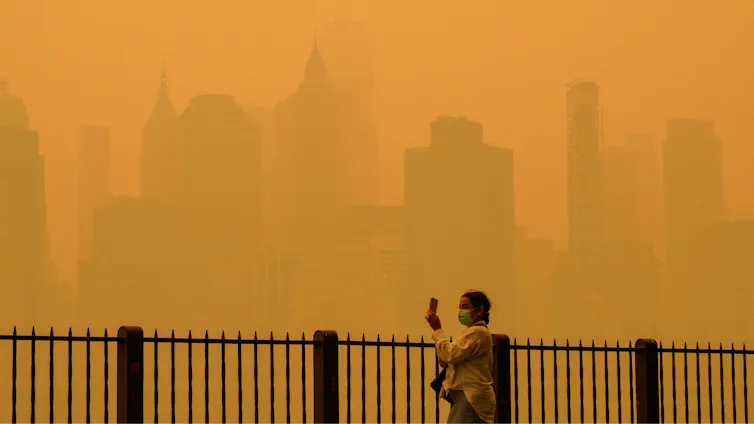
A  person walks along the river holding a phone. Buildings that are normally clearly visible disappear into the haze in New York City.
Wildfire smoke from Canadian fires has turned New York City’s sky a hazy orange several times in recent years. Angela Weiss/AFP via Getty Images

Michael A. Robinson, University of Colorado Boulder

As wildfire smoke plumes travel thousands of miles, sunlight and atmospheric chemistry bleach their color, strip away their campfire aroma and add them to the mix of urban smog.

Smoky skies plagued the East Coast and Midwest again in summer 2026, as wildfires hundreds of miles away forced people to cancel sports practices and run air conditioners around the clock.

Living in the western U.S., I am no stranger to this scene. Wildfires and the thick smoke they produce have become a fixture of summer life here. I also study wildfire smoke as an atmospheric chemist, in particular how the smoke evolves as it moves downwind from the flames to the communities where people breathe it.

To understand what’s in the smoke you might be breathing, you have to look at where it’s been.

A North America map shows how wildfire smoke spreads far from its origin, and stays dense for hundreds of miles.
Wildfire smoke is often too high in the atmosphere to be noticed, but when atmospheric conditions bring it close to the ground, people are left breathing unhealthy particles. Joshua Stevens/NASA Earth Observatory

When a forest burns, the wildfire emits large amounts of fine particulate matter, or PM2.5, along with nitrogen oxides and volatile organic compounds, or VOCs. The compounds and particles emitted by wildfires can harm human health, including the lungs, heart and organs, and include known carcinogens.

How this potent mix of pollutants transforms over time and distance is a complex puzzle. At the NOAA Chemical Sciences Laboratory, our team tracks this behavior, from studying controlled fuel burns in the lab to flying research aircraft through wildfire smoke plumes. Understanding how wildfire smoke ages is essential for predicting its impacts on human health.

It all starts at the flame

The story of smoke begins with how the wildfire burns. High temperature wildfires behave very differently from cool, smoldering wildfires.

Hot, intense flames produce nitrogen oxides, which can harm a person’s respiratory system and contribute to the formation of secondary pollutants and reactive carbon compounds like aromatic hydrocarbons, which can increase the risk of certain cancers with long-term exposure. They also emit smaller amounts of nitrous acid, hydrogen cyanide and isocyanic acid, all of which can be toxic to humans.

Wildfire smoke rising in the distance under a blue sky, viewed from a plane.
Smoke from a wildfire lofts high into the air. As it moves, its chemical composition changes. Steven S. Brown

In contrast, lower-temperature smoldering wildfires release a different mix of compounds, but it is still enriched with toxic aromatic oxygenates and ammonia, which can irritate the respiratory system. This isn’t to say that these wildfire emissions are safer for human health, but rather that burning conditions dictate the chemical makeup of the smoke and its subsequent chemical fate.

Wildfires are rarely just one or the other; they are dynamic mixtures that shift throughout the day as air temperatures rise, humidity drops or evening thunderstorms roll in.

The inside of a small plane filled with racks of instruments and one passenger seat.
The Twin Otter research planes that National Oceanic and Atmospheric Administration scientists use to study wildfire smoke are packed with instruments. Steven S. Brown

Once smoke leaves the flames, three main factors govern its journey: wind speed, atmospheric temperature and sunlight.

Think of a campfire. If you are sitting in the wrong spot, the prevailing wind blows smoke directly in your face. This horizontal movement is called advection. Small fires often don’t generate enough heat to loft their smoke high, meaning you can smell your neighbor’s campfire.

However, massive wildfires generate immense heat and powerful upward winds. This buoyancy acts like an elevator, lifting the smoke plume out of the planetary boundary layer and injecting it into the free troposphere, roughly 1.2 miles (2 kilometers) above the ground. Up there, high-altitude winds take over, transporting the smoke thousands of miles across the continent.

A large smoke plume rises high into the atmosphere
A large smoke plume rises high into the atmosphere. Michael A. Robinson

On occasion, wildfire plumes can generate their own weather, making smoke-laden pyrocumulonimbus clouds, which can inject large amounts of particles into the stratosphere.

How sunlight ‘ages’ the smoke

As smoke travels, it undergoes rapid physical and chemical changes.

First, the plume dilutes as cleaner background air mixes into it. Close to the fire, the smoke is dense and opaque. As it moves downwind, it spreads out and grows more diffuse.

Second, intense sunlight acts as a chemical engine. Solar ultraviolet photons break apart bonds in molecules, creating radicals, which oxidize VOCs. Nitrogen oxides play a key role in driving this chemistry.

Within just hours of being emitted, this mixture reacts to form ground-level ozone, which can irritate the lungs and is a key component of smog.

The wing of a research plane with the orange sky against the smoke plume and blue sky below behind it.
When the Sun shines through thick wildfire smoke, it turns the sky a dirty orange. Steven S. Brown

If smoke is lofted high, into cold free tropospheric air, the chemical aging process can temporarily freeze. The smoke can remain chemically fresh until the air parcel sinks closer to the surface, below about 1.25 miles (2 kilometers), where warmer temperatures can restart the chemical reactions.

When an aging smoke plume passes over a major city, it can mix with urban pollution, such as car exhaust. This interaction can rekindle chemical reactions, creating additional local ozone on top of the fine particulate matter emitted from the fire.

Why distant smoke smells and looks different

Have you ever noticed that long-distance wildfire smoke doesn’t smell like a campfire? There is a chemical reason for that.

The specific compounds responsible for the classic smoky aroma of a campfire – phenolic compounds like guaiacol and syringol – are highly reactive. Sunlight and the associated chemistry destroy them in a matter of hours. By the time the smoke has traveled across several states, the smoky smell is completely gone.

Sunlight also alters the color of the smoke through chemical bleaching of aerosols. Fresh smoke contains dark brown and black carbon particles that absorb light. Over several days of exposure to sunlight and oxidants, chemical reactions break down these dark compounds.

A lifeguard on a stand on a beach. The smoke is so thick, a sailboat is barely visible in the background.
A sailboat passing a lifeguard stand along Chicago’s Lake Michigan is obscured by Canadian wildfire smoke that blanketed the city on July 16, 2026. Scott Olson/Getty Images

The result?

Dark, light-absorbing particles turn into light-scattering particles, transforming dark, dense plumes into the milky white haze seen drifting across the eastern skies. These particles efficiently scatter the blue and green light while letting red and orange wavelengths pass through, creating the uncanny feeling of an all-day sunset.

The wildfire smoke inhaled hundreds of miles downwind is chemically distinct from the smoke that left the flames, but it remains a serious health threat and an area of active research. Consequently, smoke transport and its associated atmospheric chemistry represent a major North American air quality issue, one projected to intensify in the coming years.

Michael A. Robinson, Research Scientist in Atmospheric Chemistry, University of Colorado Boulder

This article is republished from The Conversation under a Creative Commons license. Read the original article.

ooOOoo

As you can see from the second image, the map of wildfire smoke, here in Oregon there has been substantial smoke, albeit because we live to the west of the Cascades, we have not been directly affected.

However, the summer of 2027 is predicted to be an even drier period than this year, and the potential for wildfires and the associated smoke is a problem that is not going away.
George Monbiot’s wake-up call!

We are losing our fundamental rights.

I follow George Monbiot, and have had his permission for some time to republish his articles.

I was born in November, 1944, some six months before the end of WWII. Over all these years, I have read countless essays and articles about the state of countries, and the world.

However, George’s latest article is the most serious reflection on the state of things, effected by the rich and powerful, that I have ever read. I’m sure I speak for millions of other people.

Read this now!

ooOOoo

Our 1933 Moment

Posted on the 4th August 2026

At astonishing speed, around the world, fundamental rights are being cancelled at the behest of oligarchs and corporations.

By George Monbiot, published in the Guardian  31st July 2026

No more resistance in the US. The era of human rights is over, and dissent is once more forbidden. This is what certain billionaires and their concierges want, and this is the model they’re also seeking to project across the world. If we fail to resist, if our new prime minister is as weak and suggestible as the last one, this is what we will get. In fact, we are halfway there already.

Why? Because successive governments in the UK have succumbed to a global campaign to cancel our fundamental freedoms, a campaign led by oligarchs and corporations, the media they own and the junktanks they fund. A campaign that has become definitional for the second Trump presidency.

At a global summit convened by the US government earlier this month, the Trump administration officials Marco Rubio, Stephen Miller and Scott Bessent explained that they were redirecting counterterrorism efforts away from Islamic jihadism and towards “the political left”. Most of the examples they cited to justify this shift were more than 30 years old. Several times they had to dig down to the 1970s to find a sufficiently menacing threat. You could hear the barrel being scraped.

Without producing a shred of evidence, Rubio, the secretary of state, claimed that the Cuban government is “inextricably linked to the far-left groups and movements across and beyond the west”. The following week, his department sought to justify this claim with a report containing a long list of leftwing legislators, journalists and activists that attempted to link them to Cuba in ways that ranged from the tenuous to the hilarious. This is a well-honed tactic, used prolifically by the Nazis among others: they claimed dissenters, by definition, were part of an international communist conspiracy. They insisted, as Rubio did, that “it is time to crush this evil for ever”.

That wasn’t the only crude reminder. Miller, Donald Trump’s deputy chief of staff, maintained that when you see antifascist protests, “not one of the people that is demonstrating looks like a normal person. Not one looks normal. They’re all deformed in some way – in their appearance, in their dress, in their mannerism … their outer appearance becomes a manifestation of their inner hatred.” I’m just surprised he didn’t say “untermenschen”. The US government, by contrast, promotes “normal, healthy, ordered living”.

But what hit me even harder was Miller’s attack on “jury nullification”: jurors acquitting people who, he said, were “obviously guilty”. Shutting down this possibility has been an aim of illiberal governments and conservative judges around the world. We saw it in the UK in the prosecution of Trudi Warner and others for holding signs that state an ancient principle in English law: “Jurors have an absolute right to acquit a defendant according to their conscience.”

We see it in the astonishing prosecution, being pursued at the moment, of Rajiv Menon KC, who reminded jurors of this right at the trial of the Palestine Action campaigners he was defending. He became, as a result, the first lawyer in English history to be charged with contempt of court for a closing speech. If convicted, he faces up to two years’ imprisonment and will be struck off. Prosecuting lawyers for defending their dissident clients is more or less the definition of authoritarianism.

We also saw it in the assault Keir Starmer launched on jury trials as a whole, greatly curtailing, without any coherent justification, our strongest defence against injustice.

Starmer was a weak man, without a clear vision of his own, who was rolled by any powerful state or corporate lobby. He was no match for a well-funded and highly effective international campaign. A network of groups such as the American Legislative Exchange Council, funded by corporations and billionaires, has been producing “model legislation”. The groups test these laws in sympathetic jurisdictions. If they are found to work, they then press for their adoption elsewhere. The result is a sustained assault on our rights to protest, to political equality and to a habitable planet.

The globalisation of this attack on our fundamental rights is a key conservative aim. As capital operates everywhere, so should its ability to crush our objections. The long series of vicious anti-protest laws in the UK is an outcome of sustained lobbying by junktanks, the media and other governments. The result is a country that now keeps hundreds of political prisoners, a country in which you can get six months in jail for marching slowly down the street.

These oppressive laws have culminated – so far – in an act of parliament passed in April that enables the police to shut down any protest they deem to have a “cumulative” impact on the community. The only protests that have ever succeeded are those with a cumulative impact. Protest is acceptable as long as it’s useless. Let the people have their say, but only if we can’t hear them.

The new laws have been accompanied by that age-old trick, traditionally associated with fascist regimes, of smearing leftwing dissidents as terrorists. As the rights group Liberty has pointed out, the definition of terrorism here has greatly expanded, to incorporate tactics formerly regarded as civil protest. This is what enabled Starmer’s government to ban Palestine Action.

The judge who referred Menon for contempt, Mr Justice Johnson, was also the first – at the same trial – to use the extraordinary powers quietly inserted by the Conservatives into the Sentencing Act 2020. These enable someone tried for one crime to be sentenced for another. The four Palestine Action protesters were convicted of ordinary crimes. But, without informing the jury, Johnson marked the case as having a “terrorist connection”. He then sentenced them for terrorist offences, which means much more prison time.

Already, his example has been followed by another judge: a different group of pro-Palestine protesters, who sprayed red paint and broke some windows of a branch of Barclays Bank, are about to be sentenced as terrorists, though neither they nor the jurors were told of this possibility during their trial for criminal damage. This means, of course, that they were unable to defend themselves against this far more serious charge.

Nothing is safe from the billionaire assault on humanity. None of our rights, however ancient and familiar, are impregnable. Fight for them now or lose them, perhaps for ever.

http://www.monbiot.com

ooOOoo

Congratulations on George Monbiot for writng this. Congratulations to The Guardian newspaper for publishing this article on July 31st, 2026.

Our human rights, everywhere in the free world, have to be fought for.

As George Monbiot says: “Fight for them now or lose them, perhaps for ever.”

Feel absolutely free to republish this post wherever you wish.

Your pet’s milestones.

Another article from Penny.

These milestones would not be in place without us owners. For all pets, cats and dogs and birds, and more, do not think in terms of milestones.

However, our pets are so special to us humans that we create these special moments.

ooOOoo

How to Capture and Cherish Your Pet’s Special Milestones

For pet owners watching their companions move through different pet life stages, the days can blur faster than expected. The core tension is real: documenting pet milestones sounds meaningful, but pet memory keeping often slips between busy routines and the pressure to make every photo, note, or keepsake “perfect.” Yet the emotional value of pet moments shows up later, when a goofy habit fades or a first-time victory becomes a distant detail. Preserving pet memories turns everyday life into something that can be held onto.

Quick Summary: Pet Milestones Made Easy

  • Start by choosing a few essential pet milestones you want to remember and track.
  • Capture special moments with photos to preserve milestones in a simple, shareable way.
  • Record quick notes alongside memories to add context and meaning over time.
  • Keep small keepsakes from key moments to create lasting, tangible reminders.

Rescue Blurry Milestone Photos With AI Upscaling

Once you’ve decided which “firsts” you want to keep, the next challenge is making sure the photos look as special as the moment felt. AI image optimization tools can help rescue milestone shots that are dim, soft, or low-resolution by automatically improving lighting, sharpening tiny details (like whiskers and fur texture), reducing blur, and enriching colors for a clearer, more vibrant result. That’s especially helpful for those quick, imperfect captures, your pet’s first day home, first park trip, or first birthday, where you don’t get a redo.

An AI image upscaler takes this a step further by enhancing resolution and clarity so you can enlarge a favorite photo while still preserving detail and visual quality. If you want a simple starting point, the Adobe Firefly AI image upscaler feature is one way to create a print-ready version for albums, frames, and long-term saving. With your milestone images looking crisp, you’re ready to follow a straightforward process for documenting your pet’s life without overwhelm.

Build a Simple System to Capture Pet Milestones

This process helps you reliably capture your pet’s big moments and keep the memories easy to find later. It matters because when life gets busy, a simple system beats a perfect plan you never use.

  1. Pick your “must-capture” milestones
    Start with 6 to 10 moments you truly care about, such as first day home, first vet visit, first groom, first trip, and adoption anniversary. Keeping the list short prevents decision fatigue and makes it more likely you will follow through. Add one flexible category like “unexpected win” for funny or sweet surprises.
  2. Set up a one-glance reminder you will actually see
    Put key dates into a personalized calendar so upcoming milestones do not sneak past you. A year-round visual reminder also prompts you to capture seasonal favorites like the first sweater day or first beach trip. Choose one place to track dates, not three.
  3. Create a repeatable photo checklist for “firsts”
    When the moment happens, take three quick shots: a wide scene (context), a close-up (face details), and one with you or a family member (connection). Use natural window light when possible and keep the background simple so your pet stays the focus. This tiny checklist makes even rushed photos feel intentional.
  4. Log the memory and file it immediately
    Right after you take the photos, write one sentence in your notes app: what happened, the date, and one detail you do not want to forget. Then save everything into a single folder using the same naming style each time, such as “2026-07 First Park Trip.” This keeps your camera roll from becoming a scavenger hunt.
  5. Organize health records alongside the memories
    Choose one home for pet documents, such as a binder with tabs or a digital folder with subfolders for vaccines, meds, and receipts. After each visit, add a quick summary like weight, any new instructions, and the next due date. Pairing health notes with milestone photos gives you a fuller picture of your pet’s life story.

Habits That Make Pet Milestones Easy to Keep

Milestones are easiest to cherish when they become routine, not a once in a while project. These habits keep memory keeping light, repeatable, and realistic, even on busy weeks.

One-Minute Memory Note

  • What it is: Write one sentence: date, what happened, and one detail you loved.
  • How often: After any notable moment.
  • Why it helps: Tiny notes make photos meaningful years later.

Sunday “Sort and Label” Reset

  • What it is: Spend five minutes naming new photos and moving them into your pet folder.
  • How often: Weekly.
  • Why it helps: You avoid a giant camera roll backlog.

Window-Light Photo Habit

  • What it is: Take pictures near soft diffused lighting instead of harsh overhead bulbs.
  • How often: Whenever you photograph.
  • Why it helps: Your pet looks calmer and clearer in a less stressful light.

Monthly Keepsake Check-In

  • What it is: Add one favorite photo and one note to a monthly album page.
  • How often: Monthly.
  • Why it helps: A median of 59 days can turn effort into autopilot.

Start Small to Preserve Your Pet’s Milestones for Life

It’s easy to love your pet fiercely and still let the little moments slip by in the rush of everyday life. A gentle, routine-first mindset, tiny check-ins instead of big projects, keeps pet memory simple and sustainable while reflecting on the pet-owner bond. Over time, those small captures become a clear, comforting record of pet growth and milestones, valuing your pet’s life journey without pressure. Celebrate one tiny milestone today, and your pet’s story will take care of itself. Pick one small next step now: label a favorite photo, jot a two-line note, or record a quick moment. That’s how motivating pet milestone preservation turns into a steadier sense of connection that lasts well beyond the day.

ooOOoo

Once again Penny has written about looking after our pets, and she has set out some brilliant habits. I particularly like the monthly keepsake check-in, and starting small so that you do not end up not doing anything at all.

Our pets are so precious to us.

Presidential transport

An article about Air Force One.

The Boeing 747, that currently serves as the means of air transport for President Trump, has been written about on The Conversation.

Here is that fascinating article:

ooOOoo

Air Force One is more than transportation – it has defined how presidents run the country and meet the world

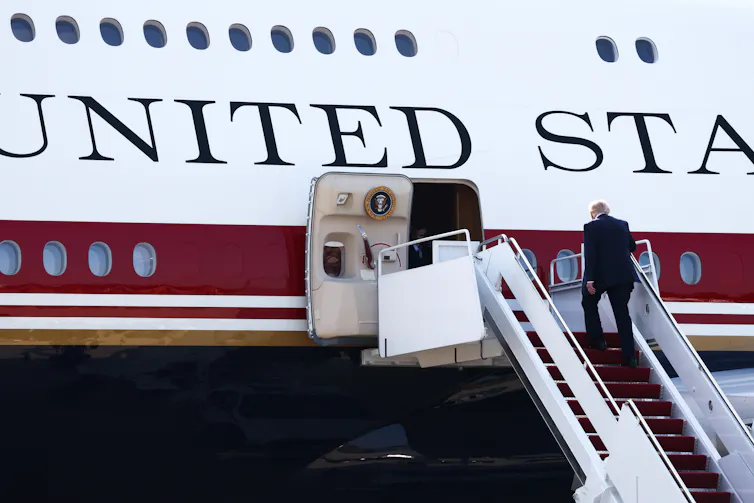
A man in a dark suit climbs a stairway to a large plane.
President Donald Trump boards Air Force One on July 1, 2026, at Joint Base Andrews, Maryland. Finn Gomez/Getty Images

Peter Kastor, Washington University in St. Louis

Air Force One used to be a high-flying symbol of American technology, ingenuity and power. For many, it was also a source of national pride.

The current Boeing 747s that serve as Air Force One are a combination transport vehicle, command center, press room, medical center and apartment, complete with bedroom and office for the nation’s chief executive.

Now, to many, Air Force One has become scandalous.

On July 8, 2026, The New York Times reported that the latest version of the presidential aircraft – presented by Qatar as a gift to President Donald Trump – lacks the sophisticated countermeasures that were a ready defense for the 747s that had been in service since 1990. Critics immediately revived earlier claims that the new 747 was a corrupt transaction from the start. Trump later said the plane would be sent to be “maxed out” with upgrades.

This article is not part of that story. Nor is it the standard story of Air Force One that appears in numerous documentaries, which tend to be gee-whiz accounts of the amazing capacities of the president’s airplane.

I am a historian writing a book about the technologies that have shaped the long history of the American presidency, in which Air Force One looms large. I believe it is important to see Air Force One as more than a cool gadget or political flash point. Von Hardesty, a curator at the Smithsonian’s National Air and Space Museum, certainly understood this when he wrote that “by the end of the 20th century, Air Force One had evolved into an essential arm of the American Presidency.”

Put simply, the presidency as we know it today would have been impossible without Air Force One, which has shaped and defined that role for decades.

A man, waving, and a woman at the top of a stairway leading down from an airplane with 'UNITED STATES OF AMERICA' painted on its side.
President Richard Nixon waves to the crowds from Air Force One with his wife, Pat, as they arrive at Ireland’s Shannon Airport on Oct. 3, 1970. Daily Mirror/Mirrorpix via Getty Images

Horse-drawn carriage to the ‘Sacred Cow’

It was only recently that Americans or their presidents could imagine things this way. When presidents left the capital throughout most of the nation’s history, it was a lengthy, at times arduous, process that severed their connection with government offices.

As a result, presidents rarely traveled while in office and were more likely to depart Washington for extended vacations than for official business. Likewise, no serving president left the United States until Teddy Roosevelt visited the construction of the Panama Canal in 1906. Woodrow Wilson became the first sitting president to cross the Atlantic when he boarded the USS George Washington in 1918 to join the negotiations in Versailles at the end of World War I.

If few presidents got away from Washington to see the country and its residents before 1900, the flip side was also true: Few Americans saw presidential candidates or incumbents in person, especially Americans who lived outside the eastern third of the United States. Instead, the connection between presidents and average citizens was mediated through political parties, the press and eventually through broadcast media.

The first designated presidential aircraft arrived in 1933, but Franklin Roosevelt never flew on it. His first flight as president came in 1943, when American Airlines loaned a flying boat called the Dixie Clipper to ferry Roosevelt to meet with other Allied leaders at the Casablanca Conference. In 1945, Roosevelt traveled to Yalta on a Douglas VC-54C called the Sacred Cow, the first plane specifically built for presidential travel.

Two men, one in a suit and the other in a military uniform, sitting next to each other and talking on an airplane.
President Franklin Roosevelt and Gen. Dwight Eisenhower on the president’s plane en route to the Tehran Conference in December 1943. George Rinhart/Corbis via Getty Images

Despite these flights to important international meetings, Roosevelt and successors Harry Truman and Dwight Eisenhower made limited domestic use of aircraft, preferring instead to travel by railroad. International trips remained lengthy journeys in loud, propeller-driven aircraft that encountered the greater turbulence of lower altitudes.

All this changed in 1962, when President John Kennedy acquired a brand-new Boeing 707, the first jet-powered Air Force One.

Presidential ubiquity

Flying higher, faster and quieter than their predecessors, the jet aircraft used for Air Force One made possible one of the central facets of the modern presidency: The nation’s chief executive could be a ubiquitous player in national politics and world affairs.

Presidential travel increased dramatically, both in its frequency and in the number of stops on each trip. This was not simply the result of the growing use of air travel worldwide. Where Roosevelt, Truman and Eisenhower understood world leadership as their ability to coordinate American power from Washington, Kennedy and his successors sought to make themselves the center of the story.

This seemed particularly important during the Cold War. As the United States asserted its leadership in the struggle against the Soviet Union, American presidents positioned themselves as the symbols of freedom in opposition to communism.

Consider President Richard Nixon traveling to China in 1972 to normalize relations, or Ronald Reagan flying to Iceland for the 1986 Reykjavík conference with Soviet leader Mikhail Gorbachev to negotiate the future of intermediate-range nuclear missiles. The presence of a president at these conferences elevated both the importance of the event and the image of the president as a statesman who was able to quickly pivot back and forth from national to international leadership.
As American presidents struggled to maintain their power and their relevance after the end of the Cold War, their international travel only increased. Bill Clinton, George W. Bush and Barack Obama each made over twice the number of international trips as Ronald Reagan did.

These trips ranged from goodwill visits to maintain old alliances to attempts to build new connections after the collapse of the Soviet empire.

Presidents specifically visited international hot spots, positioning themselves as global peacemakers. The sight of the American president descending the long stairs from Air Force One, smiling and waving along the way, became a symbol of American diplomacy.

A group of people seated on an airplane listening to a man speaking and gesturing with his hands.
President Jimmy Carter meets with reporters aboard Air Force One on July 1, 1979, while flying from Seoul, South Korea, to Honolulu. AP Photo/Ira Schwarz

Official business – and campaigning

If Air Force One enabled presidents to announce themselves as statesmen abroad, it also revolutionized politics at home.

During the 1970s, the two major parties moved from selecting their nominees at national conventions to a system where state primaries decided who would lead the ticket.

This change emerged from demands that political power move from party leaders to party members. But a primary system would have been unimaginable without aircraft to shuttle candidates around the country. That was particularly important for incumbents, as air travel enabled them to be both sitting presidents and active candidates.

Presidents and their handlers learned how to combine official government business, which permitted the use of Air Force One, with campaign opportunities. These moments not only changed how presidents operated; they changed how Americans understood their presidents.

This change began with Kennedy’s use of the jet-powered Air Force One for domestic travel, including the tragic decision to visit Texas in November 1963, where he was assassinated. In just his first year in office, Bill Clinton visited 37 states over the course of 73 days.

Air Force One is a symbol of presidential power, but its problems only reinforce the fact that technology shapes the presidency.

The clearest demonstration was on 9/11. President Bush was in Florida that morning. Air Force One whisked him into the air, delivering him first to the safety of an Air Force base in Louisiana and then to the fortified headquarters of the U.S. Strategic Command in Nebraska, and still had him back at the White House by the end of the day.

It was a grim reminder of the other task for Air Force One: a safe transport for the president during a national crisis or nuclear armageddon. While the aircraft fulfilled its promise to keep the president safe in a crisis, its legendary communication systems faltered. Crucially, Bush struggled to coordinate with senior officials in Washington, leaving him momentarily out of the loop at a terrifying historical juncture.

The role that presidents have assumed at home and abroad, as well as the ways Americans interact with their presidents, have taken form through the possibilities – and the limitations – of presidential aircraft. Air Force One is not just a great way to travel or a nifty gadget, nor is it peripheral to the presidency. It is central to it.

Peter Kastor, Professor of History & American Culture Studies, Washington University in St. Louis

This article is republished from The Conversation under a Creative Commons license. Read the original article.

ooOOoo

The last sentence of the last paragraph spells out how Air Force One is central to the presidency. The aircraft serves as a symbol of presidential power.

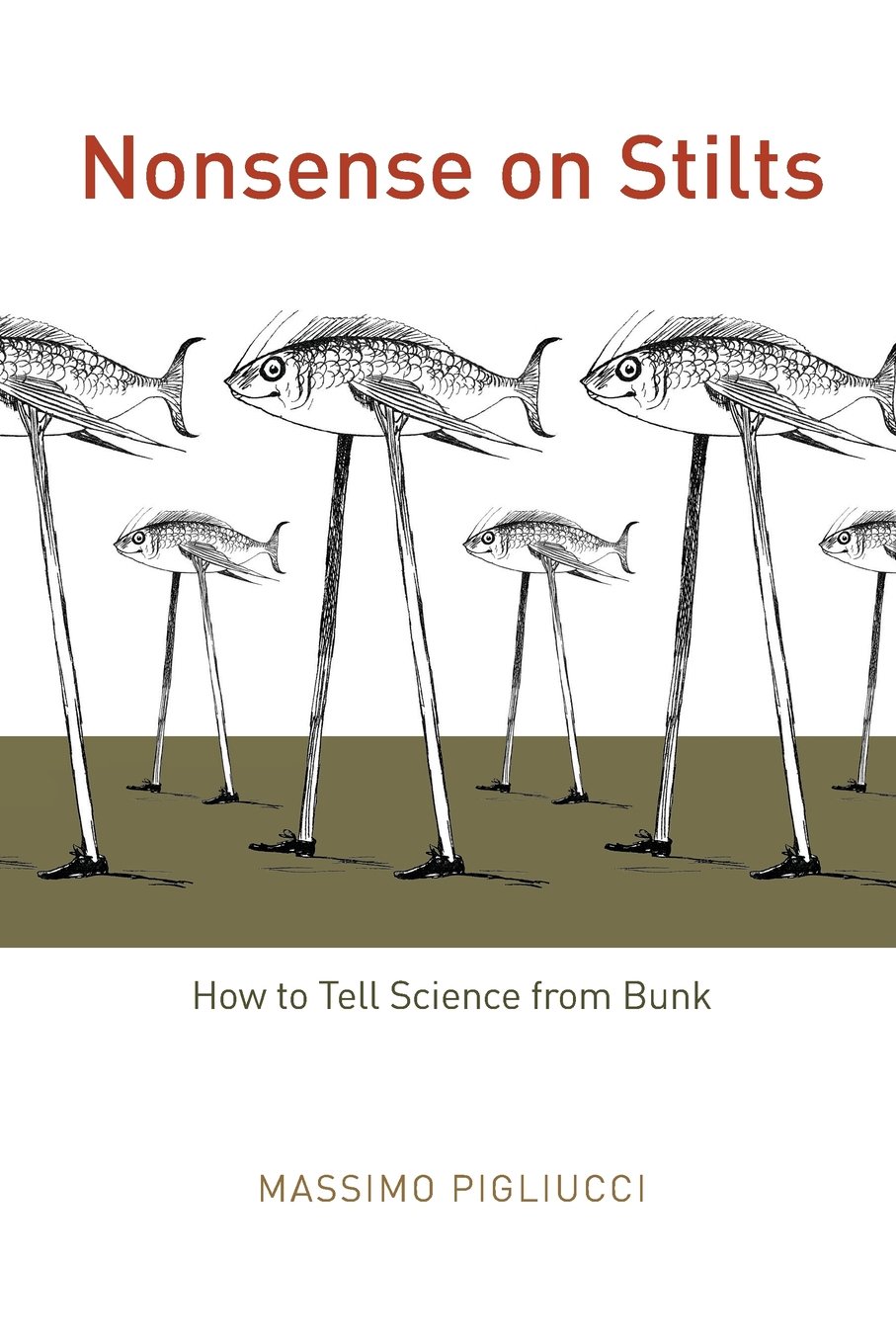
Nonsense on Stilts

The book by Massimo Pigliucci.

The subtitle of the book is “How to Tell Science from Bunk“

I am up to page 48 and I read something that is so obvious but had not occured to me before now. I have spoken to friends and they, too, had not realised this.

Namely, that the fact that “…. a variation on the old latitudinal hypothesis ….. explains a major causal factor explaining the rise of more successful civilizations in Euroasia, say, than in sub-Saharan Africa or on the American continent, is that Euroasia expands along an East-West axis.“

This East-West expansion provides greater opportunity for the invention of agriculture and the domestication of, say, the horse. Simply because feed crops are easier to grow owing to the smaller change in weather patterns. Unlike, the North-South expansion, where there is the problem of having to adjust to different weather towards the North or towards the South.

Here is the book from Amazon.

Version 1.0.0

It is a very interesting book.

The wildfire smoke

A useful article from The Conversation.

When I first read this article, I thought everyone will be aware, such is the awareness of wildfire smoke in so many places, and media.

Then I realised that this was wrong, and if only one or two people benefit from the advice then it should be republished. The original was on The Conversation.

ooOOoo

Yes, breathing wildfire smoke can harm your health – here’s what you can do to protect yourself

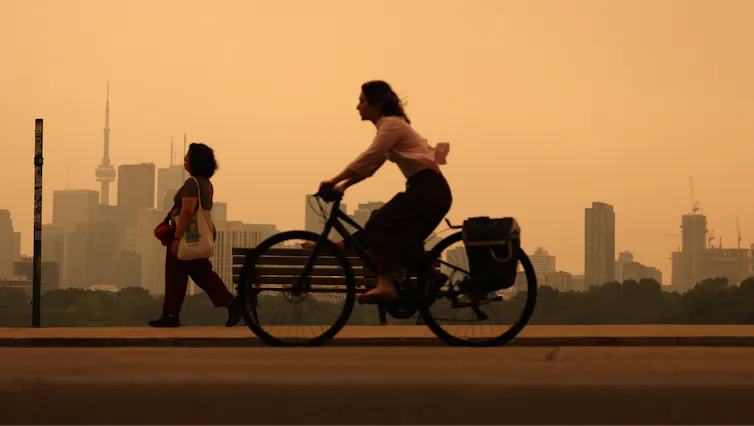
A woman rides a bike through city air tinted orange by wildfire smoke. Neither she nor a woman walking in the background is wearing a protective mask.
Heavy wildfire smoke from Canada’s forests turn skies orange in Toronto and across parts of the U.S. in July 2026. Steve Russell/Toronto Star via Getty Images

Colleen E. Reid, University of Colorado Boulder

Wildfire smoke from fires burning in Canada and northern Minnesota has been pouring across the Great Lakes and northeastern U.S. states, turning skies an eerie shade of orange. In the West, smoke has also been spreading into communities in Colorado and neighboring states as more wildfires burn in hot, dry conditions in July 2026.

University of Colorado environmental health researcher Colleen Reid explains what’s in that smoke and why breathing it is a health concern everyone should be aware of.

What is in wildfire smoke?

Wildfire smoke is a complex mixture that includes nitrogen oxides, volatile organic compounds, polycyclic aromatic hydrocarbons, carbon monoxide, carbon dioxide and particulate matter. When homes or buildings also burn, they can release an even more toxic stew of chemicals from burning electronics, furniture, plastics, paints and much more.

What you see when you see a smoke plume or when the air is hazy with wildfire smoke are the tiny particles that are too small to fall to the ground right away with gravity.

These particles, which scientists call particulate matter, are very small – we measure them in microns. When you breathe them in, they can harm your health. The smaller the particles, the deeper they can get into your lungs and body.

Map shows heavy smoke and low air quality across the Great Lakes Region and into the Northeast
EPA air quality monitors show high risks from smoke in many parts of the Great Lakes and northeastern U.S. on July 15, 2026. Reds are considered very unhealthy levels. Purples are either extremely unhealthy for light purple or hazardous for areas in maroon. AirNow Fire and Smoke Map

You may have heard the term PM2.5. It means particles that are 2.5 microns or smaller in diameter, many times smaller than the width of a human hair. High concentrations of these particles in the air during wildfire smoke episodes are what trigger air quality alerts.

Has wildfire smoke been increasing recently, and why?

Yes, wildfires have become more frequent and more intense just in the past couple of decades, and when wildfires become more frequent and intense, so does the smoke.

Scientists have found that wildfires are becoming more frequent due to a variety of factors that include increases in fire weather – hot, dry, windy conditions that fuel the spread of fires due to climate change – as well as other natural and human factors. The reasons for the increases in wildfires vary in different parts of the world.

Other studies have found that wildfire smoke makes up an increasing portion of the PM2.5 in the air in the U.S., and in many areas it is offsetting the decreases in air pollution that the U.S. has gained through regulations of industrial and vehicle emissions under the Clean Air Act.

How could wildfire smoke affect my health?

Some effects of breathing wildfire smoke include shortness of breath, coughing, itchy or watery eyes, headaches, rashes and itchiness. But smoke can cause more serious harm. Numerous epidemiological studies have shown that hospitalizations and emergency department visits for asthma and other respiratory diseases increase during wildfire smoke events.

After you breathe in the particles, they cause inflammation and oxidative stress, and they can move into the blood and spread throughout the body, affecting other organ systems.

People stand in a field as a smoke plume turns the sky orange and then dark.
The height of a smoke plume, like this one from Colorado’s Aspen Acres fire near Pueblo on July 1, 2026, affects the amount of particles and chemicals people on the ground are exposed to. But generally, if you can smell smoke, you’re breathing it in. Michael Ciaglo/Getty Images

Breathing wildfire smoke has been associated with higher risk of preterm births and other issues during pregnancy, and potentially cardiovascular problems such as heart attacks and strokes, although the evidence for these effects are more mixed.

The longer-term health effects of wildfire smoke are less clear, but it is a growing area of research.

Where can I learn more about wildfire smoke risks where I live?

The first thing to do to protect yourself from wildfire smoke is to know how bad the smoke is and how long it is going to last.

One great place to get information for where you live on current wildfire smoke is fire.airnow.gov. You can zoom in on the map to where you live and find color-coded circles reflecting data from both U.S. EPA air-quality monitors and PurpleAir sensors that people have put in their homes.

The colors show the level of PM2.5 at that location and suggest the associated health risk.

To find out how wildfire smoke is expected to change over time in North America, you can look at maps from FireSmoke Canada and the U.S. Interagency Wildland Fire Air Quality Response Program.

What can I do to protect myself and my family from wildfire smoke?

First of all, depending on the level of the air quality index where you are, there are different recommendations. When wildfire smoke reaches unhealthy levels, stay indoors as much as possible, with doors and windows shut to keep the wildfire smoke out.

If you have an air cleaner, use it, but check the filter, as filters can fill up quickly. Similarly, check the filter on your home HVAC system and replace it if needed.

If you have to go outside, consider wearing a well-fitting N95, KN95 or KF94 mask. These masks can protect you from inhaling particles in the air around you. Looser masks, such as surgical masks, mostly protect others from what you breathe out instead. They do not have a tight seal around your mouth, and when you breathe in, the air with all of the particles can find its way around the sides of the mask.

Having a tight fit of the mask to your face is important so that when you breathe, the air is going through the mask and capturing the smoke particles rather than letting them into your body where they cause harm.

If your home is leaky and you can see haze inside, consider going to a public space, such as a library or mall, with a good HVAC system. Some municipalities have designated clean air spaces where anyone can go.

Colleen E. Reid, Associate Professor of Geography, University of Colorado Boulder

This article is republished from The Conversation under a Creative Commons license. Read the original article.

ooOOoo

Thank you, Colleen, and thank you The Conversation. Lots of good advice.

Has this UK Government gone insane!

A post by George Monbiot on the 9th July explains.

I looked up quotations about government, and this one caught my eye: “Government, even in its best state, is but a necessary evil; in its worst state, an intolerable one.” — Thomas Paine.

Here is that post by George, republished with his permission.

ooOOoo

In Deep

Posted on 9th July 2026

The numbers are simply mind-blowing: up to £264 billion for a climate “solution” that will increase emissions. Has the government lost its mind?

By George Monbiot, published in the Guardian 8th July 2026

The new prime minister will be looking for money? Well, here’s £21.7bn lying on the ground. The government could cancel its deranged, disastrous carbon capture and storage (CCS) programme at no cost to public welfare: in fact, it would greatly reduce the harm we will suffer.

Sorry, did I say £21.7bn? That’s the figure the government has been putting in its press releases for spending on this programme between now and 2050. But this covers only the first phase of the project. The climate experts Dr Andrew Boswell and Simon Oldridge worked through the data produced by the government’s Climate Change Committee, which was scattered across different spreadsheets, and discovered that the projected cost of the full CCS programme between now and 2050 is £264bn.

Yes, £264bn. More than a quarter of a trillion. This cost will be divided between the public and private sectors. Given the record of CCS programmes so far, we can expect the public to carry most of it.

An investigation by the House of Commons Public Accounts Committee found that roughly 25% of the public costs of CCS will be borne directly by the government, while the remainder will come from extra levies on our energy bills. The government should explain to the electorate that it intends to slap up to £198bn on our bills. Then see how that lands.

Even this might not be the end of it. Buried in an arcane side document is a government commitment to pay a “premium” for the hydrogen produced by the CCS programme for 15 years. This commitment is uncosted, but could run to tens of billions more.

But surely CCS is essential for cutting carbon emissions? That’s how the government has pitched it. On the contrary, this programme will massively increase them. The Climate Change Committee claims that the role of CCS is “limited to sectors where there are few, or no, alternatives”. But this is simply untrue. Its own data shows that only between 5% and 6% of the CCS deployment in the UK will be used to address the emissions of industrial sectors such as chemicals and cement, whose impact is hard to abate (though even here there are partial alternatives).

The great majority of CCS will be attached to new fossil fuel-burning power stations, wood-burning power stations and hydrogen production from fossil gas. In fact, almost all the projects in the government’s first tranche are for fossil fuel-based schemes. But there are abundant alternatives to these highly destructive plans. Given the speed at which battery technology is evolving, enabling a balanced and reliable electricity supply without any use of fossil fuels, the committee’s claim is bunkum.

Its insistence that we need hydrogen made from fossil gas is also baseless. Its own figures show that producing hydrogen from gas with CCS will cost twice as much by 2050 as producing it from the electrolysis of water, using renewable electricity.

The new CCS plants will mean massively more gas use than the UK would otherwise have required. Ultimately, that means more imports of liquefied natural gas (LNG). We now know that, thanks to methane leakage along the production and transport chain, LNG has higher emissions than coal. Two-thirds of its greenhouse impact occurs before the gas arrives in this country. So that’s all right then – it doesn’t count towards our national figures.

If the real aim were to cut emissions, we would push fossil fuel use in the electricity sector down to zero, and scale up renewables and battery storage instead. The net effect? Much lower climate impacts and much lower bills. Instead, the programme will greatly ramp up both. Why?

Well, the whole thing has been built the wrong way round. It appears likely to be the result of massive lobbying by fossil fuel companies. In 2023 alone, as the key decision on deployment loomed, the oil companies Equinor, BP and ExxonMobil attended 24 meetings with Conservative ministers to discuss CCS. Why? Because they know it’s the only way they will be permitted to keep burning gas. Governments have sought to find a way of meeting their demands while adhering to the climate budgets, so lo, a £264bn white elephant is born. As the Climate Change Committee admits, “gas with CCS accounts for around half of the remaining demand for fossil fuels in 2050” in the UK. In other words, this is their lifeline.

And now we know something else: that the scientific credibility of CCS as a climate solution was shaped by the oil company BP. Investigative work by ProPublica and Drilled discovered that BP both financed and helped steer one of the most famous of all climate papers. The “Wedges” paper, published in 2004, became a foundation of government policy around the world. It purported to show how climate stabilisation was compatible with continued fossil use. And one of the major policies its plan relied on was carbon capture and storage.

BP’s chief executive suggested the “wedges” concept. Another BP executive was so heavily involved that the scientists suggested he should be named as co-author. He declined: the industry tries not to leave fingerprints. The paper greatly oversold CCS, presenting it as “already deployed at an industrial scale”. In reality, it had barely been tested. Yet it underpinned three of the 15 climate actions the paper proposed.

Since then, there has been a long record of shiny promises followed by partial or total failures. In the UK alone, three attempts (the 2005 Peterhead plan, a 2011 demonstration project and a 2012 funding competition) have been abandoned, thanks to cost escalation and infeasibility. As the Public Accounts Committee remarks, the government “is taking a high-risk approach by backing first-of-a-kind, unproven technologies with large amounts of taxpayer and consumer funding”.

But success is not the point. The point is to provide a gigantic, publicly-funded reason for the fossil fuel industry to stay in business. Guess who the lead operator of the government’s first CCS cluster is. Hello, BP.

So we come round full circle. From cradle to grave, this programme appeases the world’s most antisocial and destructive sector. The wasted money, the lost years, the lost lives: for how much longer will this farce continue? And how many more warnings will the government ignore?

http://www.monbiot.com

ooOOoo

I am towards the end of my days, and we live a pretty frugal (as in use of fossil fuels) life.

However, that does not mean that I am not very concerned about George’s essay. I have a son, a daughter, and a grandson. They are a tangible group who will be affected by this proposed legislation. As will millions of other people.

I really hope, and this is truly meant, that the UK Government does not push ahead with this Act.

Our changing world.

Now, it is the technology being applied to our electricity supply.

Although we have an array of solar panels here at home, we still have electricity cables coming to the house. In the Winter, when the solar panels are nowhere enough for our electic consumption, we depend on Pacific Power to provide the electic power for our home.

That is why the following article, published by The Conversation, was highly relevant.

ooOOoo

Electric companies don’t need to black out customers to prevent wildfires – here are 3 relatively fast, affordable solutions

Jasmine Garland, University of Colorado Boulder

A severe winter snow drought has left snowpack levels far below normal across the American West in 2026. Without a slow-melting blanket of snow to keep the soil and forests moist, alpine vegetation is drying into a tinderbox earlier than normal and ramping up the fire risk.

The historic dryness means electric utilities are facing a dilemma: how to deliver power through dry, windy regions without accidentally starting a catastrophic fire.

To cope, many utilities are turning to a controversial method pioneered in California: the public safety power shut-off – better known as a preemptive blackout. Imagine your power provider deliberately cutting electricity to your entire neighborhood for hours to days, not because a storm hit or a wire broke, but because the weather forecast is hot, dry and windy. This preventive darkness is fast becoming the new normal for millions of residents in the West.

A map of the Western U.S. shows just about everywhere except northern Idaho far below normal.
Most of the snowpack in the Western U.S. was far below the 30-year average in June 2026, suggesting a dry summer ahead. Snow-water equivalent is a measure of the amount of water in snowpack. National Water and Climate Center

As an energy systems researcher living in the West, I study how our electric grid interacts with these escalating climate risks. I believe utilities have better options that boost fire safety quickly while avoiding the drastic move of shutting off the power or investing in expensive alternatives, such as underground power lines or microgrids.

Billion-dollar spark: Why the West is going dark

To understand why a utility would willingly turn off its own product, you have to look at how the Western grid was built.

Most rural power lines consist of bare, uninsulated aluminum wires strung across thousands of miles of wooden poles, often through rugged forests. If those wires accidentally touch one another or trees or the ground, they can short-circuit, sending off sparks that can start fires.

This system, once considered the greatest engineering achievement of the 20th century, has been responsible for some of the worst fire disasters in U.S. history.

Utility workers in hard hats and reflective vests burying a power line in a trench next to a road.
Burying power lines can keep the wind from blowing tree branches into them, but it can be prohibitively expensive, particularly where transmission lines pass through rugged mountains. AP Photo/Rich Pedroncelli

In California, electricity infrastructure has ignited eight of the state’s 20 most destructive wildfires. The legal and financial fallout can be devastating. In 2019, Pacific Gas & Electric was forced into bankruptcy due to an estimated US$30 billion in wildfire liabilities stemming from equipment-caused blazes, including the 2018 Camp Fire that destroyed much of the town of Paradise. Because utilities are regulated monopolies, they can pass these massive liability costs to their customers over time.

California utilities have been using preemptive outages for several years to avoid causing more fires on hot, dry, windy days. Today, that strategy has spread beyond the state. According to the Western Electricity Coordinating Council, the independent grid reliability authority for the West, 24 western power entities had used preemptive shut-offs by 2026.

Colorado’s Xcel Energy implemented its first major preemptive blackout in 2025. Some of these outages have left communities without power for up to five days.

Chart shows how the number of utilities and agencies with policies for preemptive blackouts increased from 16 in the years before 2025 to 24 in 2026 alone
The number of utilities and agencies with policies of using wildfire preemptive blackouts has risen quickly in recent years in Western states. Jasmine Garland, based on WECC data, CC BY-ND

Fortunately, keeping communities safe does not have to mean leaving them in the dark. There are ways utilities can modernize electric system infrastructure quickly that lower the fire risk and keep the power flowing.

Solution 1: Covered conductors

The quickest, most cost-effective physical fix is to use covered conductors. Think of the electrical cords in your house. If you touched the bare copper wire inside, it would spark. But you don’t get shocked by household cords because they are wrapped in plastic insulation.

Utilities like Southern California Edison are actively wrapping their high-risk mountain wires in heavy, weather-resistant polymer insulation. By the end of 2025, SCE had installed over 700 circuit miles (1,126 kilometers) of this insulated “tree wire” in high-fire districts over the span of about a year and committed to modify an additional 1,481 miles (2,383 kilometers) by 2028.

A worker stands by a giant roll of covered conductor line – power lines covered in a plastic.
A Southern California Edison crew installs new covered conductor power lines in Aguanga, Calif. Elisa Ferrari/Southern California Edison

If a severe windstorm blows a heavy pine branch directly onto an insulated line, it simply rests against the wire without sparking. It is a highly effective middle-ground fix that’s significantly less expensive than burying transmission lines in mountain forests, and it can be deployed rapidly across thousands of miles.

2. ‘Fast-trip’ settings and topology optimization

Another option is to change how the electricity behaves inside the power line using automated technology.

Traditionally, if a tree branch touched a power line, the system would try to push electricity through the line anyway, causing repeated sparking. Today, utilities are deploying “fast-trip” settings on their circuit breakers.

Think of these like the ultra-sensitive circuit breakers in your home. The microsecond a branch bumps an outdoor line, these smart systems detect the disruption and cut the power to that specific wire before a spark can even form. This allows operators to isolate a single high-risk area rather than shutting down power to an entire county.

Topology optimization is another promising operations technique. It acts like Google Maps for the electric grid. Instead of shutting power down when one line is facing high risks, advanced software attempts to safely route electricity around the danger zone using neighboring, lower-risk lines.

By dynamically changing the pathway of the power, utilities can drastically reduce the electrical load and heat on vulnerable lines without cutting power.

Solution 3: AI and real-time smart sensors

Advanced computer software and artificial intelligence are also helping utilities act with surgical precision.

In the past, if a utility feared a windstorm could spark a fire, it had to shut off power to a large region because it lacked localized data. Today, utilities are deploying smart sensors called dynamic line rating that are installed directly onto power lines. These sensors act like digital stethoscopes, measuring real-time wire temperature, wind speed and line sag.

When combined with panoramic, AI-powered camera networks, the grid gains eyes. Xcel Energy in Colorado has deployed 81 of these cameras. Instead of executing a sweeping blackout, operators can use these cameras and automated smart switches to isolate the high-risk span in a windy canyon while keeping the lights safely on for the surrounding town.

The era of risk-aware grid design

The future of Western energy relies on moving away from static, 20th-century safety manuals and toward a practice called risk-aware dispatching.

In simple terms, this means treating the power grid like a living, breathing weather map. On a calm day, electricity is routed along the cheapest path. But when fire conditions spike, AI algorithms will automatically recalculate the region’s electricity flow, diverting power away from fragile forest lines and routing it through safer plains or underground urban corridors.

The era of cheap, unmonitored overhead power lines is over. To adapt to a changing climate, I believe the grid must evolve from a passive network of copper, aluminum and wood into a smart, dynamic machine. By combining insulated wires, targeted undergrounding of power lines, and real-time sensor data, utilities can avoid sparking devastating fires without resorting to frequent blackouts.

Jasmine Garland, Ph.D. Candidate, University of Colorado Boulder

This article is republished from The Conversation under a Creative Commons license. Read the original article.

ooOOoo

We live (very happily) in a rural part of Southern Oregon. Much of the land close to us is covered in trees. Large parts of our property has trees and bushes. We try and keep the area directly around the home clear, but what with me being over 80 and Jeannie with Parkinson’s, it is a challenging task.

We have had far less snow over the Winter than normal. There is no guarantee the coming Winter will provide the (historically) past levels of snow. We will have to wait and see.

Defiance, even when it is not easy.

Learning the skills of resistance.

Saying ‘no’ is difficult. This is an article from The Conversation that talks of our need at times to be the opposite of friendly, to stand one’s ground, and to be true to yourself.

ooOOoo

The science of defiance: A psychology researcher explains why people comply – and how to resist

Defiance need not be aggressive or loud. Sergio Mendoza Hochmann/Moment via Getty Images

Sunita Sah, Cornell University

You’re in a meeting when your boss suggests changing a number to make the quarterly report look stronger. Heads nod. The slides move on. You feel a knot in your stomach: Do you speak up and risk being branded difficult, or stay silent and become complicit?

Most people picture defiance as dramatic outbursts. In reality, it’s often these small, tense moments where conscience collides with compliance.

I first saw the power of defiance not in the workplace, but closer to home. My mother was the ultimate people-pleaser: timid, polite, eager to accommodate. Barely 4 feet, 10 inches tall, she put everyone else’s needs above her own. But one day, when I was 7, I saw a different side to her.

We were walking home from the grocery store in West Yorkshire, England, when a group of teenage boys blocked our path in a narrow alleyway. They hurled racist insults and told us to “go back home.”

My reaction was instantaneous: Stay quiet, avoid conflict and get past them as quickly as possible. I grabbed my mother’s arm, urging her to move with me. But she didn’t. My quiet, deferential, never-confrontational mother did something completely different. She stopped, turned and looked the boys directly in the eyes. Then she asked, calmly but firmly, “What do you mean?”

She wasn’t loud or aggressive. And in that moment, she showed me that defiance doesn’t always roar, and it can come from the people you least expect.

I’ve carried these lessons into my work as a physician-turned-organizational psychologist. For decades, I’ve studied why people comply, staying silent when they don’t want to, and how they can resist wisely. In my book “Defy: The Power of No in a World that Demands Yes,” I offer a framework based on behavioral science research that can help you defy in ways that are intentional, effective and true to your values.

worried woman seated with another looking at a laptop
One setting where the choice to defy or comply can arise is work. FG Trade/E+ via Getty Images

What defiance really is

When people think of defiance, they often picture teenagers slamming doors, protesters shouting in the streets or rebels breaking rules just for the thrill of it. But that’s not the kind of defiance I study or the kind that shapes our lives most often.

Defiance is not about being oppositional for its own sake. It’s about choosing to act in line with your values when there is pressure to do otherwise.

That pressure can come from anywhere: a boss urging you to fudge the numbers, a friend nudging you toward something you don’t believe in, a culture telling you to stay in your place. Defiance in those moments might be as small as saying “no,” asking for clarification or simply pausing instead of rushing along with the group. Other times, it means speaking up, challenging authority or maybe walking away.

Seen this way, defiance isn’t a fixed trait that some people are born with and others lack. It’s a practice: a skill you can strengthen over time. Some days you might comply, other days you might resist. What matters is that you have the awareness and the tools to make the choice consciously, rather than letting fear or habit decide for you.

Why people comply

If defiance is so important, why do people so often stay silent?

One reason is a psychological process I’ve uncovered in my research: insinuation anxiety. It arises when people worry that not complying with another person’s wishes may be interpreted as a signal of distrust. Turning down a boss’s request to “adjust” the numbers might feel like you’re implying they’re dishonest. To avoid that discomfort, you go along – even when it violates your values.

Behavioral science has long documented this pull toward compliance. In the 1960s, for example, psychologist Stanley Milgram showed that ordinary people would administer what they believed were dangerous electric shocks to strangers simply because an authority figure told them to.

My own research has shown surprisingly high levels of compliance with obviously bad advice, even when given by a stranger with no consequences for disagreeing. People feel immense social pressure to go along with what others suggest. That’s because if you’ve never been trained in how to say no, it feels uncomfortable and awkward.

A framework for action

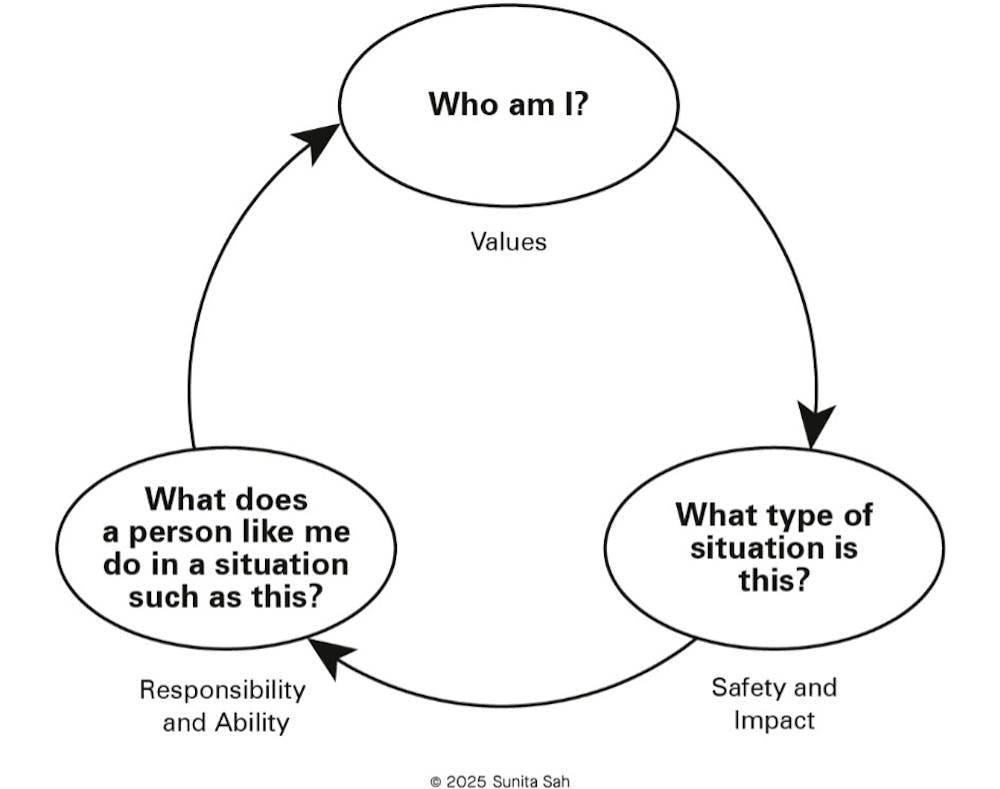
If compliance is the human default, how can you build the muscle of defiance? In my research, I’ve developed a simple actionable guide that I call the Defiance Compass. Like a navigation aid, it orients you in difficult situations by asking three questions:

  1. Who am I? What are the core values that matter most to me?
  2. What type of situation is this? Is it safe to resist? Will it have a positive impact?
  3. What does a person like me do in a situation like this? How can I take responsibility and act in a way that’s consistent with my identity and values?
circular chart with arrows connecting the three questions of the defiance compass
Three questions can help you zero in on whether the time is right for you to defy. Sunita Sah

Asking these questions shifts defiance from a gut reaction to a conscious practice. And here’s what’s important: That third question (“What does a person like me do?”) circles back to the first (“Who am I?”), because how you act again and again becomes who you are.

Defiance doesn’t always mean open confrontation. Sometimes it means asking a clarifying question, buying time or quietly refusing. It can mean speaking up or walking away. The key is to start small, practice regularly and anchor your choices in your values. Like any skill, the more you practice, the more natural it becomes.

Why defiance matters now

Defiance may be risky, but it’s never been more relevant. At work, employees are pressured to meet targets at any cost. In politics, citizens face waves of misinformation and polarization. In everyday life, people struggle to set healthy boundaries. Across all these contexts, the temptation to comply for the sake of comfort is strong.

That’s why learning to defy strategically matters. It protects personal integrity, strengthens institutions and helps sustain democracy. And it doesn’t require being loud or confrontational.

Of course, not every act of defiance is safe or guaranteed to make a difference. Sometimes it comes at real personal cost and some people still choose to act even when the impact isn’t certain: think of Rosa Parks refusing to give up her seat, or Colin Kaepernick taking a knee. In those moments, the act itself becomes the message. Both of those individuals were deeply connected to their values and the assessment is personal: What feels worth the risk to one person might not to another.

Defiance does require practice: noticing when values are at stake, pausing before you nod along, and choosing actions that align with who you want to be. Each act of consent, compliance or defiance shapes not just your story but the stories of our societies.

If you practice defiance, and teach it and model it, you can imagine a different type of society. You can start to envision a world where, in that same alleyway from my childhood, one of the boys will step forward and tell his friends, “That’s not OK. Let them pass.”

Sunita Sah, Professor of Management and Organizations, Cornell University

This article is republished from The Conversation under a Creative Commons license. Read the original article.

ooOOoo

Across the range of society there will always be persons who choose to act with poor social values. Some are very senior, such as many politicians, some are towards the bottom of society. That is a fact of life.

Sunita Sah does us proud in writing this article, and I am delighted to republish it, with the permission of The Conversation.

A Very Dry July 4th

This drought is not ameanable to fireworks.

A few days ago I asked our neighbours to the south of us if they would like to come out on July 4th. The answer was thanks but no. Fireworks and dry forest do not mix and they wanted to stay home for the day.

I write this as an introduction to the latest post from The Conversation.

ooOOoo

Fireworks, heat and drought put this July 4th at high risk for wildfires

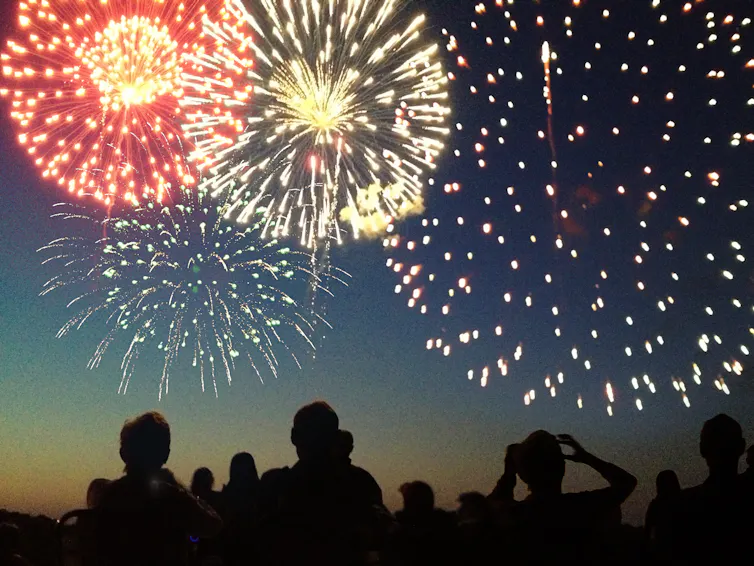
Leaving the pyrotechnics to the professionals is safer and more spectacular. YinYang/iStock/Getty Images Plus

Lauren Lowman, Wake Forest University

Across the United States, the sky will be erupting with fireworks on July 4, 2026, and the days around it as America celebrates the 250th anniversary of its independence. Many cities will be hosting spectacular fireworks shows.

But not everyone will be leaving the pyrotechnics to the professionals, so let’s talk about the risk of fireworks starting fires, including dangerous wildfires.

Fireworks, from bottle rockets to Roman candles, start a lot of fires in the U.S. every year – 32,000 of them in 2023 alone. And each year there is a clear spike in human-caused fires on July 4.

In 2026, much of the U.S. has been very dry and in moderate to severe drought. That means many areas are at high risk for fires igniting and spreading.

Dry start to the year

In the first half of the year, the U.S. has already experienced more wildfires than in the first half of any of the previous 10 years, which has included some of the country’s worst fire years on record.

The southeastern U.S. had far-below-normal precipitation in early 2026, which led to extremely dry conditions that fueled wildfires in the spring. In mid-June, half the region was still in severe to extreme drought.

In the West, a snow drought has put a pinch on water resources and left forests without the usual moisture they would get from a lingering snowpack.

Large parts of the West and Great Plains are in extreme or exceptional drought, including areas of Oklahoma, Nebraska and Utah, where wildfires in June forced entire communities to evacuate. And the national wildfire forecast shows above normal fire risk continuing into July in much of the U.S. West and Texas.

Fire risk forecast map for July 2026 shows high risk across much of the and South and East Texas.
Wildland fire risk projections for July 2026. National Interagency Fire Center

At the same time, large parts of the U.S. West and Southeast are forecast to see above-normal heat along with dryness through early July. Heat waves significantly raise the fire risk. A recent study found that 42% of all land burned in the West from 2001 to 2024 happened during or right after a heat wave.

4th of July fireworks

In hot, dry conditions it doesn’t take much to start a fire. Dry vegetation – trees, shrubs and grasses – provides the fuel. A windy day can substantially raise the risk of a runaway fire. The spark often comes from human activities, whether a car, power line or someone lighting fireworks.

Between 1992 and 2015, humans started 97% of all fires that threatened homes in the wildland-urban interface, the areas where homes and cities overlap with wildlands.

Of all the days, July Fourth stands out for its exceptional number of human-caused fires. From 1992 to 2020, around 15,000 fires were started on this holiday. Even in the eastern U.S., where July falls outside of the peak fire season, Independence Day still sees about 400 more fires than other days that month.

The professionals’ advice

In many states and drought-plagued regions, commercial fireworks are banned for community safety, and not just because of the fire risk. Emergency rooms saw an estimated 9,700 fireworks-related injuries in 2023 – injuries to hands, faces, ears and elsewhere – a third of them involving children.

The National Fire Protection Association encourages everyone to leave the fireworks to the professionals who are prepared to manage any wayward sparks. Public displays are cheaper for you, safer for everyone, and often far more spectacular.

Lauren Lowman, Associate Professor of Civil and Environmental Engineering, Wake Forest University

This article is republished from The Conversation under a Creative Commons license. Read the original article.

ooOOoo

Picking up on the last paragraph of the article, I repeat “leave the fireworks to the professionals ..”.

I wonder how many will abide by that recommendation?

Finally, Jeannie and I wish everyone a Very Happy July 4th.