Tag: Wildfire smoke

That wildfire smoke

Where it has come from can make a real difference.

Previous to this week, I hadn’t really thought of wildfire smoke other than it being a nuisance, so long as it did not get too close to home.

However, a recent article on The Conversation changed my understanding, and I bet there are many others out there that will feel the same way as I do.

ooOOoo

From flames to haze, wildfire smoke transforms as it travels, and it can harm your health in different ways
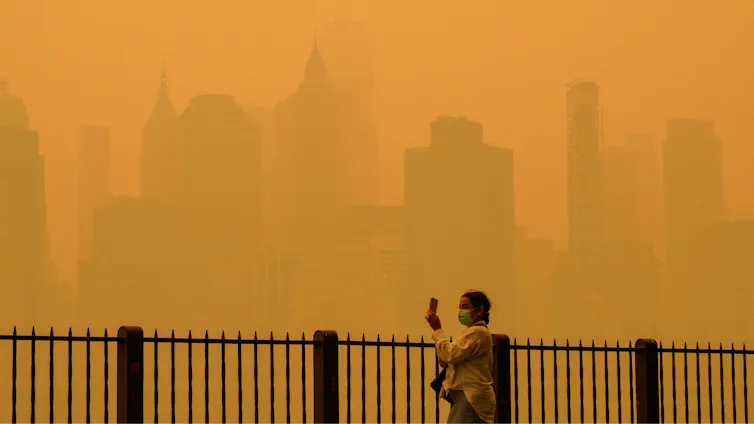
A  person walks along the river holding a phone. Buildings that are normally clearly visible disappear into the haze in New York City.
Wildfire smoke from Canadian fires has turned New York City’s sky a hazy orange several times in recent years. Angela Weiss/AFP via Getty Images

Michael A. Robinson, University of Colorado Boulder

As wildfire smoke plumes travel thousands of miles, sunlight and atmospheric chemistry bleach their color, strip away their campfire aroma and add them to the mix of urban smog.

Smoky skies plagued the East Coast and Midwest again in summer 2026, as wildfires hundreds of miles away forced people to cancel sports practices and run air conditioners around the clock.

Living in the western U.S., I am no stranger to this scene. Wildfires and the thick smoke they produce have become a fixture of summer life here. I also study wildfire smoke as an atmospheric chemist, in particular how the smoke evolves as it moves downwind from the flames to the communities where people breathe it.

To understand what’s in the smoke you might be breathing, you have to look at where it’s been.

A North America map shows how wildfire smoke spreads far from its origin, and stays dense for hundreds of miles.
Wildfire smoke is often too high in the atmosphere to be noticed, but when atmospheric conditions bring it close to the ground, people are left breathing unhealthy particles. Joshua Stevens/NASA Earth Observatory

When a forest burns, the wildfire emits large amounts of fine particulate matter, or PM2.5, along with nitrogen oxides and volatile organic compounds, or VOCs. The compounds and particles emitted by wildfires can harm human health, including the lungs, heart and organs, and include known carcinogens.

How this potent mix of pollutants transforms over time and distance is a complex puzzle. At the NOAA Chemical Sciences Laboratory, our team tracks this behavior, from studying controlled fuel burns in the lab to flying research aircraft through wildfire smoke plumes. Understanding how wildfire smoke ages is essential for predicting its impacts on human health.

It all starts at the flame

The story of smoke begins with how the wildfire burns. High temperature wildfires behave very differently from cool, smoldering wildfires.

Hot, intense flames produce nitrogen oxides, which can harm a person’s respiratory system and contribute to the formation of secondary pollutants and reactive carbon compounds like aromatic hydrocarbons, which can increase the risk of certain cancers with long-term exposure. They also emit smaller amounts of nitrous acid, hydrogen cyanide and isocyanic acid, all of which can be toxic to humans.

Wildfire smoke rising in the distance under a blue sky, viewed from a plane.
Smoke from a wildfire lofts high into the air. As it moves, its chemical composition changes. Steven S. Brown

In contrast, lower-temperature smoldering wildfires release a different mix of compounds, but it is still enriched with toxic aromatic oxygenates and ammonia, which can irritate the respiratory system. This isn’t to say that these wildfire emissions are safer for human health, but rather that burning conditions dictate the chemical makeup of the smoke and its subsequent chemical fate.

Wildfires are rarely just one or the other; they are dynamic mixtures that shift throughout the day as air temperatures rise, humidity drops or evening thunderstorms roll in.

The inside of a small plane filled with racks of instruments and one passenger seat.
The Twin Otter research planes that National Oceanic and Atmospheric Administration scientists use to study wildfire smoke are packed with instruments. Steven S. Brown

Once smoke leaves the flames, three main factors govern its journey: wind speed, atmospheric temperature and sunlight.

Think of a campfire. If you are sitting in the wrong spot, the prevailing wind blows smoke directly in your face. This horizontal movement is called advection. Small fires often don’t generate enough heat to loft their smoke high, meaning you can smell your neighbor’s campfire.

However, massive wildfires generate immense heat and powerful upward winds. This buoyancy acts like an elevator, lifting the smoke plume out of the planetary boundary layer and injecting it into the free troposphere, roughly 1.2 miles (2 kilometers) above the ground. Up there, high-altitude winds take over, transporting the smoke thousands of miles across the continent.

A large smoke plume rises high into the atmosphere
A large smoke plume rises high into the atmosphere. Michael A. Robinson

On occasion, wildfire plumes can generate their own weather, making smoke-laden pyrocumulonimbus clouds, which can inject large amounts of particles into the stratosphere.

How sunlight ‘ages’ the smoke

As smoke travels, it undergoes rapid physical and chemical changes.

First, the plume dilutes as cleaner background air mixes into it. Close to the fire, the smoke is dense and opaque. As it moves downwind, it spreads out and grows more diffuse.

Second, intense sunlight acts as a chemical engine. Solar ultraviolet photons break apart bonds in molecules, creating radicals, which oxidize VOCs. Nitrogen oxides play a key role in driving this chemistry.

Within just hours of being emitted, this mixture reacts to form ground-level ozone, which can irritate the lungs and is a key component of smog.

The wing of a research plane with the orange sky against the smoke plume and blue sky below behind it.
When the Sun shines through thick wildfire smoke, it turns the sky a dirty orange. Steven S. Brown

If smoke is lofted high, into cold free tropospheric air, the chemical aging process can temporarily freeze. The smoke can remain chemically fresh until the air parcel sinks closer to the surface, below about 1.25 miles (2 kilometers), where warmer temperatures can restart the chemical reactions.

When an aging smoke plume passes over a major city, it can mix with urban pollution, such as car exhaust. This interaction can rekindle chemical reactions, creating additional local ozone on top of the fine particulate matter emitted from the fire.

Why distant smoke smells and looks different

Have you ever noticed that long-distance wildfire smoke doesn’t smell like a campfire? There is a chemical reason for that.

The specific compounds responsible for the classic smoky aroma of a campfire – phenolic compounds like guaiacol and syringol – are highly reactive. Sunlight and the associated chemistry destroy them in a matter of hours. By the time the smoke has traveled across several states, the smoky smell is completely gone.

Sunlight also alters the color of the smoke through chemical bleaching of aerosols. Fresh smoke contains dark brown and black carbon particles that absorb light. Over several days of exposure to sunlight and oxidants, chemical reactions break down these dark compounds.

A lifeguard on a stand on a beach. The smoke is so thick, a sailboat is barely visible in the background.
A sailboat passing a lifeguard stand along Chicago’s Lake Michigan is obscured by Canadian wildfire smoke that blanketed the city on July 16, 2026. Scott Olson/Getty Images

The result?

Dark, light-absorbing particles turn into light-scattering particles, transforming dark, dense plumes into the milky white haze seen drifting across the eastern skies. These particles efficiently scatter the blue and green light while letting red and orange wavelengths pass through, creating the uncanny feeling of an all-day sunset.

The wildfire smoke inhaled hundreds of miles downwind is chemically distinct from the smoke that left the flames, but it remains a serious health threat and an area of active research. Consequently, smoke transport and its associated atmospheric chemistry represent a major North American air quality issue, one projected to intensify in the coming years.

Michael A. Robinson, Research Scientist in Atmospheric Chemistry, University of Colorado Boulder

This article is republished from The Conversation under a Creative Commons license. Read the original article.

ooOOoo

As you can see from the second image, the map of wildfire smoke, here in Oregon there has been substantial smoke, albeit because we live to the west of the Cascades, we have not been directly affected.

However, the summer of 2027 is predicted to be an even drier period than this year, and the potential for wildfires and the associated smoke is a problem that is not going away.
The wildfire smoke

A useful article from The Conversation.

When I first read this article, I thought everyone will be aware, such is the awareness of wildfire smoke in so many places, and media.

Then I realised that this was wrong, and if only one or two people benefit from the advice then it should be republished. The original was on The Conversation.

ooOOoo

Yes, breathing wildfire smoke can harm your health – here’s what you can do to protect yourself

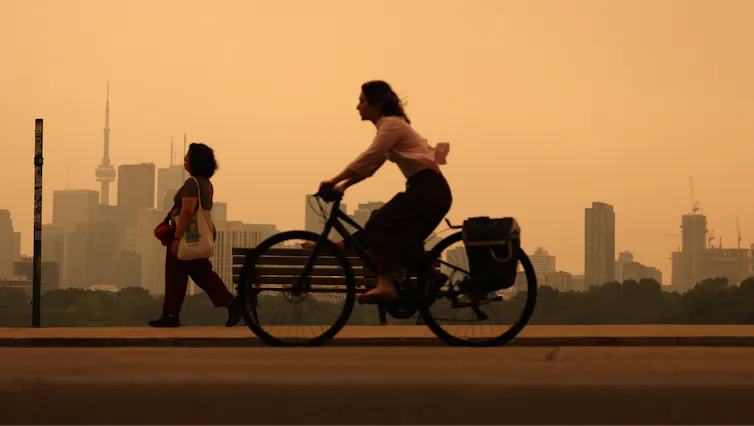
A woman rides a bike through city air tinted orange by wildfire smoke. Neither she nor a woman walking in the background is wearing a protective mask.
Heavy wildfire smoke from Canada’s forests turn skies orange in Toronto and across parts of the U.S. in July 2026. Steve Russell/Toronto Star via Getty Images

Colleen E. Reid, University of Colorado Boulder

Wildfire smoke from fires burning in Canada and northern Minnesota has been pouring across the Great Lakes and northeastern U.S. states, turning skies an eerie shade of orange. In the West, smoke has also been spreading into communities in Colorado and neighboring states as more wildfires burn in hot, dry conditions in July 2026.

University of Colorado environmental health researcher Colleen Reid explains what’s in that smoke and why breathing it is a health concern everyone should be aware of.

What is in wildfire smoke?

Wildfire smoke is a complex mixture that includes nitrogen oxides, volatile organic compounds, polycyclic aromatic hydrocarbons, carbon monoxide, carbon dioxide and particulate matter. When homes or buildings also burn, they can release an even more toxic stew of chemicals from burning electronics, furniture, plastics, paints and much more.

What you see when you see a smoke plume or when the air is hazy with wildfire smoke are the tiny particles that are too small to fall to the ground right away with gravity.

These particles, which scientists call particulate matter, are very small – we measure them in microns. When you breathe them in, they can harm your health. The smaller the particles, the deeper they can get into your lungs and body.

Map shows heavy smoke and low air quality across the Great Lakes Region and into the Northeast
EPA air quality monitors show high risks from smoke in many parts of the Great Lakes and northeastern U.S. on July 15, 2026. Reds are considered very unhealthy levels. Purples are either extremely unhealthy for light purple or hazardous for areas in maroon. AirNow Fire and Smoke Map

You may have heard the term PM2.5. It means particles that are 2.5 microns or smaller in diameter, many times smaller than the width of a human hair. High concentrations of these particles in the air during wildfire smoke episodes are what trigger air quality alerts.

Has wildfire smoke been increasing recently, and why?

Yes, wildfires have become more frequent and more intense just in the past couple of decades, and when wildfires become more frequent and intense, so does the smoke.

Scientists have found that wildfires are becoming more frequent due to a variety of factors that include increases in fire weather – hot, dry, windy conditions that fuel the spread of fires due to climate change – as well as other natural and human factors. The reasons for the increases in wildfires vary in different parts of the world.

Other studies have found that wildfire smoke makes up an increasing portion of the PM2.5 in the air in the U.S., and in many areas it is offsetting the decreases in air pollution that the U.S. has gained through regulations of industrial and vehicle emissions under the Clean Air Act.

How could wildfire smoke affect my health?

Some effects of breathing wildfire smoke include shortness of breath, coughing, itchy or watery eyes, headaches, rashes and itchiness. But smoke can cause more serious harm. Numerous epidemiological studies have shown that hospitalizations and emergency department visits for asthma and other respiratory diseases increase during wildfire smoke events.

After you breathe in the particles, they cause inflammation and oxidative stress, and they can move into the blood and spread throughout the body, affecting other organ systems.

People stand in a field as a smoke plume turns the sky orange and then dark.
The height of a smoke plume, like this one from Colorado’s Aspen Acres fire near Pueblo on July 1, 2026, affects the amount of particles and chemicals people on the ground are exposed to. But generally, if you can smell smoke, you’re breathing it in. Michael Ciaglo/Getty Images

Breathing wildfire smoke has been associated with higher risk of preterm births and other issues during pregnancy, and potentially cardiovascular problems such as heart attacks and strokes, although the evidence for these effects are more mixed.

The longer-term health effects of wildfire smoke are less clear, but it is a growing area of research.

Where can I learn more about wildfire smoke risks where I live?

The first thing to do to protect yourself from wildfire smoke is to know how bad the smoke is and how long it is going to last.

One great place to get information for where you live on current wildfire smoke is fire.airnow.gov. You can zoom in on the map to where you live and find color-coded circles reflecting data from both U.S. EPA air-quality monitors and PurpleAir sensors that people have put in their homes.

The colors show the level of PM2.5 at that location and suggest the associated health risk.

To find out how wildfire smoke is expected to change over time in North America, you can look at maps from FireSmoke Canada and the U.S. Interagency Wildland Fire Air Quality Response Program.

What can I do to protect myself and my family from wildfire smoke?

First of all, depending on the level of the air quality index where you are, there are different recommendations. When wildfire smoke reaches unhealthy levels, stay indoors as much as possible, with doors and windows shut to keep the wildfire smoke out.

If you have an air cleaner, use it, but check the filter, as filters can fill up quickly. Similarly, check the filter on your home HVAC system and replace it if needed.

If you have to go outside, consider wearing a well-fitting N95, KN95 or KF94 mask. These masks can protect you from inhaling particles in the air around you. Looser masks, such as surgical masks, mostly protect others from what you breathe out instead. They do not have a tight seal around your mouth, and when you breathe in, the air with all of the particles can find its way around the sides of the mask.

Having a tight fit of the mask to your face is important so that when you breathe, the air is going through the mask and capturing the smoke particles rather than letting them into your body where they cause harm.

If your home is leaky and you can see haze inside, consider going to a public space, such as a library or mall, with a good HVAC system. Some municipalities have designated clean air spaces where anyone can go.

Colleen E. Reid, Associate Professor of Geography, University of Colorado Boulder

This article is republished from The Conversation under a Creative Commons license. Read the original article.

ooOOoo

Thank you, Colleen, and thank you The Conversation. Lots of good advice.