Category: Technology

Clouds above, and even farther away.

The second, and last, episode of the BBC Clouds Lab programme offers an intriguing message.

On Monday, I published a post under the title of The clouds above us.  The second episode demonstrated that even in atmospheric conditions of near vacuum, intense cold and very low humidity, conditions that would kill a human in seconds, there was microscopic bacteriological material to be found.

 Exploring the troposphere

The troposphere is a turbulent layer of air that begins at the Earth’s surface and ranges from 23,000-65,000 feet above sea level, depending on the latitude, season and the time of day. Its name originates from the Greek word tropos, meaning change. It’s now known that bacteria actually exists in clouds and scientists believe that it plays a significant part in the creation of rain but little is known about life higher up. Microbiologist Dr Chris Van Tulleken has discovered that living bacteria can exist well above 10,000ft in a hostile environment with low pressure, increased UV radiation, freezing temperatures, high winds and no oxygen or water.

There is an interesting set of clips to be watched on that BBC Cloud Lab website.

What I took away from watching the programme was that the minimum conditions necessary for living bacteria were far more harsh than one might expect.  In other words, finding living bacteria in other solar systems might not be such a science-fiction idea.

With that in mind, I’m republishing an essay that Patrice Ayme wrote in 2013.  I’m grateful for his permission to so do.

ooOOoo

40 Billion Earths? Yes & No.

Up to twenty years ago, a reasonable opinion among scientists was that there might be just one solar system. Ours. Scientists like to project gravitas; having little green men all over didn’t look serious.

However, studying delicately the lights of stars, how they vary, how they doppler-shift, more than 1,000 planets have been found. Solar systems seem ubiquitous. Astronomers reported in 2013 that there could be as many as 40 billion habitable Earth-size planets in the galaxy. However, consider this:

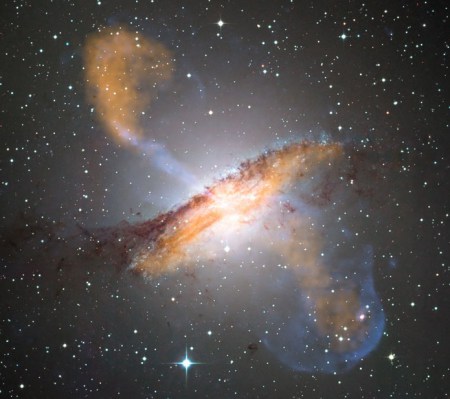
Centaurus A: Lobes Of Tremendous Black Hole Explosion Fully Visible.

Yes, that’s the center of a galaxy, and it has experienced a galactic size explosion from its central black hole.

One out of every five sun-like stars in our galaxy has a planet the size of Earth circling it in the Goldilocks zone, it seems — not too hot, not too cold — with surface temperatures compatible with liquid water. Yet, we have a monster black hole at the center of our giant galaxy, just like the one exploding above.

The Milky Way’s black hole is called Sagittarius A*. It exploded last two million years ago. Early Homo Erectus, down south, saw it. The furious lobes of the explosion are still spreading out, hundreds of thousands of light years away.

We are talking here about explosions potentially stronger than the strongest supernova by many orders of magnitude (depending upon the size of what’s falling into Sagittarius. By the way, a cloud is just heading that way).

Such galactic drama has a potential impact on the presence of advanced life. The richer the galaxy gets in various feature the situation looks, the harder it looks to compute the probability of advanced life.

The profusion of habitable planets is all the more remarkable, as the primitive methods used so far require the planet to pass between us and its star.

(The research, started on the ground in Europe, expanded with dedicated satellites, the French Corot and NASA’s Kepler spacecraft.). Sun-like stars are “yellow dwarves”. They live ten billion years.

From that, confusing “habitable” and “inhabitated”, the New York Times deduced: “The known odds of something — or someone — living far, far away from Earth improved beyond astronomers’ boldest dreams on Monday.

However, it’s not that simple.

Primitive bacterial life is probably frequent. However advanced life (animals) is probably very rare, as many are the potential catastrophes. And one needs billions of years to go from primitive life to animals.

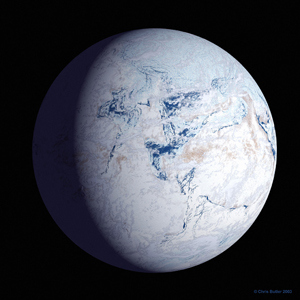
After life forms making oxygen on Earth appeared, the atmosphere went from reducing (full of strong greenhouse methane) to oxidizing (full of oxygen). As methane mostly disappeared, so did the greenhouse. Earth froze, all the way down to the equator:

When Snowball Earth Nearly Killed Life.

Yet volcanoes kept on belching CO2 through the ice. That CO2 built up above the ice, caused a strong greenhouse, and the ice melted. Life had survived. Mighty volcanism has saved the Earth, just in time.

That “snowball Earth” catastrophe repeated a few times before the Earth oxygen based system became stable. Catastrophe had been engaged, several times, but the disappearance of oxygen creating life forms had been avoided, just barely.

Many are the other catastrophes we have become aware of, that could wipe out advanced life: proximal supernovas or gamma ray explosions.

Cataclysmic eruption of the central galactic black hole happen frequently. The lobes from the last one are still visible, perpendicularly high off the galactic plane. The radiation is still making the Magellanic Stream simmer, 200,000 light years away. Such explosions have got to have sterilized a good part of the galaxy.

In 2014 when part of the huge gas cloud known as G2 falls into Sagittarius A*, we will learn better how inhospitable the central galaxy is for advanced life.

Many of the star systems revealed out there have surprising feature: heavy planets (“super Jupiters“) grazing their own stars. It’s unlikely those giants were formed where they are. They probably swept their entire systems, destroying all the rocky planets in their giant way. We don’t understand these cataclysmic dynamics, but they seem frequent.

Solar energy received on Earth fluctuated and changed a lot, maybe from one (long ago) to four (now). But, as it turned out just so that Earthly life could survive. Also the inner nuclear reactor with its convective magma and tectonic plates was able to keep the carbon dioxide up in the air, just so.

The Goldilocks zones astronomers presently consider seem to be all too large to allow life to evolve over billions of years. They have to be much narrower and not just with red dwarves (the most frequent and long living stars).

One of our Goldilocks, Mars, started well, but lost its CO2 and became too cold. The other Goldilocks, Venus, suffered the opposite major technical malfunction: a runaway CO2 greenhouse.

Mars’ axis of rotation tilts on the solar system’s plane enormously: by 60 degrees, over millions of years. So Mars experiences considerable climatic variations over the eons, as it goes through slow super winters and super summers (it’s imaginable that, as the poles melt, Mars is much more habitable during super summers; thus life underground, hibernating is also imaginable there).

Earth’s Moon prevents this sort of crazy hyper seasons. While, differently from Venus, Earth rotates at reasonable clip, homogenizing the temperatures. Venus takes 243 days to rotate.

It is startling that, of the four inner and only rocky planets, just one, Earth has a rotation compatible with the long term evolution of advanced life.

Earth has also two striking characteristics: it has a very large moon that store much of the angular momentum of the Earth-Moon system. Without Moon, the Earth would rotate on itself once every 8 hours (after 5 billion years of braking by Solar tides).

The Moon used to hover at least ten times closer than now, when earth’s days were at most 6 hours long.

The tidal force is the difference between gravitational attraction in two closely separated places, so it’s the differential of said attraction (which is proportional to 1/dd; d being the distance). Hence the tidal force is inversely proportional to the cube of the distance.

Thus on early Earth tides a kilometer high were common, washing back and forth every three hours. a hyper super tsunami every three hours, going deep inside the continents. Not exactly conditions you expect all over the universe.

Hence biological material fabricated on the continental margins in shallow pools would get mixed with the oceans readily. That would guarantee accelerated launch of life (and indeed we know life started on Earth very fast).

The theory of formation of the Moon is wobbly (recent detailed computations of the simplest impact theory do not work). All we know for sure, thanks to the Moon rocks from Apollo, is that the Moon is made of Earth mantle materials.

Somehow the two planets split in two. (Fission. Get it? It maybe a hint.)

Another thing we know for sure is that Earth has, at its core, a giant nuclear fission reactor, keeping Earth’s core hotter than the surface of the sun. An unimaginable liquid ocean of liquid iron deep down inside below our feet undergoes iron weather. Hell itself, the old fashion way, pales in comparison.

Could the Moon and the giant nuclear reactor have the same origin? This is my provocative question of the day. The Moon, our life giver, could well have formed from giant nuclear explosions, of another of our life givers, what became the nuke at the core. I can already hear herds of ecologists yelp in the distance. I present the facts, you pseudo-ecologists don’t decide upon them. It’s clear that nuclear fission is not in Drake equation: if nothing else, it’s too politically incorrect.

All the preceding makes this clear:

Many are the inhabitable planets, yet few will be inhabitated by serious denizens.

This means that the cosmos is all for our taking. The only question is how to get there. The closest stars in the Proxima, Beta and Alpha Centauri system are not attainable, for a human crew, with existing technology.

However, if we mastered clean colossal energy production, of the order of the entire present energy production of humanity, we could get a colony there (only presently imaginable technology would be fusion).

Giordano Bruno, professor, astronomer, and priest suggested that there were many other inhabitated systems around the stars. That insult against Islam meant Christianity was punished the hard way: the Vatican, the famous terrorist organization of god crazies, put a device in Giordano’s mouth that pierced his palate, and having made sure that way that he could not tell the truth, the terrorists then burned him alive. After seven years of torture.

The horror of truth was unbearable to theo-plutocrats.

Now we face something even worse: everywhere out there is very primitive life. It is likely gracing 40 billion worlds. But, if one has to duplicate the succession of miracles and improbabilities that made Earth, to earn advanced life, it may be just here that civilization ever rose to contemplate them.

Congratulations to India for launching yesterday a mission to Mars ostensibly to find out if there is life there (by finding CH4; while life is presently unlikely, Mars has much to teach, including whether it started there). That’s the spirit!

The spirit is to have minds go where even imagination itself did not go before.

If we sit back, and look at the universe we have now, from Dark Matter, to Dark Energy, to Sagittarius, to the nuclear reactor below, to billions of Earths, to a strange Higgs, to Non Aristotelian logic, we see a wealth, an opulence of possibilities inconceivable twenty years ago.

Progress is not just about doing better what was done yesterday. It’s also about previously inconceivable blossoms of entirely new mental universes.

***

Patrice Ayme

ooOOoo

Maybe, we are not alone!

The clouds above us.

A remarkable endeavour by the BBC.

A team of scientists take to the skies in one of the world's largest airships, for a unique exploration of Earth's most precious and mysterious environment - the atmosphere.
A team of scientists take to the skies in one of the world’s largest airships, for a unique exploration of Earth’s most precious and mysterious environment – the atmosphere.

In an example of what might be called a massive change of topic from yesterday’s post on Integrity and democracy, today’s offering to you, dear reader, is about the magnificent atmosphere upon which we all depend.

Here’s a clue.

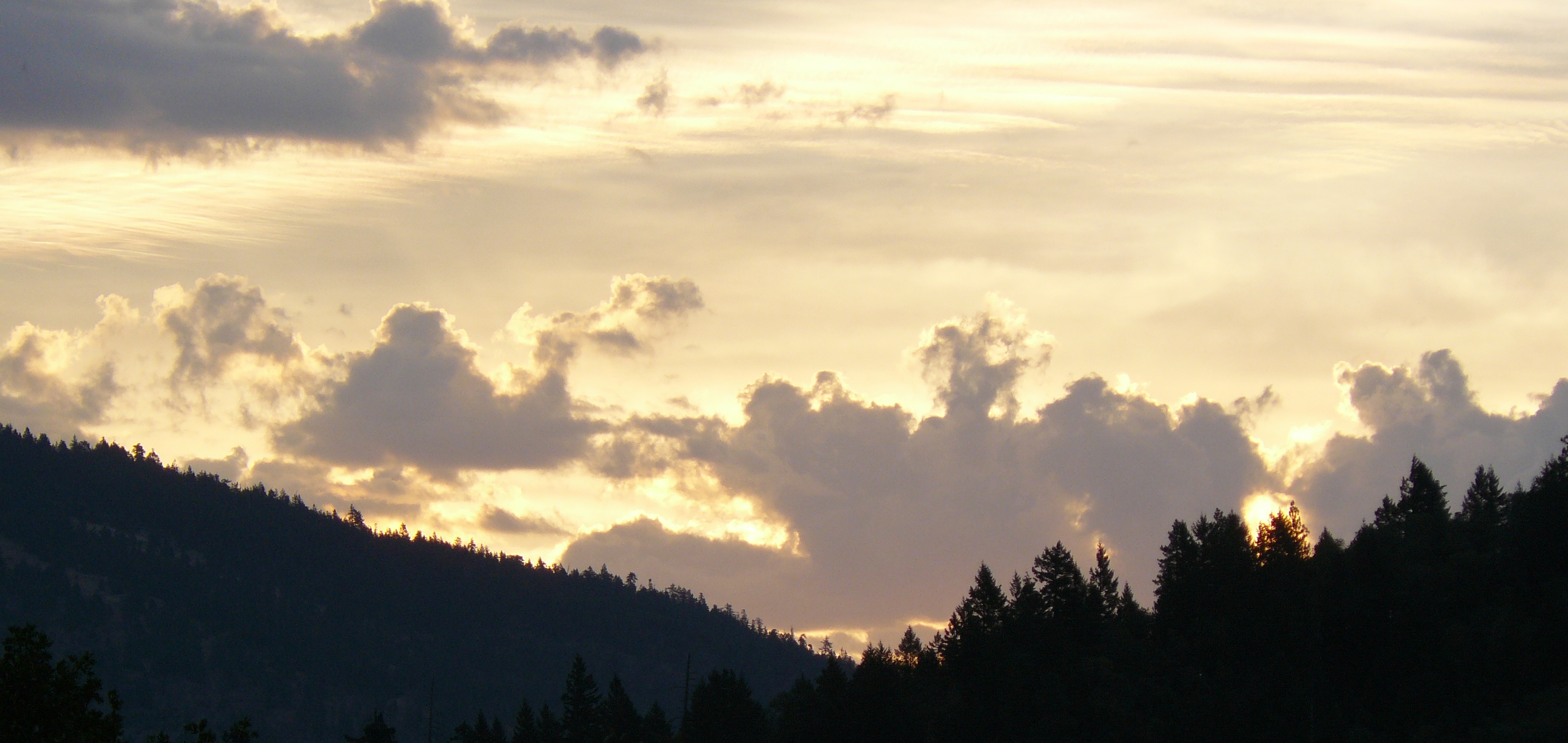
Sunrise to our North-East at a little after 7am on Sunday, 13th July, 2014.

Yes, the BBC have embarked on what they are calling Operation Cloud Lab: Secrets of the Skies. Over on that website, one can read this:

Every Breath We Take: Understanding Our Atmosphere

The air around us is not just empty space; it is an integral part of the chemistry of life. Plants are made from carbon dioxide, nitrogen nourishes the soil and oxygen gives us the energy we need to keep our hearts pumping and our brains alive. But how did we come to understand what air is made of? How did we come to know that this invisible stuff around us contains anything at all?

Gabrielle Walker tells the remarkable story of the quest to understand the air. It’s a tale of heroes and underdogs, chance encounters and sheer blind luck that spans the entire history of science. It began as a simple desire to further our knowledge of the natural world, but it ended up uncovering raw materials that have shaped our modern world, unravelling the secrets of our own physiology and revealing why we are here at all.

There is much more to explore on the website, including this trailer to the programme.

Oh, here’s another ‘clue’ from Oregon.

Same morning, same sunrise.

The presenter of the BBC series is Felicity Aston who writes on her BBC Blog:

I joined Operation Cloud Lab: Secrets Of The Skies as the expedition leader and also as a meteorologist.

The plan was to fly from Florida to California, looking at the science of the skies.

But as well as scientists, there were plenty of other people on the team including three pilots, a ground crew of 14 that followed the airship by road and a full production team including two camera crews. Not everyone could be on board at once – the airship would never have got off the ground!

But I was really fortunate to spend a lot of time on board and flew most of the way across the continent.

Exploring in three dimensions rather than being limited to making observations from the ground was a revelation to me.

The clouds in the tropics around the Gulf of Mexico are huge, and being in the sky with them really brought home the vast scale of the forces at work.

Towering cumulus cloud in Florida.

We were able to travel over, under and through these monsters, revealing that clouds are about as far from the popular image of light and fluffy floating puffs of cotton wool as you can get! They are dense and heavy and full of destructive energy.

I remember looking down at the cloud layer from a plane as a child, and daydreaming about exploring this new world of unknown places, so I was very excited the first time we flew straight through a cloud.

I leaned out of the airship as far as I dared into the heart of a cloud and found that it was a dark, damp mass of floating fog (of course!) – no mysterious worlds – my childhood fantasies were crushed!

There’s more to read on her blog as well as some stupendous photographs of clouds.

So if this gives you a thrill then don’t delay in watching the full-length Episode One on YouTube before it gets taken down. (Warning: if you watch the opening first few minutes you will be hooked for the full hour!)

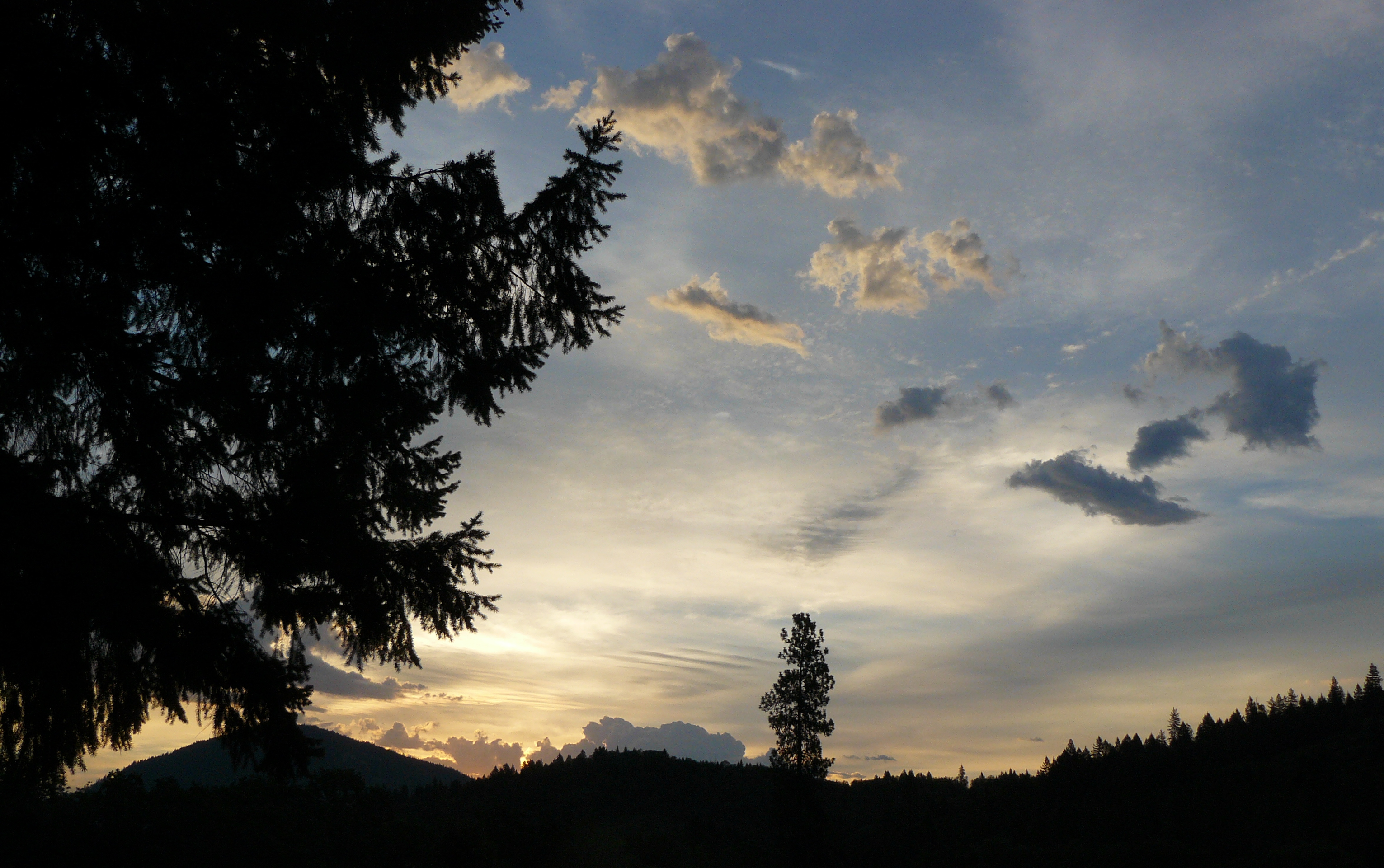
Now to close with, yes you guessed it, my final ‘clue’ from Oregon.

Beautiful Oregon dawn.

We live on the most beautiful planet!

Climate Change and Humanity

A powerful essay by Tom Engelhardt from his blogsite TomDispatch.

Regular readers of Learning from Dogs know that essays from TomDispatch often find their way onto these pages.  They are republished with the generous permission of Tom and I endeavour to select those essays that shine a new light on a current issue.   No less so than with today’s essay, first published over on TomDispatch on May 22nd, 2014.

Just a note before you start reading Tom’s very important essay.  That there are many links to papers, articles and other references throughout the essay.  (I know, they took me a couple of hours to set up!)  Could I recommend strongly that you ‘click’ on each link and make a note of the references you wish to read at a later time.  I shall be referring to some of them next week when I comment more generally on this fabulous essay.

ooOOoo

Tomgram: Engelhardt, Is Climate Change a Crime Against Humanity?

The 95% Doctrine

Climate Change as a Weapon of Mass Destruction 

By Tom Engelhardt

Who could forget? At the time, in the fall of 2002, there was such a drumbeat of “information” from top figures in the Bush administration about the secret Iraqi program to develop weapons of mass destruction (WMD) and so endanger the United States. And who — other than a few suckers — could have doubted that Saddam Hussein was eventually going to get a nuclear weapon? The only question, as our vice president suggested on “Meet the Press,” was: Would it take one year or five? And he wasn’t alone in his fears, since there was plenty of proof of what was going on. For starters, there were those “specially designed aluminum tubes” that the Iraqi autocrat had ordered as components for centrifuges to enrich uranium in his thriving nuclear weapons program. Reporters Judith Miller and Michael Gordon hit the front page of the New York Times with that story on September 8, 2002.

Then there were those “mushroom clouds” that Condoleezza Rice, our national security advisor, was so publicly worried about — the ones destined to rise over American cities if we didn’t do something to stop Saddam. As she fretted in a CNN interview with Wolf Blitzer on that same September 8th, “[W]e don’t want the smoking gun to be a mushroom cloud.” No, indeed, and nor, it turned out, did Congress!

And just in case you weren’t anxious enough about the looming Iraqi threat, there were those unmanned aerial vehicles — Saddam’s drones! — that could be armed with chemical or biological WMD from his arsenal and flown over America’s East Coast cities with unimaginable results. President George W. Bush went on TV to talk about them and congressional votes were changed in favor of war thanks to hair-raising secret administration briefings about them on Capitol Hill.

In the end, it turned out that Saddam had no weapons program, no nuclear bomb in the offing, no centrifuges for those aluminum pipes, no biological or chemical weapons caches, and no drone aircraft to deliver his nonexistent weapons of mass destruction (nor any ships capable of putting those nonexistent robotic planes in the vicinity of the U.S. coast). But what if he had? Who wanted to take that chance? Not Vice President Dick Cheney, certainly. Inside the Bush administration he propounded something that journalist Ron Suskind later dubbed the “one percent doctrine.” Its essence was this: if there was even a 1% chance of an attack on the United States, especially involving weapons of mass destruction, it must be dealt with as if it were a 95%-100% certainty.

Here’s the curious thing: if you look back on America’s apocalyptic fears of destruction during the first 14 years of this century, they largely involved three city-busting weapons that were fantasies of Washington’s fertile imperial imagination. There was that “bomb” of Saddam’s, which provided part of the pretext for a much-desired invasion of Iraq. There was the “bomb” of the mullahs, the Iranian fundamentalist regime that we’ve just loved to hate ever since they repaid us, in 1979, for the CIA’s overthrow of an elected government in 1953 and the installation of the Shah by taking the staff of the U.S. embassy in Tehran hostage. If you believed the news from Washington and Tel Aviv, the Iranians, too, were perilously close to producing a nuclear weapon or at least repeatedly on the verge of the verge of doing so. The production of that “Iranian bomb” has, for years, been a focus of American policy in the Middle East, the “brink” beyond which war has endlessly loomed. And yet there was and is no Iranian bomb, nor evidence that the Iranians were or are on the verge of producing one.

Finally, of course, there was al-Qaeda’s bomb, the “dirty bomb” that organization might somehow assemble, transport to the U.S., and set off in an American city, or the “loose nuke,” maybe from the Pakistani arsenal, with which it might do the same. This is the third fantasy bomb that has riveted American attention in these last years, even though there is less evidence for or likelihood of its imminent existence than of the Iraqi and Iranian ones.

To sum up, the strange thing about end-of-the-world-as-we’ve-known-it scenarios from Washington, post-9/11, is this: with a single exception, they involved only non-existent weapons of mass destruction. A fourth weapon — one that existed but played a more modest role in Washington’s fantasies — was North Korea’s perfectly real bomb, which in these years the North Koreans were incapable of delivering to American shores.

The “Good News” About Climate Change

In a world in which nuclear weapons remain a crucial coin of the realm when it comes to global power, none of these examples could quite be classified as 0% dangers. Saddam had once had a nuclear program, just not in 2002-2003, and also chemical weapons, which he used against Iranian troops in his 1980s war with their country (with the help of targeting information from the U.S. military) and against his own Kurdish population. The Iranians might (or might not) have been preparing their nuclear program for a possible weapons breakout capability, and al-Qaeda certainly would not have rejected a loose nuke, if one were available (though that organization’s ability to use it would still have been questionable).

In the meantime, the giant arsenals of WMD in existence, the American, Russian, Chinese, Israeli, Pakistani, and Indian ones that might actually have left a crippled or devastated planet behind, remained largely off the American radar screen. In the case of the Indian arsenal, the Bush administration actually lent an indirect hand to its expansion. So it was twenty-first-century typical when President Obama, trying to put Russia’s recent actions in the Ukraine in perspective, said, “Russia is a regional power that is threatening some of its immediate neighbors. I continue to be much more concerned when it comes to our security with the prospect of a nuclear weapon going off in Manhattan.”

Once again, an American president was focused on a bomb that would raise a mushroom cloud over Manhattan. And which bomb, exactly, was that, Mr. President?

Of course, there was a weapon of mass destruction that could indeed do staggering damage to or someday simply drown New York City, Washington D.C., Miami, and other East coast cities. It had its own efficient delivery systems — no nonexistent drones or Islamic fanatics needed. And unlike the Iraqi, Iranian, or al-Qaeda bombs, it was guaranteed to be delivered to our shores unless preventive action was taken soon. No one needed to hunt for its secret facilities. It was a weapons system whose production plants sat in full view right here in the United States, as well as in Europe, China, and India, as well as in Russia, Saudi Arabia, Iran, Venezuela, and other energy states.

So here’s a question I’d like any of you living in or visiting Wyoming to ask the former vice president, should you run into him in a state that’s notoriously thin on population: How would he feel about acting preventively, if instead of a 1% chance that some country with weapons of mass destruction might use them against us, there was at least a 95% — and likely as not a 100% — chance of them being set off on our soil? Let’s be conservative, since the question is being posed to a well-known neoconservative. Ask him whether he would be in favor of pursuing the 95% doctrine the way he was the 1% version.

After all, thanks to a grim report in 2013 from the Intergovernmental Panel on Climate Change, we know that there is now a 95%-100% likelihood that “human influence has been the dominant cause of the observed warming [of the planet] since the mid-20th century.” We know as well that the warming of the planet — thanks to the fossil fuel system we live by and the greenhouse gases it deposits in the atmosphere — is already doing real damage to our world and specifically to the United States, as a recent scientific report released by the White House made clear. We also know, with grimly reasonable certainty, what kinds of damage those 95%-100% odds are likely to translate into in the decades, and even centuries, to come if nothing changes radically: a temperature rise by century’s end that could exceed 10 degrees Fahrenheit, cascading species extinctions, staggeringly severe droughts across larger parts of the planet (as in the present long-term drought in the American West and Southwest), far more severe rainfall across other areas, more intense storms causing far greater damage, devastating heat waves on a scale no one in human history has ever experienced, masses of refugees, rising global food prices, and among other catastrophes on the human agenda, rising sea levels that will drown coastal areas of the planet.
Buy the Book

From two scientific studies just released, for example, comes the news that the West Antarctic ice sheet, one of the great ice accumulations on the planet, has now begun a process of melting and collapse that could, centuries from now, raise world sea levels by a nightmarish 10 to 13 feet. That mass of ice is, according to the lead authors of one of the studies, already in “irreversible retreat,” which means — no matter what acts are taken from now on — a future death sentence for some of the world’s great cities. (And that’s without even the melting of the Greenland ice shield, not to speak of the rest of the ice in Antarctica.)

All of this, of course, will happen mainly because we humans continue to burn fossil fuels at an unprecedented rate and so annually deposit carbon dioxide in the atmosphere at record levels. In other words, we’re talking about weapons of mass destruction of a new kind. While some of their effects are already in play, the planetary destruction that nuclear weapons could cause almost instantaneously, or at least (given “nuclear winter” scenarios) within months, will, with climate change, take decades, if not centuries, to deliver its full, devastating planetary impact.

When we speak of WMD, we usually think of weapons — nuclear, biological, or chemical — that are delivered in a measurable moment in time. Consider climate change, then, a WMD on a particularly long fuse, already lit and there for any of us to see. Unlike the feared Iranian bomb or the Pakistani arsenal, you don’t need the CIA or the NSA to ferret such “weaponry” out. From oil wells to fracking structures, deep sea drilling rigs to platforms in the Gulf of Mexico, the machinery that produces this kind of WMD and ensures that it is continuously delivered to its planetary targets is in plain sight. Powerful as it may be, destructive as it will be, those who control it have faith that, being so long developing, it can remain in the open without panicking populations or calling any kind of destruction down on them.

The companies and energy states that produce such WMD remain remarkably open about what they’re doing. Generally speaking, they don’t hesitate to make public, or even boast about, their plans for the wholesale destruction of the planet, though of course they are never described that way. Nonetheless, if an Iraqi autocrat or Iranian mullahs spoke in similar fashion about producing nuclear weapons and how they were to be used, they would be toast.

Take ExxonMobil, one of the most profitable corporations in history. In early April, it released two reports that focused on how the company, as Bill McKibben has written, “planned to deal with the fact that [it] and other oil giants have many times more carbon in their collective reserves than scientists say we can safely burn.” He went on:

The company said that government restrictions that would force it to keep its [fossil fuel] reserves in the ground were ‘highly unlikely,’ and that they would not only dig them all up and burn them, but would continue to search for more gas and oil — a search that currently consumes about $100 million of its investors’ money every single day. ‘Based on this analysis, we are confident that none of our hydrocarbon reserves are now or will become “stranded.”‘

In other words, Exxon plans to exploit whatever fossil fuel reserves it possesses to their fullest extent. Government leaders involved in supporting the production of such weapons of mass destruction and their use are often similarly open about it, even while also discussing steps to mitigate their destructive effects. Take the White House, for instance. Here was a statement President Obama proudly made in Oklahoma in March 2012 on his energy policy:

Now, under my administration, America is producing more oil today than at any time in the last eight years. That’s important to know. Over the last three years, I’ve directed my administration to open up millions of acres for gas and oil exploration across 23 different states. We’re opening up more than 75% of our potential oil resources offshore. We’ve quadrupled the number of operating rigs to a record high. We’ve added enough new oil and gas pipeline to encircle the Earth and then some.

Similarly, on May 5th, just before the White House was to reveal that grim report on climate change in America, and with a Congress incapable of passing even the most rudimentary climate legislation aimed at making the country modestly more energy efficient, senior Obama adviser John Podesta appeared in the White House briefing room to brag about the administration’s “green” energy policy. “The United States,” he said, “is now the largest producer of natural gas in the world and the largest producer of gas and oil in the world. It’s projected that the United States will continue to be the largest producer of natural gas through 2030. For six straight months now, we’ve produced more oil here at home than we’ve imported from overseas. So that’s all a good-news story.”

Good news indeed, and from Vladmir Putin’s Russia, which just expanded its vast oil and gas holdings by a Maine-sized chunk of the Black Sea off Crimea, to Chinese “carbon bombs,” to Saudi Arabian production guarantees, similar “good-news stories” are similarly promoted. In essence, the creation of ever more greenhouse gases — of, that is, the engine of our future destruction — remains a “good news” story for ruling elites on planet Earth.

Weapons of Planetary Destruction

We know exactly what Dick Cheney — ready to go to war on a 1% possibility that some country might mean us harm — would answer, if asked about acting on the 95% doctrine. Who can doubt that his response would be similar to those of the giant energy companies, which have funded so much climate-change denialism and false science over the years? He would claim that the science simply isn’t “certain” enough (though “uncertainty” can, in fact, cut two ways), that before we commit vast sums to taking on the phenomenon, we need to know far more, and that, in any case, climate-change science is driven by a political agenda.

For Cheney & Co., it seemed obvious that acting on a 1% possibility was a sensible way to go in America’s “defense” and it’s no less gospel for them that acting on at least a 95% possibility isn’t. For the Republican Party as a whole, climate-change denial is by now nothing less than a litmus test of loyalty, and so even a 101% doctrine wouldn’t do when it comes to fossil fuels and this planet.

No point, of course, in blaming this on fossil fuels or even the carbon dioxide they give off when burned. These are no more weapons of mass destruction than are uranium-235 and plutonium-239. In this case, the weaponry is the production system that’s been set up to find, extract, sell at staggering profits, and burn those fossil fuels, and so create a greenhouse-gas planet. With climate change, there is no “Little Boy” or “Fat Man” equivalent, no simple weapon to focus on. In this sense, fracking is the weapons system, as is deep-sea drilling, as are those pipelines, and the gas stations, and the coal-fueled power plants, and the millions of cars filling global roads, and the accountants of the most profitable corporations in history.

All of it — everything that brings endless fossil fuels to market, makes those fuels eminently burnable, and helps suppress the development of non-fossil fuel alternatives — is the WMD. The CEOs of the planet’s giant energy corporations are the dangerous mullahs, the true fundamentalists, of planet Earth, since they are promoting a faith in fossil fuels which is guaranteed to lead us to some version of End Times.

Perhaps we need a new category of weapons with a new acronym to focus us on the nature of our present 95%-100% circumstances. Call them weapons of planetary destruction (WPD) or weapons of planetary harm (WPH). Only two weapons systems would clearly fit such categories. One would be nuclear weapons which, even in a localized war between Pakistan and India, could create some version of “nuclear winter” in which the planet was cut off from the sun by so much smoke and soot that it would grow colder fast, experience a massive loss of crops, of growing seasons, and of life. In the case of a major exchange of such weapons, we would be talking about “the sixth extinction” of planetary history.

Though on a different and harder to grasp time-scale, the burning of fossil fuels could end in a similar fashion — with a series of “irreversible” disasters that could essentially burn us and much other life off the Earth. This system of destruction on a planetary scale, facilitated by most of the ruling and corporate elites on the planet, is becoming (to bring into play another category not usually used in connection with climate change) the ultimate “crime against humanity” and, in fact, against most living things. It is becoming a “terracide.

Tom Engelhardt is a co-founder of the American Empire Project and author of The United States of Fear as well as a history of the Cold War, The End of Victory Culture (from which some of this essay has been adapted). He runs the Nation Institute’s TomDispatch.com. His latest book, co-authored with Nick Turse, is Terminator Planet: The First History of Drone Warfare, 2001-2050.

Copyright 2014 Tom Engelhardt

ooOOoo

There are so many strong and fundamental points raised in this essay from Tom that I am going to return to them next week.  (Will give it a rest for July 4th!)
Progressing Wisdom – the preamble.

A reflection on intelligence, learning and knowledge.

Today’s essay has been prompted by a fascinating exchange of views and comments on a post recently published by Patrice Ayme.  More of that tomorrow.

Before getting to the heart of things, I feel compelled to offer a little background on my own educational journey. It is presented today as a preamble to tomorrow’s main essay.

By rights, I should have enjoyed a stunning academic journey as a young man.  My mother holds a double degree in French and German from Cambridge University.  My father was both a Chartered Architect and Chartered Surveyor and worked for Barclay Perkins & Co at their Anchor Brewery in Southwark, London all his working life.  My uncle, Christian Schiller, took up a mathematics scholarship at Sidney Sussex college at Cambridge University and ended up HM Inspector of Schools in the United Kingdom. Notably, he was a promoter of progressive ideas in primary education.

But it was not to be so.

My father died suddenly and with very little warning five days before Christmas in 1956.  I had turned 12-years-old some six weeks previously and just completed my first term at Preston Manor County Grammar School.  My secure, comfortable young life was thrown into emotional turmoil with one of the consequences being that instead of passing a clutch of GCE ‘O-Level’ exams, I barely managed to pass two subjects and was unable to continue on with a higher level of studying and the consequent sitting of GCE ‘A-Level’ exams, a pre-requisit for university.

Somehow, I then managed to win a place as a student at the Faraday House of Electrical Engineering, in those days based at Southampton Row, London.  It was to study for a Diploma in Electrical Engineering.  The requirement was that by the end of my first year at Faraday House I should pass two A-level examinations.

I was very happy as a college student.  That first year was spent entirely learning about engineering with much time ‘hands-on’ in the engineering workshop. Then came time for me to sit those two A-level exams. I failed both of them! There was no choice but for me to leave the college.

faradayhouseplaque
So that’s enough to demonstrate that academic prowess was not my speciality.

However, being unable to jump through the hoops needed for a degree or equivalent didn’t mean that I was a poor learner; far from it.

After my father’s death, my mother remarried and my ‘new’ Dad was very supportive.  He had a background in communications and quickly encouraged me to become a radio amateur.  I joined the nearby Radio Society of Harrow (still in existence!) and their encouragement enabled me to pass the full set of exams necessary to become a licensed radio amateur and a full member of the Radio Society of Great Britain.  My amateur call sign was (and still is) G3PUK. I was 17.


G3PUK0001
I can still whistle the alphabet in morse code, from A to Z, and the numbers 0 to 9!

Later on, when I was an apprentice at the British Aircraft Corporation’s site in Stevenage, Hertfordshire, one of the commercial staff, Jim Jenner, spent many hours preparing me for the Institute of Advanced Motorists examination. I passed that exam and became a full member of the IAM in May, 1966.

So there’s my background that, hopefully, will set the scene to a wonderful exchange of views and ideas that flowed from Patrice’s blog. Ideas that will be explored tomorrow.

For the reason, the powerful reason, that the intelligence and wisdom of humanity has always been important.  But now, in this time of the affairs of man, our collective intelligence and wisdom has never been more important.

Please enter your password!

An insight into “cyberspace” for those who are the wrong side of sixty!

Sent to me by Cynthia yesterday afternoon.

oooo

Please Enter Your Password …

Please enter your new password:

“cabbage”

Sorry, the password must be more than 8 characters.

“boiled cabbage”

Sorry, the password must contain 1 numerical character.

“1 boiled cabbage”

Sorry, the password cannot have blank spaces.

“50bloodyboiledcabbages”

Sorry, the password must contain at least one upper case character.

“50BLOODYboiledcabbages”

Sorry, the password cannot use more than one upper case character consecutively.

“50BloodyBoiledCabbagesShovedUpYourAss, IfYouDon’tGiveMeAccessnow”

Sorry, the password cannot contain punctuation.

“ReallyPissedOff50BloodyBoiledCabbagesShovedUpYourAssIfYouDontGiveMeAccessnow”

Sorry, that password is already in use.

oooo

Apologies to those that may have seen this before.

Prediction is easy ….

…. unless it involves the future!

There was a recent TED Talk that really made me sit up and think.  Before I introduce the talk, let me offer a personal view.  I’m speaking about the changing nature of the Earth’s climate.

On balance I believe that the climate of our planet is changing and, again on balance, I believe that mankind’s activities especially with regard to CO2 emissions are the primary cause.

But here’s the rub! I’m not a scientist.

So when scientist Gavin Schmidt, a climate scientist no less, recently gave a twelve-minute TED Talk about the complexity of Planet Earth’s climate I found it compelling.

Here is is.

Published on May 1, 2014
You can’t understand climate change in pieces, says climate scientist Gavin Schmidt. It’s the whole, or it’s nothing. In this illuminating talk, he explains how he studies the big picture of climate change with mesmerizing models that illustrate the endlessly complex interactions of small-scale environmental events.

Then just two days later, on May 3rd, Alex Jones, he of the blog The Liberated Way, posted Unpredictable nature, that I have the pleasure in republishing in full.  Read it and then reflect on Alex’s post and the talk given by Gavin Schmidt.

ooOOoo

Unpredictable nature

Posted on May 3, 2014
Nature is always full of surprises.

Amber the fox reflects the unpredictable face of nature showing up in my garden by surprise on random days.

I went camping and woke to frost on the ground. I wrote yesterday that summer had arrived in Britain. A pool of water from recent rains had frozen over.

One thing you quickly learn about nature is its unpredictability. Everything in nature has its own free will, and will determine its own unpredictable path regardless of what humanity thinks. Those that are able to let go of control enjoy a nature full of surprises.

ooOOoo

Thanks to the modern-day internet, it takes only a moment to find a relevant quotation to close today’s post.

It is always wise to look ahead, but difficult to look further than you can see.Sir Winston Churchill.

Another Saturday smile!

Yes, I know it’s a car advert ….

but I defy you to watch this and not feel all googly inside.

Thank you, Dan!

You all have a great week-end; especially the animals out there!

Trust, truth and community, Pt. Two.

Musings on truth and the corrosive nature of fear.

Yesterday, in Part One, I explored how easy it is to signal to the public that they are not to be trusted.  I used the case of PayPal’s changes to their ‘privacy’ policy which, as Wolf Richter wrote, only partially tongue-in-cheek perhaps, made “the NSA, which runs the most expansive spying dragnet in history, is by comparison a group of choirboys.

Truth

Again, back to Roget’s Thesaurus.

truth noun

1. Correspondence with fact or truth: accuracy, correctness, exactitude, exactness, fidelity, veraciousness, veracity

2. Freedom from deceit or falseness: truthfulness, veracity

So that’s all clear then!

If only it was that easy.  So many aspects of our modern lives are exposed to complex issues.  None more complex than, of course, the issue of humans having a damaging effect on the planet’s climate.  Or if one wants something more esoteric then try the origins of the universe. (So far as the former is concerned, then my personal belief is that mankind is damaging the global climate.  But do I have the scientific background to support that belief? No Sir!)

However, one thing that our complex society does offer is the opportunity to spread fear. Indeed, fear pervades popular culture and the media.  I picked up that theme from an essay published by David L. Altheide and R. Sam Michalowski of Arizona State University.

Just a random example of the spread of fear.

The link to that essay is here. It opens, thus:

Fear pervades popular culture and the news media. Whether used as a noun, verb, adverb, or adjective, an ongoing study finds that the word “fear” pervades news reports across all sections of newspapers, and is shown to move or “travel” from one topic to another. The use of fear and the thematic emphases spawned by entertainment formats are consistent with a “discourse of fear,” or the pervasive communication, symbolic awareness and expectation that danger and risk are a central feature of the effective environment. A qualitative content analysis of a decade of news coverage in The Arizona Republic and several other major American news media (e.g., the Los Angeles Times, and ABC News) reveals that the word “fear” appears more often than it did several years ago, particularly in headlines, where its use has more than doubled. Comparative materials obtained through the Lexis/Nexis information base also reveals that certain themes are associated with a shifting focus of fear over the years (e.g., violence, drugs, AIDS), with the most recent increases associated with reports about children. Analysis suggests that this use of fear is consistent with popular culture oriented to pursuing a “problem frame” and entertainment formats, which also have social implications for social policy and reliance on formal agents of social control.

No passion so effectually robs the mind of all its powers of acting and reasoning as fear. [my italics]

That last sentence offers the words of Edmund Burke, the Irish statesman and author from over 200 years ago. So, perhaps, nothing changes in this regard!

In my old country, the British press love to sell their newspapers on the back of fear.  Here are some examples of lurid front pages.

horse meat

oooo

meltdown

oooo

autism

However, it doesn’t end there. Fear of the unknown, of forces beyond our control, are behind the incredible number of conspiracy theories, many of them quite famous.  WikiPedia lists dozens of them. One that was voiced by friends of ours concerned HAARP, which is an acronym for High Frequency Active Auroral Research Program.  It was a perfectly legitimate research programme, one that was unclassified, albeit a program that was shut down in July, 2013.

But that didn’t stop it being regarded by many as deeply suspicious, “Many conspiracy theories surround HAARP. Some theorists believe that it is being used as a weather-controlling device that can trigger catastrophic events, such as floods, hurricanes, etc. Others believe that the government uses HAARP to send mind-controlling radio waves to humans.”  Taken from here.

As it happens, this was a programme that I was acquainted with back in my UK days.

OK, time to round this off.

This new, digital world allows the sharing and spreading of information in a manner unimaginable from, say, 25 years ago.  It has many positive attributes, as I will touch upon in tomorrow’s post.  But it also has the power to spread fear and misinformation.  In a world that is becoming more complex and more uncertain year by year, it takes effort by every one of us to stop, think and check on anything that has the potential to upset one.

It takes the power of community to keep us rooted in the stuff of our daily lives, to live calmly and stay in touch with the truth.  More on the power of community tomorrow.

Trust, truth and community, Pt. One.

Reflections on our present world.

Today, and the next two days, I want to offer you three essays under the theme of Trust, truth and community.

As is so often the case, there was a series of outwardly unconnected experiences that seemed, well to my eyes anyway, to speak to a theme.  You will have to wait until Friday to judge whether or not you agree with me!

Trust

This first essay was motivated by two disparate events: One very local and one as far removed from being local as one could imagine.

But first, what do we mean by trust? Roget’s Thesaurus defines the word (in part):

trust noun

Absolute certainty in the trustworthiness of another: belief, confidence, dependence, faith, reliance.

You will recall that just over three weeks ago, we welcomed two horses to our pastures; Ranger and Ben.  Both horses had previously been treated badly by humans, especially Ben who had been starved and beaten by his ex-owners.

In the early days, Ben was very cautious of any sudden movement by me and would back away from any contact from me other than being offered a food treat.

But in just three weeks, Ben has gone a huge way towards trusting Jean and me.

Taken yesterday afternoon.

oooo

My face is closer than three inches to Ben's nose.
My face is closer than three inches to Ben’s nose.

oooo

Both Ben and Ranger in the background are now very comfortable with Jean and me.

Now, I don’t know about you, but my guess is that if a human had experienced the degree of cruelty from the hands of another person that these horses had, it would take very much longer than three weeks for that human victim to regain the same level of trust that Ben and Ranger now offer. Indeed, many persons would harbour anger and distrust forever.

That was the local example of trust

Now to the ‘non-local’ example of trust. It involves PayPal.

Not so long ago, Wolf Richter, he of the Testosterone Pit blogsite, published an essay about PayPal’s recently revised privacy policy.  Or as Wolf called it: I Just Got PayPal’s New Absolutely-No-Privacy-Ever Policy

You must read it in full, especially if you are a PayPal user.  Thanks to Wolf, I can offer you his opening paragraphs:

I Just Got PayPal’s New Absolutely-No-Privacy-Ever Policy

TUESDAY, APRIL 1, 2014 AT 1:00AM
Sunday, when people had other things to do and weren’t supposed to pay attention, PayPal sent its account holders an innocuous-sounding email with the artfully bland title, “Notice of Policy Updates.” PayPal didn’t want people to read it – lest they come away thinking that the NSA, which runs the most expansive spying dragnet in history, is by comparison a group of choirboys.

The email started with corporate blah-blah-blah on privacy, that PayPal was “constantly” changing things “to give you more of what you want and improve your experience using us.”

Do read the rest of the essay here. Here’s a comment from a reader of Wolf’s essay, republished with Wolf’s permission:

Concerning: I Just Got PayPal’s New Absolutely-No-Privacy-Ever Policy

I will relate an experience I had regarding Pay Pal that I believe has some relevance to your blog on Pay Pal’s privacy policy.

I am a retired old geezer living in NY State. About 4 years ago I looked at Ebay’s bidding process to place a bid on an item I wanted. However I discovered that I could not make such a bid without subscribing to pay pal. I provided pay pal with the information it required and made my bid. My bid was exceeded by other bids and I did not get the item. My credit card was not used at that time and I never used Ebay or pay pal after that.

Because I did not respond to ongoing emails from the 2 companies I believed that I had no further connection to either of them and that my single failed bid was the end of our relationship.

Then about 2-3 years ago I received a couple of emails from Best Buy: one thanking me for opening a new account, and the other thanking me for purchasing an expensive electronic item.

When I opened up that new Best Buy account I discovered that my address was stated to be in California in care of a person named Pham Pham and that the credit card that was used was one that had recently expired although the number was still in use on a subsequently issued card. I checked all my credit cards online and found that the charge was not pending. I also took some other measures to protect myself. Within hours I received another email from Best Buy cancelling the order because payment was not made by my credit card company.

This incident took a strange turn a couple of days later. Initially I had no idea as to the source of the credit information leak. But then 2-3 days afterwards I received an email from Pay Pal requesting an update of the credit card information in my Pay Pal account. Pay Pal’s email request for updated credit information so soon after the online theft attempt may be just a coincidence, but in my mind there is an undisclosed connection. Of course I have not complied with Pay Pay’s requests. To this day no company has informed me that their accounts were hacked and that my credit information was stolen.

If, when you have read Wolf’s report in full, you feel, as I do, that the time has come to cut the relationship with PayPal then go for it.  Because only a customer base that is ‘voting with their feet’ will deliver the message.

What is that message?

Simply, if organisations want to be trusted by their customers, those organisations must behave with integrity.  Now I am not accusing PayPal of a lack of integrity but it goes beyond that.  It goes to operating with a genuine sensitivity for what is correct. PayPal’s privacy policy is anything but that.  There are parts of their ‘new’ policy that stink of gross insensitivity to their feelings for their customers. Read it in full courtesy of Wolf Richter

Oh, want to know how to close a PayPal account?

To close your Payflow account:

If your partner is PayPal, VeriSign or CyberCash contact PayPal Merchant support at 1-888-883-9770 or via email at payflow-support@paypal.com. Be sure to include your login ID.

If your partner is with a Payflow partner, reseller, or merchant bank you will need to contact the partner, reseller, or bank directly to close your Payflow account.

For additional information, contact PayPal Merchant support at 1-888-883-9770 or via email at payflow-support@paypal.com.

Note: Once your Payflow account is terminated, you cannot access the PayPal Manager or any account data. If you need access to this data, you will be charged a fee.

If you are trying to close your PayPal account and not a Payflow account do the following:
Log in to your PayPal account.
Click Profile at the top of the page.
Click Close Account in the Account Information column and follow the steps listed.

My PayPal account was closed at 15:10 PDT yesterday.

Perhaps PayPal should take note of how humans witness trust offered by our dear animals!

Things not as they quite seem.

Two videos that end up very differently to how they started!

The common link between Ed Scalpello, Dan Gomez and me is that Ed and Dan are good friends.

Coincidentally, both of them sent me links that matched today’s theme.

So with no further blathering from yours truly here’s the first video from Ed.

and here’s the second that Dan sent me.

You all have a great weekend.