Category: Technology

Apologies.

For the lack of a post this morning. It was just that by the time that Jean and I arrived back from our neighbours’ wonderful Thanksgiving dinner late yesterday afternoon, then fed the dogs and horses, it was early evening. Only for me to find there was no internet connection and an hour later I still hadn’t worked out why. So it was an early night. Then at 5am I awoke thinking I knew what the problem was.  It’s coming up to 5:30 and, as you can see, my hunch was correct. Next chapter of the book being published in under an hour!

The beauty of flight.

Not, perhaps, in quite the way you might be anticipating!

A couple of weeks ago, I forwarded an item to my son, an airline Captain for some years now, that I read on the Big Think website. It was an item called The Accidental Beauty of Flight Paths.

The Accidental Beauty of Flight Paths
by FRANK JACOBS NOVEMBER 5, 2014

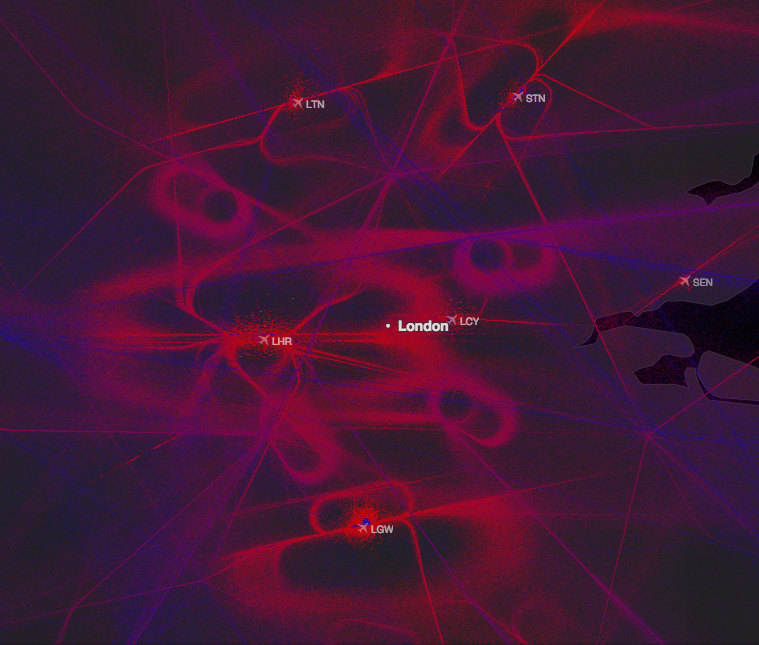
There is more between heaven and earth than bird migrations and weather fronts. These maps capture the poetic beauty of something utterly mundane and usually invisible: the flight patterns of the planes that bring us from airport A to airport B.

We live in the age of mass air travel. At any given moment, there are about 10,000 commercial planes airborne, carrying an estimated half a million passengers across the skies. We also live in the era of Big Data. Which means that the movements of those thousands of planes can be followed in real time on websites such as Plane Finder and Flightradar24.

London and the pretty holding patterns around its airports: Heathrow (LHR), Gatwick (LGW), City (LCY), Luton (LTN), Stansted (STN) and Southend-on-Sea (SEN).

You can read the full article here.

Alex, my son, then replied with a link to this item on the UK NATS website: Take a guided tour around UK airspace.

The skies above the UK have been brought to life like never before in a video showing a day of air traffic in less than three minutes.

Created from actual radar data showing over 7,000 flights, the video graphically illustrates the daily task facing air traffic controllers and the airspace features that help make it all work.


It finishes with an overview of the structure of UK airspace, highlighting the major air routes and showing how this ‘invisible infrastructure’ helps underpin the entire operation.

Matt Mills, NATS Head of Digital Communications, said: “We’ve made data visualisations in the past, but we wanted to now take people on a deeper journey into what makes UK airspace work and some of its important features.

Airspace might be the invisible infrastructure, but it is every bit as important as the airports and runways on the ground.

Created by air traffic management company, NATS, the video takes viewers on a unique tour of some of the key features of UK airspace – from the four holding stacks over London and the military training zones above Wales, to the helicopters delivering people and vital supplies to the North Sea oil and gas rigs.

It is a fascinating video.

The book! Part Three: Population and Energy.

Why a chapter on population and energy?

Because in a very real sense it is the measure of how many live on this planet and how much energy is used for our own purposes that brings into stark consideration the fundamental, inviolate rule: that we cannot sustain an existence that isn’t in balance with what our planet can provide for us. ‘Us’ of course meaning every living thing on the planet.

The story of our energy use is scary to the extreme. By using the term ‘our energy use’ I am offering it as a label, so to speak, for the number of people multiplied by the energy each person is using.

So, first let us start with global population.

The world did not reach a population of one billion until 1800. One hundred and twenty-three years later, in 1927, that global population figure passed two billion persons. That, in itself, isn’t remarkable. But what was remarkable was the continuing growth.

Thirty-three years later, in 1960, the global population reached three billion.
Twenty-four years later, in 1974, the population reached four billion.
Thirteen years later, in 1987, the world population is up to five billion.
Twelve years on, in 1999, up to six billion persons in the world.
Then just another thirteen years on for the population to reach, in 2012, seven billion.

Now that is not a cast-iron guarantee that the growth will continue on and on in a similar fashion. Recall that old saying, “I can predict anything except those matters involving the future!”

Indeed, the UN’s Economic & Social Affairs Department, in a report issued in 2013, under the title of World Population Prospects – 2012 Revision, offered in Figure 1. Population of the world, 1950-2100 (Page XV of the summary.), four possible outcomes, “according to different projections and variants.” Those being Medium; High; Low and Constant-fertility. Just to pick the extremes projected, a Constant-fertility growth would bring the global population in 2100 to twenty-eight billion persons, and a Low growth future delivering more or less today’s global population of seven billion persons.

What is the maximum carrying capacity of the planet? A number of estimates of the carrying capacity have been made with a wide range of population numbers. A 2001 UN report said that two-thirds of the estimates fall in the range of 4 billion to 16 billion (with unspecified standard errors), with a median of about 10 billion. More recent estimates are much lower, particularly if resource depletion and increased consumption are considered.

Now if seven billion people might be (and I do stress ‘might be’) more than Planet Earth can sustain today, then don’t even start to go to future population levels of the order of sixteen billion (High) or twenty-eight billion (Constant-fertility)!

However, this is a chapter on population and energy, not just population per se. Population growth is only one part of a complex energy nightmare. A huge nightmare. We must look at the other factor: our energy use. It is both a cause and a consequence of the population numbers.

The energy used by each person, measured in kilowatts on an annual basis, remained pretty constant right up to the middle of the Industrial revolution. For example, in 1800, the energy use per person was less than two kilowatts (A kilowatt is a thousand watts) of power a year. Today, that low figure from 1800 is almost beyond imagination in terms of the energy used today!

The Industrial revolution changed everything; irrevocably. By the end of that century, 1900, while the energy use per person was slightly up, the global population was steadily increasing; as explained a few paragraphs back. Thus the total energy being used in 1900 was the sum of energy used per person times the number of persons worldwide.

As it logically is the same total calculation used coming forward to the year 2000; where the energy use per person is up to three or four kilowatts a year (the chart being used was difficult to read precisely) and the population is now around seven billion! Seven billion people using three to four kilowatts of power produces a global use of energy of fifteen terawatts (The terawatt is equal to one trillion watts!) That’s fifteen trillion watts of energy!

Once more, looking into the future is challenging; to say the least. The awareness and uptake of solar electricity panels is expanding; the idea of cars being powered by other means than petroleum fuels is becoming a reality but the broader picture of total energy used across the world reveals an intense dependency of energy for some time. Indeed, we can use the UN’s forecast of population growth out to 2050 to construct a prediction of future energy needs, again on an energy per person energy equivalent.

This shows total global energy use peaking about now (2015), to the tune of 80 gigajoules per year (The equivalent of 22 megawatt-hours per year), of which 80 percent is from the use of fossil fuels, then slowly declining by 2050 to 30 gigajoules per year, of which nearly 70 percent would be from the use of non-fossil fuels.

Indeed, you may have heard about recent declines in energy consumption in both Europe and the US, but these declines have been more than offset by increases in energy consumption in China, India, and the rest of the “developing” world.

To put this into some form of historical perspective, using the assumptions chosen, the world per capita energy consumption in 2050 would be about equal to what the world per capita energy consumption was back in 1905.

Assuming we haven’t trashed the planet before then!

930 words. Copyright © 2014 Paul Handover

Ambition; the film.

Striving to achieve what is humanly possible.

A day almost exclusively devoted to writing left me wondering what to post for today.

Then in my ‘blog’ folder was this recent item from the blog site EarthSky.

It is republished here as it was received by me.

ooOOoo

Exciting Rosetta space mission inspires a magical short film

A very good 7-minute film, called Ambition. It’s not like any film about space exploration you’ve ever seen. The Rosetta comet mission lies at its heart.

Everything about the European Space Agency’s Rosetta mission – which, in August, caught up to Comet 67P/Churyumov–Gerasimenko and began moving in tandem with it – has been fantastic so far. For us space buffs, this mission has gone a long way toward fulfilling our fantasies about what might be accomplished in outer space. It’s caused us to remember why we got so excited about space exploration in the first place. And now – just weeks before Rosetta will send a lander to the surface of its comet – ESA and Platige Image have released a very good short film, called Ambition. It’s not a space documentary, or like any film about space exploration you’ve ever seen. It doesn’t focus so much on the mission itself – although the Rosetta mission does lie at the heart of the film – as on why we need to go into space.

The film features an apprentice magician and her master, talking about the making of solar systems.

I won’t tell you more; you should watch the film. It might touch your heart in ways you’ve forgotten, as the Rosetta mission itself has touched mine.

Tomek Baginski directed the film Ambition, which stars Aiden Gillen – who played Littlefinger in Game of Thrones – and Aisling Franciosi. Its producers shot Ambition on location in Iceland and produced it primarily in Poland. Its first public screening was October 24, 2014 during the British Film Institute’s celebration of Sci-Fi: Days of Fear and Wonder, at the Southbank, London.

By the way, Tim Reyes at UniverseToday.com has written a very good essay about the film Ambition, and what it means in the context of U.S. and European space efforts, and in the larger context of our striving to meet challenges in the world today. He also says you should watch the film. Because it’s about what it means to want to know what’s possible.

In the film Ambition, a young magician tries to build a solar system … but fails.
Did you assume this was an artist’s concept? It’s not. It’s a real image. It’s the Rosetta spacecraft’s selfie with comet 67P/Churyumov–Gerasimenko, imaged Sunday, September 7, 2014. Image via ESA/Rosetta/Philae/CIVA

Bottom line: A very good 7-minute film, called Ambition. It’s not like any film about space exploration you’ve ever seen. The Rosetta comet mission lies at its heart.

ooOOoo

And here is that film.

Published on Oct 24, 2014
Ambition is a collaboration between Platige Image and ESA. Directed by Tomek Bagiński and starring Aidan Gillen and Aisling Franciosi, Ambition was shot on location in Iceland, and screened on 24 October 2014 during the British Film Institute’s celebration of Sci-Fi: Days of Fear and Wonder, at the Southbank, London.

Spying and security: Further thoughts.

My follow-up to yesterday’s post.

Yesterday, the central theme of my post was the essay from Tom Engelhardt where he interviews Laura Poitras on the back of the recent release of her film Citizenfour. You will recall that I closed the post as follows:

On first reading the TomGram I found myself nodding vigorously, metaphorically speaking, with the whole thrust of the essay.

Then what appeared to be small uncertainties started appearing in my mind.

Those will be the subject of tomorrow’s post.

To set the background to what follows, you need to know a little about my own military experiences; which is not saying very much!

I was born in London six months to the day before WWII ended; at least the European side of things. When I got to the age of being vulnerable to a call-up if circumstances so dictated, I thought I would influence things by volunteering to join the United Kingdom’s Royal Naval Reserve or the RNR.  The world in the early 60’s especially in Europe was far from stable.  Thus, I signed up with London Division, RNR that was headquartered on HMS President, moored on the River Thames in the centre of London.

HMS President.
HMS President.

I served as a Radio Operator in the RNR from 1963 to 1968.  Inevitably, as a radio operator I was security cleared and, in time, as I was promoted up the ranks, allowed to handle traffic up to but not including “Top Secret: Captain’s Eyes Only”.

In 1968 I decided to emigrate to Australia and resigned from the RNR.  The parting advice was that the knowledge I had acquired prevented me, for my own safety, from entering any country hostile to NATO for a period of a further 5 years. Including the Soviet Union; naturally.

At the end of 1970, living and working in Sydney, I was planning to attend Expo70 in Japan and then travel on to Helsinki, Finland.  One look at the atlas made it clear that a wonderful way of travelling westwards was via the Russian Trans-Siberian express.

So off I trotted to the British Embassy in Sydney to seek advice about entering Russia in this fashion.  One of the military guys, on hearing about my concerns, laughed his head off and said, “The Russians will know more about you than we do!”  Then, becoming more serious, he added: “My friend, if you ever find yourself in a difficult corner anywhere in a country hostile to the West, just find a way of transmitting your RNR Service Number to us and we’ll take care of things”.  To this day, well over 40 years later, I still remember my service number.

Returning to the subject of the American security ‘apparatus’, Laura Poitras answered a question from Tom Engelhardt that seems very pertinent.

TE: To ask the same question another way, what would the world be like without Edward Snowden? After all, it seems to me that, in some sense, we are now in the Snowden era.

LP: I agree that Snowden has presented us with choices on how we want to move forward into the future. We’re at a crossroads and we still don’t quite know which path we’re going to take. Without Snowden, just about everyone would still be in the dark about the amount of information the government is collecting. I think that Snowden has changed consciousness about the dangers of surveillance. We see lawyers who take their phones out of meetings now. People are starting to understand that the devices we carry with us reveal our location, who we’re talking to, and all kinds of other information. So you have a genuine shift of consciousness post the Snowden revelations.

What struck me was the point about a changed consciousness.  That is healthy. Without doubt.

The technology available to the governments of countries with regard to the gathering of all sorts of data represents a place where we haven’t been before.  Inevitably, learning how best to govern that data, with both a small ‘g’ and a large ‘G’, is going to be a traveled road where some wrong turnings are made from time to time.

If the Edward Snowden affair has accelerated that learning process, then that seems nothing but good.

Mind you, not everyone applauds Mr. Snowden.

Fred Kaplan, a serious political scientist, published a critical article, Sins of Omission, recently on the Slate web news site from which I quote:

If all I knew about Edward Snowden were his portrait in Laura Poitras’ documentary, Citizenfour, I’d probably regard him as a conscientious, brave young man, maybe an American hero. But Poitras, a very talented filmmaker who flipped from journalist to collaborator in this story long ago, has chosen to leave a lot out.

Snowden’s claim as a whistleblower, exposing the National Security Agency’s violations of civil liberties, rests on some of the documents that he leaked, which reveal that the NSA’s domestic surveillance was far more extensive than anyone had imagined—and, in a few instances, conducted in defiance of orders from the Foreign Intelligence Surveillance Court.

However, many other documents—which he downloaded at the NSA facility in Hawaii and turned over to Poitras and the Guardian’s Glenn Greenwald in Hong Kong—go far beyond exposures of spying on Americans.

Judging from Snowden-derived stories in the Guardian and the Washington Post, some of these documents also detail NSA intercepts of email and cellphone conversations by Taliban fighters in Pakistan; assessments of CIA assets in several foreign countries; and surveillance of cellphone calls “worldwide” that (in the Post’s words) allows the NSA “to look for unknown associates of known intelligence targets by tracking people whose movements intersect.” In Snowden’s first interview abroad, with the South China Morning Post, he disclosed that the NSA routinely hacks into hundreds of computers in Hong Kong and China. Just last week a story co-authored by Poitras in Greenwald’s new publication, the Intercept, revealed—again, based on Snowden-supplied documents—that the NSA has undercover operatives in Germany and China.

Whatever you think about foreign intelligence operations, the NSA’s core mission is to intercept communications of foreign governments and agents. If Snowden and company wanted to take down an intelligence agency, they should say so. But that has nothing to do with whistleblowing or constitutional rights.

As the Mission Statement on the NSA website explains, in part,:

The National Security Agency/Central Security Service (NSA/CSS) leads the U.S. Government in cryptology that encompasses both Signals Intelligence (SIGINT) and Information Assurance (IA) products and services, and enables Computer Network Operations (CNO) in order to gain a decision advantage for the Nation and our allies under all circumstances.

The Information Assurance mission confronts the formidable challenge of preventing foreign adversaries from gaining access to sensitive or classified national security information. The Signals Intelligence mission collects, processes, and disseminates intelligence information from foreign signals for intelligence and counterintelligence purposes and to support military operations. This Agency also enables Network Warfare operations to defeat terrorists and their organizations at home and abroad, consistent with U.S. laws and the protection of privacy and civil liberties.

I read, “to gain a decision advantage for the Nation and our allies under all circumstances” as meaning maintaining a positive security for the Nation.  My home nation as it happens.

While the scale may be beyond comparison, the principle of maintaining a secure nation or home strikes me as no different as locking the doors of our house when we go off somewhere.  And that’s even with nine dogs in the house!

Given that what any ex-head of GCHQ might say, the recent words from Sir Iain Lobban, as reported by the BBC, were not extreme; far from it.

Sir Iain Lobban.
Sir Iain Lobban.

A dimly lit bunker beneath Whitehall – perhaps a suitable venue for a man to say farewell to a 31-year career in what had been one of the most secret parts of the British state.

Sir Iain Lobban was joined by an assortment of spies and securocrats including former heads of GCHQ and the current chief of MI6. It was a venue not chosen by chance.

As he leaves his position as director of GCHQ, Sir Iain used his speech to try to connect the work of today’s GCHQ with its predecessor at Bletchley Park which supplied vital information to Sir Winston Churchill who, from the same bunker, directed Britain’s wartime efforts.

Then, the mission was intercepting and breaking the Enigma code used by the German military to communicate. Dealing with today’s threats, Sir Iain argued, involved going online.

“Those who would do us harm don’t want to be found. They choose certain routers or applications to hide in the darkest places of the internet. We have to enter that labyrinth to find them. We work to crack their defences,” he told the audience.

Sir Iain took aim at those who saw spy agencies polluting a free internet. “We all now know that the beautiful dream of the internet as a totally ungoverned space was just that – a beautiful dream.

“Like all utopian visions, it was flawed because it failed to account for the persistence of the worst aspects of human nature.

“Alongside the blessings – the comprehensive information, the communities of interest, the commercial opportunities and efficiencies – there are the plotters, the proliferators and the paedophiles.”

Being reported later on as saying:

“The people who work at GCHQ would sooner walk out the door than be involved in anything remotely resembling ‘mass surveillance’.” he asserted.

“Secret does not have to equal sinister,” he went on to say, blaming the idea partly on the portrayal of intelligence in popular culture.

Finally, in an article by Jill Serjeant over on Yahoo News, she offers:

Poitras hopes the documentary will allow audiences to reach their own conclusions about Snowden, who is wanted in the United States on charges brought under the Espionage Act and is viewed as either a traitor or a hero.

Only time will tell if the USA is overdoing the ‘mass’ aspect of surveillance, or if it’s right for this age in the affairs of man.

That nothing can be constructed perfectly the first time around is a truism for life at all scales. Thank goodness I’m living in a country where I feel able to offer these thoughts.

Thank you WordPress!

Recognising the incredible contribution made to the world of modern communications.

This blog runs using software called WordPress. The WordPress community is vast. “Over 409 million people view more than 15.8 billion pages each month. Users produce about 43.7 million new posts and 58.8 million new comments each month.”  Millions and millions of websites run under WordPress.

No mistake it is a community in every sense of the word.  I feel fortunate and humbled to have made so many friends across the ‘bloggersphere’ despite not having met a single person face-to-face.  I just can’t imagine a life without my circle of followers and without me, in turn, following so many other bloggers.

Thus it seems entirely appropriate to publish in full a news item sent to all WordPress bloggers in the last twenty-four hours.

ooOOoo

Engaged, Inspired, and Ready to Build a Better Web

One week every year, the entire Automattic staff gets together to connect, work, and laugh. And then, of course, we blog about it! Could you be blogging about your experience with us in 2015?

Automattic is a distributed company — we all work from wherever we are. Right now, “where we are” is 197 cities around the world: New Orleans, USA. Montevideo, Uruguay. Tokyo, Japan. Vilnius, Lithuania.

Once a year, we get together somewhere in the world to meet, work alongside, learn from, and laugh with one another in an exhilarating, exhausting week called the Grand Meetup. This year, 277 Automatticians descended on Park City, Utah, for seven days in mid-September.

Chris Hardie @ChrisHardie
I flew across the country to spend time in a mountain lodge with a bunch of strangers I met on the Internet. And they are wonderful.

We introduced ourselves to new colleagues, reconnected with coworkers we haven’t seen since last year, and worked on ways to make WordPress.com even better. And of course, lots of us blogged about the experience, in words and images.

We were blown away by the brilliance and generosity of our colleagues…

I’m grateful to have met so many Automatticians from around the world who brought such kindness, curiosity, patience, fierce intelligence, creativity and humor to the time we had together. I’m grateful to have learned about their hobbies, families, personal journeys, quirks, pet peeves, amazing skills, unmitigated geekiness, and brilliant senses of humor.

– VIP Wrangler Chris Hardie

We marveled at the range of conversations we had, from the sublime to the absurd…

Here are some of the things I talked about this week:

  • Scottish independence
  • Taylor Swift
  • Goats
  • Sexism
  • My children
  • Other people’s children
  • Infertility
  • Tattoos
  • Swing dancing
  • Whiskey
  • Javascript
  • Waffles (lack thereof)
  • VideoPress
  • Houston
  • Leadership
  • Fake morning talkshows
  • Mario Kart

Happiness Engineer Zandy Ring

We soaked in the natural beauty of Utah…

Early morning takeoff, by yours truly.

And some of us got up close and personal with the wide Utah sky…

Happiness Engineer Jeremey DuVall realizes he’s just jumped out of an airplane.

We learned from one another, and had fun doing it…

I learned how to analyze data in Python with Carly, and went skydiving with Prasath. After discussing common security vulnerabilities with Anne, Cami and I plotted a podcast about absolutely nothing, and recorded part of our first episode…

If you asked me four years ago if I thought it were possible to enjoy working, I’d be dubious. If you asked me whether one could ever genuinely love and respect all their coworkers, I’d hesitate.

Over the past four years, the people of Automattic have demonstrated to me that it’s possible to do work you love with people you love. It’s not common — not yet — but it’s possible.

– VaultPress Eclectic Happiffier Chris Rudzki

We burned the midnight oil…

We worked, we played, we ate, we drank, we slept very little. We tried to make the world a better place, and if you think that’s me being dramatic you don’t know the people I have the honor of working with.

– Dot Organizer Cami Kaos

We took a lot of photos

On the final day, Automattic founder Matt Mullenweg led us in a toast that summed up the reason we’re all here…

I’m really grateful that I get to work with the people I do, and on the problems that we work on together. It’s far from easy, in fact each year brings new challenges and I make mistakes as often as not, but it is worthwhile and incredibly fulfilling. A few hours ago I gave a closing toast and teared up looking around the room. So many folks that give their passion and dedicate themselves to jobs both large and small, visible and unseen, to help make the web a better place.

– WordPress co-founder and Automattic CEO Matt Mullenweg

And when the week was over, heading home was bittersweet…

This morning was filled with so many hugs (and maybe a tear or two). I told myself that I was looking forward to returning home. To my own bed (although the sleep I got in the silence of the Park City night was the best I may have ever experienced). To regular exercise and home cooking. To the routine of my everyday life. And I was looking forward to that. And even though I knew I would miss my colleagues (it’s happened every time I return from a trip), the weight of the fog of sadness still surprises me when it descends.

I read their blogs. I like their Facebook posts. I retweet their Tweets. And I miss them.

– Happiness (w)Rangler Lori McLeese

If you think you might want to work with this motley crew and join us in 2015’s mayhem…

2014-company-animated

we’re hiring. (And yes, you’ll get to make up your own job title, too.)

ooOOoo

Seriously, if you think there is any way you can contribute to the success of WordPress, then do go across to this page – from where I note the following employee benefits:

BENEFITS

  • Open vacation policy (no set number of days per year). We encourage our employees to take the time they need to take vacation, develop interests, and spend time with friends and family.
  • Health, dental, & vision insurance for US and Canadian employees, their spouses or domestic partners, and children.
  • 401(k) plan and match for US employees and RRSP matching plan for Canadian employees.
  • We cover all costs of company travel.
  • We happily provide or reimburse hardware and software you’ll need, as well as books or conferences that promote continued learning.
  • Home office setup stipend, and co-working office allowance.

Well done the team!

Support Net Neutrality

Please be aware of the threat to the original concept of the Internet.

As received from WordPress at 14:30 PDT today; September 9th, 2014.

(Even if you are not a ‘blogger’, please read the following and sign by using the link right at the end of the post.)

ooOOoo

Join Us in the Fight For Net Neutrality

by Paul Sieminski

“Net Neutrality” is the simple but powerful principle that cable and broadband providers must treat all internet traffic equally. Whether you’re loading a blog post on WordPress.com, streaming House of Cards on Netflix, or browsing handcrafted tea cozies on Etsy, your internet provider can’t degrade your connection speed, block sites, or charge a toll based on the content that you’re viewing.

Net neutrality has defined the internet since its inception, and it’s hard to argue with the results: the internet is the most powerful engine of economic growth and free expression in history. Most importantly, the open internet is characterized by companies, products, and ideas that survive or fail depending on their own merit — not on whether they have preferred deals in place with a broadband service provider. Unfortunately, the principle of net neutrality, and the open internet that we know and love, is under attack.

Net Neutrality under attack

The Federal Communications Commission has proposed rules that would, for the first time, expressly allow internet providers — like Comcast, Verizon and AT&T — to charge internet companies like Automattic, Netflix or Etsy for access to their subscribers. This means there could be “fast lanes” for companies who are able to pay providers for preferred internet access, while everyone else gets stuck in the “slow lane”…which means applications won’t perform as quickly, webpages will load slowly, and of course, buffering. A slow “still loading” spinner will be an unfortunate, but common sight on the new, closed internet that the big providers want.

Unsurprisingly, the large telecom companies who stand to benefit from the FCC’s proposed rules fully support their passage. They have nearly unlimited funds and hundreds of lobbyists in Washington to promote these harmful new rules.

But what they don’t have is you.

What can we do to fight back?

Automattic strongly supports a free and open internet. After all, WordPress.com, and the WordPress open source project are living examples of what is possible on an unthrottled internet, open for creation, collaboration, and expression. Over the last few months, we’ve joined 150 major tech companies in sending a letter to Washington in support of net neutrality, and met with FCC Chairman Tom Wheeler to urge him to preserve the internet we’ve always known.

Now it’s your turn.

Automattic, along with many other companies and digital rights organizations, is proud to participate in the Internet Slowdown on September 10. For this day of action, we’ve built a “Fight for Net Neutrality” plugin that you can enable now on your WordPress.com blog to show support for this important cause.

You can turn the plugin on by going to your Dashboard, Settings → Fight for Net Neutrality.

Net1

When you enable the plugin, we’ll replace a few of the posts on your site with a “Still Loading” spinner…to show what life will be like on an internet that features dreaded slow lanes.

Net2

The plugin will also display a banner that shows your support for Net Neutrality, and links to battleforthenet.com, where visitors to your site can sign a letter to the FCC about this important issue.

Please take a few minutes to enable the Fight for Net Neutrality on your site today, and visit battleforthenet.com to send a message to Washington that net neutrality must be preserved. Together we can make a difference, and we hope you’ll join us in this important battle for the open internet!

ooOOoo

Note: When I turned on the plugin and ran the preview for this new post, it made it very confusing in my opinion.  Thus as much as I support the campaign, and have signed accordingly, I have turned off the plugin for the time being.

So please all readers and followers of Learning from Dogs go to the BattleForTheNet website and sign to indicate your support for this important campaign.

Oh, and please click Like if you support the campaign.  Thank you very much.

Thank you, Ben!

A thank you to all those that work so hard to stop fires from getting out of control.

I am drafting this post at a little after noon on the 4th., i.e. early afternoon yesterday.

It is yet another dry, hot day in a long run of hot, dry days. Our local online weather service, GrantsPassWeather.com, informs me that the temperature this afternoon (i.e. yesterday) is forecast to be a high of 93 deg F. or 34 deg C.  We last had monthly rain totals of more than an inch back in March.  At the top of the home page of Grants Pass Weather is a bold red banner proclaiming a Red Flag Warning for three counties: Jackson, Josephine and Eastern Curry.  We live in Josephine County and clicking that banner reveals:

Details:

…RED FLAG WARNING REMAINS IN EFFECT UNTIL 10 PM PDT THIS EVENING FOR COMBINATION OF STRONG WINDS AND LOW RELATIVE HUMIDITIES FOR FIRE WEATHER ZONES 280…281…617…619…620…621…622 AND 623…

* AFFECTED AREA: FIRE WEATHER ZONES 80…281…617…619…620…621…622 AND 623.

* HUMIDITY…MINIMUM RELATIVE HUMIDITY AT 10 TO 20 PERCENT FOLLOWED BY RECOVERIES TONIGHT AT 20 TO 40 PERCENT.

* WIND…NORTHEAST TO EAST WINDS 10 TO 20 MPH THROUGH THIS EVENING THEN 5 TO 15 MPH OVERNIGHT.

* IMPACTS…POSSIBLE PLUME DOMINATED BEHAVIOR ON ACTIVE FIRES AS STRONG WINDS AND LOW RELATIVE HUMIDITIES THROUGH THIS EVENING WILL CAUSE FIRES TO SPREAD VERY RAPIDLY.

* VIEW THE HAZARD AREA IN DETAIL AT HTTP://GO.USA.GOV/ZYV5

Information:

STRONG WINDS AND LOW RELATIVE HUMIDITIES WILL CAUSE FIRES TO SPREAD VERY RAPIDLY.

Little after 7am a few weeks ago - looking out to North-East.
Little after 7am a few weeks ago – looking out to North-East. Picture taken from the rear deck of our house near Merlin, Oregon.

Does this focus the mind?  You bet! The trees in the foreground of the above photograph are within our property. Our house is surrounded by tall oaks, pines and fir trees.

Now stay with me through what, at first, may seem like a disconnected change of topic.

Long, long time ago Jean met Ira Weisenfeld, a young vet making his way in the world.  Jean’s passion for rescuing feral street dogs meant that she was a more active user of a vet’s services than the average pet owner.  Jean and Ira became very good friends.

Earlier on this year, we had the pleasure of the company of Ira’s daughter, Amber, who came to see us with the man in her life, Ben Elkind.

Fast forward to the 1st September and Amber sent us the following email:

Hello Paul and Jean!

Hope you guys are doing well. Here is a BBC story about smokejumpers in Redding, CA where Ben works, he is interviewed too. Thought you might like it! Hope you had a wonderful summer. I just finished the boundary water canoe trip with Dad, it was very good.
Take care,
Amber

That BBC story explains:

Forest fires kept at bay in US by elite ‘smokejumpers’

26 August 2014 Last updated at 00:48 BST

The drought that has gripped much of the American West shows no sign of abating – yet despite the tinder-box conditions, so far less land in the region has been lost to wildfires in 2014 than in recent years.

That is partly due to an aggressive strategy to stop smaller forest fires before they become too big to handle.

At the frontline of this effort are the smokejumpers, airborne firefighters who parachute into the wilderness to get the blazes under control.

It’s a dangerous job for an elite group of highly-trained men and women. The BBC spoke to three smokejumpers – Ben Elkind, Gretchen Stumhofer and Luis Gomez – at their base in Redding, California.

Produced by the BBC’s Jack Garland.

Additional footage courtesy of Ben Elkind and Tye Erwin

Here is that film report.

The passing of time.

The world-wide-web is now twenty-five years old.

I was doing a quick search through previous posts and, to my horror, found that I had published a post when the ‘web’ was twenty-years old.  It was a post called Even more Tim Berners-Lee and was published on the 25th March, 2010; some four-and-a-half years ago. Ouch!

Now Tim’s at it again speaking about the ‘web’ being twenty-five years old.

ooOOoo

From the web at 25 website:

Tim Berners-Lee calls for a Magna Carta for the Web (TED talk)

2014-8-19 // BY CORALIE MERCIER

2014 is the year the Web turns 25. Today, 19 August, marks the anniversary of Tim Berners-Lee, inventor of the World Wide Web, releasing the code of the WWW to the public by making the files available on the net via FTP (refer to the History of the World Wide Web for more details).

Last March we launched this site, kicking off a year-long celebration of the Web’s 25th birthday, which will culminate in an Anniversary Symposium and gala dinner on 29 October in Santa Clara (USA), to focus on potential and challenges of the future Web.

Last March in Vancouver, Tim Berners-Lee gave a TED Talk: A Magna Carta for the web, that was just released by the TED conference. Enjoy!

Sir Tim Berners-Lee invented the World Wide Web 25 years ago. So it’s worth a listen when he warns us: There’s a battle ahead. Eroding net neutrality, filter bubbles and centralizing corporate control all threaten the web’s wide-open spaces. It’s up to users to fight for the right to access and openness. The question is, What kind of Internet do we want?

This talk was presented at an official TED conference, and was featured by our editors on the home page.

I will leave you with the conclusion of Tim’s talk (the emphasis is mine (Coralie’s) ):

What sort of web do you want? I want one which is not fragmented into lots of pieces, as some countries have been suggesting they should do in reaction to recent surveillance. I want a web which is, for example, a really good basis for democracy. I want a web where I can use healthcare with privacy and where there’s a lot of health data, clinical data is available to scientists to do research. I want a web where the other 60 percent get on board as fast as possible. I want a web which is such a powerful basis for innovation that when something nasty happens, some disaster strikes, that we can respond by building stuff to respond to it very quickly.

So this is just some of the things that I want, from a big list, obviously it’s longer. You have your list. I want us to use this 25th anniversary to think about what sort of a web we want. You can go to webat25.org and find some links. There are lots of sites where people have started to put together a Magna Carta, a bill of rights for the web. How about we do that? How about we decide, these are, in a way, becoming fundamental rights, the right to communicate with whom I want. What would be on your list for that Magna Carta? Let’s crowdsource a Magna Carta for the web. Let’s do that this year. Let’s use the energy from the 25th anniversary to crowdsource a Magna Carta to the web. (Applause)

Thank you. And do me a favor, will you? Fight for it for me. Okay? Thanks.

Get’s my vote. Just wish the last twenty-five years hadn’t gone by just so quickly 😦

The power of hope.

Funny how things happen.

Yesterday evening we had close friend Don Reeve staying with us.  To put this into context, it was Don and his wife, Suzann, who in 2007 invited me to spend Christmas with them at their Winter home down in San Carlos, Mexico. That, in turn, led me to meeting Jean, Suzann’s best friend, and look where that got me! 🙂

(Can’t resist adding that Jean and I were born in London, some 23 miles from each other!)

Fr. Dan Tantimonaco with the newly weds!
Fr. Dan Tantimonaco with the newly weds! Payson, AZ. November 20th., 2010.

Thus you can understand the pleasure it was for Jean and me again to see Don; albeit for a brief overnight stay.

What was an extra, unanticipated pleasure was meeting a young, rescue dog that Don had adopted in recent weeks.  Her name is Margarita and she was found and rescued by Suzann from the streets in San Carlos.  What was so glorious was to see the love and hope for a better future that flowed between Don and the sweet, young Margarita.  It resonated so perfectly well with Suzan’s post published here on Monday: Rescued dogs are life-savers.

By the time I sat down at my desk yesterday, I was conscious of a) not having a clue as to what to write, and b) inspired by the sense of hope that dogs offer us humans.  Serendipitously, the theme of hope led me to a post written by Jennifer Broudy de Hernandez over on her Transition Times blog.  It was called Warriors for the Planet and was the most beautiful essay.

I’m delighted to reblog that here with Jennifer’s approval.

ooOOoo

Warriors for the Planet

Another summer, another war. I wonder how many summers there have been in the last 5,000 years when human beings were not occupied with killing each other?

Correction: not “human beings,” “men.”

Let’s be frank: even though there may be women in the armed forces of many countries now, war still remains a masculine activity and preoccupation. The women who serve as soldiers must adhere to the masculine warrior code and become honorary “bros,” for whom the worst insult is still be called a “girl” or a “pussy.”

annebaring_a_lgI have been reading Anne Baring’s magisterial book The Dream of the Cosmos, in which she gives a detailed account of the shift, around the time of Gilgamesh, from the ancient, goddess- and nature-worshipping “lunar cultures” to the contemporary era of solar, monotheistic, warrior-worshipping cultures.

In her elaboration of this shift, I read the tragedy of our time, enacted over and over again all over the planet, and not just by humans against humans, but also by humans against the other living beings with whom we share our world. I quote at length from Baring’s remarkable book:

gilgamesh-187x300“The archetype of the solar hero as warrior still exerts immense unconscious influence on the modern male psyche, in the battlefield of politics as well as that of corporate business and even the world of science and academia: the primary aim of the male is to achieve, to win and, if necessary, to defeat other males. The ideal of the warrior has become an unconscious part of every man’s identity from the time he is a small child.

“With the mythic theme of the cosmic battle between good and evil and the indoctrination of the warrior went the focus on war and territorial conquest. War has been endemic throughout the 4000 years of the solar era. The glorification of war and conquest and the exaltation of the warrior is a major theme of the solar era—still with us today in George W. Bush’s words in 2005: ‘We will accept no outcome except victory.’ This call to victory echoes down the centuries, ensuring that hecatombs of young warriors were sacrificed to the god of war, countless millions led into captivity and slavery, countless women raped and widows left destitute. It has sanctioned an ethos that strives for victory at no matter what cost in human lives and even today glorifies war and admires the warrior leader. This archaic model of tribal dominance and conquest has inflicted untold suffering on humanity and now threatens our very survival as a species.

2014-06-15-mission
“The cosmic battle between light and darkness was increasingly projected into the world and a fascination with territorial conquest gripped the imagination and led to the creation of vast empires. It is as if the heroic human ego, identified with the solar hero, had to seek out new territories to conquer, had to embody the myth in a literal sense and as it did so, channel the primitive territorial drives of the psyche into a Dionysian orgy of unbridled conquest, slaughter and destruction. We hear very little about the suffering generated by these conquests: the weeping widows, the mothers who lost sons, the orphaned children and the crops and patterns of sowing and harvesting devastated and disrupted by the foraging armies passing over them, the exquisite works of art pillaged and looted….The long chronicle of conquest and human sacrifice, of exultation in power and the subjugation of enemies might truly be named the dark shadow of the solar age” (118;124).

Like Baring, I see our time as a critical era in the long history of homo sapiens on the planet. There is still hope that enough of us will be able to detach ourselves from the pressures and busyness of our lives—will become conscious of what is happening to the planet and human civilization writ large—will understand that there are other ways to relate to each other and to the Earth, ways that will seem increasingly possible and obvious once we focus on them and begin to put our energies into manifesting our visions of a creative, collaborative, respectful mode of being.

Baring ends her disturbing chapter on the ascendancy of the solar warrior culture with a hopeful quote from The Passion of the Western Mind by Richard Tarnas, from which she springs into her own positive vision of the potential of our time.

“’We stand at the threshold of a revelation of the nature of reality that could shatter our most established beliefs about ourselves and the world. The very constriction we are experiencing is part of the dynamic of our imminent release. For the deepest passion of the Western mind has been to reunite with the ground of its being. The driving impulse of the West’s masculine consciousness has been its quest not only to realize itself, to forge its own autonomy, but also, finally, to recover its connection with the whole, to come to terms with the great feminine principle in life; to differentiate itself from but then rediscover and reunite with the feminine, with the mystery of life, of nature, of soul. And that reunion can now occur on a new and profoundly different level from that of the primordial unconscious unity, for the long evolution of human consciousness has prepared it to be capable at last of embracing the ground and matrix of its own being freely and consciously.’

“As this deep soul-impulse gathers momentum, the ‘marriage’ of the re-emerging lunar consciousness with the dominant solar one is beginning to change our perception of reality. This gives us hope for the future. If we can recover the values intrinsic to the ancient participatory way of knowing without losing the priceless evolutionary attainment of a strong and focused ego, together with all the discoveries we have made and the skills we have developed, we could heal both the fissure in our soul and our raped and vandalized planet” (130-131).

My heart aches for the suffering of the innocent civilians trapped in the crossfire in Gaza this summer, and for the grieving families of the passenger plane heinously shot down by warriors who were either poorly trained or just plain evil.

I am heartsick when I think about the holocaust that is overtaking living beings on every quadrant of our planet as humans continue to ravage the forests and seas, to melt the poles with our greenhouse gases, and to poison the aquifers and soil with our chemicals.

The last Polar Bear

This is where the solar cultures, with their “great” warrior kings, have led us. And yet, as Baring says, they have also presided over the most amazing advances in science and technology that humans have ever known in our long history on the planet.

We don’t need or want to go back to the simple innocence of ancient lunar societies. We don’t have to bomb ourselves back into the Stone Age.

What we need is to go forward, wisely and joyously, into a new phase of consciousness, in which the masculine warrior spirit is used for protection and stewardship rather than destruction, and the Earth is honored as the Mother of all that she is.

Never let anyone tell you it can’t be done. It is already happening.

ooOOoo

May I tempt you to go back and re-read that penultimate paragraph.  A sentence that I cannot resist emphasising:

What we need is to go forward, wisely and joyously, into a new phase of consciousness, in which the masculine warrior spirit is used for protection and stewardship rather than destruction, and the Earth is honored as the Mother of all that she is.

 The power of hope!