Using electronic devices on planes!
In gratitude to Roger Davis, long-time friend from my UK days, who forwarded me the link to the following. (Caution, the video does contain some coarse language probably unsuitable for those below the age of 16.)
Dogs are animals of integrity. We have much to learn from them.
Category: Technology
Using electronic devices on planes!
In gratitude to Roger Davis, long-time friend from my UK days, who forwarded me the link to the following. (Caution, the video does contain some coarse language probably unsuitable for those below the age of 16.)
If you had to make a playlist of your life, what would be on it?
That intriguing sub-title comes from a video that Jean and I watched a couple of weeks ago.
But first I want to return to the matter of Parkinson’s Disease (PD) that was written about in a post dated the 24th February Personal Journeys. I wrote, in part,
Sue, and everyone else, we returned from seeing Dr. Lee, the neurologist, a little under two hours ago. Dr. Lee’s prognosis is that Jean is showing the very early signs of Parkinson’s disease, and Jean is comfortable with me mentioning this.
Everyone’s love and affection has meant more than you can imagine. I will write more about this next week once we have given the situation a few ‘coatings of thought’.
Jean sends her love to you all!
In recent weeks Jean has been experiencing increasing feelings of apathy, lack of motivation, lack of energy, all of which she summed up as a feeling of isolation. Plus the tremor in her hand has been slowly worsening.
Last week we decided that rather than waiting until August for the next planned appointment with Dr. Eric Lee, the neurologist, we should appraise Dr. Lee of the decline in Jean’s overall mood. That has now been done and Dr. Lee’s response is that Jean should start a trial course of the drug Sinamet® that a quick web search (see link on trade name) explains is:
SINEMET® (carbidopa-levodopa) is a combination of carbidopa and levodopa for the treatment of Parkinson’s disease and syndrome.
As before, Jean is happy for me to share this with you.
So back to the theme of playlists of our lives.
The Australian Broadcast Commission, ABC, have a YouTube channel ABCTVCatalyst that is full of great science programmes. As that website explains:
At Catalyst we know that science is a dynamic force for change. Each week Catalyst brings you stories from Australia and around the world. Our passion to meet scientists at the forefront of discovery is matched by our fascination with science breakthroughs however big or small. Science changes all our lives. For better or worse, we are committed to showing you what our future holds.
That is how Jean and I came across the following incredibly interesting talk about the role of music in our past lives assisting those with fading cognitive skills, as in my case, and including those with PD. It is just twenty-nine minutes long and something we should all watch, irrespective of our present age.
Published on Mar 8, 2016
If you had to make a playlist of your life, what would be on it? And if, toward the end of your life, your mind and memories were fading away, would this soundtrack help bring them back?
My final observation is that as a direct result of watching this programme I blew the dust off my iPod that I hadn’t used in many months. It was remarkable that despite me struggling at times to recall something I did just a few hours ago, I can hum along with tunes that are on my iPod that go back ten or twenty years.
The playlists of our lives!
Still a long way from getting to the bottom of what is ailing Hazel.
In my last post about Hazel I opened by saying:
In the last post on Hazel’s condition, back last Thursday, I passed on Dr. Codd’s observation, “… that by not having Hazel on her meds we were, of course, letting the fungal infection continue its damage.”
Dr. Codd also recommended reducing the dosage of the Fluconazole to lower its side effect of suppressing appetite.
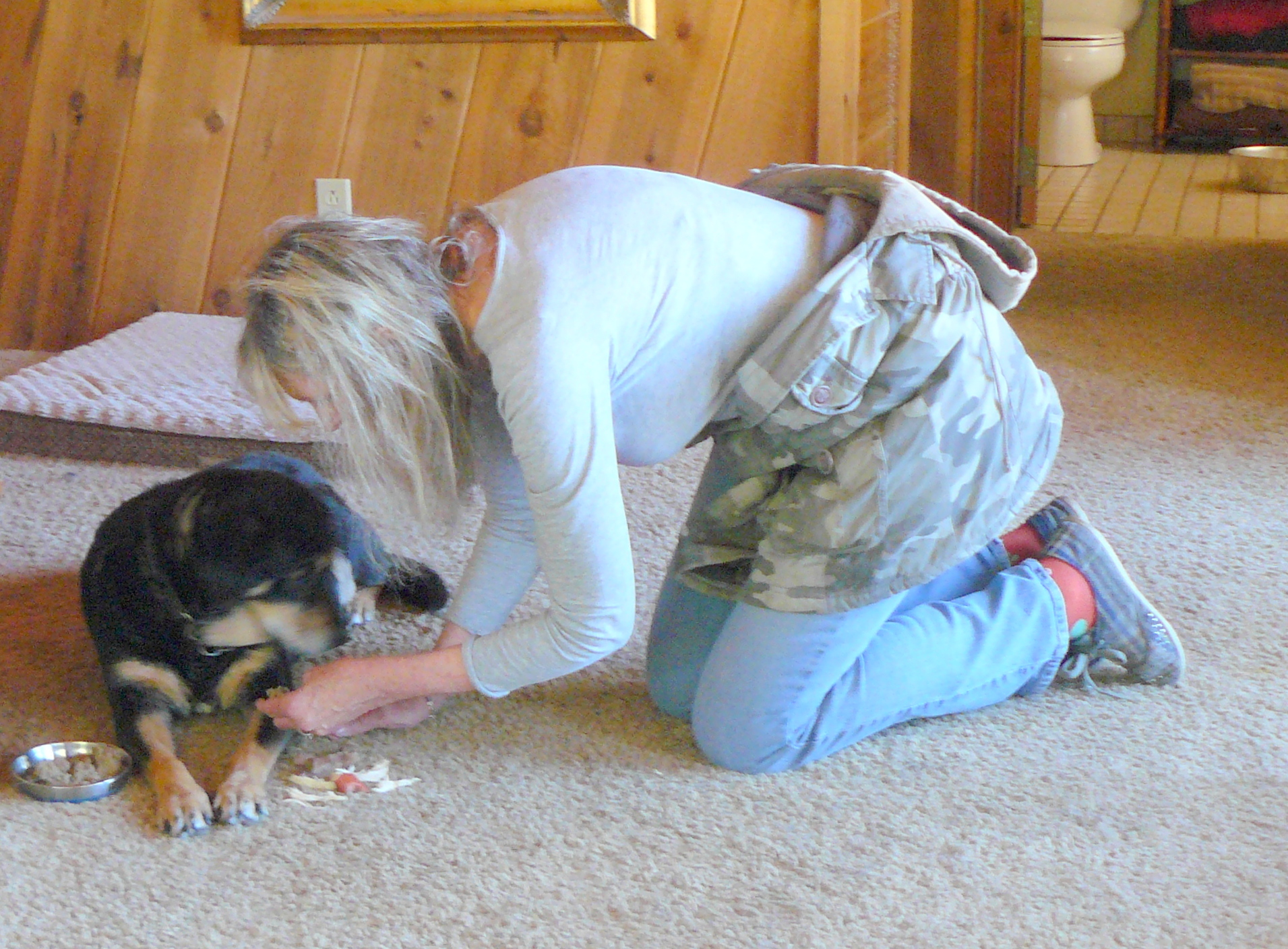
So since then, with outstanding care and patience, Jean has been coaxing Hazel to eat just sufficient food for Hazel to be able to take the Fluconazole, for her fungal infection in her lungs, and Doxycycline, for her tick infection. (Mind you, Hazel is still a long way from eating reliably.)
That was a week ago and while, at best, Hazel is just eating sufficient to take her meds she is far from improving to any noticeable degree. But she is not eating enough food to stabilise her weight and yesterday morning Jean was worried we might lose her if we didn’t rethink what was going on.

A Sunday morning call to Dr. Jim Goodbrod brought us the advice to re-think the evidence.
Jim liaised with Dr. Codd and it was agreed that further examinations needed to be conducted to obtain a clear, unambiguous diagnosis and that in the interim we stop giving Hazel any medications and offer her body systems a bit of a rest.
One option being discussed is to call in a mobile sonogram or ultra-sonic scanner. There is a very expert doctor in the area who uses such a mobile device and scans can be taken of Hazel’s abdomen and lungs here at home.
Because we will do everything to try and return Hazel to good health.
More information will be passed to you just as soon as it is to hand.
The powerful combination of good medicine and unconditional love.
In the last post on Hazel’s condition, back last Thursday, I passed on Dr. Codd’s observation, “… that by not having Hazel on her meds we were, of course, letting the fungal infection continue its damage.”
Dr. Codd also recommended reducing the dosage of the Fluconazole to lower its side effect of suppressing appetite.
So since then, with outstanding care and patience, Jean has been coaxing Hazel to eat just sufficient food for Hazel to be able to take the Fluconazole, for her fungal infection in her lungs, and Doxycycline, for her tick infection. (Mind you, Hazel is still a long way from eating reliably.)
Yesterday, (Saturday) Hazel was showing clear signs of feeling better but still having to be hand-fed by Jean.
Then this morning (Sunday) she really was perky and readily came out for a walk with the other dogs.

oooo

More generally, Dr. Jim was trying to track down supporting details to the observation made by Dr. Russ:
Namely, that there was evidence that fungal infections can lay dormat for quite long periods of time.
Jim sent me the following email:
Paul …The following article is the one and only reference I have found so far that refers to the possible dormancy of this fungal infection. In paragraph 2 (Clinical Disease) I have highlighted it in red. I have to admit, I was skeptical.Jim
The article was:
Coccidioidomycosis (Zoonotic)
Last updated on 2/4/2011.Contributors:
Rhea V. Morgan DVM, DACVIM, DACVOSynonyms:
San Joaquin Valley Fever
Valley Fever
This is that domancy aspect from that paper that Jim highlighted (in red):
The incubation period in the dog is 1 to 3 weeks.1,2 The organism can remain dormant, with exposure preceding the onset of clinical signs by 3 years or more.1,3 Although people may acquire the disease from the same sources as domestic animals and the mycelial forms are highly infectious, with one exception the disease has not been transmitted from animals to people. One published report exists of transmission to a veterinary assistant via the bite of an infected cat.15
Meanwhile, over in Brandy’s corner, he has very quickly healed after his neutering operation last Thursday. It was fair to say that he was not a happy chappy when he arrived home that day.

oooo

But his cone was off by Saturday and he is back to the wonderful, bouncing dog we all love so much. (Can’t believe that last Saturday was only the second week that Brandy had been with us; he has so quickly woven his way into all our hearts.)

oooo

Returning to Hazel we are still some way from knowing that she has returned to a fully fit dog but the love and caring sent her way by all of you out there has been precious beyond imagination.
Thank You All!
An interesting item that recently crossed my ‘screen’.
I make no apologies for cutting corners for today’s post. Because the last few days of looking after, and worrying about, Hazel have soaked up so much of our time and energy that I just couldn’t find the creative impulse to do much more than ‘copy and paste’.
That’s not to downplay the great interest of this article that appeared over on The Conversation blogsite a few days ago.
ooOOoo
April 15, 2016 5.58am EDT
David Dunning Professor of Psychology, University of Michigan
Disclosure statement: David Dunning has received funding from the National Science Foundation, the National Institutes of Health, and the Templeton Foundation in the past.
In the hours since I first sat down to write this piece, my laptop tells me the National Basketball Association has had to deny that it threatened to cancel its 2017 All-Star Game over a new anti-LGBT law in North Carolina – a story repeated by many news sources including the Associated Press. The authenticity of that viral video of a bear chasing a female snowboarder in Japan has been called into question. And, no, Ted Cruz is not married to his third cousin. It’s just one among an onslaught of half-truths and even pants-on-fire lies coming as we rev up for the 2016 American election season.
The longer I study human psychology, the more impressed I am with the rich tapestry of knowledge each of us owns. We each have a brainy weave of facts, figures, rules and stories that allows us to address an astonishing range of everyday challenges. Contemporary research celebrates just how vast, organized, interconnected and durable that knowledge base is.
That’s the good news. The bad news is that our brains overdo it. Not only do they store helpful and essential information, they are also receptive to false belief and misinformation.
Just in biology alone, many people believe that spinach is a good source of iron (sorry, Popeye), that we use less than 10 percent of our brains (no, it’s too energy-guzzling to allow that), and that some people suffer hypersensitivity to electromagnetic radiation (for which there is no scientific evidence).
But here’s the more concerning news. Our access to information, both good and bad, has only increased as our fingertips have gotten into the act. With computer keyboards and smartphones, we now have access to an Internet containing a vast store of information much bigger than any individual brain can carry – and that’s not always a good thing.
This access to the Internet’s far reaches should permit us to be smarter and better informed. People certainly assume it. A recent Yale study showed that Internet access causes people to hold inflated, illusory impressions of just how smart and well-informed they are.
But there’s a twofold problem with the Internet that compromises its limitless promise.
First, just like our brains, it is receptive to misinformation. In fact, the World Economic Forum lists “massive digital misinformation” as a main threat to society. A survey of 50 “weight loss” websites found that only three provided sound diet advice. Another of roughly 150 YouTube videos about vaccination found that only half explicitly supported the procedure.
Rumor-mongers, politicians, vested interests, a sensationalizing media and people with intellectual axes to grind all inject false information into the Internet.
So do a lot of well-intentioned but misinformed people. In fact, a study published in the January 2016 Proceedings of National Academy of Science documented just how quickly dubious conspiracy theories spread across the Internet. Specifically, the researchers compared how quickly these rumors spread across Facebook relative to stories on scientific discoveries. Both conspiracy theories and scientific news spread quickly, with the majority of diffusion via Facebook for both types of stories happening within a day.
Making matters worse, misinformation is hard to distinguish from accurate fact. It often has the exact look and feel as the truth. In a series of studies Elanor Williams, Justin Kruger and I published in the Journal of Personality and Social Psychology in 2013, we asked students to solve problems in intuitive physics, logic and finance. Those who consistently relied on false facts or principles – and thus gave the exact same wrong answer to every problem – expressed just as much confidence in their conclusions as those who answered every single problem right.
For example, those who always thought a ball would continue to follow a curved path after rolling out of a bent tube (not true) were virtually as certain as people who knew the right answer (the ball follows a straight path).
So, how so we separate Internet truth from the false?
First, don’t assume misinformation is obviously distinguishable from true information. Be careful. If the matter is important, perhaps you can start your search with the Internet; just don’t end there. Consult and consider other sources of authority. There is a reason why your doctor suffered medical school, why your financial advisor studied to gain that license.
Second, don’t do what conspiracy theorists did in the Facebook study. They readily spread stories that already fit their worldview. As such, they practiced confirmation bias, giving credence to evidence supporting what they already believed. As a consequence, the conspiracy theories they endorsed burrowed themselves into like-minded Facebook communities who rarely questioned their authenticity.
Instead, be a skeptic. Psychological research shows that groups designating one or two of its members to play devil’s advocates – questioning whatever conclusion the group is leaning toward – make for better-reasoned decisions of greater quality.
If no one else is around, it pays to be your own devil’s advocate. Don’t just believe what the Internet has to say; question it. Practice a disconfirmation bias. If you’re looking up medical information about a health problem, don’t stop at the first diagnosis that looks right. Search for alternative possibilities.
In addition, look for ways in which that diagnosis might be wrong. Research shows that “considering the opposite” – actively asking how a conclusion might be wrong – is a valuable exercise for reducing unwarranted faith in a conclusion.
After all, you should listen to Mark Twain, who, according to a dozen different websites, warned us, “Be careful about reading health books. You may die of a misprint.”
Wise words, except a little more investigation reveals more detailed and researched sources with evidence that it wasn’t Mark Twain, but German physician Markus Herz who said them. I’m not surprised; in my Internet experience, I’ve learned to be wary of Twain quotes (Will Rogers, too). He was a brilliant wit, but he gets much too much credit for quotable quips.
Misinformation and true information often look awfully alike. The key to an informed life may not require gathering information as much as it does challenging the ideas you already have or have recently encountered. This may be an unpleasant task, and an unending one, but it is the best way to ensure that your brainy intellectual tapestry sports only true colors.
ooOOoo
The way the world now communicates, for good and bad, using the internet is staggering. As the website Internet Live Stats reveals: (as of this moment today)
3,352,197,085 Internet Users in the world
1,016,623,500 Total number of Websites
2,060,120 Blog posts written today
So with that last figure in mind, I’ll send this for posting without delay! 😉
The learning and healing journey continues with Hazel.
The title to today’s post came from Dr. Jim Goodbrod, DVM. When he and I were taking a walk yesterday Jim mentioned that diagnosing exactly what an animal is suffering from is as much an art as it is a science.
Jim and Janet are close friends and neighbours who live a couple of roads away. Jim also attends the Lincoln Road Vet Clinic on a part-time basis. Off his own volition he has been speaking with Dr. Codd (Russ) about the situation with Hazel and the pair of them are showing incredible devotion to getting to the bottom of what is happening.
So, like yesterday’s post, today is being offered to you in the spirit of information. Forgive me if I repeat the caution from yesterday. (This is being written at 4pm on April 19th, 2016.)
CAUTION: The following is offered by way of information reaching out to other loving dog owners. Please do not assume I have any specialist veterinarian knowledge and please do not take the following as a replacement for seeing your own vet.
Late on Sunday afternoon Hazel was becoming so weak and lethargic that Jean and I feared that she wouldn’t make it through the night. So it was wonderful to see that she was alive and still connected to the world at 6am yesterday; Monday. Nonetheless, Hazel had not eaten since Saturday afternoon and was only drinking very small amounts of water. We made the decision to ring the Clinic as soon as they opened on Monday at 8am. They recommended that Hazel be brought in to go on to an IV drip to boost her anti-fungal intake and also to receive an anti-nausea intake to help her regain an appetite. But there was the question hanging over everyone that if this was a fungal infection, as in Coccidioidomycosis, that is not present in the Oregonian soil but is found in the drier parts of the USA and Mexico then why had it been such a long time before it brought Hazel down?
Jean also had this suspicion that Hazel might be suffering from a form of ‘Tick Fever’ that is very common in Mexico.
So off we went to the Clinic again. There were discussions about the whole situation.

Dr. Codd took a quick blood test and, bingo, it revealed that Hazel was showing that she had, or had had in the past, an Ehrlichia Infection; a tick-borne infection.

The cure for that was a course of Doxycycline.
So now we are looking at battling two separate diseases.
The blood that was taken from Hazel last Friday, when she also had radiographs taken of her lungs, had been sent for a ‘titre’ that would confirm one way or another if her lungs were suffering from a fungal infection. Those results will be available on Wednesday or Thursday of this week.

Back to Hazel’s lack of appetite. One of the side-effects of Fluconazole is that it depresses appetite. Getting Hazel eating again was becoming a priority. It seemed to make sense that until we had confirmation of whether or not Hazel had a lung fungal infection, for which taking Fluconazole would be an excellent course of action, we should pause in her dose until the results were in. To speed up the return of an appetite Dr. Jim prescribed a short course of Mirtazipine.
So that’s about it for the time being. Except for Jean and me to say how much we appreciate the art and the science that is being so skillfully offered by the Clinic. (As of 19:00 PDT yesterday Hazel was eating again! 🙂 )

Their “Special Love of Animals” comes over in spades!
New trees offer a good metaphor!
As regular followers of this place know (and a huge thank-you to you all) much of last Friday was spent planting trees in a grassy meadow just to the East of our house.

An hour before I sat down to write this post (now 13:30 PST yesterday) I didn’t have a clue as to what to write. Then I read Patrice Ayme’s latest essay and, wow, it punched me in the face. For it resonated so strongly with a few other recent readings.
Patrice’s essay was called Trump A Demagogue? So What? and it opened thus:
“We empowered a demagogue” laments the New York Times ostensibly bleeding heart liberal, the kind Mr. Kristof, in his false “Mea Culpa” editorial, “My Shared Shame: How The Media Made Trump”. By this, Mr. Kristof means that Mr. Trump is a bad person. However, Mr. Kristof’s choice of the word “demagogue” is revealing. (Actually it’s not really his choice: “demagogue” is not Mr. Kristof’s invention: he just repeats like a parrot the most prominent slogan of the worldwide campaign of insults against Trump).
Trump a demagogue? Is Mr. Sanders a “demagogue”, too? (As much of the financial and right-wing press has it: for The Economist and the Financial Times, Trump and Sanders are both “demagogues” and that’s their main flaw.)
To understand fully the word “demagogue” one has to understand a bit of Greek, and a bigger bit of Greek history.
Then later on in that essay, Patrice goes on to quote Andy Grove:
A hard day may be coming for global plutocrats ruling as they do thanks to their globalization tricks. And I am not exactly naive. Andy Grove, founder of Intel, shared the general opinion that much of globalization was just theft & destitution fostering an ominous future (the Hungarian immigrant to the USA who was one of the founders of Intel). He pointed out, an essay he wrote in 2010 that Silicon Valley was squandering its competitive edge in innovation by neglecting strong job growth in the United States.
Mr. Grove observed that: …”it was cheaper and thus more profitable for companies to hire workers and build factories in Asia than in the United States. But… lower Asian costs masked the high price of offshoring as measured by lost jobs and lost expertise. Silicon Valley misjudged the severity of those losses, he wrote, because of a “misplaced faith in the power of start-ups to create U.S. jobs.”
Silicon Valley makes its money from start-ups. However, that phase of a business is different from the scale-up phase, when technology goes from prototypes to mass production. Both phases are important. Only scale-up is an engine for mass job growth — and scale-up is vanishing in the United States (especially with jobs connected to Silicon Valley). “Without scaling,” Mr. Grove wrote, “we don’t just lose jobs — we lose our hold on new technologies” and “ultimately damage our capacity to innovate…
The underlying problem isn’t simply lower Asian costs. It’s our own misplaced faith in the power of startups to create U.S. jobs. Americans love the idea of the guys in the garage inventing something that changes the world. New York Times columnist Thomas L. Friedman recently encapsulated this view in a piece called “Start-Ups, Not Bailouts.” His argument: Let tired old companies that do commodity manufacturing die if they have to. If Washington really wants to create jobs, he wrote, it should back startups.
Friedman is wrong. Startups are a wonderful thing, but they cannot by themselves increase tech employment.”
Spot on! For in my previous life I was the founder of two businesses. First up was Dataview Ltd, based in Colchester, that was formed in the late 1970s and soon became the global distributor of the word processing software Wordcraft, written by Englishman Pete Dowson. Dataview also initiated the ‘dongle’, a software/hardware security device to protect Wordcraft.

The second company founded by me was Aviation Briefing Ltd ‘AvBrief’ that is still going today, albeit with me no longer involved!
So I can reinforce, with hundreds of hours of lost sleep and tears, that growing a company and increasing employment, especially the employment of great technical people, is a very different matter to the start-up phase.
Frankly, regarding Dataview, it was only the luck of meeting Sid Newman that saved my bacon. For within 12 months of starting trading I was already sinking under the load of trying to be the number one salesman (that I was good at) and being the company general manager (that I was total crap at). Sid had years of experience at general management and very quickly let me get on with what I really loved – opening up Wordcraft distributorships all over the world.
The analogy with planting trees is very apt. For any clown can plant the tree but parenting that young tree into a mature forty-foot high beauty takes professional management.

Tomorrow I will return and offer a viewpoint as to how we, as in society, are currently bereft of professional managers.
Dog lost at sea is found – five weeks later!
This story has been widely reported and for good reason. The source of my post is here.
ooOOoo
Celebrating the life and times of Albert Einstein.
Yesterday was the centenary of the birth of Albert Einstein (14 March 1879 – 18 April 1955). It has been widely reported. For example, a piece on the EarthSky blog:
March 14, 1879. This is the anniversary of the birth of Albert Einstein, undoubtedly the most famous scientist of the modern era.
Einstein was born in Ulm, Germany, where an uncle – Jakob Einstein, an engineer – introduced him to science and math. At age 17, he enrolled in the Swiss Polytechnic Institute after failing the entrance exam the previous year. He graduated in 1900, and in 1902 he became a junior patent examiner in the Swiss Patent Office in Bern, Switzerland, where he specialized in electrical devices.
The year 1905 came to be known as Einstein’s Miracle Year. He was 26 years old, and in that year he published four papers that reshaped physics.
Now before you read on let me proclaim that today’s post has absolutely nothing to do with dogs! (Unless dogs exist in parallel universes!)
But a recent documentary that was published on Top Documentary Films was really fascinating and incredibly well presented. Thus, in terms of the likes of you and I better understanding what Einstein revealed about our universe, I couldn’t resist sharing it with you all today. It is just 29 minutes long.
STORYLINE
One hundred years have passed since Albert Einstein first unleashed his highly influential Theory of General Relativity unto the world. These revelations charted a future course of scientific pursuit, and never cease to inform our understanding of the universe today. In celebration of that impressive legacy, the documentary short Einstein’s Extraordinary Universe travels to three research facilities in different regions across the globe, and shows us how Einstein’s work continues to challenge, shape and inspire the scientific discoveries of tomorrow.
The film opens in Tuscany. Under the shadows of Galileo’s groundbreaking work on gravity research, a group of astrophysicists are exploring Einstein’s theories related to the occurrence of gravitational waves through space and time. Can modern technologies and advanced scientific intellect result in actual proof of such waves?
Viewers are then taken to the world’s largest underground laboratory. Hidden far beneath Italy’s Gran Sasso mountains, the lab serves as a home to researchers who work tirelessly to prove another of Einstein’s grandiose theories: the existence of dark matter. The vast majority of our universe is made up of materials that we have not yet been able to detect through forces of light and energy. The dedicated team who toil away in this impressive underground lair hope they can lay the groundwork in changing that.
The filmmakers’ next stop is Switzerland, where they are given a tour of one of the most impressive displays of scientific testing technology on the planet. Housed by the European Organization for Nuclear Research, or CERN, the Large Hadron Collider is the most powerful particle accelerator on the planet, and is being used to question and examine the substance of all matter in our universe.
Through each destination on this incredible journey, what amazes most is how prescient Einstein’s theories have proven even after a century has passed. His work continues to test the limits of our scientific understanding, and sets a groundwork from which researchers still strive for answers. Featuring a plethora of illuminating interviews with many top figures in the fields of scientific study, Einstein’s Extraordinary Universe is certain to delight seasoned science geeks and novices alike.
What an extraordinary mind he had!
Is there a case for optimism? You bet there is!
To be honest, at a personal level I just don’t know the answer to that question. It seems to depend on the mood that Jean and I are in at any particular time. All I can fall back on is that well-used saying from me: “Never underestimate the power of unintended consequences”.
In other words, we shouldn’t underestimate the strength of millions of good people when their demands start reaching out to those in power. (And whatever your reaction to this post, please don’t miss watching the inspirational Al Gore speech towards the end of this post.)
Recently over on the Grist site there was an article about the critical changes that each and every one of us should be making. I want to share it with you in full.
ooOOoo