Category: Politics

The disaster of empire?

The view of Alfred McCoy

Despite Tom Engelhardt giving me permission years ago to republish his essays I rarely go down that path. Not because many of his essays aren’t deeply interesting but because he doesn’t to the best of my knowledge write about dogs!

However, a recent TomDispatch was sufficiently concerning that I am republishing it for you.

It’s quite a long article.

ooOOoo

Tomgram: Alfred McCoy, Grandmasters of the Universe

Posted by Alfred McCoyat, December 2, 2018.
Follow TomDispatch on Twitter @TomDispatch.

Whether you realize it or not, we are in a new age of imperial geopolitics on a grand — and potentially disastrous — scale. TomDispatch regular Alfred McCoy, author of In the Shadows of the American Century: The Rise and Decline of U.S. Global Power, lays out devastatingly just what that is likely to mean in the age of Donald Trump. And once you’ve read his piece on a century-plus of geopolitical thinkers who helped reorganize this planet in genuinely discordant ways, perhaps you’ll feel it’s time for us to imagine a new kind of geopolitics, one that finally addresses the disaster of empire and the ways in which such geopolitical thinking now intersects with another kind of disaster: climate change. For catastrophic as the previous versions of geopolitics may have been, just wait until such imperial and national follies, including the drive of China and India to build new coal plants galore, meet global warming.  By this century’s end, that phenomenon may leave significant parts of the planet facing six nightmarish crises at once, ranging from mega-droughts and mega-fires to rising sea levels and catastrophic flooding. Or what about the possibility that intense heat waves (sparked in part by the massive burning of coal) will, later in this century, make the north China plain, now the most heavily populated part of that country, uninhabitable and do the same for parts of northern India and South Asia? Or what about the recent estimate in a congressionally mandated report on climate change (carefully released by the Trump administration on Black Friday in an attempt to bury it) that this country will also be deeply affected, as, for instance, wildfires of the kind that just devastated parts of California will triple, and the U.S. economy will be downsized by 10% or more by 2100?

We are now on a planet guaranteed, barring a miracle of coordinated human action, to find itself in a set of geo-ruins of an unprecedented sort by 2100, ruins that will remain so on a time scale anything but historical or in any way human. With that in mind, consider McCoy’s account of the “architects of imperial disaster” who got us to just this spot and to an American president whose goal in life is to do everything humanly possible to pump more greenhouse gases in the atmosphere. Tom

Trump’s Trade Czar, The Latest Architect of Imperial Disaster
Five Academics Who Unleashed the “Demon” of Geopolitical Power
By Alfred W. McCoy

As Washington’s leadership fades more quickly than anyone could have imagined and a new global order struggles to take shape, a generation of leaders has crowded onto the world stage with their own bold geopolitical visions for winning international influence. Xi Xinping has launched his trillion-dollar “Belt and Road Initiative” to dominate Eurasia and thereby the world beyond. To recover the Soviet Union’s lost influence, Vladimir Putin seeks to shatter the Western alliance with cyberwar, while threatening to dominate a nationalizing, fragmenting Eastern Europe through raw military power. The Trump White House, in turn, is wielding tariffs as weapons to try to beat recalcitrant allies back into line and cripple the planet’s rising power, China. However bizarrely different these approaches may seem, they all share one strikingly similar feature: a reliance on the concept of “geopolitics” to guide their bids for global power.

Over the past century, countless scholars, columnists, and commentators have employed the term “geopolitics” (or the study of global control) to lend gravitas to their arguments. Few, though, have grasped the true significance of this elusive concept. However else the term might be used, geopolitics is essentially a methodology for the management (or mismanagement) of empire. Unlike conventional nations whose peoples are, in normal times, readily and efficiently mobilized for self-defense, empires, thanks to their global reach, are a surprisingly fragile form of government. They seem to yearn for strategic visionaries who can merge land, peoples, and resources into a sustainable global system.

The practice of geopolitics, even if once conducted from horseback, is as old as empire itself, dating back some 4,000 years. Until the dawn of the twentieth century, it was the conquerors themselves — from Alexander the Great to Julius Caesar to Napoleon Bonaparte — whose geopolitical visions guided the relentless expansion of their imperial domains. The ancient Greek historian Plutarch tried to capture (or perhaps exaggerate) the enormity of Caesar’s conquest of Gaul — a territory that comprises all of modern France and Belgium — by enumerating the nine years of war that “took by storm more than eight hundred cities, subdued three hundred tribes, and fought pitched battles… with three million men, of whom he slew one million… and took as many more prisoners.”

In his own account, however, Caesar reduced all of this to its geopolitical essentials. “All Gaul is divided into three parts,” he wrote in that famous first sentence of his Gallic Wars. “Of all these, the Belgae are the bravest, because… they are the nearest to the Germans, who dwell beyond the Rhine, with whom they are continually waging war; for which reason the Helvetii also surpass the rest of the Gauls in valor, as they contend with the Germans in almost daily battles.” When those formidable Helvetii marched out of their Alpine cantons to occupy Gallic lowlands in 58 BC, Caesar deployed geopolitics to defeat them — seizing strategic terrain, controlling their grain supplies, and manipulating rival tribes. Instead of enslaving the vanquished Helvetii as other Roman generals might have, Caesar, mindful of the empire’s geopolitical balance, returned them to their homelands with generous provisions, lest the German “barbarians” cross the Rhine and destabilize Gaul’s natural frontier.

In more modern times, imperial expansion has been guided by professional scholars who have made the formal study of geopolitics a hybrid field of some significance. Its intellectual lineage is actually remarkably straightforward. At the end of the nineteenth century, an American naval historian argued that seapower was the key to national security and international influence. A decade later, a British geographer observed that railroads had shifted the locus of global power landward into the interior of the vast Eurasian continent. In the succeeding century, a succession of scholars would draw on these two basic ideas to inspire bold geopolitical gambits by Nazi Germany, Cold War Washington, post-Soviet Russia, and even Donald Trump’s White House.

There is, in fact, a common thread in those disparate scholarly lives: in each case, the study of geopolitics seemed to change the trajectory of their careers, lifting them from the margins of society to the right hand of power. There, at moments when the empire they lived in was experiencing a crisis, their unconventional, even eccentric, ideas won influence — often in what would prove in the long term a nightmarish fashion.

Over the last century or so, while the actual application of such thinking regularly proved problematic at best and genuinely horrific at worst, geopolitics would remain a seductive concept with a persistent power to entice would-be practitioners. It would also prove an enormously elusive style of thinking, making it difficult to distinguish between the banal and the brilliant, between the imperially helpful and the imperially devastating.

Charting the interplay of land, people, and resources inside any empire, much less in a clash between such behemoths, is impossibly difficult. Admittedly, geopolitics in the hands of a grandmaster has, in the past, led to the crushing of armies and the conquest of continents. But seemingly similar strategies have also produced searing defeat and disaster. Caesar’s deft geopolitical balancing of Gaul and Germany on the fulcrum of the Rhine survived for some four centuries; Napoleon’s similar attempt lasted all of seven years.

Telling the difference, in the historical moment, is a daunting task and one that hasn’t turned out well in the last century. With that in mind, let’s now approach the careers of five modern “grandmasters” of geopolitics with an appropriate skepticism.

America’s Strategic Visionary

In 1890, as the industrial boom of the Gilded Age prepared the nation for a debut on the world stage, Captain Alfred Thayer Mahan, arguably America’s only original strategic thinker, published his famed Influence of Seapower Upon History. In it, he argued that naval power was the determining factor in the fate of nations. Born at West Point, where his father taught military tactics to Army cadets, Mahan came to the study of strategy almost by birthright. After graduating from the Naval Academy and having an indifferent career at sea, he became the head of the Naval War College in 1886. There, he developed novel geopolitical ideas that would revive a stalled career.

By analyzing sea power through a wide range of factors, including the defensibility of ports, national technological prowess, and the nature of good government, Mahan would produce the first serious study of geopolitics in the guise of a guide to naval strategy. In the process, he became an international celebrity, influencing admirals from London to Tokyo and inspiring leaders worldwide to join a naval arms race that would drain their treasuries to build costly battleships. The admiral who headed Germany’s navy, for instance, distributed 8,000 copies of Mahan’s history in translation and in the process won passage of the country’s first naval bill in 1898, funding his fateful challenge to British sea power.

As Europe’s empires continued to spread globally in the 1890s, Mahan’s prolific prose persuaded Washington that national defense required the creation of a genuine blue-water navy and bases in both the Caribbean and the Pacific. So important were such bases for the nation’s defense that, as Mahan gravely concluded, “No European state should henceforth acquire a coaling position within three thousand miles of San Francisco” — a distance that encompassed the Hawaiian Islands, soon to become U.S. possessions.

Like many advocates of geopolitics to come, Mahan would use seemingly precise strategic concepts to project his country’s current position into a murky future. As his geopolitical principles took physical form after 1898, they would produce an indefensible string of bases stretching across the Pacific from Panama to the Philippines.

Following his doctrine, the Navy ordered Admiral George Dewey’s squadron to seize Manila Bay during the Spanish-American War of 1898, which he did by sinking the Spanish fleet. Within five years, however, Japan’s stunning victory over the Russian fleet in the Sea of Japan forced Washington to withdraw much of its navy from the Western Pacific. In 1907, President Theodore Roosevelt began building a new Pacific bastion at Pearl Harbor in Hawaii, not in Manila Bay, saying that the Philippines, by then an American colony, is “our heel of Achilles.” Making matters worse, the Versailles peace settlement at the end of World War I conceded the Mariana Islands in the Western Pacific to Japan, allowing its navy to block the sea-lanes from Pearl Harbor to Manila Bay — a geopolitical reality that would doom General Douglas MacArthur’s Philippine command to a searing defeat at the start of World War II.

At that war’s end, however, Washington finally resolved this geopolitical conundrum by conquering Japan and building a chain of more than 100 bases from that country to the Philippines, making the Pacific littoral the strategic fulcrum for the defense of one continent (North America) and dominion over another (Eurasia).

Sir Halford Propagates Geopolitics

Little more than a decade after Mahan wrote his influential studies of seapower, Sir Halford Mackinder, head of the London School of Economics (LSE), published a seminal article that shifted the focus of geopolitics from sea to land. Writing in 1904, as the 5,700 miles of the Trans-Siberian Railway was still being built from Moscow to Vladivostok, Mackinder argued that future rail lines would knit Eurasia into a unitary landmass that he dubbed “the world island.” When that day came, Russia, perhaps in alliance with another land power like Germany, could control Eurasia’s sprawling “heartland,” allowing “the use of vast continental resources for fleet-building, and the empire of the world would be in sight.”

This path-breaking analysis came at a fortuitous time in Mackinder’s academic career. After teaching geography at Oxford for 10 years, he had failed to win a professorship and his marriage collapsed. At this low ebb in his life, he tried to establish himself as an exploratory geographer by making the first recorded ascent of Mount Kenya. Using the “moral suasion of my Mauser” rifle to force his 170 African bearers to “obey like the faithful dogs they are,” Mackinder moved through the famine-stricken foothills leading to that mountain by extracting food from hungry villages at gunpoint. Then, in September 1899, at the cost of 10 porters shot and many more whipped for “malingering,” he traversed glaciers to reach the summit at 17,000 feet. His triumph before a cheering crowd at the Royal Geographical Society in London was, however, marred not by his treatment of those bearers but by his failure to bring back significant findings or scientific specimens.

So, in yet another career change, Mackinder joined the LSE where he produced that influential article on geopolitics. At the end of World War I, he turned it into a book that contained his most memorable maxim: “Who rules East Europe commands the Heartland; Who rules the Heartland commands the World-Island; Who rules the World-Island commands the World.”

Mackinder’s expertise in imperial geopolitics helped launch his political career, including gaining him a seat in Parliament. In 1919, amid the turmoil of the Russian revolution, Britain was shipping arms to anti-Bolshevik forces there under General Anton Denikin. At Winston Churchill’s behest, the cabinet then appointed Mackinder as a special high commissioner for southern Russia. In a unique test of his “heartland” theory, Mackinder made an abortive attempt to rally the Czarist forces by meeting General Denikin inside his railcar in the Caucasus to propose an alliance with Poland and promise a mass evacuation in the event of defeat. Upon return to London, ignoring the general’s role in slaughtering some 100,000 Jews, Mackinder recommended recognizing his government and providing aid — advice the cabinet quickly dismissed.

From that brief moment at the apex of power, Mackinder soon fell into obscurity — losing his seat in Parliament, retiring from the LSE, and settling into a sinecure as chairman of the Imperial Shipping Committee. Were it not for the surprising later appeal of his ideas in Nazi Germany and Vladimir Putin’s Russia, his name would have been largely forgotten.

The Sorcerer’s Nazi Apprentice

As the Versailles peace conference of 1919 stripped Germany of its colonial empire and placed its Rhineland frontier under foreign occupation, Karl Haushofer exchanged his general’s baton for a geography professorship at Munich University. There, he would apply Mackinder’s concepts in an attempt to assure that his fatherland would never again engage in the sort of strategic blunders that, in World War I, had led to such a humiliating defeat.

While Mackinder himself was courting the powerful in postwar London, Haushofer was teaching geopolitics to future top Nazis in Munich — first to his graduate assistant Rudolf Hess (later to become the deputy Führer), and then to Adolf Hitler himself while he was writing Mein Kampf during his incarceration at Munich’s Landsberg Prison in 1924. Both Haushofer and his son Albrecht, who would train Nazi diplomats in the geopolitics of European conquest, were later rewarded with influential positions in the Third Reich. By dressing the British don’s idea of the Eurasian heartland as the pivot of world power in the local garb of Lebensraum (or “the Greater German Reich’s dazzling ascent by war… for extension of its living space”), Haushofer helped propagate an enticing logic of expansion that would send Hitler’s army on the road to defeat.

In 1942, Hitler dispatched a million men, 10,000 artillery pieces, and 500 tanks to breach the Volga River at Stalingrad and capture Russia’s heartland for lebensraum. In the end, the Reich’s forces would suffer 850,000 casualties — killed, wounded, and captured — in a vain attempt to break through the East European rimland into the world island’s heartland.

Appalled by the attack on Russia, Haushofer’s son joined the underground’s attempt to assassinate Hitler and was imprisoned. Before he was finally shot by the SS (on the day the Allies captured Berlin), he would compose mournful sonnets about geopolitical power, which he saw metaphorically as buried deep under the sea until “my father broke the seal” and “set the demon free to roam throughout the world.” A few months later, Karl Haushofer and his Jewish wife committed suicide together when confronted with the possibility that the victorious allies might prosecute him as a senior Nazi war criminal.

The Liberator of Eastern Europe

As the United States recoiled from its searing defeat in Vietnam, Zbigniew Brzezinski, an émigré Polish aristocrat and autodidact when it came to geopolitics, went from teaching international relations in New York to being President Jimmy Carter’s national security advisor in Washington. There, his risky geopolitical gambits gained an attentive audience after the Soviet Red Army invaded Afghanistan in 1979.

As an intellectual acolyte of Mackinder, Brzezinski embraced his concept of the Eurasian heartland as the “pivot” of global power. But in marked contrast to Mackinder’s failure in southern Russia in 1920, Brzezinski would prove adept at applying that geopolitician’s famous dictum on the dynamic that tied Eastern Europe to Eurasia’s heartland. (In the end, however, his Afghan moves would help give rise to Osama bin Laden, al-Qaeda, the 9/11 attacks, and the never-ending war on terror of this century.)

Wielding a multi-billion-dollar CIA covert operation in Afghanistan like a sharpened wedge, Brzezinski drove radical Islam deep into the heart of Soviet Central Asia. In the process, he drew Moscow into a debilitating decade-long Afghan war, so weakening it that Eastern Europe would finally break free from the Soviet empire in 1989. Asked about the enormous human suffering his strategy inflicted on Afghanistan and his role in creating a militant Islam hostile to the United States, he would remain coolly unapologetic. “What is most important to the history of the world?” he responded in 1998. “The Taliban or the collapse of the Soviet empire? Some stirred-up Moslems or the liberation of Central Europe and the end of the Cold War?”

In retirement, Brzezinski resumed his study of Mackinder’s theory, doing a better job as an armchair analyst than he had as a presidential adviser. In a 1998 book, he warned that dominance over Eurasia remained “the central basis for global primacy.” To control that vast region, Washington, he insisted, would have to preserve its “perch on the Western periphery” of Europe and hold its string of “offshore bases” along the Pacific littoral. Should these conditions change, he predicted with some prescience, “a potential rival to America might at some point arise.”

Putin’s Geopolitical Visionary

In the aftermath of the Soviet Union’s collapse, a Russian rightist ideologue, Alexander Dugin, would revive Mackinder’s ideas yet again to promote expansion into Eurasia. In the process, he would become “a major influence” on Russian President Vladimir Putin.

In the 1980s, as the Soviet Union was beginning to unravel, Dugin was still moving in Moscow’s bohemian circles as a dabbler in the occult and a fringe member of the “ultra-nationalist and anti-Semitic organization Pamiat.” After the Soviet collapse, he became chief ideologue for an eclectic alliance of patriotic and punk-rock groups called the New Bolshevik Party, serving as its candidate for a seat in the 1995 Duma legislative elections and winning just 1% of the vote.

At this political nadir for both him and his country, Dugin recycled Mackinder’s long-forgotten writings in a 1997 bestseller, The Foundation of Geopolitics: Russia’s Geopolitical Future. As his book moved into its fourth printing and he “became a pole star for a broad section of Russian hardliners,” he began teaching geopolitics to military officers at the General Staff Academy, later lecturing on it to elite students at Moscow State University, and anchoring Landmarks, a weekly television show on the subject. In those years, Moscow bookstores even opened special sections for geopolitics, the legislature formed a geopolitics committee, and the Russian leadership began to embrace Dugin’s vision of expansionist nationalism.

Drawing on Haushofer’s German writings, he argued that Russia should become a Eurasian bastion against “the conspiracy of ‘Atlanticism’ led by the United States and NATO… aimed at containing Russia within successive geographic rings” of the former Soviet republics. To achieve the destiny envisioned by Mackinder, Russia needed, in Dugin’s view, to dominate Eurasia — annexing Ukraine, conquering Georgia, incorporating Finland, and bringing the Balkan states (Serbia, Romania, and Bulgaria) under its rule as an Orthodox “Third Rome.” To advance such ideas, Dugin founded the Eurasia Youth Union of Russia in 2005, first to serve as “human shields” to fight against the Orange revolution in Ukraine and later to counter the “degeneration” caused by American cultural influence.

For the past decade, he has been a forceful advocate for Russian expansionism. During that country’s war with Georgia in 2008, he was photographed with a rocket launcher in South Ossetia and quoted in the national press calling for its annexation. After serving as “the brains behind Vladimir Putin’s wildly popular annexation of Crimea” in March 2014, Dugin embraced the Russian minority in eastern Ukraine, prodding the Russian president to openly support their separatist militia.

While advocacy of aggressive geopolitics has given Dugin significant political influence and Putin unprecedented popularity in Russia, it is still unclear whether in the long run such expansionism, in defiance of international norms, will prove a geopolitical masterstroke or a diplomatic debacle.

The Geopolitics of Trump’s Trade War

Most recently, a dissident economist and failed California politician named Peter Navarro has parlayed his hostility toward China into the role of key architect of Donald Trump’s “trade war” against Beijing. Like his Russian counterpart Alexander Dugin, Navarro is another in a long line of intellectuals whose embrace of geopolitics changed the trajectory of his career.

Raised by a single mom who worked secretarial jobs to rent one-bedroom apartments where he slept on the couch, Navarro went to college at Tufts on a scholarship and earned a doctorate in economics from Harvard. Despite that Ivy League degree, he remained an angry outsider, denouncing the special interests “stealing America” in his first book and later, as a business professor at the University of California-Irvine, branding San Diego developers “punks in pinstripes.” A passionate environmentalist, in 1992 Navarro plunged into politics as a Democratic candidate for the mayor of San Diego, denouncing his opponent’s husband as a convicted drug-money launderer and losing when he smirked as she wept during their televised debate.

For the next 10 years, Navarro fought losing campaigns for everything from city council to Congress. He detailed his crushing defeat for a seat in the House of Representatives in a tell-all book, San Diego Confidential, that dished out disdain for that duplicitous “sell out” Bill Clinton, dumb “blue-collar detritus” voters, and just about everybody else as well.

Following his last losing campaign for city council, Navarro spent a decade churning out books attacking a new enemy: China. His first “shock and awe” jeremiad in 2006 told horror stories about that country’s foreign trade; five years later, Death By China was filled with torrid tales of “bone-crushing, cancer-causing, flammable, poisonous, and otherwise lethal products” from that land. In 2015, a third book turned to geopolitics, complete with carefully drawn maps and respectful references to Captain Mahan, to offer an analysis of how China’s military was pursuing a relentless strategy of “anti-access, area denial” to challenge the U.S. Navy’s control over the Western Pacific.

To check China, the Pentagon then had two competing strategies — “Air-Sea Battle,” in which China’s satellites were to be blinded, knocking out its missiles, and “Offshore Control,” in which China’s entire coastline was to be blockaded by mining six maritime choke points from Japan to Singapore. Both, Navarro claimed, were fatally flawed. Given that, Navarro’s third book and a companion film (endorsed by one Donald Trump) asked: What should the United States do to check Beijing’s aggression and its rise as a global power? Since all U.S. imports from China, Navarro suggested, were “helping to finance a Chinese military buildup,” the only realistic solution was “the imposition of countervailing tariffs to offset China’s unfair trade practices.”

Just a year after reaching that controversial conclusion, Navarro joined the Trump election campaign as a policy adviser and then, after the November victory, became a junior member of the White House economic team. As a protectionist in an administration initially dominated by globalists, he would be excluded from high-level meetings and, according to Time Magazine, “required to copy chief economic adviser Gary Cohn on all his emails.” By February 2018, however, Cohn was on his way out and Navarro had become assistant to the president, with his new trade office now the co-equal of the National Economic Council.

As the chief defender of Trump’s belief that “trade wars are good and easy to win,” Navarro has finally realized his own geopolitical dream of attempting to check China with tariffs. In March, the president slapped heavy ones on Chinese steel imports and, just a few weeks later, promised to impose more of them on $50 billion of imports. When those started in July, China’s leaders retaliated against what they called “typical trade bullying,” imposing similar duties on American goods. Despite a warning from the Federal Reserve chairman that “trade tensions… could pose serious risks to the U.S. and global economy,” with Navarro at his elbow, Trump escalated in September, adding tariffs on an additional $200 billion in Chinese goods and threatening another $267 billion worth if China dared retaliate. Nonetheless, Beijing hit back, this time on just $60 billion in goods since 95% of all U.S. imports had already been covered.

Then something truly surprising happened. In September, the U.S. trade deficit with China ballooned to $305 billion for the year, driven by an 8% surge in Chinese imports — a clear sign that Navarro’s bold geopolitical vision of beating Beijing into submission with tariffs had collided big time with the complexities of world trade. Whether this tariff dispute will fizzle out inconsequentially or escalate into a full-blown trade war, wreaking havoc on global supply chains and the world economy, none of us can yet know, particularly that would-be geopolitical grandmaster Peter Navarro.

The Desire to be Grandmaster of the Universe

Though such experts usually dazzle the public and the powerful alike with erudition and boldness of vision, their geopolitical moves often have troubling long-term consequences. Mahan’s plans for Pacific dominion through offshore bases created a strategic conundrum that plagued American defense policy for a half-century. Brzezinski’s geopolitical lunge at the Soviet Union’s soft Central Asian underbelly helped unleash radical Islam. Today, Alexander Dugin’s use of geopolitics to revive Russia’s dominion over Eurasia has placed Moscow on a volatile collision course with Europe and the United States. Simultaneously, Peter Navarro’s bold gambit to contain China’s military and economic push into the Pacific with a trade war could, if it persists, produce untold complications for our globalized economy.

No matter how deeply flawed such geopolitical visions may ultimately prove to be, their brief moments as official policy have regularly shaped the destiny of nations and of empires in unpredictable, unplanned, and often dangerous ways. And no matter how this current round of geopolitical gambits plays out, we can be reasonably certain that, in the not-too-distant future, another would-be grandmaster will embrace this seductive concept to guide his bold bid for global power.

Alfred W. McCoy, a TomDispatch regular, is the Harrington professor of history at the University of Wisconsin-Madison. He is the author of The Politics of Heroin: CIA Complicity in the Global Drug Trade, the now-classic book which probed the conjuncture of illicit narcotics and covert operations over 50 years, and the recently published In the Shadows of the American Century: The Rise and Decline of U.S. Global Power (Dispatch Books).

Follow TomDispatch on Twitter and join us on Facebook. Check out the newest Dispatch Books, John Feffer’s new dystopian novel (the second in the Splinterlands series) Frostlands, Beverly Gologorsky’s novel Every Body Has a Story, and Tom Engelhardt’s A Nation Unmade by War, as well as Alfred McCoy’s In the Shadows of the American Century: The Rise and Decline of U.S. Global Power and John Dower’s The Violent American Century: War and Terror Since World War II.

Copyright 2018 Alfred W. McCoy

ooOOoo

We are now on a planet guaranteed, barring a miracle of coordinated human action, to find itself in a set of geo-ruins of an unprecedented sort by 2100, ruins that will remain so on a time scale anything but historical or in any way human.

Indeed!

Back to dogs tomorrow!

Only a dog.

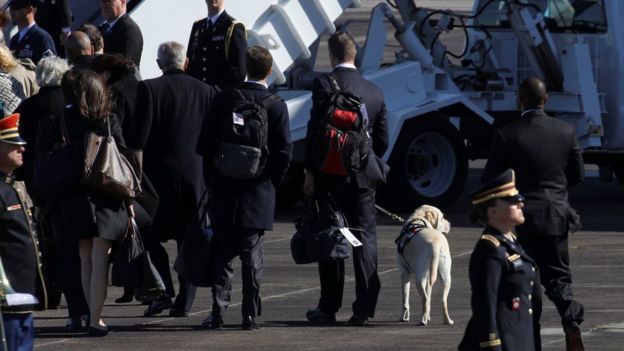
Would lie alongside President Bush’s casket.

This story has been all over the news recently and rightly so; it’s a very touching report.

I have taken my story from the BBC News and wanted to share some of it with you.

ooOOoo

George HW Bush’s service dog Sully pays touching last tribute

3 December 2018
Sully the dog sleeps next to the casket of the late US President George HW Bush

The labrador who worked as a service dog for President George HW Bush has been pictured resting beside his coffin, in a moving tribute.

Mr Bush, who served as the 41st US president between 1989 and 1993, died late on Friday at the age of 94.

Sully the dog is travelling with the casket on the flight from Texas to Washington and back this week.

Mr Bush’s body is due to lie in state this week ahead of a day of national mourning.

The coffin is being flown from Texas to DC on board Air Force One – temporarily renamed Special Air Mission 41, in homage to the late president – and then back on Wednesday, with Sully accompanying the body throughout.

oooo

ooOOoo

Irrespective of what one accomplished in one’s life, 94 is a grand age!


This is the reality, folks, for us all.

A very sombre read from George Monbiot.

I read this essay first thing in the morning last Wednesday while still in bed. It struck me with a whole range of feelings and emotions; not positive ones I should add. Then I read it aloud to Jeannie with the feeling that this speaks of what it is, what it’s going to be, and how little time we have to make the sorts of gigantic changes that we all need.

Sorry to be down-in-the-dumps about the following; published with George Monbiot’s kind permission.

ooOOoo

Hopeless Realism

No effective means of stopping climate breakdown is deemed “politically realistic”. So we must change political realities.

By George Monbiot, published in the Guardian 14th November 2018.

It was a moment of the kind that changes lives. At a press conference held by Extinction Rebellion last week, two of us journalists pressed the activists on whether their aims were realistic. They have called, for example, for carbon emissions in the UK to be reduced to net zero by 2025. Wouldn’t it be better, we asked, to pursue some intermediate aims?

A young woman called Lizia Woolf stepped forward. She hadn’t spoken before, and I hadn’t really noticed her, but the passion, grief and fury of her response was utterly compelling. “What is it that you are asking me as a 20-year-old to face and to accept about my future and my life? … this is an emergency – we are facing extinction. When you ask questions like that, what is it you want me to feel?”. We had no answer.

Softer aims might be politically realistic, but they are physically unrealistic. Only shifts commensurate with the scale of our existential crises have any prospect of averting them. Hopeless realism, tinkering at the edges of the problem, got us into this mess. It will not get us out.

Public figures talk and act as if environmental change will be linear and gradual. But the Earth’s systems are highly complex, and complex systems do not respond to pressure in linear ways. When these systems interact (because the world’s atmosphere, oceans, land surface and lifeforms do not sit placidly within the boxes that make study more convenient) their reactions to change become highly unpredictable. Small perturbations can ramify wildly. Tipping points are likely to remain invisible until we have passed them. We could see changes of state so abrupt and profound that no continuity can be safely assumed.

Only one of the many life support systems on which we depend – soils, aquifers, rainfall, ice, the pattern of winds and currents, pollinators, biological abundance and diversity – need fail for everything to slide. For example, when Arctic sea ice melts beyond a certain point, the positive feedbacks this triggers (such as darker water absorbing more heat, melting permafrost releasing methane, shifts in the polar vortex) could render runaway climate breakdown unstoppable. When the Younger Dryas period ended 11,600 years ago, Greenland ice cores reveal temperatures rising 10°C within a decade.

I don’t believe that such a collapse is yet inevitable, or that a commensurate response is either technically or economically impossible. When the US joined the Second World War in 1941, it replaced a civilian economy with a military economy within months. As Jack Doyle records in his book Taken for a Ride, “In one year, General Motors developed, tooled, and completely built from scratch 1000 Avenger and 1000 Wildcat aircraft … Barely a year after Pontiac received a Navy contract to build antishipping missiles, the company began delivering the completed product to carrier squadrons around the world.” And this was before advanced information technology made everything faster.

The problem is political. A fascinating analysis by the social science professor Kevin Mackay contends that oligarchy has been a more fundamental cause of the collapse of civilisations than social complexity or energy demand. Oligarchic control, he argues, thwarts rational decision-making, because the short-term interests of the elite are radically different to the long-term interests of society. This explains why past civilizations have collapsed “despite possessing the cultural and technological know-how needed to resolve their crises.” Economic elites, that benefit from social dysfunction, block the necessary solutions.

The oligarchic control of wealth, politics, media and public discourse explains the comprehensive institutional failure now pushing us towards disaster. Think of Trump and his cabinet of multi-millionaires, the influence of the Koch brothers, the Murdoch empire and its massive contribution to climate science denial, the oil and motor companies whose lobbying prevents a faster shift to new technologies.

It is not just governments that have failed to respond, though they have failed spectacularly. Public sector broadcasters have deliberately and systematically shut down environmental coverage, while allowing the opaquely-funded lobbyists that masquerade as thinktanksto shape public discourse and deny what we face. Academics, afraid to upset their funders and colleagues, have bitten their lips. Even the bodies that claim to be addressing our predicament remain locked within destructive frameworks.

For example, last Wednesday I attended a meeting about environmental breakdown at the Institute for Public Policy Research. Many of the people in the room seemed to understand that continued economic growth is incompatible with sustaining the Earth’s systems. As the author Jason Hickel points out, a decoupling of rising GDP from global resource use has not happened and will not happen. While 50 billion tonnes of resources used per year is roughly the limit the Earth’s systems can tolerate, the world is already consuming 70 billion tonnes. Business as usual, at current rates of economic growth, will ensure that this rises to 180 billion tonnes by 2050. Maximum resource efficiency, coupled with massive carbon taxes and some pretty optimistic assumptions, would reduce this to 95 billion tonnes: still way beyond environmental limits. A study taking account of the rebound effect (efficiency leads to further resource use) raises the estimate to 132 billion tonnes. Green growth, as members of the Institute appear to accept, is physically impossible.

On the same day, the same Institute announced a major new economics prize for “ambitious proposals to achieve a step-change improvement in the growth rate.” It wants ideas that will enable economic growth rates in the UK at least to double. The announcement was accompanied by the usual blah about sustainability, but none of the judges of the prize has a discernible record of environmental interest.

Those to whom we look for solutions trundle on as if nothing has changed. They continue to behave as if the accumulating evidence has no purchase on their minds. Decades of institutional failure ensures that only “unrealistic” proposals – the repurposing of economic life, with immediate effect – now have a realistic chance of stopping the planetary death spiral. And only those who stand outside the failed institutions can lead this effort.

Two tasks need to be performed simultaneously: throwing ourselves at the possibility of averting collapse, as Extinction Rebellion is doing, slight though this possibility may appear. And preparing ourselves for the likely failure of these efforts, terrifying as this prospect is. Both tasks require a complete revision of our relationship with the living planet. Because we cannot save ourselves without contesting oligarchic control, the fight for democracy and justice and the fight against environmental breakdown are one and the same. Do not allow those who have caused this crisis to define the limits of political action. Do not allow those whose magical thinking got us into this mess to tell us what can and cannot be done.

www.monbiot.com

ooOOoo

I have a son and daughter who live in England. My daughter and her husband have a seven-year-old boy, my grandson, and I hope that I live long enough to have some decent conversations with him.  Now whether or not those conversations will turn to his future and what fears he has only time will tell.

But that doesn’t stop me from worrying, worrying big time, just what world we are leaving for him and the thousands of others of his age as they grow up. I truly fear that it is going to be a very different planet than the one we have at present.

I hope with all my heart that I am wrong!

Picture Parade Two Hundred and Sixty-Four

And it’s all about getting the vote out!

Hannah Ingram tweeted this photo of leaders from opposing parties going head-to-head in Ramsbottom

oooo

Rocco enjoyed his trip to the polls in Tameside, Greater Manchester

oooo

Phoebe was interested to see local democracy in action in Chorlton, Manchester

oooo

This Shar Pei named Prune accompanied his owner Edward in Ipswich

oooo

Hermione and Hagrid’s owner was exercising their democratic right – and their four-legged friends

oooo

Buddy was happy to accompany his human Haley to the polls in Portsmouth

oooo

Blueberry McScruffin the sprocker exercised her democratic right in Whitley Bay.

oooo

Ava the Dachshund looked pensive as she waited to hear the outcome of her owner’s vote

oooo

Poppy in north London proved all creatures great and small could take their owners to vote.

oooo

The BBC’s assistant political editor Norman Smith’s dog had plans for a game of fetch after the poll

All taken courtesy of the BBC.

Support the Orcas

If you can, please support this PDX event coming up on the 5th.

In my post that was my letter to Mr. Neptune, Colette left a reply that was a ‘heads up’ to an event being held in Portland, Oregon on October 5th. Ergo, this coming Friday.

Now the odds are that very few of you dear readers will be within reach of that event.

But that doesn’t stop me from promoting the event so that the details may be shared as far and wide as possible.

ooOOoo

PDX ACTIVIST

activism and resistance events in Portland

Save Our Orcas

Holladay Park Portland, OR

NE 11th Street & Hollady Street

Description

Join us October 5th for a peaceful Demonstration to help endangered Southern Resident Killer Whales. There are only 74 left after the loss of 2 baby Orcas this Summer. You may have seen the dead newborn Orca carried “Save our Orcas”. Meet promptly at Holladay Park at 3:00pm.

ooOOoo

Here’s a news item taken from CBS News.

Then for those that would like more background on the Orca whale, let me republish the opening paragraphs of an item from Wikipedia.

The killer whale or orca (Orcinus orca) is a toothed whale belonging to the oceanic dolphin family, of which it is the largest member. Killer whales have a diverse diet, although individual populations often specialize in particular types of prey. Some feed exclusively on fish, while others hunt marine mammals such as seals and dolphins. They have been known to attack baleen whale calves, and even adult whales. Killer whales are apex predators, as no animal preys on them. A cosmopolitan species, they can be found in each of the world’s oceans in a variety of marine environments, from Arctic and Antarctic regions to tropical seas, absent only from the Baltic and Black seas, and some areas of the Arctic Ocean.

Killer whales are highly social; some populations are composed of matrilineal family groups (pods) which are the most stable of any animal species. Their sophisticated hunting techniques and vocal behaviours, which are often specific to a particular group and passed across generations, have been described as manifestations of animal culture.

The International Union for Conservation of Nature assesses the orca’s conservation status as data deficient because of the likelihood that two or more killer whale types are separate species. Some local populations are considered threatened or endangered due to prey depletion, habitat loss, pollution (by PCBs), capture for marine mammal parks, and conflicts with human fisheries. In late 2005, the southern resident killer whales, which swim in British Columbia and Washington statewaters, were placed on the U.S. Endangered Species list.

Wild killer whales are not considered a threat to humans,[6] but there have been cases of captive orcas killing or injuring their handlers at marine theme parks. Killer whales feature strongly in the mythologies of indigenous cultures, with their reputation ranging from being the souls of humans to merciless killers.

Orcas leaping. Picture from the Whale and Dolphin Conservation (WDC) website.

Changing the world.

The problem is not plastic. It is consumerism.

I closed yesterday’s Letter to the Moon with the last sentence from a recent essay from George Monbiot: “Defending the planet means changing the world.

Shortly, I will be republishing, with Mr. Monbiot’s generous permission, the whole of that essay.

But first I am going to reproduce in full what arrived via email from George in the early hours of yesterday morning.

If you are within reach of London please go, or if not do leave a comment on the wall.

Hi Paul,

I’m contacting you because you’re one of the people who emailed me as part of the overwhelming response to my columns In Memoriam, and Incompetence By Design, where I mentioned that ‘some of us are now mobilising to turn the great enthusiasm for wildlife and natural beauty in this country into political action, and to fight the dismantling of the laws that protect our precious wild places’.

Many of you asked what I meant by ‘Watch this space’. The mobilisation starts next Saturday, in London, with The People’s Walk for Wildlife. It’s not a demonstration, nor a rally – it’s a gentle, family-friendly day. The only kind of strength we need is strength in numbers – to show that many thousands of us care deeply about the vanishing of wild mammals, butterflies, mayflies, songbirds and fish, and that we want the Government to commit properly to protecting those that remain.

On Saturday 22nd September, we’ll gather at Reformers Tree, Hyde Park at 10.00am; entertainment will start at 12 noon. At 1pm we’ll walk from Hyde Park Corner, via Piccadilly, St James, Pall Mall, and Cockspur St, to Whitehall. Please come along if you can. Download the birdsong app to play as we go. Bring friends, dress up as your favourite plant or animal or just come as yourself!

I’m looking forward to walking for the missing millions – I hope you can join me!

George
P.S. If you can’t make it, you can still contribute by adding your message of support to the Walk’s Wonder Wall – every post is valuable proof that you care.

Now on to that post.

ooOOoo

Plastic Soup

The problem is not plastic. It is consumerism.

By George Monbiot, published in the Guardian 5th September 2018

Do you believe in miracles? If so, please form an orderly queue. Plenty of people imagine we can carry on as we are, as long as we substitute one material for another. Last month, a request to Starbucks and Costa to replace their plastic coffee cups with cups made from corn starch was retweeted 60,000 times, before it was deleted.

Those who supported this call failed to ask themselves where the corn starch would come from, how much land is needed to grow it or how much food production it will displace. They overlooked the damage this cultivation would inflict: growing corn (maize) is notorious for causing soil erosion, and often requires heavy doses of pesticides and fertilisers.

The problem is not just plastic. The problem is mass disposability. Or, to put it another way, the problem is pursuing, on the one planet known to harbour life, a four-planet lifestyle. Regardless of what we consume, the sheer volume of consumption is overwhelming the Earth’s living systems.

Don’t get me wrong. Our greed for plastic is a major environmental blight, and the campaigns to limit its use are well-motivated and sometimes effective. But we cannot address our environmental crisis by swapping one over-used resource for another. When I challenged that call, some people asked me, “so what should we use instead?”. The right question is “how should we live?”. But systemic thinking is an endangered species.

Part of the problem is the source of the plastic campaigns: David Attenborough’s Blue Planet II series. The first six episodes had strong, coherent narratives. But the seventh episode, which sought to explain the threats facing the wonderful creatures the series revealed, darted from one issue to another. We were told we could “do something” about the destruction of ocean life. We were not told what. There was no explanation of why the problems are happening, what forces are responsible and how they can be engaged.

Amid the general incoherence, one contributor stated “It comes down, I think, to us each taking responsibility for the personal choices in our everyday lives. That’s all any of us can be expected to do.” This perfectly represents the mistaken belief that a better form of consumerism will save the planet. The problems we face are structural: a political system captured by commercial interests and an economic system that seeks endless growth. Of course we should try to minimise our own impacts, but we cannot confront these forces merely by “taking responsibility” for what we consume.

Unfortunately, these are issues that the BBC in general, and David Attenborough in particular, avoid. I admire Attenborough in many ways, but I am no fan of his environmentalism. For many years, it was almost undetectable. When he did at last speak out, he consistently avoided challenging power, either speaking in vague terms or focusing on problems for which powerful interests are not responsible. I believe this tendency may explain Blue Planet’s skirting of the obvious issues.

The most obvious is the fishing industry, that turns the astonishing lifeforms the rest of the series depicted into seafood. Throughout the oceans, this industry, driven by our appetites and protected by governments, is causing cascading ecological collapse. Yet the only fishery the programme featured was among the 1% that are in recovery. It was charming to see how Norwegian herring boats seek to avoid killing orcas, but we were given no idea of how unusual it is.

Even marine plastics is in large part a fishing issue. It turns out that 46% of the Great Pacific Garbage Patch, that has come to symbolise our throwaway society, is composed of discarded nets, and much of the rest consists of other kinds of fishing gear. Abandoned fishing materials tend to be far more dangerous to marine life than other forms of waste. As for the bags and bottles contributing to the disaster, the great majority arise in poorer nations, without good disposal systems. But because this point was not made, we look to the wrong places for solutions.

From this misdirection arise a thousand perversities. One prominent environmentalist posted a picture of the king prawns she had just bought, celebrating the fact that she had persuaded the supermarket to put them in her own container, rather than a plastic bag, and linking this to the protection of the seas. But buying prawns causes many times more damage to marine life than any plastic in which they are wrapped. Prawn fishing has the highest rates of bycatch of any fishery: scooping up vast numbers of turtles and other threatened species. Prawn farming is just as bad, eliminating great tracts of mangrove forests, crucial nurseries for thousands of species.

We are kept remarkably ignorant of such issues. As consumers, we are confused, bamboozled and almost powerless. This is why corporate power has gone to such lengths to persuade us to see ourselves this way. The BBC’s approach to environmental issues is highly partisan, siding with a system that has sought to transfer responsibility for structural forces to individual shoppers. It is only as citizens, taking political action, that we can promote meaningful change.

The answer to the question “how should we live?” is “simply”. But living simply is highly complicated. In Aldous Huxley’s Brave New World, the government massacred the Simple Lifers. This is generally unnecessary: today they can be safely marginalised, insulted and dismissed. The ideology of consumption is so prevalent that it has become invisible: it is the plastic soup in which we swim.

One-planet living means not only seeking to reduce our own consumption, but also mobilising against the system that promotes the great tide of junk. This means fighting corporate power, changing political outcomes and challenging the growth-based, world-consuming system we call capitalism.

As the famous Hothouse Earth paper published last month, that warned of the danger of flipping the planet into a new, irreversible climatic state, concluded, “incremental linear changes … are not enough to stabilize the Earth system. Widespread, rapid, and fundamental transformations will likely be required to reduce the risk of crossing the threshold”. Disposable coffee cups made from new materials are not just a non-solution. They are a perpetuation of the problem. Defending the planet means changing the world.

http://www.monbiot.com

ooOOoo

Share this! Please!

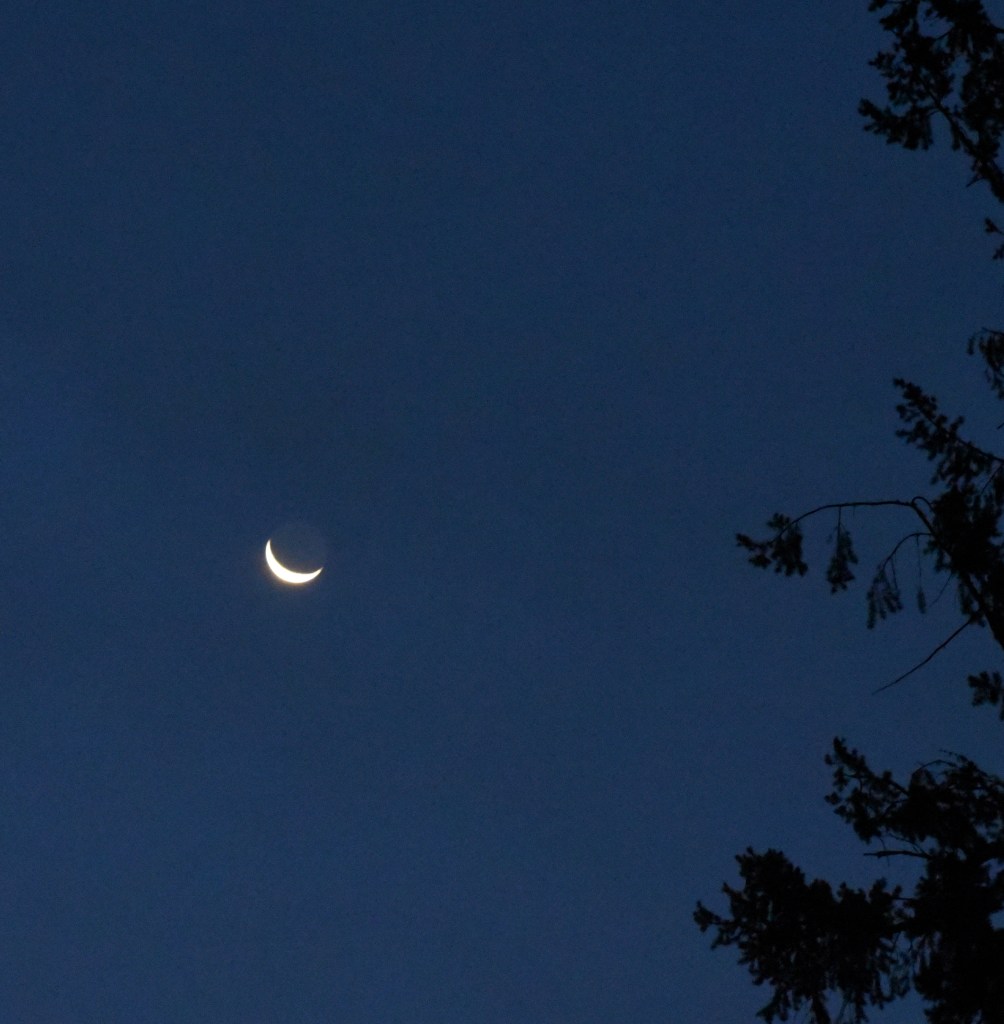
A Letter to the Moon

We live on such a fragile planet!

The idea of writing a letter to the moon is not a new one and it came to me when listening to an item yesterday morning, Pacific Time, broadcast by the BBC on Radio 4. The item was the news that Elon Musk has announced that:

Elon Musk’s company SpaceX has unveiled the first private passenger it plans to fly around the Moon.

Japanese billionaire and online fashion tycoon Yusaku Maezawa, 42, announced: “I choose to go to the Moon.”

The mission is planned for 2023, and would be the first lunar journey by humans since 1972.

So here is that letter!

ooOOoo

Dear Mr Moon,

I cannot believe how quickly the years roll by!

Who would have thought that yesterday, the 18th of September, 2018, was the anniversary of the day in September, 1977 when:

On September 18, 1977, as it headed toward the outer solar system, Voyager 1 looked back and acquired a stunning image of our Earth and moon.

You will surely remember that first image taken of the Planet Earth and your good self in the same frame.

Here is the 1st-ever photo of the Earth and moon in a single frame. Voyager 1 took the photo on September 18, 1977, when it was 7.25 million miles (11.66 million km) from Earth. Image Number: PIA00013 via NASA/JPL.

Now here we are some 41 years later and, my, how things have changed.

But something, dear Mr. Moon, has never changed for you. That is the sight of our most beautiful planet. Plus, I would go so far as to venture that what makes our planet such a beautiful sight, one that has captivated us humans when we have gone into space and looked back at home, is the magic of our atmosphere.

It is so thin!

Picture taken by a NASA satellite orbiting the earth some 200 miles above the planet’s surface.

So, so thin …. and so, so fragile.

It is akin to the thinness of the skin of an onion.

In fact, Mr. Moon, that layer that we earthlings call the troposphere, the layer closest to Earth’s surface varies from just 4 miles to 12 miles (7 to 20 km) thick. It contains half of our planet’s atmosphere!

Everything that sustains the life of air-breathing creatures, human and otherwise, depends on the health of this narrow layer of atmosphere above our heads. Now the thickness of that layer varies depending on the season and the temperature of the air. But let’s use an average thickness of 8 miles (say, 13 km) because I want to explore in my letter to you some comparisons.

In your infinite gaze down upon your mother planet you will have seen the arrival  of H. sapiens, out of ancestral H. erectus, that took place roughly 315,000 years ago.

You will also have seen from your lofty vantage point the growth of both CO2 levels in the planet’s atmosphere and the average land-ocean temperature. Forgive me quoting something at you, but:

OBSERVABLE CHANGES IN THE EARTH

SINCE THE INDUSTRIAL REVOLUTION

While politicians have been busy debating the merits of climate science, the physical symptoms of climate change have become increasingly apparent: since the industrial revolution, sea level has grown by 0.9 inches, the atmospheric concentration of carbon dioxide has risen to unprecedented levels, average global temperatures have increased by about 1.0 degree Celsius and, to top it off, the global population has jumped by nearly 600 percent; 15 of the 16 hottest years on record occurred in the 21st century, and 2016 is likely to be the warmest year ever recorded.

Now the Industrial Revolution was all but over back in 1840 and the last 178 years have seen an explosion in the way we use energy, in all its forms. Plus we have to accept that back then the global population was around 1 billion persons. It is now over 7 billion.

Between 1900 and 2000, the increase in world population was three times greater than during the entire previous history of humanity—an increase from 1.5 to 6.1 billion in just 100 years.

So on to my comparisons.

The radius of our beautiful planet is about 3,959 miles (6,371 km). The average thickness of the troposphere is 8 miles (13 km).

Thus the ratio of thickness of our liveable atmosphere to the radius of the planet is 8 divided by 3,959. That is a figure of 0.002! Our atmosphere is 1/1000th of the size of the radius of our planet.

Hang on that figure for a moment.

In the last 178 years humanity has transformed our consumption of energy and especially carbon-based fuels. H. sapiens has been around for 315,000 years.

Thus the ratio of these present ‘modern’ times (the last 178 years) to the arrival of us back then (315,000 years ago) is 178 divided by 315,000. That is a (rounded) figure of 0.0006. Our modern times are just 1/10,000th of the time that so-called modern man has been on this planet.

So, dear Mr. Moon, you must despair that in so short a number of years, proportionally ten times smaller than the ratio of the troposphere to the radius of our planet, we funny creatures have done so much damage to what we all depend on to stay alive – clean air!

Or maybe, my dear companion of the night sky, because you are celebrating your 4.1 billionth year of existence, what we humans are doing is all a bit of a yawn.

Sincerely,

This old Brit living in Oregon.

ooOOoo

My dear friends (and I’m now speaking to you dear reader, not the moon!) when you reflect on the fragility of our atmosphere, well the layer we depend on for life, you realise without doubt that each and every one of us must make this pledge.

“I promise to do everything possible to reduce my own personal CO2 output and to ensure that both to my near friends and my political representatives I make it clear that we must turn back – and turn back now!”

Or, as George Monbiot writes in closing a recent essay (that I am republishing tomorrow): “Defending the planet means changing the world.”

The burning of our forests!

But it is not a total wall-to-wall disaster.

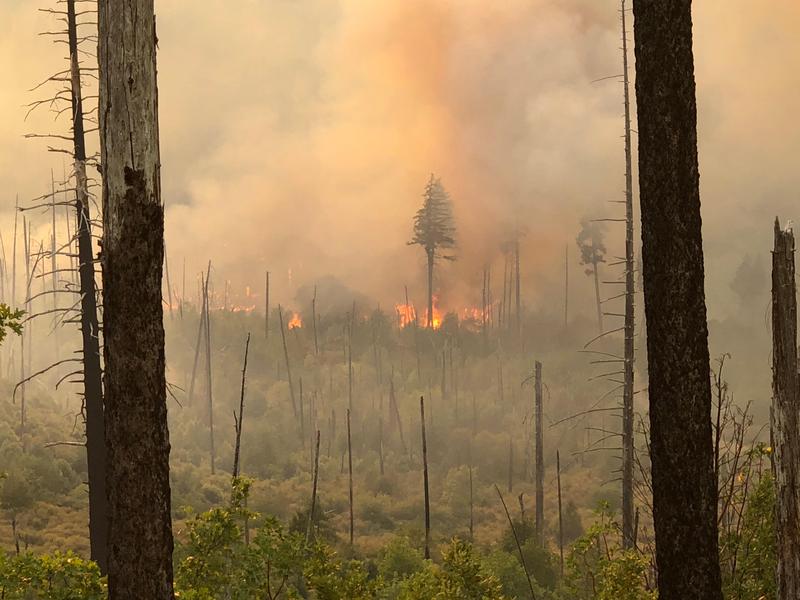
The latest news is that our Klondike Fire is now burning an area larger than 100,000 acres. Or to use the words from the incident webpage(my emphasis):

The Taylor Creek and Klondike Fires were split into zones on Saturday, Aug. 18. The fires are now referred to as “Taylor Creek Fire” and “Klondike Fire East,” managed by the Northwest Incident Management Team 12 out of Lake Selmac, and “Klondike Fire West” managed by California Interagency Incident Management Team 4 out of Gold Beach. A transfer of command of the Klondike West Zone will occur at 6:00 AM Friday when the Southern Area Red Team who arrived on Wednesday will take over.

As of the morning of Aug. 30, the Taylor Creek Fire is estimated 52,839 acres and is 95 percent contained. The Klondike Fire is estimated at 100,996 acres and is 40 percent contained. There are 1,214 personnel working on the Klondike Fire and 126 personnel assigned to the Taylor Creek Fire.

Courtesy Jeffersen Public Radio

Then just over a week ago, The Conversation blogsite published a reminder that I wanted to share  with you today, under the permissions offered by The Conversation site.

ooOOoo

Many native animals and birds thrive in burned forests, research shows

By

Associate Research Professor of Biology, Pennsylvania State University

August 22nd, 2018

Interior Secretary Ryan Zinke is blaming this summer’s large-scale wildfires on environmentalists, who he contends oppose “active management” in forests.

But the idea that wildfires should be suppressed by logging the forest is far too simplistic. Most scientists agree that large hot wildfires produce many benefits for North American forests. Notably, they create essential habitat for many native species.

Fifteen years of research on Spotted Owls – a species that has played an oversized role in shaping U.S. forest management policies and practices for the past several decades – directly contradicts the argument that logging is needed to protect wildlife from fires. Wildlife biologists, including me, have shown in a string of peer-reviewed studies, that wildfires have little to no effect on Spotted Owls’ occupancy, reproduction or foraging, and even provide benefits to the owls.

Nonetheless, despite this steadily accumulating evidence, the U.S. Forest Service advocates logging in old-growth forest reserves and Spotted Owl critical habitat in the name of protecting Spotted Owls from forest fires. Zinke’s recent statements are just the latest and broadest iteration of the false viewpoint that logging benefits wildlife and their forest habitats.

Protecting Spotted Owl habitat

Spotted Owls are birds of prey that range from the Pacific Northwest to central Mexico. Because they nest in large old-growth trees and are sensitive to logging, in the 1980s they became symbols of the exceptional biodiversity found in old-growth forests.

The Northern Spotted Owl in the Pacific Northwest was listed as threatened under the Endangered Species Act in 1990. At that point, about 90 percent of U.S. old-growth forest had already been lost to logging. Every year in the 1980s the U.S. Forest Service sold about 7 to 12 billion board feet of public lands timber.

Figure 1. National forest timber sales (1905–2017). FY 1905-2017 National Summary Cut and Sold Data USDA Forest Service

Listing the owl drew attention to the dramatic decline of old-growth forest ecosystems due to 50 years of unsustainable logging practices. In response the U.S. Forest Service adopted new regulations that included fewer clearcuts, less cutting of trees over 30 inches in diameter and fewer cuts that opened up too much of the forest canopy. These policies, along with vast depletion of old-growth forests, reduced logging on Forest Service lands to about 2 billion board feet per year.

During the 1990s, national forest management policy for the Northern Spotted Owl included creating old-growth reserves and designating critical habitat where logging was restricted – mostly within half a mile of a Spotted Owl nest. In spite of these protections, populations of Northern Spotted Owls, as well as California and Mexican Spotted Owls, continued to decline on forest lands outside national parks. This was most likely due to ongoing logging outside of their protected nesting areas in the owls’ much larger year-round home ranges.

Fire and owls

Over the years the Forest Service shifted away from treating Spotted Owls as symbols of old-

Historical range (burgundy) of the Northern Spotted Owl, which also extended north into British Columbia. One hundred fifty years of logging, agriculture and urbanization have reduced the amount of old growth forest (potential Spotted Owl habitat) in this zone by 85-90 percent. NASA Earth Observatory

growth forest biodiversity, and instead started to cite them as an excuse for more logging. The idea that forest fires were a threat to Spotted Owls was first proposed in 1992 by agency biologists and contract researchers. In a status assessment of the California Spotted Owl, these scientists speculated that fires might be as damaging as clearcuts to the owls.

This perspective gained popularity within the Forest Service over the next 10 years and led to increased logging on public lands that degraded old-growth habitat for Spotted Owls.

Academic scientists, including some with Forest Service funding, published peer-reviewed studies of Spotted Owls and fire in 2002, 2009, 2011 and 2012. All four studies showed either no effects from fire or positive benefits from fire for Spotted Owls. Subsequent research on Spotted Owls in fire-affected forests has showed repeatedly that the owls can persist and thrive in burned landscapes.


(The U.S. Forest Service says wildfires harm wildlife habitat, but wildfires actually create rare and important habitat.)

Many wild species thrive in burned landscapes

I recently conducted a systematic review and meta-analysis that summarized all available scientific research on the effects of wildfires on Spotted Owl ecology. It found that Spotted Owls are usually not significantly affected by mixed-severity forest fire. Mixed-severity forest fire, which includes large patches with 100 percent tree mortality, is how wildfires in western forests naturally burn. The preponderance of evidence indicated that mixed-severity wildfire has more benefits than costs for Spotted Owls.

In 2017 I submitted an early version of this analysis with the same conclusions to the U.S. Fish and Wildlife Service during the agency’s peer-review process for its Conservation Objectives Report for the California Spotted Owl. My conclusions were not included in the final report.

Decades of science have shown that forest fires – including large hot fires – are an essential part of western U.S. forest ecosystems and create highly biodiverse wildlife habitat. Many native animals thrive in the years and decades after large intense fires, including deer, bats, woodpeckers and songbirds as well as Spotted Owls. Additionally, many native species are only found in the snag forest habitat of dead and dying trees created by high-severity wildfire.

Pileated woodpeckers excavate nests within snags, bringing life to charred forests in Oregon. NASA/S. Russell, CC BY-ND

Wildfires threaten homes, but wildlife and water supplies benefit

Studies have shown that wildfires are strongly influenced by a warming climate, and that logging to reduce fuels doesn’t stop the biggest, hottest fires. In my view, federal and state agencies that manage wildfires should devote significant resources towards making structures ignition-resistant and creating defensible space around homes to protect communities, rather than promoting ecologically damaging logging.

It is also time to reform Forest Service management goals to emphasize carbon capture, biodiversity, outdoor recreation and water supply as the most important ecosystem services provided by national forest lands. These services are enhanced by wildfires, not by logging.

ooOOoo

These last two paragraphs are key lessons: 1. Logging does not stop the biggest, hottest fires, and, 2. It is time to change the goals under which our forests are managed emphasising carbon capture, biodiversity, recreation and water supplies!

I won’t hold my breath!

Can we really avoid the ‘train crash’?

The idea that humanity will not prevent the approaching disaster is beyond belief!

One of the results of all you great people signing up to follow Learning from Dogs is that it encourages me to share things that strike me as so, so important.

Another of the results in there being, as of today, 3,349 following this place, is that I get the sense of what many of you good people also feel is important. Ergo, it is clear to me, clear beyond doubt, that caring and loving a dog or two makes you a person who cares and loves passionately this beautiful planet that is our home.

The emotion that is spilling out of me via these words to you is a result of having just read an essay published recently on The Conversation site and shared with you today.

Directly, it has nothing to do with our dear dogs. Yet, in a way, it does!

ooOOoo

7.5 billion and counting: How many humans can the Earth support?

By Associate Professor of Mathematics, College of the Holy Cross, July 9th 2018.

Humans are the most populous large mammal on Earth today, and probably in all of geological history. This World Population Day, humans number in the vicinity of 7.5 to 7.6 billion individuals.

Can the Earth support this many people indefinitely? What will happen if we do nothing to manage future population growth and total resource use? These complex questions are ecological, political, ethical – and urgent. Simple mathematics shows why, shedding light on our species’ ecological footprint.

The mathematics of population growth

In an environment with unlimited natural resources, population size grows exponentially. One characteristic feature of exponential growth is the time a population takes to double in size.

Exponential growth of world population

It took 127 years for the world population to double from one billion to two. By contrast, it took only 47 years, from 1927 to 1974, to double from two billion to four. Since 1960, world population has grown by about one billion every 13 years. Each point represents an additional one billion people.

[Ed: Text taken from a chart displayed in the article.]

Exponential growth tends to start slowly, sneaking up before ballooning in just a few doublings.

To illustrate, suppose Jeff Bezos agreed to give you one penny on Jan. 1, 2019, two pennies on Feb. 1, four on March 1, and so forth, with the payment doubling each month. How long would his $100 billion fortune uphold the contract? Take a moment to ponder and guess.

After one year, or 12 payments, your total contract receipts come to US$40.95, equivalent to a night at the movies. After two years, $167,772.15 – substantial, but paltry to a billionaire. After three years, $687,194,767.35, or about one week of Bezos’ 2017 income.

The 43rd payment, on July 1, 2022, just short of $88 billion and equal to all the preceding payments together (plus one penny), breaks the bank.

Real population growth

For real populations, doubling time is not constant. Humans reached 1 billion around 1800, a doubling time of about 300 years; 2 billion in 1927, a doubling time of 127 years; and 4 billion in 1974, a doubling time of 47 years.

On the other hand, world numbers are projected to reach 8 billion around 2023, a doubling time of 49 years, and barring the unforeseen, expected to level off around 10 to 12 billion by 2100.

This anticipated leveling off signals a harsh biological reality: Human population is being curtailed by the Earth’s carrying capacity, the population at which premature death by starvation and disease balances the birth rate.

World population projections

In 2020, the UN predicts that there will be 7,795,482 people worldwide.

[Ed: Text taken from a chart displayed in the article.]

Ecological implications

Humans are consuming and polluting resources – aquifers and ice caps, fertile soil, forests, fisheries and oceans – accumulated over geological time, tens of thousands of years, or longer.

Wealthy countries consume out of proportion to their populations. As a fiscal analogy, we live as if our savings account balance were steady income.

According to the Worldwatch Institute, an environmental think tank, the Earth has 1.9 hectares of land per person for growing food and textiles for clothing, supplying wood and absorbing waste. The average American uses about 9.7 hectares.

These data alone suggest the Earth can support at most one-fifth of the present population, 1.5 billion people, at an American standard of living.

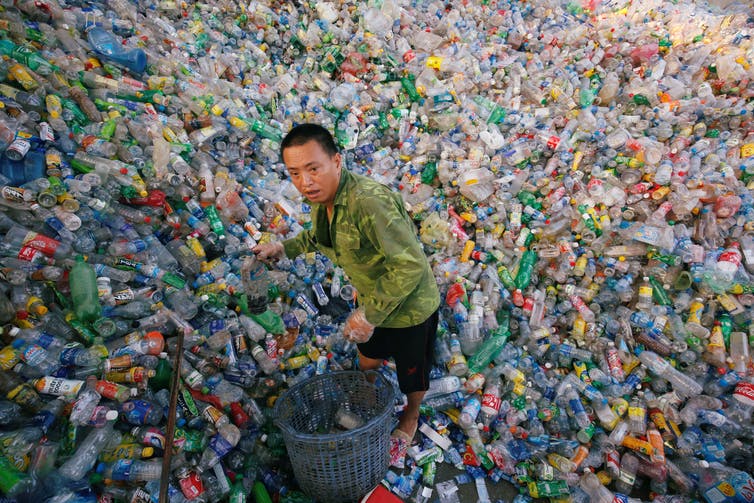
A man works recycling plastic bottles outside Hanoi, Vietnam. REUTERS/Kham

Water is vital. Biologically, an adult human needs less than 1 gallon of water daily. In 2010, the U.S. used 355 billion gallons of freshwater, over 1,000 gallons (4,000 liters) per person per day. Half was used to generate electricity, one-third for irrigation, and roughly one-tenth for household use: flushing toilets, washing clothes and dishes, and watering lawns.

If 7.5 billion people consumed water at American levels, world usage would top 10,000 cubic kilometers per year. Total world supply – freshwater lakes and rivers – is about 91,000 cubic kilometers.

World Health Organization figures show 2.1 billion people lack ready access to safe drinking water, and 4.5 billion lack managed sanitation. Even in industrialized countries, water sources can be contaminated with pathogens, fertilizer and insecticide runoff, heavy metals and fracking effluent.

Freedom to choose

Though the detailed future of the human species is impossible to predict, basic facts are certain. Water and food are immediate human necessities. Doubling food production would defer the problems of present-day birth rates by at most a few decades. The Earth supports industrialized standards of living only because we are drawing down the “savings account” of non-renewable resources, including fertile topsoil, drinkable water, forests, fisheries and petroleum.

The drive to reproduce is among the strongest desires, both for couples and for societies. How will humans reshape one of our most cherished expectations – “Be fruitful and multiply” – in the span of one generation? What will happen if present-day birth rates continue?

Population stays constant when couples have about two children who survive to reproductive age. In some parts of the developing world today, couples average three to six children.

We cannot wish natural resources into existence. Couples, however, have the freedom to choose how many children to have. Improvements in women’s rights, education and self-determination generally lead to lower birth rates.

As a mathematician, I believe reducing birth rates substantially is our best prospect for raising global standards of living. As a citizen, I believe nudging human behavior, by encouraging smaller families, is our most humane hope.

ooOOoo

This essay from Professor Hwang is one of those articles that one frequently sees online that comes across as really interesting but, in the end, only gets a skim read; at best.

So if you didn’t fully comprehend what the good Professor included then ‘Stop‘ and go back and read it all very carefully.

Don’t just be alarmed at Professor Hwang writing:

This anticipated leveling off signals a harsh biological reality: Human population is being curtailed by the Earth’s carrying capacity, the population at which premature death by starvation and disease balances the birth rate.

Or:

Though the detailed future of the human species is impossible to predict, basic facts are certain. Water and food are immediate human necessities. Doubling food production would defer the problems of present-day birth rates by at most a few decades. The Earth supports industrialized standards of living only because we are drawing down the “savings account” of non-renewable resources, including fertile topsoil, drinkable water, forests, fisheries and petroleum.

Be concerned that each and every one of us, as in you and me, can only prevent the train crash by making a change in how we live: Today!

Otherwise ….

In so many ways we are such a clever and inventive race, capable of exploring the farthest reaches of outer space and the innermost aspects of quantum mechanics. Surely we must learn to live sustainably on beautiful Planet Earth!

Just say “No!”

We have to keep banging this drum on behalf of our wildlife!

OK! This new essay from George Monbiot applies specifically to the United Kingdom. But there’s no question in my mind that awareness of what is going in the U.K. will be important for readers in many other countries.

ooOOoo

Incompetence By Design

As state bodies are dismantled, corporations are freed to rip the living world apart

By George Monbiot, published in the Guardian 4th July 2018

It feels like the collapse of the administrative state – and this is before Brexit. One government agency after another is losing its budget, its power and its expertise. The result, for corporations and the very rich, is freedom from the restraint of law, freedom from the decencies they owe to other people, freedom from democracy. The public protections that constrain their behaviour are being dismantled.

An example is the cascading decline in the protection of wildlife and environmental quality. The bodies charged with defending the living world have been so enfeebled that they now scarcely exist as independent entities. Natural England, for example, has been reduced to a nodding dog in the government’s rear window.

Its collapse as an autonomous agency is illuminated by the case that will be heard next week in the High Court, where two ecologists, Tom Langton and Dominic Woodfield, are challenging its facilitation of the badger cull. That the cull is a senseless waste of life and money is well established, but this is only one of the issues being tested. Another is that Natural England, which is supposed to assess whether the shooting of badgers causes wider environmental harm, appears incapable of discharging its duties.

As badger killing spreads across England, it intrudes upon ever more wildlife sites, some of which protect animals that are highly sensitive to disturbance. Natural England is supposed to determine whether allowing hunters to move through these places at night and fire their guns has a detrimental effect on other wildlife, and what the impact of removing badgers from these ecosystems might be. The claimants allege that it has approved the shooting without meaningful assessments.

Some of its decisions, they maintain, are farcical. In Dorset, for example, Natural England assumed that overwintering hen harriers and merlins use only one out of all the sites that have been designated for their protection, and never stray from it. It makes the same assumption about the Bewick’s swans that winter around the Severn estuary. That birds fly, enabling them to move from one site to another, appears to have been overlooked.

Part of the problem, the claimants argue, is that staff with specialist knowledge have been prevented from making decisions. The location of the badger cull zones is such a closely guarded secret that Natural England’s local staff are not allowed to see the boundaries. As a result, they can make no meaningful assessment of what the impact might be. Instead, the decisions are made in distant offices by people who have not visited the sites.

I wanted to ask Natural England about this, but its external communications have been shut down by the government: any questions now have to be addressed to Michael Gove’s environment department, Defra. Defra told me “staff carrying out this work have all the necessary information. It would be inappropriate to comment on an ongoing legal matter.” How can Natural England be an independent body when the government it is supposed to monitor speaks on its behalf?

Another example of how far Natural England has fallen is the set of deals it has struck with grouse moor owners, allowing them to burn protected habitats, kill protected species and build roads across sites that are supposed to be set aside for wildlife. For several years, the redoubtable conservationist Mark Avery has been fighting these decisions. This May, Natural England conceded, in effect, that he was right. The agency that is meant to protect our wild places has been colluding in their destruction.

A correspondent from within Natural England tells me its staff are so demoralised that it has almost ceased to function. “Enforcement, for example, is close to non-existent … Gove seems to have somehow both raised the profile of environmental issues whilst simultaneously stripping the resources … it has never been as bad as this.”

In March, the House of Lords reported that Natural England’s budget has been cut by 44% since it was founded in 2006. The cuts have crippled both its independence and its ability to discharge its duties. It has failed to arrest the catastrophic decline in our wildlife, failed to resist the housebuilders trashing rare habitats and abandoned its regulatory powers in favour of useless voluntary agreements. As if in response, the government cut the agency’s budget by a further 14%.

Dominic Woodfield, one of the claimants in the court case next week, argues that Natural England has been “on death row” since it applied the law at Lodge Hill in Kent, where the Ministry of Defence was hoping to sell Britain’s best nightingale habitat to a housing developer. Natural England had no legal choice but to designate this land as a site of scientific interest, hampering the government’s plans. As the government slashed its budget and curtailed its independence, the agency’s disastrous response has been to try to save itself through appeasement. But all this has done is to alienate its defenders, reduce its relevance and hasten its decline. “There are still good people in Natural England. But they’re broken. They talk very slowly because they’re thinking very carefully about everything they say.”

If this is happening before we leave the European Union, I can only imagine where we will stand without the protection of European law. The environmental watchdog that, according to Michael Gove, will fill the role now played by the European Commission, will know, like Natural England, that its budget is provided by the government and can be cut at the government’s discretion. What is to prevent it from being nobbled as other agencies have been?

Already, the deliberate mutilating of the administrative state, delivering incompetence by design, has released landowners, housebuilders and assorted polluters from regulatory restraint. Only through European law have government agencies been forced to discharge their duties. Brexit strips away this defence. And if, as some propose, it paves the way for One Nation Under Gove, we should, the evidence so far suggests, be even more alarmed.

But some of us are now mobilising to turn the great enthusiasm for wildlife and natural beauty in this country into political action, and to fight the dismantling of the laws that protect our precious wild places. Watch this space.

http://www.monbiot.com

ooOOoo

On George Monbiot’s blog home page is this quote:

“I love not man the less, but Nature more.”

We must all love Nature more!