Category: Politics

The coming new year!

Be warned, one of my more reflective muses!

Tomorrow is the last day of the year 2011.

For reasons that I am not clear about, there is a mood of pessimism about my person.  Whether it is the scale of global issues that I see ahead that drags me down, whether the year of an American Presidential election will remind me of the loss of reason that afflicts so many modern democracies, whether the messages in Kunstler’s book The Long Emergency still resonate in my mind well, who knows?

But when one does look at the broader picture of modern society, there is much that troubles.

So forgive me if I provide a couple of examples of these troubles.  I do so on the grounds of communication – the more that understand the risks ahead of us, the more likely we, as in the peoples of this planet, will say to our leaders, “Enough of this!  For the sake of my children, my grandchildren and all of humanity we have to change our priorities, and soon!”

Here’s my first example.

The US National Resources Defense Council recently published an item about severe weather including an interactive Extreme Weather Map, introduced thus,

Climate change increases the risk of record-breaking extreme weather events that threaten communities across the country. In 2011, there were at least 2,941 monthly weather records broken by extreme events that struck communities in the US.

That was backed up by an article on the Onearth website that opened,

By many measures, 2011 was the most extreme weather year for the United States since reliable record-keeping began in the 19th century — and the costs have been enormous. According to the National Oceanic and Atmospheric Administration, 2011 set a record for the most billion-dollar disasters in a single year. There were 12, breaking the old record of nine set in 2009. The aggregate damage from these 12 events totals at least $52 billion, NOAA found.

And that just for the USA.  But will climate change be the Number One political issue in 2012?  And if not in 2012, when will it be?

Let me move on to my second example, very different from the one above but, in a sense, just as scary.  This is an interview that was in a recent article on the Food Freedom website ( brilliant website, by the way).  Dr. Joseph Mercola, the leading natural health practitioner, interviews Dr. Don M. Huber, one of the senior scientists in the U.S about the area of science that relates to genetically modified organisms (GMO). Here’s an extract from the article on Food Freedom,

Toxic botulism in animals linked to RoundUp

Dr Mercola recently interviewed Dr Don Huber, whose letter to the USDA warning that Monsanto’s RoundUp, a broad-spectrum “herbicide” that has been linked with spontaneous abortion in animals, continues to be ignored by food and environmental safety authorities. In this important hour-long discussion, Huber, a plant pathologist for over 50 years, explains how RoundUp is destroying our healthy soils by killing needed microorganisms.

Not only did his team discover a new soil pathogen, but he reports that animals are coming down with over 40 new diseases, like toxic botulism. Huber explains that before the widespread use of herbicides, pesticides and genetically modified food and feed, natural probiota would have kept Clostridium botulinum in check

The video, below, of the interview is included in the article.  Please don’t be put off by the length, the material covered is riveting and critical to our general knowledge about the threats to our society.

So that’s enough from me for one day!  On Monday, I shall include another video relating to the RoundUp issue that reveals, both directly and metaphorically, how the only solution to pessimism is to embrace the need to make change happen.  Be inspired by this poem by Sam Keen, included in the latest Sabbath Moment from Terry Hershey,

I Want to Surrender

God, I want to surrender
to the rhythm of music and sea,
to the seasons of ebb and flow,
to the tidal surge of love.

I am tired of being hard,
tight, controlled,
tensed against tenderness,
afraid of softness.
I am tired of directing my world,
making, doing, shaping.

Tension is ecstasy in chains.
The muscles are tightened to prevent trembling.
Nerves strain to prevent trust,
hope, relaxation….

Surrender is a risk no sane man may take.
Sanity never surrendered
is a burden no man may carry.

God give me madness
that does not destroy
wisdom,
responsibility,
love.

Sam Keen

Big money – update

After writing, last Friday, the Post that came out an hour ago, called The Power of Big Money, there was a further email from Duncan Meisel of 350.org.  It is reproduced in full.

RED ALERT: Obama caving on Keystone?!

Friends,

It all comes down to Barack Obama.

As I type this, Big Oil’s representatives in the House and Senate are pushing legislation that would rush approval of the Keystone XL tar sands pipeline. Up until now President Obama has stood strong, threatening to reject any bill that includes the pipeline. But in the last hour, some terrible news has begun to leak from DC: President Obama seems to be on the verge of caving on Keystone.

The next few hours will be absolutely crucial — the President needs to hear from you that cutting a back-room deal with Big Oil on Keystone XL is unacceptable. If he steps up makes a public threat to veto this bill, he can stop this pipeline in its tracks.

Can you make a call right away? Here’s the White House number: 202-456-1111

Feel free to say what you want on the call, but remember to drive this one message home: to keep his promises, President Obama needs to veto legislation that would rush approval of Keystone XL. This pipeline is a threat to our climate and jobs and needs to be stopped.

After you’ve called the White House, let us know how it went by clicking here.

(Don’t worry if you get a busy signal — it’s actually a good sign: it means we’ve flooded the White House switchboard and that the movement is sending an overwhelming message to the President. Just keep on trying until you get through.)

President Obama came into office promising to “end the tyranny of oil.” This is his chance to prove he was serious. If he’s not, he needs to know right now that there will be real consequences.

Big Oil cut a back-room deal with the dirtiest Members of Congress to attach this legislation to a must-pass tax cut bill. These kinds of deals exemplify the tyranny Big Oil exercises over our government, and underscores why the President needs to threaten a veto.

We have just a few hours to convince him to stand strong and veto any legislation to rush the Keystone pipeline. Can you make a call right now and tell him that we expect nothing less? Here’s the number again: 202-456-1111

Your calls right now are absolutely crucial, and you should also be getting ready to get back into the streets in the days and weeks to come. We’re dusting off our plans to go to Obama 2012 offices and raise a ruckus. Call the White House, but also get in touch with your friends to start plotting your next steps locally.

Thanks to you, this fight isn’t over yet — not by a long shot.

Let’s go,

Duncan Meisel for the team at 350.org

P.S. Many of your friends cheered you on when you buried this pipeline the first time — share this red alert with a few clicks onFacebookand Twitter to bring them back into the game.

And then a short while later, this further email from Duncan,

Hey friends,

Just wanted to pass along an update: today, we completely flooded the White House phone lines with thousands of calls opposing this deal on Keystone XL oil pipeline.

The good news: this means we overwhelmed the White House with our calls. The bad news: it also means that a lot of people didn’t get through, and that the comment line is now shut down for the weekend.

If you weren’t able to get through or make a call, you can leave a short message for the President on the White House website here.

Thanks again — we’ll be in touch soon.

Onwards,

Duncan Meisel for the 350.org Team

P.S. In your comment to the White House, make sure you include some form of this message:

To keep his promises, President Obama needs to veto legislation that would rush approval of Keystone XL. This pipeline is a threat to our climate, our communities, and the creation of a new clean energy economy. and jobs and needs to be stopped.

When I sat down at my PC around 2.30pm (MT) on Saturday, there was a further email this time from Bill McKibben, as follows:

Dear Friends,

As you might know, the Keystone tar sands pipeline is back in play. 

This morning, the Senate passed a bill that requires a 60-day, expedited approval process for the pipeline in return for a payroll tax cut, and the President has said he will sign it.

The news has been swirling around Washington the last few days, with one report after another of deals and deadlines. (It’s a little weird to think that six months ago, when we started the campaign to stop this pipeline, almost no one had even heard of this thing and now it’s the center of frantic bargaining — that’s a real tribute to your efforts).

Here’s what we do know: 

1) The dirty energy industry wants the pipeline fast-tracked, and is demanding that the President grant or deny a permit within two months. They’re going to do all they can to make that happen.

2) The administration knows that Americans don’t want that permit granted. They know because many of you encircled the White House in November,  and submitted more public comments than on any energy project in history, and because yesterday the climate movement flooded the White House switchboard with so many phone calls that the busy signal was the sound of the day. For all that work, thank you.

Here’s what we don’t know: what happens next. 

Our hope — and what you should ask the President for when you write him — is that when he signs the bill he will say the obvious thing:

“Two months is not long enough to review the pipeline. The Canadians themselves have just delayed review of their tar sands pipelines over safety concerns, and we’ve just come through a year that set a record for billion-dollar climate-related disasters; I’m not going to do a rush job just to please the oil industry lobbyists. So this pipeline is dead.”  

Since the State Department has already, in essence, said two months is not enough time, this should be pretty straightforward.

We should know how it’s going to play out within 48 hours or so. We’re of course ready to fight like heck.  

But for this weekend? Well, the switchboard is now closed, so to contact the White House you’ll need to send them a message here.  And click here to spread the word on Facebook, and click here to share the news on on Twitter. 

Once you’ve done that, I recommend eggnog, football, caroling, Hannukah-shopping — and checking the email every once in a while? We’re hanging fire on this, and we’ll let you know when we find out what’s going down and if rapid reaction of some kind is required.

So so many thanks for your continued good hearted work,

Bill McKibben for 350.org Team

P.S. We know one other thing too. On Thursday night the Republican debating society came out in favor the pipeline, which is easy for them to do since they’ve all now denied climate science. Newt Gingrich in particular blamed “San Francisco environmental extremists” with holding things up. I’m sure our California crew is happy for the shout-out, but it seemed a little unfair to Nebraska farmers, Texas ranchers, Florida College students, New York trade unionists, Wall Street occupiers, and even us Vermont granola eaters. We’re a big broad bunch and we’re going to stay that way!

Please do everything to circulate this information.  Thank you!

The power of big money!

Disappointing news about the Keystone XL pipeline project.

I have previously written about the madness of this proposed project, in fact have written six or seven times before.  You may like to dip back into this Post.  This one, too, shows starkly how our relationship with oil is changing the world we live in.

So it is with some sadness that I reproduce in full a recent circulation from Duncan Meisel from 350.org.

Dear friends,

I’m writing to share some disappointing news: yesterday, the U.S. House of Representatives voted in favor of rushing approval of the Keystone XL oil pipeline.

This doesn’t mean the pipeline is getting built — not by a long shot. The bill would still have to pass the Senate and be signed by the President, neither of which are likely to happen. It does show that we need to be vigilant after our temporary victory to stop Keystone XL — the corporate polluters pushing this climate disaster never sleep.

Since we blocked the front door, Big Oil is now trying to bring Keystone in through the back — their representatives in Congress are attaching the pipeline as an amendment to a crucial bill about taxes and the economy. If we want to make sure the pipeline never gets built, once again we need to get loud and bring this fight back into the public.

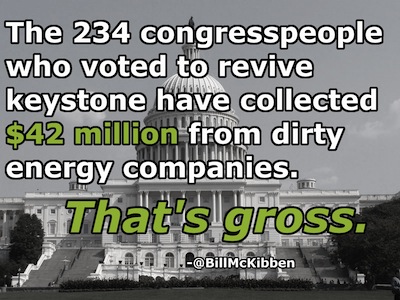
Here’s the truth: much of our Congress is bought and sold by corporations. The 234 members of the House who supported this bill took $42,374,100 from corporate polluters in the last decade. If we want Congress to start working for us, and for the planet, we need to call them out on this corruption whenever it happens.

Can you share this image (with a quote from Bill McKibben) on Facebook or Twitter to show just how much this corrupt attempt to revive the pipeline stinks?

We’ll never have the money and the lobbyists of Big Oil, so we’ve got to use our voices and our bodies to make our point.

Over the past six months, we’ve signed petitions, led actions in communities coast-to-coast, and organized large-scale civil disobedience against this pipeline. All that work added up. President Obama’s announcement about the pipeline delay was HUGE, and gave us the chance to shut Keystone XL down for good.

Ultimately, we’re in a long term fight to save the planet from the polluters who would buy their way to total catastrophe. It’s up to us to use this moment to show just how dangerous they have become, and begin making the case that corporate control over government must end. Let’s make sure all of our friends know how much their latest Keystone XL stunt stinks.

Many thanks for raising your voice,

Duncan Meisel, for the 350.org team

P.S. In case you were wondering, we’re not only spreading the word online — folks in certain states are calling their senators and we’re continuing to ratchet up our actions across the country. As I type this, activists in Ohio are staging a “human oil spill” to House Speaker Boehner’s front door. We’ll need all sorts of creative tactics on the road ahead — more on that in a future email!

Please do everything to spread this message.  Thank you.

Finally, go and put your arms around your dog, give him or her a very big hug, and pray that mankind might learn something about truth and integrity from the humble dog!

Learning from dogs!

The Long Emergency, part one

A reflection on the huge changes facing our global society.

I am reading James Howard Kunstler’s book The Long Emergency.  On the front cover there is a quote from a review in The Independent newspaper, “If you give a damn, you should read this book.”  On the back cover, the quote, “Stark and frightening.  Read it soon.” – Daily Camera.  The quotes are spot on!

Rather than give my own opinion at this stage (I should finish the book first!), let me quote from the opening of Chapter Five, Nature Bites Back.

I was a at a four-day conference called Pop Tech in the seaside village of Camden, Maine, at the peak of the fall foliage season in October 2003, having a pretty good time at the talks, and enjoyiong a series of extravagant dinners – one featuring a free oyster raw bar and gratis Grey Goose vodka – not to mention all the lobsters, steaks, and other products of our bountiful cheap-oil economy.  Then, on Saturday afternoon, a scientist from the University of Washington, Peter D. Ward, got up in the old-time opera house where the conference was held and did a presentation about the life and death of the planet Earth,  Using a series of vivid artist’s renderings delivered on PowerPoint, Ward showed us how, hundreds of millions of years hence, all land animals would become extinct, the green forests and grasslands would broil away, the oceans would evaporate, and eventually our beloved planet would be reduced to a pathetic ball of inert lifeless lint – prefatory to being subsumed in the expanded red giant heat cloud of our baking sun.  Few members of the audience had any appetite for the spread of cookies and munchables laid out for the break that followed.  Personally, I was so depressed that I felt like gargling with razor blades.

The human spirit is remarkably resilient, though.  A few hours later, the horror of it all was forgotten and the conference-goers reported to the next supper buffet with the appetites recharged, happy to scarf more lobster and beef medallions and guzzle more liquor, while chatting up new friends about their various hopes and dreams for the continuing story of civilized life here on good old planet Earth, which, it was assumed, had quite a ways to go before any of us needed to worry about its fate, if ever.

Wasn’t it John Maynard Keynes who famously remarked to a group of fellow economists dithering about the long-term this and the long-term that: “Gentlemen, in the long term we’re all dead.”  Our brains are really not equipped to process events on a geological scale – at least in reference to how we choose to live, or what we choose to do in the here-and-now.  Five hundred millions years is a long time, but how about the mad rush of events in just the past 2,000 years starring the human race?  Rather action-packed, wouldn’t you say?  Everything from the Roman Empire to the Twin Towers, with a cast of billions – emperors, slaves, saviors, popes, kings, queens, navies, rabbles, conquest , murder, famine, art, science, revolution, comedy, tragedy, genocide, and Michael Jackson.  Enough going on in a mere 2,000 years to divert anyone’s attention from the ultimate fate of the earth, you would think.  Just reflecting on the events of the twentieth century alone could take your breath away, so why get bent out of shape about the ultimate fate of the earth?  Yet, I was not soothed by these thoughts, nor by the free eats, and even the liquor failed to lift me up because I couldn’t shake the recognition that in the short term we are in pretty serious trouble, too.

OK, that’s enough for today – I’ll continue this important extract on Monday.  Let me close by inviting you to watch James Kunstler in interview.

Pick up thy pen!

A reminder that other people in other places may not be so fortunate as you.

In that sub-heading is an assumption that everyone who calls by Learning from Dogs enjoys a life where they are, relatively speaking, free to make their own life decisions.  My apologies if that is a false assumption.

Amnesty International have a December campaign Write for Rights.  It is so worth supporting.  Here are some details from that website,

YOUR WORDS CAN CHANGE LIVES.

Your words can be a SPOTLIGHT that exposes the dark corners of the torture chamber. They can bring POWER to a human rights defender whose life is in jeopardy. They can IGNITE hope in a forgotten prisoner.

Your words can SAVE LIVES.

Join hundreds of thousands of people around the world in marking International Human Rights Day this December by taking part in Amnesty International’s Write for Rights Global Write-a-thon – the world’s largest human rights event. Through letters, cards and more, we take action to demand that the human rights of individuals are respected, protected and fulfilled. We show solidarity with those suffering human rights abuses, and work to bring about positive change in people’s lives.

Will you write a letter to save a life?

Sign up now to Write for Rights!

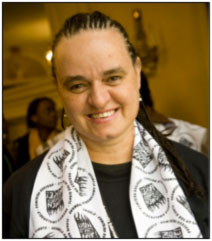
Jenni Williams

“I am alive today, after 34 arrests, because members of Amnesty International spoke out for me.”

 – Jenni Williams, human rights defender in Zimbabwe

It really doesn’t make any difference which Amnesty case you support – just pick one and do it before the end of the month.

Amnesty also offer a full suite of resources, obtainable from here, to assist you with producing your letter.

Jean and I have decided to write in support of Jabbar Savalan, as described here and below,

AZERBAIJAN – Jabbar Savalan / Youth activist detained after using facebook

Jabbar Savalan

Hours after he posted a note on Facebook calling for protests against the government, Jabbar Savalan told his family that he was being followed. The next evening, February 5, 2011, police arrested him without explanation and took him to the Sumgayit police station, where they “discovered” marijuana in his outer coat pocket. Police questioned him without a lawyer for two days, reportedly hitting and intimidating him to make him sign a confession.

Authorities in Azerbaijan have a history of using trumped-up drug charges to jail perceived critics. Jabbar maintains that he does not use drugs and that the marijuana was planted on him. In May 2011, he was was convicted of possessing illegal drugs and sentenced to two-and-a-half years in prison. Amnesty International believes that authorities fabricated the drug charges against Jabbar to silence him. Amnesty considers him to be a prisoner of conscience.

A history student in college, Jabbar was an active member of an opposition political party. In January 2011, he posted on Facebook a newspaper article that described Azerbaijan’s President Ilham Aliyev as corrupt.

On February 4, Jabbar was inspired by the protests in the Middle East and North Africa to use Facebook to call for a “Day of Rage” to protest the government in Azerbaijan. The next day, police arrested him. He was 19 years old at the time.

Enough said!

Let me close with this video.

Make a difference – now!

A plea to sign a global call not to delay action on global warming

How many of you in Europe watched the final episode of Sir Peter Attenborough’s Frozen Planet series, entitled On Thin Ice?

Did you watch the short video in last week’s post, The power of truth?  If not, it’s below.

Here’s a piece from a BBC news item from yesterday,

A hungry polar bear

It is an image that is sure to shock many people.

An adult polar bear is seen dragging the body of a cub that it has just killed across the Arctic sea ice.

Polar bears normally hunt seals but if these are not available, the big predators will seek out other sources of food – even their own kind.

The picture was taken by environmental photojournalist Jenny Ross in Olgastretet, a stretch of water in the Svalbard archipelago.

“This type of intraspecific predation has always occurred to some extent,” she told BBC News.

“However, there are increasing numbers of observations of it occurring, particularly on land where polar bears are trapped ashore, completely food-deprived for extended periods of time due to the loss of sea ice as a result of climate change.”

Re-read that last segment of that last sentence, “completely food-deprived for extended periods of time due to the loss of sea ice as a result of climate change.

So with all that in mind, please read on.

Friends,

What if someone told you we should abandon all hope for global climate action until 2020? Well, that’s exactly the proposal that the United States is pushing at the UN Climate Talks taking place this week in Durban, South Africa. The 2020 delay might well be the worst idea ever.

Waiting nine years for climate action isn’t just a delay, it’s a death sentence for communities on the front lines of the climate crisis — and it could slam the door on ever getting carbon pollution levels below the safe upper limit of 350 parts per million.

It’s not too late to stop this delay from going through. Over the next three days, our team of 350.org activists in Durban will be working with our partners at Avaaz and allies from around the world to isolate the United States — and build support for the African nations that are fighting for real climate action. But it will take a massive grassroots outcry to demonstrate that people everywhere are taking a stand to prevent the United States negotiators from signing away our future.

If we raise an international alarm before the talks end on Friday, we can convince the US to get out of way of progress and help unlock the global process that can lead to bold climate action all around the world.

Click here to add your voice to a global call to action we’re delivering in Durban: www.350.org/durban

The climate talks in South Africa end in just 48 hours, and it’s vital that we ramp up the pressure now. To make sure the US gets the message, our team on the ground here in Durban will deliver your messages directly to the US negotiating team at a high-impact event we’re helping to pull together on Friday. We can’t say much more about it now, but suffice to say our message will be unavoidable.

This year, the 350 network has shown that people power can truly move the planet in the right direction. We mobilized hundreds of thousands of people to push for climate action in nearly every country on earth. We beat back the Keystone XL pipeline when no one said it was possible. We took over the radio waves to spread a message of hope and action on the climate crisis. And through our actions, we helped keep the hope of saving our planet — and reaching 350 ppm — alive.

The UN Climate Talks here in Durban aren’t going to get us back to 350 by themselves, but they can keep the option open by making progress on a legally binding, international framework to help nations make serious cuts in carbon emissions. In 2012, we’re going to need to do all we can to challenge the fossil fuel companies that are the real obstacles to progress. Breaking their stranglehold on our governments is the only way to really unlock these negotiations.

But right now, the most important thing we can do is keep the possibility of a strong international climate deal alive by pushing back on the United States negotiating team. In recent months, President Obama has shown that he’ll stand up for the climate, but only if he’s got a movement to back him up. On the Keystone pipeline, he’s been doing the right thing by blocking Republican efforts to push it through — now we need him to do the right thing on the international stage.

There’s no guarantee that we’ll be successful, but we owe it to our allies across the planet — many of whom are already feeling the impacts of climate change — to resist the chorus of cynics and keep hope alive. As Nelson Mandela said, “It always seems impossible until it’s done.” The 350 network has pulled off the impossible before — now’s the time to step up the pressure again.

Please add your voice today: www.350.org/durban

Let’s do this,

Jamie Henn for the whole 350.org team

P.S. We have just 48 hours to build a huge groundswell of pressure. Please help make it go viral with a few clicks on Twitterand Facebook — tag your popular friends, and post it again and again.

The Greatest Crash – footnote

The story that could run for an awfully long time!

I rather revealed my newness as a US resident by posting my review of David Kauders’ book The Greatest Crash over 2 days last week,  one of them being Thanksgiving Day.  Despite that 1,895 people viewed my review which was entitled The end of an era.

A week has now passed since that review.  I was curious to see what sorts of headlines had been making the news in the last 7 days.  It’s just a random trawl through those items that have captured my attention.

Let’s start with the Financial Times, November 27th,

The eurozone really has only days to avoid collapse

By Wolfgang Münchau

In virtually all the debates about the eurozone I have been engaged in, someone usually makes the point that it is only when things get bad enough, the politicians finally act – eurobond, debt monetisation, quantitative easing, whatever. I am not so sure. The argument ignores the problem of acute collective action.

Last week, the crisis reached a new qualitative stage. With the spectacular flop of the German bond auction and the alarming rise in short-term rates in Spain and Italy, the government bond market across the eurozone has ceased to function.

Wolfgang concludes his article thus,

Italy’s disastrous bond auction on Friday tells us time is running out. The eurozone has 10 days at most.

Then my print copy of The Economist that arrived on the 26th had this lurid cover page,

Unless Germany and the ECB move quickly, the single currency’s collapse is looming

The leader article contains this paragraph,

Past financial crises show that this downward spiral can be arrested only by bold policies to regain market confidence. But Europe’s policymakers seem unable or unwilling to be bold enough. The much-ballyhooed leveraging of the euro-zone rescue fund agreed on in October is going nowhere. Euro-zone leaders have become adept at talking up grand long-term plans to safeguard their currency—more intrusive fiscal supervision, new treaties to advance political integration. But they offer almost no ideas for containing today’s conflagration.

and a few paragraphs later, this,

This cannot go on for much longer. Without a dramatic change of heart by the ECB and by European leaders, the single currency could break up within weeks. Any number of events, from the failure of a big bank to the collapse of a government to more dud bond auctions, could cause its demise. In the last week of January, Italy must refinance more than €30 billion ($40 billion) of bonds. If the markets balk, and the ECB refuses to blink, the world’s third-biggest sovereign borrower could be pushed into default.

Then on Sunday, 27th, MISH’s Trend Analysis blogsite reveals,

ICAP Plc, the world’s largest inter-dealer broker (one that carries out transactions for financial institutions rather than private individuals), is now Testing Trades In Greek Drachma Against Dollar, Euro

ICAP Plc is preparing its electronic trading platforms for Greece’s potential exit from the euro and a return to the drachma, senior executives at the inter-dealer broker said Sunday.

ICAP is the latest firm to disclose such preparations, joining the growing ranks of banks, governments and other key players in the global financial system whose officials are worried enough about the stability of the common currency to be making contingency plans for a possible break-up.

Then Bloomberg published an article by Peter Boone and Simon Johnson, the latter of Baseline Scenario fame, that opened as follows,

Investors sent Europe’s politicians a painful message last week whenGermany had a seriously disappointing government bond auction. It was unable to sell more than a third of the benchmark 10-year bonds it had sought to auction off on Nov. 23, and interest rates on 30-year German debt rose from 2.61 percent to 2.83 percent. The message? Germany is no longer a safe haven.

and concluded,

Ultimately, an integrated currency area may remain in Europe, albeit with fewer countries and more fiscal centralization. The Germans will force the weaker countries out of the euro area or, more likely, Germany and some others will leave the euro to form their own currency. The euro zone could be expanded again later, but only after much deeper political, economic and fiscal integration.

Tragedy awaits. European politicians are likely to stall until markets force a chaotic end upon them. Let’s hope they are planning quietly to keep disorder from turning into chaos.

Finally, on the 29th the BBC News website carried details of the Autumn Statement made by British Chancellor, George Osborne, to Parliament.

Osborne confirms pay and jobs pain as growth slows

Chancellor George Osborne has said public sector pay rises will be capped at 1% for two years, as he lowered growth forecasts for the UK economy.

The number of public sector jobs set to be lost by 2017 has also been revised up from 400,000 to 710,000.

Borrowing and unemployment are set to be higher than forecast and spending cuts to carry on to 2017, he admitted.

Just look at that figure of public sector job losses – 710,000!

Well that’s more than enough from me but it does surely endorse the opening views that David Kauders expounded in his book, as carried in my review, and reproduced here,

Starting with the first sentence, David sets out the core problem;

This book argues that it is impossible to expand the financial system much further.

expanding this a few paragraphs later,

This is the financial system limit: lack of new borrowing plus excessive weight of debt obligations from past borrowing combine to slow economies down. This is the barrier whichever way policy makers turn. It is like the lid on a boiling kettle. Enough steam can lift it for a while but it always snaps back into place. The financial system limit is a roadblock preventing growth.

A few pages later in this opening chapter ‘The roadblock preventing growth‘ this limit is explained thus,

Policy contradictions also show us that the financial system has reached a roadblock. The glaring conflict between bailout and austerity is at the core. Each bailout or stimulus requires creation of more credit, leading to false financial speculation, and for a short while markets recover their poise. The threat of inflation returns. Later, bad debts rise, the markets tumble again and a new crisis emerges. Austerity, the alternative policy, cuts spending thereby cutting the immediate level of economic activity and bringing economic decline more quickly than the stimulus alternative. Whichever way they turn, the authorities are damned.

You can understand why I called this Post a ‘footnote’ not an endnote.

The end of an era, part two.

A review of David Kauder’s recently published book, The Greatest Crash.

Details of the availability of the book are included at the end of the review.

Extracts from the book included are with grateful thanks to Sparkling Books.

Part One of this review was published yesterday which needs to be read before Part Two.

——————-

Chapter 5 continues by examining the over-bearing consequences of excessive public spending, excessive Government regulations, substitute taxation, weakness of Treasury forecasts, and so on. While these are UK issues, there is no doubt that similar restraints of free enterprise exist in many other western nations.

In Chapter 6, ‘Group Think‘, David looks at the strange ways in which we form opinions.  It’s a topic that has been discussed and written about widely but the point behind this chapter is that people have in great part lost the ability to discern truth from fiction, with terrible implications when it comes to understanding how individuals are affected by government and bureaucratic institutions.

The chapter closes;

One of the remarkable points that I have found in writing this book is that many of the detailed errors, incorrect policies et al, have already been amply documented by others. But we never learn. The delegated society, the strength of lobby groups and vulnerability of our political system to pressure, the sheer volume of noise in the media and on the Internet, the immediacy of the demands of daily life, all combine to make our collective memory rather short.

Amen to that!

Chapter 7, ‘Academic differences of opinion‘, was surprisingly short at just 6 1/2 pages. One would have thought the subject worthy of a much longer review especially as David was exploring the fundamental differences between Keynesian and Ricardian economic theories and opportunities for alternative theories. Must say that that I laughed out loud (David’s book is a little short on humour!) at the sentence on p.127 that ran, “One correspondent writing to the Financial Times proposed that economics should be declared a failing discipline, economists as not fit for purpose, and a physicist put in charge of sorting their theories out.

Chapter 8, ‘The dark side of capital markets‘, is the penultimate chapter and quite a technical one at that. But David manages to trip through esoteric aspects, well esoteric to the lay reader, in a manner that keeps one involved.   Here’s an example from early on in the chapter.

Capital markets follow a long cycle beyond the experience of most practitioners, detectable only by understanding history and then applying this understanding to contemporary conditions.

It didn’t mean much to me. Then the next sentence;

The principles are identical for any market where prices depend on the supply of credit: equities, bonds, property and commodities are all markets where the prices must relate to the availability of credit.

That, at least, was understood but still the penny hadn’t dropped. Then came;

Bond prices prosper when credit is lacking while the other three prosper when credit is abundant.

That then made sense to me but still only at some academic level. David then followed those sentences with these two paragraphs;

The whole market cycle consists of bull market followed by bear market, as surely as night follows day. The bull market in assets is driven by an increasing supply of credit and economic expansion, since more credit leads to higher prices. The bear market in assets is driven by less credit and economic contraction; there is no purchasing power to keep asset prices high. Only fixed interest bonds are contra-cyclical, declining in price as credit expands and rising in price as credit sinks.

There are two useful theories for analysing the whole market cycle: conversion flow and Dow theory.

So in half-a-page of text, the book effectively educated me and then showed the relevance of that learning to the world I was living in. Cleverly done!

Chapter 9, ‘The attitude change‘, is, without doubt, a clincher of a close to this fascinating book. The sentiments conveyed in this chapter are so unexpected that, forgive me, it would be wrong to explicitly refer to them.  Buy the book!

Let me just say that the last chapter fully endorsed me calling this review The End of an Era.

Overall conclusions

This is an important book from a writer who has both the academic and professional experience to enable him to form the views that he expresses. Only time will tell if the whole scenario that is envisaged by Mr. Kauders will play out as he expects. My personal view is that it will.

For individuals and business alike, reading The Greatest Crash will inform you in a manner that I would argue is critical when one notes the precarious and potentially unstable period we are living through. The decisions readers make after reading the book are beyond the remit of this review and, of course, David Kauders, but, at least, read the book!

Prof. Myddelton in the book’s introduction wrote, “But one of the things we need now is new thinking on the fundamentals.” Perhaps not new thinking on fundamentals, as the Prof. puts it, but a reinstatement of core fundamental values.

I am not alone from sensing that the world, especially the western world, is transitioning from an era of greed and materialism, seeing a world of unlimited resources, to a different societal relationship with planet Earth, the only planet we have. A transition across all layers of society towards the values of truth, integrity and compassion; values whose day has come.

The Greatest Crash reinforces immensely my notion that this truly is the end of an era.

——————

Want to buy The Greatest Crash?  The ebook was published in October worldwide, the  paperback published in the UK on the 1st November UK, the hardcover being released any day now in the UK.  For North America both the paperback and hardcover versions are being published on 1st February, 2012.

Full details from the Sparkling Books webpage here.

Copyright © 2011 Paul Handover

The end of an era, part one.

A review of David Kauder’s recently published book, The Greatest Crash.

Details of the availability of the book are included at the end of both parts of my review, part two is published tomorrow.

Extracts from the book included are with grateful thanks to Sparkling Books.

Personal introduction.

Back in the late 90s, when I was living in England, I attempted to bolster my self-employed income by investing and trading in equities. It was a frustrating game, game being the right word! One day I was lamenting this to a close friend and he gave me the name of David Kauders at Kauders Portfolio Management and suggested I might like to contact him.

I followed my friend’s recommendation and met with David. What he outlined at that meeting all those years ago was mind-blowing, no other way of putting it. Essentially, David predicted a financial and economic crisis of huge proportions. He convinced me of the likelihood of that crisis and in November 2001 I became a fee-paying client. As the world now knows that prediction came to fruition. My anticipated residency in the USA meant continuing to be a client was not possible, and I ceased being a client of Kauders Portfolio Management in June 2010.

Thus not only am I deeply indebted to my friend for referring me to David but also unable to write this review from an unprejudiced point of view.

The Greatest Crash

The book, released in paperback in England in October 2011, published by Sparkling Books, is subtitled ‘How contradictory policies are sinking the global economy‘. Frankly, that subtitle doesn’t do much for me. A clearer message that comes from the book is this: the economic world has reached a ‘systems limit’. Indeed, the term systems limit is used widely throughout the book.

In his introduction to the book, Professor D. R. Myddelton, Chairman of the Institute of Economic Affairs, writes,

Adam Smith said ‘There’s a deal of ruin in a nation’, and it would be a mistake to despair. But one of the things we need now is new thinking on the fundamentals. That is what David Kauders provides in his book ‘The Greatest Crash’.

Without doubt, David achieves that.

Starting with the first sentence, David sets out the core problem;

This book argues that it is impossible to expand the financial system much further.

expanding this a few paragraphs later,

This is the financial system limit: lack of new borrowing plus excessive weight of debt obligations from past borrowing combine to slow economies down. This is the barrier whichever way policy makers turn. It is like the lid on a boiling kettle. Enough steam can lift it for a while but it always snaps back into place. The financial system limit is a roadblock preventing growth.

A few pages later in this opening chapter ‘The roadblock preventing growth‘ this limit is explained thus,

Policy contradictions also show us that the financial system has reached a roadblock. The glaring conflict between bailout and austerity is at the core. Each bailout or stimulus requires creation of more credit, leading to false financial speculation, and for a short while markets recover their poise. The threat of inflation returns. Later, bad debts rise, the markets tumble again and a new crisis emerges. Austerity, the alternative policy, cuts spending thereby cutting the immediate level of economic activity and bringing economic decline more quickly than the stimulus alternative. Whichever way they turn, the authorities are damned.

In the next chapter, ‘Evolution by trial and error‘, David writes about economic cycles and reminds his readers that the long economic cycle is often “beyond the practical experiences of our working lifetimes“.  Then later suggesting that because we have seen the greatest period of inflation ever since the end of World War Two, ergo “the unwelcome lesson from history is that the greatest deflation should follow.

In Chapter 4, ‘An Era of Wishful Thinking‘, the spotlight is put on the horrific policy errors that have been made for decades, try these three examples (there is a longer list in the book),

  • Policy makers believed that debt could expand indefinitely, at no cost.
  • Nobody realised that interest rate rises would make existing borrowing unaffordable and cause a wave of defaults.
  • The world was swamped with so many detailed requirements and standards that nobody could understand how they all fitted together. It was assumed that ‘transparency’, i.e. extensive detail, would solve the inability to comprehend how the parts made the whole.

Part Two of the review, continuing with Chapter 5 is tomorrow.

Want to buy The Greatest Crash?  The ebook was published in October worldwide, the  paperback published in the UK on the 1st November UK, the hardcover being released any day now in the UK.  For North America both the paperback and hardcover versions are being published on 1st February, 2012.

Full details from the Sparkling Books webpage here.

Copyright © 2011 Paul Handover

Oil, sustainability, and American politics

The strange affairs of humans.

A quick piece of web research turned up a quote by the famous physicist, Richard P. Feynman, as follows,

In physics the truth is rarely perfectly clear, and that is certainly universally the case

in human affairs.

I thought the quote an apt introduction to an article written by Bill McKibben of 350 org fame, recently published on Tom Engelhardt’s TomDispatch blog.  As always, a vote of thanks to Tom for giving me permission to reproduce his pieces.

The topic is the Keystone XL pipeline, recently sidelined by Pres. Obama and now generating some interesting musings about the political strategy that may be at play here.  I have written previously about this pipeline and a quick search from the home page of Learning from Dogs using the search terms ‘keystone pipeline’ will find these articles.

Do read the full article from Bill McKibben.  Despite it’s length it’s full of thought-provoking ideas.  As Tom Engelhardt says in the closing sentences of his introduction, “Mark my words on this one: sooner or later, Americans are going to wake up to climate change, just as they have this year on the issue of inequality, and when they do, watch out.  There will be political hell to pay.Tom”

With no more ado, to the TomDispatch article,

Tomgram: Bill McKibben, Puncturing the Pipeline

Posted by Bill McKibben at 8:07am, November 15, 2011.

What’s the biggest story of the last several weeks?  Rick Perry’s moment of silence, all 53 seconds’worth?  The Penn State riots after revered coach JoePa went down in a child sex abuse scandal? The Kardashian wedding/divorce?  The European debt crisis that could throw the world economy into a tailspin?  The Cain sexual harassment charges?  The trial of Michael Jackson’s doctor?

The answer should be none of the above, even though as a group they’ve dominated the October/November headlines.  In fact, the piece of the week, month, and arguably year should have been one that slipped by so quietly, so off front-pages nationwide and out of news leads everywhere that you undoubtedly didn’t even notice.  And yet it’s the story that could turn your lifeand that of your children and grandchildren inside out and upside down.

On the face of it, it wasn’t anything to shout about — just more stats in a world drowning in numbers.  These happen to have been put out by the U.S. Department of Energy and they reflected, as an Associated Press headline put it, the “biggest jump ever seen in global warming gases.”  In other words, in 2010, humanity (with a special bow to China, the United States, and onrushing India) managed to pump more carbon dioxide into the atmosphere than at any time since the industrial revolution began — 564 million more tons than in 2009, which represents an increase of 6%.

According to AP’s Seth Borenstein, that’s “higher than the worst case scenario outlined by climate experts just four years ago.” He’s talking about the Intergovernmental Panel on Climate Change, or IPCC, which is, if anything, considered “conservative” in its projections of future catastrophe by many climate scientists.  Put another way, we’re talking more greenhouse gases than have entered the Earth’s atmosphere in tens of millions of years.

Consider as well the prediction offered by Fatih Birol, chief economist at the International Energy Agency: without an effective international agreement to staunch greenhouse gases within five years, the door will close on preventing a potentially disastrous rise in the planet’s temperature.  You’re talking, that is, about the kind of freaky weather that will make October’s bizarre snowstorm in the Northeast look like a walk in the park.  (That storm had all the signs of a climate-change-induced bit of extreme weather: New York City hadn’t recorded an October snowfall like it since the Civil War and it managed to hit the region in a period of ongoing warmth when the trees hadn’t yet had the decency to lose their leaves, producing a chaos of downed electrical wires.)  And don’t get me started on what this would mean in terms of future planetary hot spells or sea-level rise.

Honestly, if we were sane, if the media had its head in the right place, this would have been screaming headlines.  It would have put Rick Perry and Herman Cain and the Kardashians andItaly and Greece and Michael Jackson’s doctor in the shade.

The only good news — and because it unsettled the politics of the 2012 election, it did garner a few headlines — was that the movement Bill McKibben and 350.org spearheaded to turn back the tar-sands pipeline from Hades (or its earthly global-warming equivalent, which is Alberta, Canada) gained traction in our Occupy Wall Street moment.  Think of it as a harbinger.  Mark my words on this one: sooner or later, Americans are going to wake up to climate change, just as they have this year on the issue of inequality, and when they do, watch out.  There will be political hell to pay.Tom

Obama’s Positive Flip and Romney’s Negative Flop
Is Global Warming an Election Issue After All? 

By Bill McKibben

Conventional wisdom has it that the next election will be fought exclusively on the topic of jobs. But President Obama’s announcement last week that he would postpone a decision on the Keystone XL pipeline until after the 2012 election, which may effectively kill the project, makes it clear that other issues will weigh in — and that, oddly enough, one of them might even be climate change.

The pipeline decision was a true upset.  Everyone — and I mean everyone who “knew” how these things work — seemed certain that the president would approve it. The National Journal runs a weekly poll of “energy insiders” — that is, all the key players in Washington. A month to the day before the Keystone XL postponement, this large cast of characters was “virtually unanimous” in guaranteeing that it would be approved by year’s end.

Transcanada Pipeline, the company that was going to build the 1,700-mile pipeline from the tar-sands fields of Alberta, Canada, through a sensitive Midwestern aquifer to the Gulf of Mexico, certainly agreed.  After all, they’d already mowed the strip and prepositioned hundreds of millions of dollars worth of pipe, just waiting for the permit they thought they’d bought with millions in lobbying gifts and other maneuvers. Happily, activists across the country weren’t smart enough to know they’d been beaten, and so they staged the largest civil disobedience actionin 35 years, not to mention ringing the White House with people, invading Obama campaign offices, and generally proving that they were willing to fight.

No permanent victory was won. Indeed, just yesterday Transcanada agreed to reroute the pipeline in Nebraska in an effort to speed up the review, though that appears not to change the schedule.  Still, we’re waiting for the White House to clarify that they will continue to fully take climate change into account in their evaluation.  But even that won’t be final.  Obama could just wait for an election victory and then approve the pipeline — as any Republican victor certainly would.  Chances are, nonetheless, that the process has now gotten so messy that Transcanada’s pipeline will die of its own weight, in turn starving the tar-sands oil industry and giving a boost to the global environment.  Of course, killing the pipeline will hardly solve the problem of global warming (though heavily exploiting those tar sands would, in NASA scientist James Hansen’s words, mean “game over for the climate.”)

In this line of work, where victories of any kind are few and far between, this was a real win.  It began with indigenous activists, spread to Nebraska ranchers, and eventually turned into the biggest environmental flashpoint in many years.  And it owed no small debt to the Occupy Wall Street protesters shamefully evicted from Zuccotti Park last night, who helped everyone understand the power of corporate money in our daily lives.  That these forces prevailed shocked most pundits precisely because it’s common wisdom that they’re not the sort of voters who count, certainly not in a year of economic trouble.

In fact, the biggest reason the realists had no doubts the pipeline would get its permit, via a State Department review and a presidential thumbs-up of that border-crossing pipeline, was because of the well-known political potency of the jobs argument in bad economic times. Despite endless lazy reporting on the theme of jobs versus the environment, there were actually no net jobs to be had from the pipeline. It was always a weak argument, since the whole point of a pipeline is that, once it’s built, no one needs to work there.  In addition, as the one study not paid for by Transcanada made clear, the project would kill as many jobs as it would create.

The Washington Post’s Juliet Eilperin and Steven Mufson finally demonstrated this late in the game with a fine report taking apart Transcanada’s job estimates. (The 20,000 jobs endlessly taken for granted assumed, among other stretches, that modern dance troupes would move to Nebraska, where part of the pipeline would be built, to entertain pipeline workers.)  Still, the jobs trope remained, and you can be sure that the Chamber of Commerce will run 1,000 ads during the 2012 presidential campaign trying to hammer it home. And you can be sure the White House knew that, which was why it was such a tough call for them — and why the pressure of a movement among people whose support matters to them made a difference.

Let’s assume the obvious then: that one part of their recent calculations that led to the postponement decision might just be the suspicion that they will actually win votes thanks to the global-warming question in the next election.

For one thing, global warming denial has seen its apogee. The concerted effort by the fossil-fuel industry to underwrite scientific revision met its match last month when a team headed by Berkeley skeptic and prominent physicist Richard Muller– with funding from the Koch Brothers, of all people — actually found that, what do you know, all the other teams of climate-change scientists were, um, right. The planet was indeed warming just as fast as they, and the insurance companies, and the melting ice had been insisting.

Still, scientific studies only reach a certain audience.  Weird weather is a far more powerful messenger. It’s been hard to miss the record flooding along the Mississippi and Missouri Rivers, and across the Northeast; the record drought andfires across the Southwest; the record multi-billion dollar weather disasters across the country this year; the record pretty-much everything-you-don’t-want across the nation. Obama certainly noticed.  He’s responsible for finding the cash every time some other state submerges.

As a result, after years of decline, the number of Americans who understand that the planet is indeed warming and that we’re to blame appears to be on the rise again. And ironically enough, one reason may be the spectacle of all the tea-partying GOP candidates for the presidency being forced to swear fealty to the notion that global warming is a hoax. Normal people find this odd: it’s one thing to promise Grover Norquist that you’ll never ever raise taxes; it’s another to promise that you’ll defeat chemistry and physics with the mighty power of the market.

Along these lines, Mitt Romney made an important unforced error last month. Earlier in the primaries, he and Jon Huntsman had been alone in the Republican field in being open to the idea that global warming might actually be real. Neither wanted to do anything about it, of course, but that stance itself was enough to mark them as realists.  It was also a sign that Romney was thinking ahead to the election itself, and didn’t want to be pinned against this particular wall.

In late October, however, he evidently felt he had no choice but to pin himself to exactly that wall and so stated conclusively: “My view is that we don’t know what’s causing climate change on this planet.” In other words, he not only flip-flopped to the side of climate denial, but did so less than six months after he had said no less definitively: “I don’t speak for the scientific community, of course, but I believe the world’s getting warmer… And number two, I believe that humans contribute to that.”  Note as well that he did so, while all the evidence, even some recently funded by the deniers, pointed the other way.

If he becomes the Republican presidential candidate as expected, this may be the most powerful weathervane ad the White House will have in its arsenal.  Even for people who don’t care about climate change, it makes him look like the spinally challenged fellow he seems to be. But it’s an ad that couldn’t be run if the president had okayed that pipeline.

Now that Obama has at least temporarily blocked Keystone XL, now that his team has promised to consider climate change as a factor in any final decision on the pipeline’s eventual fate, he can campaign on the issue. And in many ways, it may prove a surprise winner.

After all, only people who would never vote for him anyway deny global warming.  It’s a redoubt for talk-show rightists. College kids, on the other hand, consistently rank it among the most important issues. And college kids, as Gerald Seib pointedout in the Wall Street Journal last week, are a key constituency for the president, who is expected to need something close to the two-thirds margin he won on campus in 2008 to win again in 2012.

Sure, those kids care about student loans, which threaten to take them under, and jobs, which are increasingly hard to come by, but the nature of young people is also to care about the world.  In addition, independent voters, suburban moms — these are the kinds of people who worry about the environment.  Count on it: they’ll be key targets for Obama’s presidential campaign.

Given the economy, that campaign will have to make Mitt Romney look like something other than a middle-of-the-road businessman.  If he’s a centrist, he probably wins. If he’s a flip-flopper with kooky tendencies, they’ve got a shot. And the kookiest thing he’s done yet is to deny climate science.

If I’m right, expect the White House to approve strong greenhouse gas regulations in the months ahead, and then talk explicitly about the threat of a warming world. In some ways it will still be a stretch.  To put the matter politely, they’ve been far from perfect on the issue: the president didn’t bother to waste any of his vaunted “political capital” on a climate bill, and he’s opened huge swaths of territory to coal mining and offshore drilling.

But blocking the pipeline finally gave him some credibility here — and it gave a lot more of the same to citizens’ movements to change our world. Since a lot of folks suspect that the only way forward economically has something to do with a clean energy future, I’m guessing that the pipeline decision won’t be the only surprise. I bet Barack Obama talks on occasion about global warming next year, and I bet it helps him.

But don’t count on that, or on Keystone XL disappearing, and go home.  If the pipeline story (so far) has one lesson, it’s this: you can’t expect anything to change if you don’t go out and change it yourself.

Bill McKibben is a founder of 350.org, a TomDispatch regular, and Schumann Distinguished Scholar at Middlebury College. His most recent book is Eaarth: Making a Life on a Tough New Planet.

Copyright 2011 Bill McKibben