Category: Politics

TomDispatch and Ernest Callenbach

A remarkable insight into our present world and hopes for the future.

As many of you dear readers will know, I am incredibly fond of the essays that Tom Engelhardt of TomDispatch fame publishes on a regular basis.  Indeed, it was just a week ago that I published a Tomgram from Bill McKibben.  Had it not been for Tom querying if I had read his Ernest Callenbach last-words piece I might have missed what, for me, has been one of the most profound ‘mind-stretching’ reads for a very long time.

I pondered for most of a morning as to whether to publish Tom’s essay in one piece, as Tom presented it, or to break it down into two.  Our much shorter attention-spans as a result of the world we now live in worked against it being two parts.  But I also wanted to include other materials that give an insight into the late Ernest Callenbach so, in the end, this TomDispatch is republished as two pieces.  I trust that works for you.

So without further ado, here is Tom’s introduction to the last words of Ernest Callenbach.

Tomgram: Ernest Callenbach, Last Words to an America in Decline

Thirty-five years later, it was still on my bookshelf in a little section on utopias (as well it should have been, being a modern classic).  A friend had written his name inside the cover and even dated it: August 1976, the month I returned to New York City from years of R&R on the West Coast.  Whether I borrowed it and never returned it or he gave it to me neither of us now remembers, but Ecotopia, the visionary novel 25 publishers rejected before Ernest Callenbach published it himself in 1975, was still there ready to be read again a lifetime later.

Callenbach once called that book “my bet with the future,” and in publishing terms it would prove a pure winner.  To date it has sold nearly a million copies and been translated into many languages.  On second look, it proved to be a book not only ahead of its time but (sadly) of ours as well.  For me, it was a unique rereading experience, in part because every page of that original edition came off in my hands as I turned it.  How appropriate to finish Ecotopia with a loose-leaf pile of paper in a New York City where paper can now be recycled and so returned to the elements.

Callenbach would have appreciated that.  After all, his novel, about how Washington, Oregon, and Northern California seceded from the union in 1979 in the midst of a terrible economic crisis, creating an environmentally sound, stable-state, eco-sustainable country, hasn’t stumbled at all.  It’s we who have stumbled.  His vision of a land that banned the internal combustion engine and the car culture that went with it, turned in oil for solar power (and other inventive forms of alternative energy), recycled everything, grew its food locally and cleanly, and in the process created clean skies, rivers, and forests (as well as a host of new relationships, political, social, and sexual) remains amazingly lively, and somehow almost imaginable — an approximation, that is, of the country we don’t have but should or even could have.

Callenbach’s imagination was prodigious.  Back in 1975, he conjured up something like C-SPAN and something like the cell phone, among many ingenious inventions on the page.  Ecotopia remains a thoroughly winning book and a remarkable feat of the imagination, even if, in the present American context, the author also dreamed of certain things that do now seem painfully utopian, like a society with relative income equality.

“Chick” — as he was known, thanks, it turns out, to the chickens his father raised in Appalachian central Pennsylvania in his childhood — was, like me, an editor all his life.  He founded the prestigious magazine Film Quarterly in 1958.  In the late 1970s, I worked with him and his wife, Christine Leefeldt, on a book of theirs, The Art of Friendship.  He also wrote a successor volume to Ecotopia (even if billed as a prequel), Ecotopia Emerging.  And as he points out in his last piece, today’s [tomorrow’s, Ed.] TomDispatch post, he, too, has now been recycled.  He died of cancer on April 16th at the age of 83.

Just days later, his long-time literary agent Richard Kahlenberg wrote me that Chick had left a final document on his computer, something he had been preparing in the months before he knew he would die, and asked if TomDispatch would run it.  Indeed, we would.  It’s not often that you hear words almost literally from beyond the grave — and eloquent ones at that, calling on all Ecotopians, converted or prospective, to consider the dark times ahead.  Losing Chick’s voice and his presence is saddening.  His words remain, however, as do his books, as does the possibility of some version of the better world he once imagined for us all. Tom

Let’s find out a bit more about ‘Chick’ ahead of his words tomorrow.

This is the Wikipedia entry from which I quote:

Born April 3, 1929 in Williamsport, Pennsylvania, he attended the University of Chicago, where he was drawn into the then ‘new wave’ of serious attention to film as an art form. After six months in Paris at the Sorbonne, watching four films a day, he returned to Chicago and earned a Master’s degree in English and Communications.

Callenbach then moved to California. From 1955 to 1991, he was on the staff of the University of California Press (Berkeley). A general copywriter for a number of years, he edited the Press’s Film Quarterly from 1958 until 1991. He also occasionally taught film courses at U.C. and at San Francisco State University.

For many years Callenbach edited the Natural History Guides at the U.C. Press. He began to take environmental issues and their connections to human value systems, social patterns, and lifestyles just as seriously as he had taken film. He was heavily influenced by Edward Abbey. He is therefore known as an author of green books, namely as author of the ecological utopias Ecotopia (1975) and Ecotopia Emerging (1981). (While his novel popularized the term “ecotopia,” it was actually coined by the ethnographer E. L. Anderson.)

In terms of concepts of human involvement with the ecology, as well as some of the economic and social concepts, the Ecotopia books are related to what is known as the sustainability movement. Callenbach’s Ecotopian concept is not “Luddite” — he does not reject high technology, but rather his fictional society shows a conscious selectivity about technology. As an example, with its emphasis on personal rather than impersonal interaction, Callenbach’s Ecotopian society anticipates the development and liberal usage of videoconferencing.

Indeed, for all his involvement with print publications, Callenbach remained quite interested in visual media. Aspects of his book Ecotopia in some ways anticipated “reality TV” — which emerged into recognition, and was given a label as a genre, 20 or more years later — because in the story the daily life of the legislature and some of that of the judicial courts is televised in this fictional society, and televised debates (including technical debates concerning ecological problems) met a need and desire among citizens.

Callenbach has been a part of the circle of West Coast technologists, architects, social thinkers, and scientists which has included such luminaries as Ursula K. Le GuinStarhawk (Miriam Simos), Sim Van der RynPeter CalthorpeStewart BrandKevin KellyJ. Baldwin, and John Todd. As with a number of these others, he has been a speaker, discussion panellist, and essayist.

Here is Chick’s website which is worth a careful peruse including his biographical details and some of his talks.

Finally, there are a number of good videos featuring Ernest Callenbach’s visionary ideas and one of his longer ones will be included tomorrow.

To close today’s Post let me leave you with this.

THE TEN COMMANDMENTS OF MOTHER EARTH
by Ernest Callenbach

I. Thou shall love and honor the Earth for it blesses thy life and governs thy survival.
II. Thou shall keep each day sacred to the Earth and celebrate the turning of its seasons.
III. Thou shall not hold thyself above other living things nor drive them to extinction.
IV. Thou shall give thanks for thy food, to the creatures and plants that nourish thee.
V. Thou shall educate thy offspring for multitudes of people are a blessing unto the Earth when we live in harmony.
VI. Thou shall not kill, nor waste Earth’s riches upon weapons of war.
VII. Thou shall not pursue profit at the Earth’s expense but strive to restore its damaged majesty.
VIII. Thou shall not hide from thyself or others the consequences of thy actions upon the Earth.
IX. Thou shall not steal from future generations by impoverishing or poisoning the Earth.
X. Thou shall consume material goods in moderation so all may share the Earth’s bounty.

Music: Marcome, “All Alone”
http://www.marcome.com

The shaming of free speech

Free speech isn’t always free!

Recently over at the Blog Climate Sight, Kate wrote a Post about the antics of the group known as the  Heartland Institute, a Chicago-based PR group that denies the existence of human-caused climate change. Kate has given me permission to reproduce her post in full.

Stalin believed in gravity. Do you?

May 9, 2012 by climatesight

Here’s a classy way to slam people you disagree with: compare them to terrorists, dictators, and mass murderers.

Such was the focus of a recent billboard campaign by the Chicago-based Heartland Institute, a PR group that denies the existence of human-caused climate change. The only billboard that was actually displayed featured Ted Kaczynski (the Unabomber) and read, “I still believe in global warming. Do you?”

The message is clear: if a monster believes something, citizens of good moral standing should believe exactly the opposite. The Internet was quick to ridicule this philosophy, with parodies such as the following:

Similar billboards featuring Charles Manson and Fidel Castro were planned, but never publicly displayed. Heartland also considered putting Osama bin Laden on a future billboard. On their website, they attempted to justify this campaign:

The people who still believe in man-made global warming are mostly on the radical fringe of society. This is why the most prominent advocates of global warming aren’t scientists. They are murderers, tyrants, and madmen.

Given that a majority of Americans accept global warming, people did not take kindly to this campaign. Public outcry and negative media coverage led Heartland to cancel the project after 24 hours. However, their statementshowed little remorse:

We do not apologize for running the ad, and we will continue to experiment with ways to communicate the ‘realist’ message on the climate.

Even though the campaign has been cancelled, the Heartland Institute continues to suffer financial repercussions. Dozens of corporate donors, including State Farm Insurance and drinks firm Diego (which owns Guiness and Smirnoff) have ended their support as a direct result of this campaign. Earlier in the year, Heartland lost financial backing from General Motors after internal documents exposed some of the group’s projects, particularly the development of an alternative curriculum to teach K-12 students that global warming is fake.

Will they recover from this failed campaign? Given Heartland’s reliance on donations, their prospects look poor. It seems that the Heartland Institute, previously one of the most influential mouthpieces for climate change denial, is going out with a bang.

My prayer is that the aforementioned institute goes out, not with a bang, but with the sound of whimpering!  Because the right of free speech is abused and shamed by such disgraceful actions.  Well done, Kate.

Not so common sense!

Sometimes one wonders what happened to common sense!

Today’s Post is motivated by a number of items that have crossed my screen over the last few days which when looked at collectively might remind one of the old saw, “You don’t have to be mad to work here, but it does help!

Sit with me, metaphorically, and allow me to muse.

First was a recent Post on 350 or bust that included the March 2012 TED Conference in Long Beach, California where NASA climate scientist Dr. James Hansen explains why he must speak out about climate change. (See the video later on.)  That Post refers to an item on Martin Lack’s Blog, Lack of Environment, where Martin as well as including the video below also lists the challenges that we on this single, finite planet face.  Here is that list,

  1. The Earth’s current energy imbalance is 0.6 Watts per sq.m.; a rate of energy input 20 times greater than the energy output of all human activity; and equivalent to the detonation of 400,000 Hiroshima-type atomic bombs every day.
  2. Since measurements began in 2003, there has been a noticeable acceleration in the annual rate of mass loss from both the Greenland and Antarctica ice caps.
  3. The last time atmospheric CO2 was 390 ppm, sea levels were 15 m higher than they are today, which implies even if we stopped burning all fossil fuels tomorrow, this is where they would end up several centuries from now because the warming “is already in the pipeline” (i.e. because the Earth must warm-up in order to restore its energy balance).
  4. Unless we stop burning fossil fuels soon, sea level rise will continue to accelerate, which is likely to cause between 1 and 5 metre rise by 2100AD (depending on how quickly we now decide to stop burning them).
  5. Palaeoclimatology tells us that 350 ppm is the safe limit for avoiding significant disruption to the planet’s ecological carrying capacity (i.e. in terms of both populations of individual species and overall biodivesity); and it now seems likely that between 20%-50% of all species will be “ticketed for extinction” by the end of the century.
  6. If we push the Earth beyond it’s “tipping point” (i.e. allow all the emerging positive feedback mechanisms to take hold); ACD will become unstoppable; and the ensuing socio-economic damage will be almost unimaginable. The total global cost of mitigation is already put at somewhere between 35 and 70 Trillion US Dollars depending on how soon we choose to act.
  7. If we had started to get off fossil fuels in 2005, it would have required 3% reduction per year in order to restore energy imbalance by 2100AD. If we start next year, it will require 6% p.a. If we wait 10 years it will require 15% p.a.
  8. Recent droughts in Texas, Oklahoma and New Mexico were 3 Standard Deviations outside the norm. Events such as these cannot therefore be ascribed to natural variability; anthropogenic climate disruption (ACD) is happening just as Hansen said it would 24 years ago (if we did not change course – which we haven’t).
  9. Pursuing emissions limits (i.e. Cap and Trade) will not work because there is no actual incentive to reduce emissions without any self-imposed restraint being to the advantage of others who do not do the same (i.e. the Tragedy of the Commons problem).
  10. Hansen uses the analogy of an approaching asteroid – the longer we wait to prevent it hitting us the harder it becomes to do so.

Do watch that Hansen video,

Second is that yesterday Martin Lack published an item that really does seem to endorse the view that there is no sign of intelligent life living on Planet Earth (not counting dogs!).

Think about it.  The planet is warming up.  The use of carbon-based fuels is a strong suspect, putting it mildly, of the rising levels of CO2 in our atmosphere, 394.45 on April 5th, so rather than change the incentives for using such fuels, we are taking advantage of  this warming planet causing the melt of the Arctic ice cap by allowing Shell to drill for oil in the Arctic.  But even crazier than that, Shell have contracted for a Finnish icebreaker to assist them in breaking up the ice!  (I really do feel a headache coming on!)

Greenpeace in the UK are running a campaign to stop this.

Sign up to save the Arctic

Let Shell know your feelings.

The pristine and beautiful Arctic: Shell wants to exploit it for oil. We want it protected.

Dozens of Greenpeace Nordic activists have boarded and occupied a Shell-contracted icebreaker in Helsinki harbour as it prepares to leave for the Alaskan Arctic.

Drilling in this fragile ecosystem – home to the polar bear, narwhal, Arctic fox and other iconic species – is unacceptable. A spill or accident in these waters would be disastrous and the harsh conditions would make responding to such a disaster almost impossible.

Demand Shell stop their plans to put the fragile Arctic and its biodiversity at risk.  We’ll keep you updated on our campaigns.

Write to Mr. Peter Voser.

Mr Peter Voser, Shell

The Arctic isn’t a place you can exploit, it’s a place we have to protect. Time and time again, experts have expressed serious doubts about the possibility of cleaning up an oil spill in the Arctic. The technical challenges posed by drilling there are obvious and no matter how much you try to convince people that your company can operate safely in such a harsh environment, we know the truth.

Because of this, I demand that you scrap your Arctic plans immediately.

Yours sincerely,

————–

By the end of this week we want 500,000 people shouting at Shell that it must end its campaign of Arctic destruction. Click here now[N.B. This is a time-sensitive campaign response – please visit Greenpeace website and enter your name and email address and they will email Shell on your behalf.]

We can change things! Together we can stop Shell and other oil companies from destroying the Arctic. Not everyone can board a ship to demand that change. But today, you can email Shell and ask them to stop drilling for oil and ask 10 of your friends to do the same. Together, we can save the Arctic!

Rosa Gierens
Greenpeace Nordic activist from Finland.

It’s not just an isolated instance of madness! Just a little over 10 days ago, I reported on President Obama’s support for the oil companies that threatens the polar bears, see “President Obama’s proposal for these magnificent and imperiled animals is a gift to Big Oil

In closing, luckily there are many voices being raised about putting an end to this madness; see the recent item from Patrice Ayme.  Hopefully, all these voices will bring about the changes to the way so many of us are governed.  As Patrice commented recently on Learning from Dogs, “Hope is the breathing of the planet“.  Maybe, just maybe, hope will win through.  No better put than by James Hansen,

Most impressive is the work of the Citizens Climate Lobby, a relatively new, fastgrowing, nonpartisan, nonprofit group with 46 chapters across the United States and Canada. If you want to join the fight to save the planet, to save creation for your grandchildren, there is no more effective step you could take than becoming an active member of this group.”
– Dr. James Hansen, head of Goddard Institute for Space Studies, NASA

Oh, and before I forget, a tornado touched down in Southern France!  Not common and not making sense!

Common sense!

Some people seem to have a knack for saying it how it should be!

My sub-heading, above, applies to many people right across the world.  But the reason that this was triggered in my mind for today’s post, was a recent item on Christine’s excellent Blog, 350 or bust.  Read more about that Blog here.  I subscribe to that Blog.

A couple of days ago, there was an article with the title of Live Long And Prosper, Already.  It started thus,

Gene Roddenberry, the creator of the amazingly popular Star Trek series, was a man ahead of his time. Here is one of the things he  had to say about humanity and our problems (with one editorial comment from me!):

“I believe in humanity. We are an incredible species. We’re still just a child creature, and we’re still being nasty to each other [Stephen Harper: are you listening?].  And all children go through those phases. We’re moving into adolescence now. When we grow up, man, we’re going to be something!”

But what caught my eye were these comments to the Post.

The first one from a Mickey Haist that read,

It’s a nice goal, but would clenching our teeth and willing progress be of any effect? After all, children don’t spontaneously mature – they’re raised.

Have to say that I was left unsure by what Mr. Haist was trying to convey.  But not so Christine!  This was the first of her two replies,

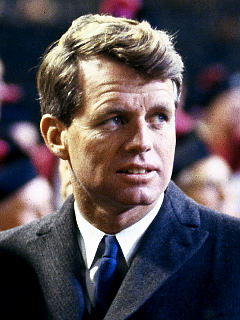
No teeth clenching allowed! Robert Kennedy once said “Each time a person stands up for an ideal, or acts to improve the lot of others, or strikes out against injustice, he or she sends forth a tiny ripple of hope. And crossing each other from a million different centers of energy and daring, those ripples build a current that can sweep down the mightiest walls of oppression and resistance.”

It’s not about everyone doing everything, it’s about each of us doing what we can. Not taking action because the problem is too big is not the answer.

And her second reply,

And Mickey – if the challenge of climate change/ocean acidification/biodiversity loss that we are facing as a species (taking the rest of the natural world with us) doesn’t make us mature, then nothing will.  But I believe it will – as Paul Gilding says, humans are slow but not stupid!

Paul Gilding’s excellent website is always a great read, by the way.

But do reread those words of Robert Kennedy, they are powerfully inspiring.

Robert Kennedy

Each time a person stands up for an ideal, or acts to improve the lot of others, or strikes out against injustice, he or she sends forth a tiny ripple of hope. And crossing each other from a million different centers of energy and daring, those ripples build a current that can sweep down the mightiest walls of oppression and resistance.

Despite the fact that these words were said in response when South Africans suffered the tyranny of apartheid, the words are, perhaps, even more relevant today.  Mankind has to combine the many ‘ripples of hope’ and build that current that will sweep away the crazy selfishness that is preventing us from living in harmony with this beautiful planet for hundreds of years ahead.

Thanks Christine.

Moved to help?

A plea to take action to preserve the Western Arctic Reserve in Alaska.

I received the following email from the Center for Biological Diversity the other day.

Dear Paul,

caribouThe Western Arctic Reserve, also known as the National Petroleum Reserve-Alaska, is the largest tract of unprotected, relatively pristine public land in the United States. But Big Oil has the reserve in its sights and will not hesitate to turn this vast wilderness into a sprawling industrial complex to drum up massive profits.

The 23.5 million-acre reserve is home to imperiled polar bears, seabirds and one of the densest populations of nesting raptors in the world. Its shores and lagoons harbor beluga whales, seals, walruses and other marine mammals.

In the rapidly warming Arctic, short-sighted oil and gas development will further stress the remarkable wildlife that lives and breeds there.The Bureau of Land Management (BLM) is now collecting comments on a planning document that will set the stage for oil and gas leasing in the western Arctic for decades to come.

You can help save this national treasure: Take action to tell the BLM to protect the Western Arctic Reserve from dirty fossil fuel development.

The action that is requested is to email or mail the following to the BLM  (the link is here.)  The email address for Bob Abbey, taken from the relevant BLM webpage is Director: Bob Abbey E-mail: Director@blm.gov

Director Bob Abbey
Bureau of Land Management
NPR-A IAP/EIS Comments, AECOM Project Office
1835 South Bragaw Street, Suite 490
Anchorage, AK 99508
US

Subject: Comments Regarding the BLM’s National Petroleum Reserve-Alaska Integrated Activity, DEIS

The National Petroleum Reserve-Alaska, or Western Arctic Reserve, comprises the largest unprotected tract of public land in the United States. It provides habitat for a wide variety of Arctic species, and its wilderness values are second to none. While the most environmentally protective alternative analyzed by the Bureau of Land Management (Alternative B) is an improvement over previous plans, it still allows over 11 million acres of ecologically intact wilderness-quality lands to be leased for oil development. As the BLM develops the “integrated activity plan” and “final environmental impact statement” for the reserve, I urge you to provide maximum protection for areas with high-value habitats by designating all of the Special Area contained in Alternative B, and to create additional protections for all other areas in the reserve that contain ecologically intact and/or wilderness-quality lands.

The BLM must also consider the long-term impacts of greenhouse gas emissions from oil and gas development, and any future impacts of climate change on the low-lying western Arctic. Arctic animals are already stressed by a melting and warming Arctic, and none of the alternatives considered go far enough to protect these species from the wide array of impacts from oil and gas development.

Among other things, the BLM must account for sea-level rise due to ice melt, permafrost collapse, coastal erosion and increased high-energy storm events that will degrade, or wipe out, critical coastal habitat, including the Teshekpuk Lake area. The BLM must also consider the impacts of ocean acidification, changes in circulation, increased freshening due to sea ice melt, and shifts in productivity to the marine environment and to marine species, including polar bears, ice seals, walruses, bowhead whales, and beluga whales.

Congress has required that “maximum protection” be given to Special Areas in the reserve. I encourage the BLM to adopt an alternative that provides protections for these areas, which include Teshekpuk Lake, the Colville River, Kasegaluk Lagoon, and the Utukok River Uplands. The BLM must also protect the Dease Inlet-Meade River area, Peard Bay and adjacent wetlands, and the Ikpikpuk River and adjacent wetlands.

I implore the BLM to adopt a management alternative that includes the strongest possible protections for the Western Arctic Reserve. This means designating Alternative B as the preferred alternative, and adding additional protective measures for important wildlife habitat and wilderness areas so they are not destroyed by ecologically devastating oil and gas development, or from the long-term impacts of greenhouse gas emissions and climate change.

Thank you.

But if that doesn’t work then there is a full webpage offering detailed information and which also has links relevant to letting the BLM know your views.  That webpage starts,

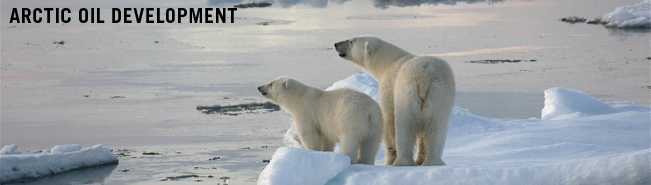
ARCTIC OIL DEVELOPMENT

Alaska’s north coast and ocean waters are teeming with species found in few other places, and many of them are now under threat. The Western Arctic Reserve and the Arctic National Wildlife Refuge provide critical denning areas for polar bears, support vast caribou herds and are essential nesting grounds for thousands of bird species, including threatened eiders and yellow-billed loons. The sea ice of the Arctic Ocean is hunting and denning habitat for polar bears and a foraging platform for Pacific walrus and numerous Arctic ice seal species. Under the sea ice, endangeredbowhead whales and other whale species live off the biological richness of the Arctic Ocean.
Nearly all Arctic species are at risk from global warming. But that’s not the only problem: In a drastically changing environment, Arctic species must now contend with dirty, industrial fossil fuel development.

Please go here, read the the full information and do your little bit.  It all makes a difference.

Connecting the dots

On the 23rd March, I wrote a piece entitled The most important alarm ever heard.  It opened as follows:

The most important alarm ever heard.

The heading says it all.

In fact the heading was taken from an email that came in from Bill McKibben’s 350.org yesterday.  But before reproducing that email in full, let me take you back to the 6th January this year when I published a piece simply called Keystone XL pipeline.  This is how that Post opened up,

Yesterday, I had published a lecture given in Melbourne by Britain’s eminent Astronomer Royal, Lord Martin Rees.  Lord Rees concluded his lecture with the call for us to take better care of our own planet. He, like many others, recognises the unique place in history that we occupy. For the first time a single species is capable of exerting profound changes on the Earth’s natural and physical environments.

Over and over again, scientists are reporting the rise in climate temperature of Planet Earth and the implications thereof if we do not wakeup soon to changing our ways.  The Keystone pipeline is a huge potential mistake!

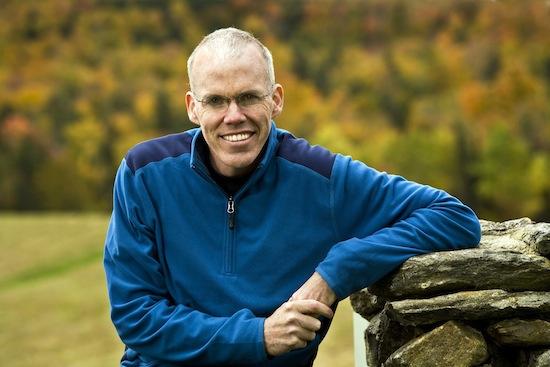
Bill McKibben of 350.org

Not easy to focus on a single sentence from Lord Rees but this one’s pretty direct, “For the first time a single species is capable of exerting profound changes on the Earth’s natural and physical environments.”

Now have a read of the article on 350orbust.com called Things Happen, But It’s Time To Connect The Dots. I’ve taken the liberty of republishing it in full.  But first the video:

Things Happen, But It’s Time To Connect The Dots

APRIL 16, 2012

Thailand has the worst flooding in its history, only a month after Central America has the worst flood in its history, a month after Vermont has the worst flooding in its history in the same year that the Mississippi river has the worst flooding in its history. And Queensland in Australia has its worst floods only a few months after Pakistan floods so badly that 20 million people are forced from their homes – it’s connected, folks.

Across the planet now we see ever more flood, ever more drought, ever more storms. People are dying, communities are being wrecked — the impacts we’re already witnessing from climate change are unlike anything we have seen before.

But because the globe is so big, it’s hard for most people to see that it’s all connected. That’s why, on May 5, we will Connect the Dots.

In places from drought-stricken Mongolia to flood-stricken Thailand, from fire-ravaged Australia to Himalayan communities threatened by glacial melt, we will hold rallies reminding everyone what has happened in our neighborhoods. And at each of those rallies, from Kenya to Canada, from Vietnam to Vermont, someone will be holding a…dot. A huge black dot on a white banner, a “dot” of people holding hands, encircling a field where crops have dried up, a dot made of fabric and the picture taken from above — you get the idea. We’ll share those images the world around, to put a human face on climate change–we’ll hold up a mirror to the planet and force people to come face to face with the ravages of climate change.

Anyone and everyone can participate in this day. Many of us do not live in Texas, the Philippines, or Ethiopia — places deeply affected by climate impacts. For those communities, there are countless ways to stand in solidarity with those on the front-lines of the climate crisis: some people will giving presentations in their communities about how to connect the dots. Others will do projects to demonstrate what sorts of climate impacts we can expect if the crisis is left unchecked. And still others of us will express our indignation to local media and politicians for failing to connect the dots in their coverage of “natural disasters.”

However you choose to participate, your voice is needed in this fight — and you can sign up here: www.climatedots.org

These will be beautiful events, we’re sure. But they will also have an edge. It’s important for all of us whose lives are being damaged to know that it’s right that we get a little angry at those forces causing this problem. The fossil fuel industry is at fault, and we have to make that clear. Our crew at 350.org will work hard to connect all these dots — literally — and weave them together to create a potent call to action, and we will channel that call directly to the people who need to hear it most.

May 5 is coming soon; we need to work rapidly. Because climate change is bearing down on us, and we simply can’t wait. The world needs to understand what’s happening, and you’re the people who can tell them.

Please join us–we need you to send the most important alarm humanity has ever heard:www.climatedots.org

Onwards,

Bill McKibben for the whole team at ClimateDots.org

More wisdom!

Further reflections on where next for US Energy policy.

Pumping our way to extinction!

On the 28th March, I republished a powerful essay from Patrice Ayme under my Post title of Questions are never stupid.  In fact, Patrice’s essay was called Energy Question For The USA and concluded thus:

Total oil sales, per day are about 100 million barrels (in truth the cap is lower, see graph above), at, say $100, so ten billion dollars a day, 3.6 trillion a year. The USA uses about 25% of that. Some have incorporated the price of the part of the gigantic American war machine and (what are truly) bribes to feudal warlords insuring Western access to the oil fields, and found a much higher cost up to $11 a gallon.

Ultimately, and pretty soon, in 2016, specialists expect oil prices to explode up, from the exhaustion of the existing oil fields. Then what?

Moreover, in 2016, the dependence upon OPEC, or, more exactly Arab regimes, is going to become much greater than now. What’s the plan of the USA? Extend ever more the security state, and go occupy the Middle East with a one million men army? To occupy, or not to occupy, that is the question.

Is it time for a better plan? And yes, any better plan will require consumers to pay higher energy prices. As consumers apparently want the army to procure the oil, they ought to pay for it.

So when Michael Klare published an essay just two days ago on TomDispatch entitled, Welcome to the New Third World of Energy, the U.S. it seemed highly relevant to have that follow-on from Patrice’s essay.  Again I am very grateful to Tom Engelhardt for giving me permission to republish.  Readers may like to know a little of Michael Klare’s background, from here:

Michael T. Klare is a professor of peace and world security studies at Hampshire College and the author of Resource Wars and Blood and Oil. Consider this essay a preview of his newest book, Rising Powers, Shrinking Planet: The New Geopolitics of Energy, which has just been published by Metropolitan Books. A brief video of Klare discussing key subjects in his new book can be viewed by clicking here.

So here is that essay.  I’m going to include Tom’s introduction because it’s fair to so do!

Tomgram: Michael Klare, Welcome to the New Third World of Energy, the U.S.

[Note for TomDispatch Readers:With today’s Michael Klare piece, you get your last chance to receive a signed, personalized copy of his new book, The Race for What’s Left: The Global Scramble for the World’s Last Resources, in return for a contribution of $100 or more to this website.  (Visit our donation page to check it out.)  The offer will end later this week.  Many thanks to those of you who have already given.  Klare’s book is little short of prophetic and the dollars you so generously send in really do help keep TomDispatch afloat! Tom]

Here’s a simple rule of thumb when it comes to energy disasters: if it’s the nuclear industry and something begins to go wrong — from Three Mile Island in Pennsylvania in 1979 to Fukushima, Japan, after the 2011 tsunami — whatever news is first released, always relatively reassuring, will be a lie, pure and simple.  And as the disaster unrolls, it’s not likely to get much better.  The nuclear industry is incapable of telling the truth about the harm it does.  So when the early stories appear about the next nuclear plant in trouble, whatever you hear or read, just assume that you don’t know the half, not even the quarter, of it.

When it comes to the oil and gas industry and disasters, a similar rule of thumb follows: however bad it first sounds, the odds are it’s going to sound a lot worse before it’s over.  (See BP, Deepwater Horizon.)  So when you first hear about an oil leak from a Chevron well off the coast of Brazil or from a natural gas well in the North Sea operated by the French oil giant Total and you getthose expectable reassurances, they, too, are likely to be nothing but gas.

And here’s the sad thing, you’re going to get all too many chances to test out these simple rules when it comes to bad energy news.  After all, as Michael Klare has been writing at this site for years, we’re entering the “tough energy” era.  The big energy companies are going to be extracting hydrocarbons in ever more hazardous, difficult-to-reach places like the Arctic and they’re going to be using ever uglier methods to do so.

It’s a guarantee that, however bad the environmental damage we’ve seen so far, it’s only going to get worse as the energy industry despoils various regions to give us our fossil-fuel fix and theirmega-profits.  As Klare points out, one of those regions is slated to be not in distant Africa, the Persian Gulf, or the Caspian Sea, but right here in the U.S.  Klare has been ahead of the energy curve ever since, in the late 1990s, he suggested that we would soon be on a planet embroiled in“resource wars.”  His new book, The Race for What’s Left: The Global Scramble for the World’s Last Resources, catches the nightmarish nature of the planet’s last energy boom in a way no one else has.  And don’t be surprised if that nightmare lands squarely in your backyard. Tom

A New Energy Third World in North America?
How the Big Energy Companies Plan to Turn the United States into a Third-World Petro-State 

By Michael T. Klare

The “curse” of oil wealth is a well-known phenomenon in Third World petro-states where millions of lives are wasted in poverty and the environment is ravaged, while tiny elites rake in the energy dollars and corruption rules the land.  Recently, North America has been repeatedly hailed as the planet’s twenty-first-century “new Saudi Arabia” for “tough energy” — deep-sea oil, Canadian tar sands, and fracked oil and natural gas.  But here’s a question no one considers: Will the oil curse become as familiar on this continent in the wake of a new American energy rush as it is in Africa and elsewhere?  Will North America, that is, become not just the next boom continent for energy bonanzas, but a new energy Third World?

Once upon a time, the giant U.S. oil companies — Chevron, Exxon, Mobil, and Texaco — got their start in North America, launching an oil boom that lasted a century and made the U.S. the planet’s dominant energy producer.  But most of those companies have long since turned elsewhere for new sources of oil.

Eager to escape ever-stronger environmental restrictions and dying oil fields at home, the energy giants were naturally drawn to the economically and environmentally wide-open producing areas of the Middle East, Africa, and Latin America — the Third World — where oil deposits were plentiful, governments compliant, and environmental regulations few or nonexistent.

Here, then, is the energy surprise of the twenty-first century: with operating conditions growing increasingly difficult in the global South, the major firms are now flocking back to North America. To exploit previously neglected reserves on this continent, however, Big Oil will have to overcome a host of regulatory and environmental obstacles.  It will, in other words, have to use its version of deep-pocket persuasion to convert the United States into the functional equivalent of a Third World petro-state.

Knowledgeable observers are already noting the first telltale signs of the oil industry’s “Third-Worldification” of the United States.  Wilderness areas from which the oil companies were once barred are being opened to energy exploitation and other restraints on invasive drilling operations are being dismantled.  Expectations are that, in the wake of the 2012 election season, environmental regulations will be rolled back even further and other protected areas made available for development.  In the process, as has so often been the case with Third World petro-states, the rights and wellbeing of local citizens will be trampled underfoot.

Welcome to the Third World of Energy

Up until 1950, the United States was the world’s leading oil producer, the Saudi Arabia of its day. In that year, the U.S. produced approximately 270 million metric tons of oil, or about 55% of the world’s entire output. But with a postwar recovery then in full swing, the world needed a lot more energy while America’s most accessible oil fields — though still capable of growth — were approaching their maximum sustainable production levels.  Net U.S. crude oil output reached a peakof about 9.2 million barrels per day in 1970 and then went into decline (until very recently).

This prompted the giant oil firms, which had already developed significant footholds in Indonesia, Iran, Saudi Arabia, and Venezuela, to scour the global South in search of new reserves to exploit — a saga told with great gusto in Daniel Yergin’s epic history of the oil industry, The Prize. Particular attention was devoted to the Persian Gulf region, where in 1948 a consortium of American companies — Chevron, Exxon, Mobil, and Texaco — discovered the world’s largest oil field, Ghawar, in Saudi Arabia.  By 1975, Third World countries were producing 58% of the world’s oil supply, while the U.S. share had dropped to 18%.

Environmental concerns also drove this search for new reserves in the global South. On January 28, 1969, a blowout at Platform A of a Union Oil Company offshore field in California’s Santa Barbara Channel produced a massive oil leak that covered much of the area and laid waste to local wildlife. Coming at a time of growing environmental consciousness, the spill provoked an outpouring of public outrage, helping to inspire the establishment of Earth Day, first observed one year later. Equally important, it helped spur passage of various legislative restraints on drilling activities, including the National Environmental Policy Act of 1970, theClean Water Act of 1972, and the Safe Drinking Water Act of 1974. In addition, Congress banned new drilling in waters off the Atlantic and Pacific coasts and in the eastern Gulf of Mexico near Florida.

During these years, Washington also expanded areas designated as wilderness or wildlife preserves, protecting them from resource extraction. In 1952, for example, President Eisenhower established the Arctic National Wildlife Range and, in 1980, this remote area of northeastern Alaska was redesignated by Congress as theArctic National Wildlife Refuge (ANWR). Ever since the discovery of oil in the adjacent Prudhoe Bay area, energy firms have been clamoring for the right to drill in ANWR, only to be blocked by one or another president or house of Congress.

For the most part, production in Third World countries posed no such complications. The Nigerian government, for example, has long welcomed foreign investment in its onshore and offshore oil fields, while showing little concern over the despoliation of its southern coastline, where oil company operations have produced a massive environmental disaster. As Adam Nossiter of the New York Timesdescribed the resulting situation, “The Niger Delta, where the [petroleum] wealth underground is out of all proportion with the poverty on the surface, has endured the equivalent of the Exxon Valdez spill every year for 50 years by some estimates.”

As vividly laid out by Peter Maass in Crude World, a similar pattern is evident in many other Third World petro-states where anything goes as compliant government officials — often the recipients of hefty bribes or other oil-company favors — regularly look the other way. The companies, in turn, don’t trouble themselves over the human rights abuses perpetrated by their foreign government “partners” — many of them dictators, warlords, or feudal potentates.

But times change.  The Third World increasingly isn’t what it used to be.  Many countries in the global South are becoming more protective of their environments, ever more inclined to take ever larger cuts of the oil wealth of their own countries, and ever more inclined to punish foreign companies that abuse their laws. In February 2011, for example, a judge in the Ecuadorean Amazon town of Lago Agrio ordered Chevron to pay $9 billion in damages for environmental harm caused to the region in the 1970s by Texaco (which the company later acquired).  Although the Ecuadorians are unlikely to collect a single dollar from Chevron, the case is indicative of the tougher regulatory climate now facing these companies in the developing world.  More recently, in a case resulting from an oil spill at an offshore field, a judge in Brazil hasseized the passports of 17 employees of Chevron and U.S. drilling-rig operator Transocean, preventing them from leaving the country.

In addition, production is on the decline in some developing countries like Indonesia and Gabon, while others have nationalized their oil fields or narrowed the space in which private international firms can operate. During Hugo Chávez’s presidency, for example, Venezuela has forced all foreign firms to award a majority stake in their operations to the state oil company, Petróleos de Venezuela S.A.  Similarly, the Brazilian government, under former President Luiz Inácio Lula da Silva, instituted a rule that all drilling operations in the new “pre-salt” fields in the Atlantic Ocean — widely believed to be the biggest oil discovery of the twenty-first century — be managed by the state-controlled firm, Petróleo de Brasil (Petrobras).

Fracking Our Way to a Toxic Planet

Such pressures in the Third World have forced the major U.S. and European firms — BP, Chevron, ConocoPhillips, ExxonMobil, Royal Dutch Shell, and Total of France — to look elsewhere for new sources of oil and natural gas.  Unfortunately for them, there aren’t many places left in the world that possess promising hydrocarbon reserves and also welcome investment by private energy giants. That’s why some of the most attractive new energy markets now lie in Canada and the United States, or in the waters off their shores.  As a result, both are experiencing a remarkable uptick in fresh investment from the major international firms.

Both countries still possess substantial oil and gas deposits, but not of the “easy” variety (deposits close to the surface, close to shore, or easily accessible for extraction).  All that remains are “tough” energy reserves (deep underground, far offshore, hard to extract and process). To exploit these, the energy companies must deploy aggressive technologies likely to cause extensive damage to the environment and in many cases human health as well.  They must also find ways to gain government approval to enter environmentally protected areas now off limits.

The formula for making Canada and the U.S. the “Saudi Arabia” of the twenty-first century is grim but relatively simple: environmental protections will have to be eviscerated and those who stand in the way of intensified drilling, from landowners to local environmental protection groups, bulldozed out of the way.  Put another way, North America will have to be Third-Worldified.

Consider the extraction of shale oil and gas, widely considered the most crucial aspect of Big Oil’s current push back into the North American market. Shale formations in Canada and the U.S. are believed to house massive quantities of oil and natural gas, and their accelerated extraction is already helping reduce the region’s reliance on imported petroleum.

Both energy sources, however, can only be extracted through a process known as hydraulic fracturing (“hydro-fracking,” or just plain “fracking”) that uses powerful jets of water in massive quantities to shatter underground shale formations, creating fissures through which the hydrocarbons can escape. In addition, to widen these fissures and ease the escape of the oil and gas they hold, the fracking water has to be mixed with a variety of often poisonous solvents and acids. This technique produces massive quantities of toxic wastewater, which can neither be returned to the environment without endangering drinking water supplies nor easily stored and decontaminated.

The rapid expansion of hydro-fracking would be problematic under the best of circumstances, which these aren’t.  Many of the richest sources of shale oil and gas, for instance, are located in populated areas of Texas, Arkansas, Ohio, Pennsylvania, and New York. In fact, one of the most promising sites, the Marcellus formation, abuts New York City’s upstate watershed area.  Under such circumstances, concern over the safety of drinking water should be paramount, and federal legislation, especially the Safe Drinking Water Act of 1974, should theoretically give the Environmental Protection Agency (EPA) the power to oversee (and potentially ban) any procedures that endanger water supplies.

However, oil companies seeking to increase profits by maximizing the utilization of hydro-fracking banded together, put pressure on Congress, and managed to get itself exempted from the 1974 law’s provisions. In 2005, under heavy lobbying from then Vice President Dick Cheney — formerly the CEO of oil services contractor Halliburton — Congress passed the Energy Policy Act, which prohibited the EPA from regulating hydro-fracking via the Safe Drinking Water Act, thereby eliminating a significant impediment to wider use of the technique.

Third Worldification

Since then, there has been a virtual stampede to the shale regions by the major oil companies, which have in many cases devoured smaller firms that pioneered the development of hydro-fracking. (In 2009, for example, ExxonMobil paid $31 billion to acquire XTO Energy, one of the leading producers of shale gas.)   As the extraction of shale oil and gas has accelerated, the industry has faced other problems. To successfully exploit promising shale formations, for instance, energy firms must insert many wells, since each fracking operation can only extend several hundred feet in any direction, requiring the establishment of noisy, polluting, and potentially hazardous drilling operations in well-populated rural and suburban areas.

While drilling has been welcomed by some of these communities as a source of added income, many have vigorously opposed the invasion, seeing it as an assault on neighborhood peace, health, and safety. In an effort to protect their quality of life, some Pennsylvania communities, for example, have adopted zoning laws that ban fracking in their midst. Viewing this as yet another intolerable obstacle, the industry has put intense pressure on friendly members of the state legislature to adopt a law depriving most local jurisdictions of the right to exclude fracking operations. “We have been sold out to the gas industry, plain and simple,” saidTodd Miller, a town commissioner in South Fayette Township who opposed the legislation.

If the energy industry has its way in North America, there will be many more Todd Millers complaining about the way their lives and worlds have been “sold out” to the energy barons.  Similar battles are already being fought elsewhere in North America, as energy firms seek to overcome resistance to expanded drilling in areas once protected from such activity.

In Alaska, for example, the industry is fighting in the courts and in Congress to allow drilling in coastal areas, despite opposition from Native American communities which worry that vulnerable marine animals and their traditional way of life will be put at risk. This summer, Royal Dutch Shell is expected to begin test drilling in the Chukchi Sea, an area important to several such communities.

And this is just the beginning. To gain access to additional stores of oil and gas, the industry is seeking to eliminate virtually all environmental restraints imposed since the 1960s and open vast tracts of coastal and wilderness areas, including ANWR, to intensive drilling. It also seeks the construction of the much disputed Keystone XL pipeline, which is to transport synthetic crude oil made from Canadian tar sands — a particularly “dirty” and environmentally devastating form of energy which has attracted substantial U.S. investment — to Texas and Louisiana for further processing. According to Jack Gerard, president of the American Petroleum Institute (API), the preferred U.S. energy strategy “would include greater access to areas that are currently off limits, a regulatory and permitting process that supported reasonable timelines for development, and immediate approval of the Keystone XL pipeline.”

To achieve these objectives, the API, which claims to represent more than 490 oil and natural gas companies, has launched a multimillion-dollar campaign to sway the 2012 elections, dubbed “Vote 4 Energy.” While describing itself as nonpartisan, the API-financed campaign seeks to discredit and marginalize any candidate, including President Obama, who opposes even the mildest version of its drill-anywhere agenda.

“There [are] two paths that we can take” on energy policy, the Vote 4 Energy Web site proclaims. “One path leads to more jobs, higher government revenues and greater U.S. energy security — which can be achieved by increasing oil and natural gas development right here at home. The other path would put jobs, revenues and our energy security at risk.” This message will be broadcast with increasing frequency as Election Day nears.

According to the energy industry, we are at a fork in the road and can either chose a path leading to greater energy independence or to ever more perilous energy insecurity. But there is another way to characterize that “choice”: on one path, the United States will increasingly come to resemble a Third World petro-state, with compliant government leaders, an increasingly money-ridden and corrupt political system, and negligible environmental and health safeguards; on the other, which would also involve far greater investment in the development of renewable alternative energies, it would remain a First World nation with strong health and environmental regulations and robust democratic institutions.

How we characterize our energy predicament in the coming decades and what path we ultimately select will in large measure determine the fate of this nation.

Michael T. Klare is a professor of peace and world security studies at Hampshire College, a TomDispatch regular, and the author of The Race for What’s Left: The Global Scramble for the World’s Last Resourcesjust published by Metropolitan Books.  To listen to Timothy MacBain’s Tomcast audio interview in which Klare discusses his new book and what it means to rely on extreme energy, click here, or download it to your iPod here.  Klare can be followed on Facebook.

Follow TomDispatch on Twitter @TomDispatch and join us on Facebook.

Copyright 2012 Michael T. Klare

Fascinating times indeed!

Questions are never stupid!

A powerful guest post from Patrice Ayme on where next for American energy.

Introduction.

I must have spent an age musing over what to call this Post.  Patrice called it simply ‘Energy Question For The USA’ and it’s a highly appropriate question.  But in the end I chose the title ‘Questions are never stupid’ because I was mindful of the well-known saying, “There is no such thing as a stupid question, only a stupid answer!

So the smart question raised by Patrice is not only very highly appropriate for 2012, it’s also a question that just has to have a smart answer.  Because we are on the brink of it being too late to be flirting with stupid answers.  What many scientists are saying, in one form or another, is that if we don’t embrace the journey of moving away from carbon-based sources of energy for society now and find those alternate sustainable sources by the end of this decade then the laws of unintended consequences will kick in with a vengeance.  The end of the decade is eight years away!

Here’s a picture of my grandson who was one-year-old just a week ago.

Trusting his elders!

That picture reminds me of the comment early on in James Hansen’s book, Storms of my Grandchildren, where he writes ‘I did not want my grandchildren, someday in the future, to look back and say, “Opa understood what was happening, but he did not make it clear.

So on to the Guest post from Patrice.  It’s not an easy, quick read but I’ll tell you what it is!  It’s the sort of ‘wake-up’ call this fine Nation and this even finer Planet should be getting from countless politicians and leaders.  So do read it and, even better, add your comments, and wonder why we seem so content on fiddling while Rome burns!

oooOOOooo

Energy Question For The USA

THE AGE OF OIL PRODUCED THE AMERICAN CENTURY. NOW WHAT?

No Vision, No Mission, No Energy

***

Another editorial of Paul Krugman firing volleys at republican “paranoia” for accusing Obama of driving up oil prices. As he observes in “Paranoia Strikes Deeper“: …“the president of the United States doesn’t control gasoline prices, or even have much influence over those prices. Oil prices are set in a world market, and America, which accounts for only about a tenth of world production, can’t move those prices much. Indeed, the recent rise in gas prices has taken place despite rising U.S. oil production and falling imports.”

American households tend to borrow as much as they can. Thus, when oil prices increase markedly, Americans have to cut in crucial budgets, such as house payments. I said at the time that it would lead to a peak in housing prices, and it did.

Why such a drastic influence of oil prices on the economy of the USA? Because Americans, except in a few places such as New York, commute by private car to work. So Americans have to feed the car, if they want to feed themselves.

It was not this way a century ago, or so. At the time public transportation systems using electric tramways and trains were found all over, even in Los Angeles. Car companies put an end to that outrage in the late fifties by buying, and then destroying, all the public transportation system they could put their greedy hands on.  Fossil fuel plutocrats were delighted.

But let’s set aside Krugman’s fake indignation. He is smart enough to know that Romney will do what Romney needs to do to win the Obama, I mean, the election. Waxing lyrical about Romney doing as Obama, does not beat going lyrical about sunrise.

Gasoline prices in the USA are way down in real dollars to what they used to be, decades ago. And so is the gas tax. This means that, far from adapting to the gathering multiply-pronged world ecological and energy crisis, the USA has gone the other way, denying there is any crisis. “What? Me worry?” That’s got to be anti-American indeed.  No, real blooded Americans are all into strip searches and the death panel at the White House.

In Europe, gas prices are more than twice that of the USA, thanks to heavy taxes (stations in France have sported two euros a liter, that is 8 euros per gallon, or more than $10.50). [UK unleaded petrol price, as of today, is the equivalent of $8.70 per gallon, Ed.]

This means that far from being down and out, Europe is efficient enough to operate at that high price level. It also means that Europe is much more motivated than the USA to get much more efficient. In other words, high gasoline prices in Europe are a safety margin. The high prices force the European free market to adapt to a situation that the free market of the USA will encounter someday. Adaptation takes decades: new energies take on the average, historically speaking, 50 years to become dominant. Same, one would guess, for energy efficiencies.

Basically, if oil prices doubled from here, gasoline prices would double in the USA. Whereas, even if the Europeans decided to keep the same high taxes, gasoline prices would only augment by 50%. And, in the much more efficient European economy, with plenty of public electric transportation available, the noxious effects on the European economy would be much less than one would expect from a 50% oil price rise.

The world gets 55 × 1018 joules of useful energy from 475 × 1018 joules of primary energy produced by fossil fuels, biomass and nuclear power plants. That tremendous inefficiency (less than 13%!)  needs to be corrected. It will be, if, and only if, prices are kept high. Thus energy taxes are necessary to adapt to the looming penury.

Why looming penury? Because the reserves of other fossil fuels may have been vastly overestimated (by a factor of 5 in the case of coal). Various fossil fuel lobbies have an interest to over-estimate the reserves (because it keeps the world addicted, as they present their industry as a long range solution, which it is not).

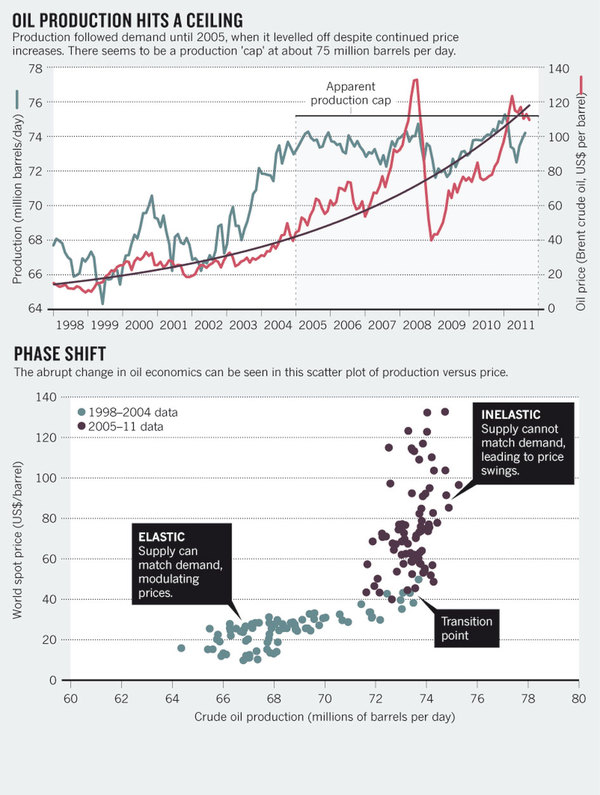
Looking at the raw production numbers, as exhibited below in the graphs, paints a completely different story: production from existing fields is going down dramatically (at 5% rate, per year).  In other words we are in the treachorous waters between the catastrophe of CO2 poisoning and the disaster of running out of energy to burn.

The unavoidable rise of fuel prices will be less grave in Europe than in the USA, because many Europeans would opt for the available electric-based public transportation system (the combination of much more efficient electric motors and central generation is much more efficient than distributing oil to put in SUVs all over, as done in the USA; SUVs, because there are too many holes in the asphalt. A problem partly related to high oil prices!).

Yet, the increase of the cost of imported oil corresponds exactly to the Italian deficit ($55 billion). Although that deficit increase had many causes, oil price increase was by far the most important. And the same for other Southern European countries. So the rise of oil prices was the barrel that broke the back of European debt.

In the USA, ten out of 11 post WWII recessions were followed by oil price spikes. Why are American minds so closed up to the looming strangulation of their economy by oil? Because the fossil fuel plutocracy is on a rampage in the USA. It uses a red hot propaganda to persuade the vast American public of undifferentiated sheep that there is no CO2 ecological crisis, and no energy crisis. (Although the latest polls indicate that two thirds of the public, in a splendid turn-around, believe that there is indeed a man-made climate change crisis; never mind that the New York Times had the latest tornado rampage, with 40 dead, presented as discreetly as possible.)

Why are the fossil plutocrats hysterical? Well we are past Peak Cheap Oil. Moreover, the “majors“, the world’s largest oil companies, have been pushed out of more and more countries, and replaced by national oil companies. Desperate, the majors have gone for riskier and riskier drilling in the deep ocean. Now Chevron, and Transocean, after a 4-day leak off Brazil, see prosecutors asking for lengthy prison sentences and enormous fines.

Most of these oil companies are American, so they have pushed forfracking (destroying the underground with poisons to extract fossil fuels). Superficially, it works: USA imports of fossil fuels went quickly from 60% down to 40%.

However, that did not make a dent in the world price situation, because the demand keeps rising, but the world, overall, is PAST PEAK OIL (as I have long argued and the Nature article alluded to below confirmed, using the obvious argument found in the graphs).

So, basically, American fracking finances Chinese oil consumption. Here are some graphs extracted from Nature and the USA government:

When the horrid sun of diminishing resources rises over the parched American oil desert, while fracking reveals itself to be an unfathomable catastrophe, the howling is going to be very great, and one more reason for a depression will blossom.

Much of the USA’s superiority, in the last 150 years, has come from abundant and cheap oil. First in the North-East, then down to Oklahoma, Texas, Colorado, California. Compare with Western Europe, which had basically no oil.

Oil was not just a question of cheap, convenient energy. Oil has, short of nuclear energy, the highest energy density of any material (OK, nuclear energy is millions of time more energy dense).

Oil gave the USA enormous diplomatic and conspiratorial leverage. American oil plutocrats helped Lenin and Stalin develop their colossal fields in the Caucasus and Caspian. One of those plutocrats, Harriman, son of a railroad magnate, and brother of another Harriman, was one of the main operators of the democratic party. Let alone banker to Hitler. He was decorated both by Stalin, and by Hitler. He then went on as U.S. ambassador to major European capitals, and stayed one the main operators of the government of the USA for decades. “Democrats” have long been impure.

Interestingly, I searched the Internet for a document mentioning Harriman’s Stalino-Hitlerian decorations, but could not find it (I have seen the pictures in the past). All I could read is how much Harriman resisted Stalin each time they met, and that was all the time (a total lie that Harriman resisted Hitler, or Stalin: Harriman was an accomplice of Stalin, and helped give him half of Europe, in exchange for manganese and other stuff. But now Internet agents are obviously paid to reconstruct a truth where American plutocrats look good,  knights in shining armor, fighting Stalin or Hitler, each time they met for tea, dinner, lunch, breakfast, and interminable conferences, for years on end, decade after decade).

A famous example of the clout oil provided the USA with: Texaco fueled Hitler’s conquest of the Spanish republic (this one is hard to hide, because the U.S. Congress slapped Texaco with a symbolic fine, well after the deed was done). That used to amuse Hitler a lot (Hitler gave elaborated reasons to his worried supporters for being in bed with American plutocrats; as the Nazi Party was officially socialist, and anti-plutocratic, that awkward situation may have led him to declare war to the USA on December 11, 1941, to ward off the German generals’ argument that he was just a little corporal in above his head).

Another example: Mussolini was hanged from an American gas station in Milan. Italian communists hanged him from his sponsors’ works.

The fueling of the fascists by American fossil fuel companies helped bring the American Century to the world in general, and Europe in particular. Without Stalin and American plutocratic oil, Hitler’s Panzers could not have moved in 1939 or 1940.

The dignified Elie Wiesel, instead of crying crocodiles tears, wondering how such a thing as Auschwitz was possible, should ask how and why the Nazi extermination machine was fuelled by American plutocrats, and how come he, himself, never talks about that.

Wiesel got the Nobel Peace Prize, just as Jimmy Carter (who launched the American attack on Afghanistan). Was it for disinformation? (And how come waging war in Afghanistan is a big plus for the Peace Prize? Is it related to the same mood which made Sweden help Hitler before and during WWII, and never having a serious look at that, ever since? I know the prize is ostensibly given by Norwegians.)

Wikipedia is big on the notion of “weasel words“, and rightly so. Deeper than that is what I would call weasel logic. And ever deeper, weasel worlds. To talk about Hitler without ever wondering who his sponsors were, and what they were after, is to live in a weasel world.

I like Elie Wiesel personally. Yet, just as I like Krugman, Obama, and countless others, such as the infamous Jean-Paul Sartre, he likes power even more than truth. OK, It is unfair to put Sartre, who really espoused the most abject terrorism, with the others… As long as individuals prefer power to truth, the spontaneous generation of infamy is insured.

Total oil sales, per day are about 100 million barrels (in truth the cap is lower, see graph above), at, say $100, so ten billion dollars a day, 3.6 trillion a year. The USA uses about 25% of that. Some have incorporated the price of the part of the gigantic American war machine and (what are truly) bribes to feudal warlords insuring Western access to the oil fields, and found a much higher cost up to $11 a gallon.

Ultimately, and pretty soon, in 2016, specialists expect oil prices to explode up, from the exhaustion of the existing oil fields. Then what?

Moreover, in 2016, the dependence upon OPEC, or, more exactly Arab regimes, is going to become much greater than now. What’s the plan of the USA? Extend ever more the security state, and go occupy the Middle East with a one million men army? To occupy, or not to occupy, that is the question.

Is it time for a better plan? And yes, any better plan will require consumers to pay higher energy prices. As consumers apparently want the army to procure the oil, they ought to pay for it.

***

Patrice Ayme

***

Note 1: Flying cost at least ten times more in CO2 creation than taking a train. And jet fuel is not taxed, at least until the carbon plan of the European Union starts charging next year, in 2013. In spite of the screaming from the USA and its proxies: it’s funny how attached to subsidies American society can be.

Note 2: Refusing to pay for necessary military expenses through taxation and mobilization, was a big factor in the downfall of the Roman Principate.

The Principate then tried to accomplish defense on the cheap, by using more and more mercenaries. Many of these mercenaries or their children and descendants were poorly integrated in Roman republican culture (say emperors Diocletian or Constantine, let alone Stilicho the Vandal, a century later), so they established theDominate, itself a negation of the Roman republic. Amusingly the Western Franks, those salt water (“Salian“) Franks remembered the Roman republic better than all these imports from the savage East… who could not remember it, they, and their ancestors, having never known it.

Guess what? The USA’s army presently employs 300,000 “private contractors” (aka, mercenaries). Curiously, in that case, it’s not so much to save money, than to extract more money from the system (but that’s another story). Still, it will have the same effect.

oooOOOooo

Is it me? Or are we all truly insane?

At times it does seem as though we, as in mankind, are truly beyond help!

If you detect a note of frustration in the title of today’s Post and the sub-heading above, then you are not mistaken.  It comes from a series of communications that have impinged upon my consciousness over the last twelve hours or so.

This morning Rob I., from here in Payson, emailed me a scan of an article in today’s (Monday) The Arizona Republic newspaper, written by Doyle Rice.  It was entitled Study: Global temps may jump 5 degrees by 2050

I’m going to take the liberty of reproducing it in full.

As the U.S. simmers through its hottest March on record — with more than 6,000 record-high temperatures already set this month — a new study released Sunday shows that average global temperatures could climb 2.5 to 5.4 degrees by 2050 if greenhouse-gas emissions continue unabated.

The study findings are based on the results of 10,000 computer model simulations of future weather overseen by researchers at Oxford University in the United Kingdom.

“These are the first results to suggest that the higher warming scenario could be plausible,” said study lead author Dan Rowlands of Oxford.

It is a faster rate of warming than most other models predict.

Most scientists say that increasing amounts of carbon dioxide in the atmosphere from the burning of fossil fuels such as oil, gas and coal are causing the planet to warm to levels that cannot be explained by natural variability.

The study was published online Sunday in the journal Nature Geoscience and backs up similar predictions from the Intergovernmental Panel on Climate Change in 2007.

The climate models used in the study accurately reproduced actual, observed temperature changes over the last 50 years. Assuming that models that simulate past warming realistically are the best candidates for future warming predictions, the authors conclude in the study that a warming of 2.5 to 5.4 degrees by 2050, compared with the 1960-90 average, is in the “likely range” of climate warming.

The Earth’s average temperature during the decade of 2000-10 was almost a full degree higher than the average from 1960-90, Rowlands said.

I don’t feel too bad at ‘borrowing’ the story above because I also subscribe to the UK’s Met Office News Blog and, guess what, in my ‘in-box’ this morning were two news stories from the Met Office.  Let me take them in this order.

The first one I want to refer to here is this Citizen science looks at future warming uncertainty  and includes the link to the Nature Geoscience magazine article that prompted the story in The Arizona Republic.

This is how it develops,

A project running almost 10,000 climate simulations on volunteers’ home computers has found that a global warming of 3 degrees Celsius by 2050 is ‘equally plausible’ as a rise of 1.4 degrees.

The study addresses some of the uncertainties that previous forecasts, using simpler models or only a few dozen simulations, may have over-looked.

Importantly, the forecast range is derived from using a complex Met Office model that accurately reproduces observed temperature changes over the last 50 years.

The results suggest that the world is very likely to cross the ’2 degrees barrier’ at some point this century if emissions continue unabated.

It also suggests that those planning for the impacts of climate change need to consider the possibility of warming of up to 3 degrees (above the 1961-1990 average) by 2050, even on a mid-range emission scenario. This is a faster rate of warming than most other models predict.

Just go and read that last paragraph again: “This is a faster rate of warming than most other models predict.

Then the next item from the Met Office blog was this,  Why is it so warm?  It’s referring to the specific weather conditions in the UK at present:

The last few days have been unseasonably warm but why is this happening so early in the year? The answer lies largely in the air flow directly above the United Kingdom but more importantly where that air has come from.

Just a few paragraphs down we read, “we have seen a new record high for Scotland in March as the temperature reached 22.8 °C  [73.04 °F] at Fyvie Castle in Aberdeenshire on Sunday 25 March.”  So another temperature record!

I had a quick call with Martin Lack about an hour before starting this Post and he pointed me to the Australian website of CSIRO.  There we find the latest State of the Climate report, from which we read,

The previous State of the Climate, released in March 2010 highlighted a multi-decadal warming trend over Australia’s land and oceans, an increase in record hot days and decrease in record cold days across the country, a decrease in rainfall in southwest and southeast Australia, an increase in global sea level, and increases in global greenhouse gas concentrations.

Do read the full report starting here.  Or if you want a video to watch, then here it is:

Dr Karl Braganza from the Climate Monitoring Section of the Bureau of Meteorology discusses the State of the Climate in 2012.

Also on the CSIRO website is a small piece saying,

Planet Under Pressure 2012

Scientists from around the globe are meeting in London in March to discuss ‘solutions, at all scales, to move societies on to a sustainable pathway’. Planet Under Pressure 2012 is designed to bring together senior policymakers, industry leaders, NGOs, young scientists, the media, health specialists, and academics from many disciplines.
25 March 2012

Meeting to discuss ‘solutions, at all scales, to move societies on to a sustainable pathway’.  Any rational thinking person on this planet if given a chance to reflect on the science knows we have to change our ways.  And the means to do it are clear; we are not talking rocket-science here.

So when Martin Lack catches my attention with a recent piece entitled The seven woes of the Tea Party and I am linked to this article by Rick Santorum, I feel as though it must be me!  This is what Mr. Santorum writes:

The Elephant in the Room: Challenging science dogma

As with evolution, the ‘consensus’ on climate change has become an ideology.

Questioning the scientific consensus in pursuit of the truth is an important part of how science has advanced through the centuries. But what happens when the scientific consensus becomes an ideology that trumps the pursuit of truth? Answer: Those making legitimate inquiries are ostracized, the careers of dissenters are destroyed, and debate is stifled.

Unfortunately, I am referring not only to the current proponents of the theory of man-made global warming.

With the penultimate paragraph reading thus,

Why? Well, maybe because Americans don’t like being told what to believe. Maybe because we have learned to be skeptical of “scientific” claims, particularly those at war with our common sense – like the Darwinists’ telling us for decades that we are just a slightly higher form of life than a bacterium that is here purely by chance, or the Environmental Protection Agency’s informing us last week that man-made carbon dioxide – a gas that humans exhale and plants need to live, a gas that represents less than 0.1 percent of the atmosphere – is a dangerous pollutant threatening to overheat the world.

Frankly, I am lost for words and probably best that I am!  Lost because irrespective of political ‘left’ or ‘right’ the science of where this so-called intelligent species we call homo sapiens is heading, is beyond question.  I use the phrase ‘beyond question’ not as a statement of fact but as a statement of truth.  For science, as this non-scientist understands it, is about distinguishing the truth from ‘non-truth’.

Our beautiful companions for thousands of years truly do know better.  That’s the truth you see in those eyes below.

The truth is always clear, Mr. Man. Just open your eyes!

The most important alarm ever heard.

The heading says it all.

In fact the heading was taken from an email that came in from Bill McKibben’s 350.org yesterday.  But before reproducing that email in full, let me take you back to the 6th January this year when I published a piece simply called Keystone XL pipeline.  This is how that Post opened up,

Yesterday, I had published a lecture given in Melbourne by Britain’s eminent Astronomer Royal, Lord Martin Rees.  Lord Rees concluded his lecture with the call for us to take better care of our own planet. He, like many others, recognises the unique place in history that we occupy. For the first time a single species is capable of exerting profound changes on the Earth’s natural and physical environments.

Over and over again, scientists are reporting the rise in climate temperature of Planet Earth and the implications thereof if we do not wakeup soon to changing our ways.  The Keystone pipeline is a huge potential mistake!

Bill McKibben of 350.org

Not easy to focus on a single sentence from Lord Rees but this one’s pretty direct, “For the first time a single species is capable of exerting profound changes on the Earth’s natural and physical environments.”

God only knows what money, power and influence is going on behind the scenes because no leader in their right mind ought to be supporting any major investment in the continuation of carbon-based energy.  So it was with deep dismay that around 2pm US Mountain Time yesterday afternoon the following email arrived in my in-box.  (Feel free to republish this Post, indeed please do so!)

Dear friends,

Earlier today, Barack Obama wrapped up his first trip to Oklahoma as President. He arrived just after a week of floods, capping off a winter that never came, which followed the hottest and driest summer Oklahoma had seen in thousands of years, perhaps ever.

But he wasn’t in Oklahoma to talk about these climate disasters. He was there to laud his administration’s fast-tracking of the southern leg of the Keystone XL tar sands pipeline. In his speech today, President Obama didn’t connect the dots between fossil fuel extraction, climate change, and the extreme weather that has reshaped so much of the American landscape this past year.

It’s a painful reminder that sometimes we must be leaders ourselves, before we can expect our elected officials to follow. It’s clearly up to us to connect the dots.

Today 350.org is launching a global day of action to call attention to these and other climate disasters, here on the same day as the President’s annoucement. Across the planet now we see ever more flooding, ever more drought, ever more storms. People are dying, communities are being wrecked — the impacts we’re already witnessing from climate change are unlike anything we have seen before.

If we’re going to do these communities justice, we need to connect the dots between these disasters and show how all of them are linked to fossil fuels. We’re setting aside May 5th for a global day of action to do just that: Connect the Dots between extreme weather and climate change.

Anyone and everyone can participate in this day. Many of us do not live in Oklahoma, the Philippines, or Ethiopia — places deeply affected by climate impacts. For those of us not in directly-impacted communities, there are countless ways to stand in solidarity with those on the front-lines of the climate crisis: some people will be giving presentations in their communities about how to connect the dots. Others will do projects to demonstrate what sorts of climate impacts we can expect if the crisis is left unchecked. And here in the US, it’s particularly important that we make the connections clear to our elected officials — beginning with President Obama.

However you choose to participate, your voice is needed in this fight — and you can sign up to host a local event here: www.climatedots.org/start

(For more general info about the day, check out our new website here: www.climatedots.org)

350.org has done giant global days of action before (over the last three years we’ve helped coordinate over 15,000 events in 188 countries) and they’re always beautiful moments when our movement stands together. This year we’ll use that same captivating tactic to draw attention to the struggles of our friends around the world  — the communities already feeling the harsh impacts of climate change.

These will also be beautiful events, we’re sure. But they will also have an edge. It’s right that we get a little angry at those forces causing this problem. The fossil fuel industry is at fault, and we have to make that clear. Our crew at 350.org will work hard to connect all these dots — literally — and weave them together to create a potent call to action, and we will channel that call directly to the people who need to hear it most.

May 5 is coming soon; we need to work rapidly. Because climate change is bearing down on us, and we simply can’t wait. The world needs to understand what’s happening, and you’re the people who can tell them.

Please join us — we need you to send the most important alarm humanity has ever heard.

Onwards,

–Bill McKibben for the whole 350.org team

P.S. This is news worth spreading — and it only takes a moment to share it. Click here to share it on Facebook, or click here to post it on Twitter.