Category: Politics

Loving our wilderness

Loving our wilderness is another vital loving relationship

I quite deliberately named today’s post so that it would extend the theme of loving relationships posted yesterday.

So the recent announcement from the White House, “White House announced President Obama signed proclamations Friday to protect almost 2 million acres of pristine lands.” is to be welcomed with open arms. The article published in The Press Enterprise explained that those millions of acres were in California.

 The Castle Mountains, shown, will be declared a national monument in the Mojave Desert, along with Sand to Snow and Mojave Trails. KURT MILLER, STAFF PHOTOGRAPHER

The Castle Mountains, shown, will be declared a national monument in the Mojave Desert, along with Sand to Snow and Mojave Trails.
KURT MILLER, STAFF PHOTOGRAPHER

President Barack Obama established three national monuments today, Feb. 12, that cover almost 2 million acres in the Mojave Desert, the White House announced.

Obama used his power under the Antiquities Act to sign a proclamation designating the Mojave Trails, Sand to Snow and Castle Mountains national monuments. The move bypasses similar legislation, introduced by Sen. Dianne Feinstein, D-Calif., that has languished for years in Congress.

Feinstein asked the president in August to use his executive power to create the monuments. She praised the action in a statement: “I’m full of pride and joy knowing that future generations will be able to explore these national monuments and that the land will remain as pristine and as it is today. To a city girl like me, this expanse of desert, with its ruggedness and unique beauty, is nothing short of awe-inspiring.”

While on the subject of California, there is more good news from the Canis lupus 101 blog.

ooOOoo

Wolves get a grudging welcome from Northern California ranchers

By Tim Holt February 11, 2016
Photo: Oregon Fish And Wildlife
Wolves such as OR 25, a 3-year-old male, have crossed the Oregon border, and Northern California ranchers are preparing to accommodate them.

We are going to have a viable population of wolves in the far northern reaches of California, and it will be with the grudging cooperation of our ranchers.

That was the takeaway from a public hearing held last month in Yreka (Siskiyou County), where the state’s Department of Fish and Wildlife invited public comment on its draft plan for accommodating our new four-footed residents, and where there were as many Stetsons in the audience as you’d see at a cowboy poetry convention.

Where are the wolves?

premium_landscapeYes, there was some foaming at the mouth, some evidence of the government-hating libertarianism this region is known for. “We don’t want people in Sacramento telling us how to live our lives,” grumbled one rancher.
But on the whole, there was a lot of thoughtful comment by those in attendance, and the beginnings of a dialogue between those who are charged with facilitating the wolves’ re-entry, and those who will be most affected by it. There was a focus on practical, down-to-earth matters — the threat to one’s livelihood when livestock are killed by predators, and the impracticality of maintaining 24-hour surveillance on sprawling ranch lands.

There was not much discussion of the nonlethal methods that can be used to ward off wolf depredations, although a number of speakers strongly urged that radio collars be put on wolves so ranchers can be warned if they’re getting near their cattle or sheep. That idea is already in the draft wolf management plan, as well as hazing techniques that include spotlights and air horns, as well as guard dogs and mobile electric fences.

Suzanne Asha Stone was on hand as the Rocky Mountain field representative for Defenders of Wildlife. After listening to some of the ranchers’ comments, she said, “This is verbatim what we heard in Idaho 20 years ago,” when wolves were introduced in Yellowstone National Park. Ranchers in that state were naturally concerned about the impact those wolves would have on their livelihoods. Two decades later, through programs Stone and her organization have helped implement, nonlethal strategies have reduced wolf kills of livestock in Idaho to “near zero,” she said. And that’s with a wolf population than now totals 770.

According to Stone, “It takes a while living with wolves before people realize that their worst fears won’t come true.”

I think most ranchers in California’s far north respect the wildlife around them, but their relationship with it is complicated by the need to make a living. Looking closely at the strategies used in Idaho would be a good first step in helping convince them that there are ways to reconcile ranching with the presence of this new predator.

John Wayne has long been a conservative icon, the personification of rugged individualism in the Wild West. In the 1963 movie “McLintock,” made late in his career, Wayne plays a cattle rancher and land baron. At one point he tells his daughter what he plans to do with his holdings after he dies: “I’m gonna leave most of it to the nation, really, for a park, where no lumber mill (can) cut down all the trees for houses with leaky roofs, nobody’ll kill all the beavers for hats for dudes, nor murder the buffalo for robes.”

John Wayne was no tree hugger. But neither, like the ranchers up here, should he be reduced to a simple stereotype.

ooOOoo

Back to Governments or is this case the U.S. Government and a little-known unit known as Wildlife Services. Another arm reaching out to love our wilderness? H’mmm. Not according to Wolves of Douglas County blog:

PUBLISHED FEBRUARY 12, 2016

Wildlife Services—ever heard of it? No, not the U.S. Fish and Wildlife Service. That’s something different. The Fish and Wildlife Service is part of the Department of the Interior, charged with enforcing wildlife laws, restoring habitat, and protecting fish, plants, and animals. Wildlife Services isn’t your state fish and game commission, either, which issues hunting and fishing licenses and manages local wildlife.
Wildlife Services is a federal agency under the U.S. Department of Agriculture, and it specializes  in killing wild animals that threaten livestock—especially predators such as coyotes, wolves, and cougars. Outside the ranching community, Few have heard of Wildlife Services.
Since 2000, the agency has killed at least two million mammals and 15 million birds. Although it’s main focus is predator control in the West, Wildlife Services also does things like bird control nationwide at airports to prevent crashes and feral pig control in the South.

What one hand gives out, the other takes away.

Funny old world!

In defence of sovereignty and democracy.

The challenges facing the European Union ripple out across the whole of the free world.

I note that this is the second Friday where there is an abrupt change from the run of posts during the previous few days. For last Friday I republished a George Monbiot article on Rigging the Market and today there is another Monbiot article that I want to share with you; shared with you with the kind permission of Mr. Monbiot.

Unlike last Friday’s Monbiot article that clearly had global implications, at first sight this article about the European Union has no relevance to those of us not living with EU boundaries. But that would be wrong. For the importance of protecting a country’s sovereignty and the democratic processes within that country is supreme across all democratically elected governments.

ooOOoo

The Lesser Evil

Oil, corruption and public money.

Nothing at all to do with dogs, or with integrity if it comes to that!

Regular followers of this place know that I am a tremendous fan of George Monbiot, the Englishman who so regularly exposes stuff that needs to be aired and discussed. As his About page explains:

Here are some of the things I love: my family and friends, salt marshes, arguments, chalk streams, Russian literature, kayaking among dolphins, diversity of all kinds, rockpools, heritage apples, woods, fishing, swimming in the sea, gazpacho, ponds and ditches, growing vegetables, insects, pruning, forgotten corners, fossils, goldfinches, etymology, Bill Hicks, ruins, Shakespeare, landscape history, palaeoecology, Gavin and Stacey and Father Ted.

Here are some of the things I try to fight: undemocratic power, corruption, deception of the public, environmental destruction, injustice, inequality and the misallocation of resources, waste, denial, the libertarianism which grants freedom to the powerful at the expense of the powerless, undisclosed interests, complacency.

Here is what I fear: other people’s cowardice.

I still see my life as a slightly unhinged adventure whose perpetuation is something of a mystery. I have no idea where it will take me, and no ambitions other than to keep doing what I do. So far it’s been gripping.

Way back in the early days of Learning from Dogs, the blog that is, not the book, George was very gracious in giving me blanket permission to republish his posts, and many of them have appeared in this place.

So now read George Monbiot’s latest Rigging the Market. It is yet another example of what is going wrong in these times.

ooOOoo

Rigging the Market

More sharing the thoughts of others.

Unexplored waters ahead!

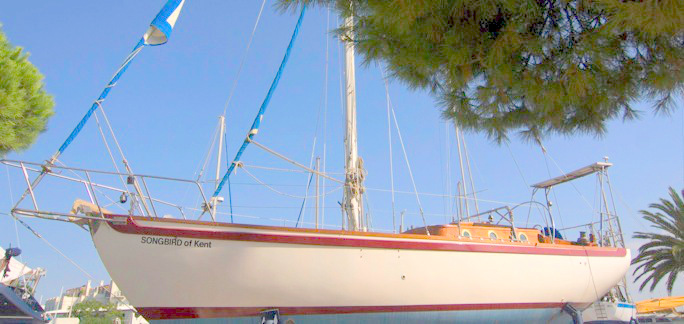
My sub-title comes from personal knowledge of what it feels like to set out on an ocean voyage into waters that one has not sailed before. In my case, leaving Gibraltar bound for The Azores on my yacht Songbird of Kent in the Autumn of 1969.

Tradewind 33 - Songbird of Kent.
My home for five years – Tradewind 33: Songbird of Kent.

Despite me being very familiar with my boat, and with sailing in general, there was nonetheless a sense of trepidation as I headed out into a vast unfamiliar ocean.

Coming to matters closer to hand, there is a sense of trepidation felt by me and countless others as to what world we are heading into if we don’t take seriously the risks that are ‘tapping on our door’.

So hold that in your mind as you read a recent essay published by Patrice Ayme’; an essay that highlights very uncertain times ahead if we, as a global society, don’t get our act together pretty damn quick. Republished here on Learning from Dogs with Patrice’s kind permission.

ooOOoo

Record Heat 2015, Obama Cool

2014 was the warmest year ever recorded. 2015 was even warmer, and by far, by .16 degrees centigrade. The UK (Great Britain) meteorological office announced that the temperature rise is now a full degree C above the pre-industrial average. At this annual rate of increase, we will get to two degrees within six years (as I have predicted was a strong possibility).

What’s going on? Exponentiation. Just as wealth grows faster, the greater the wealth, mechanisms causing more heat are released, the greater the heat. Yes, it could go all the way to tsunamis caused by methane hydrates explosions. This happened in the North Atlantic during the Neolithic, leaving debris of enormous tsunamis all over Scotland.

heat-2015
2015: Not Only Record Heat, But Record Acceleration Of Heat

The Neolithic settlements over what is now the bottom of the North Sea and the Franco-English Channel (then a kind of garden of Eden), probably perished the hard way, under giant waves.

Explosions of methane hydrates have started on the land, in Siberia. No tsunami, so far. But it can, and will happen, any time. The recent North Easter on the East Coast of the USA was an example of the sort of events we will see ever more of: a huge warm, moist Atlantic born air mass, lifted up by a cold front.

Notice that, at the COP 21 in Paris all parties, 195 nations, agreed to try their best to limit warming to 1.5 degree Centigrade. At the present instantaneous rate, that’s less than 4 years away. Even with maximum switching out of fossil fuels, we are, at the minimum, on a three degrees centigrade target, pretty soon.

By the way, if all nations agree, how come the “climate deniers” are still heard of so loudly? Well, plutocrats control Main Stream Media. It’s not just that they want to burn more fossil fuels (as it brings them profit, they are the most established wealth). It’s also that they want to create debates about nothing significant, thus avoiding debates about significant things, such as how much the world is controlled by Dark Pools of money.

Meanwhile, dear Paul Krugman insists in “Bernie, Hillary, Barack, and Change“, that it would be pure evil to see him as a “corrupt crook“, because he believes everything Obama says about change and all that. Says Krugman: “President Obama, in his interview with Glenn Thrush of Politico, essentially supports the Hillary Clinton theory of change over the Bernie Sanders theory:

[Says Obama]: ‘I think that what Hillary presents is a recognition that translating values into governance and delivering the goods is ultimately the job of politics, making a real-life difference to people in their day-to-day lives.’”

This is all hogwash. We are not just in a civilization crisis. We are in a biosphere crisis, unequalled in 65 million years. “Real-life differences“, under Obama, have been going down in roughly all ways. His much vaunted “Obamacare” is a big nothing. All people in the know appraise that next year, it will turn to a much worse disaster than it already is (in spite of a few improvements, “co-pays” and other enormous “deductibles” make the ironically named, Affordable Care Act, ACA, unaffordable).

The climate crisis show that there is no more day-to-day routine. At Paris, the only administration which caused problem, at the last-minute, was Obama’s. How is that, for “change”? The USA is not just “leading from behind”, but pulling in the wrong direction. Really, sit down, and think about it: under France’s admirable guidance (!), 194 countries had agreed on a legally enforceable document. Saudi Arabia agreed. The Emirates agreed. Venezuela agreed. Nigeria agreed. Russia agreed. Byelorussia agreed. China, having just made a treaty with France about climate change, actually helped France pass the treaty. Brazil agreed. Zimbabwe agreed. Mongolia agreed. And so on. But, lo and behold, on the last day, Obama did not.

I know Obama’s excuses well; they are just that, excuses. Bill Clinton used exactly the exact same excuses, 20 years ago. Obama is all for Clinton, because, thanks to Clinton, he can just repeat like a parrot what Clinton said, twenty years ago. Who need thinkers, when we have parrots, and they screech?

I sent this (and, admirably, Krugman published it!):

“No doubt Obama wants to follow the Clintons in making a great fortune, 12 months from now. What is there, not to like?

Obama’s rather insignificant activities will just be viewed, in the future, as G. W. Bush third and fourth terms. A janitor cleaning the master’s mess. Complete with colored (“bronze”) apartheid health plan.

What Sanders’ supporters are asking is to break that spiral into ever greater plutocracy (as plutocrat Bloomberg just recognized).”

Several readers approved my sobering message, yet some troll made a comment, accusing me of “racist “slander”. Racist? Yes the “bronze” plan phraseology is racist. I did not make it up. And it is also racist to make a healthcare system which is explicitly dependent upon how much one can afford. Krugman is all for it, but he is not on a “bronze” plan. Introducing apartheid in healthcare? Obama’s signature achievement. So why should we consider Obama as the greatest authority on “progressive change”? Because we are gullible? Because we cannot learn, and we cannot see? Is not that similar to accepting that Hitler was a socialist, simply because he claimed to be one, it had got to be true, and that was proven because a few million deluded characters voted for him?

We are in extreme circumstances, unheard of in 65 million years, they require extreme solutions. They do not require, nor could they stand, Bill Clinton’s Third Term (or would that be G. W. Bush’s fifth term? The mind reels through the possibilities).

“Change we can believe in”: the new boss, same as the old boss, the same exponentiation towards inequality, global warming and catastrophe, the same warm rhetoric of feel-good lies.

As it is, there is a vicious circle of disinformation between the Main Stream Media, and no change in the trajectory towards Armageddon. Yes, Obama was no change. Yes, Obama was the mountain of rhetoric, who gave birth to a mouse. Yes, we need real change, and it requires to start somewhere. And that means, not by revisiting the past.

Patrice Ayme’

ooOOoo

Yes, we do need real change, and every day that we think that this change is the responsibility of someone else then that is another day lost forever. Or in the more proasic words of Mahatma Gandi, “You must be the change you wish to see in the world.”

This interconnected world.

There is no question that we are living in interesting times!

Back in the old country there was a popular saying: “There are liars, damn liars, and politicians.” I am insufficiently aware of politics in both my new home country, the US of A, and my new home state, Oregon, to know if that saying is equally pertinent to life in America as it was in Great Britain – I suspect that it is.

So what’s getting ‘my knickers in a twist’ today? Namely the state of the world economy.

There seems to be so much spin and counter-spin that getting to the truth of what is going on, economically speaking, is not straightforward.

Which is why a recent article posted by over on The Automatic Earth jumped out at me. To my eyes, it really did cover the truth of what’s going on. And to double-check my analysis I shared it with Dan Gomez, no stranger to global finances, and he found it useful. Indeed, this was Dan’s reply: “That’s pretty much it. This should be the top of the world news every week until governments become accountable. All the other big issues of the day pale compare to the backlash from this sclerotic thinking. Good luck to all of us.”

Raúl has very kindly given me his permission to republish this. It’s not an easy read but that doesn’t detract from the value of the essay.

ooOOoo

 Why This Slump Has Legs

 January 18, 2016  Posted by Raúl Ilargi Meijer
Berenice Abbott Columbus Circle, Manhattan 1936

We’ve only really been in two weeks of trading in the new year, things are looking pretty bad to say the least, so predictably the press are asking -and often answering- questions about when the slump will be over. Rebound, recovery, the usual terminology. When will we get back to growth?

For me personally, but that’s just me, that last question sounds a bit more stupid every single time I hear and read it. Just a bit, but there’s been a lot of those bits, more than I care to remember. Luckily, the answer is easy. The slump will not be over for a very long time, there will be no rebound or recovery, and please stop talking about a return to growth unless you can explain what you want to grow into.

I’m sorry, I know that’s not what you want to hear, but life’s a bitch and so’s the economy. You’ve lived on pink fumes for a long time, most of you for their whole lives, but reality dictates that real ‘growth’ stopped decades ago, and you never figured that out because, and I quote here (see below), you and the world you’re part of became “addicted to borrowing money, spending it, and passing this off as ‘growth’”.

That you believed this was actual growth, however, is on you. You fell for a scam and you’re going to have to pay the price. If there’s one single thing people are good at, it’s lying. It’s as old as human history, and it happens every day, so you’re no exception to any rule. You’re perhaps just not particularly clever.

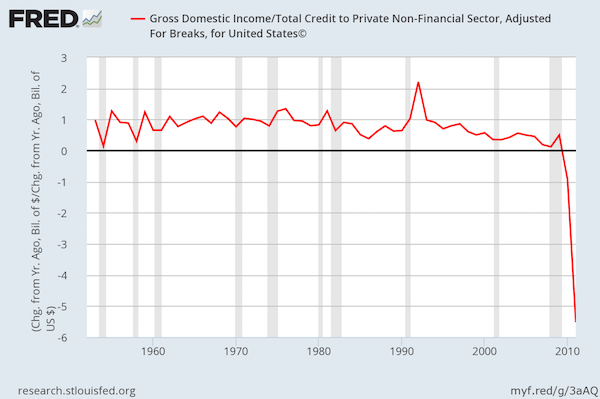
How do we know a ‘recovery’ is so far off it’s really no use to even talk about it? As I said, it’s easy. Let me lead this in with a graph I saw just today, which deals with a topic the Automatic Earth has covered a lot: marginal debt, or more precisely, the productivity/growth gained from each additional dollar of debt.

Please note, this particular graph deals with private non-financial debt only, we’ll get to other kinds of added debt, but that restriction is actually quite illuminating.

MarginalDebtNow of course, you have to wonder about the parameters the St. Louis Fed uses for its data and graphs, and whether ‘growth’ was all that solid in the run up to 2008. There’s plenty of very valid arguments that would say growth in the 1960’s was a whole lot more solid than that in the naughties, after the Glass-Steagall repeal, and after the dot.com blubber.

However, that’s not what I want to take away from this, I use this to show what has happened since 2008, more than before, when it comes to “passing debt off as ‘growth’”.

But it’s another thing that has happened since 2008, or rather not happened, that points out to us why this slump will have legs. That is, in 2008 a behemoth bubble started bursting, and it was by no means just US housing market. That bubble should have been allowed to fully deflate, because that is the only way to allow an economy to do a viable restart.

Instead, all that has been done since 2008, QE, ZIRP, the works, has been aimed at keeping a facade ‘alive’, and aimed at protecting the interests of the bankers and other rich parties. That facade, expressed most of all in rising stock markets, has allowed for societies to be gutted while people were busy watching the S&P rise to 2,100 and the Kardashians bare 2,100 body parts.

It was all paid for, apart from western QE, with $28 trillion and change of newfangled Chinese debt. The problem with this is that if you find yourself in a bubble and you don’t go through the inevitable deleveraging process that follows said bubble in a proper fashion, you’re not only going to kill economies, you’ll destroy entire societies.

And that is not just morally repugnant, it also works as much against the rich as it does against the poor. It’s just that that is a step too far for most people to understand. That even the rich need a functioning society, and that inequality as we see it today is a real threat to everyone.

Recognizing this simple fact, and the consequences that follow from it, is nothing new. It’s why in days of old, there were debt jubilees. It’s also why we still quote the following from Marriner Eccles, chairman of the Federal Reserve under FDR and Truman from 1934-1948, in his testimony to the Senate Committee on the Investigation of Economic Problems in 1933, which prompted FDR to make him chairman in the first place.

It is utterly impossible, as this country has demonstrated again and again, for the rich to save as much as they have been trying to save, and save anything that is worth saving. They can save idle factories and useless railroad coaches; they can save empty office buildings and closed banks; they can save paper evidences of foreign loans; but as a class they cannot save anything that is worth saving, above and beyond the amount that is made profitable by the increase of consumer buying.

It is for the interests of the well to do – to protect them from the results of their own folly – that we should take from them a sufficient amount of their surplus to enable consumers to consume and business to operate at a profit. This is not “soaking the rich”; it is saving the rich. Incidentally, it is the only way to assure them the serenity and security which they do not have at the present moment.

Everything would all be so much simpler if only more people understood this, that you need a – fleeting, ever-changing equilibrium- to prosper.

Instead, we’re falling into that same trap again. Or, more precisely, we already have. We have been fighting debt with more debt and built the facade put up by the Fed, the BoJ and the ECB, central banks that all face the same problems and all take the same approach: save the rich at the cost of the poor. Something Eccles said way back when could not possibly work.

Anyway, so here are the graphs that prove to us why the slump has legs. There’s been no deleveraging, the no. 1 requirement after a bubble bursts. There’s only been more leveraging, more debt has been issued, and while households have perhaps deleveraged a little bit, though that is likely strongly influenced by losses on homes etc. plus the fact that people were simply maxed out.

First, global debt and the opposite of deleveraging:

LeverageGlobalAnd global debt from a longer, 65 year, more historical perspective:

LeverageGlobal2-500It’s a global debt graph, but it’s perhaps striking to note that big ‘growth’ spurts happened in the days when Reagan, Clinton and Obama were the respective US presidents. Not so much in the Bush era.

Next, China. What we’re looking at is what allowed the post 2008 global economic facade to have -fake- credibility, an insane rise in debt, largely spent on non-productive overinvestment, overcapacity highways to nowhere and many millions of empty apartments, in what could have been a cool story had not Beijing gone all-out on performance enhancing financial narcotics.

LeverageChina500Today, the China Ponzi is on its last legs, and so is the global one, because China was the last ‘not-yet-conquered’ market large enough to provide the facade with -fleeting- credibility. Unless Elon Musk gets us to Mars very soon, there are no more such markets.

So US debt will have to come down too, belatedly, with China, and it will have to do that now. because there are no continents to conquer and hide the debt behind. We’re all going to regret engaging in the debt game, and not letting the bubble deflate in an orderly fashion when we still could, but all those thoughts are too late now.

LeverageUS500What the facade has wrought is not just the idea that deleveraging was not needed (though it always is, after every single bubble), but that net US household worth rose by 55% in the 6-7 years since the bottom of the crisis, an artificial bottom fabricated with…more debt, with QE, and ZIRP.

USTaxesHoneyPot2Meanwhile, in today’s world, as stock markets go down at a rapid clip, China, having lost control of a market system it never had the control over that Politburos are ever willing to acknowledge they don’t have, plays a game of Ponzi whack-a-mole, with erratic ‘policies’ such as circuit breakers and CIA-style renditions of fund managers and the like.

And all the west can do is watch them fumble the ball, and another one, and another. And this whole thing is nowhere near the end.

China bad loans have now become a theme, but the theme doesn’t mean a thing without including the shadow banking system, which in China has been given the opportunity to grow like a tumor, on which Beijing’s grip is limited, and which has huge claims on local party officials forced by the Politburo to show overblown growth numbers. If you want to address bad loans, that’s where they are.

Chinese credit/debt graphs paint only a part of the picture if and when they don’t include shadow banks, but keeping their role hidden is one of Xi’s main goals, lest the people find out how bad things really are and start revolting. But they will anyway. That makes China a very unpredictable entity. And unpredictable means volatile, and that means even more money flowing out of, and being lost in, markets.

The ‘least worst’ place to be for what money will be left is US dollars, US treasuries and perhaps metals. But there’ll be a whole lot less left than just about anyone thinks. That’s the price of deleveraging.

The price of not deleveraging, on the other hand, is what we see in the markets today. And there is no cure. It must be done. The price for keeping up the facade rises sharply with each passing day, and the effort will in the end be futile. All bubbles have limited lifespans.

I’ll close this with a few recent words from Tim Morgan, who puts it so well I don’t feel the need to try and do it better.

The Ponzi Economy, Part 1

In order to set the Ponzi economy into some context, let’s put some figures on it. In the United States, total “real economy” debt (which excludes inter-bank borrowing) increased by $19.4 trillion – in real, inflation-adjusted terms – between 2000 and 2014, whilst real GDP expanded by only $3.7 trillion. Britain, meanwhile, added £1.9 trillion of new debt for less than £400bn on “growth” over the same period. I spent part of the holiday period unearthing quite how much debt countries added for each dollar of “growth” over a period starting at the end of 2000 and ending in mid-2015.

Unsurprisingly, the league is topped by Portugal ($5.65 for each $1 of growth), Ireland ($5.42) and Greece ($5.39). Britain’s ratio ($3.46) is somewhat flattering, in that the UK has used asset sales as well as borrowing to sustain its consumption. The average for the Eurozone ($3.54) covers ratios as diverse as Germany (just $1.87) and France ($4.22).

China’s $2.56 looks unexceptional until you note that the more recent (post-2007) number is much worse. Economies which seem to have been growing without too much borrowing (such as Brazil and Russia) are now experiencing dramatic worsening in their ratios, generally in the wake of tumbling commodity prices.

In the proverbial nutshell, then, the world has become addicted to borrowing money, spending it, and passing this off as “growth”. This is a copybook example of a pyramid scheme, which in turn means that the world’s most influential economic mentor is neither Keynes nor Hayek, but Charles Ponzi.

[..] How, in the absence of growth, can inflated capital values be sustained? The answer, of course, is that they can’t. Like all Ponzi schemes, this ends with a bang, not a whimper. This is why I find forecasts of a ‘big fall’ or ‘sharp correction’ in markets hard to swallow. Ponzi schemes don’t end gradually, any more than someone can fall off a cliff gradually, or be “slightly pregnant”.

The Ponzi economy simply continues for as long as irrationality prevails, and then implodes. Capital markets, though, are the symptom, not the cause. The fundamental problem is an inability to escape from an addictive practice of manufacturing supposed “growth” on the basis of borrowed money.

There may be shallow lulls in the asset markets, nothing ever only falls down in a straight line in the real world, but that debt I’ve described here will and must come down and be deleveraged.

The process will in all likelihood lead to warfare, and to refugee movements the likes of which the world has never seen just because of the sheer numbers of people added in the past 50 years.

When your children reach your age, they will not live in a world that you ever thought was possible. But they will still have to live in it, and deal with it. They will no longer have the facade you’ve been staring at for so long now, to lull them into a complacent sleep. And the Kardashians will no longer be looking so attractive either.

ooOOoo

If you found your mind wandering somewhat as you tried to stay focussed on the essay, just go back and read the closing two paragraphs.

The process will in all likelihood lead to warfare, and to refugee movements the likes of which the world has never seen just because of the sheer numbers of people added in the past 50 years.

When your children reach your age, they will not live in a world that you ever thought was possible. But they will still have to live in it, and deal with it. They will no longer have the facade you’ve been staring at for so long now, to lull them into a complacent sleep. And the Kardashians will no longer be looking so attractive either.

As I said at the start: we are living in interesting times!

Trying to make sense of these times?

A departure from recent themes.

Tom Engelhardt
Tom Engelhardt

Some time ago, I republished, with Tom’s permission, essays that were being published on the TomDispatch blogsite. While those essays had nothing at all to do with dogs, they had much to do with integrity; the underlying theme of Learning from Dogs. Then Tom Engelhardt very generously gave me blanket permission to republish further TomDispatch essays whenever I felt so inclined. Thus back in 2011, I republished The Great American Carbon Bomb because it seemed so important to readers of this place. Subsequently, from time to time, other essays have been republished again because they seemed worthy of a broader distribution.

Which brings me to today’s post; another republication of a TomDispatch essay. Why? Because what is presently going on in the world, about the price of oil, about the chaos in the Middle-East, about the prospects of global deflation and the frightening consequences that could flow from that, are of concern to 99.9% of the ordinary folk living on this planet, including the vast majority of owners of dogs.

Thus without any further ado, here is the latest ‘Tomgram’: Michael Klare, The Look of a Badly Oiled Planet.

ooOOoo

Tomgram: Michael Klare, The Look of a Badly Oiled Planet

I am what I learn!

Reflections on the old and the new.

So here we are on the last day of 2015, the cusp of a new year and who knows what the next twelve months have in store.

All I am going to do is to reflect on the huge potential our modern ‘wired-up’ world offers for learning.

Most will know the saying, “You can’t teach an old dog new tricks.”

But it is wrong!

Here at home, where a number of the dogs are in their old age (Pharaoh is the equivalent in age of 100 human years; one dog year being approximately the same as eight human years) Jean and I see no difficulty in these elderly dogs learning new tricks.  Staying with Pharaoh, as an example, his hearing is pretty poor now but he has learnt a whole range of hand signals in recent months and he still communicates very well with us.

There is much in this new world that concerns me and I know I am not alone with this view. But the rewards of reading the thoughts of others right across the world are wonderful beyond measure.

Here’s a tiny dip into some fascinating items and articles that have graced my in-box in just the last twenty-four hours.

  • Eckhart Tolle’s Moment Reminder: “As far as inner transformation is concerned, there is nothing you can do about it. You cannot transform yourself, and you certainly cannot transform your partner or anybody else. All you can do is create a space for transformation to happen, for grace and love to enter.”
  • Val Boyco, “Everything comes to us that belongs to us, if we create the capacity to receive it.” ~ Rabindranath Tagore
  • John Zande in his Sketches on Atheism, “Theism’s most potent, pervasive, irresistibly enchanting gift to frightened but otherwise sane individuals is a belief—a promise—that upon their death they will go home.”
  • Mother Nature Network, “7 ways to meditate while you move – If you don’t have time for sitting meditation, give one of these active meditations a try.”
  • George Monbiot, (on the UK floods), “These floods were not just predictable. They were predicted. There were clear and specific warnings that the management of land upstream of the towns now featuring in the news would lead to disaster.”

and my final selection:

  • Patrice Ayme: (from an essay on Brain & Consciousness) “The best microprocessors you can buy in a store now can do 10 to the power 11 (10^11; one hundred billions) operations per second and use a few hundred watts,” says Wilfred van der Wiel of the University of Twente in the Netherlands, a leader of the gold circuitry effort. “The human brain can do orders of magnitude more and uses only 10 to 20 watts.  That’s a huge gap in efficiency.”

So here’s to a new year of wonderful new learnings.  And let me leave you with this additional message for 2016.

Namely that The Nation weekly journal are celebrating their 150 years of publishing the magazine. They recently published a 150th Anniversary edition and the front editorial is written by Katrina Vanden Heuval. There is a ‘break out’ to one side on Page 2 of that editorial that reads:

Change is inevitable, but the one constant in The Nation‘s history has been a faith in what can happen if you tell people the truth.

Finding out the truth and sharing it so we can all see what can happen is my wish for 2016.

Happy New Year to all of you, and to all of your friends and loved ones.

Maggie the teaching dog.

Two views of teaching in the United Kingdom.

The title to today’s post may be a tad misleading, for it doesn’t offer a guide to both aspects of the post.

But first to what prompted the title.

Earlier yesterday, Neil Kelly, friend from my days when I was living in South Devon, sent me a link to a recent BBC News item. Here’s the story:

Maggie the dog made honorary primary school teacher

28 December 2015 Last updated at 04:31 GMT

A dog has become so successful in helping children to read, that she’ has become an honorary member of staff at a school in the West Midlands.

The idea of getting pupils to read to dogs in order to improve their literacy was first tried out in the UK five years ago, but Maggie, a 10-year-old Shih Tzu, has become so successful that she now has her own staff badge at Earls High school in Halesowen.

Phil Mackie went along to meet Maggie, and Grace, another Shih Tzu, who’ is training to take over when Maggie retires.

Teaching Assistant Toni Gregory spoke on behalf of the two literary pups.

Unfortunately, the short video of Toni Gregory speaking hasn’t yet made it to YouTube so I can’t include that in the post. But do go across to here and watch the short interview with Toni. Here’s a picture of Maggie.

_87347683_87347682Moving on!

It’s difficult not to see the connection between Maggie offering teaching services in a UK school and this recent essay from Richard Murphy of the Tax Research UK blog. It is republished in full with Richard’s very kind permission.

ooOOoo

The parents of primary school kids need to get very angry for their children

Posted on

Ninety three per cent of all children in the UK are taught in state schools. The parents of the other seven per cent may wish to pretend otherwise but the truth is that the prosperity, well being and future of the UK is dependent upon the ability of state schools to deliver the education our young people need. But, as the Guardian has reported, that is in jeopardy:

Britain’s leading expert on school recruitment has warned that a shortage of trainee teachers is reaching crisis levels in some of the most important subjects in the curriculum.

In evidence submitted to the parliamentary education select committee, TeachVac, an independent vacancy-matching and monitoring service for education professionals, said that it had identified a “woeful” lack of new teachers in several key secondary school subjects.

This is not a minor issue. As they note:

[TeachVac] has identified an 85% shortfall in the number of trainee teachers needed to fill vacancies in both business studies and social sciences. The number of new teachers for design and technology is also more than a third below what it needs to be and there is a 10% shortfall in the number of IT teachers required.

These are core subjects at the heart of the skill base the UK needs. And we may not be able to teach them.

There are three reasons for that. First, when the government portrays any job in the state sector as parasitical – and large parts of the media join in – any recruitment programme is going to be hard.

Second, student debt is crippling for those on what is thought to be middle pay, which is what many teachers can, at best, hope to earn.

And third, pay is just not good enough.

All of those are the direct result of policy. The first is ideological. The second is born of the desire to economically enslave people though debt which underpins neoliberalism. The third is the austerity mantra.

Put them together and this country will be crippled by denying an education to those who need and deserve it.

We need a new narrative.

The need to supply high quality education has to be at the core of that narrative.

I hope parents of those ten and younger realise what is going to happen to their children. It is not good, and they need to get angry, now.

ooOOoo

It strikes me that we need new narratives on so many issues ‘both sides of the pond’. Maybe, just maybe, 2016 kicks some of these new narratives into play.

Britain before humans.

A remarkable look at the extraordinary history of the British Isles.

Now on first sight, any reasonable follower of my scribblings who lived outside Britain might wonder why this post was so focussed on one particular country, the country of my birth: Great Britain.

My justification, however, for including this George Monbiot essay is that many residents of many other countries, not just North Americans, have roots and family ties in GB. Plus, so typical of a Monbiot essay, the subject will be of interest to anyone, wherever they live in the world, who wonders about time before we shaped our environment. (I have converted some of the figures used in the essay within square brackets [ …] )

Could I also mention that from Thursday through to the end of the year, my posts in this place are going to be a mix of trivial, humorous and repeat posts. I need a bit of a break as much as you good people need a break from Learning from Dogs! 😉

Monbiot’s essay is republished here with the kind permission of George Monbiot.

ooOOoo

Walk on the Wild Side

17th December 2015

Rewilding, hillwalking and the extraordinary history of these islands.

George Monbiot, interviewed by Dan Bailey for UKHillwalking.com, 11th December 2015

What would a natural upland habitat have looked like in Britain before humans started having the dominant influence?

This is a particularly interesting question, because we have two completely different baselines in Britain. The more recent one is the situation that prevailed after the ice retreated, and a temperate climate returned. I’m talking about parts of the Boreal and Atlantic stages, roughly between 9000 and 5000 years ago. It seems that during this period, Britain was more or less covered by closed canopy rainforest from top to toe. I’m using the term rainforest precisely: to denote forests that are wet enough to support epiphytes, plants that grow on other plants. Wherever you see polypody, the many-footed fern, growing along the branches of a tree, it’s a reminder that you are looking at rainforest fragment.

Hardly any land in this country would have been treeless at this time. With the exception of the summits of the Cairngorms, Ben Nevis and one or two other mountains, there is nowhere here that is too high for them to grow. Our bare and rocky hills are an artefact of deforestation, heavy grazing and the subsequent loss of soil.

But even that state arguably reflected the dominant influence of humans. To see what the land would have been like without them, you would have to go back to the previous interglacial period, the Eemian. At this time, the climate was almost identical to ours, but for some reason the people driven out by the previous ice age appear not to have returned to this country. At this stage, there was plenty of forest, but it seems that it was not continuous. The closed canopy rainforest was punctuated by more open forest, as well as wood pasture and savannah. Why? Because humans had not wiped out the dominant species. During the Eemian, Britain had a fairly similar collection of wildlife to the one we know today. You know: foxes, badgers, hedgehogs, deer, robins, jackdaws, elephants, rhinos, hippos, scimitar cats, hyenas and lions.

Ah yes, not the same in all respects. Like everywhere else on earth, we had a megafauna, and this shaped the ecosystem. The large herbivores were driven out of Britain by the ice, then driven to extinction in southern Europe about 30,000 years ago when modern humans arrived. (The hyenas and lions, incidentally, persisted throughout the ice age, hunting reindeer across the frozen tundra, and it seems that they survived here until about 10,000 years ago, when Mesolithic hunters turned up).

What does a typical British upland habitat look like now, and how does it differ from uplands in Mainland Europe?

In almost all other European countries (Ireland is an exception), the pattern of tree cover is what you would expect to see. The lowlands, where the land is worth farming, are largely treeless. The uplands, where the land is infertile and the climate is harsh, largely forested. This is why Europe has an average forest cover of 37%. In Britain, the lowlands are largely treeless, as you might expect, but the uplands are even barer. This peculiarity explains the fact that Britain has only 13% tree cover. Instead of a rich ecosystem in the hills, a mosaic of trees, scrub and glades (which is what would occur now, on our depleted soils, if the land were allowed to recover), the uplands are almost entirely treeless, and therefore remarkably poor in birds, insects and all the other lifeforms you might expect to find there. The parts of the country which would otherwise function as our great wildlife reserves – those places, in other words, where hardly anyone lives and there is almost no economic activity – have even less wildlife than the places that are intensely habited and farmed.

What are the people and processes responsible for keeping our hills bare in England and Wales? Who’s more to blame in Scotland?

In England and Wales, the cause is simply stated. Sheep, which originated in Mesopotamia, are wildly, disproportionately destructive. In many of our hills, they are kept at densities of no more than one per hectare or even less. But because they selectively browse out tree seedlings, they ensure that no recovery can take place. Even where remaining woods exist, they are often dying on their feet, because there are no young trees with which to replace the old ones. In terms of food production, upland sheep farming makes a minuscule contribution. It is hard to think of any industry where there is a higher ratio of destruction to production.

The denuding of our hills by sheep is supplemented by the burning of grouse moors, a fantastically destructive activity carried out for the benefit of a very small number of exceedingly rich people. These two activities ensure that in England and Wales there are scarcely any trees above around 200 m. [Ed: 656 feet]

Both are also important factors in Scotland, but in the Highlands the dominant cause of destruction is the deer stalking estates. By keeping the numbers of red deer very high, so that a banker waddling up the hillside in tweed pantaloons is almost guaranteed to make a kill, these estates have a similar effect to sheep farms. Like sheep, deer seek out the seedlings, and when their numbers rise above five or ten per square kilometre, they ensure that no forest can grow.

So why the difference between Britain and the rest of Europe? The answer seems to be the size of land holdings. Because, unlike most other European countries, Britain never had a successful revolution, we have, on one estimate, the second highest concentration of landholding in the world, after Brazil. This grants landowners inordinate power. It also leads to the situation I’ll describe in the next answer.

Where does subsidy farming come in?

People farming the uplands claimed to make their money by raising sheep. But in economic terms, sheep are ornamental. Sheep farming throughout our hills is a loss-making activity, and persists only as a result of public money, that takes the form of farm subsidies. We pay £3.6 billion [Ed: 5.33 billion US dollars] a year in this country to have our watersheds destroyed and our wildlife wiped out. The reason why the hills are kept bare here but not in the rest of Europe is that the landholdings in Britain are big enough to make subsidy harvesting a worthwhile activity: you are paid by the hectare. The more land you own, the more public money you receive. Some people take millions of pounds in these benefit payments every year. It’s extraordinary, when such restrictions are placed upon the ordinary recipients of social security, that this situation has not yet become politically explosive.

And culturally – how does our idealised view of the upland landscape feed into land management?

Our idealised, romanticised view of sheep farming, that bears almost no relationship to reality, but that is constantly drilled into our minds by programmes like Countryfile, makes it hard for us to see what is really going on. It’s because of this view that we fail to grasp a vast and obvious fact. That by denuding our hills, this economically-tiny industry has done more damage to our ecosystems and wildlife than all the building that has taken place in Britain.

Can you explain, in a nutshell, what you mean by re-wilding, and why you’d like to see it in the British hills?

Rewilding is the mass restoration of ecosystems and the re-establishment of missing species. I’m not arguing for the blanket rewilding of our hills by any means. But I believe that Britain would be greatly enriched, in terms of both wildlife and human experience, if significant areas were allowed to recover; if trees were allowed to grow in some of our denuded places, and some of the wonderful species we have lost were permitted to return. In particular, I’m thinking of beavers, boar, lynx, wolves and species that we retain in small numbers but that were once widespread, such as wildcat, pine martens, capercaillie, eagles and goshawks.

The other great benefit of allowing trees to return to the hills is the restoration of watersheds. In one study in Wales, the soil beneath woodland was found to absorb water at 67 times the rate of the soil beneath sheep pasture. The rain flashes off sheep pasture as if it were concrete, instantly causing floods downstream. Trees hold back the water and release it gradually, smoothing out the cycle of flood and drought.

Could you talk us through the stages of a habitat restoration process that could take a bare hillside and return it to woodland?

Many of our hillsides have been so thoroughly sheepwrecked that there are now no remaining seed sources. In these circumstances, we would need to plant islands of trees, using seed taken from the nearest surviving pockets of woodland in order to sustain local genetic diversity. Short of greatly reducing stocking levels or temporarily keeping herbivores off altogether, there is not a lot more that needs to be done. In some places, all that is required is temporary exclusion of grazing animals.

What is a trophic cascade, and how is this idea relevant in the British context?

A trophic cascade is an ecological process that tumbles from the top of the foodchain to the bottom. It turns out that in many places, large carnivores regulate the entire ecosystem; ecosystems that retain them behave in radically different ways to ecosystems from which they have been lost. This presents a powerful challenge to British models of conservation, as we have lost all our large carnivores here, with the result that ecological processes, and their dynamic and ever-shifting successional patterns, have been curtailed.

Critics sometimes suggest that proponents of re-wilding are advocating turning the clock back to an arbitrary point in history and then keeping things permanently fixed in this state. Is that fair?

It is precisely the opposite. Our current model of conservation fixes ecosystems at an arbitrary point and then keeps them in a state of arrested development through extreme management of the kind that everywhere else on earth we recognise as destruction, not protection: namely cutting, burning and grazing. There is no intelligible reason behind the choices that have been made by conservationists of the ecosystems and species they choose to maintain by these means. Rewilding, by contrast, has no fixed outcomes. It seeks to restore ecological processes by bringing back some of the key elements of ecosystems and the key drivers: species that trigger trophic cascades. To the greatest extent possible, it then seeks to stand back and allow natural processes to take their course.

What would a healthy population of deer look like? How about sheep – do you have a figure for environmentally supportable grazing densities?

In the infertile uplands, it is roughly 5 per square kilometre (in other words per 100 ha). [Ed: 247 acres] Beyond that point, there is almost no regeneration of trees.

The debate often seems to be framed in absolute terms – either we re-wild everywhere, and get rid of all the farmers and deer, or not at all. How big would be big enough to please you? Are you talking about re-foresting every hill, moor and mountain, from valley to summit?

The aim of the group Rewilding Britain, that I helped to found but do not run, is to allow natural ecological processes and key species to return to at least one million hectares (4.5%) of Britain’s land and 30% of our territorial waters over the next 100 years. It would like to see at least one large rewilded area to connect both land and sea – descending from the mountaintops to our coastal waters.

In somewhere as crowded as Britain are vast re-created wildernesses a viable prospect, or would it be more realistic to go for smaller scale projects in which re-wilding is just part of a mixed land use picture – projects such as Wild Ennerdale perhaps, where habitat restoration is being managed in conjunction with forestry, leisure, water extraction and livestock?

The British population is highly concentrated. Some parts of the country are exceedingly crowded; others remarkably empty. Most British uplands have a far lower population density than many parts of Europe in which wolves, lynx, bear and other species are found. Wolves have even been appearing in countries such as Belgium, the Netherlands and Denmark, where there is very little land that is unsuitable for intensive farming, and the rural population density tends to be much higher. Their arrival has been greeted by most sectors of society with delight.

Many hill-goers will recognise your picture of the degraded upland environment, but some may simply be making a different aesthetic judgement to you, valuing the barren wide open spaces for the experience they provide. If they just happen to prefer grass and heather landscape on some romantic level, and don’t much care about botany and wildlife, how might you seek to convert them?

I believe we should have both. At the moment those who value a wild, self-willed landscape have nowhere to turn in Britain. We have to travel abroad to find it and to experience magnificent encounters with wildlife. I believe this deprives us of the wonder and delight that can enhance our lives and of choice and freedom. We have nowhere in which to escape the order and control that governs all other aspects of our lives.

Hillwalkers and climbers have fought long and hard against vested landowning interests for our right to roam. There is a worry that conservation could be used to curtail these freedoms, and some evidence to support that concern. What place does public access on open upland have in a re-wilded landscape, and which would take precedence – amenity or conservation?

I was heavily involved in campaigns for the right to roam, through another group I helped to found, The Land Is Ours, and I would be dismayed by any scheme which sought to keep people out of the hills. I believe that rewilding and access are entirely compatible. While it may be necessary in some places temporarily to fence out grazing animals, the fencing required is no different from that which is already found across the uplands, and exactly the same arrangements can be made to cross it as are used today. My hope is that in some places, as a result of rewilding, in some places there will one day be no fencing at all: in other words it will mean better access than there is today.

On a related note, could public support for re-wilding have unintended consequences? Might it, for instance, be a gift to landowners and conservation bodies with priorities quite other than public access?

I would be surprised if there were no unintended consequences. But if problems arise, the policies should be modified. No good policy emerges from the egg mature and complete. It must be constantly assessed and adjusted to head off any problems that emerge.

What sort of reception have your ideas met from folk in rural communities such as hill farmers and shooting estate workers?

I think it’s fair to say that they have been mixed. There has been a fair bit of hostility from some farming and shooting groups, but also support from surprising quarters, including landowners’ representatives and a large number of individual farmers and estate owners. In the wider countryside, there is often strong support. We would do well to remember that farmers are a very small minority even of the rural population, though this often gets forgotten because of their powerful influence on policy.

Can you offer a fully thought-through transition from sheep farming and shooting to an alternative model for the rural economy, one in which rural residents still have a secure place in a re-wilded countryside? Can you understand people’s aversion to risking this?

I certainly can understand people’s concerns. But there is going to be a major transition in the countryside before long, with or without rewilding, when farm subsidies are either scrapped or greatly reduced, as they inevitably will be. When essential public services are being cut, giving €55 billion [Ed: 61 billion USD] a year from the public purse across the EU to landowners, while helping to destroy both human communities and ecological resilience is surely as unsustainable politically as it is environmentally. So what are farmers whose livelihood is sustained only as a result of farm subsidies going to do?

I have two proposals. The first is that we start campaigning for the retention of some subsidies, whose purpose would be changed to that of ecological restoration and the support of communities. Landowners and tenants would be paid to restore watersheds, woodlands, rivers and wildlife. It’s hard to see how else continued subsidies could remain publicly acceptable. Rewilding could be a way out for struggling rural communities.

The second proposal is to start investigating means by which rural people can enhance their livelihoods by enhancing the ecosystem. There are plenty of examples from around the world of eco-tourism and associated activities reviving communities by generating income and employment. Given that the traditional industries have manifestly failed to sustain jobs and incomes, in some cases it will not be hard to show the alternatives might work better. But more research is needed, and we have to remember that the same approach is not going to work everywhere. Different local circumstances demand different strategies.

“We have an incredibly narrow and restrictive vision of cultural heritage and cultural landscapes” – your words. What would a broader vision look like?

I would love to see rural culture becoming more inclusive. It’s often highly hierarchical, with the landowners and farmers sitting at the top of the pyramid, dictating policy. In some respects, democracy is a stranger to the countryside; the old, landed powers still wield disproportionate influence over the lives of others. But I don’t want to invent a new culture. I believe that democratisation and pluralism creates its own cultures, that will evolve and develop independently in different places. I’m calling on people to challenge cultural hegemony in the countryside – perhaps we could call it agricultural hegemony – and for a much wider range of voices to be heard.

Farming and shooting are supported by the current dominant countryside culture. But wouldn’t a shift to re-wilding simply be replacing this set of special interests with another, a sort of cultural colonisation of the countryside by urbanites?

That’s certainly not how I see it. And this has nothing whatever to do with the presumed urban-rural divide. Many of rewilding’s most ardent proponents live in the countryside, perhaps unsurprisingly. We are repeatedly told that the countryside is at war with the towns and vice versa. But I see no evidence of this. What I see is certain dominant interests in the countryside in conflict with other rural interests. And those dominant interests often have either one or both feet in the cities.

A few years ago there was an article in the Telegraph that sought to characterise authentic rural people. These people apparently don’t care about “newts, trees and bats”: such matters are of interest only in London. It described David Cameron as “at heart, a rural Tory”, who “still grumbles to his wife about what, for him, are ‘banned activities’ – notably shooting”. Authentic rural people, in other words, spend their adult lives in Notting Hill and drive out to their second homes for a shooting party at the weekend. People who live in the countryside and care about wildlife, on the other hand, are, “at heart”, Londoners. The rural-urban divide, as characterised in such papers, has nothing to do with location. It’s really about class.

What chance is there of significant progress being made in the current funding climate? You’ve recently written about the ‘toothless’ Environment Agency in this regard. Given the squeeze on public bodies would it be more effective to promote the out-sourcing of re-wilding to non-governmental organisations, private philanthropists and large corporate landowners such as water companies?

There is a real problem here. Government agencies are being gutted and re-centralised. Cameron’s devolution agenda is a con: he is even more of a micromanager than Tony Blair was. The current environment secretary, Liz Truss, has put her department’s head on the block, volunteering for early execution. Statutory bodies like the Environment Agency are now, in terms of what they can do, almost dead. But the crazy situation that prevails today might not – should not – last forever. It is true to say however, that we cannot rely on government alone to deliver these changes, whatever form a government might take.

Are our National Park Authorities a help or a hindrance?

At the moment, they are a real drag on progress. This is partly because of policy, such as the Lake District National Park’s application for World Heritage status, which, as currently framed, will ensure that destructive practices are locked in (and continue to contribute to flooding). And it’s partly because of the way they frame the issues. They go to great lengths to persuade us that current land management is not only compatible with the protection of nature, but actually essential to it! All their brochures and display boards and websites create the impression that these ecological disaster zones are rich and thriving ecosystems, so people are constantly misled and misdirected. They are led to believe that all is well in our national parks, that these wastelands, which are in most cases little more than sheep ranches, are magnificent wildernesses. Our national parks are a disgrace, a shame upon the nation, and park authorities with an ounce of intellectual honesty would recognise this and seek to address it.

Re-wilding seems to be moving up the agenda of the large conservation organisations, and gaining a space in the public discourse. Do you see grounds for optimism?

It certainly is. Before Feral was published, I visited all the principal conservation groups, and received responses that varied from mild interest to outright rejection. The change over the past three years has been astonishing. Rewilding appears to have moved from the fringe of the mainstream, and I’m delighted to see how these groups have begun to pick it up and engage with it. There’s still a long way to go, and plenty of daft practices still in play, but change among the conservation groups is certainly happening, albeit slowly. We will see rewilding in this country. The question is how far and how fast it will go.

ooOOoo

Much of my adopted country, the United States, is still wild and the Bureau of Land Management state that they manage “over 245 million surface acres ..”. However, to put that into perspective the area of the USA is 2.436 billion acres so the BLM managed area is just a fraction over 10%.

Finally, Monbiot refers to his book Feral. I have read it and can recommend it.

Feral-665x1024

More details of his book may be found here.

This is much more than an issue for just Great Britain.

You couldn’t make it up!

However hard one tried to!

LfDFrontCoverebook
In Chapter Eight, Behaviours and Relationships, I speak of how the development of humans has been, unsurprisingly, the result of our human behaviours. Adding that it is likely that our behaviours have been damaging, in varying degrees, to the survival of our species and countless others for a very long time. Continuing:

But 2,000 years ago, the global population of man was only 300 million persons[1]. It took 1,200 years for that global population to become 1 billion persons; in 1800. Now track the intervals as we come forward in time.

In 1927, just 127 years later, the two-billionth baby was born. In 1960, only 33 years on, came the birth of the three-billionth baby. Just 16 years later, in 1974, the four-billionth baby was born. In 1987, now only 13 years later, we have a population of five billion persons. Around October 1999, the sixth-billionth baby was born.
The growth rate of global population is slowing[2] but nevertheless it is trending to a billion additional persons every decade. In other words, a 100-million population growth every year, or about 270,000 more persons every single day.

Combine man’s behaviours rooted in times way back with this growth in population and we have the present situation. A totally unsustainable situation for one basic and fundamental reason. We all live on a finite planet.

[1] http://en.wikipedia.org/wiki/Population_growth
[2] According to UN’s 2010 revision to its population projections, world population will peak at 10.1bn in 2100 compared to 7bn in 2011. A 2014 paper by demographers from several universities and the United Nations Population Division forecast that the world’s population will reach about 10.9 billion in 2100 and continue growing thereafter. However, some experts dispute the UN’s forecast and have argued that birthrates will fall below replacement rate in the 2020s. According to these forecasters, population growth will be only sustained till the 2040s by rising longevity but will peak below 9bn by 2050.

A growth of about 270,000 more persons every single day!

I am sure that I am not alone in seeing this growth in our population as something that is both unsustainable and a critical component of long-term damage to our planet.

But George Monbiot in a recent essay, in true Monbiot style, highlights an aspect of our human population and the damage resulting that would have never previously occurred to me.

Read it and see if you don’t agree likewise. (Again, there are just too many links in George’s essay to reconstruct in this republishing and, as the other day, I have highlighted those phrases that are a link to other material in red. Go here if you wish to further investigate those links.)

ooOOoo

Pregnant Silence

19th November 2015

It’s about time we discussed the real population crisis.

By George Monbiot, published in the Guardian 18th November 2015

This column is about the population crisis. About the breeding that’s laying waste to the world’s living systems. But it’s probably not the population crisis you’re thinking of. This is about another one, that we seem to find almost impossible to discuss.

You’ll hear a lot about population in the next three weeks, as the Paris climate summit approaches. Across the airwaves and on the comment threads it will invariably be described as “the elephant in the room”. When people are not using their own words, it means they are not thinking their own thoughts. Ten thousand voices each ask why no one is talking about it. The growth in human numbers, they say, is our foremost environmental threat.

At their best, population campaigners seek to extend women’s reproductive choices. Some 225 million women have an unmet need for contraception. If this need were answered, the impact on population growth would be significant, though not decisive: the annual growth rate of 83 million would be reduced to 62m (1). But contraception is rarely limited only by the physical availability of contraceptives. In most cases, it’s about power: women are denied control of their wombs. The social transformations they need are wider and deeper than donations from the other side of the world are likely to achieve.

At their worst, they seek to shift the blame from their own environmental impacts. Perhaps it’s no coincidence that so many post-reproductive white men are obsessed with human population growth, as it’s about the only environmental problem of which they can wash their hands. Nor, I believe, is it a coincidence that of all such topics this is the least tractable. When there is almost nothing to be done, there is no requirement to act.

Such is the momentum behind population growth, an analysis in the Proceedings of the National Academy of Sciences discovered, that were every government to adopt the one-child policy China has just abandoned, there would still be as many people on Earth at the end of this century as there are today. If two billion people were wiped out by a catastrophe in mid-century, the planet would still hold a billion more by 2100 than it does now.

If we want to reduce our impacts this century, the paper concludes, it’s consumption we must address. Population growth is outpaced by the growth in our consumption of almost all resources. There is enough to meet everyone’s need, even in a world of 10 billion people. There is not enough to meet everyone’s greed, even in a world of 2 billion people.

So let’s turn to a population crisis over which we do have some influence. I’m talking about the growth in livestock numbers. Human numbers are rising at roughly 1.2% a year. Livestock numbers are rising at around 2.4% a year. By 2050, the world’s living systems will have to support about 120m tonnes of extra human, and 400m tonnes of extra farm animals(2).

Raising them already uses three quarters of the world’s agricultural land. One third of our cereal crops are used to feed them. This may rise to roughly half by 2050. More people will starve as a result, because the poor rely mainly on grain for their subsistence, and diverting it to livestock raises the price. Now the grain that farm animals eat is being supplemented by oil crops, particularly soya, for which the forests and savannahs of South America are being cleared at shocking rates.

This might seem counter-intuitive, but were we to eat soya, rather than meat, the clearance of natural vegetation required to supply us with the same amount of protein would decline by 94%. Producing protein from chickens requires three times as much land as protein from soybeans. Pork needs nine times, beef 32 times.

A recent paper in the journal Science of the Total Environment suggests that our consumption of meat is likely to be “the leading cause of modern species extinctions”. Not only is livestock farming the major reason for habitat destruction and the killing of predators, but its waste products are overwhelming the world’s capacity to absorb them. Factory farms in the US generate 13 times as much sewage as the human population. The dairy farms in Tulare county, California produce five times as much as New York City.

Freshwater life is being wiped out across the world by farm manure. In England, as I reported last week, the system designed to protect us from the tide of crap has comprehensively broken down. Dead zones now extend from many coasts, as farm sewage erases ocean life across thousands of square kilometres.

Livestock farming causes around 14% of the world’s greenhouse gas emissions: slightly more than the output of the world’s cars, lorries, buses, trains, ships and planes. If you eat soya, your emissions per unit of protein are 20 times lower than eating pork or chicken, and 150 times lower than eating beef.

So why is hardly anyone talking about the cow, pig, sheep and chicken in the room? Why are there no government campaigns to reduce the consumption of animal products, just as they sometimes discourage our excessive use of electricity? A survey by the Royal Institute of International Affairs found that people are not unwilling to change their diets, once they become aware of the problem, but that many have no idea that livestock farming damages the living world.

It’s not as if eating less meat and dairy will harm us. If we did as our doctors advise, our environmental impacts would decline in step with heart disease, strokes, diabetes and cancer. British people eat, on average, slightly more than their bodyweight in meat every year, while Americans consume another 50%: wildly more, in both cases, than is good for us or the rest of life on Earth.

But while plenty in the rich world are happy to discuss the dangers of brown people reproducing, the other population crisis scarcely crosses the threshold of perception. Livestock numbers present a direct moral challenge, as in this case we have agency. Hence the pregnant silence.

www.monbiot.com

Footnotes:

  1. While the number of unintended pregnancies would fall by 52m (or 70%), this does not mean that the number of babies would fall by the same amount. The Guttmacher/UNFPA report breaks down the outcome thus: “21 million fewer unplanned births; 24 million fewer abortions; six million fewer miscarriages; and 0.6 million fewer stillbirths.”
  2. Additional global meat consumption by this date is estimated to be roughly 200 million tonnes. Boned meat comprises roughly half the weight of a living animal. So total additional livestock biomass will be in the order of 400 million tonnes, or 400 billion kg. The average human weight is 52 kg and the anticipated rise in population by 2050 is 2.3 billion (the median estimate is 9.7 billion by that date). So the additional human weight is likely to be somewhere around 120 billion kg.

ooOOoo

Powerful reasons to turn vegetarian or vegan. And well done if you are already there. Well done, indeed!