Yesterday, a visitor to this place left a comment to a post published in September, 2012. Simply, he wrote, “Some food for thought midst all the drivel and crap.” The post was under the heading of The Charles Schulz Philosophy. I had forgotten about it. I thought it would be nice to republish it today (or rather the essence of that post).
ooOOoo
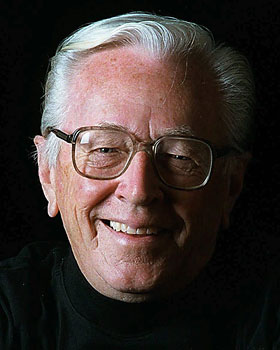
Charles Schulz
The following is the philosophy of Charles Schulz, the creator of the ‘Peanuts’ comic strip.
You don’t have to actually answer the questions. Just ponder on them. It will make very good sense!
Here’s A Little Quiz
You don’t have to actually answer the questions. Just read them straight through, ponder a tad, and you’ll get the point.
Name the five wealthiest people in the world.
Name the last five Heisman trophy winners.
Name the last five winners of the Miss America pageant.
Name ten people who have won the Nobel or Pulitzer Prize.
Name the last half dozen Academy Award winners for best actor and actress.
Name the last decade’s worth of World Series Winners.
How did you do?
The point is, none of us remember the headliners of yesterday. These are no second-rate achievers. They were the best in their fields.
But the applause dies. Awards tarnish over time. Achievements are forgotten and accolades and certificates are buried with their owners.
Here’s another quiz. See how you do on this one:
List a few teachers who aided your journey through school.
Name three friends who have helped you through a difficult time.
Name five people who have taught you something worthwhile.
Think of a few people who have made you feel appreciated and special!
Think of five people you enjoy spending time with.
Did you find that Easier? Of course you did!
So here’s the lesson!
The people who make a difference in your life are not the ones with the most credentials, or the most money…or the most awards…they simply are the ones who care the most.
Recently, she posted a beautiful poem to commemorate the nine years of having Susami in their lives. It is republished here with Bela’s kind permission.
ooOOoo
There is a presence, here
and now; the bellows of breath,
warmth of blood, the feeling,
even if imagined,
that we are connected, one
to the other.
We each have our memories,
after all.
Your passing removes that utterly,
and somehow the same hand
lying on the same fur and flesh
will sense void, not even spirit,
not even that.
One can forgive the athiest,
or even theist their doubts,
props, religions. For this
at least is real:
This. Here. Now.
Tomorrow it will be gone.
And no matter in visions I linger
in the numinous; despite
in the garden I witness the alchemy
of decay transforming
into green and vibrant,
the loss of a loving companion
is egregious, indeed.
ooOOoo
Bela explained how Susami came to them:
This sweet being has been with us only nine years, since she was about 10-12 weeks old. Her previous steward, a multiply-pierced and -tattooed young woman, had to find a home for her. We were on our way to the east coast to deal with some business, and I had taken our good friend Kevin with me to the local feed store to get the horse stocked up on alfalfa pellets (it was during a long drought). I saw the pup with a bandage on her leg before, and asked the gal what was wrong with her. I later learned from the store owner (who thanked me many, many times for giving Susami a good home) that the dog had been severely abused. (She never did tell me specifics, so I was left to wonder.) The young woman tried her best, but there were forces beyond her control in her environment. When I saw Susami again, we had to take her, but how? I asked Kev if he would watch yet one more animal for us while we were gone, and he happily agreed! So she joined our chocolate Lab who we brought with us to Hawaii from northern Maine (a Non-rescue). He was Thrilled to have that little creature’s companionship.
Going to close with the exquisite words from Suzanne Clothier that Dr. Jim Goodbrod used in the foreword to my book:
There is a cycle of love and death that shapes the lives of those who choose to travel in the company of animals. It is a cycle unlike any other. To those who have never lived through its turnings or walked its rocky path, our willingness to give our hearts with full knowledge that they will be broken seems incomprehensible. Only we know how small a price we pay for what we receive. Our grief, no matter how powerful it may be, is an insufficient measure of the joy we have been given.
(Suzanne Clothier: Bones Would Rain from the Sky: Deepening Our Relationships with Dogs.)
Suzanne’s words cannot be bettered when it comes to the death of a beloved dog.
My dear, sweet wife is struggling with a personal issue that I am not going to share with you dear readers; for obvious reasons. The issue is not to do with our relationship, not at all, but part of the journey of getting a little older day by day.
Yesterday morning, sitting up in bed after breakfast, accompanied by many of our dogs fast asleep around us, Jean had a bit of a weepy session. Today Jean and I are off to see a medical consultant to ascertain the nature of the issue. Not going to say any more than that.
So back to yesterday morning, me reflecting on Jean’s tears, and me musing about what to write for today’s post. There in my email inbox was an item in the latest Big Think newsletter that was perfect. It was called The Science behind Maintaining a Happy Long-Term Relationship and it was by Dr. Helen Fisher, senior research fellow at the Kinsey Institute.
Here is how that article by Dr. Fisher opens:
Plenty of people are pessimistic about the state of relationships in society. Dr. Helen Fisher, senior research fellow at the Kinsey Institute, isn’t one of them. She sees trends like extended periods of cohabitation before marriage and a persistent fear of divorce not only as interrelated, but also signs of a healthy change in attitude toward love. While marriage was once the start of a long-term relationship, she says, today it’s the finale. And that’s a good way to cope with a brain whose primitive regions are driven intensely toward short-term relationships. Dr. Fisher also explains how to maintain novelty, the fuel of romantic love, and how to be aware of the brain regions that affect satisfaction in a relationship.
Now I don’t have permission to republish the full transcript but I see that the video, that was included in the Big Think article, is on YouTube.
I count myself incredibly lucky to have met Jean back in December, 2007 and that out of that meeting came a loving relationship that is more beautiful than words. Well more beautiful than my words so I will let E. E. Cummings say it how it should be said.
You will recall that last Friday I featured an item under the title of Private First Class Lingo. The item had been brought to my attention by Constance Frankland.
Well here’s another really special story that Constance came across on a website called Arditor and I wanted to share it with you.
ooOOoo
8 Ways Your Dog is Saying “I Love You“
Although dogs don’t speak our language, they are constantly trying to tell us that they love us and always showing love through their actions. Unfortunately, many shrug their shoulders or get annoyed over their dogs’ love gestures.
Here are 8 ways your dog is saying “I love you”…
Tail Wagging
Similar to a cat, a dog’s tail is a communication tool. In fact it is sometimes more accurate in translating its emotions than barking. Held at different positions, a dog’s wag could communicate excitement, fear, threat or submission. If your dog’s tail is held in a relaxed position and wagging all together with its entire butt, it means it is very happy to see you.
Face Licking
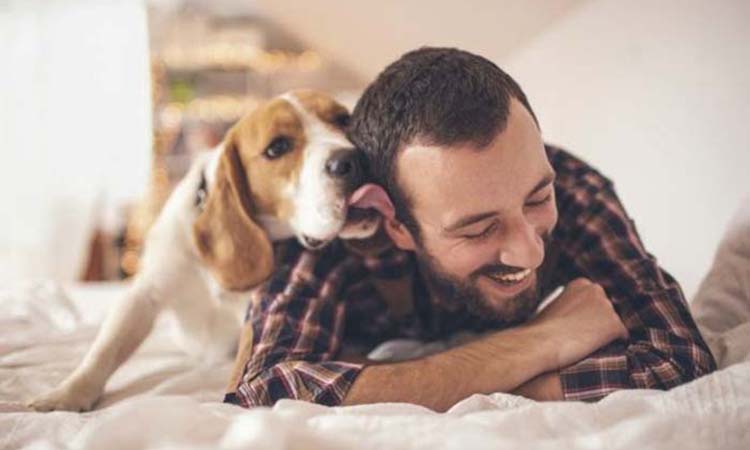
Warm, sticky, wet and stinky! We know this can get annoying but licking a person’s face is a love gesture from a dog. Dogs lick faces for a few reasons. Mainly, if your pet dog is licking your face, he is trying to groom you! Grooming is an intimate gesture only done after a strong connection is made between dogs (so now you know he sees you as one of his kind). On the other hand, if a stranger dog licks your face, it is simply trying to say that he is harmless and friendly.
Following You Wherever You Go
This is another behaviour that can get on your nerves, especially when your dog attempts to follow you to work! However, it is only a dog’s way to show his love, devotion and loyalty to you. Wherever you are, that is where your dog wants to be. Dogs are extreme social creatures and unlike humans, there is no need for solitude.
Sleeping with You
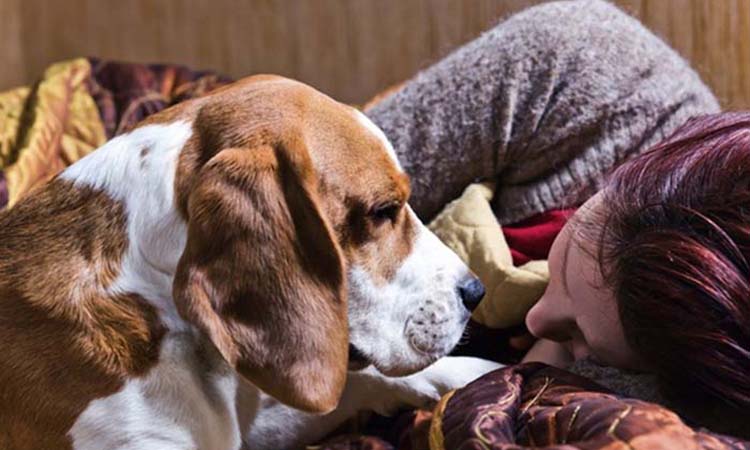
Similar to wild wolve packs, wild dogs curl up together to sleep in the night. Rather than sleeping alone in his designated corner, your dog prefers to snuggle right next to you in your bed. If you catch your dog sneaking onto your bed or falling asleep next to you in your couch, it implies that you are his family.
Smiling
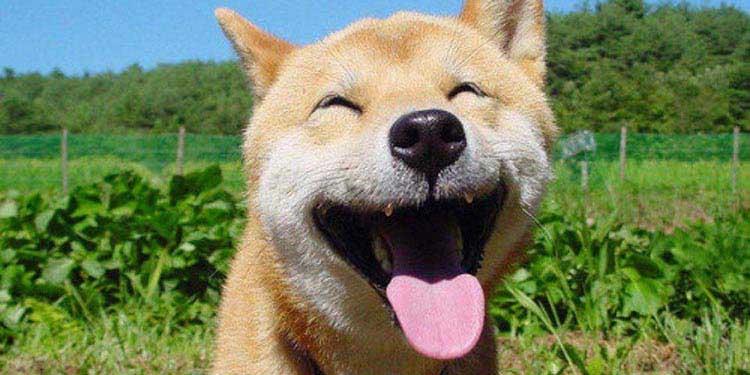
It is no surprise when you see something like a smile on your dog. Dogs do smile too! Research has found that dogs can also show and use facial expressions similar to how humans do. A dog’s smile is another way of showing his love and joy to his owner. Having said that, most of us are guilty of not recognizing our dog’s smile.
Crotch Sniffing
Argh, this is an embarrassing one and how we wished our dogs can quit going around sniffing crotches. But before you start screaming at your dog, try to understand it. This behaviour is in fact a dog’s perculiar way of greeting. More importantly, apart from a hello, it allows the dog to understand and remember you through your scent.
Taking Care of You When You are Sick
Does your dog stay by your bed and watch you the whole time while you are nursing a flu? This is its natural instinct to care for a sick or wounded family member, just as they would in the wild. A dog extends its love and care to its sick or injured owner by quietly and patiently watching over him/her. But make sure you hide any superficial wounds away from your dog! It might actually lick your wound as its form of first aid.
Leaning on You
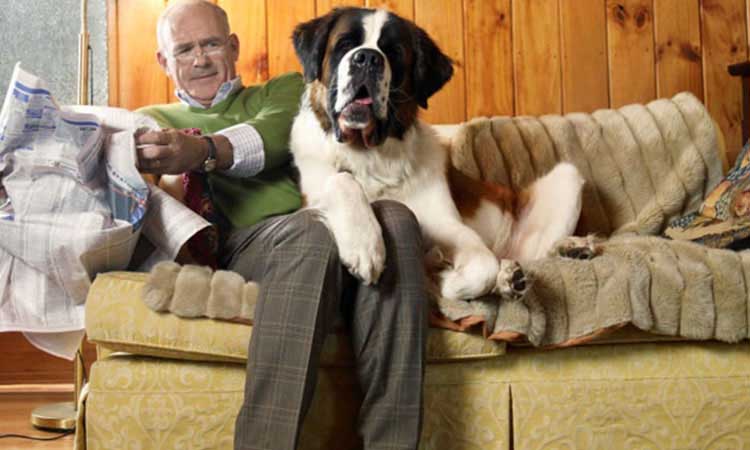
Whether you are sitting or standing, your dog is leaning on you and wouldn’t budge. You can’t move and you can’t get on with your daily routine. While you are wondering what they are up to, your dog has already got what they needed: your attention. Getting your attention and giving you their attention by leaning on you is their way of showing affection. Next time this happens, stop what you are doing and reciprocate with some love.
ooOOoo
This turned out to be more of a Sunday Picture Parade but it seemed too special to hold it from you until the weekend.
No, our dogs don’t speak a language that we humans would recognise as such but, nonetheless, our dogs communicate in ways that still are as magical and special as our human poetry.
Speaking of poetry, let me close today’s post with this.
Eleanore MacDonald is the author of the blog Notes From An Endless Sea. It’s a blog that I have been following for a while.
On the last day of last year, I published a post that contained the following:
There is much in this new world that concerns me and I know I am not alone with this view. But the rewards of reading the thoughts of others right across the world are wonderful beyond measure.
Little did I know that in just five days time Eleanore would demonstrate “wonderful beyond measure” par excellence! With her very kind permission I republish in full her post from last Sunday. Please don’t read any further until you can be very still and read Eleanore’s post with your total concentration on her stunningly beautiful prose.
I didn’t have to search for it. My word for the year just came to me, and with it, a host of lovely synonyms in its wake. Devotion. Well, devotion––minus the religious connotations––holding hands with dedication, fealty, loyalty, commitment, fortitude and constancy.
In the past I have labored over what it might be for me, that word that embodies all I want to do with my intentions in the year ahead. But this year, it came floating to me like an errant leaf, late falling on a winter’s breeze. It resonated deep within and because it came with an entourage I felt like a farmer with acres and acres of fertile, unblemished land spread before me all waiting for me to plant an endless bounty.
So I start my new cycle, this new year, with the sowing of seeds of intention, digging deeply into this dark, rich soil. It begins with a renewed Devotion and dedication to loving. To magic. And to beauty.
chalice well, glastonburymagic
And writing – something I failed so miserably at conjuring last year. A block is no joke, it is a deep, dark hole that any creative soul can fall into and in my case is called ‘writer’s block’, and it is real. And it sucks. I banish it now with a loyalty to work, those further and continual efforts to paint with words from a palette-full of color.
wordsand more words …
And then there is Fealty. A deep and resonant fealty to my love/partner/mate, to family and those dear ones who love me as I am whether broken or whole; to those who love the animals and celebrate empathy, truth and compassion; to those who will be happy for me when I succeed, and cry with me in my sadness, who try to pick me up when I fall, and push me hard to continue to explore the vast continents of my interior and to walk onward along the path to becoming the best I can possibly be.
Those beloveds who allow me, in all of that vulnerability, to do the same for them.
Loyalty. Loyalty to my path. And to the greater good. To honesty, integrity, goodness, caring, loving––to kindness and empathy, to staying awake with eyes and ears and heart attentive to the big world around us, to laughter, to weeping buckets when I’m overflowing, to connection, to speaking up and speaking out (loudly!), to celebrating beauty and color, and to a nurturance of the evolution of soul and spirit, my own and that of others.
loyaltythere is a world …music
Commitment. To continuing to wield light, through music.
Commitment to seeing the glass half full.
And to the voiceless ones, who really are my reason for being. The animals. Commitment to doing what I can to ease the burden of suffering for those in need of compassion and caring, of rescue and respite.
Dear Ouranosthe grande dame
Commitment to honoring those others who continue to do the hard and mostly thankless work attending to the emergent needs of those barely surviving untenable lives in the shadows; those caring for the pets of the homeless, animals who act as angels for the people of the streets whose only tether left to any comfort in this life is a beloved dog or cat companion; those pulling the newborn kits and pups from garbage bins, or flimsy boxes set in the cold rain along busy streets, those rescuing dogs from a brutal existence of abuse, abandonment, fighting, life at the end of a cold chain; those earthly angels whose hearts have been broken over and over again yet they continue on, continue giving, helping, trying to make a better life and a better world for those left behind. (I have always held that, were humans to collectively realize that the other beings we share this glowing, gorgeous orb with––the animals, the trees, the waters, the land––all require and deserve our recognition, our action, our honor and caring, then the world’s ills would resolve. And so it goes…)
Fortitude. The fortitude to walk my path ahead in constancy, through dark and light with no time or inclination to curl into a ball and sink to the bottom of the well. Life now is too short for that.
Dedication, fealty, loyalty, commitment, fortitude… in action, together they reduce down and distill to a fine and pure constancy of devotion.
I am good with that! Right?
Do you have a ‘word for the year’? If so, do try to hold it close, in honor of its gift. When 2016 comes to pass, I would love to hear what your word was and how it served you. Or, how you served it.
Spreading my wings now… With love and light, and hopes that your year ahead is graced by all that is good,
Today’s post is inspired by something I read that is very special.
The last time I published a post headed What is love?, back in 2012, I included this:
I would imagine that there are almost as many ideas about the meaning of love as there are people on this planet. Dictionary.com produces this in answer to the search on the word ‘love’.
love
[luhv] noun, verb, loved, lov·ing. noun
a profoundly tender, passionate affection for another person.
a feeling of warm personal attachment or deep affection, as for a parent, child, or friend.
sexual passion or desire.
a person toward whom love is felt; beloved person;sweetheart.
(used in direct address as a term of endearment, affection,or the like): Would you like to see a movie, love?
But, I don’t know about you, those definitions leave something missing for me. Here’s my take on what love is, and it’s only by having so many dogs in my life that I have found this clarity of thought.
“Love is trust, love is pure openness, love is knowing that you offer yourself without any barriers. Think how you dream of giving yourself outwardly in the total surrender of love. Reflect on that surrender that you experience when deeply connecting, nay loving, with your dog.“
One of the very special qualities of our dogs is their natural and instinctive ability to love, unconditionally, both us humans and other animals around them (with some notable exceptions; of course.)
Yet as much as we want to learn unconditional love from our dogs, there is something just too complex about us humans to manage that. Possibly rooted in our inability to really live in the present, another quality our dogs also demonstrate so perfectly.
“What is love” was the most searched phrase on Google in 2012, according to the company. In an attempt to get to the bottom of the question once and for all, the Guardian has gathered writers from the fields of science, psychotherapy, literature, religion and philosophy to give their definition of the much-pondered word.
So I sub-titled today’s post by saying that I was inspired by something.
Here it is, recently published over on The Conversation and republished within their terms. I think you are going to love it!
ooOOoo
The life-changing love of one of the 20th century’s greatest physicists
December 9, 2015
Author: Richard Underman, Chancellor’s Professor of Medicine, Liberal Arts, and Philanthropy, Indiana University
Love is for everyone. mawazeFL/Flickr, CC BY-NC
One of the great short stories of the 20th century is Nobel Laureate Isaac Bashevis Singer’s The Spinoza of Market Street. It tells of an aged scholar who has devoted his life to the study of Spinoza’s great work, Ethics. Protagonist Dr Fischelson has lost his library job and, like his hero, been expelled from his religious community for his heretical views. Looking down from his garret with disdain at the crowded street below him, he devotes his days to solitary scholarship. At night he gazes up through his telescope at the heavens, where he finds verification of his master’s wisdom.
Then one day Dr Fischelson falls ill. A neighbor, an uneducated “old maid,” nurses him back to health. Eventually, though the good doctor never understands exactly how or why, they are married. On the night of the wedding, after the unlikeliest of passionate consummations, the old man gazes up at the stars and murmurs, “Divine Spinoza, forgive me. I have become a fool.” He has learned that there is more to life than the theoretical speculations that have preoccupied him for decades.
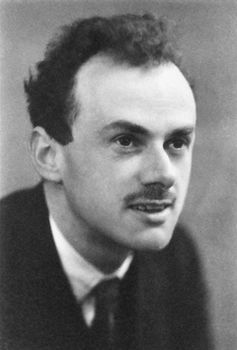
The history of modern physics boasts its own version of Fischelson. His name was Paul Dirac. I first encountered Dirac in physics courses, but was moved to revisit his life and legacy through my service on the board of the Kinsey Institute for the Study of Human Sexuality and teaching an undergraduate course on sexuality and love.
A brilliant but very strange man
Born in Bristol, England, in 1902, Dirac became, after Einstein, the second most important theoretical physicist of the 20th century. He studied at Cambridge, where he wrote the first-ever dissertation on quantum mechanics. Shortly thereafter he produced one of physics’ most famous theories, the Dirac equation, which correctly predicted the existence of antimatter. Dirac did more than any other scientist to reconcile Einstein’s general theory of relativity to quantum mechanics. In 1933 he received the Nobel Prize in Physics, the youngest theoretical physicist ever to do so.
At the time Dirac received the Nobel Prize, he was leading a remarkably drab and, to most eyes,
Paul Dirac in 1933. Nobel Foundation via Wikimedia Commons
unappealing existence. As detailed in Graham Farmelo’s wonderful biography, The Strangest Man: The Hidden Life of Paul Dirac, Mystic of the Atom, on which I rely heavily in this article, Dirac was an incredibly taciturn individual. Getting him to utter even a word could prove nearly impossible, leading his mischievous colleagues to introduce a new unit of measure for the rate of human speech, the Dirac, which amounted to one word per hour.
Dirac was the kind of man who would “never utter a word when no word would do.” Farmelo describes him as a human being completely absorbed in his work, with absolutely no interest in other people or their feelings, and utterly devoid of empathy. He attributes this in part to Dirac’s tyrannical upbringing. His father ruthlessly punished him for every error in speech, and the young Dirac adopted the strategy of saying as little as possible.
Dirac was socially awkward and showed no interest in the opposite sex. Some of his colleagues suspected that he might be utterly devoid of such feelings. Once, Farmelo recounts, Dirac found himself on a two-week cruise from California to Japan with the eminent physicist Werner Heisenberg. The gregarious Heisenberg made the most of the trip’s opportunities for fraternization with the opposite sex, dancing with the flapper girls. Dirac found Heisenberg’s conduct perplexing, asking him, “Why do you dance?” Heisenberg replied, “When there are nice girls, it is always a pleasure to dance.” Dirac pondered this for some minutes before responding, “But Heisenberg, how do you know beforehand that the girls are nice?”
Love finds the professor
Then one day, something remarkable entered Dirac’s life. Her name was Margit Wigner, the sister of a Hungarian physicist and recently divorced mother of two. She was visiting her brother at the Institute for Advanced Study in Princeton, New Jersey, where Dirac had just arrived.
Known to friends and family as “Manci,” one day she was dining with her brother when she observed a frail, lost-looking young man walk into the restaurant. “Who is that?” she asked. “Why that is Paul Dirac, one of last year’s Nobel laureates,” replied her brother. To which she replied, “Why don’t you ask him to join us?”
Thus began an acquaintance that eventually transformed Dirac’s life. Writes Farmelo:
His personality could scarcely have contrasted more with hers: to the same extent that he was reticent, measured, objective, and cold, she was talkative, impulsive, subjective, and passionate.”
A self-described “scientific zero,” Manci embodied many things that were missing in Dirac’s life. After their first meeting, the two dined together occasionally, but Dirac, whose office was two doors down from Einstein, remained largely focused on his work.
After Manci returned to Europe, they maintained a lopsided correspondence. Manci wrote letters that ran to multiple pages every few days, to which Dirac responded with a few sentences every few weeks. But Manci was far more attuned than Dirac to a “universally acknowledged truth” best expressed by Jane Austen: “A single man in possession of a good fortune must be in want of a wife.”
She persisted despite stern warnings from Dirac:
I am afraid I cannot write such nice letters to you – perhaps because my feelings are so weak and my life is mainly concerned with facts and not feelings.
When she complained that many of her queries about his daily life and feelings were going unanswered, Dirac drew up a table, placing her questions in the left column, paired with his responses on the right. To her question, “Whom else should I love?” Dirac responded, “You should not expect me to answer this question. You would say I was cruel if I tried.” To her question, “Are there any feelings for me?” Dirac answered only, “Yes, some.”
Realizing that Dirac lacked the insight to see that many of her questions were rhetorical, she informed him that “most of them were not meant to be answered.” Eventually, exasperated by Dirac’s lack of feeling, Manci wrote to him that he should “get a second Nobel Prize in cruelty.” Dirac wrote back:
You should know that I am not in love with you. It would be wrong for me to pretend that I am, as I have never been in love I cannot understand fine feelings.
Yet with time, Dirac’s outlook began to change. After returning from a visit with her in Budapest, Dirac wrote, “I felt very sad leaving you and still feel that I miss you very much. I do not understand why this should be, as I do not usually miss people when I leave them.” The man whose mathematical brilliance had unlocked new truths about the fundamental nature of the universe was, through his relationship with Manci, discovering truths about human life that he had never before recognized.
Soon thereafter, when she returned for a visit, he asked her to marry him, and she accepted immediately. The couple went on two honeymoons little more than month apart. Later he wrote to her:
Manci, my darling, you are very dear to me. You have made a wonderful alteration in my life. You have made me human… I feel that life for me is worth living if I just make you happy and do nothing else.
A Soviet colleague of Dirac corroborated his friend’s self-assessment: “It is fun to see Dirac married, it makes him so much more human.”
In Dirac, a thoroughly theoretical existence acquired a surprisingly welcome practical dimension.
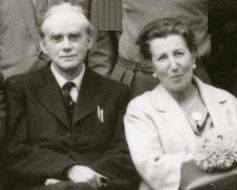
Paul and Manci in 1963. GFHund via Wikimedia Commons, CC BY
A man who had been thoroughly engrossed in the life of the mind discovered the life of the heart. And a human being whose greatest contributions had been guided by the pursuit of mathematical beauty discovered something beautiful in humanity whose existence he had never before suspected.
In short, a brilliant but lonely man found something new and wonderful that had been missing his entire life: love. As my students and I discover in the course on sexuality and love, science can reveal a great deal, but there are some aspects of reality – among them, love – that remain largely outside its ambit.
ooOOoo
Picking up on that last sentence, “there are some aspects of reality – among them, love – that remain largely outside its ambit.” all I can offer is to introduce dogs to the students!
I struggled for ages wondering how to close today’s post. In the end, decided on the following:
In view of all that’s been happening these last few weeks, this is perfect!
We are exactly one month away from Christmas Day! Not sure if that’s scary or satisfying. For years, I have always embraced mid-Winter’s Day on December 21st as the bottom of the slope; so to speak. Thus on that basis Christmas Day is satisfying.
Anyway, tomorrow is Thanksgiving Day in this fine, new country of ours and I was wondering what to write to recognise both the importance, current and historical, for Americans and, at a more parochial level, for yours truly. Because, for sure, at the start of this year I wouldn’t have imagined in my wildest dreams that by Thanksgiving Day I would have a book available on Amazon!
Then along comes the perfect answer to my pondering as to what to write. A gorgeous post written by Kate Johnston of 4am Writer‘s fame. Even better, Kate giving me permission to republish it in this place. So to all my readers and followers: Happy Thanksgiving.
ooOOoo
The Writers’ Tree
Kate Johnston
There once was a tree where writers could go and put down stories in the thin bark. Over time, the stories began to bleed into each other until the day came when the tree could take no more stories.
image courtesy of wordsareart.wordpress.com
The writers didn’t have any other place to go.
They tried to write in the sand dunes, but the wind just blew the words around into gibberish.
They tried to write in the sky, but the rains came and washed everything away.
They tried to write on the animals and birds but got bitten and clawed for their trouble.
One little girl missed writing too much. Her stories were piling up inside her like rotten apples on the ground, and she needed a place to write them. She went searching. Over the hills and behind some mist that beckoned with gauzy fingers.
She found a secret place where trees grew by the dozens, trees with papery bark that wanted to give stories. She told no one of her discovery, wanting to keep all the trees to herself. She spent day after day writing story after story upon tree after tree.
When she had scribed all her stories, she abandoned the secret place and never returned. She didn’t tell a single soul about the trees that gave stories, for fear that someone wouldn’t like what she wrote, would laugh at her, wouldn’t understand.
But while she was gone, attending to other things like school, friends, growing up and starting a family, her stories began to fade away. With no one to savor them, the tales began to disappear from the trees.
Stories cannot exist without readers. And writers cannot exist without stories.
The girl, now an old woman, returned to the secret place with her grandson, thinking he would appreciate the magic of the stories on the trees. Imagine her devastation when she saw that her words were destroyed, scabbed over by new bark and punctured by holes from insects and birds.
It was plain to the girl, now an old woman, the trees could no longer give to a writer who had stopped writing. She fell to her knees and wept. She couldn’t even start over. It’d been too long since she’d come to the secret place and had forgotten how to write at all.
image courtesy of socialmeems.com
Her grandson scraped away the new growth, traced his finger over the faintest of marks, trying to find the long-lost stories. It was no use, not by himself. He was young and couldn’t yet read.
They went back to the world where they found a baker, a postman, a teacher, an electrician, and a dancer, all of whom could read and longed to write stories. The old woman and her grandson brought their new friends to the secret place to find the lost stories, but still, it was no use.
The stories were gone forever.
It had been too long since the girl, now an old woman, had written them that she couldn’t even remember how they went, or what they were about, or why she wrote them at all.
All she knew was that when she wrote, she’d felt indescribable joy. She’d fooled herself into thinking that was enough. The girl not knowing then as the old woman knows now that you must tend to joy if you want joy to stay.
Together, the friends wrote anew, wrote stories into the bark like paper. They shared their ideas and questions and hopes. They took the time to feel and find meaning in all of the stories. They laughed and cried and debated over worlds they created. They left comments with hearts to show how much each story moved them. They talked about how they couldn’t wait to bring a husband or a mother or a friend to the writers’ trees to show them the stories that grew there.
The girl, now an old woman, watched her friends’ stories blossom and grow with each reader that visited the writers’ trees. She saw the joy on her friends’ faces, saw how the joy stayed because they kept doing the one thing they loved: writing.
She wondered if she dared try again, to bring a story to life here, even though she’d failed so miserably in the past.
Image courtesy of Paul W. Koester Photography
Her friends walked the old woman to a new tree. If you love it so, they said, if writing brings you joy, they said, then write you must and never give up, they said.
The old woman took to the tree and wrote.
Her stories live on.
Happy Writersgiving!
ooOOoo
Perfect!
Dear readers: I am going to take a break for one day, so my next post will be on Friday. You all have a wonderful time wherever you are in the world.
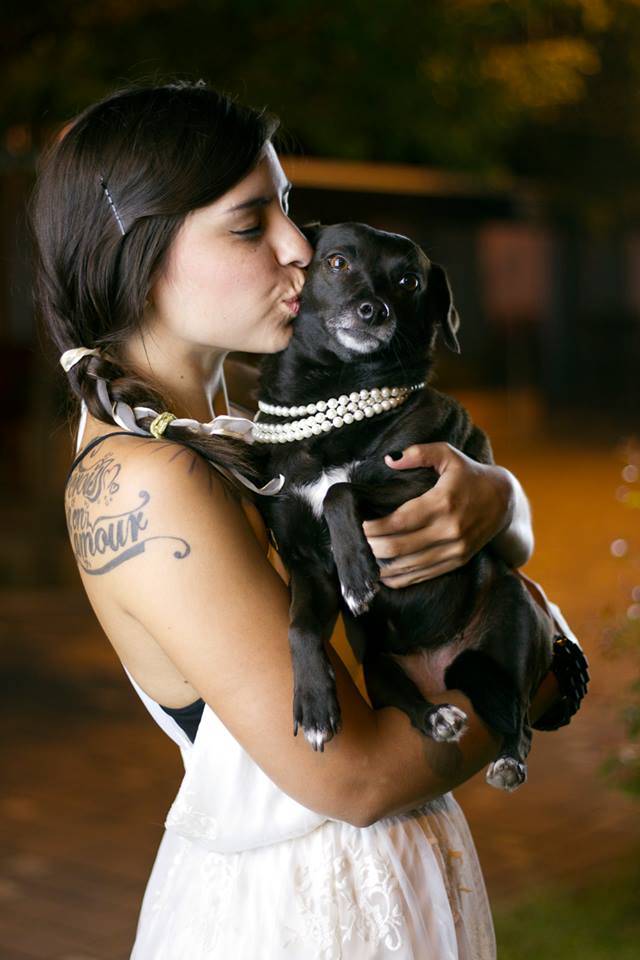
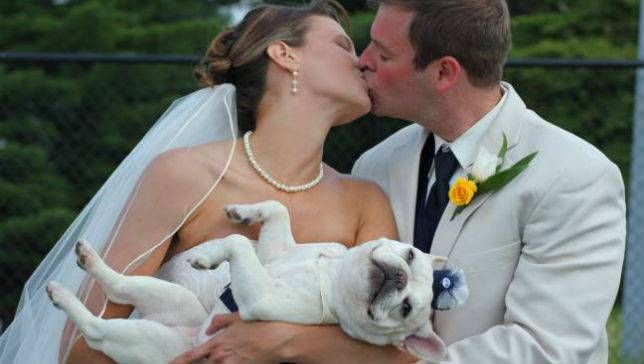
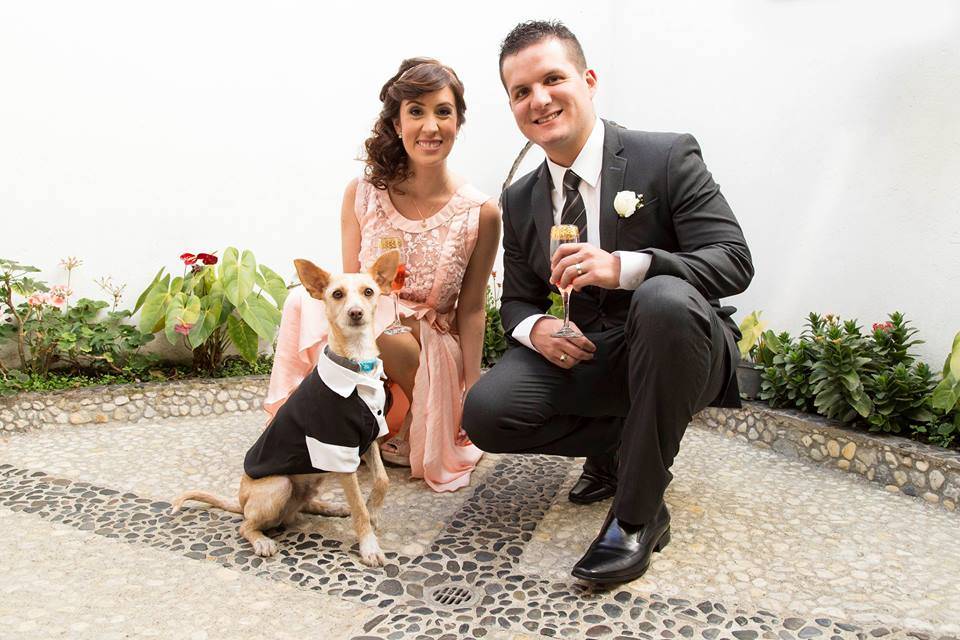
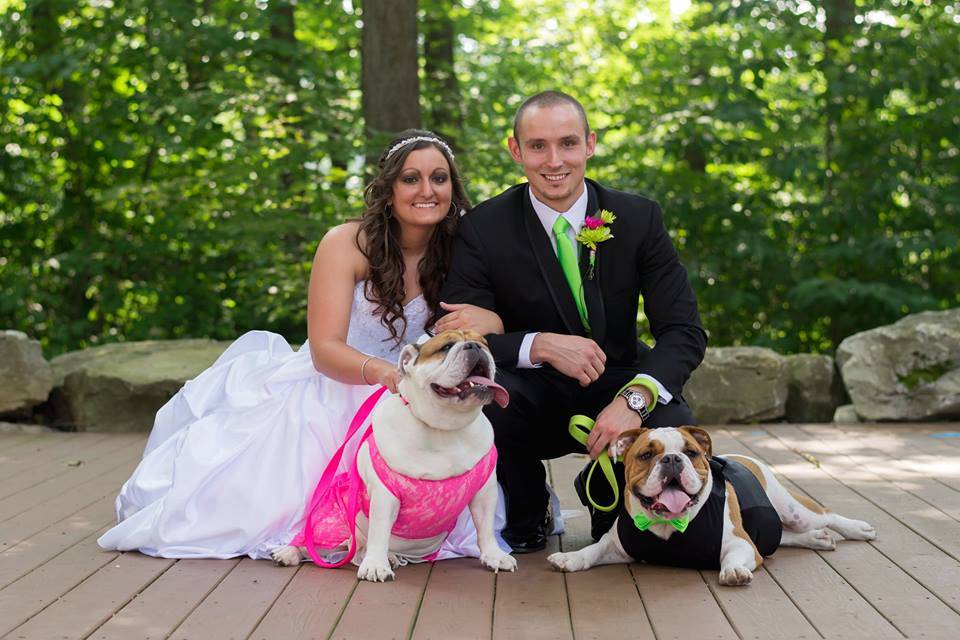
When putting together yesterday’s post, based heavily on a recent article over on Mother Nature Network, I couldn’t help noticing a link on that MNN item to this: 13 photos of dogs that got invited to the wedding. Wanted to share some of the photographs with you for today’s picture parade.
Final picture for today is the one of Jean and me at our anniversary lunch taken at The Twisted Cork in Grants Pass on Friday. Not quite newly-weds but still not that long ago!
If you don’t care for yourself, then you can not care for others.
This beautiful Tao Wisdom was published over on Find Your Middle Ground, Val Boyko’s blogsite, and is republished here with Val’s very kind permission.
ooOOoo
Knowing the world is intelligent. Knowing yourself is enlightenment.
Bending the world to your will takes force. Willing yourself to bend is true strength.
Succeeding in the world yields riches. Being content with what is yields wealth.
Apply Tao to the physical world and you will have a long life. See past the physical world to the enduring presence of Tao and death will lose its meaning.
Lao Tzu*
This is one of my favorite passages from the Tao Te Ching.
May it enrich the whole of you and your day. ☯
*Braun Jr., John; Tzu, Lao; von Bargen, Julian; Warkentin, David (2012-12-02). Tao Te Ching (Kindle Locations 492-498). . Kindle Edition.
ooOOoo
May you, and all your friends and loved ones, including your beautiful animals, have a very contented weekend, extending forever more!
Integrity really is at the heart of all that we are – or it should be.
The fundamental premise behind this blog is my discovery back in 2007, when I was living in South Devon, England with Pharaoh, that dogs are creatures of integrity. As is written elsewhere in this place:
Dogs are part of the Canidae, a family including wolves, coyotes and foxes, thought to have evolved 60 million years ago. There is no hard evidence about when dogs and man came together but dogs were certainly around when man developed speech and set out from Africa, about 50,000 years ago. See an interesting article by Dr. George Johnson.
Because of this closeness between dogs and man, we (as in man!) have the ability to observe the way they live. Now I’m sure that scientists would cringe with the idea that the way that a dog lives his life sets an example for us humans, well cringe in the scientific sense. But man seems to be at one of those defining stages in mankind’s evolution where the forces bearing down on the species homo sapiens have the potential to cause very great harm. If the example of dogs can provide a beacon of hope, an incentive to change at a deep cultural level, then the quicker we ‘get the message’, the better it will be.
value and cherish the ‘present’ in a way that humans can only dream of achieving
are, by eons of time, a more successful species than man.
And have poetry written for them:
Inner Peace
If you can start the day without caffeine,
If you can always be cheerful, ignoring aches and pains,
If you can resist complaining and boring people with your troubles,
If you can eat the same food every day and be grateful for it,
If you can understand when your loved ones are too busy to give you any time,
If you can take criticism and blame without resentment,
If you can conquer tension without medical help,
If you can relax without liquor,
If you can sleep without the aid of drugs,
You are probably the family dog!
So an essay that I came across in undertaking research for ‘the book’ really struck a chord. An essay written by Stephanie Staples (see footnote), and you can learn more about her at this place. Her essay was entitled Reflections On The Value of Integrity and is republished here with Stephanie’s very kind permission.
ooOOoo
Your Life, Unlimited
Stephanie Staples
Reflections on The Value of Integrity?
Integrity comes into play in everything we do. In fact, it’s more than everything we do, it’s everything we are.
Having a high level of integrity is one of the most important characteristics we can possess. It is a core value, a choice, and something we can nurture. Integrity is modeled all around us, yet its value in our society seems to be underrated.
Coming from a place of integrity means being truthful and honest. It means being reliable. It means trying to build rather than break, help rather than hurt, connect rather than crumble. Coming from a place of integrity means being authentic—the same you, whether people are watching or not.
We will not always be right or do right, but when we have integrity, we step up; we accept responsibility for our actions, we feel remorse, we have an understanding of what went wrong and why it happened so that we can put a plan in place to ensure it won’t happen again.
You know how a bad reputation follows you around? Well, the fabulous thing about living life brimming with integrity is that it actually precedes you. If you tell the truth even when you don’t have to, do the right thing even when nobody is around to notice, honestly do your best, keep your promises, etc., then that is what people will assume of you. Your actions define your character. This comes in handy so when you do make a mistake, people tend to give you the benefit of the doubt, and perhaps forgive more easily. You see how the reputation comes first? Can you see how it could work in reverse as well? If you lack integrity, people will not trust, value or respect you.
Think about how integrity plays a role in your life, in the life of your family, and in your career. Think about what sort of values you are modeling, how you are modeling them, and how you can live a life of integrity.
This could mean being honest and saying your son is 12, even if he looks 11, and 12 years olds have to pay. This may mean answering a call light of a patient who is not ‘yours.’ It might mean accommodating a request even if you don’t want to. Perhaps it is giving credit where credit is due? What might it mean to you?
If you are not getting what you want out of your life, then look inside and see exactly what’s going on in your life. I know if you focus on being a person of integrity, your character will be strengthened, your relationships at home and at work will be strengthened, and your life will be strengthened. Start by being honest and true to yourself, and the rest will follow.
One final point—it is not just the big things that count, it is the hundreds of little things we do every day that mould our character, that develop our integrity, and that help us live our lives, unlimited!
ooOOoo
Of all the qualities that we have to learn from dogs, the one of integrity is the most important, by a mile. Stephanie’s essay gets to the heart of what integrity really means in a way that I have not previously come across. I am very grateful to have been given her permission to republish it.
Footnote
Stephanie Staples is a member of Rockford Kingsley’s Advisory Board
and is a proud Canadian coach and speaker who helps audiences
around North America shift their perspective and kick up the quality of their life!
 Here’s A Little Quiz
 Here’s another quiz. See how you do on this one:
 ooOOoo









 Learning from Dogs