Jean and I went to a conference down in Medford last Saturday. It was a conference to do with Parkinson’s Disease and was arranged by the group Parkinson’s Resources of Oregon (PRO).
Almost immediately upon our arrival at 1pm we saw a gentleman in his wheel chair accompanied by his service dog. That gentleman soon identified himself as Ken Schiff and his wonderful service dog was named Lacey. It was clear within moments how beautifully behaved was Lacey and, by implication, how well trained he had been to perform his role as a service dog to Ken.
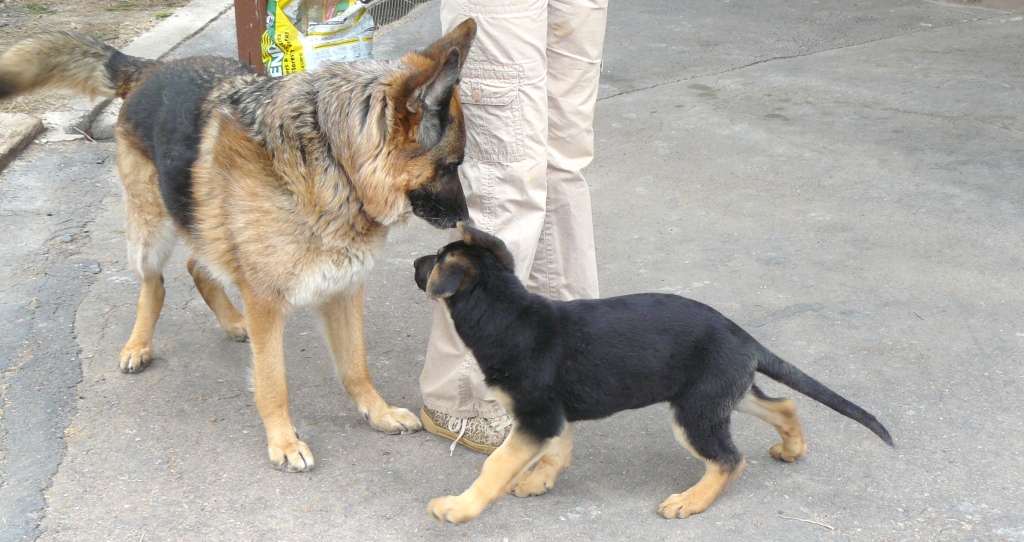
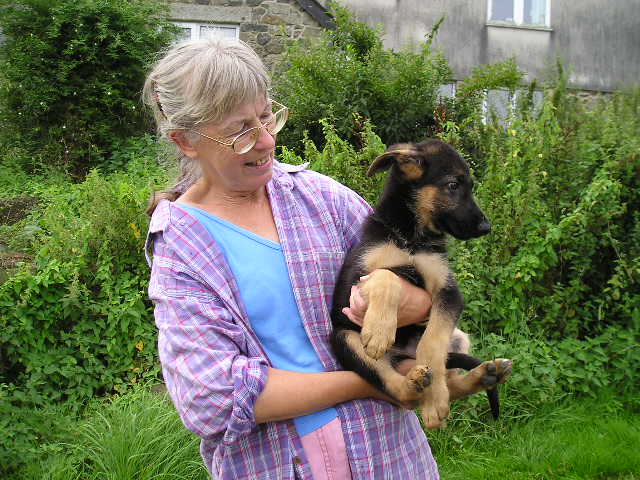
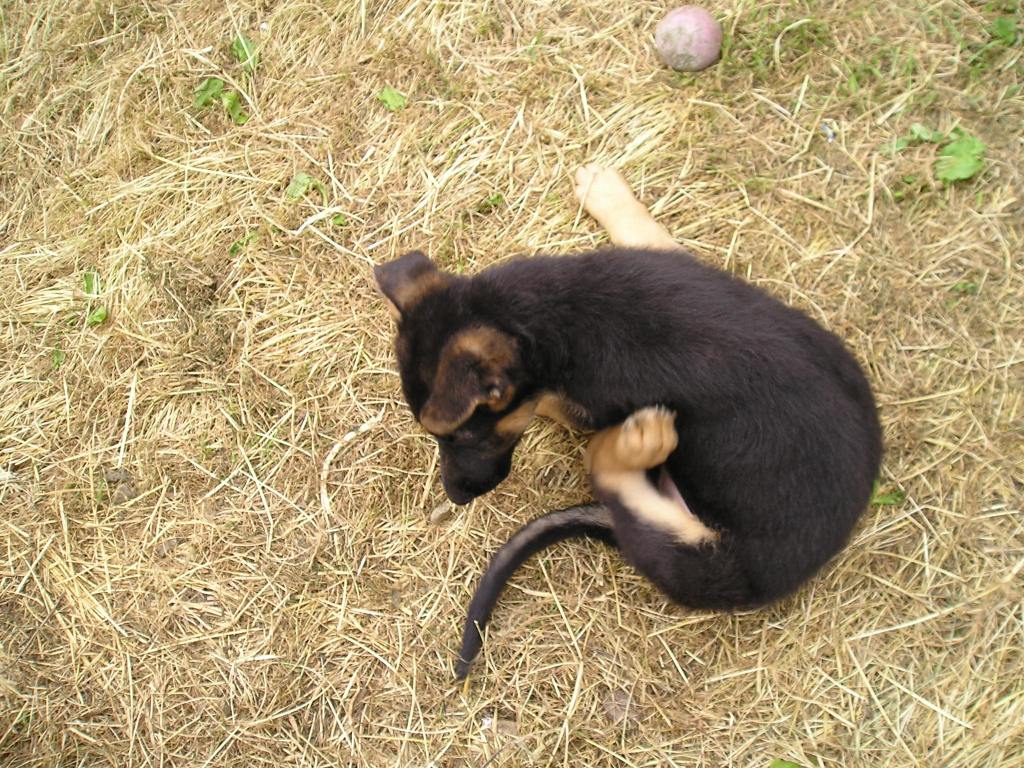
That took me way back to my days of working with Pharaoh back in Devon; before Jean and I met. Living in a very rural part of England with, reputedly, there being more sheep than people, one of the early requirements was to train Pharaoh to behave properly in the vicinity of sheep. Here are a couple of pictures from that training day in Devon.
Pharaoh’s training the afternoon of the 11th May, 2004.
oooo
Luckily the training paid off! Pharaoh was fabulous in and around sheep!
Needless to say, Pharaoh also received professional training for his general behaviours.
So treat all of the above as my introduction to a guest post by Robert Michael. On dog training. So who is Robert Michael?
Robert Michael
Robert is professional dog trainer having an experience of almost 8 years now. And he loves to contribute to the pets blogs to enjoy his passion. Plus, I write free of cost for those pets blogs: do you have one? Contact me rob.michael47@gmail.com
ooOOoo
A Comprehensive Visual Guide on Dog Training Schedule to Get 100% Outcomes
by Robert Michael. April 26th. 2017
There are a number of acts to follow on time, when your dog is on a training with you! So, if it is said that, you can get no any effective outcomes of the dog training, without making a proper schedule; it would not be wrong at all.
So, you must be aware of the fact that:
Making an appropriate dog training scheduleis necessary for a super effective output. Now you might be thinking that:
How to make a dog training schedule?
So, it is not a tough task to do so! You just can make a schedule by following the tips given below:
Take a pen and diary specified in writing and following the schedule.
Save notes in your mobile phone, and set the reminders.
Make an Excel sheet containing the schedule.
Make an MS Word document to file the training schedule.
Make a training schedule chart and attach to one of the walls of your home.
So, these are the super easy ways, you can make and follow the training schedule of your dogs.
You will be habituated by the training schedule.
Your dog will get habituated by the schedule timings.
You will get a punctual routine.
Your training sessions will prove to be more effective.
You will be able to train your dog by an organized manner.
What can you include in the schedule?
The feeding timings.
The playing timings.
The walk timings.
The toilet timings.
The training sessions’ timings.
The exercise timings.
The sleeping and waking up timings.
You can see the Legit Review Machine infographic to better understand the dog training schedule ways and steps.
ooOOoo
And here is that infographic that Robert included as a separate image in his email to me.
Puppy Training Schedule
I’m sure many of you will have found this very useful and I do hope there will be more guest posts from Robert.
(And, please, make a note of my final remark at the end of today’s post.)
Those who are regular visitors to this place will know that John Zande, who lives in Brazil, is a good friend, and, for that matter, I try to be a good friend of his place. (If you didn’t read my recent review of John’s latest book On The Problem of Good then it is here.)
So when a couple of days ago I received the following email from John you can imagine my positive response to his request.
Paul, hi, I have a favour to ask.
My wife’s sister, Dee (who lives in Australia) has started a gofundme campaign to help cover a rash of vet surgery bills we’ve had recently. These past few months (most of summer, really) has been appalling with the number of dumped animals in our area.
Together with a few other people in our loose group we rescued about ten and got them adopted out to good homes. Plus, we have three in temporary shelters as we nurse them back to health. We took one into our house, Nina, thus making eleven here now, who had her tail amputated last Tuesday. We were fortunate in that our vet worked for free (a 3hr operation) and only charged us for the anesthetist.
We’re lucky to have these wonderful people around, but we’re a tad snowed under right now with the accumulated surgeries and medicines, which is why Dee started this little campaign.
Now there was no question that Jean and I wanted to help. Not only by making a modest donation ourselves but by promoting Dee’s campaign. I emailed a reply to John saying just that.
John then responded with more details, including some photographs:
Dee is married to a very good friend of mine from Uni. She started this campaign to help Dionete, my wife, and I (and if possible a few other Vista Verde folk who’re in our rescue network) here in Brazil. Dee was here just before Christmas and saw the problem first hand. She actually helped us rescue a wonderful little fellow, Terrorista, who now lives a few streets away with a wonderful family.
I didn’t know, but Dionete was chatting to her a week or two ago and it came up just how many vet/surgery/medicine expenses we’d accumulated over the summer. Without either of us knowing, she, Dee, then started this gofundme campaign to lend a hand and help clear the vet bills. We’re not an NGO (we actually help four here in Sao Jose dos Campos, two in Sao Paulo, and Sandra’s Maxmello in another city south of Sao Paulo). Because we’re not an NGO we’ve never thought about doing a campaign ourselves, so was surprised when Dee started this one. It’s quite modest, $1,000 Australian dollars (the goal) converted to Brazilian Reis will make a sizable dent in our backlog of vet surgery bills. Our bills are tiny compared to a guy we know who does have an NGO and owes his network of vets 90,000. He’s a wonderful fellow and I’m actually working with him to try and get a mobile neutering unit started here in Sao Jose dos Campos. But that’s another story. So, to be clear, the campaign is for us here in Vista Verde, which is sadly a dumping ground for animals. Surrounding districts seem to think we’re all wealthy here and therefore they can dump their animals. It’s infuriating, and the animals never stop coming.
I am sure that Jean and I aren’t the only ones that want to help.
And John could offer no better reason for seeking some financial support from the wider world. Here’s some of his later email:
My apologies if there was some confusion. I’m actually heading out right now to feed a new fellow I found a few days ago and is sleeping outside a house in another district. When I get back I’ll send some more photos, OK.
Let me close with some more photos of dogs that have been helped by John, Dionete and the rest of the great band of the Vista Verde Fund.
oooo
oooo
oooo
Finally!
Please offer whatever you can to help. Even the smallest amount makes a real difference.
I wish I understood where my fascination with the night sky came from. Not that I am anything other than an amateur gazer (of the night sky, I should hasten to add!). I have never taken the trouble to gain any real knowledge.
Yet, some of the most serene moments of my life have been when I have been alone at sea under a night sky.
OK, that’s enough wallowing for anyone!
The last week has been an important one for those that take an interest in the planets in our solar system, or to be specific, take an interest in Jupiter.
Today – April 8, 2017 – the planet Jupiter is closest to Earth for this year.
Yet yesterday was Jupiter’s opposition, when Earth flew between Jupiter and the sun, placing Jupiter opposite the sun in our sky. You’d think Jupiter was closest to Earth for 2017 yesterday as well … and yet it wasn’t. It’s closest to Earth for 2017 today, April 8, coming to within 414 million miles (666 million km).
EarthSky also included this image:
Jupiter at its April 7, 2017 opposition with the Great Red Spot and moons Io, Europa, and Ganymede (L to R). Photo by Rob Pettengill in Austin, Texas.
During the month of April, Jupiter will be in opposition, meaning the planet is at its closest point to Earth. Thanks to the sun, it’s during this window that astronomers can enjoy a particularly close-up photo session that can help reveal how the planet’s atmosphere has changed over time by comparing it with previous such photos of the gas giant.
This photo of Jupiter was taken on April 3 by the Hubble Space Telescope when the enormous planet was 670 million kilometers (or about 416 million miles) from Earth. The photo shows the Great Red Spot, but it also shows something new: a weather feature called the Great Cold Spot, which is almost as large as its more well-known cousin.
“The Great Cold Spot is much more volatile than the slowly changing Great Red Spot, changing dramatically in shape and size over only a few days and weeks, but it has reappeared for as long as we have data to search for it, for over 15 years,” Tom Stallard, a planetary astronomer at the University of Leicester in the U.K. and lead author of the study, said in a statement.
The cold spot is nearly 15,000 miles by about 7,500 miles in size, and it’s dubbed the “cold” spot because it’s 200 degrees Kelvin (about 400 degrees Fahrenheit) cooler than the surrounding atmosphere.
The article included this stunning image of Jupiter.
Photo: A. Simon (GSFC)/NASA, ESA
Jaymi went on to write:
Here’s what some of the other details in the image mean:
The NASA/ESA Hubble Space Telescope reveals the intricate, detailed beauty of Jupiter’s clouds as arranged into bands of different latitudes. These bands are produced by air flowing in different directions at various latitudes. Lighter coloured areas, called zones, are high-pressure where the atmosphere rises. Darker low-pressure regions where air falls are called belts. Constantly stormy weather occurs where these opposing east-to-west and west-to-east flows interact. The planet’s trademark, the Great Red Spot, is a long-lived storm roughly the diameter of Earth. Much smaller storms appear as white or brown-coloured ovals. Such storms can last as little as a few hours or stretch on for centuries.
The Great Red Spot is an anticyclonic storm that is so large that Earth would fit inside it. That stormy spot — which is actually shrinking, though astronomers don’t know why — gives us a great perspective for understanding just how huge Jupiter is compared to our own blue dot in the solar system.
It’s been 27 years since the Hubble Space Telescope went into orbit, and the geriatric observatory is still going strong. When the telescope recently trained its sights on the solar system’s largest planet, the results were spectacular—proof that for the stellar spectator, age is but a number.
The image above is the latest picture of Jupiter. The snapshot was taken by Hubble on April 3 with the help of the telescope’s Wide Field Camera 3, a high-res instrument that lets the telescope observe using different wavelengths. It combines light on the visible, ultraviolet, and infrared spectrum to create an image of a massive planet in constant atmospheric flux.
In a press release, the European Space Agency, which co-runs Hubble with NASA, said that Hubble was able to take advantage of the planet’s current opposition with Earth to take the close-up. At the moment, Jupiter is lined up perfectly with the sun, and Earth is lined up with both the sun and Jupiter. Think of it as a truly heavenly photographic opportunity—a chance to look at the planet head-on. Better yet, Jupiter’s position relative to the sun means that it’s brighter than at any other time of year, which lets telescopes trained on the gigantic planet see even more detail than usual.
AsThe Washington Post’s Amy B. Wang notes, there were no new discoveries in the picture per se, but that doesn’t mean there’s nothing to look at. As ESA explains, scientists will compare the photo to previous views of the planet to hopefully learn more about the atmosphere. And for the rest of us, there’s a strangely soothing view of Jupiter’s layered cloud bands and impressive vortices.
The gas giant is thought to have sucked up most of the space debris left over after the sun formed, grabbing dust and gas with gravity. Scientists think it has two times as much debris as all of the other bodies in the solar system combined—and all of that material swirls through cloud layers in its quickly-rotating atmosphere.
Since Jupiter doesn’t exactly have a surface, it has nothing to slow the spots and vortices that appear in its atmosphere. The most famous, the Great Red Spot, is thought to have been swirling around for more than 150 years, and even though it’s unclear which gases give it that red hue, it’s the planet’s most recognizable feature. As NASA writes, the cloudiness of Jupiter’s atmosphere makes it hard to understand what might be contributing to it. But that doesn’t decrease its allure.
Want to delve even further into the mesmerizing bands of a huge planet’s atmosphere? A high-res version of the snapshot is available online. And if you prefer seeing things live, it’s a great time to check out Jupiter through in the night sky. You can find Jupiter in the east right after the sun goes down—a massive mystery that’s brighter than any star.
Namely, that the universe came into existence some 13.82 billion years ago. The power of natural evolution that came with that event eventually brought along homo sapiens some 200,000 years ago. 200,000 is 0.0000145 of 13.82 billion.
Or to put it another way, we humans have only been a part of this universe for 1/10th of 1% of the life of said universe! (Oh, and dogs came along 100,000 years ago!)
For the last few weeks we have had a pair of Canada geese on our tiny island in the centre of our lake in the large paddock where our horses graze most days. More accurately, we have had the mother sitting on her clutch of eggs for the last few weeks.
We knew it was getting close to the eggs hatching and several times a day we look out to see if the youngsters have made it out of their nest.
A little over two hours ago, Oregon time, I took the following photographs!
Mum and Dad and what looks like 5 goslings.
oooo
oooo
oooo
oooo
oooo
Going round the back of the little island. The nest can be seen on the far right-hand side of the photo.
Stories like this make my toes curl with pleasure!
Less than two weeks ago I shared an item that I had read about the firefighters of Santa Monica, CA, saving the life of a ten-year-old dog.
When Santa Monica firefighters were called to a burning apartment, they found the lifeless body of a tiny dog overcome by the heat and smoke on the floor of a bedroom. They pulled out the dog, named Nalu, but he wasn’t breathing and didn’t have a pulse.
Then two days ago, courtesy of the Care2 Causes blogsite, along comes another fabulous example of the care, love and generosity shown by firefighters.
ooOOoo
Firefighters Rescue Golden Retriever From Icy Pond
With perhaps just seconds to spare, North Hampton firefighter Will Taber barreled toward a dog who was barely clinging to thin ice last week in New Hampshire.
Photo Credit: North Hampton Professional Fire Fighters
Three-year-old Emmett ran out onto his family’s frozen backyard pond, suddenly falling through the ice. Although homeowner Kacey Eddinger started into the pond to rescue him, she had to turn back when she realized the water was simply too cold. Eddinger and her toddler son waited anxiously for help to arrive.
Photo Credit: North Hampton Professional Fire Fighters
The family isn’t certain exactly how long their golden retriever was in the water before they realized he’d fallen through, but by the time firefighters arrived, Emmett was exhausted and close to drowning.
In thermal ice rescue gear, firefighter Taber held a tethered line as he crossed the ice and entered the water. Once he reached Emmett, the other firefighters pulled the pair back to shore.
Photo Credit: North Hampton Professional Fire Fighters
“The canine was exhausted and scared and minutes from going completely under water and carried by the current under the ice,” the Fire Department posted on Facebook. “The rescue was made just in time where he was then immediately warmed, carried to a police cruiser and transported to North Hampton Animal Hospital.”
Though spring has officially arrived, ice rescues have escalated due to the thin ice that remains on some bodies of water.
Again and again, I find myself rating actions such as these from the North Hampton Fire Fighters (and not forgetting the Santa Monica Fighters) so gloriously uplifting. Again and again, they serve as a reminder that real people all around the world are so very often wonderful, generous and loving real people!