Another republication of the Spanish walk by Tom and Chica.
There was such a wonderful response to the post on the 28th January that I decided to republish another one. This time I have started at the beginning.
ooOOoo
The GR7
The road less travelled…..
If you tell someone you’re planning a long walk in Spain, they will mostly assume you’re talking about the Camino de Santiago pilgrim trail across northern Spain. Tom being a bit of a misanthrope said he’d rather go somewhere less crowded.
We are familiar with a part of the GR7 as it runs through the Serrania de Ronda where we have spent a few recent winters. After more research it was decided that this would be the most interesting.
The GR7 starts on the south coast at Tarifa, near Gibraltar, and then runs up through the Los Alcornocales, a beautiful forest of cork oaks, then into the Grazalema National Park before reaching the city of Ronda. Dramatically perched above a deep gorge, Ronda is our favourite city.
From there the route turns eastwards towards Antequera and passes through the Parque Natural del Torcal whose bizarre rocky outcrops form one of the most impressive karst landscapes in Europe.
Shortly beyond, the route splits and Tom and Chica will be taking the southern variation through many small villages into Las Alpajarras. Then it heads up into the Sierra Nevada and there it may get tricky depending on the snow level. Chica isn’t keen on being belly deep in snow!
As the route heads north inland from the east coast, it is all new territory for us. There should be a couple of visits to both our charities near Alicante and Valencia and then due north to the border with Andorra. The final stop for recuperation will be with good friend, Kate, in the Pyrenees.
At last, after a fair few hitches and glitches, Tom and Chica took their first steps on a journey that will take them right across Spain to Andorra on the GR7 route. The start is at the aptly (and purely coincidentally) named Playa Chica, which is the most southerly point of mainland Europe. From here, you have the Med to the east, the Atlantic to the west and Africa on the horizon. It’s an epic trip and one that only around five people complete every year. It should cover a variety of landscapes, starting today with the beautiful beaches of Tarifa and the surrounding area. As it’s a Saturday, with a good strong breeze, the kite surfers were out in force. It’s quite a sight!
Kite surfers at Valdavaqueros
Today was a short toddle, by comparison with what will follow – just 11k in about 2.5 hours. The route was almost entirely on the beach and Tom shed his shoes and walked barefoot. It might be the only time that will be possible.
Given that he is recovering from flu an easy start seemed a good plan – definitely so as it’s now raining! Chica, however, needs to understand that stopping to investigate every interesting smell would mean the walk would take several years.
We will be posting a blog every day of the walk, with information on the route, the scenery and the flora and fauna. Tom isn’t able to carry field guides – too much extra weight – so identification from any of our followers would be appreciated, starting with these shells found on the beach today. These pics will be posted on our instagram page too.
Shells found on the beach at Valdevaqueros
As well as posting our position, hopefully using Viewranger (we’re working on this) we will also give our position using What Three Words. Tonight’s are: tigress, asked, varies. This is fun and will be another way of ensuring that the back up team (me) can hook up with them.
Stay with us!
Just this far to go….
ooOOoo
This is an incredible journey and I’m so pleased that Tom is happy for me to share it with you.
Tom came to Learning from Dogs a short while ago and signed up to follow the blog. As is usual, I went across to his blog in order to leave a thank-you note. I was flabbergasted at what I saw. Tom and his two dogs were walking across Spain. He called his blog Chica’s Challenge and this is what he wrote on his home page.
First, Tom decided he wanted to do a long walk.
Then he thought Spain would be nice as it has to be in winter.
And he’d like to take Chica, our podenco.
As an afterthought, he said, “Maybe we could raise some money?”
“Who for?” I asked.
“Well, as I’m taking Chica and it’s in Spain, I guess for Spanish podencos.”
“Great idea! I’ll write the blog!”
I wanted to follow his posts and did so.
Then I wanted to republish a post and asked Tom if I had his permission to so do.
One dog and her man walking across Spain, raising money for their podenco friends.
Day 7: Jimena de la Frontera to Cerra de la Fantasia 20k
The last two days were non-walking days, one for bad weather and another to move base again. Now we have the luxury of being in a house for a while in Jimera de Libar, a village we know well.
So the day started with the drive back to Jimena and the weather looked reasonable. Again, Merlin refused to be left so the three of them set off up the path, climbing steadily for the first hour and a half.
Climbing pathSpanish Fir / Pinsapo (Abies Pinsapo) in the background
The path eventually levelled out and passed beneath the rocky outcrops of the Altos de Paneron and Cerro de Marin. After a bare rocky sections where the route was harder to determine, they went into dense forest of oak and Spanish fir (we love these and call them lollipop trees because of their shape). Both dogs in great form, but Tom was mean and moody :).
Dark clouds were gathering from all directions but the view to the coast was still impressive. However, it wasn’t long before the rain began and the temperature dropped.
Looking south – you can just see the sea
Fortunately the rest of the route was on a well-defined and signposted track, winding down through the cork oaks in the midst of the Los Alcornacales. It was here deep in the forest that I eventually picked them up. I had forgotten that smaller Spanish roads aren’t always roads as I know them and the last five and a half miles I was driving along a rough track with no mobile signal, not at all sure I was in the right place. Even though we have a 4×4, I made very slow progress and it was with considerable relief that I found them, damp but completely unconcerned.
ooOOoo
In the original some of the photographs were side-by-side but in copying them across I chose to enlarge them.
The start of Tom’s walk may be seen here and I thoroughly recommend that you read it in full.
I shall continue to follow Tom’s walk and may republish another post.
Unfortunately, there are still some drivers out there who apparently don’t know how to treat pedestrians with the respect that they deserve.
But this little dog is doing his best to set them straight.
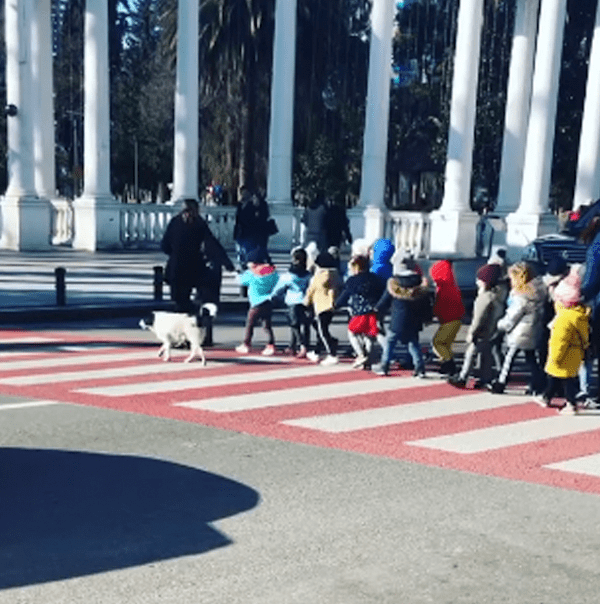
The other day, Beqa Tsinadze happened upon a curious scene in the town of Batumi, Georgia. There, at a clearly marked crosswalk, a group of young kids were waiting for cars to yield so they could safely cross the road.
Photo Credit: Beqa Tsinadze
Regrettably, though, it seems that many drivers weren’t eager to extend that courtesy without being told to.
So, that’s exactly what this dog did — taking on the role of crossing guard on the kids’ behalf. The moment was captured on video.
The thoughtful dog tackled the situation like a pro. But apparently this wasn’t just a one-time thing.
Tsinadze shared another video of the same dog stopping traffic and escorting yet another group of kids across the street.
Photo Credit: Beqa Tsinadze
Though it’s unclear why the pup came to adopt the role of crossing guard, it may be as a way of saying thanks.
According to Georgian media, the dog arrived to the area as a helpless stray a few years back, and has since endeared himself to members of the community who have taken it upon themselves to care for him.
The report above states that the dog goes by several names among folks in the neighborhood who know him — but there’s no doubt that you’d be safe in calling him a very good boy.
ooOOoo
Another wonderful report.
I’m sorry, I ought to write more but I would only be waffling!
Yesterday and today are days where it’s my turn to do the neighborhood watch patrols. I left for the first patrol a little after 9am yesterday and when I was going up Livingston Drive there was a guy walking his Corgi. Now it’s the second time we have met and I stopped and let the sweet dog come up to my outstretched hand and sniff my fingers. John, not his real name, mentioned that he was slowly adapting to a life of love and affection in stark contrast to the beatings the dog received in his previous life. John was a real hero!
Here’s another example of goodness beyond description. Taken from The Dodo.
ooOOoo
Dog Found On Side Of Road Immediately Snuggles Her Rescuer
Photo Credit: Kris Lenker
Kris Lenker and her husband were driving home from work last week when they spotted something on the road ahead.
They assumed, being out in the country, that the small, tan animal was a baby deer — but as they got closer, they realized their mistake. “We slowed down and realized that it was a dog,” Lenker told The Dodo.
Lenker hopped out of the car and called to the dog, but the nervous pup took off down a pathway. Lenker followed close behind, tempted to turn around. “I couldn’t see her anymore and we almost left,” Lenker said. “I just had a feeling, though.”
Photo Credit: Kris Lenker
Lenker found the dog hiding behind a fence, and after a few minutes of gentle pets, the nervous dog decided to take a chance. “She wrapped her front paws around my neck and let me carry her back to the car,” Lenker said. “She was absolutely terrified, but I could tell she trusted me … It just felt like we were brought together for a reason.”
Shortly after the dog entered the car, her demeanor changed. It was as if she knew she was finally safe. “I just pet her and told her I had her,” Lenker said. “That is when she just collapsed into a ball in my lap. It’s like relief just hit her. She rode the rest of the way home in my lap like that.”
Photo Credit: Kris Lenker
While she decompresses and regains her strength, the dog, whom the couple has named Reba, is hanging out in a warm bathroom. When she’s up to it, she’ll get to meet her new dog siblings, who will show her the rules of the house.
And Reba is still just as affectionate as the first day they found her: “Belly rubs are her favorite, and she doesn’t hesitate to ask for them!” Lenker said. “She rolls on her back and paws at us until we give in.”
Reba was initially resistant to being rescued, but now she doesn’t want to leave — even to go outside for potty training. She demands that her mom carries her outside and back in every time.
Photo Credit: Kris Lenker
“I think she is still afraid she will be left out there,” Lenker said.
It’s only been a few days, but already Reba has been putting on weight and learning what it means to have a real family. “Her energy level is so much better and she is the biggest love bug,” Lenker said. “All she wants to do is snuggle us and give us kisses. It’s her favorite thing to do.”
Lenker believes they were truly meant to have Reba as part of their family. “She wouldn’t let anyone get near her, but she let us take her,” Lenker said. “She trusts us so much and we have fallen in love.”
ooOOoo
“She trusts us so much and we have fallen in love.” What a fabulous end result.
There are so many loving people out there that would do the same. It’s an honour to present this account.
Devoted exclusively to the work of Sue Dreamwalker
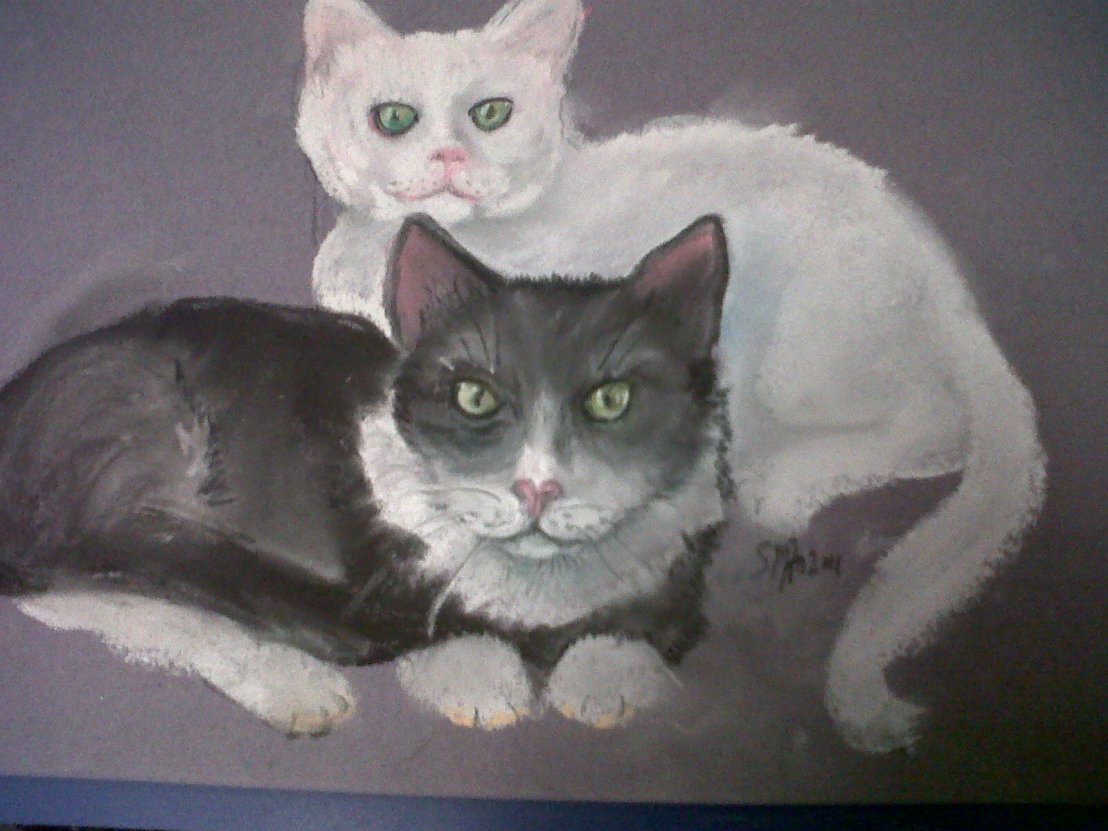
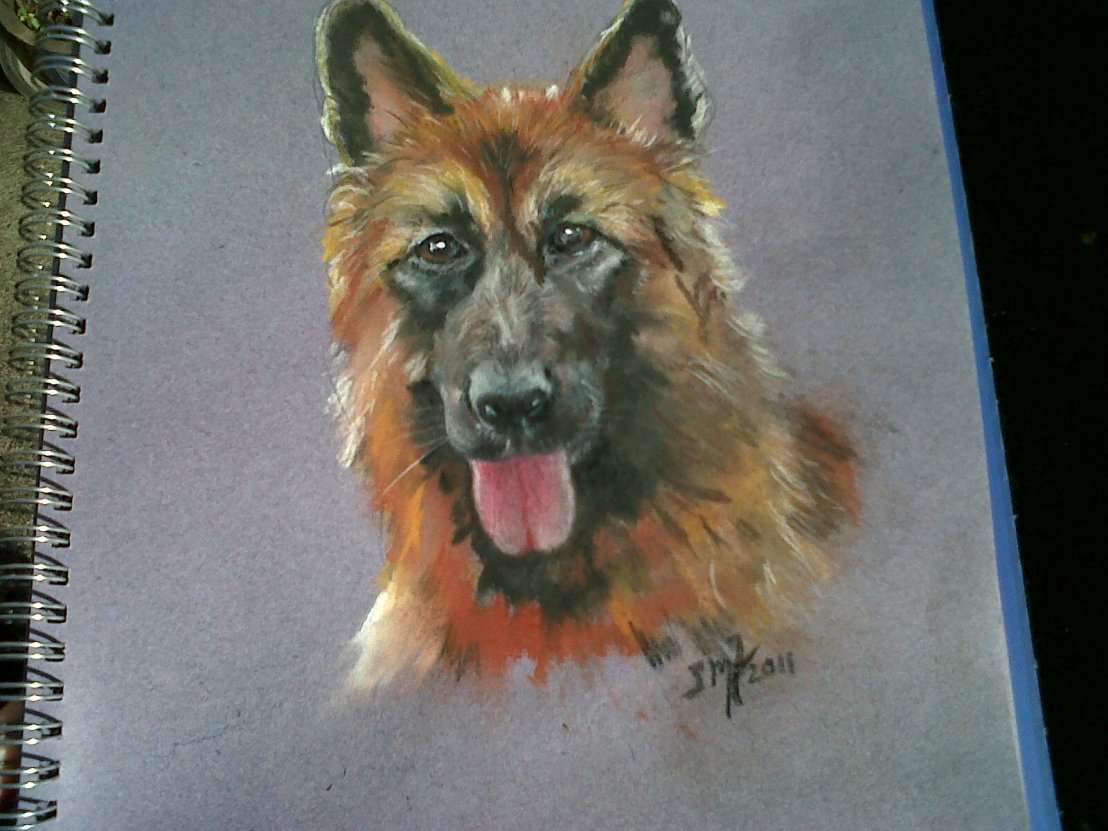
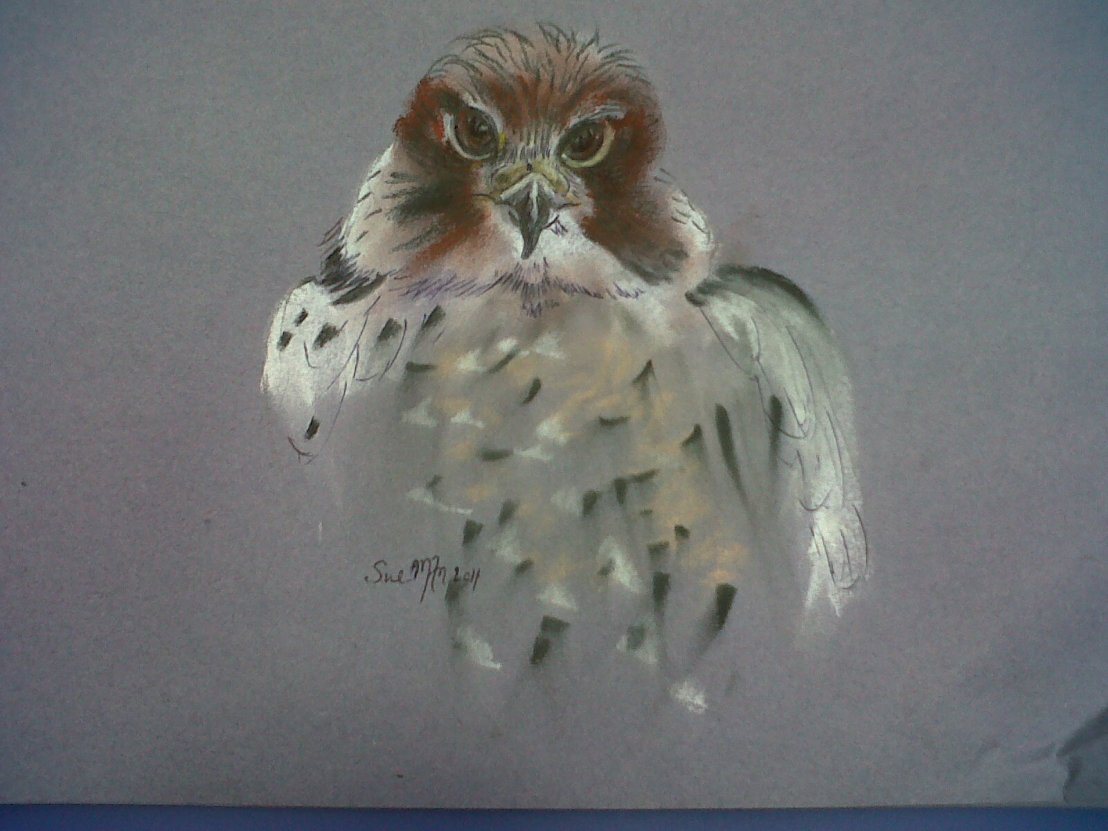
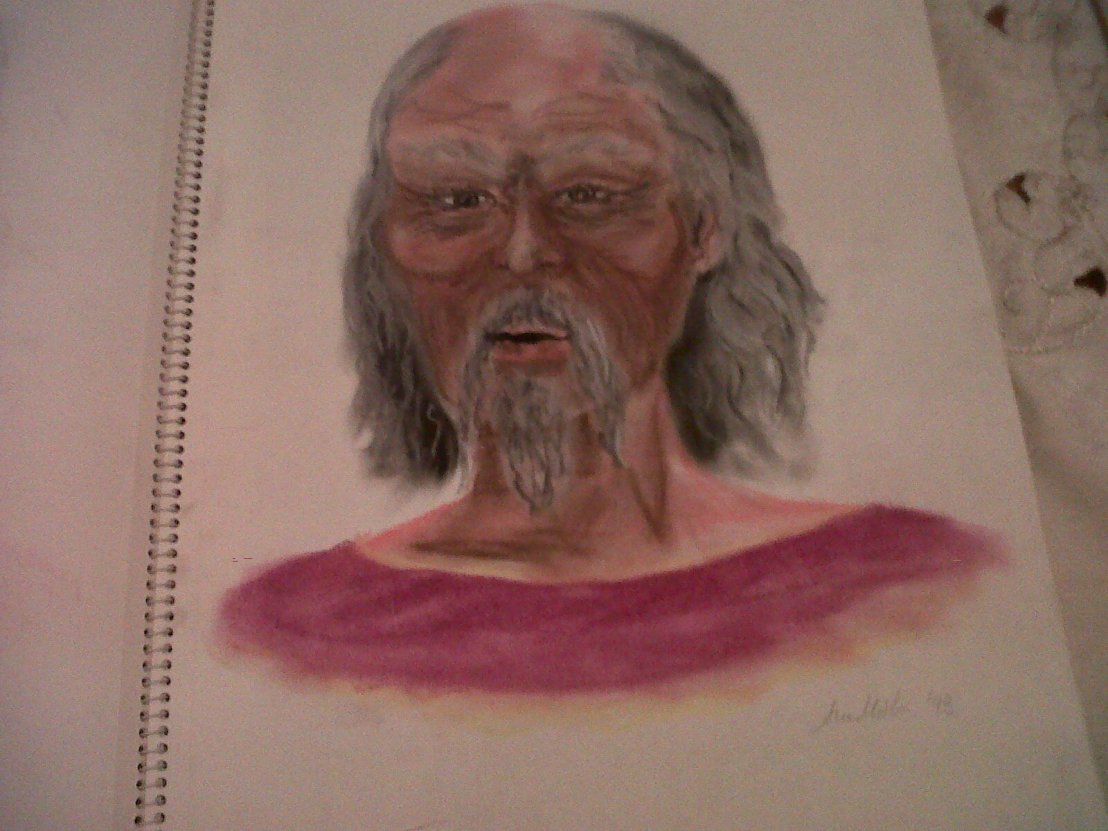
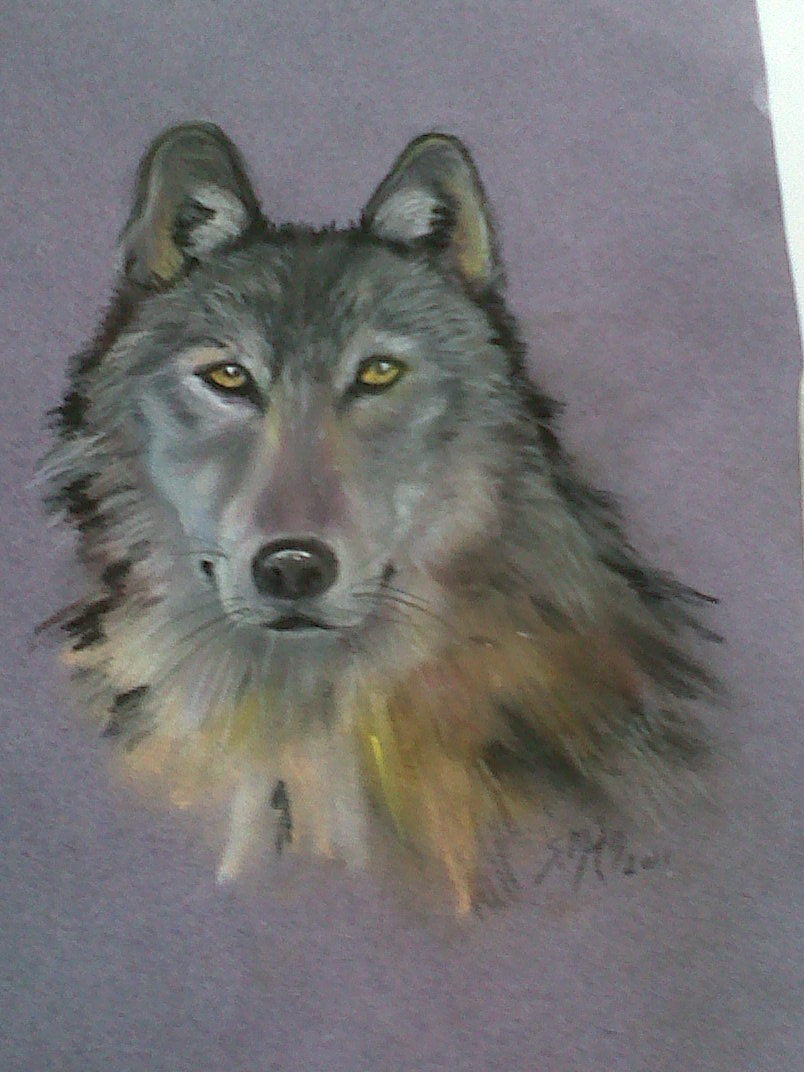
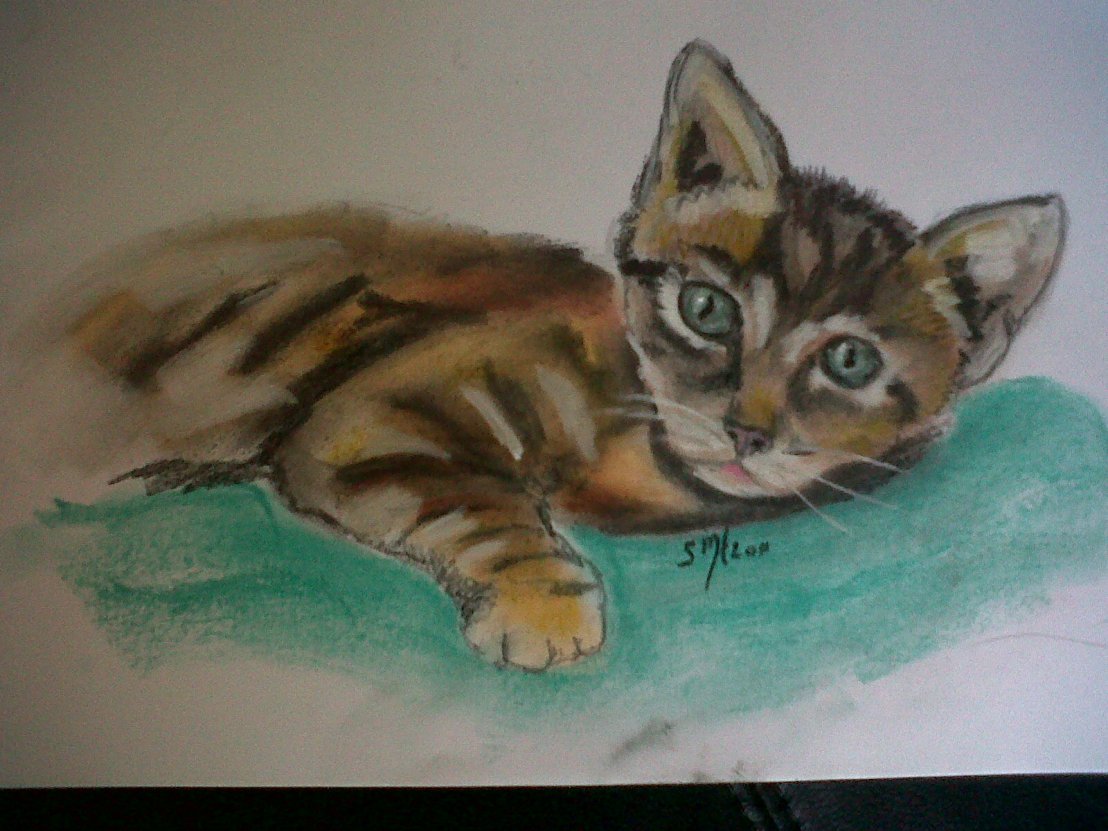
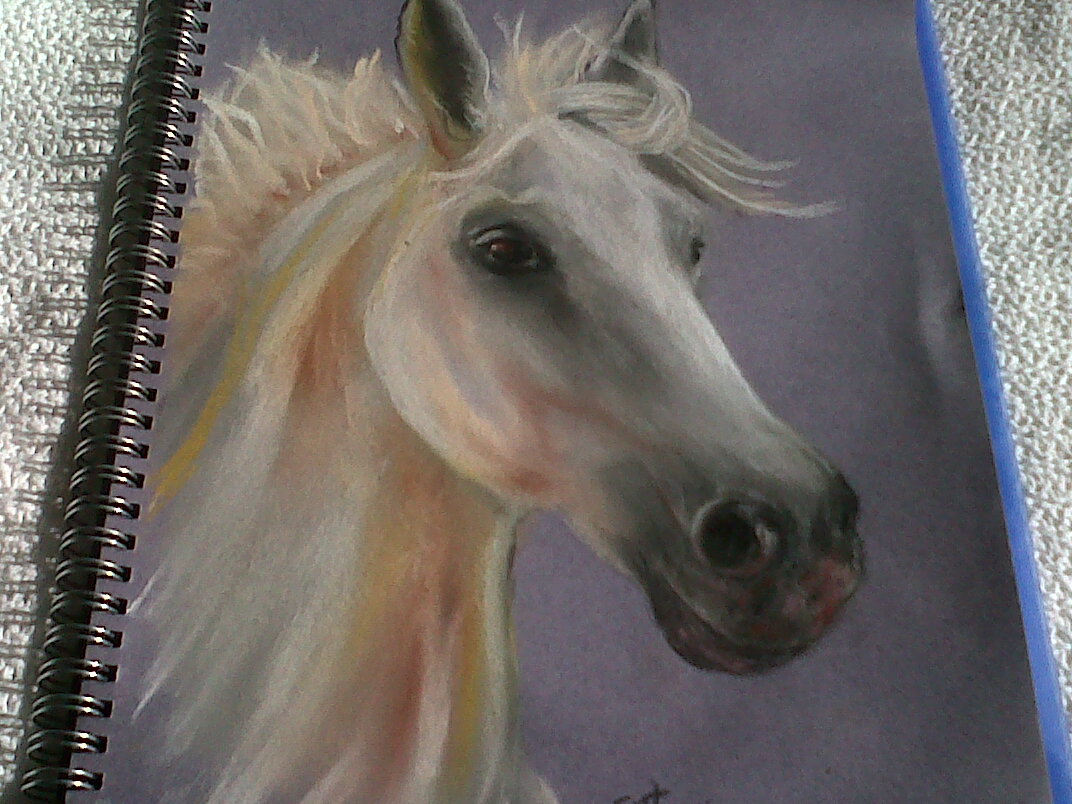
Sue earlier on in the week brought my attention to this page on her blog: Pastel Drawings. Sue said that I could republish them. I am flattered. In fact, there are sixteen of these beautiful drawings and I intend to publish eight of them today and the remaining eight in Picture Parade Three Hundred and Twenty-Two.
oooo
oooo
oooo
oooo
oooo
oooo
oooo
They are so beautiful.
Thank you, Sue, for giving me permission to republish them. Needless to say full copyright is vested in Sue Morton and them being republished in this place does not give authority for them to be republished elsewhere.
I have written quite a few times about the eyes of dogs but never the wolf.
This was sent to me by Julie Thomas-Smith, the wife of my best friend, Richard Maugham, and it is just beautiful.
It comes from the Wolf Conservation Center and when one goes across to that website then one reads:
A wolf’s eyes have the power to speak a great language. Did you know that wolves possess certain ocular characteristics that allow them to communicate with other members of their species using their eyes alone? One can guess that this gives a new meaning to the common phrase “puppy-dog eyes!”
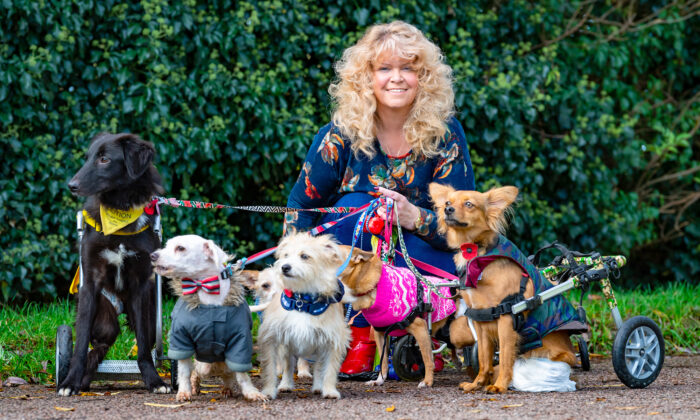
A woman who cares for sick and disabled pooches from around the world has been dubbed a “miracle worker” after getting many of them back on their feet again.
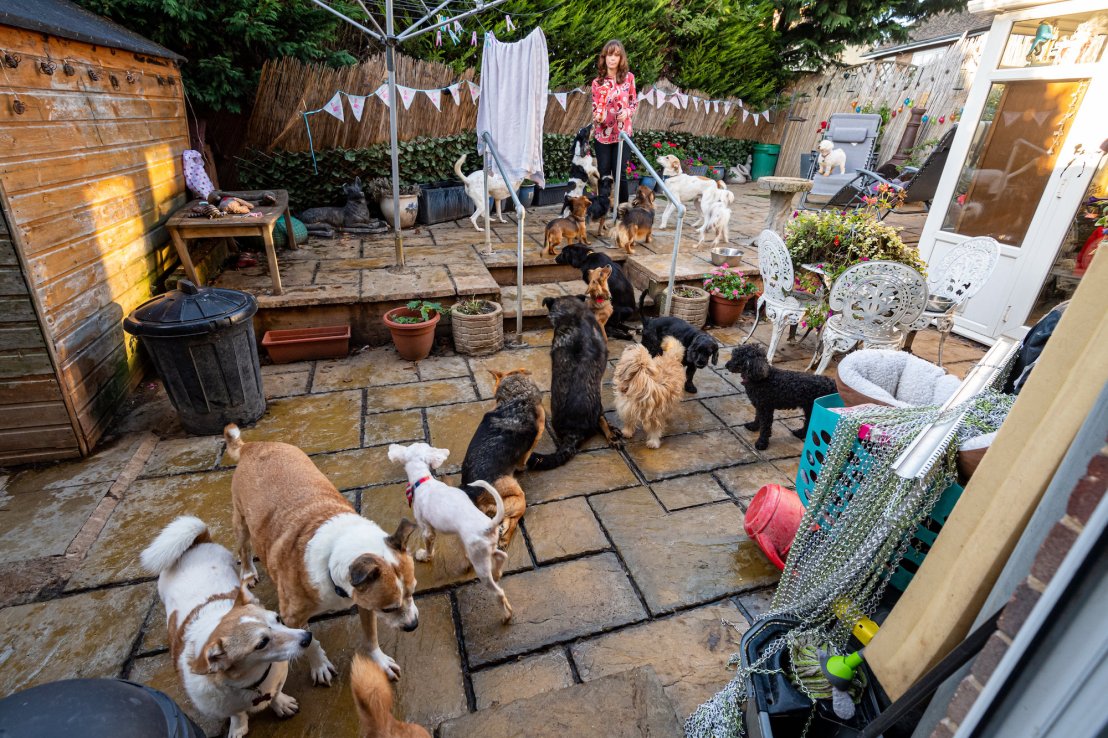
Claire-Louise Nixon, 48, is a dog lover and shares her modest home with 27 canines that no one else wants.
Claire-Louise Nixon, 51 out walking 8 of her 27 dogs that she has helped to walk again. See Cambridge copy SWCAdogs: Dog-lover Claire-Louise Nixon has told how she shares her semi-detached house with her family – and a staggering 27 rescued pooches.Claire-Louise, 48, rescues sick and paralysed dogs from around the world and looks after them at her humble home in Milton Keynes, Bucks.She says looking after the brood of canines is a full-time job and takes her from 6am until midnight.
Many of them are street dogs that have been abused or have lost limbs from mines and explosives in former war zones. But regardless of what conditions the dogs arrive in, Claire is determined to get them walking again through intense physio sessions and walks on wheels.
Her motley crew of dogs all live in her four-bedroom, semi-detached house in Milton Keynes with her husband, Gary, 50 and daughter, Rhia-Louise, 22. While Claire’s initial plan is usually to find forever homes for the dogs, quite often, their needs are too complex, with some even having to wear nappies.
The home of Clarie-Lousie Nixon who has 27 dogs living in the house. See Cambridge copy SWCAdogs: Dog-lover Claire-Louise Nixon has told how she shares her semi-detached house with her family – and a staggering 27 rescued pooches.Claire-Louise, 48, rescues sick and paralysed dogs from around the world and looks after them at her humble home in Milton Keynes, Bucks.She says looking after the brood of canines is a full-time job and takes her from 6am until midnight.Some of the 27 dogs that Clarie-Lousie Nixon has living at her home. See Cambridge copy SWCAdogs: Dog-lover Claire-Louise Nixon has told how she shares her semi-detached house with her family – and a staggering 27 rescued pooches.Claire-Louise, 48, rescues sick and paralysed dogs from around the world and looks after them at her humble home in Milton Keynes, Bucks.She says looking after the brood of canines is a full-time job and takes her from 6am until midnight.
She said: “When I get these dogs who are in such a bad way, the vet would say: ‘Claire, you won’t get them walking again.’
“But now they say nothing is impossible! They say we work miracles with them!
“I think all they need is love, kindness and patience. When they walk into my house they see other dogs like them so they don’t feel any different that’s why I think they do so well here.
“If you give them a reason to walk again then they will.”
Rita Ora Collie from Romania who was abandoned on the roadside after beeing born deformed and was sent to Claire-Lousie Nixon as no one wanted her. See Cambridge copy SWCAdogs:Dog-lover Claire-Louise Nixon has told how she shares her semi-detached house with her family – and a staggering 27 rescued pooches.Claire-Louise, 48, rescues sick and paralysed dogs from around the world and looks after them at her humble home in Milton Keynes, Bucks.She says looking after the brood of canines is a full-time job and takes her from 6am until midnight.Forest Gump a small collie crossed pomeranian who was run over on an Army base in Romania. Men on the base found Clarie-Lousie Nixon on facebook and sent Forest Gump to her for treatment. See Cambridge copy SWCAdogs: Dog-lover Claire-Louise Nixon has told how she shares her semi-detached house with her family – and a staggering 27 rescued pooches.Claire-Louise, 48, rescues sick and paralysed dogs from around the world and looks after them at her humble home in Milton Keynes, Bucks.She says looking after the brood of canines is a full-time job and takes her from 6am until midnight.
Claire, who looks after the brood of canines—seven of which are paralyzed—says it’s a full-time job and takes her from 6 a.m. until midnight. Feeding them alone is a mammoth chore involving 15 kilograms (approx. 33 pounds) of biscuits and a complete crate of dog food every single day.
Eight of the dogs have to wear nappies, with little bodysuits to keep them in place, and they all need daily baths to keep them clean and infection-free. There’s a lot of cleaning up involved, and Claire is constantly trying to keep on top of the housework.
Feeding time at The home of Clarie-Lousie Nixon who has 27 dogs living in the house. See Cambridge copy SWCAdogs: Dog-lover Claire-Louise Nixon has told how she shares her semi-detached house with her family – and a staggering 27 rescued pooches.Claire-Louise, 48, rescues sick and paralysed dogs from around the world and looks after them at her humble home in Milton Keynes, Bucks.She says looking after the brood of canines is a full-time job and takes her from 6am until midnight.
Claire’s passion to care for sick dogs all started 12 years ago when a puppy named Thomas Cook, who was only a few days old, was brought to the vets to be put down. The puppy had a hair lip and cleft palate, which prevented him from suckling milk and feeding, but Claire was determined to save him.
Claire painstakingly hand-reared Thomas Cook by feeding him a bottle every few hours, and from there, it escalated to having 27 disabled and sick dogs.
She said: “It went into having paralyzed dogs and dogs that had their legs blown off in Bosnia and dogs that had been shot and still had bullets inside them.”
All of Claire’s dogs are named after celebrities that she feels describe their personalities.
Sir Elton John, who Nixon named because of the song “I’m still standing,” was rescued from Romania after he was run over and left on the road to die. This left him with a broken spine. However, with Claire’s help, he can now go on small walks.
Sir Elton John, a Jack Russell cross who Clarie-Lousie Nixon has helped to walk again. See Cambridge copy SWCAdogs: Dog-lover Claire-Louise Nixon has told how she shares her semi-detached house with her family – and a staggering 27 rescued pooches.Claire-Louise, 48, rescues sick and paralysed dogs from around the world and looks after them at her humble home in Milton Keynes, Bucks.She says looking after the brood of canines is a full-time job and takes her from 6am until midnight.
Sherlock Holmes, who was rightly named for his intelligence and curiosity, was a street dog in Oman who was shot by a security guard.
The other dogs to name a few are Patrick Swayze, who twitches all the time and was previously paralyzed, Freddie Mercury, who wanted to “break free,” and David Bowie, who was “under pressure.”
Claire said: “They’re part of the family. The dogs have a free run of the house.
“They sit where they want and they sleep wherever they happen to fall asleep—often on our beds.
“The dogs arrive with the most horrible past we give them love and [a] wonderful future. They come from all over the world but with me they are home forever.”
Doris Day the pomeranian cross who Claire-Louise Nixon is helping to walk again. See Cambridge copy SWCAdogs: Dog-lover Claire-Louise Nixon has told how she shares her semi-detached house with her family – and a staggering 27 rescued pooches.Claire-Louise, 48, rescues sick and paralysed dogs from around the world and looks after them at her humble home in Milton Keynes, Bucks.She says looking after the brood of canines is a full-time job and takes her from 6am until midnight.Rylan Clark- neal theJack Russell cross Shih tzu who Claire-Louise Nixon helped to walk again. See Cambridge copy SWCAdogs: Dog-lover Claire-Louise Nixon has told how she shares her semi-detached house with her family – and a staggering 27 rescued pooches.Claire-Louise, 48, rescues sick and paralysed dogs from around the world and looks after them at her humble home in Milton Keynes, Bucks.She says looking after the brood of canines is a full-time job and takes her from 6am until midnight.
She further added: “I’m really lucky in that all the neighbors have dogs themselves so we don’t get complaints. And although 27 dogs sounds a lot, they are really quite well behaved.”
Claire raises funds through her organization, Wheels to Paws UK, to provide them with medical treatment, rehabilitation, and the equipment they need to walk again. Vets bills can be a huge drain on resources, but local vets are sympathetic to her cause and often offer a discount.
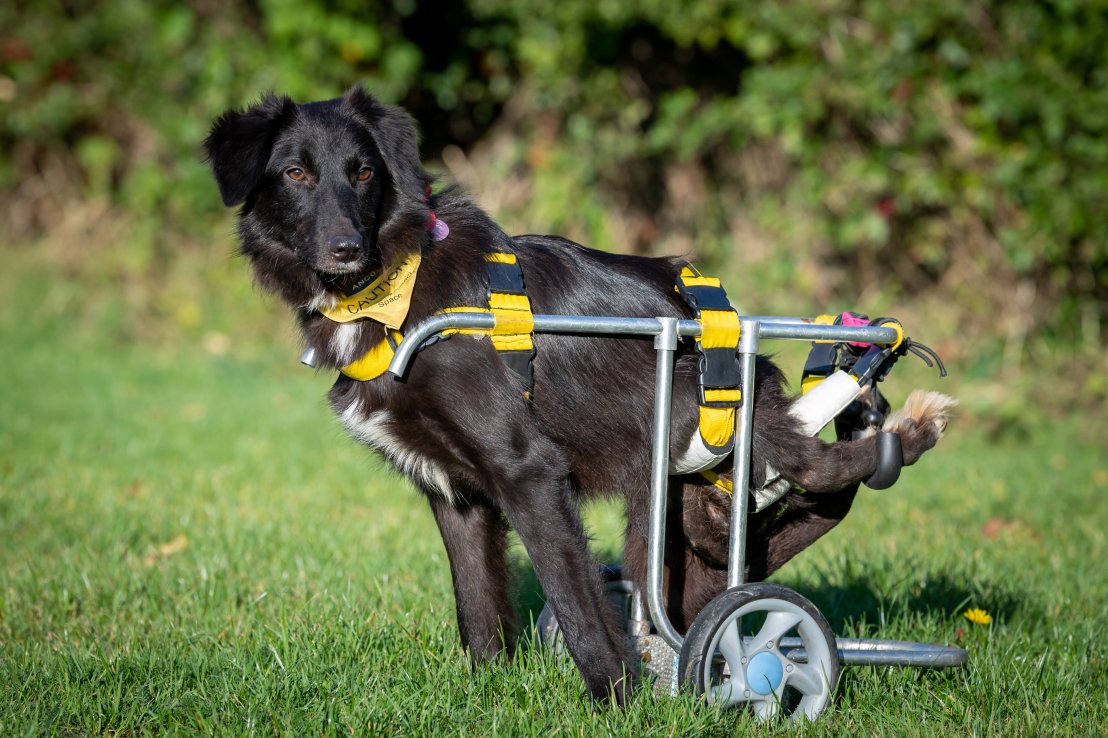
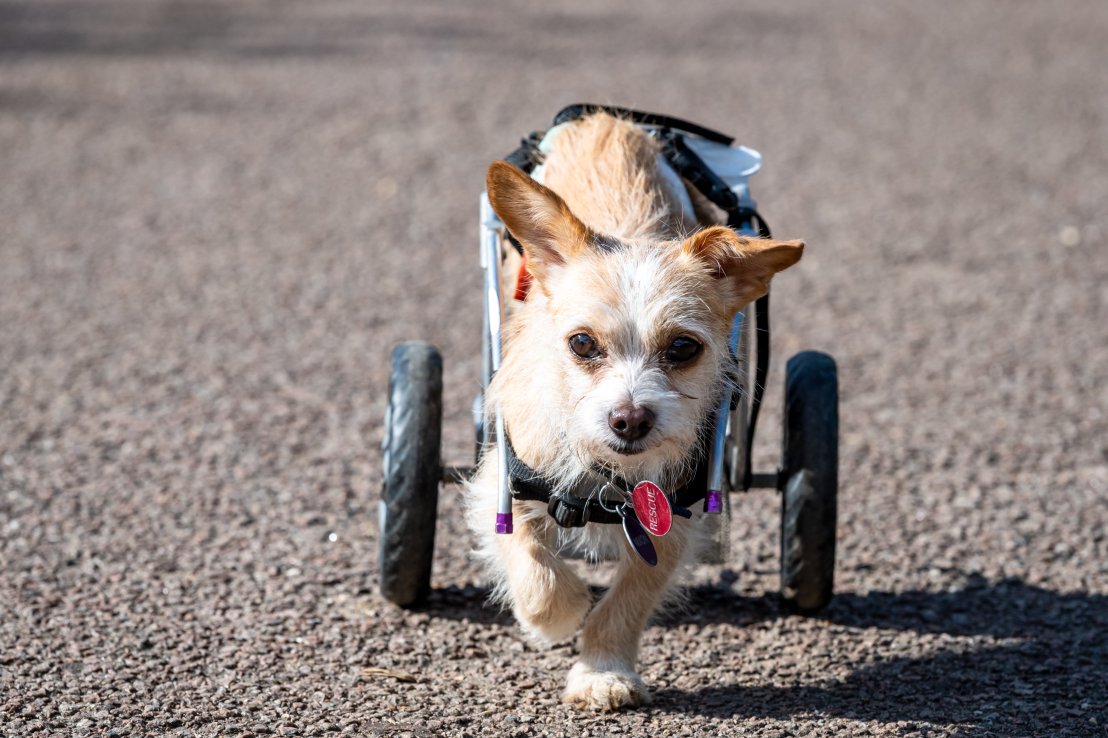
For long walks, the dogs are put in specially made harnesses with wheels to act as false legs so they can enjoy going out for walks. Meanwhile, those that can’t walk are put in buggies.
Other dogs are regularly taken for doggy hydrotherapy, while all those that can walk are taken out for exercise in rotation.
Claire-Louise Nixon, 51 out walking 8 of her 27 dogs that she has helped to walk again. See Cambridge copy SWCAdogs: Dog-lover Claire-Louise Nixon has told how she shares her semi-detached house with her family – and a staggering 27 rescued pooches.Claire-Louise, 48, rescues sick and paralysed dogs from around the world and looks after them at her humble home in Milton Keynes, Bucks.She says looking after the brood of canines is a full-time job and takes her from 6am until midnight.
Claire said: “The dog rescue charities abroad all know of me. So if they get a badly injured or disabled dog in need of specialist care they will pay to transport them to me in the UK. I can never say no.”
She further added: “It is tremendous hard work but I can’t tell you how rewarding it is. The love these dogs give back is amazing. I would not be without any single one of them.”
ooOOoo
There are some people around who do so much more than can be expected and Claire is very much one of those people.
To be impressed with her is only just the half of it.
Thank you Margaret for bringing this wonderful story to all our attentions.
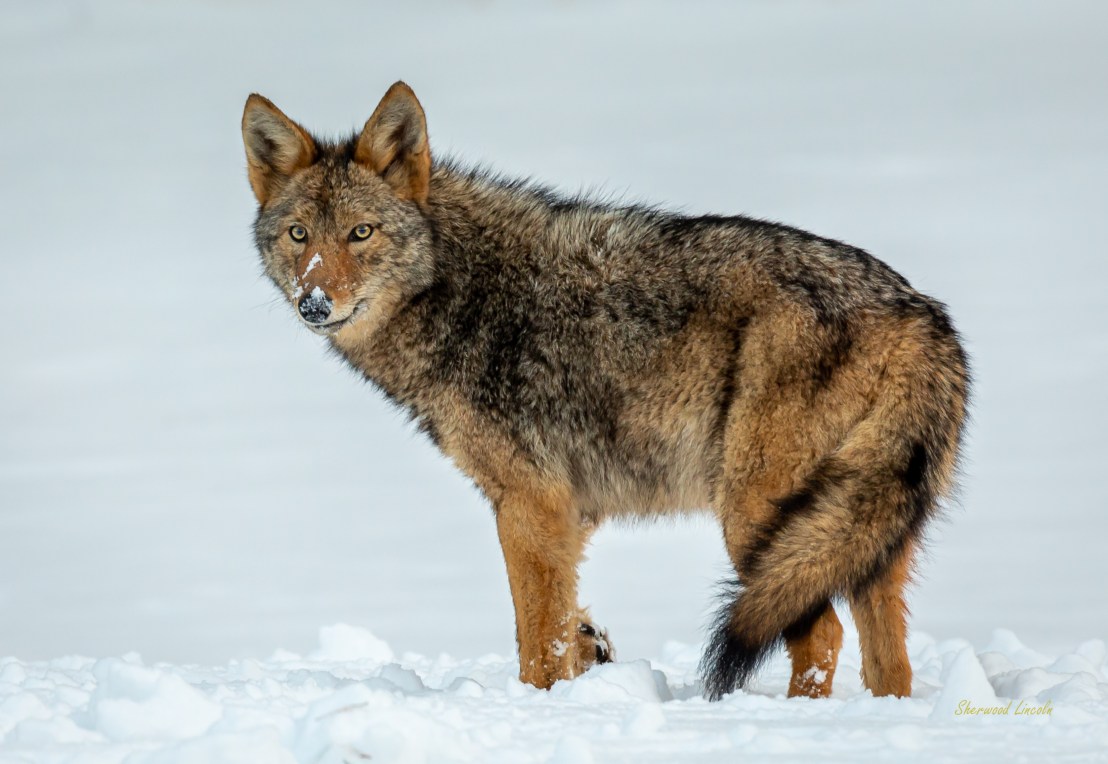
Good boy! Call it what you will; Coydog, Eastern Coyote, or Coymolf. Up close and personal, Taken in East Lyme Ct.
Ecologist and evolutionary biologist Javier Monzón analyzed the DNA of eastern coyotes and found the genes contain all three canids — dog, wolf, and coyote.
According to Monzón’s research, about 64% of the eastern coyote’s genome is coyote (Canis latrans), 13% gray wolf (Canis lupus), 13% Eastern wolf (Canis lycaon), and 10% dog (Canis familiaris).
Later on he added:
All my bird and nature photos are taken in South Eastern Ct. most with a Canon 7D Mark II or 5D Mark IV and Canon 100 to 400II THANK YOU. About 20 yards.
Then followed in response to my request for permission to republish:
Feel free, no problem!
Whatever happens to me in the next year, I truly hope I can continue to share such incredibly photographs with you.
Nature in all her glory!
Tomorrow is Christmas Day and I will be taking a short break, probably back on December 27th.





















 Learning from Dogs