Category: Photography

Carl Sagan

How very precious, vulnerable and fragile is this precious place we call home.

Today’s consciousness perambulation is the fault of Mr. P., as I like to call him. I refer to Pendantry as he is on his blog, Wibble.

You see on Sunday he added a comment to my post Just a small, white dot! that included the beautiful and awe-inspiring film made by the late Carl Sagan called Pale Blue Dot.

carl-sagan

Like millions of others, I came to admire Carl Sagan through watching the fabulous, the truly fabulous, television series Cosmos: A Personal Voyage. (NB. All the episodes are on YouTube, Episode One is at the end of this Post, Ed.)  Here’s how WikiPedia opens their reference to Carl.

Carl Edward Sagan (November 9, 1934 – December 20, 1996) was an American astronomer, astrophysicist, cosmologist, author, science popularizer and science communicator in astronomy and natural sciences. He spent most of his career as a professor of astronomy at Cornell University where he directed the Laboratory for Planetary Studies.

He published more than 600 scientific papers and articles and was author, co-author or editor of more than 20 books. He advocated scientifically skeptical inquiry and the scientific method, pioneered exobiology and promoted the Search for Extra-Terrestrial Intelligence (SETI).

Sagan is known for his popular science books and for the award-winning 1980 television series Cosmos: A Personal Voyage, which he narrated and co-wrote.  The book Cosmos was published to accompany the series. Sagan wrote the novel Contact, the basis for a 1997 film of the same name.

He died far too young and was a tragic loss to humanity.  The Carl Sagan web portal is here.

That 3:30 minute video Pale Blue Dot has, likewise, been seen by millions.  If you or someone you know hasn’t seen it, then you must pause now …

It’s practically impossible to watch that video and not embrace the central message from Mr. Sagan.  Here’s the transcript:

Our home from 6 billion kilometres. A very tiny dot against the vastness of space.

From this distant vantage point, the Earth might not seem of any particular interest. But for us, it’s different.

Consider again that dot. That’s here. That’s home. That’s us.

On it everyone you love, everyone you know, everyone you ever heard of, every human being who ever was, lived out their lives.

The aggregate of our joy and suffering, thousands of confident religions, ideologies, and economic doctrines, every hunter and forager, every hero and coward, every creator and destroyer of civilization, every king and peasant, every young couple in love, every mother and father, hopeful child, inventor and explorer, every teacher of morals, every corrupt politician, every “superstar,” every “supreme leader,” every saint and sinner in the history of our species lived there – on a mote of dust suspended in a sunbeam.

The Earth is a very small stage in a vast cosmic arena.

Think of the rivers of blood spilled by all those generals and emperors so that in glory and triumph they could become the momentary masters of a fraction of a dot.

Think of the endless cruelties visited by the inhabitants of one corner of this pixel on the scarcely distinguishable inhabitants of some other corner. How frequent their misunderstandings, how eager they are to kill one another, how fervent their hatreds.

Our posturings, our imagined self-importance, the delusion that we have some privileged position in the universe, are challenged by this point of pale light. Our planet is a lonely speck in the great enveloping cosmic dark. In our obscurity – in all this vastness – there is no hint that help will come from elsewhere to save us from ourselves.

The Earth is the only world known, so far, to harbor life. There is nowhere else, at least in the near future, to which our species could migrate. Visit, yes. Settle, not yet. Like it or not, for the moment, the Earth is where we make our stand.

It has been said that astronomy is a humbling and character-building experience. There is perhaps no better demonstration of the folly of human conceits than this distant image of our tiny world. To me, it underscores our responsibility to deal more kindly with one another and to preserve and cherish the pale blue dot, the only home we’ve ever known.

Tomorrow, I will stay with the theme of our beautiful planet. Hope you can join me.

Now spoil yourself and watch Episode One of Cosmos.

Just a small, white dot!

Does rather serve to remind us of our place in the scheme of things.

This stunning image was taken by the Cassini-Huygens probe.  Many of the images taken by NASA are available for download from the DVIDS website, which is where this one was found. (But also do visit the Ciclops website.)

The title of the photograph is:

A View of Earth from Saturn

A View of Earth from Saturn: Image of the Day

Although the Earth Observatory typically reserves ”Image of the Day” space for publishing data and images acquired by Earth-observing satellites, we are sometimes so enthralled by the spectacular images acquired by spacecraft observing other parts of the solar system that we want to share these ‘otherworldy’ views with our visitors. And if you are looking for remotely sensed images of the Earth, this view is the most remotely sensed image we have ever published!

This beautiful image of Saturn and its rings looks more like an artist’s creation than a real image, but in fact, the image is a composite (layered image) made from 165 images taken by the wide-angle camera on the Cassini spacecraft over nearly three hours on September 15, 2006.

Scientists created the color in the image by digitally compositing ultraviolet, infrared, and clear-filter images and then adjusting the final image to resemble natural color. (A clear filter is one that allows in all the wavelengths of light the sensor is capable of detecting.) The bottom image [the one above. Ed.] is a closeup view of the upper left quadrant of the rings, through which Earth is visible in the far, far distance.

On this day, Saturn interceded between the Sun and Cassini, shielding Cassini from the Sun’s glare. As the spacecraft lingered in Saturn’s shadow, it viewed the planet’s rings as never before, revealing previously unknown faint rings and even glimpsing its home world. Seen from more than a billion kilometers (almost a billion miles) away, through the ice and dust particles of Saturn’s rings, Earth appears as a tiny, bright dot to the left and slightly behind Saturn.

Although it might appear that Earth is located within Saturn’s outermost rings, that positioning is just an illusion created by the enormous distance between Cassini and Earth. When Cassini took this image, the spacecraft was looking back at Saturn from a distance of about 2.2.million kilometers (about 1.3 million miles). The Sun was millions of additional miles beyond, hidden behind Saturn. On September 15, Earth’s orbit had brought our home planet to a location slightly behind and to the left of the Sun from Cassini’s perspective. The Website of the Cassini Imaging Central Laboratory for Operations (CICLOPS) provides more detailed information about this image. The Cassini-Huygens mission is a cooperative project of NASA, the European Space Agency, and the Italian Space Agency.

Trying to find that faint image of Planet Earth in the above photograph is a challenge, even for those with much younger eyes than mine.

However, with a little bit of jiggery-pokery I was able to crop and enlarge the photograph, see below:

saturn

Planet Earth is in the ’10 o’clock’ position in the photograph, about half-way from the centre of the enlarged segment towards the top-left corner of the picture, just outside the outer white ring.

That’s us. All that we have ever been. All that we ever will be. Just that small white dot.

The love of a dog

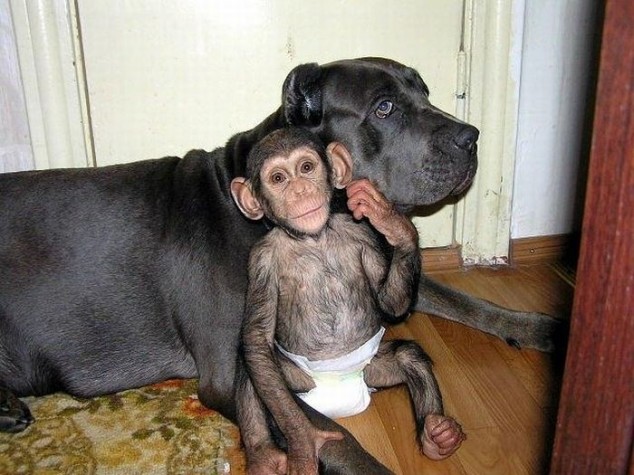
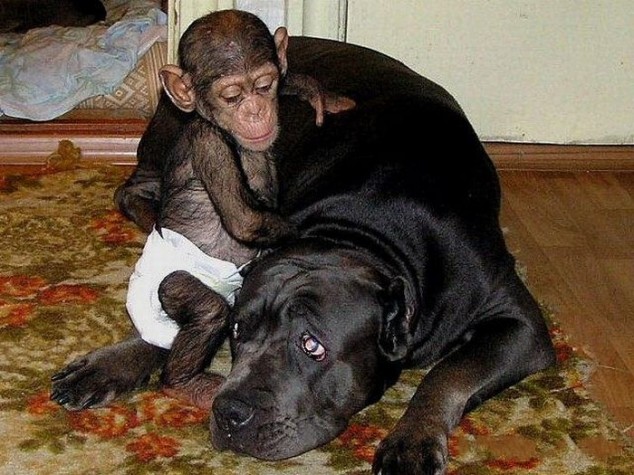
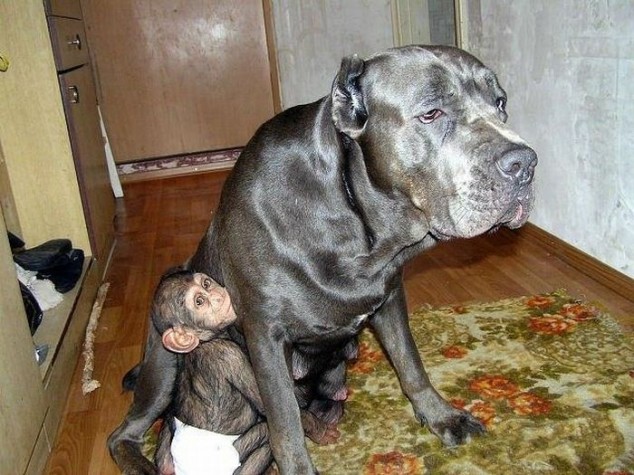
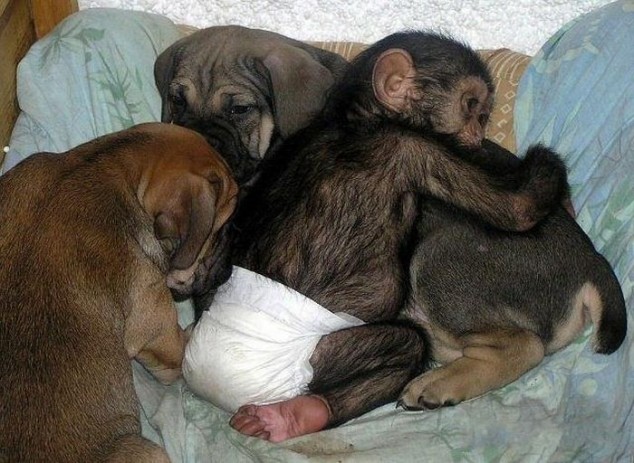
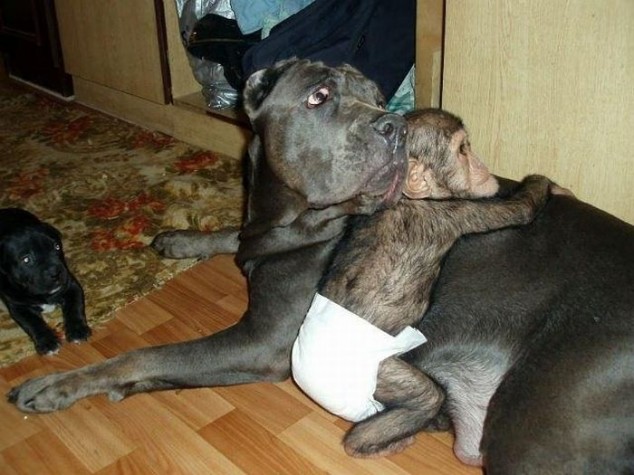
The widely reported story of a dog ‘adopting’ a baby chimpanzee.

(With big thanks to Chris Snuggs for sending me the pictures)

As a quick Google search finds:

Two years ago in a Russian zoo a female chimpanzee for some reason repudiated and abandoned her baby chimpanzee. When one of the employees of the zoo took the little chimpanzee home it never crossed her mind that her dog, a mastiff, would become a mother for the orphaned chimpanzee and treat the baby as her own child.

chris1

Judging by the look on her face at times, she is not quite sure why this particular offspring has hands to grab her with!

chris2

The unconditional love of a dog.

chris3

Fascinating example of the power of upbringing.

chris4

What is so wonderful, and amazing, is how ‘mother’ accepts this strange looking and strange smelling creature as it’s own.  Think how important smell is to dogs!

chris5

Words add nothing to the beauty of this photograph.

chris6

You can see the huge difference in body mass between these two.  One swipe, one bite and the little chimp would be toast!  The dog’s love for the chimp overrides all!

chris7

Just beautiful.

chris8

Mummy, what’s that on the wall?

chris9

Mummy, your feet are so big …. and not at all like mine!

oooOOOooo

Dear Chris, thank you so much for sending me these pictures.  It’s a privilege to share them with LfD readers.  It reminds us that in this difficult era, with so many challenges facing us, that there’s nothing that can’t be solved with love, compassion and understanding.

Now temporarily eighteen!

Young Allegra comes to live with us.

Back on the 14th January in a post called Now we are seventeen, I introduced the two miniature horses, Dancer and Grace, that came to be with us.  In that post I mentioned,

Ready to leave
Ready to leave

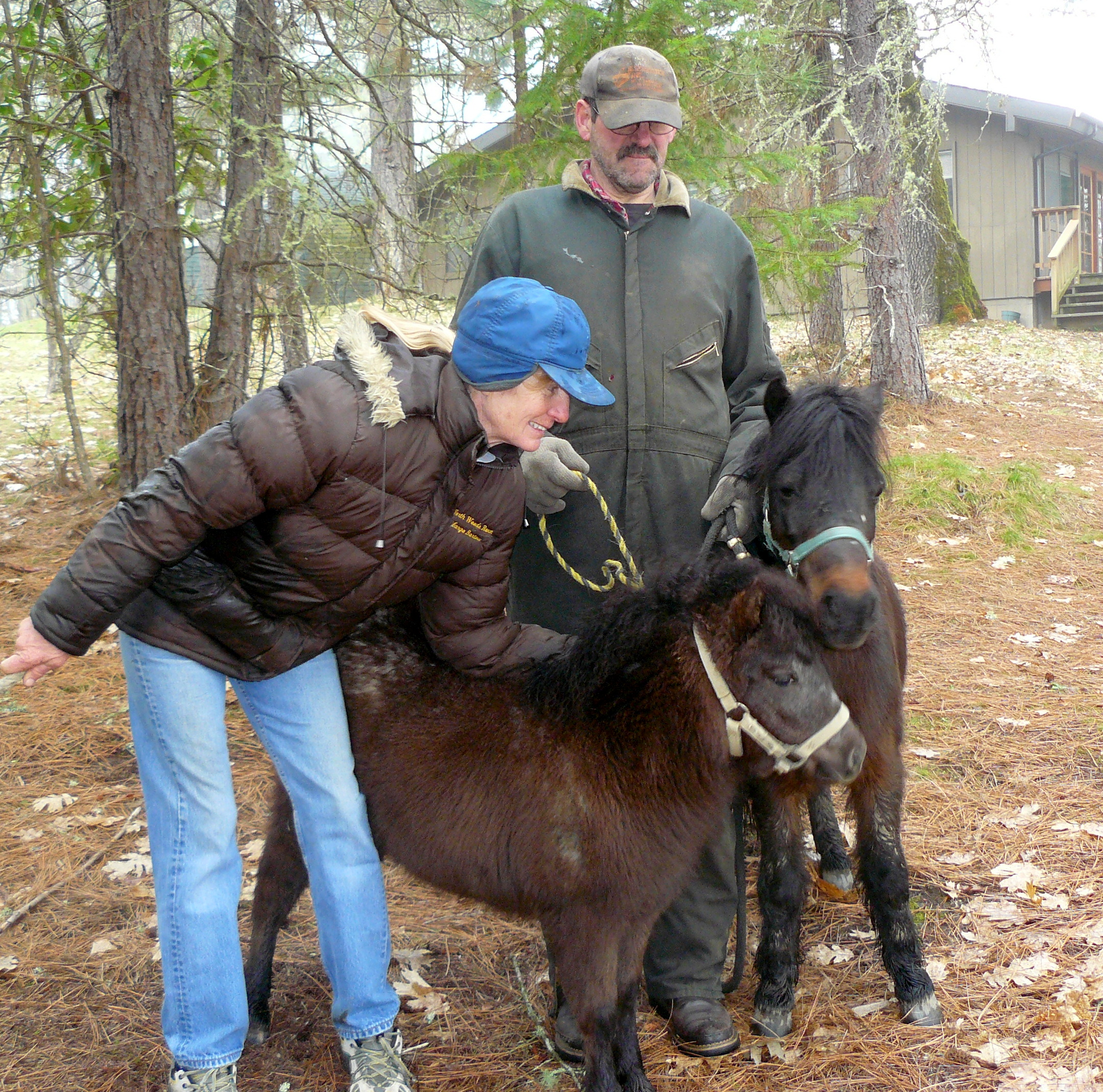
Jean is holding Dancer while Grace is waiting by the fence.  Our original plans had been to take Dancer’s sister’s foal Allegra, but she was too stressed to leave her mother so soon; she is just six months old.  As an interim, we borrowed Grace, Dancer’s last foal, until Allegra is ready to move homes.

Well yesterday Allegra was ready and came over to join Dancer while lovely Grace returned to neighbour Margo.  Just wanted to share some pictures from yesterday.

P1120585

Margo, her arm on Allegra, and her husband, Clarence, holding Allegra’s mother Keepsake.  The two horses had come over together so as to offer comfort to young Allegra, now just 7 months old.

P1120606

Allegra is on the left getting to know her new grounds.  On the right is Aunt Chloe who came to spend the night here with Allegra to minimise any separation anxiety.

P1120595

Close up of Dancer’s nose!

Don't believe it!  Another horse!!
Don’t believe it! Another horse!!

I’m sure Pharaoh is wondering how long it will be before there are more horses than dogs!

oooOOOooo

Finally, on a completely different theme …

P1120578

Does this remind you of anyone you know?

Have a great Sunday!

If you are not into dogs, especially big dogs, then skip today’s post!

Two ways to view these wonderful pictures of large dogs.

Either watch the video, if you don’t mind the advert at the end, (cool music, by the way.)

Or take a look at the pictures, one by one, with a big thanks to Dan for sending them to me.

Here we go!

Dogs Who Don’t Realize

They are BIG!!!!

Bigdog1

oooo

bigdog2

oooo

bigdog3

oooo

bigdog4

oooo

bigdog6

oooo

bigdog7

oooo

bigdog8

oooo

bigdog9

oooo

bigdog10

oooo

bigdog11

oooo

bigdog12

oooo

bigdog13

oooo

bigdog14

oooo

bigdog15

oooo

bigdog16

oooo

bigdog17

oooo

Finally, assuming you haven’t had sufficient of dogs, here’s a lovely animated GIF sent to me by Chris Sunggs.

noname

Oregon and the wolf

Sharing a beautiful aspect of this new home State of ours.

Let’s face it, Jean and I know as much about Oregon as we know about Timbuktu! A house and property requiring much love and care and 10 dogs, 5 cats and 2 miniature horses does rather cramp one’s style!  Actually, let me be honest.  We just adore the grounds that surround the house.  Almost every single walk around the property with or without a few dogs brings some new discovery.  Thus we are not lusting to get out.

Just by way of example, yesterday we discovered that the dam built across our creek, just upstream of the bridge, was used in days long ago for creating flood irrigation.  That’s the dam in the picture below.  The old plank and steel work are still in the undergrowth alongside the creek; to the right of the picture.

Irrigation dam on Bummer Ck.

OK, to the point of this post.

Shortly after we arrived here in Merlin, Oregon we joined Oregon Wild.  Their Mission Statement says: Oregon Wild works to protect and restore Oregon’s wildlands, wildlife and waters as an enduring legacy for all Oregonians.  Can’t argue with that!

Last December a press release was issued about Bringing Wolves Back Home to Oregon.  Here’s part of that release.

Wolves in Oregon:

Gray wolves (Canis lupus) were once common in Oregon, occupying most of the state. However, a deliberate effort to eradicate the species was successful by the late 1940s.

Trouble for wolves began before Oregon even became a state. In 1843 the first wolf bounty was established and Oregon’s first legislative session was called in part to address the “problem of marauding wolves”. By 1913, people could collect a $5 state bounty and an Oregon State Game Commission bounty of $20. The last recorded wolf bounty was paid out in 1947.

After an absence of over half a century, wolves began to take their first tentative steps towards recovery. Having dispersed from Idaho, the native species is once again trying to make a home in Oregon. One of the first sightings came in 1999 when a lone wolf was captured near the middle fork of the John Day River, put in a crate and quickly returned to Idaho. In 2000, two wolves were found dead – one killed by a car, the other illegally shot.

In 2006, a flurry of sightings led state wildlife biologists to believe that a number of wild wolves were living in Northeast Oregon near the Wallowa Mountains and the Eagle Cap Wilderness. In May of 2007 a wolf was found shot to death near La Grande, OR.

As I explain on this blog, there is a deep connection between dogs and wolves:

Dogs are part of the Canidae, a family including wolves, coyotes and foxes, thought to have evolved 60 million years ago.  There is no hard evidence about when dogs and man came together but dogs were certainly around when man developed speech and set out from Africa, about 50,000 years ago.  See an interesting article by Dr. George Johnson.

Back to Oregon Wild.  Just three weeks ago came this update.

State Announces Wolf Recovery Numbers

With the state’s wolf killing program on hold, conservationists celebrate recent success, express concern for the future.

SALEM, OR Jan 16, 2013

Today the Oregon Department of Fish and Wildlife (ODFW) announced the state’s wolf population has risen to at least 53 animals and as many as five breeding pairs. Though still mostly confined to the Northeastern corner of the state, the news was welcomed by conservationists.

The confirmation of wolf numbers comes on the heels of a number of announcements of new wolf pups, interbreeding between packs, and new science demonstrating the important and irreplaceable role wolves and other native hunters play on the landscape.

The announcement also comes on the heels of the one-year anniversary of another great wolf recovery story. On December 28, 2011, a wolf known as Journey (OR-7) crossed the Oregon border to become the first wolf in California in nearly a century. The story was celebrated around the world.

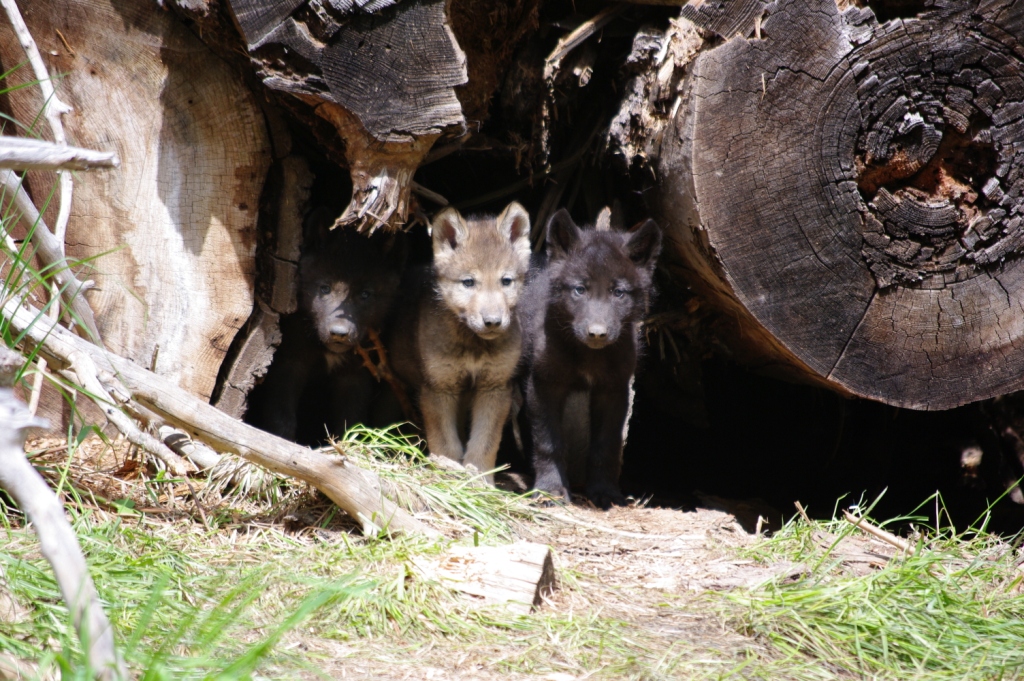
Read the rest of this good news story here.  But I couldn’t resist showing you this photograph that appeared in that story.

These wolf pups born to the Wenaha Pack in 2012 helped get recovery back on track. But their future remains tenuous (photo courtesy ODFW)

Let me close with these two videos.

Imnaha alpha female wolf, July 2011

Snake River Wolf Pack howling

Published on Aug 1, 2012

On July 25, 2012, an ODFW wolf biologist on a survey for wolf pups took this video of a Snake River wolf pack pup howling. The video was taken in the Summit Ridge area within the Snake River Wildlife Management Unit, in Wallowa County.

In the video, the pup howls three times. A low returning howl is heard and the pup gets up. Then, other members of the wolf pack (not seen in the video) return the pup’s howls.

Wolves are highly social animals and howling is a common behavior that help packs communicate and stay together. Wolf howls can be heard from several miles away.

More information on wolves in Oregon can be found at http://www.dfw.state.or.us/wolves.

Plus ça change – footnote

Plus ça change, plus c’est la même chose (“the more it changes, the more it’s the same thing”).

The final of three repostings from a year ago.  To recap, I wrote on Monday, “… out of curiosity I wondered what I had published a year ago, in early February 2012.  To my amazement what was published was as fresh and relevant as if it had been published today.

The second post from a year ago was reposted yesterday.  Today the footnote is from the 9th February, 2012.  (It reads in its original form with the links and references unchanged.)

oooOOOooo

So many vested opinions!

Regular readers will know that I published recently, in two parts, a post with the heading of Climate, truth and integrity, the first part being here and the second part here.

To me the arguments supporting the premise that mankind is engaged in the process of destroying our very being are powerful and convincing.  But if there is any serious scientific doubt, then I am reminded of that saying in aviation circles about a risk to the safety of an aircraft, “If there’s any doubt, there’s no doubt!”  Surely, that’s the stance the climate change skeptics should be taking!  Because when the evidence of global warming, pollution, natural resource depletion, species extinctions, and habitat destruction is drawn together and there are no skeptics left, then will the last person left alive please switch the lights off!

Anyway, I’m going to republish, with permission, a recent Post that appeared on Tom Engelhardt‘s powerful blogsite, Tom Dispatch.  It was written by Bill McKibben of 350.org fame.  Here it is,

Tomgram: Bill McKibben, Why the Energy-Industrial Elite Has It In for the Planet

Posted by Bill McKibben at 9:39am, February 7, 2012.

Introduction

Two Saturdays ago, I was walking with a friend in a park here in New York City.  It was late January, but I was dressed in a light sweater and a thin fall jacket, which I had just taken off and tied around my waist.  We were passing a strip of bare ground when suddenly we both did a double-take.  He looked at me and said, “Crocuses!”  Dumbfounded, I replied, “Yes, I see them.”  And there they were, a few clumps of telltale green shoots poking up from the all-brown ground as if it were spring.  Such a common, comforting sight, but it sent a chill through me that noticeably wasn’t in the air.  Even the flowers, I thought, are confused by our new version of weather.

Later that same week, as temperatures in the Big Apple crested 60 degrees, I was chatting on the phone with a friend in Northampton, Massachusetts.  I was telling him about the crocuses, when he suddenly said, “I’m looking out my window right now and for the first time in my memory of January, there’s not a trace of snow!”

Of course, our tales couldn’t be more minor or anecdotal, even if the temperatures that week did feel like we were on another planet.  Here’s the thing, though: after a while, even anecdotes add up — maybe we should start calling them “extreme anecdotes” — and right now there are so many of them being recounted across the planet.  How could there not be in a winter, now sometimes referred to as “Junuary,” in which, in the United States, 2,890 daily high temperature records have either been broken or tied at last count, with the numbers still rising?  Meanwhile, just to the south of us, in Mexico, extreme anecdotes abound, since parts of the country are experiencing “the worst drought on record.”  Even cacti are reportedly wilting and some towns are running out of water (as they are across the border in drought-stricken Texas).  And worst of all, the Mexican drought is expected to intensify in the months to come.

And who can doubt that in Europe, experiencing an extreme cold spell the likes of which hasn’t been seen in decades — even Rome had a rare snowfall and Venice’s canals were reported to be freezing over — there are another set of all-too-extreme anecdotes.  After all, in places like Ukraine, scores of the homeless are freezing to death, pipes are bursting, power cuts are growing, and maybe even an instant energy crisis is underway (at a moment when the European Union is getting ready to cut itself off from Iranian oil).

That’s just to begin a list.  And yet here’s the strange thing.  At least in this country, you can read the “freaky” weather reports or listen to the breathless TV accounts of unexpected tornadoes striking the South in January and rarely catch a mention of the phrase “climate change.”  Given the circumstances, the relative silence on the subject is little short of eerie, even if worries about climate change lurk just below the surface.  Which is why it’s good to have TomDispatch regular Bill McKibben, author of Eaarth: Making a Life on a Tough New Planet, take a clear-eyed look at American denialism and just what it is we prefer not to take in. Tom

The Great Carbon Bubble
Why the Fossil Fuel Industry Fights So Hard

By Bill McKibben

If we could see the world with a particularly illuminating set of spectacles, one of its most prominent features at the moment would be a giant carbon bubble, whose bursting someday will make the housing bubble of 2007 look like a lark. As yet — as we shall see — it’s unfortunately largely invisible to us.

In compensation, though, we have some truly beautiful images made possible by new technology.  Last month, for instance, NASA updated the most iconic photograph in our civilization’s gallery: “Blue Marble,” originally taken from Apollo 17 in 1972. The spectacular new high-def image [see below, Ed] shows a picture of the Americas on January 4th, a good day for snapping photos because there weren’t many clouds.

It was also a good day because of the striking way it could demonstrate to us just how much the planet has changed in 40 years. As Jeff Masters, the web’s most widely read meteorologist, explains, “The U.S. and Canada are virtually snow-free and cloud-free, which is extremely rare for a January day. The lack of snow in the mountains of the Western U.S. is particularly unusual. I doubt one could find a January day this cloud-free with so little snow on the ground throughout the entire satellite record, going back to the early 1960s.”

In fact, it’s likely that the week that photo was taken will prove “the driest first week in recorded U.S. history.” Indeed, it followed on 2011, which showed the greatest weather extremes in our history — 56% of the country was either in drought or flood, which was no surprise since “climate change science predicts wet areas will tend to get wetter and dry areas will tend to get drier.” Indeed, the nation suffered 14 weather disasters each causing $1 billion or more in damage last year. (The old record was nine.) Masters again: “Watching the weather over the past two years has been like watching a famous baseball hitter on steroids.”

In the face of such data — statistics that you can duplicate for almost every region of the planet — you’d think we’d already be in an all-out effort to do something about climate change. Instead, we’re witnessing an all-out effort to… deny there’s a problem.

Our GOP presidential candidates are working hard to make sure no one thinks they’d appease chemistry and physics. At the last Republican debate in Florida, Rick Santorum insisted that he should be the nominee because he’d caught on earlier than Newt or Mitt to the global warming “hoax.”

Most of the media pays remarkably little attention to what’s happening. Coverage of global warming has dipped 40% over the last two years. When, say, there’s a rare outbreak of January tornadoes, TV anchors politely discuss “extreme weather,” but climate change is the disaster that dare not speak its name.

And when they do break their silence, some of our elite organs are happy to indulge in outright denial. Last month, for instance, the Wall Street Journal published an op-ed by “16 scientists and engineers” headlined “No Need to Panic About Global Warming.” The article was easily debunked. It was nothing but a mash-up of long-since-disproved arguments by people who turned out mostly not to be climate scientists at all, quoting other scientists who immediately said their actual work showed just the opposite.

It’s no secret where this denialism comes from: the fossil fuel industry pays for it. (Of the 16 authors of the Journal article, for instance, five had had ties to Exxon.)Writers from Ross Gelbspan to Naomi Oreskes have made this case with such overwhelming power that no one even really tries denying it any more. The open question is why the industry persists in denial in the face of an endless body of fact showing climate change is the greatest danger we’ve ever faced.

Why doesn’t it fold the way the tobacco industry eventually did? Why doesn’t it invest its riches in things like solar panels and so profit handsomely from the next generation of energy? As it happens, the answer is more interesting than you might think.

Part of it’s simple enough: the giant energy companies are making so much money right now that they can’t stop gorging themselves. ExxonMobil, year after year, pulls in more money than any company in history. Chevron’s not far behind. Everyone in the business is swimming in money.

Still, they could theoretically invest all that cash in new clean technology or research and development for the same. As it happens, though, they’ve got a deeper problem, one that’s become clear only in the last few years. Put briefly: their value is largely based on fossil-fuel reserves that won’t be burned if we ever take global warming seriously.

When I talked about a carbon bubble at the beginning of this essay, this is what I meant. Here are some of the relevant numbers, courtesy of the Capital Institute: we’re already seeing widespread climate disruption, but if we want to avoid utter, civilization-shaking disaster, many scientists have pointed to a two-degree rise in global temperatures as the most we could possibly deal with.

If we spew 565 gigatons more carbon into the atmosphere, we’ll quite possibly go right past that reddest of red lines. But the oil companies, private and state-owned, have current reserves on the books equivalent to 2,795 gigatons — five times more than we can ever safely burn. It has to stay in the ground.

Put another way, in ecological terms it would be extremely prudent to write off $20 trillion worth of those reserves. In economic terms, of course, it would be a disaster, first and foremost for shareholders and executives of companies like ExxonMobil (and people in places like Venezuela).

If you run an oil company, this sort of write-off is the disastrous future staring you in the face as soon as climate change is taken as seriously as it should be, and that’s far scarier than drought and flood. It’s why you’ll do anything — including fund an endless campaigns of lies — to avoid coming to terms with its reality. So instead, we simply charge ahead.  To take just one example, last month the boss of the U.S. Chamber of Commerce, Thomas Donohue, called for burning all the country’s newly discovered coal, gas, and oil — believed to be 1,800 gigatons worth of carbon from our nation alone.

What he and the rest of the energy-industrial elite are denying, in other words, is that the business models at the center of our economy are in the deepest possible conflict with physics and chemistry. The carbon bubble that looms over our world needs to be deflated soon. As with our fiscal crisis, failure to do so will cause enormous pain — pain, in fact, almost beyond imagining. After all, if you think banks are too big to fail, consider the climate as a whole and imagine the nature of the bailout that would face us when that bubble finally bursts.

Unfortunately, it won’t burst by itself — not in time, anyway. The fossil-fuel companies, with their heavily funded denialism and their record campaign contributions, have been able to keep at bay even the tamest efforts at reining in carbon emissions. With each passing day, they’re leveraging us deeper into an unpayable carbon debt — and with each passing day, they’re raking in unimaginable returns. ExxonMobil last week reported its 2011 profits at $41 billion, the second highest of all time. Do you wonder who owns the record? That would be ExxonMobil in 2008 at $45 billion.

Telling the truth about climate change would require pulling away the biggest punchbowl in history, right when the party is in full swing. That’s why the fight is so pitched. That’s why those of us battling for the future need to raise our game. And it’s why that view from the satellites, however beautiful from a distance, is likely to become ever harder to recognize as our home planet.

Bill McKibben is Schumann Distinguished Scholar at Middlebury College, founder of the global climate campaign 350.org, a TomDispatch regular, and the author, most recently, of Eaarth: Making a Life on a Tough New Planet.

Follow TomDispatch on Twitter @TomDispatch and join us on Facebook.

Copyright 2012 Bill McKibben

This photo was taken on January 4, 2012.
Most Amazing High Definition Image of Earth – Blue Marble 2012

January 25, 2012

*Updated February 2, 2012: According to Flickr, “The western hemisphere Blue Marble 2012 image has rocketed up to over 3.1 million views making it one of the all time most viewed images on the site after only one week.”

A ‘Blue Marble’ image of the Earth taken from the VIIRS instrument aboard NASA’s most recently launched Earth-observing satellite – Suomi NPP. This composite image uses a number of swaths of the Earth’s surface taken on January 4, 2012. The NPP satellite was renamed ‘Suomi NPP’ on January 24, 2012 to honor the late Verner E. Suomi of the University of Wisconsin.

Suomi NPP is NASA’s next Earth-observing research satellite. It is the first of a new generation of satellites that will observe many facets of our changing Earth.

Suomi NPP is carrying five instruments on board. The biggest and most important instrument is The Visible/Infrared Imager Radiometer Suite or VIIRS.

To read more about NASA’s Suomi NPP go to: www.nasa.gov/npp

Credit: NASA/NOAA/GSFC/Suomi NPP/VIIRS/Norman Kuring

Plus ça change – sequel

Plus ça change, plus c’est la même chose (“the more it changes, the more it’s the same thing”).

As I wrote yesterday, “… out of curiosity I wondered what I had published a year ago, in early February 2012.  To my amazement what was published was as fresh and relevant as if it had been published today.

So here’s the second part of that trilogy of posts from February, 2012.  (It reads in its original form with the links and references unchanged.)

oooOOOooo

Climate, truth and integrity, part two

Continuing from Part One last Friday.

Last Friday I started re-publishing the wonderful comments that had appeared on Climate Sight in response to a question that I had raised, namely,

While in every way that I can think of, I support the premise of mankind affecting global climate, I would love to hear from someone who could reconcile the Post above with these recent items:” and then included the links to the WSJ and Daily Mail items.

If you are not familiar with those WSJ and Daily Mail items, then you will need to go back to Friday’s Post.

So moving on.

The third response was from chrisd3, here’s what he wrote,

Paul, here is the Met Office’s response, which begins, “[The Daily Mail] article includes numerous errors in the reporting of published peer reviewed science undertaken by the Met Office Hadley Centre and for Mr. Rose to suggest that the latest global temperatures available show no warming in the last 15 years is entirely misleading.”

Here is Deltoid taking David Rose apart on some earlier pieces:

And NASA never said anything about the Thames freezing over. Rose just made that bit up.

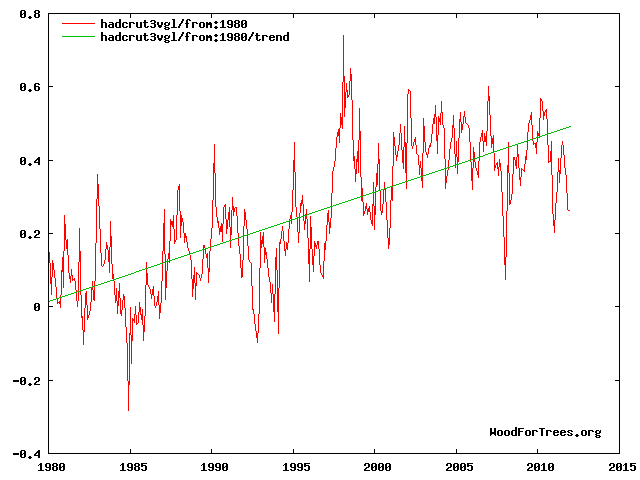
Finally, here is a chart of global temps from HadCRU:

From this, it is pretty clear why Rose chooses 15 years as his starting point: 1997-1998 was the time of the largest El Nino ever recorded, resulting in a huge temperature spike. Using that as the starting point for a temperature comparison is absolutely classic cherry-picking.

And in any event, you can’t say anything about trends in noisy data by simply comparing two arbitrary points. That is not a valid way to analyze the data (especially if you pick an obvious outlier as your starting point!). It is like trying to say whether the tide is coming in or going out by looking at the height of two waves. It just doesn’t work that way. You have to look at the long-term trend to remove the noise.

Let me take you to that Met Office response (and I’m republishing it in full).

Met Office in the Media: 29 January 2012

Today the Mail on Sunday published a story written by David Rose entitled “Forget global warming – it’s Cycle 25 we need to worry about”.

This article includes numerous errors in the reporting of published peer reviewed science undertaken by the Met Office Hadley Centre and for Mr. Rose to suggest that the latest global temperatures available show no warming in the last 15 years is entirely misleading.

Despite the Met Office having spoken to David Rose ahead of the publication of the story, he has chosen to not fully include the answers we gave him to questions around decadal projections produced by the Met Office or his belief that we have seen no warming since 1997.

For clarity I have included our full response to David Rose below:A spokesman for the Met Office said: “The ten year projection remains groundbreaking science. The complete period for the original projection is not over yet and these projections are regularly updated to take account of the most recent data.

“The projections are probabilistic in nature, and no individual forecast should be taken in isolation. Instead, several decades of data will be needed to assess the robustness of the projections.

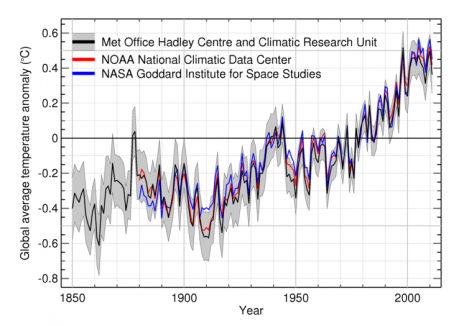
“However, what is absolutely clear is that we have continued to see a trend of warming, with the decade of 2000-2009 being clearly the warmest in the instrumental record going back to 1850. Depending on which temperature records you use, 2010 was the warmest year on record  for NOAA NCDC and NASA GISS, and the second warmest on record in HadCRUT3.”

Global average temperatures from 1850 to 2011 from the three individual global temperature datasets (Met Office/UEA HadCRUT3, NASA GISS and NOAA NCDC)

Furthermore despite criticism of a paper published by the Met Office he chose not to ask us to respond to his misconceptions. The study in question, supported by many others, provides an insight into the sensitivity of our climate to changes in the output of the sun.

It confirmed that although solar output is likely to reduce over the next 90 years this will not substantially delay expected increases in global temperatures caused by greenhouse gases. The study found that the expected decrease in solar activity would only most likely cause a reduction in global temperatures of 0.08 °C. This compares to an expected warming of about 2.5 °C over the same period due to greenhouse gases (according to the IPCC’s B2 scenario for greenhouse gas emissions that does not involve efforts to mitigate emissions).  In addition the study also showed that if solar output reduced below that seen in the Maunder Minimum – a period between 1645 and 1715 when solar activity was at its lowest observed level – the global temperature reduction would be 0.13C.

Back to that response from chrisd3.  He offered this, “Finally, here is a chart of global temps from HadCRU.”  Here is that chart, remember we are looking at Global temperatures.

Global temperature trend

OK, between this Post and my Post last Friday, you probably get the message!  There were many other contributions and I could go on and on quoting the great responses I got, all of them uniformly saying there IS global warming unprecedented in recent years.  The message is crystal clear and those who wish to deny the evidence … well, I can’t come up with a polite term, so will just leave it at that!

My final contribution is from Martin Lack, author of the Blog Lack of Environment, and a good friend of Learning from Dogs.  Here is what he wrote in a recent email,

You may have seen my latest response to How much is most?

When I eventually saw your earlier comment, I was surprised and disappointed in equal measure because I almost feel that I have failed in some way. Let me explain:  Unlike ClimateSight and SkepticalScience, which both do an excellent job of focusing on the science of climate change, my blog is deliberately focused on the politics underlying the denial of all environmental our problems; including 2 key aspects to my MA dissertation, namely the political misuse of scepticism; and the psychology of denial.  See my How to be a Climate Change ‘Sceptic’  for more detail.

Therefore, although not specifically categorised as such, just about everything I have posted is traceable back to Paul and Anne Ehrlich’sBetrayal of Science and Reason (1996) and/or Naomi Oreskes and Erik Conway’s Merchants of Doubt (2010).  For someone who does not currently go to any Church, I am remarkably fond of quoting Scripture so, if necessary, please forgive me but, as the Good Book says:  “What has been will be again, what has been done will be done again; there is nothing new under the sun” (Ecclesiastes 1:9).

Therefore, I do not think you should be surprised by the amount of misinformation and misrepresentation contained in the original WSJ Sixteen’s article; and/or the fact that denialist arguments are repeated no matter how many times they have been shown to be false.  Furthermore, I would warn against trying to summarise it all on Learning from Dogs.  This is definitely Book territory and, in addition to the two mentioned above, the market is already saturated by the likes of Climate Change Cover-up by James Hoggan and Climate Change Denial by Haydn Washington and John Cook.

With very best wishes for a fog-free future,

What to say to close these two Posts off?  Frankly, it’s difficult to know how to pitch it.  The science seems clear beyond reasonable doubt.  But if you are reading this and disagree, then PLEASE offer the science to refute the conclusions presented here.  I promise you that I will present it on Learning from Dogs.

So let me end with a simple photograph.

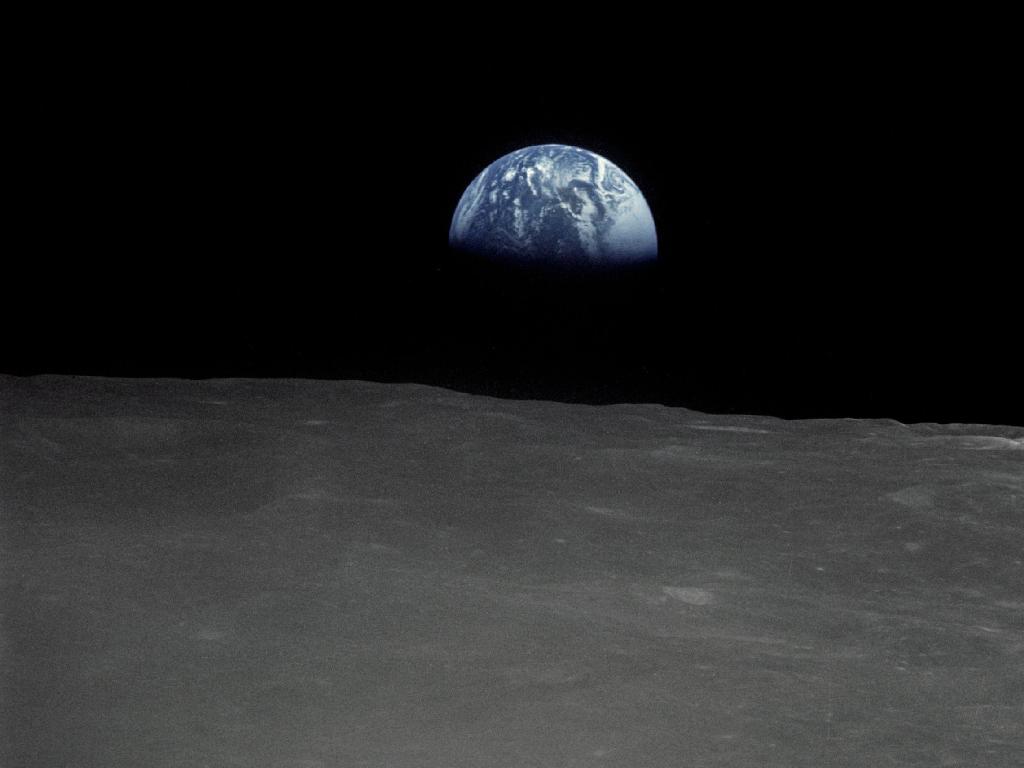
Earthrise

This is the photograph that wilderness photographer Galen Rowell called, “the most influential environmental photograph ever taken.”

The now world-famous photograph was taken by Astronaut William Anders from Apollo 8, the first manned mission to the Moon, a little over 43 years ago on December 24th, 1968.

As the Earth rose above the horizon of the moon, NASA astronaut Frank Borman uttered the words, “Oh my God! Look at that picture over there! Here’s the Earth coming up. Wow, is that pretty.”  Bill Anders then took the ‘unscheduled’ photograph.

Now project forward 43 years to the year 2055 and play with the idea of what ‘pretty‘ planet Earth will be like for mankind and so many other species, including our longest companion, the dog, if we don’t get our act together pretty soon!

Support a good cause

Please help save the Ecuadorian Jaguar and the Amazon jungle

Today’s article is a complete reposting of what appeared on Lack of Environment last Friday.

oooOOOooo

Please help save the Ecuadorian Jaguar and the Amazon jungle and stop Ecuador’s President from being a total hypocrite!

Jaguar-14

This courtesy of Avaaz:
———–

Dear friends,

There is one area of the Ecuadorian Amazon that is so pristine that the whole ecosystem has been preserved and even jaguars roam free! But the government is now threatening to go in and drill for oil.

The local indigenous people have been resisting, but they are afraid that oil companies will break up the community with bribes. When they heard that people across the world might stand with them and make a stink to save their land, they were thrilled. The president of Ecuador claims to stand for indigenous rights and the environment, but he has just come up with a new plan to bring oil speculators in to 4 million hectares of jungle. If we can say ‘wait a minute, you’re supposed to be the green president who says no one can buy Ecuador’, we could expose him for turning his back on his commitments just as he is fighting for re-election.

He doesn’t want a PR nightmare right now. If we get a million of us to help this one community defend their ancestral land and challenge the president openly to keep to his word, we could start a media storm that would make him reconsider the whole plan. Sign the petition now and tell everyone — let’s help save this beautiful forest:

http://www.avaaz.org/en/oil_in_the_amazon_8/?tSkdncb

After Texaco and other oil companies polluted Ecuadorian waters and irreversibly devastated precious ecosystems, Correa led his country to be the world’s first nation to recognize the rights of “Mother Earth” in its constitution. He announced Ecuador was not for sale, and in Yasuni National Park promoted an innovative initiative where other governments pay Ecuador to keep oil in the ground to protect the rainforest rather than destroy it. But now he’s on the verge of selling out.

Shockingly, the Sani Isla Kichwa land is partly in Yasuni National Park. But even more shocking is Correa’s bigger plan — in days government officials begin a world tour to offer foreign investors the right to drill across 4 million hectares of forest (an area larger than the Netherlands!) Ecuador, as any country, may argue it has the right to profit from its natural resources, but the constitution itself says it must respect indigenous rights and its amazing forests, which bring millions in tourist dollars every year.

Right now, Correa is in a tough fight to win a second term as president. It’s the perfect time to make him honour his environmental promises and make this green constitution come to life. Sign now to stand with the Kichwa people and save their forest:

http://www.avaaz.org/en/oil_in_the_amazon_8/?tSkdncb

Our community has fought year after year to protect the Amazon in Brazil and Bolivia, and won many victories standing in solidarity with indigenous communities. Now it’s Ecuador’s turn — let’s respond to this urgent call for action and save their forest.

With hope and determination,

Alex, Pedro, Alice, Laura, Marie, Ricken, Taylor, Morgan and all the Avaaz team

More Information:

Ecuadorian tribe gets reprieve from oil intrusion (The Guardian)
http://www.guardian.co.uk/environment/2013/jan/17/indigenous-ecuadorian-tribe-oil-intrusion

Ecuador adopts rights of nature in constitution (Rights of Nature)
http://therightsofnature.org/ecuador-rights/

How oil extraction impacts the rainforest (Amazon Watch)
http://amazonwatch.org/news/2013/0107-oil-extraction-how-oil-production-impacts-the-rainforest

Drilling for oil in Eden: initiative to save amazon rainforest in Ecuador is uncertain (Scientific American)
http://blogs.scientificamerican.com/guest-blog/2012/03/17/drilling-for-oil-in-eden-initiative-to-save-amazon-rainforest-in-ecuador-is-uncertain/

Ecuador’s indigenous leaders oppose new oil exploration plans in Amazon region (Earth Island Journal)
http://www.earthisland.org/journal/index.php/elist/eListRead/ecuadors_indigenous_leaders_oppose_new_oil_exploration/
——————

I am not a pantheist or animist. However, I feel the Western world has much to learn from the attitude of the South American people towards their environment. Former CIWEM President, Nick Reeves, agrees:
http://ciwem.helixsoftware.co.uk/hot-topics/2011/jul/the-human-rights-of-mother-earth.aspx

oooOOOooo

tiger

Now there’s a set of eyes.  Up to so many of us to be able to look back into those eyes with honesty and love.

So please sign here:  http://www.avaaz.org/en/oil_in_the_amazon_8/?tSkdncb