Category: People

The great global tragedy.

Reinforcing the need to move personhood beyond the human person.

Yesterday, I wrote about the moves to have the concept of personhood extended to chimpanzees. Here’s a small extract:

The order to show cause on the issue of habeas corpus is the first step in a process which Steven Wise and the Nonhuman Rights Project (NhRP) hope will secure Hercules and Leo’s bodily liberty and integrity. If the court were to find in their favour, the chimpanzees would no longer be kept for research and could be moved to a sanctuary in Florida.

Last Friday, George Monbiot published an essay that reinforced our need to regard our animals differently than hitherto; especially our larger animals. It is my pleasure to republish it with Mr. Monbiot’s permission.

ooOOoo

Megadeath

22nd May 2015

The destruction of some of the last of the huge animals that shaped us inflicts a great wound in our lives.

By George Monbiot, published on the Guardian’s website 22nd May 2015

When I read about the attacks on the world’s remaining elephants and rhinos, the first thought that enters my head is: “these creatures used to be everywhere”. Almost every area of land and sea, in every region of the world, had a megafauna. Elephants lived throughout Europe, Asia, Africa and America until very recently in ecological time (30,000 years ago in Europe, 14,000 years ago in the Americas). Rhinos lived across Africa, Asia and Europe. Temperate forest rhinos lived in Britain during previous interglacials, and woolly rhinos lived here in colder periods. Russia was haunted by two gigantic species: humpbacked rhinos the size of elephants, eight feet to the crest, weighing perhaps five tonnes.

Lions were everywhere except Australasia (that had a marsupial equivalent); tigers ranged to the borders of Europe; hippos wallowed in British rivers; hyaenas survived into the early Mesolithic in Britain and northern Europe. All this is easily forgotten in a world afflicted by Shifting Baseline Syndrome: our habit of conceptualising as natural and normal the ecosystems that prevailed in our own youth, unaware that they were, even then, in an extremely degraded state.

The places in which monsters remain are the last tiny redoubts of what was once a global population. Of the 42 species of terrestrial mammals weighing more than a tonne that existed on Earth when modern humans left Africa, just eight are left: the African and Asian elephants, the larger of the two hippopotamus species and the black, white, Indian, Javan and Sumatran rhinos. Seven of them are threatened and four are critically endangered.

Even in the relatively recent past, the area of land over which these animals roamed has drastically declined. Maps published in a new paper in the journal Science Advances show that elephants, hippos and black rhinos occupied most of sub-Saharan Africa when their populations were first encountered by modern Europeans, but are now confined to a few tiny specks of land.
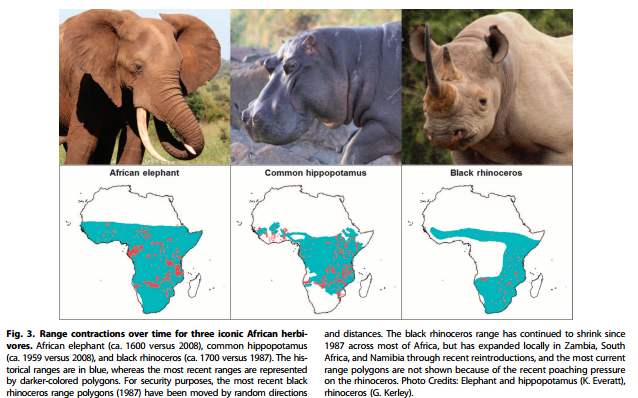
From William J. Ripple et al, 1st May 2015. Collapse of the world’s largest herbivores. Science Advances. 2015;1:e1400103

Why do the very large animals prove most susceptible to destruction? It’s partly because they reproduce slowly and partly because they require plenty of land and food for their survival, so the destruction of wild places tends to hit them sooner than it affects smaller species. But it’s also, I believe, because we have a deep-rooted urge to assert our status by killing them and owning their body parts. Even when people don’t do the killing themselves, possessing their skins, heads, tusks or horns has long been a means of acquiring bragging rights.

From the exquisite sculpture of two reindeer migrating across a river, carved from a piece of mammoth ivory 13,000 years ago and now housed in the British Museum, to the tiger skin rugs and heads of exotic beasts exhibited in stately homes today, bigging ourselves up by displaying our mastery of great beasts seems to be a fundamental human trait. Today’s aristocrats, some of whom are descendants of tribal chiefs, hang their ancestors on the wall to establish their genealogy and the heads of the animals they have killed beside them, to establish their prowess. Not much has changed in thousands of years.

Many of the world’s great sagas, tales of Ulysses, Sinbad, Sigurd, Beowulf, Cú Chulainn, St George, Arjuna, Lạc Long Quân and Glooskap, tell of struggles with megafauna real or imagined. Doubtless at least some of these stories originated in real battles with beasts whose true nature has been forgotten, as a result of their extinction. Think of Sinbad and the roc, which might be a garbled version of encounters with the elephant bird of Madagascar.

Today, some very rich people try to recreate these battles in ways that seem to me grotesque. They bid on the internet for the right to shoot a particular animal, sometimes paying tens of thousands of dollars, arrange a date, a time and a place, then fly over, in some cases with their taxidermists in tow, to bag the creature they have bought.

The animal is waiting for them – sometimes in an enclosure, sometimes just after being released from one, sometimes in the wild but already located by guides. There is no question about the outcome; otherwise the money would have to be repaid. I have heard that in some cases these people fly to a country for just a couple of days, during which they have booked the killing of several spectacular animals. Their diary secretaries arrange their schedules so that they can fit them all in. Once they have posed triumphantly with a foot on the beast they have just killed, they leave it for the taxidermist to process and move on to the next appointment with death.

This looks to me as dry and joyless as it is brutal and unsporting. Though I would struggle nowadays to bring myself to shoot a mammal or a bird (in my youth I killed and ate a few rabbits, squirrels and pigeons), I can understand the attraction of doing so in difficult circumstances, stalking and crawling and lying in wait much as a wild predator would. Canned, predetermined hunting of this kind seems empty of challenge and romance, bought rather than won. But such is the drive to establish dominion over the largest and most magnificent of beasts, and such is the obsession with conspicuous outcomes, that, for some people, none of this appears to matter.

Others are satisfied to remove themselves even further from contingency, by purchasing pieces of animals that have already been killed. My guess is that the use of rhino horn, tiger bones and other such body parts in traditional Chinese medicine, which are of course clinically useless, might be another manifestation of this deep-rooted drive, to make ourselves feel better by association with creatures larger or fiercer than ourselves.

You might have imagined that there were now plenty of alternative means of asserting our status and persuading ourselves of our own value, but traits that resonate with our evolutionary past – our ghost psyche – die hard.

So this great global tragedy continues. I know I should write about it more often. But I find it too upsetting.

Until 2008, conservationists, in some places at least, appeared to be winning. But in that year the number of rhinos killed in South Africa rose (from 13 in 2007) to 83. By 2011, the horrible tally had risen to 448. It climbed to 668 in 2012, 1004 in 2013 and 1215 in 2014. In the first four months of this year, 393 rhinos have been killed there, which is 18% more than in the same period last year.
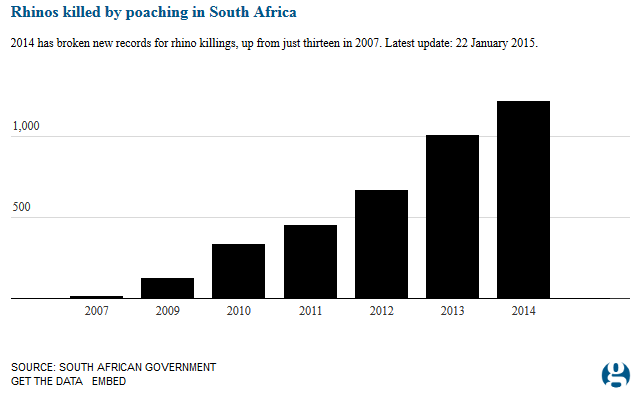
rhino-poaching-trend

The reasons for this acceleration in the Great Global Polishing are complex and not always easy to tease out. But they appear to be connected to rising prosperity in Vietnam, the exhaustion of illegal stocks held by Chinese doctors and, possibly, speculative investment in a scarce and tangible asset during the financial crisis. Corruption and judicial failure help to keep the trade alive.

Already, the western black rhino is extinct (the declaration was made in 2011). The northern white rhino has been reduced to five animals: a male at the end of its anticipated lifespan and four females, scattered between Kenya, the US and the Czech Republic.

Similar stories can be told about some populations of elephants – in particular the forest elephants of West and central Africa.

It’s not just these wonderful, enchanting creatures that are destroyed by poaching, but also many of the living processes of the places they inhabit. Elephants and rhinos are ecological engineers, creating conditions that hundreds of other species have evolved to exploit.

As the paper in Science Advances notes, the great beasts maintain a constantly shifting mosaic of habitats through a cycle of browsing and toppling and trampling, followed by the regrowth of the trees and the other plants they eat. They open up glades for other herbivores, and spaces in which predators can hunt. They spread the seeds of trees that have no other means of dispersal (other animals are too small to swallow the seeds whole, and grind them up). Many trees in Africa and Asia are distributed exclusively by megaherbivores.

They transport nutrients from rich places to poor ones and in some places reduce the likelihood of major bushfires, by creating firebreaks and eating twigs and leaves that would otherwise accumulate as potential fuel on the ground. Many animal species have co-evolved with them: the birds that eat their ectoparasites, the fish that feed on hippos’ fighting wounds (some of these species, I believe, are now used for fish pedicures), the wide range of life that depends on their dung for food and moisture, on their wallows for habitats, on the fissures they create in trees for nesting holes.

Who knows what ecological processes the world has already lost through the retreat of the megafauna? Everywhere on earth, living systems have been radically altered by the loss of the great beasts. (I’ll be discussing the impacts of the extinction of European elephants in next month’s edition of BBC Wildlife magazine).

The destruction of some of the last populations of the animals that shaped us, as well as the natural world, inflicts, I feel, a great wound in our lives, diminishing the wonderful planet on which we evolved, shrinking imagination, crushing experience. All of us should have an interest in supporting those who seek to save these wonderful creatures.

www.monbiot.com

ooOOoo

Dear Reader, I don’t intend to cast you in some dark mental place with the republication of this dark essay from Mr. Monbiot. Yet if you care about the world that we are leaving for the next generation, and I’m certain that the majority, the vast majority, of you readers do so care, then these terrible aspects of humanity must be highlighted. For if just one person is moved to make a difference then the mental pain is a necessary step on that journey of making a difference.

Always search for the rainbow – it’s there somewhere. If

you can’t find one, invent one.Anon.

Beyond humans

Loving the animals on this planet must be more than a romantic notion.

Before you read on, take a small break in your busy day and watch the following:

On December 8, 2013 Michael Mountain spoke on “”I Am Not an Animal” — The Signature Cry of our Species” at the Personhood Beyond the Human conference at Yale University.

Michael Mountain is Past President and one of the founders of Best Friends Animal Sanctuary, the nation’s largest sanctuary for abused and abandoned animals.

Abstract: The past 50 years have seen enormous growth in the animal protection movement. But the situation for nonhuman animals in every sphere, with the exception of homeless pets, continues to deteriorate. Any small advances remain incremental. Animal rights and welfare groups find themselves at a loss to explain their inability to influence the general public. But the work of Ernest Becker (The Denial of Death) and of psychologists in the field of Terror Management Theory (TMT) offer essential insight.

In this talk, we discuss how our need, as humans, to proclaim that “I am not an animal!” and to deny personhood to other animals affects our relationship with them at a fundamental level. We argue that to be effective, the animal protection movement needs to understand TMT and take it into account. And we conclude that a new kind of relationship to the world of nature in the 21st Century is not only essential to the mitigation of the catastrophic effects of the Sixth Great Extinction, but that it also holds the key to Becker’s still-unanswered question of how we can begin to relate positively to our own terror of personal mortality — and therefore our own future as a species.

Me spending time becoming better acquainted with the subject of rights for other animals besides us humans coincided with a recent item published over on The Conversation and republished here within their rights.

ooOOoo

May 19 2015, 4.05pm EDT

Climbing the tree: the case for chimpanzee ‘personhood’

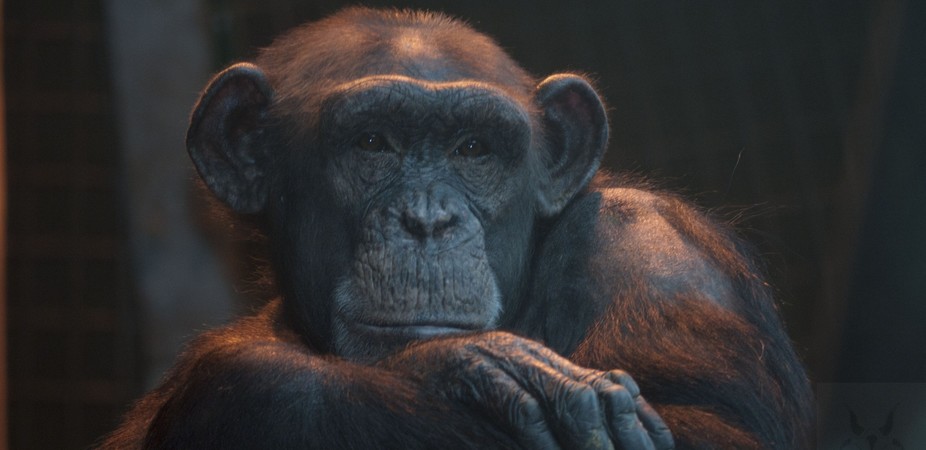
Should primates such as chimpanzees be given rights normally reserved for humans? phil/Flickr, CC BY-NC-SA

Hercules and Leo don’t know it, but a decision about their future has made history. In granting an order to show cause on whether Hercules and Leo (who just happen to be chimpanzees) are illegally imprisoned, a Supreme Court judge in Manhattan has kept open the possibility that some nonhuman animals will be granted legal rights under common law.

The plaintiffs are currently used for biomedical research at New York’s Stony Brook University. What the lawyers running the case hope to show is that Hercules and Leo shouldn’t be treated as if they were just things or property, but should instead be given the status of persons.

Showing that any animal has what is needed for legal personhood is a difficult task. But chimpanzees seem promising candidates as there is a wealth of scientific evidence showing they possess complex cognitive abilities, like self-awareness and autonomy.

The order to show cause on the issue of habeas corpus is the first step in a process which Steven Wise and the Nonhuman Rights Project (NhRP) hope will secure Hercules and Leo’s bodily liberty and integrity.

If the court were to find in their favour, the chimpanzees would no longer be kept for research and could be moved to a sanctuary in Florida.

NhRP was founded by Wise in 2007 and after years of research it filed its first cases back in December 2013. To date it has brought three cases on behalf of chimpanzees held in captivity in the state of New York. But NhRP is ambitious, aiming to run as many cases on behalf of animals as it can fund.

If it can find suitable plaintiffs, NhPR hopes to mount cases for the personhood of elephants, whales and dolphins too.

Different perspectives on personhood for animals

Reactions to treating nonhuman animals as persons vary widely. Some people think it is ridiculous to even entertain the idea. Persons have to be human – end of story.

For philosophers, this is not very satisfactory. It tries to answer the question of whether animals can be persons by asserting a definition rather than offering an argument. It gets more interesting when people give reasons to support their view.

One approach to defending the idea that only humans are persons involves saying that persons need to participate in society. Society is founded on reciprocity; you can’t just take rights without also assuming responsibilities. And animals like chimpanzees can’t take on responsibilities, so they can’t have rights.

Another tactic is to suggest that there is a whole heap of criteria that one has to meet to be a person. And although humans meet these criteria, nonhuman animals don’t. These criteria could include things like being rational, self-aware, autonomous, having culture and being able to communicate.

The problem is neither of these kinds of arguments stand up to interrogation. There are lots of humans who get the benefit of rights without living up to reciprocal responsibilities, such as young children and people with certain physical or mental impairments.

There are similar difficulties when using a criteria based approach. Just as there are many humans who don’t meet certain criteria for personhood, there are some nonhuman animals who do.

This is known as the “problem of marginal cases”. Taking a consistent approach would mean treating some animals, but not all humans, as worthy of moral consideration.

This is known as the “problem of marginal cases”. Taking a consistent approach would mean treating some animals, but not all humans, as worthy of moral consideration.

There are other people who are sympathetic towards giving greater ethical consideration to animals, but who don’t think using personhood is the best approach. Utilitarians, for example, worry about the capacity to suffer. If a chimpanzee – or for that matter a dog, cat or rat – can experience pleasure and pain, then they matter regardless of whether they meet a test for personhood.

Implications of nonhuman animals as persons

If Wise and the NhRP win their case it will be a significant precedent and other cases will surely follow. Chimpanzees in jurisdictions where successful cases are mounted will no longer be permitted to be used in research or kept in zoos and circuses.

However, less charismatic animals – ones that don’t look like us or where it is not in our interests to grant them rights – won’t be so fortunate. Historically, there is a deep inconsistency in how we treat different types of animals that is not easily overturned, even in the face of compelling legal and ethical arguments.

The case of Hercules and Leo also has connections to Australia. Wise was inspired to practice animal law back in the 1980s after reading the work of Australian philosopher, Peter Singer. The hearing of the case in New York was actually interrupted due to Wise’s long-standing commitment to visit Australia and deliver the 2015 Voiceless Animal Law Lecture Series.

The hearing is now scheduled for 10:30am Wednesday May 27 at the New York County Supreme Court. Those interested in seeking rights for nonhuman animals keenly await the outcome.

ooOOoo

 Towards the end of that piece, one sentence stood out. This one: “Historically, there is a deep inconsistency in how we treat different types of animals that is not easily overturned, even in the face of compelling legal and ethical arguments.

Well it has to be overturned if mankind is to have any future on this planet!

Yet another aspect of our lives where taking a lesson from our dogs would do us no harm.

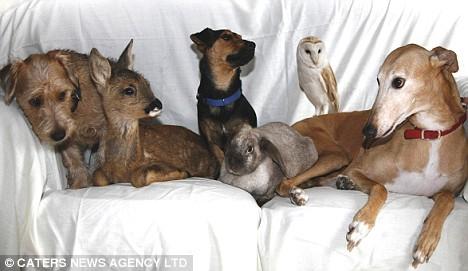
Remember Jasmine the greyhound?

MD6

Pictured left to right are: “Toby”, a stray Lakeland dog; “Bramble”, orphaned roe deer; “Buster”, a stray Jack Russell; a dumped rabbit; “Sky”, an injured barn owl; and “Jasmine”. All told a mother’s heart doing best what a caring mother does.

Just a thought!

A novel Nursing Home plan.

Sent to me by dear friend, Dan Gomez, as a light-hearted diversion for the weekend. (But it did fit rather nicely as a sequel to my Lies, Damn Lies, and … from yesterday!)

ooOOoo

Say you are an older senior citizen and can no longer take care of yourself and the government says there is no Nursing Home care available for you. So, what do you do? You opt for Medicare Part G.

The plan gives anyone 75 or older a gun (Part G) and one bullet. You are allowed to shoot one worthless politician.

This means you will be sent to prison for the rest of your life where you will receive three meals a day, a roof over your head, central heating and air conditioning, cable TV, a library, and all the Health Care you need. Need new teeth? No problem. Need glasses? That’s great. Need a hearing aid, new hip, knees, kidney, lungs, sex change, or heart? They are all covered!

As an added bonus, your kids can come and visit you at least as often as they do now! And who will be paying for all of this? The same government that just told you they can’t afford for you to go into a nursing home. And you will get rid of a useless politician while you are at it. And now, because you are a prisoner, you don’t have to pay any more income taxes!

Is this a great country or what? Now that you have solved your senior financial plan, enjoy the rest of your week!

ooOOoo

I’ll leave the closing words to Dan: “Crazy world but compelling plan.​”

Have a great weekend wherever you are.

Lies, Damn lies, and ….

What is so terrible about integrity!

I don’t know if my title to today’s post is part of a saying that is well-known in the USA. But back in dear old England the expression is widely used; the full expression being, “Lies, Damn Lies, and Politicians“.

So what’s got my ‘knickers in a twist’ about the various hues of ‘truth’ that we find amongst our politicians?

Before answering that question, perhaps I should answer a more fundamental question that might be arising in the minds of those followers who are relatively new to this place. (And each and every one of you has to understand the very great privilege you offer me by being a follower.) That question being what have integrity and politicians got to do with a blog about dogs?

Easily answered in the words over at About this Blog:

The underlying theme of Learning from Dogs is about truth, integrity, honesty and trust in every way. We use the life of dogs as a metaphor.

I subscribe to the blogsite The Conversation (US arm). Back on May 18th, they published an item under the title of How many ways can politicians ‘lie’?

The article seemed to articulate, in a measured and responsible fashion, what huge numbers of us sense subjectively: truth is rare to see in the world of power and politics.

I’m not going to republish it in full, including the tables, but will offer the first half with a link to the rest of the article. The author of the article is Dr. Ellis Jones, Assistant Professor of Sociology at the College of the Holy Cross in Worcester, MA.

How many ways can politicians ‘lie’? How a class led to a ‘truth’ report card for the 2016 election.

I regularly teach a course called The Sociology of Television & Media in which my students and I critically explore newscasts, entertainment programming and (both commercial and political) advertising. The theme that I use as a touchstone throughout the class is: What happens when, as a society, we begin to mix fantasy and reality together in mass media?

We discuss how a range of troubling outcomes emerge for a public that has difficulty telling truth from fiction. Max Horkheimer, a German-Jewish sociologist, argued that this is part of what led to the rise of Nazism in Germany.

Once we lose our ability to detect lies, we become vulnerable to demagogues.

Six categories of rhetoric

About halfway through the semester, I have students deconstruct political ads, and we discuss practical resources for navigating the web of truths, half-truths and outright lies that proliferate unhindered during each election cycle.

One resource that I offer is Politifact.org’s Truth-o-Meter. Students fact-check politicians’ statements to determine how much, if any, truth is contained therein (they actually won a Pulitzer Prize for their work fact-checking the 2008 election).

The first, and perhaps most important, takeaway from their work is that modern political statements cannot accurately be rated as simply “true” or “false.” So sophisticated has the art of mixing truth and lies become that the scale Politifact currently uses includes six separate categories of political rhetoric: true, mostly true, half true, mostly false, false and “pants on fire” (for statements that aren’t just false but also completely ludicrous – and yet still stated as truth).

In essence, while there is still but one way to tell the truth, there are now at least five times as many acceptable ways to lie.

For example, John Boehner’s May 3 2015 statement on Meet The Press that “we spend more money on antacids than we do on politics” is rated simply “false.” Fact-checking reveals that in the US, we spent somewhere between US$3 billion and US$7 billion on elections in 2014 (depending on what money streams you include), while we spent less than $2 billion on antacids in the same year.

Boehner’s team was apparently trying to compare global sales of antacids (including all seven billion people on the planet) to US spending on elections (about 320 million of us) – a false comparison.

On April 23 2015, Hillary Clinton provided a good illustration of a statement that rates as a “half truth.” When addressing the Women in the World Summit in New York City, Clinton asserted that the US ranks “65th out of 142 nations” when it comes to equal pay for women. The statistic comes from the World Economic Forum’s 2014 Global Gender Gap Report.

However, the primary measure generated by this report ranks the US 20th in gender equity. The ranking of 65th is taken from a subcategory in the report that relies on a survey of perceptions of executives rather than hard numbers. So, while it is technically true, it may actually be overstating the severity of the gender pay gap comparison.

Whom can we trust?

The second takeaway, though it may not be much of a surprise, is that there are no politicians in this country that exclusively tell the truth. Every single one, to a greater or lesser extent, spins, bends, twists or breaks the truth.

Perhaps this is the price of power in our modern democracy, but we should find it at least a little troubling.

So where does this leave us? Well, knowing that every one of our politicians lies, the most important question, in my mind, becomes: Who is most often telling the truth and who is lying to us repeatedly in order to gain our support?

In other words, whom can and whom can’t we trust?

With this question in mind, I had my students add up the raw numbers for 25 major politicians (based on Politifact’s fact-checking over the past eight years) and write the results up on the board in rank order from most to least honest based on the data. The results were intriguing.

While the prototype point system was not particularly sophisticated (two points for each true statement, one point for each mostly true statement, zero for half-truths, etc.), the numbers revealed that many well-known politicians were abusing the truth far more than they were embracing it.

When I asked the class what they thought of the results, one student raised her hand and replied, “I’m not shocked.” Many of the others immediately nodded their heads in agreement.

I wondered if we’ve become so accustomed to the bending and breaking of the truth that we no longer expect truth from our leaders. Now we’re teaching the next generation not to expect it either.

After seeing these preliminary results, I was hooked.

Please do read the rest of this fascinating and hugely helpful report. It names names in terms of the ‘good, bad and ugly’!

However, the closing paragraphs of Dr. Jones’ article are so wonderful that I can’t resist republishing them!

As teachers, caught up in our own subject matter, we easily forget that our students are hungry to apply what they’re being taught in our classes to something meaningful in their own lives.

It is our obligation to offer each generation a sense of social responsibility, hope for the future and the practical tools that will allow them to build it for themselves.

Something like a yearly Honesty Report Card might serve us well at this point in our democracy’s evolution. At the very least, let’s use this idea as a starting point for some kind of political unity in this country.

Whether you are liberal or conservative, can’t we at least agree that our politicians should start telling us the truth?

At this point in preparing today’s post, I wanted, wanted so much, something to take me away into some dreamy corner of my mind. For just a few minutes to be distracted from the present day realities of life.

I chose to do it by listening to this track from Chris Rea.

Oh, nearly forgot to mention that dogs don’t lie!

We are what we eat!

Some aspects of our food that many of us would rather not know about!

Many readers will be used to me republishing the essays from George Monbiot. Admittedly, not every single one of them but especially those that seem to have a message that deserves a wider promulgation. Having Mr. Monbiot’s permission to so do is generous of him.

Yesterday, there was an essay written by him that was published both on his blog and in the UK’s Guardian Newspaper. At first reading, it seemed to apply predominantly to the United Kingdom. Then, upon a second reading, I was convinced that this was yet another ‘message’ that quite happily fits in here, on Learning from Dogs. Because it is another reminder that integrity is missing from so many aspects of our societies.

You be the judge!

ooOOoo

Fowl Deeds

19th May 2015

The astonishing, multiple crises caused by chicken farming.

By George Monbiot, published in the Guardian 20th May 2015

It’s the insouciance that baffles me. To participate in the killing of an animal: this is a significant decision. It spreads like a fungal mycelium into the heartwood of our lives. Yet many people eat meat sometimes two or three times a day, casually and hurriedly, often without even marking the fact.

I don’t mean to blame. Billions are spent, through advertising and marketing, to distract and mollify, to trivialise the weighty decisions we make, to ensure we don’t connect. Even as we search for meaning and purpose, we want to be told that our actions are inconsequential. We seek reassurance that we are significant, but that what we do is not.

It’s not blind spots we suffer from. We have vision spots, tiny illuminated patches of perception, around which everything else is blanked out. How often have I seen environmentalists gather to bemoan the state of the world, then repair to a restaurant in which they gorge on beef or salmon? The Guardian and Observer urge us to go green, then publish recipes for fish whose capture rips apart the life of the sea.

The television chefs who bravely sought to break this spell might have been talking to the furniture. Giant chicken factories are springing up throughout the west of England, the Welsh Marches and the lowlands of the east. I say factories for this is what they are: you would picture something quite different if I said farm; they are hellish places. You might retch if you entered one, yet you eat what they produce without thinking.

Two huge broiler units are now being planned to sit close to where the River Dore rises, at the head of the Golden Valley in Herefordshire, one of the most gorgeous landscapes in Britain. Each shed at Bage Court Farm – warehouses 90 metres long – is likely to house about 40,000 birds, that will be cleared out, killed and replaced every 40 days or so. It remains to be seen how high the standards of welfare, employment and environment will be.

The UK now has some 2,000 of these factories, to meet a demand for chicken that has doubled in 40 years [1]. Because everything is automated, they employ few people, and those in hideous jobs: picking up and binning the birds that drop dead every day, catching chickens for slaughter in a flurry of shit and feathers, then scraping out the warehouses before the next batch arrives.

The dust such operations raise is an exquisite compound of aerialised faeces, chicken dander, mites, bacteria, fungal spores, mycotoxins, endotoxins, veterinary medicines, pesticides, ammonia and hydrogen sulphide. It is listed as a substance hazardous to health, and helps explain why 15% of poultry workers suffer from chronic bronchitis. Yet, uniquely in Europe, the British government classifies unfiltered roof vents on poultry sheds as the “best available technology”. If this were any other industry, it would be obliged to build a factory chimney to disperse the dust and the stink. But farming, as ever, is protected by deference and vested interest, excused from the regulations, planning conditions and taxes other business must observe. Already, Herefordshire County Council has approved chicken factories close to schools, without surveying the likely extent of the dust plumes either before or after the business opens. Bage Court Farm is just upwind of the village of Dorstone.

Inside chicken factories are scenes of cruelty practised on such a scale that they almost lose their ability to shock. Bred to grow at phenomenal speeds, many birds collapse under their own weight, and lie in the ammoniacal litter, acquiring burns on their feet and legs and lesions on their breasts. After slaughter they are graded. Those classified as grade A can be sold whole. The others must have parts of the body removed, as they are disfigured by bruising, burning and necrosis. The remaining sections are cut up and sold as portions. Hungry yet?

Plagues spread fast through such factories, so broiler businesses often dose their birds with antibiotics. These require prescriptions but – amazingly – the government keeps no record of how many are issued. The profligate use of antibiotics on farms endangers human health, as it makes bacterial resistance more likely.

But Herefordshire, like other county councils in the region, scarcely seems to care. How many broiler units has it approved? Who knows? Searches by local people suggest 42 in the past 12 months. But in December the council claimed it has authorised 21 developments since 2000. [2] This week it told me it has granted permission to 31 since 2010. It admits that it “has not produced any specific strategy for managing broiler unit development” [3]. Nor has it assessed the cumulative impact of these factories. At Bage Court Farm, as elsewhere, it has decided that no environmental impact assessment is needed [4].

So how should chicken be produced? The obvious answer is free range, but this exchanges one set of problems for another. Chicken dung is rich in soluble reactive phosphate. Large outdoor flocks lay down a scorching carpet of droppings, from which phosphate can leach or flash into the nearest stream. Rivers like the Ithon, in Powys, are said to run white with chicken faeces after rainstorms. The River Wye, a special area of conservation, is blighted by algal blooms: manure stimulates the growth of green murks and green slimes that kill fish and insects when they rot. Nor does free range solve the feed problem: the birds are usually fed on soya, for which rainforests and cerrado on the other side of the world are wrecked.

There is no sensible way of producing the amount of chicken we eat. Reducing the impact means eating less meat – much less. I know that most people are not prepared to stop altogether, but is it too much to ask that we should eat meat as our grandparents did, as something rare and special, rather than as something we happen to be stuffing into our faces while reading our emails? To recognise that an animal has been sacrificed to serve our appetites, to observe the fact of its death, is this not the least we owe it?

Knowing what we do and what we induce others to do is a prerequisite for a life that is honest and meaningful. We owe something to ourselves as well: to overcome our disavowal, and connect.

http://www.monbiot.com

[1] Total purchases for household consumption (uncooked, pre-cooked and take-aways combined) rose from 126 grammes per person per week in 1974 to 259 grammes in 2013 (see the database marked UK – household purchases).

[2] BBC Hereford and Worcester, 15th December 2014

[3] Response to FoI request IAT 7856, 13th August 2014

[4] Herefordshire County Council, 22nd December 2014. Screening Determination of Bage Court Farm development, P143343/F

ooOOoo

Jean and I found a way to watch the BBC Panorama programme that was broadcast recently. It was screened under the title of Antibiotic Apocalypse. This is how the programme was introduced on the BBC website:

Panorama investigates the global advance of antibiotic-resistant superbugs and the threat they pose to modern medicine and millions of patients worldwide. Reporter Fergus Walsh travels to India and finds restricted, life-saving antibiotics on sale without prescription and talks to NHS patients whose recovery depends on them.

There is much in George Monbiot’s essay that resonates with the findings of that Panorama programme. Indeed, the Panorama programme showed the extent of the use of antibiotics in many animals over and beyond chickens.

It hardly needs to be said by me that the reason this is republished in a blog based in Southern Oregon, USA is because this is a problem that is not unique to the United Kingdom; far from it!

What a strange species we humans are!

Wild Nature

Best laid plans of mice and men!

For reasons that I am still unclear about, yesterday slipped through my fingers before I knew it. That’s the worst mental state for me when I am trying to be creative over a new blog post. So it came around to 4:30pm yesterday and I knew that I was faced with two choices: not post or use something stored as a ‘draft’.

That’s what caused me to look through my draft posts folder and offer you this for today.

The videos are short but nonetheless beautiful.

They are the products of an Australian film company: Riggs Australia.

The list of nature films made by Riggs is impressive; to say the least.

Here’s a couple of examples of their wonderful filming.

Published on Oct 15, 2012
This 4 metre plus female great white had just bitten Mark’s cage and was circling when he turned on his camera …. at 1.09 he see’s it approaching from behind his cage. He’s been down at 26 metres for over half an hour and is forced to make a decision. Stay on the bottom and run into decompression time or confront it …. Starvation Bay, South Coast Western Australia, October 2011.

Published on Jun 11, 2014
Aerial perspectives of a huge pod of Bottlenose dolphins surfing waves off Esperance Western Australia … Enjoy!

Our beautiful bees.

Incredible, intimate portraits of bees.

While Jean and I no longer attend meetings of the Southern Oregon Beekeepers Association, the meetings are a little too far away for us, I still subscribe to their email updates. Thus that’s how I was informed of a most incredible set of photographs on the National Geographic website. Here’s how the article opens:

Researchers take advantage of photography technology developed by the U.S. Army to capture beautiful portraits of bees native to North America.

Text by Jane J. Lee

Photography by Sam Droege, USGS

1-carpenter-bee-1600

Bees are the workhorses of the insect world. By transferring pollen from one plant to another, they ensure the next generation of the fruits, nuts, vegetables, and wildflowers we so enjoy.

There are 4,000 species of North American bees living north of Mexico, says Sam Droege, head of the bee inventory and monitoring program at the U.S. Geological Survey (USGS).

Only 40 of them are introduced species, including the European honeybee. (See “Pictures: Colored Honey Made by Candy-Eating French Bees.”)

Most of the natives are overlooked because “a lot of them are super tiny,” Droege says. “The bulk of the bees in the area are about half the size of a honeybee.”

The native species also go unnoticed because they don’t sting, he adds. They quietly go about their business gathering pollen from flowers in gardens, near sand dunes, or on the edges of parks.

The bee pictured above is a species of carpenter bee from the Dominican Republic known as Xylocopa mordax. It nests in wood or yucca stems, and is closely related to the U.S. species that chews through the wood in backyard decks.

2-golden-dusting-1600

Trust me when I say that to view these images, and more, in their breathtaking beauty you need to go here and revel in what you see and read. Plus, in the text above I didn’t include the many links that are in the Nat Geo site’s version – so go there!

The natural world is so deserving of man’s care and protection.

On your bike, Mrs. H.!

My dear wife takes to cycling.

Like most young boys I was on a bicycle at a very young age. Then once sufficiently old to drive a motor car that was the end of bike riding for almost forever. Except that a few months ago the argument for anaerobic exercise as a means of delaying the worst of all the ailments that come with an ageing body (and mind!) convinced me to get back on a bike.  That was made a lot easier because a small group of close neighbours ride three times a week and that seemed an opportunity not to be missed.

Those same neighbours supported, and recommended, a local bike shop in Grants Pass and I have ‘borrowed’ this picture of the store from their website.

Views of the interior of Don's Bike Center, Grants Pass, Oregon.
Views of the interior of Don’s Bike Center, Grants Pass, Oregon.

Having now been riding an average of 35 miles a week for the last ten or twelve weeks, I can vouch for the benefits it is providing.

Logically, therefore, it was going to be much better if Jean could come with me, and the rest of the riding group, each week. But there was a small challenge: Jean had never ridden a bike in her life. Horses, yes! Bicycles, no!

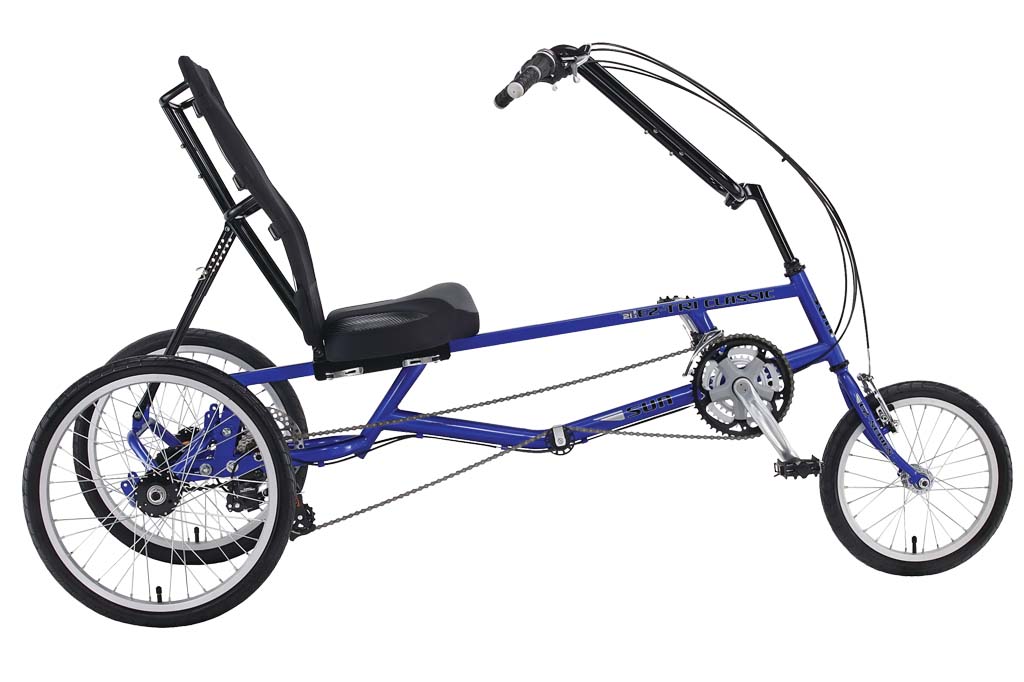
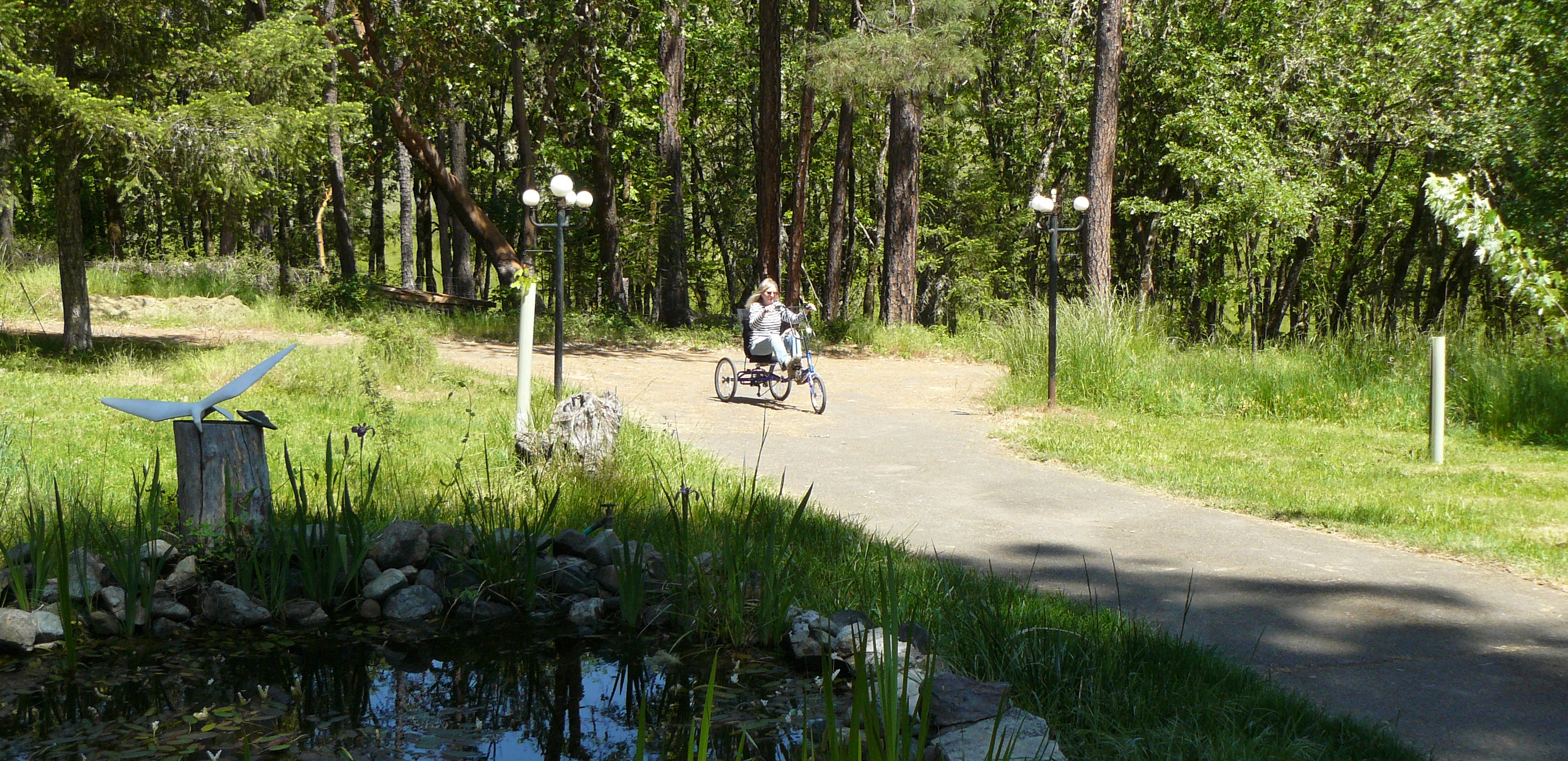
Eric over at the bike centre lent Jean a two-wheeler to try but very quickly it was clear that Jean would not easily develop the confidence to ride on our local roads. The next suggestion from Erik was a tricycle! Not one that was designed in the days of Noah and his Arc but a modern model of the ‘recumbent’ design. In particular, one manufactured by Sun Bicycles. Here’s an image of the trike from the Sun’s website.

Sun EZ Tri Classic SX

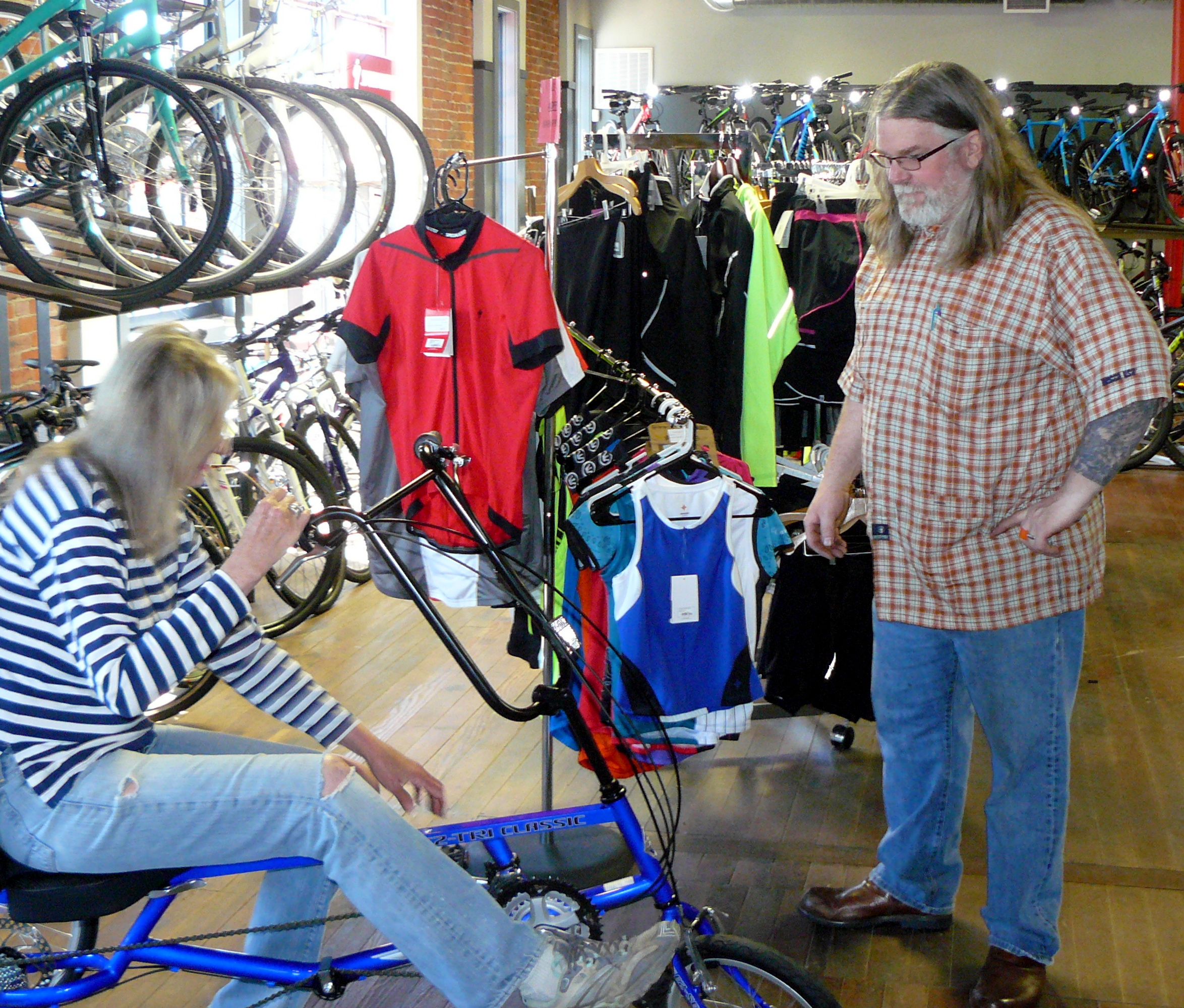
Thus it came about that last Friday Jean and I went over to Don’s Bike Center to collect her new bike.

Eric at the store checking that the bike was properly set up for Jean.

Then once home it was time for Jean to learn a number of very new skills. At first just by riding around our turning circle in front of the house.

P1150655

Then trying out our quarter-mile driveway that includes a couple of steep gradients; well steep for a cycle rider!

P1150660

Another view of Jean getting to know her new bike here at home.

P1150656

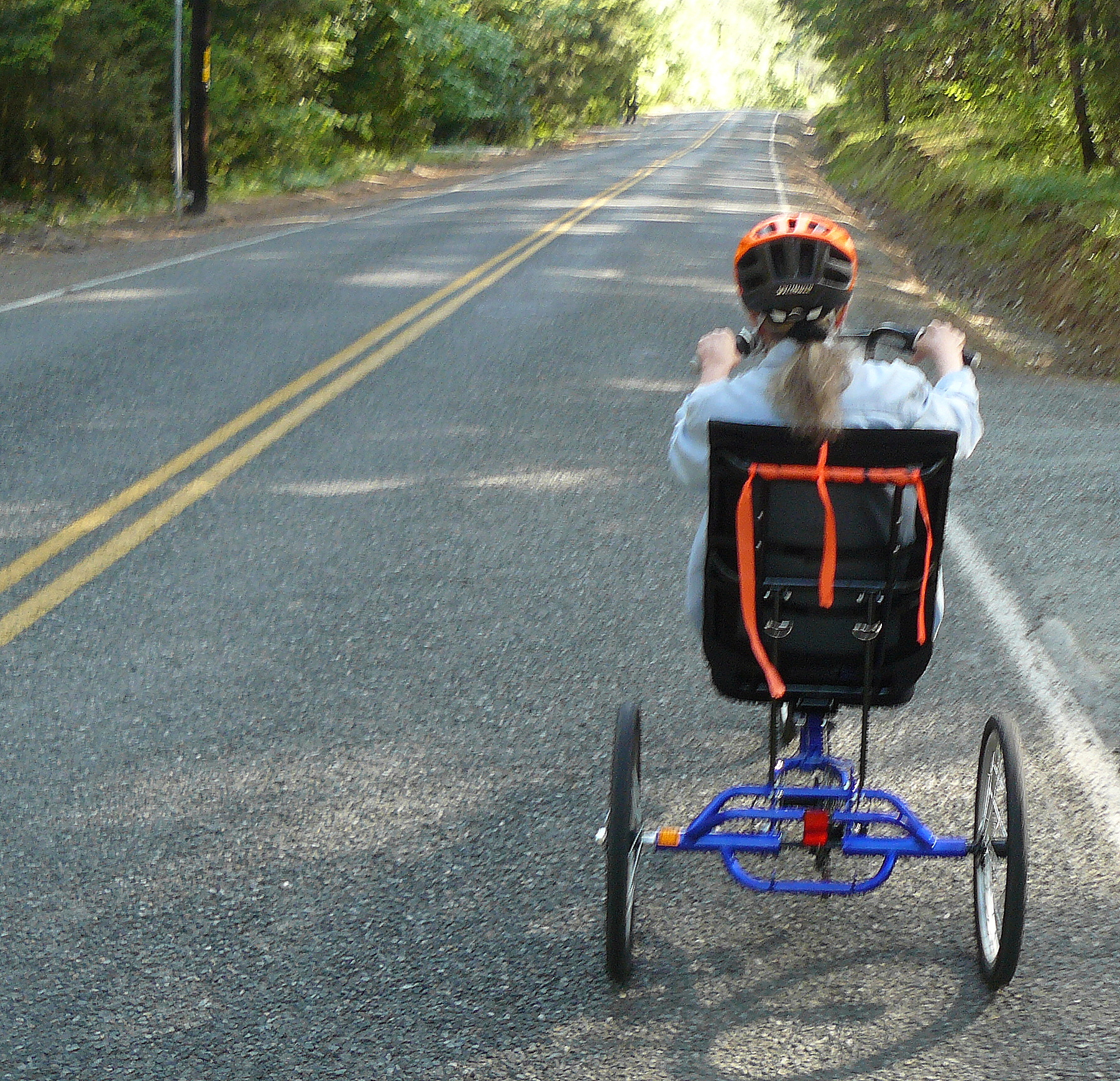
Then, deep breath, time to put on the safety helmet and go for a short ride on Hugo Road, our local road that runs past our property.

Slightly blurred image as I had the camera in my hand as I was riding behind Jean.

So all’s well that ends well!

Jean coming up the road towards the driveway entrance!

I will embarrass Jean by saying to my dear readers that Jean is already getting familiar with riding her trike and it won’t be too long before our riding group will be increased by one Mrs. Handover on her bike!

The things we do to stay healthy in our increasing years!

More sharing of ideas

A positive message from George Monbiot.

I ran out of writing time yesterday so looked for a quick and easy post to offer you.

Not that that undervalues what is presented; far from it!

George Monbiot’s essays are frequently on topics that concern him and rightly so. However, last Thursday George published an essay that offers real hope to those that want to see an end to the ceaseless news of lost species.  It is called Otter Joy and is published with George Monbiot’s kind permission.

ooOOoo

Otter Joy

The return of Britain’s otters offers a glimpse of rewilding’s great rewards

By George Monbiot, published on the Guardian’s website, 7th May 2015

I spent last week travelling with my family across the Scottish Highlands, meeting land managers to discuss possibilities of rewilding. The speed of change there is astonishing, and opportunities for a mass restoration of living systems are emerging faster than I could have imagined even a year ago. I’ll be writing about this in a few weeks, when Rewilding Britain is launched.

But for now I want to talk not about the practicalities of rewilding but about its essence: the reason why this idea excites and inspires me so much that I’ve chosen to devote much of the rest of my life to it.

During our tour across the Highlands we stopped for a few days in the village of Shieldaig, at the head of a sea loch on the west coast. We took a cottage overlooking Shieldaig Island, partly because, for the past few years, white-tailed eagles have been nesting there. After becoming extinct in Britain in 1916, this magnificent bird, bigger than a golden eagle, was reintroduced to the island of Rum in 1975. It has been spreading slowly along the west coast. (It could have moved further across Scotland were it not for shooting and poisoning by grouse estates and others). This is one of the species I would love to see returning to much of the rest of Britain.

Unfortunately, the eagles have chosen another place to nest this year. But there were other returning species to see. I woke one morning when it was still dark, and lay in bed until I heard the song thrush in the sycamore behind the cottage start to sing. I slipped out as the light began to rise over the hills.

There’s a path that leads out of the village, winding north over the headlands and around the small bays of Loch Shieldaig. The willow warblers in the trees along the path had started to sing, and from behind the crest of a hill I heard the cry of an unfamiliar raptor – listening later to recordings, I felt it might have been a white-tailed eagle. There was not a tremor of wind and the air was clear. I could see the promontories and islands stepping away for many miles across a polished sea.

As I came over a low ridge, I noticed a disturbance in the water below me, a few metres from the shore. I dropped into the heather and watched. A moment later, two small heads broke from the sea, then the creatures arced over and disappeared again.

After another moment, the larger one – the dog otter – scrambled out of the water with something thrashing in its mouth. He dropped it onto the rocks, gripped it again, then chewed it up. Then the bitch emerged from the sea beside him, also carrying something, that she dispatched just as quickly. They plunged in again, and I watched the trails of bubbles they made as they rummaged round the roots of the kelp that filled the shallow bay.

When they emerged once more, each with a fish in its mouth, I was able to identify the quarry. They were catching rocklings: small, very slippery fish of the same olive-brown as the kelp. Over the next half hour, each of them caught about fifteen. I marvelled at their ability to grab such difficult prey. I loved the slick, swift movements with which they dived and dolphined and twisted underwater. It looked to me like an expression of pure joy.

Hiding among the rocks and heath, I could keep ahead of the otters without being seen, as they foraged round the coast. As the cliffs became lower, I found myself coming ever closer to them. Then, though I don’t know why, the otters emerged from the water without fish, shook themselves out, and climbed up the rocks, long low bodies undulating, towards me. The dog grunted and huffed while his mate made a high whickering noise. They kept raising their heads and staring in my direction. But as I was buried in the heather and they have weak eyesight, I doubt they could have seen me. Soon they were standing about 20 or 30 feet away, raising their bristly little faces to smell the air. I could hear them panting.

Then they turned and rippled back down the rocks, slipped into the water with scarcely a splash and started hunting round the coast once more. Soon they disappeared around a cliff I couldn’t negotiate.

I walked back elated, recharged with wonder and enchantment. A week later, the feeling still buoys me up.

While many species in this country are in rapid decline, the otter is among the few whose prospects are improving. This is partly because it’s no longer hunted, and partly because of a reduction in the organochlorine insecticides that accumulated up the food chain. But, especially in England, it still inhabits just a fraction of its former range.

Otters are an adaptable species that, given the chance, can quickly recolonise the habitats from which they have been excised. Their hesitant return sharpens the hopes of those of us who want a wilder Britain, who strive for the re-establishment of magnificent, enthralling wildlife that you don’t have to travel halfway around the world to see.

Already otters are beginning to appear in a few towns and cities. As they become accustomed to their protected status, they’re likely to become less shy and easier to watch, bringing nature’s wonders closer to the lives of people who have become disconnected from the living planet. If our advocacy of the widespread return to Britain of animals such as beavers, boar and lynx succeeds (and one day, perhaps, of wolves, bison, pelicans, bluefin tuna and whales of several species), the opportunities for re-enchantment will begin to blossom in places that are currently little more than wildlife deserts.

Everyone should be able to experience such marvels, and to step outside the ordered, regulated, predictable world of our own making, that sometimes seems to crush the breath out of us.

www.monbiot.com

ooOOoo

If you, like me, are uncertain what the White-tailed eagle looks like then here’s a photograph of one.

Image: Niall Benvie. RSPB.

The image was taken from a news item on the website of the Royal Society for the Protection of Birds and opens:

2011 has proved another record breaking year for breeding pairs of Scotland’s largest bird of prey. White-tailed eagles soared to new heights despite heavy storms throughout the 2011 breeding season.

Conservationists, and many sea eagle enthusiasts, had been concerned that the high winds felt across Scotland in May could have had a detrimental impact on breeding white-tailed eagles at the vulnerable part of the season when most nests contain small chicks. Indeed, some nests failed including that of BBC Springwatch star, nicknamed “Itchy”, who experts fear lost his chicks in the storm.

However, the bad weather failed to blow the species off course. Recent survey figures for the 2011 breeding season reveal that there were 57 territorial pairs in Scotland, an increase of 10 per cent on the previous year. A total of 43 young fledged successfully from these nests.

George’s essay also mentioned the Scottish sea otter.

RICHARD PETERS photography

This image came from a post on Richard Peters’ Wildlife Photography blog which is very well worth visiting.

Sharing Ideas.

There’s no limit to learning.

I can’t recall how but recently I came across an online source of analysis, ideas and research that calls itself The Conversation. In their folder How we’re different, (in part) they explain:

The Conversation US launched as a pilot project in October 2014. It is an independent source of news and views from the academic and research community, delivered direct to the public.

Our team of professional editors work with university and research institute experts to unlock their knowledge for use by the wider public.

Access to independent, high quality, authenticated, explanatory journalism underpins a functioning democracy. Our aim is to promote better understanding of current affairs and complex issues. And hopefully allow for a better quality of public discourse and conversation.

We aim to help rebuild trust in journalism. All authors and editors sign up to our Editorial Charter. All contributors must abide by our Community Standards policy. We only allow authors to write on a subject on which they have proven expertise, which they must disclose alongside their article. Authors’ funding and potential conflicts of interest must also be disclosed. Failure to do so carries a risk of being banned from contributing to the site.

The Conversation launched in Australia in March 2011 and​ the UK in May 2013.

So with no further ado, and within the terms of The Conversation, may I share:

What does it mean to preserve nature in the Age of Humans?

Ben A Minteer, Arizona State University and Stephen Pyne, Arizona State University

Is the Earth now spinning through the “Age of Humans?” More than a few scientists think so. They’ve suggested, in fact, that we modify the name of the current geological epoch (the Holocene, which began roughly 12,000 years ago) to the “Anthropocene.” It’s a term first put into wide circulation by Nobel-Prize winning atmospheric chemist Paul Crutzen in an article published in Nature in 2002. And it’s stirring up a good deal of debate, not only among geologists.

The idea is that we needed a new planetary marker to account for the scale of human changes to the Earth: extensive land transformation, mass extinctions, control of the nitrogen cycle, large-scale water diversion, and especially change of the atmosphere through the emission of greenhouse gases. Although naming geological epochs isn’t usually a controversial act, the Anthropocene proposal is radical because it means that what had been an environmental fixture against which people acted, the geological record, is now just another expression of the human presence.

It seems to be a particularly bitter pill to swallow for nature preservationists, heirs to the American tradition led by writers, scientists and activists such as John Muir, Aldo Leopold, David Brower, Rachel Carson and Edward Abbey. That’s because some have argued the traditional focus on the goal of wilderness protection rests on a view of “pristine” nature that is simply no longer viable on a planet hurtling toward nine billion human inhabitants.

Given this situation, we felt the time was ripe to explore the impact of the Anthropocene on the idea and practice of nature preservation. Our plan was to create a salon, a kind of literary summit. But we wanted to cut to the chase: What does it mean to “save American nature” in the age of humans?

We invited a distinguished group of environmental writers – scientists, philosophers, historians, journalists, agency administrators and activists – to give it their best shot. The essays appear in the new collection, After Preservation: Saving American Nature in the Age of Humans.

Getting the chronology right, it turns out, matters less than we might think. The historian J R McNeill recounts the difficulty in fixing a clear start date for the Anthropocene. (Should it coincide with the late Pleistocene megafaunal extinctions? The rise of agriculture? The birth of the industrial era in the 19th century? The mid-20th century uptick in carbon emissions?) Wherever we peg it, McNeill argues, the future of nature preservation in America will increasingly be shaped by environmental traditions more congruent with notions of a human-driven world.

Is humanity now ‘too big for nature?’ (Photo by Mark Klett)
Trails of Weekend Explorers, near Hanksville, CC BY-NC-ND

It’s a view shared by ecologist Erle Ellis. We’ve simply “outgrown” nature, Ellis argues, and so we have to become more comfortable within the “used and crowded planet” we’ve made. Andrew Revkin, author of the Dot Earth environmental blog for the New York Times, sounds a similar theme, arguing that the whole idea of “saving” a nature viewed outside the human presence is an anachronism. What we need instead, he suggests, is to focus on restoring a bipartisan politics able to cope with the challenges of living in and managing a human-driven world.

But all this talk of a more human-driven world and a species that is now “too big for nature” is dismissed by wilderness activist Dave Foreman, who spies a dark future awaiting us if we continue on the current path. Foreman condemns the vision of the “Anthropoceniacs” who he argues are promoting nothing less than the technological takeover of life on the planet. We need to remind ourselves, he writes, “that we are not gods.”

The need for humility courses throughout After Preservation. But it’s joined by an equally strong plea for pragmatism and more intelligent control. As science journalist Emma Marris writes, the desire to restrain ourselves in nature may ironically prove self-defeating if it means we can’t intervene to prevent present and future species extinctions. The biologist Harry Greene echoes this view with his manifesto to “rewild” the Anthropocene by actively introducing cheetahs, elephants, camels and lions to North America as proxies for the long-lost megafauna of the Pleistocene. It’s a rebooting of the wilderness idea – or maybe a wilderness 2.0 – for the technological age.

Regardless of how the Anthropocene debate plays out, environmental science and policy experts Norm Christensen and Jack Ward Thomas remind everyone how hard it is to implement whatever we want on the ground without unexpected consequences. Thomas, a former chief of the US Forest Service, describes how the unpredictability of ecosystems can result in cases in which the preservationist agenda becomes complicated as ecosystems change in surprising ways (for instance, when an unplanned growth in the barred owl population starts to displace the protected northern spotted owl in the Pacific Northwest).

The Anthropocene has become an environmentalist Rorshach. (Photo by Mark Klett)
Computer Monitor Washed Down Stream by Flood Waters, Salt River, CC BY-NC-ND

Much of the discussion of the Anthropocene must hinge on values. But many of our authors conclude that it also needs grounding in a deeper and more nuanced understanding of history. As historians Donald Worster and Curt Meine point out, even if purist notions of the wilderness may no longer be realistic in the Anthropocene, it would be a grave mistake to jettison our environmental traditions and the commitment to protecting as much wildness as we can.

Even so, many suggest that nature conservation will have to evolve in order to reflect a more diverse constituency, an urban population not well served by the older preservationist values and images. Or, as ecologist Michelle Marvier and The Nature Conservancy’s Hazel Wong sum it up, “Move over, Grizzly Adams.”

The debate wasn’t settled at the end of After Preservation but we didn’t expect it to be. The argument has deep roots, as the writer and climate activist Bill McKibben reminds us in his coda to the book. And in one way or another, pragmatists and preservationists have been at odds since the birth of the American conservation movement in the late 19th century. The Anthropocene debate is only the most recent replaying of this enduring struggle.

What way forward? We think John McPhee probably got it about right nearly forty years ago in his memorable portrait of modern Alaska, Coming into the Country:

Only an easygoing extremist would preserve every bit of country. And extremists alone would exploit it all. Everyone else has to think the matter through – choose a point of tolerance, however much the point might tend to one side.

Our hope is that After Preservation will help us choose that point of tolerance as we puzzle through the environmental ethos of the Anthropocene. We’ve little choice: it’s going to be a challenge confronting the meaning and work of nature preservation for some time to come.

The Conversation

Ben A Minteer is Arizona Zoological Society Endowed Chair at Arizona State University.
Stephen Pyne is Regents Professor in the School of Life Sciences at Arizona State University.

This article was originally published on The Conversation.
Read the original article.

ooOOoo

No matter what people tell you, words and ideas can change the world.” Robin Williams