Category: Musings

Of love, and trauma.

When it comes to animals it’s practically impossible to have one without the other.

Today’s post was inspired by a comment left on yesterday’s post The most beautiful bond of all by MargfromTassie. This is what she wrote (my emphasis):

Yes, these people are inspirational as are all the people who voluntarily give their time and efforts to animal welfare work, sometimes for years. For many, it can be emotionally traumatising as well as rewarding.

It didn’t take me long to agree that for most it will be emotionally traumatising. In fact, one of the great lessons that we learn from our dogs, and all the other animals that we love, is that unconditional love brings with it emotional trauma.

So much better expressed by Suzanne Clothier in her book Bones Would Rain from the Sky: Deepening Our Relationships with Dogs

There is a cycle of love and death that shapes the lives of those who choose to travel in the company of animals. It is a cycle unlike any other. To those who have never lived through its turnings or walked its rocky path, our willingness to give our hearts with full knowledge that they will be broken seems incomprehensible. Only we know how small a price we pay for what we receive; our grief, no matter how powerful it may be, is an insufficient measure of the joy we have been given.

Our grief is always an insufficient measure of the joy we receive!

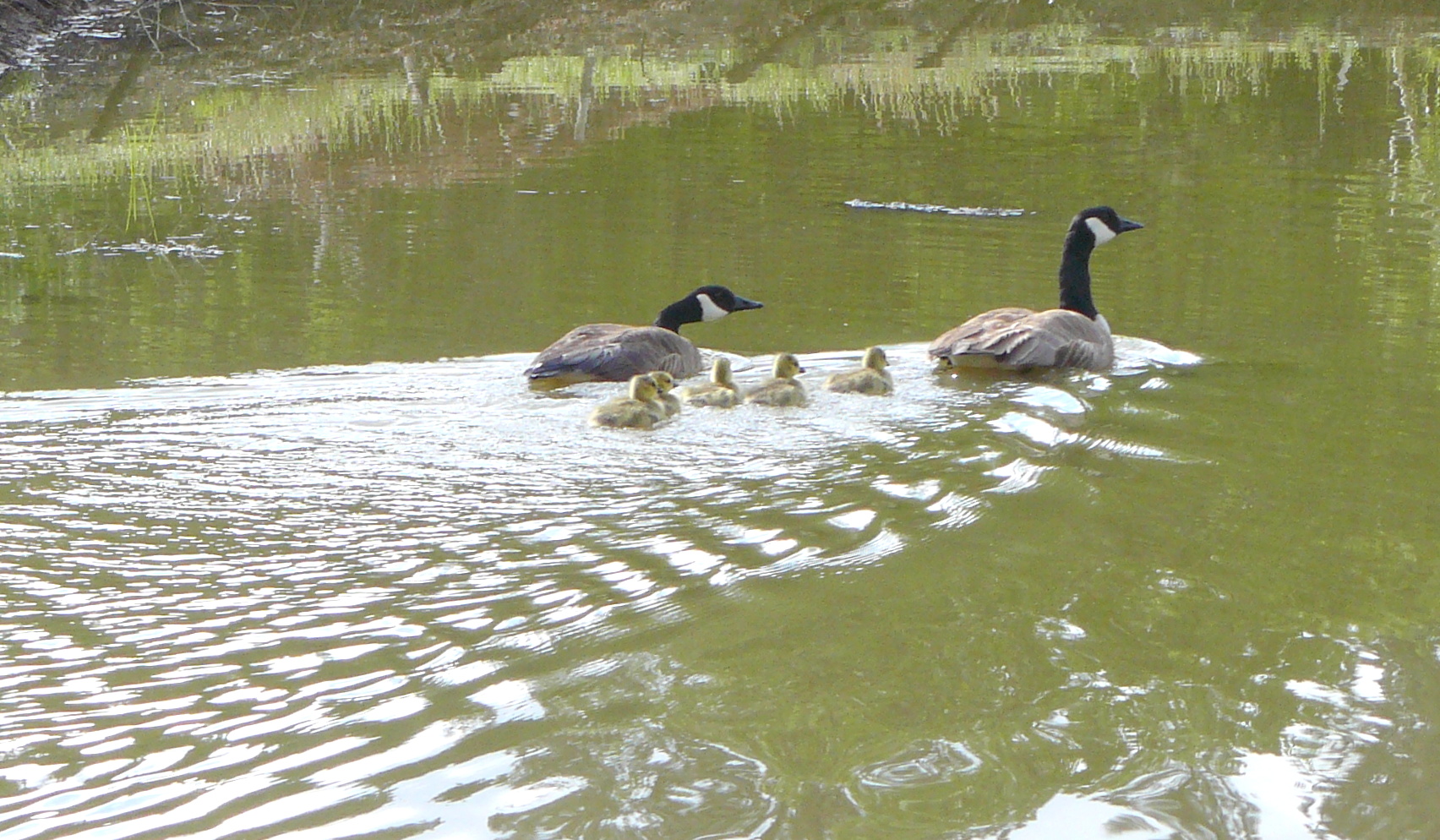
Speaking of joy, when we pulled back the bedroom curtains this morning (Thursday) the nest was empty!

P1160060For the last too many weeks to remember a mother Canadian Goose has been sitting on her nest of eggs with Father Goose staying close. We like to think that the mother returned to this place after having been born here a year ago.

Overnight five young healthy goslings were born! 🙂

P1160059May their little lives be full of love with a total absence of trauma!

Chew on this!

Why it’s impossible to actually be a vegetarian!

Jean and I are both vegetarians. Indeed, Jean has been a ‘veggie’ for decades and I swung inline with her when we started being together in 2008.

So it was natural (pun unintended!) for my eyes to notice a recent item that was published over on The Conversation.

Not only is it an interesting article but it also saved my bacon (pun intended!) when I was running out of time and wondering what to post for today.

The article is republished here within the generous terms of The Conversation.

ooOOoo

Why it’s impossible to actually be a vegetarian

April 26, 2016

In a sense, aren’t they one and the same? 'Heads' via www.shutterstock.com
In a sense, aren’t they one and the same? ‘Heads’ via http://www.shutterstock.com

In case you’ve forgotten the section on the food web from high school biology, here’s a quick refresher.

Plants make up the base of every food chain of the food web (also called the food cycle). Plants use available sunlight to convert water from the soil and carbon dioxide from the air into glucose, which gives them the energy they need to live. Unlike plants, animals can’t synthesize their own food. They survive by eating plants or other animals.

Clearly, animals eat plants. What’s not so clear from this picture is that plants also eat animals. They thrive on them, in fact (just Google “fish emulsion”). In my new book, “A Critique of the Moral Defense of Vegetarianism,” I call it the transitivity of eating. And I argue that this means one can’t be a vegetarian.

Chew on this

I’ll pause to let the collective yowls of both biologists and (erstwhile) vegetarians subside.

A transitive property says that if one element in a sequence relates in a certain way to a second element, and the second element relates in the same way to a third, then the first and third elements relate in the same way as well.

Take the well-worn trope “you are what you eat.” Let’s say instead that we are “who” we eat. This makes the claim more personal and also implies that the beings who we make our food aren’t just things.

How our food lives and dies matters. If we are who we eat, our food is who our food eats, too. This means that we are who our food eats in equal measure.

Plants acquire nutrients from the soil, which is composed, among other things, of decayed plant and animal remains. So even those who assume they subsist solely on a plant-based diet actually eat animal remains as well.

This is why it’s impossible to be a vegetarian.

For the record, I’ve been a “vegetarian” for about 20 years and nearly “vegan” for six. I’m not opposed to these eating practices. That isn’t my point. But I do think that many “vegetarians” and “vegans” could stand to pay closer attention to the experiences of the beings who we make our food.

For example, many vegetarians cite the sentience of animals as a reason to abstain from eating them. But there’s good reason to believe that plants are sentient, too. In other words, they’re acutely aware of and responsive to their surroundings, and they respond, in kind, to both pleasant and unpleasant experiences.

Check out the work of plant scientists Anthony Trewavas, Stefano Mancuso, Daniel Chamowitz and František Baluška if you don’t believe me. They’ve shown that plants share our five senses – and have something like 20 more. They have a hormonal information-processing system that’s homologous to animals’ neural network. They exhibit clear signs of self-awareness and intentionality. And they can even learn and teach.

It’s also important to be aware that “vegetarianism” and “veganism” aren’t always eco-friendly. Look no further than the carbon footprint of your morning coffee, or how much water is required to produce the almonds you enjoy as an afternoon snack.

A word for the skeptics

I suspect how some biologists may respond: first, plants don’t actually eat since eating involves the ingestion – via chewing and swallowing – of other life forms. Second, while it’s true that plants absorb nutrients from the soil and that these nutrients could have come from animals, they’re strictly inorganic: nitrogen, potassium, phosphorus and trace amounts of other elements. They’re the constituents of recycled minerals, devoid of any vestiges of animality.

As for the first concern, maybe it would help if I said that both plants and animals take in, consume or make use of, rather than using the word “eat.” I guess I’m just not picky about how I conceptualize what eating entails. The point is that plants ingest carbon dioxide, sunlight, water and minerals that are then used to build and sustain their bodies. Plants consume inasmuch as they produce, and they aren’t the least bit particular about the origins of the minerals they acquire.

With respect to the second concern, why should it matter that the nutrients drawn by plants from animals are inorganic? The point is that they once played in essential role in facilitating animals’ lives. Are we who we eat only if we take in organic matter from the beings who become our food? I confess that I don’t understand why this should be. Privileging organic matter strikes me as a biologist’s bias.

Then there’s the argument that mineral recycling cleanses the nutrients of their animality. This is a contentious claim, and I don’t think this is a fact of the matter. It goes to the core of the way we view our relationship with our food. You could say that there are spiritual issues at stake here, not just matters of biochemistry.

Changing how we view our food

Let’s view our relationship with our food in a different way: by taking into account the fact that we’re part of a community of living beings – plant and animal – who inhabit the place that we make our home.

We’re eaters, yes, and we’re also eaten. That’s right, we’re part of the food web, too! And the well-being of each is dependent on the well-being of all.

From this perspective, what the self-proclaimed “farmosopher” Glenn Albrecht calls sumbiotarianism (from the Greek word sumbioun, to live together) has clear advantages.

Sumbioculture is a form of permaculture, or sustainable agriculture. It’s an organic and biodynamic way of farming that’s consistent with the health of entire ecosystems.

Sumbiotarians eat in harmony with their ecosystem. So they embody, literally, the idea that the well-being of our food – hence, our own well-being – is a function of the health of the land.

In order for our needs to be met, the needs and interests of the land must come first. And in areas where it’s prohibitively difficult to acquire the essential fats that we need from pressed oils alone, this may include forms of animal use – for meat, manure and so forth.

Simply put, living sustainably in such an area – whether it’s New England or the Australian Outback – may well entail relying on animals for food, at least in a limited way.

All life is bound together in a complex web of interdependent relationships among individuals, species and entire ecosystems. Each of us borrows, uses and returns nutrients. This cycle is what permits life to continue. Rich, black soil is so fertile because it’s chock full of the composted remains of the dead along with the waste of the living.

Indeed, it’s not uncommon for indigenous peoples to identify veneration of their ancestors and of their ancestral land with the celebration of the life-giving character of the earth. Consider this from cultural ecologist and Indigenous scholar-activist Melissa Nelson:

The bones of our ancestors have become the soil, the soil grows our food, the food nourishes our bodies, and we become one, literally and metaphorically, with our homelands and territories.

You’re welcome to disagree with me, of course. But it’s worth noting that what I propose has conceptual roots that may be as old as humanity itself. It’s probably worth taking some time to digest this.

ooOOoo

In reflecting on how to close this post I couldn’t help thinking that “The bones of our ancestors have become the soil, ” presumably includes the bones of our dogs! Leading me to ponder that maybe our dogs from old are nourishing our bodies; I would like to think that is the case.

Inner Thinking: Of dogs and humans.

We are what we think about most.

Today’s post was inspired by something yesterday I read, not for the first time, over on The People Workshop site. (As an aside, I know that many regulars of this place are familiar with the history of my friendship with Jon.) On the page that explains more of Jon Lavin’s approach to his work with clients, he writes:

“We can’t solve problems by using the same kind of thinking we used when we created them.”

Thus said Albert Einstein (1879-1955).

Intuitively, it strikes one as correct. However, reflect for a few moments on how you think and very quickly it becomes clear that how you think is based on deep-seated experiences and the learnings that flow from those experiences.

As it is for all of us.

Just as relevantly, perhaps more so, is that how we behave is based on those same deep-seated experiences and subsequent learnings. This offers a clue as to why bringing about lasting, behavioural change can often feel like pushing water uphill!

That prompted me to look up a previous time when I had written a post about feelings. It was last December when in a post called Feelings – Of Both Humans and Animals, I wrote this:

There couldn’t have been a better answer to that ponder than a recent video that was presented by TED Talks. It was a talk by Carl Safina about what is going on inside the brains of animals: What are animals thinking and feeling? Or in the fuller words of that TED Talk page:

What’s going on inside the brains of animals? Can we know what, or if, they’re thinking and feeling? Carl Safina thinks we can. Using discoveries and anecdotes that span ecology, biology and behavioral science, he weaves together stories of whales, wolves, elephants and albatrosses to argue that just as we think, feel, use tools and express emotions, so too do the other creatures – and minds – that share the Earth with us.

So back to what inspired today’s post. It was the challenge of really knowing why we behave the way we do, both humans and dogs. With dogs, however, we accept they cannot speak to us clearly. Or as Esme put it in a recent reply to an update on Hazel: “Well you’re getting there, half the battle is diagnosis with dogs because they can’t actually tell us how they feel.” (My emphasis.)

Back to humans. When Jon wrote on his site, “…. how you think  …… is based on deep-seated experiences ….”, what I heard is that for us humans there are many times when we cannot actually tell ourselves what we are feeling. That is why we need the counselling of someone who has the professional training and experience to expose those deep emotional and psychological drivers within us; those drivers that are normally out of sight from us.

In my own case, how my father’s death was managed by my mother back in December, 1956 left an emotional wound that was totally out of sight from my conscious mind for 50 years.  The emotional crisis that I went through back then was discovered by Jon to have its roots back in December, 1956. By a massive stroke of fortune Jon gave me the insight into that mental place of old and a year later I met Jean down in Mexico.

In other words, to return to Albert Einstein:

We can’t solve problems by using the same kind of thinking we used when we created them.

The challenge is having sufficient self-awareness to know when an aspect of our behaviour requires the support of the Jon Lavins of this world.

So what would we require from a counsellor, from a therapist, who was working with us to uncover those hidden aspects? In other words, in terms of assessing that therapist what’s the difference that would make the difference?

Naturally, I don’t have the skills to answer that question in any direct, professional manner. But if I look down at our dogs then a form of answer does ‘speak’ to me. Dogs are creatures of integrity, openness and trust. They relate to us humans and other known dogs around them through friendship and love; frequently unconditional love.

A therapist who embraces those values; nay, lives those values, would display that very quickly after meeting with the ‘client’. Any person seeing that in a therapist would be seeing the difference that makes the difference.

Good people, I’m not asking any of you who read this to divulge any personal stuff but, nonetheless, I would love to hear your thoughts on what I have written today!


Reflections on the internet.

An interesting item that recently crossed my ‘screen’.

I make no apologies for cutting corners for today’s post. Because the last few days of looking after, and worrying about, Hazel have soaked up so much of our time and energy that I just couldn’t find the creative impulse to do much more than ‘copy and paste’.

That’s not to downplay the great interest of this article that appeared over on The Conversation blogsite a few days ago.

ooOOoo

Why the Internet isn’t making us smarter – and how to fight back

April 15, 2016 5.58am EDT

Professor of Psychology, University of Michigan

Disclosure statement: David Dunning has received funding from the National Science Foundation, the National Institutes of Health, and the Templeton Foundation in the past.

In the hours since I first sat down to write this piece, my laptop tells me the National Basketball Association has had to deny that it threatened to cancel its 2017 All-Star Game over a new anti-LGBT law in North Carolina – a story repeated by many news sources including the Associated Press. The authenticity of that viral video of a bear chasing a female snowboarder in Japan has been called into question. And, no, Ted Cruz is not married to his third cousin. It’s just one among an onslaught of half-truths and even pants-on-fire lies coming as we rev up for the 2016 American election season.

The longer I study human psychology, the more impressed I am with the rich tapestry of knowledge each of us owns. We each have a brainy weave of facts, figures, rules and stories that allows us to address an astonishing range of everyday challenges. Contemporary research celebrates just how vast, organized, interconnected and durable that knowledge base is.

That’s the good news. The bad news is that our brains overdo it. Not only do they store helpful and essential information, they are also receptive to false belief and misinformation.

Just in biology alone, many people believe that spinach is a good source of iron (sorry, Popeye), that we use less than 10 percent of our brains (no, it’s too energy-guzzling to allow that), and that some people suffer hypersensitivity to electromagnetic radiation (for which there is no scientific evidence).

But here’s the more concerning news. Our access to information, both good and bad, has only increased as our fingertips have gotten into the act. With computer keyboards and smartphones, we now have access to an Internet containing a vast store of information much bigger than any individual brain can carry – and that’s not always a good thing.

Better access doesn’t mean better information

This access to the Internet’s far reaches should permit us to be smarter and better informed. People certainly assume it. A recent Yale study showed that Internet access causes people to hold inflated, illusory impressions of just how smart and well-informed they are.

But there’s a twofold problem with the Internet that compromises its limitless promise.

First, just like our brains, it is receptive to misinformation. In fact, the World Economic Forum lists “massive digital misinformation” as a main threat to society. A survey of 50 “weight loss” websites found that only three provided sound diet advice. Another of roughly 150 YouTube videos about vaccination found that only half explicitly supported the procedure.

Rumor-mongers, politicians, vested interests, a sensationalizing media and people with intellectual axes to grind all inject false information into the Internet.

So do a lot of well-intentioned but misinformed people. In fact, a study published in the January 2016 Proceedings of National Academy of Science documented just how quickly dubious conspiracy theories spread across the Internet. Specifically, the researchers compared how quickly these rumors spread across Facebook relative to stories on scientific discoveries. Both conspiracy theories and scientific news spread quickly, with the majority of diffusion via Facebook for both types of stories happening within a day.

Making matters worse, misinformation is hard to distinguish from accurate fact. It often has the exact look and feel as the truth. In a series of studies Elanor Williams, Justin Kruger and I published in the Journal of Personality and Social Psychology in 2013, we asked students to solve problems in intuitive physics, logic and finance. Those who consistently relied on false facts or principles – and thus gave the exact same wrong answer to every problem – expressed just as much confidence in their conclusions as those who answered every single problem right.

For example, those who always thought a ball would continue to follow a curved path after rolling out of a bent tube (not true) were virtually as certain as people who knew the right answer (the ball follows a straight path).

Defend yourself

So, how so we separate Internet truth from the false?

First, don’t assume misinformation is obviously distinguishable from true information. Be careful. If the matter is important, perhaps you can start your search with the Internet; just don’t end there. Consult and consider other sources of authority. There is a reason why your doctor suffered medical school, why your financial advisor studied to gain that license.

Second, don’t do what conspiracy theorists did in the Facebook study. They readily spread stories that already fit their worldview. As such, they practiced confirmation bias, giving credence to evidence supporting what they already believed. As a consequence, the conspiracy theories they endorsed burrowed themselves into like-minded Facebook communities who rarely questioned their authenticity.

Instead, be a skeptic. Psychological research shows that groups designating one or two of its members to play devil’s advocates – questioning whatever conclusion the group is leaning toward – make for better-reasoned decisions of greater quality.

If no one else is around, it pays to be your own devil’s advocate. Don’t just believe what the Internet has to say; question it. Practice a disconfirmation bias. If you’re looking up medical information about a health problem, don’t stop at the first diagnosis that looks right. Search for alternative possibilities.

Seeking evidence to the contrary

In addition, look for ways in which that diagnosis might be wrong. Research shows that “considering the opposite” – actively asking how a conclusion might be wrong – is a valuable exercise for reducing unwarranted faith in a conclusion.

After all, you should listen to Mark Twain, who, according to a dozen different websites, warned us, “Be careful about reading health books. You may die of a misprint.”

Wise words, except a little more investigation reveals more detailed and researched sources with evidence that it wasn’t Mark Twain, but German physician Markus Herz who said them. I’m not surprised; in my Internet experience, I’ve learned to be wary of Twain quotes (Will Rogers, too). He was a brilliant wit, but he gets much too much credit for quotable quips.

Misinformation and true information often look awfully alike. The key to an informed life may not require gathering information as much as it does challenging the ideas you already have or have recently encountered. This may be an unpleasant task, and an unending one, but it is the best way to ensure that your brainy intellectual tapestry sports only true colors.

ooOOoo

The way the world now communicates, for good and bad, using the internet is staggering. As the website Internet Live Stats reveals: (as of this moment today)

3,352,197,085 Internet Users in the world

1,016,623,500 Total number of Websites

2,060,120 Blog posts written today

So with that last figure in mind, I’ll send this for posting without delay! 😉

The essence of our relationship with dogs.

Woman Rescues Burned Puppy and He Grows Up to Save Her Life

This wonderful story was recently published on the Care2 site and is republished here to share with you all and to underline the importance of always trying to find your next pet from a rescue shelter.

ooOOoo

Woman Rescues Burned Puppy and He Grows Up to Save Her Life

2997475.largeBy: Laura S. April 6, 2016

About Laura

Editor’s note: This post was originally published on January 7, 2013. We are republishing it for your reading pleasure. Enjoy!

Anyone who has ever saved an animal will tell you that its the kind of experience that shakes up your DNA. You won’t regrow hair on a balding head or suddenly run a four-minute-mile, but there is a pulse of positive energy that churns through the human body much like a twister. In some cases, fragments of that emotional explosion are powerful enough to be credited with modern medical miracles. And for one Texas woman, the experience was profound enough to help wake her from a coma.

My Name is Danielle…

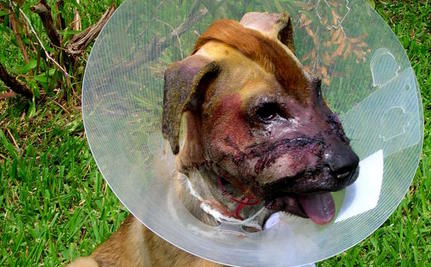
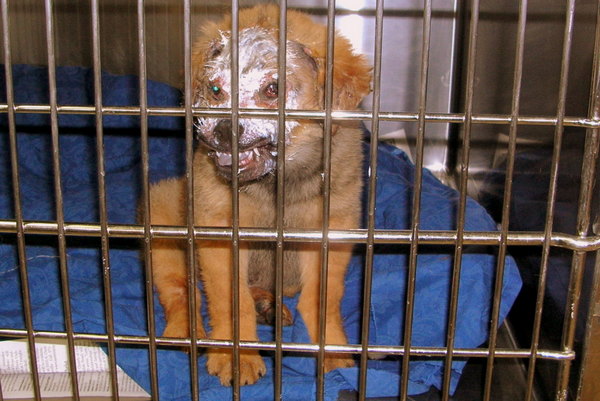
“My name is Danielle and it’s been over a year since something terrible happened to me. I am ready now to share my story,” explained the letter we received recently from veterinary technician Danielle Torgerson of Killeen, Texas. ”Four years ago somebody brought a puppy to the clinic. I was not assigned to that room but I was in the second room when I felt something pull me into the hallway. It was strange, but I glanced into the other exam room and saw a puppy on the table. He looked at me with so much pain and despair. A man had brought him in for a ‘sting’ but I knew instantly that was not the case. The puppy was horribly burned on the head like somebody had poured gasoline over him and set him on fire. He was there to be euthanized.”

But Danielle’s conscience began to wrestle down the injustice of extinguishing this young life before it had known the simple joys that every dog should know. She wondered if he might be able to have a bed of his own. Could there be walks through the park in the cool evening air? Was it possible that this puppy might wake up each morning beside a person whose first words were his name?

“I asked the vet if something could be done,” Danielle recalls. “He said that treatment could be carried out, but only with lots of money.”

The Rescue Begins

And that was all Danielle needed to hear. She wasn’t wealthy, but she was determined and if there was a chance at recovery, she’d already made up her mind to take it. So Danielle had the man who brought in the puppy sign over custody to her. She then contacted Dr. Elaine Caplin in Austin and the puppy was brought in for a surgical consulation to see what could be done.

“He was not able to eat or drink because part of his mouth was melted,” Danielle recalls.

Skingraft surgery was undertaken to reconstruct the mouth and soon the puppy’s condition improved dramatically and he began to function on his own.

Danielle named the puppy D’Artagnan (who served Louis XIV as captain of the Musketeers of the Guard) or Mister D for short and introduced him to other dogs and cats who welcomed him.

Mister D began to grow into a large dog and earned a reputation for his generous nature. “He allows all the cats to sleep with him and we have actually seen him share food with other dogs. He picks out pieces of food and gives it to them.”

All grown up.
All grown up.
But in the street, Mister D is sometimes regarded as a beast.“He looks like a werewolf with his skin grafts and people are kind of scared,” Danielle explains. “But he truly is my loving angel and I know that saving him is what helped save me.”You see, last year, Danielle was in a terrible motorcycle accident when she tried to avoid a collision with a car. Within seconds, she was on the ground bleeding with a broken skull and awaiting a lifelight helicopter to a trauma center where doctors would find no brain function.Photo00811For 12 days, Danielle lay motionless in her pale blue hospital gown while her mother, who flew in from Germany, went back and forth between the hospital and Danielle’s home to take care of not only her dying daughter, but of the animals who meant the world to her.

At night, Danielle’s ex-husband would help look after the pets so that her mother could spend more time with Danielle, and try to get some rest, but everyone feared the worst.

But in the silence of the mind, a louder voice came from Danielle’s soul.

“I had to get back to Mister D and my other ‘kids’ because they needed me and I needed them,” Danielle says of her sense that she carried that desperate need to be reunited with her pets, despite the lack of medical evidence that she was processing those emotions during her coma.

I Had to Wake Up for My Animals

“After 12 days, a miracle happened,” Danielle says tearfully. “I woke up. The doctors and nurses have told me that the first words that I uttered were ‘Mister D.’”

For several weeks, Danielle remained in rehabilitation while she learned to walk and to fully speak again. It seemed so painfully long for her to be away from the ones she loved and that motivated her to work harder each day.

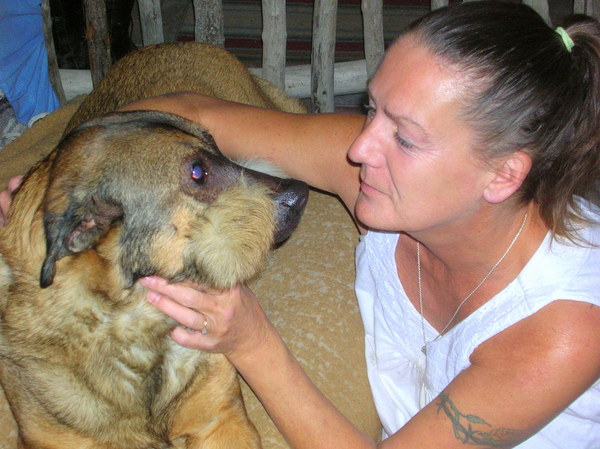
“When I finally got home, Mister D was so happy,” Danielle said. “He checked on me all the time. When he felt that I was hurting, he would put his paw very carefully on my head and sigh. I truly know that if it was not for Mister D, I would not be here. He has become my musketeer, my protector and has given me the security and protection that I never had from people.”

together-todayNow fully recovered, Danielle’s greatest hope is that her story will inspire others to rescue animals. She asks people to consider rescuing, rather than buying pets and explains that “the bond between you is one that can never be broken.”

ooOOoo

Please help share this message of the bond and love that is possible between us and our pets and to always consider taking on rescues.

Just something silly for today.

High-flying chickens!

This vidoe was posted on Roger Davis’ Facebook page in the last day.

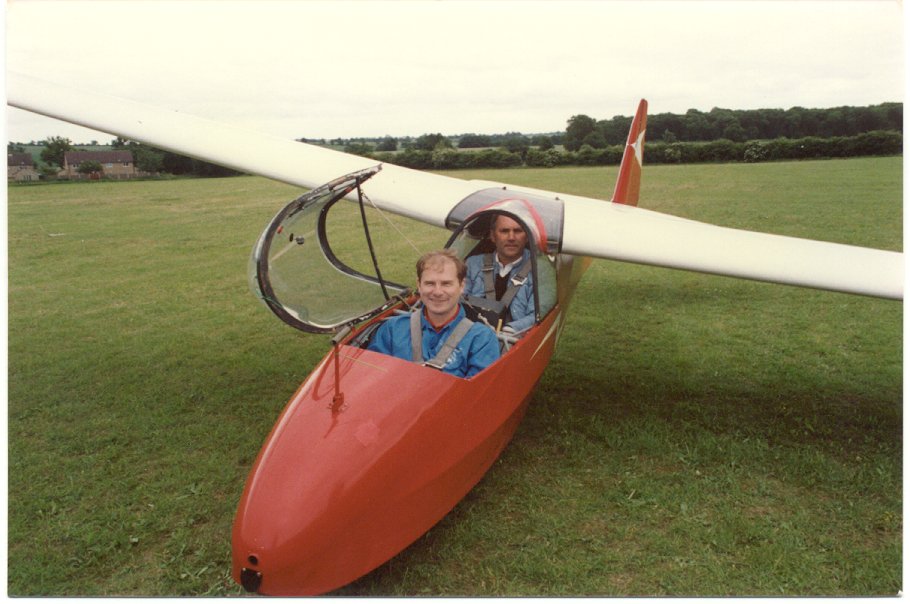
By way of background, Roger and I were running companies from the same office base in Colchester, Essex, England back in the 1980s and it was Roger who introduced me to gliding, or sail-planing in American speak.. Here’s a short extract from a previous LfD post in 2014.

My first exposure to private flying was on the 7th June, 1981 when, at Rattlesden Gliding Club in Suffolk, I was taken up for two air-experience circuits in a two-seater glider known as a ‘K7’. I was immediately hooked! Those experience flights leading to a 4-minute flight (flight number 46) on the 6th September, 1981 that has the remark in my pilot’s log book: Solo! Now fast forward to October, 1984 and my log book shows me attending a gliding instructor’s course at Lasham, resulting in me being issued with a British Gliding Association (BGA) Assistant Instructor Rating on the 14th October. (105/84).

A K-7 two-seat glider.

Anyway, here’s the item that just had to be shared:

How on earth does one follow that up! 😉

The difference that makes the difference!

A nice reminder of past scribblings!

Yesterday, a visitor to this place left a comment to a post published in September, 2012. Simply, he wrote, “Some food for thought midst all the drivel and crap.” The post was under the heading of The Charles Schulz Philosophy. I had forgotten about it. I thought it would be nice to republish it today (or rather the essence of that post).

 ooOOoo

Charles Schulz

The following is the philosophy of Charles Schulz, the creator of the ‘Peanuts’ comic strip.

You don’t have to actually answer the questions. Just ponder on them. It will make very good sense!

Here’s A Little Quiz

You don’t have to actually answer the questions. Just read them straight through, ponder a tad, and you’ll get the point.

  • Name the five wealthiest people in the world.
  • Name the last five Heisman trophy winners.
  • Name the last five winners of the Miss America pageant.
  • Name ten people who have won the Nobel or Pulitzer Prize.
  • Name the last half dozen Academy Award winners for best actor and actress.
  • Name the last decade’s worth of World Series Winners.

How did you do?

The point is, none of us remember the headliners of yesterday. These are no second-rate achievers. They were the best in their fields.

But the applause dies. Awards tarnish over time. Achievements are forgotten and accolades and certificates are buried with their owners.

Here’s another quiz. See how you do on this one:

  • List a few teachers who aided your journey through school.
  • Name three friends who have helped you through a difficult time.
  • Name five people who have taught you something worthwhile.
  • Think of a few people who have made you feel appreciated and special!
  • Think of five people you enjoy spending time with.

Did you find that Easier? Of course you did!

So here’s the lesson!

The people who make a difference in your life are not the ones with the most credentials, or the most money…or the most awards…they simply are the ones who care the most.

ooOOoo

You all have a very wonderful weekend.

Living on.

They will always live on in our hearts and minds.

I follow the blog belas bright ideas.

Recently, she posted a beautiful poem to commemorate the nine years of having Susami in their lives. It is republished here with Bela’s kind permission.

ooOOoo

dscn0130

There is a presence, here
and now; the bellows of breath,
warmth of blood, the feeling,
even if imagined,
that we are connected, one
to the other.

We each have our memories,
after all.

Your passing removes that utterly,
and somehow the same hand
lying on the same fur and flesh
will sense void, not even spirit,
not even that.

One can forgive the athiest,
or even theist their doubts,
props, religions. For this
at least is real:
This. Here. Now.
Tomorrow it will be gone.

And no matter in visions I linger
in the numinous; despite
in the garden I witness the alchemy
of decay transforming
into green and vibrant,
the loss of a loving companion
is egregious, indeed.

ooOOoo

Bela explained how Susami came to them:

This sweet being has been with us only nine years, since she was about 10-12 weeks old. Her previous steward, a multiply-pierced and -tattooed young woman, had to find a home for her. We were on our way to the east coast to deal with some business, and I had taken our good friend Kevin with me to the local feed store to get the horse stocked up on alfalfa pellets (it was during a long drought). I saw the pup with a bandage on her leg before, and asked the gal what was wrong with her. I later learned from the store owner (who thanked me many, many times for giving Susami a good home) that the dog had been severely abused. (She never did tell me specifics, so I was left to wonder.) The young woman tried her best, but there were forces beyond her control in her environment. When I saw Susami again, we had to take her, but how? I asked Kev if he would watch yet one more animal for us while we were gone, and he happily agreed! So she joined our chocolate Lab who we brought with us to Hawaii from northern Maine (a Non-rescue). He was Thrilled to have that little creature’s companionship.

Going to close with the exquisite words from Suzanne Clothier that Dr. Jim Goodbrod used in the foreword to my book:

There is a cycle of love and death that shapes the lives of those who choose to travel in the company of animals. It is a cycle unlike any other. To those who have never lived through its turnings or walked its rocky path, our willingness to give our hearts with full knowledge that they will be broken seems incomprehensible. Only we know how small a price we pay for what we receive. Our grief, no matter how powerful it may be, is an insufficient measure of the joy we have been given.

(Suzanne Clothier: Bones Would Rain from the Sky: Deepening Our Relationships with Dogs.)

Suzanne’s words cannot be bettered when it comes to the death of a beloved dog.

Susami, you will not be forgotten.

All upside down today!

As shared by Roger Davis, a gliding colleague from way back.

and

The things we do for fun!

Have a wonderful weekend, everyone, whatever your attitude!

The Song Dog

The North American Coyote

When we let the dogs out last thing on Tuesday evening there was a local pack of coyotes not far from our fence line. Cleo started barking and some of the coyotes responded with their spine-chillingly beautiful howls. The sound really does transport one back thousands of years in a mystical sense.

howling-coyote-picturesI started doing some research as to whether we, as in us humans, had studied what the song of the coyote means. I came across The Natural History of the Urban Coyote website and therein was an article called Translating the Song Dog. It’s a fabulously interesting article and I do hope it’s OK to share with you.

ooOOoo

The scientific name for the coyote is Canis latrans, which translates to “barking dog,” a perfect name for this species which has been called the most vocal of North America’s mammals.

Less formally, the coyote is known as the song dog, and one listen to a group howl by a pack of coyotes makes it clear why. Rather than the simple but soul-haunting sound of a wolf’s howl, the coyote’s howl can be made up of high-pitched howls, barks, and yips that make it clear the coyote has a whole lot of lyrics in a single song. But what exactly do those lyrics say?

The coyote has a range of vocalizations depending on social context and message. In 1978, Philip N. Lehner published his research of coyote communication and what the various vocalizations mean, which has been included in Coyotes: Biology, Behavior, and Management.

“The vocal repertoire of the adult coyote contains eleven vocalizations, several of which are also given by pups. These vocalizations grade into one another such that their separation into eleven types is somewhat arbitrary based on their different sounds, behavior context, and physical characteristics.”

In other words, the coyote language is complex and depends on the social situation, the coyote’s body language in addition to the sounds, the intensity of the vocalization, and other factors. This makes sense considering that when one digs a little into hunting forums, some coyote hunters are convinced they know more than eleven calls for coyotes. Indeed, there are likely more vocalizations when one looks at subtleties.

If you have paid close attention the vocalizations of domestic dogs, especially those more talkative breeds, you’ll likely find it easy to decode coyote sounds. There is a lot of overlap in the sounds dogs, coyotes and other canid species make – from a startled huff to a whine of greeting, from an antagonistic growl to a bark of alarm. But coyotes take the language of canids to another level with their extensive list of sounds, especially the yips, howls, and of course their choral group howls.

Though Lehner notes that it’s a bit arbitrary to categorize coyote sounds, we can at least begin to understand them by breaking them down into the types of sounds they make along with their purpose. So he created the following 11 categories, which can also be considered sign-posts on a gradient of meaning and intensity.

Types of Coyote Vocalizations

1. Growl – This vocalization holds no mystery. A growl is used as a threat, specifically for something within close range.

2. Huff – This is the expulsion of air through the nose and mouth, and is also used as a high-intensity threat in close proximity. Huffs are used, for instance, when there’s bickering over carrion.

3. Woof – This vocalization is made as both a low-intensity threat and as an alarm. It’s a sound made when a coyote is startled and unsure of exactly what is happening, but knows it is not comfortable with whatever it is.

4. Bark – The bark is a long-distance threat or alert of low to medium intensity.

5. Bark-Howl – This is when the coyote gets serious about a threat. The bark-howl is used as a long-distance high-intensity threat or alarm. It starts with a bark and blends into a howl.

What is interesting about the bark and the bark-howl is that research suggests that the varying intensity and frequency of barks could contain different information. More recent research by Brian R. Mitchell has shown that coyotes likely identify individuals by their barks and bark-howls.

“By analyzing spectrograms of howls and barks,” writes Mitchell, “I was able to determine that both of these vocalizations do indeed contain individually specific information.  Because of the tremendous advantage of being able to determine individual identities, I presume that coyotes use the information in barks to identify individuals they are familiar with.”

“Another interesting aspect of coyote barks and howls,” he continues, “is that howls stably convey information for distances of at least one kilometer.  Barks, on the other hand, rapidly attenuated and did not appear suitable for transmitting information.  Barks likely serve other purposes, such as attracting information and providing information that listeners could use to estimate distance to the barking animal.”

Barks and bark-howls, then, can serve in saying, “I’m here, and here’s how I’m feeling” and allow listening coyotes to recognize if those individuals are family or strangers. Mitchell underscores that a coyote recognizing an individual by their howl isn’t about the howling coyote shouting his own name again and again; rather it is akin to how we can recognize a family member or friend by the sound of their voice no matter what they’re saying, because of their unique pitch, timbre, cadence and even accent.

6. Whine – This sound is used to express submission and is usually given by a subordinate coyote to a more dominant coyote.

7. Yelp – The yelp takes the whine up a notch and represents high-intensity submission. However, it can also be a response to being startled. As is the case with several other of these vocalizations, this categorization shows that coyote communication is more of a gradient. Lehner writes, “A yi-e-e-e often precedes or follows the yelp portion and resembles a high-frequency bark [and] appears on a sonogram like a short howl chopped into segments.”

8. Woo-oo-wow – This is the “greeting song” of coyotes, and is used during high-intensity greeting displays. The vocalization modulates in frequency and amplitude as a coyote’s motivation shifts, Lehner notes, and so can fluctuate from a whine to a growl.

9. Lone Howl – The lone howl is just what you probably already know it to be: a howl by a single coyote, which is often started with a series of barks that reseracher R. M. Mengel called “herald barks.” As mentioned above, coyotes can distinguish individuals based on their unique howl, and the purpose of the howl is to announce one’s location to others in their social group. Often, the lone howl gets an answer, and the coyotes can find each other to meet up.

10. Group Howl – A group howl is sent up when two or more coyotes come together after being apart, or it could be given as a response to the howls of distant coyotes. It is, according to Lehner, essentially two or more coyotes giving their own lone howls either successively or simultaneously, as a way of giving out location information to any listeners.

11. Group Yip-Howl – This is what coyotes are really known for. The group yip-howl is sent up when coyotes reunite, or just before they separate to go off hunting individually. As more coyotes join in, the more intense the vocalizations become, increasing in frequency and amplitude. Lehner notes that the group yip-howl includes sounds that researcher H. McCarley called screams, gargles and laughs. In other words, the many variations of coyote vocalizations show up in this chorus.

According to Lehner, the group yip-howl probably strengthens social bonds, may help to synchronize mood, and may also reaffirm social status within the pack. He also notes that the group yip-howl “may be most important in announcing territorial occupancy and preventing visual contact between groups of coyotes.”

The chorus tells any nearby coyote packs about whose turf this is, and thus keeps other coyotes away. It also reveals (or hides) how many coyotes are in the area and may help regulate coyote density through reproductive rate. Research has shown that female coyotes will produce larger litters when there is little competition, and smaller litters when there is a high density of coyotes in the habitat. This is one of the secrets to the coyote’s success at spreading across the continent in the last century.

[Note: This is also why indiscriminate killing of coyotes to decrease their density doesn’t work as a management strategy. Coyotes repopulate an area quickly and easily when competition is eliminated, with the population rebounding or even expanding in a very short time. Perhaps a more effective, cost-cutting and non-lethal strategy for reducing the number of coyotes in an area would be playing recorded group yip-howls to make resident coyotes think there is more competition for resources. This is something several researchers have expressed interest in exploring, specifically in order to reduce conflicts with ranchers. If we can discover more about what specific messages are embedded in certain howls or barks, ranchers could play specific recordings to keep coyotes away from livestock as well as minimize the number of coyotes living in an area.]

Mitchell writes, “Group yip-howls are produced by a mated and territorial pair of ‘alpha’ coyotes, with the male howling while the female intersperses her yips, barks, and short howls. ‘Beta’ coyotes (the children of the alpha pair from previous years) and current year pups may join in if they are nearby, or respond with howls of their own. And once one group of coyotes starts howling, chances are that any other alpha pairs nearby will respond in kind, with chorus after chorus of group yip-howls rippling across the miles.”

In Talking to Coyotes with the Song Dog, a pamphlet about using a coyote caller, Major L. Boddicker, Ph.D. brings up a personal experience with such a chain reaction.  After sending up what he calls a “Joy of Life Call” which is a group yip-howl, “It sounded like every coyote in the USA responded in the musical see-saw coyote chant which went on and on for 3-5 minutes. I later called a friend in Steamboat Springs, Colorado (150 miles away) to check for the time when the coyotes started to sing there. Given the time it took sound to travel and coyotes to react, I very likely started the chorus.” Whether or not the chorus traveled that far, it is indeed possible to start a chain of coyotes sending up group yip-howls.

Boddicker discusses Lehner’s list of vocalizations in his pamphlet, and brings in two more vocalizations that he or experienced coyote callers have heard. He notes that these my fall into the umbrella categories identified by Lehner, but are distinct enough to point out anyway. They are:

Whoop – This sound is used as part of more complex sounds such as the group howl or group yip-howls.

Yodel – This is when a howl tapers up and ends abruptly, rather than tapering down in a typical howl, which gives the howl a sound like the coyote is asking a question. Boddicker notes that this happens when coyotes howl for an unusual reason such as for a lost family member.

How Many Coyotes Are Howling?

“When people hear coyote howls, they often mistakenly assume that they’re hearing a large pack of animals, all raising their voices at once,” writes Mitchell. “But this is an auditory illusion called the ‘beau geste’ effect.”

Coyotes howl both to reunite and to keep trespassers at bay. It may be in their favor that if they howl, they sound like a bigger pack than they really are. They accomplish complicated and confusing howls by a smart strategy of using wavering howls and changing their pitch rapidly. This, combined with the howls bouncing off objects in the environment such as rocks, trees, or the far side of a valley may make it hard for a listener to know if they are hearing one coyote or several howling simultaneously.

When two or three coyotes howl together, they can sound like a pack of six or ten or more, which perhaps makes them seem much more formidable to any nearby competitors or predators.

Coyotes May Have Local Accents

We know that coyotes vary in size and build depending on their location, as the difference between western and eastern coyotes clearly demonstrates. Does their location also mean they have accents? We know that other species with complex communication such as whales have different accents, so it makes sense that coyotes may also have regional accents. And does that affect how they might interpret or respond to strangers?

Sara Waller, associate professor of philosophy at Montana State University in Bozeman, told the Bozman Gazette, “We know that dogs have ‘accents’ just as people do — we can reliably tell the difference between British dog barks and American dog barks. When we have enough recordings to really compare Eastern and Western coyotes, we may find that like dogs, and people, they have regionally based differences in the way they communicate with each other. This would show that coyote vocalizations are impacted by social and environmental factors just as human speech is.”

What Can Coyotes Teach Us About Language?

There is still so much to learn about what coyotes are saying through their complex and varied vocalizations. The more we learn about the way coyotes communicate as social predators, the more we can learn about not just their species, but our own as well.

Coyotes can sense things we humans can’t, and Waller questions, “How does that impact the way they think? They are social, communicative predators, and so are very like humans in many ways. If we could figure out what some of these vocalizations mean, it would give us insight into how our own language works, and how human minds differ from those of other social predators.”

Examples of Coyote Vocalizations

In the video below, two coyotes give barks and bark-howls as an alarm against the person recording the video:

http://www.youtube.com/watch?v=Kudkwlfk5LY

The person who uploaded this video notes that the coyotes had been hanging around a lot and ventured a guess that is because her dog was in heat. However, the date on the video is in late May, which is about the time when coyote pups are emerging from the den and becoming active around the den site. So it is possible that these are the parents and/or helper coyote keeping a watch on the person taking a video and giving alarm, warning them away from a nearby den.

In the video below, coyotes send up a group yip-howl. Note that the howls do not begin with a bark, like the previous video. As Lehner notes, the group yip-howl starts usually with the dominant individual of the pack. That seems to happen here as the coyote in the video joins in after another coyote begins the howl:

The video below is a coyote group yip-howl, likely started with reunion of group members, and includes yips, whines and other vocalizations on the coyote-sounds spectrum as the members interact. There is so much great behavior and body language captured in this video, showing the group dynamics of submissive members with more dominant members of the pack:

Listen to more coyote vocalizations on Soundboard or The Social Predator Vocalization Project.

References:
Coyotes: Biology, Behavior and Management
Talking to Coyotes with the Song Dog
Information Content of Coyote Barks and Howls
Coyotes: Decoding Their Yips, Barks, and Howls

ooOOoo

And that beautiful photograph of the howling coyote at the start of today’s post? That came from this website that also included the following that I will use to close this post.

“when the end comes there will be coyotes and coach roaches left in the world and the coyote will eat the coach roach and that will be that!”   Some say that “Cher” will still be on tour though.