Bob Derham and his wife, Julie, are long-term friends back in the UK.
They recently lost their two dogs.
Bob sent me this:
Millie and Summer both had a fun life.
They were cross breed dogs, partly Springer Spaniel and part Collie. They were born in Wales, but as there are quite a lot of similar dogs there, the owner advertised in a local paper, and brought them up to Dorset one weekend 13 years ago.
Initially we had been looking for only one dog, but it seemed such a shame to separate the two puppies so we decided to take both. Most people were of the opinion that two girls from the same litter was not a good idea, but nevertheless we trained them, and the two animals were always together.
Family holidays, walking the children to the school bus, visiting friends, etc., always included Millie and Summer.
Just over two years ago, Summer became diabetic. Had this been only ten years ago, nothing could have been done for her, but we were able to inject her twice a day, and keep her healthy, apart from failing sight as a result of the insulin. It was not long after that Millie developed the same problem, so both dogs had the same routine.
Summer went to the vets on the right day for her, and was put to sleep peacefully, and two weeks later Millie needed the same choice to be made.
They enjoyed an almost identical lifespan, and we enjoyed them to the full.
Bob and Julie’s daughter Stephanie then made the following video in memory of their two beloved dogs.
Back to me.
Going to close today’s post with this poem by Rudyard Kipling.
ooOOoo
The Power of the Dog
There is sorrow enough in the natural way
From men and women to fill our day;
And when we are certain of sorrow in store,
Why do we always arrange for more?
Brothers and Sisters, I bid you beware
Of giving your heart to a dog to tear.
…
Buy a pup and your money will buy
Love unflinching that cannot lie–
Perfect passion and worship fed
By a kick in the ribs or a pat on the head.
Nevertheless it is hardly fair
To risk your heart for a dog to tear.
…
When the fourteen years which Nature permits
Are closing in asthma, or tumour, or fits,
And the vet’s unspoken prescription runs
To lethal chambers or loaded guns,
Then you will find–it’s your own affair–
But…you’ve given your heart for a dog to tear.
…
When the body that lived at your single will,
With its whimper of welcome, is stilled (how still!);
When the spirit that answered your every mood
Is gone–wherever it goes–for good,
You will discover how much you care,
And will give your heart for the dog to tear.
…
We’ve sorrow enough in the natural way,
When it comes to burying Christian clay.
Our loves are not given, but only lent,
At compound interest of cent per cent.
Though it is not always the case, I believe,
That the longer we’ve kept ’em, the more do we grieve:
For, when debts are payable, right or wrong,
A short-time loan is as bad as a long–
So why in Heaven (before we are there)
Should we give our hearts to a dog to tear?
I have a marvellous blogging friend in New Mexico who has Rufina, a chicken who was shot in the head, sealed in a plastic bag, placed in a freezer for 24hrs, and lived! (albeit now blind).
I have a framed poster of Rufina up in my living room, and even one her feathers perched in one of my many, many, many St. Francis’s
Then in response to me wanting to republish that story replied: “Contact her, she’s wonderful, and her pottery is to die for.”
So I did and, with Laura’s permission here is that story of this most remarkable chicken.
ooOOoo
The Undead Chicken
by Laura Bruzzese, June 24th, 2013
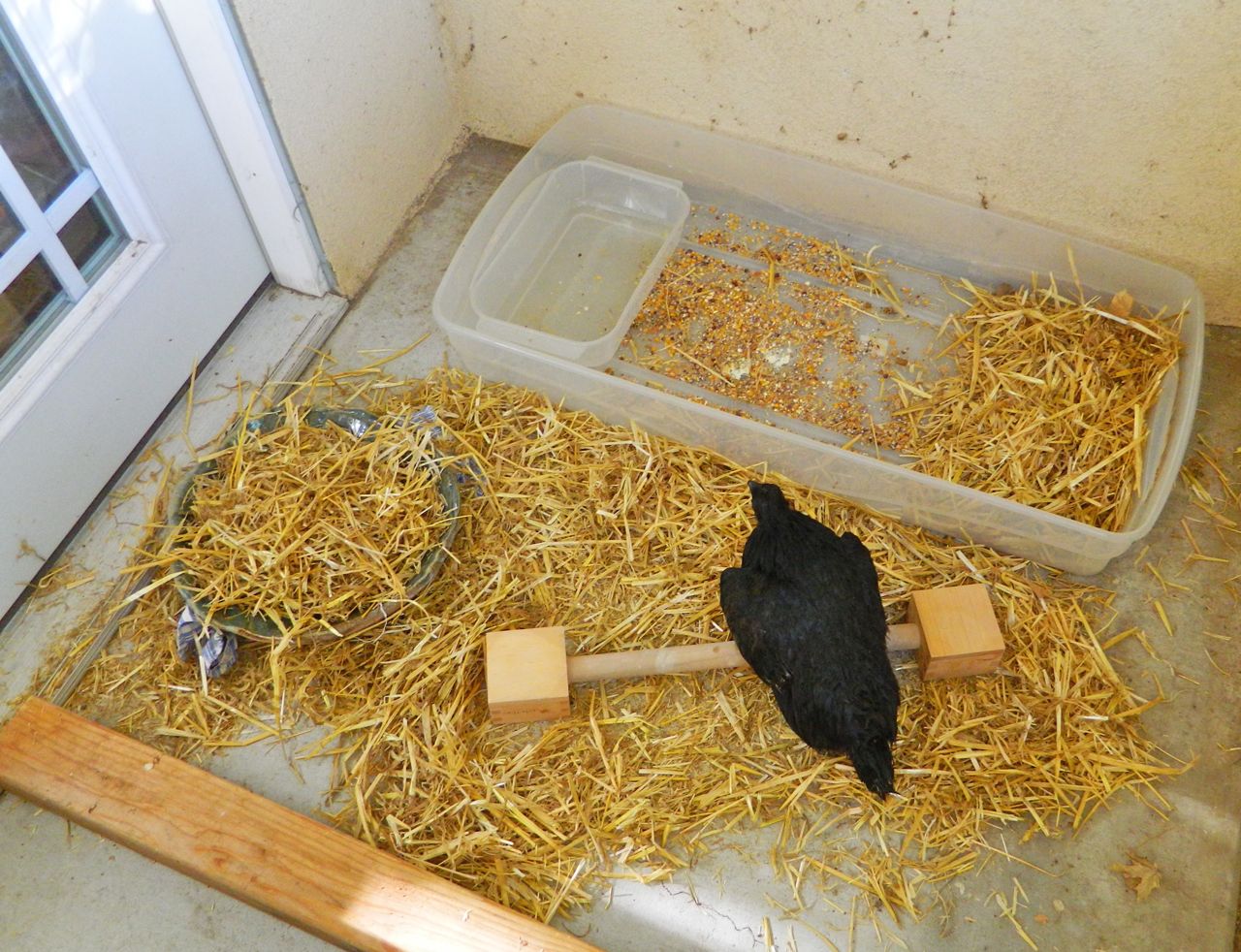
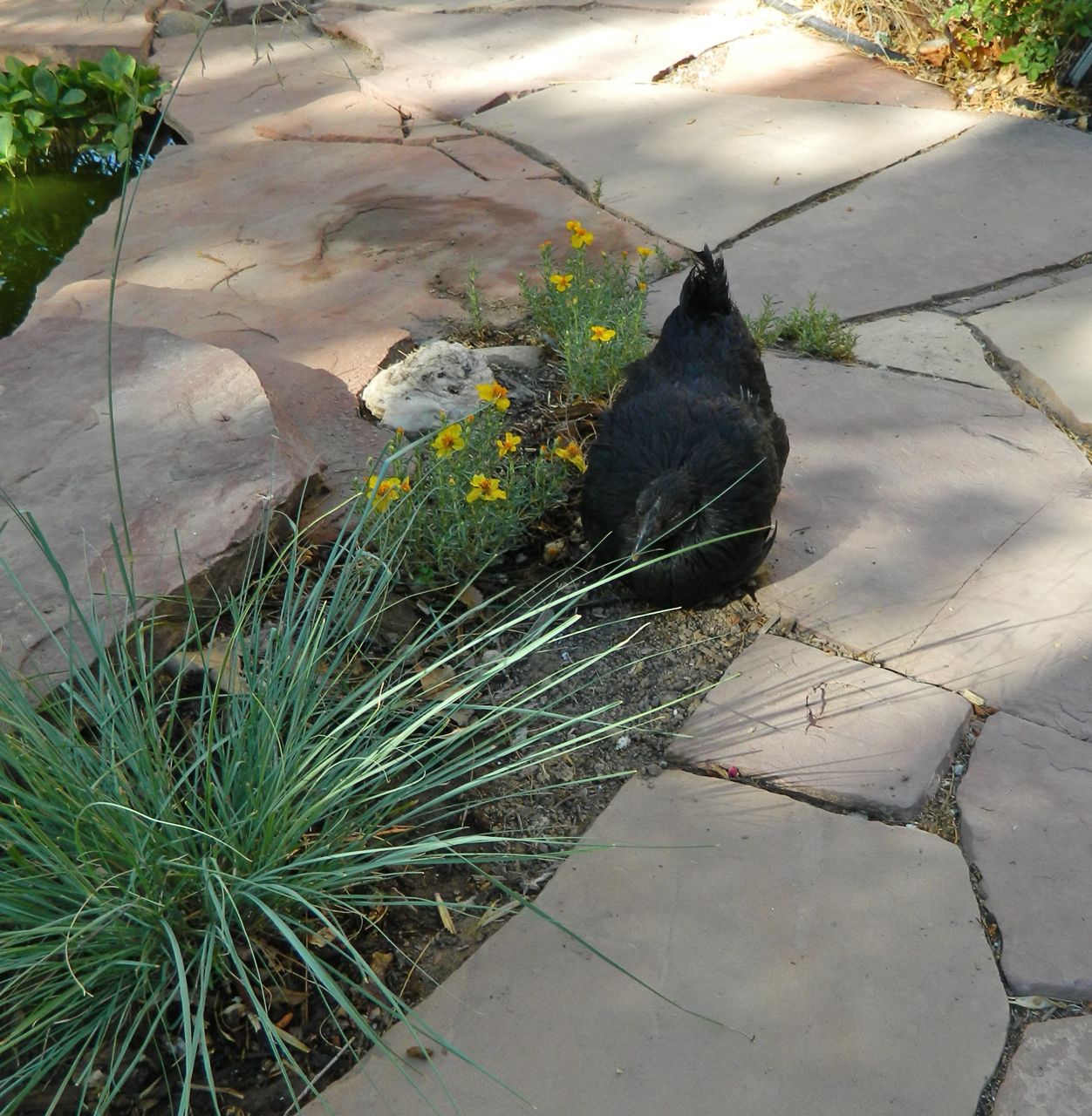
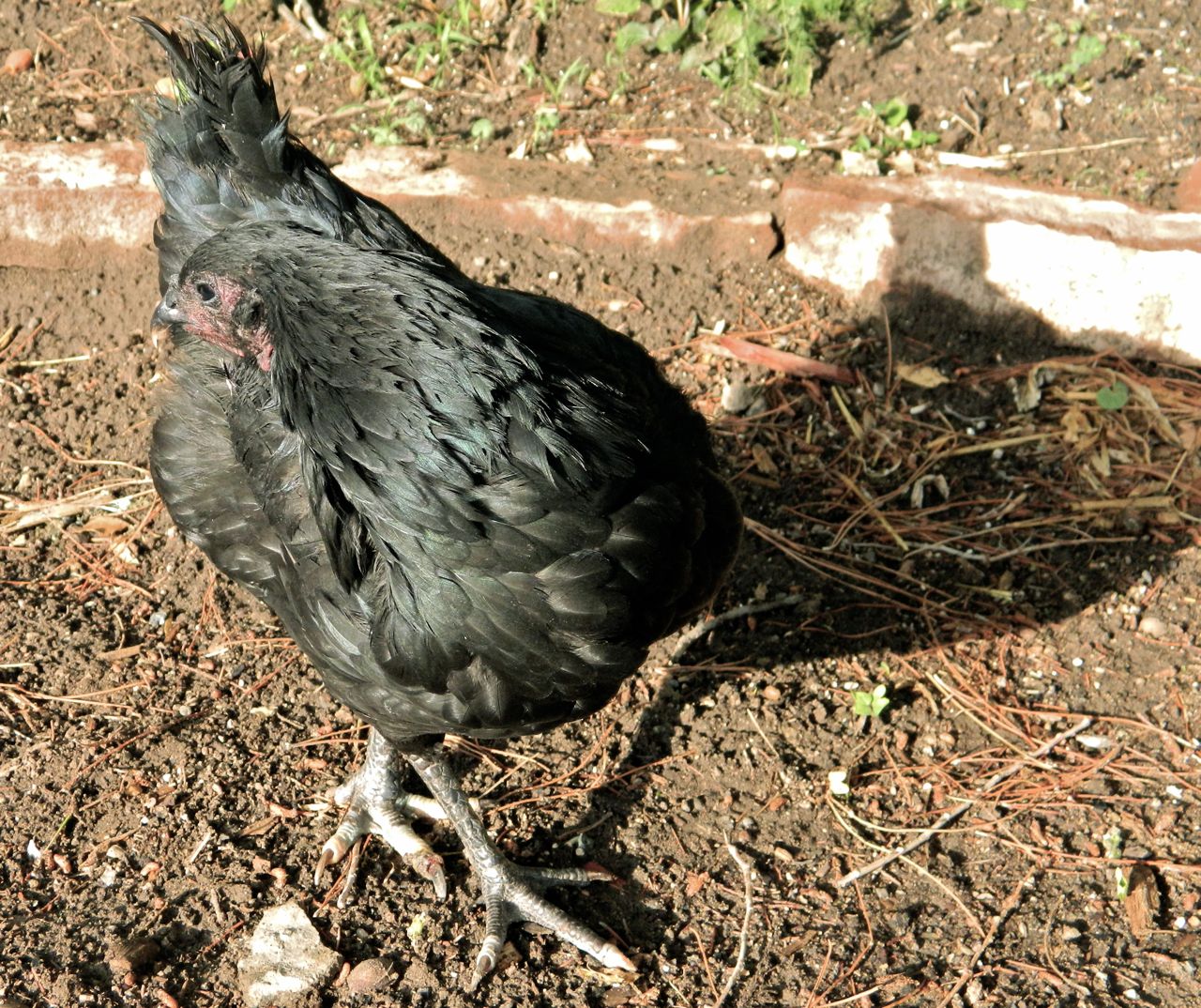
This is Rufina. She’s new to our household.
She’s quiet and doesn’t take up much space, mostly sits on her perch or in her ceramic nest all day. She moves around slowly. If you are really gentle, she lets you pick her up.
We sit by the pond together in the morning, before everyone else gets up.
Last Thursday, I answered a friend’s call on Facebook for someone to take this chicken. Isabella and I drove to my friend’s house in the South Valley, put her in a bin, and brought her home. I didn’t think she’d actually still be alive today.
My friend had posted this story Thursday morning:
The neighbor gave us fresh chickens last night for cooking up. He shot them in the head with gun and handed them over the fence. We bagged them and put in freezer for today. Evan gets home, opens freezer and one bird is perched fully alive, very cold, and pissed off.
Chase ensues… !! We now have a blind undead chicken in our yard.
Anybody want it?
I’m not sure why anyone would shoot chickens in the head.
But when I read the story, I couldn’t help but admire this chicken’s tenacity. She is courageous. She made her way out of a plastic bag inside a freezer and survived for thirty-six hours. After being shot in the head. I figured any animal that fought that hard to live deserved a little help, if only for a day or two.
The chicken hasn’t made any effort to eat like a normal chicken. Because, of course, she can’t see where to peck. (There isn’t much point in force-feeding a blind chicken.) But she does drink, so I’ve started blending up borrowed chicken food and water and giving her that. She seems content, grooming herself sometimes, showing no signs of pain or anxiety. And still, she will die.
But until then, we will enjoy each of her borrowed mornings by the pond, the sound of birds and running water, the sun on her feathers, expecting nothing.
I’m not sure why I have a blind, undead chicken in my studio. But here is one of my favorite poems, by Laura Gilpin.
The Two-Headed Calf
Tomorrow when the farm boys find this
freak of nature, they will wrap his body
in newspaper and carry him to the museum.
But tonight he is alive and in the north
field with his mother. It is a perfect
summer evening: the moon rising over
the orchard, the wind in the grass. And
as he stares into the sky, there are
twice as many stars as usual.
Now if you think that was remarkable then let me share what Laura posted a few weeks later, linked to via her Epilogue above.
ooOOoo
The Miracle of Re-Birth
by Laura Bruzzese, July 11th, 2013
Good news: it’s been three weeks since the attempted murder of Rufina, and she continues to dwell among the living!
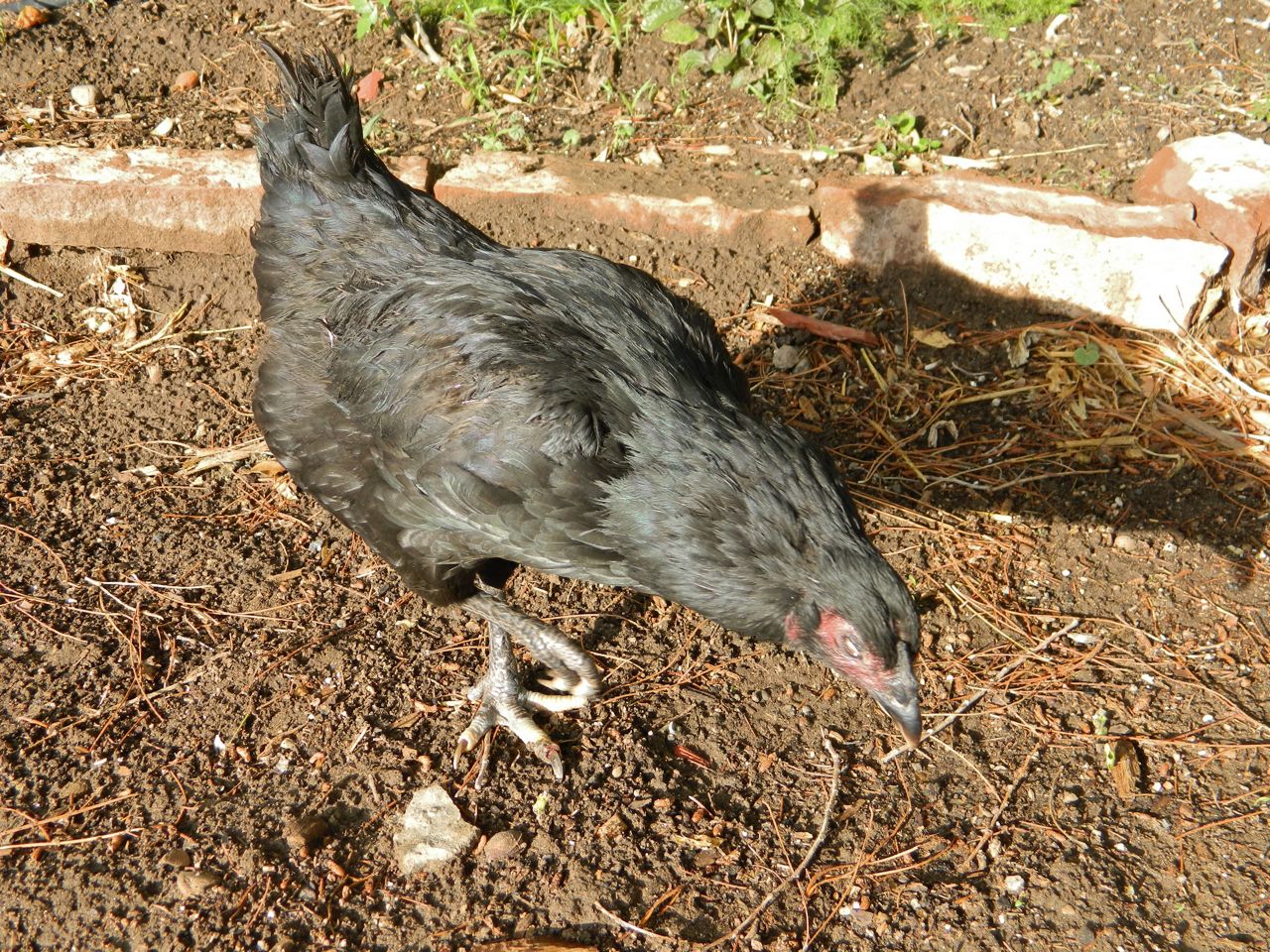
After loads of eye care, foot washing, antibiotics, food and vitamins, she has gained weight and is learning to find food and water by herself. Her remaining eye looks normal again but is still blind (I was hoping for a miracle), and the place of its former pair seems to have reached its majority in terms of healing–no eye, but no skin, either. Just a weird, green spot surrounded by red skin that looks not unlike a tiny sun-dried tomato.
But that does not prevent her daily forays into the garden where she walks around with her head craned forward to “feel” where she’s going, and from exhibiting other persisting chicken qualities that seem to evidence a contented life.
I’m still surprised, and slightly in awe of this traumatized chicken who is satisfied to reside indefinitely on my studio porch. Shiny, happy chicken.
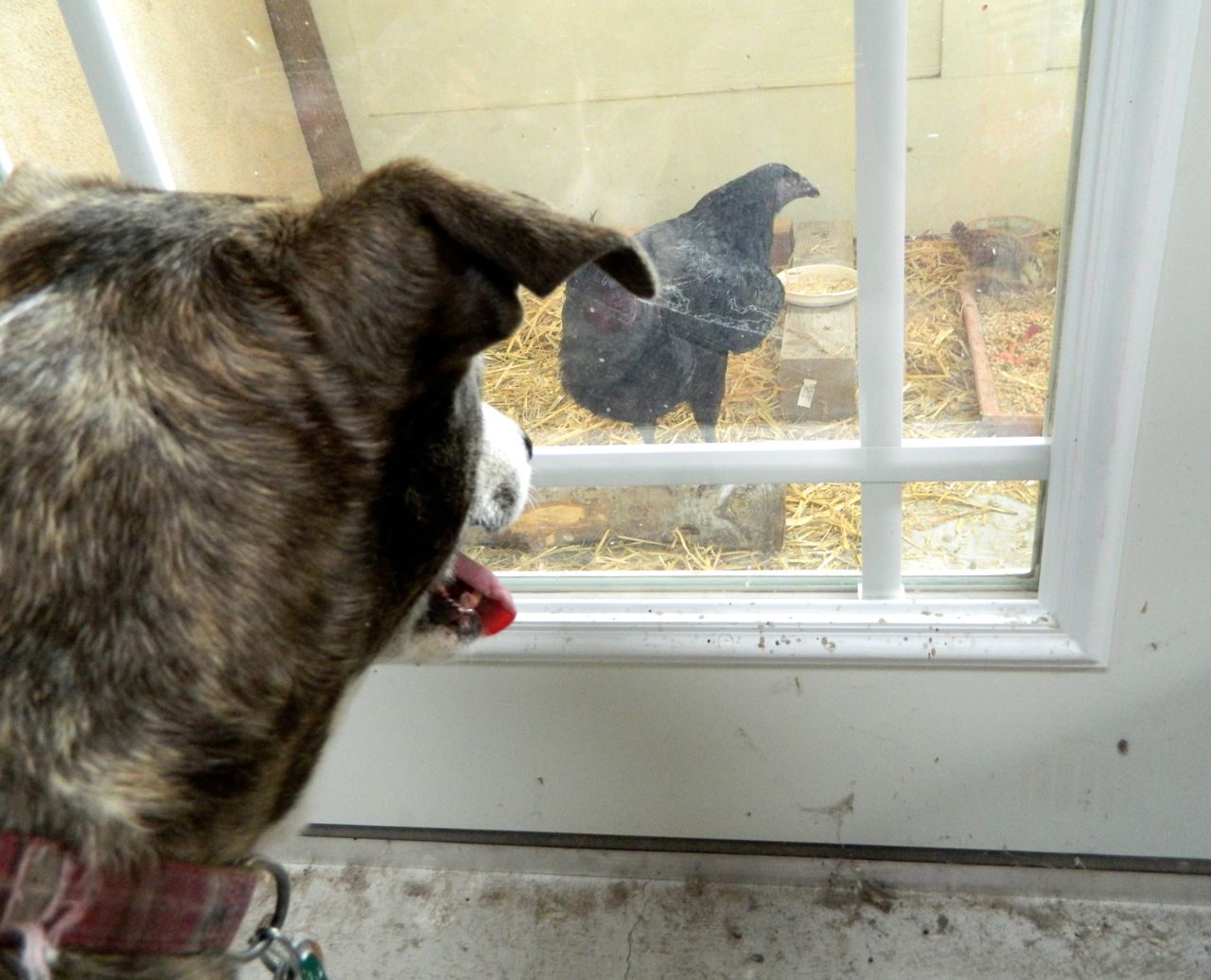
And so far, Velma the Rascally Whippet has not been the nuisance I was afraid she might be, but instead, a proud example of a bird-dog in defiance of her own natural instincts (save for one minor incident involving a tail feather. That was still attached to Rufina.). Perhaps Velma knows they are kindred spirits, she herself having survived a scary encounter with the Great Beyond earlier this year.
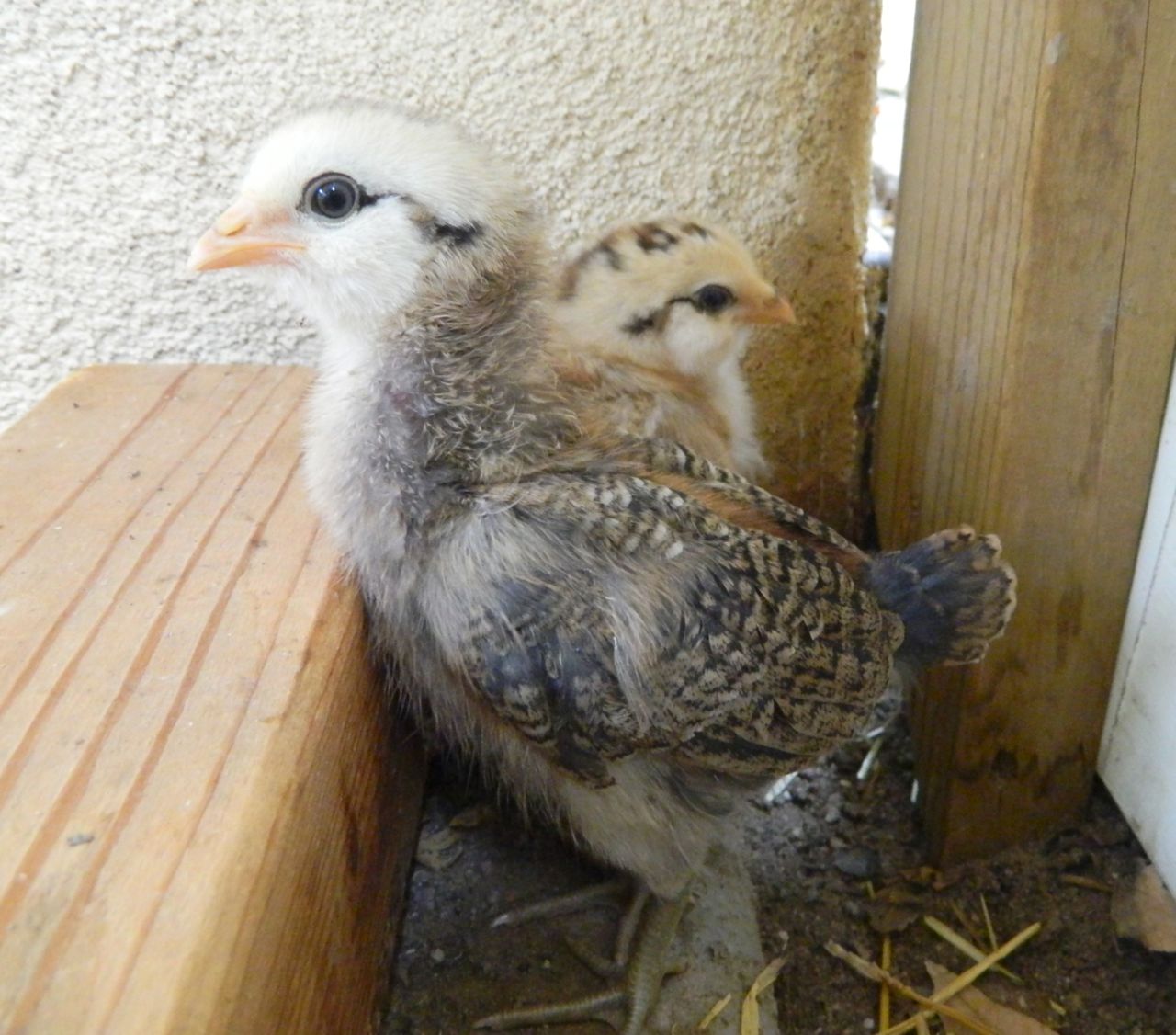
Thanks to everyone who has contributed free chicken advice, food, ER and vet consults, and even a couple of adorable, surprise chicks* (!) to keep Rufina company.
*Chicks will unfortunately be dispatched to some other venue because they are exploiting their sighted advantage: stealing food out of Rufina’s mouth, crowding the water dish, and mocking her by constantly blinking and sticking their tongues out. Also, they are filthy little creatures that walk in their own poop and then jump on me.
And finally, what’s in a name? When it became clear that chicken might live, I thought I should name her, and Rufina was the first thing that popped into my head. A few days later, I googled it to see what came up. This is what I found on Wiki:
Saints Justa and Rufina (Ruffina) (Spanish: Santa Justa y Santa Rufina) are venerated as martyrs. They are said to have been martyred at Hispalis (Seville) during the 3rd century.
Their legend states that they were sisters and natives of Seville who made fine earthenware pottery for a living, with which they supported themselves and many of the city’s poor. Justa was born in 268 AD, Rufina in 270 AD, of a poor but pious Christian family. During a pagan festival, they refused to sell their wares for use in these celebrations. In anger, locals broke all of their dishes and pots. Justina and Rufina retaliated by smashing an image of Venus.
The city’s prefect, Diogenianus, ordered them to be imprisoned. Failing to convince them to renounce their faith, he had them tortured on the rack and with iron hooks. This method also having failed, they were imprisoned, where they suffered from hunger and thirst.
They were then asked to walk barefoot to the Sierra Morena; when this did not break their resolve, they were imprisoned without water or food. Justa died first. Her body, thrown into a well, was later recovered by the bishop Sabinus. Diogenianus believed that the death of Justa would break the resolve of Rufina. However, Rufina refused to renounce her faith and was thus thrown to the lions. The lion in the amphitheatre, however, refused to attack Rufina, remaining as docile as a house cat. Infuriated, Diogenianus had Rufina strangled or beheaded and her body burned. Her body was also recovered by Sabinus and buried alongside her sister in 287 AD.
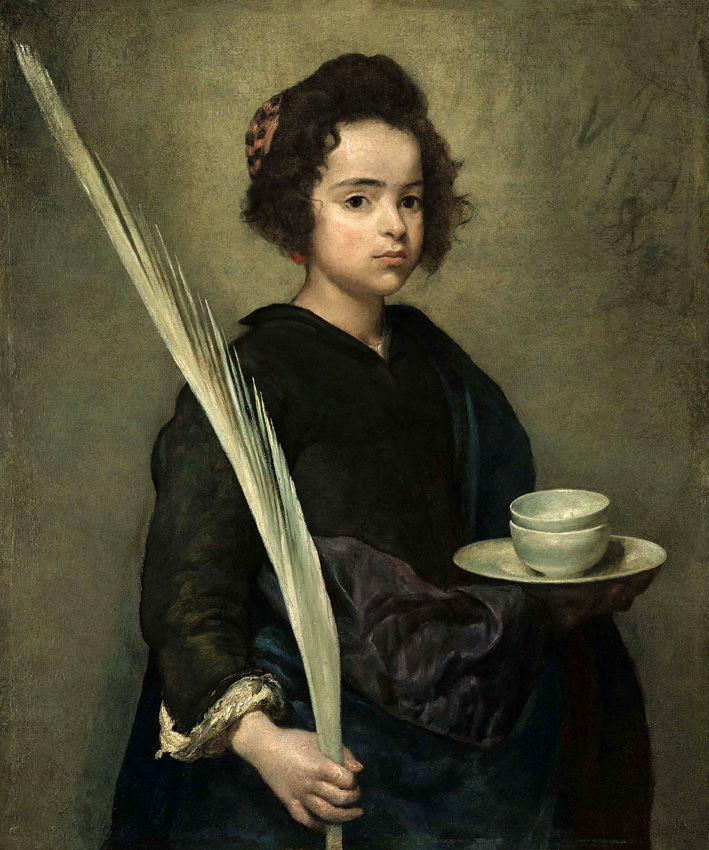
Saint Rufina, by Velázquez. See the likeness?? She’s even carrying a giant feather!
Just another name? Perhaps. Or: a dark-haired Spaniard and a Italian-New Mexican, two Christian potters separated by centuries, a saint, a chicken, and an ordinary human united in an extraordinary coincidence of the undead.
ooOOoo
Follow that!
Well I can’t but John Zande can.
For he was the first to leave a comment to Laura’s Rebirth post:
Here, i feel this song is in order. Listen carefully to the words, and who is singing them.
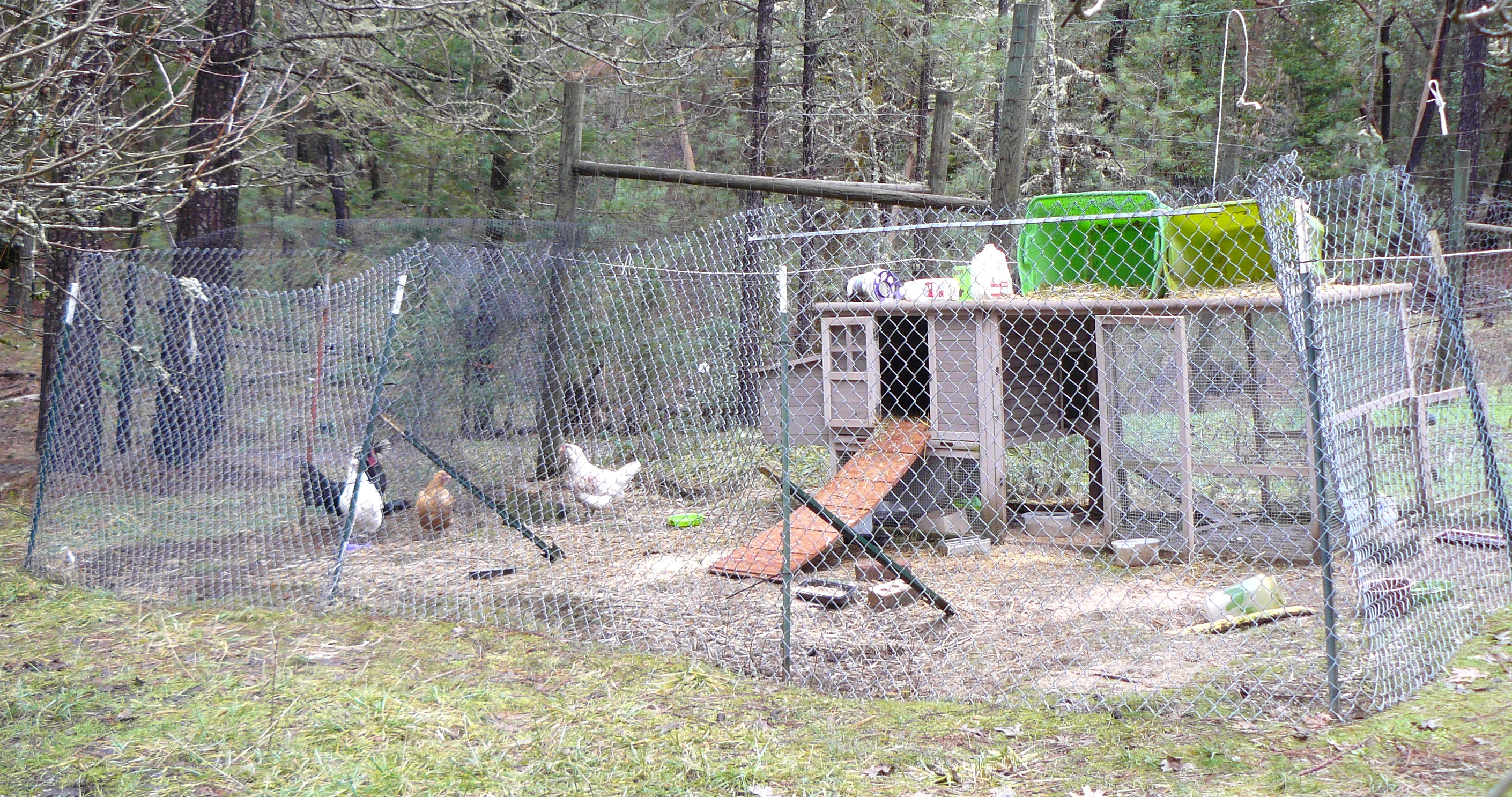
We have a rather run-down ‘home’ for our chickens close to the house. It was run-down before the snow fell and almost brought down the surrounding wire fence.
But, hopefully, this coming Thursday sees a new walk-in run being constructed for our birds so they are better protected.
It’s time we started paying attention to chickens, one of the most misunderstood and ignored species on Earth.
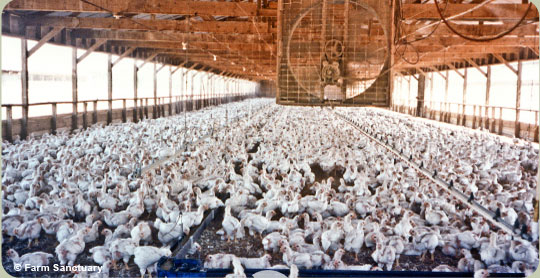
There was a time when chickens were viewed as exotic, fascinating birds. Descendants of exotic Asian jungle fowl, they were revered for their ferocity and intelligence, and domesticated around 8,000 years ago, more for cockfighting than eating. But then, we humans began eating them in ever-larger quantities, until we reached the point where we are now, with 20 billion (mostly white) chickens living in dirty, crowded barns, awaiting slaughter.
Chickens have been a part of human lives for millennia, and yet they are one of the most misunderstood, if not ignored, species on Earth. Lori Marino, an American neuroscientist and animal intelligence researcher, wants to change this. She is intrigued by the fact that chickens are so rarely recognized for their cognitive abilities and frustrated that studies about birds almost always focus on other, less-domesticated species, like crows and parrots.
“Arguably even the scientific community has been influenced by public perceptions of chickens as cognitively simple… This asymmetry in the literature is likely a reflection of, as well as a contributor to, the disconnect scientists and the public have between chickens as commodities and who they actually are as individuals.”
Chickens deserve more attention, and here are some quirky, interesting facts to get you thinking about chickens less as food and more as fascinating co-inhabitants of our world. These come via Marino’s recent paper, “Thinking Chickens,” published online in Animal Cognition in January 2017.
1. Chickens are a sub-species of the red jungle fowl that hails from southeast Asia.
The red jungle fowl (galls gallus) inhabit the edges of fields, scrubland, and groves. Domestication was well established 8,000 years ago, but some records suggest it could have started as much as 58,000 years ago.
2. Domestic chickens are similar to their wild counterparts.
Despite the intense breeding and genetic manipulation of recent years, chickens have not been cognitively or behaviorally affected by domestication. This stands in contrast to dogs and wolves, for example, which have diverged significantly due to domestication. Nor have chickens become less aggressive toward predators through domestication, which is a common outcome; in fact, some chickens are more aggressive even than red jungle fowl.
3. A chicken’s beak is highly sensitive to touch.
The beak, with numerous nerve endings, is used to explore, detect, drink, preen, and defend. This also means that when a bird is de-beaked, as often happens in industrial farming, it experiences great pain, sometimes for months, which changes its behavior. Marino writes, “At the end of the beak is a specialized cluster of highly sensitive mechanoreceptors, called the bill tip organ, which allows chickens to make fine tactile discriminations.”
4. Chickens have finely tuned senses.
They can see long distance and close-up at the same time in different parts of their vision. They can see a broader range of colors than humans. They can hear at low and high frequencies at a variety of pressure levels. They possess well-developed senses of taste and smell. They can orient to magnetic fields, like many other birds.
5. Chickens are surprisingly good at math.
Three-day-old chicks are able to perform basic arithmetic and discriminate quantities, always opting to explore a set of balls with the greater number, even when an object was visibly transferred from one set to another. Five-day-old chicks have been found to track up to five objects.
“When they were presented with two sets of objects of different quantities disappearing behind two screens, they were able to successfully track which screen hid the larger number by apparently performing simple addition and subtraction.”
6. Chickens can exercise self-control.
In an experimental setting, chickens have been given the choice between 2-second delay with 6 seconds of access to food, versus a 6-second delay with 22-seconds of access to food. The hens waited for the longer reward, “demonstrating rational discrimination between different future outcomes while employing self-control to optimize those outcomes.” Self-control usually doesn’t appear in humans until four years of age.
These are just a few of the remarkable discoveries described in Marino’s study, a highly readable, entertaining paper. It’s an important reminder that chickens, arguably the most ubiquitous animals in our world, deserve far more respect than they currently receive. Hopefully this will lead to more people questioning the horrific conditions in which most of them are kept.
It’s easy to fall into the trap of looking for a humourous way to close today’s post. But a more responsible approach would be to repeat the words from the start of the article to serve as a reminder of trying, wherever possible, to think about the food we eat, especially when animals and birds have to be slaughtered to provide us with that food.
…. we reached the point where we are now, with 20 billion (mostly white) chickens living in dirty, crowded barns, awaiting slaughter.
But please don’t leave this page until you have watched the following video.
Published on Dec 3, 2014
After 22 years of raising chickens for Perdue, one brave factory farmer Craig Watts was at his breaking point and did something no one has done before. He invited us, as farm animal welfare advocates, to his farm to film and tell his story. Ask your supermarket for Better Chicken at http://better-chicken.org.
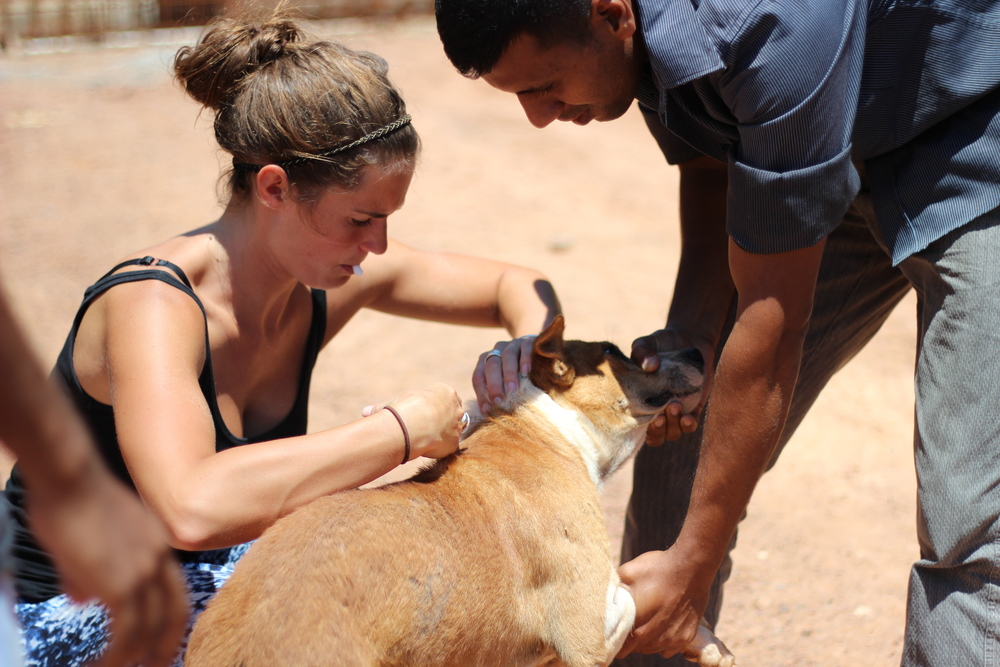
A vet has left behind her home in England to care for Sri Lanka’s street dogs.
Janey Lowes from Barnard Castle, County Durham, has spent the past two years caring for the neglected animals.
There are about three million street dogs on the island – about 60% of puppies born on the street do not survive to adulthood.
The 28-year-old set up charity WECare Worldwide to raise money to buy the equipment needed to treat the animals and to set up her own clinic in Talalla.
I am pleased that the video clip that was included in the BBC News story has found its way to YouTube.
Inevitably the charity WECare Worldwide has its own website: the home page is here. Then you can read on the charity’s ‘About’ page: (Note: CNVR is the acronym standing for catch-neuter-vaccinate-release.)
CNVR
CNVR is carried out as it is the most humane way to reduce roaming dog populations and reduce the number of unwanted puppies that are dumped on the streets at a very young age. It also allows the females that would inevitably spend their whole lives pregnant to only have to worry about number one when thinking about limited food resources and shelter options, which transforms their lives.
Vaccinating the dog population against Rabies is the most effective way to eliminate the disease in the human population. As an island nation, eradication of Rabies in the near future is a very real possibility and will change the future of both animals and humans here, allowing improved relationships between the two.
CNVR is the backbone of everything we are trying to achieve in Sri Lanka.
But that’s only one part of what they do. Again, as the website sets out:
We focus on 3 main areas here in Sri Lanka.
CNVR (catch-neuter-vaccinate-release)
Treatment of sick and injured animals
Education and training
I shall be making contact with the charity very soon .
Not only to pass on our respect and admiration for what she has accomplished but to see if there are other ways we can help them in what they are doing. I use the word ‘we’ to cover not only Jean and me but also all of you who are close to this blog and who, so frequently, show how much love you have for dogs!
WECare Worldwide will help by providing free veterinary treatment, alongside love, compassion and respectful care of the Ceylon dogs, who make up such a huge part of Sri Lankan heritage and culture, both in the past and the current day.
After spending nearly a year on a Georgia animal shelter’s adoption list, Kailey’s time was up. The shy 3-year-old shepherd mix didn’t like to be petted by strangers, which raised a big red flag for potential forever families.
“Her one issue was that something had happened to her in her past, so that if you tried to touch her and she did not know you, she would snap at you,” Jacqueline Berlin, who had fostered Kailey, told FOX 5.
Fortunately, Kailey’s life was spared, and not a moment too soon. Shortly before Kailey was going to be euthanized by DeKalb County Animal Services, Suzy Chandler came across the dog’s video on the DeKalb County Animal Services Facebook page.
“Do you like to be alone or just with a close friend?” the post read. “Is an evening at home surfing the web or cuddling with a loved one watching Netflix your idea of bliss? Does the idea of being grabbed anywhere by someone you don’t know horrifying? Meet your doggie soulmate: Kailey.”
It noted that while Kailey didn’t make the greatest first impression due to her “don’t touch me until I know you” issue, within 24 hours she would be in love with you. Her biggest flaw? She “has no idea of personal space. She is a Velcro dog who wants nothing more than to be with you.”
“The story of what she had been through just pulled on our heartstrings,” Chandler told FOX 5. “We just thought we would be the perfect people for her. It was a perfect match.”
On the morning of Dec. 30, just a couple of weeks after Chandler saved Kailey’s life, the former death-row dog paid it forward.
Kailey started barking and growling at Chandler, trying to get her attention. When Chandler took Kailey outside her house, thinking she needed a potty break, the dog pulled her toward the side yard.
“Right away I smelled overpowering gas and a loud whooshing sound,” Chandler told FOX 5. She called 911.
DeKalb County Fire responded and repaired the ruptured gas line. If Kailey hadn’t alerted Chandler to it, the outcome could have been disastrous. Chandler lives next door to an apartment complex where many children live.
“She’s our hero dog, because we don’t know what the outcome would have been,” Berlin told FOX 5.
Chandler hopes Kailey’s actions will inspire others to adopt pets, despite whatever red flags they may perceive. (“Here, here”, say Jean and Paul)
“If you have the space, you have room in your heart to take in a needy animal, to love on them,” she told FOX 5. “I mean it comes back to you tenfold.”
Kailey isn’t the only rescued dog who has rescued her family. Among these four-legged heroes last year were a pit bull named Leon who alerted his owner to an intruder in the house, a German Shepherd named Haus who protected a little girl from a rattlesnake, and a pug named Earl who, just a week after he was adopted, woke up his new family and saved them from a house fire.
Then as soon as I started to write today’s post (as of yesterday afternoon) I realised the error in my sub-title. For one might argue that this does have a connection with how our dogs behave as a cohesive group. But I’m going to be ‘an arse’ (‘ass’ in American speak) and ask you to hold out until the end of today’s post to read the ‘doggie’ connection. (Note that today’s post is Part One. Part Two continues tomorrow.)
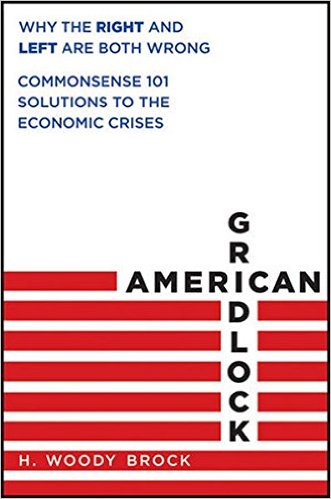
I am in the middle of reading American Gridlock written by H. Woody Brock and published in 2012. Here’s an extract of what the book is about, courtesy of Amazon:
A sensible solution to getting our economy back on track
Pessimism is ubiquitous throughout the Western World as the pressing issues of massive debt, high unemployment, and anemic economic growth divide the populace into warring political camps. Right-and Left-wing ideologues talk past each other, with neither side admitting the other has any good ideas. In American Gridlock, leading economist and political theorist H. Woody Brock bridges the Left/Right divide, illuminating a clear path out of our economic quagmire.
Arguing from first principles and with rigorous logic, Brock demonstrates that the choice before us is not between free market capitalism and a government-driven economy. Rather, the solution to our problems will require enactment of constructive policies that allow “true” capitalism to flourish even as they incorporate social policies that help those who truly need it.
Brock demonstrates how deductive logic (as opposed to ideologically driven data analysis) can transform the way we think about these problems and lead us to new and different solutions that cross the ideological divide. Drawing on new theories such as game theory and the economics of uncertainty that are based upon deductive logic, Brock reveals fresh ideas for tackling issues central to the 2012 U.S, Presidential election and to the nation’s long-run future:
It greatly influenced me and I sat down and wrote an essay. Mainly to clarify my own thinking ahead of a meeting last Saturday of our local Freethinkers Group where the topic was “Ideas for Improving our Democratic Processes”. The “our” being the US democratic process but just as valid for many other countries.
I first set out to see if there was a clear, unambiguous definition of what a democratic society is. Surprise, surprise there isn’t one. Very quickly I came up with three:
The first:
A democracy by definition is government through elected representatives. It is a form of society which favours equal rights, freedom of speech and a fair trial and tolerates the views of minorities. Civics and Citizenship website
The second:
A DEMOCRACY IS a society in which all adults have easily accessible, meaningful, and effective ways:
(a) to participate in the decision-making processes of every organization that makes decisions or takes actions that affect them, and;
(b) to hold other individuals, and those in these organizations who are responsible for making decisions and taking actions, fully accountable if their decisions or actions violate fundamental human rights, or are dishonest, unethical, unfair, secretive, inefficient, unrepresentative, unresponsive or irresponsible;
(c) so that all organizations in the society are citizen-owned, citizen-controlled, and citizen-driven, and all individuals and organizations are held accountable for wrongdoing. Democracy Watch website
And the third:
Better democracy, everywhere.
The Democratic Society (Demsoc) works for more and better democracy, where people and institutions have the desire, opportunity and confidence to participate together.
We work to create opportunities for people to become involved in the decisions that affect their lives and for them to have the skills to do this effectively. We support governments, parliaments and any organisation that wants to involve citizens in decision making to be transparent, open and welcoming of participation. We actively support spaces, places and processes to make this happen. Democratic Society website.
I went on to say in my essay:
Yes, there is some harmony between all three definitions but there are also significant differences in tone and language.
I am sure many of you are familiar with the book by H. Woody Brock American Gridlock. I started reading it a few days ago and cannot now put it down.
For the core message of the book is that we, as in society, must distinguish between inductive and deductive reasoning. Let me use the definitions as found on the Live Science website.
Deductive reasoning
Deductive reasoning is a basic form of valid reasoning. Deductive reasoning, or deduction, starts out with a general statement, or hypothesis, and examines the possibilities to reach a specific, logical conclusion, according to the University of California. The scientific method uses deduction to test hypotheses and theories. “In deductive inference, we hold a theory and based on it we make a prediction of its consequences. That is, we predict what the observations should be if the theory were correct. We go from the general — the theory — to the specific — the observations,” said Dr. Sylvia Wassertheil-Smoller, a researcher and professor emerita at Albert Einstein College of Medicine.
In deductive reasoning, if something is true of a class of things in general, it is also true for all members of that class. For example, “All men are mortal. Harold is a man. Therefore, Harold is mortal.” For deductive reasoning to be sound, the hypothesis must be correct. It is assumed that the premises, “All men are mortal” and “Harold is a man” are true. Therefore, the conclusion is logical and true.
That is, we predict what the observations should be if the theory were correct.”
Let that really work it’s way through your consciousness. It’s an idea that is rooted in the great scientists and philosophers of many thousands of years ago. Think of Euclid, the Greek Socratic philosopher who founded the Megarian school of philosophy. He was a pupil of Socrates in the late 5th century BCE, and was present at his death. (I cheated and looked it up.)
It was Euclid who through Euclidian geometry came to understand the principles of angles and straight lines; as in the shortest distance between two points.
Moving on:
Inductive reasoning
Inductive reasoning is the opposite of deductive reasoning. Inductive reasoning makes broad generalizations from specific observations. “In inductive inference, we go from the specific to the general. We make many observations, discern a pattern, make a generalization, and infer an explanation or a theory,” Wassertheil-Smoller told Live Science. “In science there is a constant interplay between inductive inference (based on observations) and deductive inference (based on theory), until we get closer and closer to the ‘truth,’ which we can only approach but not ascertain with complete certainty.”
Even if all of the premises are true in a statement, inductive reasoning allows for the conclusion to be false. Here’s an example: “Harold is a grandfather. Harold is bald. Therefore, all grandfathers are bald.” The conclusion does not follow logically from the statements.
Inductive reasoning has its place in the scientific method. Scientists use it to form hypotheses and theories. Deductive reasoning allows them to apply the theories to specific situations.
Now for some of you this side trip into reasoning may have seen more like a complete departure. But the point is that, as American Gridlock makes so powerfully: There are two main problems to be solved if this nation is to get back on track. First, win-win policy solutions must be identified for the five real-world problems addressed in Chapters 2 through 6. Second, the Dialogue of the Deaf must come to an end, policy gridlock with it, and these solutions must be implemented. (Pages 7-8)
I closed my essay by setting out the following proposition:
Until we have a clear, universally acknowledged definition of what a democratic society is then it is impossible and utterly futile to debate the various processes including what is the best process for American society.
Is this relevant to the world outside the USA? You bet it is. For better or for worse, what the USA does today the rest of the world does soon thereafter.
And as you will see in Part Two that comes tomorrow democratising the economy is key.
For when we look at the way that dogs, and wolves, operate as a pack in the wild there are only three animals with status:
The alpha female who has first choice of the male dogs for mating purposes and makes the decision, as and when necessary, to move her pack to a new territory,
The beta dog, always a male, whose role is to keep the pack running smoothly as a cohesive group and not letting squabbles get out of hand, and,
The omega dog, that can be of either gender, whose role is to keep the pack happy.
All the other animals in the pack of around fifty are of equal status and work for the benefit of the pack. Now that is something we should learn from dogs!
The philosophy of hunting in terms of it being ‘right’ or ‘wrong’.
Anyone who comes here for more than a couple of visits will know that both Jean and I are opposed to hunting completely. Period!
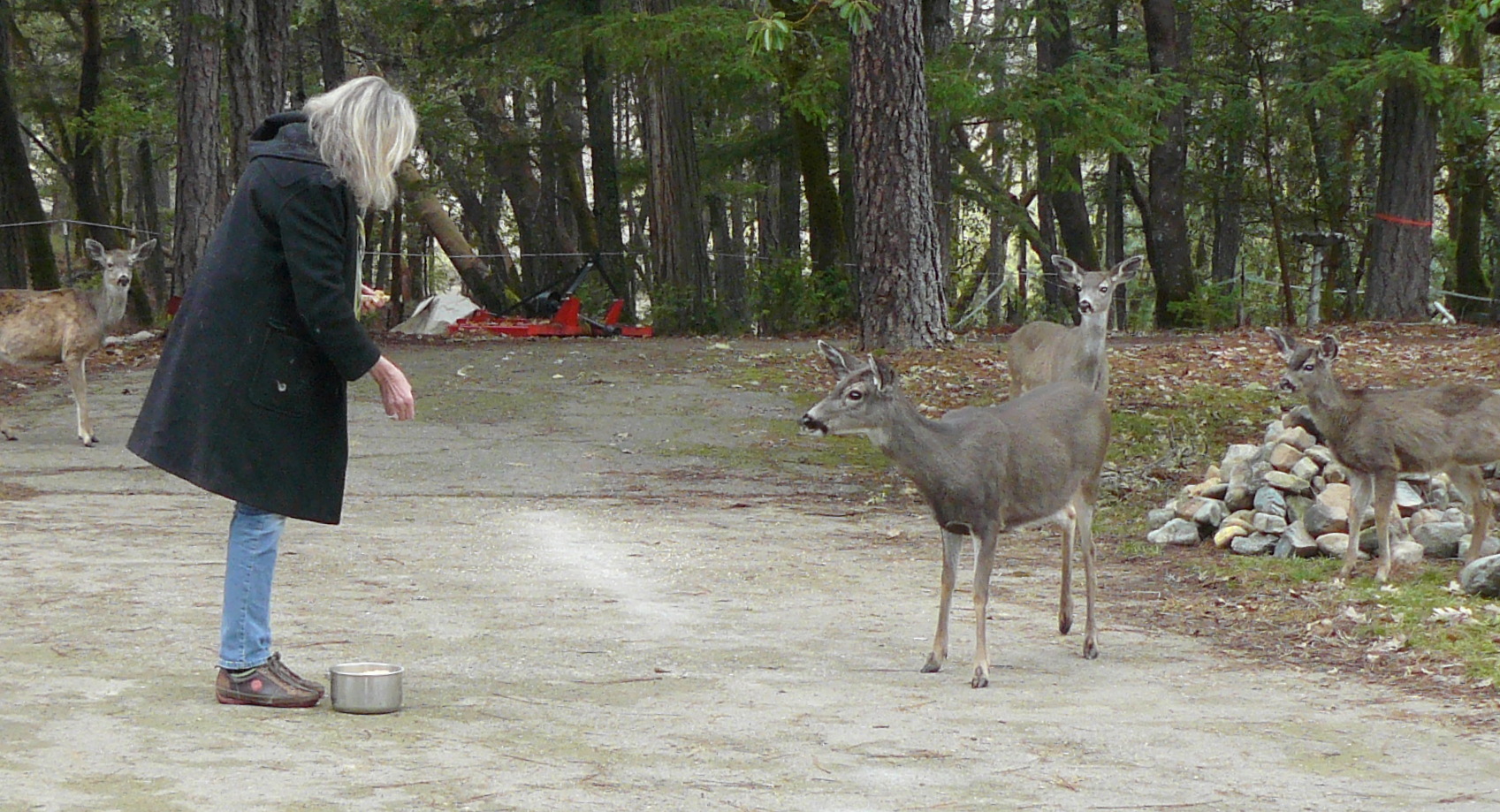
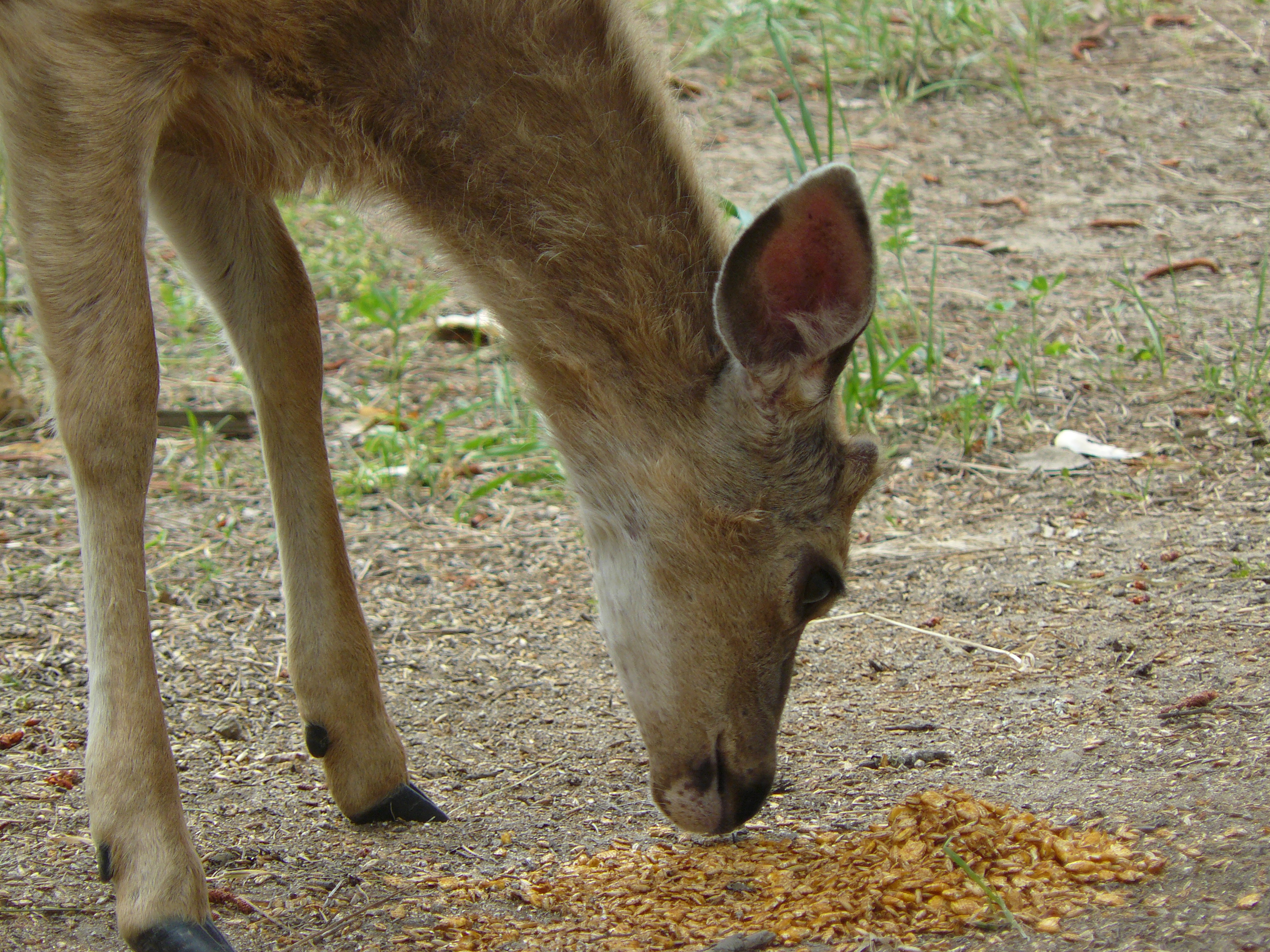
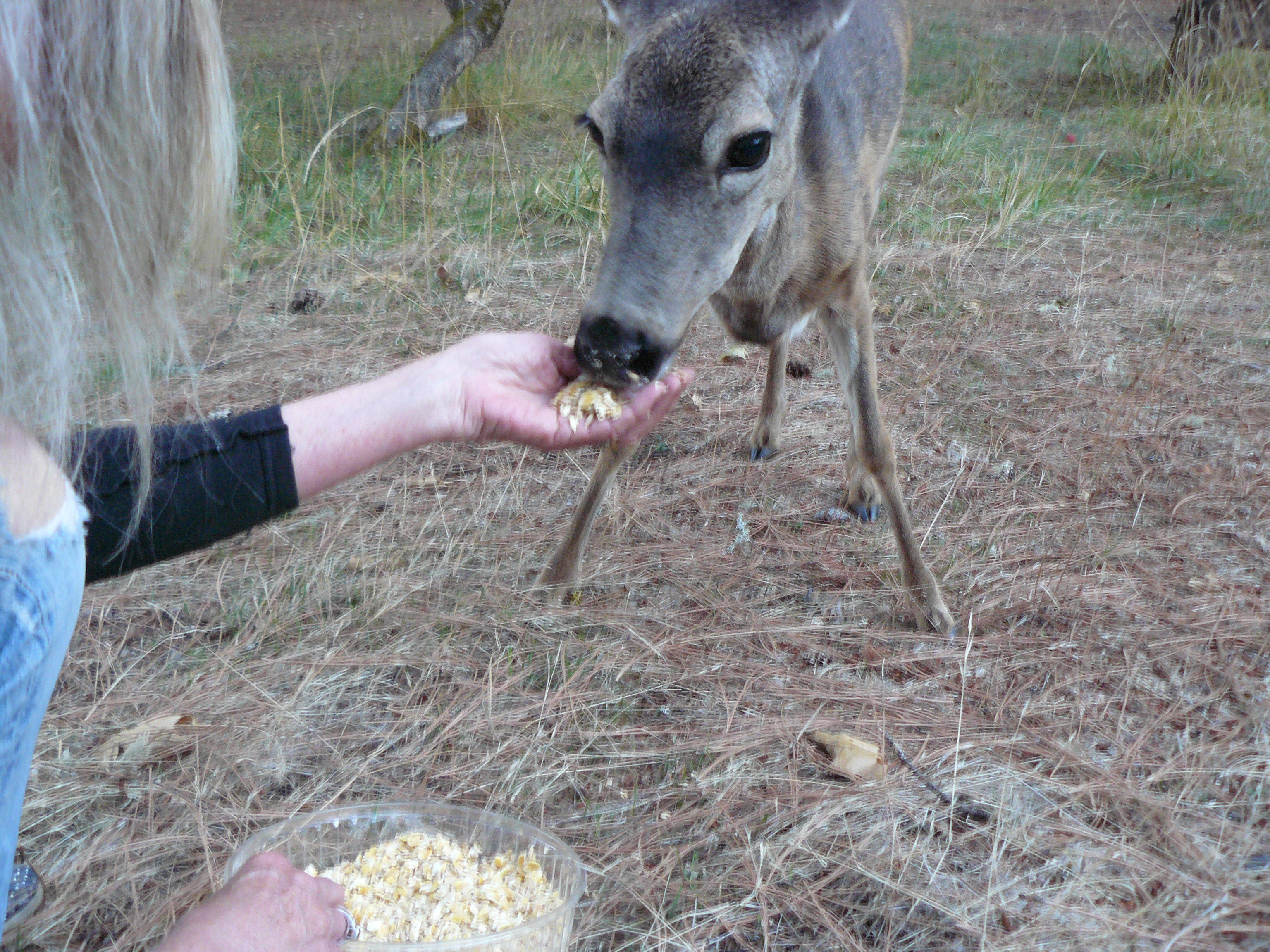
That’s not surprising as there have been a number of posts over the years describing how we feed the wild deer. Here’s three more photographs that haven’t previously been shared with you.
oooo
oooo
But, of course, the opinions of Jean and me are not, and should not be, the rule for the wider population of this part of Oregon.
All I would ask is that there is a proper, mature discussion as to the pros and cons of hunting wild animals in this, the twenty-first century.
Every year as daylight dwindles and trees go bare, debates arise over the morality of hunting. Hunters see the act of stalking and killing deer, ducks, moose and other quarry as humane, necessary and natural, and thus as ethical. Critics respond that hunting is a cruel and useless act that one should be ashamed to carry out.
As a nonhunter, I cannot say anything about what it feels like to shoot or trap an animal. But as a student of philosophy and ethics, I think philosophy can help us clarify, systematize and evaluate the arguments on both sides. And a better sense of the arguments can help us talk to people with whom we disagree.
Therapeutic hunting involves intentionally killing wild animals in order to conserve another species or an entire ecosystem. In one example, Project Isabella, conservation groups hired marksmen to eradicate thousands of feral goats from several Galapagos islands between 1997 and 2006. The goats were overgrazing the islands, threatening the survival of endangered Galapagos tortoises and other species.
Subsistence hunting is intentionally killing wild animals to supply nourishment and material resources for humans. Agreements that allow Native American tribes to hunt whales are justified, in part, by the subsistence value the animals have for the people who hunt them.
Crawford Patkotak, center, leads a prayer after his crew landed a bowhead whale near Barrow, Alaska. Both revered and hunted by the Inupiat, the bowhead whale serves a symbol of tradition, as well as a staple of food. AP Photo/Gregory Bull
In contrast, sport hunting refers to intentionally killing wild animals for enjoyment or fulfillment. Hunters who go after deer because they find the experience exhilarating, or because they want antlers to mount on the wall, are sport hunters.
These categories are not mutually exclusive. A hunter who stalks deer because he or she enjoys the experience and wants decorative antlers may also intend to consume the meat, make pants from the hide and help control local deer populations. The distinctions matter because objections to hunting can change depending on the type of hunting.
What bothers people about hunting: Harm, necessity and character
Critics often argue that hunting is immoral because it requires intentionally inflicting harm on innocent creatures. Even people who are not comfortable extending legal rights to beasts should acknowledge that many animals are sentient – that is, they have the capacity to suffer. If it is wrong to inflict unwanted pain and death on a sentient being, then it is wrong to hunt. I call this position “the objection from harm.”
If sound, the objection from harm would require advocates to oppose all three types of hunting, unless it can be shown that greater harm will befall the animal in question if it is not hunted – for example, if it will be doomed to slow winter starvation. Whether a hunter’s goal is a healthy ecosystem, a nutritious dinner or a personally fulfilling experience, the hunted animal experiences the same harm.
But if inflicting unwanted harm is necessarily wrong, then the source of the harm is irrelevant. Logically, anyone who commits to this position should also oppose predation among animals. When a lion kills a gazelle, it causes as much unwanted harm to the gazelle as any hunter would – far more, in fact.
Lions attack a water buffalo in Tanzania. Oliver Dodd/Wikipedia, CC BY
Few people are willing to go this far. Instead, many critics propose what I call the “objection from unnecessary harm”: it is bad when a hunter shoots a lion, but not when a lion mauls a gazelle, because the lion needs to kill to survive.
Today it is hard to argue that human hunting is strictly necessary in the same way that hunting is necessary for animals. The objection from necessary harm holds that hunting is morally permissible only if it is necessary for the hunter’s survival. “Necessary” could refer to nutritional or ecological need, which would provide moral cover for subsistence and therapeutic hunting. But sport hunting, almost by definition, cannot be defended this way.
Sport hunting also is vulnerable to another critique that I call “the objection from character.” This argument holds that an act is contemptible not only because of the harm it produces, but because of what it reveals about the actor. Many observers find the derivation of pleasure from hunting to be morally repugnant.
In 2015, American dentist Walter Palmer found this out after his African trophy hunt resulted in the death of Cecil the lion. Killing Cecil did no significant ecological damage, and even without human intervention, only one in eight male lions survives to adulthood. It would seem that disgust with Palmer was at least as much a reaction to the person he was perceived to be – someone who pays money to kill majestic creatures – as to the harm he had done.
The hunters I know don’t put much stock in “the objection from character.” First, they point out that one can kill without having hunted and hunt without having killed. Indeed, some unlucky hunters go season after season without taking an animal. Second, they tell me that when a kill does occur, they feel a somber union with and respect for the natural world, not pleasure. Nonetheless, on some level the sport hunter enjoys the experience, and this is the heart of the objection.
Is hunting natural?
In discussions about the morality of hunting, someone inevitably asserts that hunting is a natural activity since all preindustrial human societies engage in it to some degree, and therefore hunting can’t be immoral. But the concept of naturalness is unhelpful and ultimately irrelevant.
A very old moral idea, dating back to the Stoics of ancient Greece, urges us to strive to live in accordance with nature and do that which is natural. Belief in a connection between goodness and naturalness persists today in our use of the word “natural” to market products and lifestyles – often in highly misleading ways. Things that are natural are supposed to be good for us, but also morally good.
Setting aside the challenge of defining “nature” and “natural,” it is dangerous to assume that a thing is virtuous or morally permissible just because it is natural. HIV, earthquakes, Alzheimer’s disease and post-partum depression are all natural. And as The Onion has satirically noted, behaviors including rape, infanticide and the policy of might-makes-right are all present in the natural world.
Head-Smashed-In Buffalo Jump, a UNESCO World Heritage Site in Alberta, Canada, commemorates a place where indigenous peoples of the North American Plains killed buffalo for more than 6,000 years by driving them over a cliff.
Hard conversations
There are many other moral questions associated with hunting. Does it matter whether hunters use bullets, arrows or snares? Is preserving a cultural tradition enough to justify hunting? And is it possible to oppose hunting while still eating farm-raised meat?
As a starting point, though, if you find yourself having one of these debates, first identify what kind of hunting you’re discussing. If your interlocutor objects to hunting, try to discover the basis for their objection. And I believe you should keep nature out of it.
Finally, try to argue with someone who takes a fundamentally different view. Confirmation bias – the unintentional act of confirming the beliefs we already have – is hard to overcome. The only antidote I know of is rational discourse with people whose confirmation bias runs contrary to my own.
ooOOoo
This is a very important essay from Joshua. Well done, that man!
I will just leave you all with this further image.
Two young stags keeping it together. (Taken here at home in July, 2016.)
Best wishes to each of you; irrespective of your view on hunting!
Slowly getting back to normal although yesterday morning saw the water supply fail from the well. (Now restored!) Perhaps not surprising as overnight Thursday-through-Friday the outside temperature went down to 8.6 deg. F. or in ‘new money’ -13 deg. C. (In fact I’m writing this at 10am yesterday waiting for the well engineer to arrive!)
On January 4th, the Care2 site published what has to be one of the most remarkable examples of the loyalty of a dog. This is about as perfect an example of what we humans can learn from our dogs as it gets!
ooOOoo
Loyal Dog Protects Buddy Stuck on Tracks From Speeding Train
If you’ve ever had the slightest doubt about just how loyal dogs can be – not only to people but to other dogs – a pup who’s been named Panda really proved it on Christmas Day.
Panda and his pal, now named Lucy, apparently escaped from their home in western Ukraine and somehow ended up on railroad tracks in the town of Uzhhorod. Lucy had an injury and was unable to stand or move. Panda remained right by her side, warming her with his body in the freezing cold.
A train engineer contacted a group of animal rescue volunteers including Denis Malafeyev, telling them he’d seen the dogs on the tracks for two days. Malafeyev and the others took off to try to save them.
“I saw a train approaching and felt sick,” he wrote on Facebook. “The male dog heard the sound of the approaching train, came close to the female dog and laid down next to her. Both of them pushed their heads toward the ground and let the train pass.”
A viral video Malafeyev posted shows the dogs being run over by the speeding train. It’s chilling to think that this wasn’t the first time this happened to the dogs.
The video is disturbing and difficult to watch, but amazingly, both dogs survived with just minor injuries. It may also seem disturbing that, knowing a train would be approaching, Malafeyev didn’t put down his camera and save the dogs. He wrote in his Facebook post that he and the group had tried, unsuccessfully, to move them, but Panda would bark at them and refuse to let them get close to Lucy.
“Think about it. He was keeping her warm,” Malafeyev wrote. ” I don’t know what to call this: instinct, love, friendship, loyalty? One thing I know for sure is that not all people would do the same as this dog!”
The video has been viewed more than 1.5 million times, with many commenters agreeing with Malafeyev that humans have a lot to learn from this dog.
Four days later, Malafeyev posted new videos of Panda and Lucy on Facebook. The dogs were taken to an animal shelter and have been reunited their owners, UPI reports. (There are conflicting reports that the dogs were adopted and given the names Panda and Lucy by their new owners. Either way, the two dogs are in a forever home together.)
I am going to close this post by including another YouTube video of this incredible act together with the text supporting this video.
Incredible Story of Devotion Dog! 2017
Published on Jan 4, 2017
Incredible Story of Devotion Dog! The dog two days guarded wounded friend on the rails!
On Sunday, December 25 near the village of Uzhgorod in the district of Tyyglash a touching story took place in Ukraine. Two dogs spent about two days on the tracks, one of them was injured, and the other kept the injured dog warmed and protected from the passing trains.
The story was posted on his page on facebook user Denis Malafeev. His friends noticed two dogs lying on the tracks, one of them was injured. Later, the man himself arrived on the scene.
Several attempts to remove the animal from the rails were in vain, because the dog strongly defended her friend from the people!
When the animals heard an approaching train, the healthy dog lay next to a wounded dog and together they were pressed to the ground between the rails. This moment Malafeev managed to capture on video.
The dog did it for two days in a row! Just think! He warmed it for two days, so that it did not freeze and put himself in danger every time! I do not know how to call it: the instinct, love, friendship, loyalty? It is instructive for us!
Together with his friends, they took dogs and took them to the shelter. The Post reports that they are now waiting for their owners.
P.S. Shortly after the publication in social networks there were dog owners. It was learned that the Pandas and Lucy – so call the animals – there are no serious injuries, only bruises and hematomas. I found out that shaggy live in the home side’s S. Tseglovka in Transcarpathia for several years and are committed to each other from puppyhood. Dogs run away from home when someone from the house forgot to close the door on the site. They searched all over the village. But when the owners heard the story of “Romeo and Juliet” on track – immediately rushed to pick up pets from the shelter. Now dogs are at home, and their life is not threatened.
For two days that one dog protected the other. It is beyond imagination to think how frightening a speeding train would have been for those two precious dogs. Not just once but numerous times before rescue came to them.
Such a privilege to be able to share this with you.
My title and sub-title comes from commercial aviation. It’s one aspect of the safety culture that safely the millions of passengers who embark on a commercial flight each year. (IATA estimate that it will be 3.6 billion in 2016.) In other words, if the flight crew have even an inkling of an issue with the aircraft while in flight they will make an immediate decision to land.
Why I chose this title will become clearer as you read on.
The end of the Second World War so far as Europe was concerned came on May 8th, 1945. In other words: VE Day. London was not a pretty sight in 1945.
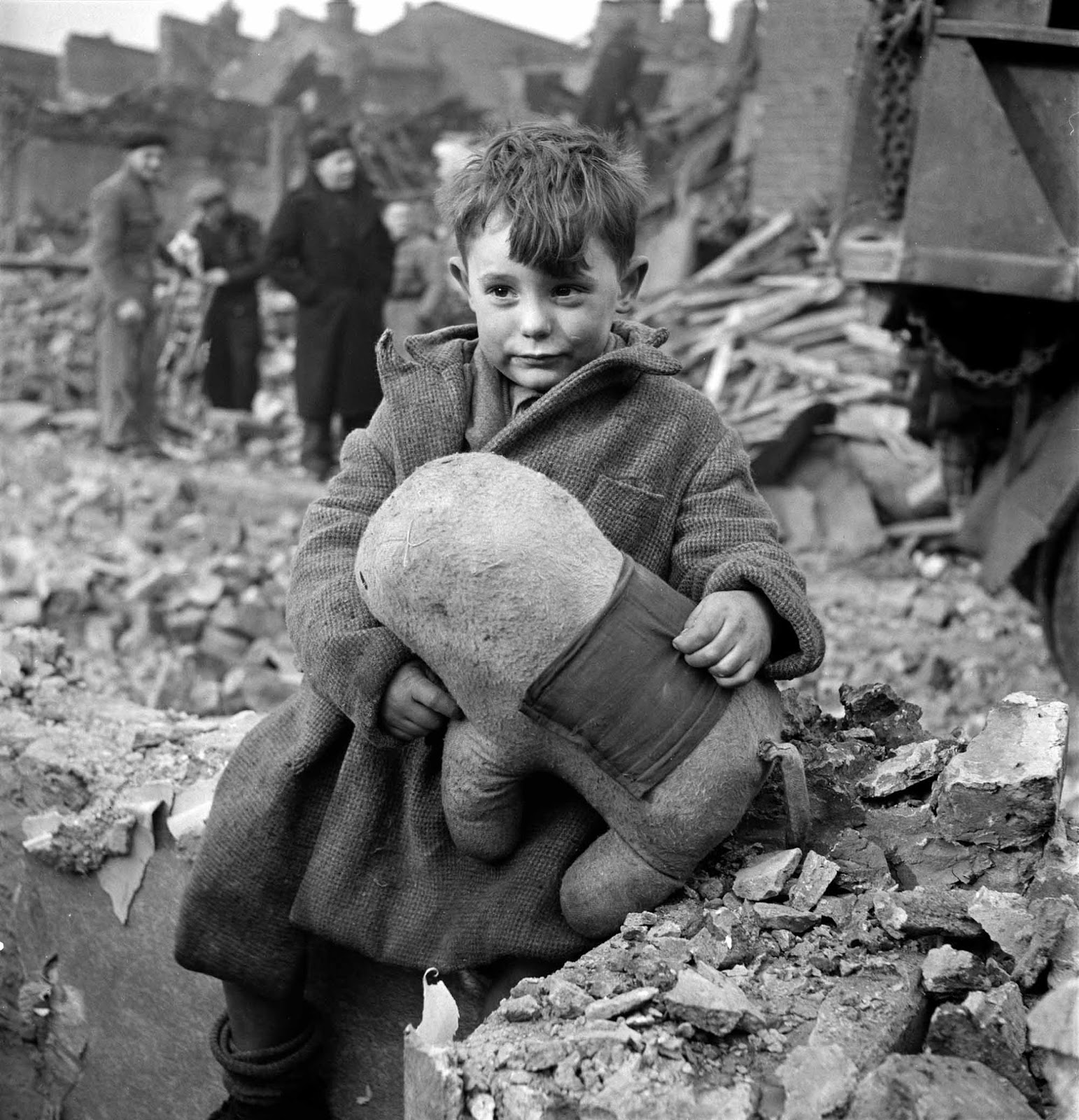
Toni Frissell’s famous image of an abandoned boy clutching a stuffed animal in the rubble of 1945 London. (Image taken from this website page.)
What’s the relevance of May 8th, 1945 to me? Well exactly six months, to the day, before VE Day yours truly was born in Acton which was just six miles West of Marble Arch in the centre of London.
It has been a family legend that when VE Day was announced my mother looked at her six-month-old baby son and announced that he was going to live! For those first six months of my life in London were very dangerous. From that same website page where that photograph above came from one can read (my emphasis):
Nazi Germany continued to bomb London up until 1945 using a variety of delivery methods including V-1 and V-2 rockets. In total 1,115 V-2s were fired at the United Kingdom. The vast majority of them were aimed at London, though about 40 targeted (and missed) Norwich. They killed an estimated 2,754 people in London with another 6,523 injured.
I have very clear mental images of playing in and around bomb sites near our home right up to 1953 when there was a real push to clear the sites away ahead of the Queen’s Coronation on June 2nd, 1953.
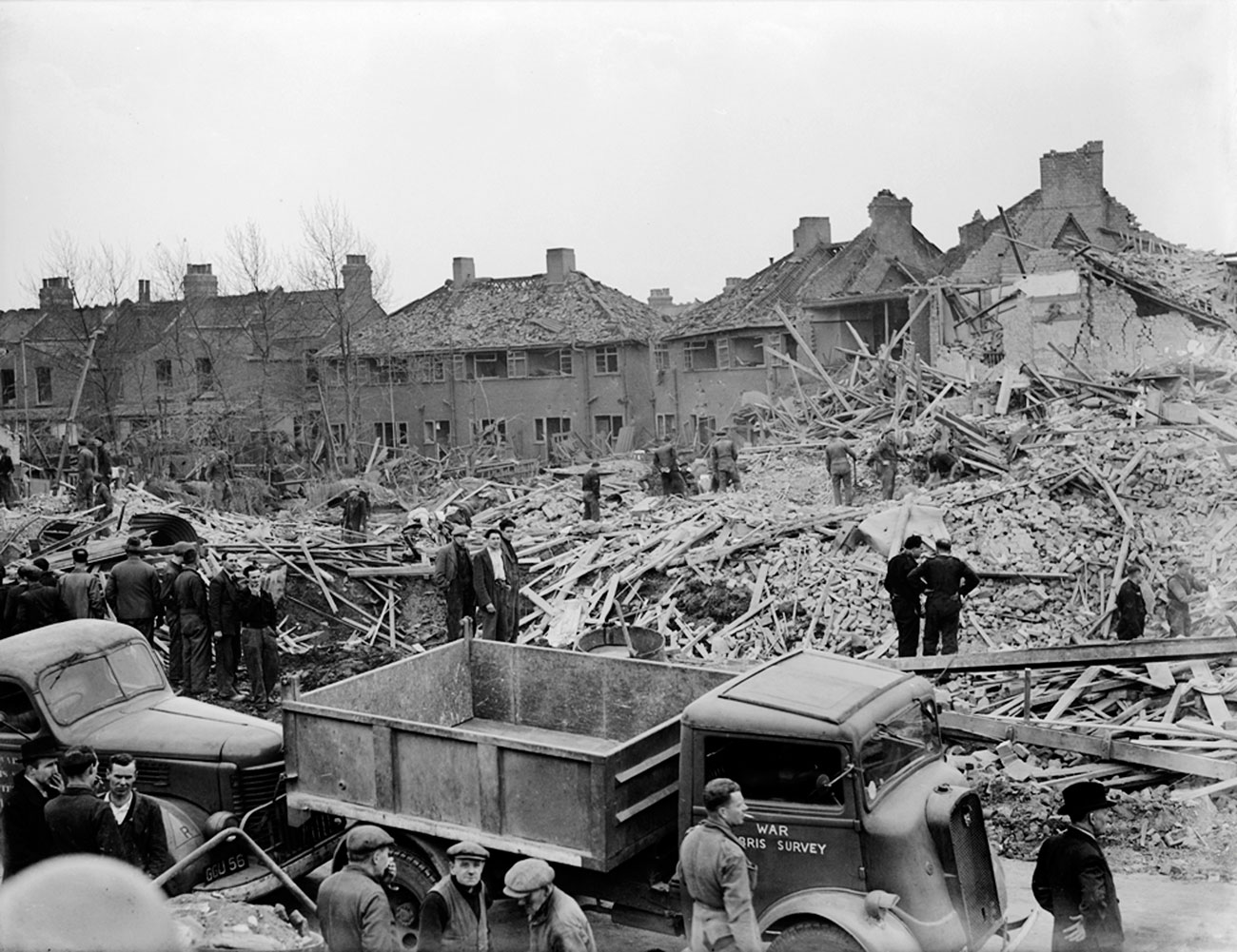
German V-2 bomb damage on houses in Uppingham Avenue, Stanmore, just a few miles from home. The bomb exploded on March 16th, 1945.
So what’s this all about and why do I see it as relevant to today’s world? Stay with me for a little longer.
With all due respect, and abundant apologies for the daring image, we can’t write exclusively about dogs, lest we want to finish as dog food. As Paul is suggesting. Indeed I view seriousness in global inquiry as a basic moral duty.
Imagine Jews worrying just about dogs, while Auschwitz was being built; it’s arguably what happened, said Hannah Arendt (I’m paraphrasing; she was hated for it, though…) Some will scoff, but Kim in Korea is building one new H bomb every 5 weeks… One single H bomb, in the ‘right’ place, can kill more than Auschwitz.
In the Real World, Foundations Saved Civilization Before:
The combination of imperial collapse followed by re-birth from Foundations within happened several times already, for real.
Civilizations collapsing into Dark Ages from the actions of dozens of millions of people occurred more than once. And then very small groups arose, often within the collapsing empire, and imposed new ways of thinking which enabled civilization to restart.
After I read his post I left a question as a comment: “Are you saying that our present civilization is on the point of collapse?”
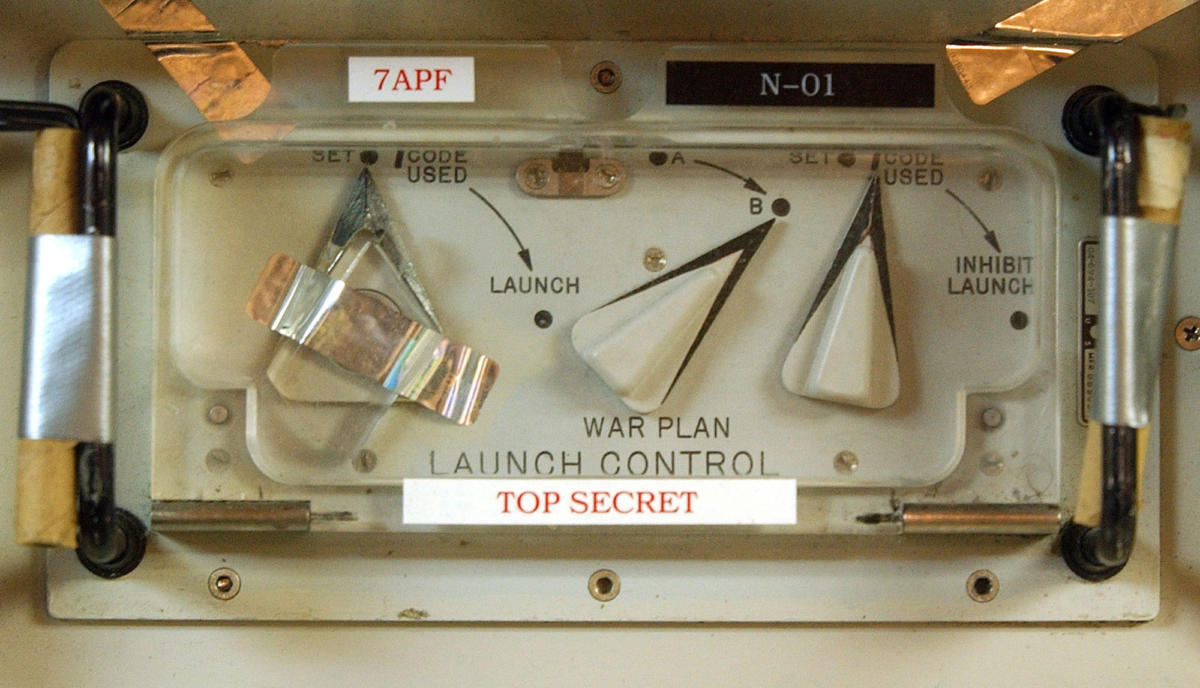
I then went across to that article carried by The New Yorker. It was an article written by Eric Schlosser, author of the book Command and Control: Nuclear Weapons, the Damascus Accident, and the Illusion of Safety and a producer of the documentary Command and Control from 2016.
Harsh political rhetoric, combined with the vulnerability of the nuclear command-and-control system, has made the risk of global catastrophe greater than ever.
A dilemma has haunted nuclear strategy since the first detonation of an atomic bomb: How do you prevent a nuclear attack while preserving the ability to launch one? PHOTOGRAPH BY ANDY CROSS / THE DENVER POST VIA GETTY
On June 3, 1980, at about two-thirty in the morning, computers at the National Military Command Center, beneath the Pentagon, at the headquarters of the North American Air Defense Command (NORAD), deep within Cheyenne Mountain, Colorado, and at Site R, the Pentagon’s alternate command post center hidden inside Raven Rock Mountain, Pennsylvania, issued an urgent warning: the Soviet Union had just launched a nuclear attack on the United States. The Soviets had recently invaded Afghanistan, and the animosity between the two superpowers was greater than at any other time since the Cuban Missile Crisis.
U.S. Air Force ballistic-missile crews removed their launch keys from the safes, bomber crews ran to their planes, fighter planes took off to search the skies, and the Federal Aviation Administration prepared to order every airborne commercial airliner to land.
President Jimmy Carter’s national-security adviser, Zbigniew Brzezinski, was asleep in Washington, D.C., when the phone rang. His military aide, General William Odom, was calling to inform him that two hundred and twenty missiles launched from Soviet submarines were heading toward the United States. Brzezinski told Odom to get confirmation of the attack. A retaliatory strike would have to be ordered quickly; Washington might be destroyed within minutes. Odom called back and offered a correction: twenty-two hundred Soviet missiles had been launched.
Brzezinski decided not to wake up his wife, preferring that she die in her sleep. As he prepared to call Carter and recommend an American counterattack, the phone rang for a third time. Odom apologized—it was a false alarm. An investigation later found that a defective computer chip in a communications device at NORAD headquarters had generated the erroneous warning. The chip cost forty-six cents.
[Two paragraphs later]
My book “Command and Control” explores how the systems devised to govern the use of nuclear weapons, like all complex technological systems, are inherently flawed. They are designed, built, installed, maintained, and operated by human beings. But the failure of a nuclear command-and-control system can have consequences far more serious than the crash of an online dating site from too much traffic or flight delays caused by a software glitch. Millions of people, perhaps hundreds of millions, could be annihilated inadvertently. “Command and Control” focusses on near-catastrophic errors and accidents in the arms race between the United States and the Soviet Union that ended in 1991. The danger never went away. Today, the odds of a nuclear war being started by mistake are low—and yet the risk is growing, as the United States and Russia drift toward a new cold war. The other day, Senator John McCain called Vladimir Putin, the President of the Russian Federation, “a thug, a bully, and a murderer,” adding that anyone who “describes him as anything else is lying.” Other members of Congress have attacked Putin for trying to influence the Presidential election. On Thursday, Putin warned that Russia would “strengthen the military potential of strategic nuclear forces,” and President-elect Donald Trump has responded with a vow to expand America’s nuclear arsenal. “Let it be an arms race,” Trump told one of the co-hosts of MSNBC’s “Morning Joe.” “We will outmatch them at every pass and outlast them all.”
The harsh rhetoric on both sides increases the danger of miscalculations and mistakes, as do other factors. Close encounters between the military aircraft of the United States and Russia have become routine, creating the potential for an unintended conflict. Many of the nuclear-weapon systems on both sides are aging and obsolete. The personnel who operate those systems often suffer from poor morale and poor training. None of their senior officers has firsthand experience making decisions during an actual nuclear crisis. And today’s command-and-control systems must contend with threats that barely existed during the Cold War: malware, spyware, worms, bugs, viruses, corrupted firmware, logic bombs, Trojan horses, and all the other modern tools of cyber warfare. The greatest danger is posed not by any technological innovation but by a dilemma that has haunted nuclear strategy since the first detonation of an atomic bomb: How do you prevent a nuclear attack while preserving the ability to launch one?
[Going to the closing paragraph]
Every technology embodies the values of the age in which it was created. When the atomic bomb was being developed in the mid-nineteen-forties, the destruction of cities and the deliberate targeting of civilians was just another military tactic. It was championed as a means to victory. The Geneva Conventions later classified those practices as war crimes—and yet nuclear weapons have no other real use. They threaten and endanger noncombatants for the sake of deterrence. Conventional weapons can now be employed to destroy every kind of military target, and twenty-first-century warfare puts an emphasis on precision strikes, cyberweapons, and minimizing civilian casualties. As a technology, nuclear weapons have become obsolete. What worries me most isn’t the possibility of a cyberattack, a technical glitch, or a misunderstanding starting a nuclear war sometime next week. My greatest concern is the lack of public awareness about this existential threat, the absence of a vigorous public debate about the nuclear-war plans of Russia and the United States, the silent consent to the roughly fifteen thousand nuclear weapons in the world. These machines have been carefully and ingeniously designed to kill us. Complacency increases the odds that, some day, they will. The “Titanic Effect” is a term used by software designers to explain how things can quietly go wrong in a complex technological system: the safer you assume the system to be, the more dangerous it is becoming.
ooOOoo
My greatest concern is the lack of public awareness about this existential threat, the absence of a vigorous public debate about the nuclear-war plans of Russia and the United States, the silent consent to the roughly fifteen thousand nuclear weapons in the world.
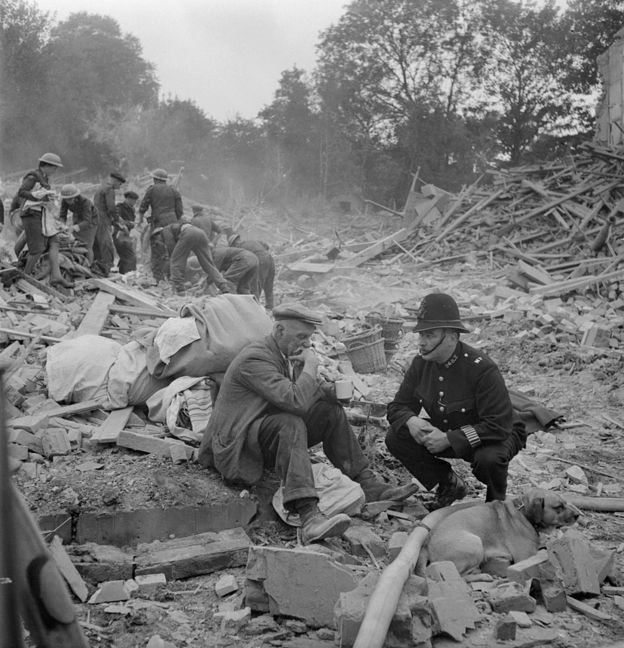
Is there a dog angle to all of this? You bet! For dogs as well as people are all innocents caught up in the madness of war.
A policeman offering sympathy to a now homeless man, who returned home from walking his dog to find his house destroyed and wife killed by a V1 flying bomb. London 1944. (The dog is just below the Policeman’s left shin.)
Now do you see why I entitled today’s post If there’s any doubt. there’s no doubt.
For if we were the flightcrew of the good ship Earth we would be urgently looking for a diversion airfield upon which to land; and land now!
Wherever you are in the world, whatever you are doing, if you share the concern expressed so clearly by Patrice don’t do nothing. Even if all you do is to send a message on one of the social media apps that’s far better than doing nothing. All that evil requires to succeed is for good people to do nothing!
For I haven’t a clue as to when and how my life will come to an end but, as sure as hell, I would prefer that it isn’t six months to the day after the start of World War III.
The power of corporations must never be permitted to override democratic choice.
The main thrust in yesterday’s post was a plea by Chip Colwell , Lecturer on Anthropology, University of Colorado, Denver for our natural lands to be given the legal status of a person. Here’s how Prof. Colwell concluded his essay (my emphasis):
In New Zealand, the Te Urewera Act offers a higher level of protection, empowering a board to be the land’s guardian. The Te Urewera Act, though, does not remove its connection to humans. With a permit, people can hunt, fish, farm and more. The public still has access to the forest. One section of the law even allows Te Urewera to be mined.
Te Urewera teaches us that acknowledging cultural views of places as living does not mean ending the relationship between humans and nature, but reordering it – recognizing nature’s intrinsic worth and respecting indigenous philosophies.
In the U.S. and elsewhere, I believe we can do better to align our legal system with the cultural expressions of the people it serves. For instance, the U.S. Congress could amend the NHPA or the American Indian Religious Freedom Act to acknowledge the deep cultural connection between tribes and natural places, and afford better protections for sacred landscapes like New Mexico’s Mount Taylor.
Until then, it says much about us when companies are considered people before nature is.
Chip Colwell was alerting us, as in humanity, that our natural resources are way, way too important for them to be considered corporate assets.
The days between a Christmas Day and a New Year’s Day are frequently a time for introspection; well they are for me! A few days to reflect on what did or did not work in the year just coming to an end and to find some clarity about the important issues for the new year.
That mood of introspection, of reflection, seems to be creeping into my blog posts this last week of 2016. For following Chip Colwell comes George Monbiot and an essay he published on the 6th December, 2016, that is republished here with Mr. Monbiot’s very kind permission.
Regarding the power of corporations there are strong echoes between Prof. Colwell and Mr. Monbiot.
ooOOoo
The Golden Arches Theory of Decline
10th December 2016
Why is there a worldwide revolt against politics as usual? Because corporate globalisation has crushed democratic choice.
By George Monbiot, published in the Guardian, 6th December 2016
A wave of revulsion rolls around the world. Approval ratings for incumbent leaders are everywhere collapsing. Symbols, slogans and sensation trump facts and nuanced argument. One in six Americans now believes that military rule would be a good idea. From all this I draw the following, peculiar conclusion: no country with a McDonald’s can remain a democracy.
Twenty years ago, the New York Times columnist Thomas Friedman proposed his “golden arches theory of conflict prevention”. This holds that “no two countries that both have McDonald’s have ever fought a war against each other since they each got their McDonald’s”.
Friedman’s was one of several end-of-history narratives suggesting that global capitalism would lead to permanent peace. He claimed that it might create “a tip-over point at which a country, by integrating with the global economy, opening itself up to foreign investment and empowering its consumers, permanently restricts its capacity for troublemaking and promotes gradual democratization and widening peace.” He didn’t mean that McDonald’s ends war, but that its arrival in a nation symbolised the transition.
In using McDonalds as shorthand for the forces tearing democracy apart, I am, like him, writing figuratively. I do not mean that the presence of the burger chain itself is the cause of the decline of open, democratic societies (though it has played its part in Britain, using our defamation laws against its critics). Nor do I mean that countries hosting McDonald’s will necessarily mutate into dictatorships.
What I mean is that, under the onslaught of the placeless, transnational capital McDonald’s exemplifies, democracy as a living system withers and dies. The old forms and forums still exist – parliaments and congresses remain standing – but the power they once contained seeps away, re-emerging where we can no longer reach it.
The political power that should belong to us has flitted into confidential meetings with the lobbyists and donors who establish the limits of debate and action. It has slipped into the dictats of the IMF and the European Central Bank, which respond not to the people but to the financial sector. It has been transported, under armed guard, into the icy fastness of Davos, where Mr Friedman finds himself so warmly welcomed (even when he’s talking cobblers).
Above all, the power that should belong to the people is being crushed by international treaty. Contracts such as NAFTA, CETA, the proposed TransPacific Partnership and Trade in Services Agreement and the failed Transatlantic Trade and Investment Partnership are crafted behind closed doors in discussions dominated by corporate lobbyists. They are able to slip in clauses that no informed electorate would ever approve, such as the establishment of opaque offshore tribunals, through which corporations can bypass national courts, challenge national laws and demand compensation for the results of democratic decisions.
These treaties limit the scope of politics, prevent states from changing social outcomes and drive down labour rights, consumer protection, financial regulation and the quality of neighbourhoods. They make a mockery of sovereignty. Anyone who forgets that striking them down was one of Donald Trump’s main promises will fail to understand why people were prepared to risk so much in electing him.
At the national level too, the McDonalds model destroys meaningful democracy. Democracy depends on a reciprocal sense of belief, trust and belonging: the conviction that you belong to the nation and the nation belongs to you. The McDonalds model, by rooting out attachment, could not have been better designed to erase that perception.
As Tom Wolfe observes in his novel A Man in Full, “the only way you could tell you were leaving one community and entering another was when the franchise chains started repeating and you spotted another 7-Eleven, another Wendy’s, another Costco, another Home Depot.” The alienation and anomie this destruction of place promotes are enhanced by the casualisation of labour and a spirit-crushing regime of monitoring, quantification and assessment (at which McDonald’s happens to excel). Public health disasters contribute to the sense of rupture. After falling for decades, for example, death rates among middle-aged white Americans are now rising. Among the likely causes are obesity and diabetes, opioid addiction and liver failure, diseases whose vectors are corporations.
Corporations, released from democratic constraints, drive us towards climate breakdown, an urgent threat to global peace. McDonald’s has done more than its fair share: beef production is among the most powerful causes of climate change.
In his book The Globalisation Paradox, the Harvard economist Dani Rodrik describes a political trilemma. Democracy, national sovereignty and hyperglobalisation, he argues, are mutually incompatible. You cannot have all three at once. McDonalisation crowds out domestic politics. Incoherent and dangerous as it often is, the global backlash against mainstream politicians is, at heart, an attempt to reassert national sovereignty against the forces of undemocratic globalisation.
An article about the history of the Democratic party by Matt Stoller in The Atlantic reminds us that a similar choice was articulated by the great American jurist Louis Brandeis. “We may have democracy, or we may have wealth concentrated in the hands of a few, but we can’t have both.” In 1936, the congressman Wright Patman managed to pass a bill against the concentration of corporate power. Among his targets was A&P, the giant chainstore of his day, that was hollowing out towns, destroying local retailers and turning “independent tradesmen into clerks”.
In 1938, President Roosevelt warned that “the liberty of a democracy is not safe if the people tolerate the growth of private power to a point where it becomes stronger than their democratic state itself. That, in its essence, is fascism.” The Democrats saw concentrated corporate power as a form of dictatorship. They broke up giant banks and businesses and chained the chainstores. What Roosevelt, Brandeis and Patman knew has been forgotten by those in power, including powerful journalists. But not by the victims of this system.
One of the answers to Trump, Putin, Orban, Erdogan, Salvini, Duterte, Le Pen, Farage and the politics they represent is to rescue democracy from transnational corporations. It is to defend the crucial political unit that’s under assault by banks, monopolies and chainstores: community. It is to recognise that there is no greater hazard to peace between nations than a corporate model which crushes democratic choice.
It’s very easy to pick out from Mr. Monbiot’s essay what the theme should be for 2017, and beyond. What each and every one of us who cares about the future and understands the huge changes that have to take place if our grandchildren are to have a viable future.
It was that compelling quotation by Louis Brandeis:
We may have democracy, or we may have wealth concentrated in the hands of a few, but we can’t have both.





 Learning from Dogs