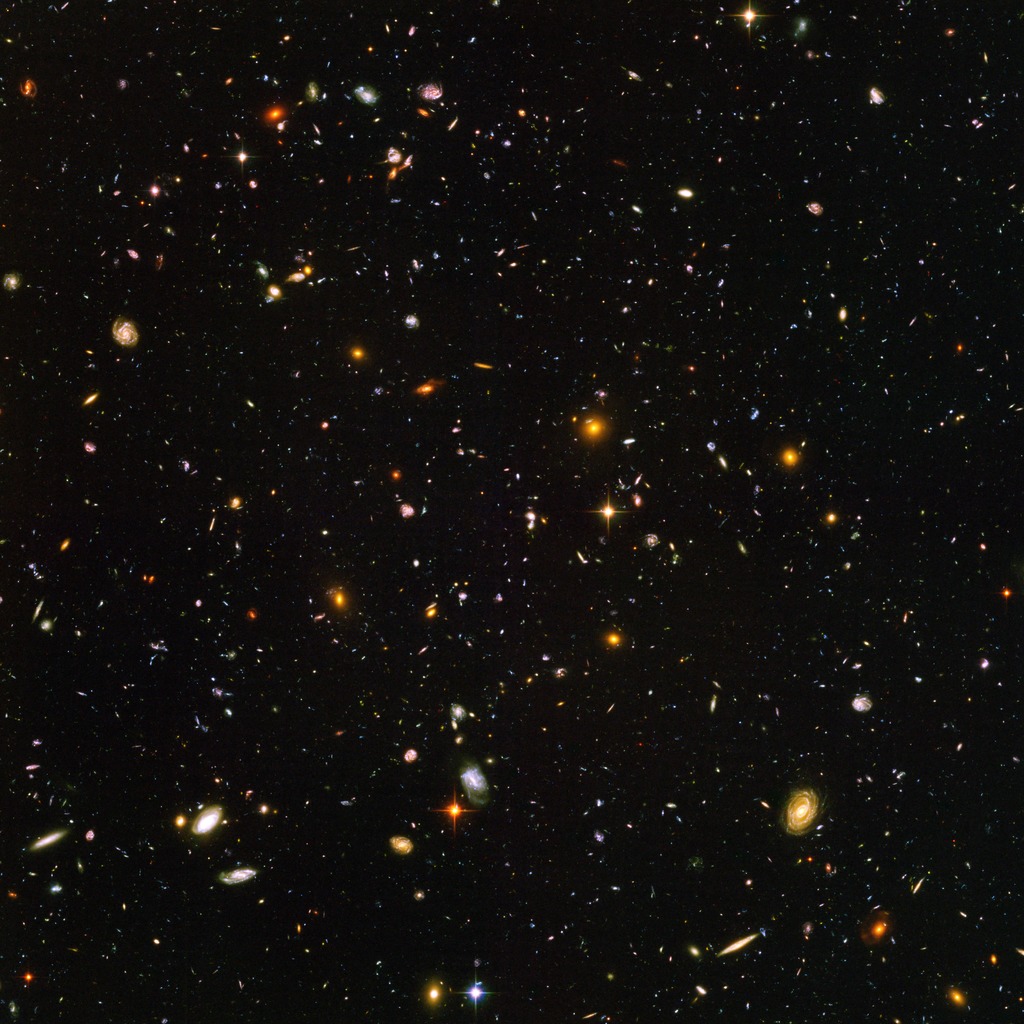
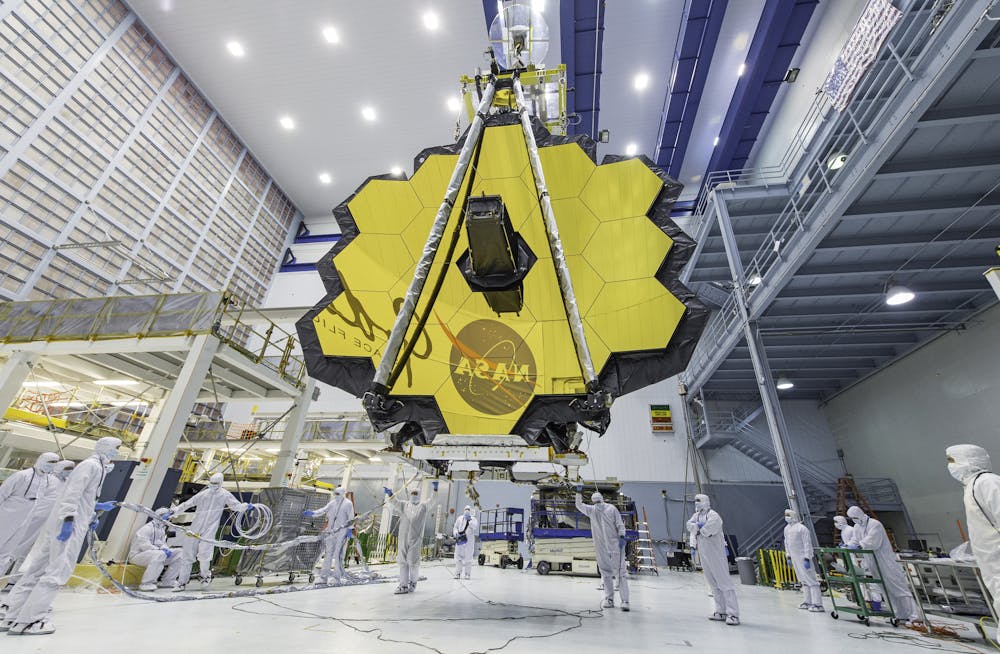
A beautiful example of humans in the supreme invention and deployment of JWST.
(A reminder that Tuesday is a ‘non-doggie’ day.)
JWST is astounding. It will look back to the beginnings of the universe, just 200 million light-years after the Big Bang, or possibly further back in time. Because of the way that the universe stretches out and causes light to go red, as it were, JWST will be searching for images from the cosmos in the infrared.
I recently listened to a 30-minute programme on BBC Sounds. It was a BBC Discovery episode about the JWST. Recorded before the launch it was, nonetheless, a deeply fascinating programme about what JWST will be looking for.
There are many things we just take for granted including, if I may say, celebrating a birthday for our dog. Now I’ve no way to check with readers if what I just said is correct; it is an assumption.
Earlier in the year, July to be exact, The Dodo published ideas that might be useful for you. Here they are:
ooOOoo
7 Ways To Celebrate Your Dog’s Birthday
For the absolute best birthday (or adoption day) ever 🥳
There are lots of ways to celebrate your dog’s birthday. But different dogs might like to celebrate in different ways depending on their personality — some dogs are more social, and others might just want to spend the day lounging around.
With all the different ways to celebrate and all the different dogs out there, it might be hard for you to decide what to do to give your dog the best birthday.
To help you decide, The Dodo made a list of seven fun ideas for ways to celebrate your dog’s birthday.
Dog birthday party ideas
Throw a dog party
Invite all your dog’s friends to his birthday party! To make sure everyone’s included, send out invites like this one. You can personalize the template and add whatever you want to say to the front!
You’ll need some decorations for the party, too, so get this banner of your dog’s face! Just send in a pic of your dog, and you’ll get this banner to hang your pup’s face all over your house.
Give your dog’s guests some party favors before they go. Fill up these paw print party bags with little treats or toys to say thanks for coming. They come in a set of 20, so you’ll have plenty to go around.
Have a pool party
If your dog’s birthday is in the summer, let him cool off by taking a dip in the pool! This doggie poolcomes in multiple sizes and doesn’t need to be inflated, so it’s super easy to set up.
Obviously your dog will need a cool outfit for his party. Get him this Birthday Boy (or Birthday Girl) shirt that comes in multiple sizes and keeps your dog warm enough to wear on outdoor walks.
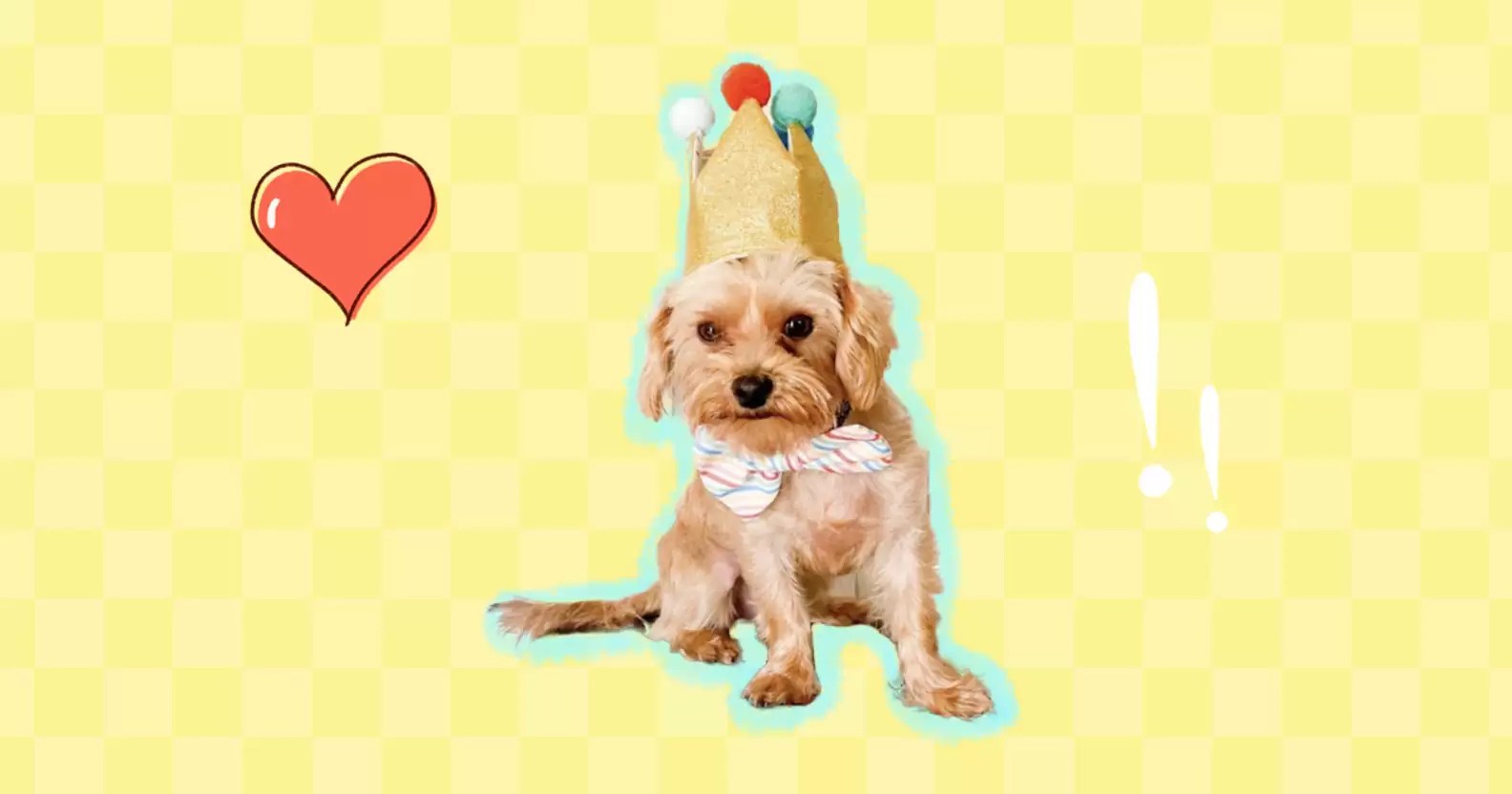
Get this birthday crown to complete the look. It’s sparkly gold with pom poms on top and has a chin strap, so it will stay put all day long (or as long as your dog will keep it on).
Have a photo booth
Set up a photo booth with props! These birthday-themed props will let you take lots of Instagram-worthy pictures with your dog. There are glasses, balloons, cake and hats, so you’ll have a lot of options.
Make pupcakes
Make homemade pupcakes for your pup with this dog cake mix. The recipe is all-natural and peanut butter flavored, comes with an icing mix and can be made in either the oven or microwave for easy baking.
Spend time with your dog
Spend quality time with your dog and give him some exercise by taking him on a long walk. You can still dress your pup up for his birthday walk with a fun harness and leash combo like this mix-and-match one that earned The Dodo’s Paw of Approval. The harness is adjustable, and there are tons of different colors. It also comes with a cute poop bag carrier to make cleaning up after your pup a little more fun.
Take time out of your day just to play with your dog. Whether it’s throwing a ball or playing with a squeaky toy or tug-of-war, your dog will love it. Get him some new toys that he can play with on his birthday too.
Let your dog pick out a gift
Take your pup to a pet store and let him pick out his own gift! You’ll probably be getting him tons of presents, but it’ll be fun for him to pick one out for himself too. Plus, dogs go crazy for all the sights, smells and sounds in pet stores, so it’ll be an adventure.
ooOOoo
You should be aware that if you choose to purchase an item from The Dodo website then their statement is applicable:
We independently pick all the products we recommend because we love them and think you will too. If you buy a product from a link on our site, we may earn a commission.
I think there are some brilliant ideas and, upon reading this article, maybe many fewer people will take it for granted when their dogs have a birthday!
There have been two recent articles on head-tilting in dogs. One was published by Springer Link and was a scientific report; the Abstract as follows:
Little is known about head-tilts in dogs. Based on previous investigations on the head turning and the lateralised brain pattern of human speech processing in dogs, we hypothesised that head-tilts may be related to increased attention and could be explained by lateralised mental functions. We observed 40 dogs during object-label knowledge tests and analysed head-tilts occurring while listening to humans requesting verbally to fetch a familiar toy. Our results indicate that only dogs that had learned the name of the objects tilted their heads frequently. Besides, the side of the tilt was stable across several months and tests. Thus, we suggest a relationship between head-tilting and processing relevant, meaningful stimuli.
The other report was a more easy read, so to speak, and is from Treehugger and that is the one that I shall share with you.
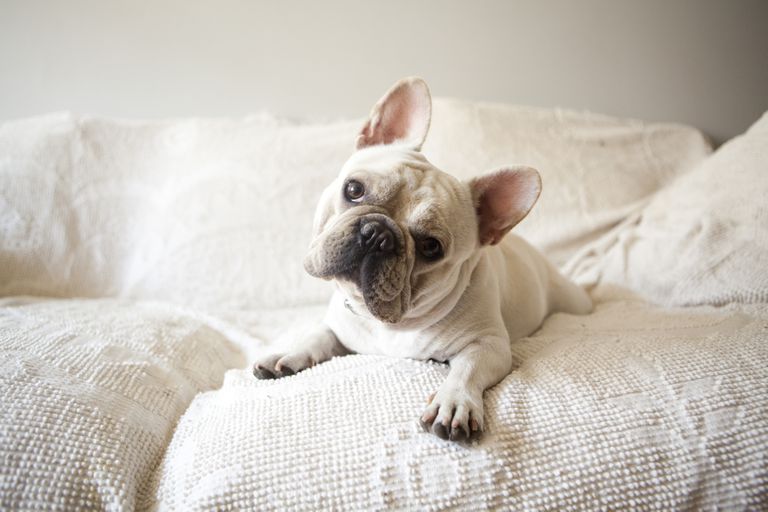
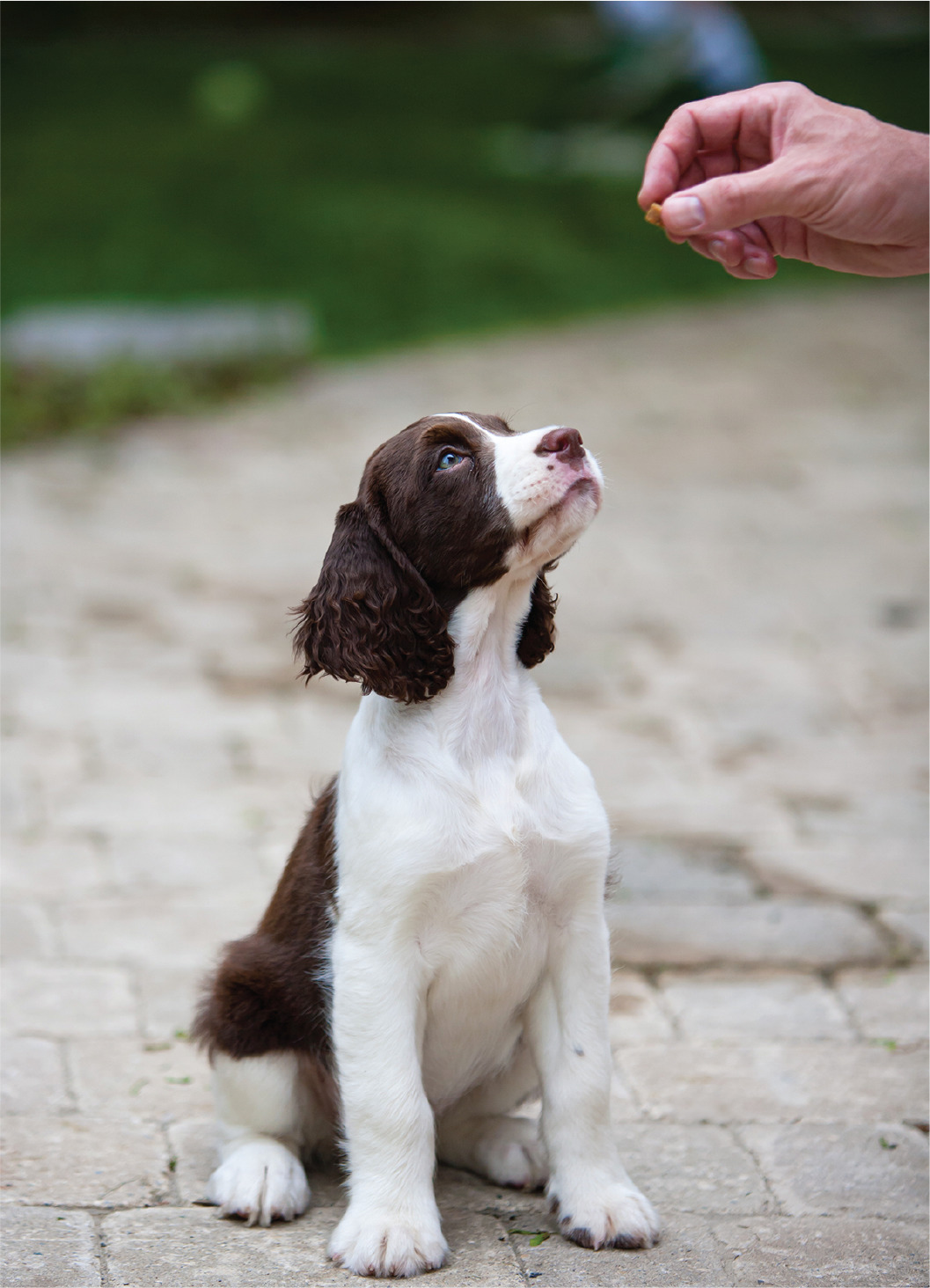
Ask your dog a question, and there’s a good chance he’ll tilt his head as he ponders his response.
The head tilt is a cute canine maneuver that gives the impression your pup is paying attention to you. But there’s been little scientific research analyzing the behavior.
In a new study of “gifted” dogs, researchers found that dogs that can easily learn the names of their toys tilt their heads when their owners ask them to fetch a specific toy. And they typically tilt their heads consistently to the same side.1
Data was collected during the Genius Dog Challenge, a series of experiments that were broadcast on social media, showing dogs retrieving their toys by name. The information was also collected during an earlier study that researched how some dogs are able to learn the names of many of their toys.2
These dogs were dubbed “gifted word learners” by researchers.
“We started studying this phenomenon after we realised that all of us observed this behaviour very often when we were testing the gifted word learner (GWL) dogs,” lead researcher Andrea Sommese, from the Family Dog Project at the Eötvös Loránd University in Budapest, tells Treehugger.
“It’s such a cute, common behaviour but we didn’t know why our dogs were doing it and most of all, why so often!”
Gifted Learners
For their work, researchers searched globally for two years, looking for dogs that had the ability to quickly memorize the names of their toys. They also created the Genius Dog Challenge, a research project and social media campaign, to find even more brilliant pups.3
They found six border collies that live in different countries, who all learned toy names just while playing with their owners. For the challenge, these gifted word learners had a week to learn the names of six toys. During the second stage, they had a week to try to learn the names of a dozen toys.4
“In all our experiments we found that the GWL dogs were tilting the head very often. It wasn’t just during the challenge but also when we were testing them every month,” Sommese says.
“We believe that there is a relationship between head tilting and processing relevant, and meaningful stimuli as our GWL dogs only showed this behaviour during the test when their owners were saying the name of a toy.”
In one experiment, researchers observed 40 dogs for three months as they attempted to learn the names of two new toys. The dogs sat or stood in front of their owners when they were asked to fetch one of the toys by pronouncing its name. (For example, “bring rope!”) The dogs would then go to another room and attempt to retrieve the correct toy.1
The researchers found that the gifted word learner dogs tilted their heads 43% of the time versus the typical dogs that only tilted in 2% of trials.1
Dogs, horses, and other animals—including humans—show asymmetry in the way they perceive the world around them. They prefer one ear, eye, hand (or paw) over the other when interacting with the environment.5
“A typical way to show asymmetry, especially in humans, is handedness. Most of us are right-handed but there are still left-handed people around. The same can happen to animals,” Sommese says.
“Of course, it doesn’t always have to be a ‘hand’ or a paw in their case, it can be an eye or an ear. For instance, in dogs, even the inclination their tails have when they’re wagging is a sign of asymmetrical behaviour.”
In the study, researchers found that the dogs also showed asymmetry, nearly always tilting their heads to the same side.1
What About Typical Dogs?
Researchers say the findings suggest there’s a connection between head tilting and processing relevant and meaningful stimuli.5
But their results are limited because they only studied these brilliant pups who have learned toy names.
“Even if typical dogs are not able to learn the names of many toys as we showed with our previous study, typical dogs still tilt their head,” Sommese says. “It seems that even in them this might be in response to meaningful stimuli—but we don’t know what meaningful means for a typical dog just yet.”
lead researcher Andrea Sommese, from the Family Dog Project at the Eötvös Loránd University in Budapest
ooOOoo
Now I see The Smithsonian magazine has jumped on the bandwagon. Here is a small piece from their article:
“The next step is asking more questions to get at what the head tilt really means,” says Monique Udell, a human-animal interaction researcher at Oregon State University who wasn’t involved in the work, to Rachel Fritts of Science. “Can we use head tilting to predict word-learning aptitude, or attention, or memory?”
But The Smithsonian has to be thanked for mentioning Monique Udell because one can quickly find her details:
Monique Udell
Dr. Udell is the Director of the Human-Animal Interaction Laboratory and teaches courses on Animal Behavior & Cognition, Applied Animal Behavior, Animal Learning, Behavior Modification and Enrichment within the Department of Animal & Rangeland Sciences at OSU.
Her research interests include:
Human-animal interactions & bonding, including animal training and animal assisted intervention programs aimed at improving the lives of humans and animals through mutually beneficial interactions.
Lifetime and evolutionary factors influencing the social development and wellbeing of canines (dogs and wolves), domestic cats, and other captive and domesticated species.
Evaluating and improving the welfare of animals living as companion, working, or production animals.
More details can be found at the Human-Animal Interaction lab website: TheHumanAnimalBond.com
We had a break from the rain yesterday and I went for a bike ride in the morning and then in the afternoon it was a case of going to the recycling depot. All pretty humdrum stuff but nevertheless what our life, in the main, is made up of plus the many other things that we have to do, indeed enjoy doing, with our six dogs, two horses and thirteen acres in rural Southern Oregon.
So I got to my iMac pretty late on in the day and found a delightful article about a dog who has a fascination with a commercial laundromat.
Read it for yourself.
ooOOoo
Dog Who Works At Laundromat Can’t Stop Taking Naps On All The Machines
“He figured out a way to climb from the chair to the smaller washers and then to the bigger ones.”
By Lily Feinn, Published on the 11th October, 2021
If you walk into Larkin Street Laundry around closing time, you might get an extra-special greeting.
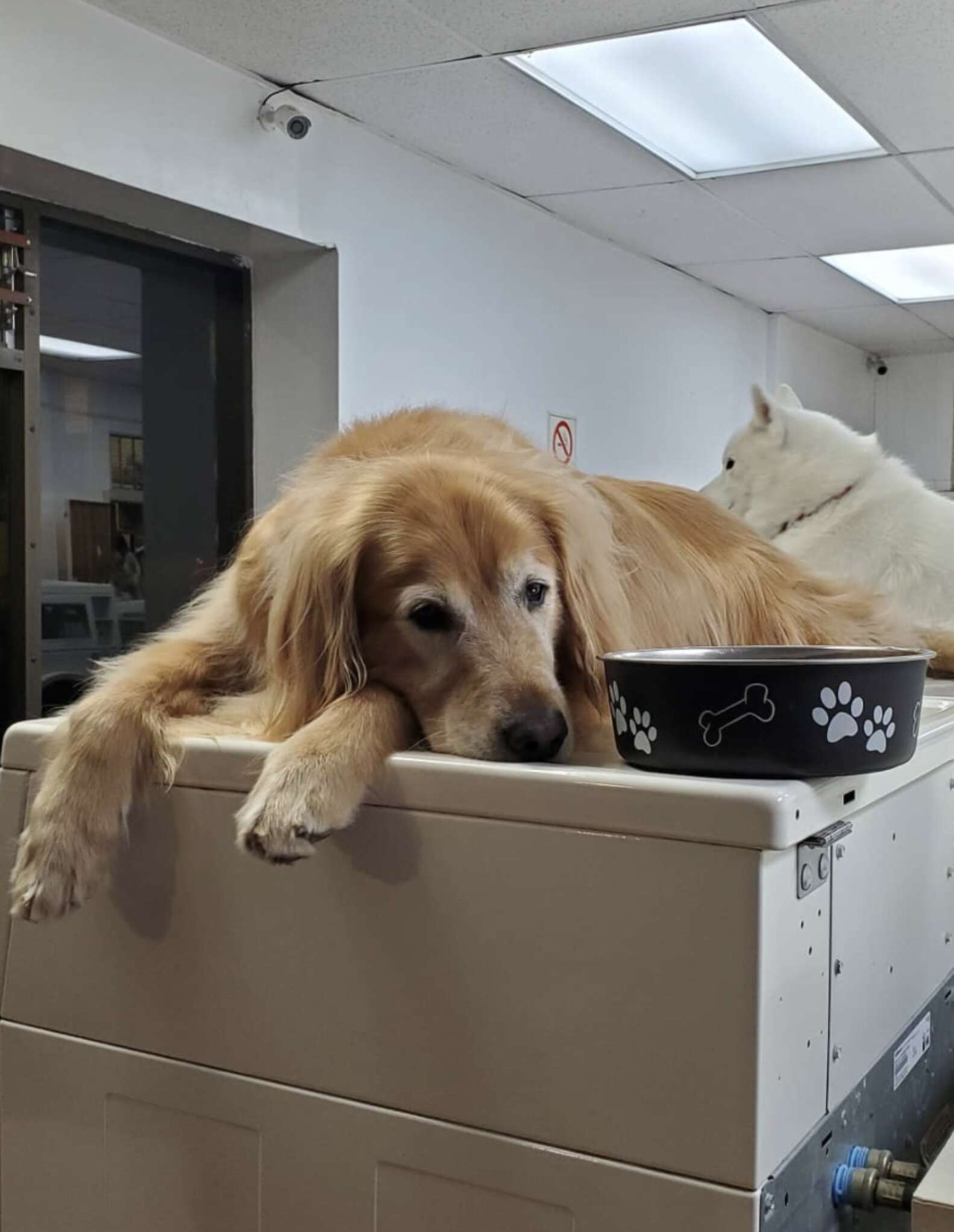
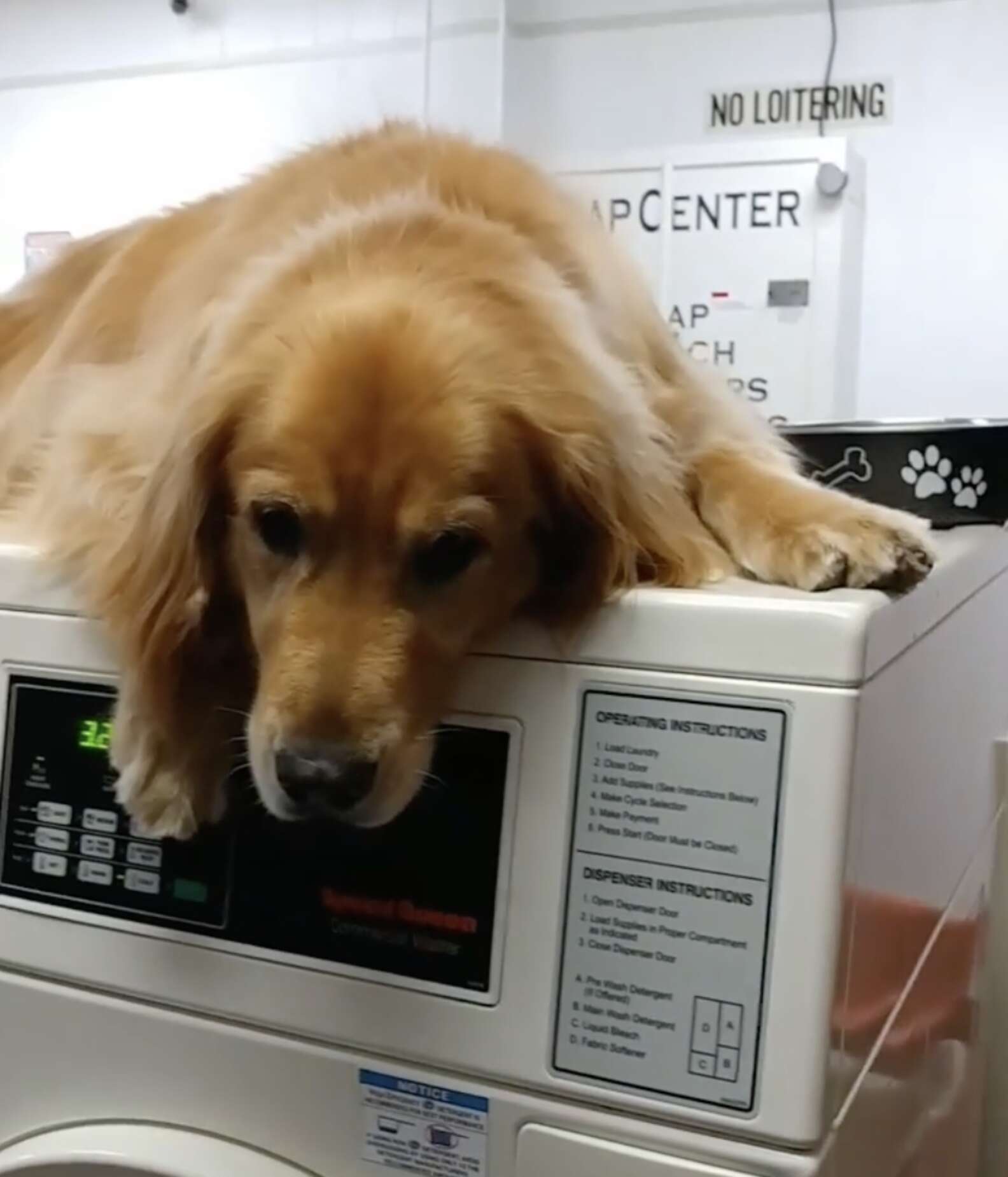
Every night, an 8-year-old golden retriever named Cody helps his dad close up the laundromat. Cody takes his job very seriously: While his dad cleans and puts everything away, Cody takes a nap on top of the washing machines.
INSTAGRAM/CODYTHERETRIEVER
Luckily, his dad doesn’t mind that Cody isn’t the best worker.
“My dad owns the laundromat and has always taken our dogs there with him when he closes up at the end of the day,” Stephanie, Cody’s sister who asked that her last name not be used, told The Dodo. “Our old dog loved to sit in the chairs to watch customers and people pass by, but Cody is more nimble than him.”
“After we tried to get him to just sit on the chairs, he figured out a way to climb from the chair to the smaller washers and then to the bigger ones,” she added. “He’s a little lazier than our old dog, so he’d rather lay down and wait for pets and treats.”
Instagram/Reichenyoo
Cody has become the main attraction at the laundromat, providing the perfect distraction for customers waiting for their clothes to finish drying.
This arrangement works out for the independent Cody, who loves attention but prefers people come to him. “His motto has always been: ‘I do what I want,’” Stephanie said.
INSTAGRAM/CODYTHERETRIEVER
And from his high-up vantage point, Cody can keep watch on everything going on at the laundromat.
“I think he likes how he can see everyone at eye level when he’s on top of the washers,” Stephanie said. “He’s also kinda snobby for a dog, so I have a theory he likes to feel like a king up there.”
INSTAGRAM/CODYTHERETRIEVER
After years of laundromat service, Cody has become a local celebrity — and even the subject of a few memes. But the good boy doesn’t let fame distract him. After all, he has a job to do, and those washers aren’t going to sit on themselves.
ooOOoo
That Larkin Street Laundromat is at Nob Hill in San Francisco. I looked it up by clicking on the link in the text.
It is just fascinating what dogs will do. They have a will of their own and yet they seem to be happiest when in the company of people.
Time and time again dogs do things which cause me to wonder about the way that dogs think and behave. One would think that with so many dogs here at home my days of wondering would be over but the truth is that the more I stay engaged with dog blogs, such as The Dodo, the more I realise that I am only skimming the surface of dogs.
That is my introduction to this post about a Turkish dog.
ooOOoo
Stray Dog Takes The Train All By Himself Every Day
“He knows where to go and has a purpose.”
By Lily Feinn, Published on the 8th October, 2021.
Meet Boji — a stray dog who’s bringing joy to commuters every day.
A few months ago, Istanbul’s public transportation department noticed a large, brown dog riding the buses, trams, subways and ferries. The dog, whom they dubbed Boji, seems to know exactly where he’s going any time he steps on or off the train.
INSTAGRAM/BOJI_IST
“Two months ago, we noticed a dog trying to use our trams, metros and our trains and he knows where to go and he knows where to get out,” Aylin Erol, head of customer relations at Metro Istanbul, told CNN. “It was quite interesting and we have started to follow him. And it was really an interesting pattern. It’s something like that he knows where to go and has a purpose.”
In mid-August, public transit officials picked Boji up and brought him to a vet for a health check. Boji also received a microchip which is connected to a mobile application, allowing the Metro Istanbul customer relations department to keep tabs on his whereabouts and wellbeing.
Boji’s frequent travels have made him a celebrity on public transit. When he’s not napping on a tram seat, rushing to catch a train, or enjoying the breeze on the ferry, he’s always happy to pose for selfies with commuters and receive lots of pets and treats.
INSTAGRAM/BOJI_IST
The good boy has proven himself to be the most polite passenger you’ll ever encounter.
“Boji knows all the rules of travel, gives way to the disembarking passengers, waits, enters the train, and calmly finds a place for himself,” wrote Cumhuriyet. “When he misses the subway, he runs after the subway.”
INSTAGRAM/BOJI_IST
Boji visits at least 29 stations and travels approximately 18 miles a day around the city, saying hi to his adoring fans along the way. While most commuters can’t wait to get off the subway or bus, for Boji, it’s where he’s most comfortable.
“I think it’s very beautiful,” passenger Abdulkadir Yalçın told Cumhuriyet. “It adds joy to the subway. It makes us smile. It’s the first time I’ve encountered such a thing.”
INSTAGRAM/BOJI_IST
Luckily, the good boy doesn’t have to pay a fare to hop on his preferred bus or train. For Boji, it’s just home.
ooOOoo
Isn’t that amazing! I wonder, however, how he stays fit and healthy? But whatever, it is a delightful story.
Chris Impey writes about his specialty in observational cosmology.
This has nothing to do with life, nothing that we are dealing with in our daily affairs, and has nothing to do with our dear dogs. BUT! This is incredibly interesting! Incredibly and beautifully interesting!
ooOOoo
The most powerful space telescope ever built will look back in time to the Dark Ages of the universe
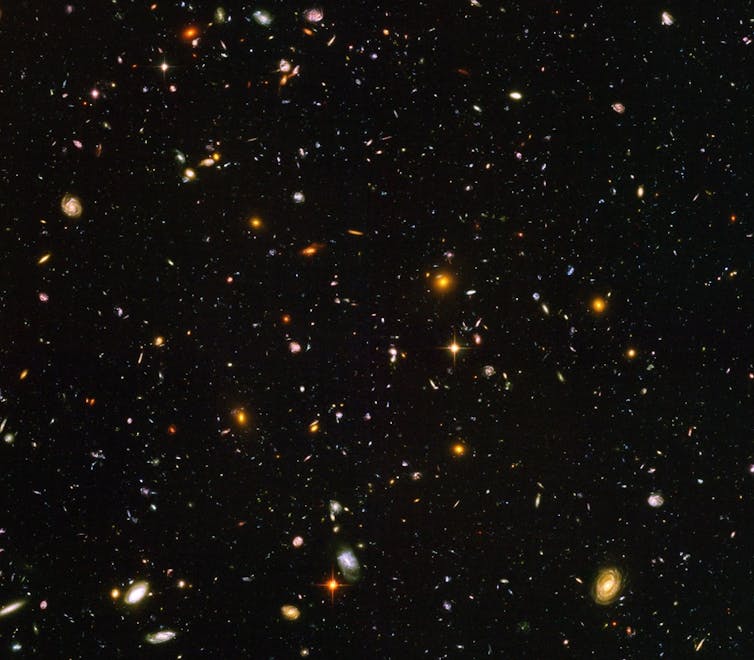
Hubble took pictures of the oldest galaxies it could – seen here – but the James Webb Space Telescope can go back much farther in time. NASA
Some have called NASA’s James Webb Space Telescope the “telescope that ate astronomy.” It is the most powerful space telescope ever built and a complex piece of mechanical origami that has pushed the limits of human engineering. On Dec. 18, 2021, after years of delays and billions of dollars in cost overruns, the telescope is scheduled to launch into orbit and usher in the next era of astronomy.
I’m an astronomer with a specialty in observational cosmology – I’ve been studying distant galaxies for 30 years. Some of the biggest unanswered questions about the universe relate to its early years just after the Big Bang. When did the first stars and galaxies form? Which came first, and why? I am incredibly excited that astronomers may soon uncover the story of how galaxies started because James Webb was built specifically to answer these very questions.
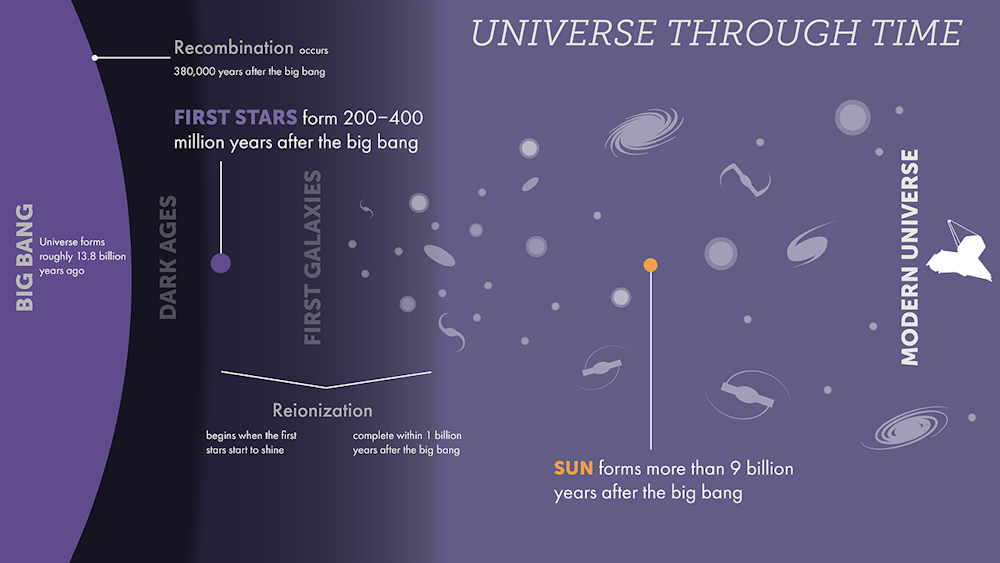
The Universe went through a period of time known as the Dark Ages before stars or galaxies emitted any light. Space Telescope Institute
The ‘Dark Ages’ of the universe
Excellent evidence shows that the universe started with an event called the Big Bang 13.8 billion years ago, which left it in an ultra-hot, ultra-dense state. The universe immediately began expanding after the Big Bang, cooling as it did so. One second after the Big Bang, the universe was a hundred trillion miles across with an average temperature of an incredible 18 billion F (10 billion C). Around 400,000 years after the Big Bang, the universe was 10 million light years across and the temperature had cooled to 5,500 F (3,000 C). If anyone had been there to see it at this point, the universe would have been glowing dull red like a giant heat lamp.
Throughout this time, space was filled with a smooth soup of high energy particles, radiation, hydrogen and helium. There was no structure. As the expanding universe became bigger and colder, the soup thinned out and everything faded to black. This was the start of what astronomers call the Dark Ages of the universe.
The soup of the Dark Ages was not perfectly uniform and due to gravity, tiny areas of gas began to clump together and become more dense. The smooth universe became lumpy and these small clumps of denser gas were seeds for the eventual formation of stars, galaxies and everything else in the universe.
Although there was nothing to see, the Dark Ages were an important phase in the evolution of the universe.
The Dark Ages ended when gravity formed the first stars and galaxies that eventually began to emit the first light. Although astronomers don’t know when first light happened, the best guess is that it was several hundred million years after the Big Bang. Astronomers also don’t know whether stars or galaxies formed first.
Current theories based on how gravity forms structure in a universe dominated by dark matter suggest that small objects – like stars and star clusters – likely formed first and then later grew into dwarf galaxies and then larger galaxies like the Milky Way. These first stars in the universe were extreme objects compared to stars of today. They were a million times brighter but they lived very short lives. They burned hot and bright and when they died, they left behind black holes up to a hundred times the Sun’s mass, which might have acted as the seeds for galaxy formation.
Astronomers would love to study this fascinating and important era of the universe, but detecting first light is incredibly challenging. Compared to massive, bright galaxies of today, the first objects were very small and due to the constant expansion of the universe, they’re now tens of billions of light years away from Earth. Also, the earliest stars were surrounded by gas left over from their formation and this gas acted like fog that absorbed most of the light. It took several hundred million years for radiation to blast away the fog. This early light is very faint by the time it gets to Earth.
But this is not the only challenge.
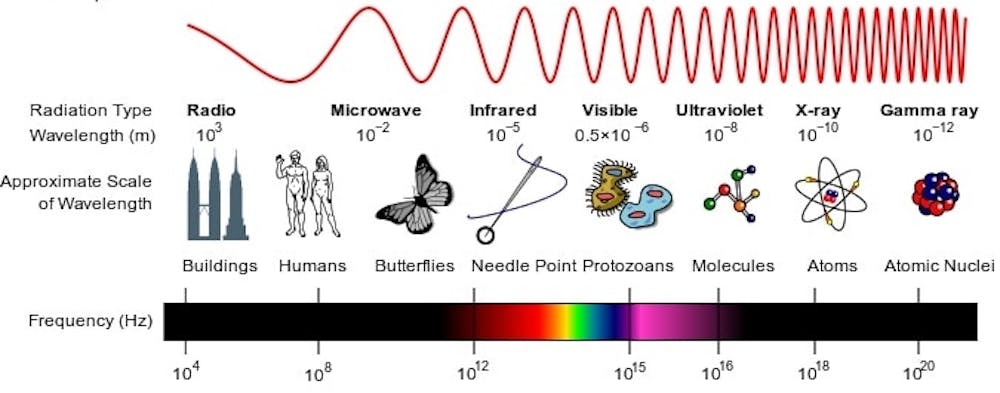
As the universe expands, it continuously stretches the wavelength of light traveling through it. This is called redshift because it shifts light of shorter wavelengths – like blue or white light – to longer wavelengths like red or infrared light. Though not a perfect analogy, it is similar to how when a car drives past you, the pitch of any sounds it is making drops noticeably. Similar to how a pitch of a sound drops if the source is moving away from you, the wavelength of light stretches due to the expansion of the universe.
By the time light emitted by an early star or galaxy 13 billion years ago reaches any telescope on Earth, it has been stretched by a factor of 10 by the expansion of the universe. It arrives as infrared light, meaning it has a wavelength longer than that of red light. To see first light, you have to be looking for infrared light.
Telescope as a time machine
Enter the James Webb Space Telescope.
Telescopes are like time machines. If an object is 10,000 light-years away, that means the light takes 10,000 years to reach Earth. So the further out in space astronomers look, the further back in time we are looking.
The James Webb Space Telescope was specifically designed to detect the oldest galaxies in the universe. NASA/JPL-Caltech, CC BY-SA
The strategy will be to stare deeply at one patch of sky for a long time, collecting as much light and information from the most distant and oldest galaxies as possible. With this data, it may be possible to answer when and how the Dark Ages ended, but there are many other important discoveries to be made. For example, unraveling this story may also help explain the nature of dark matter, the mysterious form of matter that makes up about 80% of the mass of the universe.
James Webb is the most technically difficult mission NASA has ever attempted. But I think the scientific questions it may help answer will be worth every ounce of effort. I and other astronomers are waiting excitedly for the data to start coming back sometime in 2022.
The dark ages of the universe that lasted for millions of years until gravity started to form some order out of the ‘soup’.
I don’t know about you but the winter nights, when the sky is clear, have me waiting outside for the dogs to come in looking up at the night sky just lost in the sheer wonder of it all.
In this month’s Science magazine, on page 1213, there is a short piece under the heading of In Other Journals.
I share it with you.
ooOOoo
Canine Behavior Friends from the start
By Sacha Vignieri.
Dogs, unlike wolves, are highly responsive to human voice, gestures, and eye contact. CREDIT: ISTOCK.COM/HNIJJAR007
The closest relative to dogs, “man’s best friend,” is the wolf, a wily predator that generally avoids human interaction. For decades, researchers and dog owners have wondered how the leap to domestication occurred.
The main hypothesis invoked very early selection for wolves that “liked”—or least tolerated—humans, and the connection strengthened from there.
However, there is still some debate about whether the degree to which dogs interact and communicate with humans is a learned trait.
Two recent studies appear to close the book on this learning hypothesis. Bray et al. looked at about 400 puppies and found that at this young age and without much human interaction, they were adept at following human gestures and positively responded to high-pitched “puppy talk.” Further, there was variation in these responses with an association between relatedness and social communication skills, which supports a genetic driver.
Salomons et al. compared dog and wolf puppies and found no difference in general cognitive responses, but much greater responsiveness to human gestures and eye contact, in dog puppies. Importantly, this happened even though the dog pups had received less actual human interaction than did the wolf pups.
These studies confirm that dogs’ interest in communication with humans is an evolved trait unique to their lineage.
Curr. Biol.31, 3132, 3137 (2021).
ooOOoo
That is fascinating. Dogs have evolved this trait on their own, so to speak. It further underlines the precious nature of the relationship between dogs and humans.
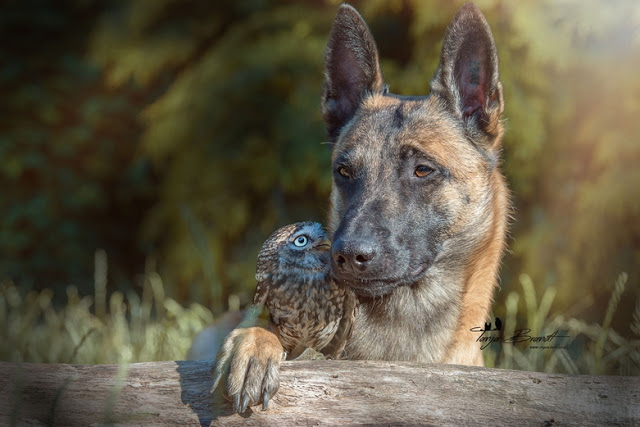
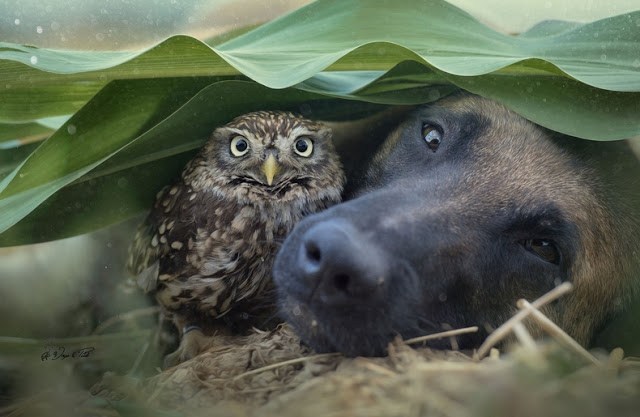
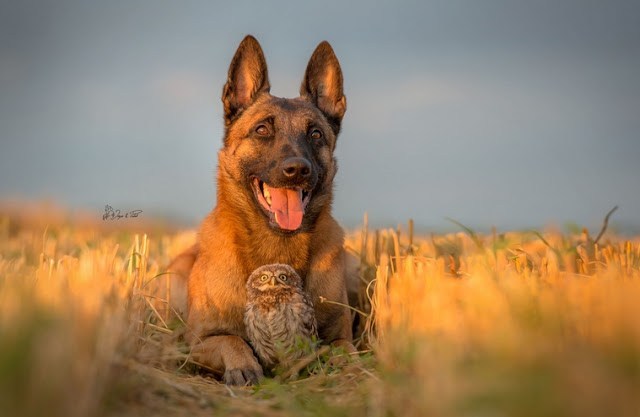
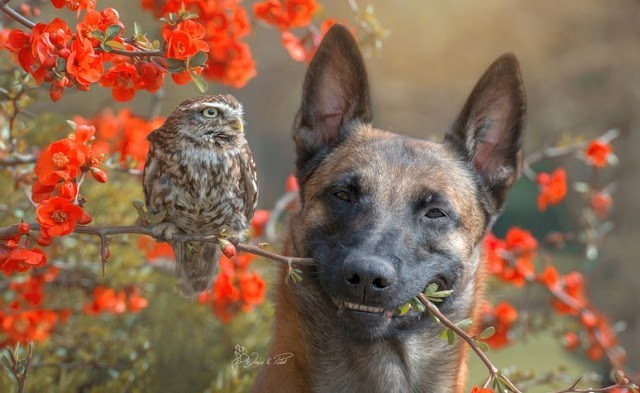
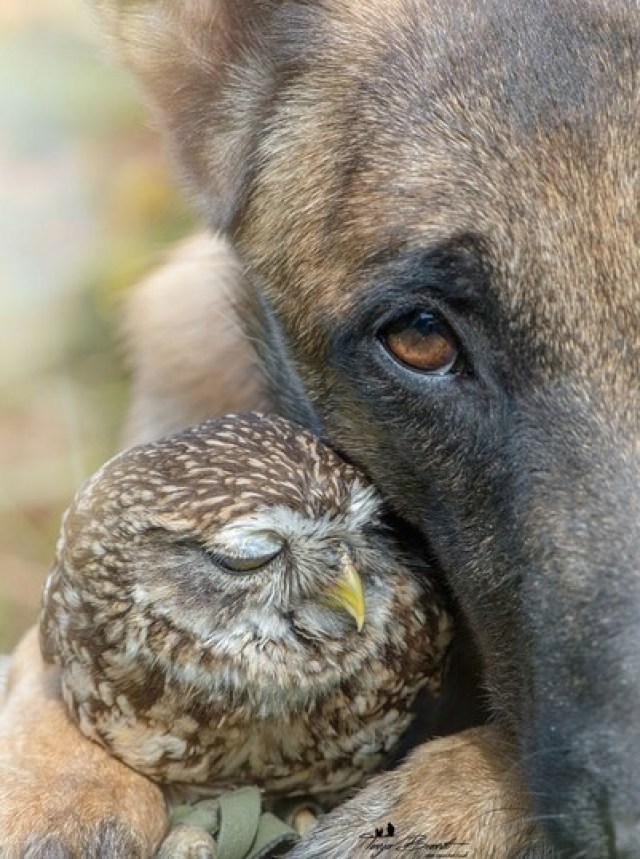
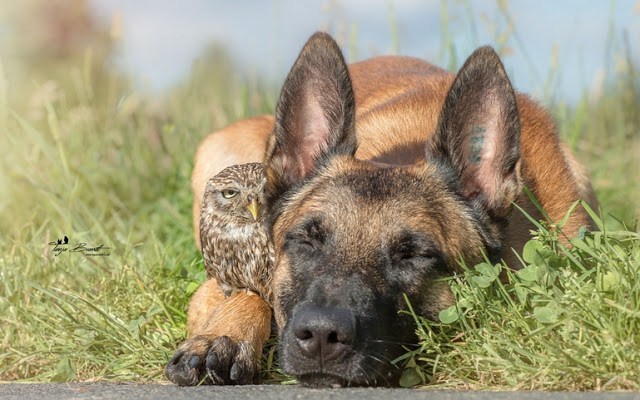
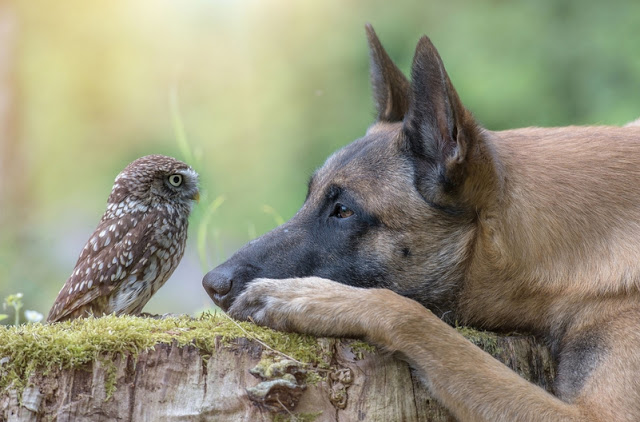
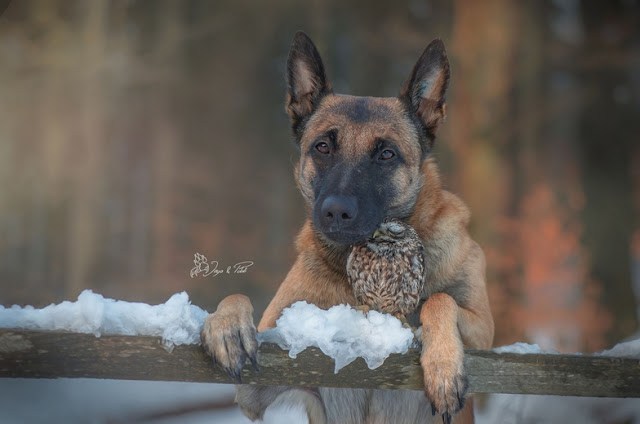
The following photographs were sent to me by Jess Anderson. But first here is the story:
For years, photographer Tanja Brandt has made it her mission to capture magnificent photos of animals and wildlife and has drawn accolades in the German and international photography world with her heart-warming animal portraits.
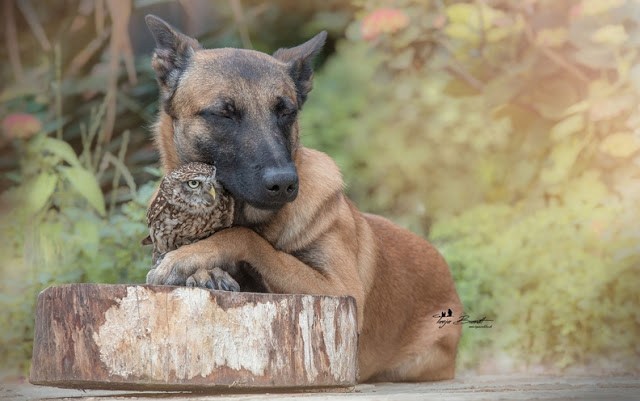
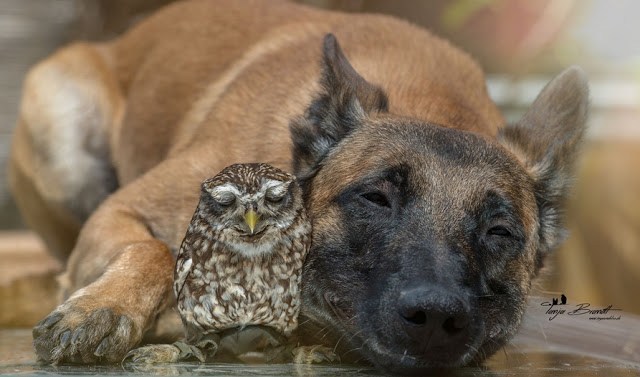
Recently, the German artist found a new challenge when she photographed the unique bond between two unlikely friends: Ingo, a Belgian Shepherd, and Poldi (Napoleon), a one-year-old owlet.
The owlet and canine have a special protector-protected relationship. Their affection toward each other couldn’t be any more evident. Ingo lovingly guards Poldi, who apparently doesn’t know how to live free.
The owlet hatched two days after his six brothers and sisters, therefore, has always been very vulnerable due to his small size. They respect each other and they can read each other, says the photographer.
oooo
oooo
oooo
oooo
oooo
oooo
oooo
oooo
oooo
These photographs are truly unique. Plus they are astoundingly beautiful.
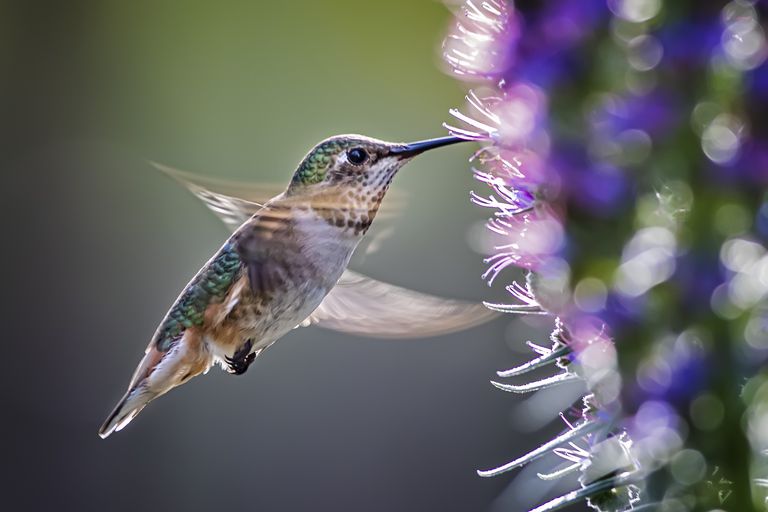
Glittery and graceful, hummingbirds hover and flit in midair as they gather nectar. But it’s not just their athleticism that helps them source food.
New research finds that these tiny birds have a great sense of smell that helps them detect potential danger when they are hunting for nectar.
“In the last 10-15 years, researchers have just now begun to realize the importance of smell in birds in general. For a very long time, it has been known that some birds, such as vultures, have a keen sense of smell and use it to find food,” study co-author Erin Wilson Rankin, an associate entomology professor at the University of California Riverside, tells Treehugger.
“However, the role of olfaction in most birds has only been recently recognized. That may be in part because many birds do not appear to use odor to help them locate food.”
In earlier studies, researchers were unable to show that hummingbirds preferred the smell of flowers that contained nectar. Also, flowers that have been pollinated by birds don’t have strong aromas, like those that have been pollinated by insects. That’s why scientists didn’t believe that birds had the ability to smell odors.
But with this new study, researchers believe otherwise.
For their experiment, Rankin and her colleagues observed more than 100 hummingbirds in the wild and in aviaries. The birds were given the choice between feeders that contained just sugar water, or sugar water with the addition of one of several chemicals with a scent that meant there was an insect present. The feeders otherwise looked exactly the same.
The scents included one deposited on flowers by European honeybees, a chemical produced by Argentine ants, and formic acid, which is released defensively by some formica ants and can injure birds and mammals.
“If a bird has any exposed skin on their legs, formic acid can hurt, and if they get it in their eyes, it isn’t pleasant,” Rankin said in a statement. “It’s also extremely volatile.”
In the experiments, the hummingbirds avoided the feeders with the sugar water that contained the ant-derived chemicals. They didn’t react to the sugar water with the honeybee scent, even though it’s been known to keep other bees from visiting flowers.
To make sure the bees weren’t avoiding the feeders due to a fear of a new smell, the researchers performed an extra test with sugar water and ethyl butyrate, which is a common additive in human food.
“It smells like Juicy Fruit gum, which is not a smell known in nature,” Rankin said. “I did not enjoy it. The birds did not care about it though and didn’t go out of their way to avoid it.”
For hummingbirds, recognizing smells isn’t just about finding a meal. They use their sense of smell much differently than vultures. These birds use the massive olfactory bulb in their brain like an “airborne bloodhound” to detect decaying carcasses.
Instead, hummingbirds use their excellent vision to locate flowers from which they collect nectar.
“Flowers, while specific species may be patchy in distribution, are much more common and numerous than the animal carcasses that vultures rely on. Thus, it is not surprising that vultures use their sense of smell to find carcasses which they then scavenge,” Rankin explains.
Hummingbirds use their ability to smell in a different way.
“Rather than using odors to find flowers, they will avoid flowers or feeders that have specific insect odors on them, such as formic acid or an Argentine ant aggregation pheromone. A hummingbird can use the chemical cues associated with ants to help them determine if the hummingbird should feed from there, or avoid it because it’s already occupied by ants, which can drink the nectar first or potentially harm them,” Rankin says.
“Ants are also very hard for hummingbirds to see until they are up close, so being able to smell them even when they are hidden deep in a flower could be advantageous. By avoiding defensive chemicals, hummingbirds can avoid interactions with ants and focus on feeding at safer food resources.”
ooOOoo
As long as I shall live I will never stop being amazed at what science discovers and then reports. And the photograph is gorgeous!
I heard yesterday from Erik Hoffner who is responsible for the Mongabay website that Bill McKibben is stepping up to the mark in wanting to take action regarding climate change.
I very quickly signed up and received the following email:
Dear Friend,
Many thanks for signing up to be a part—and we hope a big part—of Third Act.
My name is Bill McKibben, and I’m one of the volunteers helping to launch this effort for Americans 60 and older who want to build a fairer and more sustainable nation and planet.
We’re very much in the early days of this, and we need your help—especially if you’re good at the behind-the-scenes tasks like administration, development, and project management. If you’ve got some time to donate right now, write to us at info@thirdact.org.
And we will be back in touch as autumn rolls on, with some early campaigns focused on climate action and on ending voter suppression. As you can tell, we’re making this up as we go along. So it should be interesting, and also a little bumpy!
If you can assemble a sizable group of people, I’ll do my best to join you for a virtual talk to explain more about this idea. (And when the pandemic ends, we’ll try to do it in person!).
And if you can donate some small sum of money to help with the launch, here’s the place.
Thank you. This is our time to make some powerful change—we’ve got the skills, the resources, and the desire. So let’s try.
We’re over 60—the Baby Boomers and the Silent Generation. We have skills, we have resources, we have time—and many of us have kids and grandkids. We also have a history. In our early years we saw remarkable shifts in politics and society; now, in our latter years, we want to see those changes made real and lasting.
We were there for the first Earth Day, and we’ve been glad to see cleaner air and water—but now we know that the climate crisis presents an unparalleled threat. The heat is on and we must act quickly to turn it down.
We watched or participated in the civil rights movement—and now we know that its gains were not enough, and that gaps in wealth have only widened in our lifetimes. We’ve got to repair divisions instead of making them worse. We saw democracy expand—and now we’re seeing it contract, as voter suppression and gerrymandering threaten the core of the American experiment. We know that real change can only come if we all get to participate.
You are the key to this work. Maybe you’ve asked yourself: how can I give back on a scale that matters? The answer is, by working with others to build movements strong enough to matter. That’s why we hope you’ll join us.
Clearly I have signed up and I hope an enormous number of other people will do as well.
Because the time left is not very long and even me at the age of 76 fear for the near future if nothing is done urgently.
:max_bytes(150000):strip_icc()/MaryJoDiLonardo-bw-treehugger-6d5044d7d4ae44298fb31df11a3d5a66.jpg)





 Learning from Dogs