Here’s an anti-aging project that we all wish for a successful outcome.
Despite the fact that one of the very important items that we learn from dogs is the certainty of death, there is not a single dog carer who doesn’t want them to live much longer lives.
Today’s post is the republication of a recent science report over on Mother Nature Network concerning a drug, rapamycin, that is hoped may give our wonderful dogs several more healthy years of life. As always, republished within the generous terms of MNN.
We wish the scientists much luck in achieving this outcome, without any deleterious side effects.
ooOOoo
Anti-aging project aims to extend dogs’ life spans
Researchers hope a drug called rapamycin can give dogs several more healthy years of life.
By: Russell McLendon, December 4, 2015,
Although some dogs have lived as long as 29 years, canine life spans are typically closer to half that length. (Photo: Shutterstock)
Living with a dog can help humans in lots of ways, from reducing stress and anxiety to lifting our spirits and making us laugh. Yet despite the abundance of benefits dogs offer, they also come with a notable drawback: Their life spans are much shorter than ours, forcing us to deal with the sadness of their deaths every 15 years or so.
Grieving for our dogs is just part of life, and in the big picture, it’s a small price to pay. But according to researchers at the University of Washington (UW), there may be a way to help our best friends stay with us — and stay healthy — a little longer.
Dog aging varies widely by size and breed, with smaller dogs typically maturing more quickly, yet also living a few years longer on average. It’s also common for mutts to outlive purebred dogs, thanks to the perks of higher genetic diversity. But while almost any dog is considered elderly by age 15, some have been known to nearly double their expected life spans — including Bluey, an Australian cattle dog who famously lived to see his 29th birthday last century.
And now researchers at UW’s Dog Aging Project (DAP) are working to bring similar longevity to canines of all kinds. In addition to performing “the first nationwide, large-scale longitudinal study of aging in pet dogs,” this project involves efforts to improve dogs’ “healthy life span” via therapies that already work in lab settings.
“To be clear, our goal is to extend the period of life in which dogs are healthy, not prolong the already difficult older years,” the project’s website explains. “Imagine what you could do with an additional two to five years with your beloved pet in the prime of his or her life. This is within our reach today.”
If it pans out, this may also aid ongoing research into extending the lives of other animals, including humans. But for now, the therapy is focused on dogs.
Researchers think rapamycin might increase a dog’s healthy life span by up to 5 years. (Photo: Shutterstock)
Namely, they’re testing the FDA-approved drug rapamycin (aka sirolimus) on middle-aged dogs. High doses of rapamycin are already used in humans to fight cancer and prevent organ-transplant rejection, but at low doses, it has also been shown to slow aging and extend life span in several animals with few or no side effects. In mice, for example, the immunosuppressant can lengthen lives by up to 25 percent.
“If rapamycin has a similar effect in dogs — and it’s important to keep in mind we don’t know this yet — then a typical large dog could live 2 to 3 years longer, and a smaller dog might live 4 years longer,” the project’s organizers write. “More important than the extra years, however, is the improvement in overall health during aging that we expect rapamycin to provide.”
Rapamycin trials have already begun on 32 middle-aged golden retrievers, Labrador retrievers and German shepherds. Ranging from 6 to 9 years old, these dogs will spend several months on a low-dose rapamycin regimen in which researchers study age-related metrics like heart function, immune response, physical activity, body weight and cognitive measures. They’ll also follow these 32 dogs throughout the rest of their lives, looking for any significant changes in aging or life span.
And in phase two of the study, a second group of middle-aged dogs will enter a longer-term, low-dose rapamycin regimen “designed to optimize lifespan extension.” Based on mouse studies conducted both at UW and elsewhere, they anticipate the drug “could increase healthy lifespan of middle-aged dogs by 2-5 years or more.”
Rapamycin isn’t a miracle drug, however, and high doses have been linked to side effects like immune suppression and delayed wound healing. But as the DAP website argues, “these are greatly mitigated at the doses used to extend longevity, and both animal and human studies indicate that even mild adverse events are rare.”
Regular exercise and outdoor time are great ways to boost a dog’s quality of life. (Photo: Shutterstock)
While the idea of extending dogs’ lives is exciting, it’s important not to let quantity of life overshadow quality of life. We may never have full control over how long our dogs live, but we can make sure they live well while they’re here.
A good reminder of this comes from Pegasus, a Great Dane rescued from unscrupulous breeders in South Africa when she was 4 weeks old. Suffering from a pigment deficiency often associated with blindness and deafness, Pegasus wasn’t expected to live very long. Filmmaker Dave Meinert adopted her anyway, and decided to film her daily as she grew up. In May 2015, he released a time-lapse movie (see below) of her reaching adulthood that quickly went viral. And as he explains in the video, Pegasus’ prognosis only helped the pair live every day like it was their last.
“I still don’t know how long she is going to live,” Meinert admits. “But right now is pretty great.”
ooOOoo
Watching the video offers the most beautiful, and powerful, reminder of the unconditional love that we can share with our dogs! What a gift they give us!
Wouldn’t we all love a few more years of happy and healthy life for our beloved dogs.
What clues does your dog’s spit hold for human mental health?
This is not a spoof. Apparently the closeness of the relationship between dogs and humans holds real scientific value.
Just my way of introducing a most fascinating and interesting item that recently appeared on The Conversation blogsite. (And see my note at the end of today’s post.)
ooOOoo
What clues does your dog’s spit hold for human mental health?
December 2, 2015
Elixir Karlsson, Assistant Professor of Bioinformatics and Integrative Biology, University of Massachusetts Medical School
There goes some precious DNA…. Graeme Bird, CC BY-NC-ND
Dogs were the first animals people domesticated, long before the earliest human civilizations appeared. Today, tens of thousands of years later, dogs have an unusually close relationship with us. They share our homes and steal our hearts – and have even evolved to love us back. Sadly, they also suffer from many of the same difficult-to-treat psychiatric and neurological diseases we do.
I learned this firsthand about six years ago, when my sister Adria adopted Beskow, a beautiful,
Beskow, in fine spirits. Elinor Karlsson, CC BY-ND
boisterous, black and white mutt. Beskow became my constant companion on my morning runs along the Charles River. Her joy in running was obvious to everyone we passed, and she kept me going mile after mile.
When not running, though, Beskow suffered from constant anxiety that left her stressed and unhappy – on edge around other dogs and prone to aggressive behavior. Beskow had trouble even playing outdoors, since she was compelled to attend to every sound and movement. Working one-on-one with skilled behaviorists and trainers helped immensely, but poor Beskow still never seemed able to relax. Eventually, Adria combined the intensive training with medication, which finally seemed to give Beskow some relief.
Beskow’s personality – her intelligence, her focus and her anxiety – was shaped not only by her own life experiences, but by thousands of years of evolution. Have you ever known a dog who would retrieve the same ball over and over again, for hours on end? Or just wouldn’t stay out of the water? Or wasn’t interested in balls, or water, but just wanted to follow her nose? These dogs are the result of hundreds of generations of artificial selection by human beings. By favoring useful behaviors when breeding dogs, we made the genetic changes responsible more common in their gene pool.
When a particular genetic change rapidly rises in prevalence in a population, it leaves a “signature of selection” that we can detect by sequencing the DNA of many individuals from the population. Essentially, around a selected gene, we find a region of the genome where one particular pattern of DNA – the variant linked to the favored version of the gene – is far more common than any of the alternative patterns. The stronger the selection, the bigger this region, and the easier it is to detect this signature of selection.
In dogs, genes shaping behaviors purposely bred by humans are marked with large signatures of selection. It’s a bit like evolution is shining a spotlight on parts of the dog genome and saying, “Look here for interesting stuff!” To figure out exactly how a particular gene influences a dog’s behavior or health, though, we need lots more information.
To try to unravel these connections, my colleagues and I are launching a new citizen science research project we’re calling Darwin’s Dogs. Together with animal behavior experts, we’ve put together a series of short surveys about everything from diet (does your dog eat grass?) to behavior (is your dog a foot sitter?) to personality (is your dog aloof or friendly?).
Any dog can participate in Darwin’s Dogs, including purebred dogs, mixed breed dogs, and mutts of no particular breed – our study’s participants will be very genetically diverse. We’re combining new DNA sequencing technology, which can give us much more genetic information from each dog, with powerful new analysis methods that can control for diverse ancestry. By including all dogs, we hope to be able to do much larger studies, and home in quickly on the important genes and genetic variants.
A beagle considers making the saliva donation. Stephen Schaffner, CC BY-ND
Once an owner has filled out the survey, there’s a second, crucial step. We send an easy-to-use kit to collect a small dog saliva sample we can use for DNA analysis. There’s no cost, and we’ll share any information we find.
Our plan is to combine the genetic data from many dogs and look for changes in DNA that correlate with particular behaviors. It won’t be easy to match up DNA with an obsession with tennis balls, for instance. Behavior is a complex trait that relies on many genes. Simple Mendelian traits, like Beskow’s black and white coat, are controlled by a single gene which determines the observable characteristic. This kind of inherited trait is comparatively easy to map. Complex traits, on the other hand, may be shaped by tens or even hundreds of different genetic changes, each of which on its own only slightly alters the individual carrying it.
Adding to the complexity, environment often plays a big role. For example, Beskow may not have been as anxious if she’d lived with Adria from puppyhood, even though her genetics would be unchanged.
Darwin’s Dogs team member Jesse McClure extracts DNA from a sample. Elinor Karlsson, CC BY-ND
To succeed, we need a lot of dogs to sign up. Initially, we’re aiming to enroll 5,000 dogs. If successful, we’ll keep growing. With bigger sample sizes, we’ll be able to tackle even more complex biological puzzles.
Understanding the biology underlying a disease is the first step in developing more effective treatments – of both the canine and human variety. For example, genetic studies of narcolepsy in Doberman pinschers found the gene mutation causing the disease – but only in this one dog population. Researching the gene’s function, though, led to critical new insights into the molecular biology of sleep, and, eventually, to new treatment options for people suffering from this debilitating disease.
Darwin’s Dogs is investigating normal canine behaviors as well as diseases. We hypothesize that finding the small genetic changes that led to complex behaviors, like retrieving, or even personality characteristics, like playfulness, will help us figure out how brains work. We need this mechanistic understanding to design new, safe and more effective therapies for psychiatric diseases.
And Beskow? Six years later, she is as wonderful as ever. While still anxious some of the time, the
Beskow with one of her loving family members. Adria Karlsson, CC BY-ND
medication and training have paid off, and she enjoys her daily walks, training and playtime. She still gets very nervous around other dogs, but is a gentle, playful companion for my sister’s three young children.
We are now sequencing her genome. In the next few months, we should have our first glimpse into Beskow’s ancestry. We know she is a natural herder, so we’re curious to find out how much her genome matches up to herding breeds, and which genes are in that part of the genome.
This is an incredibly interest research project with far-reaching implications for us humans. I have written to Professor Karlsson to double-check that anyone who reads this can participate, even if living outside the USA, and will update this post as soon as I hear back from her.
Do share this as far and wide as you can for the benefits for us humans are clear and obvious.
Not a week goes by without me gaining more and deeper understanding of just how wonderful and fabulous our dogs are.
The household here in Oregon has a number of seniors, both dogs and humans. And while I’m pretty sure that this senior human is practically past the point of learning new tricks, apparently it doesn’t apply to our old dogs.
So enjoy this recent article that appeared on Mother Nature News.
oooooh
Teaching an old dog new tricks is not only possible, but a lot of fun!
By: Jaymi Heimbuch, November 30, 2015
Old dogs can learn new tricks with ease! (Photo: Annette Shaff/Shutterstock)
The old saying goes that you can’t teach an old dog new tricks, but we know a lot of old sayings are wrong — this one included. Of course we can teach old dogs new tricks! In fact, it’s a great way to keep your dog mentally stimulated and having fun throughout his life.
One important thing to keep in mind about teaching senior dogs new tricks and behaviors is the dog’s level of physical ability. Many senior dogs are perfectly able, but if your dog is getting achy in the joints or has other limitations that come with age, keep these in mind. Older dogs may have joint pain or arthritis and have a harder time jumping or even sitting for long periods. They may also have dental issues which may limit the tricks they can do using their mouths. And they may also have hearing or vision problems which alter not only what kinds of tricks you want to teach them but also the way in which you teach them. So it’s important to know what your dog’s physical limitations are when you’re thinking up new tricks, and not push him to the point of possible injury.
While your dog may be past the days of learning to jump through hoops or leap over walls, there is a huge range of tricks that keep mobility issues in mind, and which senior dogs will have a lot of fun learning. Some of the tricks listed here build on each other and gain complexity, so you can keep things interesting for your dog for weeks at a time while training.
Touch
This is such a great trick to use as a foundation for other tricks, from flipping light switches on or off to coming back to your side. And it’s incredibly easy for your dog to learn and do. This is great for older dogs because you can make it really simple at first and build complexity into it after your dog has it down. To start out, you train your dog to do hand targeting. Here’s a video that shows not only how to train your dog to touch your hand, but many of the uses of the behavior:
Teaching your dog to yawn is all about “capturing behavior” with clicker training. It’s much like training your dog “touch” but this time, you have to wait for your dog to offer the behavior and capture it when it happens. Click — or say a key word like “Yes” — whenever you catch your dog yawning, and then reward him with treats or a game with a toy. After awhile, your dog begins to associate the yawn as being a trick that earns a reward. Here’s a video that demonstrates capturing different behaviors that you can turn into cute tricks, including yawning on command:
Even when you’re a grown-up, you have to pick up your toys when you’re done playing. Teaching your dog this tidy behavior will keep him or her a little more active in a low-key way, and thus help loosen up those stiff joints and muscles without putting a strain on their body. Plus, it’s a fun game that you can play over and over, not just on clean-up duty.
Stretch your dog’s mental abilities by teaching him the name of different objects or toys. This is a great way to teach your dog to fetch certain items from the toy box or even various objects from around house. You can start off with a few items from the toy box or simply get rolling with items you may want him to fetch for you, including hats, keys, shoes, blankets and so on.
Though it may take a while for your dog to truly grasp the name for each item at first, soon he will catch on to what the name game is all about and will likely grasp names faster when introduced to new objects.
Here’s a video that shows how to begin teaching a dog the name of an item, and how to add more items into the mix:
Your senior dog may be house-trained, but is he also trained to tell you precisely when he wants or needs to go out? You can give your older dog a great tool to tell you what he needs by teaching him to ring a bell as a cue to go outside. This video shows the progression of teaching a dog to touch the bell, and then eventually transition to learning that ringing the bell means their human opens the door for them.
Chapter 8 of my book is entitled: Behaviours and Relationships. It opens thus:
“It is all to do with relationships.”
I heard this many years before the idea of writing this book came to me. Heard it from J, who was referred to in the previous chapter. J was speaking of what makes for happy people in all walks of life. It’s one of those remarks that initially comes over as such an obvious statement, akin to water being wet or the night being dark, that it is easy to miss the incredible depth of meaning behind those seven words.
Humans are fascinating. Every aspect of who we are can be seen in our relationships. How we relate to people around us, whether it be a thirty-second exchange with a stranger or a long natter with friends whom we have known for decades, including our partners and family relations. The core relationship, of course, the relationship that drives so many of our behaviours is the relationship that we have with ourself. That being rooted in our relationship experiences with the adults around us when we were young people.
When one looks at the performance of successful companies one often sees, nay one always sees, people being valued. The directors and managers of those companies understand that if people are valued then a myriad of benefits flow from that approach to relationships. Moving out of the workplace, the relationships that people have are always stronger and happier if those individual persons know they are valued. Moving beyond people, our dogs, and many other animals, are always stronger and happier if they feel valued. It’s the difference between empathy and sympathy.
Recently over on Mother Nature Network there was an essay presented by Russell McLendon who is science editor for MNN. It is about happiness.
ooOOoo
Happiness is all in your head
Scientists say they’ve found where happiness happens in the brain. What does that mean?
By: Russell McLendon, November 24, 2015
Understanding how our brains generate happiness could help make it less elusive, researchers say. (Photo: Andrew Vargas/Flickr)
Everyone wants to be happy. Yet despite all our efforts in pursuit of this prized emotion, it can be a surprisingly nebulous goal. What is “happiness,” exactly?
That question has puzzled philosophers for thousands of years, and it’s still tricky for anyone to tackle. But recent advances in neuroscience have finally begun to shed light on it, and now a new study claims to have found an answer. Being told happiness is “all in your head” may seem both obvious and dismissive, but in this case the specifics are also empowering. The more we know about how (and where) happiness happens, the less helpless we’ll be to summon it when we need it.
By comparing magnetic resonance imaging (MRI) with questionnaires about emotional states, researchers from Kyoto University in Japan say they’ve traced the experience of happiness to a specific part of the human brain. Overall happiness, they conclude, occurs when positive emotions combine with a sense of life satisfaction in the precuneus, a region of the medial parietal lobe that’s linked to important brain tasks like episodic memory, self-reflection and consciousness.
Psychologists already distinguish between broad life satisfaction and “subjective well-being,” since happiness often seems to fade during bad moods without necessarily plunging us into deeper existential despair. But by revealing the neural mechanics of how these feelings combine to create overall happiness, the authors of the new study hope to make it easier to objectively quantify this mysterious and elusive emotion.
“Over history, many eminent scholars like Aristotle have contemplated what happiness is,” lead author Wataru Sato says in a press release. “I’m very happy that we now know more about what it means to be happy.”
Scientists used MRI brain scans to identify happiness in a brain region known as the precuneus. (Photo: Kyoto University)
To pinpoint the location of happiness, Sato and his colleagues first used MRI to scan the brains of their study subjects. Those participants then took a survey, which asked about their general sense of happiness, the intensity of their emotions and the degree of their overall life satisfaction.
After analyzing the data, the researchers discovered that those who scored higher on the happiness survey also had more gray matter mass in the precuneus. That means this brain region is larger in people who feel happiness more intensely, feel sadness less intensely and who are better able to find meaning in life.
“To our knowledge, our study is the first to show that the precuneus is associated with subjective happiness,” the researchers write in the journal Scientific Reports.
Complex phenomena like happiness rarely boil down to a single brain region, but other recent research also points to an outsized role for the precuneus. A study published this month links impaired connectivity in the precuneus to depression, for example, and a 2014 study suggests the region is a “distinct hub” in the brain’s default-mode network, which is active during self-reflection and daydreaming.
All this may seem like an esoteric quest for neuroscientists, but it’s about more than just academic curiosity. By knowing which parts of the human brain generate our sensation of happiness, we might develop more accurate ways to test methods of becoming happier, like travel, exercise or meditation.
“Several studies have shown that meditation increases grey matter mass in the precuneus,” Sato says. “This new insight on where happiness happens in the brain will be useful for developing happiness programs based on scientific research.”
ooOOoo
It’s an unscientific opinion from me but I truly believe that humans have a bias towards happiness. And if there’s one animal that we can learn happiness from, it’s the dog!
Published on Nov 6, 2015
Another try at a slow motion video of Abbey shaking the water off after a bath
Published on Apr 24, 2014
Stunning, Perfection, Breathtaking – just a few words that describe this 3 minute surfing clip that shows Ian Walsh catching huge waves and making it look effortless.
Well over two million viewings.
Music: Versailles
Warner // Chappell Production Music
Published on Oct 22, 2014
This is a clip from our movie “THE SECRET LIFE OF TREES”.
More on www.homan.pl
Finally, back to slow animal shakes! (And I must acknowledge Mother Nature News for the idea for today’s picture parade.)
Published on Mar 21, 2013
Why do wet furry mammals shake? Si and Sam give some of their favourite animals a shower to uncover the science behind the ‘wet dog shake’. Sam caught up with Andrew Dickerson from Georgia Institute of Technology to find out more about the science… we’ll have the full interview for you soon.
Locavore or vegetarian? What’s the best way to reduce climate impact of food?
With Thanksgiving Day just behind us and Christmas just around the corner, this is the season of feasting.
Just last Monday I published an essay written by George Monbiot, Pregnant Silence, that highlighted the impact on our climate of modern food production. Here are a couple of paragraphs from that essay:
Freshwater life is being wiped out across the world by farm manure. In England, as I reported last week, the system designed to protect us from the tide of crap has comprehensively broken down. Dead zones now extend from many coasts, as farm sewage erases ocean life across thousands of square kilometres.
Livestock farming causes around 14% of the world’s greenhouse gas emissions: slightly more than the output of the world’s cars, lorries, buses, trains, ships and planes. If you eat soya, your emissions per unit of protein are 20 times lower than eating pork or chicken, and 150 times lower than eating beef.
Thus it seemed both timely and appropriate to republish a further essay on the topic. This one published in The Conversation by Elliott Campbell, who is Associate Professor, Environmental Engineering, at the University of California. It is republished here under the terms of essays published in The Conversation.
ooOOoo
Locavore or vegetarian? What’s the best way to reduce climate impact of food?
This year’s Thanksgiving feast falls only a few days before the start of the global climate summit in Paris. Although the connections are not always obvious, the topic of food – and what you choose to eat – has a lot to do with climate change.
Our global agriculture system puts food on the table but it also puts greenhouse gases (GHG) in the air, which represent a huge portion of global emissions. GHG emissions come directly from farms such as methane from cows and nitrous oxide from fertilized fields, while other emissions come from the industries that support agriculture, such as fertilizer factories that consume fossil fuels.
Still other emissions come from natural lands, which have massive stocks of natural carbon stored in plants and soils. When natural lands are cleared to make room for more food production, the carbon in those natural pools is emitted to the atmosphere as carbon dioxide.
Adding all these emissions together makes agriculture responsible for between roughly one fifth and one third of all global anthropogenic, or man-made, greenhouse gas emissions.
Undoubtedly, broad emissions reductions must come from political action and industry commitments. Nevertheless, an enlightened consumer can also help achieve meaningful reductions in GHG emissions, particularly for the case of food. The trick is to understanding what food means for your personal carbon footprint and how to effectively shrink this footprint.
On par with electricity
Zooming in from the global picture on emissions to a single home reveals how important our personal food choices are for climate change. You can use carbon footprint calculators, such as the University of California CoolClimate Tool, to get an idea of how important food is in relation to choices we make about commuting, air travel, home energy use, and consumption of other goods and services.
For the average U.S. household, food consumption will be responsible for about the same GHG emissions as home electricity consumption for the average US household.
Measuring the greenhouse gas impact of different foods is complex but in general, it’s commonly agreed that plant-based diets have a lower carbon footprint. davidwoliver/flickr, CC BY-NC
That’s a significant portion of an individual’s GHG footprint but it could be seen as a blessing in disguise. While you may be stuck with your home or your vehicle for some time and their associated GHG emissions, food is something we purchase with great frequency. And every trip to the grocery store or farmer’s market is another opportunity for an action that has a significant and lasting impact on our climate.
Making concrete decisions, though, is not always straight-forward. Many consumers are faced with a perplexing array of options from organic to conventional foods, supermarkets to farmers markets, and genetically modified organisms to more traditional varieties.
And in truth, the carbon footprint of many food options is disputed in the scientific literature. Despite the need for more research, there appears to be a very clear advantage for individuals to chose a more plant-based diet. A meat-intensive diet has more than twice the emissions of a vegan diet. Reducing the quantity of meat (particularly red meat) and dairy on the table can go a long way to reducing the carbon footprint of your food.
Food miles and water recycling
Local food systems are popularly thought to reduce GHG emissions through decreased food transport or food miles. But in many cases food miles turn out to be a meaningful but small piece of the overall GHG emissions from food.
For example, a broad analysis of the US food supply suggests that food miles may be responsible for less than 10% of the GHG emissions associated with food. This general trend suggests that where you get your food from is much less important than first-order issues, such as shifting to a more plant-based diet.
A little-appreciated way of reducing the carbon footprint of food is to recycle nearby water rather than pump it long distances. The Pajaro Valley Water Management Agency (PVWMA) Water Resources Center in California sanitizes wastewater for direct use or blending with ground (well) water. US Department of Agriculture, CC BY
Where, then, does this leave a rapidly emerging local food movement?
For starters, there are some cases where food miles have greater importance. For example, food miles can play a big part in the carbon footprint of foods when airplanes or refrigeration are required during transport.
There is, however, untapped potential for locally produced food to deliver carbon savings around water and fertilizers.
When water is pumped long distances, it can add to food’s carbon footprint. Re-use of purified urban wastewater for irrigating crops represents one strategy for addressing this challenge but is only economically and environmentally feasible when food production is in close proximity to cities.
Using fossil fuels to produce fertilizers, such as ammonia, can also be a big piece of the carbon footprint of food. Nutrients in reclaimed wastewater and urban compost may provide a low-carbon alternative to fossil fuel-based fertilizers. But similar to water re-use, reusing nutrients is most easily done when there is a short distance between food production and consumption.
To be sure, buying local food doesn’t imply that food or nutrient recycling has happened. But developing local food systems could certainly be a first step towards exploring how to close the water and nutrient loop.
ooOOoo
I am sure many, as with me, tend not to follow through on all the links in an online essay. But there was one that really caught my eye. It was the CoolClimate Calculator on the Berkeley Edu website. It allows one to fill in a number of figures in terms of living, travel, food and more, and determine one’s total tons CO2/year emitted and how that compares with other people in your neighbourhood. Unfortunately, it only calculates CO2/year for US locations. Does anyone know of similar calculators online in, say, the United Kingdom? Would love to know.
So if we are discussing feelings, as we are today, there is no better place to start than by me expressing my feelings of joy and love that I feel for, and still receive from, my gorgeous Jean. I know five years at our stage of life is far fewer than for many married couples but, nevertheless, they have been beautiful years and I wish for many more.
Diane Jackson, Bridesmaid, Jean and me, my mother and Dan Gomez, Best Man. November 20th, 2010
I had been pondering these last few days as to what I would write for today. For I wanted to celebrate our anniversary yet wanted a broader theme; so to speak.
There couldn’t have been a better answer to that ponder than a recent video that was presented by TED Talks. It was a talk by Carl Safina about what is going on inside the brains of animals: What are animals thinking and feeling? Or in the fuller words of that TED Talk page:
What’s going on inside the brains of animals? Can we know what, or if, they’re thinking and feeling? Carl Safina thinks we can. Using discoveries and anecdotes that span ecology, biology and behavioral science, he weaves together stories of whales, wolves, elephants and albatrosses to argue that just as we think, feel, use tools and express emotions, so too do the other creatures – and minds – that share the Earth with us.
Safina is very qualified to speak on the subject as his bio on that TED Talk page reveals. However, I couldn’t find a YouTube link for that TED Talk but could find two videos that are very good alternatives.
The first is a short video of Safina promoting his book Beyond Words: What Animals Think and Feel.
The second is a much longer video that is Safina’s presentation at the recent Ransom A. Myers Lecture. If you can spare the time, then do watch it. You will not be disappointed.
Published on Oct 9, 2015
8th Annual Ransom A. Myers Lecture in Science and Society. Thursday, October 1st 2015.
Title: Beyond Words: What animals think and feel
Presented by: Dr. Carl Safina, Marine Ecologist/Author, The Safina Centre
Finally, and please forgive my indulgences, I want to close today’s post with some photographs that for me have “feelings” stamped all over them!
Jeannie, Hazel and cat feeling trust for each other.
oooo
One of our local wild deer trusting Jeannie.
oooo
Oliver and Pedy adoring each other.
oooo
Last but not least! A photograph taken two days ago by yours truly reflecting my feelings of wonder at being alive in this world!
Close neighbour, Dordie, sent me an email with a link to a recent item that was broadcast on CBS.
Published on Oct 1, 2015
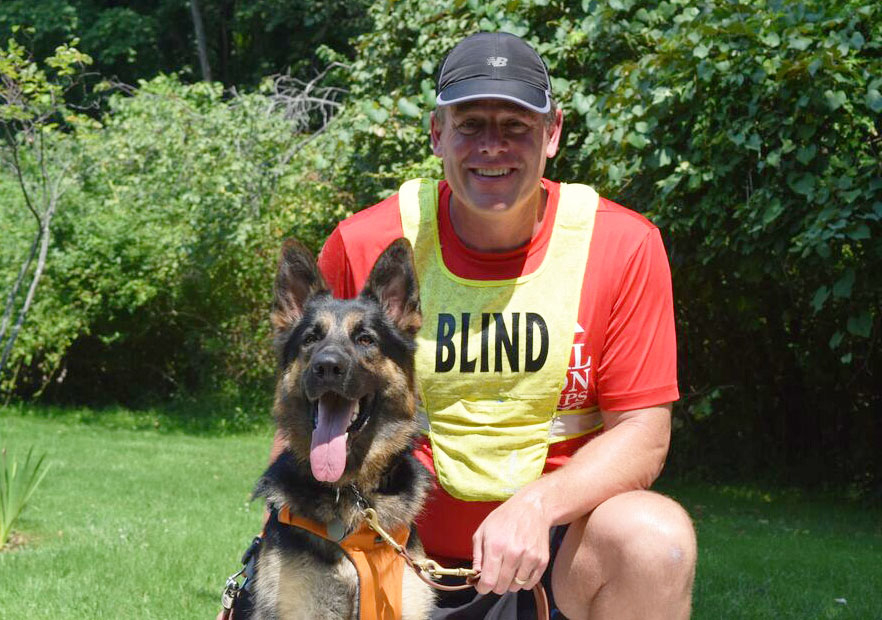
For thousands of blind athletes across the country, just setting foot out the door can be a huge challenge. Now one special dog is helping his owner not just walk out the door, but run. Only on “CBS This Morning,” Barry Petersen reports on the extraordinary story of one man’s journey to find the perfect running mate.
Richard and Klinger, and all those who made it happen, Jean and I salute you!
The vastness of the seas and the immensity of their influence over all of us.
This is an introduction, a rather long one I’m warning, to a republication of a recent post by Patrice Ayme. An introduction that offers a deeply personal memory of the Atlantic ocean.
Many years ago, I spent 5 years living on a boat; a wonderful heavy-displacement ocean-going yacht of a type known as a Tradewind 33.
My home for five years – Tradewind 33: Songbird of Kent.
There is a place in my mind to which I can so easily travel; a memory of a dark night out in the Atlantic ocean one time in the Autumn of 1969. But first let me set the scene from almost fifty years ago.
The call of the open ocean
Those first few hours were utterly absorbing as I went through the whole business of clearing the yacht harbour at Gibraltar and heading out to the South-West hugging this unfamiliar coastline of Southern Spain. It was tempting to move out to deeper waters but the almost constant flow of large ships through the Straights of Gibraltar soon quashed that idea. Thankfully, the coastal winds were favourable for me and my single-masted sailing yacht.
After such a long time sailing in the relatively confined waters of the Mediterranean, it was difficult for me to imagine that in a few hours time the southern-most point of Spain would pass me by and the vastness of the Atlantic ocean would be my home for the next few weeks.
Soon the city of Tarifa was past my starboard beam and the Spanish coastline was rapidly disappearing away to the North-West. The horizon ahead of me was already approaching 180 degrees of raw, open ocean. There was just a flicker of a thought that whispered across my mind: “Oh Paul, what have you gone and done” as slowly but persistently the coastlines of Spain to the North and of Africa to the South became more and more distant and fuzzy. It was at 15:30 that I made an entry in my yacht’s log: “No land in sight in any direction!”
Now was the time to make sure that my bunk was made up, flashlights to hand, and my alarm clock ready and set. Alarm clock? Set to go off every twenty minutes during the night! For this was the only way to protect me and my yacht from being hit by one of those gigantic container ships that seemed to be everywhere. It took at least twenty minutes from the moment a ship’s steaming lights appeared above the horizon to crossing one’s path!
It was in the early hours of my first morning alone at sea, when once again the alarm clock had woken me and I was looking around an ocean without a single ship’s light to be seen that more of Les’ words (see footnote) came to me. I remembered asking Les: “What’s the appeal of sailing?” Les replied without a moment’s hesitation: “It’s the solitude. When you’re out at sea on your own, there’s no government or bankers to worry about. You’re not responsible to anyone but yourself.”
Yes, I could sense the solitude that was all around me but it was an intellectual sense not an emotional one. That would come later. Inside, I was still afraid of what I had let myself in for.
Remarkably quickly however, the pattern of solo life aboard a thirty-three-foot yacht became my world. Frankly, it staggered me as to how busy were my days. Feeding myself, navigating, trying to forecast the winds, staying in touch with other yachties via the short-wave radio, keeping the boat tidy and a zillion other tasks meant the first few days and nights just slipped by.
But it was a sight on my fourth night at sea that created the memory that would turn out to remain with me for all my life. The memory that I can go to anytime in my mind.
That fourth night I was already well into the routine of waking to the alarm clock, clipping on my harness as I climbed up the three steps that took me from my cabin into the cockpit, scanning the horizon with my eyes, checking that the self-steering had the boat at the correct angle to the wind and then, if no ships’ lights had been seen, slipping back down into my bunk and sleeping for another twenty minutes. Remarkably, I was not suffering from any long-term tiredness during the day.
It was a little after 3am that fourth night when the alarm clock had me back up in the cockpit once again. Then it struck me.
Songbird was sailing beautifully. There was a steady wind of around ten knots from the south-east, almost a swell-free ocean, and everything set perfectly. Not a sign of any ship in any direction.
Then I lifted my eyes upwards. There was not a cloud in the night sky, not a single wisp of mist to dim a single one of the million or more stars that were above my head. For on this dark, moonless night, so far removed from any shore-based light pollution, the vastness, yet closeness of the heavens above was simply breath-taking. I was transfixed. Utterly unable to make any rational sense of this night splendour that glittered in every direction in which I gazed. This dome that represented a vastness beyond any meaning other than a reminder of the magic of the universe.
This magic of the heavens above me that came down to touch the horizon in all directions. Such a rare sight to see the twinkling of stars almost touching the starkness of the ocean’s horizon at night. A total marriage of this one planet with the vastness of outer space.
I heard the alarm clock go off again and again next to my bunk down below. But I remained transfixed until there was a very soft lightening of the skyline to the east that announced that another dawn was on its way.
I would never again look up at the stars in a night sky without being transported back to that wonderful night and the memory of a lonely sea and sky.
I did warn you it would be a long introduction!
ooOOoo
Non-Linear Cold Blob Rising Over North Atlantic
The reason life survived on Earth for so long, and blossomed into animals, and now mind, is that the planet is equipped with homeostatic mechanisms (homeo means similar in Greek, and stasis, standing still). However, those mechanisms tend to be geological.
Human civilization is now having an impact on the biosphere of a violence probably never seen before. The changes are faster than what geology, or even life, can accommodate.
Some will brandish the impact of the Yucatan asteroid, and claim that was worse; however that’s just a theory: the biosphere was clearly under stress at the time from the Deccan Traps eruptions, and had been under that stress for hundreds of thousands of years, if not millions. At its worst, the Asteroid was just the straw which broke the Camel’s back.
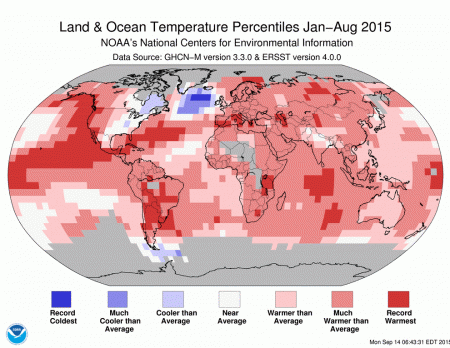
2015 will be the warmest year since the end of the Eemian, 115,000 years ago. So why are record low temperatures appearing just south of Iceland? Yes, record lows, lower than ever recorded.
While The Rest Of Planet Is At Record Warmth, Off Iceland, Record Colds Are Achieved!
That was fully expected, and a demonstration of Non-Linearity of the incipient global warming. A phenomenon is linear when it looks like a line. Global warming is not going up like a line, as some places are warming at a rate ten times higher than the average, and some regions are cooling (and some are cooling spectacularly, off Iceland and some seas around Antarctica, for reasons related to warming).
The Dryas events were extremely fast and pronounced cooling events which happened several times during the period 10,000 years to 15,000 Before Present. Some lasted around a millennium, others, just a century. They vanished as fast as they came. They are named after a tundra flower, the Dryas. In Scandinavia forests were replaced by tundra graced with Dryas (hence the name). In Britain, average temperature collapsed to minus 5 degree Celsius, and glaciers formed at elevation.
These spastic events of drastic cooling, while, overall, de-glaciation was going on, long remained a mystery. Overall, the great glaciation which had brought glaciers down to New York, was on its way out, the planet was globally, irresistibly warming. So why would temperatures collapse in some places around Greenland by 15 degrees Celsius? The solution to the Dryas events’ spastic glaciation riddle? The same as always! Warming is non-linear.
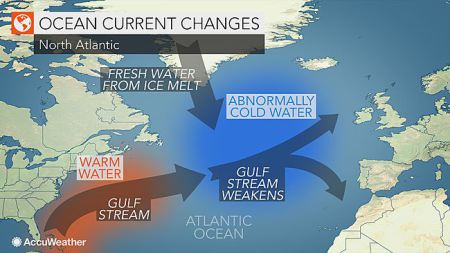
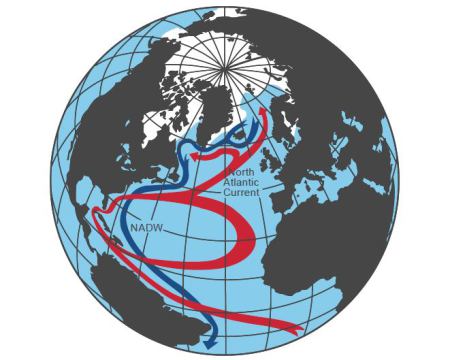
What’s the theory? The details are uncertain, but we know that the Gulf Stream (aka the North Atlantic “Conveyor”) shorted, literally: analyses of deep sea sediments have shown this. The conveyor sends an enormous current of warm tropical waters northward.
When the warm tropical waters become very cold between Iceland and Spitzbergen, they sink to the bottom of the sea, and head south. This sinking, plus the pushing by trade winds in the tropics, is what provides the energy of the Gulf Stream.
However, if the warm tropical waters are capped by a very cold, but light sweet(er) water lid, they will get cold early, and sink before Iceland. This is what happened in the Dryas events.
And It Is Happening Again, Albeit On A Smaller Scale.
Was it in response to a sudden influx of fresh water from Lake Agassiz and deglaciation in North America, and Greenland? Sudden freezing there would have removed the freshwater lid, hence the brutal switchback to warming after the brutal cooling. By the way, the sea level rising speed responded quickly, by a factor of three. After the typical Dryas cooling, oceanic rise rebounded to 18 millimeter per year right away (this shows that those who expect a slow rise of sea level rise are deluding themselves, or, more to the point, are trying to delude us!)
Nowadays a Dryas-like mechanism would have to rest on the melting of Greenland alone (that’s the only place with significant ice). This is, of course, insufficient, but summer 2015, cool and rainy over the northern North Atlantic is evidence that the effect is on. Scientific analysis confirms it. See: “Exceptional Twentieth Century Slow Down of Atlantic Ocean Overturning Circulation” (Nature, 23 March, 2015).
The exact nature of what is going on at this point is a matter of debate among experts. What is sure is that something is going on.
The Atlantic Conveyor Is A Subtle Thing, Yet Dominates Glaciation In The Arctic.
A similar situation beckons in Antarctica, where ice shield melting creates a freshwater lid all around which in turn freeze, extending the ice cap in the Austral winter.
When considering nonlinearity, subtlety and surprises are of the essence. This is true in physics, as it is in psychology, history, or politics.
And the morality in all this? The USA has played god. The European Union made a honest to goodness effort to reduce CO2 emission, while the USA, paying lip service to the opposite of what it was doing went right ahead, with its factory, the Plutocratic Republic of China, to use and abuse fossil fuels as never before.
So now what? Is god still American, as usual? At first it seems so: the USA started to frack massively and massive amounts of fossil fuels were extracted from the USA’s generous soil. When American companies tried the same in Poland, it failed: the underground god (Pluto?) did not cooperate: Polish soil is adverse to fracking.
Here comes the punchline: sea level has been rising fast along the Eastern seashore of the USA. Actually, three to four times faster than the world average. That’s more than one centimeter per year.
Why? Imagine a traffic jam. Or rather a crash ahead: things come to a halt, cars, water piles up behind. Maybe the Washington politicians will soon have to learn to swim, and not just against the tide of world public opinion.
The USA is going to be punished with its own instruments. Meanwhile 20 countries formed the V20, a group of twenty countries whose existence is immediately threatened by global warming, although they caused it not.
Footnote: The Les referred to is Les Powells, the yachtsman who sailed solo three times around the world. He and I became good friends when we met up at Larnaca Marina in Cyprus.
Last Monday, Jean and I had been living here in Merlin, Oregon for three years.
Why I am explaining this is because my day yesterday ended up being so busy that I ran out of time to focus on writing a fresh new post for you good people.
Thus, I decided to repost something that I published that first week we moved in to our Merlin home. Namely, a post published on the 16th October, 2012 under the heading of The death of the USA?.
So my apologies for you dear readers that recall this from three years ago, and welcome to the many new followers of this place that have signed up since then.
ooOOoo
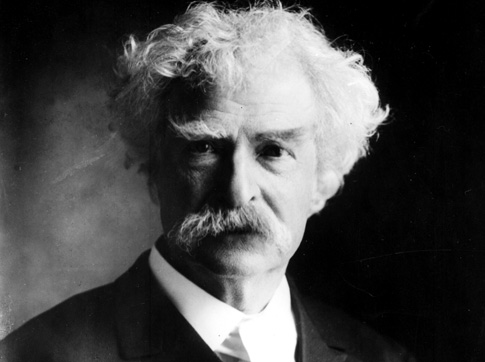
“The reports of my death are greatly exaggerated!”Mark Twain.
Mark Twain
The Mark Twain quotation after hearing that his obituary had been published in the New York Journal.
Mistaken publications of obituaries aren’t as rare as you might expect. A recent example is of Dave Swarbrick, the British folk/rock violinist, who was killed off mistakenly by the Daily Telegraph in April 1999 when they reported that his visit to hospital in Coventry had resulted in his death. He did at least get the opportunity to read a rather favourable account of his life, not something we all get to do, and to deliver the gag “It’s not the first time I have died in Coventry”.
So why have I opened with this quote from Mark Twain? Read on and I hope all will be clear.
A little under a week ago, I published a couple of posts that proposed that the United States of America is an empire in decline. The first was What goes up? and the second Might just come down! As a Brit, I well know that aspect of British history!
However a recent conversation with a friend of many years back in England, who has also been a shrewd and wise entrepreneur for longer than I care to remember, argued that the evidence for the ‘end of the USA’ could be challenged.
He cited five reasons why he thought the USA would remain, more or less, in its dominant position. They were:
Spirit of innovation
Relaxed labour laws
The importance of Mexico
The uncertainty of China in terms of the next ’empire’
The likely energy self-sufficiency for the USA in the near-term.
So let me expand on each of those points.
Spirit of innovation
Let me quote from an article in TIME Magazine of the 5th June, 2011,
Innovation is as American as apple pie. It seems to accord with so many elements of our national character — ingenuity, freedom, flexibility, the willingness to question conventional wisdom and defy authority. But politicians are pinning their hopes on innovation for more urgent reasons. America’s future growth will have to come from new industries that create new products and processes. Older industries are under tremendous pressure. Technological change is making factories and offices far more efficient. The rise of low-wage manufacturing in China and low-wage services in India is moving jobs overseas. The only durable strength we have — the only one that can withstand these gale winds — is innovation.
Now there are plenty who would argue both ways in terms of the future innovation potential for the USA, as a recent article in The Atlantic does, see American Innovation: It’s the Best of Times and the Worst of Times. But the spirit of innovation will, nonetheless, be a powerful economic potential for the USA for many years to come.
Relaxed labour laws.
Definitely an area that I have little knowledge of except for the subjective notion that compared to many other nations, the laws in the USA are much less of a restraint on economic productivity than elsewhere.
The importance of Mexico.
The importance in the context of providing the USA with a source of cheaper manufacturing facilities. My English friend thought that this was a significant competitive advantage for the USA. Now, as it happens, we had a couple staying with us over the week-end of the 6th/7th October. The husband is a senior manager of Horst Engineering, an American firm based in Guaymas, Sonora County, Mexico. Here’s a picture from their website,
We are a contract manufacturer of precision machined components and assemblies for aerospace, medical, and other high technology industries. Our core processes include Swiss screw machining, turning, milling, thread rolling, centerless grinding, and assembly. Our extensive supply chain offers our customers a full service logistics solution for managing their precision product requirements. We are ISO9001:2008 and AS9100 registered and proud of our 66 year, three-generation legacy of quality and performance.
I was told that many American and British firms were using Mexico rather than China for a number of reasons. Not least because Chinese suppliers require full payment before shipment. Plus that taking into account that financial aspect together with shipping costs and other logistical issues, China wasn’t as ‘cheap’ over all. Here’s a recent announcement from Rolls Royce,
Rolls-Royce plans new Sonora hub
The burgeoning aerospace industry in Guaymas had its efforts validated recently when the venerable Rolls-Royce chose it as the site for its newest global purchasing office.
Surrounded by several of its aerospace manufacturing suppliers, London-based Rolls-Royce will move into a Guaymas industrial park owned by Tucson-based The Offshore Group to develop a supply hub for commercial jets and military aircraft around the globe.
“Rolls-Royce has very robust booking orders for the next 10 years,” said Joel Reuter, director of communications for Rolls-Royce in North America. “We need to double our production.”
Because a number of Rolls-Royce suppliers already operate in Guaymas, the city was a logical choice, Reuter said.
The uncertainty of China in terms of the next ’empire’
The point made in terms of China taking over ’empire’ status from the USA, as Simon Johnson argues over at Baseline Scenario, is countered by the fact that politically China is an unknown quantity. Until China endorses some form of democratic process, that unknowingness is not going to disappear.
The likely energy self-sufficiency for the USA in the near-term.
I can’t do better than to ask you to watch this video! Just 27-minutes long, it is a very interesting review of the energy future of the USA.
As the TED website suggests in terms of why you should listen to Amory Lovins,
Amory Lovins was worried (and writing) about energy long before global warming was making the front — or even back — page of newspapers. Since studying at Harvard and Oxford in the 1960s, he’s written dozens of books, and initiated ambitious projects — cofounding the influential, environment-focused Rocky Mountain Institute; prototyping the ultra-efficient Hypercar — to focus the world’s attention on alternative approaches to energy and transportation.
His critical thinking has driven people around the globe — from world leaders to the average Joe — to think differently about energy and its role in some of our biggest problems: climate change, oil dependency, national security, economic health, and depletion of natural resources.
So, don’t know about you, but I found those five points deeply convincing. How about you? Are the reports of the death of the USA greatly exaggerated? Do leave a comment.
ooOOoo
Now some three years later on, these five factors still seem to be valid.












 Learning from Dogs