Category: History

Out of this world!

A fascinating journey about our Sun (and welcome Bruce).

The sun gives us everything. It is life!

I don’t know about you but there is something beautiful, something therapeutic, about thinking about stuff outside the day-to-day run of things. I came across this video recently, luckily on YouTube so I can share it with you. It is about the sun.

Here’s the introduction to the video:

The Copernican Principle has been with us for centuries. It broadly states that “we are typical” but increasingly we are beginning to question this doctrine. One famous push back is the Rare Earth hypothesis, but testing this idea will take generations. What about our Sun? Surely here we should have a better understanding as to whether our star is typical or not.

Join us as we discuss why the Sun might be more special than Copernicus ever imagined. Written and presented by Prof Kipping, this video is based on research conducted at the Cool Worlds Lab at Columbia University, New York.

The video starts immediately with some outstanding statements and one is drawn straightaway into Professor Kipping’s voice. The voyage is fantastic and truly out of this world.

Here it is:

It makes for a most intriguing thought about our planet and how we are, or are not, caring for it.

Origins of the Dog, a repeat!

Dogs and humans go back a very long way.

I wrote in my post of the 23rd: “In fact tomorrow I shall republish a post I wrote in 2015 about the origins of the dog!”

Well tomorrow wasn’t possible with the sad news of the loss of our cat.

But it is today! It was originally published on the 13th July, 2015 – my how 5 years have sped by!

So here it is again. I suspect many of you have not read it!

ooOOoo

The Origins of the Dog.

Dogs and humans go back even further than previously thought.

Humans and dogs were constant companions well before our ancestors settled in villages and started growing crops 10,000 years ago …

I have no doubt that thousands of dog owners all around the world must be enthralled by the way that dogs relate to us and, in turn, how we humans relate to dogs. More than once a day, one of our dogs will do something that has me and Jean marvelling at their way of living so close to us.

Then when one starts to reflect on how long dogs and humans have been together, perhaps it could be seen as the direct result of that length of relationship.

Now there’s nothing new in me writing this, after all the home page of Learning from Dogs states:

Yet they have been part of man’s world for an unimaginable time, at least 30,000 years. That makes the domesticated dog the longest animal companion to man, by far!

Back in May the website Livescience published an article that revealed more about the length of our relationship with dogs. This is how it opened:

Ancient Wolf DNA Could Solve Dog Origin Mystery

by Becky Oskin, Senior Writer

Humans and dogs were constant companions well before our ancestors settled in villages and started growing crops 10,000 years ago, a new study suggests.

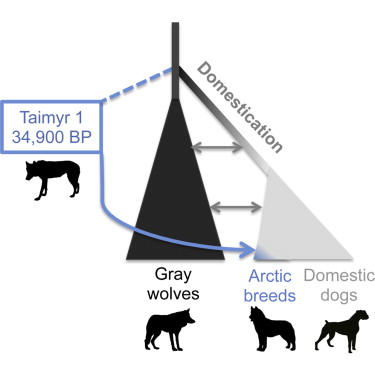
Genetic evidence from an ancient wolf bone discovered lying on the tundra in Siberia’s Taimyr Peninsula reveals that wolves and dogs split from their common ancestor at least 27,000 years ago. “Although separation isn’t the same as domestication, this opens up the possibility that domestication occurred much earlier than we thought before,” said lead study author Pontus Skoglund, who studies ancient DNA at Harvard Medical School and the Broad Institute in Massachusetts. Previously, scientists had pegged the wolf-dog split at no earlier than 16,000 years ago.

The Livescience article referred to results that were published in the journal Current Biology on May 21st this year. One needs a subscription to read the full report but here is their summary:

The origin of domestic dogs is poorly understood [ 1–15 ], with suggested evidence of dog-like features in fossils that predate the Last Glacial Maximum [ 6, 9, 10, 14, 16 ] conflicting with genetic estimates of a more recent divergence between dogs and worldwide wolf populations [ 13, 15, 17–19 ]. Here, we present a draft genome sequence from a 35,000-year-old wolf from the Taimyr Peninsula in northern Siberia. We find that this individual belonged to a population that diverged from the common ancestor of present-day wolves and dogs very close in time to the appearance of the domestic dog lineage. We use the directly dated ancient wolf genome to recalibrate the molecular timescale of wolves and dogs and find that the mutation rate is substantially slower than assumed by most previous studies, suggesting that the ancestors of dogs were separated from present-day wolves before the Last Glacial Maximum. We also find evidence of introgression from the archaic Taimyr wolf lineage into present-day dog breeds from northeast Siberia and Greenland, contributing between 1.4% and 27.3% of their ancestry. This demonstrates that the ancestry of present-day dogs is derived from multiple regional wolf populations.

That summary page also includes the following Graphical Abstract:

fx1

I don’t have permission to republish the Livescience article in full but would like to offer the closing paragraphs of this fascinating report.

“It is a very well-done paper,” Perry [George Perry, an expert in ancient DNA at Pennsylvania State University] told Live Science. “This topic is a critical one for our understanding of human evolution and human-environment interactions in the Paleolithic. Partnership with early dogs may have facilitated more efficient hunting strategies.”

If dogs first befriended hunter-gatherers, rather than farmers, then perhaps the animals helped with hunting or keeping other carnivores away. For instance, an author of a new book claims humans and dogs teamed up to drive Neanderthals to extinction. Skoglund also suggested the Siberian husky followed nomads across the Bering Land Bridge, picking up wolf DNA along the way.

“It might have been beneficial for them to absorb genes that were adapted to this high Arctic environment,” Skoglund said.

This is the first wolf genome from the Pleistocene, and more ancient DNA from prehistoric fossils could provide further insights into the relationship between wolves, dogs and humans, the researchers said.

Yes, our dogs have been part of man’s world for an unimaginable time – and Jean and I, as with tens of thousands of others, can’t imagine a world without dogs.

ooOOoo

They are our supreme companions. They don’t judge. They don’t lie. They are …. well let me repeat what I wrote right at the beginning of the blog.

Dogs are part of the Canidae, a family including wolves, coyotes and foxes, thought to have evolved 60 million years ago.  There is no hard evidence about when dogs and man came together but dogs were certainly around when man developed speech and set out from Africa, about 50,000 years ago.  See an interesting article by Dr. George Johnson.

Because of this closeness between dogs and man, we (as in man!) have the ability to observe the way they live.  Now I’m sure that scientists would cringe with the idea that the way that a dog lives his life sets an example for us humans, well cringe in the scientific sense.  But man seems to be at one of those defining stages in mankind’s evolution where the forces bearing down on the species homo sapiens have the potential to cause very great harm.  If the example of dogs can provide a beacon of hope, an incentive to change at a deep cultural level, then the quicker we ‘get the message’, the better it will be.

Dogs:

  • are integrous ( a score of 210) according to Dr David Hawkins
  • don’t cheat or lie
  • don’t have hidden agendas
  • are loyal and faithful
  • forgive
  • love unconditionally
  • value and cherish the ‘present’ in a way that humans can only dream of achieving
  • are, by eons of time, a more successful species than man.

There! Nothing more to say!

From Wolf to Dog.

A very interesting article in Scientific American magazine!

A single page article in this month’s Scientific American magazine is fascinating. The sub-heading is: “An amicable disposition also governed the course of evolution for an animal that turned into a favorite pet.”

A little later on in the article one reads:

When our research group began its work almost 20 years ago, we discovered that dogs also have extraordinary intelligence: they can read our gestures better that any other species, even bonobos and chimpanzees. Wolves, in contrast, are mysterious and unpredictable. Their home is the wilderness, and that wilderness is shrinking.

The article was written by Prof. Brian Hare and Vanessa Woods and is part of a much longer piece on Homo sapiens.

In fact tomorrow I shall republish a post I wrote in 2015 about the origins of the dog!

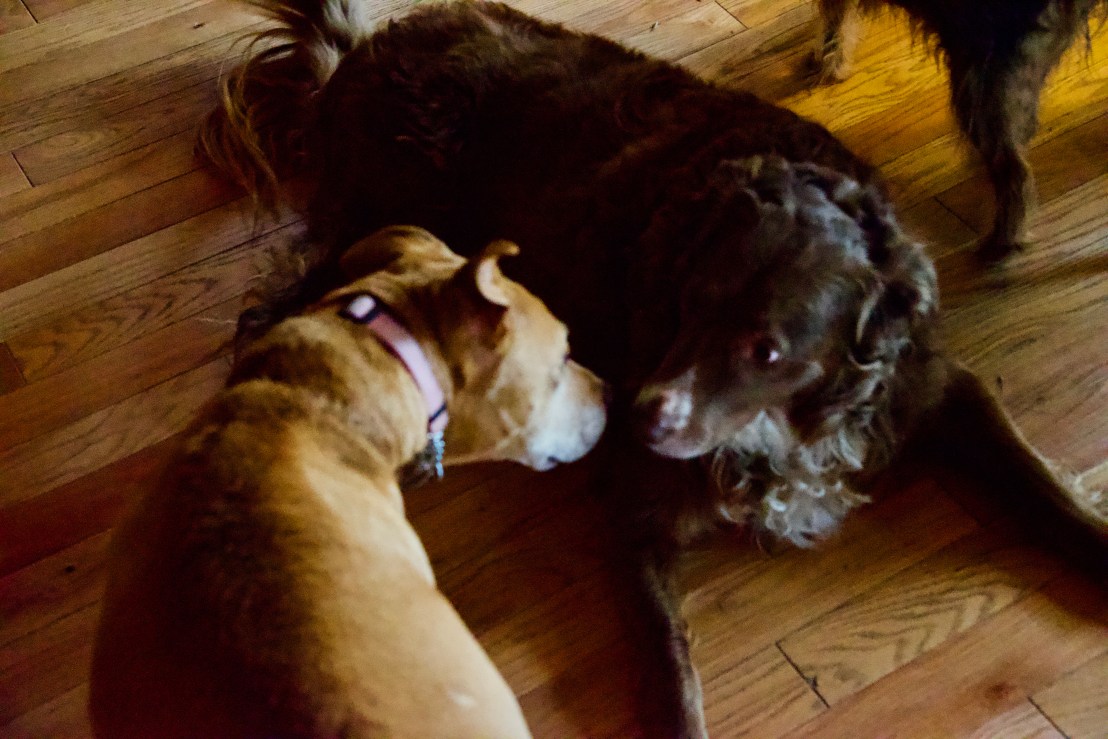
Sheena getting to know Oliver.

The moon and Venus

A photograph taken yesterday at 05:40 (PDT).

This was taken with a Nikon D750 from the rear deck of our house.

It has been greatly cropped and slightly adjusted in terms of contrast and shadows.

But, although I say it myself, it is an outstanding photograph! The moon is in a waning phase, about 10% illumination. Venus is just beautiful!

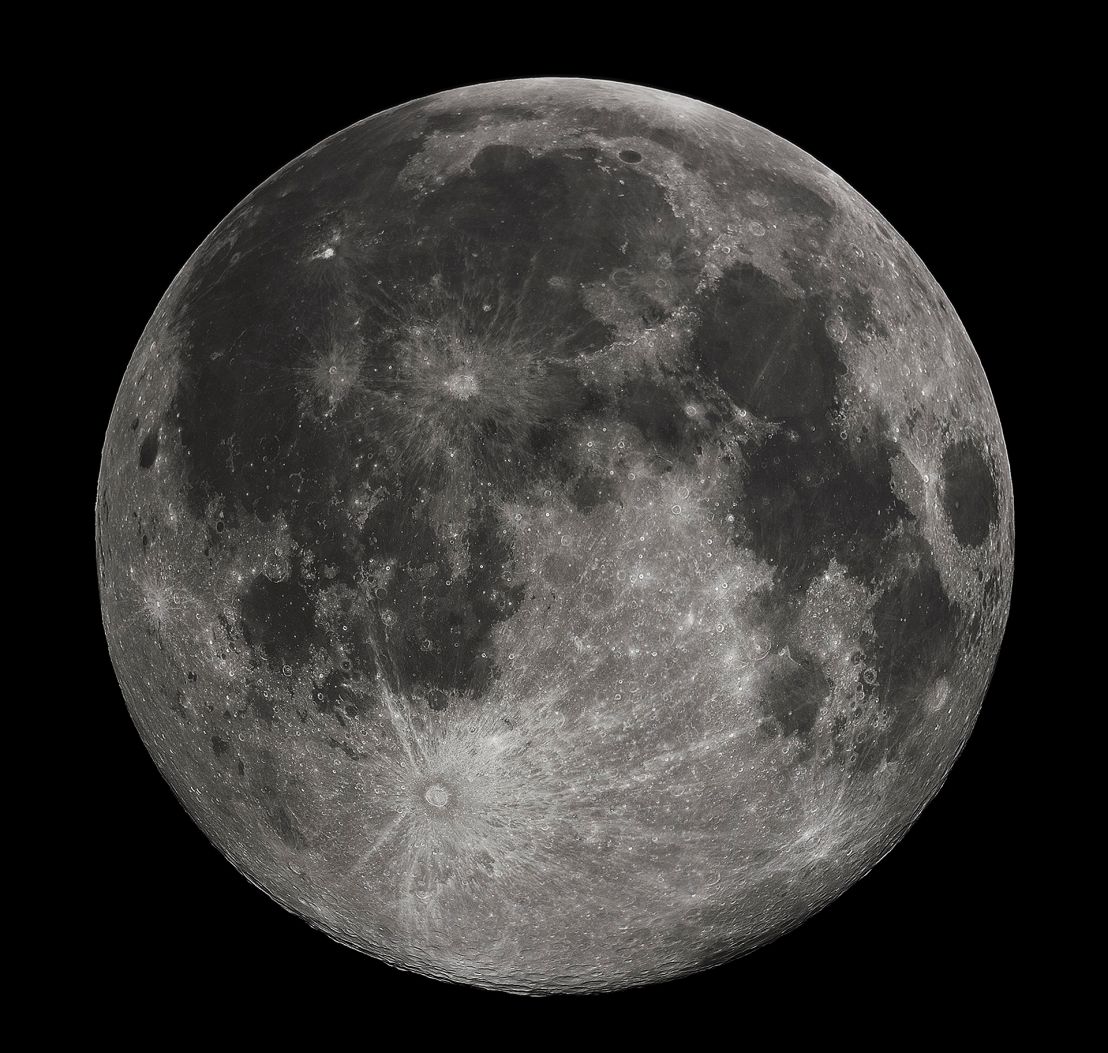
Here is the full moon.


And part of a Wikipedia extract:

The Moon is an astronomical body orbiting Earth and is the planet’s only natural satellite. It is the fifth-largest satellite in the Solar System, and by far[13] the largest among planetary satellites relative to the size of the planet that it orbits (its primary). The Moon is, after Jupiter‘s satellite Io, the second-densest satellite in the Solar System among those whose densities are known.

The Moon is thought to have formed about 4.51 billion years ago, not long after Earth. The most widely accepted explanation is that the Moon formed from the debris left over after a giant impact between Earth and a hypothetical Mars-sized body called Theia. New research of Moon rocks, although not rejecting the Theia hypothesis, suggests that the Moon may be older than previously thought.[14]

The Moon is in synchronous rotation with Earth, and thus always shows the same side to Earth, the near side. Because of libration, slightly more than half (about 59%) of the total lunar surface can be viewed from Earth.[15] The near side is marked by dark volcanic maria that fill the spaces between the bright ancient crustal highlands and the prominent impact craters. After the Sun, the Moon is the second-brightest celestial object regularly visible in Earth’s sky. Its surface is actually dark, although compared to the night sky it appears very bright, with a reflectance just slightly higher than that of worn asphalt. Its gravitational influence produces the ocean tides, body tides, and the slight lengthening of the day.

The Moon’s average orbital distance is 384,402 km (238,856 mi),[16][17] or 1.28 light-seconds. This is about thirty times the diameter of Earth. The Moon’s apparent size in the sky is almost the same as that of the Sun, since the star is about 400 times the lunar distance and diameter. Therefore, the Moon covers the Sun nearly precisely during a total solar eclipse. This matching of apparent visual size will not continue in the far future because the Moon’s distance from Earth is gradually increasing.

Here is a part of Wikipedia on Venus:

Venus is the second planet from the Sun. It is named after the Roman goddess of love and beauty. As the second-brightest natural object in the night sky after the Moon, Venus can cast shadows and can be, on rare occasion, visible to the naked eye in broad daylight.[15][16] Venus lies within Earth’s orbit, and so never appears to venture far from the Sun, either setting in the west just after dusk or rising in the east a bit before dawn. Venus orbits the Sun every 224.7 Earth days.[17] With a rotation period of 243 Earth days, it takes longer to rotate about its axis than any other planet in the Solar System and does so in the opposite direction to all but Uranus (meaning the Sun rises in the west and sets in the east).[18] Venus does not have any moons, a distinction it shares only with Mercury among planets in the Solar System.[19]

Venus is a terrestrial planet and is sometimes called Earth’s “sister planet” because of their similar size, mass, proximity to the Sun, and bulk composition. It is radically different from Earth in other respects. It has the densest atmosphere of the four terrestrial planets, consisting of more than 96% carbon dioxide. The atmospheric pressure at the planet’s surface is 92 times that of Earth, or roughly the pressure found 900 m (3,000 ft) underwater on Earth. Venus is by far the hottest planet in the Solar System, with a mean surface temperature of 737 K (464 °C; 867 °F), even though Mercury is closer to the Sun. Venus is shrouded by an opaque layer of highly reflective clouds of sulfuric acid, preventing its surface from being seen from space in visible light. It may have had water oceans in the past,[20][21] but these would have vaporized as the temperature rose due to a runaway greenhouse effect.[22] The water has probably photodissociated, and the free hydrogen has been swept into interplanetary space by the solar wind because of the lack of a planetary magnetic field.[23] Venus’s surface is a dry desertscape interspersed with slab-like rocks and is periodically resurfaced by volcanism.

As one of the brightest objects in the sky, Venus has been a major fixture in human culture for as long as records have existed. It has been made sacred to gods of many cultures, and has been a prime inspiration for writers and poets as the morning star and evening star. Venus was the first planet to have its motions plotted across the sky, as early as the second millennium BC.[24]

I included these excerpts from WikiPedia because many will find them of interest and quite a few, including yours truly, actually learnt something!

Alexandra Horowitz

Alexandra is a writer about dogs!

I can’t remember how long ago it was that I came across Alexandra Horowitz but the name stuck. For Alexandra is an author of many titles although many of them are about dogs.

But here’s a quote from someone who reviewed her book, On Looking: A Walker’s Guide to the Art of Observation.

“Horowitz writes like a poet, thinks like a scientist, and ventures like an explorer. Her book will have you looking in a new way at the world around you, and make you glad you did.” – Susan Orlean, author of Rin Tin Tin

If you haven’t already read some of her books then don’t delay!

Now I want to introduce a different side of Alexandra. That of her being a broadcaster, for want of a better description.

This is not a short video, it is 49 minutes long. But that’s a reason to sit down and thoroughly immerse oneself in her talk.

It is introduced thus:

To a dog, there is no such thing as “fresh air.” Every breath is full of information—in fact, what every dog knows about the world comes mostly through their nose. Dogs, when trained, can identify drugs of every type, underwater cadavers, cancer, illicit cell phones in prison, bed bugs, smuggled shark fins, dry rot, land-mines, termites, invasive knapweed, underground truffles, and dairy cows in estrous. But they also know about the upcoming weather, earthquakes before they happen, how “afternoon” smells, what you had for breakfast, and whether a cat touched your leg yesterday. And of course, they sniff their way home and know the distinctive odor of each spot of sidewalk as you travel there.
Alexandra Horowitz is a research scientist in the field of dog cognition and the New York Times bestselling author of “Inside of a Dog”. Her new book “BEING A DOG: Following the Dog into a World of Smell” explores in even greater depth what dogs know, delving into all of these remarkable abilities and revealing a whole world of experiences we miss every day. Alexandra visited Google Seattle to share her research and open eyes (and noses!) of pet parents everywhere.
Get the book here: https://goo.gl/cWJCfN

It’s a really fascinating and interesting talk and, I suspect, you will learn things about your dog’s nose that you didn’t know before.

If you want more news on Alexandra then go here!

And, forgive me, I can’t resist showing you a picture I took yesterday of Sheena!


Summer solstice 2020.

As old as time itself!

holding-the-sunThe point at which the sun reaches its farthest point north of the equator is the Summer Solstice, well it is for the Northern Hemisphere. This occurs annually on June 20 or June 21, depending on your time zone.

Here in Southern Oregon, the moment of the Summer Solstice will be at 2:43 PM or 14:43 PDT on Saturday, i.e. today! For the United Kingdom it will be at 22:43 BST on the same day or 21:43 GMT/UTC.

A quick web ‘look-up’ finds that the word solstice is from the Latin solstitium, from sol (sun) and stitium (to stop), reflecting the fact that the Sun appears to stop at this time, albeit momentarily.

At the ancient stone circle of Stonehenge in Southern England, the prehistoric monument that took Neolithic builders an estimated 1,500 years to erect, for many years the Druids have celebrated the Solstice and, undoubtedly, will be doing so again.

AMESBURY, UNITED KINGDOM - JUNE 21: A man stands on top of Stonehenge as the sun rises over Salisbury Plain on June 21, 2006 in Amesbury, England. Police estimated around 17,000 people travelled to watch the sun rise ove the 5,000 year old stone circle to start the longest day of the year. The all-night party to celebrate the Summer Solstice passed with only four arrests being made. (Photo by Daniel Berehulak/Getty Images)
AMESBURY, UNITED KINGDOM – JUNE 21: A man stands on top of Stonehenge as the sun rises over Salisbury Plain on June 21, 2006 in Amesbury, England. Police estimated around 17,000 people travelled to watch the sun rise over the 5,000 year old stone circle to start the longest day of the year. (Photo by Daniel Berehulak/Getty Images)

There’s a good article over at EarthSky on this year’s Solstice. I would like to quote a little from it:

At the June solstice, Earth is positioned in its orbit so that our world’s North Pole is leaning most toward the sun. As seen from Earth, the sun is directly overhead at noon 23 1/2 degrees north of the equator, at an imaginary line encircling the globe known as the Tropic of Cancer – named after the constellation Cancer the Crab. This is as far north as the sun ever gets.

All locations north of the equator have days longer than 12 hours at the June solstice. Meanwhile, all locations south of the equator have days shorter than 12 hours.

and

Where should I look to see signs of the solstice in nature? Everywhere. For all of Earth’s creatures, nothing is so fundamental as the length of the day. After all, the sun is the ultimate source of almost all light and warmth on Earth’s surface.

If you live in the Northern Hemisphere, you might notice the early dawns and late sunsets, and the high arc of the sun across the sky each day. You might see how high the sun appears in the sky at local noon. And be sure to look at your noontime shadow. Around the time of the solstice, it’s your shortest noontime shadow of the year.

If you’re a person who’s tuned in to the out-of-doors, you know the peaceful, comforting feeling that accompanies these signs and signals of the year’s longest day.

Is the solstice the first day of summer? No world body has designated an official day to start each new season, and different schools of thought or traditions define the seasons in different ways.

In meteorology, for example, summer begins on June 1. And every schoolchild knows that summer starts when the last school bell of the year rings.

Yet June 21 is perhaps the most widely recognized day upon which summer begins in the Northern Hemisphere and upon which winter begins on the southern half of Earth’s globe. There’s nothing official about it, but it’s such a long-held tradition that we all recognize it to be so.

It has been universal among humans to treasure this time of warmth and light.

For us in the modern world, the solstice is a time to recall the reverence and understanding that early people had for the sky. Some 5,000 years ago, people placed huge stones in a circle on a broad plain in what’s now England and aligned them with the June solstice sunrise.

We may never comprehend the full significance of Stonehenge. But we do know that knowledge of this sort wasn’t limited to just one part of the world. Around the same time Stonehenge was being constructed in England, two great pyramids and then the Sphinx were built on Egyptian sands. If you stood at the Sphinx on the summer solstice and gazed toward the two pyramids, you’d see the sun set exactly between them.

How does it end up hotter later in the summer, if June has the longest day? People often ask:

If the June solstice brings the longest day, why do we experience the hottest weather in late July and August?

This effect is called the lag of the seasons. It’s the same reason it’s hotter in mid-afternoon than at noontime. Earth just takes a while to warm up after a long winter. Even in June, ice and snow still blanket the ground in some places. The sun has to melt the ice – and warm the oceans – and then we feel the most sweltering summer heat.

Ice and snow have been melting since spring began. Meltwater and rainwater have been percolating down through snow on tops of glaciers.

But the runoff from glaciers isn’t as great now as it’ll be in another month, even though sunlight is striking the northern hemisphere most directly around now.

So wait another month for the hottest weather. It’ll come when the days are already beginning to shorten again, as Earth continues to move in orbit around the sun, bringing us closer to another winter.

And so the cycle continues.

Indeed, so the cycle continues as it has for time immemorial!

A Cherokee legend!

A precious and profound legend.

I follow Colin’s blog Wibble. It ranges across a myriad of thoughts and beliefs and it’s a good follow.

On June 9th, Colin published a post regarding The wolves within, a beautiful legend from the Cherokees. Colin readily and promptly gave me permission to share it with you.

The content isn’t mine, but of course it’s fine by me, Paul. You’re too polite by half! 😀

Here it is.

ooOOoo

The wolves within: a Cherokee legend

Posted on June 9, 2020

An old grandfather said to his grandson, who came to him with anger at a friend who had done him an injustice, “Let me tell you a story.

“I too, at times, have felt a great hate for those that have taken so much, with no sorrow for what they do.

“But hate wears you down, and does not hurt your enemy. It is like taking poison and wishing your enemy would die. I have struggled with these feelings many times.” He continued, “It is as if there are two wolves inside me. One is good and does no harm. He lives in harmony with all around him, and does not take offense when no offense was intended. He will only fight when it is right to do so, and in the right way.

“But the other wolf, ah! He is full of anger. The littlest thing will set him into a fit of temper. He fights everyone, all the time, for no reason. He cannot think because his anger and hate are so great. It is helpless anger, for his anger will change nothing.

“Sometimes, it is hard to live with these two wolves inside me, for both of them try to dominate my spirit.”

The boy looked intently into his grandfather’s eyes and asked, “Which one wins, grandfather?”

The grandfather smiled and quietly said, “The one I feed.”

With thanks to White Wolf Pack.

ooOOoo

So let all of us feed that wolf!

There are some more legends here!

Other inhabited worlds, and the implications of finding one.

This is profoundly important.

Well it is to me and Jean and, I suspect, it will be to many other people.

I am an atheist. So is Jean. We have been all our lives. I think that many of you who follow this blog know that. The love that we have for our dogs, and all our animals, plus the beauty that is all around us in nature is enough. (Now I am not naive enough to realise that there are many, literally millions, that don’t have the same fortune in their lives.)

The Conversation recently republished an essay by David Weintraub that was first published in 2014. It is at the core of our existence and I am delighted to have the permission to republish it for you.

ooOOoo

Is your religion ready to meet ET

By
 Professor of Astronomy, Vanderbilt University

November 5th, 2014

Square away your personal philosophy now; proof of life beyond earth is coming. Stargazing image via http://www.shutterstock.com

How will humankind react after astronomers hand over rock-solid scientific evidence for the existence of life beyond the Earth? No more speculating. No more wondering. The moment scientists announce this discovery, everything will change. Not least of all, our philosophies and religions will need to incorporate the new information.

Searching for signs of life

Astronomers have now identified thousands of planets in orbit around other stars. At the current rate of discovery, millions more will be found this century.

Having already found the physical planets, astronomers are now searching for our biological neighbors. Over the next fifty years, they will begin the tantalizing, detailed study of millions of planets, looking for evidence of the presence of life on or below the surfaces or in the atmospheres of those planets.

And it’s very likely that astronomers will find it. Despite the fact that more than one-third of Americans surveyed believe that aliens have already visited Earth, the first evidence of life beyond our planet probably won’t be radio signals, little green men or flying saucers. Instead, a 21st century Galileo, using an enormous, 50-meter-diameter telescope, will collect light from the atmospheres of distant planets, looking for the signatures of biologically significant molecules.

Astronomers filter that light from far away through spectrometers – high-tech prisms that tease the light apart into its many distinct wavelengths. They’re looking for the telltale fingerprints of molecules that would not exist in abundance in these atmospheres in the absence of living things. The spectroscopic data will tell whether a planet’s environment has been altered in ways that point to biological processes at work.

What is our place in the universe? Woman image via http://www.shutterstock.com

If we aren’t alone, who are we?

With the discovery in a distant planet’s light spectrum of a chemical that could only be produced by living creatures, humankind will have the opportunity to read a new page in the book of knowledge. We will no longer be speculating about whether other beings exist in the universe. We will know that we not alone.

An affirmative answer to the question “Does life exist anywhere else in the universe beyond Earth?” would raise immediate and profoundly important cosmotheological questions about our place in the universe. If extraterrestrial others exist, then my religion and my religious beliefs and practices might not be universal. If my religion is not universally applicable to all extraterrestrial others, perhaps my religion need not be offered to, let alone forced on, all terrestrial others. Ultimately, we might learn some important lessons applicable here at home just from considering the possibility of life beyond our planet.

In my book, I investigated the sacred writings of the world’s most widely practiced religions, asking what each religion has to say about the uniqueness or non-uniqueness of life on Earth, and how, or if, a particular religion would work on other planets in distant parts of the universe.

Extrasolar sinners?

Let’s examine a seemingly simple yet exceedingly complex theological question: could extraterrestrials be Christians? If Jesus died in order to redeem humanity from the state of sin into which humans are born, does the death and resurrection of Jesus, on Earth, also redeem other sentient beings from a similar state of sin? If so, why are the extraterrestrials sinful? Is sin built into the very fabric of the space and time of the universe? Or can life exist in parts of the universe without being in a state of sin and therefore without the need of redemption and thus without the need for Christianity? Many different solutions to these puzzles involving Christian theology have been put forward. None of them yet satisfy all Christians.

Mormon worlds

Mormon scripture clearly teaches that other inhabited worlds exist and that “the inhabitants thereof are begotten sons and daughters unto God” (Doctrines and Covenants 76:24). The Earth, however, is a favored world in Mormonism, because Jesus, as understood by Mormons, lived and was resurrected only on Earth. In addition, Mormon so-called intelligences can only achieve their own spiritual goals during their lives on Earth, not during lifetimes on other worlds. Thus, for Mormons, the Earth might not be the physical center of the universe but it is the most favored place in the universe. Such a view implies that all other worlds are, somehow, lesser worlds than Earth.

Bahá’í without bias

Members of the Bahá’í Faith have a view of the universe that has no bias for or against the Earth as a special place or for against humans as a special sentient species. The principles of the Bahá’í Faith – unifying society, abandoning prejudice, equalizing opportunities for all people, eliminating poverty – are about humans on Earth. The Bahá’í faithful would expect any creatures anywhere in the universe to worship the same God as do humans, but to do so according to their own, world-specific ways.

Light years from Mecca

The pillars of the faith for Muslims require the faithful to pray five times every day while facing Mecca. Because determining the direction of Mecca correctly could be extremely difficult on a quickly spinning planet millions of light years from Earth, practicing the same faith on another world might not make any sense. Yet the words of the Qu’ran tell us that “Whatever beings there are in the heavens and the earth do prostrate themselves to Allah” (13:15). Can terrestrial Muslims accept that the prophetically revealed religion of Muhammad is intended only for humans on earth and that other worlds would have their own prophets?

Astronomers as paradigm-shatterers

Philosophers and scientists have forced worldviews to adapt in the past.

At certain moments throughout history, astronomers’ discoveries have exerted an outsized influence on human culture. Ancient Greek astronomers unflattened the Earth – though many then chose to forget this knowledge. Renaissance scholars Copernicus and Galileo put the Earth in motion around the Sun and moved humans away from the center of the universe. In the 20th century, Edwin Hubble eliminated the very idea that the universe has any center at all. He demonstrated that what the universe has is a beginning in time and that, bizarrely, the universe, the very fabric of three-dimensional space, is expanding.

Clearly, when astronomers offer the world bold new ideas, they don’t mess around. Another such paradigm-shattering new idea may be in the light arriving at our telescopes now.

No matter which (a)theistic background informs your theology, you may have to wrestle with the data astronomers will be bringing to houses of worship in the very near future. You will need to ask: Is my God the God of the entire universe? Is my religion a terrestrial or a universal religion? As people work to reconcile the discovery of extrasolar life with their theological and philosophical worldviews, adapting to the news of life beyond Earth will be discomfiting and perhaps even disruptive.

ooOOoo

Now I don’t really want to open up the subject of religion but I will say that WikiPedia have a great entry about the subject. My own view is that a few hundred years ago, when life was a lot more mysterious and uncertain, believing in life after death made some sense.

But we know a lot better now despite death still being a certainty.

Brandy!

Dogs don’t need religion!

And what about mathematics?

Yet another revelation!

Fairly soon after publishing my post about music and the dog world I came across another article on dogs, and other animals, having a sense of numbers.

Now this post which was originally published by The Conversation is intricate in it’s deliberations but it is still clear. Try the article yourself.

ooOOoo

Animals that can do math understand more language than we think

May 28, 2020

By Erik Nelson, Phd Student, Philosophy, Dalhousie University

It is often thought that humans are different from other animals in some fundamental way that makes us unique, or even more advanced than other species. These claims of human superiority are sometimes used to justify the ways we treat other animals, in the home, the lab or the factory farm.

So, what is it that makes us so different from other animals? Many philosophers, both past and present, have pointed to our linguistic abilities. These philosophers argue that language not only allows us to communicate with each other, but also makes our mental lives more sophisticated than those that lack language. Some philosophers have gone so far as to argue that creatures that lack a language are not capable of being rational, making inferences, grasping concepts or even having beliefs or thoughts.

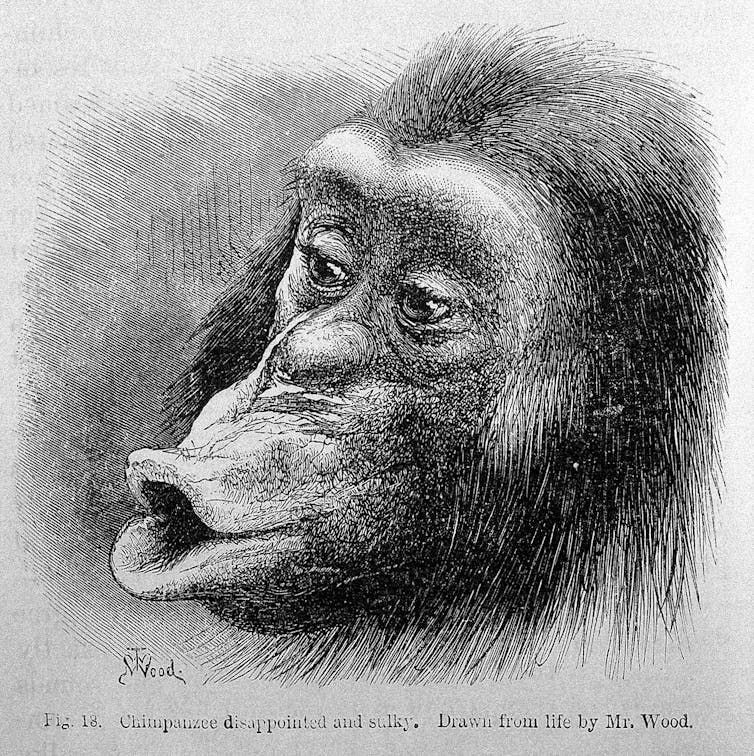
An illustration of a sulky chimpanzee from Charles Darwin’s 1872 book, ‘The Expression of the Emotions in Man and Animals.’ (Wellcome Collection)

Even if we are willing to accept these claims, what should we think of animals who are capable of speech? Many types of birds, most famously parrots, are able to make noises that at least sound linguistic, and gorillas and chimpanzees have been taught to communicate using sign language. Do these vocalizations or communications indicate that, like humans, these animals are also capable of sophisticated mental processes?

The philosophy of animal language

Philosophers have generally answered this question by denying that talking parrots and signing gorillas are demonstrating anything more than clever mimicry. Robert Brandom, a philosopher at the University of Pittsburgh, has argued that if a parrot says “red” when shown red objects and “blue” when presented with blue ones, it has not actually demonstrated that it understands the meaning of those words. According to Brandom — and many other philosophers — understanding the meaning of a word requires understanding both the meaning of many other words and the connections that exist between those words.

Imagine that you bring your toddler niece to a petting zoo for the first time, and ask her if she is able to point to the rabbits. If she successfully does, this might seem like a good indication that she understands what a rabbit is. However, you now ask her to point to the animals. If she points to some rocks on the ground instead of pointing to the rabbits or the goats, does she actually understand what the word “rabbit” means? Understanding “rabbit” involves understanding “animal,” as well as the connection between these two things.

So if a parrot is able to tell us the colour of different objects, that does not necessarily show that the parrot understands the meanings of those words. To do that, a parrot would need to demonstrate that it also understands that red and blue fall underneath the category of colour, or that if something is red all over, it cannot, at the same time, be blue all over.

What sort of behaviour would demonstrate that a parrot or a chimpanzee did understand the words it was using? As a philosopher who focuses on the study of animal cognition, I examine both empirical and theoretical work to answer these types of questions.

In recent research, I argue that testing an animal’s arithmetical capabilities can provide insight into just how much they are capable of understanding. In order to see why, we need to take a brief detour through the philosophy of mathematics.

Counting animals

In the late 1800s, the German mathematician and philosopher Gottlob Frege tried to demonstrate that arithmetic is an objective science. Many philosophers and mathematicians at the time thought that arithmetic was merely an artifact of human psychology. Frege worried that such an understanding would make arithmetic entirely subjective, placing it on no firmer ground than the latest fashion trends.

In The Foundations of Arithmetic, Frege begins by logically analyzing what sorts of things numbers are. He thinks that the key to this investigation is figuring out what it takes to answer the question “how many?”

If I hand you a deck of cards and ask, “How many?” without specifying what I want counted, it would be difficult to even figure out what sort of answer I am looking for. Am I asking you how many decks of cards, how many cards all together, how many suits or any of the other number of ways of dividing up the deck? If I ask, “How many suits?” and you respond “four,” you are demonstrating not just that you can count, but that you understand what suits are.

Frege thought that the application of number labels depends on being able to grasp the connection between what is being counted and how many of them there are. Replying “four” to the question “How many?” might seem like a disconnected act, like parrots merely calling red objects “red.” However, it is more like your niece pointing to the rabbits while also understanding that rabbits are animals. So, if animals are able to reliably respond correctly to the question “How many?” this demonstrates that they understand the connection between the numerical amount and the objects they are being asked about.

Animal mathematical literacy

One example of non-human animals demonstrating a wide range of arithmetical capabilities is the work that Irene Pepperberg did with African grey parrots, most famously her subjects Alex and Griffin.

In order to test Alex’s arithmetic capabilities, Pepperberg would show him a set of objects on a tray, and would ask, “How many?” for each of the objects. For example, she would show him a tray with differently shaped objects on it and ask, “How many four-corner?” (Alex’s word for squares.) Alex was able to reliably provide the answer for amounts up to six.

Alex was also able to provide the name for the object if asked to look for a number of those objects. For example, if a tray had different quantities of coloured objects on it including five red objects, and Alex was asked, “What colour is five?” Alex was able to correctly respond by saying “red.”

Pepperberg’s investigations into the ability to learn and understand basic arithmetic provide examples that show that Alex was able to do more than simply mimic human sounds. Providing the right word when asked, “How many?” required him to understand the connections between the numerical amount and the objects being asked about.

Animal mathematical skills

While Pepperberg’s results are impressive, they are far from unique. Numerical abilities have been identified in many different species, most prominently chimpanzees. Some of these capabilities demonstrate that the animals understand the underlying connections between different words and labels. They are therefore doing something more than just mimicking the sounds and actions of the humans around them.

Animals that can do basic arithmetic show us that some really are capable of understanding the terms they use and the connections between them. However, it is still an open question whether their understanding of these connections is a result of learning linguistic expressions, or if their linguistic expressions simply help demonstrate underlying capabilities.

Either way, claims that humans are uniquely able to understand the meanings of words are a bit worse for wear.

ooOOoo

There’s little that I can add to the excellent summary in that penultimate paragraph;

Animals that can do basic arithmetic show us that some really are capable of understanding the terms they use and the connections between them. However, it is still an open question whether their understanding of these connections is a result of learning linguistic expressions, or if their linguistic expressions simply help demonstrate underlying capabilities.

but one thing is becoming clearer and clearer: dogs and other animals are a whole lot smarter than many (most?) of us think. Primarily on the back of research into the nature of our creatures and especially those creatures that are very close to us.

A sailing memory, part two.

Again, this is for Pendantry.

I left yesterday’s post with the statement: “However, getting to Gibraltar was not without its challenge for we suffered a knockdown and this scared us both to the core.”

This is the account of that knockdown.

ooOOoo

The knockdown

So this was it, the end of life. This is what that end felt like. A lifetime of experiences reduced to this stilled moment; all my hopes, dreams, pleasures, memories, everything shrunk to this tiny moment of now.

I knew, in some trance-like way, that if just one of those foaming, giant waves swept across us, so utterly over-whelmed as we were on our side, it would flood the cabin, and down Dave and I and the yacht would go.

Other sensations came to me. Feelings of quiet, of calm, even of peace. My world now reduced to close, intimate dimensions. To the yacht’s wheel, to which I so grimly hung. To the front edge of the port cockpit seat, now underneath me, against which I braced my feet. To the starboard guardrail, bizarrely above my head, and to those raging seas so very close that seemed to beckon, ‘Give up, give up now and slip away.’

Me and Dave, alone in this Mediterranean storm 10 days West of Cyprus, are going to drown, founder without trace in these vast waves and probably end up not being missed for many days. Our dream of sailing across the Atlantic snuffed out as easily as Songbird of Kent would sink the 5,000 feet down to the seabed. The futility of it all.

It was a strange, detached perspective that hardly registered the gusts coming at us like great padded hammers. This unimaginable gale that had Songbird of Kent, my floating home for the last 5 years, totally pressed down on her port side, even though the yacht offered nothing more to the winds than her bare mast and rigging.

From within the cabin, Dave could do no more than simply watch. Hunkered down outside, I could do no more than simply hang-on. Both of us transfixed in this stillness of life’s imminent ending. Dave would later say no words would ever properly describe what his eyes had seen.

My past life, rather ominously, started running before me. How one year, in the early 1950s, when I was 7 or 8 years old, my parents had rented a holiday villa in the French Atlantic coastal town of Arcachon. What a glorious summer holiday that had been.

Arcachon’s beautifully sheltered bay had enabled me to learn to swim. The buoyant sea-water helping me increase the number of strokes each day, until one afternoon I had swum out to a yacht anchored well off the beach. As I hung on to the anchor chain, panting hard, the owner looked over the guardrail. Next, me being rowed back to the beach in a dinghy and then everyone getting to know Englishman John Calvert, a solo sailor living aboard his yacht, Garrawog.

Next year we had holidayed again in Arcachon and found Garrawog moored in the small yacht harbour. I recalled fond memories of sitting in the cabin with my father and John Calvert, drinking lemonade, eating cream crackers and loving the cosiness of it all.

Then the amazing coincidence when the following year we had holidayed at the French Mediterranean town of Menton and Garrawog had sailed into the harbour. That had led to John taking us sailing along the coast, memories so vivid, all these years later, of helping to haul sails, steer Garrawog, even remembering the gentle nudge of the yacht into the waves.

I was clear how those memories had fuelled my romantic obsession with sailing. How as a young teenager growing up in London I had joined the Welsh Harp sailing club, based at a large lake, well a reservoir, just three miles from home, and learnt to sail a dinghy. All fuelling this fascination with the sea. Yet that romantic obsession didn’t revolve around idyllic meanderings along the Mediterranean coastline. No, my dreams involved ocean sailing. Not even as part of a crew, but sailing, single-handed, across the oceans.

I had devoured every book written by those sailors who, totally alone, had journeyed the vast oceans in a small yacht. Joshua Slocum, who wrote of his solo trip around the world in his yacht, Spray, way back in 1895. Master English navigator, Francis Chichester, who conceived the idea of a single-handed yacht race across the Atlantic ocean, later completing a round-the-world solo circumnavigation in his yacht, Gipsy Moth IV. Eric Tabarly, Chay Blyth, Robin Knox-Johnston and many more.

I reflected how that dream had remained with me for years. All through nearly 20 years as a salesman and entrepreneur to the point when, quite suddenly, on a Monday in the Spring of 1986, uncharacteristically I had nothing in my diary for that day, or for many days ahead. I had just sold my thriving company in Colchester and there was no longer a job to go to!

Then not so long after I had taken a holiday in Larnaca and in wandering around the marina I had seen Songbird of Kent for sale, and had bought it! I had previously read about Tradewind yachts and knew how many had made world circumnavigations. Thus by the end of 1986, my new address had become: Yacht ‘Songbird of Kent’, Larnaca Marina, Cyprus.

A shout from Dave jerked me back to the real world.

“Hey, is it my imagination or is that wind easing?”

I lifted my head and turned my face into the weather coming full at us. The seas were just as terrible but, yes, something was different, some subtle lowering of the tone of the wind.

“Dave, you’re right, it has eased back a bit. We’re not so pressed down, are we?”

“Don’t think so. What do you reckon?”

“Not sure what to do, frankly these conditions scare the shit out of me!”

In the subtlest way imaginable, Songbird provided the answer. The yacht now showed some response to the waves rather than previously being so overwhelmed. A tiny thought entered my mind, something I hardly dared acknowledge: Songbird is not going to founder.

Those 3 tons of lead at the bottom of Songbird’s keel were, at last, overcoming the wind pressure on her topsides and with seawater cascading down from the mast and rigging, the yacht slowly righted and bestowed on me and Dave the continuation of our lives. A miracle of miracles!

I quickly helmed the bow round to point us downwind, putting the full force of the gale directly aft. Within moments, a wave slowly started to overtake us but I couldn’t do anything other than keep my eyes on the mast-head wind-vane that, against all odds, had stayed intact during the knock-down. Watching the arrow head that absolutely had to keep pointing directly into the wind. We may be upright but one slip of steering, one moment’s loss of concentration and I knew we would slew broadsides to the seas and go over again.

I couldn’t believe the size of this wave that lifted us up and up, as if we were in giant, invisible hands. Up to the foaming crest from which was revealed, all around us, wild, angry, jagged waves, huge crests covered in white foam, an Alpine-like scene of raging hell as far as the eye can see. A vista of utter desolation.

Then the foaming crest moved ahead of us and Songbird slid down that vast lee of the wave, down towards the trough that lay behind us. Our bowsprit pointed directly into the dark green water ahead, water streaked with spume, as down and down we went until the inevitable arrival of the next wave started us up to another foaming crest.

We had survived what we could never have imagined. Hardly believing it, we intuitively knew that surviving that first wave increased the odds of us surviving the next few. Then the next few, and the next few until, against all expectations, we knew we stood a chance of living through it all.

I spotted something in the water and shouted, “Dave, look, look there in the water, just to our left. That bit of sail, surely not from our mainsail?”

As we ran before the weather, a scrap of white sail had surged past our side, a piece of sail bearing the number 33 and two palm trees, the symbol of a Tradewind 33 yacht.

Dave laughed, “I can’t believe that, Paul. It’s from the mainsail that blew out when the gale first struck. How amazing! It must be from us, can’t be too many other Tradewind 33s out here!“.

“Imagine that, Dave, after all that we have been through these past few hours, we’ve just sailed by a bit of our mainsail, close enough to have grabbed it.”

That triggered my mind as to when this terrible experience started. How long ago was that? I didn’t have a clue, though surely it couldn’t have been much more than an hour or so ago. Indeed, I struggled to think what day it was, then realised it was Thursday, October 8th, 1992. Just 24 hours since we had left the dirty, commercial port of Algiers for the last leg of our trip from Larnaca in Cyprus to Gibraltar.

“Dave, hand me the log, it’s at the back of the chart table.”

I read,

Thursday, 8th October, 1992.

08:20 Sea state terrible.

I recalled how the dawn had revealed banks of low angry clouds, skidding across the tops of a nasty swell, made even worse by a vicious cross-swell. The next entry after that read,

09:00 Sky extremely threatening. Wind NE F4. Just 16 miles east of Greenwich meridian.

Then we had approximately 3 hours of sailing to go before we crossed Greenwich. On to the last entry,

12:00 Sea extremely ugly, Wind NNE F5. Longitude 2 minutes East of Greenwich.

Just 15 minutes from crossing that historical navigational line. I recalled how we had chatted about sharing a glass of something to celebrate ‘crossing the line’! Then how my words had been torn away when, in a seeming instant of time, this huge squall had come out of the North, heralding this vast, cauldron of a storm. The mainsail, even tripled-reefed, was way too much sail. But it was far too dangerous to leave the cockpit to drop the sail, too much to do anything other than hang on.

The mainsail failed, ripped into shreds as it tore away from the mast-track and disappeared into the storm. The sounds of the event obliterated by the screaming noise of a wind that I had guessed was now more than 50 knots. The rain and spray had stung my face so hard that I needed to turn my head away just to breathe. Clearly something had to give; I expected the mast to fail.

But it didn’t! Instead, as the wind force grew and grew, it steadily pressed us further and further over until Songbird ended up fully horizontal to the sea. It seemed a lifetime ago.

I looked at my watch: 5.30pm. To hell and back in so few hours!

“Dave, what’s our position?”

Dave ducked out of sight to read the GPS, came back out with a slip of paper on which he had written our position: Eight minutes of longitude west of the Greenwich meridian. We were now in the Western hemisphere!

“Come on, Dave, you take the wheel. I’m going to fetch a couple of beers.”

“I reckon a double celebration, Paul, crossing the Meridian and living to tell the tale!”

We drank our beers, chit-chatted about nothing much, both aware that we had literally stared into the abyss of a dark watery grave, and sailed on.

Just before 13:00 on Saturday, October 10th, Songbird rounded Gibraltar’s breakwater, briefly rolled in the cross-swell, and slipped into the calm waters of the inner harbour.

Soon we were safe and secure in a marina berth, a few minutes walk from good food and friendly bars. Our experiences rapidly migrated into the private worlds of our minds, as if discussing it openly might replay it all with a different, more tragic, outcome.

I struggled through those first nights of sleep. Again and again I awoke, panic across my chest, clinging to the sides of my bunk, trying to lay all the nightmares to rest. Slowly, those October days resting up in Gibraltar shone a light on this sailing obsession. How, with the sudden death of my father in 1956, those memories of idyllic times in and around Garrawog had buried themselves deep into my hidden emotional world. How dreams of sailing had more to do with keeping the memory of my father alive than with anything else.

That gale expunged the obsession. I never sailed on Songbird again or, for that matter, on any other sailing vessel. Paid crew eventually returned Songbird to England, where she was subsequently sold.

I would never forget the stillness I had experienced in the midst of all that chaos, but one knock-down in a lifetime was more than enough.

ooOOoo

This is absolutely a true account of what happened. Yes, an intimate, personal account of what happened but accurate down to the last detail.

I am so pleased I kept a written account of the knockdown all those years ago for if I was to recall it today then much of the detail would have been lost. Maybe lost as a result of old age or lost as a consequence of not wanting it in one’s mind. Who knows.

Finally, there are no photographs because we just had more important things to look after – keeping ourselves alive!