Category: History

Happy Birthday Jeannie

It is Jean’s birthday today.

This photograph was taken on the 8th January, 2008. Jean and I had met for the first time late in 2007.

It was close by in San Carlos, Mexico. Jean then lived in San Carlos!

It’s all too much, or it could be!

This year, 2020, has been unlike any other year.

I am not saying anything new but just reiterating what has been said before: 2020 is going to go down as the year from hell! And I don’t think that is too strong a word!

Part of it are the news stories that sweep the world: Covid-19; Brexit; Climate change; up until yesterday what was President Trump going to do in his last few weeks; etc; etc.

Also part of it is the way that news and more news and, yes, more news is flashed around the globe. Most of it bad news as we all know that bad news sells!

Finally, part of it is the new world of social media especially messaging on a smartphone. President Trump isn’t the only one to communicate greatly via Twitter.

Now, speaking personally, I couldn’t have got through this year without Jeannie and our dogs.

Pure bliss!

But, nevertheless, something has changed and Mark Satta has written an article that tries to explain things.

ooOOoo

Three reasons for information exhaustion – and what to do about it

By Mark Satta, Assistant Professor of Philosophy, Wayne State University.

November 18th, 2020

An endless flow of information is coming at us constantly: It might be an article a friend shared on Facebook with a sensational headline or wrong information about the spread of the coronavirus. It could even be a call from a relative wanting to talk about a political issue.

All this information may leave many of us feeling as though we have no energy to engage.

As a philosopher who studies knowledge-sharing practices, I call this experience “epistemic exhaustion.” The term “epistemic” comes from the Greek word episteme, often translated as “knowledge.” So epistemic exhaustion is more of a knowledge-related exhaustion.

It is not knowledge itself that tires out many of us. Rather, it is the process of trying to gain or share knowledge under challenging circumstances.

Currently, there are at least three common sources that, from my perspective, are leading to such exhaustion. But there are also ways to deal with them.

1. Uncertainty

For many, this year has been full of uncertainty. In particular, the coronavirus pandemic has generated uncertainty about health, about best practices and about the future.

At the same time, Americans have faced uncertainty about the U.S. presidential election: first due to delayed results and now over questions about a peaceful transition of power.

Experiencing uncertainty can stress most of us out. People tend to prefer the planned and the predictable. Figures from 17th-century French philosopher René Descartes to 20th-century Austrian philosopher Ludwig Wittgenstein have recognized the significance of having certainty in our lives.

With information so readily available, people may be checking news sites or social media in hopes of finding answers. But often, people are instead greeted with more reminders of uncertainty.

As Trump supporters denounce the 2020 election results, feelings of uncertainty can come up for others. Karla Ann Cote/NurPhoto via Getty Images

2. Polarization

Political polarization is stressing many Americans out.

As political scientist Lilliana Mason notes in her book, “Uncivil Disagreement: How Politics Became Our Identity,” Americans have been increasingly dividing politically “into two partisan teams.”

Many writers have discussed the negative effects of polarization, such as how it can damage democracy. But discussions about the harms of polarization often overlook the toll polarization takes on our ability to gain and share knowledge.

That can happen in at least two ways.

First, as philosopher Kevin Vallier has argued, there is a “causal feedback loop” between polarization and distrust. In other words, polarization and distrust fuel one another. Such a cycle can leave people feeling unsure whom to trust or what to believe.

Second, polarization can lead to competing narratives because in a deeply polarized society, as studies show, we can lose common ground and tend to have less agreement.

For those inclined to take the views of others seriously, this can create additional cognitive work. And when the issues are heated or sensitive, this can create additional stress and emotional burdens, such as sadness over damaged friendships or anger over partisan rhetoric.

3. Misinformation

Viral misinformation is everywhere. This includes political propaganda in the United States and around the world.

People are also inundated with advertising and misleading messaging from private corporations, what philosophers Cailin O’Connor and James Owen Weatherall have called “industrial propaganda.” And in 2020, the public is also dealing with misinformation about COVID-19.

As chess grandmaster Garry Kasparov put it: “The point of modern propaganda isn’t only to misinform or push an agenda. It is to exhaust your critical thinking, to annihilate truth.”

Misinformation is often exhausting by design. For example, a video that went viral,Plandemic,” featured a large number of false claims about COVID-19 in rapid succession. This flooding of misinformation in rapid succession, a tactic known as a Gish gallop, makes it challenging and time-consuming for fact checkers to refute the many falsehoods following one after another.

What to do?

With all this uncertainty, polarization and misinformation, feeling tired is understandable. But there are things one can do.

The American Psychological Association suggests coping with uncertainty through activities like limiting news consumption and focusing on things in one’s control. Another option is to work on becoming more comfortable with uncertainty through practices such as meditation and the cultivation of mindfulness.

To deal with polarization, consider communicating with the goal of creating empathetic understanding rather than “winning.” Philosopher Michael Hannon describes empathetic understanding as “the ability to take up another person’s perspective.”

[Deep knowledge, daily. Sign up for The Conversation’s newsletter.]

As for limiting the spread of misinformation: Share only those news stories that you’ve read and verified. And you can prioritize outlets that meet high ethical journalistic or fact-checking standards.

These solutions are limited and imperfect, but that’s all right. Part of resisting epistemic exhaustion is learning to live with the limited and imperfect. No one has time to vet all the headlines, correct all the misinformation or gain all the relevant knowledge. To deny this is to set oneself up for exhaustion.

ooOOoo

That last section, What to do?, is full of really sensible advice. In fact, the American Psychological Association has an article at the moment that appears to be freely available called Healing the political divide.

I intend to read it.

It finishes up saying:

Scientists must strive to share their research as broadly as possible. And they don’t have to do it alone. Organizations like More in Common work to conduct research and communicate findings to audiences where it can have the greatest impact.

Advocacy is essential as well. Other countries that have made strides in addressing the political divide relied heavily on government-led reconciliation efforts. The Truth and Reconciliation Commission, for example, in South Africa, has been fundamental in addressing disparities and conflict around Apartheid.

Were the United States to consider similar, government-backed efforts, psychologists must be part of the call to do so. And the behavioral expertise of the field would be central to success.

“The collective mental health of the nation is at risk,” says Moghaddam. “Just as we should rely on epidemiological science to tell us when there is a vaccine ready for mass use, we have to rely on psychological science to guide us through these mental health issues.”

And following an election that, for many, has felt like the most polarized of a lifetime, this piece seems critical. “ This is what our profession is all about,” says Moghaddam.

Good advice especially if you can take time off just losing oneself in nature.

Dawn behind nearby Mt. Sexton. Taken from our deck on the 21st August, 2019.

Enough said!

Of dogs and men.

Ancient genomes reveal the common history of human and dog.

At the end of October, 2020 Science magazine published an article about the evolutionary genetics of humans and dogs.

I am not allowed to republish the full text, despite being an AAAS member, but I am sure that selected quotes will be alright.

The article was written by Pavlos Pavlidis and Mehmet Somel.

Dogs likely evolved from a wolf population that self-domesticated, scavenging for left-overs from Palaeolithic hunter-gatherers in Eurasia. However, the exact timing and geographic location where the dog lineage started remain unknown, owing to the scarcity of Palaeolithic dogs in the archaeological record. Analyses of genetic data suggest that dog-wolf divergence took place ~25,000 to 40,000 years ago, providing an earliest possible date for dog domestication.

The last paragraph in the short article is as follows:

For example, there is evidence that pigs were domesticated in both Anatolia and China. For dogs, however, the story is different. Dogs and modern-day Eurasian grey wolves appear as monophyletic groups; that is, any dog is genetically closer to another dog than to a wolf, and vice versa, Monophyly supports a single origin of dogs from a possible extinct wolf lineage.

Absolutely fascinating!

A couple of photographs, courtesy of Pexels, to close the piece.

The wolf

oooo

The dog.

See you tomorrow.

The rise of dogs!

Mr and Mrs Biden are very fine dog owners.

As the BBC News website reported yesterday:

A Joe Biden presidency means the return of a long-held tradition of pets in the White House.

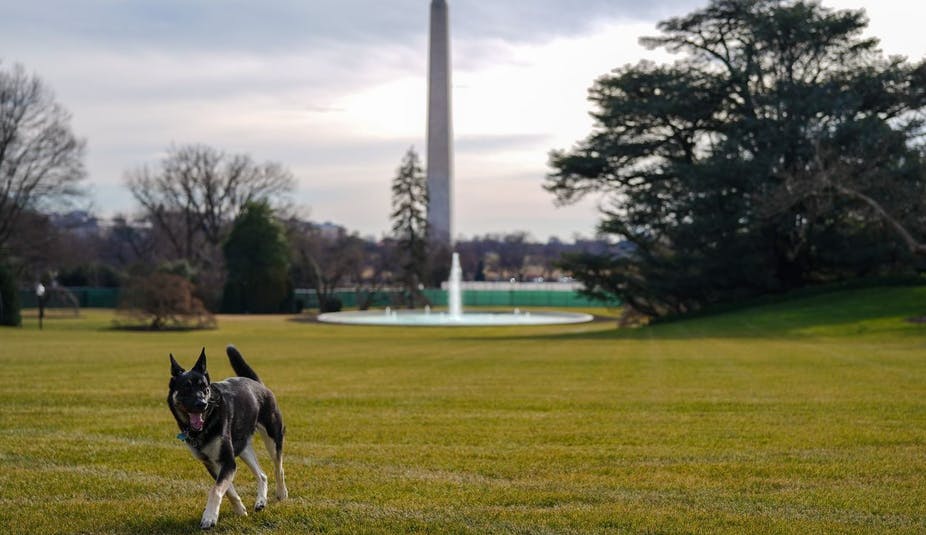
The President-elect and his wife have two dogs at present: Champ and Major. They are German Shepherds. Champ, who was then a puppy, was given to Joe Biden in 2018 by his wife. Major was fostered and then adopted, also in 2018, from the Delaware Humane Association.

Joe Biden with Major. Courtesy of The New York Times.

Here is another picture of the two dogs. This time featuring Mrs Biden.

Courtesy of Yahoo News.

So GSD Major will be the first shelter dog that from January, 2021 will reside in the White House.

The 2020 presidential election is bringing a slew of firsts into the White House: the first woman vice president, as well as the first Black woman and person of South Asian heritage to hold the position. The first first lady to continue working a full-time job. The first Jewish spouse of either a president or vice president.

But President-elect Joe Biden is bringing yet another first this January: The first-ever shelter dog will now reside in the White House.

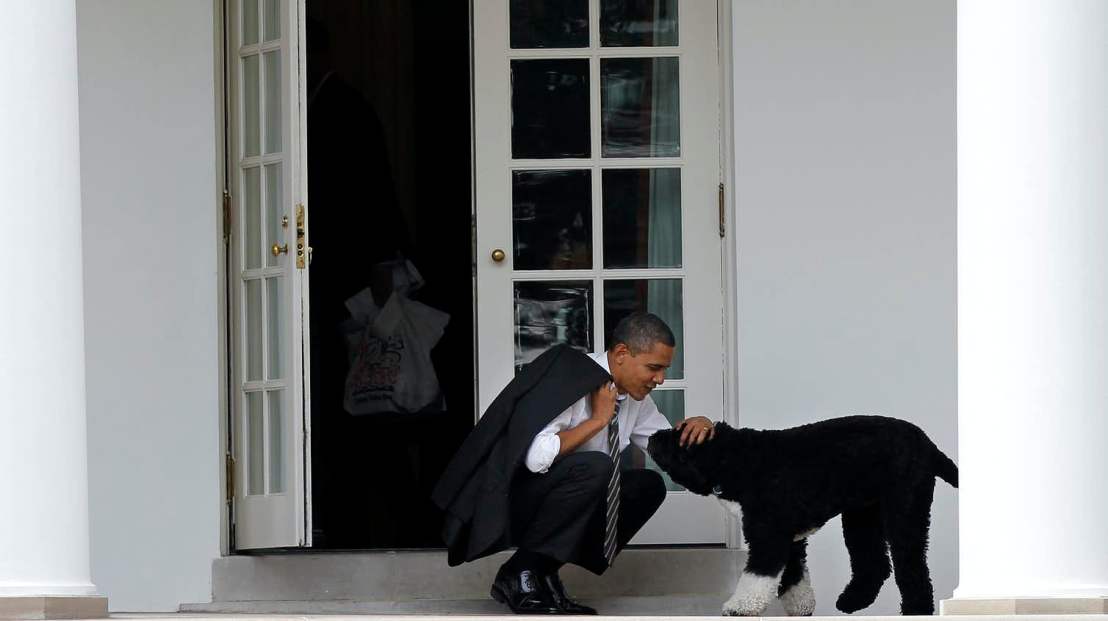
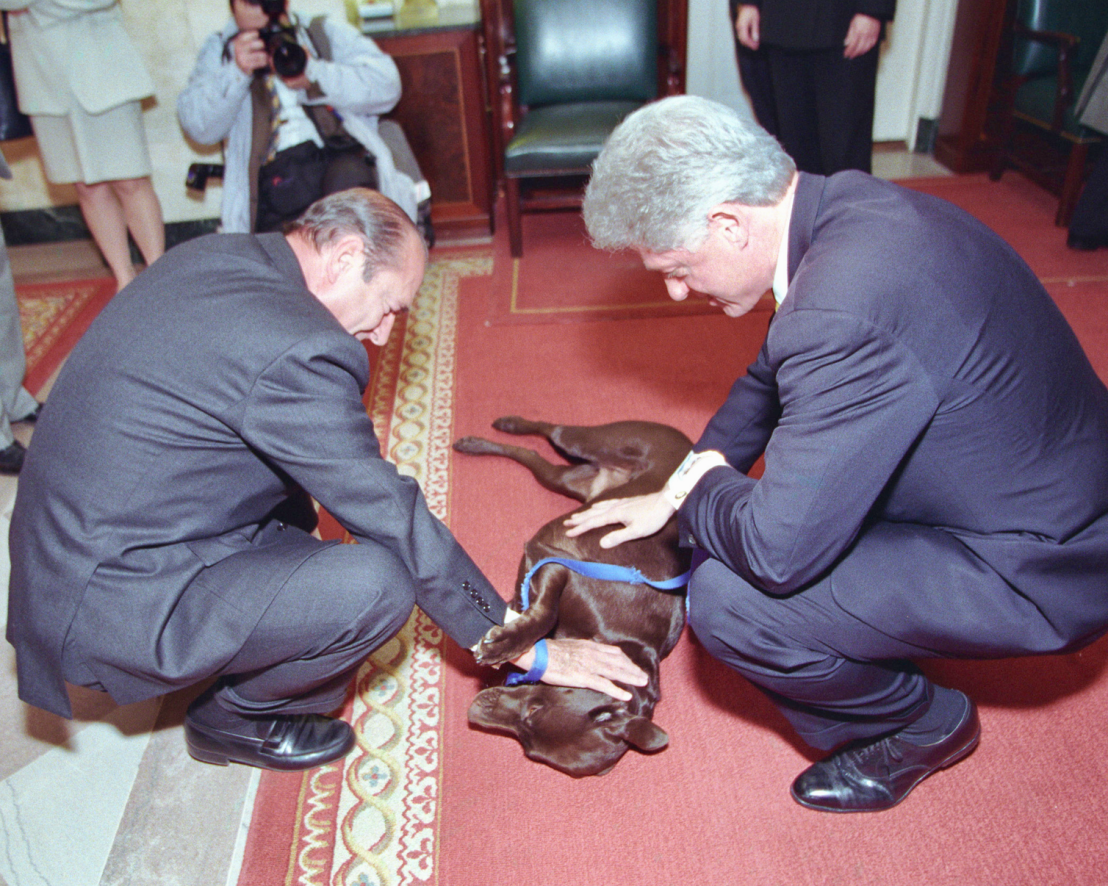
Whatever one thinks about the current politics it is brilliant that dogs are back in the White House.

Maybe President-elect Biden should think of a more formal role for Champ and Major!

That DNA link; from the BBC.

Another article about the origin of the dog.

This time on the BBC News website.

When I published the post about the dog’s nose and heart I concluded at the end that:

When one quietly reflects on the span of time that dogs and humans have been together, something in the order of 40,000 years, it’s no surprise that dogs have evolved to be our closest companion.

But the BBC proclaimed that:

The analysis reveals that dog domestication can be traced back 11,000 years, to the end of the last Ice Age.

So that rather confused me.

But read the full article from the BBC before I comment further.

ooOOoo

Dogs are humans’ oldest companions, DNA shows

By Paul Rincon
Science editor, BBC News website, 29th October, 2020

A study of dog DNA has shown that our “best friend” in the animal world may also be our oldest one.

The analysis reveals that dog domestication can be traced back 11,000 years, to the end of the last Ice Age.

This confirms that dogs were domesticated before any other known species.

Our canine companions were widespread across the northern hemisphere at this time, and had already split into five different types.

Despite the expansion of European dogs during the colonial era, traces of these ancient indigenous breeds survive today in the Americas, Asia, Africa and Oceania.

The research fills in some of the gaps in the natural history of our close animal companions.

Dr Pontus Skoglund, co-author of the study and group leader of the Ancient Genomics laboratory at London’s Crick Institute, told BBC News: “Dogs are really unique in being this quite strange thing if you think about it, when all people were still hunter gatherers, they domesticate what is really a wild carnivore – wolves are pretty frightening in many parts of the world.

“The question of why did people do that? How did that come about? That’s what we’re ultimately interested in.”

To some extent, dog genetic patterns mirror human ones, because people took their animal companions with them when they moved. But there were also important differences.

The Rhodesian Ridgeback retains ancestry from an ancient African dog lineage

For example, early European dogs were initially diverse, appearing to originate from two very distinct populations, one related to Near Eastern dogs and another to Siberian dogs.

But at some point, perhaps after the onset of the Bronze Age, a single dog lineage spread widely and replaced all other dog populations on the continent. This pattern has no counterpart in the genetic patterns of people from Europe.

Anders Bergström, lead author and post-doctoral researcher at the Crick, said: “If we look back more than four or five thousand years ago, we can see that Europe was a very diverse place when it came to dogs. Although the European dogs we see today come in such an extraordinary array of shapes and forms, genetically they derive from only a very narrow subset of the diversity that used to exist.”

An international team analysed the whole genomes (the full complement of DNA in the nuclei of biological cells) of 27 ancient dog remains associated with a variety of archaeological cultures. They compared these to each other and to modern dogs.

The results reveal that breeds like the Rhodesian Ridgeback in southern Africa and the Chihuahua and Xoloitzcuintli in Mexico retain genetic traces of ancient indigenous dogs from the region.

The New Guinea singing dog is one representative of a lineage found in dogs across Asia and Oceania

The ancestry of dogs in East Asia is complex. Chinese breeds seem to derive some of their ancestry from animals like the Australian dingo and New Guinea singing dog, with the rest coming from Europe and dogs from the Russian steppe.

The New Guinea singing dog is so named because of its melodious howl, characterised by a sharp increase in pitch at the start.

Greger Larson, a co-author from the University of Oxford, said: “Dogs are our oldest and closest animal partner. Using DNA from ancient dogs is showing us just how far back our shared history goes and will ultimately help us understand when and where this deep relationship began.”

Dogs are thought to have evolved from wolves that ventured into human camps, perhaps sniffing around for food. As they were tamed, they could then have served humans as hunting companions or guards.

The results suggest all dogs derive from a single extinct wolf population – or perhaps a few very closely related ones. If there were multiple domestication events around the world, these other lineages did not contribute much DNA to later dogs.

Dr Skoglund said it was unclear when or where the initial domestication occurred. “Dog history has been so dynamic that you can’t really count on it still being there to readily read in their DNA. We really don’t know – that’s the fascinating thing about it.”

Many animals, such as cats, probably became our pets when humans settled down to farm a little over 6,000 years ago. Cats were probably useful for controlling pests such as mice, that were attracted by the waste generated by dense settlements. This places their domestication in cradles of agriculture such as the Near East.

“For dogs, it could almost have been anywhere: cold Siberia, the warm Near East, South-East Asia. All of these are possibilities in my mind,” Pontus Skoglund explained.

The findings have been published in the journal Science.

ooOOoo

Well back to that age thing!

I decided to review the Wikipedia page on the origin of dogs. At last the discrepancy became clear. The difference between divergence and domestication. (My emboldening.)

The genetic divergence between dogs and wolves occurred between 20,000–40,000 years ago, just before or during the Last Glacial Maximum[6][1] (20,000–27,000 years ago). This timespan represents the upper time-limit for the commencement of domestication because it is the time of divergence but not the time of domestication, which occurred later.[6][7] One of the most important transitions in human history was the domestication of animals, which began with the long-term association between wolves and hunter–gatherers more than 15,000 years ago.[4]

So that explains a great deal.

But it nevertheless remains the fact that they are our longest, dearest companion.

Purple Mountains

This is a film that all should watch!

Now again this has nothing to do with dogs and I would be the first person to say that there are still some people out there who are not convinced that global warming is a major result of human activity.. But none other than the Union of Concerned Scientists are persuaded that humans are the major cause. See their website here. (From which the following is taken.)

Every single year since 1977 has been warmer than the 20th century average, with 16 of the 17 warmest years on record occurring since 2001, and 2016 being the warmest year on recorded history. A study from 2016 found that without the emissions from burning coal and oil, there is very little likelihood that 13 out of the 15 warmest years on record would all have happened.

And further on in the article, this:

Scientists agree that today’s warming is primarily caused by humans putting too much carbon in the atmosphere, like when we choose to extract and burn coal, oil, and gas, or cut down and burn forests.

Today’s carbon dioxide levels haven’t been seen in at least the last 800,000 years. Data assembled from Antarctic ice core samples and modern atmospheric observations.

So on to the film.

My son, Alex, sent me the following email on the 7th October.

Hi Dad

This is a really interesting film about climate change in the west coast mountains, USA.  A bit skiing related but a good watch !

Lots of love

Alex

Included in the email was a link to the film available on YouTube.

The film is just under one hour in length and a great film to watch as well as having a clear, fundamental message: All of us must act in whatever ways we can if our children and grandchildren are to have a future. Indeed, do you believe you have another twenty or more years to live? Then include yourself as well.

ooOOoo

About The Film
Professional snowboarder and mountaineer Jeremy Jones has an intimate relationship with the outdoors. It’s his escape, his identity, and his legacy. But over the course of his 45 years in the mountains, he’s seen many things change: more extreme weather, fewer snow days, and economic strain on mountain towns.
Motivated by an urge to protect the places he loves, Jeremy sets out on a physical and philosophical journey to find common ground with fellow outdoor people across diverse political backgrounds. He learns their hopes and fears while walking a mile in their shoes on the mountain and in the snow.
With intimacy and emotion set against breathtaking backdrops, Purple Mountains navigates America’s divide with a refreshing perspective: even though we may disagree about climate policy, our shared values can unite us.

Please, please watch the film!

Thank you!

An insight into how breeds come about.

The background to breeds.

Funnily enough, Jeannie and I were speaking just recently about the creation of breeds, in particular because we were fascinated as to the breed origins of Oliver.

Oliver. Taken at home, 17th May, 2020.

Oliver’s eyes are to die for!

Well a recent article on the Treehugger blog threw some light on this.

I hope it is permissible to share it with you.

ooOOoo

Labradoodles Are More Poodle Than Lab

Study helps deepen understanding about how breeds are formed.
By
Published September 22, 2020

Australian Labradoodles aren’t officially recognized as a breed. Purple Collar Pet Photography / Getty Images

The Australian creator of the Labradoodle was trying to find the perfect guide dog for a blind woman whose husband was allergic to dog hair. He tried about a dozen poodles before breeding a poodle with a Labrador retriever. The resulting Australian Labradoodles became incredibly popular as a mix of two well-liked breeds.

But a new study finds that the breed that developed from that popular cross isn’t an even split of both breeds – it is primarily poodle.
Australian Labradoodles have been around for several decades and have been bred to each other and tinkered with since then. By contrast, many Labradoodles that are found in the U.S. are first-generation mixes of one Labrador and one poodle. These dogs were used as the control dogs in the study, researcher Elaine Ostrander, geneticist at the National Human Genome Research Institute of the National Institutes of Health, tells Treehugger.

“We were interested in taking a genomic snapshot of a breed in the making—the Australian Labradoodle. The breed has only been around since the 1980s as opposed to the many breeds we see at the dog park which have been around since Victorian times and were created in Western Europe,” she says.

The Australian Labradoodle has gone through several generations, with careful and thoughtful addition of Labradors and poodles added, reflecting what breeders and owners want. We wanted to see if genomics could be used to tell what was happening to the genome of these dogs as they evolved into a breed.
The Fédération Cynologique Internationale (FCI), an international federation of many national kennel clubs, recognizes about 350 dog breeds. The American Kennel Club (AKC) recognizes 195 breeds. The Labradoodle is not an official breed.

“We were also curious to see if the breed met the statistical definition of a breed. There are many measures in terms of genomic diversity and ability to ‘breed true’ that are taken into account when determining when a dog population is really a ‘breed’ at the genetic level,” Ostrander says.

Many of these breeds have been created through intense breeding programs focused on enhancing specific traits. When designer breeds are created, the genetic diversity is limited because there are a small number of animals being bred together. This often leads to a high incidence of disease and other problems.
Lots of Poodle DNA

For the study, researchers analyzed genetic data from Australian Labradoodles, Labrador retrievers, poodles, and a number of other breeds. The results were published in PLOS Genetics.

Ostrander says they were somewhat surprised at what they found.

“First, the Australian Labradoodle meets the definition of a breed at the statistical level. Those arguing for it to have breed status with various registries have a good argument,” she says. “What we didn’t expect was the degree to which today’s Australian Labradoodle has such a large component of its genome from the poodle. While the breed started as a 50-50 mix, it is clear that poodle traits are highly valued and many more poodles than Labradors have been added to the breed at strategic points.”

That’s likely because poodles have a reputation for being hypoallergenic, she points out, and elicit a lower allergic reaction than many other dog breeds in people with allergies or asthma.

“Owners buy Labradoodles for many reasons including their trainability, family friendly traits, and, importantly, they want a dog that won’t make them sneeze or otherwise respond,” she says. “Interestingly, the Labrador is very much present in every Australian Labradoodle we tested. Likely people are seeking the family-friendly traits of the Labrador and breeders work hard to retain that as well.”

Labradoodles weren’t the first doodle dogs and definitely are not the last. The first poodle mixes were likely Cockapoos because Cocker spaniels and poodles were two of the most popular dog breeds in the U.S. in the 1940s. Today, you’ll find schnoodles (schnauzers), sheepadoodles (Old English sheepdog), and whoodles (soft-coated wheaten terrier). Poodles have been mixed with beagles, pugs, Australian shepherds, corgis, and even Saint Bernards.

The lore behind Australian Labradoodles is that English and American Cocker spaniels were mixed in with the breed early on.

“We did find some minor evidence for the addition of other breeds in some lineages of Australian Labradoodle. Likely this represents the historical relationship of those breeds with the poodle or Labrador more than anything else,” Ostrander says. “We did not see that in every lineage we looked at and where we did see it, the addition was very small and, likely, many generations ago.”

The findings are helpful, the researchers point out, because it shows how quickly genetics can be changed by thoughtful breeding.

“Imagine a breed has a significant risk for a disease. Careful breeding can reduce the incidence of those deleterious variants in just a few generations,” Ostrander says. “This is incredibly important to breeders who have taken very seriously the criticism they have received over the years regarding how established breeds are less healthy than mixes. We all want our dogs to be healthy, regardless of what breed they are.”

ooOOoo

This deserves a very careful read and, to those really interested in the subject, perhaps this will serve as an incentive to do more research. There are links in the article to the FCI and AKC.

And I will finish with the closing statement by Elaine Ostrander: “We all want our dogs to be healthy, regardless of what breed they are.

Simply in awe!

It’s both beautiful and yet beyond comprehension.

When we have a clear night there are two occasions for me to gaze upwards and become lost in thought. One is in the evening when the dogs are outside just before going to bed. The other is in the morning because we are usually awake well before sunrise.

We are very lucky in that there is no light pollution locally.

So, in the evening, while I look at the broad expanse of stars, my eyes are drawn to the Big Dipper and to Orion.

In the morning, when we look to the East there is Venus sparkling bright in the night-sky over the hills.

I still vividly remember all those years ago when I was sailing in the Western Mediterranean coming on deck in the middle of the night to find the stars down to the horizon all 360 degrees about me. I am sure it will be one of the last memories of mine just before I die! I hope so!

But I speak of the solar system. Here’s an article that was recently published by EarthSky that goes way beyond the solar system. It is a wonderful essay and almost mystical.

ooOOoo

What is a galaxy?

Posted by in ASTRONOMY ESSENTIALS, September 25, 2020

We live in a galaxy called the Milky Way. But there is so much more to know about these grand and glorious star islands in space! Click in here, and prepare to have your mind expanded.

This is a giant galaxy cluster known as Abell 2744, aka Pandora’s Cluster, located in the direction of the constellation Sculptor. The cluster is about 4 million light-years across and has the mass of 4 trillion suns. It appears to be the result of a simultaneous pile-up of at least 4 separate, smaller galaxy clusters that took place over a span of 350 million years. Read more about this image at HubbleSite. Image via NASA/ ESA/ J. Lotz/ M. Mountain/ A. Koekemoer/ the Hubble Frontier Fields Team.

A galaxy is a vast island of stars in an ocean of space. Galaxies are typically separated from one another by huge distances measured in millions of light-years. Galaxies are sometimes said to be the building blocks of our universe. Their distribution isn’t random, as one might suppose: galaxies are strung out along unimaginably long filaments across the universe, a cosmic web of star cities.

A galaxy can contain hundreds of billions of stars and be many thousands of light-years across. Our own galaxy, the Milky Way, is around 100,000 light-years in diameter. That’s about 587,900 trillion miles, nearly a million trillion kilometers.

Galaxies are of widely varying sizes, too.

There are an estimated two trillion galaxies in the universe.

Illustration showing snapshots from a simulation by astrophysicist Volker Springel of the Max Planck Institute in Germany. It represents the growth of cosmic structure (galaxies and voids) when the universe was 0.9 billion, 3.2 billion and 13.7 billion years old (now). Image via Volker Springel / MPE/ Kavli Foundation.

Galaxies group together in clusters. Our own galaxy is part of what is called the Local Group, for example: a cluster comprising 55 galaxies that we know of so far.

In turn, galaxy clusters themselves group into superclusters. Our Local Group is part of the Virgo Supercluster.

The “glue” that binds stars into galaxies, galaxies into clusters, clusters into superclusters and superclusters into filaments is – of course – gravity, the universe’s construction worker, which sculpts all the structures we see in the cosmos.

Distances from the Local Group for selected groups and clusters within the Local Supercluster, which is called the Virgo Supercluster.

There are several basic types of galaxy, each containing sub-types. Galaxies were first systematically classified, based on their visual appearance, by the famous astronomer Edwin P. Hubble in the late 1920s and 30s, during years of painstaking observations. Hubble’s Classification of Galaxies, as it is known, is still very much in use today, although, since Hubble’s time, like any good classification system it has been updated and amended in the light of new observations.

Before Hubble’s study of galaxies, it was believed that our galaxy was the only one in the universe. Astronomers thought that the smudges of light they saw in their telescopes were in fact nebulae within our own galaxy and not, as Hubble discovered, galaxies in their own right. It was Hubble who demonstrated, by measuring their velocities, that they lie at great distances from us, millions of light-years beyond the Milky Way, distances so huge that they appear tiny in all but the largest telescopes. Moreover, he demonstrated that, wherever he looked, galaxies are receding from us in all directions, and the further away they are, the faster they are receding. Hubble had discovered that the universe is expanding.

A diagrammatic representation of Edwin Hubble’s “tuning fork diagram.” In the late 1920s and 30s, Hubble conducted the laborious observations needed to begin to classify galaxies. His original classification scheme was published in 1936 in a book called “The Realm of the Nebulae.” His original scheme is – like all scientific work – continually being modified. But his idea of a “tuning fork diagram” has continued to be useful. Image via Las Cumbres Observatory.

The most common type of galaxy is the one most people are familiar with: the spiral galaxy. The Milky Way is of this family. Spiral galaxies have majestic, sweeping arms, thousands of light years long, made up of millions upon millions of stars. Our solar system is situated about 2/3 of the way out from the galactic center towards the periphery of the galaxy, embedded in one of these spiral arms.

Spiral galaxies are also characterised by having a bright center, made up of a dense concentration of stars, so tightly packed that from a distance the galaxy’s center looks like a solid ball. This ball of stars is known as the galactic bulge. At the center of the Milky Way – within the galactic bulge – the density of stars has been calculated at 1 million per 34 cubic light-years, for example.

Meanwhile, in the vicinity of our sun, the stellar density has been estimated as 0.004 stars per cubic light-year. Big difference!

A stunning view of the center of our Milky Way galaxy as seen by the Murchison Widefield Array (MWA) telescope in Australia in 2019. Image via Natasha Hurley-Walker (ICRAR/ Curtin)/ GLEAM Team/ Phys.org.

The Milky Way is, in fact, in one of Hubble’s spiral galaxy sub-types: it’s a barred spiral, which means it has a bar of stars protruding out from either side of the center. The ends of the bar form the anchors of the spiral arms, the place from where they sweep out in their graceful and enormous arcs. This is a fairly recent discovery: how the bar forms in a galaxy is not yet understood.

Also established recently is the fact that the disk of the Milky Way is not, as most diagrams depict, flat: it is warped, like a long-playing vinyl record left too long in the sun. Exactly why is not known, but it is thought to be the result of a gravitational encounter with another galaxy early in the Milky Way’s history.

Artist’s illustration of our warped Milky Way. Image via Ogle/ Warsaw University/ BBC.

Elliptical galaxies are the universe’s largest galaxies. They are huge and football-shaped.

They come to be because – although most galaxies are flying apart from each other – those astronomically close to each other will be mutually gravitationally attracted. Caught in an inexorable gravitational dance, eventually they merge, passing through each other over millions of years, eventually forming a single, amorphous elliptical galaxy. Such mergers may result in the birth of new generations of stars as gravity’s shock-wave compresses huge clouds of interstellar gas and dust.

The Milky Way is caught in such a gravitational embrace with M31, aka the Andromeda galaxy, which is 2 1/2 million light-years distant. Both galaxies are moving toward each other because of gravitational attraction: they will merge in about 6 billion years from now. However, both galaxies are surrounded by huge halos of gas which may extend for millions of light-years, and it was recently discovered that the halos of the Milky Way and M31 have started to touch.

The two galaxies have had their first kiss.

Galaxy mergers are not uncommon: the universe is filled with examples of galaxies in various stages of merging together, their structures disrupted and distorted by gravity, forming bizarre and beautiful shapes.

Galaxies may take billions of years to fully merge into a single galaxy. As astronomers look outward in space, they can see only “snapshots” of this long merger process. Located 300 million light-years away in the constellation Coma Berenices, these 2 colliding galaxies have been nicknamed The Mice because of the long tails of stars and gas emanating from each galaxy. Otherwise known as NGC 4676, the pair will eventually merge into a single giant galaxy. Image via Wikimedia Commons.

At the lower end of the galactic size scale, there are the so-called dwarf galaxies, consisting of a few hundred to up to several billion stars. Their origin is not clear. Usually they have no clearly defined structure. Astronomers believe they were born in the same way as larger galaxies like the Milky Way, but for whatever reason they stopped growing. Ensnared by the gravity of a larger galaxy, they orbit its periphery. The Milky Way has around 20 dwarf galaxies orbiting it that we know of, although some models predict there should be many more.

The two most famous dwarf galaxies for us earthlings are, of course, the Small and Large Magellanic Clouds, visible to the unaided eye in Earth’s Southern Hemisphere sky.

Eventually, these and other dwarf galaxies will be ripped apart by the titanic maw of the Milky Way’s gravity, leaving behind a barely noticeable stream of stars across the sky, slowly dissipating over eons.

Lynton Brown captured this beautiful image of the Milky Way over Taylor’s Lake near Horsham, Australia, on April 22, 2019. The 2 objects on the right are the Magellanic Clouds. Thank you, Lynton!

It is believed that all galaxies rotate: the Milky Way takes 226 million years to spin around once, for example. Since its birth, therefore, the Earth has travelled 20 times around the galaxy.

At the center of most galaxies lurks a supermassive black hole, of millions or even billions of solar masses. The record holder, TON 618, has a mass 66 billion times that of our sun.

The origin and evolution of supermassive black holes are not well understood. A few years ago, astronomers uncovered a surprising fact: in spiral galaxies, the mass of the supermassive black hole has a direct linear relationship with the mass of the galactic bulge. The more mass the black hole has, the more stars there are in the bulge. No one knows exactly what the significance of this relationship is, but its existence seems to indicate that the growth of a galaxy’s stellar population and that of its supermassive black hole are inextricably linked.

This discovery comes at a time when astronomers are beginning to realize that a supermassive black hole may control the fate of its host galaxy: the copious amounts of electromagnetic radiation emitted from the maelstrom of material orbiting the central black hole, known as the accretion disk, may push away and dissipate the clouds of interstellar hydrogen from which new stars form. This acts as a throttle on the galaxy’s ability to give birth to new stars. Ultimately, the emergence of life itself may be tied to the activity of supermassive black holes. This is an area of much ongoing research.

While astronomers still know very little about exactly how galaxies formed in the first place – we see them in their nascent forms existing only a few hundred million years after the Big Bang – the study of galaxies is an endless voyage of discovery.

Less than a hundred years after it was realized that other galaxies beside our own exist, we have learned so much about these grand, majestic star cities. And there is still much to learn.

Bottom line: What is a galaxy? Learn about these starry islands in space.

ooOOoo

There are an estimated two trillion galaxies out there. It is beyond comprehension. Well it is to this mind sitting in front of his Mac in a rural part of Oregon. Two trillion! I can’t even get my mind around the fact that our local galaxy, our Milky Way, is 100,000 light years across. Although some would say that it is even larger; about 150,000 light years across. And what is a light year?

Here’s NASA to answer that:

A light-year is a unit of distance. It is the distance that light can travel in one year. Light moves at a velocity of about 300,000 kilometers (km) each second. So in one year, it can travel about 10 trillion km. More precisely, one light-year is equal to 9,500,000,000,000 kilometers.

Why would you want such a big unit of distance? Well, on Earth, a kilometer may be just fine. It is a few hundred kilometers from New York City to Washington, DC; it is a few thousand kilometers from California to Maine. In the universe, the kilometer is just too small to be useful. For example, the distance to the next nearest big galaxy, the Andromeda Galaxy, is 21 quintillion km. That’s 21,000,000,000,000,000,000 km. This is a number so large that it becomes hard to write and hard to interpret. So astronomers use other units of distance.

In our solar system, we tend to describe distances in terms of the Astronomical Unit (AU). The AU is defined as the average distance between the Earth and the Sun. It is approximately 150 million km (93 million miles). Mercury can be said to be about 1/3 of an AU from the Sun and Pluto averages about 40 AU from the Sun. The AU, however, is not big enough of a unit when we start talking about distances to objects outside our solar system.

For distances to other parts of the Milky Way Galaxy (or even further), astronomers use units of the light-year or the parsec . The light-year we have already defined. The parsec is equal to 3.3 light-years. Using the light-year, we can say that :

  • The Crab supernova remnant is about 4,000 light-years away.
  • The Milky Way Galaxy is about 150,000 light-years across.
  • The Andromeda Galaxy is 2.3 million light-years away.

So here we are. In a remote part of our galaxy, the Milky Way, far, far from everywhere, on a pale blue dot. As Carl Sagan put it in his talk from The Age of Exploration given in 1994:

On it, everyone you ever heard of… The aggregate of all our joys and sufferings, thousands of confident religions, ideologies and economic doctrines, every hunter and forager, every hero and coward, every creator and destroyer of civilizations, every king and peasant, every young couple in love, every hopeful child, every mother and father, every inventor and explorer, every teacher of morals, every corrupt politician, every superstar, every supreme leader, every saint and sinner in the history of our species, lived there on a mote of dust, suspended in a sunbeam. …
Think of the rivers of blood spilled by all those generals and emperors so that in glory and triumph they could become the momentary masters of a fraction of a dot.

Carl Sagan, Cornell lecture in 1994

It all seems impossible for us mortals to understand.

But it won’t stop me from peering up into the night sky and wondering about the universe with total awe.

And thank goodness for dogs!

Doggie love?

We humans love to be loved and, especially, by our dogs.

I am certain that all of the people who read Learning from Dogs on a regular basis are dog lovers and, just as important, your love for your dogs means that they in turn love you.

But unfortunately not everyone thinks of dogs in such a beautiful manner. For example, not far from here on Hugo Rd are a group of dogs, 4 or 5 I think, that I cycle past, and they live in outside kennels.

If you are an uncertain owner or a new owner you may want to understand more about your dog’s behaviour, or more accurately, whether your dog loves you. This article on The Dodo explains this very well.

ooOOoo

Does My Dog Love Me?

How to tell what those happy wiggles really mean ❤️️

By DANIELLE ESPOSITO
PUBLISHED ON 8/19/2020

Humans loveeee love. Which means we want the people — or animals — we love to show us they love us back.

But it’s sometimes hard for us to tell whether or not our dogs truly, deeply, madly love us — especially if you’re a new pet owner.

Who doesn’t want to feel all warm, fuzzy and loved by our pets?

To help you get that confirmation you’re looking for, The Dodo turned to Dr. Vanessa Spano, a veterinarian at Behavior Vets in New York City, to understand how dogs show their love.

“It is so important to understand your pets’ body language, as that is their way of communicating with us,” Dr. Spano said.

Here are some of the most common ways to tell that your dog, in fact, abso-freakin’-lutely loves you.

Your dog has a relaxed, wiggly body

“When interacting with your dog, body language signs to look out for that may indicate comfort and positivity include a relaxed body (or wiggly body during times of excitement, like play or you coming home), soft, forward ears and soft, rounded eyes,” Dr. Spano said.

He wiggles his eyebrows at you

You read that right! Doggos in love are known to raise their eyebrows when they see their owner. In fact, a 2013 Japanese study used a high-speed camera to record dogs’ faces when their humans walked into the room. It found that dogs raised their eyebrows when they saw their owners, but not when strangers walked in. *happy cry*

He wants your attention

“It is also a good sign if your dog is soliciting attention from you, such as with a play bow,” Dr. Spano said.

This can also be seen when he brings you one of his favorite toys.

He leans against you

A dog will lean on humans for a few different reasons — sometimes it’s because he’s anxious or he wants you to do something — but it’s also a sign of affection. And regardless — even if your dog is leaning against you because he’s nervous — it still indicates that he thinks of you as someone who can protect him and keep him safe.

Confusing body language to look out for

According to Dr. Spano, there are some things dogs do that humans typically consider to be signs of affection, but aren’t always.

“Confusing signs include wagging tails and exposed bellies,” Dr. Spano said. “A dog wagging his tail simply means he is aroused by the situation. This can be a good thing, but not necessarily; it depends on the context of the situation.”

This means that it’s good to notice the situations that cause each of your dog’s behaviors and begin to build an understanding of your individual dog’s moods.

For example, maybe you notice your dog always wags her tail when you walk into a room — you can equate that situation with her being happy in those moments. On the other hand, maybe you’ve also noticed she wags her tail just a bit stiffer when she sees a strange dog, and it’s almost always followed by raising her hair and growling. While she is wagging her tail in both of these situations, it’s not the same kind of tail wag.

“Similarly, a dog showing his belly may be asking for belly rubs, but it can also indicate fear,” Dr. Spano said. “Dogs do have the capability of trusting and loving you, but depending on their own fears, stress level and past experiences, it may take some time.”

So in general, look for those relaxed and wiggly bodies to know how happy your dog is to see you. Other behaviors you’ll learn over time — and it’ll just help your bond grow even stronger since you’ll be the only one who can truly detect your dog’s moods and emotions.

ooOOoo

Yes, it certainly takes time to really get to know a dog. Although one might think that having a number of dogs in the household makes it easier, and generally that is the case, even in a largish group one can have tensions that exist between a couple of the dogs. Knowing both dogs as well as you can enables one to adjust things so that the tension no longer exists or it becomes a very rare event.

But it is rare and, luckily, loving dogs is the normal!

I will close with a photograph of dear Oliver who is one of the most loving dogs I have come across.

Oliver. Taken at home, 17th May, 2020.

The science of dog learning.

A very interesting article in The Smithsonian Magazine.

There are countless breeds of dogs and they represent thousands of years of breeding.

But recent work in determining the genetic background behind the many different features of dogs has revealed so much.

The Smithsonian Magazine published an article nearly a month ago and hopefully it is alright to share it with you.

ooOOoo

What a Crowdsourced Study Taught Us About How Dogs Learn

A new study looks at the genes that underlie traits from self control to communication


Three dogs sit at attention ( MediaProduction

By Viviane Callier, July 31, 2020

Thousands of years of selective dog breeding has created a fantastic diversity of domestic canine companions, from the workaholic border collie to the perky Pomeranian. In cultures around the world, humans bred different dogs to be good at tasks including guarding, hunting and herding. Later, in Victorian England, kennel clubs established breed standards related not only to their behavior, but also their appearance.

As genomic sequencing has become more affordable, scientists have begun to understand the genes behind physical features such as body shape and size. But understanding the genes behind dog cognition—the mental processes that underlie dogs’ ability to learn, reason, communicate, remember, and solve problems—is a much trickier and thornier task. Now, in a pair of new studies published in Animal Cognition and in Integrative and Comparative Biology, a team of researchers has begun to quantify just how much variation in dog cognition exists, and to show how much of it has a genetic basis.

To study canine cognition, the studies’ authors turned to publicly available genetic information from a 2017 study, and a large community science project, Dognition.com, in which dog owners tested their own pets. “These papers offer an exciting integration of two forms of big data,” says Jeff Stevens, a psychologist at the University of Nebraska-Lincoln who was not involved in the study.

Previous studies often compared cognition in one breed against another using small sample sizes of dogs from each. This study, by contrast, is the first to examine the variation in cognition across three dozen breeds, and the genetic basis of that variation, explains Evan MacLean, a comparative psychologist at the University of Arizona who oversaw the pair of new studies. MacLean says dog breeds may be an ideal way to study the heritability of cognitive traits because breeds—all part of the same species—represent close genetic relatives with an incredibly diverse range of appearances and behaviors.

To gather a sufficient amount of data on how dogs reason and solve problems, the researchers looked to the Dognition.com portal. The initiative, created by Duke University dog researcher Brian Hare, started with tests in the lab. Researchers developed methods to understand how dogs think. They then stripped those methods down, and simplified them for dog owners to do themselves. In an earlier project, the researchers tested dogs in the lab and compared their results to those from owners testing the same dog at home. The results were the same, giving them confidence that the results from the citizen science project were reliable.

To participate in this project, dog owners tested their pups on 11 standardized tasks used by animal behaviorists on a variety of species that reflect four aspects of cognition: inhibitory control, communication, memory and physical reasoning. One task that measured inhibitory control, for example, involved having an owner put a treat on the floor in front of the dog and then verbally forbidding the dog from taking it. The owner then measured how long the dog would wait before eating the treat. In a task to assess communication skills, the dog owner placed two treats on the ground and gestured towards one of them. The owner then determined if the dog approached the indicated treat. To assess memory, the owner visibly placed food under one of two cups, waited for a few minutes, and then determined if the dog remembered which cup the food was placed under. To test physical reasoning, the owner hid food under one of two cups, out of view of the dog. The owner lifted the empty cup to show the dog that there was no food and then assessed whether the dog approached the cup with the food underneath.

The participating dog owners reported their dog’s scores and breed, producing a dataset with 1,508 dogs across 36 breeds. The researchers analyzed the scores and found that about 70 percent of the variance in inhibitory control was heritable, or attributable to genes. Communication was about 50 percent heritable, while memory and physical reasoning were about 20 percent heritable.

“What’s so cool about that is these two traits that are highly heritable [control and communication] are those that are thought to be linked to dogs’ domestication process,” says Zachary Silver, a graduate student in the Canine Cognition Center at Yale who was not involved in the study.

Dogs are better at following humans’ communicative cues than wolves, and this is something that seems to be highly heritable, explains Silver. In contrast, there’s some evidence that wolves are better than dogs at physical reasoning.

Some of these traits are also influenced by environment and how the dog was handled as a puppy, so there are both genetic and environmental components. In fact, there is so much environmental and experiential influence on these traits that Gitanjali Gnanadesikan, a graduate student in MacLean’s lab and lead author of the new studies, cautions against the idea that these findings support certain breed restrictions or stereotypes. “Even the highly heritable traits have a lot of room for environmental influence,” she says. “This shouldn’t be interpreted as, ‘each of these breeds is just the way they are, and there’s nothing that can be done about it.’”

In the same way that women are on average shorter than men, but there’s quite a lot of overlapping variation within each sex, dog breeds also show a lot of variation within each breed that overlaps with variation among breeds.

Previous work has linked differences in inhibitory control to the estimated size of dogs’ brains. Comparative studies across many different species, ranging from tiny rodents to elephants and chimpanzees, also show that some aspects of self-control are strongly related to brain size. The bigger the brain size, the more self-control the animals seem to have, MacLean says.

Stevens notes that a lot of things—not just inhibitory control—correlate with brain size across species. And brain size, metabolic rate, lifespan, home range size are all correlated with body size. When many traits are correlated with each other, it is not clear which of these factors may underlie the cognitive differences. So there are a number of questions remaining to be explored.

After showing the degree to which different aspects of dog cognition are heritable, Gnanadesikan and MacLean used publicly available information on the genomes of dog breeds to search for genetic variation that was associated with the cognitive traits of interest. The researchers found that, like many other complex traits, there were many genes, each with small effect, that contribute to dogs’ cognitive traits. That is in contrast to morphological features in dogs; about 50 percent of variation in dog body size can be accounted for by variation in a single gene.

One of the limitations of the study is that the researchers did not have cognitive and genetic information from the same dogs; the genomes were breed averages. In the future, the researchers are planning to collect genetic data from the very same dogs that are completing the cognitive tests, to get measures of cognitive and genetic variation at the level of individual dogs. “This gives us a roadmap for places that we might want to look at more carefully in the future,” MacLean explains.

ooOOoo

Now this is an article that deserves to be read carefully so if you are in a hurry bookmark this and wait until you can sit and absorb the messages the article contains.

I was minded to look up Gitanjali’s details and I am glad I did. These are the details:

Gitanjali Gnanadesikan
I am an evolutionary biologist and comparative psychologist who is interested in social behavior and cognition. I work with Evan MacLean in the Arizona Canine Cognition Center studying the development and evolution of behavior and cognition in dogs and wolves.

I think I will reach out to her and see if she has more information she would like to share with us all.