This is not a single topic blog. But the last few days have brought such a wealth of marvellous stuff that I couldn’t resist this final, for the time being, post on the benefits of slowing down, of taking a break – meditation, in other words.
First, and I wish I could remember from whence it came, I found this essay by Bertrand Russell In Praise of Idleness It’s a wonderful piece of writing from one of the great masters of the art. Take this extract from just the first paragraph, (and the photo insertion is from me!):
Bertrand Russell (18 May 1872 – 2 February 1970)
I think that there is far too much work done in the world, that immense harm is caused by the belief that work is virtuous, and that what needs to be preached in modern industrial countries is quite different from what always has been preached. Everyone knows the story of the traveler in Naples who saw twelve beggars lying in the sun (it was before the days of Mussolini), and offered a lira to the laziest of them. Eleven of them jumped up to claim it, so he gave it to the twelfth. This traveler was on the right lines. But in countries which do not enjoy Mediterranean sunshine idleness is more difficult, and a great public propaganda will be required to inaugurate it. I hope that, after reading the following pages, the leaders of the YMCA will start a campaign to induce good young men to do nothing. If so, I shall not have lived in vain.
Then from out of the Transition Network stables came this interview by Rob Hopkins with Sophy Banks on the Power of Not Doing Stuff. Just going to pick out a couple of exchanges that really struck me.
Sophy, I’m sure you get asked the question lots of times, but how would you describe Inner Transition ? What’s Inner Transition for you?
I gave a talk about Inner Transition in Canada just recently, and someone said “what I want from the talk is, what’s the most succinct story? What’s the E=mc² of Inner Transition?” The way that I’m talking about that at the moment is to say the absolute core of Inner Transition is that in our groups, within ourselves, in our relationships, in what we’re doing in our communities, how can we be creating a culture that supports us to be in a state of feeling resourced, feeling empowered, feeling seen and appreciated? With the understanding that when we have those kind of external conditions, we find ourselves in a state where we’re the most open to new ideas, the most open to connection, the most able to build relationships with people who are different from us.
That’s the core of it, to understand that internally we can be in different inner states, we can be in a state where we feel stressed and closed and driven or whatever, or we can be in a state where we’re open and creative and learning and available. That’s one way of framing Inner Transition, how do we keep recreating that?
Part of it, I think, is when we’re all in that state of being open and creative and connected with each other and with ourselves, we make the best decisions. We’re able to take the longest and the widest view, we’re able to see the consequences of what we do, so there’s also something which has really been resonating for me. That’s not only the process we need for Transition, that’s the end-state we want to get to. Part of what’s not working in our culture is that lots of the people with a lot of power who are making really key decisions are in a state of constant stress and pressure and having to make very narrow decisions, decisions based on very narrow viewpoints.
oooo
One of the expressions you’ve been using increasingly over the last couple of years is “healthy human culture” and this idea that that’s ultimately the aim of Transition, to enable that and to create that. What does that mean? Can you define “healthy human culture”?
This is where my enquiry took me. I got really interested in seeing polarities and dualities – people have been doing that for centuries – about our culture and calling it dualistic. I came across Riane Eisler’s work. She talks about basically two kinds of human culture. One is based on partnership and one is based on domination. I got really interested in that and the question what if that’s true? It’s a big proposition.
If that’s true, what’s underneath that and what is it about what goes on inside us that we’re constructed, the way we’ve evolved, that causes that to be so, that there are these two stable states? I feel like I’ve been looking at lots of different territories, I’m really interested in trauma and how that affects us in the creation of the unconscious that comes through trauma.
This whole thing about how we create unintended consequences. The idea that anybody could have sat down and designed the consequences that we’re living with is inconceivable. However dysfunctional people were and however much they’re interested in wealth or power or anything, I just don’t believe that anybody intended it to be like this. How do we get this as a by-product of something that’s natural and…just who we are, who we’ve evolved to be.
So for me, the question around “healthy human culture” is one of the inner. What’s the inner state of a culture that creates partnership, learns to live within its resources, that’s oriented towards joyful, pleasurable existence, that has a belief about ourselves as humans that we’re trustworthy and generous and want good things for the future, good things for our children. What I see very very strongly: in a lot of the depth work that I’ve done, what I see is when you peel away a lot of the damage, what you find is a profound and I could say universal. In my experience (I haven’t worked with the psychopaths and the most damaged people) but that sense that if we’re healed and whole what we want is to love each other and do good in the world.
Then there’s another state we could be in, which comes back to your first question, where we feel under-resourced, disempowered, under attack. There’s not enough and I’m taught that other people are selfish, violent and greedy so I need to fight for what I can get. In order to have status I’ve got to have stuff, I’ve got to prove myself. With that goes a whole lot of very difficult feelings.
I’m very interested in that idea, that in unhealthy culture we have a whole lot of unmanageable feelings centred around shame and not being good enough that we then disown – I can’t deal with that in myself, I’ll put it on to you, I’ll find somebody else to have that experience and then I’ll watch it in them and feel OK about myself. It’s really interesting to look at cultures of domination and colonialism and capitalism and power-over as being driven by the need to not feel stuff myself, but grab enough power so that I can do it to somebody else.
The whole driver for those things is a psychological state of splitting and projection. When I bring that back to me and what culture I create in my relationships and my groups, you see it out in those big systems in the world but it’s also a very precise way of understanding and discerning what culture do I make in this room with these people, around splitting and projection or unity.
That’s quite a big answer! The short answer is “healthy human culture” is that one where we reel resourced, empowered, connected, appreciated and safe. Those seem to be the 5 things. If we have those, we are in that state of openness and availability and connection and learning and receptivity and then taking good action instead of action that creates a problem somewhere else in the system.
It really is a fascinating and thought-provoking interview. Go and read it in full, or better still, find somewhere to sit and relax, close your eyes and listen to it.
Moving on.
There was an article in Nature about the Brain: Neuroscience: Idle minds – Neuroscientists are trying to work out why the brain does so much when it seems to be doing nothing at all.
For volunteers, a brain-scanning experiment can be pretty demanding. Researchers generally ask participants to do something — solve mathematics problems, search a scene for faces or think about their favoured political leaders — while their brains are being imaged.
But over the past few years, some researchers have been adding a bit of down time to their study protocols. While subjects are still lying in the functional magnetic resonance imaging (fMRI) scanners, the researchers ask them to try to empty their minds. The aim is to find out what happens when the brain simply idles. And the answer is: quite a lot.
Again, a very important read so do go across and read it in full. Because, you will come to this:
Zen and the art of network maintenance
Raichle favours the idea that activity in the resting state helps the brain to stay organized. The connections between neurons are continually shifting as people age and learn, but humans maintain a sense of self throughout the upheaval. Spontaneous activity might play a part in maintaining that continuity. “Connections between neurons turn over in minutes, hours, days and weeks,” says Raichle. “The structure of the brain will be different tomorrow but we will still remember who we are.”
Or perhaps the activity is part of the reshaping process, tweaking connections while we idle. Several teams have reported changes in resting connectivity after language and memory tasks and motor learning. Chris Miall, a behavioural brain scientist at the University of Birmingham, UK, and his colleagues have shown that spontaneous activity at rest can be perturbed by what has just happened. The team scanned volunteers at rest, and then asked them to learn a task involving using a joystick to track a moving target. When the participants were scanned at rest again, the team could see the effects of motor learning in the resting networks. That study, and subsequent work along the same lines, suggests that “the brain is not only thinking about supper coming up, but it’s also processing the recent past and converting some of that into long-term memories”, says Miall. The network changes are specific to the tasks performed.
So, hopefully, anyone who has read this post and who would like to slow down, to practise the art of doing nothing, will be eager to learn how. Well, keep reading!
There are lots and lots of ways to meditate. But our concern is not to find a perfect form of meditation — it’s to form the daily habit of meditation. And so our method will be as simple as possible.
1. Commit to just 2 minutes a day. Start simply if you want the habit to stick. You can do it for 5 minutes if you feel good about it, but all you’re committing to is 2 minutes each day.
2. Pick a time and trigger. Not an exact time of day, but a general time, like morning when you wake up, or during your lunch hour. The trigger should be something you already do regularly, like drink your first cup of coffee, brush your teeth, have lunch, or arrive home from work.
3. Find a quiet spot. Sometimes early morning is best, before others in your house might be awake and making lots of noise. Others might find a spot in a park or on the beach or some other soothing setting. It really doesn’t matter where — as long as you can sit without being bothered for a few minutes. A few people walking by your park bench is fine.
4. Sit comfortably. Don’t fuss too much about how you sit, what you wear, what you sit on, etc. I personally like to sit on a pillow on the floor, with my back leaning against a wall, because I’m very inflexible. Others who can sit cross-legged comfortably might do that instead. Still others can sit on a chair or couch if sitting on the floor is uncomfortable. Zen practitioners often use a zafu, a round cushion filled with kapok or buckwheat. Don’t go out and buy one if you don’t already have one. Any cushion or pillow will do, and some people can sit on a bare floor comfortably.
5. Start with just 2 minutes. This is really important. Most people will think they can meditate for 15-30 minutes, and they can. But this is not a test of how strong you are at staying in meditation — we are trying to form a longer-lasting habit. And to do that, we want to start with just a two minutes. You’ll find it much easier to start this way, and forming a habit with a small start like this is a method much more likely to succeed. You can expand to 5-7 minutes if you can do it for 7 straight days, then 10 minutes if you can do it for 14 straight days, then 15 minutes if you can stick to it for 21 straight days, and 20 if you can do a full month.
6. Focus on your breath. As you breathe in, follow your breath in through your nostrils, then into your throat, then into your lungs and belly. Sit straight, keep your eyes open but looking at the ground and with a soft focus. If you want to close your eyes, that’s fine. As you breathe out, follow your breath out back into the world. If it helps, count … one breath in, two breath out, three breath in, four breath out … when you get to 10, start over. If you lose track, start over. If you find your mind wandering (and you will), just pay attention to your mind wandering, then bring it gently back to your breath. Repeat this process for the few minutes you meditate. You won’t be very good at it at first, most likely, but you’ll get better with practice.
And that’s it. It’s a very simple practice, but you want to do it for 2 minutes, every day, after the same trigger each day. Do this for a month and you’ll have a daily meditation habit.
Now to the close.
Beautifully rendered thanks to Terry Hershey. For on his website there is this:
When I pause, I put myself in a new or different environment. When I pause, I create spaces–or sanctuaries–in which renewal can be born. When I pause, I allow my soul to savor, relish, value, honor, welcome, see, celebrate, wonder, and to experience grace.
Over the last few weeks there have been a number of posts touching on the role of meditation and the huge potential benefits of taking a little time out each day. For those new to Learning from Dogs or to this particular thread, here are links to previous posts.
On the 19th June, there was a post called Maybe home is found in our quietness. In that post there were three references to the power of meditation, that is in a curative sense. Here’s a small extract from that post:
A few weeks ago when meeting our local doctor for the first time since we moved to Oregon, I had grumbled about bouts of terrible short-term memory recall and more or less had shrugged my shoulders in resignation that there was nothing one could do: it was just part of getting older, I guessed!
“On the contrary”, responded Dr. Hurd, continuing, “There’s growing evidence that our information-crowded lives: cell phones; email; constant TV; constant news, is pumping too much for our brains to manage.”
Dr. Hurd continued, “Think about it! Our brains have to process every single sensory stimulus. The research is suggesting that our brains are being over-loaded and then the brain just dumps the excess data. If that is the case, and the evidence is pointing in that direction, then try thirty minutes of meditation each day; give your brain a chance to rest.”
Just hang on to what Dr. Hurd said, “There’s growing evidence that our information-crowded lives: cell phones; email; constant TV; constant news, is pumping too much for our brains to manage.”
The second was a recent science programme on the BBC under the Horizon series. The programme was called,The Truth About Personality.
…….
Within the programme came the astounding fact that even ten minutes a day meditation can help the brain achieve a more balanced personality (balance in terms of not being overly negative in one’s thoughts).
You will not have failed to note, “even ten minutes a day meditation can help the brain achieve a more balanced personality“.
Information Fatigue Syndrome (IFS): What it is and how it affects you
Wednesday, July 03, 2013 by: Zach C. Miller
(NaturalNews) These days, we’re living in an increasingly connected, electronic world. Every day we use the internet, computers, cell phones, Blackberries, and Bluetooth devices. We read newspapers, watch TV and listen to internet radio (and even read ads on billboards as we drive down the freeway). While all our media and technology is convenient and useful (we’re always just an internet search away from the answer to any question that pops into our heads, especially if our cellular phone has mobile internet), being connected so much results in something called “Information Overload”, a term coined by futurist Alvin Toffler back in 1970. The term refers to our inability to absorb and process all the information we’re exposed to, and this information is literally everywhere these days.
The problem defined
Information Overload, or “Information Fatigue Syndrome (IFS),” occurs when we over-expose ourselves to media, technology and information. Our brains have trouble keeping up with everything that we are feeding them, and the distorted-spin EMF energy fields we’re being exposed to don’t help the case (generated by cell phones and wi-fi). We end up having headaches and being exhausted and end up making mistakes and wrong decisions. The main point is, when exposed to too much information and technology, we tend to shut down.
Causes
Information Overload is now commonplace around the world, at work, at home and during leisure time. Some of the causes include:
– Widespread and easy access to the Internet
– Social networking sites such as Facebook and Twitter
– Cheap and accessible use of cell phones, texting, and mobile internet
– Online and offline news, media, and advertising: TV, newspapers, magazines, and billboards
Simple solutions
The only upside to these problems is that they have a relatively simple solution; take a day off occasionally from being connected to any media and the internet, and set limits on your internet in terms of hours per day. These restrictions may sound scary for us web-addicted techno-humans, but it’s absolutely imperative if we want to regain control of our energy levels, mental health, and life in general in an increasingly information-infused modern era.
Take a full day off from all media and electronic devices (including cell phones; this may be nearly impossible for some), and go out into nature and pursue outdoor interests. If you feel better, which you likely will, take a day off occasionally whenever you need one. If you’d rather a set schedule, take one day per week and set it aside as a internet-free day. If this is too often, make it bi-monthly. Pick a schedule that fits in with work or school. A key point being that even good things need to be used in moderation, including useful techo-goodies as the internet, Facebook, and Twitter updates.
About the author:
Zach C. Miller was raised from an early age to believe in the power and value of healthy-conscious living. He later found in himself a talent for writing, and it only made sense to put two & two together! He has written and published articles about health & wellness and other topics on ehow.com and here on NaturalNews. He holds a Bachelor’s degree in Applied Science.
oooOOOooo
The problem, I’m sure, is that the vast majority of readers of this post will give a sage nod because they intuitively agree and …… do nothing about it! Trust me, I’m just as guilty. My short-term memory is really crap and it feeds my worry that this may be early stage dementia. (My sister’s recent death from dementia doesn’t help!)
So even though my doctor spoke about the benefits of meditation, even though there have been other articles recently posted on this blog, even though I would, supposedly, do anything to arrest or reverse my memory problems, guess what; I’m pathetic! Kept up taking 30 minutes away from everything for a week and then the good intentions crumbled.
If this verbal slap across my wrists is resonating out there, dear reader, then that’s good. Because, I am going to try harder! From today!
So how to close this! Obviously with more advice about meditating! None better than from Leo Babauta over on Zen Habits. It’s called How to Meditate Daily. Starts thus:
The habit of meditation is one of the most powerful things I’ve ever learned.
Amazingly, it’s also one of the most simple habits to do — you can do it anywhere, any time, and it will always have immediate benefits.
How many habits can you say that about?
While many people think of meditation as something you might do with a teacher, in a Zen Center, it can be as simple as paying attention to your breath while sitting in your car or on the train, or while sitting at the coffee shop or in your office, or while walking or showering.
It can take just one or two minutes if you’re busy. There’s no excuse for not doing it, when you simplify the meditation habit.
The healing power of meditation and self-reflection.
Yesterday, I wrote about two seemingly disconnected events that appeared to resonate together. One of those was a comment left by reader Patrice Ayme.
But that harmony didn’t stop with those two events. Here’s how it continued to flow.
Patrice has a recently published post called Consciousness I. To be honest, some of the concepts have been a bit of a struggle for me to understand. However, at one point in that essay, Patrice wrote:
Meditation is a most precious, most human state of consciousness. Whereas sentience is shared with many animals on this planet, obviously, not so with the capacity for meditation. meditation allows to shut down most (over-) used neuronal circuitry, and engage more strategically important parts of the brain.
Action without meditation is as slavedom without wisdom.
That really struck a chord with me because, once again, the power of meditation has been brought into focus. Regular readers of Learning from Dogs may recall that just six days ago, I wrote a piece called Maybe home is found in our quietness. There were three references to meditation in that post that I will take the liberty of repeating today.
The first was:
A few weeks ago when meeting our local doctor for the first time since we moved to Oregon, I had grumbled about bouts of terrible short-term memory recall and more or less had shrugged my shoulders in resignation that there was nothing one could do: it was just part of getting older, I guessed!
“On the contrary”, responded Dr. Hurd, continuing, “There’s growing evidence that our information-crowded lives: cell phones; email; constant TV; constant news, is pumping too much for our brains to manage.”
Dr. Hurd continued, “Think about it! Our brains have to process every single sensory stimulus. The research is suggesting that our brains are being over-loaded and then the brain just dumps the excess data. If that is the case, and the evidence is pointing in that direction, then try thirty minutes of meditation each day; give your brain a chance to rest.”
Then later on in that post came:
The second was a recent science programme on the BBC under the Horizon series. The programme was called,The Truth About Personality.
…….
Within the programme came the astounding fact that even ten minutes a day meditation can help the brain achieve a more balanced personality (balance in terms of not being overly negative in one’s thoughts).
The last one was in a short talk by writer Pico Iyer meditating on the meaning of home, the joy of traveling and the serenity of standing still.
Now come forward just three days to last Tuesday evening. Jean and I sat down and more or less randomly wondered if there was something of interest to watch on the website Top Documentary Films. Just by chance, we came across a film by filmmaker Isabelle Raynauld with the title of Mystical Brain.
Here’s a tiny snippet from the film:
Filmmaker Isabelle Raynauld offers up scientific research that suggests that mystical ecstasy is a transformative experience.
It could contribute to people’s psychic and physical health, treat depression and speed up the healing process when combined with conventional medicine.
This documentary reveals the exploratory work of a team from the University of Montreal who seek to understand the states of grace experienced by mystics and those who meditate. In French with English subtitles.
However, as interesting as this snippet is, the power of the film is in the area of spirituality and the way that meditation can open up the brain to an incredible range of mystical experiences, as well as the impressive health benefits of slowing the mind. Maybe, just maybe, the power of religious and spiritual experience is being understood, with some very surprising results.
To underscore why the film should be watched, there is much about the nature of the theta rhythms in the brain. The relevance of these? Simply that when the brain is generating these regular slow oscillations the human condition is one of great peace.
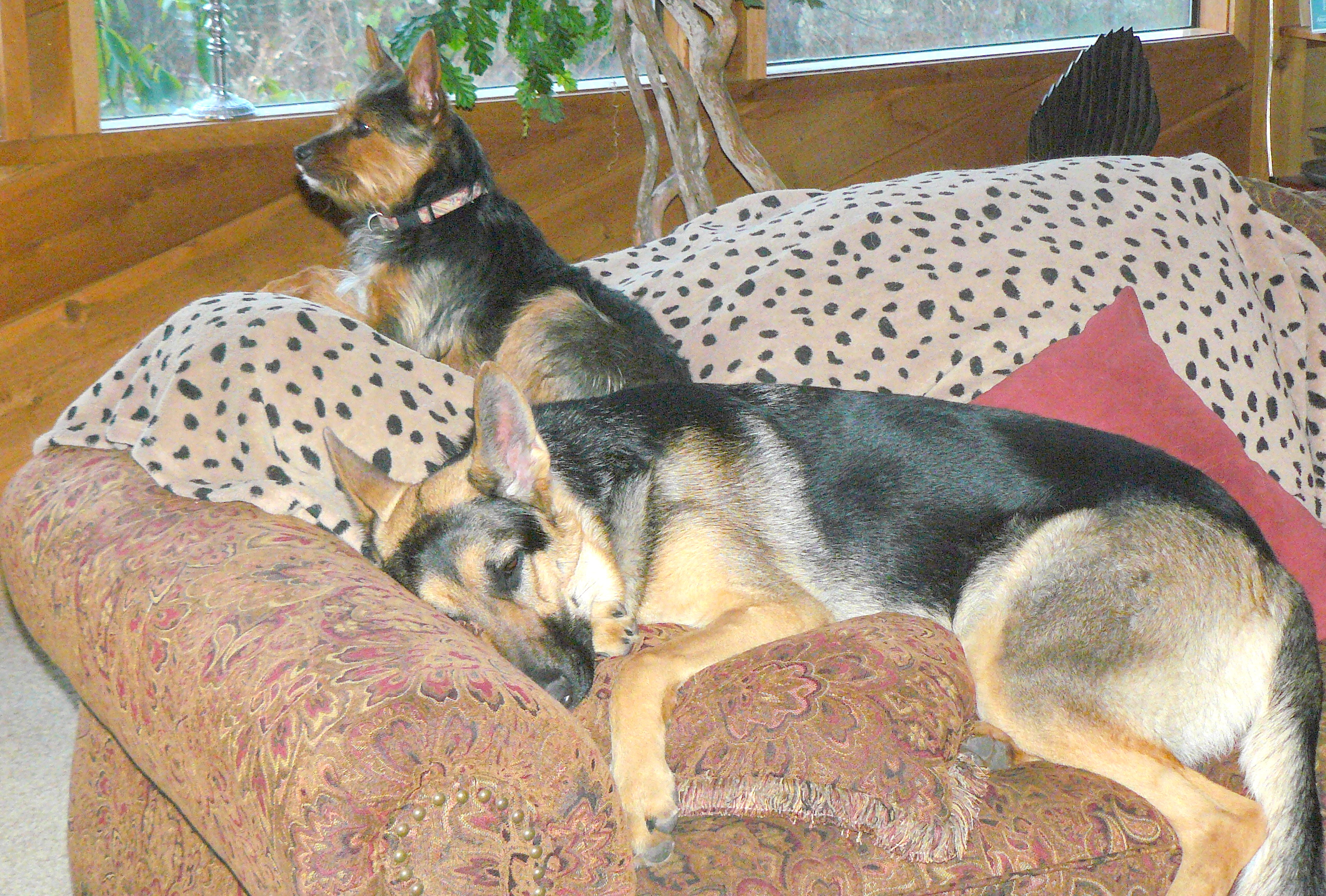
Dhalia showing us humans how easy it is to meditate!
Call it prayer, meditation, relaxation, building internal energy or life force, compassion, love, patience, generosity or forgiveness; what does it matter. It’s what it is doing to you that matters!
So when you bury your face in the warm fur of your beautiful dog and both you and your dog appear to be transported to some beautiful, magical place you have entered that indestructible sense of well-being.
Actually, let me make one small correction. Both you and your dog have entered that indestructible sense of well-being.
Only one way to finish today’s post: “I think, therefore I am!” René Descartes.
John Hurlburt writing as ‘an old lamplighter‘ has been a regular contributor to Learning from Dogs. Indeed, just last Friday in my rather introspective post, Maybe home is found in our quietness, I included John’s beautiful Evening Meditation. The day before that post, John sent me the following (the picture below is my contribution to John’s essay!) It’s a reflection on both the absurdity of modern times and the simplicity of the answers.
oooOOOOoo
Our interconnected world.
Bird Seed!
In return for a local pet store patronage, today’s cost savings included free bird seed. Meanwhile, our economic system squanders our common wealth.
The agendas of rich and powerful people who don’t want anything to change are reflected by FAUX News. What we have on our hands is an absurd interpretation of reality, which is made up as they go along. Politics has become a game of “Can You Top This”; with no limits. There’s a question about our collective level of sanity.
Our shared crisis mounts as our demographic increases and our natural resources are depleted accordingly. The fact is that we’re beyond the carbon limits the atmosphere requires to maintain the inclusive well-being of life on earth. And we’re damaging the surface layer of the planet that sustains us all in the process.
The answers are simple and natural. Here are five quick examples and a conclusion of sorts.
1. Diesel fuels run the majority of the world’s heavy machinery. Switching from carbon-based diesel fuels to natural bio-fuels, as per the original design by Rudolf Diesel, would have a profound effect on carbon pollution as well as fostering green innovation and industry. No modification of any on-line diesel engines would be required. As a matter of fact, they’d probably run more efficiently.
Solution: Economic advantage of using bio-fuels.
2. Re-establishing human rights may be best accomplished through increased awareness of our fragile unity as a species. The openness, honesty and integrity of Creation lights the way each day and lends serenity to our reflections.
Solution: Accept that deliberate human war and related destruction of the earth is empty, has no future, and is contrary to the purpose of human life.
Incidentally, when we put a natural floor under the global economy we’ll save our collective bacon in the process. Transitioning military forces to support green economic development opportunities might be a possibility if we decide to take life seriously enough to make a real difference.
3. Re-establishing a realistic base for a global economy that’s swollen 25 times beyond any material planetary resource foundation may best be accomplished by transitioning to green industries that benefit our planet, nations, communities and the sanctity of life in general. A modification to our technically driven financial system is needed.
Solution: Isaac Asimov; “I Robot” (the laws of robotics)
4. Re-establishing common law with inclusive equality and justice may be best accomplished by an in-depth examination of personal beliefs values, motives and actions in terms of respect for whatever Higher Power we may believe there to Be, compassion for Creation and the realization that we’re all living in and on the same life boat.
Solution: Education, formation and transformation based upon the facts of reality that we know in our present state of development and the far greater Reality which transcends our being and our current understanding based upon reason alone.
For example, Einstein’s General and Special Theories of Relativity tell us that we are in the process of turning inside out without breaking. A phrase that comes to mind is “transrational reality”. When we step beyond “self” we see the world through new eyes.
5. Agreeing on an equitably interactive and enforceable world-wide corporate, government, labor, and service organization wage scale may best be accomplished by listening to the voices of economic reason which tell us that money is only a symbol.
Rationale: Everything fits together. Change is constant. Life needs to adapt to survive. In Unity there is strength. At our best, we care for the earth and each other.
Inclusive solution: Surrender to Reality. The global system is broken, Resources are limited. It’s time to wake up. It’s time to change. A sustainable and growing green economy benefits everyone on earth.
Bottom Line
Love lights the way
Faith is stronger than fear
Hope springs Eternal
Our truths, our home, our serenity; all flow from stillness.
Soon silence will have passed into legend. Man has turned his back on silence. Day after day he invents machines and devices that increase noise and distract humanity from the essence of life, contemplation, meditation.
As is often the way, a number of disparate items came together for today’s post in a way of lovely connectivity.
A few weeks ago when meeting our local doctor for the first time since we moved to Oregon, I had grumbled about bouts of terrible short-term memory recall and more or less had shrugged my shoulders in resignation that there was nothing one could do: it was just part of getting older, I guessed!
“On the contrary”, responded Dr. Hurd, continuing, “There’s growing evidence that our information-crowded lives: cell phones; email; constant TV; constant news, is pumping too much for our brains to manage.”
Dr. Hurd continued, “Think about it! Our brains have to process every single sensory stimulus. The research is suggesting that our brains are being over-loaded and then the brain just dumps the excess data. If that is the case, and the evidence is pointing in that direction, then try thirty minutes of meditation each day; give your brain a chance to rest.”
So that was the first revelation.
The second was a recent science programme on the BBC under the Horizon series. The programme was called, The Truth About Personality.
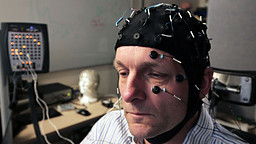
Michael Mosley’s brain being measured.
Michael Mosley explores the latest science about how our personalities are created – and whether they can be changed.
Despite appearances, Mosley is a pessimist who constantly frets about the future. He wants to worry less and become more of an optimist.
He tries out two techniques to change this aspect of his personality – with surprising results.
And he travels to the frontiers of genetics and neuroscience to find out about the forces that shape all our personalities.
Within the programme came the astounding fact that even ten minutes a day meditation can help the brain achieve a more balanced personality (balance in terms of not being overly negative in one’s thoughts).
The third revelation came from Jean and me watching a TED Talk last night. Just 14 minutes long, please watch it – you will be transformed!
Published on Jul 17, 2013
More and more people worldwide are living in countries not considered their own. Writer Pico Iyer — who himself has three or four “origins” — meditates on the meaning of home, the joy of traveling and the serenity of standing still.
Then, just three days ago, John Hurlburt, a long-time supporter and regular contributor to Learning from Dogs, emailed me his reflection on meditation. John quickly gave permission for it to be published here.
oooOOOooo
The stillness of evening.
Evening Meditation
Our world is increasingly spiritually, morally, mentally, physically and economically bankrupt. Many people would like to change the world one way or another. Most don’t really know why. Some folks simply don’t care. The idea is to leave life a bit better than we found it when we were born.
The fact is we’re all intrinsically sacred in a universe we didn’t create. We tend to prioritize illusion and delusion above reality. Playing God is a precursor of evil. A supreme faith in Money is self contradictory and ultimately fatal. Arrogance compounds the problem.
We connect in unified awareness through serene meditation. We experience harmony within an emerging celestial symphony. Answers flow from the inside out as we surrender to the eternal energy flow.
Be still and know…
an old lamplighter
oooOOOooo
Finally, after having a real struggle to find the place, both psychologically and physically, where I could start my own relationship with meditation, on Wednesday afternoon, when walking the quarter-mile up to our mail-box, it struck me as obvious.
Embraced by nature.
This quiet place on our creek where the water trickles down from an old flood irrigation dam. Somewhere to sit under the shade of a tree, somewhere to be still, somewhere as perfect a home as anyone could ever find.
Meditation is the dissolution of thoughts in Eternal awareness or Pure consciousness without objectification, knowing without thinking, merging finitude in infinity.
Owning a dog really makes a measurable and positive difference to health outcomes!
Yesterday, I republished a post from October, 2010 which included the story of Ricochet. In that post, I mentioned a graphic that had been sent to me by ZocDoc. I had been sent an email that in part read:
Hey Paul,
I work for ZocDoc, a doctor’s appointment website (not for dogs yet!). I just stumbled upon your blog, because you wrote about the healing power of dogs. We’ve just launched an infographic called “the healing power of dogs” and since you also have the post on your site I thought that this should be interesting to your readership and possibly help adoption.
I hadn’t heard of the company but very quickly the About Us page explained the background. Now in fairness, that email was all about promoting a commercial organisation. Nevertheless, it seemed such a useful and enjoyable graphic that I agreed to publish it.
For today, I was going to post a graphic that was sent to me recently by ZocDoc (will offer the link tomorrow). It’s a fabulous visual reminder of just how important dogs are to humans.
But aware that this subject has been touched on before (the name of the blog rather suggests this might happen!) I was trawling through nearly 4 years of posts and came across a post first published on October 7th, 2010; Real healing power. So presuming that many of the current readers of Learning from Dogs (big hugs to you all) will not have seen that one, here it is again.
oooOOOooo
Ricochet – just another healing dog!
Ricochet
This story has spread far and wide but, nonetheless, deserves a Post on Learning from Dogs because it is the essence of what dogs offer the world – unconditional love.
To gain the trust of a dog and enter the special relationship that humans have with dogs is to understand the significance of taking people at their face value and expect nothing in return, as dogs do.
Ricochet was born as a service dog and entered into the appropriate training. But there was a hic-cup in her learning, fortuitous as it happened and …. no, that’s enough from me. Watch it yourself ….
Now take a few minutes and understand what Ricochet and Ian McFarland demonstrated to the world.
Without doubt, President Obama’s recent speech on climate change was very welcome. I fervently hope this is a genuine commitment to change the course of the biggest and most powerful nation on our planet. Abandoning the Keystone XL pipeline would be the proof to my mind. UPDATE: But read this!
But the runaway, exponential growth in CO2 has a brother; huge growth in the world’s population.
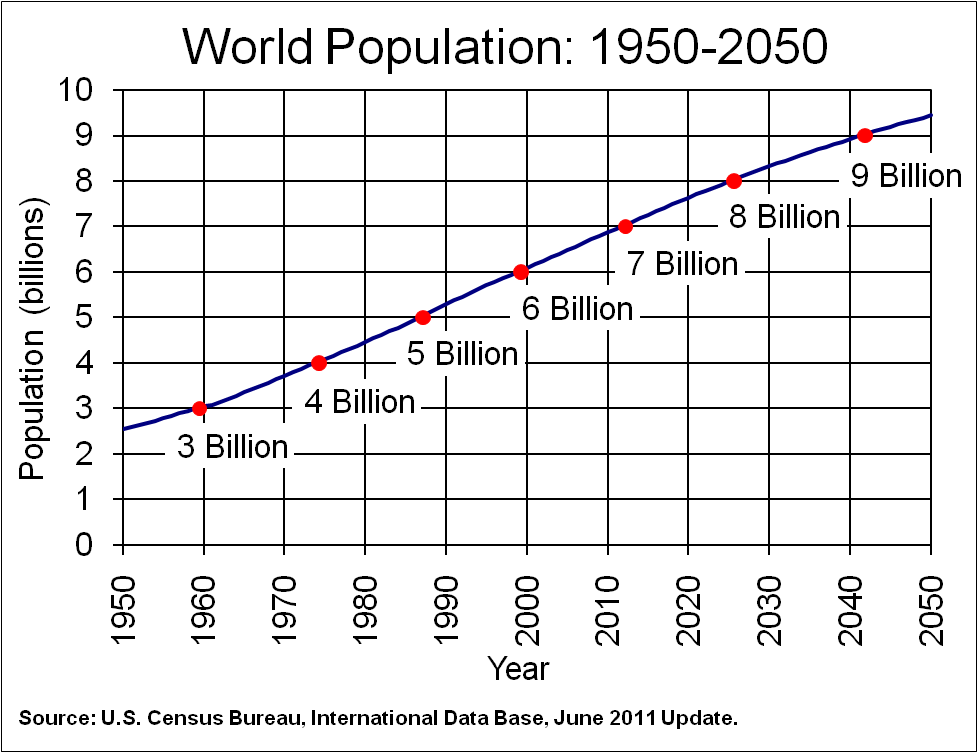
I’m going to ‘smack you in the face‘ with this population chart.
To put that into context from a personal perspective, when I was born in 1944 the global population was 2.5 billion persons. Some 4.7 billion fewer people than today!
But that prediction from the U.S Census Bureau in June, 2011 is already out of date!
13 June 2013 – The current world population of 7.2 billion is projected to increase by 1 billion over the next 12 years and reach 9.6 billion by 2050, according to a United Nations report launched today, which points out that growth will be mainly in developing countries, with more than half in Africa.
Now please humour me for a few moments. If the world population is presently 7.2 billion people and by 2050 the prediction is 9.2 billion people, that is an increase of 2,400,000,000 persons.
The end of 2050 is 438 months away. Now do the maths. That growth in population in that time period is the equivalent of an increase in population of 5,479,000 persons every single month!
Need to find a darkened room – I feel a headache coming on!
Posted by Chip Ward at 4:29pm, June 23, 2013.
Follow TomDispatch on Twitter @TomDispatch.
Rewilding the West
Here’s a nifty trick that’s been on my mind lately. In case you hadn’t noticed, the weather news this season has been pretty grim. Tornados so large and destructive that they would have given Dorothy pause, 500-year European floods, massive rainstorms rolling across the land, record heat in California and Alaska, late snowfalls that boggle the imagination, wildfires that dwarf past ones in the American West. I could go on, but why bother since anyone who has been watching primetime TV news can’t but notice that staggering weather has been the lead or second story much of the time all spring and into the summer.
You’re probably wondering right now: But what’s the trick? I’m surprised you haven’t noticed yourself. All of this weather has a new, made-for-TV label. It’s now regularly called “extreme weather” or “severe weather.” And that’s anything but inaccurate. The weather has been both “severe” and “extreme” this spring. The trick is that, as a label, “extreme weather” has managed (with rare exceptions) to obviate the need even to mention that any of this could have the slightest thing to do with climate change, with our overheating, over-greenhouse-gassed planet. Think of it as a fabulous form of recognition and denial wrapped in the same package.
The TV news gets all the benefits of night-after-night, eyeball-gluing drama in which the weather goes nuts, houses are destroyed, and people weep (or are stoic) about ruined lives. It gets to bring in the tornado watchers and the weather people in their raincoats and waders. (Have you noticed that the TV news can’t report a flood without putting some reporter with a mic knee-deep in water?) It gets to focus nightly on those daunting weather maps with their blazing red danger zones, and offer warnings about what potential disaster tomorrow might have to offer, all the while remaining in official, blissful denial about what’s happening on this planet of ours. Somehow, it has managed to incorporate the possible effects of climate change into the nightly news as a major story, while excluding just about all serious discussion of it. Tell me that isn’t a doubly nifty trick!
Of course, if there’s nothing but “extreme weather” happening and that weather has no extreme context, no extreme meaning, then none of us have to worry our little heads about what’s to be done. Those trying to remedy the degradation of conditions on this planet can also be ignored, which is why we couldn’t be more pleased that TomDispatch regular Chip Ward introduces us to such a person today. Tom
Trek West for the Big Picture Saving the Land One Footfall at a Time
By Chip Ward
My home sits at the gateway to a national park in Utah, a source of envy among tourists who gather along Capitol Reef’s “scenic drive.” But after 40 years of living in one desert or another, I know firsthand that America’s iconic desert landscapes, places like Monument Valley and Arches National Park, are the exceptions, not the rule. The rule is that we dig up, dump on, dam, bomb, drill, over-graze, and otherwise abuse our deserts, most of them public lands owned by you, the taxpaying citizen. Generally, our management of the nation’s public lands is a disgrace and deserts are exhibit A.
But let’s skip the grim survey of how humans are overloading the carrying capacity of our original earthly Eden that usually opens a report like this. The intent of such a recitation of folly is to compel the reader’s attention by underlining the dire importance of the topic at hand. But I assume you understand by now that you woke up this morning on an overheated planet of slums threatened by ecological collapse.
So instead, let’s get right to the point: what do we do about it? How do we begin to heal the wounds?
The crises we face and that our children and grandchildren will endure long after we leave them invite a visionary response. On the other hand, the world is already awash in well-intentioned tinkerers. Yet dysfunction and destruction still reign. Maybe it’s time to leap to a new paradigm.
Enter John Davis and Trek West. At this very moment, Davis is walking, biking, paddling, and horseback riding 6,000 miles through a chain of mountain ranges that stretches like a spine across North America from the Sierra Madres of Mexico through the Rockies of the American West up into Canada. He started this winter in the Sonoran desert we share with our southern neighbor and has been heading northward for months. He will cross many of our most treasured national parks like Yellowstone and Grand Canyon, the ones that tourists love, but his trek is no sightseeing adventure.
Davis and his Trek West partners along the route are advocating for what they call “landscape connectivity” on a continental scale. Two years ago, Davis trekked from Key West to Quebec, 8,000 human-powered miles. Same theme: conserve and connect.
A Conservation Revolution
Gone are the days when conservation was all about bullets, hooks, and cameras. Fishermen and hunters are still an important constituency in the conservation community, but birdwatchers now outnumber them. Ecological criteria increasingly frame any debate about how to heal degraded habitat. What the nineteenth century naturalist and Sierra Club founder John Muir knew intuitively — that everything in the universe is “hitched to everything else” — has been confirmed beyond doubt by hard science.
Davis is one of the founders of a new school of thought called conservation biology. Its proponents argue that it is not faintly enough to preserve scenic rock and ice parks and isolated islands of wildlife. Wild creatures need room to roam so they can find the necessary water, food, and mates. In the long run, many of America’s wild creatures from salamanders to bears will survive only in Disney movies if we box out genetic diversity, block migration routes, destroy nesting grounds, and save only carefully preserved, isolated populations of a species. Connectivity is the keel of an emerging conservation ethic for helping to heal this country.
John Davis envisions an unbroken chain of wild lands spanning North America from Mexico to Canada. When completed, a necklace of “core” areas, including national parks, wildlife reserves, and protected wilderness areas will be linked together and buffered by national forests and private lands. Creatures now boxed into wild islands surrounded by a sea of development will have room to roam.
A connected landscape will be more resilient as climate change puts further stress on creatures and their habitats. Already species from birds to mammals are responding to warming temperatures by moving northward if they can, or to higher ground if they can’t migrate horizontally. The famed scientist and conservationist E.O. Wilson called the project to link together America’s wild lands the most important conservation initiative in the world today.
After trekking through the habitat of the last remaining jaguars on the continent, Davis ran into the new wall designed to keep illegal Mexican migrants out of the United States. It is, he pointed out, a far more effective barrier against wildlife migration than the human version of the same and so is lobotomizing the border ecosystem we share with Mexico. As for Davis, he easily climbed it in less than five minutes and was on his way.
Backpacks Meet Cowboy Hats
Although pushing 50, Davis has the trim, muscular build of a professional athlete — and he’ll need every toned muscle he has to complete his quest. The day before I met him in Escalante, Utah, he had been surprised by a lingering bout of spring weather and found himself pushing his bike through 10 miles of deep snow on top of Utah’s Aquarius Plateau. The next week, he planned to paddle through Desolation Canyon, one of the most spectacular river passages on the planet. But when I encountered him, he was taking a break and making a pitch for connectivity before a gathering of federal land managers, concerned local citizens, and ranchers who share the watershed of the Escalante River.
The Escalante River Watershed Partnership (ERWP) is the unwieldy name for a grassroots coalition whose aim is to restore the river’s degraded ecosystem. The rugged network of high desert canyons that drain into the remote Escalante River have been eroding for years thanks to overgrazing by cattle. They are also choked with tamarisk and Russian olive trees.
Tamarisks are an invasive species that suck up precious ground water, while filling in springs and seeps that are the only water sources for many bird and animal species. The tall, feathery plumes of the tamarisk have taken over hundreds of miles of riverbank in the West. “Tammies” also salt the surrounding soil when they shed their leaves, killing native plants that might otherwise compete. A beetle was imported from Eurasia to eat the tammies and was unbelievably successful. As a result, those thick hedges that still block riverbanks are now dead-dry and ready to ignite. If not cut back, they will burn or regrow. Russian olive trees also crowd stream banks and add needle-like thorns to the unpleasant mix.
The diverse stakeholders in the Escalante River Watershed Partnership may not share John Davis’s grand vision of an ecologically whole and “rewilded” continent, but they are intent on sewing together and rewilding their pieces of the torn fabric of American life. As any effective organizer knows, you start where there is common ground — or where there are common weeds.
Ranchers, rangers, biologists, hikers, and back-country guides are in many ways competing constituencies, but it turns out they all share the goal of clearing riparian (wet) canyons of those suffocating tammies. The scientists survey the ground and identify targets. Grants are written to bring in volunteers to do the fieldwork. Last week, a dozen Great Old Broads for Wilderness, mostly outspoken middle-aged women, spent a week clearing unwanted brush as a service project.
As biologists monitor progress and the group discusses issues that arise, inevitably the damage done by grazing cows comes up. It couldn’t be a more awkward topic. After all, ranchers are in the room. Cattle ranching in these desert landscapes is a marginal activity. Those ranchers depend on federal grants, tax breaks, and access to public land to make it work. But cows erode stream banks and silt the water, short-circuit forest succession by eating seedlings, and contaminate fresh water with their voluminous poop that also spreads cheatgrass and weeds.
The hope is that eventually the EWRP will become a platform for a public airing of difficult issues like where cattle should be allowed to graze on public land and how many and when.
A Roadkill Extravaganza
Those awaiting Davis’s Trek West presentation this particular day in this particular corner of Utah have already found a scale that seems to fit the desperate needs of our landscape, state, country, and planet. Most of us who believe in change are caught between the seeming futility of small-scale actions — like recycling our trash or using more energy-efficient light bulbs — and the impotence we experience when we push for large-scale change like climate legislation in Congress or international treaties to limit atmospheric greenhouse gases.
On the one hand, too little; on the other, too late. There does, however, turn out to be a middle scale between individual action and national or global campaigns that works well and makes sense: the community. That’s the place where people can best embrace their roles as citizens, face off, share, contend, cooperate, create, learn from, and empower one another.
Watershed partnerships harken back to an old ideal. John Wesley Powell, the one-armed general and Civil War hero who later explored the Colorado River and its tributaries, was the first person to grasp and publicize the aridity rather than fecundity of significant parts of the American West. He argued that practices and policies developed for wet Eastern lands were inappropriate for the drier West. He advocated for governance around watersheds where local stakeholders committed to living within the limits they knew firsthand could come together and plan. That’s what I’m observing this morning in Utah. In twenty-first-century terms, think of it as ecological citizenship.
Davis claims he is shy and a poor presenter, but it turns out that he is quietly charismatic. The case he makes for corridors is practical. His listeners know that he is trekking across a landscape that is not your grandfather’s Wild West. The wide-open spaces where the antelope once roamed are now fragmented by a zillion roads featuring SUVs with flattened animals on their bumpers. Davis says that, on his most recent journey, he’s already seen at least 1,000 crushed, dead creatures. It’s been a roadkill extravaganza.
So, what to do? He shows pictures of a landscaped underpass in nearby Kanab, Utah, constructed at a deer crossing where at least 100 deer a year were being hit by cars. Every year about 10% of the local herd was becoming roadkill along with foxes, turkeys, and the occasional bobcat. The underpass cost $2.6 million, which is hardly chump change in this neck of the woods, but each deer-car collision costs, on average, $6,600. Do the math, he tells them. Making the landscape permeable for animals seeking food, mates, and water keeps them healthy and pays for itself soon enough.
The Wolf at the Door
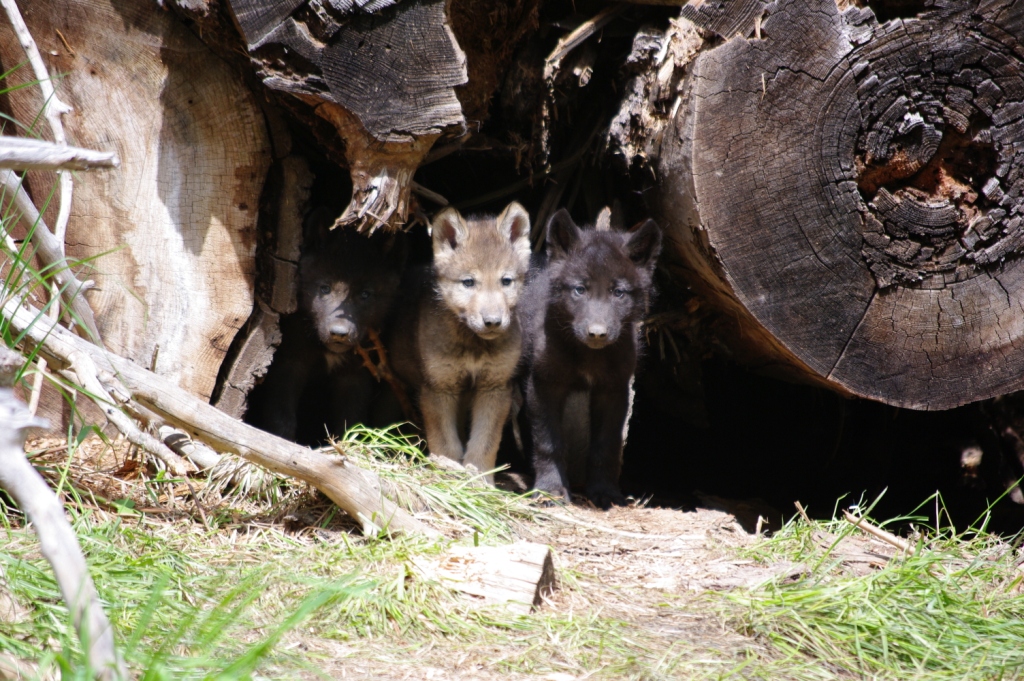
Ranchers and the Bureau of Land Management (BLM) rangers who serve them view John Davis skeptically. For one thing, he’s been frank about the need to reintroduce wolves across Western ecosystems, given the “keystone” role they play in shaping a healthy landscape. In case you’re not a Westerner, you should know that the subject of wolf reintroduction is a political third rail in much of our region. It’s an idea that would stun and appall our grandfathers, who killed wolves on their lands to leave more deer and elk for hunters and make meadows safe for cattle.
Ecologically, the reintroduction of wolves to Yellowstone National Park has been an unqualified success. Since wolves were returned to that landscape, elk are no longer bunching up and munching down in stream-fed valleys until they are silted, eroded, and devoid of other wildlife. The wolves thin the elk herds and move them, which, in turn, allows willows, aspens, beavers, birds, and a more biodiverse landscape to thrive. Their success in Yellowstone has confirmed the insights of conservation biologists, giving them credibility and authority. Cowboys fear that, having pushed aside elk, conservationists will go after their cows next.
Meanwhile, back at the ranch, elk hunters, cowboys, gun-nuts, and tea-hadi politicians have worked themselves into an anti-wolf frenzy. Western state legislators have introduced several bills designed to limit and control wolves even if they haven’t seen one in their area for 100 years. They want to trade the wolves’ endangered status under the law for licenses to hunt them. A few days after Davis met the watershed group, the Obama administration caved in to this eco-political hysteria and agreed to remove endangered species protections from wolves. This backlash against reintroduction has been painful for advocates like Davis.
A Greater Canyonlands National Monument Moment?
The decision to lift wolf protection is consistent with the Obama administration’s disappointing record on Western environmental issues. Nevertheless, conservation advocacy groups like the Southern Utah Wilderness Alliance and the Sierra Club are urging the president to take a cue from Bill Clinton’s example. Back in 1996, he created the Grand Staircase Escalante National Monument under the Antiquities Act that allows presidents to set aside natural and archaeological treasures. Now, the conservation groups want Obama to do something similar on an even grander scale and create a “Greater Canyonlands National Monument” from some of the healthiest wild lands in southern Utah.
A few days later, Davis addressed the need for such a monument at a forum in Moab, Utah. Our state has about nine million acres of quality wilderness land ready to be designated and protected as such. That’s a lot of core area for John Davis’s conservation vision, a lot of possibility for connectivity. But the public debate about wilderness designation has been stalemated for decades. Utah Republicans in particular resist more steps to formally protect wilderness areas even though the public overwhelmingly supports it.
They are wedded to traditional mining and grazing interests and like to portray themselves as victims of a bullying federal government that wants to jam national monuments and formally designated wilderness areas down their throats. But Clinton’s creation of the new monument has proven a boon for Escalante’s economy. In the 12 years since it came into being, the populations of surrounding Kane and Garfield counties have grown by 8%. Jobs rose in those years by 38% and per capita income by 30%. Adjoining counties whose economies are oriented towards gas and oil lagged far behind.
President Obama’s appointment of Sally Jewel, former CEO of REI, a chain of outdoor gear and clothing stores, may signal a shift away from ranching and mining as the dominant voices on the Western political stage. Jewel understands firsthand that recreation and tourism have become powerful economic engines here.
A presidential initiative alone will hardly begin to settle all the questions we face about how to make peace with the land that holds us in its embrace. But designating another monument here could be a catalyst for an ever-expanding idea of grassroots stewardship of America’s wild lands.
The Escalante watershed partnership was formed in the wake of Clinton’s catalytic act. At that time, the Clinton administration took another experimental step. It gave stewardship of Grand Staircase Escalante to the controversial Bureau of Land Management instead of the National Park Service. That was a first and undoubtedly a concession to Utah’s politicians who would rather deal with the traditionally compliant, pro-mining, pro-grazing BLM than the stricter National Park Service. Clinton gambled that the move might instill a missing environmental ethic in that bureau.
The results on that are not yet in, but there is no question about one thing: Clinton’s creation has been a catalyst for grassroots political activity. When monument status was a done deal, the river’s stakeholders decided the time had finally come to practice that awkward dance of mutuality among conservationists who want to save the land, ranchers who want to use it, and federal land managers charged with sorting out what exactly to do. John Davis is clearly on the side of conservation.
Making the Imaginary Real
The Trek West sponsors recognize that there may never be some grand national initiative to accomplish their vision, nothing like the Wilderness Act, the Clean Air Act, or the other signature environmental legislation of the 1960s and 1970s. If our troubled public lands are rescued, it’s likely to happen in a piecemeal fashion, as local and regional groups work to improve their own backyards. The folks who gather in Escalante don’t claim to have all the answers. They are not here to spread the truth and save the world. They belong to no ideology or movement. They’re just working on their piece of the puzzle, experimenting and learning as they go. Rivers being the arteries of the land, it makes sense to start there.
An existing constituency almost always trumps an imaginary one. You can make a case, for example, that a change in land use practices and policies would benefit more people, boost the local economy, and be healthier for wildlife, too, but those imaginary winners can’t compete with cattlemen who are real, well organized, and have been active in the political arena for many years. They have established close relationships with local politicians who depend on their support. Because they were there first, they wrote most of the rules and those favor their uses of public land.
The trick for conservationists who want change is to make that imaginary constituency real, to bring a new set of stakeholders together and find ways to empower them. That may not be the intention of those who gathered in Escalante for the watershed partnership, but it’s what is happening nonetheless — and John Davis is a catalyst.
According to the prevailing belief, growth should always be the bottom line. Trek West expresses an alternate vision that aims instead to translate ecological principles and criteria into actual designs on the ground. That’s not simply a matter of making better maps. Those of us who live within the iconic Western landscapes so treasured by all Americans understand that maps, charts, and spreadsheets do not adequately measure or describe this inspiring and awesome place where we live.
We experience the land sensually. Perhaps that is the ultimate message John Davis is delivering as he treks across the continent’s wild spine. He is making sense of the land one footfall at a time, listening to it, watching it, and feeling it as he goes. So, reconnect landscapes, yes, but also connect head and heart.
Davis’s quest is heroic, but his testimony is simple: when we learn from the land we lean towards wholeness.
I opened the first post on Monday with the sub-heading: “Certainty is perfect knowledge secure from error or doubt.” going on to write that, “Whatever your views on the effect of man’s behaviours on our planet’s climate, it’s a long way from the logical idea of ‘2 + 2‘!”
Within that very strict definition, I remain unmoved. The argument that mankind is the cause of the present change in the climate of Planet Earth is not certain!
However, if only life was that simple! The change in our planet’s atmosphere is possibly the most emotionally-laden topic of all time. For some reason that quotation attributed to Hiram Johnson comes to mind, “The first casualty when war comes is truth.” because the supporters and deniers of AGW are engaged in what amounts to a verbal war.
Each side can draw on much information.
For example, a very recent article in The New York Times by their Justin Gillis offered this:
The rise in the surface temperature of earth has been markedly slower over the last 15 years than in the 20 years before that. And that lull in warming has occurred even as greenhouse gases have accumulated in the atmosphere at a record pace.
The slowdown is a bit of a mystery to climate scientists. True, the basic theory that predicts a warming of the planet in response to human emissions does not suggest that warming should be smooth and continuous. To the contrary, in a climate system still dominated by natural variability, there is every reason to think the warming will proceed in fits and starts.
But given how much is riding on the scientific forecast, the practitioners of climate science would like to understand exactly what is going on. They admit that they do not, even though some potential mechanisms of the slowdown have been suggested. The situation highlights important gaps in our knowledge of the climate system, some of which cannot be closed until we get better measurements from high in space and from deep in the ocean.
As you might imagine, those dismissive of climate-change concerns have made much of this warming plateau. They typically argue that “global warming stopped 15 years ago” or some similar statement, and then assert that this disproves the whole notion that greenhouse gases are causing warming.
Rarely do they mention that most of the warmest years in the historical record have occurred recently. Moreover, their claim depends on careful selection of the starting and ending points. The starting point is almost always 1998, a particularly warm year because of a strong El Niño weather pattern.
Dan Gomez, a long-time friend of over 40 years and a regular contributor to items on Learning from Dogs, wrote in a recent email,
I’m not sure what is meant by “believer”, Paul. The Universe unfolds as it should. Because many have been led to “believe” that AGW is inevitable and that all the facts are the ‘Truth”, we’ve created a religious substitute, almost a new “industry” with significant “tithing” obligations, etc. (e.g. Cap and Trade). Presumptions and facts are being manipulated to fulfill the prophecy.
Interesting to note in our daily lives, that weather prediction is very good 24-36 hrs out. This drops precipitously just a few days out. More than 7-10 days is nearly impossible. Even though both Europe and the USA have decreased CO2 levels by multiple percentage points over the last 20 years, the rest of the world does not care and the impact is very problematic. Recently, CO2 gas has increased overall but heat has not. In the past, warming has occurred followed by CO2 levels increasing. Global politics and redistribution of wealth schemes continue to interfere with common sense.
Let’s just deal with the facts as Science reveals its secrets. New information is discovered every day about the interaction of the Earth/Sun/Atmosphere/Lithosphere/Hydrosphere. New information is learned every day about the Universe. These are not closed subjects. Climatology, meteorology, geology and solar system dynamics will continue to shape the Earth’s future for millennia to come whether Man is involved or not.
There is much in what Dan writes that has me nodding my head; stimulates my recollection of what Luther Haave and Derek Alker wrote in 2009:
With the explosion of knowledge, particularly in the past 100 years, each of us has found it a requirement for being successful, and to being able to earn a living, to concentrate our knowledge in an ever increasingly narrow field. Just as we have come to expect others to defer to our expertise in our narrow area, we have come to assume that we need to defer to others who have a deeper comprehension of seemingly complex topics such as the science related to climate change. [Apologies, can’t find the web link for this.]
However, if we broaden the perspective from that tight definition of certainty to an analysis of probabilities, then it all changes for me and I can embrace the views so strongly put forward by Martin Lack.
For example, Martin left a comment on Monday, “ACD is not a matter of opinion or belief; it is a matter of probability. As such, all that matters now is the extremely high probability that the scientific consensus is real, reasonable and reliable.” That comment included a link to a discussion on the website Skeptical Science, Is the science settled? Let me quote from that:
Some aspects of the science of AGW are known with near 100% certainty. The greenhouse effect itself is as established a phenomenon as any: it was discovered in the 1820s and the basic physics was essentially understood by the 1950s. There is no reasonable doubt that the global climate is warming. And there is also a clear trail of evidenceleading to the conclusion that it’s caused by our greenhouse gas emissions. Some aspects are less certain; for example, the net effect of aerosol pollution is known to be negative, but the exact value needs to be better constrained.
What about the remaining uncertainties? Shouldn’t we wait for 100% certainty before taking action? Outside of logic and mathematics, we do not live in a world of certainties. Science comes to tentative conclusions based on the balance of evidence. The more independent lines of evidence are found to support a scientific theory, the closer it is likely to be to the truth. Just because some details are still not well understood should not cast into doubt our understanding of the big picture: humans are causing global warming.
In most aspects of our lives, we think it rational to make decisions based on incomplete information. We will take out insurance when there is even a slight probability that we will need it. Why should our planet’s climate be any different?
That, ultimately, delivers for me what truly counts.
I am not a scientist; just a Brit living in Southern Oregon trying to make sense of the world while I still have a functioning head and body – time is not on my side! 😉 The powerful common-sense in the sentence, “Outside of logic and mathematics, we do not live in a world of certainties.” is beyond argument.
In the year 2012, the total number of passengers carried by US Airlines and other carriers in and out of the USA was a staggering 815 million people. 815,000,000 people!
Remember the sub-heading from the start of this post! “If there’s any doubt, there’s no doubt!” Years ago I heard that from Bob Derham, a long-time friend and a commercial airline Captain since the time God was a boy! It’s that cautious, safety-focused attitude that has made airline transport such an amazing mode of transport for all those millions of passengers.
Should we not travel with the same cautious, safety-focused attitude on the ‘vehicle’ that carries every man, woman and child; every animal, plant and living thing: Planet Earth!







 Learning from Dogs