I came at today’s post from a number of directions.
A few days ago I was catching up with a good friend back in the UK, Peter M. We hadn’t spoken in a couple of months. One of the items from my end was mentioning that I had converted to a vegetarian diet, verging on trying to be a vegan. Jeannie has been a vegetarian for almost her entire life. Having made the change to a vegetarian diet, to my surprise I had gained 12 lbs (5.4 kgs) in the last month. Peter then mentioned that he, too, had put on 8 kgs before deciding to try and cut back. Peter and I are of the same age and motivated to stay as fit and healthy as we can. Anyway, Peter’s route for losing some weight was to commit to the fasting arrangement promoted and recommended by Dr. Michael Mosley – more of this later.
The conversation also reminded me of an essay by George Monbiot back at the end of November: Wrong About Being Wrong. Mr. Monbiot wrote of his mind changes about being vegetarian. With his permission, here is that essay.
oooOOOooo
Wrong About Being Wrong
November 27, 2013
The argument seems, once more, decisively to favour veganism.
By George Monbiot, published on the Guardian’s website 27th November 2013
He did it quietly, and the decision is the better for that: Al Gore, according to reports in the US press, has gone vegan.
Certain things could be said about other aspects of his lifestyle: his enormous houses and occasional use of private jets, for example. While we can’t demand that everyone who espouses green causes should live like a Jain monk, I think we can ask that they don’t live like Al Gore. He’s a brilliant campaigner, but I find the disjunction between the restraint he advocates and the size of his ecological footprint disorienting.
So saying, if he is managing to sustain his vegan diet, in this respect he puts most of us to shame. I tried it for 18 months and almost faded away. I lost two stone, went as white as a washbasin and could scarcely concentrate. I think I managed the diet badly; some people appear to thrive on it. Once, after I had been unnecessarily rude about vegans and their state of health (prompted no doubt by my own failure), I was invited to test my views in an unconventional debate with a vegan cage fighter. It was a kind invitation, but unfortunately I had a subsequent engagement.
In 2010, after reading a fascinating book by Simon Fairlie, a fair part of which was devoted to attacking my views, I wrote a column in which I maintained that I’d been wrong to claim that veganism is the only ethical response to what is arguably the world’s most urgent social justice issue. Diverting grain that could have fed human beings to livestock, I’d argued, is grotesque when 800 million go hungry.
Fairlie does not dispute this, and provides many examples of the madness of the current livestock production system. But he points out that plenty of meat can be produced from feed which humans cannot eat, by sustaining pigs on waste and grazing cattle and sheep where crops can’t grow. I was swayed by his argument. But now I find myself becoming unswayed. In the spirit of unceasing self-flagellation I think I might have been wrong about being wrong.
Part of the problem is that while livestock could be fed on waste and rangelands, ever less of the meat we eat in the rich nations is produced this way. Over the past week, a row has erupted between chefs and pig farmers over the issue of swill. The chefs point out – as Simon Fairlie does – that it is ridiculous to feed pigs on soya grown at vast environmental cost in the Amazon instead of allowing them to dispose of our mountain of waste food. Feeding pigs on swill has been forbidden since the foot and mouth outbreak of 2001.
The farmers respond that the risks of spreading disease are too great and that pigs fed on waste grow more slowly than pigs fed on soya. I side with the chefs: I believe that a society capable of identifying the Higgs boson should be able to sterilise waste food. But I suspect that they’re not going to win: the industry and its regulators are firmly against them.
I should have seen it coming, but I watched in horror as the meat industry used my article to justify the consumption of all meat, however it was produced, rather than just the meat raised on food that humans can’t eat. A potential for good is used to justify harm.
While researching my book Feral, I also came to see extensive livestock rearing as a lot less benign than I – or Simon Fairlie – had assumed. The damage done to biodiversity, to water catchments and carbon stores by sheep and cattle grazing in places unsuitable for arable farming (which means, by and large, the hills) is out of all proportion to the amount of meat produced. Wasteful and destructive as feeding grain to livestock is, ranching appears to be even worse.
The belief that there is no conflict between this farming and arable production also seems to be unfounded: by preventing the growth of trees and other deep vegetation in the hills and by compacting the soil, grazing animals cause a cycle of flash floods and drought, sporadically drowning good land downstream and reducing the supply of irrigation water.
So can I follow Al Gore, and do it better than I did before? Well I intend at least to keep cutting my consumption of animal products, and to see how far I can go. It’s not easy, especially for a person as greedy and impetuous as I am, but there has to be a way.
Back to the conversation with Peter M. about fasting. He spoke enthusiastically about Dr. Mosley who one quickly discovers,
Dr. Michael Mosley.
Michael J. Mosley (born 22 March 1957) is a British journalist, medical doctor, producer and TV presenter. He is probably best known as a television presenter of programmes on biology and medicine, particularly his series on the workings of the human body, Inside the Human Body and his regular appearances as the friendly medic on The One Show.
He was interviewed by Steve Wright of BBC Radio 2 back in January, 2012 and that interview is on YouTube:
That BBC Horizon programme is no longer available to watch but a 4-minute extract may be seen here:
Inevitably, Dr. Mosley has a website Fast Diet that is packed full of valuable information.
So just as soon as we have the water back to the house and I can have a long, hot shower I intend to adopt the 5:2 diet.
Now don’t knock it for because the Irish don’t take their medical terminology too seriously, they have the lowest stress rate!
Artery – The study of paintings
Bacteria – Back door to cafeteria
Barium – What doctors do when patients die
Benign – What you be, after you be eight
Caesarean Section – A neighbourhood in Rome
Cat scan – Searching for Kitty
Cauterize – Made eye contact with her
Colic – A sheep dog
Coma – A punctuation mark
Dilate – To live long
Enema – Not a friend
Fester – Quicker than someone else
Fibula – A small lie
Impotent – Distinguished, well known
Labour Pain – Getting hurt at work
Medical Staff – A Doctor’s cane
Morbid – A higher offer
Nitrates – Rates of Pay for Working at Night,
Normally more money than Days
Node – I knew it
Outpatient – A person who has fainted
Pelvis – Second cousin to Elvis
Post Operative – A letter carrier
Recovery Room – Place to do upholstery
Rectum – Nearly killed him
Secretion – Hiding something
Seizure – Roman Emperor
Tablet – A small table
Terminal Illness – Getting sick at the airport
Tumour – One plus one more
Urine – Opposite of you’re out
Like thousands of others, Jean and I are regular viewers of the TED Talks.
So first the old. Here’s a reminder of the inspiring nature of mathematics; in this case Fibonacci numbers.
Published on Nov 8, 2013
Math is logical, functional and just … awesome. Mathemagician Arthur Benjamin explores hidden properties of that weird and wonderful set of numbers, the Fibonacci series. (And reminds you that mathematics can be inspiring, too!)
Now to the new. Innovation at its very best.
Published on Jul 11, 2013
The development of new medicine is problematic because laboratories cannot replicate the human body’s environment, making it difficult to determine how patients will respond to treatment. At TEDxBoston, Geraldine Hamilton demonstrates how scientists can implant living human cells into microchips that mimic the body’s conditions. These “organs-on-a-chip” can be used to study drug toxicity, identify potential new therapies, and could lead to safer clinical trials.
We have had a run of cold days here in Southern Oregon going down to the mid-twenties Fahrenheit at night (-4 deg C.)
So this first picture sent in by John H. seemed appropriate for today.
oooo
Then continuing with the series that started last Sunday.
oooo
Wise words indeed.
oooo
oooo
oooo
Finally, to a short but inspiring video sent to me by Dan Gomez.
A man, a dog, a cat and a rat…
This is a video of a homeless man in Santa Barbara and his pets.
They work State Street every week for donations.
The animals are pretty well fed and are mellow.
They are a family.
The man who owns them rigged a harness up for his cat so she wouldn’t have to walk so much (like the dog and the man himself).
At some juncture the rat came along, and as no one wanted to eat anyone else, the rat started riding with the cat, frequently on the cat.
For a few chin scratches the dog will stand all day and, let you talk to him and admire him.
So the Mayor of Santa Barbara decided to film this clip and send it out as a holiday card.
With thanks to Cynthia for including me on her recent email.
oooOOOooo
FDA seeks pet owner help on dangerous jerky treats
From Associated Press October 23, 2013 8:17 AM EST
WASHINGTON (AP) — The Food and Drug Administration is appealing to dog and cat owners for information as it struggles to solve a mysterious outbreak of illness and deaths among pets that ate jerky treats.
In a notice to consumers and veterinarians published Tuesday, the agency said it has linked illnesses from jerky pet treats to 3,600 dogs and 10 cats since 2007. About 580 of those pets have died.
The FDA’s Center for Veterinary Medicine has run more than 1,200 tests, visited pet treat manufacturing plants in China and worked with researchers, state labs and foreign governments but hasn’t determined the exact cause of the illness, the FDA statement said.
“This is one of the most elusive and mysterious outbreaks we’ve encountered,” Bernadette Dunham, a veterinarian and head of the FDA vet medicine center, said in the statement.
Pets can suffer from a decreased appetite, decreased activity, vomiting and diarrhea among other symptoms within hours of eating treats sold as jerky tenders or strips made of chicken, duck, sweet potatoes or dried fruit.
Severe cases have involved kidney failure, gastrointestinal bleeding, and a rare kidney disorder, the FDA said.
Most of the jerky treats implicated have been made in China, the FDA said.
The FDA has issued previous warnings. A number of jerky pet treat products were removed from the market in January after a New York state lab reported finding evidence of up to six drugs in certain jerky pet treats made in China, the FDA said. The agency said that while the levels of the drugs were very low and it was unlikely that they caused the illnesses, there was a decrease in reports of jerky-suspected illnesses after the products were removed from the market. FDA believes that the number of reports may have declined simply because fewer jerky treats were available.
oooOOOooo
That FDA Notice is here. I have taken the liberty of republishing it in full.
oooOOOooo
Jerky Pet Treats
The problem
Since 2007, FDA has received reports of illnesses in pets associated with the consumption of jerky pet treats. As of September 24, 2013, FDA has received approximately 3000 reports of pet illnesses which may be related to consumption of the jerky treats. The reports involve more than 3600 dogs, 10 cats and include more than 580 deaths.
What we are doing
FDA is working with laboratories across the country to investigate causes. To date, testing for contaminants in jerky pet treats has not revealed a cause for the illnesses.
We have tested for:
Salmonella
Metals or Elements (such as arsenic, cadmium and lead, etc.)
Markers of irradiation level (such as acyclobutanones).
Pesticides
Antibiotics (including both approved and unapproved sulfanomides and tetracyclines)
Mold and mycotoxins (toxins from mold)
Rodenticides
Nephrotoxins (such as aristolochic acid, maleic acid, paraquat, ethylene glycol, diethylene glycol, toxic hydrocarbons, melamine, and related triazines)
Other chemicals and poisonous compounds (such as endotoxins).
Testing has also included measuring the nutritional composition of jerky pet treats to verify that they contain the ingredients listed on the label and do not contain ingredients that are not listed on the label. Another area of investigation includes the effects of irradiation and its byproducts.
Watch your pet closely. Signs that may occur within hours to days of feeding the jerky treat products are decreased appetite, decreased activity, vomiting, diarrhea (sometimes with blood or mucus), increased water consumption and/or increased urination. Severe cases are diagnosed with pancreatitis, gastrointestinal bleeding, and kidney failure or the resemblance of a rare kidney related illness called Fanconi syndrome.
If your pet has experienced signs of illness, please report it to FDA. Once a consumer has filed a report with their local FDA Consumer Complaint Coordinator, or electronically through our safety reporting portal, FDA will determine whether there is a need to conduct a follow-up phone call or obtain a sample of the jerky pet treat product in question. While FDA does not necessarily respond to every individual complaint submitted, each report becomes part of the body of knowledge that helps to inform FDA on the situation or incident.
What veterinarians can do
The “Dear Veterinarian” letter to veterinary professionals explains how they can provide valuable assistance to the agency’s investigation, requests that veterinarians report to FDA any cases of jerky pet treat-related illness that come to their attention and, when requested, that they also provide samples for diagnostic testing by the Veterinary Laboratory Investigation and Response Network (Vet-LIRN), a network of veterinary laboratories affiliated with FDA.
oooOOOooo
I just mentioned this to Jeannie who says that while we do feed our dogs jerky treats, she is careful to purchase only those brands that are made in the USA.
Today is our first anniversary of living in Oregon.
In many ways, it’s difficult to comprehend that we have now lived in our house a few miles from Merlin, OR, for a full year.
There are so many different, wonderful emotions associated with our move from Arizona to Oregon, of moving into a property quite unlike anything that Jean and I have ever lived in before, of seeing our dogs so happy with their surroundings, of being immersed in Nature, and so much more.
But rather than waffle on about everything in general and nothing in particular, I just want to write about the several acres of grassland that slope down from our house towards Bummer Creek, flowing North-South through the Eastern part of the property.
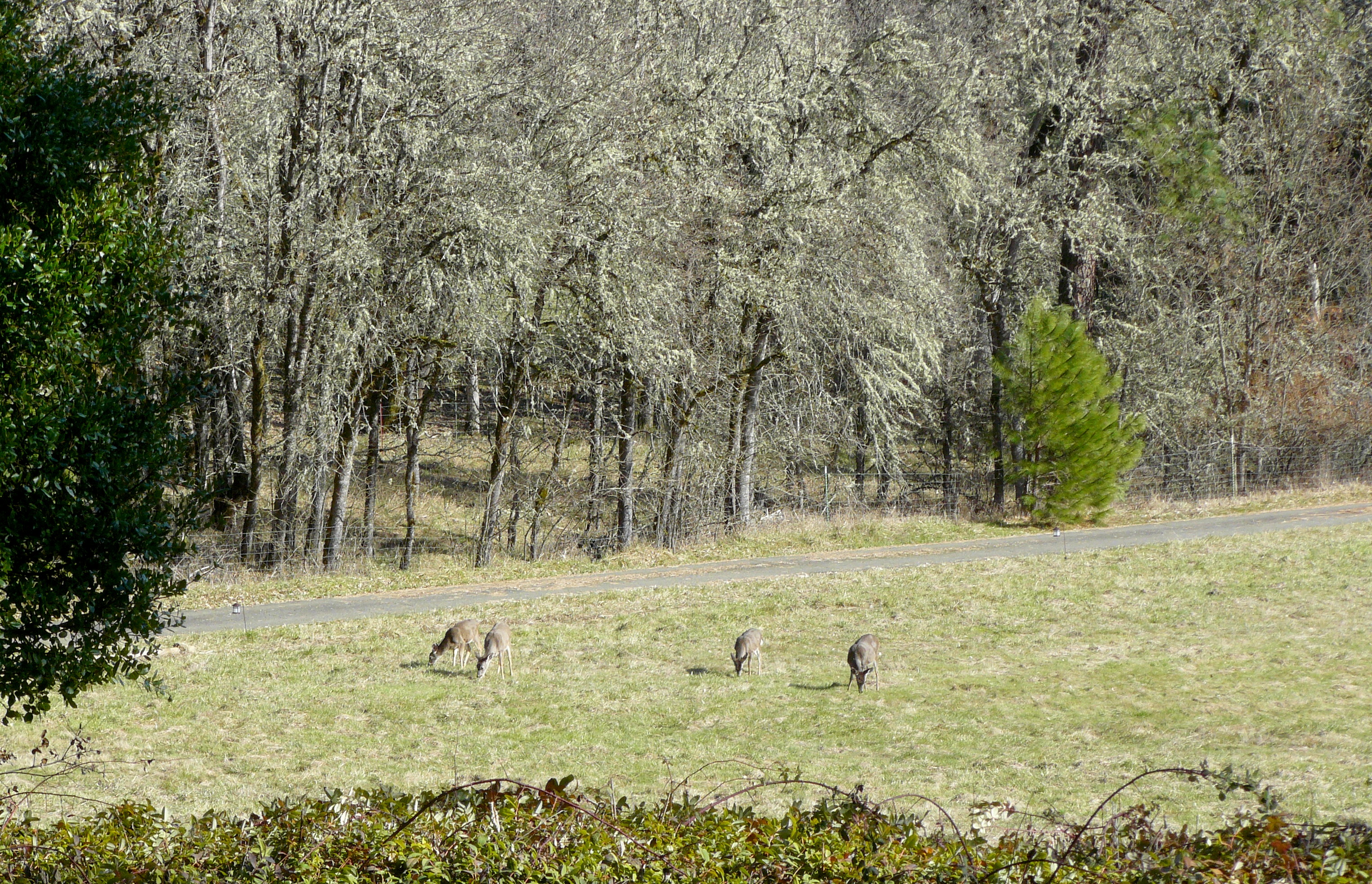
Wild deer feeding in the North-West corner of about 5 acres of our grassland.
Having mown the grassland a number of times in the Spring musing that there must be better ways to spend your time, a few weeks ago we came across an article about not mowing lawns. It was on the Mother Nature Network website and here’s how the article started.
Get off your grass and create an edible lawn
What would happen if you stopped watering, fertilizing, pesticiding and mowing your lawn?
Americans currently spend more than $30 billion, millions of gallons of gasoline, and countless hours to maintain the dream of the well-kept 31 million acres of lawns. An estimated 67 million pounds of herbicides, fungicides and insecticides are applied around homes and gardens yearly. Commercial areas such as parks, schools, playing fields, cemeteries, industrial, commercial and government landscapes, apply another 165 million pounds.
Lawn grasses are not native to the North American continent. A century ago, people would actually pull the grass out of their lawns to make room for the more useful weeds that were often incorporated into the family salad or herbal tea. It was the British aristocracy in the 1860s and ’70s, to show off their affluence, that encouraged the trend of weed-free lawns, indicating one had no need of the more common, yet useful plants. Homeowners were encouraged to cultivate lawns that would serve as examples to passers-by. These types of lawns also lent themselves to the popular lawn sports, croquet and lawn tennis. From the 1880s through 1920s in America, front lawns ceased to produce fodder for animals, and garden space was less cultivated, promoting canned food as the “wholesome choice.” Cars replaced the family horse and chemical fertilizers replaced manure.
It has been estimated that about 30 percent of our nation’s water supply goes to water lawns. In Dallas, Texas, watering lawns in the summer uses as much as 60 percent of the city water’s supply.
Next, a newsletter from The Xerces Society mentioned bee feed wildflower seed mixes from a company called Sunmark Seeds in Portland, OR. A call to them quickly produced the answer about what we could sow to help our local bees.
Hi Paul:
Upon further searching I did find 2 mixes that might fit what you are looking for. They are attached. The Bee Feed Mixture would be $36 per lb. The Honey Bee Flower Mixture would be $38 per lb. The price is a little higher but you would need a lot less. It is suggested 6-12 lbs per acre. You can still add the clover at $5 per lb and you should add 1 oz per lb of wildflower seed. There is still the option of the Knee High Low Profile mix which would be a little less at $30 per lb but the seeding rate is higher at 8-16 lbs per acre.
I have attached a spec sheet on all three mixes. Please let me know if you have any further questions.
Decision made. Three pounds of Bee Feed Mix to sow on a half-acre area as a test before we do all five acres next Spring.
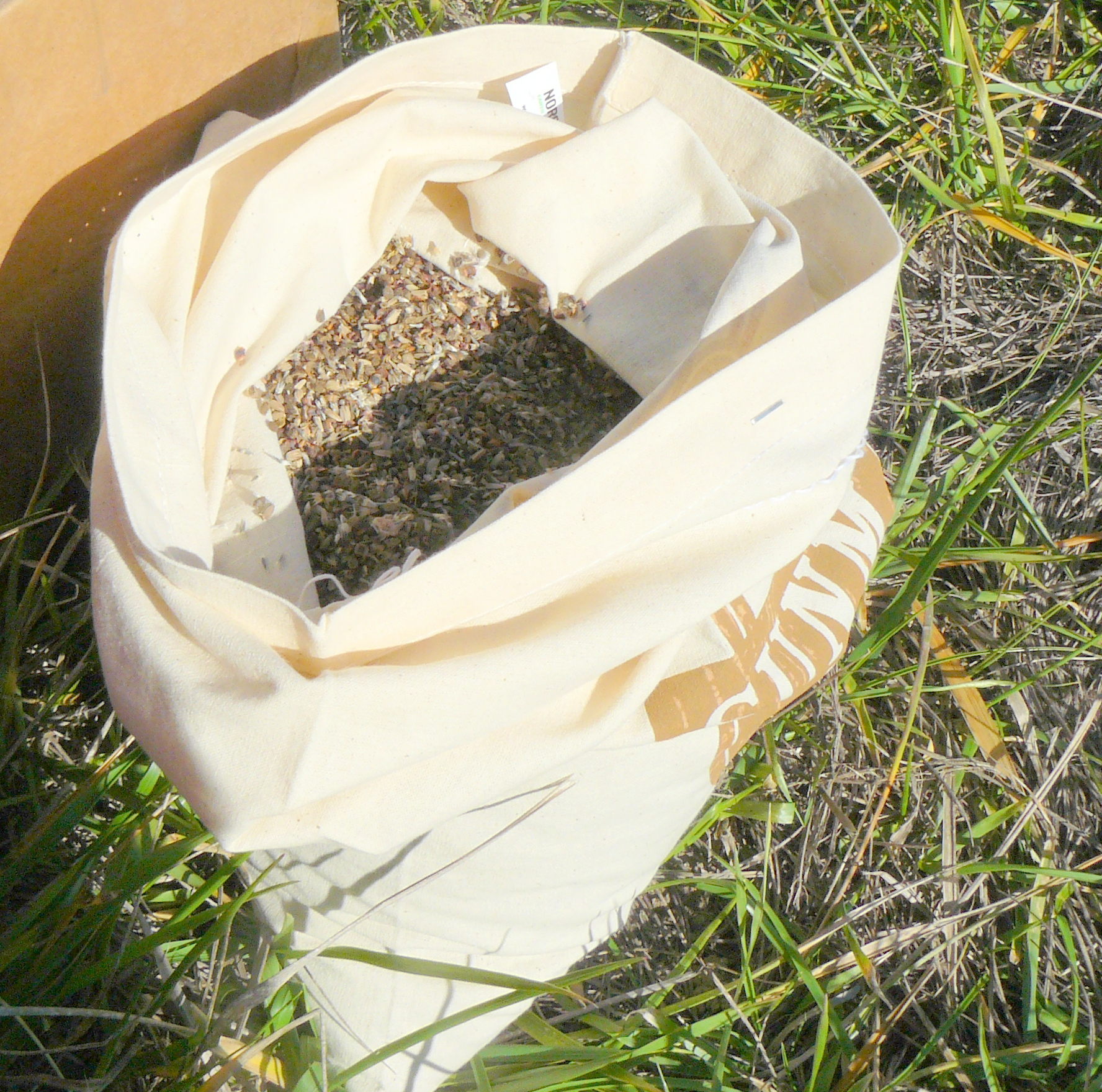
Thus not so much later a box arrived with our Bee Feed Mix and the next afternoon saw Jean and me marking out the test area and scattering the seed.
3 lbs of wild flower seed for next Spring’s bees!
oooo
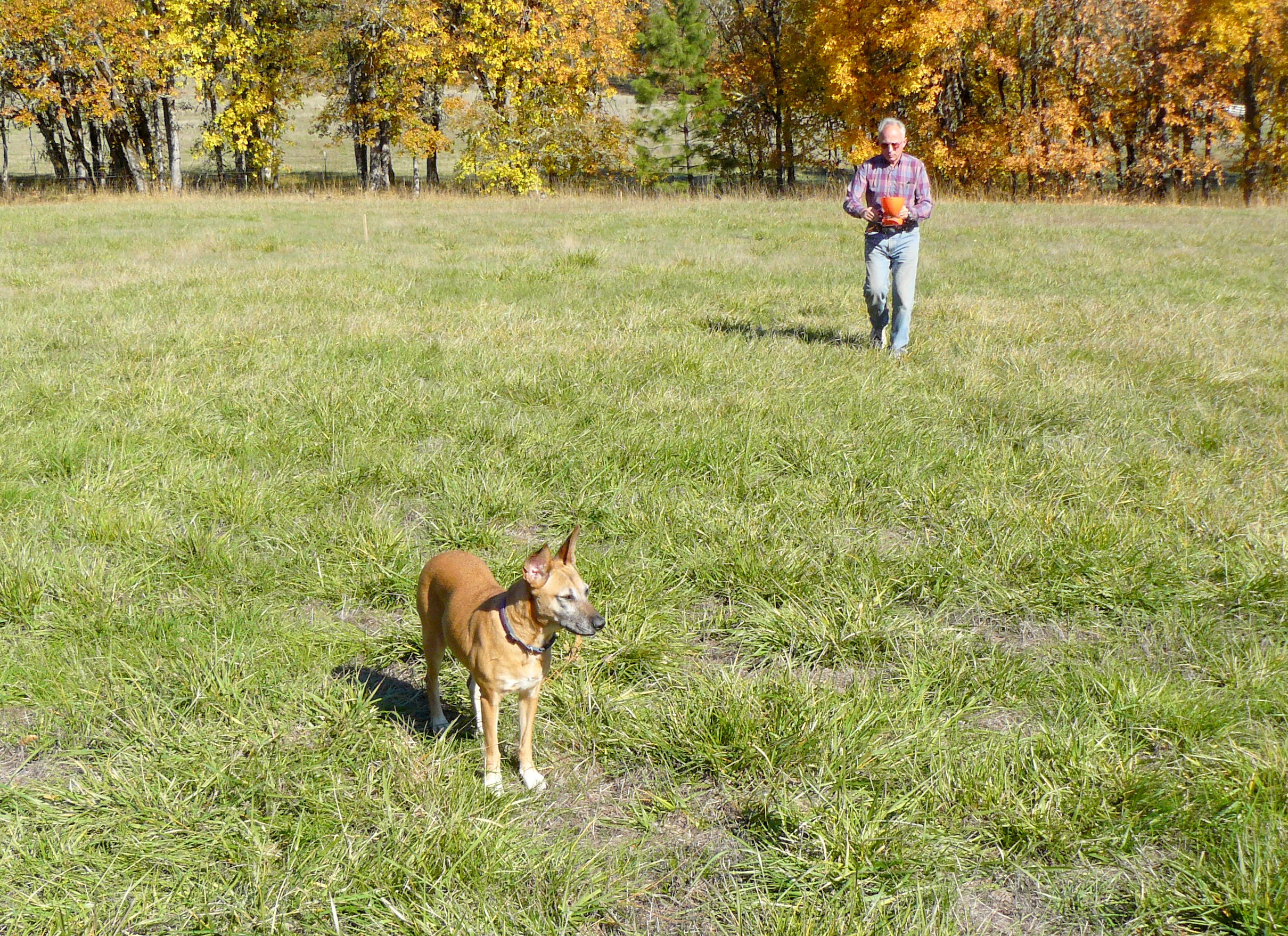
Hand-scattering the seeds with Dhalia keeping an eye on things.
oooo
It’s been an amazing year with plenty of challenges as we learnt to be rural people; yet another thing the dogs were able to teach us! However, the joy of living in such beautiful surroundings will last for ever. And more or less picking up on the theme for the week, the sharing, caring community of neighbours around us doubles that joy.
Jean and I consider ourselves two very lucky people. And no more mowing grassland! 🙂
“Minds together do not just bind together, they find together.”
My post last Monday, The lure of patterns, appears to have resonated far and wide. In the sense of many echoes reinforcing the perilous nature of our present times and the desperately uncertain decades ahead. Tomorrow I shall be writing specifically about those echoes.
Today, I wanted to spend a little time reflecting on dogs and communities! After all this blog is called Learning from Dogs!
In Monday’s post I opined that the future may well see a return to people re-evaluating and re-energising the benefits of local communities. Now when it comes to communities, there are no better examples than dogs and, so many thousands of years before dogs, grey wolves. These species have an incredibly strong social structure. I mean, of course, the pack. It’s a shame that the expression ‘pack of wolves’ or ‘pack of dogs’ has such misplaced negative connotations.
Before dogs were domesticated, as in when they first evolved from the grey wolf, they shared with wolves a natural pack size of around 50 animals. There was a very strong social cohesiveness within that pack yet a very ‘light’ status differential between those dogs having pack status and the mass of the pack group. Ditto with wolves.
In fact there were (still are) just three status roles: Mentor/Monitor/Nanny. Or has been described previously on this blog: Alpha/Beta/Omega roles. Even within the domesticated dog, thousands upon thousands of years later, those social instincts are alive and well. Many followers of Learning from Dogs will know that Pharaoh, him of the Home Page, now an elderly German Shepherd is a Monitor or Beta dog. I could write about this aspect of dogs for hours!
Pharaoh being a monitor for young Cleo.
So back to us funny old humans.
I closed last Monday’s post off with three predictions:
That the power of internet communications will allow more people, more quickly, to find their soul-mates wherever they are on this planet.
That the realisation of how dysfunctional many Governments are, of how truly poorly they serve the majorities of their citizens, will lead to mass rejections of these so-called Governments’ policies. Such rejections predominantly peaceful, as in taking the horse to water but being unable to make it drink.
That there will be a new form of localism. At two levels. Literally, people geographically close to each other creating 21st C. versions of local communities. Virtually, those local communities linking to other like-minded communities right across the world resulting in highly effective and innovative learning, accelerated common-sense, (call it wisdom if you wish), and extraordinarily efficient and sustainable ways of living on this planet.
Dear Paul: I like your predictions. They will play some role. But maybe somewhere in the bushes only. I think predictions of the future beyond the next 12 months are obsolete.
Jeremy remarked: (and do click the link and read some of Jeremy’s fantastic poetry)
I am hoping for a new localism. I see signs of this in the local food movement and a growing concern about factory farming, for one thing. I think people are really scrutinizing where their food comes from, where their medicines are made, and I think there also is a dawning awareness of how we are living on the backs of exploited third world workers (and poorly paid service workers here at home). I do see signs of these things permeating the consciousness of many people and leading them to want to become more “local.”
Your predictions are good, and I liked the one of communities from different parts of the world working with each other… that was creatively brilliant.
(Click on their names to see three wonderful blog sites, by the way.)
So my idea of a return to an era of localism, but a 21st C. version reflecting the way so many millions of us are connected electronically, wasn’t immediately rejected.
Patrice recently published a post called Devils In The Details. I mentioned in a comment to that post that I would be referring to it in this place. Patrice replied [my italics]:
Very good, Paul! No doubt you will bring more common sense to one more of these interesting collaborations you bring together! Internet debates! A long way from the paleolithique cave!… But still the same idea. Minds together do not just bind together, they find together.
I found that last sentence so powerful that it was used as the sub-heading to today’s post. Then Alexi Helligar commented:
The word consciousness, breaks down to con+scious+ness, which literally means together knowing or shared knowledge.
Adding in a subsequent comment:
In other words: Without society there is no consciousness. The sages of old knew this. Why has it been forgotten?
So right before my eyes (and yours!) we are seeing the power of ‘finding together‘.
Finally, just on the spur of the moment, I did a web search under an entry of ‘early caveman social structure’. Guess what! One of the top search returns was an essay by an Erik D. Kennedy under the title of On the Social Lives of Cavemen. From which jumped off the screen:
Human beings are no strangers to group living. Call it a family trait. Our closest animal relatives spend a good bulk of their time eating bugs off of their friends’ back. While I’m overjoyed we’re not social in that manner, I’m less pleased that we’re not social more to that degree. In study after study, having and spending time with close friends is consistently correlated with happiness and well-being. And yet, the last few decades in America have seen a remarkable decline in many things associated with being in a tight-knit social circle—things like family and household size, club participation, and number of close friends. Conversely, we’ve seen an increase in things associated with being alone—TV, commutes, and the internet, for example.
This trend is quite unhealthy. It’s no surprise that humans are social animals—but it may be surprising that we’re such social animals that merely joining a club halves your chance of death in the next year—or that living in a close-knit town of three-generation homes can almost singlehandedly keep you safe from heart disease.
My goodness me, this sharing idea may be core to a healthy society in ways that we need to return to. Erik’s essay goes on thus:
That particular case—of Roseto, Pennsylvania—is mentioned by Malcolm Gladwell in his book Outliers. In 1950’s Roseto, the incidence of heart disease in men over sixty-five was half the national average (and suicide, alcoholism, drug addiction, and serious crime were also basically unheard of[ii]). Bewildered doctors searched for solutions in genetics, diet, exercise, and geography, but finding nothing, reached the conclusion that it was the close-knit social life of the community that kept its residents so healthy. Dinners with grandma, friendly chats between neighbors, and a precocious level of civic involvement were the driving factors in the health of a town that nothing but old age could kill.
The happiness and health I’m describing are not, however, ingredients to a long-lost elixir of well-being. This sort of paleo social life occurs in cultures large and small all over the globe. America just happens to be an enormous exception (and the one that I live in). The whole reason Roseto was an outlier is because it was a town whose inhabitants more or less collectively moved from rural Italy to the middle of Pennsylvania over a few decades. This was basically an Italian village in the American countryside, and it stood out because Italy’s social culture was remarkable compared to America’s—and that was in the 1950’s. America’s social culture has only deteriorated even further since then. We’ve lost a lot, but my thesis is a positive one; we have as much to gain as ever.
So if wolves and dogs naturally settle into packs of 50 animals, what’s the optimum ‘pack’ size for humans? Dear Erik even offers that answer:
Along with that urban emigration came a shrink in residents per household and a widespread decline in community and organization engagement. This isolation has been taxing on our physical and mental health, and the reason has been clear from the beginning: it’s not good for man to be alone.
So we’ll spend more time with other people. Fine. But who should we spend our time with? What kind of groups should we hang out in? And how big of groups? The simple answer is: as long as you’re pretty close to the people you’re with, it hardly matters. Piles of research back up what is essentially obvious from everyday experience: that the more time you spend with people you trust, the better off you are. That’s not to discourage actively meeting new people, but seeing as though close friends push us towards health and happiness better than strangers, there does appear to be a limit on the number of people you can have in your “tribe”.
And that number is about 150, says anthropologist Robin Dunbar, who achieved anthropologist fame by drawing a graph plotting primates’ social group size as a function of their brain sizes. He inputted the average human brain size into his model, and lo and behold, the number 150 has been making a whirlwind tour of popular non-fiction books ever since. Beyond being the upper bound for both hunter-gatherer tribes and Paleolithic farming villages, it appears that everything from startup employee counts to online social networks show this number as a fairly consistent maximum for number of close social ties.
You really must read Erik’s essay in full; it really ‘spoke’ to me and maybe it will do the same for you.
So no other way to close than to say that of all the things we can learn from dogs, the power of sharing, of living a local community life, may just possibly be the difference between failure and survival of us humans.
Dogs and man should never be alone.
oooo
I’ll say it again! Dogs, and man, should never be alone!
There’s been a couple of posts that I want to refer to because they underline the fact that humans are so prone to forgetting that we are of the wild, from the wild and connected to the wild.
The first of those posts was a recent essay by Patrice Ayme under the title of Rewilding Us and is republished on Learning from Dogs with the kind permission of Patrice.
oooOOOooo
Rewilding Us.
REALITY IS WILD & FEROCIOUS. IGNORING IT IS INHUMAN.
And Presents A Civilizational Risk.
Princeton is freaking out. Flesh devouring aliens are lurking out in the woods, threatening academia’s fragile thoughts. Krugman:
A growing population of coyotes in the wooded area bordering the Institute for Advanced Study has motivated the Princeton Animal Control Advisory Committee to recommend that sharpshooters be hired to help handle the problem. “There is a big pack over at the Institute Woods,” officer Johnson said this week. “I’m having a lot of complaints that they follow people around.”‘
You Can’t Always Eat Who You Want
The “Mountain Lion”, is a relative of the Cheetah (erroneously put in the cat family, felis, until last year or so). It has 40 names, in English alone, and is found from the American Arctic to Patagonia, from the sea shore to the high mountains. The weight above is that of the female. Males are heavier (typically up to 100 kilograms). The heaviest puma shot in Arizona was 300 pounds (136 kilos).
The lion/cougar/puma is capable of jumping up twenty feet from a standstill (yes, 6 meters; horizontally, 14 meters). It is capable of killing a grizzly (pumas and ‘golden bears’ were famous for their naturally occurring furious fights to death in California). The feline’s crafty method consisted into jumping on top of the bear, and blinding him with furious pawing. Top speed: 50 mph, 80 km/h. (By the way, there used to be pure cheetahs in North America, recently exterminated by man. I propose to re-install the Asian cheetah in the USA, in a sort of cheetah diplomacy with Iran.)
The philosophical question here is: what is this world all about? Is it about living on our knees, or ruling among animals and wilderness?
Why would Princeton panic about small canids? Because they don’t obey the established order?
Coyotes are totally clever, and not at all dangerous (being so clever). They have very varied voices, when in packs. Going out and shooting them is really primitive, and misses the main point of having nature around. That is: to teach humility, and teach the richness of our planet, visit hearts with emotional diversity, and minds with complexity.
Bears and Mountain Lions are a completely different matter. They are both extremely clever too, but can be very dangerous.
Running and hiking in the Sierra, I got charged by scary bears several times. I view this dangerosity as a plus, but it never loses my mind, and I got scared nearly out my wits more than once.
Once, in a national Park on the coast, I literally ran into two large lions in 30 minutes! Then I got charged by a large elk before he realized I was not a lion. Other high notes were finding a bear cub on the trail in the near vertical mountain side, on the way down, as dusk was coming.
Another high point was the large bear by the trail, who was lying like a bear rug, at 9pm, in an apparent ruse to let me approach until he could jump at his prey, as he did, before realizing that I was not a deer, something that obviously infuriated him. He was torn between making the human into dinner, and the instinct that this would turn badly for him.
In Alaska I was charged by a moose with her progeny… although I did not go as fast as an experienced mountain biker who happened to be there too, the anti-grizzly cannister in my hand emboldened me to succeed in a circuitous move to proceed towards my distant destination, something facilitated by the calf’s crash into some obstacle, drawing his mother’s concern. Mountain running often requires to proceed, no matter the obstacles in the way, when one is too far to turn around.
Bears know rocks, they have been hurt by them, and so they fear airborn rocks (throw the rock on something noisy, to impress; I had to hit, with a very large rock, a charging bear directly, once; it fled; it was killed by rangers later after he caused a flesh wound to somebody else; some will find all this very violent; well, it is, that’s part of the whole point).
Mountain Lions are better charged and/or, roared or barked at. They fear insane behavior.
In general making lots of noise helps, with bears and lions. I don’t have clever tricks to suggest for bathing safely in the murky icy Pacific. Although I assume that the presence of sea lions bobbing on the surface placidly is indicative of the absence of an obvious white shark prowling… In any case the pacific is so cold, you will probably die of cardiac arrest before you are devoured.
In Africa, there are about 500,000 elephants. 25,000 to 30,000 are killed, a year, to send the ivory to east Asia (China, Vietnam). So African elephants may disappear. This is beyond tragic, it’s irreplaceable. Elephants understand people’s gestures, without any learning (they apparently learn to use trunk gestures among themselves). One is talking about extremely intelligent animals here. (In contrast, chimpanzees have great difficulties understanding human gestures.)
Intelligence and culture are dominant among apex mammals. That’s what makes them so superior. Washington State had the smart idea to shoot full grown adult male mountain lions. Thus mountain lion society and culture collapsed, uneducated teenagers took over, and incidents with humans exploded (something about the quiet macho society!).
A Japanese specialist of chimpanzee intelligence who happens to have a bear in his lab, found that the bear did not underperform chimpanzees on mental tasks (that’s actually a problem with bears; being so clever, they can be unpredictable, one can never know what they have up their sleeve, like the one who mimicked a bear rug, above, or one who drove a car in Tahoe). A number of social mentally advanced animals (sea mammals, parrots) use advanced languages.
So what are my recommendations? The Princeton Institute for Advanced Studies ought to realize that, if it wants to become really brainy, it ought to give our fellow species a chance. They are part of what make our minds, in full.
Elephants and rhinoceroses used to be all over Europe and North America. They ought to be re-introduced right away, using Indian and African species (rare camels too; later, thanks to genetic engineering, part of those could be replaced by re-engineered ancient species, such as the Mammoth). Lions and leopard like species ought to be reintroduced too.
It can work: in the San Francisco Bay Area, there is an impressive population of mountain lions. I had many close calls (in the most recent incident, a few weeks ago, a lion peed an enormous and dreadfully smelling amount on a trail I was making a loop on, obviously to show me he owned the territory, a total wilderness reserve a few miles from Silicon Valley… especially at dusk).
However, the lions are extremely good at avoiding people (although one got killed by police in downtown Berkeley in the wee hours of the morning). They will all be collared in the next ten years, to find out what is going on. With modern technology (collars!) and sophisticated human-animal culture, there is no reason why extremely dangerous, but clever species could not live in reasonable intelligence with humans.
So rewilding is possible. It’s also necessary. Why? So we humans can recover our hearts, and our minds.
Whether we like it or not, we are made for this wild planet. By forgetting how wild it is, by shooting it into submission, we lose track of the fact human life, and civilization itself, are much more fragile than they look.
And thus, by turning our back to the wilds, we lose track of what reality really is. Worse: we never discover all what our minds can be, and how thrilling the universe is. We are actually bad students who refuse to attend the most important school, that taught by reality itself.
Rewilding is necessary, not just to instill a mood conducive to saving the planet, but also to remake us in all we are supposed to be.
Expect Evil, And Don’t Submit.
These are the times when, once again, the plutocratic phenomenon is trying to take over. That’s when the few use the methods of Pluto to terrorize and subjugate the many (to constitute what is variously named an elite, oligarchy, or “nomenklatura“, or aristocracy, that is, a plutocracy).
And how is that possible? because the many have been made into a blind, stupid, meek herd (I refer to Nietzsche for the condemnation of the herd mentality).
How do we prevent that? Nietzsche advocated the mentality of the “blonde beast“. That meant the lion (and not what the Nazis claimed it was; few were as anti-Nazi as Nietzsche). Why lion? Because lions are domineering. I learned in Africa that one could go a long way with wild lions, as long as one gave them respect, and time to get out of the way. However, disrespecting a lion means death.
Lions don’t accept to live on their knees. When abominable forces from the giant Persian theocratic plutocracy put the tiny Athenian democracy in desperate military situations, Athenians fought like lions. And democracy won.
Yet, 150 years later, when fascist, plutocratic, but apparently not as abominable, Macedonian forces put Athens in a difficult situation, Athenians surrendered. They did not fight like lions. Democracy would not come back to Athens for 23 centuries (and only thanks to the European Union).
We will not defeat plutocracy if we do not rewild ourselves. First. Let there be lions.
***
Patrice Ayme
oooOOOooo
What I read in Patrice’s essay is this. Man is, by definition, part of nature. Yet man, uniquely of all the natural species on this planet, has contrived to ‘evolve’ a set of beliefs that run counter to the core integrity of nature. Perhaps more accurately put: sections of modern man have evolved this way.
I have a background piece on Learning from Dogs called Dogs and integrity. Here’s an extract:
value and cherish the ‘present’ in a way that humans can only dream of achieving
are, by eons of time, a more successful species than man.
And have poetry written for them:
Inner Peace
If you can start the day without caffeine,
If you can always be cheerful, ignoring aches and pains,
If you can resist complaining and boring people with your troubles,
If you can eat the same food every day and be grateful for it,
If you can understand when your loved ones are too busy to give you any time,
If you can take criticism and blame without resentment,
If you can conquer tension without medical help,
If you can relax without liquor,
If you can sleep without the aid of drugs,
You are probably the family dog!
Those words apply equally to all the animals on this planet; all of Nature’s animals. In other words, integrity must be and has to be the one and only framework within which we live.
I occasionally read sad stories in my local media of senseless cruelty against wildlife around my town of Colchester: the smashing of barn owl eggs; people suffocated badgers by closing their den up. People have no opportunity to expose themselves to nature, and thus connect with nature, some experts call “Nature Deficit Disorder.”
Technology, far from liberating, enslaves the individual to a relentless need for entertainment and personal validation, backed by demands of television, homework, cellphones and money earning. Many view nature as a health and safety risk, so that it is either managed or avoided. The situation is best illustrated in a satirical YouTube video called“The discovery of the last child in the woods.”
The solution is simple: expose yourself to nature.
The indigenous Native American expresses a connection to nature in this video:
Here is that video. Watch it without interruption. In less that 3 minutes it spells out everything that we humans have to relearn about the world we live in; the world we are part of. The integrous world we must fight for. Fight for as lions!
When all the trees have been cut down,
when all the animals have been hunted,
when all the waters are polluted,
when all the air is unsafe to breathe,
only then will you discover you cannot eat money. ~ Cree Prophecy ~
A warning of the dangers of cell phones and the like!
Yesterday, I simply ran out of time to write to write a more personal post for today. So I looked at some of the news items that I had collected recently and two jumped out as being both deeply connected and worthy of posting.
The first was an item that was seen on Natural News a little more than a couple of months ago. It had the title of EMF exposures destroy health and well-being, claims panel of top international scientists. The link to that article is here. It opens, thus:
(NaturalNews) Nearly 8 million people worldwide die from cancer on an annual basis. Cardiovascular disease is the number one cause of death, killing almost 17 million people in 2011; both of these statistics are spiraling out of control. Now three top scientists, Dr. Panagopoulos of the University of Athens , Associate Prof. Johansson of the Karolinska Institute, and Dr. Carlo of the Science and Public Policy Institute, are sounding the alarm bell.
Leaders in their respective fields, Panagopoulos, Johansson, and Carlo, claim electromagnetic field (EMF) exposures significantly below international safety levels exposures are destroying the public’s health and well-being.
Recent study findings
This latest study concluded the present standard of measuring EMFs, Specific Absorption Rate (SAR), to be totally inappropriate. SAR measures the heating effect of EMF based technologies like microwave ovens, cell phones, cordless phones, Wi-Fi and the like. But countless studies have brought to light adverse biological effects at radiation levels significantly below levels where a thermal effect is detected.
Please do go here and read the full article. Because as one reads from the closing advice, as below, whom these days isn’t being affected?
Basic EMF protection
Reducing personal exposure to EMFs is a fairly easy endeavor. Basic EMF protection can be achieved by:
• Texting instead of talking with cell phones
• Setting cell phones on airplane mode when not in use
• Clearing the bedroom of electrical devices
• Replacing Wi-Fi with a hard-wired connection
Taking these simple steps is well worth the effort; the power to reduce EMF exposure and the adverse health effects that stem from them are truly right there at your fingertips.
Multifocal Breast Cancer in Young Women with Prolonged Contact between Their Breasts and Their Cellular Phones
Abstract
Breast cancer occurring in women under the age of 40 is uncommon in the absence of family history or genetic predisposition, and prompts the exploration of other possible exposures or environmental risks. We report a case series of four young women—ages from 21 to 39—with multifocal invasive breast cancer that raises the concern of a possible association with nonionizing radiation of electromagnetic field exposures from cellular phones. All patients regularly carried their smartphones directly against their breasts in their brassieres for up to 10 hours a day, for several years, and developed tumors in areas of their breasts immediately underlying the phones. All patients had no family history of breast cancer, tested negative for BRCA1 and BRCA2, and had no other known breast cancer risks. Their breast imaging is reviewed, showing clustering of multiple tumor foci in the breast directly under the area of phone contact. Pathology of all four cases shows striking similarity; all tumors are hormone-positive, low-intermediate grade, having an extensive intraductal component, and all tumors have near identical morphology. These cases raise awareness to the lack of safety data of prolonged direct contact with cellular phones.
Although not my usual type of post here on Learning from Dogs a forthcoming event regarding GMOs seemed worthy of greater promotion, especially as it includes concerns about possible ‘contaminated’ dog food. The event was mentioned on the Permaculture News blog; a blog that I follow.
What was described was a free, 3-day online ‘summit’ about genetically modified organisms. Let me quote from the blog post:
The scary truth about Genetically Modified Organisms (GMOs) is being deliberately kept from you….
Fact: Your food has been unnaturally changed. These changes have very serious consequences.
Your family’s health is at risk and you deserve the truth….
We’re going to share with you the true effects of genetically engineered food on human health and the environment. You’re invited to join our panel of experts, researchers and activists in an inspirational and free, 3-day GMO Summit — October 25-27, 2013.
This is a virtual event you can enjoy at no cost from the comfort and convenience of your own home.
If you want to know the truth about GMOs and the risks Monsanto, the government, their paid advisors and the media are deliberately hiding from you, then join in this unique, free summit.
There’s an impressive line-up of 10 main speakers and another 10 supplementary speakers. And, as the blog post goes on to say:
We didn’t want to overwhelm you in just 3 days, so once the GMO Mini Summit is complete, you’ll get even more empowered by 10 more experts in interviews over the next 5 weeks (2 per week) who will share even more about this crucial topic. When you register for free you will gain access to all 20 speakers!
So you need to go here to sign up, after which you will be directed to a welcome page. There you will learn more about the way that GMOs are affecting so many aspects of our lives and of the lives of our beloved dogs.







 Learning from Dogs