It’s almost impossible, at times, to get one’s mind around life’s events. I’m not wishing to be overly philosophical but, nonetheless, it doesn’t do any harm to muse from time to time about the nature of things.
Take our two rescue horses: Ben and Ranger.
They have now been with us for coming up to three months. Considering how terribly they were treated before being rescued by Darla Clark of Strawberry Mountain Mustangs, it’s a privilege to experience the way that these two horses have so rapidly put their past behind them.
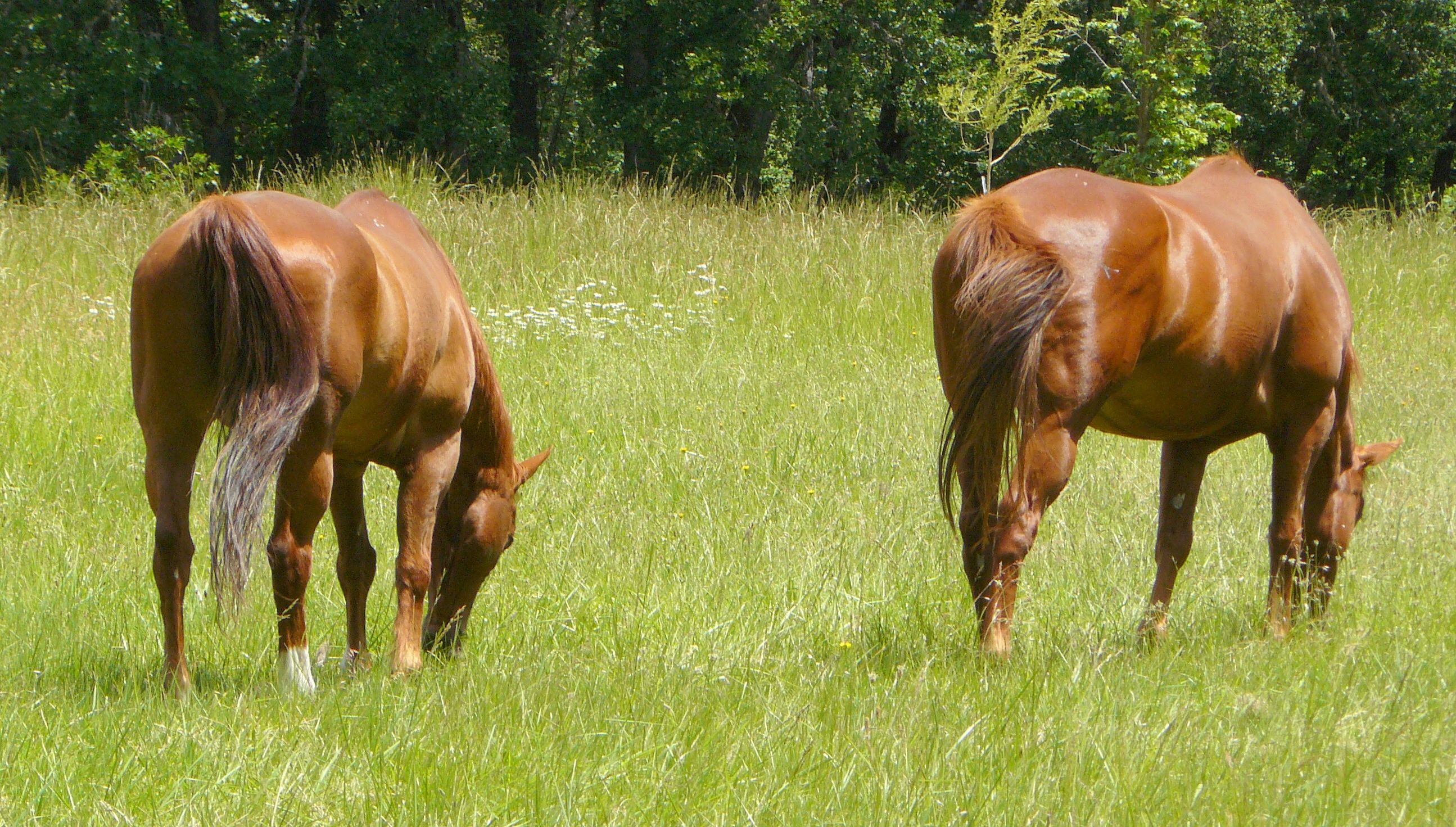
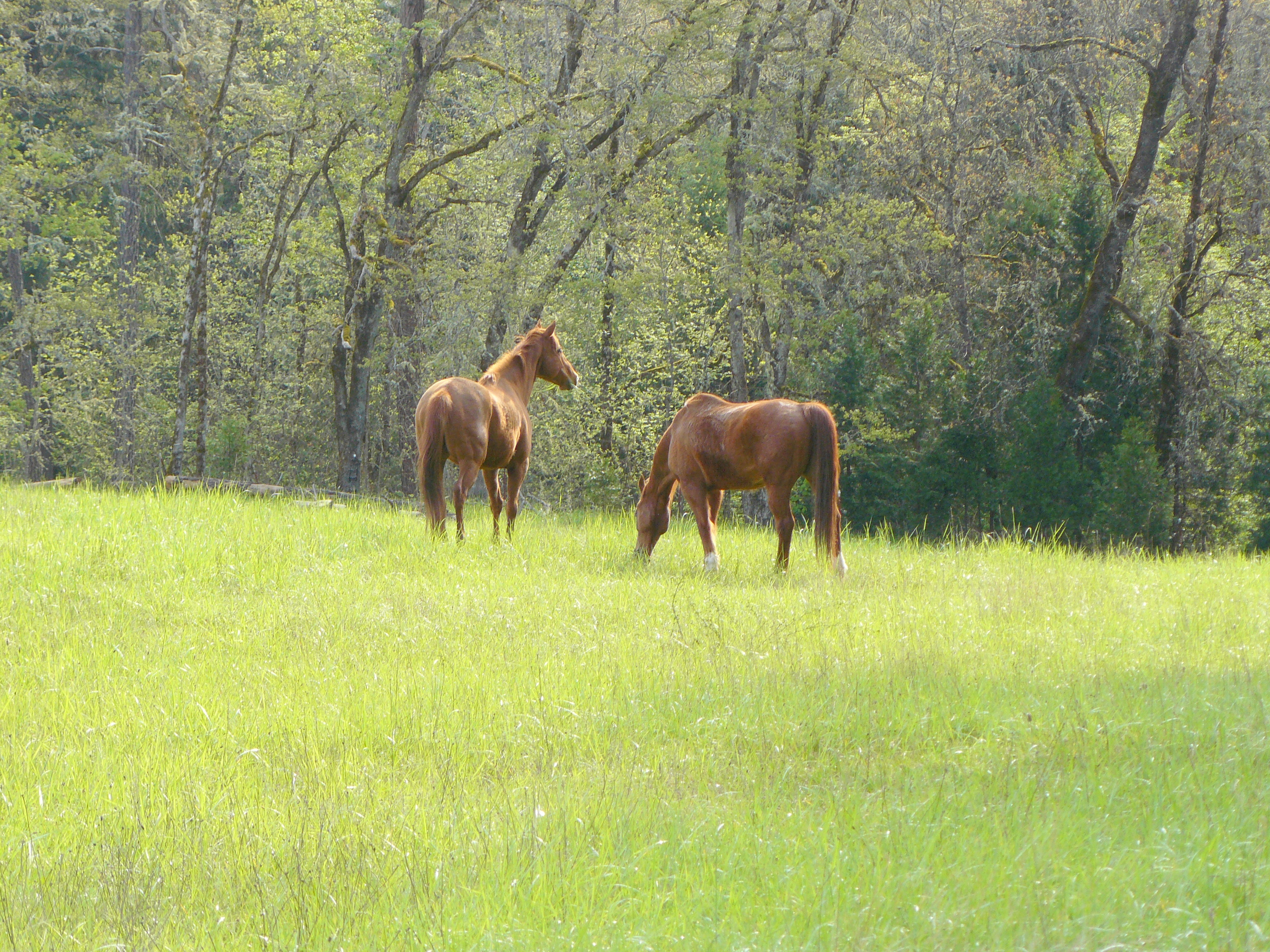
All of which is a preamble to this photograph taken just a couple of days ago.
Ranger (LHS) and Ben enjoying our open grassland.
Just look at their shiny coats! Just look at them so happily munching away on the grass.
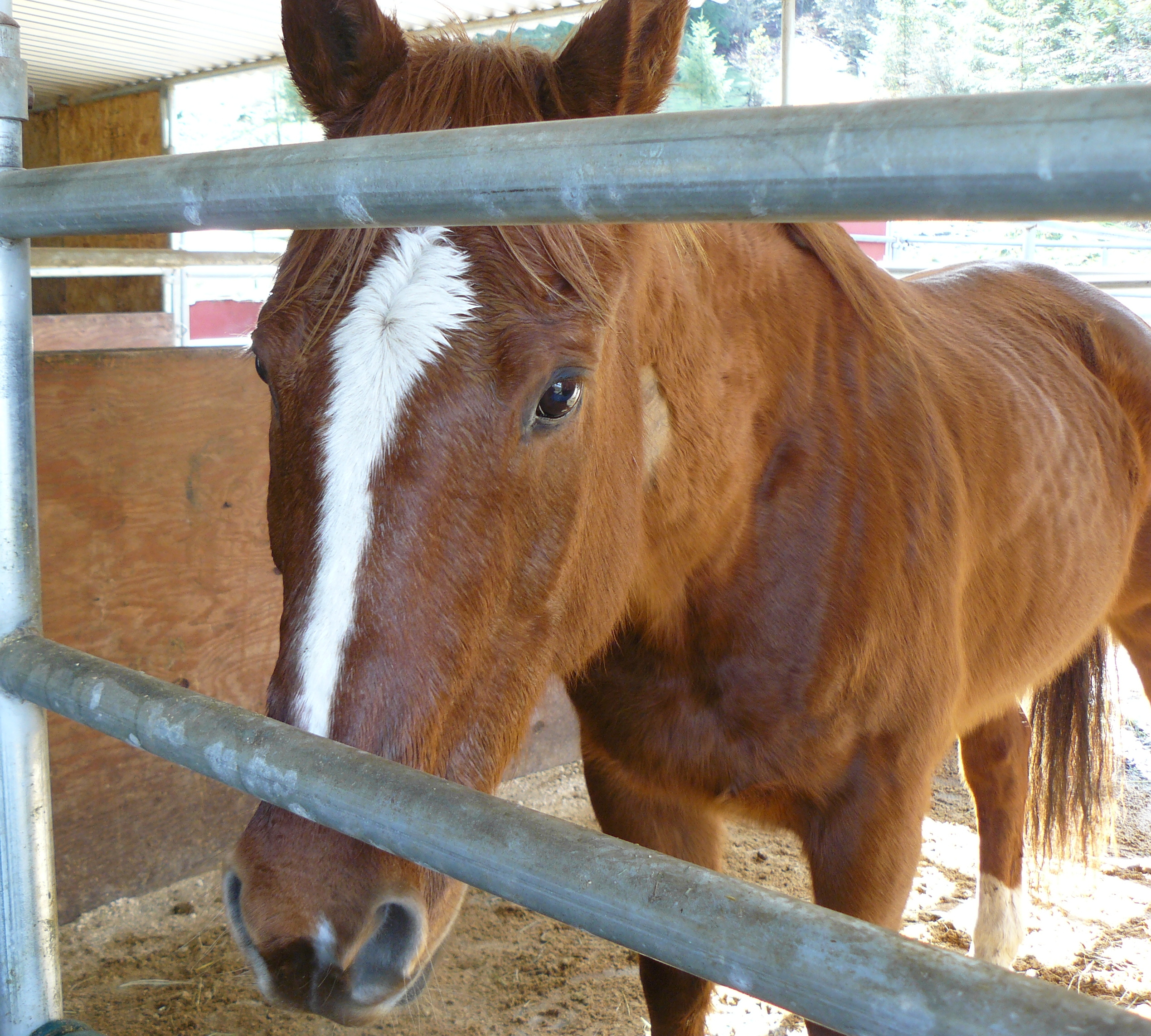
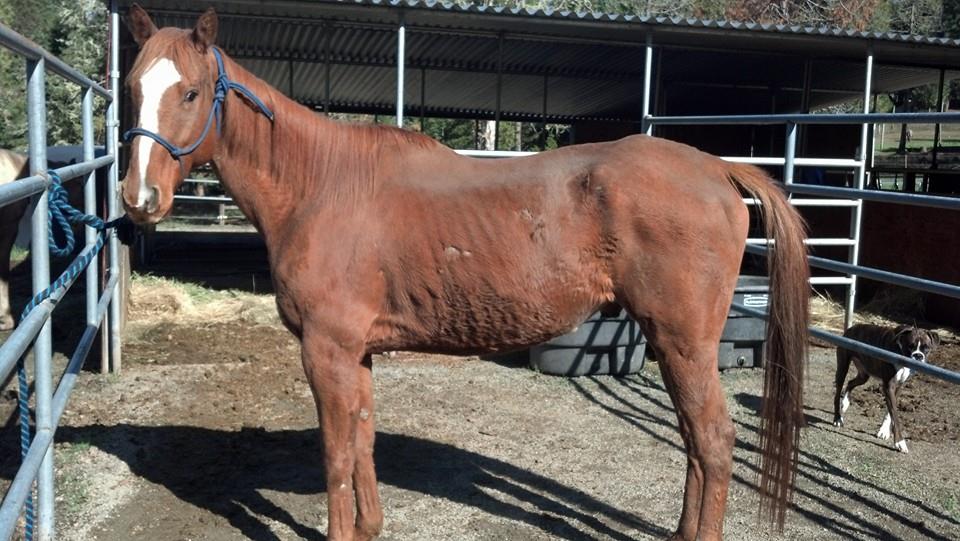
Now look at how they were not so long ago.
Ranger, when first seen in February.
oooo
Ben as seen last October.
So back to present, happy times.
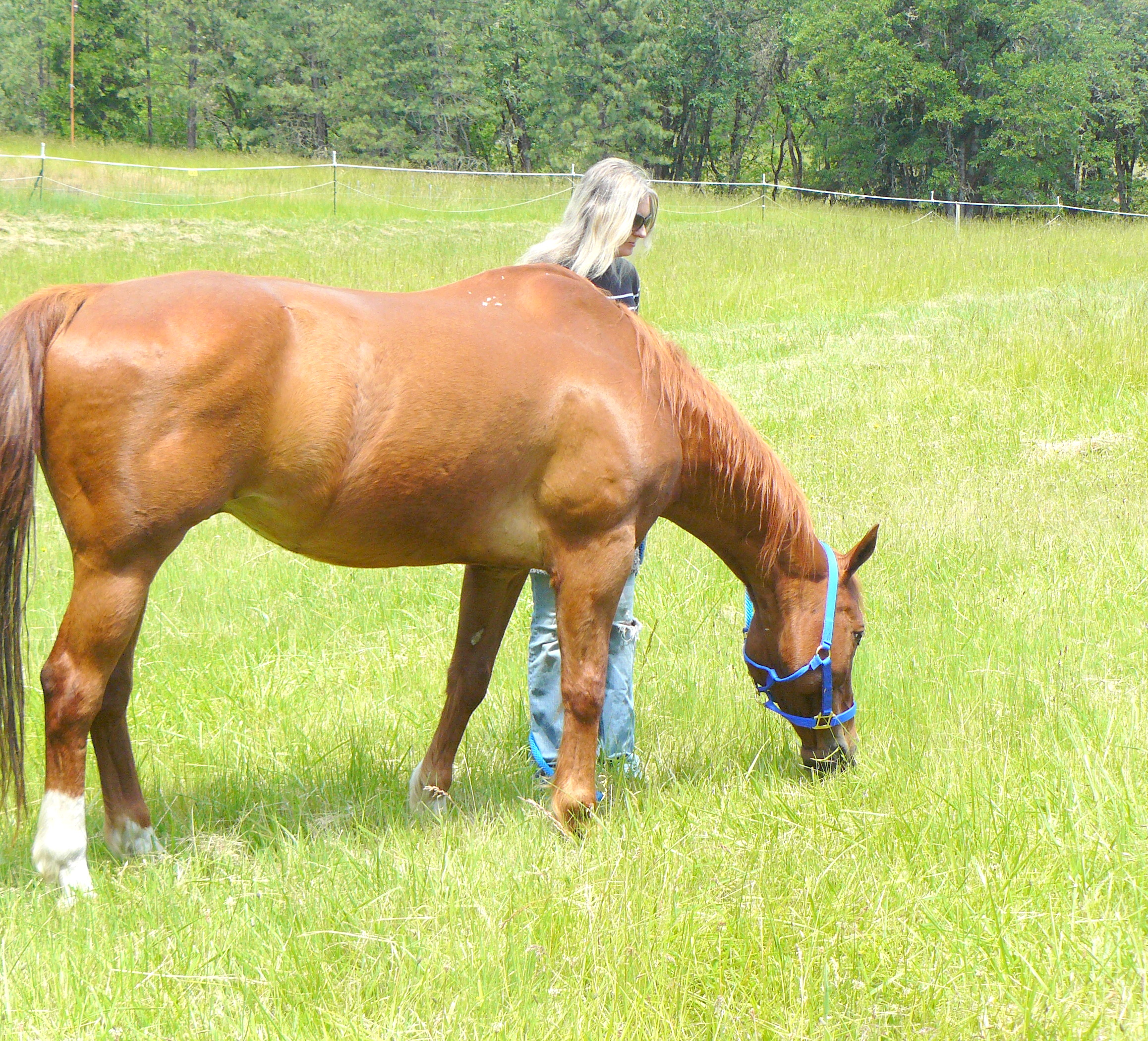
The last photograph is of Jean having just put a halter on Ranger so that the two of them can be taken in at the end of the day. Ben follows Ranger in without the need of a halter. Ben and Ranger are inseparable!
oooo
Tomorrow, the celebration of another beautiful animal!
OK, I accept that the sub-heading is slightly provocative but so what!
The fascination in truly knowing who we are is endless!
Back in January of this year, I penned an essay under the title of 20:20 self-awareness. Here’s a snippet from that post:
“The single biggest problem in communication is the illusion that it has taken place.” George Bernard Shaw is reputed to have once said!
Today’s essay on the challenges of speaking clearly to another, perhaps better described as communicating in a clear and unambiguous fashion, came out of a recent conversation with Jon Lavin, a good friend from my Devon days. (Jon offers services for business owners and entrepreneurs under his business banner of The People Workshop.)
Jon was explaining that the number one hurdle for businesses that are managing change, and for so many businesses managing change is practically a constant, is having clear communications within the team.
The essence of that, and other posts over the years, is that knowing others, communicating with others, is so much easier when we know ourself well.
Not just relevant to us humans, by the way. Dogs love knowing us sufficiently well that they can trust and understand our behaviours.
So all of that is an introduction to an article that was recently on the website of London-based Harley Therapy. The article is called How to Be Your Authentic Self. I have taken the liberty of republishing it in full here on Learning from Dogs. (See copyright statement at the end.)
ooOOoo
It’s a little after 6am.
I awoke this morning with the terrible realisation that I didn’t have permission to republish that article and, therefore, have ‘amended’ today’s post and removed the item..
A reflection on intelligence, learning and knowledge.
Today’s essay has been prompted by a fascinating exchange of views and comments on a post recently published by Patrice Ayme. More of that tomorrow.
Before getting to the heart of things, I feel compelled to offer a little background on my own educational journey. It is presented today as a preamble to tomorrow’s main essay.
By rights, I should have enjoyed a stunning academic journey as a young man. My mother holds a double degree in French and German from Cambridge University. My father was both a Chartered Architect and Chartered Surveyor and worked for Barclay Perkins & Co at their Anchor Brewery in Southwark, London all his working life. My uncle, Christian Schiller, took up a mathematics scholarship at Sidney Sussex college at Cambridge University and ended up HM Inspector of Schools in the United Kingdom. Notably, he was a promoter of progressive ideas in primary education.
But it was not to be so.
My father died suddenly and with very little warning five days before Christmas in 1956. I had turned 12-years-old some six weeks previously and just completed my first term at Preston Manor County Grammar School. My secure, comfortable young life was thrown into emotional turmoil with one of the consequences being that instead of passing a clutch of GCE ‘O-Level’ exams, I barely managed to pass two subjects and was unable to continue on with a higher level of studying and the consequent sitting of GCE ‘A-Level’ exams, a pre-requisit for university.
Somehow, I then managed to win a place as a student at the Faraday House of Electrical Engineering, in those days based at Southampton Row, London. It was to study for a Diploma in Electrical Engineering. The requirement was that by the end of my first year at Faraday House I should pass two A-level examinations.
I was very happy as a college student. That first year was spent entirely learning about engineering with much time ‘hands-on’ in the engineering workshop. Then came time for me to sit those two A-level exams. I failed both of them! There was no choice but for me to leave the college.
So that’s enough to demonstrate that academic prowess was not my speciality.
However, being unable to jump through the hoops needed for a degree or equivalent didn’t mean that I was a poor learner; far from it.
After my father’s death, my mother remarried and my ‘new’ Dad was very supportive. He had a background in communications and quickly encouraged me to become a radio amateur. I joined the nearby Radio Society of Harrow (still in existence!) and their encouragement enabled me to pass the full set of exams necessary to become a licensed radio amateur and a full member of the Radio Society of Great Britain. My amateur call sign was (and still is) G3PUK. I was 17.
I can still whistle the alphabet in morse code, from A to Z, and the numbers 0 to 9!
Later on, when I was an apprentice at the British Aircraft Corporation’s site in Stevenage, Hertfordshire, one of the commercial staff, Jim Jenner, spent many hours preparing me for the Institute of Advanced Motorists examination. I passed that exam and became a full member of the IAM in May, 1966.
So there’s my background that, hopefully, will set the scene to a wonderful exchange of views and ideas that flowed from Patrice’s blog. Ideas that will be explored tomorrow.
For the reason, the powerful reason, that the intelligence and wisdom of humanity has always been important. But now, in this time of the affairs of man, our collective intelligence and wisdom has never been more important.
Nature imposes herself on us humans in absolute terms.
I do not believe in any form of life after death. Jean is uncertain. Many good people do believe in some form of spiritual afterlife.
However, one thing is sure. Our living mind and body will die.
These few words are an introduction to the first essay under the broad title of The Natural order. On the 23rd April I introduced the idea of writing a regular essay “about the past, present and future of man’s relationship with Nature.”
Thus it did seem entirely appropriate to ‘kick off’ the essays with reflections about life and death.
Posted on April 27, 2014 | Nature reminds me life and death is a circle.
The circle of life and death.
I visit a house, the noise of hungry little birds emanating from a nest hidden in the roof, busy parents flying in and out feeding their brood. Less than a week before summer (1st May) I encounter life all about me, like a vast fountain of creativity, as plant and animal erupt into growth and creation. I feel a sense of joy at the life all about me, like dipping my feet in crystal clear spring waters.
Amongst this carnival of life a reminder that with life there is also death. Helix our cat is an effective hunter, a blue tit is found dead upon the ground. I feel no sadness for the death, it is a natural part of the cycle of nature, my animistic viewpoint is of a small spirit returning to the source, and from then renewing. No anger for Helix, since this is the nature of cats, despite being fed, a cat must follow the primal instinct of its nature to hunt. I carry the dead blue tit to an overgrown spot of trees and grass, here I place the blue tit to decay and thus become part of the life of plant and animal of that place, such is the circle of life and death.
ooOOoo
There can’t be a single person on this planet who does not understand that our human life is finite.
Life span of early man: Until fairly recently, little information existed about how long prehistoric people lived. Too few fossilized human remains made it tough for historians to estimate the demographics of any population. Anthropology professors Rachel Caspari and Sang-Hee Lee chose instead to analyze the relative ages of skeletons found in archeological digs in eastern and southern Africa, Europe, and elsewhere. Comparing the proportion of those who died young, with those who died at an older age, the team concluded that longevity only began to significantly increase (that is, past the age of 30 or so) about 30,000 years ago – quite late in the span of human evolution.
In an article published in 2011 in Scientific American, Caspari calls the shift the “evolution of grandparents”, as it marks the first time in human history that three generations might have co-existed. ( Source: Longevity Throughout History.)
Thus given that living much past the age of thirty years is a relatively recent experience, it baffles me beyond comprehension that we, as in mankind, have become so short-sighted about reinvesting in the one and only natural planet that sustains us.
Beautifully expressed in another wonderful essay from John Hurlburt.
ooOOoo
Notes on the Human Dilemma
The metanexus of Faith, Nature and Science form an integral vision of the reality in which we exist. We are components of Creation living in an emerging universe. As consciously aware life forms we are each and all responsible to the Nature of God in a steadily emerging universe. Change is both constant and inevitable. Species that don’t adapt, do not survive.
Our human problems are obvious.
The essential growth of human conscious awareness remains questionable.
There is a blatant disregard for Nature. The rate of Natural disasters is increasing everywhere on Earth
Civil unrest is bordering on a second Civil War and is already in that state in many other nations of the world.
Imminent economic collapse remains probable as long our world economy is based on a foundation that has been leveraged at least twenty-five times above any realistic material foundation on Earth.
Are we a moral species?
A steady increase in natural disasters worldwide is inevitable until we change in response to Nature’s warnings or become extinct. The collapse of morality threatens the existence of global civilization.
The virtual extinction of the human race in its present state is all but assured within the next century unless we adapt to the Reality we presently blithely ignore or chose to vilify.
We still have a choice.
Our alternative to what has been euphemistically referred to as “new reality” is the process of education, reformation and transformation on a personal level. The objectives are an obvious need to adapt to constant natural change and create a species renaissance in harmony with the reality of God, Nature and Science.
There is clearly a need for a global economy that is based on our primal need for clean air, clean water, clean food and clean energy. We need to maintain our balance through gratitude for the blessings of the life we share and equal justice for all. We need to remember that we are not in charge of anything except our responsibilities to God, Nature and each other.
Under these simple guidelines, a healthy, growing future remains possible as we prepare to migrate from our home planet and relieve the consumptive consequences of an exponentially growing and ravenous demographic ruled by the artificial symbol of Money.
Sound impossible? Au contraire…
The world is being forced to re-evaluate its economic premises. Here are a few proven solutions to help create a naturally invigorated economy.
We can cut air pollution dramatically overnight by converting commercial diesel engines to far more cost-effective bio-fuels without a single change to the diesel mechanisms.
Bio-diesel distillation plants can filter and recycle the clean water we need to live.
We are capable of growing our own food with recycled organic fertilizers.
We have begun the process of harnessing the limitless clean renewable energy provided by the sun, the wind and hydraulic power.
Electric cars that may be fueled by solar energy are winning world class races.
The list of what we are capable of doing is only limited by our imaginations.
The questions to ask ourselves are:
Are we at the beginning of a new world or at the end of an old world?
“Are we a part of the problem or part of a realistic solution?”
The power of having a great friendship – with yourself!
Today’s post came as a result of some poems published by Kimberley over at Words4jp’s Blog. She and I follow each other’s blog and each often stirs the other’s emotions. There was a sad post published by her on the 23rd April called within. Part of the comment that I wrote to that post read as follows:
Oh, it pains me to read your post. You are such an open, honest person; well that’s what comes across through your writings. Knowing and loving ourself is the only worthwhile journey of our life. For without being at peace with who we are, we will struggle to be at peace with others.
Kimberley published another post the following day, friend and foe, that again struck me as being sad. Read it and see if you agree with me.
it is said
to keep one’s friends close
but
to keep one’s enemies closer
SO
could this explain
WHY
when i look in the mirror
i find
i am becoming less of a friend
and
more of an enemy –
to myself
?
…
After reading both those poems I ‘threatened’ Kimberley that I would write a post on becoming friends with oneself.
Here it is. Adding immediately that I’m drawing heavily on a conversation that Jon Lavin and I had a few months ago; Jon’s background can be looked up over at The People Workshop. Jon is the professional psychotherapist – I am not!
ooOOoo
Knowing who we are.
On the 24th January last, I published a post under the title of 20:20 self-awareness. Included in that post was this:
What we hear and what we say are both modified, frequently unconsciously, by past events, experiences and trauma. That being the case, then it is key, critically so, that we achieve the best possible self-awareness. Because it is only through an understanding of our past that we come to learn of our sensitivities and our associated ‘tender spots’ and their potential for ‘pulling our strings’. Here’s a personal story.
In 1956, when I was 12, I experienced a trauma that was interpreted by my consciousness as emotional rejection. By the age of 14 that sensitivity to rejection had descended into my subconscious. For fifty years, that sensitivity remained hidden yet continued to influence my life in many unseen ways, not all of them negatively by a long measure. In 2007 a period of counselling revealed that hidden emotional rejection; brought it to the surface. It changed beyond imagination how I felt, how I behaved, how I was. Nonetheless, that sensitivity to rejection is still there, albeit now visible. Thus when I hear or experience something that tickles that sensitivity I still react. But because I can now see and feel myself reacting, I can sidestep the emotional strings.
OK, but what does better self-awareness not achieve? Knowing better who we are delivers no cleansing of our past, no removal of the capacity of that past to cause pain. Those psychological hooks and impulses are still alive and well!
So what’s the point of knowing better who we are if that greater self-awareness doesn’t remove those hooks and impulses that have the capacity to cause us pain?
The answer to that last question is this.
Greater self-awareness brings about control by the self of the self! We are able to start the slow process of gaining trust in ourselves. Trust; as in emotional trust. Being able to emotionally trust ourself is a central theme in psychotherapy solutions.
When we trust the emotional person that we are then we have achieved a liking for the person that we are. Bringing to mind the truism that you cannot like another if you do not like yourself. Like = Love, of course.
So two things to offer to close the post.
The first is that if you have any suspicion, or know for certain, that you have experienced trauma in your past life, especially in your formative years then the book Waking The Tiger by Peter A. Levine is a valuable resource. You can learn more about the book including reading the first chapter on the Somatic Experiencing website.
The second is to repeat the short film that was included in the 20:20 self-awareness post. This is how it was introduced:
The following is a short, twenty-minute, documentary film about fear. Do watch it. The message that we are so profoundly a product of our past is beautifully presented.
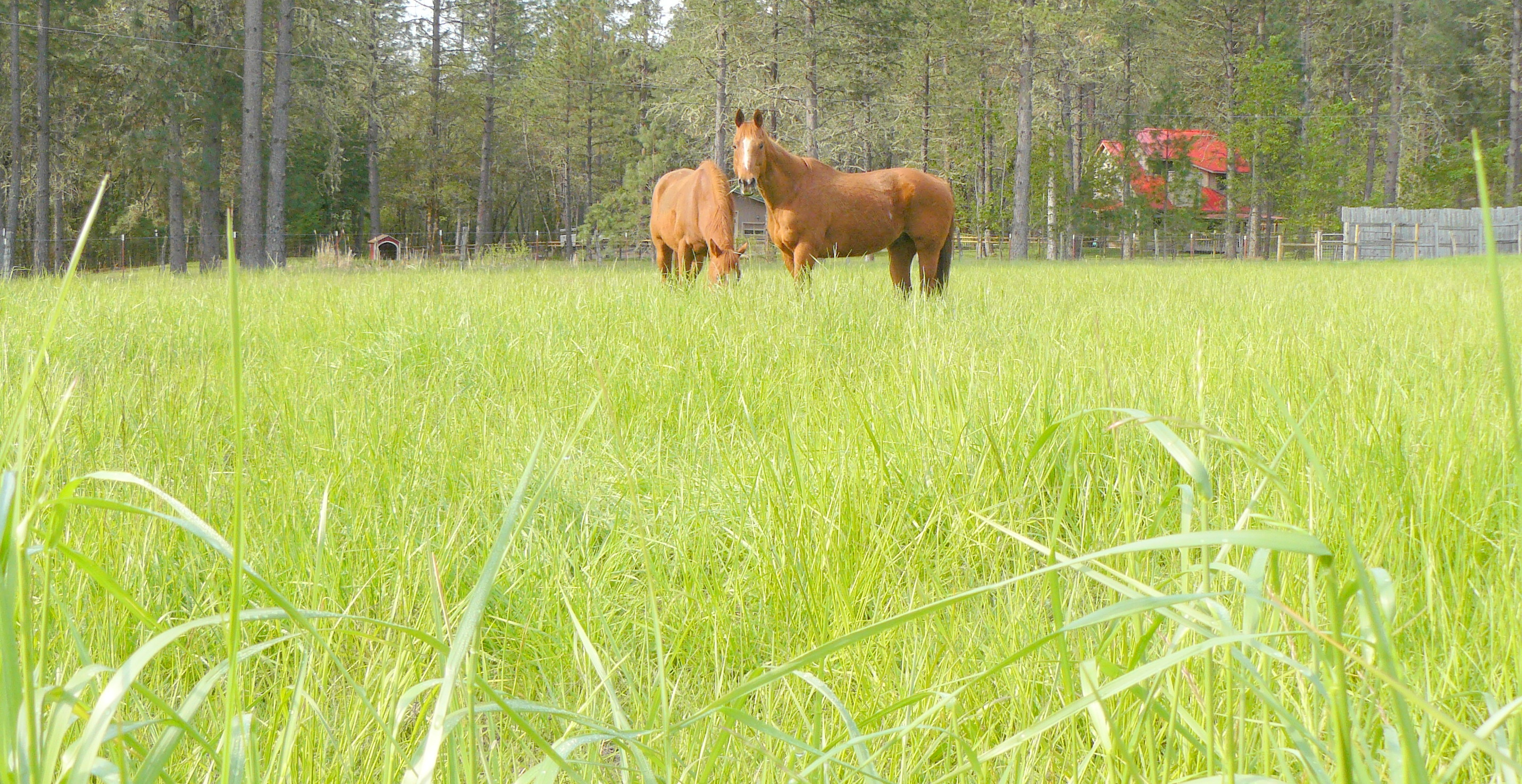
Our horses, Ben and Ranger, now graze in our main pasture.
Nearly six weeks ago, we welcomed our two rescue horses to our home. Then a week ago I reported that Ben and Ranger had settled in. The final part of embracing these two wonderful horses was to offer them grazing facilities out in the main area of grassland.
Thus as soon as an electric fence had been installed, Ben and Ranger faced a great deal of fresh grass! Admittedly, for just a couple of hours a day to prevent them from getting fat.
So three photographs of two very happy horses!
Wow! This I can’t believe!
Ben is to the left in the above picture; Ranger head down nibbling grass as if it was going out of fashion!
Grass, grass and, yes, more grass!
This time it is Ranger looking at the camera in the above picture, with Ben filling his chops!
Thank you Mum & Dad! Oh, excuse me for speaking with my mouth full! (Ben to the left.)
Unlike Jean, I have had no previous experience of horses. I have been bowled over by the speed at which these two wonderful creatures, both with a background of suffering cruelty from humans, have embraced me. And Jean; of course.
Six weeks ago I could hardly touch them. Now they will nuzzle my hands and let me rest my face against their heads.
Reflections on the Great March through Payson, Arizona.
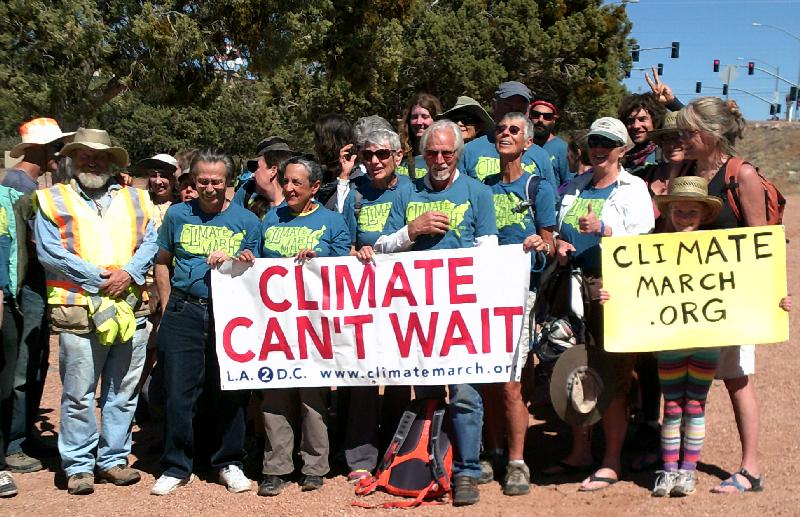
In yesterday’s post The Natural order I referred to Payson recently welcoming the Great March for Climate Action in their walk from Los Angeles to Washington D.C. I also referred to writing an essay on the event. That now follows, starting with a report from John Hurlburt, one of the organisers.
Thanks for your help for “the Great March for Climate Action”
“The Great March for Climate Action” arrived In Payson mid-afternoon on April 14. We had learned that the majority of the marchers are in the “younger” category (under 40), including two girls ages 10 and 12, walking for about a week of the journey with their Mom. But, impressively, quite a few are “AARP-ers”, in their 60’s and 70’s — walking all the way! Most of the group plans to continue on to Washington, D.C., being joined in various sections by hundreds of others! Our efforts aimed at making their brief visit to Payson as friendly and comfortable as possible.
They arrived at the meeting spot by the Event Center, having hiked up from near Rye, about twelve miles with significant elevation gain. Though weary, they were friendly and enthusiastic. Jim Speiser and family had set up their hot-dog cart, and we provided cold water and fresh fruit donated by Safeway — a case of huge premium oranges, and a case of bananas. The Marchers were delighted with the snacks, and extra fruit was given to their “chuck-wagon” for future days.
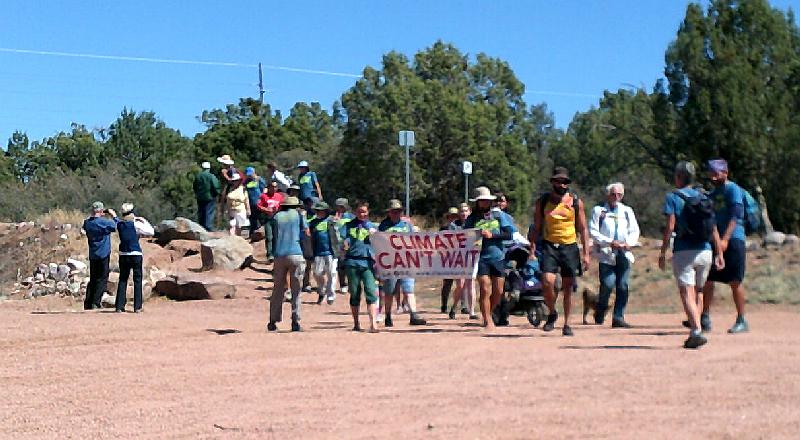
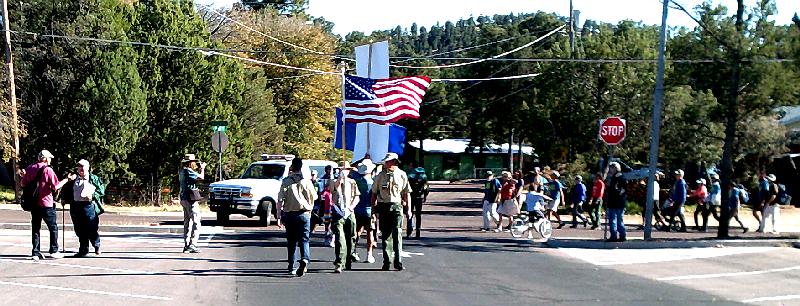
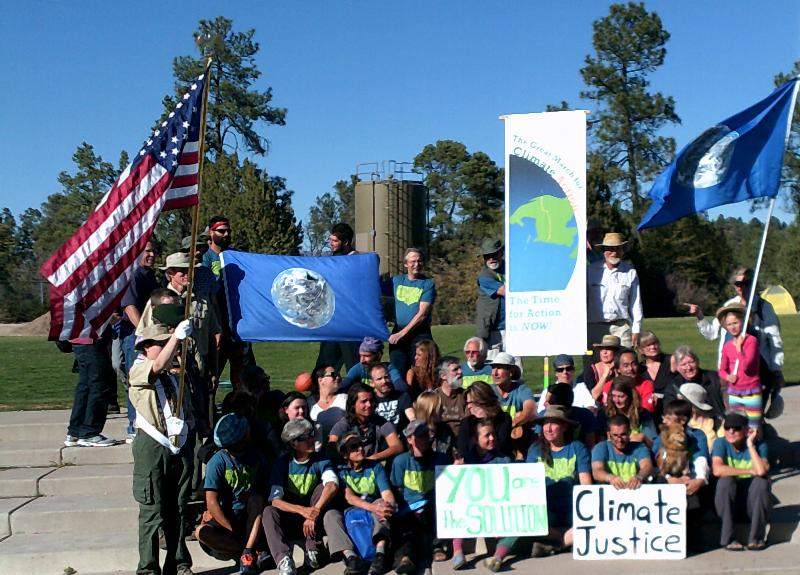
About ten local folk joined the Marchers on the two mile walk to the Payson Christian School, following their beautiful banners and signs. A local Boy Scout Color Guard led the procession and two Payson Police vehicles accompanied the March all the way. People in passing cars waved, smiled, honked and took pictures. Exhilarating and fun! A feature writer/photographer from the Payson Roundup covered the March, both along the route and at the school, where she took group photos and interviewed some of the participants.
Marchers who desired showers/clean laundry were transported to various Payson homes. Some of the group rested in their tents that were clustered on the sports field grass, and others helped with our dining room and kitchen set-up for the dinner. Food from our Payson volunteers began to arrive at five pm and by six the big buffet tables were loaded with delicious hot dishes, sides, snacks, beverages, salad and desserts, and the dining room was packed nearly to overflowing.
The evening opened with a Proclamation of welcome from the Mayor and Town Council, read by Ed Blair, and a prayer. John Hurlbert introduced the evening program that began with a talk about the History of Marches by Ray Spatti. Rob Ingram gave an overview of Payson, its achievements, water and forest issues, and future. Various participants in the March described their adventures, goals and dreams and asked about Payson’s outlook regarding environmental issues. Interacting with these dedicated Marchers was an education, a pleasure and an inspiration, perhaps motivating our Town to step ahead with sustainable solutions. In fact we heard that a young woman from here in Payson is going to join the “Great March”!
Our evening peaked with a delightful music performance by Cinnamon Twist and a sing-along. A number of Marchers were also musicians and they joined in with their instruments, resulting in a spontaneous “jam session” that brought the evening to a grand and joyful conclusion.
We couldn’t have done it without the amazing generosity and assistance from the Payson Christian School and their Staff, and without volunteers like you. Countless Marchers said they were overwhelmed by the friendly reception they received, and it was due to great team-work and local involvement. All the small things you did – offering showers, bringing food, walking with the Marchers, coming to the dinner – added up to a most memorable event. It is through small daily things that we can make a difference in our world — and all of you certainly have.
We can’t thank you enough!
The Organizational group for “The Great March for Climate Action” Payson visit 4-14-14: Ray Spatti, John Hurlburt, Jim Spieser, Dean Gooding and Vee Jeanne.
These were some photographs sent on by John.
oooo
oooo
oooo
But it’s no good just thinking how wonderful it was for Payson to be involved, and for the marchers in their nearly 3,000 mile walk from Los Angeles to Washington DC. Each of us who cares for a sustainable future on Planet Earth must make a difference. As is now a common plea: “Think globally: Act locally.”
One story that came out from the march through Payson struck me forcibly. MaryAnne, a good friend of this blog, offered, as did others, laundry and washing facilities to two young marchers. One of them, a young girl, was so committed to the message behind the march that she had vowed to remain silent from start to finish; the only exception being singing in the evenings. I was blown away by that commitment.
On March 1, 2014, 1,000 climate patriots will set-out from Los Angeles, CA, walking 2,980 miles across America to Washington, DC, inspiring and motivating the general public and elected officials to act now to address the climate crisis. This will be the largest coast-to-coast march in American history.
Credits:
Director, Producer and Chief Editor: Zach Heffernen
Script Writer: Melvin Baker
Studio Manager: Maddie Kain
Voice 1: Ed Fallon
Voice 2: Maddie Kain
Voice 3: Jami Bassman
Voice 4: Zach Heffernen
Editor: Ed Fallon
Editor: Shari Hrdina
Editor: Courtney Kain
Regular readers of Learning from Dogs will recall that just under a week ago I published an essay under the title of A bedtime story for mankind. The post centred around an essay from Patrice Ayme. Patrice’s essay could be summarised as follows: “At the present rate of greenhouse gases emissions, within nine years, massively lethal climate and oceanic changes are guaranteed.”
Then just last Sunday, Patrice published a second essay reinforcing that first one. The subsequent essay was called Ten Years to Catastrophe. I was minded to republish that but upon reflection thought that there was a better option. That was to explore the deep, core questions that both of Patrice’s essays raised in my mind and, presumably, must be raised in the minds of countless thousands of others. Questions along the lines of a comment I submitted to that subsequent post from Patrice.
Do you have an idea, even a sense, of when global leaders, elected Governments, the ‘movers and shakers’ in societies, will truly embrace the global catastrophe that is heading our way?
And a supplementary question: What would be the indicators that Governments were acknowledging the task ahead?
Frankly, they weren’t especially good questions but they were an attempt by me to open up a debate on whether or not this is the “beginning of the end” of life for us humans. Central to what was going through my mind was the core question of how did it all go wrong?
Welcome to Payson, AZ
On Monday evening, I rang John Hurlburt, a close friend of Jean and me from our Payson, Arizona days and kicked around those questions . It was a most enlightening conversation. John is an active founder member of Transition Town Payson and Payson recently welcomed the Great March for Climate Action in their walk from Los Angeles to Washington D.C. (An essay on that event coming soon.)
Anyway, from out of that conversation with John came the idea of a series of essays here on Learning from Dogs about the past, present and future of man’s relationship with Nature. The aim is to offer an essay on a weekly basis but we’ll see how it goes. Wherever possible, I will use the essays and posts from other bloggers that reinforce the vision. As always, your feedback in the form of ‘Likes’ or comments will reflect on the value of the essays to you.
After John and I finished the call, he sent me an email with what could be best described as his vision for these essays. Here is that email [my emphasis].
Integral Vision
Everything fits together. Otherwise, we’d simply be disassociated atoms.
Human beings are a consciously aware component of Nature. We have a DNA-level directive to survive as a species and as individual members of a species …. in that order!
We are consciously aware components of the conscious interaction between energy and matter in a predominently smoothly emerging cyclic universe with departures from time to time into pockets of chaos.
We disconnect from reality when we become self-centered, often during the various stages of our lives. When we are blessed we continue to live and learn.
Issues of ideology, rational thought, economics, politics, religion, history and science become insignificant in comparison to the whelming power of Nature.
Such is life. It comes with the territory. Spirituality, Nature and Science describe the metanexus in which we live.
Maintain an even strain,
an old lamplighter
Ref: Episcopal “Catechism of Creation”
Ideas, feedback and comments, as always, hugely welcomed.
Even millions of ‘juniors’ would struggle to match this!
On the basis that today, the Monday after Easter Sunday, is a holiday in many countries, it seemed very apt to keep the theme relaxed.
The following video was sent to me by our neighbours, Dordie and Bill, with the comment, “Paul and Jean, This is incredible….you must watch this on the big screen!”
However, big screen or not, this video will have you gasping with admiration.
The Britain’s Got Talent website can be found here.
Years ago I recall hearing the retort, “What part of the word no are you having trouble with!”
It made me laugh out loud.
It comes to mind again, and this is why.
The accumulation of evidence mounts almost on a daily basis that mankind is critically affecting the viability of Planet Earth. Not only threatening a sustainable home for tens of thousands of species but, most importantly, for homo sapiens.
Yesterday, I included a report that suggested we may be on the verge of one of the largest El Ninos in history. The presumption being that the extra heat energy in the atmosphere is transferring to the Pacific waters.
Today, I want to stay with the theme that it is nature, not mankind, that is dictating our future; that our leaders, are way ‘behind the drag curve’ to use an aviation expression.
But let me offer yet another lesson from dogs. Learnt from understanding the role of the ‘alpha’ dog; the leader.
When dogs lived in the wild the size of their pack, or community, was around fifty animals. The most senior in status was the alpha dog. The alpha dog was a female who had two important roles on behalf of the pack. First, the alpha dog had the pick of the male dogs to ensure the optimum genetic health of the entire group.
Second, it was alpha dog that, in the rare circumstances of their pack’s territory becoming unsustainable, made the decision for her pack to find a new territory.
Humans are on the verge of understanding that our ‘territory’ is rapidly becoming unsustainable. Just a great shame we don’t have any ‘alpha leaders’ to find ‘a new territory’. Clearly in a metaphorical sense. Because the last time I looked a ‘backup’ to Planet Earth wasn’t anywhere close!
No better illustrated than by a recent essay from George Monbiot that I am republishing in full within his blanket permission to so do. The essay is called Loss Adjustment and was published in the Guardian newspaper on the 1st April 2014.
ooOOoo
Loss Adjustment
When people say we should adapt to climate change, do they have any idea what that means?
By George Monbiot
To understand what is happening to the living planet, the great conservationist Aldo Leopold remarked, is to live “in a world of wounds … An ecologist must either harden his shell and make believe that the consequences of science are none of his business, or he must be the doctor who sees the marks of death in a community that believes itself well and does not want to be told otherwise.” (1)
The metaphor suggests that he might have seen Henrik Ibsen’s play An Enemy of the People (2). Thomas Stockmann is a doctor in a small Norwegian town, and medical officer at the public baths whose construction has been overseen by his brother, the mayor. The baths, the mayor boasts, “will become the focus of our municipal life! … Houses and landed property are rising in value every day.”
But Dr Stockmann discovers that the pipes were built in the wrong place, and the water feeding the baths is contaminated. “The source is poisoned …We are making our living by retailing filth and corruption! The whole of our flourishing municipal life derives its sustenance from a lie!” People bathing in the water to improve their health are instead falling ill.
Dr Stockmann expects to be treated as a hero for exposing this deadly threat. After the mayor discovers that re-laying the pipes would cost a fortune and probably sink the whole project, he decides that his brother’s report “has not convinced me that the condition of the water at the baths is as bad as you represent it to be.” He proposes to ignore the problem, make some cosmetic adjustments and carry on as before. After all, “the matter in hand is not simply a scientific one. It is a complicated matter, and has its economic as well as its technical side.” The local paper, the baths committee and the business people side with the mayor against the doctor’s “unreliable and exaggerated accounts”.
Astonished and enraged, Dr Stockmann lashes out madly at everyone. He attacks the town as a nest of imbeciles, and finds himself, in turn, denounced as an enemy of the people. His windows are broken, his clothes are torn, he’s evicted and ruined.
Yesterday’s editorial in the Daily Telegraph, which was by no means the worst of the recent commentary on this issue, follows the first three acts of the play (3). Marking the new assessment by the Intergovernmental Panel on Climate Change, the paper sides with the mayor. First it suggests that the panel cannot be trusted, partly because its accounts are unreliable and exaggerated and partly because it uses “model-driven assumptions” to forecast future trends. (What would the Telegraph prefer? Tea leaves? Entrails?). Then it suggests that trying to stop manmade climate change would be too expensive. Then it proposes making some cosmetic adjustments and carrying on as before. (“Perhaps instead of continued doom-mongering, however, greater thought needs to be given to how mankind might adapt to the climatic realities.”)
But at least the Telegraph accepted that the issue deserved some prominence. On the Daily Mail’s website, climate breakdown was scarcely a footnote to the real issues of the day: “Kim Kardashian looks more confident than ever as she shows off her toned curves” and “Little George is the spitting image of Kate”.
Beneath these indispensable reports was a story celebrating the discovery of “vast deposits of coal lying under the North Sea, which could provide enough energy to power Britain for centuries.” (4) No connection with the release of the new climate report was made. Like royal babies, Kim’s curves and Ibsen’s municipal baths, coal is good for business. Global warming, like Dr Stockmann’s contaminants, is the spectre at the feast.
Everywhere we’re told that it’s easier to adapt to global warming than to stop causing it. This suggests that it’s not only the Stern review on the economics of climate change (showing that it’s much cheaper to avert climate breakdown than to try to live with it (5)) that has been forgotten, but also the floods which have so recently abated. If a small, rich, well-organised nation cannot protect its people from a winter of exceptional rainfall – which might have been caused by less than one degree of global warming – what hope do other nations have, when faced with four degrees or more?
When our environment secretary, Owen Paterson, assures us that climate change “is something we can adapt to over time” (6) or Simon Jenkins, in the Guardian yesterday, says that we should move towards “thinking intelligently about how the world should adapt to what is already happening” (7), what do they envisage? Cities relocated to higher ground? Roads and railways shifted inland? Rivers diverted? Arable land abandoned? Regions depopulated? Have they any clue about what this would cost? Of what the impacts would be for the people breezily being told to live with it?
My guess is that they don’t envisage anything: they have no idea what they mean when they say adaptation. If they’ve thought about it at all, they probably picture a steady rise in temperatures, followed by a steady rise in impacts, to which we steadily adjust. But that, as we should know from our own recent experience, is not how it happens. Climate breakdown proceeds in fits and starts, sudden changes of state against which, as we discovered on a small scale in January, preparations cannot easily be made.
Insurers working out their liability when a disaster has occurred use a process they call loss adjustment. It could describe what all of us who love this world are going through, as we begin to recognise that governments, the media and most businesses have no intention of seeking to avert the coming tragedies. We are being told to accept the world of wounds; to live with the disappearance, envisaged in the new climate report, of coral reefs and summer sea ice, of most glaciers and perhaps some rainforests, of rivers and wetlands and the species which, like many people, will be unable to adapt (8).
As the scale of the loss to which we must adjust becomes clearer, grief and anger are sometimes overwhelming. You find yourself, as I have done in this column, lashing out at the entire town.
Published on Apr 6, 2014
Hollywood celebrities and respected journalists span the globe to explore the issues of climate change and cover intimate stories of human triumph and tragedy. Watch new episodes Sundays at 10PM ET/PT, only on SHOWTIME.
It’s the biggest story of our time. Hollywood’s brightest stars and today’s most respected journalists explore the issues of climate change and bring you intimate accounts of triumph and tragedy. YEARS OF LIVING DANGEROUSLY takes you directly to the heart of the matter in this awe-inspiring and cinematic documentary series event from Executive Producers James Cameron, Jerry Weintraub and Arnold Schwarzenegger.