I am writing another book; my third. It is about the changing planet.
But first I want to tell you a story.
I know Scott Draper. He is the founder and CEO of the Club Northwest. It is the club that Jean goes for her Rock Steady class, and she has been going there for some time.
Indeed Scott and I have struck up a friendship and we now meet up at Scott’s home.
At our first meeting at Scott’s home he lent me the National Geographic’s Earth Day, 50th Anniversary Special Issue printed in April, 2020. It is a magazine that may be flipped and read from either end. On one side there is “A Pessimist’s Guide to Life on Earth in 2070”. On the flip side there is “An Optimist’s Guide to Life on Earth in 2070”. It was a very powerful read.
For on one hand the pessimist’s opinion was speaking of now, of current trends, of the fact that if we don’t change, and change relatively soon, say within the next five years, “our reckless consumption and abuse of resources have made the world a deadlier place for us and for the rest of life on Earth”. It conveys despair!
On the other hand the optimist’s opinion is that life will be different in 2070 and also warmer, “but we will find ways to limit carbon emissions, embrace nature, and thrive”. It conveys hope!
I asked Scott which opinion he supported. Scott told me the following:
There is a legend of two people; a grandfather and his grandson. The grandfather explains to his grandson that there are two wolves fighting inside of him, that they will always be there as he grows up and becomes an adult.
“I have a fight going on in me, even at the age I am,” the wise old man says. “It is taking place between these two wolves. One is evil; he is anger, envy, sorrow, regret, greed, arrogance, self-pity, guilt, resentment, inferiority, lies, false pride, superiority, and ego.”
The grandfather paused and looked at his grandson, and then continued; “The other wolf embodies the best of our emotions. He is joy, peace, love, hope, serenity, humility, kindness, benevolence, empathy, generosity, truth, compassion, and faith. Both wolves are fighting to the death. It is a fight that is going on inside you and indeed every other person, too.”
The grandson thought for some time about what his grandfather had just said. Then he looked up at his grandfather and quietly asked, “Which wolf will win?”
The grandfather gave his reply: “The one we feed”
Now this is an image that serves as a metaphor for our inner sense of conflict. This parable is a powerful reminder of the fight that every human being must face. Regardless of the type of person you are or what kind of life you lead, you will find yourself battling two conflicting emotions at many points in your life. Whether the fight is between anger and peace or resentment and compassion, it is important to recognise the conflicting feelings inside you and to feed the values and choices that matter most to you.
Now I am of an age where I won’t be alive in 2070.
But I am interested in the opinions of others who will be.
I want to ask the following questions:
First Name: Surname: DOB:
Email Address:
Do You Support An Optimist’s Guide to Life on Earth in 2070: Yes / No (please circle one)
Do You Support A Pessimist’s Guide to Life on Earth in 2070: Yes / No (please circle one)
How Many Years Before It Is Too Late To Demand Change: (Please tick your answer.)
Less than 5 years
Between 6 and 10 years
Between 11 and 20 years
Between 21 and 50 years
More than 50 years
How concerned are you? (5 is highest, as in very) 1, 2, 3, 4, 5 (Please circle one.)
Please leave a message if you want to:
Please will you consider helping me.
I am not going to present another post this week. In other words, I will leave this up until the end of Saturday, 26th June.
If you are happy to help me then send me your email address (to paulhandover ‘at’ gmail ‘dot’ com) and I will send out the above survey on the 28th June, 2021. All the recipients will be a bcc.
The survey feedback will be required by a week later; July 5th, 2021.
I will publish the results just as soon as they have been collated.
To be honest this is more about the Spitfire! The Spitfire SX336.
Raymond was working on the design of his dog tags and to nail stuff about the way to make them, the material thickness, how to work with it (2MM thick brass) and how to stop them failing, when he turned to a contact he had who is a Spitfire Engineer. At that point Ian, the contact, was up the road from Hertfordshire at The Shuttleworth Collection, getting AR501 back in the air.
However, mid-2019 he moved across the airfield to Kennet Aviation. That’s the home of Spitfire XVII.
At that point Raymond was still pestering for help with a fair few aspects of the manufacturing, from working with the five-ton fly-press that was recommended (from a closed aircraft factory south of Birmingham) to using high-speed polishing tools, but – above all – the position of the hole in relation to the edge of the tag, which is the same distance rivets are from the edge of the wing in a Spitfire.
In return, Raymond offered to build a few websites, one for Kennet Engineering and one for Kennet Aviation. Both the same company really, the Engineering one to try and get more work for a few huge and expensive CNC machines they’ve recently acquired to make spitfire parts they couldn’t get hold of.
Anyway, it was when researching regarding the Spitfire that he, Raymond, came across my Spitfire content and obviously noticed the title of the website he was looking at: LearningFromDogs.com, saw I had a tremendous-looking book and thought ‘hang on a minute!’ this is all too much of a coincidence, he must say hello AND introduce me (Paul) to the SX336.
So Raymond finally said ‘hello’ and let me know there is indeed another Spitfire still flying somewhere in the world.
At approximately 3pm on Tuesday 25 April 2017 The Shuttleworth Collection’s Spitfire under restoration fired into life for the first time in 12 years.
A first stage engine run took place on the airfield with volunteers who have been working on the project watching with fingers crossed. The Spitfire has recently been fitted with new propeller and spinner, with testing on all systems from hydraulics, electrical, coolant and air being undertaken in the engineer workshop where visitors have been able to follow the project’s progress.
Project engineer Ian Laraman expressed his relief that all had gone to plan, saying, “With any engine being tested for the first time you always hope it will run smoothly, and happily today the Spitfire’s first engine run couldn’t have gone any better. Higher power runs will now follow, which will give us a better indication of how close we are to flight testing, but for now hearing this aircraft powered up again after all the work that’s gone into it has just been fantastic!”
The coolant systems will now be flushed out, and checks carried out on the oil filters in advance of further testing of the Spitfire’s 1,440hp Rolls Royce Merlin V12 engine in the next fortnight. To follow the progress of AR501 as it moves toward the end of its restoration come along to see the aircraft in the engineering hangar or follow The Collection’s Facebook and Twitter pages!
Seafire FXVII, SX336, G-KASX, acquired in 2001 and put on the Civil Register by Kennet Aviation in 2006.
A real blast from the past!
I will finish the post be repeating the photograph that Raymond took at the Eastbourne Air Show.
Lulu loved an air show, going to several with us over the years. Here she is at Eastbourne air show, enjoying the Lancaster Bomber and a Spitfire from the Battle of Britain Memorial Flight.
Sometimes realisation comes in a blinding flash. Blurred outlines snap into shape and suddenly it all makes sense. Underneath such revelations is typically a much slower-dawning process. Doubts at the back of the mind grow. The sense of confusion that things cannot be made to fit together increases until something clicks. Or perhaps snaps.
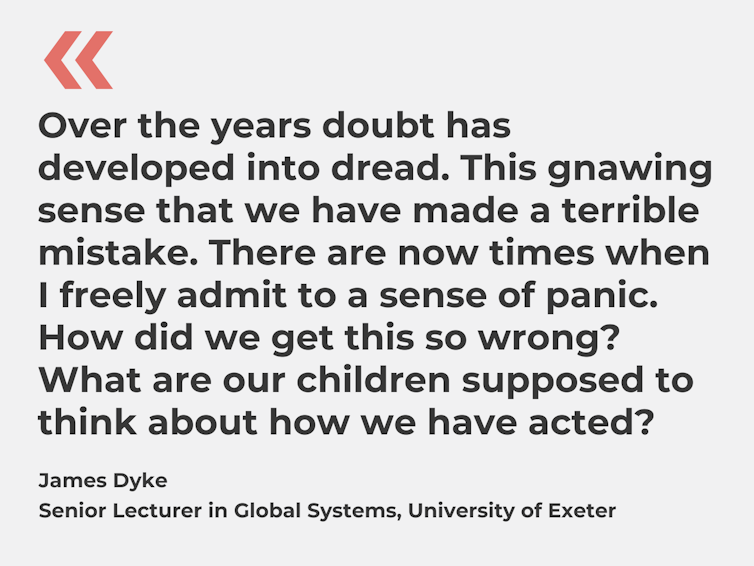
Collectively we three authors of this article must have spent more than 80 years thinking about climate change. Why has it taken us so long to speak out about the obvious dangers of the concept of net zero? In our defence, the premise of net zero is deceptively simple – and we admit that it deceived us.
The threats of climate change are the direct result of there being too much carbon dioxide in the atmosphere. So it follows that we must stop emitting more and even remove some of it. This idea is central to the world’s current plan to avoid catastrophe. In fact, there are many suggestions as to how to actually do this, from mass tree planting, to high tech direct air capture devices that suck out carbon dioxide from the air.
The current consensus is that if we deploy these and other so-called “carbon dioxide removal” techniques at the same time as reducing our burning of fossil fuels, we can more rapidly halt global warming. Hopefully around the middle of this century we will achieve “net zero”. This is the point at which any residual emissions of greenhouse gases are balanced by technologies removing them from the atmosphere.
This is a great idea, in principle. Unfortunately, in practice it helps perpetuate a belief in technological salvation and diminishes the sense of urgency surrounding the need to curb emissions now.
We have arrived at the painful realisation that the idea of net zero has licensed a recklessly cavalier “burn now, pay later” approach which has seen carbon emissions continue to soar. It has also hastened the destruction of the natural world by increasing deforestation today, and greatly increases the risk of further devastation in the future.
To understand how this has happened, how humanity has gambled its civilisation on no more than promises of future solutions, we must return to the late 1980s, when climate change broke out onto the international stage.
Steps towards net zero
On June 22 1988, James Hansen was the administrator of Nasa’s Goddard Institute for Space Studies, a prestigious appointment but someone largely unknown outside of academia.
By the afternoon of the 23rd he was well on the way to becoming the world’s most famous climate scientist. This was as a direct result of his testimony to the US congress, when he forensically presented the evidence that the Earth’s climate was warming and that humans were the primary cause: “The greenhouse effect has been detected, and it is changing our climate now.”
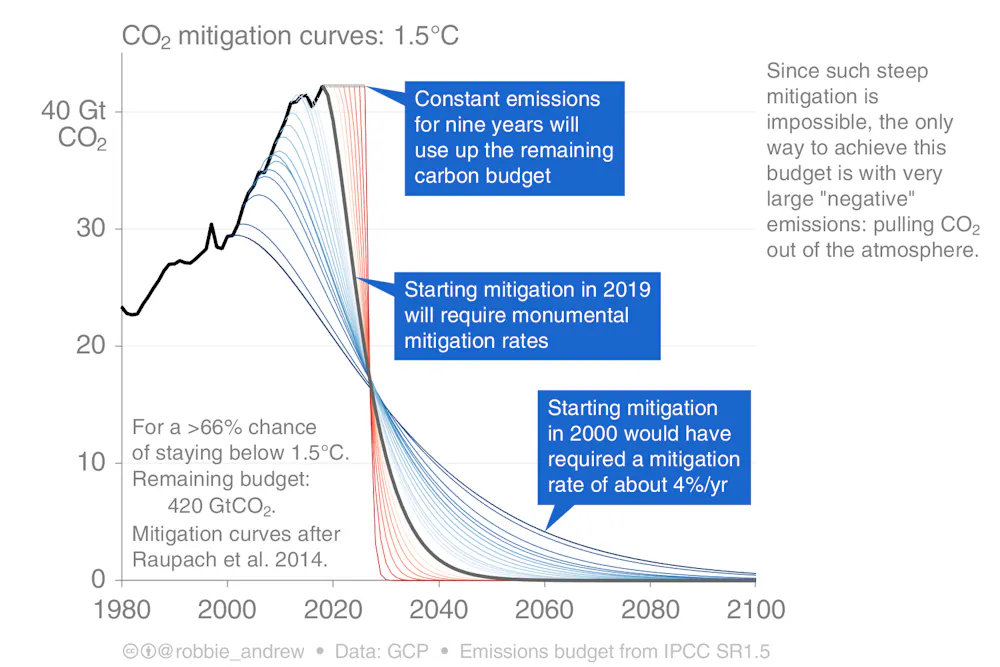
If we had acted on Hansen’s testimony at the time, we would have been able to decarbonise our societies at a rate of around 2% a year in order to give us about a two-in-three chance of limiting warming to no more than 1.5°C. It would have been a huge challenge, but the main task at that time would have been to simply stop the accelerating use of fossil fuels while fairly sharing out future emissions.
Four years later, there were glimmers of hope that this would be possible. During the 1992 Earth Summit in Rio, all nations agreed to stabilise concentrations of greenhouse gases to ensure that they did not produce dangerous interference with the climate. The 1997 Kyoto Summit attempted to start to put that goal into practice. But as the years passed, the initial task of keeping us safe became increasingly harder given the continual increase in fossil fuel use.
It was around that time that the first computer models linking greenhouse gas emissions to impacts on different sectors of the economy were developed. These hybrid climate-economic models are known as Integrated Assessment Models. They allowed modellers to link economic activity to the climate by, for example, exploring how changes in investments and technology could lead to changes in greenhouse gas emissions.
They seemed like a miracle: you could try out policies on a computer screen before implementing them, saving humanity costly experimentation. They rapidly emerged to become key guidance for climate policy. A primacy they maintain to this day.
Unfortunately, they also removed the need for deep critical thinking. Such models represent society as a web of idealised, emotionless buyers and sellers and thus ignore complex social and political realities, or even the impacts of climate change itself. Their implicit promise is that market-based approaches will always work. This meant that discussions about policies were limited to those most convenient to politicians: incremental changes to legislation and taxes.
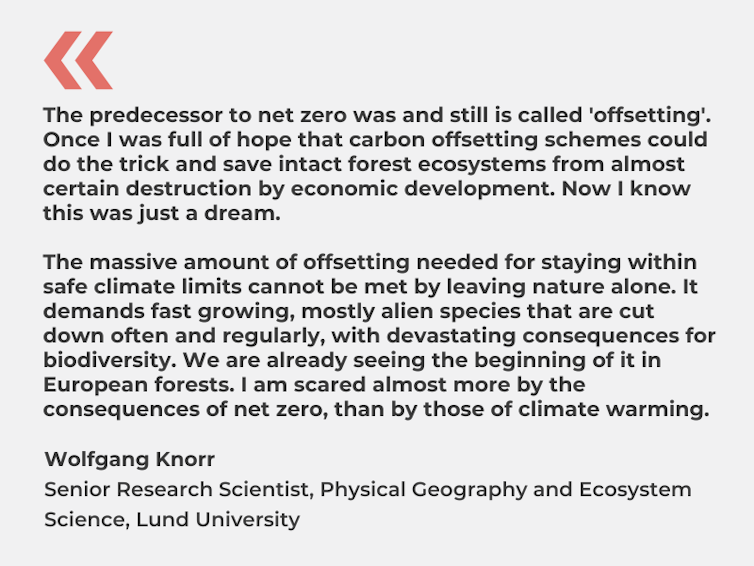
Around the time they were first developed, efforts were being made to secure US action on the climate by allowing it to count carbon sinks of the country’s forests. The US argued that if it managed its forests well, it would be able to store a large amount of carbon in trees and soil which should be subtracted from its obligations to limit the burning of coal, oil and gas. In the end, the US largely got its way. Ironically, the concessions were all in vain, since the US senate never ratified the agreement.
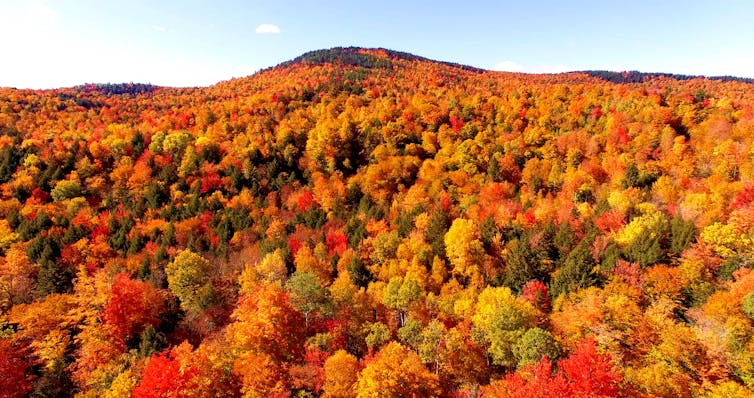
Forests such as this one in Maine, US, were suddenly counted in the carbon budget as an incentive for the US to join the Kyoto Agreement. Inbound Horizons/Shutterstock
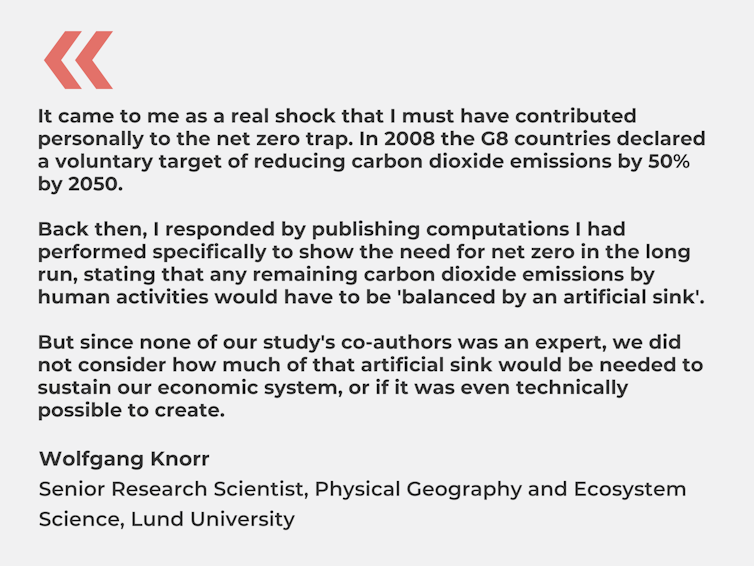
Postulating a future with more trees could in effect offset the burning of coal, oil and gas now. As models could easily churn out numbers that saw atmospheric carbon dioxide go as low as one wanted, ever more sophisticated scenarios could be explored which reduced the perceived urgency to reduce fossil fuel use. By including carbon sinks in climate-economic models, a Pandora’s box had been opened.
It’s here we find the genesis of today’s net zero policies.
That said, most attention in the mid-1990s was focused on increasing energy efficiency and energy switching (such as the UK’s move from coal to gas) and the potential of nuclear energy to deliver large amounts of carbon-free electricity. The hope was that such innovations would quickly reverse increases in fossil fuel emissions.
But by around the turn of the new millennium it was clear that such hopes were unfounded. Given their core assumption of incremental change, it was becoming more and more difficult for economic-climate models to find viable pathways to avoid dangerous climate change. In response, the models began to include more and more examples of carbon capture and storage, a technology that could remove the carbon dioxide from coal-fired power stations and then store the captured carbon deep underground indefinitely.
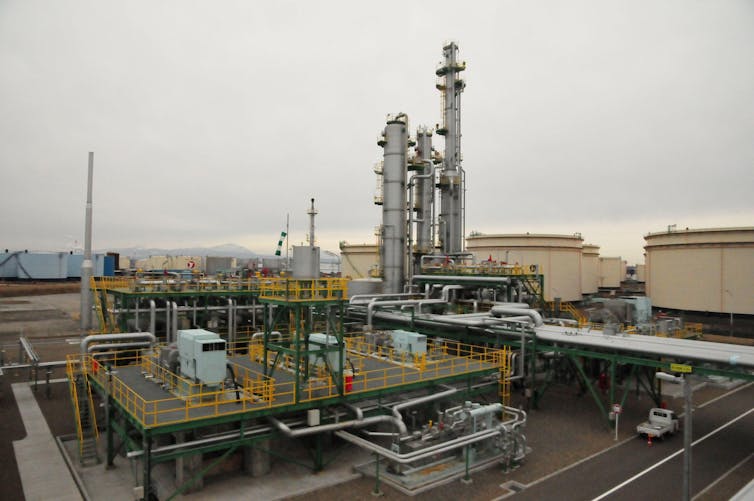
The Tomakomai carbon, capture and storage test site, Hokkaido, Japan, March 2018. Over its three-year lifetime, it’s hoped that this demonstrator project will capture an amount of carbon approximately 1/100,000 of current global annual emissions. The captured carbon will be piped into geological deposits deep under the sea bed where it will need to remain for centuries. REUTERS/Aaron Sheldrick
This had been shown to be possible in principle: compressed carbon dioxide had been separated from fossil gas and then injected underground in a number of projects since the 1970s. These Enhanced Oil Recovery schemes were designed to force gases into oil wells in order to push oil towards drilling rigs and so allow more to be recovered – oil that would later be burnt, releasing even more carbon dioxide into the atmosphere.
Carbon capture and storage offered the twist that instead of using the carbon dioxide to extract more oil, the gas would instead be left underground and removed from the atmosphere. This promised breakthrough technology would allow climate friendly coal and so the continued use of this fossil fuel. But long before the world would witness any such schemes, the hypothetical process had been included in climate-economic models. In the end, the mere prospect of carbon capture and storage gave policy makers a way out of making the much needed cuts to greenhouse gas emissions.
The rise of net zero
When the international climate change community convened in Copenhagen in 2009 it was clear that carbon capture and storage was not going to be sufficient for two reasons.
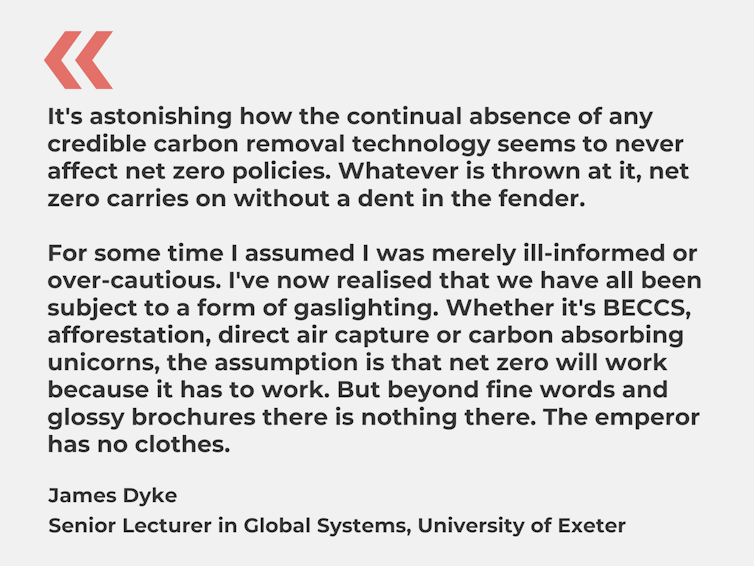
First, it still did not exist. There were no carbon capture and storage facilities in operation on any coal fired power station and no prospect the technology was going to have any impact on rising emissions from increased coal use in the foreseeable future.
The biggest barrier to implementation was essentially cost. The motivation to burn vast amounts of coal is to generate relatively cheap electricity. Retrofitting carbon scrubbers on existing power stations, building the infrastructure to pipe captured carbon, and developing suitable geological storage sites required huge sums of money. Consequently the only application of carbon capture in actual operation then – and now – is to use the trapped gas in enhanced oil recovery schemes. Beyond a single demonstrator, there has never been any capture of carbon dioxide from a coal fired power station chimney with that captured carbon then being stored underground.
Just as important, by 2009 it was becoming increasingly clear that it would not be possible to make even the gradual reductions that policy makers demanded. That was the case even if carbon capture and storage was up and running. The amount of carbon dioxide that was being pumped into the air each year meant humanity was rapidly running out of time.
With hopes for a solution to the climate crisis fading again, another magic bullet was required. A technology was needed not only to slow down the increasing concentrations of carbon dioxide in the atmosphere, but actually reverse it. In response, the climate-economic modelling community – already able to include plant-based carbon sinks and geological carbon storage in their models – increasingly adopted the “solution” of combining the two.
So it was that Bioenergy Carbon Capture and Storage, or BECCS, rapidly emerged as the new saviour technology. By burning “replaceable” biomass such as wood, crops, and agricultural waste instead of coal in power stations, and then capturing the carbon dioxide from the power station chimney and storing it underground, BECCS could produce electricity at the same time as removing carbon dioxide from the atmosphere. That’s because as biomass such as trees grow, they suck in carbon dioxide from the atmosphere. By planting trees and other bioenergy crops and storing carbon dioxide released when they are burnt, more carbon could be removed from the atmosphere.
With this new solution in hand the international community regrouped from repeated failures to mount another attempt at reining in our dangerous interference with the climate. The scene was set for the crucial 2015 climate conference in Paris.
A Parisian false dawn
As its general secretary brought the 21st United Nations conference on climate change to an end, a great roar issued from the crowd. People leaped to their feet, strangers embraced, tears welled up in eyes bloodshot from lack of sleep.
The emotions on display on December 13, 2015 were not just for the cameras. After weeks of gruelling high-level negotiations in Paris a breakthrough had finally been achieved. Against all expectations, after decades of false starts and failures, the international community had finally agreed to do what it took to limit global warming to well below 2°C, preferably to 1.5°C, compared to pre-industrial levels.
But dig a little deeper and you could find another emotion lurking within delegates on December 13. Doubt. We struggle to name any climate scientist who at that time thought the Paris Agreement was feasible. We have since been told by some scientists that the Paris Agreement was “of course important for climate justice but unworkable” and “a complete shock, no one thought limiting to 1.5°C was possible”. Rather than being able to limit warming to 1.5°C, a senior academic involved in the IPCC concluded we were heading beyond 3°C by the end of this century.
Instead of confront our doubts, we scientists decided to construct ever more elaborate fantasy worlds in which we would be safe. The price to pay for our cowardice: having to keep our mouths shut about the ever growing absurdity of the required planetary-scale carbon dioxide removal.
Taking centre stage was BECCS because at the time this was the only way climate-economic models could find scenarios that would be consistent with the Paris Agreement. Rather than stabilise, global emissions of carbon dioxide had increased some 60% since 1992.
Alas, BECCS, just like all the previous solutions, was too good to be true.
Across the scenarios produced by the Intergovernmental Panel on Climate Change (IPCC) with a 66% or better chance of limiting temperature increase to 1.5°C, BECCS would need to remove 12 billion tonnes of carbon dioxide each year. BECCS at this scale would require massive planting schemes for trees and bioenergy crops.
The Earth certainly needs more trees. Humanity has cut down some three trillion since we first started farming some 13,000 years ago. But rather than allow ecosystems to recover from human impacts and forests to regrow, BECCS generally refers to dedicated industrial-scale plantations regularly harvested for bioenergy rather than carbon stored away in forest trunks, roots and soils.
Currently, the two most efficient biofuels are sugarcane for bioethanol and palm oil for biodiesel – both grown in the tropics. Endless rows of such fast growing monoculture trees or other bioenergy crops harvested at frequent intervals devastate biodiversity.
It has been estimated that BECCS would demand between 0.4 and 1.2 billion hectares of land. That’s 25% to 80% of all the land currently under cultivation. How will that be achieved at the same time as feeding 8-10 billion people around the middle of the century or without destroying native vegetation and biodiversity?
Growing billions of trees would consume vast amounts of water – in some places where people are already thirsty. Increasing forest cover in higher latitudes can have an overall warming effect because replacing grassland or fields with forests means the land surface becomes darker. This darker land absorbs more energy from the Sun and so temperatures rise. Focusing on developing vast plantations in poorer tropical nations comes with real risks of people being driven off their lands.
And it is often forgotten that trees and the land in general already soak up and store away vast amounts of carbon through what is called the natural terrestrial carbon sink. Interfering with it could both disrupt the sink and lead to double accounting.
As these impacts are becoming better understood, the sense of optimism around BECCS has diminished.
Pipe dreams
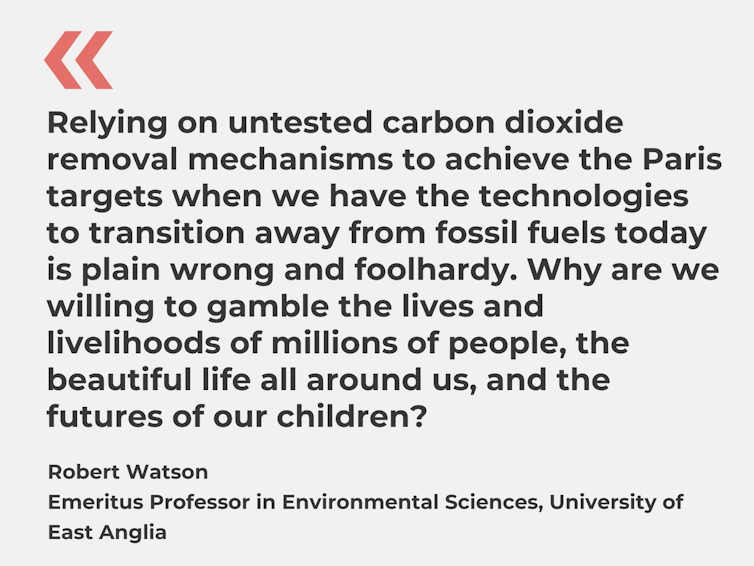
Given the dawning realisation of how difficult Paris would be in the light of ever rising emissions and limited potential of BECCS, a new buzzword emerged in policy circles: the “overshoot scenario”. Temperatures would be allowed to go beyond 1.5°C in the near term, but then be brought down with a range of carbon dioxide removal by the end of the century. This means that net zero actually means carbon negative. Within a few decades, we will need to transform our civilisation from one that currently pumps out 40 billion tons of carbon dioxide into the atmosphere each year, to one that produces a net removal of tens of billions.
Mass tree planting, for bioenergy or as an attempt at offsetting, had been the latest attempt to stall cuts in fossil fuel use. But the ever-increasing need for carbon removal was calling for more. This is why the idea of direct air capture, now being touted by some as the most promising technology out there, has taken hold. It is generally more benign to ecosystems because it requires significantly less land to operate than BECCS, including the land needed to power them using wind or solar panels.
Unfortunately, it is widely believed that direct air capture, because of its exorbitant costs and energy demand, if it ever becomes feasible to be deployed at scale, will not be able to compete with BECCS with its voracious appetite for prime agricultural land.
It should now be getting clear where the journey is heading. As the mirage of each magical technical solution disappears, another equally unworkable alternative pops up to take its place. The next is already on the horizon – and it’s even more ghastly. Once we realise net zero will not happen in time or even at all, geoengineering – the deliberate and large scale intervention in the Earth’s climate system – will probably be invoked as the solution to limit temperature increases.
One of the most researched geoengineering ideas is solar radiation management – the injection of millions of tons of sulphuric acid into the stratosphere that will reflect some of the Sun’s energy away from the Earth. It is a wild idea, but some academics and politicians are deadly serious, despite significant risks. The US National Academies of Sciences, for example, has recommended allocating up to US$200 million over the next five years to explore how geoengineering could be deployed and regulated. Funding and research in this area is sure to significantly increase.
Difficult truths
In principle there is nothing wrong or dangerous about carbon dioxide removal proposals. In fact developing ways of reducing concentrations of carbon dioxide can feel tremendously exciting. You are using science and engineering to save humanity from disaster. What you are doing is important. There is also the realisation that carbon removal will be needed to mop up some of the emissions from sectors such as aviation and cement production. So there will be some small role for a number of different carbon dioxide removal approaches.
The problems come when it is assumed that these can be deployed at vast scale. This effectively serves as a blank cheque for the continued burning of fossil fuels and the acceleration of habitat destruction.
Carbon reduction technologies and geoengineering should be seen as a sort of ejector seat that could propel humanity away from rapid and catastrophic environmental change. Just like an ejector seat in a jet aircraft, it should only be used as the very last resort. However, policymakers and businesses appear to be entirely serious about deploying highly speculative technologies as a way to land our civilisation at a sustainable destination. In fact, these are no more than fairy tales.
‘There is no Planet B’: children in Birmingham, UK, protest against the climate crisis. Callum Shaw/Unsplash, FAL
The only way to keep humanity safe is the immediate and sustained radical cuts to greenhouse gas emissions in a socially just way.
Academics typically see themselves as servants to society. Indeed, many are employed as civil servants. Those working at the climate science and policy interface desperately wrestle with an increasingly difficult problem. Similarly, those that champion net zero as a way of breaking through barriers holding back effective action on the climate also work with the very best of intentions.
The tragedy is that their collective efforts were never able to mount an effective challenge to a climate policy process that would only allow a narrow range of scenarios to be explored.
Most academics feel distinctly uncomfortable stepping over the invisible line that separates their day job from wider social and political concerns. There are genuine fears that being seen as advocates for or against particular issues could threaten their perceived independence. Scientists are one of the most trusted professions. Trust is very hard to build and easy to destroy.
But there is another invisible line, the one that separates maintaining academic integrity and self-censorship. As scientists, we are taught to be sceptical, to subject hypotheses to rigorous tests and interrogation. But when it comes to perhaps the greatest challenge humanity faces, we often show a dangerous lack of critical analysis.
In private, scientists express significant scepticism about the Paris Agreement, BECCS, offsetting, geoengineering and net zero. Apart from some notable exceptions, in public we quietly go about our work, apply for funding, publish papers and teach. The path to disastrous climate change is paved with feasibility studies and impact assessments.
Rather than acknowledge the seriousness of our situation, we instead continue to participate in the fantasy of net zero. What will we do when reality bites? What will we say to our friends and loved ones about our failure to speak out now?
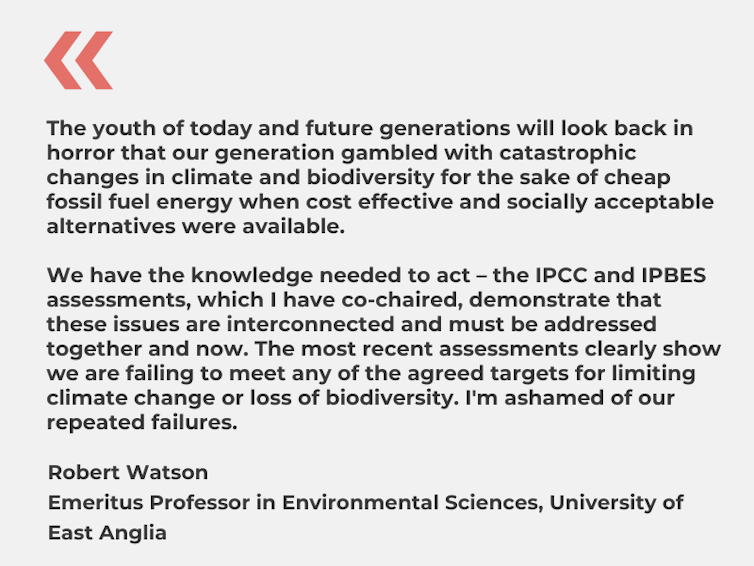
The time has come to voice our fears and be honest with wider society. Current net zero policies will not keep warming to within 1.5°C because they were never intended to. They were and still are driven by a need to protect business as usual, not the climate. If we want to keep people safe then large and sustained cuts to carbon emissions need to happen now. That is the very simple acid test that must be applied to all climate policies. The time for wishful thinking is over.
To hear about new Insights articles, join the hundreds of thousands of people who value The Conversation’s evidence-based news. Subscribe to our newsletter.
I can’t add anything to this article because it is written by scientists and that is one thing that I know I am not!
But I can comment as a very concerned adult and really can do more that repeat what I said in yesterday’s post:
Thank goodness for our younger generation. Because these young people are coming together to fight for change. May they have universal encouragement from those of us who will never see our younger days again!
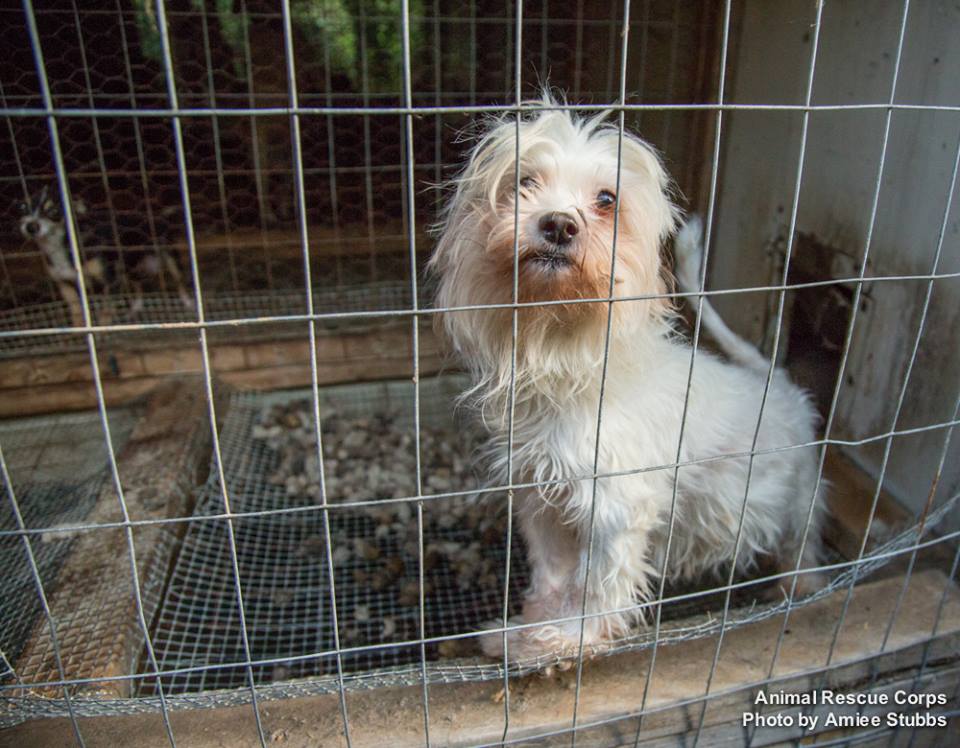
Puppy Mills are disgraceful. Worse than that they are a scar on the face of mankind.
Yesterday I received an email that came in from the Humane Society Legislative Fund. I am sure many of you also received it.
I am going to republish it. Please help if you can.
ooOOoo
Tell the USDA to protect puppies
Dogs suffer horribly in puppy mills. What’s worse is that over the last four years, The U.S. Department of Agriculture, which is charged with monitoring, citing and revoking licenses of these breeding facilities if they sell to pet stores, brokers or online, stopped taking their job of puppy mill enforcement seriously and the agency did not take all the necessary steps to make sure that standards of care are improved to ensure that puppy mill facilities meet the basic needs of happy and healthy dogs.
Enforcement has plummeted at USDA since 2017 and citations for violations are down more than 65%. But we have a new Administration leading the United States Department of Agriculture, one that has already promised that they are going to take animal care seriously. Now is our chance to send a message loud and clear: you must protect dogs and puppies and take puppy mill enforcement seriously, and you must ensure that standards of care are improved in puppy mills to meet the needs of the thousands of dogs living in those facilities.
TAKE ACTION Please send a brief, polite message to the USDA using the form provided.
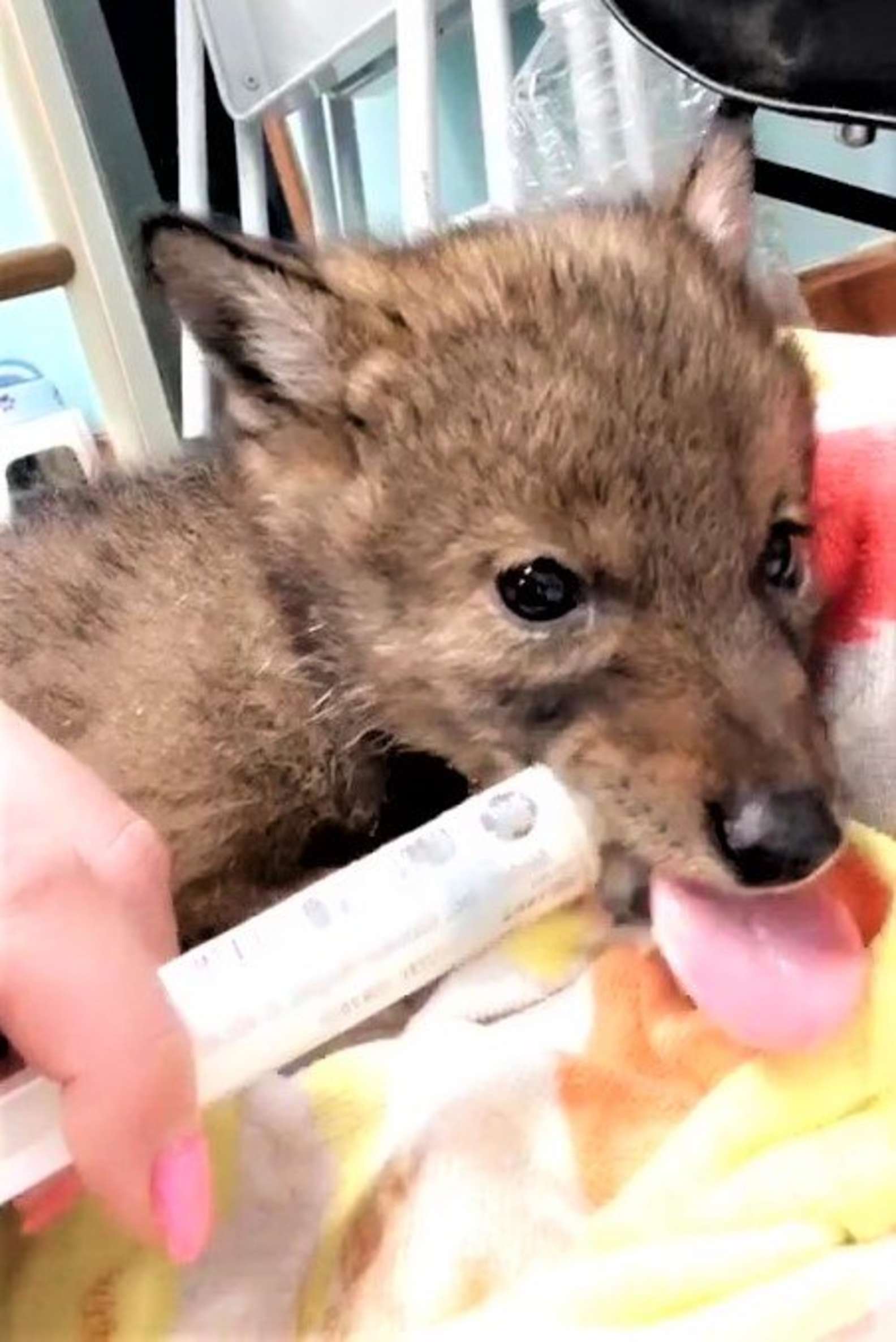
This week, a Massachusetts State Police trooper did just that — coming to the aid of a helpless young coyote pup who’d been found stranded all alone along a busy roadway.
MASSACHUSETTS STATE POLICE
Seeing that the pup’s mother was nowhere in sight, trooper Carlo Mastromattei contacted Lisa Cutting, owner of Ocean View Kennels, for help in safely removing the animal from that perilous spot.
The pup was now out of immediate danger, but Mastromattei’s kindhearted actions didn’t end there.
MASSACHUSETTS STATE POLICE
At that late hour, all nearby wildlife rehab facilities were apparently closed. So, the trooper then decided to go above and beyond his call of duty in order to keep the little coyote safe until morning.
Mastromattei brought the pup home, where he and his girlfriend kept him cozy and fed through the night.
MASSACHUSETTS STATE POLICE
The next day, Mastromattei brought the coyote to the Tufts Wildlife Clinic for a checkup. Fortunately, he was found to be in good health — thanks in no small part to the trooper having rescued him in time.
MASSACHUSETTS STATE POLICE
According to the Massachusetts State Police, the young coyote has since been placed under the care of a wildlife rehabilitator. With any luck, he’ll continue gaining his strength until he’s old enough to be released back into the wild to live life as nature intended.
For their efforts, those involved in the pup’s rescue are getting some much-deserved praise from police officials, who wrote in a post:
“The Department offers its sincere thanks to Trooper Mastromattei, his girlfriend, Ocean View Kennels, and Tufts for their compassionate care for this beautiful little creature.”
ooOOoo
I would like to bet that Carlo Mastromattei has a dog at home. For this compassion shown by Carlo Mastromattei is surely brought about by having a dog or two in his life.
Dog owners recognize jealousy when they see it. Edoma / Getty Images
To the surprise of no dog owner anywhere, a new study finds that dogs get jealous.
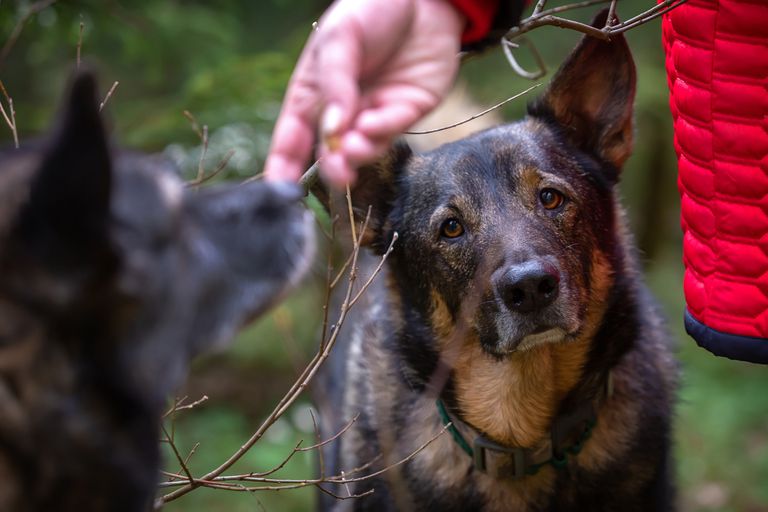
You may know the feeling when you’re out on a walk and stop to pet another pooch. Your dog may bark or whine, or even come in between you and the offending canine.
New research published in the journal Psychological Science finds that dogs exhibit these types of jealous behaviors even when they only imagine their owner is interacting with another dog.1 In the case of this study, the perceived rival was an artificial dog.
In the past, some scientists have insisted jealousy is strictly a human trait and people are merely projecting emotions on their pets.1
“I think it is natural for dog owners to project a range of human thoughts and emotions onto their pets,” lead author Amalia Bastos, a Ph.D. candidate at the University of Auckland in New Zealand, tells Treehugger.
Bastos cites a study published in 2008 in the journal Cognition and Emotion where 81% of dog owners said their pets get jealous. But as much as pet owners love their animals, they are sometimes wrong about them, she says.2
That same study found that 74% of dog owners reported their pets feel guilty after misbehaving.2 But several studies have found that what people see as a “guilty look” is merely dogs responding to getting in trouble from their owners, whether they actually misbehaved or not.3,4
“Anecdotes from dog owners are interesting and can inspire fascinating research into dog intelligence and behavior, but it is important that this is taken only as a starting point for rigorous science before we can make such claims,” Bastos says.
She adds: “Work on dog jealousy to date is more promising than for guilt: our study shows that dogs exhibit three signatures of human jealous behavior. However, we caution that the fact that dogs display jealous behavior does not necessarily mean that they experience jealousy as we do.”
For the study, researchers set up an experiment where 18 dogs imagined their owners interacting with either a realistic-looking stuffed dog or a similarly sized fleece-covered cylinder that looked nothing like a dog. The fake dog played the role of a potential rival while the cylinder was a control.1
First, the dogs watched the stuffed dog next to their owner. Then, a barrier was placed between the dog and the stuffed animal so they could no longer see the potential rival. The dogs pulled strongly on their leashes when their owners appeared to be petting the fake dog behind the barrier. In a second experiment, the dogs pulled on the leashes with less force when the owners appeared to be petting the fleece cylinder.1
“We developed a novel methodology whereby we could directly measure the amount of force a dog used to pull on its lead,” Bastos explains. “This provided the first easily quantifiable, objective measure of how strongly dogs attempt to approach a jealousy-inducing interaction between their owner and a social rival.”
This is called the “approach response” as the dog tries to get closer to the owner and the potential rival. It’s also how babies and kids respond when they are jealous, Bastos says.
“The approach response is a straight-forward and clean measure which happens to be the single most universal reaction to jealousy-inducing situations in human infants and children,” she says. “Although infants and children show a range of behaviors when observing their mothers interact with another infant — including but not limited to attacking the rival, crying, seeking physical contact with the mother, throwing a tantrum, or screaming — almost all react primarily by approaching the jealousy-inducing interaction.”
Researchers were able to measure the actual strength of the approach response rather than relying on inconsistent behaviors like barking, whining, growling, or attempting to bite, which would vary among dogs.1
The Canine Subjects Showcased Jealousy Signatures
The researchers found the dogs exhibited three human-like signatures of jealous behavior.1
These findings were different from earlier research because it’s the first to show dogs can mentally represent — or imagine — social interactions that they can’t directly see, Bastos says.
“We know this because when their owners appeared to pet a fake dog the dogs could not see behind an opaque barrier, they reacted with an approach response, which is a common jealous behaviour in humans. This suggests that dogs could mentally simulate what their owners must have been doing out of their direct line of sight,” she says.
It also showed that, like humans, dogs reacted more strongly when their owners interacted with a potential rival than with an inanimate object. And the reactions happened due to the interaction, and not when the owner and the rival were in the same room but not interacting.1
“Previous studies confounded jealous behavior with play, interest, or aggression because they never tested dogs’ reactions to the owner and the social rival being present in the same room but not interacting,” Bastos says.
“In our control condition, where owners petted a fleece cylinder, the fake dog was still present nearby,” she adds. “Dogs did not try to approach it as they did when they were being petted by the owner, showing that the interaction itself triggered their approach response, and therefore this is caused by jealous behaviour.”
Although this research is the first step, more research is necessary to figure out if dogs experience jealousy the same way people do.1
“There is still much work to be done to establish what dogs subjectively experience while exhibiting jealous behaviours, and this is a very difficult question to answer scientifically,” Bastos says. “We may never have an answer!”
ooOOoo
The researchers went to some lengths to show that the dogs were able to detect real interaction with another dog rather than a fake dog. The video is very interesting and I hope you are able to watch it.
The unconditional love of dogs put to a very beneficial human use!
Yesterday while we were waiting to pay for a few food items in Winco we stopped behind a woman with a small service dog. The dog was a Dachshund and had a jacket on which were sewn badges saying that this was a service dog and not to make contact.
The woman suffered from panic attacks and strongly recommended an organisation that was called ADA. In fact it is a government organisation and ADA stands for Americans with Disabilities Act.
All of which makes a nice introduction to this next item that was published on The Conversation blog site.
ooOOoo
Service dogs can help veterans with PTSD – growing evidence shows they may reduce anxiety in practical ways
PTSD, a mental health problem that some people develop after experiencing or witnessing a life-threatening traumatic event, is a complex condition and can be hard to treat. Our lab is studying whether service dogs can help these military veterans, who may also have depression and anxiety – and run an elevated risk of death by suicide – in addition to having PTSD.
The traditional treatments for PTSD, such as talk therapy and medication, do work for many veterans. But these approaches do not alleviate the symptoms for all veterans, so a growing number of them are seeking additional help from PTSD service dogs.
The nation’s estimated 500,000 service dogs aid people experiencing a wide array of conditions that include visual or hearing impairments, psychological challenges, epilepsy and multiple sclerosis.
Service dogs can help vets with PTSD in many ways. The most common tasks include helping veterans remain calm and interrupting their anxiety. The veterans said they are asking their dogs to calm or comfort them from anxiety five times per day and that their dogs independently interrupted their anxiety three times per day on average.
For example, a dog may “cover” a veteran at a supermarket, allowing its owner to calmly turn to take something off the shelf, because veterans with PTSD can get startled if they don’t know if someone is approaching and benefit if their dogs signal that this is happening. If a veteran starts to have a panic attack, a service dog can nudge its owner to “alert” and interrupt the anxiety. At that point, the veteran can focus on petting the dog to re-center on the present – ideally preventing or minimizing the panic attack.
Service dogs can help veterans with PTSD relax when they’re shopping for groceries, a common trigger for their symptoms of this condition. Barcroft Media via Getty Images
Aside from the tasks that their dogs are trained to do, veterans also shared that the love and companionship they get from simply being with their dogs is helping make their PTSD easier to manage.
Once veterans got service dogs, they described themselves in surveys as more satisfied with their lives, said they felt a greater sense of well-being and deemed themselves as having better relationships with friends and loved ones.
We have also measured levels of cortisol, commonly called the “stress hormone,” in veterans with service dogs. We found they had patterns closer to adults without PTSD.
Challenges and extra responsibilities
Not all veterans are willing or able to benefit from having their own service dogs.
Being accompanied by dogs in public can draw attention to the veterans. Some veterans appreciate this attention and the way it encourages them to get out of their shell, while others dread having to avoid well-meaning, dog-loving strangers. We’ve found that veterans do not expect this challenge, but often experience it.
Service dogs can also make it harder to travel, since bringing a dog along can require more planning and effort, especially because many people don’t understand the legal rights of people with service dogs and may ask inappropriate questions or create barriers that they aren’t legally allowed to do. Many experts believe educating the public about service dogs could alleviate these challenges.
What’s more, feeding, walking, grooming and otherwise taking care of a dog also entails additional responsibilities, including making sure they see a veterinarian from time to time.
There can also be a new sense of stigma that goes along with making a disability that might otherwise be hidden readily apparent. Someone who has PTSD might not stick out until they get a service dog that is always present.
Most veterans say it’s worth it because the benefits tend to outweigh the challenges, especially when appropriate expectations are set. Clinicians can play a role in helping veterans realize in advance what caring for the animal entails, to make the intervention positive for both the veterans and the dogs.
We are now completing the first registered clinical trial comparing what happens when these veterans get the usual PTSD interventions with what happens when they get that same treatment in addition to a trained service dog.
As our research proceeds, we are trying to see how the effects of a service dog last over time, how the service dogs affect veterans’ families and how we can support the partnership between veterans and their service dogs.
ooOOoo
I am still struggling with WordPress. For example I haven’t yet worked out how to place the credit for the photograph underneath the picture. (It did it all on its own!) And there doesn’t seem to be a ‘blockquote’ command.
But coming back to the article it was a perfect description of the way that dogs are so, so good to us humans whether we have a medical need for a service dog or not.
Midwestern Pet Foods Recalls Multiple Dog and Cat Food Brands
March 27, 2021 — Midwestern Pet Foods of Evansville, Indiana is recalling multiple brands of dog and cat food because they have the potential to be contaminated with disease-causing Salmonella bacteria.
What’s Recalled?
Recalled products include specific lots of CanineX, Earthborn Holistic, Venture, Unrefined, Sportmix Wholesomes, Pro Pac, Pro Pac Ultimates, Sportstrail, Sportmix and Meridian produced at its production facility in Monmouth, Illinois.
Recalled Dog and Cat Food with Lot Numbers
About Salmonella
Salmonella can affect animals eating the products and there is risk to humans from handling contaminated pet products, especially if they have not thoroughly washed their hands after having contact with the products or any surfaces exposed to these products.
Healthy people infected with Salmonella should monitor themselves for some or all of the following symptoms: nausea, vomiting, diarrhea or bloody diarrhea, abdominal cramping and fever.
Rarely, Salmonella can result in more serious ailments, including arterial infections, endocarditis, arthritis, muscle pain, eye irritation, and urinary tract symptoms.
Consumers exhibiting these signs after having contact with this product should contact their healthcare providers.
Pets with Salmonella infections may be lethargic and have diarrhea or bloody diarrhea, fever, and vomiting.
Some pets will have only decreased appetite, fever and abdominal pain.
Infected but otherwise healthy pets can be carriers and infect other animals or humans.
If your pet has consumed the recalled product and has these symptoms, please contact your veterinarian.
No human or pet illnesses have been reported to date.
Where Were the Products Sold?
Products were distributed to retail store nationwide and to online retailers.
Lot code information may be found on the back of the bags with the following format: “EXP AUG/02/22/M1/L#”
This recall covers only certain products manufactured at Midwestern Pet Foods Monmouth, Illinois facility.
The unique Monmouth Facility identifier is located in the date code as an “M”.
What Caused the Recall?
The recall was as the result of a routine sampling program by the company which revealed that the finished products may contain the bacteria.
What to Do?
Retailers and distributors should immediately pull recalled lots from their inventory and shelves.
Do not sell or donate the recalled products.
Retailers are encouraged to contact consumers that have purchased the recalled products if the means to do so exists.
Do not feed the recalled products to pets or any other animals.
Destroy the food in a way that children, pets and wildlife cannot access them.
Wash and sanitize pet food bowls, cups and storage containers.
Always ensure you wash and sanitize your hands after handling recalled food or any utensils that come in contact with recalled food.
For more information, contact Midwestern Pet Foods Consumer Affairs at info@midwesternpetfoods.com. Or call 800-474-4163, ext 455, from 8 AM to 5 PM CT, Monday through Friday.
This voluntary recall is being conducted in cooperation with the US Food and Drug Administration. All other Midwestern Pet Foods products are unaffected by this recall.
U.S. citizens can report complaints about FDA-regulated pet food products by calling the consumer complaint coordinator in your area.
Nothing to do with dogs but everything to do with the future!
An item in The Conversation recently was not only interesting from a scientific point-of-view but also it had real lessons for the way that we humans are interfering with the planet.
As The Conversation introduced the article:
A mile below the surface of the Greenland ice sheet, an ancient Arctic ecosystem is preserved in the frozen soil. How scientists discovered its leaves, twigs and mosses is a story in itself. It starts with a secret military base built into the northern Greenland ice.
In 1963, inside a covert U.S. military base in northern Greenland, a team of scientists began drilling down through the Greenland ice sheet. Piece by piece, they extracted an ice core 4 inches across and nearly a mile long. At the very end, they pulled up something else – 12 feet of frozen soil.
The ice told a story of Earth’s climate history. The frozen soil was examined, set aside and then forgotten.
Half a century later, scientists rediscovered that soil in a Danish freezer. It is now revealing its secrets.
Using lab techniques unimaginable in the 1960s when the core was drilled, we and an international team of fellow scientists were able to show that Greenland’s massive ice sheet had melted to the ground there within the past million years. Radiocarbon dating shows that it would have happened more than 50,000 years ago. It most likely happened during times when the climate was warm and sea level was high, possibly 400,000 years ago.
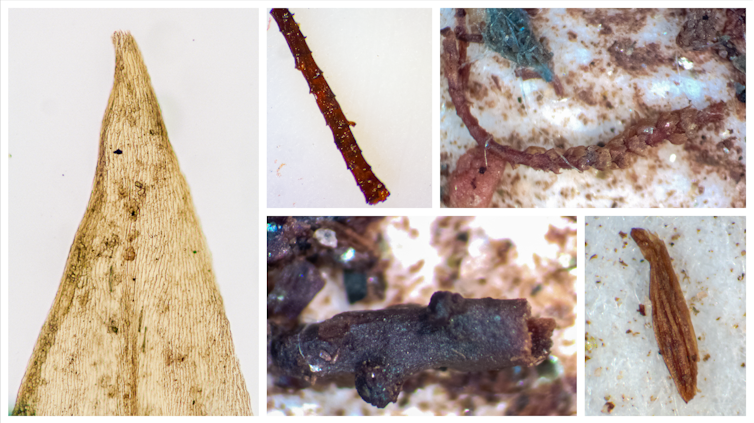
And there was more. As we explored the soil under a microscope, we were stunned to discover the remnants of a tundra ecosystem – twigs, leaves and moss. We were looking at northern Greenland as it existed the last time the region was ice-free. Our peer-reviewed study was published on March 15 in Proceedings of the National Academy of Sciences.
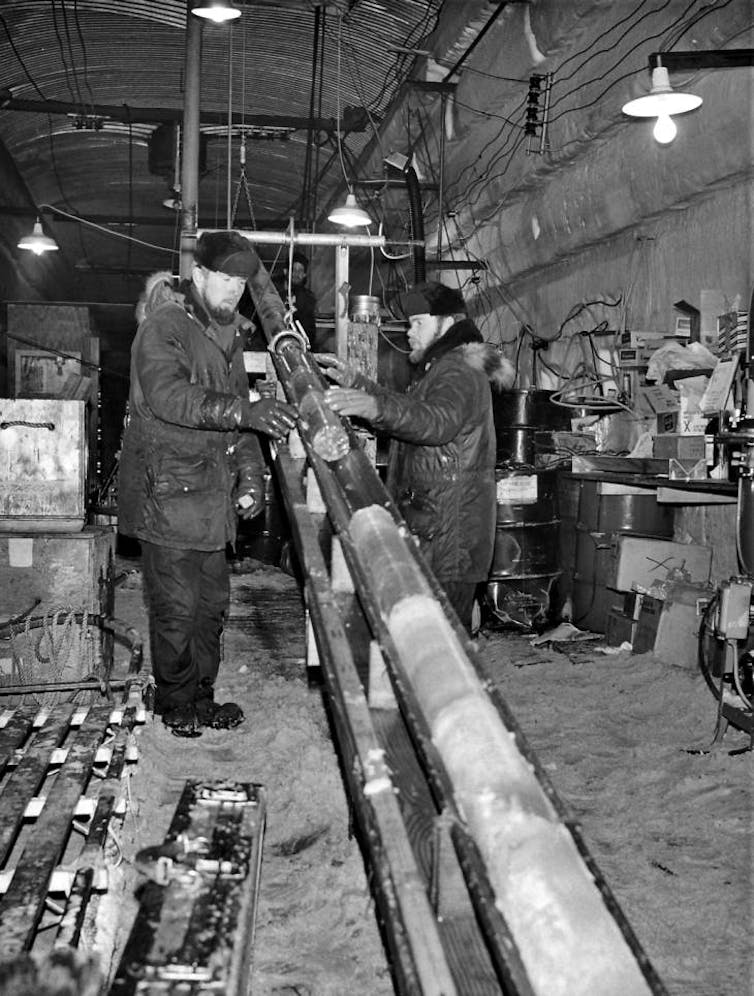
Engineers pull up a section of the 4,560-foot-long ice core at Camp Century in the 1960s. U.S. Army Corps of Engineers
Paul Bierman, a geomorphologist and geochemist, describes what he and his colleagues found in the soil.
With no ice sheet, sunlight would have warmed the soil enough for tundra vegetation to cover the landscape. The oceans around the globe would have been more than 10 feet higher, and maybe even 20 feet. The land on which Boston, London and Shanghai sit today would have been under the ocean waves.
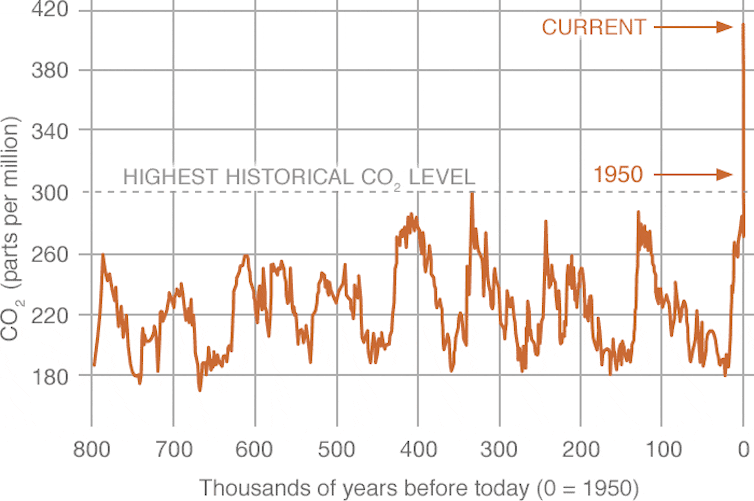
All of this happened before humans began warming the Earth’s climate. The atmosphere at that time contained far less carbon dioxide than it does today, and it wasn’t rising as quickly. The ice core and the soil below are something of a Rosetta Stone for understanding how durable the Greenland ice sheet has been during past warm periods – and how quickly it might melt again as the climate heats up.
Secret military bases and Danish freezers
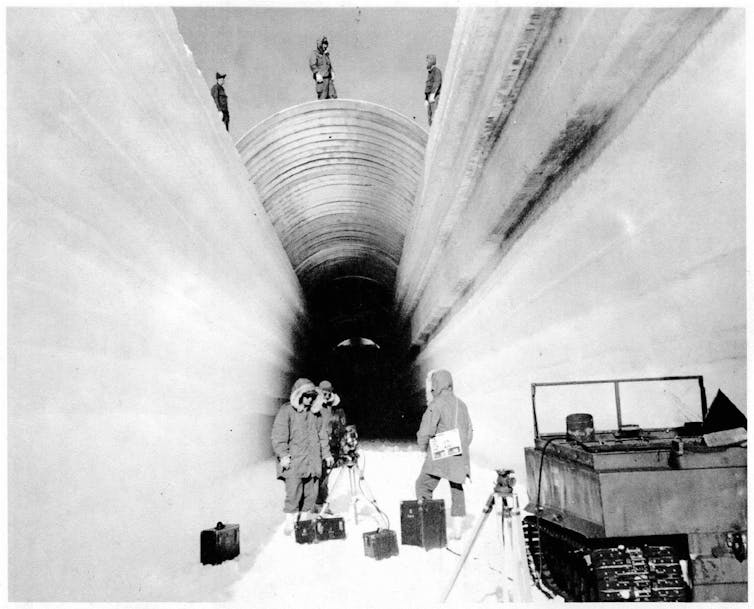
The story of the ice core begins during the Cold War with a military mission dubbed Project Iceworm. Starting around 1959, the U.S. Army hauled hundreds of soldiers, heavy equipment and even a nuclear reactor across the ice sheet in northwest Greenland and dug a base of tunnels inside the ice. They called it Camp Century.
It was part of a secret plan to hide nuclear weapons from the Soviets. The public knew it as an Arctic research laboratory. Walter Cronkite even paid a visit and filed a report.
Workers build the snow tunnels at the Camp Century research base in 1960. U.S. Army Corps of Engineers
Camp Century didn’t last long. The snow and ice began slowly crushing the buildings inside the tunnels below, forcing the military to abandon it in 1966. During its short life, however, scientists were able to extract the ice core and begin analyzing Greenland’s climate history. As ice builds up year by year, it captures layers of volcanic ash and changes in precipitation over time, and it traps air bubbles that reveal the past composition of the atmosphere.
One of the original scientists, glaciologist Chester Langway, kept the core and soil samples frozen at the University at Buffalo for years, then he shipped them to a Danish archive in the 1990s, where the soil was soon forgotten.
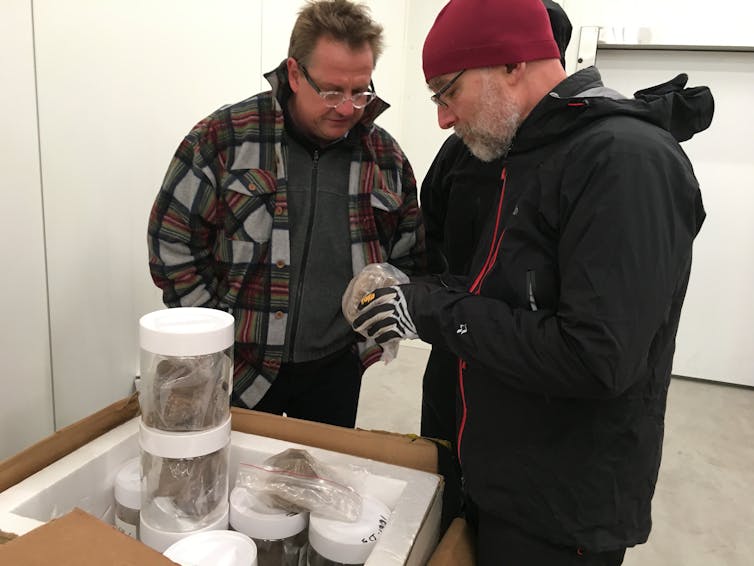
A few years ago, our Danish colleagues found the soil samples in a box of glass cookie jars with faded labels: “Camp Century Sub-Ice.”
Geomorphologist Paul Bierman (right) and geochemist Joerg Schaefer of Columbia University examine the jars holding Camp Century sediment for the first time. They were in a Danish freezer set at -17 F. Paul Bierman, CC BY-ND
A surprise under the microscope
On a hot July day in 2019, two samples of soil arrived at our lab at the University of Vermont frozen solid. We began the painstaking process of splitting the precious few ounces of frozen mud and sand for different analyses.
First, we photographed the layering in the soil before it was lost forever. Then we chiseled off small bits to examine under the microscope. We melted the rest and saved the ancient water.
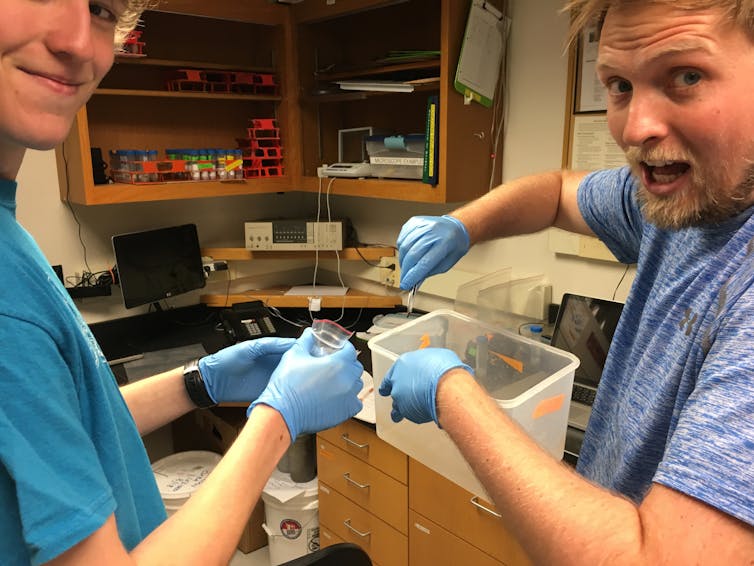
Then came the biggest surprise. While we were washing the soil, we spotted something floating in the rinse water. Paul grabbed a pipette and some filter paper, Drew grabbed tweezers and turned on the microscope. We were absolutely stunned as we looked down the eyepiece.
Staring back at us were leaves, twigs and mosses. This wasn’t just soil. This was an ancient ecosystem perfectly preserved in Greenland’s natural deep freeze.
Glacial geomorphologist Andrew Christ (right), with geology student Landon Williamson, holds up the first twig spotted as they washed a sediment sample from Camp Century. Paul Bierman, CC BY-ND
Dating million-year-old moss
How old were these plants?
Over the last million years, Earth’s climate was punctuated by relatively short warm periods, typically lasting about 10,000 years, called interglacials, when there was less ice at the poles and sea level was higher. The Greenland ice sheet survived through all of human history during the Holocene, the present interglacial period of the last 12,000 years, and most of the interglacials in the last million years.
But our research shows that at least one of these interglacial periods was warm enough for a long enough period of time to melt large portions of the Greenland ice sheet, allowing a tundra ecosystem to emerge in northwestern Greenland.
We used two techniques to determine the age of the soil and the plants. First, we used clean room chemistry and a particle accelerator to count atoms that form in rocks and sediment when exposed to natural radiation that bombards Earth. Then, a colleague used an ultra-sensitive method for measuring light emitted from grains of sand to determine the last time they were exposed to sunlight.
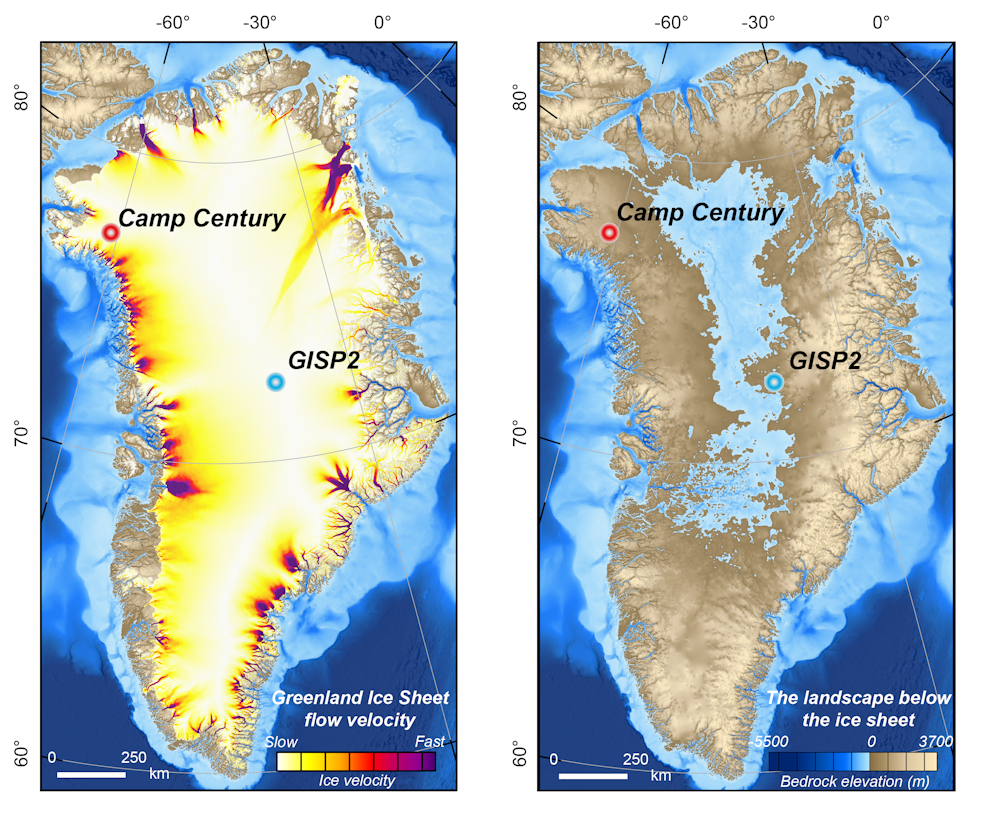
Maps of Greenland show the speed of the ice sheet as it flows (left) and the landscape hidden beneath it (right). BedMachine v3; Copernicus Climate Change Service (C3S), CC BY-ND
The concentration of carbon dioxide in the atmosphere today is well beyond past levels determined from ice cores. On March 14, 2021, the CO2 level was about 417 ppm. NASA Jet Propulsion Laboratory, CC BY-ND
Losing the Greenland ice sheet would be catastrophic to humanity today. The melted ice would raise sea level by more than 20 feet. That would redraw coastlines worldwide.
About 40% of the global population lives within 60 miles of a coast, and 600 million people live within 30 feet of sea level. If warming continues, ice melt from Greenland and Antarctica will pour more water into the oceans. Communities will be forced to relocate, climate refugees will become more common, and costly infrastructure will be abandoned. Already, sea level rise has amplified flooding from coastal storms, causing hundreds of billions of dollars of damage every year.
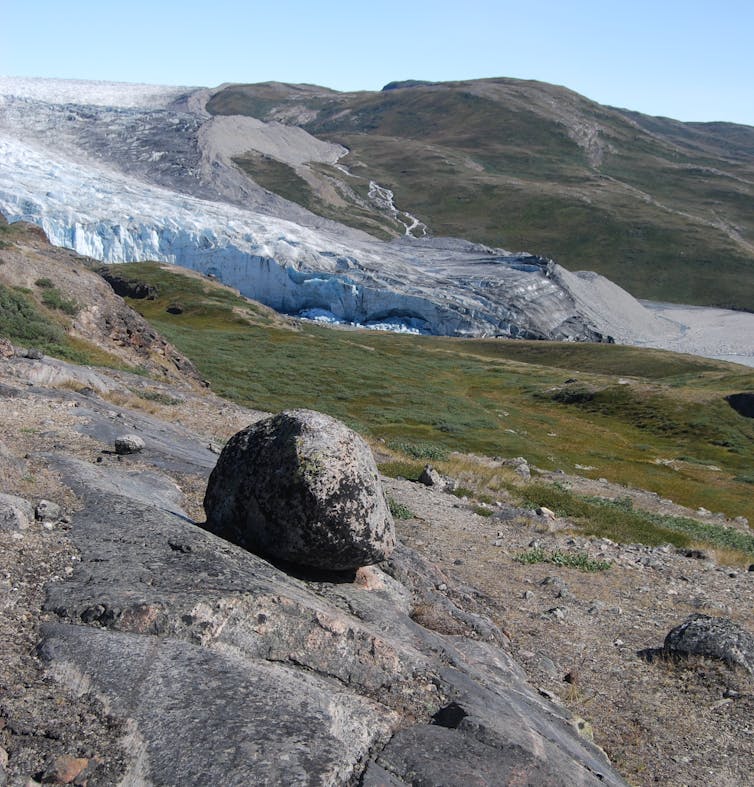
Tundra near the Greenland ice sheet today. Is this what Camp Century looked like before the ice came back sometime in the last million years? Paul Bierman, CC BY-ND
The story of Camp Century spans two critical moments in modern history. An Arctic military base built in response to the existential threat of nuclear war inadvertently led us to discover another threat from ice cores – the threat of sea level rise from human-caused climate change. Now, its legacy is helping scientists understand how the Earth responds to a changing climate.
The article is republished with the full permission of The Conversation.
I hope you read it because the way the climate is changing is affecting all of us now and sooner rather than later we have all got to amend our ways. Indeed, when I look at anyone who has potentially thirty or more years of life in them I ponder what their future is going to be like. And, of course, it won’t be a drastic change in thirty years it is already happening now albeit at times difficult to see.
But there is not one scintilla of doubt that we humans are the cause and we humans have to be the solution!















 Learning from Dogs
