Category: Environment

An insight into health

What we can learn about healthy lifestyles.

I am indebted to Schalk Cloete who has been leaving some very thoughtful comments on Learning from Dogs.  Schalk writes the blog, One in a Billion and more information about him can be learned here.  One of the very generous aspects of Schalk’s Blog is that his material is free from copyright, so I gratefully offer the following from his blog.

oooOOOooo

Perfect health the traditional way

There are a number of very special traditional communities around the world that enjoy amazing health and longevity completely without the help of modern medicine. People still contribute actively to their communities in their 80′s and 90′s and often surpass the magical age of 100 sometimes without ever visiting a doctor.

The most well-documented of these communities is the Okinawa islands in Japan, but a number of other such communities also exist. These include the region of Abkhasia in the Soviet Union, the Symi island in Greece, the Italian village Campodimele, and the mountain communities of Hunza in Pakistan, Vilcabamba in Ecuador and Bama in China.

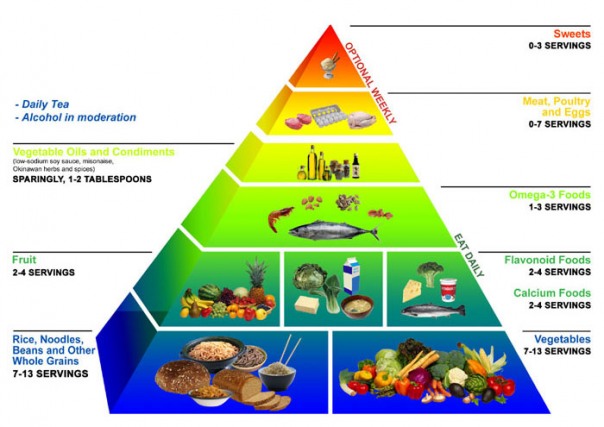
So, what are the secrets of these amazingly healthy people? Well, I don’t really think we can call them “secrets”, but here they are: these people simply eat a healthy, nutrient dense and predominately plant-based diet (Okinawan food pyramid given below), they never over-eat, they live very active lifestyles and they have a very strong sense of community.  Basically, they live the polar opposite of the modern western lifestyle.

These healthy lifestyle choices have some pretty impressive results. One fun statistic about Okinawa is that they boast 15% of the world’s confirmed super-centenarians (those over 110) while having only 0.0002% of the worlds people, thereby giving them a concentration of super-elders close to 100,000 times greater than the rest of the world. Wow…

In John Robbins’ excellent book “Healthy at 100″, he discloses a lot of well documented research on Okinawa, stating that they are about 15% as likely to die of heart disease and cancer as Americans. They also live 5 years longer on average.

When it comes to healthcare spending, Okinawa has the lowest healthcare costs in all of Japan, which already has a three times smaller per-capita healthcare expense than the USA. Thus, they have about a 7 times smaller chance of dying from degenerative disease and live 5 years longer, all while incurring about 5 times fewer healthcare expenses. Not bad, I’d say.

Unfortunately, the younger generation of Okinawans are rapidly screwing up these awesome stats by succombing to the American lifestyle brought by the US troops stationed on Okinawa.  It really is quite sad how many grandparents have to bury their grandchildren in Okinawa nowadays.

But this just shows how alluring our modern consumerist lifestyle really is. These young Okinawans saw the vibrant health of their parents and grandparents first hand, but still chose to consume their bodies into oblivion. Unthinking consumerism is indeed a very powerful enemy…

oooOOOooo

Fascinating article from Schalk, as I’m sure you will agree.

It’s really quite simple.

David Roberts of Grist offers a very clear message.

But before going to the piece, just let me say why there’s been a preponderance of climate change articles on Learning from Dogs.  Two reasons come to mind.  The first one is that this blog’s primary theme is integrity.  The idea of writing about what we can learn from the closest species to man, the domesticated dog, came out of the understanding that dogs are integrous creatures.  As I concluded in the Purpose of this blog,

Or, possibly, it’s more accurate to say that our civilisation is under threat and the time left to change our ways, to embrace those qualities of integrity, truth and consciousness for the very planet we all live on, is running out.

So what has this to do with dogs? Simply that man’s best friend, a relationship that goes back tens of thousands of years, is still a wonderful example of the many qualities that we need now for the very survival of the human species.

The second reason is that as many will be aware it is the G20 gathering this week and the more that millions around the world add their demand for common-sense and reason the better that will be.  Again, honesty and integrity, values not usually associated with the world’s political leaders, must come to the fore.

So now to the recent piece from Grist.

Climate change is simple: We do something or we’re screwed

By David Roberts

Back in April, The Evergreen State College invited me to speak at a TEDx event called “Hello Climate Change: Rethinking the Unthinkable.” Videos from the event are now online.

My talk was called “Climate change is simple.” I’m proud to say that I used only 17 of my allotted 15 minutes.

I’ve put an annotated version of my slideshow beneath the video, linking to sources and adding thoughts. The only thing I’ll say about the video itself is that I’ve always thought these things would be better with a soundtrack. If anybody out there on the web wants to make a mashup with it, add some good beats, be my guest.

This is the video of David’s talk.

And in case you think this is all green paranoia, then spend a couple of minutes watching this,

A group of scientists from around the world who are part of The Berkeley Initiative in Global Change Biology (BiGCB) is warning that an ever-growing population and widespread destruction of natural ecosystems may be driving Earth toward a planet-wide tipping point, an irreversible change in the biosphere with unpredictable consequences. Anthony Barnosky, professor of integrative biology at the University of California, Berkeley, is the lead author of a review paper about this issue in the journal Nature.
For full story: NewsCenter.berkeley.edu
Video by Roxanne Makasdjian, UC Berkeley Media Relations

NB. I found the sound levels on these videos to be rather low – hope you can hear them clearly.

Changing our fuel would be a great move.

A recommendation to watch this film.

I’m talking about the film Fuel which Jean and I watched on Monday night.

Here’s the trailer,

This movie trailer gives insight into the impeding oil dependency problem and hints at the biofuel solution. The Fuel Film raises awareness of 9/11, global warming, and moreover, how we can switch to an alternative fuel called biofuel. It is based on renewable sources such as algae or ethanol, costs less, and combats the impeding destruction of the environment.

But Top Documentary Films has the full film available, the link is here. (And see below)  TDF describe the film, thus,

Eleven years in the making, FUEL is the in-depth personal journey of filmmaker and eco-evangelist Josh Tickell, who takes us on a hip, fast-paced road trip into America’s dependence on foreign oil.

Combining a history lesson of the US auto and petroleum industries and interviews with a wide range of policy makers, educators, and activists such as Woody Harrelson, Sheryl Crow, Neil Young and Willie Nelson.

Animated by powerful graphics, FUEL looks into our future offering hope via a wide-range of renewable energy and bio-fuels. Winner of the Sundance Audience Award.

The events of Sept. 11 and Hurricane Katrina factor in both visually and thematically, providing provocative anchors for the movie’s indictment of what Tickell believes is the Big Oil-cozy, ecologically indifferent Bush administration.

Johnny O’Hara’s WGA Award-nominated script doesn’t dwell on muckraking, however; it’s more focused on broadly inspiring viewers than preaching to the converted.

Interviews with a wide range of environmentalists, policy makers and educators, along with such “green” celebrities as Woody Harrelson, Sheryl Crow and Larry Hagman offer serious fuel for thought – as well as for action.
Smartly animated interstitials, memorable archival material and a lively soundtrack round out the fast-paced proceedings.

Have to say that the film was powerful and compelling and a great reminder that a sustainable way of life for all of us doesn’t mean the end of the world as we know it.  Far from it; the word ‘sustainable’ is the clue here!

Here’s the full film,

Director Josh Tickell takes us along for his 11 year journey around the world to find solutions to America’s addiction to oil. A shrinking economy, a failing auto industry, rampant unemployment, an out-of-control national debt, and an insatiable demand for energy weigh heavily on all of us. Fuel shows us the way out of the mess we’re in by explaining how to replace every drop of oil we now use, while creating green jobs and keeping our money here at home. The film never dwells on the negative, but instead shows us the easy solutions already within our reach.

Finally, a little footnote for all you Planet watchers out there.  Summer starts, as in the summer solstice, today (the 20th) in North America at 7:09 P.M. EDT (UTC -4 hours) or 4:09 P.M. MST (UTC -7 hours) and in the UK at 23:09 UTC.

End Fossil Fuel Subsidies NOW!

It’s rare for me to post a second item on the same day but this warrants it!

The full copy of this recently issued Press Release now available on the End Fossil Fuels Subsidies website is republished in full below.

PASS IT ON!

oooOOOooo

PRESS RELEASES

MIDDAY TWITTERSTORM REPORT
June 18, 2012

Call to #EndFossilFuelSubsidies at Rio+20 Tops Twitter

EU Commissioner for Climate Action Connie Hedegaard, celebrities Mark Ruffalo,
Stephen Fry, and Robert Redford, journalist Nicholas Kristof, and more join global push

RIO DE JANEIRO — The push to end fossil fuel subsidies at Rio+20 became the #2 most talked about topic worldwide on Twitter this morning.

The social networking site, which has 100 million active users, tracks discussions by hashtag and #endfossilfuelsubsidies ranked #2 globally and #2 in United States and Australia. 350.org, the global climate campaign coordinating the effort, estimated that the hashtag was being tweeted at least once a second, reaching millions of people around the world.

A number of politicians, journalists, celebrities, and high-profile activists joined in the campaign, helping catapult it into the spotlight:

British actor Stephen Fry tweeted, “Let’s green $1 trillion with a plan to save the planet. Sign the petition & RT: http://j.mp/endFFS #endfossilfuelsubsidies #G20 #RioPlus20.”

American actor Mark Ruffalo, who recently played the Hulk in the box-office sensation The Avengers, tweeted, “Good Morn! Can you help us end fossil fuel subsidies? Pls tweet #endfossilfuelsubsidies TODAY to help us send a msg & spread the word.!!!”

The EU Commissioner for Climate Action Connie Hedegaard, who is expected to play a key role at the Rio+20 negotiations,tweeted, “Fossil fuels subsidies have no place in today’s world . They must be phased out as the G20 pledged. #EndFossilFuelSubsidies #Rioplus20.”

Journalist and New York Times columnist Nicholas Kristof tweeted, “A twitterstorm underway calling on leaders to #EndFossilFuelSubsidies at Rio summit: http://yfrog.com/1qamv1j.”

350.org founder Bill McKibben tweeted, “$1 trilllion is a lot of money–tired of the fossil fuel industry laughing at us, so joining the twitterstorm #endfossilfuelsubsidies.”

Activists with 350.org are projecting tweets in cities around the world, including Sydney, London, New Delhi, and New York, as well as inside the Rio+20 negotations.

Yesterday, 350.org and Avaaz unfurled a giant $1 trillion bill on the Copacabana beach in Rio, producing some spectacular photos. The global campaign Avaaz.org is delivering a petition with 750,000 signatures calling for an end to fossil fuel subsidies to G20 leaders in Los Cabos, Mexico this afternoon. Over a million people have signed different petitions calling for action on subsidies in the last two weeks.

The current draft of the Rio+20 agreement released on Saturday includes a paragraph on ending fossil fuel subsidies, but negotiations now hang in the balance as oil exporting countries led by Saudi Arabia and Venezuela attempt to delete any references to the proposal. The final decision is likely to come down to Brazil, who hold sway as the host country.

The Twitterstorm can be tracked at endfossilfuelsubsidies.org. Supporting organizations for endfossilfuelsubsidies.org include: 350.org, Avaaz, Climate Reality Project, Earth Day Network, Friends of the Earth International, Global Exchange, Green For All, Greenpeace International, Greenpeace New Zealand, Natural Resource Defense Council, Oil Change International, Quercus, SumOfUs, Wild Aid, WWF

###

CONTACT: In the US, Daniel Kessler, dk@350.org, +1 510-501-1779; In Rio, Jamie Henn, jamie@350.org, +55(0)2181061948

NOTE TO EDITORS:

1. Information on the $1 Trillion in fossil fuel subsidies: http://priceofoil.org/wp-content/uploads/2012/05/1TFSFIN.pdf

##

PRESS ADVISORY/PHOTO CALL

‘Twitterstorm’ gathers speed before Monday’s Global Cyberaction to #EndFossilFuelSubsidies at Rio+20

RIO, 15 June 2012 — Momentum is building for this Monday’s 24-hour “Twitterstorm,” a massive international online action to increase pressure on world leaders to cut nearly $1 trillion in fossil fuel subsidies at the upcoming Rio+20 Earth Summit.

For 24 hours between June 18th and 19th, as world leaders gather at the G20 summit and prepare for Rio+20, hundreds of thousands of people around the world will tweet with the same hashtag — #EndFossilFuelSubsidies — at celebrities and politicians, flooding the popular social network with their demand. Over 1 million people have already signed a petition calling on leaders to act.

Recent developments on the Twitterstorm include:

• Confirmation of tweet projections in Sydney, London, New Dehli, and Rio (see Notes section for times and locations) (1)
• A new website with fact sheets, a tool to tweet at celebrities and Heads of State, and more resources for activists: http://www.endfossilfuelsubsidies.org
• A new Facebook event that has registered over two thousand “Tweet Team” members to recruit participants for the day of action. (2)
• Support from over a dozen civil society groups, including 350.org, Greenpeace International, Oil Change International and WWF. (3)

WHAT: A 24-hour Twitterstorm to #EndFossilFuelSubsidies at Rio+20

WHEN: The 24-hour clock will begin at 8:00 UTC (6 PM local time in Sydney) when activists will flock to Twitter with messages that will be projected in iconic locations in Sydney, New Delhi, London, and Rio. In recent weeks campaigning groups have collected over 1 million signatures demanding that leaders act now.

WHY: According to figures compiled by Oil Change International, countries are spending as much as $1 trillion USD combined annually on fossil fuel subsidies. (4) The International Energy Agency estimates that by cutting these subsidies, the world can cut global warming causing emissions in half and significantly contribute to preventing a 2 degree temperature rise, the limit most scientists say we need to stay under to prevent runaway climate change. (5)

In May, leaders of the G20 again pledged to eliminate fossil fuel subsidies. They first made the commitment in 2009 but have yet to implement the policy change at the country level.

While global warming emissions rise and gas prices spike, fossil fuel companies continue to make massive profits, which brings into doubt the need for subsidies. ExxonMobil, for example, made $41.1 billion USD in profit in 2011.

###

CONTACT: In the US, Daniel Kessler, 350.org, dk@350.org, +1 510-501-1779; In Rio, Jamie Henn, jamie@350.org, +55(0)2181061948

NOTE TO EDITORS:

1. June 18 projection events

• Sydney
◦ Summary: Sydney will launch the Twitter Storm from the Sydney Opera House.  Local supporters are invited to send a photo or video message to world leaders with the Sydney Opera House and Sydney Harbour Bridge as a backdrop.  Projection of the Twitter feed will continue late at night around Sydney’s CBD.
◦ 6 PM (UTC+10) Sydney Opera House Boardwalks
◦ 9 PM (UTC+10) Sydney CBD
◦ CONTACT: Abi Jamines abigail@350.org, +61 403278621

• New Delhi
◦ Summary: There will be two projections in New Delhi.
◦ Projection 1: 6 PM – 9 PM, Moonlighting, An indoor projection while the Twitter feed is projected to an invited audience along with a speaker to discuss the issue of fossil fuel subsidies in the Indian context. (Will share speaker details soon, yet to be confirmed).
◦ Projection 2: 6PM – 11 PM An outdoor projection at a local mall called DLF Saket.
◦ CONTACT: Chaitanya Kumar, chaitanya@350.org, +91-9849016371

• London
◦ Summary: There will be 3 events in London–a petition delivery at 10 Downing Street in the morning, followed by two projections.
◦ Petition delivery: 10:30am GMT+1, Number 10 Downing Street, London.
◦ Projection 1: 1:30pm GMT+1, Houses of Parliament, London
◦ Projection 2: Approximately midnight GMT+1 (Tuesday 19th June), Nelson’s Column, Trafalgar Square, London
◦ CONTACT: Emma Biermann, emma@350.org, +44 (0) 78 3500 4720,

• Rio
◦ Summary: Tweets will be displayed in the Rio Centro conference center all day.
◦ CONTACT: Jamie Henn, jamie@350.org, +55(0)2181061948

2.  https://www.facebook.com/events/304496622975461/

3. Supporting organizations include: 350.org, Avaaz, Climate Reality Project, Earth Day Network, Friends of the Earth International, Global Exchange, Green For All, Greenpeace International, Greenpeace Australia, and Greenpeace New Zealand, League of Conservation Voters, Natural Resource Defense Council, Oil Change International, Oxfam, Quercus, SumOfUs, Wild Aid, World Wildlife Fund

4. http://priceofoil.org/wp-content/uploads/2012/05/1TFSFIN.pdf

5. http://www.iea.org/files/energy_subsidies_slides.pdf

##

‘Twitter Storm’ Planned to Pressure Leaders to End Fossil Fuel Subsidies at Rio+20

Environmental conference ideal place to end wasteful giveaways to corporate polluters, says civil society groups

Oakland, 7 June 2012 — Campaigning organizations from around the world will join forces on June 18 for a 24-hour ‘Twitter storm’ in which tens of thousands of messages will be posted on the social networking site demanding that world leaders use Rio+20 to agree to end fossil fuel subsidies.

The 24 hour clock will start at 6PM local time in Sydney (8AM UTC), when activists will begin to flock to Twitter with messages that will also be projected in iconic spots in Sydney, New Delhi, London, Rio, and other locations. In recent weeks campaigning groups have collected over 1 million signatures demanding that leaders act now to end subsidies and start to invest in clean energy solutions. (1)

According to figures compiled by Oil Change International, countries together are spending as much as $1 trillion dollars annually on fossil fuel subsidies. (2) The International Energy Agency estimates that by cutting these subsidies, the world can cut global warming causing emissions in half and significantly contribute to preventing a 2 degree temperature rise, the number most scientists say we need to stay under to prevent runaway climate change. (3)

“We are giving twelve times as much in subsidies to fossil fuels as we are providing to clean energy, like wind and solar. World leaders shouldn’t be subsidizing the destruction of our planet, especially since these subsidies are cooking our planet,” said Jake Schmidt, International Climate Policy Director at the Natural Resources Defense Council.

In May, leaders of the G20 again pledged to eliminate fossil fuel subsidies. They first made the commitment in 2009 but have yet to implement the policy change at the country level.

While global warming emissions rise and gas prices spike, fossil fuel companies continue to make massive profits, which brings into doubt the need for subsidies. ExxonMobil, for example, paid an effective US federal tax rate in 2010 of 17.2 percent, while the average American paid 28 percent.

Participating organizations include 350.org, Avaaz, Greenpeace. Oil Change International, Natural Resources Defense Council, and others.

###

CONTACT: In the US, Daniel Kessler, 350.org, +1 510 501 1779, daniel@350.org

NOTE TO EDITORS:

1.http://endfossilfuelsubsidies.org/

2. http://priceofoil.org/wp-content/uploads/2012/05/1TFSFIN.pdf

3. http://www.iea.org/files/energy_subsidies_slides.pdf

Planet Earth is just one world!

A very simple, fundamental message to the G20+ Conference in Rio.

We live on one planet.  It is the solemn duty of everyone living on this planet to protect it from harm.  So to all those at Rio claiming to represent a Nation, or more accurately the people living in that Nation, act not only on behalf of that Nation but on behalf of the planet, the only planet, we all live on.

The only life-sustaining planet we have!

The art of relaxation

Yesterday’s article reminds me of something fundamental!

In Patricia’s guest post of yesterday, she wrote about Chloe, her dog,

Chloe was born knowing. She knows about joy. She knows about living a life in balance. She knows about forgiveness, trust, exuberance, a passion for learning and the power of a good nap.

I was speaking with Jon Lavin a few days ago about the effect of anxiety on memory.  Jon confirmed that as we get older even low levels of anxiety can play games with our mental focus.  He described what many of us know – of walking into a room, for instance, and suddenly realising that you didn’t have a clue as to why you had come into the room!  In a very real sense anxiety is the body’s manifestation of fear.

Jon went on to say that practicing ‘letting go’ for a couple of 10-minute sessions a day is wonderfully therapeutic for the mind.  In fact, when Jon was a guest author for Learning from Dogs he touched on the subject of fear in a post almost two years ago to the day; Dealing with the fear of the known.  Indeed, I’m going to reproduce that article in full – here it is,

Jon Lavin

Can we ever conquer fear?

In a recent article I discussed the fear of the unknown, linked to the down-turn, redundancies, etc.

Per Kurowski, a great supporter of this Blog, posed the following question. “Great advice… but how do we remove the fear of what is known?”  A simple, and slightly flippant answer would be, “Develop a different relationship with it.”

What I’m saying is that when we are facing the known, and I’m assuming that it’s something unpleasant, our choices are limited. It’s going to happen, so the only thing we can do is change the way we view it.

This brings us back full circle to developing a different relationship with it. Let’s take the word, ‘fear’.

All fear is an illusion, walk right through“. I heard Dr David Hawkins say on a CD. Granted, a great trick if you can do it!

Here’s another description of fear: Fear = False Evidence Appearing Real

Fear is generally future-based. We tend to use the past as a learning reference to inform us of what to be afraid of in the future. So human beings live their lives trying to predict and prepare for the future, limited by their past experiences.

Unfortunately, the only way to work with fear of the known is to live in the present!

Our whole society is geared up to look into the future. We are forever worrying about or planning something for the future.

To begin focussing on the present, try this.

Simply, to start off, become aware of the breath and sensations in the body. This will slowly start to remind us to be present, or embodied, in our own body. Problems, fear and spiral thinking, often at 3 or 4 in the morning, are generated in the mind. Thoughts occur randomly, although we call them, “Our thoughts“, and refer to, “Our mind“.

By dropping out of the thought processes into the awareness of our breath and our body, the noise stops, even if only for a moment.  Here’s the rub: So very few people in the world will have even the slightest inkling what these words mean!

If more of us got used to coming out of the mind before making an important decision, and simply sat with the question for a while, the answer would probably present itself.

This will probably raise more questions than it answers but that’s not a bad thing.

By Jon Lavin

Difficult to add anything to that very sound advice save to try it out yourself, and if you own a dog or have one as a friend, just look much more closely at how he or she behaves and remember why this blog is called what it is!  Or as Trish wrote,

Chloe was born knowing. She knows about joy. She knows about living a life in balance. She knows about forgiveness, trust, exuberance, a passion for learning and the power of a good nap.

Ah, the power of a good nap!

Puppy Cleo enjoying a good nap!

What the dog knew!

A guest post from Patricia Iles.

Regular readers will know that one of my joys of this blog writing game is the wonderful connections that are made across this funny old virtual world.  Trish Iles is one of those wonderful connections.

In fact, Trish is based at our local insurance firm, Crabdree Insurance, right here in Payson but until we ‘chit-chatted’ about writing a guest post for Learning from Dogs I had no idea there is much more to this lady.

To underline that, anyone who has their own blog called Contemplating Happiness will inevitably generate some curiosity.  That curiosity increases as one learns more about Trish and discovers that she is a published author.

Anyway, that’s enough from me, here is Trish Iles writing What the dog knew!

oooOOOooo

The wisdom of Chloe

I was pondering the eternal question: why does two weeks of relaxing vacation seem like so much more time than two weeks of working like my pants are on fire, here at my desk? My sweet husband and I talked about it a little bit, but came to no definitive answer. I chatted with friends about it. No insights. Google had no opinion, either.

Chloe came to us from a rescue organization. I think sometimes about what her experiences have been in her young life. She started out as an abandoned puppy on a reservation in New Mexico and was soon in the pound where she was on the euthanasia list. A kind woman rescued her and took care of her until she found us: just when Chloe was becoming at home with the rescue lady, she was uprooted again and sent home with two new people. What must she have been thinking?

Chloe didn’t close her heart to us, though. She watched for a few days. When she decided we weren’t going to make dinner out of her and that she was really staying with us, she threw her whole being into becoming one of the family. She let herself trust us.

I’m not sure I would have had the courage to trust a new set of people again. I’m doubly not sure that I give a rat’s patootie what those new people thought of or wanted from me. Chloe was willing not only to trust us, but to love us. She forgave us immediately for ripping her from the home she knew, and she adopted us right back.

Chloe was born knowing. She knows about joy. She knows about living a life in balance. She knows about forgiveness, trust, exuberance, a passion for learning and the power of a good nap. I think that when I grow up, I want to be just like her.

oooOOOooo

Don’t know about you dear reader but I just loved that story from Patricia.  Deep messages about what we can learn from our wonderful canine friends.

Indeed, I’m going to stay with the theme with tomorrow’s Post.

Fracking Hell!

Is it me or are we all totally mad?  Only if we don’t take action!

I’ve quoted this expression before so forgive me for using it again.  That’s the old Devon expression, “All the world’s a little queer, ‘cept thee and me, and I ha’ me doubts about thee!”  It really does seem as if most of us are ‘a little queer!’

Yesterday, I expressed the tip of much frustration, nay incredulity, in a rant about why society showed such complacency towards the impending crisis of our civilisation.  As I wrote,

Why isn’t there such a huge outpouring of anger at the complacency of the world’s leaders?  How far does the collapse of the conditions, both social and physical, as in biosphere, have to go before we get real, urgent change?

Well today’s Post is taking a selection of recent items that have been published to show why I feel as I do.  I make no apologies for this being a longish Post but that doesn’t make it anything other than incredibly important; personal opinion, of course!

Let’s start with our love affair with carbon-based fuels, in this case natural gas (that’s methane you know).  Over on Lack of Environment Martin Lack recently published a piece on Fracking.  Here’s an extract,

Burning fossil fuels just because they are there is insane
For a long time, I have told anyone that would listen that we should leave unconventional hydrocarbons in the ground because of the extremely high probability that James Hansen is right; if we burn them all the runaway greenhouse effect is a “dead certainty” (i.e. on page 236 of Storms of My Grandchildren). However, thanks to the persistence of my many friends in the blogosphere, I have now also woken up to the reality that unconventional fossil fuel extraction – and hydraulic fracturing (known as fracking) in particular – is having significant immediate adverse environmental impacts. Pendantry has described this as humanity “fouling its own nest”; but I think my own description of it as “defecating in our own pig pen” conveys a more appropriate image.

In the USA, fracking has recently been prohibited in the State of Vermont and it must be hoped that other States will now do the same. The Vermont legislature took this action as a result of reports confirming the link between fracking and minor earthquakes; and because of high profile campaigns mounted by those communities already being adversely impacted by fracking. However, the latter should not be confused with NIMBYism. This is because opposition to fracking is a response to real environmental problems afflicting real people as a result of real stupidity on an industrial scale.

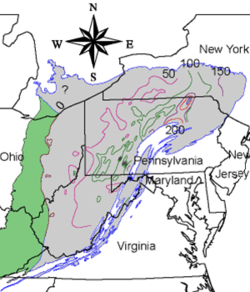
The Marcellus Shale formation

Martin also included a 17-minute feature from Link TV on the use, and dangers, of extracting natural gas from the Marcellus Shale in the US North-East.  It’s a sobering reminder of how we are playing with fire with the planet, both literally and metaphorically.  This is the video:

My next reference is an article published in the latest issue of Nature.  Only a summary is available freely online, but here it is anyway,

Approaching a state shift in Earth’s biosphere

Localized ecological systems are known to shift abruptly and irreversibly from one state to another when they are forced across critical thresholds. Here we review evidence that the global ecosystem as a whole can react in the same way and is approaching a planetary-scale critical transition as a result of human influence. The plausibility of a planetary-scale ‘tipping point’ highlights the need to improve biological forecasting by detecting early warning signs of critical transitions on global as well as local scales, and by detecting feedbacks that promote such transitions. It is also necessary to address root causes of how humans are forcing biological changes.

The overall theme of this issue of Nature is shown in their leading story, again taking the liberty of republishing an extract.  First how the article opens,

Return to Rio: Second chance for the planet

Twenty years ago, when the world’s leaders pledged to protect Earth’s climate and biodiversity at the Rio Earth Summit, they knew it would not be easy. But few could have guessed how much worse the situation would get. In 1992, the atmosphere held fewer than 360 parts per million (p.p.m.) of carbon dioxide; the concentration is now nearing 400 p.p.m. and surging upwards. At the same time, species are disappearing at an accelerating rate.

On the eve of the second Rio Earth Summit, Nature explores the causes and consequence of those changes, as well as the efforts that are being made to avert the worst outcomes. Our assessment shows how little progress nations have made towards honouring the commitments they made in 1992.

Then how that article closes,

Anthony Barnosky and his colleagues argue that the global ecosystem could eventually pass a tipping point and shift into a new state, the likes of which are hard for science to predict. But there are ways to avoid that fate, say Paul Ehrlich and his colleagues (page 68), who suggest techniques to make societies more sustainable and to head off many of the world’s chronic environmental problems.

Earth and its inhabitants have a second chance in Rio. They may not get many more.

There’s more and more of this but, yes, I know, one can only take so much.  So let me head for the close with a message of what you and I, and all of us, can do.

The United Nations Environment Programme recently released a video showing how inadequate have been our leaders.  Watch it first and then I’ll offer a solution.

The fifth edition of the Global Environmental Outlook (GEO-5), launched on the eve of the Rio+20 Summit, assessed 90 of the most-important environmental goals and objectives and found that significant progress had only been made in four.

More on the report findings here.

So join with me as I focus my rant from yesterday into something more valuable – asking you to take action – in whatever way you can!

Go here and sign the petition from 350.org.

Add your name to this:

To the G20 and World Leaders:

As concerned global citizens, we urge you to honour your previous commitments to end taxpayer handouts to the fossil fuel industry. To save our planet we need a game-changer now — we call on you to first lead by example, and then make ending all polluter payments the top global priority for the Rio Earth Summit.

So do it now – Go here and sign the petition from 350.org.

Then when you have signed that plea to world leaders to stop the subsidies to fossil fuels, pass this link to everyone you can – www.350.org/rio

And get close to 350.org and stay in touch.

Let’s do this; it’s so much better than ranting!

I feel a headache coming on!

A bit of a personal rant about complacency!

But before I get my blood up, let me reflect on a small passage of time.  I first started writing this Blog on July 15th, 2009, coming up to three years ago.  The idea came from a previous conversation with Jon Lavin of The People Workshop when we were chatting about Dr. David Hawkins’ Map of Consciousness and Jon pointed out that dogs had a ‘score’ of about 210, i.e. were positively above the boundary between truth and falsehood.  As I wrote here,

Dogs:

  • are integrous ( a score of 210) according to Dr David Hawkins
  • don’t cheat or lie
  • don’t have hidden agendas
  • are loyal and faithful
  • forgive
  • love unconditionally
  • value and cherish the ‘present’ in a way that humans dream of achieving
  • are, by eons of time, a more successful species than man.

That’s why the blog is called Learning from Dogs!

Stay with me just a little longer.

The picture of Pharaoh on the Home page, this one:

Dogs know better, much better! Time again for man to learn from dogs!

is a picture of a ‘beta’ dog.  The beta dog is the second-in-command, so to speak, in a wild dog pack.  A dog pack, about 40 to 50 dogs in the wild, has three dogs of special rank, although rank is not really the correct word, role is a better one.  The leader of the pack is the alpha dog; always a female dog.  The next role dog is the beta; always a male.  The third role dog is the ‘clown’ dog and can be either sex.

In reverse order, the clown dog is there to keep the pack happy (in dog terms), the beta dog’s role is to break up fights within the pack and to ‘teach’ the puppies their social skills (which is why a beta dog is always a dominant male) and the alpha’s primary role is to ensure that the pack’s territory is not compromised by other animals and that there is plenty of food for the pack.

Ergo, the single most important decision of the alpha dog is to move the pack to a new territory when she judges that the present one is unsustainable!

OK, to my ‘rant’!

Why isn’t mankind learning from dogs and realising that our present ‘territory’, Planet Earth, is not capable of sustaining mankind for very much longer.

I don’t believe that man is intrinsically stupid!  Many know the famous quotation from Einstein, “Insanity: doing the same thing over and over again and expecting different results.”  So if most of us ‘nod’ our heads when we read that quote, why are most of us seemingly content to keep doing the same thing?  Why isn’t there such a huge outpouring of anger at the complacency of the world’s leaders?  How far does the collapse of the conditions, both social and physical, as in biosphere, have to go before we get real, urgent change?

Last Thursday, in a post I called Denialists standing up for insanity, I quoted Tom Engelhardt in his introduction to an article by Bill McKibben thus,

It’s true that no single event can be pinned on climate change with absolute certainty.  But anyone who doesn’t think we’re in a fierce new world of weather extremes — and as TomDispatch regular Bill McKibben has suggested, on an increasingly less hospitable planet that he calls Eaarth – is likely to learn the realities firsthand soon enough.  Not so long ago, if you really wanted to notice the effects of climate change around you, you had to be an Inuit, an Aleut, or some other native of the far north where rising temperatures and melting ice were visibly changing the landscape and wrecking ways of life — or maybe an inhabitant of Kiribati.  Now, it seems, we are all Inuit or Pacific islanders.  And the latest polling numbers indicate that Americans are finally beginning to notice in their own lives, and in numbers that may matter.

Well it’s good that Americans are starting to get the picture but it’s all too gentile – we all have to get much more excited about making our leaders understand that we want action to curb CO2 emissions, and we want action NOW!

Just look at this chart from NOAA as seen on the Climate Central website:

Year-to-Date divisional temperature rankings from NOAA.

More about that tomorrow!

OK, only a short rant!  Which is immediately followed by an apology!  Because you will have to wait 24 hours before reading my next Post about fracking, about how some ‘leaders’ expect the CO2 emissions in the earth’s atmosphere to stabilise at 650 ppm and how very close we are to losing control!

Think I need to go and lie down!

Quirks of the natural world

Or should that be ‘quacks’?  A delightful duck story from San Antonia, Texas.

With big thanks to Merci O. for sending me the story.

A True Duck Story from San Antonio , Texas

Something really cute happened in downtown San Antonio this week. Michael R. is an accounting clerk at Frost Bank and works there in a second story office. Several weeks ago, he watched a mother duck choose the concrete awning outside his window as the unlikely place to build a nest above the sidewalk. The mallard laid ten eggs in a nest in the corner of the planter that is perched over 10 feet in the air. She dutifully kept the eggs warm for weeks, and Monday afternoon all of her ten ducklings hatched.

Michael worried all night how the momma duck was going to get those babies safely off their perch in a busy, downtown, urban environment to take them to water, which typically happens in the first 48 hours of a duck hatching.

Tuesday morning, Michael watched the mother duck encourage her babies to the edge of the perch with the intent to show them how to jump off. Office work came to a standstill as everyone gathered to watch.

The mother flew down below and started quacking to her babies above. In disbelief Michael watched as the first fuzzy newborn trustingly toddled to the edge and astonishingly leapt into thin air, crashing onto the cement below. Michael couldn’t stand to watch this risky effort nine more times! He dashed out of his office and ran down the stairs to the sidewalk where the first obedient duckling, near its mother, was resting in a stupor after the near-fatal fall. Michael stood out of sight under the awning-planter, ready to help.

As the second one took the plunge, Michael jumped forward and caught it with his bare hands before it hit the concrete. Safe and sound, he set it down it by its momma and the other stunned sibling, still recovering from that painful leap. (The momma must have sensed that Michael was trying to help her babies.)

One by one the babies continued to jump.. Each time Michael hid under the awning just to reach out in the nick of time as the duckling made its free fall. At the scene the busy downtown sidewalk traffic came to a standstill. Time after time, Michael was able to catch the remaining eight and set them by their approving mother.

At this point Michael realized the duck family had only made part of its dangerous journey. They had two full blocks to walk across traffic, crosswalks, curbs and past pedestrians to get to the closest open water, the San Antonio River, site of the famed “RiverWalk.”

The on-looking office secretaries and several San Antonio police officers joined in. An empty copy-paper box was brought to collect the babies. They carefully corralled them, with the mother’s approval, and loaded them in to the container. Michael held the box low enough for the mom to see her brood. He then slowly navigated through the downtown streets toward the San Antonio River. The mother waddled behind and kept her babies in sight, all the way.

As they reached the river, the mother took over and passed him, jumping in the river and quacking loudly. At the water’s edge, Michael tipped the box and helped shepherd the babies toward the water and to the waiting mother after their adventurous ride.

All ten darling ducklings safely made it into the water and paddled up snugly to momma.  Michael said the mom swam in circles, looking back toward the beaming bank book-keeper, and proudly quacking.

At last, all present and accounted for: “We’re all together again. We’re here! We’re here!”

And here’s a family portrait before they head outward to further adventures….

Like all of us in the big times of our life, they never could have made it alone without lots of helping hands. I think it gives the name of San Antonio ‘s famous “River Walk” a whole new meaning! Maybe you will want to share this story with others.

And even if you enjoyed the story, do settle down for 3 minutes and watch the YouTube version – it’s something you will treasure, I promise you!

Both versions end with this thought:

Live honestly, Love generously, Care deeply and Speak kindly