Category: Economics

Pitchforks or Pens.

The extreme importance of engaging in the fight for better societies.

I must warn you that today’s post is nothing about dogs. Unless, as with me, you see dogs as well as being the most gorgeous of creatures as being critically important metaphors for what societies need now! Or as I present elsewhere in this place:

Because of this closeness between dogs and man, we (as in man!) have the ability to observe the way they live.  Now I’m sure that scientists would cringe with the idea that the way that a dog lives his life sets an example for us humans, well cringe in the scientific sense.  But man seems to be at one of those defining stages in mankind’s evolution where the forces bearing down on the species homo sapiens have the potential to cause very great harm.  If the example of dogs can provide a beacon of hope, an incentive to change at a deep cultural level, then the quicker we ‘get the message’, the better it will be.

Dogs:

  • are integrous ( a score of 210) according to Dr David Hawkins
  • don’t cheat or lie
  • don’t have hidden agendas
  • are loyal and faithful
  • forgive
  • love unconditionally
  • value and cherish the ‘present’ in a way that humans can only dream of achieving
  • are, by eons of time, a more successful species than man.

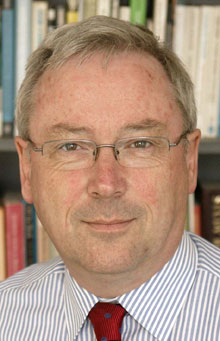
richard-murphySo what’s this all leading up to!

Regular followers of this place (and you are always appreciated – never forget that) will know that previously I have mentioned Professor Richard Murphy. I have been following and reading his blog Tax Research UK for some time.

Many of the good Professor’s posts are specific to what is going on in the UK and, inevitably, Europe and the EU referendum.

But on the wider horizon these seem to be such terrible times. Here’s a comment I left to another of Richard’s posts that opened with the sentence, I am so bored by the EU referendum campaign.

My comment being:

It’s coming up to 5:30 am here in Southern Oregon and, as per usual, I have dipped into the latest postings from Tax Research. Part of me, a large part of me, is sickened by what seems to be going on in this world with the EU referendum and the US Presidential election being the two most glaringly terrible examples. But this old Brit (London-born in 1944) has this sense that the way that Richard and so many of his supporters can now ‘shout’ out the truth will, in the end, deliver a better future. Indeed, my own blog post today is called The Power of Open Opinions.

So keep on banging your truthful drum, Richard!

However, last Tuesday Richard published a post that seemed to speak to me, and presumably countless others, about the dilemma as to whether to be active in speaking up about what is right or wrong, or to just huddle up with one of your dogs on a nice (oversized) dog bed!

In my estimation that post from Richard should be widely circulated and it is republished in full now with Richard’s kind permission.

ooOOoo

To engage or not; that is the question

Posted on7:57 am May 31 2016

It would seem I have touched a raw nerve for some regular commentators by suggesting that I welcome the IMF article, recently published, that appeared to recognise the failure of neoliberalism to tackle inequality and the inappropriateness of much of the austerity agenda.

It now seems that this article has attracted a vicious backlash from the FT, which clearly sees it as touching on neoliberal heresy. In that case to suggest, as some do, that this article is inconsequential is, in my opinion, wrong.  If nothing else, it has revealed the true opinion of the FT, and the sharp divide between its editorial stance and the opinion of its lead economic  columnist, Martin Wolf.

It is also safe to assume that if this has been the response outside the organisation then the debate within it has been at least as heated,  and all this on an article which says it can find merit in some parts of the neoliberal agenda.

Why come back to the issue then?  I think there are three good reasons for doing so.

First, how to respond to such an article from such an organisation opens up one of the more difficult questions in campaigning, which is whether to engage or not with those organisations that you criticise?  It is not possible to be a tax justice campaigner and to not have been critical of the IMF and its approach over the last few decades.  I have been of the IMF, the World Bank and, of course, of the Washington Consensus  that they have promoted.  But, a long time ago I decided that the only viable way  in which I could help deliver tax justice was by engaging with those people and organisations whose opinions I wished to change.

Over the years I’ve been criticised for this, and  been told that the policy would undermine my chances of success.  So, variously,  I was told that it was a mistake to serve on George Osborne’s General Anti-Abuse Rule  committee.  Likewise, engaging with the  OECD BEPS  process was described as a mistake by some because the terms of engagement were clearly biased against developing countries.  Others have also suggested that it was a mistake not to object to Jeremy Corbyn  using some of my policy ideas.   I suspect some would also criticise the fact that I went to the World Bank last week  and there were definitely those who suggested that I should not accept an appointment at City University, precisely because it has got links to the City of London. As for the Fair Tax Mark; some say that is a sell out.

In all cases I disagree.  It is my job to  create ideas  that might effect change.  My purpose for doing so is, I hope clear:  my aim is to create a more  genuinely prosperous, more equal, more democratic, more accountable, more sustainable,  more tolerant  and so more enjoyable world in which we might live.  More is an important word in that sentence:  it could be prefaced with ‘much’  in many cases but I do not think we will ever create  utopia.  I want better because I doubt that the best I believe possible is actually achievable within the necessary compromises that human society requires, not just now but ever.

That, then, brings me to my second point.  I am not seeking a revolution, but an evolution.  I respect those who wish to be perpetual outsiders because they believe that the only way forward is to sweep away all that is in their path to create an entirely new society, but their’s is not a path I would ever choose.  There is good reason for that: I believe that the cost of such change is too high, and the uncertainty of the outcome too great for any such risk to be taken.  The chance  that what we have will be replaced by tyranny is also too significant to justify this approach, in my opinion.

But, perhaps, most of all,  and thirdly, I believe that the power of an idea at the right time is sufficiently strong to ensure that such a revolutionary approach is wholly unnecessary.  I stress, I am not claiming that my ideas are in this category;  I am suggesting that ideas can be.  Neoliberalism arose because it was an idea in the right place at the right time, even if I fundamentally disagree with the prescription that it offered.  The post-war consensus was similarly created in this way.

I regret that as yet we have not reached a point where a similar replacement idea has been sufficiently developed to capture, unambiguously, the common political narrative.  Discussion of sustainability is become mainstream, but not in reality commonplace.  Disquiet with austerity is deep-rooted, but has not yet displaced the obsession with balanced budgets.  Debate on inequality  in its many egregious forms is taking place, but is not yet reversing trends. Some  political developments  now arising are deeply  antagonistic to democracy. But, and I stress the point,  the fact that all these things are happening is, in itself, indication that something really important is going on and that we may, in my opinion, be reaching a point where real change is possible.

I stress, in the context the IMF article is, in my opinion  important even though it is not  as radical as that  which many people would wish to read.  But that is how change takes place: very few of us are really capable of embracing giant leaps. Most of us have to, inevitably, partake in incremental steps on the way to a bigger goal.

I accept, and embrace that fact,  which I perceive to be a reality.  That is not to say there is no place for the campaigner who demands, with reason, more radical change.  Whilst I see many of the attractions of being a ‘no compromiser’  that is not the path I have chosen to follow, even with tax havens (as my Plan B for Jersey made clear).  If the choice is between a pitchfork and a pen, then I choose the pen,  believing that at the end of the day this is the way to  create real change. But as a result I also choose to engage, without apology.

ooOOoo

We must never forget that the pen is mightier than the sword! And we must never stop engaging!

Keep shouting it out!

The force of public opinion has never been more important; critically so!

As you all know this world of blogging: authors; followers; readers, is a great number of wonderful communities right across the planet. It is nothing like the traditional media, now owned and controlled by just a handful of large corporations, because the vast majority of blogging participants are free to say what they want, when they want.

Here’s an example.

Martin Lack is an Englishman who is the author of the blog Lack of Environment. As his home page quietly states:

Although scientificly trained (with degrees in Geology and Hydrogeology – see my About page), this blog arises from my having also got an MA in Environmental Politics and, as such, as the tagline indicates, is a blog on “the politics and psychology underlying the denial of all our environmental problems”… I hope you will take this on board; and enjoy the discussion.

“There is something fundamentally wrong in treating the Earth as if it were a business in liquidation” – Herman E. Daly (former World Bank economist).

The science about the chemistry of climate change especially the new danger of methane is clear. The commitment of our political leaders is less clear. But that doesn’t mean that we shouldn’t keep shouting out loud.

As Martin Lack did recently.

ooOOoo

Open Letter to David Cameron

29 March 2016

The Rt. Hon. David Cameron MP

The Prime Minister
10 Downing Street
London, SW1A 2AA

Dear Prime Minister,

Whatever happened to the greenest government ever?

Given my experience of working in environmental consultancy or regulation, I understand the importance of making pragmatic, risk-based decisions (as opposed to dogmatic, opinion-based ones).  I therefore believe that government policy should be formulated this way.  Unfortunately, however, this does not always seem to be the case.

As a pragmatic scientist, I am not ideologically opposed to nuclear power.  However, I do question the logic of pursuing ‘Hinkley Point C’ when equivalent investment in distributed renewable technologies – from domestic solar PV to submarine tidal stream – could probably generate more electricity faster.  Indeed, as Greenpeace has recently pointed out, the UK could meet nearly all its electricity generation needs from renewable energy sources by 2030.[1]

With regard to risk, the scientific consensus is that, in order to minimise anthropogenic climate disruption (ACD), the World must now embark upon the fastest-possible transition to a zero carbon economy.  Therefore, I also question the logic of simultaneously promoting investment in shale gas; discouraging investment in renewables; and cancelling investment in Carbon Capture and Storage research.

It is now over 50 years since scientists started warning of the climatic implications of continuing to burn fossil fuels;[2] and 50 years since fossil fuel company executives started spending huge sums of money on being “Merchants of Doubt”.[3]  As such, along with their counterparts in the tobacco industry, they have clearly not acted in the long-term interest of humanity as a whole.

However, as with the individual health benefit of ceasing to smoke tobacco, the sooner we stop burning fossil fuels the greater the collective environmental benefit will be. Therefore, I am pragmatically opposed to shale gas exploration because burning it is not consistent with the need to transition away from fossil fuels as fast as possible.

I am certain that you would like to secure an enduring political legacy; and would therefore like to ask just one question:

What could be better than being remembered as the Prime Minister that committed the UK to meeting nearly all its electricity generation needs from renewable energy sources by 2030?

Yours sincerely,

Martin C. Lack

————
[1] See: http://www.greenpeace.org.uk/blog/climate/uk-can-be-almost-entirely-powered-renewable-energy-2030-new-study-shows-20150921.

[2] Nuccitelli, D. (2015), ‘Scientists warned the US president about global warming 50 years ago today’, Guardian newspaper, 5 November 2015: London.

[3] Oreskes, N. & Conway E. (2010), Merchants of Doubt,  New York: Bloomsbury. See: http://www.merchantsofdoubt.org/

ooOOoo

Let me finish today’s post by republishing an exchange between Patrice Ayme and Martin over on a recent PA essay, that I republished in full in this place: Runaway Antarctica.

Martin:

I know I am wasting my time writing letters to David Cameron; and I know my opinions are irrelevant. However, the facts of history are not; nor will they be in the future.

Patrice:

I know you are doing the right thing. Writing to Cameron is entirely correct. But of course, he is a guy with just a salary and a few “savings”, a few tens of millions dollars of savings, maybe, or maybe not, and knew nothing about his recently deceased father having a fund of around 50 million dollars sheltered by shell companies, out there, somewhere related to Panama, or the British Virgin Islands, or the Bahamas, or Bermuda, whatever…

OK, David’s wife, officially, has a fund of more than twenty million pounds….

Martin:

For the record: I am socially-conservative (i.e. as opposed to liberal) but under no illusion as to the folly of what has been called ‘money fetishism’ (Karl Marx); and ‘growthmania’ (Herman E. Daly).

Patrice:

Hi Martin, thanks for the comment. I spent a whole hour reading the hard cover version of the paper the electronic version of which I criticized above. It’s quite a bit different. They use RCPs (Reasonable Carbon Projections, or the like in meaning). Yet, they don’t explain what they consist of exactly. All I know is that we are around 500 ppmv, and they work with 400 ppmv, in the 130 K-115 K years BP, when orbital conditions were cooler than now.

Plus we are going to be at 550 ppmv within ten years, at the present rate. The earliest date they have for the failure of Larsen C in their worst RCP 8.5 is 2055 CE. I would be surprised if it did not fail within ten years.

However, the paper version is more insistent on the danger of AIR warming, not just subsurface.

Also the Hansen paper has a scenario, which is suitably apocalyptic, but not apocalyptic enough in my book. Temperatures over the Arctic were strikingly high this winter, of the order of 4 to 5 degrees Centigrade higher than normal, and sometimes more. Nobody expected this sort of jumps. Except for yours truly!😉

Martin:

Thanks for the explanation, Patrice. This is all very reminiscent of the position of (Arizona) Professor Guy McPherson, who believes most scientists are in denial about the consequences of multiple positive feedback mechanisms we can already see operating:
http://lackofenvironment.wordpress.com/2013/02/19/what-on-earth-are-we-doing/

You all have a wonderful weekend and keep hugging those dogs of yours!

Mature, healthy trees.

Continuing the metaphor that our trees offer us.

In yesterday’s post I offered up the idea that:

The analogy with planting trees is very apt. For any clown can plant the tree but parenting that young tree into a mature forty-foot high beauty takes professional management.

That post had been inspired by a recent essay over at Patrice Ayme’s Thoughts regarding the observation by Andy Grove, the founder of Intel, that promoting start-ups without the commensurate focus on growing those start-ups into viable commercial concerns was strategically and politically incorrect. Back to that essay for a further extract:

However, American-based manufacturing is not on the agenda of Silicon Valley or the political agenda of the United States. Venture capitalists actually told me it was obsolete (before stepping in their private jets). That omission, according to Mr. Grove, is a result of anotherunquestioned truism”: “that the free market is the best of all economic systems — the freer the better.” To Mr. Grove, or Mr. Trump, or yours truly, that belief is flawed.

Andy Grove: “Scaling used to work well in Silicon Valley. Entrepreneurs came up with an invention. Investors gave them money to build their business. If the founders and their investors were lucky, the company grew and had an initial public offering, which brought in money that financed further growth.” 

The triumph of free-market principles over planned economies in the 20th century, Mr. Grove said, did not make those principles infallible or immutable. There was room for improvement, he argued, for what he called “job-centric” economics and politics. In a job-centric system, job creation would be the nation’s No. 1 objective, with the government setting priorities and arraying the forces necessary to achieve the goal, and with businesses operating not only in their immediate profit interest but also in the interests of “employees, and employees yet to be hired.”

As even the New York Times now admits, the situation has degenerated since 2010. Although the employment rate halved, in a slave state, everybody is employed. But neither the economy, nor the society, let alone progress and civilization are doing better.

“Insecure, low-paying, part-time and dead-end jobs are prevalent. On the campaign trail, large groups of Americans are motivated and manipulated on the basis of real and perceived social and economic inequities.

Conditions have worsened in other ways. In 2010, one of the arguments against Mr. Grove’s critique was that exporting jobs did not matter as long as much of the corporate profits stayed in the United States. But just as American companies have bolstered their profits by exporting jobs, many now do so by shifting profits overseas through tax-avoidance maneuvers.

The result is a high-profit, low-prosperity nation. “All of us in business,” Mr. Grove wrote, “have a responsibility to maintain the industrial base on which we depend and the society whose adaptability — and stability — we may have taken for granted.” Silicon Valley and much of corporate America have yet to live up to that principle.”

If we return to that analogy of the tree, think how long and how much attention must be put into the conditions that will promote not only sustained growth of that young tree but growth to the point where it can propogate its own saplings.

As it is for young companies. The skills that company managers require to nurture that company to the point of self-sustaining maturity are many and varied. But they are underpinned by the need to be truthful and trustworthy, to be devoted to the employees of the company and to instill in all who work, and finance, that company to “love the customer”. Not just those customers that are the big spenders but also, and especially so, the many, many smaller clients that can make or break a company’s reputation.

So with that in mind let’s take a peek at USA LLC and UK Ltd.

Here are the closing paragraphs from Patrice’s essay:

Our corruption is not just an economic and social problem, a political problem, and a civilizational problem, as it was under Aristotle.  It is a problem for the entire planet.

We empowered a demagogue“, laments Mr. Kristof. His true calling, and that of the Main Stream Media, was to empower plutocrats, and their obsequious servants. How sad they are.

Patrice Ayme’

Then there is Richard Murphy in the UK who writes the blog Tax Research UK. In a recent post, entitled The Party Political Problem he opened, thus:

I like being outside the fray of party politics. I wasn’t born with a sufficient capacity for compromise to believe that any political party has all the answers to all questions. And yet, equally, I can admire those who can make the sacrifice to take part in this process. It is, for better or worse, at the heart of democratic politics.

That demands that it be done well. This requirement is predicated on three things. The first is a willingness to pretend you have the answer to all things. The second is a leadership that knows this is not true and which as a result respects its opponents. The third is an acute appreciation of the fact that compromise in pursuit of a higher goal, whilst saving face, is the ultimate political aim: nothing really happens without the accommodation of others.

He then closes his post:

Passion, dogma and steadfastness, come what may, are not what makes party politics.

Conviction based on wisdom, understanding and compassion does.

But these qualities remain in far too short supply, even if they’re not quite out of stock, yet.

And that’s the party political problem.

Many people both ‘sides of the pond’ would nod heads in agreement with that.

My final peek is into an essay that was recently published by the quarterly journal The Baffler. The essay was from David Graeber under the heading of Despair Fatigue. Opening:

Is it possible to become bored with hopelessness?

There is reason to believe something like that is beginning to happen in Great Britain. Call it despair fatigue.

For nearly half a century, British culture, particularly on the left, has made an art out of despair. This is the land where “No Future for You” became the motto of a generation, and then another generation, and then another. From the crumbling of its empire, to the crumbling of its industrial cities, to the current crumbling of its welfare state, the country seemed to be exploring every possible permutation of despair: despair as rage, despair as resignation, despair as humor, despair as pride or secret pleasure. It’s almost as if it’s finally run out.

and closing, thus:

Twenty-first century problems are likely to be entirely different: How, in a world of potentially skyrocketing productivity and decreasing demand for labor, will it be possible to maintain equitable distribution without at the same time destroying the earth? Might the United Kingdom become a pioneer for such a new economic dispensation? The new Labour leadership is making the initial moves: calling for new economic models (“socialism with an iPad”) and seeking potential allies in high-tech industry. If we really are moving toward a future of decentralized, small, high-tech, robotized production, it’s quite possible that the United Kingdom’s peculiar traditions of small-scale enterprise and amateur science—which never made it particularly amenable to the giant bureaucratized conglomerates that did so well in the United States and Germany, in either their capitalist or socialist manifestations—might prove unusually apt. It’s all a colossal gamble. But then, that’s what historical change is like.

In other words, it’s this!

One of the age-old maxims from professional company managers is:

It’s always a case of putting people before profits!

Putting people before profits should be in the front of the minds of all our leaders and masters; both sides of the ‘pond’.

Or in tree language investing in this:

Clown work! (This is a Red Maple, by the way!)
An American Red Maple sapling.

to achieve this:

A mature American Red Maple tree.

Come on good people, we really do need healthy, mature trees in our 21st C. societies.

New growth required!

New trees offer a good metaphor!

As regular followers of this place know (and a huge thank-you to you all) much of last Friday was spent planting trees in a grassy meadow just to the East of our house.

P1150940
A part view of the area where the trees were planted: Kentucky Coffeetrees; Northern Catalpas; a Red Maple, Eastern Redcedars.

An hour before I sat down to write this post (now 13:30 PST yesterday) I didn’t have a clue as to what to write. Then I read Patrice Ayme’s latest essay and, wow, it punched me in the face. For it resonated so strongly with a few other recent readings.

Patrice’s essay was called Trump A Demagogue? So What? and it opened thus:

“We empowered a demagogue” laments the New York Times ostensibly bleeding heart liberal, the kind Mr. Kristof, in his false “Mea Culpa” editorial, “My Shared Shame: How The Media Made Trump”. By this, Mr. Kristof means that Mr. Trump is a bad person. However, Mr. Kristof’s choice of the word “demagogue” is revealing. (Actually it’s not really his choice: “demagogue” is not Mr. Kristof’s invention: he just repeats like a parrot the most prominent slogan of the worldwide campaign of insults against Trump).

Trump a demagogue? Is Mr. Sanders a “demagogue”, too? (As much of the financial and right-wing press has it: for The Economist and the Financial Times, Trump and Sanders are both “demagogues” and that’s their main flaw.)

To understand fully the word “demagogue” one has to understand a bit of Greek, and a bigger bit of Greek history.

Then later on in that essay, Patrice goes on to quote Andy Grove:

A hard day may be coming for global plutocrats ruling as they do thanks to their globalization tricks. And I am not exactly naive. Andy Grove, founder of Intel, shared the general opinion that much of globalization was just theft & destitution fostering an ominous future (the Hungarian immigrant to the USA who was one of the founders of Intel). He pointed out, an essay he wrote in 2010 that Silicon Valley was squandering its competitive edge in innovation by neglecting strong job growth in the United States.

Mr. Grove observed that: …”it was cheaper and thus more profitable for companies to hire workers and build factories in Asia than in the United States. But… lower Asian costs masked the high price of offshoring as measured by lost jobs and lost expertise. Silicon Valley misjudged the severity of those losses, he wrote, because of a “misplaced faith in the power of start-ups to create U.S. jobs.”

Silicon Valley makes its money from start-ups. However, that phase of a business is different from the scale-up phase, when technology goes from prototypes to mass production. Both phases are important. Only scale-up is an engine for mass job growth — and scale-up is vanishing in the United States (especially with jobs connected to Silicon Valley). “Without scaling,” Mr. Grove wrote, “we don’t just lose jobs — we lose our hold on new technologies” and “ultimately damage our capacity to innovate…

The underlying problem isn’t simply lower Asian costs. It’s our own misplaced faith in the power of startups to create U.S. jobs. Americans love the idea of the guys in the garage inventing something that changes the world. New York Times columnist Thomas L. Friedman recently encapsulated this view in a piece called “Start-Ups, Not Bailouts.” His argument: Let tired old companies that do commodity manufacturing die if they have to. If Washington really wants to create jobs, he wrote, it should back startups.

Friedman is wrong. Startups are a wonderful thing, but they cannot by themselves increase tech employment.”

Spot on! For in my previous life I was the founder of two businesses. First up was Dataview Ltd, based in Colchester, that was formed in the late 1970s and soon became the global distributor of the word processing software Wordcraft, written by Englishman Pete Dowson. Dataview also initiated the ‘dongle’, a software/hardware security device to protect Wordcraft.

The Wordcraft dongle.

The second company founded by me was Aviation Briefing Ltd ‘AvBrief’ that is still going today, albeit with me no longer involved!

So I can reinforce, with hundreds of hours of lost sleep and tears, that growing a company and increasing employment, especially the employment of great technical people, is a very different matter to the start-up phase.

Frankly, regarding Dataview, it was only the luck of meeting Sid Newman that saved my bacon. For within 12 months of starting trading I was already sinking under the load of trying to be the number one salesman (that I was good at) and being the company general manager (that I was total crap at). Sid had years of experience at general management and very quickly let me get on with what I really loved – opening up Wordcraft distributorships all over the world.

The analogy with planting trees is very apt. For any clown can plant the tree but parenting that young tree into a mature forty-foot high beauty takes professional management.

Clown work! (This is a Red Maple, by the way!)

Tomorrow I will return and offer a viewpoint as to how we, as in society, are currently bereft of professional managers.

Where to for democracy?

Good people must resist what is going on!

My sub-heading was prompted by that very well-known saying, “All that evil requires to succeed is for good people to do nothing.”

That saying came to me when I was reading a recent essay published by Professor Richard Murphy over in the UK. I am referring to his article entitled: Nature reckons science is watching as democracy rides over a cliff.

Here’s the extent of Richard’s short post:

This comes from Colin Macilwain in the latest edition of the massively influential journal ‘Nature’, and I quote in the public interest and as it reinforces the arguments I have made today:

But at the top [of science] there is paralysis: leading scientific organizations do little except chase money and reinforce the ruling nexus of politics and finance — even since the financial crisis of 2008, which discredited the free-market philosophy that underpins that nexus. I argued years ago (see Nature479, 447; 2011) that scientific leaders had failed to respond in any meaningful way to that collapse, and I’m still waiting.

The political structure of the West is in deep trouble, and should it fall apart, there will be plenty of blame to go around. Most will go to political and financial elites, or to rowdy mobs. But some will belong to people in the middle who have taken public funds, defended elites and then stood back and watched as democracy got ridden over a cliff.

I think that fair comment and recommend the rest.

If one now goes across to that post from Colin here’s what one would read in the opening paragraphs:

The elephant in the room we can’t ignore

16 March 2016

The annual meeting of the American Association for the Advancement of Science (AAAS) in Washington DC last month was one of the best I’ve witnessed in more than 20 years of regular attendance. The policy sessions were packed and genuinely stimulating. I met tons of smart, influential people I hadn’t seen for ages, and we all enjoyed a good chinwag about how better to engage with the public — the meeting’s theme for 2016.

The only trouble was what was going on outside the hotel — in the United States and the world at large.

Colin then makes the point that is neatly articulated in the extract that was published by Professor Murphy and is republished above.

I don’t have any answers other than wanting to share this with you, dear reader. For decent, ordinary folk must be aware of the multiple threats to our Western democracy that are taking place.

Just as I want to share with you an example of what a good honest person and his adorable Labrador get up to. An example from my old country (and Richard Murphy’s home country).

ooOOoo

Dog Refuses to Leave the Side of Near-Death Man Trapped in Mud

3171690.large

When one false step left Martin Kay literally drowning in ice-cold mud in the English countryside, he quickly found out who his two best friends are. Turns out one of them is a dog.

Holly Blue is a typical Labrador who has never met a tree trunk or a blade of grass that doesn’t smell good. So when Martin took out her leash one recent afternoon, his dog was over-the-moon with expectation of the crisp afternoon air and a landscape of wintery fields. Neither of them had any inkling that this simple walk would soon turn catastrophic.

This day, the two set out along a different route through England’s historic Thornham Parva village. Though it was a very cold day, the skies were clear and there was no reason for concern, or so it seemed.

“I hadn’t walked that route for about two years,” Martin said. “When I came across the mud, I tested the ground at the side and it felt firm, but as I walked into the middle the ground began to sink. I called for help but nobody heard me.”

Minutes turned into hours and Martin simply couldn’t extricate himself from the mud. Holly Blue circled anxiously, but there was nothing the dog could do except to stand guard beside her friend. She never left his side.

“I eventually drifted off,” Martin said. “I wasn’t optimistic about being found, but I wasn’t panicking – it was too cold for that!”

Fortunately, Martin’s good friend was scheduled to pick him up that day and when Martin didn’t return home, his friend grew concerned enough to call the police. Martin was reported missing to the police at 7:30 in the evening. Other friends and neighbors had already begun searching for Martin themselves, but they were all focused on his usual route, not realizing that he’d gone in a different direction.

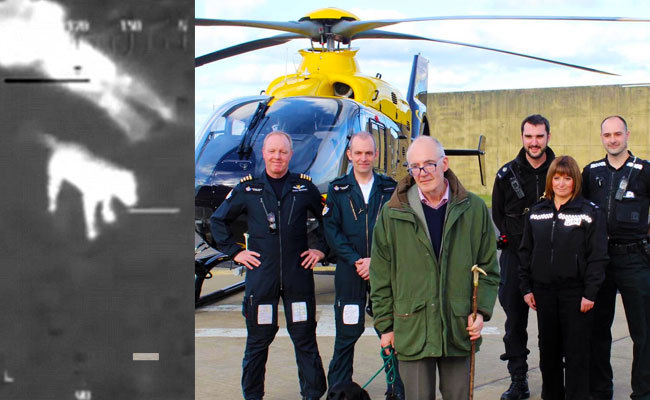
Police used a thermal imaging camera during helicopter sweeps from above. After some time they came across a heat signature that appeared to be the warm body of dog curled up at the edge of the bog. According to police, indeed Holly Blue was found first, and sighting her led them to Martin. Watch a portion of the rescue below.

Police Constables Luke Allard and Clare Wayman were the first on the ground.

“The field was in the middle of nowhere and we were relying on the light from the helicopter and torch light,” Allard said. “When I got to Mr Kay I took hold of his hand and he wouldn’t let go – I told him he would have to let go or I wouldn’t be able to help him.”

Unfortunately Allard and Wayman began getting stuck themselves while trying to extricate Martin, so they covered him with their own jackets to keep him warm while waiting for reinforcements.

Martin was in and out of consciousness as he was taken to West Suffolk Hospital. When he awoke, he was told how Holly Blue had helped save his life.

“It was the first and the last time she had been called into action,” Martin said in an interview with Global News. “She’s a very loyal dog.”

ooOOoo

Now compare the behaviourial values of Martin Kay, Holly Blue and everyone else who ensured this had a happy ending with those being demonstrated in the first part of this post!

It’s no sinecure to say, once again, how urgent it is for humankind to learn from our fabulous dogs!

The arrow of time.

Everything, eventually, falls into decay.

What is deeply fascinating, at a number of levels, is how time only goes one way. At every single level of our experience, from the scale of the universe down to the tiniest particle known to science, it all flows forward. The arrow of time!

I was reminded of this interesting question of time in a book that has been published by a local Oregon author, John Taylor Our Curious UNIVERSE (the book is not available online otherwise I would have linked to it.)

It got me thinking of age. How we are all aging. How there is nothing that we can do to stop it. How the only thing we can do is to change our relationship with age. That then reminded me of an item that was published on The Conversation site a week ago that I wanted to share with you – share within the terms provided by The Conversation. The article was called It’s time to measure 21st century aging with 21st century tools.

ooOOoo

It’s time to measure 21st century aging with 21st century tools

March 4, 2016

Disclosure statement

The research was conducted in the framework of the European Research Council ERC-2012-AdG 323947-Re-Ageing

Sergei Scherbov receives funding from the European Research Council ERC-2012-AdG 323947-Re-Ageing

oooo

The populations of most countries of the world are aging, prompting a deluge of news stories about slower economic growth, reduced labor force participation, looming pension crises, exploding health care costs and the reduced productivity and cognitive functioning of the elderly.

These stories are dire, in part because the most widely used measure of aging – the old-age dependency ratio, which measures the number of older dependents relative to working-age people – was developed a century ago and implies the consequences of aging will be much worse than they are likely to be. On top of that, this ratio is used in political and economic discussions of topics such as health care costs and the pension burden – things it was not designed to address.

Turning 65 in 2016 doesn’t mean the same thing as hitting 65 in 1916. So instead of relying on the old-age dependency ratio to figure out the impact of aging, we propose using a series of new measures that take changes in life expectancy, labor participation and health spending into account. When you take these new realities into account, the picture looks a lot brighter.

 How facts from the census questionnaire were tabulated into statistics in 1950. The U.S. National Archives/Flickr
How facts from the census questionnaire were tabulated into statistics in 1950. The U.S. National Archives/Flickr

Our tools to measure aging have aged

The most commonly used measure of population aging is the “old-age dependency ratio,” which is the ratio of the number of people 65 years or older to those 20 to 64.

But, since the old-age dependency ratio was introduced in the early 1900s, most countries have experienced a century of rising life expectancy, and further increases are anticipated.

For instance, in 1914, life expectancy at birth in Sweden was 58.2 years (average for both sexes). By 2014, it had risen to 82.2 years. In 1935, when the U.S Social Security Act was signed into law, 65-year-olds were expected to live 12.7 more years, on average. In 2013, 65 year-olds may expect to live 19.5 years more.

But these changes aren’t reflected in the conventional statistics on aging. Nor is the fact that many people don’t just stop working when they turn 65, and that people are staying healthier for longer.

To get a better sense of what population aging really means today, we decided to develop a new set of measures that take these new realities into account to replace the old-age dependency ratio. And instead of one ratio, we created several ratios to evaluate health care costs, labor force participation and pensions.

Who retires at 65 anymore?

One of these new realities is that the number of people working into their late 60’s and beyond is going up. In 1994, 26.8 percent of American men aged 65-69 participated in the labor force. That figure climbed to 36.1 percent in 2014 and is forecast to reach 40 percent by 2024. And the trend is similar for even older men, with 17 percent of those aged 75-79 expected to still be working in a decade, up from just 10 percent in 1994.

Clearly, these older people did not get the message that they were supposed to become old-age dependents when they turned 65.

Depot Supervisor Eric Headley, 74, takes a call on his mobile phone while at work for Pimlico Plumbers in London July 29, 2010. Britain announced plans to scrap the fixed retirement age next year, saying it wanted to give people the chance to work beyond 65, but business leaders warned the move would create serious problems. REUTERS/Suzanne Plunkett (BRITAIN - Tags: POLITICS SOCIETY) - RTR2GUL1
Depot Supervisor Eric Headley, 74, takes a call on his mobile phone while at work for Pimlico Plumbers in London July 29, 2010. Britain announced plans to scrap the fixed retirement age next year, saying it wanted to give people the chance to work beyond 65, but business leaders warned the move would create serious problems. REUTERS/Suzanne Plunkett.

This isn’t unique to the U.S. Rates like these in many countries have been rising. In the U.K., for instance, the labor force participation rate of 65- to 69-year-old men was 24.2 percent in 2014, and in Israel it was 50.2 percent, up from 14.8 percent and 27.4 percent, respectively, in 2000. In part this is because older people now often have better cognitive functioning than their counterparts who were born a decade earlier.

So, instead of assuming that people work only from ages 20 to 64 and become old-age dependents when they hit 65, we have computed “economic dependency ratios” that take into account observations and forecasts of labor force participation rates. This tells us how many adults not in the labor force there are for every adult in the labor force, giving us a more accurate picture than using 65 as a cutoff point. We used forecasts produced by the International Labour Organization to figure this out.

The old-age dependency ratio in the U.S. is forecast to increase by 61 percent from 2013 to 2030. But using our economic dependency ratio, the ratio of adults in the labor force to adults not in the labor force increases by just 3 percent over that period.

Clearly, doom and gloom stories about U.S. workers having to support so many more nonworkers in the future may need to be reconsidered.

Is the health care burden going to be so high?

Another reality is that while health care costs will go up with an older population, they won’t rise as much as traditional forecasts estimate.

Instead of assuming that health care costs rise dramatically on people’s 65th birthdays, as the old-age dependency ratio implicitly does, we have produced an indicator that takes into account the fact that most of the health care costs of the elderly are incurred in their last few years of life. Increasing life expectancy means those final few years happen at ever later ages.

In Japan, for example, when the burden of the health care costs of people aged 65 and up on those 20-64 years old is assessed using only the conventional old-age dependency ratio, that burden is forecast to increase 32 percent from 2013 to 2030. When we compute health care costs based on whether people are in the last few years of their lives, the burden increases only 14 percent.

Pension ages are going up

The last reality we considered concerns pensions.

In most OECD countries, the age at which someone can begin collecting a full public pension is rising. In a number of countries, such as Sweden, Norway and Italy, pension payouts are now explicitly linked to life expectancy.

In Germany, the full pension age will rise from 65 to 67 in 2029. In the U.S., it used to be 65, is now 66 and will soon rise to 67.

Instead of assuming that everyone receives a full public pension at age 65, which is what the old-age dependency ratio implicitly does, we have computed a more realistic ratio, called the pension cost dependency ratio, that incorporates a general relationship between increases in life expectancy and the pension age. The pension cost dependency ratio shows how fast the burden of paying public pensions is likely to grow.

For instance, in Germany, the old-age dependency ratio is forecast to rise by 49 percent from 2013 to 2030, but 65-year-old Germans will not be eligible for a full pension in 2030. Our pension cost dependency ratio increases by 26 percent over the same period. Instead of indicating that younger Germans will have to pay 49 percent more to support pensioners in 2030 compared to what they paid in 2013, taking planned increases in the full pension age into account, we see that the increase is 26 percent.

Pranom Chartyothin, a 72-year-old bus conductor, sells and collects bus tickets in downtown Bangkok, Thailand, February 3, 2016. Such scenes will only become more common in Thailand as its population rapidly ages, unlike its neighbours with more youthful populations. The World Bank estimates the working-age population will shrink by 11 percent by 2040, the fastest contraction among Southeast Asia's developing countries. Thailand's stage of economic development, the rising cost of living and education, and a population waiting longer to get married are among the reasons it is ageing more quickly than its neighbours. An effective contraception programme in the 1970s also played a part, said Sutayut Osornprasop, a human development specialist at the World Bank in Thailand. Picture taken February 3, 2016. REUTERS/Jorge Silva TPX IMAGES OF THE DAY - RTX269SM
Pranom Chartyothin, a 72-year-old bus conductor, sells and collects bus tickets in downtown Bangkok, Thailand, February 3, 2016. Such scenes will only become more common in Thailand as its population rapidly ages, unlike its neighbours with more youthful populations. The World Bank estimates the working-age population will shrink by 11 percent by 2040, the fastest contraction among Southeast Asia’s developing countries. Thailand’s stage of economic development, the rising cost of living and education, and a population waiting longer to get married are among the reasons it is ageing more quickly than its neighbours. An effective contraception programme in the 1970s also played a part, said Sutayut Osornprasop, a human development specialist at the World Bank in Thailand. Picture taken February 3, 2016. REUTERS/Jorge Silva.

Sixty-five just isn’t that old anymore

In addition to this suite of measures focused on particular aspects of population aging, it is also useful to have a general measure of population aging. We call our general measure of population aging the prospective old-age dependency ratio.

People do not suddenly become old-age dependents on their 65th birthdays. From a population perspective, it makes more sense to classify people as being old when they are getting near the end of their lives. Failing to adjust who is categorized as old based on the changing characteristics of people and their longevity can make aging seem faster than it will be.

In our prospective old-age dependency ratio, we define people as old when they are in age groups where the remaining life expectancy is 15 years or less. As life expectancy increases, this threshold of old age increases.

In the U.K., for instance, the conventional old-age dependency ratio is forecast to increase by 33 percent by 2030. But when we allow the old-age threshold to change with increasing life expectancy, the resulting ratio increases by just 13 percent.

Populations are aging in many countries, but the conventional old-age dependency ratio makes the impact seem worse than it will be. Fortunately, better measures that do not exaggerate the effects of aging are now just a click away.

ooOOoo

Yes, we live in interesting times!

Interconnections Three

Is there a case for optimism? You bet there is!

To be honest, at a personal level I just don’t know the answer to that question. It seems to depend on the mood that Jean and I are in at any particular time. All I can fall back on is that well-used saying from me: “Never underestimate the power of unintended consequences”.

In other words, we shouldn’t underestimate the strength of millions of good people when their demands start reaching out to those in power. (And whatever your reaction to this post, please don’t miss watching the inspirational Al Gore speech towards the end of this post.)

Recently over on the Grist site there was an article about the critical changes that each and every one of us should be making. I want to share it with you in full.

ooOOoo

Want to fight climate change? Here are the 7 critical life changes you should make

Interconnections Two

Continuing the stark assessment of where we are today.

In yesterday’s post I covered the first five of the eleven facts about sea-level rise. Here are the rest of those facts.

ooOOoo


11 alarming facts about sea-level rise

Russell McLendon, February 26, 2016.

6. Sea levels could rise another 1.3 meters (4.3 feet) in the next 80 years.

sea-level rise mapThis map shows areas that would flood (marked in red) due to 1-meter sea-level rise. (Photo: NASA)

In another study published this month, scientists report that global sea levels will likely rise 0.5 to 1.3 meters (1.6 to 4.3 feet) by the end of this century if greenhouse gas emissions aren’t rapidly reduced. Even if last year’s Paris Agreement does spur ambitious climate policy, sea levels are still projected to rise 20 to 60 cm (7.8 to 23.6 inches) by 2100. Taken with the longer-term effects from melting ice sheets in Greenland and Antarctica, that means any strategy to endure sea-level rise must involve adaptation plans as well as efforts to slow the trend.

7. Up to 216 million people currently live on land that will be below sea level or regular flood levels by 2100.

coastal flooding in Typhoon FitowHigher sea levels can exacerbate storm surges, like this 2013 flood in Wenzhou, China. (Photo: STR/AFP/Getty Images)

Of the estimated 147 million to 216 million people in harm’s way, between 41 million and 63 million live in China. Twelve nations have more than 10 million people living on land at risk from sea-level rise, including China as well as India, Bangladesh, Vietnam, Indonesia and Japan. Bangladesh is especially vulnerable, identified by the U.N. as the country most in danger from rising seas. Once the ocean rises by 1.5 meters (4.9 feet) next century, it will affect 16 percent of Bangladesh’s land area and 15 percent of its population — that’s 22,000 km2 (8,500 mi2) and 17 million people.

The situation is also urgent for low-lying island nations like Kiribati, the Maldives, the Marshall Islands and the Solomon Islands, where land is already so close to sea level that a few inches make a world of difference. Some are even mulling mass relocations — the government of Kiribati, for one, has a web page outlining its strategy for “migration with dignity.” A town on Taro Island, the capital of Choiseul Province in the Solomon Islands, is also planning to move its entire population in response to rising seas. The small community of Newtok, Alaska, has already begun the difficult process of transplanting itself away from the encroaching coast.

8. Sea-level rise can contaminate water used for drinking and irrigation.

saltwater intrusionSea-level rise can aid saltwater intrusion of freshwater aquifers, as seen in this schematic illustration. (Image: NRC.gov)

In addition to surface flooding, sea-level rise can both push up the freshwater table and contaminate it with seawater, a phenomenon known as saltwater intrusion. Many coastal areas rely on aquifers for drinking water and irrigation, and once they’re tainted by saltwater they may be unsafe for humans as well as crops.

It is possible to remove salt from water, but the process is complex and costly. San Diego County recently opened the Western Hemisphere’s largest desalination plant, for example, and several other sites are proposed in the state. Yet that may not be practical for many coastal communities, especially in less wealthy nations.

9. It can also threaten coastal plant and animal life.

loggerhead sea turtle hatchlingFloods fueled by rising seas may harm baby sea turtles, like these South African loggerheads. (Photo: Jeroen Looyé/Flickr)

Humans aren’t the only ones who’ll suffer as sea levels rise. Any coastal plants or animals that can’t quickly move to new, less flood-prone habitats could face dire consequences. As one 2015 study noted, sea turtles have a long-established habit of laying eggs on beaches, which need to stay relatively dry for their babies to hatch.

Inundation for one to three hours reduced egg viability by less than 10 percent, the study’s authors found, but six hours underwater cut viability by about 30 percent. “All embryonic developmental stages were vulnerable to mortality from saltwater inundation,” the researchers write. Even for hatchlings that do survive, being starved of oxygen in the egg could lead to developmental problems later in life, they add.

Other beach life may also be at risk, including plants. A recent study found that some salt marshes can adapt, both by growing vertically and by moving inland, but not all flora will be so fortunate. “Trees have to work harder to pull water out of salty soil; as a result, their growth can be stunted — and if the soil is salty enough, they will die, a common sign of sea-level rise,” Climate Central explains. “Even trees that are especially suited to salty soil can’t survive repeated flooding by seawater.”

10. Global flood damage for large coastal cities could cost $1 trillion a year if cities don’t take steps to adapt.

sea-level rise in TokyoThis Google Earth simulation shows a Tokyo neighborhood with 1.3-meter sea-level rise. (Image: Google Earth)

The average global losses from flooding in 2005 were about $6 billion, but the World Bank estimates they’ll rise to $52 billion per year by 2050 based on socioeconomic changes alone. (That means things like increasing coastal populations and property value). If you add the effects of sea-level rise and sinking land — which is happening even faster in some places — the cost could surge to $1 trillion per year.

11. It’s too late to stop sea-level rise — but not too late to save lives from it.

iceberg off GreenlandA full moon shines over an iceberg that broke off Greenland’s Jakobshavn Glacier. If the entire Greenland ice sheet melted, sea levels would rise about 6 meters, or 20 feet. (Photo: Joe Raedle/Getty Images)

Unfortunately, CO2 emissions linger in the atmosphere for centuries, and today’s CO2 levels have already committed Earth to dangerous sea-level rise. About 99 percent of all freshwater ice resides in two ice sheets: one in Antarctica and one in Greenland. Both are expected to melt if humanity’s CO2 output isn’t curbed quickly, but the question is when — and how much damage we still have time to prevent.

The Greenland ice sheet is smaller and melting more quickly. If it completely melted, sea levels would rise by about 6 meters (20 feet). The Antarctic ice sheet has been more buffered from warming so far, but it’s hardly immune, and would raise the ocean by 60 meters (200 feet) if it melted. (Estimates vary widely on how long these ice sheets might survive — while most expect they’ll take centuries or millennia to melt, a controversial 2015 paper suggested it could happen much more quickly.)

Sea levels have naturally risen and receded for billions of years, but they’ve never risen this quickly in modern history — and they’ve never had so much human help. It’s unclear what effect they’ll have on our species, but what is clear is that our descendants will still be dealing with this problem long after we’re all gone. Giving them a head start on a solution is the least we can do.

“With all the greenhouse gases we already emitted, we cannot stop the seas from rising altogether, but we can substantially limit the rate of the rise by ending the use of fossil fuels,” says Anders Levermann, a climate scientist at Columbia University and co-author of the new study on future sea-level rise. “We try to give coastal planners what they need for adaptation planning, be it building dikes, designing insurance schemes for flooding or mapping long-term settlement retreat.”

As another recent study pointed out, any policy decisions made in the next few years and decades “will have profound impacts on global climate, ecosystems and human societies — not just for this century, but for the next ten millennia and beyond.”

ooOOoo

Tomorrow, in the final part of this three-part posting I will look at some positive things that we can all be doing now.

But let me leave you with a rather beautiful consequence of these changing times. As seen over on Grist:

ooOOoo

Incredible glacier art pays homage to our disappearing ice

Interconnections One.

The beat of a butterfly’s wings.

From Wikipedia:

The Butterfly Effect is a concept that small causes can have large effects. Initially, it was used with weather prediction but later the term became a metaphor used in and out of science.[1]

In chaos theory, the butterfly effect is the sensitive dependence on initial conditions in which a small change in one state of a deterministic nonlinear system can result in large differences in a later state. The name, coined by Edward Lorenz for the effect which had been known long before, is derived from the metaphorical example of the details of a hurricane (exact time of formation, exact path taken) being influenced by minor perturbations such as the flapping of the wings of a distant butterfly several weeks earlier. Lorenz discovered the effect when he observed that runs of his weather model with initial condition data that was rounded in a seemingly inconsequential manner would fail to reproduce the results of runs with the unrounded initial condition data. A very small change in initial conditions had created a significantly different outcome.

We all live in an interconnected world. Frankly, it’s such an obvious statement that one presumes that very few would not agree with the sentiment expressed within it.

But (and you knew there was a ‘but’ coming, didn’t you!) very few of us (and I include Jean and me to a very great extent) really understand, “A very small change in initial conditions had created a significantly different outcome.”

Take these few items; more or less randomly read over the last few days.

Such as this post over on Patrice Ayme’s blog.

Biblical Flood Starting Anew

Abstract: update on Sea Level Rise. The meat of the essay is at the end, in the section “THE SITUATION IS ACTUALLY CATACLYSMIC“.

Heard of The Flood? As in the Bible? Sea level rose 120 meters (400 feet), in the period centered around 10,000 years ago. The cause? More than half of Earth’s ice melted in a few millennia,  During the rest of the early Holocene, the rate of rise of the world’s ocean reached peaks as high as 60  millimeters (2.5 inches) per year. The melting of the ice happened because Earth’s positional and orbital parameters had made northern hemisphere’s summers too warm (most of the ice shields rested on the large continents of the north). Nowadays only two enormous ice shields are left: Greenland and Antarctica.

Those who enjoy catastrophes will love it: we have 75 meters of further sea rise to enjoy pretty soon, on our way to a Jurassic climate (the Jurassic was characterized by gigantic warm shallow seas on top of the continents). Here was the situation in the Miocene, when CO2 was at 500 ppm (where we will be at in ten years, see conclusion below).

Patrice said that the essence, the meat, of his essay was at the end. Here are his closing words:

Three scientific papers published in the last two months support my, admittedly drastic, point of view. One observed the collapse of a colossal glacier in northwest Greenland, eaten by a current at one degree C. It was a miniature reproduction of what to expect for entire ice shields. Two others observed the past, and that Antarctica was unstable at 500 ppm CO2. What they did not say is how dramatic the situation was. Indeed, sounding moderate is how they get funded by a benevolent, plutocratically ruled government (and by government, I also mean the corrupt Supreme Court, not just the latest elected buffoons). The scientists who evoked the 500 ppm of CO2 omitted two significant details, where the devil lurks. They claimed that it would take 30 years to get there. That’s not correct; at the present rate, we will add 100 ppm of CO2 within 25 years. But not just that: there are other man-made GreenHouse Gases (GHG): CH4, NOx, Fluorocarbons, etc. All these gases warm up the lower atmosphere much more than CO2. So the correct measurement is not CO2 ppm, but CO2 EQUIVALENT ppm.

We are right now ABOVE 450 ppm in EQUIVALENT CO2, and will be at 500 ppm within ten years. Let’s hope there will be more boats than on the Titanic.

Patrice Ayme’

P/S: If anything, the preceding is a conservative estimate. Indeed very serious scientists evaluated already the man-made greenhouse gases at 478 ppm in 2013. This means we will be above 500 ppm in CO2 equivalent within six years, in line with my previous analyses, such as “Ten Years To Catastrophe“. See:

http://oceans.mit.edu/news/featured-stories/5-questions-mits-ron-prinn-400-ppm-threshold

Now it’s not all ‘doom and gloom’ and there is much that each and every one of us can do. More of that in Interconnections Three on Thursday.

But to continue with this ‘wake up call’ I’m going to republish in full an item that was recently published over on Mother Nature Network: 11 alarming facts about sea-level rise. To stop today’s post being excessively long, I’m going to split that MNN article over today and tomorrow. Here are the first 5 alarming facts. (Don’t read them just before turning the light out when going to bed tonight!)

ooOOoo

11 alarming facts about sea-level rise

Russell McLendon,  February 26, 2016.
 Up to 216 million people currently live on land that will be below sea level or regular flood levels by 2100. (Photo: Shutterstock)
Up to 216 million people currently live on land that will be below sea level or regular flood levels by 2100. (Photo: Shutterstock)

The ocean is coming for us. Global sea levels are now rising by 3.4 millimeters per year, up from an average rate of 1.4 mm per year last century. In just 80 years, the ocean could be a full 1.3 meters (4.3 feet) taller than it is today.

That kind of planetary sea change can be hard to fathom — unless you live in a low-lying place like Miami, the Maldives or the Marshall Islands, where the effects of sea-level rise are already apparent. But within just a few decades, the problem will become unavoidable in major coastal cities around the world, from New Orleans, New York and Amsterdam to Calcutta, Bangkok and Tokyo.

We all know why this is happening. Rising seas are one of the most salient effects of man-made climate change, triggered by thermal expansion of seawater as well as the influx of melting glaciers. Yet many people still see it as a distant risk, failing to grasp how (relatively) quickly the sea is swallowing shores worldwide. And since half of all humans now live within 60 kilometers (37 miles) of a coast, this isn’t a niche issue.

To help put things in perspective, here’s a deeper look at the problem:

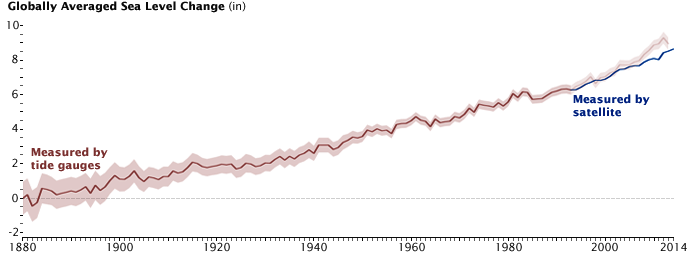
1. Global sea levels have already risen by 8 inches (200 mm) since 1880.

sea-level-rise-1880-2014

The chart above was produced by NASA’s Earth Observatory, based on data from the U.S. National Oceanic and Atmospheric Administration (NOAA) and Australia’s Commonwealth Scientific and Industrial Research Organization (CSIRO). Most of those historical data come from tide-gauge measurements, which are now complemented by satellite observations.

2. Not only are sea levels rising; the rate of their rise is rising.

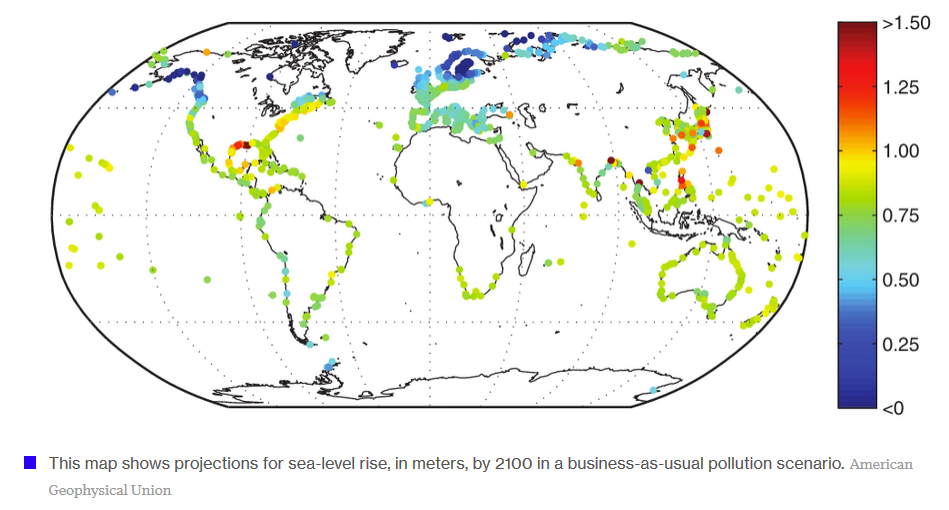
Average global sea-level rise is now 3.41 mm per year, but the rate varies widely by location. (Image: NASA GSFC)

On average, sea levels rose by 1.4 mm from 1900 to 2000. The yearly pace had surpassed 3 mm by 2010, and now it’s up to 3.4 mm per year.

3. That’s the fastest sea-level rise Earth has experienced in 3,000 years.

Cb5MxZ4WIAAAW06If not for surging carbon dioxide in the atmosphere, sea levels should have only risen about an inch or two last century, and might have even fallen. Instead, thanks to the highest CO2 levels at any point in human history, global sea levels rose by 5.5 inches (14 cm) between 1900 and 2000. That’s the fastest oceanic advance in 27 centuries, according to a study published Feb. 22, and it’s still speeding up.

“The 20th century rise was extraordinary in the context of the last three millennia — and the rise over the last two decades has been even faster,” says lead author Robert Kopp, a climate scientist at Rutgers University, in a statement.

“Scenarios of future rise depend upon our understanding of the response of sea level to climate changes,” adds co-author Benjamin Horton. “Accurate estimates of sea-level variability during the past 3,000 years provide a context for such projections.”

4. Every vertical inch of sea-level rise moves the ocean 50 to 100 inches inland.

Miami coastal flooding
Rising seas worsen regular flooding — like this 2015 high tide in Miami Beach — for many coastal cities. Miami is in the midst of a five-year, $400 million effort to upgrade its stormwater pump program. (Photo: Joe Raedle/Getty Images)

5. That’s already causing flood problems in many big coastal cities.

CLICK HERE TO SEE THE EFFECT ON BIG COASTAL CITIES

As the ocean invades coastal cities, the first signs of trouble are often urban saltwater floods. These can also happen naturally, though, so to determine the influence of rising seas, a new report by Climate Central models “alternative histories simulating the absence of anthropogenic climate change” at 27 U.S. tide gauges.

Out of 8,726 days since 1950 when unaltered water levels exceeded the National Weather Service thresholds for local “nuisance” floods, 5,809 didn’t exceed those thresholds in the alternative histories. “In other words,” the report explains, “human-caused global sea level rise effectively tipped the balance, pushing high-water events over the threshold, for about two-thirds of the observed flood days.”

Coastal flooding days have more than doubled in the U.S. since the 1980s, according to the report, in places ranging from Miami, Virginia Beach and New York to San Francisco, Seattle and Honolulu. According to a 2014 report, at least 180 floods will strike Annapolis, Maryland, during high tides every year by 2030 — sometimes twice a day. The same will be true for about a dozen other U.S. cities by 2045, not to mention many other low-lying urban areas around the world.

ooOOoo

To be continued tomorrow.

None so blind …

…. as those who choose not to see!

Note: This is a long and pretty depressing post yet one that contains a critically vital message. Just wanted to flag that up.

This is not the first time I have used this expression as a header to a blogpost. The first time was back in August 2013 when I introduced the TomDispatch essay: Rebecca Solnit, The Age of Inhuman Scale.

I am using it again to introduce another TomDispatch essay. Like the Solnit essay a further reflection on the incredible madness of these present global times.

But before getting to that essay let me refer to a recent Patrice Ayme post. It is called: New Climate Lie: Magical CO2 Stop Possible.

Patrice included this graph:

To Stay Below 2C, CO2 Emissions Have To Stop Now. We Are On The Red Trajectory: Total Disaster

Adding:

Tempo depended upon the CO2 concentration, pitch upon the Earth global temperature, distortion upon the energy balance on land in watts per square meter. The numbers used were past and anticipated. After 2015, the graphs became two: one was red, the bad case scenario, the other was blue, and represented the good scenario.

As I looked at the blue graphs, the optimistic graphs, I got displeased: the blue CO2 emissions, the blue temperature, and the blue power imbalance, had a very sharp angle, just in 2016. First a sharp angle is mathematically impossible: as it is now, the curves of CO2, and temperature are smooth curves going up (on the appropriate time scale). It would require infinite acceleration, infinite force. Even if one stopped magically any human generated greenhouse gases emissions next week, the CO2 concentration would still be above 400 ppm (it is 404 ppm now). And it would stay this way for centuries. So temperature would still rise.

The composer, who was on stage, had been advised by a senior climate scientist, a respectable gentleman with white hair, surrounded by a court, who got really shocked when I came boldly to him, and told him his blue graph was mathematically impossible.

I told him that one cannot fit a rising, smooth exponential with a sharp angle bending down and a line. Just fitting the curves in the most natural, smooth and optimistic way gives a minimum temperature rise of four degrees Celsius. (There is a standard mathematical way to do this, dating back to Newton.)

Read Patrice’s essay in full here.

However, I find the malaise gripping us in these times to be infinitely more difficult to understand than what is or is not mathematically possible. I just can’t get my mind around the possibility that we are in an era where greed, inequality and the pursuit of power and money will take the whole of humanity over the edge.

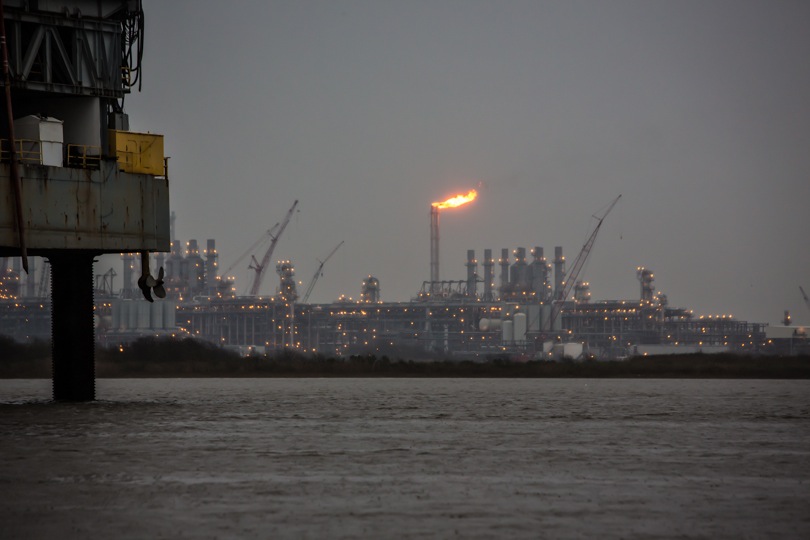
Why, for goodness sake, is the U.S., my adopted home country, pursuing gas exports? As I read here: United States On Path to Becoming Major Exporter of Natural Gas Despite Climate Impacts
Here’s a taste of this report from Julie Dermansky of Desmogblog:

A flare at Cheniere Energy Sabine Pass LNG facility. ©2016 Julie Dermansky

But rather than acknowledging the climate risk posed by further expansion of LNG export infrastructure, the U.S. Congress and the Obama administration are moving in the opposite direction.

The natural gas export industry may grow even more rapidly if the first new bipartisan energy legislation drafted since 2007 passes. The Energy Policy Modernization Act of 2015, known as S. 2012, would expedite permitting for LNG export terminals.

The bill’s passage was considered imminent until it derailed with the introduction of an amendment that would provide emergency aid towards solving the lead-contaminated water crisis in Flint, Michigan. Now the passage of the bill hinges on whether the Senate will come to terms on aid to Flint.

Lobbying for the bill has been heavy. As DeSmog’s Steve Horn reported: “The list of lobbyists for S.2012 is a who’s who of major fossil fuel corporations and their trade associations: BP, ExxonMobil, America’s Natural Gas Alliance, American Petroleum Institute, Peabody Energy, Arch Coal, Southern Company, Duke Energy and many other prominent LNG export companies.”

I highlighted the name ExxonMobil in that extract because that company is the subject of Tom Engelhardt’s essay from Bill McKibben. Republished here with Tom’s kind permission.

ooOOoo

Tomgram: Bill McKibben, It’s Not Just What Exxon Did, It’s What It’s Doing