In fact it started on Thursday with a local owner not taking care of a couple of dogs. I’m not sure about whether or not the dogs are being cared for but there have been a number of cases suggesting that they were thin and also that they were running wild.
Then yesterday it took a turn for the worse shortly after 7am. I was on my way back to the house having fed the horses and then heard an animal calling out. I paused trying to identify this animal. It was located very close to our border on the Northern side.
Then the noise stopped and I thought nothing more of it.Later on I realised that it was animal in serious pain. Too late now to attempt to save it.
A little later I went across to the area where the calling had been coming from. There, just alongside our fence but on the other side of it, lay a young deer. It was dead but still warm.
Then about 10:30 yesterday when after I had called animal control I decided to revisit the location and take a couple of pictures.
oooo
It was tragic! The loss of a wild animal. In fairness, one that the dogs themselves are not responsible for. Dogs will be dogs.
Meantime, I pondered on what might have evolved differently had I intervened when I first heard the animal in pain.
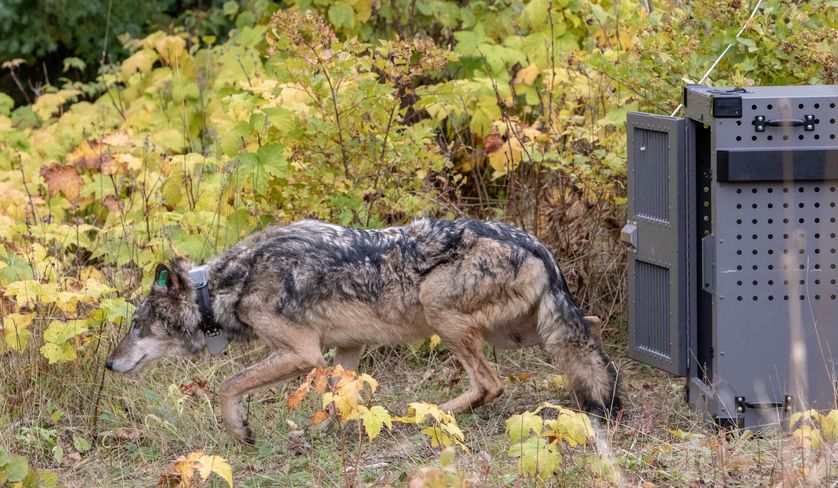
Dawn breaks over Moskey Basin, at Isle Royale National Park, Michigan. Canadian wolves colonized the island in 1949. (Photo: Steve Lagreca/Shutterstock)
The American people’s relationship with top predators — especially wolves — is complex and ever-evolving. About three decades ago, it was mostly just animal-rights groups and their supporters who fought for the wolves’ right to exist; they were often considered a nuisance. But now there’s plenty of scientific evidence proving what’s good for wolves is good for their prey, the plants those prey eat, and indeed, positively affects the entire ecosystem. That’s ultimately good for humans too — unless you’re competing with the wolves, like a rancher who grazes animals or a hunter who wants to shoot the same deer or moose that wolves need to eat. But at this point, even some ranchers and hunters have come over to the pro-predator side.
Much of that change in the perception of predators is down to studies that have proven how precisely cougars, wolves, bears, tigers, lions, bald eagles, alligators and other apex predators affect the land around them. None have been studied longer than the wolves and moose in Isle Royale National Park, a Guam-sized island in Lake Superior. For almost 60 years, the populations of these two groups have been tracked — as well as their effects on the plants and other animal communities on the island. (You can read the reports here, including the recent 59th annual report.)
As the video above explains, there used to be as many as 50 wolves on Isle Royale; however, that number has dwindled, mostly due to inbreeding that caused a debilitating spinal condition to proliferate among the too-closely-related wolves. Just 10 years ago, there were still around 30 wolves but by 2015, there were only three wolves left. Now, there are just two, a closely related male-female pair that probably won’t breed. (The female of the pair has aggressively fought back when the male attempted to breed with her.)
Already, the moose population on the island has boomed, “undoubtably because of lack of predation,” John Vucetich, a wildlife ecologist from Michigan Technological University told Science magazine, adding that the two remaining wolves are now “… swimming in moose.” Despite the wolves’ regular predation on moose, there’s been a 20 percent increase in moose in just one year, which scientists estimate is about five to 10 times higher than on mainland areas. Beaver populations have also risen sharply. There’s just not enough wolves to keep either population in check.
So what’s so bad about so many moose? Well, as most ungulates do, moose spend their days browsing on vegetation, so the more moose, the more food they need — and the plants on the island can only take so much nibbling. An aquatic plant, which was found in abundance just six years ago, is now only found in places where moose are not. Long-term, this means the island will soon run out of food to keep the ever-larger moose population alive, and many will starve once food becomes scarce. Previously, the wolves have kept moose populations low enough so they didn’t overeat the vegetation, keeping the system in balance.
A plan to rebalance the ecosystem
This female wolf arrived at Isle Royale on Oct. 2, 2018. (Photo: NPS/Jim Peaco)
This is why some people think the best solution is to bring a fresh influx of wolves to Isle Royale National Park. The plan is to release 25-30 wolves over the next three to five years. So far, park officials have trapped four wolves on the mainland beginning in late September and released them on the island. Three of the wolves are female — with the hope they will successfully breed.
This new blood would potentially rebalance the predator-prey relationship and the idea is that the rest of the ecosystem would follow. Introducing so many wolves over several years is hardly natural either, others argue, saying that humans should just be hands off and let nature take its course. The original 50 wolves had found their way to the island on their own, having moved in from Canada; perhaps they could do so again if given the chance.
Editor’s note: This article has been updated since it was originally published in April 2017.
G & C Dog and Cat Food Recall Expands to Include Multiple Brands
October 24, 2018 — G & C Raw of Versailles, Ohio, is recalling all products lots manufactured from February 27, 2018 through July 20, 2018, because they have the potential to be contaminated with Listeria monocytogenes.
Affected products are sold under the brand names G & C Raw Dog Food and G & C Raw Cat Food and sold through direct distribution to customers.
Product Image
No product images have been provided by either the company or the Food and Drug Administration.
About Listeria
Listeria monocytogenes, an organism which can cause serious and sometimes fatal infections in animals eating the products.
Furthermore, there is risk to humans from handling contaminated pet products, especially if they have not thoroughly washed their hands after having contact with the products or any surfaces exposed to these products.
Healthy people infected with Listeria monocytogenes should monitor themselves for some or all of the following symptoms: nausea, vomiting, aches, fever, and diarrhea.
Listeria monocytogenes infections can cause serious and sometimes fatal infections in young children, frail or elderly people, and others with weakened immune systems.
Although healthy individuals may suffer only short-term symptoms such as high fever, severe headache, stiffness, nausea, abdominal pain and diarrhea, Listeria infection can cause miscarriages and stillbirths among pregnant women.
Consumers exhibiting these signs after having contact with this product should contact their healthcare providers.
Pets with Listeria monocytogenes infections are rare, and pets may display symptoms such as mild to severe diarrhea, anorexia, fever, nervous, muscular and respiratory signs, abortion, depression, shock, and death.
In addition to the possibility of becoming sick, such infected animals can shed Listeria monocytogenes through their feces onto their coats and into the home environment and thus serve as sources of infection to humans and other animals in the household.
If your pet has consumed the recalled product and has these symptoms, please contact your veterinarian.
Where Was Product Distributed?
Recalled products were distributed by direct delivery and may have been sent to the following states:
Georgia
Illinois
Indiana
Kentucky
Michigan
North Carolina
Ohio
Pennsylvania
Tennessee
What’s Being Recalled?
The manufacture dates are included at the end of the lot number.
For example, the pet food product manufactured on February 27, 2018 has a lot code of that ends with 022718.
The company is now recalling all products with lot numbers that end in 022718 through 072018.
The recalled dog food products include:
Beef Veggie Mix Dog Food
Ground Beef Dog Food
Sliced Beef Heart Dog Food
Ground Beef Heart Dog Food
Kim’s Special Beef Organ Dog Food
Ground Chicken Dog Food
Chicken Veggie Mix Dog Food
Chicken Mix Patties Dog Food
Duck Veggie Mix Dog Food
Ground Duck Dog Food
Ground Rabbit Dog Food
Rabbit Veggie Mix Dog Food
Ground Lamb Dog Food
Lamb Veggie Mix Dog Food
Ground Beef Pancreas Dog Food
Beef Liver Chunks Dog Food
Beef Sweet Breads Dog Food
Ground Pork Dog Food
Pork Veggie Mix Dog Food
Shelby’s Pork Organ Mix Dog Food
Ground Pollock Dog Food
Turkey Veggie Mix Dog Food
Ground Turkey Dog Food
Tripe Dog Food
The recalled cat food products include:
Pat’s Cat Beef
Pat’s Cat Chicken
Pat’s Cat Turkey
Pat’s Cat Duck
Pat’s Cat Rabbit
No confirmed illnesses have been reported to date.
What Caused the Recall?
The recall was initiated as the result of a routine sampling program by the Ohio Department of Agriculture which revealed that some finished products contained the bacteria.
What to Do?
Consumers who have purchased the products are urged to return them to G & C Raw, 225 N. West Street, Versailles, OH, for a full refund.
Consumers with questions may contact G & C Raw at 937-827-0010 from 9 to 5 pm Easter Time or by email at mgcrawdogfood@yahoo.com.
U.S. citizens can report complaints about FDA-regulated pet food products by calling the consumer complaint coordinator in your area.
Last Sunday, Sweeny not having eaten for 3 days, it was felt that we could not leave it any longer and decided to take Sweeny to Southern Oregon Veterinary Specialty Center. They are an emergency 24-hour a day service. It turned out to be a longer day that we had anticipated.
For we arrived at 9:15 am and didn’t leave until 5:15 pm.
Even then we were still left with some uncertainty.
For the long rigmarole of tests didn’t come to a firm conclusion.
A part of the SOVMC invoice.
Luckily we could leave taking dear Sweeny back with us but the results from the Fine needle aspirate won’t be through until Tuesday or Wednesday. (P.S. Just heard by phone that the results should be through in the next hour. Ergo: Monday evening.)
If it is Tuesday that will be better than Wednesday.
For on Wednesday we leave for a short holiday in Mexico.
In fairness, the house is being looked after by Jana Stewart but it will still be better to know before we leave.
That leads me to say that for the next ten days the regularity of blogging is going to be variable; to say the least.
These next couple of weeks are going to be challenging!
So ….. I am returning to a post I published a year ago.
Sabrina’s Loyalty
Lisa Mae DeMasi offers you all a beautiful guest post.
ooOOoo
How this Handler and Service Dog Nurture One Another
by Lisa Mae DeMasi
At two years old, Lady’s ribs protruded from her coat and her belly was swollen with milk.
Like the thirteen other Labs that had arrived at a rest stop in Union, CT on the straight 12½-hour drive from Muncie, IN, she was presented to us on a crisp autumn day amid the chaos of respective adopters.
My husband Dennis had never experienced the warmth and companionship of having a dog and well, I surprised him with Lady, who we quickly renamed to Sabrina. The very afternoon we picked her up, we raced to the park, wanting her to feel the joy of freedom and play. My husband’s face lit up and while I was thrilled at the opportunity to befriend and care for Sabrina; it meant closing the 20-year gap since our beloved German Shepard from my childhood passed away.
Until laying my eyes on Sabrina’s profile, my heart couldn’t entertain loving another dog.
And what canine isn’t after the same love?
In Sabrina’s case, she couldn’t know of the family members that awaited to embrace her presence. Within days of the initial hair-raising excitement, the cat sought out occasions to groom her ears. Our pet rat was free to waddle the kitchen floor un-bothered, and the pair of bonded bunnies in want of company stretched out beside her on the living room floor.
Dog, cat, rat, rabbit?
You bet.
And Dennis and me?
Like kids again.
Sabrina settled into the folds of our lives, well-nourished and exercised in Boston’s epic snowfall in the winter of 2009-2010, taking careful watch over all of us. The fear expressed in her eyes pre-adoption disappeared.
Eight years later, she watches over me in particular. Thirty years ago, I was struck and thrown from the passenger side of a car until my abdomen collided with the steering wheel—blunt force that called for iterative repair to my digestive system and caused permanent damage to the nerves that signal my bladder is full.
Today when I’m busy working away, Sabrina will alert me to get up every couple of hours to make a trip to the restroom by gently placing her head in my lap.
When I suffer acute intestinal cramping, Crohns-like symptoms, she’ll sit at my side and lean her body against mine. Her calm and steady source of nurturing, helps me to relax and mitigates the cramps.
In 2008, the Department of Justice amended the Americans with Disabilities Act (ADA). This was amended to include digestive, bowel and bladder impairments that limit major life activities as the disabled, calling for employers to make reasonable accommodations and if the individual elects, to allow task-oriented service animals [dog or miniature horse] to accompany them on the job.
Sabrina, serving in the capacity of a sensory/medical assist – alerting me to get up and take care of myself – qualifies.
The HR Director, Debra Susler of Reputation Institute in Cambridge, MA this past April would not allow Sabrina to accompany me on-the-job. I sent her an elaborate email explaining my condition and Sabrina’s certification. She did not reply to me but to my supervisor.
She said “no”.
My response?
I walked out of the place
Sabrina: rescue dog to devoted helper dog.
Respectively, Sabrina’s competencies and understanding of language cease to astound us and her behavior on-the-job at Dell EMC is so well-mannered, coworkers never run out of compliments.
And bystanders in public? The grocery store, pharmacy, gym, dentist, doctor?
Gazes from cell phones are broken, conversations fall short.
Then, come the smiles. A question. Praises. The feel-good moment.
Sabrina brings people together.
I recently read a distressing post from a woman who said every time she looks into a service dog’s eyes, she sees sadness. Even Ingrid Newkirk, CEO and Co-Founder of PETA, has told me, “the life of a typical service dog is a terrible one.”
It’s true. Any canine enslaved to servitude is doomed a dog’s life unlived.
Service animals are working animals, not pets.
The ADA confirms it.
But that’s not the relationship Sabrina and I share [and I understand it can’t be the same with other handlers and service dogs]. In addition to being my devoted helper, Sabrina teaches me to exist in the moment — just like she does. To enjoy the sight of the sun shimmering through the trees, the call of the birds, the fragrance of wildflowers, the feel of the soft soil I tread a few yards behind her when we’re on our hikes.
What more could a dog do for a girl?
ooOOoo
There is something rather special about Lisa’s guest post; special in an introspective way!
That will be better appreciated if you go across to Lisa’s blog site at Nurture Is My Nature.
In particular when you read, via her ‘About’ link, what Lisa offers about herself. Republished here in full.
ooOOoo
As time goes by and you’re getting older and stuff like that—getting older sucks. You know, I hear all this crap about, ‘Oh, you can age with dignity.’ Really? —Mickey Rourke
Lisa’s creative work has recently placed second in Fiftiness’s 2017 Writing Contest (Why I Love Bike Commuting in Boston) and been featured in the anthologies, Unmasked, Women Write About Sex & Intimacy After Fifty (9/17, print) and The Best of Vine Leaves Literary Journal (11/17, print). Her essays have been published in the lit journals and several other media outlets. She considers Massachusetts her home, but has lived in Connecticut, Vermont, New York State and two other planets called Wyoming and Arizona. She earned a B.A. from Regis College and an MBA from Babson College, and holds a Master certificate in Reiki.
Lisa is seeking a development editor [that gets her] to work on her collection of essays and her memoir.
There is something about a Huskie that takes one’s breath away. Not only because of the grace and wit with which they conduct their lives but also because the majority of them are working dogs.
So it was with interest that I read recently about the Huskies and wanted to share it with you all.
A happy husky with its characteristic blue eyes. (Photo: Nancy Wong/Wiki Commons)
A dog DNA startup company called Embark, based out of Boston, Massachusetts, and Ithaca, New York, appears to have finally solved the mystery as to why huskies sport their beautiful blue eyes. The study is the first consumer genomics study ever conducted in a non-human model, as well as the largest canine genome-wide association study to date, reports Phys.org.
The key, it turns out, lies in the dogs’ 18th chromosome. A duplication on chromosome 18, near the ALX4 gene, was found to be strongly associated with blue eye color. The ALX4 gene plays an important role in mammalian eye development, so this association is not entirely out of left field. And interestingly, the study also found this same genetic quirk in non-merle Australian shepherds, which also tend to have blue eyes.
This flies in the face of how eye color is usually thought to be determined in dogs. For instance, two genetic variants are known to underlie blue eye color in many dogs, but scientists have long known that these variants do not explain the blue eyes of huskies, thus the mystery.
In fact, even though we’re seemingly in a genomic scientific age, the genetic underpinnings of many traits in non-human animals are still largely unknown, even for humans’ best friends. Embark aims to change that.
For the study, which was performed in partnership with Cornell University College of Veterinary Medicine, researchers used a diverse panel of 6,070 genetically tested dogs, with owners who contributed phenotype data — physical traits of the dogs — via web-based surveys and photo uploads. A comprehensive, consumer-driven survey of this size is largely unprecedented.
“Using genetic data from the pets of our customers, combined with eye colors reported by customers for those same animals, we have discovered a genetic duplication that is strongly associated with blue eye color. This study demonstrates the power of the approach that Embark is taking towards improving canine health,” explained Aaron J. Sams of Embark. “In a single year, we collected enough data to conduct the largest canine study of its kind. Embark is currently pursuing similar research projects in a range of morphological and health-related traits and we hope to continue to use our platform to move canine genetics and health forward in a very real way.”
It’s all in the name of improved health care options for our canine companions, as well as helping curious human owners better understand the origins of their pets. Answering why huskies have blue eyes is just the first such mystery they hope to solve.
Just the view at night from one small planet, the one that I happen to live on, Planet Earth, reveals millions upon millions of stars. It is then beyond inconceivable that there are not, in turn, countless numbers of other planets.
Extending this line of thought and recognising that a ‘mere’ billion years after the formation of our solar system and Planet Earth, some 4.54 billion years ago, the earliest life appeared, we can’t surely be alone!
Granted it was only cyanobacteria, as in blue-green algae, but, but, but ……… that this evolution of life on Planet Earth, and that evolution eventually leading to intelligent life, including the gift to us humans of the genetic separation of the dog from the wolf some 100,000 years ago, has not occurred on other planets is also totally inconceivable.
So, dear Mr. Cosmos, why have we not detected any signs of that intelligent life. Where are they?
Are we alone in the universe? New Drake equation suggests yes
A fresh take on the decades-old Drake equation incorporates new factors and greater uncertainty, suggesting a high likelihood that humanity is alone in the universe.
At the Los Alamos National Laboratory in 1950, physicist Enrico Fermi famously posed to his colleagues a simple question borne of complex math: ‘Where are they?’
He was asking about aliens—intelligent ones, specifically. The Italian-American scientist was puzzled as to why mankind hasn’t detected any signs of intelligent life beyond our planet. He reasoned that even if life is extremely rare, you’d still expect there to be many alien civilizations given the sheer size of the universe. After all, some estimates indicate that there is one septillion, or 1,000,000,000,000,000,000,000,000, stars in the universe, some of which are surrounded by planets that could probably support life.
So, where are they, and why aren’t they talking to us?
Now, as the article reveals, there is a lot to tackling this question, much of it involving statistics and mathematics, but it does prove one very important fact: Finding another planet as good for life and humanity as this one is just about impossible.
This is our only home!!
My wish, dear Mr. Cosmos, to you is this: That before I die it becomes clear beyond question that the peoples of this sweet Planet, from the lone individual living on some island out in the wilderness to the Governments of the most powerful nations on Earth, understand that nothing is more important than loving, caring for and looking after Planet Earth.
I remain, dear Mr. Cosmos, your respectful servant.
I found it very interesting and wanted to share it with you.
ooOOoo
Scientists have been drilling into the ocean floor for 50 years – here’s what they’ve found so far
September 26, 2018
By Professor Suzanne O’Connell, Professor of Earth & Environmental Sciences, Wesleyan University
The scientific drilling ship JOIDES Resolution arrives in Honolulu after successful sea trials and testing of scientific and drilling equipment. IODP, CC BY-ND
It’s stunning but true that we know more about the surface of the moon than about the Earth’s ocean floor. Much of what we do know has come from scientific ocean drilling – the systematic collection of core samples from the deep seabed. This revolutionary process began 50 years ago, when the drilling vessel Glomar Challenger sailed into the Gulf of Mexico on August 11, 1968 on the first expedition of the federally funded Deep Sea Drilling Project.
I went on my first scientific ocean drilling expedition in 1980, and since then have participated in six more expeditions to locations including the far North Atlantic and Antaractica’s Weddell Sea. In my lab, my students and I work with core samples from these expeditions. Each of these cores, which are cylinders 31 feet long and 3 inches wide, is like a book whose information is waiting to be translated into words. Holding a newly opened core, filled with rocks and sediment from the Earth’s ocean floor, is like opening a rare treasure chest that records the passage of time in Earth’s history.
Over a half-century, scientific ocean drilling has proved the theory of plate tectonics, created the field of paleoceanography and redefined how we view life on Earth by revealing an enormous variety and volume of life in the deep marine biosphere. And much more remains to be learned.
Technological innovations
Two key innovations made it possible for research ships to take core samples from precise locations in the deep oceans. The first, known as dynamic positioning, enables a 471-foot ship to stay fixed in place while drilling and recovering cores, one on top of the next, often in over 12,000 feet of water.
Anchoring isn’t feasible at these depths. Instead, technicians drop a torpedo-shaped instrument called a transponder over the side. A device called a transducer, mounted on the ship’s hull, sends an acoustic signal to the transponder, which replies. Computers on board calculate the distance and angle of this communication. Thrusters on the ship’s hull maneuver the vessel to stay in exactly the same location, countering the forces of currents, wind and waves.
Another challenge arises when drill bits have to be replaced mid-operation. The ocean’s crust is
The re-entry cone is welded together around the drill pipe, then lowered down the pipe to guide reinsertion before changing drill bits. IODP, CC BY-ND
composed of igneous rock that wears bits down long before the desired depth is reached.
When this happens, the drill crew brings the entire drill pipe to the surface, mounts a new drill bit and returns to the same hole. This requires guiding the pipe into a funnel shaped re-entry cone, less than 15 feet wide, placed in the bottom of the ocean at the mouth of the drilling hole. The process, which was first accomplished in 1970, is like lowering a long strand of spaghetti into a quarter-inch-wide funnel at the deep end of an Olympic swimming pool.
Confirming plate tectonics
When scientific ocean drilling began in 1968, the theory of plate tectonics was a subject of active debate. One key idea was that new ocean crust was created at ridges in the seafloor, where oceanic plates moved away from each other and magma from earth’s interior welled up between them. According to this theory, crust should be new material at the crest of ocean ridges, and its age should increase with distance from the crest.
Part of a core section from the Chicxulub impact crater. It is suevite, a type of rock, formed during the impact, that contains rock fragments and melted rocks. IODP, CC BY-ND
The only way to prove this was by analyzing sediment and rock cores. In the winter of 1968-1969, the Glomar Challenger drilled seven sites in the South Atlantic Ocean to the east and west of the Mid-Atlantic ridge. Both the igneous rocks of the ocean floor and overlying sediments aged in perfect agreement with the predictions, confirming that ocean crust was forming at the ridges and plate tectonics was correct.
Reconstructing earth’s history
The ocean record of Earth’s history is more continuous than geologic formations on land, where erosion and redeposition by wind, water and ice can disrupt the record. In most ocean locations sediment is laid down particle by particle, microfossil by microfossil, and remains in place, eventually succumbing to pressure and turning into rock.
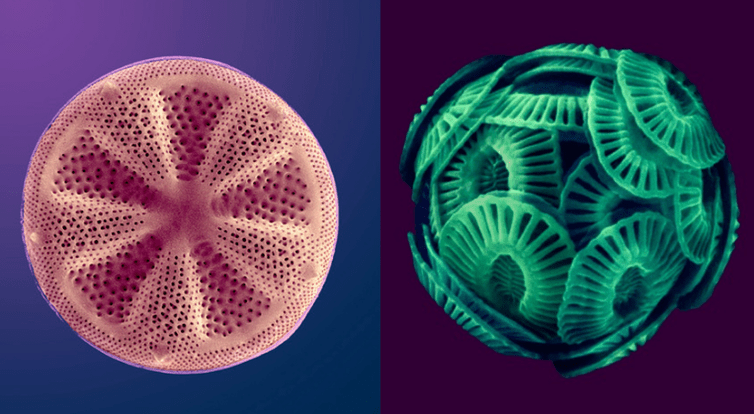
Microfossils (plankton) preserved in sediment are beautiful and informative, even though some
are smaller than the width of a human hair. Like larger plant and animal fossils, scientists can use these delicate structures of calcium and silicon to reconstruct past environments.
The resulting acidification of the ocean from the release of carbon into the atmosphere and ocean caused massive dissolution and change in the deep ocean ecosystem.
This episode is an impressive example of the impact of rapid climate warming. The total amount of carbon released during the PETM is estimated to be about equal to the amount that humans will release if we burn all of Earth’s fossil fuel reserves. Yet, an important difference is that the carbon released by the volcanoes and hydrates was at a much slower rate than we are currently releasing fossil fuel. Thus we can expect even more dramatic climate and ecosystem changes unless we stop emitting carbon.
Enhanced scanning electron microscope images of phytoplankton (left, a diatom; right, a coccolithophore). Different phytoplankton species have distinct climatic preferences, which makes them ideal indicators of surface ocean conditions. Dee Breger, CC BY-NC-ND
Today scientists from 23 nations are proposing and conducting research through the International Ocean Discovery Program, which uses scientific ocean drilling to recover data from seafloor sediments and rocks and to monitor environments under the ocean floor. Coring is producing new information about plate tectonics, such as the complexities of ocean crust formation, and the diversity of life in the deep oceans.
This research is expensive, and technologically and intellectually intense. But only by exploring the deep sea can we recover the treasures it holds and better understand its beauty and complexity.
ooOOoo
Did the phrase in the first paragraph of the article jump out for you as it did for me?
This one: “…we know more about the surface of the moon than about the Earth’s ocean floor.”
Doesn’t Mr. Neptune hold his cards close to his chest.



 At two years old, Lady’s ribs protruded from her coat and her belly was swollen with milk.
 In Sabrina’s case, she couldn’t know of the family members that awaited to embrace her presence. Within days of the initial hair-raising excitement, the cat sought out occasions to groom her ears. Our pet rat was free to waddle the kitchen floor un-bothered, and the pair of bonded bunnies in want of company stretched out beside her on the living room floor.
 Eight years later, she watches over me in particular. Thirty years ago, I was struck and thrown from the passenger side of a car until my abdomen collided with the steering wheel—blunt force that called for iterative repair to my digestive system and caused permanent damage to the nerves that signal my bladder is full.
 calling for employers to make reasonable accommodations and if the individual elects, to allow task-oriented service animals [dog or miniature horse] to accompany them on the job.
 Sabrina brings people together.
















 Learning from Dogs