Owning a dog really makes a measurable and positive difference to health outcomes!
Yesterday, I republished a post from October, 2010 which included the story of Ricochet. In that post, I mentioned a graphic that had been sent to me by ZocDoc. I had been sent an email that in part read:
Hey Paul,
I work for ZocDoc, a doctor’s appointment website (not for dogs yet!). I just stumbled upon your blog, because you wrote about the healing power of dogs. We’ve just launched an infographic called “the healing power of dogs” and since you also have the post on your site I thought that this should be interesting to your readership and possibly help adoption.
I hadn’t heard of the company but very quickly the About Us page explained the background. Now in fairness, that email was all about promoting a commercial organisation. Nevertheless, it seemed such a useful and enjoyable graphic that I agreed to publish it.
New research shows the beauty of the bond between dog and man.
I was doing some research for another writing project and came across this on the NBC News website:
What prehistoric dog burials tell us about owners
By Jennifer Viegas
An analysis of ancient dog burials finds that the typical prehistoric dog owner ate a lot of seafood, had spiritual beliefs, and wore jewelry that sometimes wound up on the dog.
The study, published in PLoS ONE, is one of the first to directly test if there was a clear relationship between the practice of dog burial and human behaviors. The answer is yes.
Photo – Robert Losey. The ancient dog was buried in a resting position. It was part of a study to directly test if there was a clear relationship between the practice of dog burial and human behaviors. The answer is yes.
That PLOS ONE study, published March 2013, found that “dog domestication predates the beginning of agriculture about 10,000 years ago.”
Dr. Losey and his dog, Guiness
Dr. Robert Losey, Associate Professor in the Department of Anthropology, University of Alberta and the lead author, explained that,
Dog burials appear to be more common in areas where diets were rich in aquatic foods because these same areas also appear to have had the densest human populations and the most cemeteries,
If the practice of burying dogs was solely related to their importance in procuring terrestrial game, we would expect to see them in the Early Holocene (around 9,000 years ago), when human subsistence practices were focused on these animals.
Robert Losey continued.
Further, we would expect to see them in later periods in areas where fish were never really major components of the diet and deer were the primary focus, but they are rare or absent in these regions.
The PLOS ONE paper went on to report that researchers found that most of the dog burials occurred during the Early Neolithic period, some 7,000-8,000 years ago, and that “dogs were only buried when human hunter-gatherers were also being buried.” Dr. Losey went on to say,
I think the hunter-gatherers here saw some of their dogs as being nearly the same as themselves, even at a spiritual level. At this time, dogs were the only animals living closely with humans, and they were likely known at an individual level, far more so than any other animal people encountered. People came to know them as unique, special individuals.
Those interested in the research paper may find it here, and read the Abstract:
Ancient DNA Analysis Affirms the Canid from Altai as a Primitive Dog
Abstract
The origin of domestic dogs remains controversial, with genetic data indicating a separation between modern dogs and wolves in the Late Pleistocene. However, only a few dog-like fossils are found prior to the Last Glacial Maximum, and it is widely accepted that the dog domestication predates the beginning of agriculture about 10,000 years ago. In order to evaluate the genetic relationship of one of the oldest dogs, we have isolated ancient DNA from the recently described putative 33,000-year old Pleistocene dog from Altai and analysed 413 nucleotides of the mitochondrial control region. Our analyses reveal that the unique haplotype of the Altai dog is more closely related to modern dogs and prehistoric New World canids than it is to contemporary wolves. Further genetic analyses of ancient canids may reveal a more exact date and centre of domestication.
DNA testing indicates that the evolutionary split between dogs and wolves was around 100,000 years ago or more. The value of dogs to early human hunter-gatherers led to them quickly becoming ubiquitous across world cultures.
Thus it is in the order of 90,000 years, possibly a couple of decades longer, from the point where a bond was made between early man and the wolf to the era when man evolved from a tribal hunter-gatherer existence to farming the resources of the planet. Thousands and thousands of years of dogs being the greatest animal relationship we humans have ever experienced.
Back to that NBC news item:
Erik Axelsson, a researcher at Uppsala University’s Science for Life Laboratory, has also studied prehistoric dogs. He too found that human and dog diets, burial practices and more often paralleled each other, revealing how close the dog-human bond has been for thousands of years.
Axelsson said, “Dogs and humans share the same environment, we eat similar food and we get similar diseases.”
Based on the number of burials, we also often spend eternity together too.
Eons of time.
A hundred, thousand years of knowing man, and it shows in the eyes.
This has been very widely reported but nevertheless it’s a great story about the devotion of dogs to humans, and in return, the way that so many people recognised the need for help for the badly injured dog.
Readers will recall that the dog, Kabang, suffered massive injuries back in December 2011 when she jumped into the path of a motorcycle, stopping it from running over her owner’s daughter and niece in Zamboanga, a city in the Southern Philippines.
Here’s a video that was published back in October last year that explores the circumstances of the dog’s actions and the public’s response.
“A dog who became an international cause celebre after her snout was sliced off saving two young girls in the Philippines was examined by veterinarians Thursday at UC Davis, a milestone event in a remarkable humanitarian effort to help a canine heroine.
The mixed-breed dog, named Kabang, became an unlikely star in the Philippines after she reportedly threw herself into the path of a speeding motorcycle just as it was about to hit two young girls crossing a roadway in Zamboanga City.
The lunge, by all accounts, saved the lives of the daughter and niece of Kabang’s owner, but cost the dog her snout and upper jaw, which was sheared off when she got tangled in the motorcycle’s spokes. The gruesome injury puts her in grave danger of developing an infection. At minimum, the gaping wound must be closed, a delicate procedure that is beyond the capability of veterinarians in the Philippines.”* Would you prolong your dog’s life even if it were that costly? Ana Kasparian, John Iadarola, and Jayar Jackson break it down.
DAVIS (CBS13) – Kabang, the Philippine dog that suffered a severely injured snout and upper-jaw while saving two girls from being hit by a motorcycle, has been released from the hospital.
The dog was brought to the veterinary medicine teaching hospital at UC Davis in October 2012 to be treated for the injury that left her with a gaping wound where her snout had been. But veterinarians found she had heartworm disease and a type of infectious cancer. A team of UC Davis veterinarians specializing in oncology; infectious diseases; dental, oral and soft-tissue surgery; internal medicine; and outpatient care was assembled to treat Kabang, according to the UC Davis News Service.
“We were able to treat all of the complications that arose with the best specialists available,” Verstraete said Professor Frank Verstraete, chief of the hospital’s dentistry and oral surgery service.
Like thousands of others I have been supporting the efforts to ensure that the US Government did not proceed with the proposal to remove wolves from endangered species protection.
Wolves are the animals that enabled early man to ‘progress’ from hunter-gatherer to the life of farming, and thence to our modern world. As I write elsewhere on Learning from Dogs,
There is no hard evidence about when dogs and man came together but dogs were certainly around when man developed speech and set out from Africa, about 50,000 years ago.
So it utterly breaks my heart to republish a recent post on The Sand County, Jeremy Nathan Marks wonderful and evocative blog. Here it is, republished with Jeremy’s kind permission.
oooOOOooo
I used to believe
As some of you may have heard, late last week the Obama Administration officially delisted gray wolves from endangered species protection. This means that 40 years of wolf recovery efforts have come to an end. Wolves only occupy a tiny fraction of their former habitat and with anti-wolf governments occupying the state houses in the few places that still have wolf populations, states like Montana, Wyoming, Idaho and Wisconsin, it is hard to imagine that wolves have a bright future in the lower 48 states.
I am deeply, profoundly saddened by this decision. I have learned over time how wolves -like so many other species- just don’t register on the list of national concerns and priorities. A great many people oppose the delisting, in fact one gets the impression that the effort to remove these protections has consistently been guided by political pressures and a political agenda and not by a true commitment to a sustainable and enduring wolf recovery. I know that I am hardly alone in registering my disappointment and voice of protest.
I cannot let this sad milestone pass without acknowledging it here on this blog. If you do not like wolves -if you feel hatred or resentment towards them or are pleased at what has recently transpired, I respectfully request that you refrain from sharing your feelings here. I seldom offer any “directives” like this, but if you are a reader of this blog then you know how strongly I feel about this issue. I am sharing these thoughts because I want to not only draw attention to what has happened, but also because I feel the need to mourn it. I tremble at the thought of a United States -or a North America- without wolves. Defenders of the administration and the Department of Interior’s position will say that the United States Government is committed to protecting wolves and ensuring their future but I am afraid I see things quite differently. This is not a partisan political issue: Democratic and Republican administrations alike are behind this stance towards wolves.
I would like to share a poem which I feel is very incomplete and does not begin to adequately draw upon the well of feelings, concerns and thoughts I have on this subject. But I would be remiss I think if I did not mark what has just happened.
I used to believe
I used to believe that one day
I might live carefully, cooperatively
beside the wolves
I would go to them but respect their
space; wait for their return and tend
my garden with local mind, open my windows
When they moved off I would wait
and make a space; I would lock my guns
in bolted cabinets to honor and not to intrude
I used to believe that there was a chance
of this because there were others who saw
in wolves the same uncertainties and histories
And we, a new community, would redraw
the map, eradicate “the frontier” and perhaps
expunge that word altogether from our plans
It is ironic really how a word, a concept,
one invisible line can have more tendrils
and seeds than a weed, more pups than a pack.
–Jeremy Nathan Marks
oooOOOooo
The Center for Biological Diversity has been incredibly active in fighting for the continued protection of the wolf. The Press Release about the loss of protection is here. Do read it and do everything you can to help. PLEASE!
Let me share some of my special feelings about wolves.
Luna, the wild wolf, with Tim and Tim’s dog; taken in 2006.
Then in February this year, I wrote about Oregon and the wolf. The following picture was in that Post.
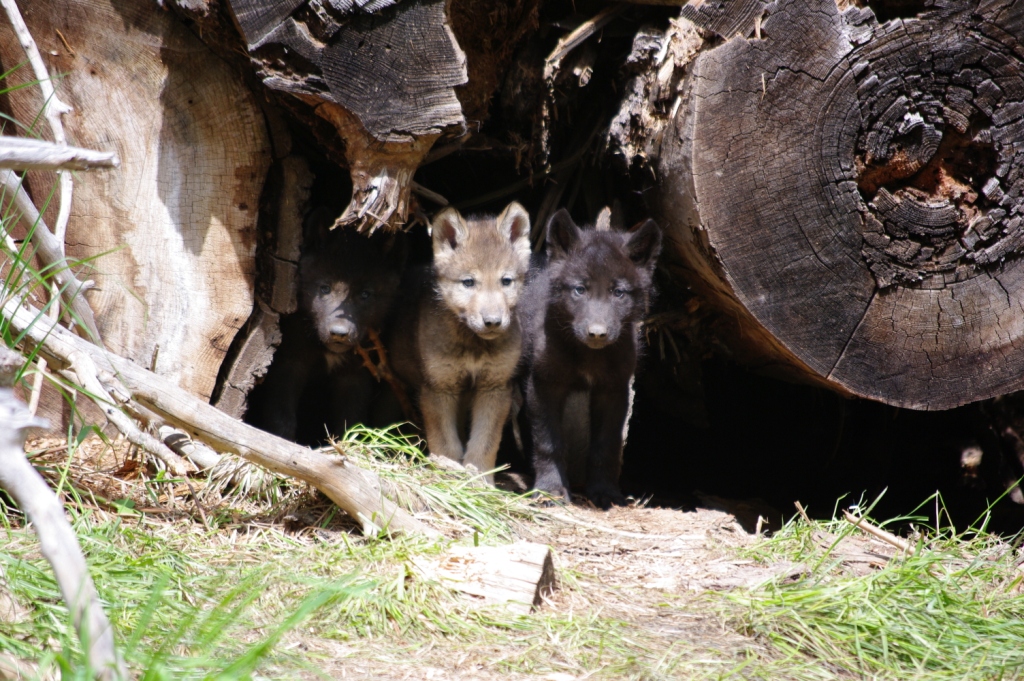
These wolf pups born to the Wenaha Pack in 2012 helped get recovery back on track. But their future remains tenuous (photo courtesy ODFW)
Please now listen to this:
So you can see that I have written frequently about wolves; indeed just a few days ago did so and included this photograph.
Wolf greets man.
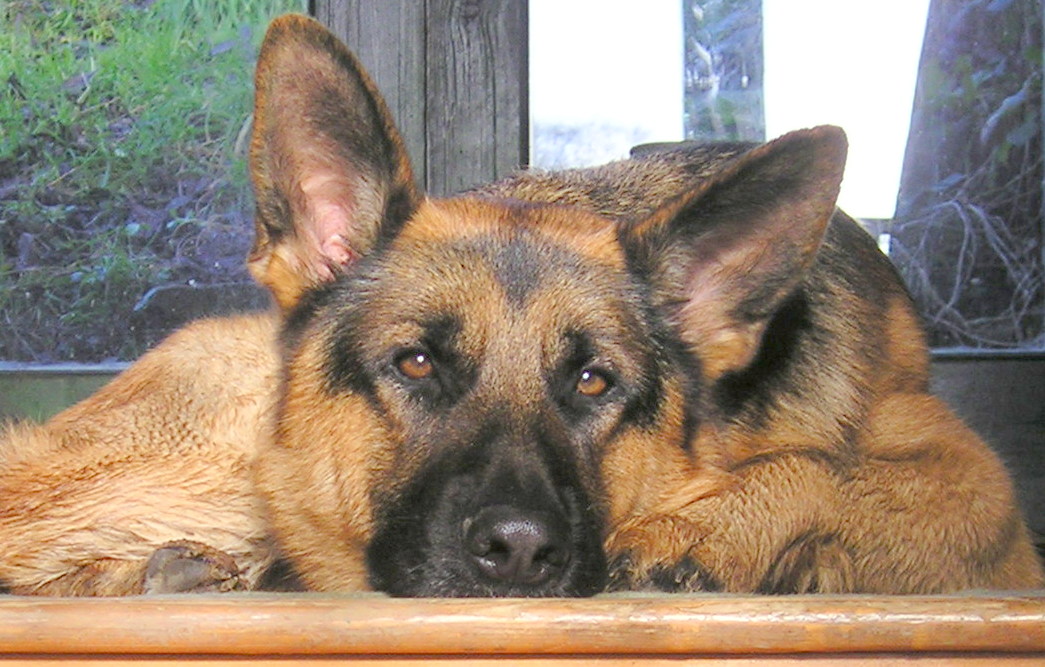
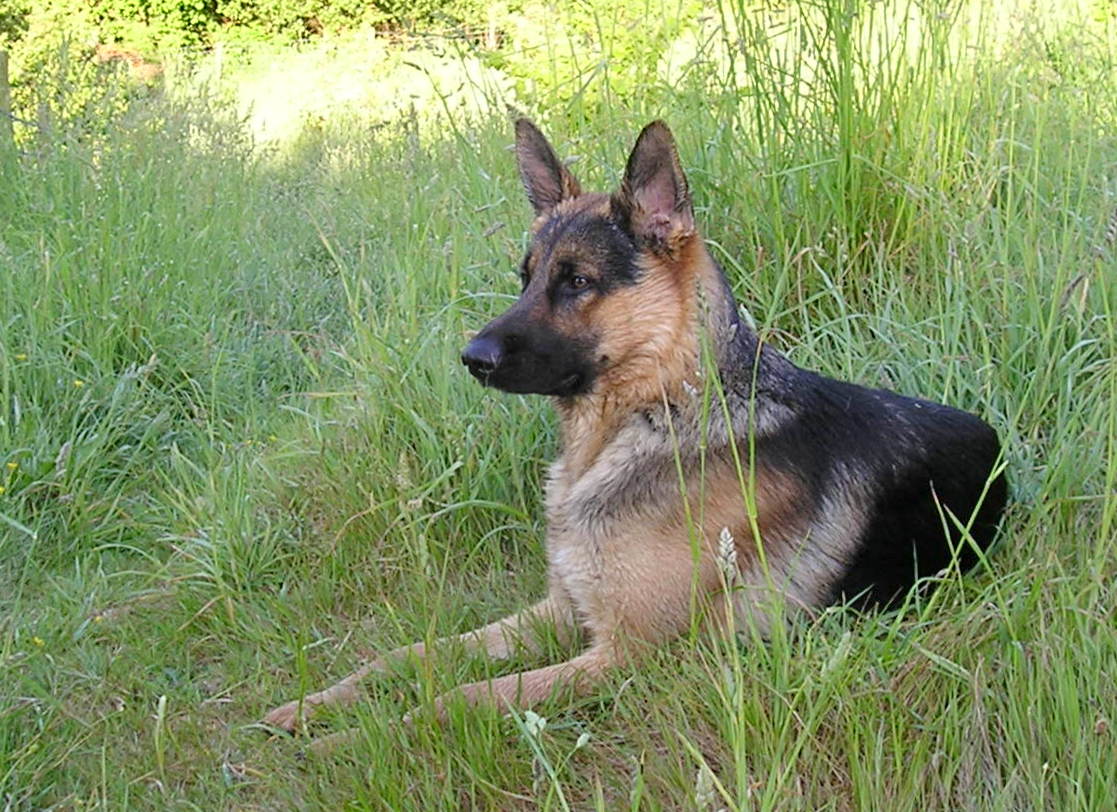
Now just look at those eyes of the Grey Wolf above and compare them to the eyes of the German Shepherd dog below and tell me that wolves aren’t as close to man as dogs.
Finally, feel free to share this post as far and wide as you can. Learning from Dogs is published under a Creative Commons License. This link covers how to share my material.
Please do something to help these ancient animals who, more than any other creature, helped put mankind ‘on the map’.
This second offering from Dan is very different to yesterday’s deep space theme.
Yesterday, I published an item sent in by Dan that included a video of an area of deep space photographed by the Hubble Space Telescope. Do take a look if you missed it yesterday – it is truly astounding.
Today, something from Dan that is altogether much more pragmatic, albeit very funny. Enjoy!
Years ago if I was ever to own a dog, it had to be one breed and one breed only: a German Shepherd Dog.
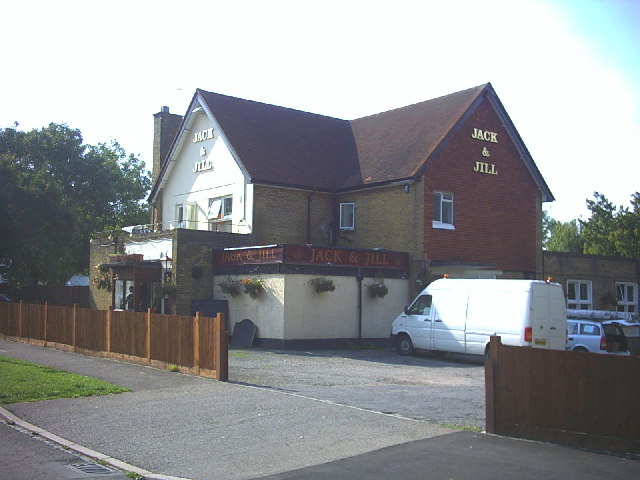
The reason for this was that back in 1955 my father and mother looked after a German Shepherd dog called Boy. Boy belonged to a lovely couple, Maurice and Marie Davies. They were in the process of taking over a new Public House (Pub); the Jack & Jill in Coulsdon, Surrey. My father had been the architect of the Jack & Jill.
Jack & Jill, Longlands Avenue, Coulsdon, Surrey
As publicans have a tough time taking holidays, it was agreed that the move from their old pub to the Jack & Jill represented a brilliant opportunity to have that vacation. My parents offered to look after Boy for the 6 weeks that Maurice and Marie were going to be away.
Boy was the most gentle loveable dog one could imagine and I quickly became devoted to him; I was 11 years old at the time. So when years later it seemed the right time to have a dog, there was no question about the breed. Boy’s memory lived on all those years, and, as this post reveals, still does!
Pharaoh was born June 3rd, 2003 at Jutone Kennels up at Bovey Tracy, Devon, on the edge of Dartmoor. As the home page of the Jutone website pronounces,
The Kennel was established in 1964 and it has always been the aim to breed the best German Shepherd Dogs for type and temperament. To this end the very finest German bloodlines are used to continue a modern breeding programme.
and elsewhere on that website one learns:
Jutone was established by Tony Trant who was joined by Sandra Tucker in 1976. Sandra continues to run Jutone since Tony passed away in 2004. Both Tony and Sandra qualified as Championship Show judges and Sandra continues to judge regularly. Sandra is the Secretary and a Life Member of the German Shepherd Dog Club of Devon.
Tony Trant
Turning to Pharaoh, here are a few more pictures over the years.
Pharaoh, nine months old.
oooOOOooo
One year old: June 3rd 2004.
The next picture of Pharaoh requires a little background information.
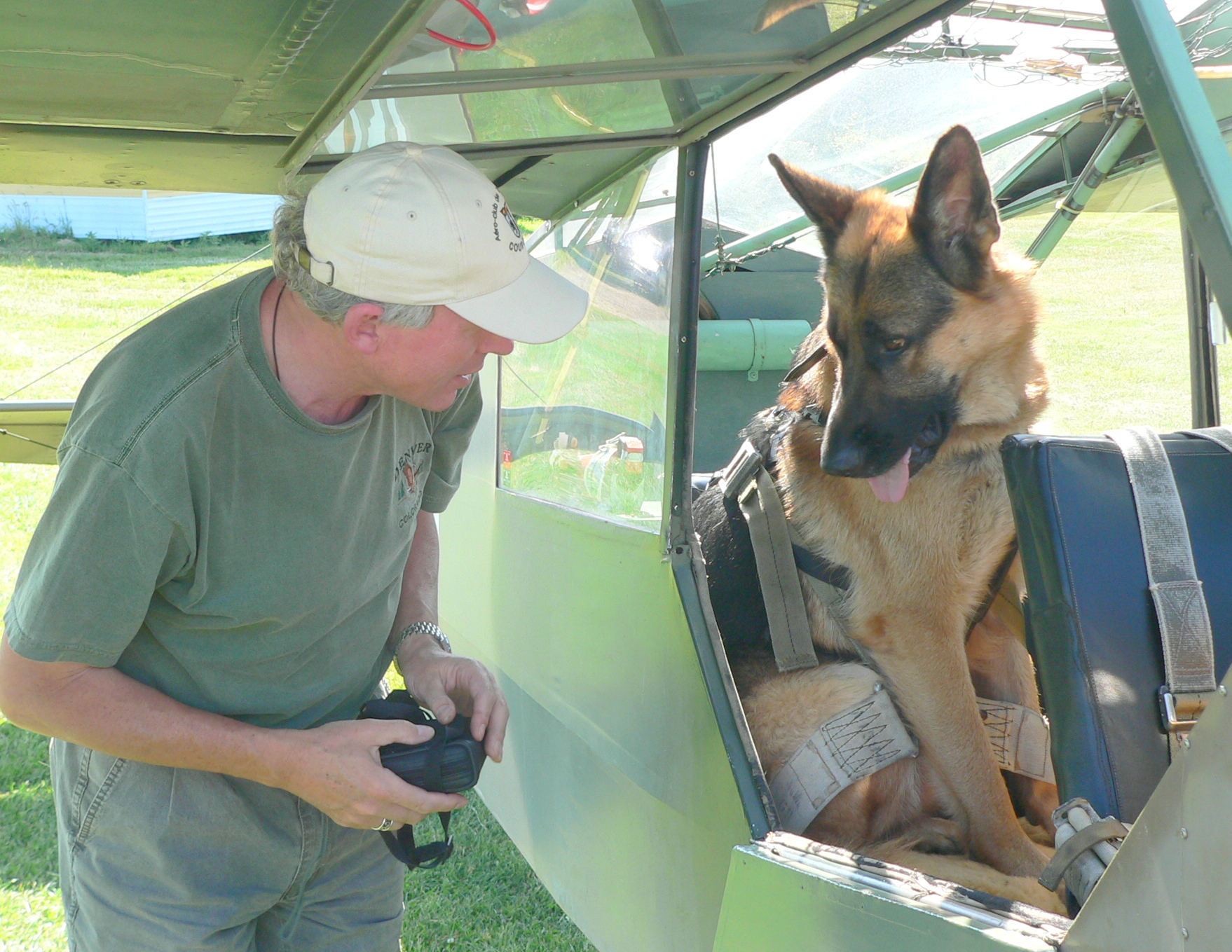
For many years I was a private pilot and in later days had the pleasure, the huge pleasure, of flying a Piper Super Cub, a group-owned aircraft based at Watchford Farm in South Devon. The aircraft, a Piper PA-18-135 Super Cub, was originally supplied to the Dutch Air Force in 1954 and was permitted by the British CAA to carry her original military markings including her Dutch military registration, R-151, although there was a British registration, G-BIYR, ‘underneath’ the Dutch R-151. (I wrote more fully about the history of the aircraft on Learning from Dogsback in August 2009.)
Piper Cub R151
Anyway, every time I went to the airfield with Pharaoh he always tried to climb into the cockpit. So one day, I decided to see if he would sit in the rear seat and be strapped in. Absolutely no problem with that!
Come on Dad, let’s get this thing off the ground!
My idea had been to fly a gentle circuit in the aircraft. First I did some taxying around the large grass airfield that is Watchford to see how Pharaoh reacted. He was perfectly behaved.
Then I thought long and hard about taking Pharaoh for a flight. In the Cub there is no autopilot so if Pharaoh struggled or worse it would have been almost impossible to fly the aircraft and cope with Pharaoh. So, in the end, I abandoned taking him for a flight. The chances are that it would have been fine. But if something had gone wrong, the outcome just didn’t bear thinking about.
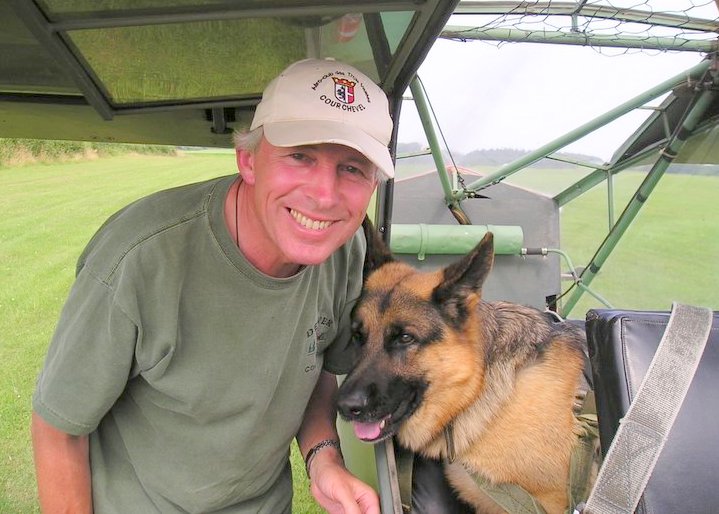
So we ended up motoring for 30 minutes all around the airfield which, as the next picture shows, met with doggie approval. The date was July 2006.
That was fun!
What a dear dog he has been over all the years and, thankfully, still is!
As if to reinforce the fabulous dog he still is, yesterday it was almost as though he knew he had to show how youthful he still was.
Because, when I took his group of dogs out around 7.30am armed with my camera, Pharaoh was brimming over with energy.
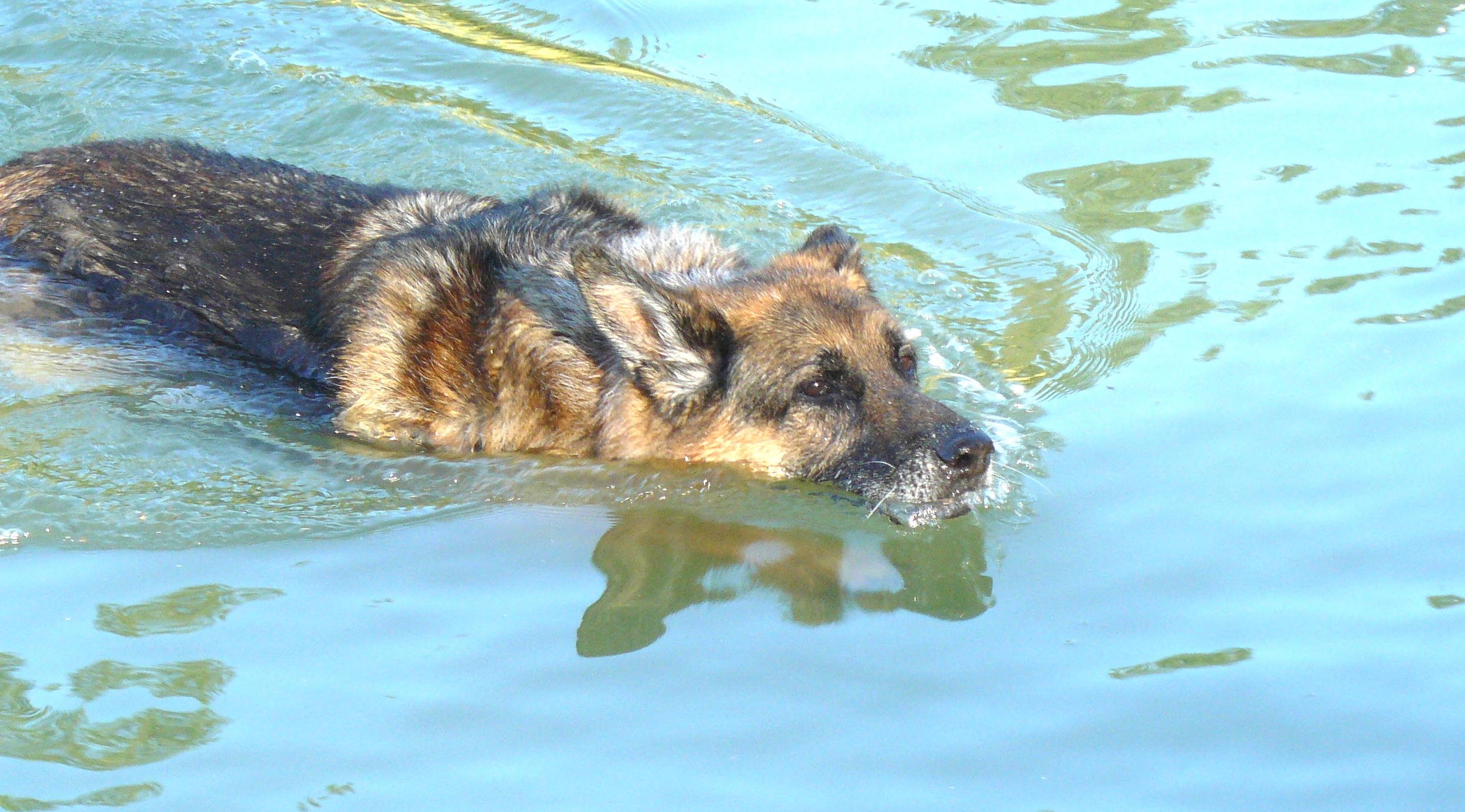
First up was a swim in the pond.
Ah, an early birthday dip! Bliss!
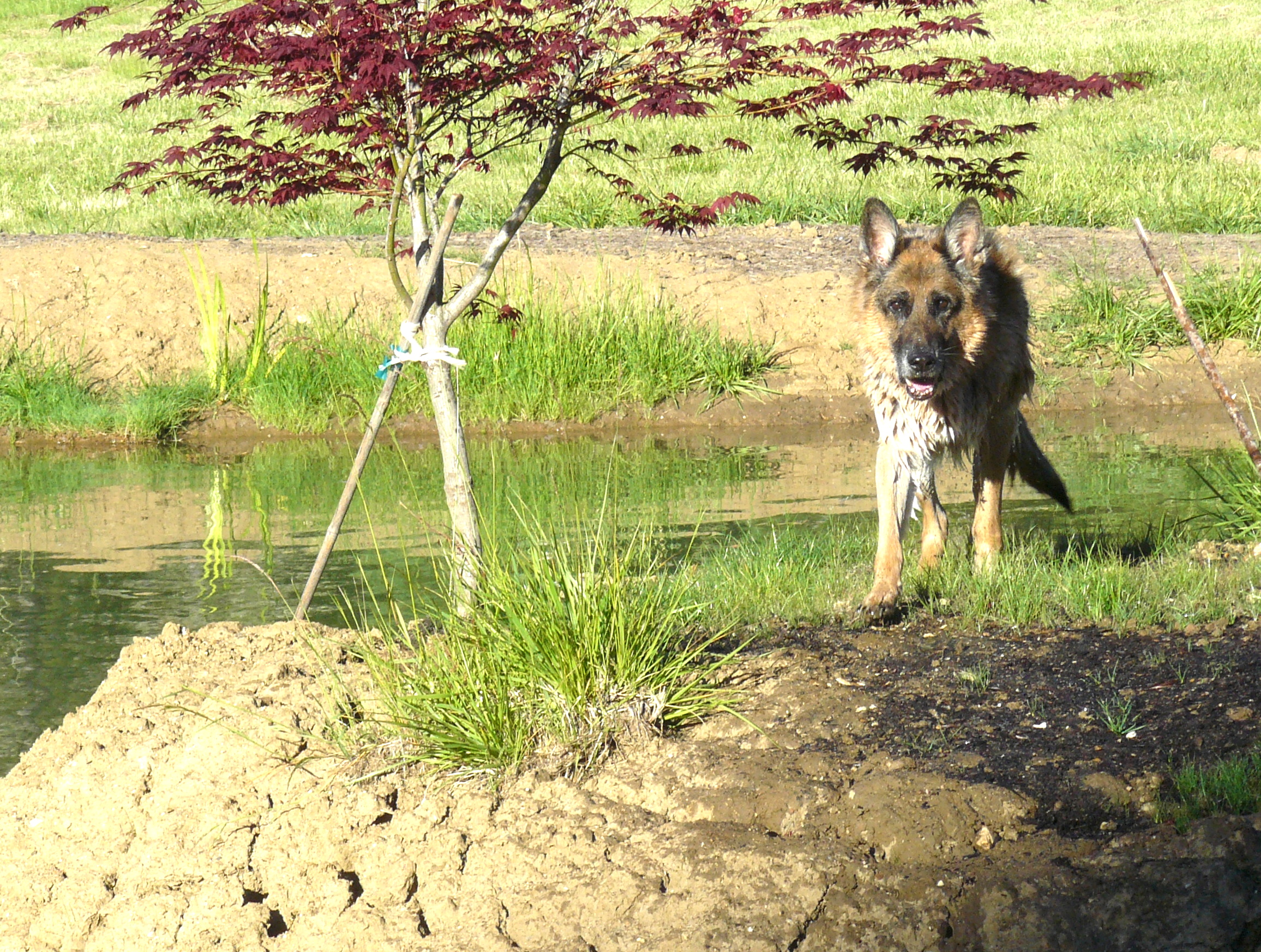
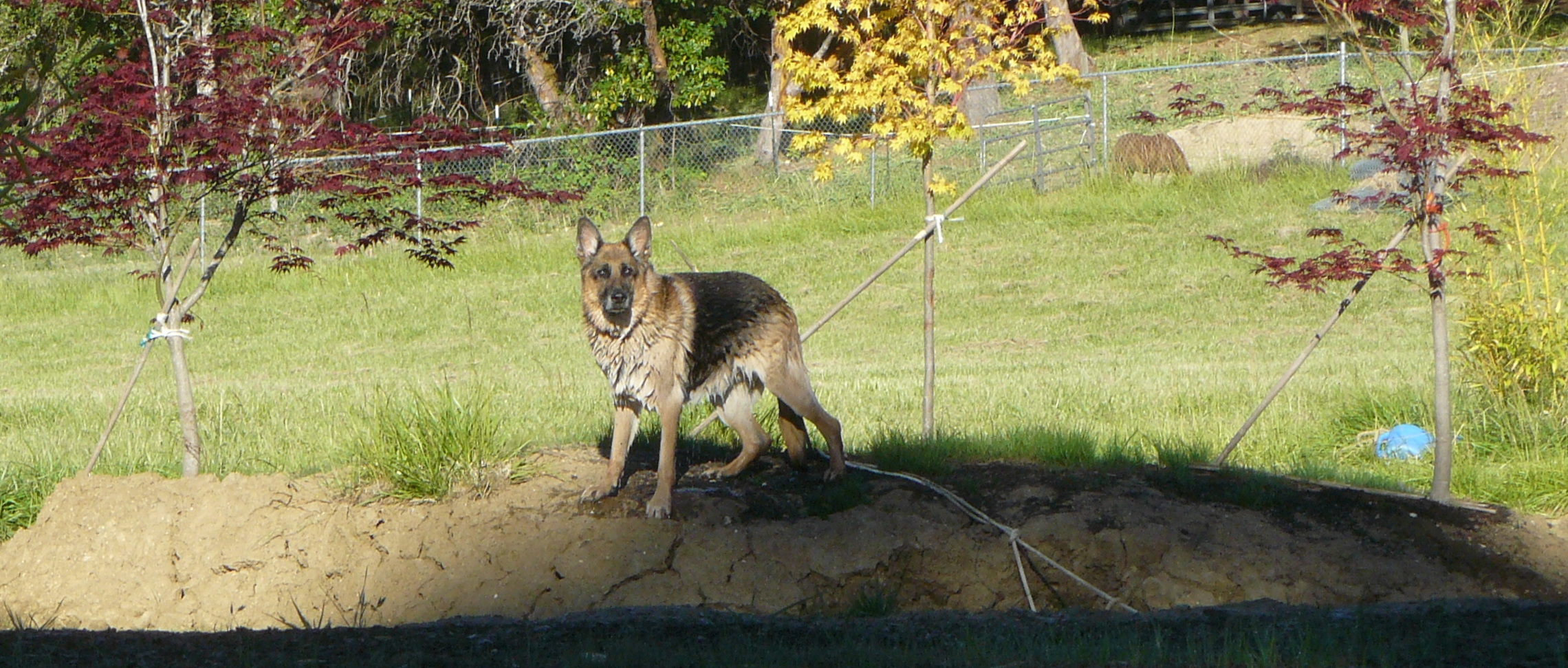
Then in a way he has not done before, Pharaoh wanted to play ‘King of my Island’, which is in the middle of the pond.
Halt! Who goes there!
ooo
This is my island! So there!
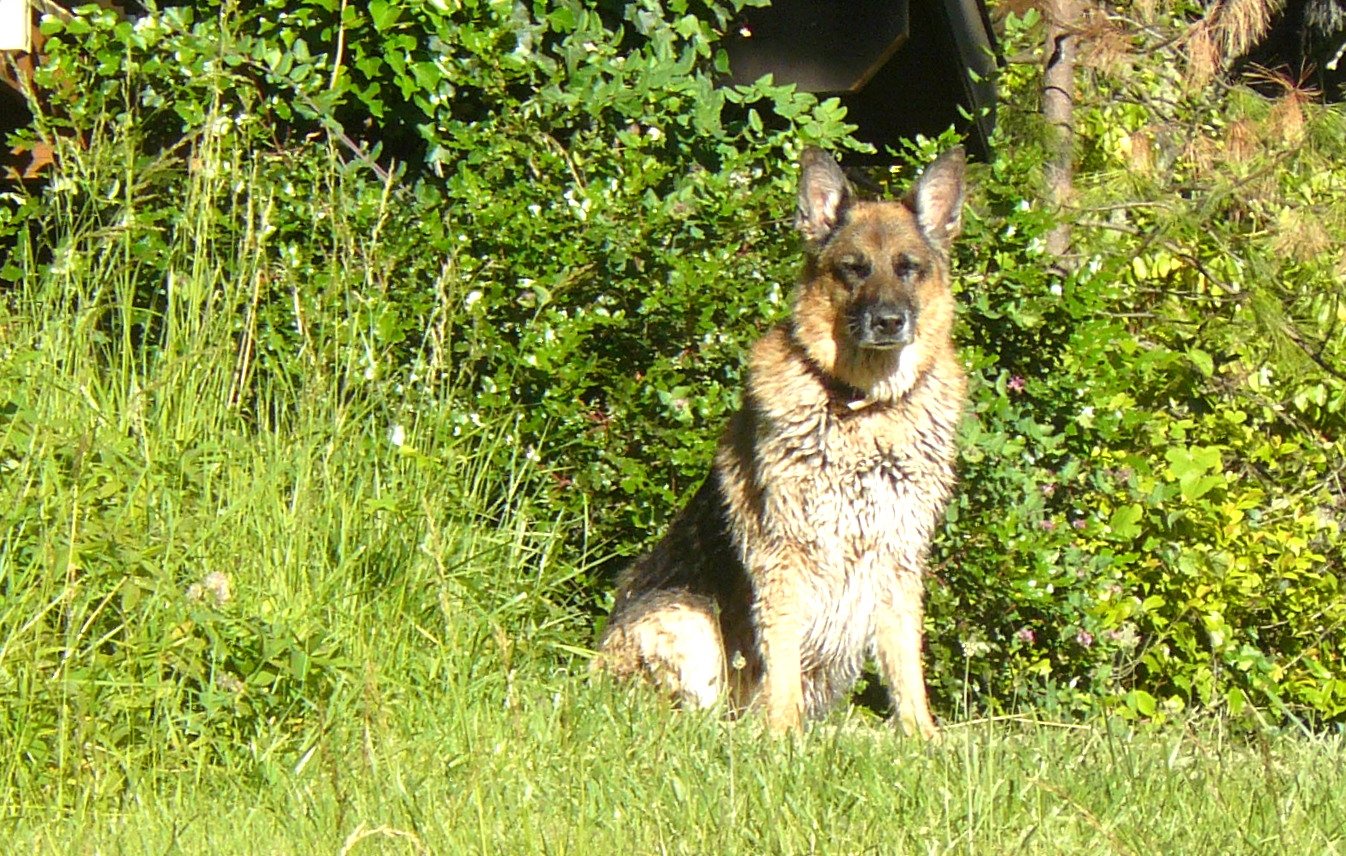
Then a while later, when back on dry land, so to speak, it was time to dry off in the morning sunshine.
Actually, this isn’t a bad life!
Long may he have an enjoyable and comfortable life.
Yes, Pharaoh was born back on June 3rd 2003. So today, in human years he is 10. In the old traditional ‘dog years is seven times times human years‘ he would be 70. But according to a recent item on BBC News there is a more accurate way of calculating dog years.
Longevity secrets of readers’ pets who lived past 100 ‘dog years’
Thanks to our dog age calculator, people have been reassessing the age of their furry friends.
It put a new spin on the old saying that the age of dogs could be better understood by multiplying the number of years since their birth by seven.
You can read more here. That dog age calculator is here.
Dog years: The calculator
Working out your dog’s true age used to be a case of simply multiplying it by seven. But it’s more complicated than that, and here’s a handy calculator to do it for you.
Dogs age at varying speeds at different stages of their lives
With that in mind, we’ve built a calculator for you to work out your dog’s true age – its age in “dog years”.
Alternatively, you can find out how old you would be if you were a dog. You can choose to be a labrador, a spaniel, a whippet, or any one of 20 breeds.
The calculator uses these multipliers for the first two years of a dog’s life:
12.5 for small dogs
10.5 for medium-sized dogs
9 for large dogs
Then, for the third and subsequent years of the dog’s life, each human year has to be multiplied by between 4.3 and 13.4 years, depending on the breed:
Small: Dachshund (Miniature) 4.32, Border Terrier 4.47, Lhasa Apso 4.49, Shih Tzu 4.78, Whippet Medium 5.30, Chihuahua 4.87, West Highland White Terrier 4.96, Beagle 5.20, Miniature Schnauzer 5.46, Spaniel (Cocker) 5.55, Cavalier King Charles 5.77, Pug 5.95, French Bulldog 7.65
The calculator does not work for cross breeds, sadly, but on average these live 1.22 years longer than pure breeds, according to Dan O’Neill (from Petts Wood in London…) who is researching the subject for a PhD at the Royal Veterinary College.
Nor does the calculator work for cats. What we can say is that the average life expectancy of a cat is 12.1 years, which equates to 64 human years.
Guidelines issued by the American Association of Feline Practitioners say that cats reach 10 human years in their first six months and are approximately 24 at the age of two years. After this their age increases by four “cat years” every year.
So dear Pharaoh is the equivalent of an 80-year-old human! The breed has an average life expectancy of 9.73 years. (Source: BBC calculations on data from UK Kennel Club and US Veterinary Medical Database.)
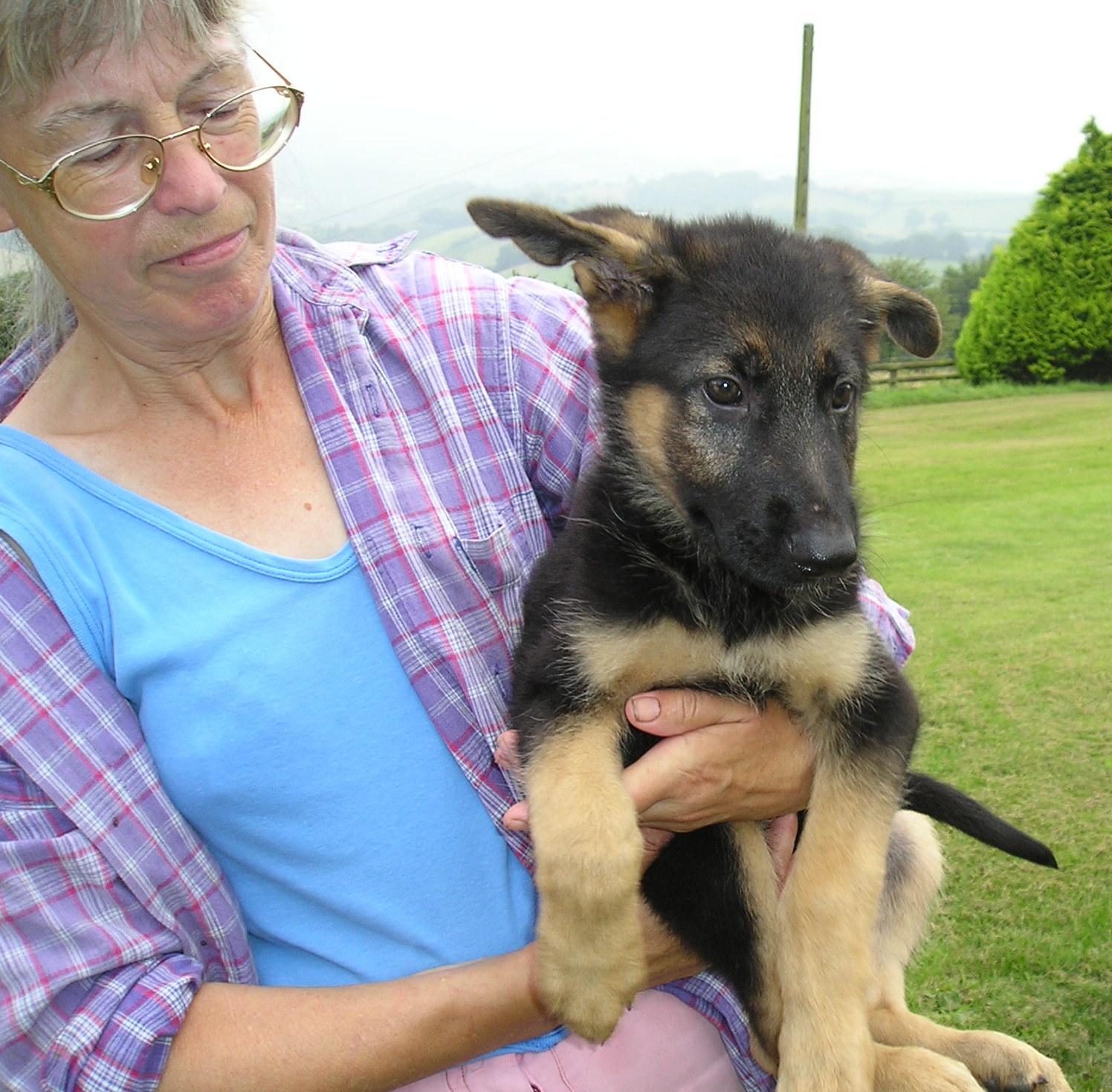
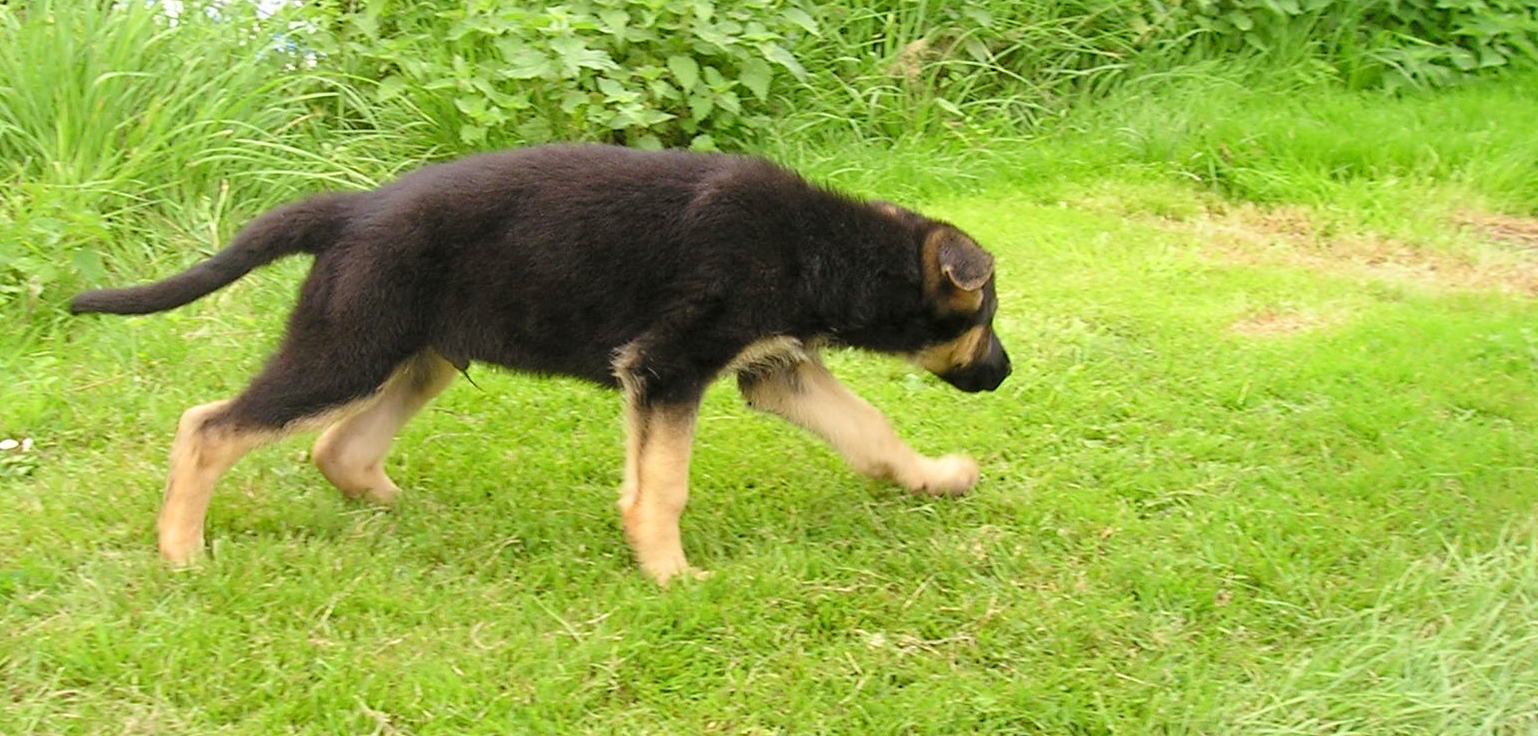
Going to leave you for today with three photographs of Pharaoh taken the day I first saw Pharaoh as a puppy, back on the 12th August 2003. The woman holding Pharaoh is Sandra Tucker who runs Jutone Kennels in Devon, England., where Pharaoh was born 10 years ago this day!








 Learning from Dogs