“Until one has loved an animal, a part of one’s soul remains unawakened.” Anatole France
This gorgeous video has been doing the rounds and came to me thanks to Suzann.
Enjoy!
Very Talented Russian Bear and His Awesome Friend
This unbelievably talented and cute Russian bear can roll over, play the trumpet, sit on a lawn chair, play the trumpet, you name it. Leave it to a random Russian guy to train such an awesome bear.
I was doing some research for another writing project about the history of the domestication of the dog and came across a peer-reviewed article on The National Center for Biotechnology Information website, here in the USA. The article was entitled: Genome-wide SNP and haplotype analyses reveal a rich history underlying dog domestication. The website link is here. (As an aside, if you drop in here and look at the NCBI sitemap it may well serve as an excellent resource.)
Anyway, the dog domestication article is, of necessity, highly scientific but nonetheless worth the read. Here’s a taste from the Abstract.
Advances in genome technology have facilitated a new understanding of the historical and genetic processes crucial to rapid phenotypic evolution under domestication 1,2. To understand the process of dog diversification better, we conducted an extensive genome-wide survey of more than 48,000 single nucleotide polymorphisms in dogs and their wild progenitor, the grey wolf. Here we show that dog breeds share a higher proportion of multi-locus haplotypes unique to grey wolves from the Middle East, indicating that they are a dominant source of genetic diversity for dogs rather than wolves from east Asia, as suggested by mitochondrial DNA sequence data 3
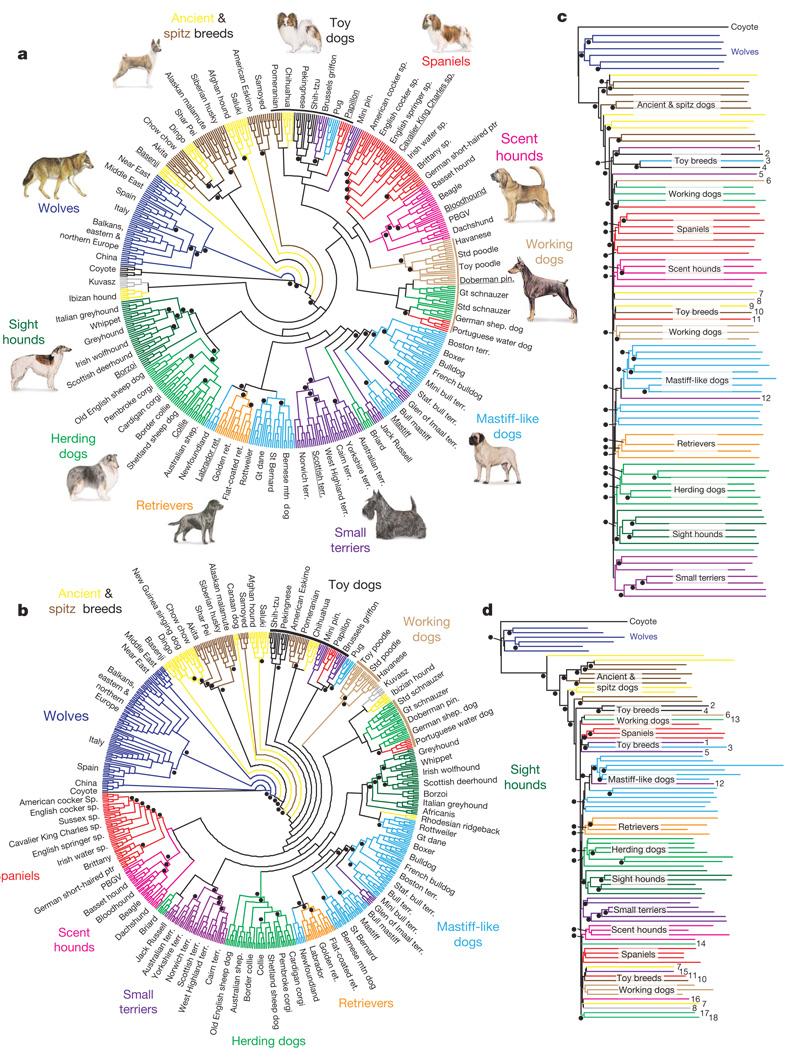
But what really caught my eye was Figure 1, a wonderful illustration of the links between all the breeds of dogs and the grey wolf.
Neighbour-joining trees of domestic dogs and grey wolves.
Branch colour indicates the phenotypic/functional designation used by dog breeders 8,9. A dot indicates ≥95% bootstrap support from 1,000 replicates. a, Haplotype-sharing cladogram for 10-SNP windows (n = 6 for each breed and wolf population). b, Allele-sharing cladogram of individuals based on individual SNP loci. c, Haplotype-sharing phylogram based on 10-SNP windows of breeds and wolf populations. d, Allele-sharing phylogram of individual SNPs for breeds and wolf populations. For c and d, we note breeds where genetic assignments conflict with phenotypic/functional designations as follows: 1, Brussels griffon; 2, Pekingese; 3, pug; 4, Shih-tzu; 5, miniature pinscher; 6, Doberman pinscher; 7, Kuvasz; 8, Ibizian hound; 9, chihuahua; 10, Pomeranian; 11, papillon; 12, Glen of Imaal; 13, German shepherd; 14, Briard; 15, Jack Russell; 16, dachshund; 17, great schnauzer; and 18, standard schnauzer. Gt, great; mtn, mountain; PBGV, petit basset griffon vendeen; pin., pinscher; ptr, pointer; ret., retriever; shep., shepherd; sp., spaniel; Staf., Staffordshire; std, standard; terr., terrier. Canine images not drawn to scale. Wolf image adapted from ref. 31; dog images from the American Kennel Club (http://www.akc.org).
The diagram on its own was a bit of a struggle but looked at in conjunction with the research paper was much better understood. Another reason for going to the original article on the NCBI website is the interesting range of links to other scientific papers that may be seen to the right-hand side of the screen. For example:
The mean sequence distance to ancestral haplotypes indicates an origin 5,400-16,300 years ago (ya) from at least 51 female wolf founders. These results indicate that the domestic dog originated in southern China less than 16,300 ya, from several hundred wolves. The place and time coincide approximately with the origin of rice agriculture, suggesting that the dogs may have originated among sedentary hunter-gatherers or early farmers, and the numerous founders indicate that wolf taming was an important culture trait.
Mitochondrial DNA sequences isolated from ancient dog remains from Latin America and Alaska showed that native American dogs originated from multiple Old World lineages of dogs that accompanied late Pleistocene humans across the Bering Strait. One clade of dog sequences was unique to the New World, which is consistent with a period of geographic isolation. This unique clade was absent from a large sample of modern dogs, which implies that European colonists systematically discouraged the breeding of native American dogs.
If you needed a reminder of the Pleistocene period, as I did, there’s a helpful Wikipedia entry here.
The final link that I wanted to highlight was this one, for all dog owners who worry about the health of our dogs.
Dogs exhibit more phenotypic variation than any other mammal and are affected by a wide variety of genetic diseases. However, the origin and genetic basis of this variation is still poorly understood. We examined the effect of domestication on the dog genome by comparison with its wild ancestor, the gray wolf. We compared variation in dog and wolf genes using whole-genome single nucleotide polymorphism (SNP) data. The d(N)/d(S) ratio (omega) was around 50% greater for SNPs found in dogs than in wolves, indicating that a higher proportion of nonsynonymous alleles segregate in dogs compared with nonfunctional genetic variation. We suggest that the majority of these alleles are slightly deleterious and that two main factors may have contributed to their increase. The first is a relaxation of selective constraint due to a population bottleneck and altered breeding patterns accompanying domestication. The second is a reduction of effective population size at loci linked to those under positive selection due to Hill-Robertson interference. An increase in slightly deleterious genetic variation could contribute to the prevalence of disease in modern dog breeds.
Have to say that there are some fabulous learning opportunities from the enormous range of websites available nowadays.
A beautifully written, soul-stirring account of strife, darkness, hope and, above all, love shared between dog and human.
Gracious, I don’t know where to start! Guess at the beginning.
Which was that a little over a month ago, I received this email:
Dear Paul:
I hope this note finds you well. We were in touch several years about Racing in the Rain, and I wanted to get in touch about another dog-related novel that may be of interest to you and your readers.
I am working with Forge Books to set up a blog tour for Andrea Thalasinos, whose novel Traveling Light hits bookshelves and e-readers on July 16th. Traveling Light is an inspiring story about fate, family, and healing; it also explores the special bond that exists between humans and canines.
Now I well remembered the book Racing in the Rain, writing about it in May 2011 and then a guest post from the author, Garth Stein, in September under the title of A game called Fetch.
Wiley included in his email a “flavour” of Andrea Thalasinos’ novel, as in:
Paula Makaikis is ashamed of her marriage. Driven out of their bedroom by Roger’s compulsive hoarding, she has spent the past ten years sleeping downstairs on her husband’s ratty couch. Distant and uninspired, Paula is more concerned with the robins landing on her office window ledge than her hard-earned position at the university. Until a phone call changes everything.
A homeless Greek man is dying in a Queens hospital and Paula is asked to come and translate. The old man tells her of his beloved dog, Fotis, who bit a police officer when they were separated. Paula has never considered adopting a dog, but she promises the man that she will rescue Fotis and find him a good home. But when Fotis enters her life she finds a companion she can’t live without. Suddenly Paula has a dog, a brand-new Ford Escape, an eight-week leave of absence, and a plan.
So Fotis and Paula begin the longest drive of their lives. In northern Minnesota, something compels her to answer a help-wanted ad for a wildlife rehabilitation center. Soon Paula is holding an eagle in her hands, and the experience leaves her changed forever.
Traveling Light explores what is possible when we cut the ties that hold us down and the heart is free to soar.
Of course, I wanted to read and review Andrea’s book. Wiley and I agreed that a review published on the 18th July, i.e. today, would be perfect. However, for reasons not entirely clear, the review copy of the book didn’t arrive until July 10th; just 8 days ago. That made it too tight for me to read in that time, so I gave the book to Jean for her to read first.
If I tell you that Jean devoured the book and had it finished in three days, you won’t get a better idea than that of how moving and captivating she found it. At the time of writing this post (9am yesterday) I was already up to page 160. So the review that follows a little later in today’s post is the combined feelings of Jean and me.
One of the other things that Wiley offered was for Andrea to write a guest post for Learning from Dogs. That now follows! I checked with Wiley: This is a true account from Andrea. (Trust me, you will be entranced!)
oooOOOooo
Andrea and Panda.
We’d come up to the edge of a wooden bridge that had almost as much space between the boards as the width of the boards themselves. Snow ordinarily covered the iffy-looking surfaces of such bridges, but the strength March’s early sun had melted clear down to the wood, leaving a full view of the snowy rocks in the creek bed below.
At the time, I didn’t know what my lead dog, Gorky, a red Siberian yearling (tiny in stature by Siberian standards) would do. From a puppy, she’d had more confidence in her furry little toe than I had in my whole body.
The dog positioned the team at the edge of the bridge and paused. She looked around, sniffing the wind, looking to the other side and then down through the slats into the creek bed below. I could tell she was thinking, calculating risks, odds and whether or not she had the moxie to cross. The other six dogs (including her father), were hooked up to the gangline behind her and by the set of their shoulders, their hedging and shirking back in their harnesses I could tell they were nervous.
It was a narrow trail, just wide enough for one dog team. Two more experienced teams were closing in from behind and I wondered what we would do. Rock walls butted up to either side of the trail, making it impossible to either turn around or move off the trail to let the others pass. I’d considered leading my dog team down into the gully, but the drop-off looked steep and as a rookie musher, I didn’t trust my skills to do so safely.
“Fifty bucks says she won’t take it,” the approaching musher called out from behind.
Thinking I’d be out the fifty before I could say boo, Gorky stepped up to the edge. Her body language changed. She’d committed to taking the bridge. As the red dog leaned into her harness, she gave the forward cue. The others fell in line, following her calm, forward gait with no signs of wavering.
After her first step I noticed that not once did Gorky look down, but rather kept her eye on the other side of the bridge as if she were already there.
Whenever I have to make difficult decisions, I think back to this moment. Sometimes I don’t have enough information or am waiting for some cosmic gut-affirmation that never seems to arrive when I need it. But one thing is clear. Like Gorky, once I set my mind on a course of action, I think of her and act.
Who knows if she was scared or not—she never said. The red dog lived to be 15 ½ and taught me more about not second-guessing than any person, place or thing I’ve come across since. Being brave doesn’t mean you’re not scared, it just means you do it anyway.
oooOOOooo
Traveling Light, a novel by Andrea Thalasinos
The opening of the book, In The Beginning, more of a prologue than anything else, firmly sets the context. For we read that the heroine of the story, Paula Makaikis, is tipped out of what is a highly unsatisfactory marriage into “the longest drive of her life” by a phone call from Celeste, Paula’s best friend.
The drive comes out of the tragic death of an old Greek man who pleads, in his last few breaths, that Paula takes his dog, Fotis, before the pound puts the dog to sleep.
If I tell you that by page 71, I had been brought to tears on two occasions then you will understand the depth of feeling that Andrea conveys: about life; about love; and the precious nature of a dog called Fotis .
This book, even as a work of fiction, seems to reach out to the reader, well to this reader anyway, with many messages of what life is all about. Take this for example, from page 104:
Paula few out of the Holland Tunnel into the early colors of the morning. Gas pedal depressed, windows open, her hair blowing, the faster she accelerated the better she felt. Getting up to eighty, then ninety, she thought maybe the wind would whisk her thoughts away.
Jersey was a blur except for periodic traffic congestion; Pennsylvania went on like a past life. The faster she drove, the clearer the sense that there was somewhere she needed to be. It wasn’t California or New York. It wasn’t a place. The map was nothing but lines, numbers, destinations. Wherever she was meant to be, she’d know it when she got there.
How many of us have shaken off our troubles as a dog shakes off water from its coat and ended up coming to a place and knowing that we were at the place we were meant to be!
In many ways, the book is a lovely fairy-tale, right up to the perfect ending. But in so many other ways the book is a reminder that we only have one life. Easy to say but less easy to embrace fully with heart and head. In fact, the book reinforces something that I wrote as a private letter to a family member in consequence of my sister’s recent death. I will share just a portion of that letter because I sense Andrea Thalasinos would love to see how her book reaches out to her readers.
Be clear about the purpose of life: your life. Do not put off what brings meaning, truth and happiness. Not even for a day. Live your beautiful life now; live it this day.
Thus for both Jean and me, this was the most beautiful of books and both of us have no hesitation in strongly recommending it.
Big thanks to Wiley Saichek for giving Jean and me the opportunity to read Traveling Light.
oooOOOooo
Now here’s an offer.
Wiley has offered a free copy of Andrea’s book as a ‘give-away’ from Learning from Dogs. Here’s the plan.
Would you like to write a story about any aspect of the relationship that dogs can have with humans?
Any length, truth or fiction; it doesn’t matter. Email your story to me (learningfromdogs (at) gmail (dot) com) to be received by the end of Wednesday, 31st July 2013, Pacific Daylight Time.
Then during the early part of August, I will publish every one received with some mechanism for readers to ‘score’ the stories and the winning author will be sent a free copy of the book.
It is our routine at home here in Oregon to let the kitchen group of dogs out first (Lily, Ruby, Casey & Paloma, with Sweeny tagging along) while Jean puts together our small breakfast. The time is around 6am to 6:30am and both Jean and I are usually wearing dressing gowns. Once this first group has been outside, then I let the ‘bedroom’ group out (Pharaoh, Cleo, Hazel and Dhalia).
Such as I did this morning, unusually a day starting dull with overcast cloud.
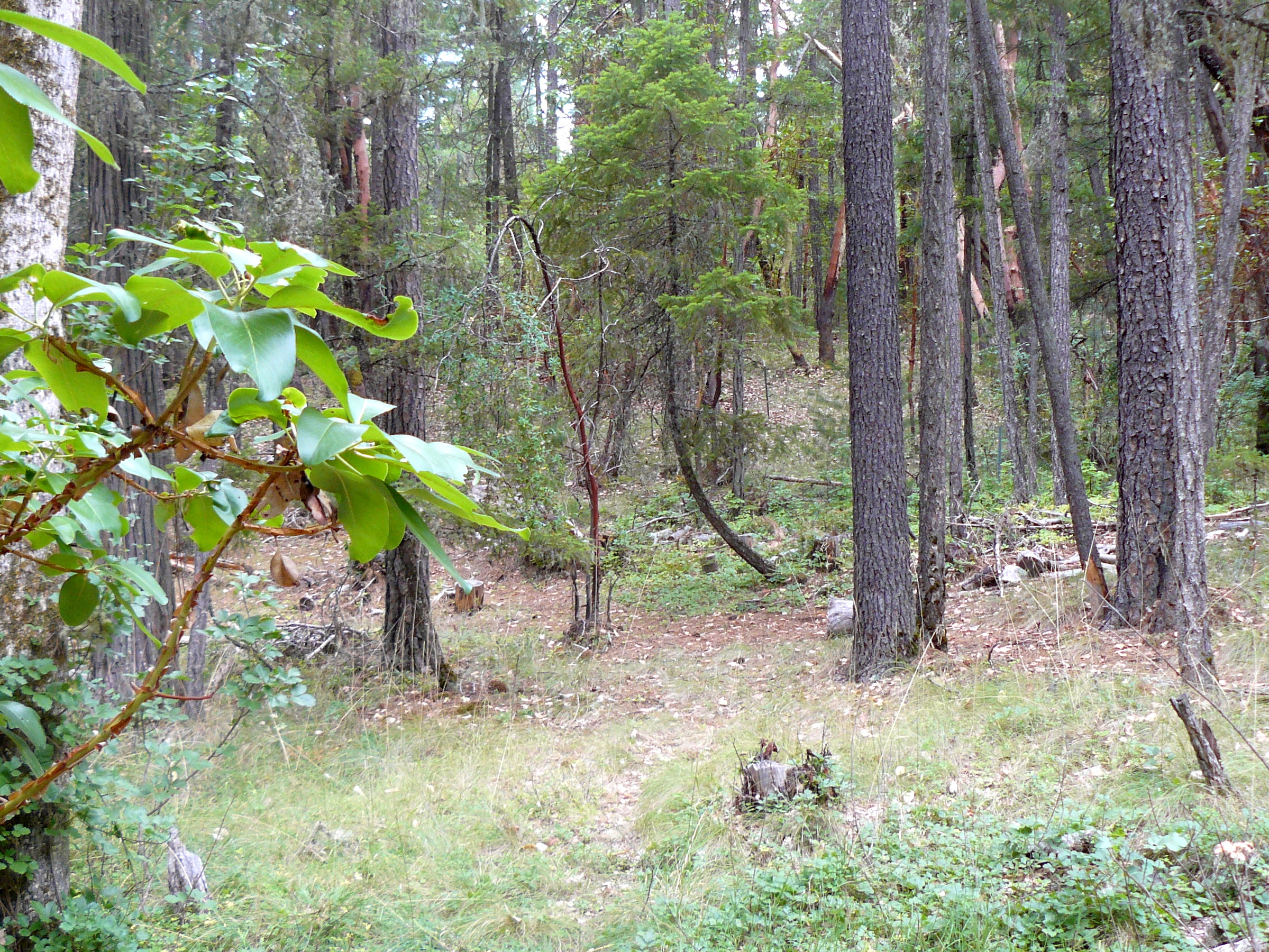
Suddenly, I heard the most awful squealing of an animal in pain over in the dense wooded area to the South-West of the property.
The wooded area in question.
In plastic slippers and dressing-gown only, I dashed into the woods and to my horror saw that Cleo, Hazel and Dhalia had cornered a young deer, and at least Hazel was nipping at a rear leg.
A not uncommon sight at home.
I screamed at the dogs, to no avail. They took not the slightest notice of me.
Then the young deer wriggled free and fled into the trees. The dogs recornered it and plunged in again. The deer broke free again, and so it went on. Eventually, after some ten minutes of the most dreadful hollering and chasing by me, the young deer jumped a fence and ran off with its mother who had been shadowing the terrible event. I prayed that it wasn’t badly hurt.
Gracious, I was so angry with the dogs! What disgusting behaviour towards this young, beautiful creature.
When I was back in the house trying to regain my breath, still so angry at the dogs, a thought came to my mind. Tens of thousands of years ago, this behaviour of the dogs was held in great esteem.
Early man evolved from a tribal hunter-gatherer existence to the pastoral life of farming about 10,000 years ago. If the DNA evidence shows, as it does, that the dog evolved from the wolf as a separate species around 100,000 years ago, then dogs were part of the life of hunter-gatherer man for something of the order of 90,000 years, possibly a couple of decades longer!
In fairness, the present lineage of dogs was domesticated from grey wolves only about 15,000 years ago. Despite fossil remains of domesticated dogs having been found in Siberia and Belgium from about 33,000 years ago, none of those lineages survived the Last Glacial Maximum. No fossil specimens prior to 33,000 years ago have indicated that they are clearly from the morphologically domesticated dog.
Even if, and it’s a very big ‘if’, the relationship between man and dog is only about 15,000 years old, one can only speculate how each species came to know the other, in every imaginable way.
Actually, we can go beyond speculation because in a study published by the PLOS ONE scientific journal in March 2013, Dr. Robert Losey, Associate Professor in the Department of Anthropology, University of Alberta and the lead author, explained that:
Dog burials appear to be more common in areas where diets were rich in aquatic foods because these same areas also appear to have had the densest human populations and the most cemeteries,
If the practice of burying dogs was solely related to their importance in procuring terrestrial game, we would expect to see them in the Early Holocene (around 9,000 years ago), when human subsistence practices were focused on these animals. Further, we would expect to see them in later periods in areas where fish were never really major components of the diet and deer were the primary focus, but they are rare or absent in these regions.
The PLOS ONE paper went on to report that researchers found that most of the dog burials occurred during the Early Neolithic period, some 7,000-8,000 years ago, and that “dogs were only buried when human hunter-gatherers were also being buried.”
So back to the morning’s drama between the dogs and the young deer.
The efficiency of the way the dogs cornered the deer was breath-taking. Had I not been coming at them in such a state of anger and agitation, and especially if I was one of a group of say, 2 or 3 humans, the odds are that the deer could have been grabbed and dispatched. In other words, those three dogs had demonstrated that 20,000, 40,000, 80,000 or more years ago, they were critically useful at helping early hunter-gatherer man feed himself.
Back to Dr. Losey’s view, “I think the hunter-gatherers here saw some of their dogs as being nearly the same as themselves, even at a spiritual level. At this time, dogs were the only animals living closely with humans, and they were likely known at an individual level, far more so than any other animal people encountered. People came to know them as unique, special individuals.”
Does make sense, doesn’t it.
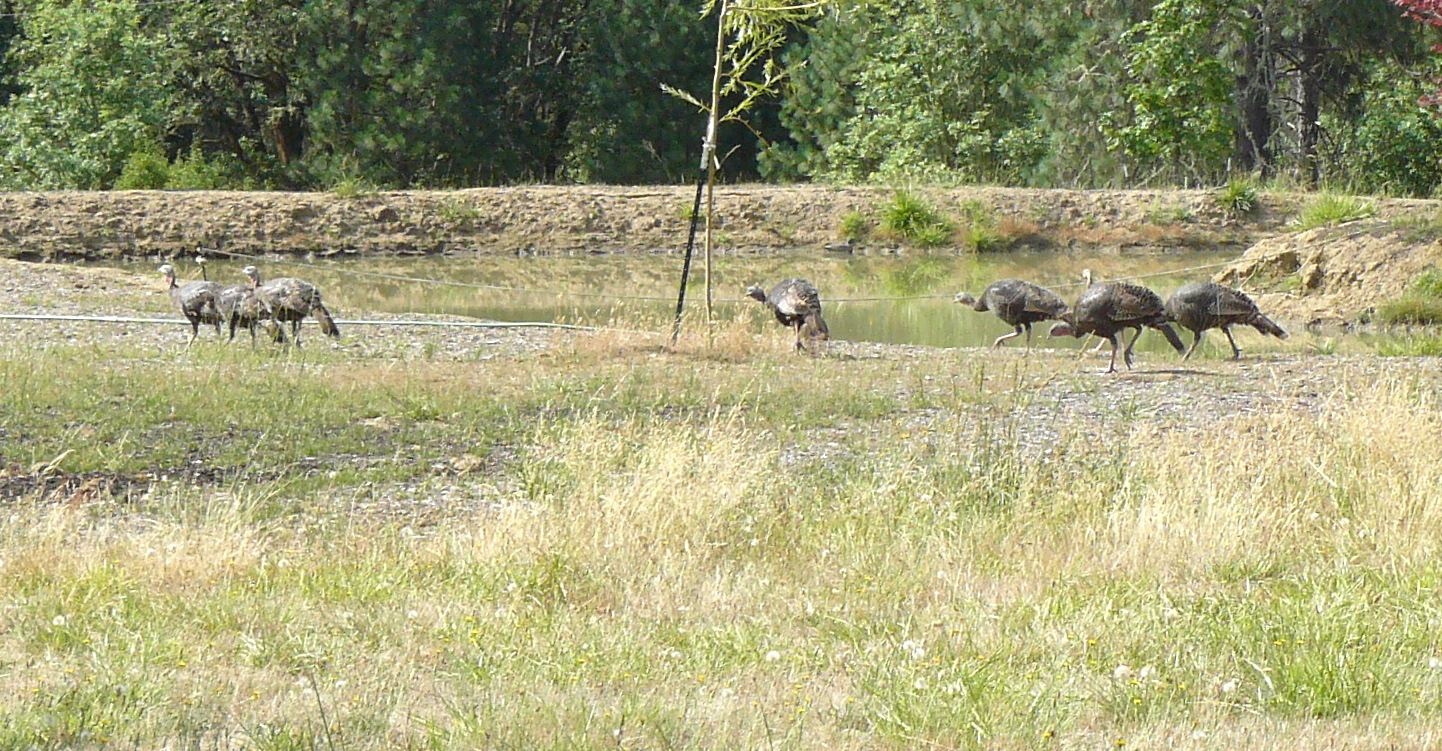
“Oh look! We could have turkey for dinner tonight!”
A reflection on the history of the German Shepherd dog.
Yesterday’s account of getting to know GSD Duke a little better caused me to find a post that had been sitting in my Drafts folder for a couple of years. It was about a piece published in The New York Times, Sunday Review, October 8th, 2011 under the heading of Why German Shepherds Have Had Their Day.
Why German Shepherds Have Had Their Day
By SUSAN ORLEAN
SUCCESS can be a drag. You yearn for it, strive for it, and then, when it finally arrives, it sets off repercussions you never anticipated that sometimes undo that success.
Take the German shepherd. Originally bred to the exacting standards of a German cavalry officer, it became one of the 20th century’s most popular working breeds. But in recent years that popularity, and the overbreeding that came with it, has driven the German shepherd into eclipse: even the police in the German state of North Rhine-Westphalia, who had relied on the dogs for years, recently announced they were replacing them with Belgian Malinois, because the less-popular Malinois were hardier and more reliable.
But there is good news about this bad news, if you are a lover of the breed, because less visibility, especially in inspiring roles as public servants, is likely to mean less demand for the dogs. That means less reason to produce too many puppies, which is the best thing that can happen to any purebred dogs.
The article continued with the history of the breed. But rather than stay with the NYT piece, for more about the breed history I’m going to cross over to the website of the British charity, German Shepherd Dog Rescue (GSDR). They have a comprehensive account of the History and Origins of the Breed.
History and Origins of the German Shepherd Dog
A brief insight into the development of the breed
The German Shepherd breed appeared late at the end of the 19th century in Germany and they were first exhibited at a show in Hanover in 1882. They were not like German Shepherds as we know them today though being rough coated, short tailed and rather resembling mongrels. The German Shepherd Dog as we now know it didn’t really appear until after the Second World War.
The breed was actually created by the cross breeding of working sheep dogs from rural Germany by an ex cavalry officer called Max von Stephanitz whose aim was to create a working dog for herding which could trot for long periods.
A breed standard was drawn up and the first breed show took place in 1899 following which the GSD became firmly established across Germany. In 1906 the first dogs were exported to the USA .
Since then, the breed has grown enormously in popularity and is now one of the most popular pedigree breeds in the UK as a pet as well as being the favourite working breed for many forces, especially the police. They are widely used for security purposes because of their strong protective instincts.
Many people in the UK still call these dogs Alsatians which may partly be due to the fact that when they were first bred, the Alsace region of France, where these dogs were very popular, was part of Germany . I still get people who think that Alsatians are the traditional short coat black and tan dogs and that German Shepherds are the long coated dogs that have become popular.
GSD’s make wonderful family pets and will protect family and home.
These dogs are highly intelligent and will show undying devotion to their master but they are dogs that need company and stimulation to be at their best. It is however, important to remember that this is a working breed and that they do have certain characteristics that some people might find difficult to live with. The German Shepherd should be steady, loyal, self assured, courageous and willing and should not be nervous over aggressive or shy. Nervous aggression is something that we are now seeing more often as a result of bad breeding. It is sad but there has always been indiscriminate breeding of German Shepherds right from the start, which has lead to problems with temperament and health.
Before leaving the GSDR website, please read more about this important charity, “We are one of the longest standing and largest German Shepherd rescues in the UK.” and if there is any way at all that you can help, please, please, please! (And fellow bloggers, consider a post spreading the word about this wonderful charity and these most magnificent of dogs.)
So a few memories of German Shepherds closer to home.
Young Pharaoh 12th August, 2003 when he was just 10 weeks old.
We are friends for life! Each for the other.
Pharaoh, ten-years-old, and King of his Castle! Taken on the 3rd June, 2013 at our home in Oregon.
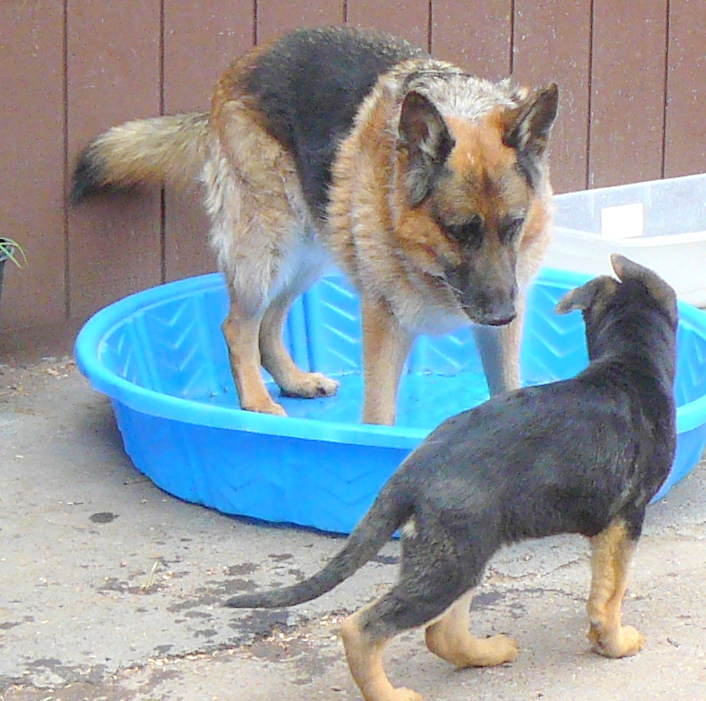
The arrival of young Cleo!
I suspect Pharaoh is explaining to Cleo that there’s only rule of the house – his rule!
Picture taken April 7th, 2012
From puppy to Big Dog! Cleo resting where she shouldn’t be! February, 2013.
Owning a dog really makes a measurable and positive difference to health outcomes!
Yesterday, I republished a post from October, 2010 which included the story of Ricochet. In that post, I mentioned a graphic that had been sent to me by ZocDoc. I had been sent an email that in part read:
Hey Paul,
I work for ZocDoc, a doctor’s appointment website (not for dogs yet!). I just stumbled upon your blog, because you wrote about the healing power of dogs. We’ve just launched an infographic called “the healing power of dogs” and since you also have the post on your site I thought that this should be interesting to your readership and possibly help adoption.
I hadn’t heard of the company but very quickly the About Us page explained the background. Now in fairness, that email was all about promoting a commercial organisation. Nevertheless, it seemed such a useful and enjoyable graphic that I agreed to publish it.
New research shows the beauty of the bond between dog and man.
I was doing some research for another writing project and came across this on the NBC News website:
What prehistoric dog burials tell us about owners
By Jennifer Viegas
An analysis of ancient dog burials finds that the typical prehistoric dog owner ate a lot of seafood, had spiritual beliefs, and wore jewelry that sometimes wound up on the dog.
The study, published in PLoS ONE, is one of the first to directly test if there was a clear relationship between the practice of dog burial and human behaviors. The answer is yes.
Photo – Robert Losey. The ancient dog was buried in a resting position. It was part of a study to directly test if there was a clear relationship between the practice of dog burial and human behaviors. The answer is yes.
That PLOS ONE study, published March 2013, found that “dog domestication predates the beginning of agriculture about 10,000 years ago.”
Dr. Losey and his dog, Guiness
Dr. Robert Losey, Associate Professor in the Department of Anthropology, University of Alberta and the lead author, explained that,
Dog burials appear to be more common in areas where diets were rich in aquatic foods because these same areas also appear to have had the densest human populations and the most cemeteries,
If the practice of burying dogs was solely related to their importance in procuring terrestrial game, we would expect to see them in the Early Holocene (around 9,000 years ago), when human subsistence practices were focused on these animals.
Robert Losey continued.
Further, we would expect to see them in later periods in areas where fish were never really major components of the diet and deer were the primary focus, but they are rare or absent in these regions.
The PLOS ONE paper went on to report that researchers found that most of the dog burials occurred during the Early Neolithic period, some 7,000-8,000 years ago, and that “dogs were only buried when human hunter-gatherers were also being buried.” Dr. Losey went on to say,
I think the hunter-gatherers here saw some of their dogs as being nearly the same as themselves, even at a spiritual level. At this time, dogs were the only animals living closely with humans, and they were likely known at an individual level, far more so than any other animal people encountered. People came to know them as unique, special individuals.
Those interested in the research paper may find it here, and read the Abstract:
Ancient DNA Analysis Affirms the Canid from Altai as a Primitive Dog
Abstract
The origin of domestic dogs remains controversial, with genetic data indicating a separation between modern dogs and wolves in the Late Pleistocene. However, only a few dog-like fossils are found prior to the Last Glacial Maximum, and it is widely accepted that the dog domestication predates the beginning of agriculture about 10,000 years ago. In order to evaluate the genetic relationship of one of the oldest dogs, we have isolated ancient DNA from the recently described putative 33,000-year old Pleistocene dog from Altai and analysed 413 nucleotides of the mitochondrial control region. Our analyses reveal that the unique haplotype of the Altai dog is more closely related to modern dogs and prehistoric New World canids than it is to contemporary wolves. Further genetic analyses of ancient canids may reveal a more exact date and centre of domestication.
DNA testing indicates that the evolutionary split between dogs and wolves was around 100,000 years ago or more. The value of dogs to early human hunter-gatherers led to them quickly becoming ubiquitous across world cultures.
Thus it is in the order of 90,000 years, possibly a couple of decades longer, from the point where a bond was made between early man and the wolf to the era when man evolved from a tribal hunter-gatherer existence to farming the resources of the planet. Thousands and thousands of years of dogs being the greatest animal relationship we humans have ever experienced.
Back to that NBC news item:
Erik Axelsson, a researcher at Uppsala University’s Science for Life Laboratory, has also studied prehistoric dogs. He too found that human and dog diets, burial practices and more often paralleled each other, revealing how close the dog-human bond has been for thousands of years.
Axelsson said, “Dogs and humans share the same environment, we eat similar food and we get similar diseases.”
Based on the number of burials, we also often spend eternity together too.
Eons of time.
A hundred, thousand years of knowing man, and it shows in the eyes.
This has been very widely reported but nevertheless it’s a great story about the devotion of dogs to humans, and in return, the way that so many people recognised the need for help for the badly injured dog.
Readers will recall that the dog, Kabang, suffered massive injuries back in December 2011 when she jumped into the path of a motorcycle, stopping it from running over her owner’s daughter and niece in Zamboanga, a city in the Southern Philippines.
Here’s a video that was published back in October last year that explores the circumstances of the dog’s actions and the public’s response.
“A dog who became an international cause celebre after her snout was sliced off saving two young girls in the Philippines was examined by veterinarians Thursday at UC Davis, a milestone event in a remarkable humanitarian effort to help a canine heroine.
The mixed-breed dog, named Kabang, became an unlikely star in the Philippines after she reportedly threw herself into the path of a speeding motorcycle just as it was about to hit two young girls crossing a roadway in Zamboanga City.
The lunge, by all accounts, saved the lives of the daughter and niece of Kabang’s owner, but cost the dog her snout and upper jaw, which was sheared off when she got tangled in the motorcycle’s spokes. The gruesome injury puts her in grave danger of developing an infection. At minimum, the gaping wound must be closed, a delicate procedure that is beyond the capability of veterinarians in the Philippines.”* Would you prolong your dog’s life even if it were that costly? Ana Kasparian, John Iadarola, and Jayar Jackson break it down.
DAVIS (CBS13) – Kabang, the Philippine dog that suffered a severely injured snout and upper-jaw while saving two girls from being hit by a motorcycle, has been released from the hospital.
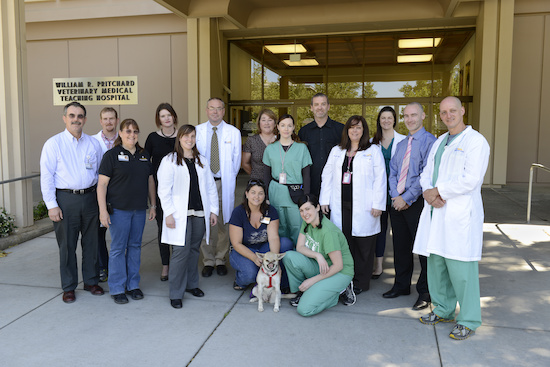
The dog was brought to the veterinary medicine teaching hospital at UC Davis in October 2012 to be treated for the injury that left her with a gaping wound where her snout had been. But veterinarians found she had heartworm disease and a type of infectious cancer. A team of UC Davis veterinarians specializing in oncology; infectious diseases; dental, oral and soft-tissue surgery; internal medicine; and outpatient care was assembled to treat Kabang, according to the UC Davis News Service.
“We were able to treat all of the complications that arose with the best specialists available,” Verstraete said Professor Frank Verstraete, chief of the hospital’s dentistry and oral surgery service.