Category: Culture

A mathematical approach to the demise of the Neanderthals.

Pure mathematics is, in its way, the poetry of logical ideas. Albert Einstein.

I have never been proficient at mathematics. But that doesn’t mean that I am not fascinated by the field of maths.

Hold that in your thoughts as I mention the name of blogger: Patrice Ayme.  It’s a non-de-plume but so what!  What blows me away, to use the vernacular, is the depth of thought expressed through the keyboard of Mr. Ayme (even the gender is an assumption).  The sub-heading on the home page of his blog is “Intelligence at the core of humanism“.  Just run your eye down the list of Recent Posts to the right-hand side of the home page to get a feel for the topics covered in the last few months.  Impressive is an understatement!

Anyway, five days ago Patrice published a post proposing how the Neanderthals were outbred, under the title of Math Extinguished Neanderthals.  It fascinated me and Patrice was gracious in allowing me permission to republish it on Learning from Dogs.

oooOOOooo

Math Extinguished Neanderthals

HOW NEANDERTHALS WERE OUTBRED:

Zillions of theories about the “disappearance” of Neanderthals. The latest one, from Oxford University, claims that Neanderthals’ big, beautiful eyes, and their big muscles caused their demise. They were too busy looking at things, and flexing their muscles. The idea is that significantly larger eyes would have crowded the Neanderthal brain out, making them relatively stupid. In particular it made them incapable of having social groups as large as those of Homo Sapiens Sapiens.

Big Eyes Do Not Kill

Big Eyes Do Not Kill

Sapiens girl on the left, Neanderthal girl on the right (reconstitution published in Science Magazine a few years ago).

I have long argued that the strength of democracy came from having many brains working in parallel. There is little doubt that larger social groups bring a higher cultural intelligence, hence higher individual intelligence. So I agree about that bit of logic. Yet, ironically, to reach the conclusion that Neanderthals’ social group were less numerous, the simple fact that Neanderthals were bigger, is enough. There is no need for hazardous demeaning allegations about Neanderthals’ brains.

That big eyes made Neanderthals stupid contradicts some facts that were thought to be established:

1) Sapiens Neanderthalis’ brains were significantly larger to start with. See Wikipedia.

2) Many very clever Homo Sapiens Sapiens have small brains. Famously Anatole France, an intellectual, had only a 1,000 cubic centimeters brain. Homo Floresiensis, the “hobbit” species living on the island of Flores, Indonesia, until it was wiped out recently, was extremely intellectually capable, although it had really small (and completely different) brains.

3) In the Middle East, Neanderthals and Sapiens went back and forth through the same large caves over 50,000 years. So whatever happened, it was not in evidence for 50,000 years.

So, of course, I have my own theory. That’s what philosophy is all about: trying to guess what really matters most, and how that most significant data logically articulate. Then scientists, politicians and writers can swoop, figure out the details, and attribute themselves the glory.

What could have happened by around 28,000 years ago that caused the demise of Neanderthals? At the time, the last fierce glaciation was gaining ground. (It reached its maximum 25,000 years ago.) Some have argued, absurdly, that the Neanderthals could not take it. That’s beyond silly, as Neanderthals had evolved, from half a million years ago, precisely to handle extreme cold.

Neanderthals were stocky, powerful, and they had thrived through hundreds thousands years of glaciation, mostly on a meat diet, hunting big game. But they also knew how to cook plants, and eat them.

50,000 years ago, Neanderthals exterminated Cave Bears, a huge animal who lived in caves, prime real estate Neanderthals craved for. Could the disappearance of Cave Bears be logically linked to the disappearance of Neanderthals? Yes. That’s a consequence of my theory. More advanced technology played a direct role.

How did Neanderthals kill Cave Bears? With technology. We do not know exactly what weapons Neanderthals had at their disposal. However, technology had improved, and kept improving. Recently it was found that Sapiens Sapiens (Homo SS; I hope one gets the joke) in Africa had invented bows and arrows 80,000 Before Present (BP).  (About 60,000 years earlier than previously thought!) Before bows and arrows, the propeller had been invented, and was used in Europe. The propeller took advantage of angular momentum to send a sort of mini lance further and stronger than by hand.

Why did the Neanderthals and Denisovans (another human species from Central Eurasia) lose their edge? Advancing technology is the obvious answer. When technology of clothing and weapons was sufficiently advanced, the physiological advantage that the Neanderthals genetically had, disappeared. Homo Sapiens Sapiens could thrive just as well through winter.

At that point, Homo Sapiens Sapiens from Africa could be as successful as the Neanderthals through the freezing wastelands of Europe. OK.

But the Homo SS outbred the Neanderthals, so they became genetically more successful. How do I explain that?

Simple. However, the explanation involves the exponential function, the same function found all over, and that the mathematician Rudin called “the most important function in mathematics”. The exponential also explains the plutocratic phenomenon, and that is why it’s so dangerous. The exponential always rules extinction events, that’s why one day a species is all over, like the American Pigeon, or the Tasmanian Tiger, and the next day, it’s gone.

So visualize this. Neanderthals were bigger than Homo SS, just like the Polar Bear is bigger than the Black Bear. Bigness is an adaptation to cold. Southern Europe’s Brown Bears are smaller than those found in Kamchatka, or Alaska (also known as Grizzlies: the Grizzly is an emigrated European Brown Bear!) Bigger makes warmer inside. That’s why the most massive animal that ever was, the Blue Rorqual, at up to 180 tons, is nearly twice the mass of the largest dinosaur (it’s not just that it’s floating, but also that water is cooler than Jurassic air, I hold).

To simplify, let’s use a bit of exaggeration (that’s reasoning by exaggeration, one of my preferred tactic of thought; the one humor exploits, and why joking helps thinking). Let’s assume Neanderthals were twice more massive than Homo SS.

Now let’s consider an habitat where Homo SS and Neanderthal bands roamed. They will tend not to mix, for obvious racist reasons. The racial hatred between Neanderthals and Homo SS has got to have been colossal. People who look too different are not even sexually attracted to each other (and where Neanderthals and Homo SS were in contact in the Middle East, for 50,000 years, there is no evolution of an interbred species, an indirect proof that there was no love lost there!)

The density of human mass is going to be roughly the same all over, because that density depends only upon the resources available (mostly meat on the hoof, and fur in burrows in glaciating conditions).

Thus, there would have been apartheid. But the Homo SS would have been twice more numerous, where they reigned (from my assumption of twice the mass). So now graft on this a catastrophe; a drought, a flood, a very tough winter, a volcanic super disaster, whatever. The climate was highly variable, starting about 40,000 years ago, just when Homo SS appeared. Some have stupidly argued that Neanderthals were too stupid to adapt to this changing circumstances. Like this paralyzing stupidity struck them just when Homo SS were around. My explanation is more subtle.

After a catastrophe in said habitat, say one of these numerous habitat in Europe isolated by glacial mountain ranges, or seas and lakes, most of the human population would be wiped out, Homo SS, just as Neanderthals. There would tend to be always a small remaining population, because the greatest limit on man is man himself: as a population gets wiped out, resources rebound, and life of the survivors tend to get much easier (that’s what happened in Europe after the Black Death of 1348 CE; if nothing else, survivors could ask for higher salaries from their plutocratic masters, and they did).

So say 90% of the population of the habitat was wiped out. As suddenly resources are now not limited, the human population will rebound exponentially. The equation is: N(t) = N(0) exp(Rt). “R” is the “Malthusian” parameter, the rate of growth. Now it’s going to require twice the resources to feed a Neanderthal to sexual maturation (under our outrageously simplifying assumption that Neanderthals are twice the mass). Thus one may assume that R(Homo SS)/R(Neanderthal) is 2. The end result is that the quotient:

Number Homo SS/ Number Neanderthal = A exp(2t). (Where A is the ratio of the populations H SS/Neanderthal after the catastrophe.)

Thus the population of H SS would exponentially grow relative to that of the Neanderthals, resulting in a quick extinction. And in no way this is happening because Homo SS were superior. Just because they were more gracile.

Hence the mystery of the evolution of contemporary man is smoothly explained. Just a bit of math. QED.
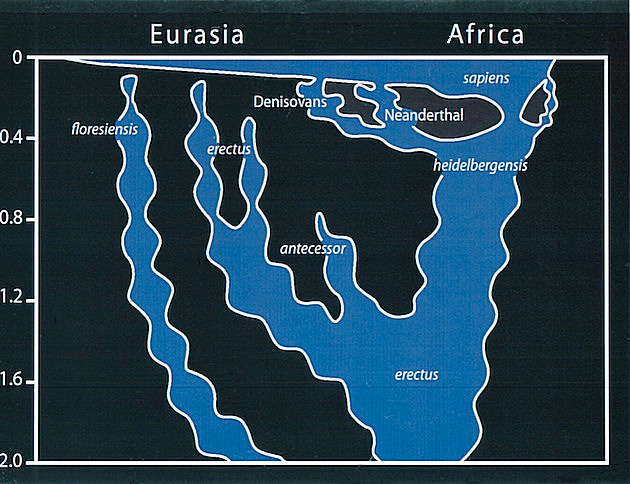
Europeans & Asians: Not Just African

Europeans & Asians: Not Just African

***

Patrice Ayme

***

Note 1: what of the mentally deliquescent and racist article in the Proceedings of the Royal Society? First, they sank so low as tousing orbit size as a proxy, that Neanderthals had larger visual systems than contemporary AMH [Anatomically Modern Humans]. That’s about as intelligent as saying that, because special forces use night vision goggles, they have got to have bigger visual systems.

The main woman author also found the same physiological feature, bigger eyes, in the past, about people presently living at high latitude. She contentedly asserted that, because light levels are lower in the north, people living in the north (40,000 years at least for Homo SS) have bigger eyes. Amusingly, she did not draw, in that case the conclusion that Norwegians and the English are therefore more stupid. Somehow, though, in her lack of smarts, she applies that controversial reasoning to Neanderthals. Does she have giant eyes?

Seriously the Oxford study rests on a central fact that contradicts one of established facts about Neanderthals. Indeed it claims Neanderthals’ brains were not any larger than Homo SS.

***

Note 2; what catastrophes am I talking about? Well the climate fluctuated wildly, to start with. Second, A Campanian ignimbritevolcanic super-eruption around 40,000 years ago, followed by a second one a few thousand years later, certainly crashed Neanderthal populations (based on logic, and evidence fromMezmaiskaya cave in the Caucasus. Mitochondrial DNA analysis of a specimen there is C14 dated 29,000 years BP, one of the latest living pure Neanderthals). After such a catastrophe, the exponential rebounds of populations would have advantaged Homo SS, as explained above.

***

Note 3: OK, I exaggerated with the mass ratio. (Mathematicians often do this, considering an exaggerated case to understand the mean, through the tails.) But the real mass ratio would be aggravated because, Neanderthal was built in such a way, relative to gracile Homo SS, that they consumed more calories per day (some paleontologists have come up with 300). So there is no doubt that the effect above will play a role, even if the mass ratios were not as bad. Notice the mechanism above would tend to extinguish the Neanderthal traits that were most characteristic of the subspecies.

***

Note 4: A preferred trick of Neanderthals’ haters is to exhibitArchaic Neanderthals‘skulls, and compare them to those of modern men. The skull of an Archaic Neanderthal of 400,000 years ago should not be compared to a modern human, less than 40,000 year old! All the more since Neanderthals’ brain size augmented faster than the brain size of Homo Sapiens Sapiens.

***

Note 5: Part of the mechanism above generalizes for other species in competition. It provides with a disappearance mechanism after ecological turbulence, according to species’ ecological footprint.

oooOOOooo

So hope that others shared my pleasure at reading the essay.

Going to close with another quotation from Mr. Albert Einstein: “As far as the laws of mathematics refer to reality, they are not certain, and as far as they are certain, they do not refer to reality.”


I’m a man – can fix anything!

Second set of wonderful pictures, courtesy of Bob Derham.

(In case you missed the first set, here’s the link: Trust me, I’m an engineer.)

oooOOOooo

Don’t have a spoon?

I can fix that!

rd1

Seat belt broken?
I can fix that! (Is that a neck brace you have on?)

rd2

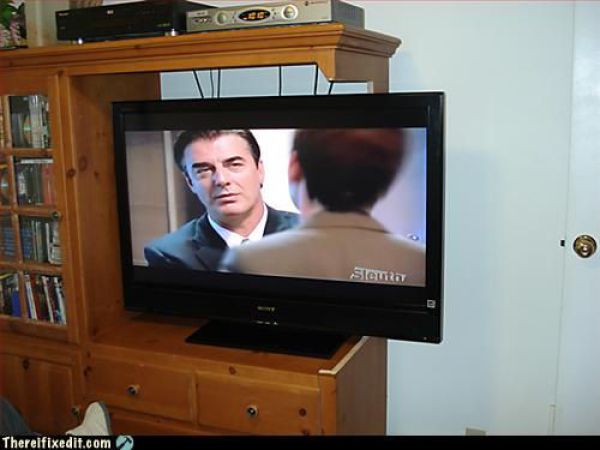
New TV too big for the old cabinet?
I can fix that!

rd3

No bottle opener?
I can fix that!

rd4

Room too dark using compact fluorescent?
I can fix that!

rd5

Electrical problem?
I can fix that!

rd6

Car stereo stolen?
I can fix that!

rd7

Bookshelf cracking under the weight?
I can fix that!

rd8

No ice chest?
I can fix that!

rd9

Can’t read the ATM screen?
I can fix that!

rd10

Car imported from the wrong country?
I can fix that!

rd11

Satellite signal goes out when it rains?
I can fix that!

rd12

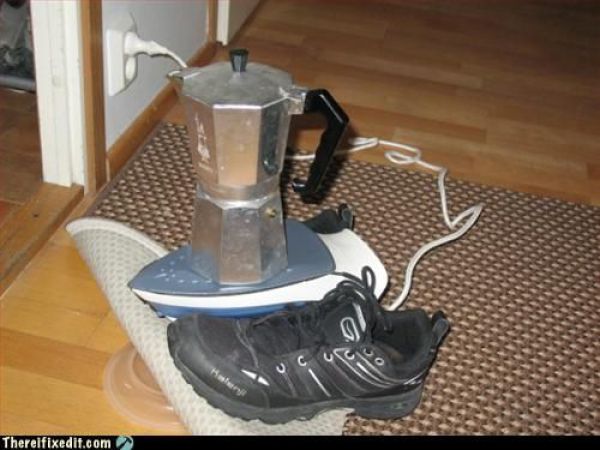
Electric stove broken & can’t heat coffee?
I fixed that.

rd13

Wiper motor burned out?
I can fix that!

rd14

What the HECK!!!

rd15

Display rack falling over?
I can fix that!

rd16

Desk overloaded?
I can fix that!

rd17

Car can’t be ordered with the ‘Wood Trim’ option?
I can fix that!

rd18

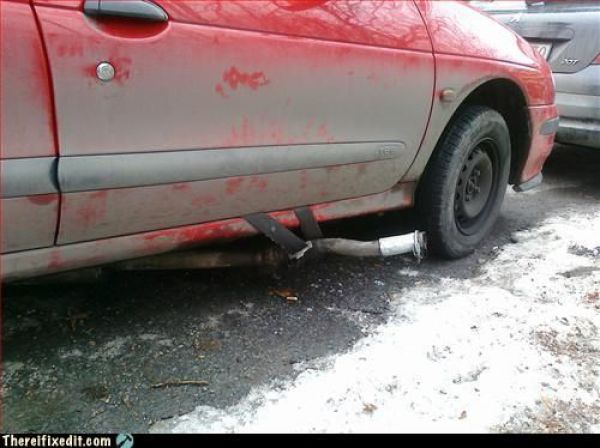
Exhaust pipe dragging?
I can fix that!

rd19

Need to feed the baby AND do the laundry?
I can fix that!

rd20

Cables falling behind the desk? (Now this is a Good One!)
I can fix that!

rd21

No skate park in town?
I can fix that!

rd22

And – last but not least – – – –
Out of diapers? I can fix that!

rd23


oooOOOooo

Wonderful, aren’t they!  Mind you, please understand I am not encouraging anyone to copy these ideas!

Trust me, I’m an engineer!

Wonderful set of pictures, courtesy of Bob Derham.

oooOOOooo

eng1

eng2

eng3'

eng4

eng5

eng6

eng7

eng8

eng9

eng10

eng11

oooOOOooo

In search of intelligent life!

One does have to wonder at times!

The title of today’s post comes from that silly anecdote as to why Planet Earth has never been visited by a species of intergalactic explorers from a far, distant world?

Answer: Because as they passed by and looked down upon our planet they saw no signs of intelligent life!

So what triggered all this?

Well last Wednesday, Christine over at 350 or bust published a review of the recently released film Greedy Lying Bastards.  Christine offered an insightful review of the film but more importantly went on to reveal a whole raft of issues that deserve to be widely promoted.  She has been generous in allowing me to republish her post on Learning from Dogs.

What has this to do with dogs?  On the face of it, very little.  But then again, everything.  Because if humans reverted to the standards of trust, loyalty and openness that we see every day in our dogs then we wouldn’t be in the mess that we are in!

oooOOOooo

Greedy Lying Bastards: Exposing The Fossil Fools Who Put Profit Before Human Lives

GreedyLyingBastards.com

*

One of the few-and-far-between perks of being a climate blogger is that occasionally I get access to books and movies before the general public does. This past weekend I got to watch “Greedy Lying Bastards” before it hit movie screens across the U.S. on Monday. Sunday night I, along with some fellow Citizens Climate Lobby volunteers, got together to watch this 90 minute documentary. This movie exposes the American fossil fuel interests that have been blocking action on climate change for decades, taking a page – and some of the same PR firms and lobbyists – right out of the tobacco companies’ playbook.  Like the tobacco lobby, these fossil fools have opposed government action on the science showing their product is harmful and have actively disseminated lies about the science.

After the movie, I surveyed group members for their responses; we all gave it 10 out of 10 for its topic, but for actual delivery the movie was rated between 6 to 8 out of 10.

Some of the comments were:

“I really appreciated the whistle-blowing, the naming of names. I also really appreciated first-hand accounts of people in the U.S. who are already suffering the consequences of climate change.”

“I haven’t watched a documentary about this topic before, and really appreciated the great graphics. They made the connections for me.”

Two viewers had recently watched “The Age of Stupid” and felt that it spelled out the greed and petro-corruption as well as the consequences of inaction on climate change more clearly than did GLB.

I enjoyed the movie. Of course as a climate hawk I’m thrilled that this corruption and interference in democracy is receiving more attention at this critical juncture in the planet’s history, and for that I want to give a big shout-out to writer and director Scott Rosebraugh and producer Darryl Hannah. Compared to “Age of Stupid” which totally overwhelmed and depressed me and my companion, GLB left me riled up and ready to fight back at these soulless corporate monsters. One critique I have is that the movie ended with a whimper. Rosebraugh offers – in 60 seconds – four actions for people to take in response to the information they’ve just heard (possibly for the first time). It’s not that the actions mentioned (boycotting Exxon & Koch products, asking your Congressional representatives to take action to curb greenhouse gases, “joining the campaign” to stop fossil fuel subsidies and campaigning to overturn Citizens United) aren’t important, they are but to spend 89 minutes of the movie focused on the fossil fools who are destroying U.S. democracy as well as our children’s future without giving viewers more information on taking action may well foster more futility and despair. And, frankly, just signing a petition or writing a letter to your congressperson isn’t going to cut it at this point. The movie doesn’t give enough specifics on responses; the shocking amount of fossil fuel subsidies companies are given every year ($4 Billion in the United States, $775 Billion globally) isn’t even mentioned even while people are encouraged to get active on this issue. To move people from outrage to action, more information and empowerment is necessary. For example, viewers should know that there are governments (Australia, and the Canadian province of British Columbia) who have enacted a tax on carbon pollution, one of the first actions that governments can take to counter the fossil fuel stranglehold on our democracies and our economies.There are groups like 350.org and Citizens Climate Lobby (to name the ones I’m most familiar with) who are working to mobilize people at the grassroots; these important resources are not mentioned in the movie or on the movie’s “take action” website. This silo mentality is one of the biggest stumbling blocks to climate action, so I would beg the fine people involved in GLB and its website to expand their resources and “take action” focus. For that reason I would give the movie a ranking of 7.5 out of 10. Having said that, get out and watch the movie if it’s showing in a theatre near you, and take some friends with you.

For my part as a Canadian, I’d like to add a few more GLBs to the rogues’ gallery compiled by Rosebraugh:

Tim Ball worked as a professor of geography at the University of Winnipeg for eight years between 1988 and 1996. I am personally offended by Mr. Ball because not only did he work at my alma mater, and employed a family member for several years as his research assistant, he has been quoted back to me by acquaintances of mine from rural Manitoba where he’s gone on paid lecturing junkets. I hear that he can be very persuasive, and he’s told these good people that climate change is nothing to worry about (“the climate has always changed”), and so they don’t worry, even while this inaction puts their children’s future at risk. He even lies about his credentials – in this 2007 movie that purports to debunk climate science, you can see he’s identified as being from a department that never existed, in the university that he left 11 years earlier. Now that’s what I call a GLB!

SwindleTimBall

And this Canadian GLB gallery wouldn’t be complete without a portrait of our current prime minister, Stephen Harper, son (spawn? LOL) of an Imperial Oil employee who went on to work for the oil company himself. Harper and his party’s ties to Big Oil are well-documented and are clearly playing themselves out in the current federal government’s policy decisions (see Murray Dobbin’s “Stephen Harper and the Big Oil Party of Canada, or DesmogBlog’s new series, Blame Canada).

406305_339945026024087_278550055496918_1365624_697749516_n

*

More links:

Dr. Jeff Masters’ WunderBlog: Greedy Lying Bastards: A Movie Review

Washington Post: Greedy Lying Bastards: Movie Review

GreedyLyingBastards.com

ExposeTheBastards.com: Take Action

Welcome Home

Sharing the truth of who each of us really is!

I subscribe to Christine’s blog 350 or bust.  As the home page declares, Christine is “a mother, an educator, and a former registered nurse, concerned about climate change.”

Being a follower of Christine’s blog I automatically received an email on Tuesday about her latest post.  This is what that email said,

It’s TED Talk Tuesday on 350orbust. Here’s a fascinating TEDx talk by South African trainer and speaker Bruce Muzik whose “passion is having people experience unprecedented freedom and happiness, through being Authentic.

To be perfectly honest, it didn’t strike me as something that I would watch anytime soon.  However, fate decided to intervene!

Because yesterday, Wednesday, I went up to Portland for an interview today to convince the authorities that I was safe to have my US Residency renewed (aka Green Card).  So last Tuesday, when I was writing these words, I thought I would just grab something quickly for today’s post.  Christine’s TED talk seemed an easy answer.

I started to watch the video and within just a few minutes was overwhelmed with Bruce Muzik’s story.  At the 7 minute mark I paused the video and wrote these words.  The title of today’s post comes from the video just a moment after the 7 minute point.

While the video is about Bruce confronting his inner fears over his racial prejudices, and is no less moving for doing that, there was another message surfacing in parallel in my consciousness.

As I wrote not so long ago under the title of Going beyond the self, “the human psyche lives in a bubble of delusion.”  In the same way that Bruce had to cast aside his delusions and embrace the reality of black people, we have to cast aside our delusions about the way the world is heading.  Which is why Christine’s title How Our Secrets Steal Our Lives was just perfect.

So without further ado, here is that speech by Bruce Muzik. Twenty minutes of pure, gorgeous inspiration.

Want more? Bruce has a blog here.

The Keystone XL protest event.

A guest post from Tom Engelhardt.

As regular followers of this blog know, Tom Engelhardt of Tom Dispatch fame has very kindly given permission for essays on Tom Dispatch to be republished on Learning from Dogs.  I try to be circumspect about which essays I do republish.

I’m away from my desk for the next two days which seemed like a great reason to republish this reflection from Tom on the Keystone XL protest event held in Washington D.C last February 17th.

oooOOOooo

Tomgram: Engelhardt, Climate Change as History’s Deal-Breaker

Where Is Everybody?
Why It’s So Tough to Get Your Head Around Climate Change 
By Tom Engelhardt

Two Sundays ago, I traveled to the nation’s capital to attend what was billed as “the largest climate rally in history” and I haven’t been able to get the experience — or a question that haunted me — out of my mind.  Where was everybody?

First, though, the obvious weather irony: climate change didn’t exactly come out in support of that rally. In the midst of the warmest years and some of the warmest winters on record, the demonstration, which focused on stopping the Keystone XL Pipeline — it will bring tar-sands oil, some of the “dirtiest,” carbon-richest energy available from Alberta, Canada, to the U.S. Gulf Coast — was the coldest I’ve ever attended. I thought I’d lose a few fingers and toes while listening to the hour-plus of speakers, including Senator Sheldon Whitehouse from Rhode Island, who were theoretically warming the crowd up for its march around the (other) White House.

And I also experienced a moment of deep disappointment. When I arrived early at the spot in front of the Washington Monument on the National Mall where we were to assemble, my heart sank.  It looked like only a few thousand protestors were gathering for what had been billed as a monster event.  I had taken it for granted that I would be adding one small, aging body (and voice) to a vast crowd at a propitious moment to pressure Barack Obama to become the climate-change president he hasn’t been.  After all, he has a decision to make that’s his alone: whether or not to allow that pipeline to be built.  Nixing it would help keep a potentially significant contributor to climate change, those Albertan tar sands, in the ground.  In other words, I hoped to play my tiny part in preserving a half-decent future for this planet, my children, and my new grandson.

Sixty environmental and other organizations were backing the demonstration, including the Sierra Club with its hundreds of thousands of members.  Given what was potentially at stake, it never crossed my mind that the turnout wouldn’t be substantial.  In fact, on that frigid day, lots of demonstrators did turn up.  Evidently, they knew the dirty little secret of such events: that much talk would precede a modest amount of walking and inventive slogan shouting.  So they arrived — poured in actually — late, and in real numbers.

In the end, the organizers estimated attendance at somewhere in the 35,00050,000 range.  Media reports varied between the usual “thousands,” generically used to describe (or, if you’re in a conspiratorial frame of mind, minimize) any demonstration, and tens of thousands.  I have no way of estimating myself, but certainly the crowd was, in the end, sizeable, as well as young, enthusiastic, and loud.  It made itself heard passing the White House. Not that President Obama was there to hear anything.  He was then on a golf course in the Florida warmth teeing up with “a pair of Texans who are key oil, gas, and pipeline players.” That seemed to catch another kind of climate-change reality of our moment and strongly hinted at the strength of the forces any such movement is up against.  In the meantime, Keystone builder TransCanada was ominously completing the already green-lighted first half of the Texas-Oklahoma leg of its prospective future pipeline.

In the end, I felt genuine satisfaction at having been there, but given what was at stake, givenFrankenstorm Sandy, the devastating Midwestern drought and record southwestern fires of 2012, the Snowmageddon winter storm that had recently dropped 40 inches of the white stuff on Hamden, Connecticut, the blistering spring and summer of 2012, the fast-melting Arctic sea ice, and the fact that last year broke all heat records for the continental United States, given the build-up of billion-dollar weather disasters in recent years, and the growing emphasis on “extreme weather” events on the national TV news, shouldn’t hundreds of thousands have been there?  After all, I’ve been inantiwar demonstrations in which at least that many marched and in 1982, I found myself in my hometown in a crowd of a million demonstrating against the possibility of a world-ending nuclear war.  Is climate change a less important issue?

“There Is No Planet B”

While protesting that Sunday, I noted one slogan on a number of hand-made signs that struck me as the most pointed (and poignant) of the march: “There is no planet B.”  It seemed to sum up what was potentially at stake: a planet to live reasonably comfortably on.  You really can’t get much more basic than that, which is why hundreds of thousands, perhaps millions, should have been out in the streets demanding that our leaders begin to attend to climate change before it’s quite literally too late.

After all, to my mind, climate change, global warming, extreme weather — call it what you will — is the obvious deal-breaker in human, if not planetary, history.  Everything but nuclear catastrophe pales by comparison, no matter the disaster: 9/11, 70,000 dead in Syria, failed wars, the grimmest of dictatorships, movements of hope that don’t deliver — all of that’s familiar history.  Those are the sorts of situations where you can try again, differently, or future generations can and maybe do far better.  All of it involves human beings who need to be dealt with or human structures that need to be changed.  While any of them may be the definition of “the worst of times,” they are also thedefinition of hope.

Nature and the weather are another matter (even if it’s humanity that, by burning of fossil fuels atincreasingly staggering rates, has created its own Frankenstein’s monster out of the natural world).  Climate change is clearly something new in our experience.  Even in its relatively early but visibly intensifying stages, it threatens to be the singular event in human history, because unlike every other disaster we can imagine (except a full-scale nuclear war or, as has happened in the planet’s past, a large meteorite or asteroid impact), it alone will alter the basis for life on this planet.

Raise the planet’s temperature by three to six degrees Celsius, as various well-respected scientific types and groups are now suggesting might happen by century’s end (and possibly throw in some more heat thanks to the melting of the permafrost in the north), and if you live in a city on a coastline, you’d better watch out.  And that only begins to suggest the problems humanity will face.

The world, at best, will be a distinctly poorer, less comfortable place for us (and from there the scenarios only get uglier).

Don’t misunderstand me.  I’m no scientist.  I doubt I’d even be considered scientifically literate (though I try).  But the scientific consensus on the subject of climate change seems striking enough to me, and what’s happening around us is no less striking as a confirmation that our world is changing — and remarkably quickly at that.   Whether you read about melting glaciers, the melting Greenland ice shield, melting Arctic waters, melting permafrostacidifying oceans, intensifying storms, greater desertification, wilder wild fires, or so many other allied subjects, doesn’t it always seem that the rates of bad news are on the rise and the word “record” is usually lurking somewhere in the vicinity?

So I continue to wonder, given our situation on this planet, given our future and that of our children and grandchildren, where is everybody?

Can You Organize Against the Apocalypse?

Don’t for a second think that I have some magic answer to that question. Still, as it’s been on my mind, here’s an attempt to lay out at least some of the possible factors, micro to macro, that might have limited the size of that crowd two Sundays ago and perhaps might tend to limit the size of any climate-change crowd, as well as the mobilizing possibilities that lie in the disaster awaiting us.

Outreach: Yes, there were at least 60 groups involved, but how much outreach was there really?  Many people I know hadn’t heard a thing about the event.  And while climate change has been on the human agenda for a while now, a real movement to deal with what’s happening to us is in its absolute infancy.  There is so much outreach and so much education that still needs to be done.

The slowness of movements: It’s easy to forget how long it can take for movements of change to grow, for their messages to cohere, penetrate, and begin to make sense or seem meaningful to large numbers of people in terms of their everyday lives.  Despite its obvious long-term destructive power, for many reasons (see below) climate change might prove a particularly difficult issue to link to our everyday lives in ways that mobilize rather than demobilize us.  On a similarly difficult issue, the nuclear movement, it took literally decades to grow to that million-person march, and even early anti-Vietnam War protests were smaller than the recent Keystone demo.

Politics: Attitudes toward climate change have largely polarized along left-right lines, so that the issue seems politically ghettoized at the moment (though there was a time when Republicans of some stature were concerned about the subject).  To my mind, it’s part of the insanity of our moment that the preservation of our planet as we have known it, which should be the great conservative issue of our era, is now pure poison on the right.  Even American paleo-conservatives, who are willing to make common cause on American war policy with left anti-imperial types, won’t touch it with a 10-foot pole.  When this begins to change, you’ll know something of significance is happening.

Enemies: Here’s a factor it’s easy to ignore, but no one should.  Giant energy companies and energy-connected right-wing billionaires have for years now been funneling staggering amounts of money into a network of right-wing think tanks and websites dedicated to creating doubts about climate change and promoting climate denial.  In the latest revelation about the well-financed climate-denial movement, the British Guardian reports that between 2002 and 2010, $120 million dollars was shuttled, “using a secretive funding route,” into “more than 100 groups casting doubt about the science behind climate change.” It all came from conservative billionaires (and not just the Koch brothers) who were guaranteed total anonymity. And it “helped build a vast network of think tanks and activist groups working to a single purpose: to redefine climate change from neutral scientific fact to a highly polarizing ‘wedge issue’ for hardcore conservatives.”  The funders of this “movement” and their minions should, of course, be disqualified on the spot.  They are almost all identified with and profit from the very fossil fuels that climate-change scientists say are heating up the planet.  But they — and a few outlier scientific types they’ve scrounged up — provide the “balance,” the “two sides,” that the mainstream media adores.  And they play upon the arcane nature of Science itself to intimidate the rest of us.

Science: When you have a bad boss, or your country is ruled by a dictator, or your bank cheats you, it’s within your everyday experience.  You have some body of personal knowledge to draw on to understand the situation.  You are personally offended.  But Science?  For most of us, the very word is intimidating.  It means what we didn’t understand in school and gave up understanding long ago.  To grasp climate change means teaching yourself Science with no professors in sight.  Filling the knowledge bank you don’t have on your own.  It’s daunting.  Oh yes, the Ice-Albedo feedback loop.  Sure thing.  If the boss, the bank, the dictator takes your home, you get it.  If Superstorm Sandy turns your home into rubble, what you get is an argument.  What you need is an education to know just what role “climate change” might have played in making that storm worse, or whether it played any role at all.  Similarly, you need an education to grasp the dangers of those tar sands from Canada.  It can be overwhelming.  Doubts are continually raised (see “enemies”), the natural variability of the weather makes climate change easier to dismiss, and sometimes, when Science takes the lead, it’s easier just to duck.

Nature: Science is bad enough; now, throw in Nature.  How many of us still live on farms?  How many of us still live in “the wilderness”?  Isn’t Nature what we catch on the Discovery Channel?  Isn’t it what we pay a lot of money to drop in on briefly and ogle while on vacation?  In our everyday lives, most of us are, in some way, no longer a part of this natural world of “ours” — not at least until drought strikes your region, or that “record wildfire” approaches your community, or that bear/coyote/skunk/puma stumbles into your (urban or suburban) neck of the woods.  Connecting with Nature, no less imagining the changing natural state of a planet going haywire (along with the likelihood of mass, climate-changed induced extinctions) is again not exactly an easy thing to do; it’s not what comes “naturally” to us.

Blame: Any movement needs a target.  But this isn’t the Arab Spring.  Climate change is not Hosni Mubarak.  This isn’t the Occupy moment.  Climate change is not simply “Wall Street” or the 1%.  It’s not simply the Obama administration, a polarized Congress filled with energy-company-supported climate ignorers and deniers, or the Chinese leadership that’s exploiting coal for all its worth, or the Canadian government that abandoned the Kyoto treaty and supports that tar-sands pipelineor the U.S. Chamber of Commerce, which has put its money where its mouth is in American electoral politics when it comes to climate change.  Yes, the giant energy companies, which are making historic profits off our burning planet, couldn’t be worse news or more culpable.  The oil billionaires are a disaster, and so on.  Still, targets are almost too plentiful and confusing.  There are indeed villains, but so many of them!  And what, after all, about the rest of us who lend a hand in burning fossil fuels as if there were no tomorrow?  What about our consumer way of life to which all of us are, to one degree or another, addicted, and which has been a model for the rest of the world.  Who then is the enemy?  What exactly is to be done?  In other words, there is anamorphousness to who’s aiding and abetting climate change that can make the targeting on which any movement thrives difficult.

The future:  In the environmental movement, there is some serious discussion about why it’s so hard for climate change to gain traction among the public (and in the media).  It’s sometimes said that the culprit is our brains, which weren’t set up, in an evolutionary sense, to deal with a problem that won’t deliver its full whammy for perhaps close to a century or more.  Actually, I wonder about this.  I would argue, based on the historical record, that our brains are well enough equipped to face distant futures and their problems.  In fact, I think it’s a reasonable proposition that if you can’t imagine the future, if you can’t imagine building something not just for yourself but for your children or the children of others and of future generations, then you probably can’t build a movement at all.  All movements, even those intent on preserving the past, are in some sense future-oriented.

The apocalypse: Here’s the thing, though.  It’s difficult to organize for or even against a future that you can’t imagine yourself and those children and future generations in.  The thought of world-ending events may simply close down our operative imaginations.  The end of the world may be popular in fiction, but in everyday life, I suspect, the apocalypse is the version of the future that it’s hardest to mobilize around.  If the prospect is that it’s already hopeless, that the suffering is going to be largely down the line, that we’re all going down anyway, and the planet will simply be destroyed, well, why bother?  Why not focus on what matters to you now and forget the rest?  This is wheredenial, the almost involuntary turning away from unpalatable futures that seem beyond our power or ability to alter, comes into play.  If the future is essentially over before it begins, then better to ignore it and go about your still palatable enough daily life.

Putting Your Money on Climate Change

Add all these factors (and others I’ve probably ignored) together and perhaps it’s a miracle that so many people turned out in Washington two weekends ago.  As we’ve already learned in this nuclear age of ours, it’s quite possible for a grid of exterminationism, a sense of hopelessness about the distant future, to descend upon us almost unnoticed.  That grid in no way stops you from thinking about your own life in the present, or even about the immediate future, about, say, getting married, having a child, making a living, but it’s crippling when it comes to mobilizing for a different future.

I’ve always believed that some of the vaunted organizing power and energy of the famed Sixties came from the fact that, in 1963, the superpowers achieved an agreement on the testing of nuclear weapons that sent them underground and more or less out of consciousness.  The last end-of-the-world films of that era appeared in 1964, just as bomb-shelter and civil defense programs were heading for the graveyard. By 1969, the National Committee for a SANE Nuclear Policy had even eliminated “nuclear” from its own name.  Without necessarily being aware of it, many (especially among the young), I suspect, felt their energies liberated from a paralyzing sense of doom.  You no longer had to think about scenarios in which the two Cold War superpowers would destroy the planet.  It made almost anything seem possible. For a brief period before the Reagan presidency raised such fears again, you could look to the future with a sense of hope, which was exhilarating.

Can there be any doubt that, to steal a phrase from that era, the personal is indeed political?  On the other hand, the apocalypse, particularly an apocalypse that features Science and Nature in its starring roles, seems anything but personal or stoppable — unless you’re a farmer and a pipeline filled with a particularly nasty version of oil runs right through your nearest aquifer.  The real issue here is how to make climate change personal in a way that doesn’t simply cause us to shut down.

One of the cleverer approaches to climate change has been that of Bill McKibben, the man who organized 350.org.  In a determined fashion, he’s been breaking the overwhelming nature of climate change down into some of its component parts that can be grasped, focused on, and organized around.  Stopping the Keystone XL pipeline and encouraging students to lobby to make their schools divest from big fossil fuel companies are examples of his approach.

More generally, climate change is, in fact, becoming more personal by the year.  In the “extreme weather,” which so regularly leads the TV news, its effects are coming closer to us all.  Increasing numbers of us know, in our hearts, that it’s the real deal.  And no, it doesn’t have to be the apocalypse either.  The planet itself, of course, will survive and, given a few hundred thousand or even a few million years, will recover and once again be a thriving place of some unknown sort.  As for humanity, we’re a clever enough species.  Sooner or later, we will undoubtedly figure out how to survive as well, but the questions are: How many of us?  On what terms?  In what kind of degraded state?  And what can we do soon to mitigate climate change’s worst future effects?

Perhaps a modern, post-religious version of seventeenth-century French philosopher Blaise Pascal’s famous bet is what’s needed.  He argued that it was in the interest of those who remained in doubt about God to place a wager on His existence.  As he pointed out, with such a bet, if you win, you win everything; if you lose, you lose nothing.

Something somewhat analogous might be said of climate change.  Perhaps it’s time to put your wager on the reality of climate change, on its paramount importance to us and our children and our children’s children, and to bet as well that your efforts (and those of others) will in the end make enough of a difference.  Then, if you win, humanity wins everything; if you lose, well, there will be hell to pay.

Tom Engelhardt, co-founder of the American Empire Project and author of The United States of Fear as well as a history of the Cold War, The End of Victory Culture, runs the Nation Institute’s TomDispatch.com. His latest book, co-authored with Nick Turse, is Terminator Planet: The First History of Drone Warfare, 2001-2050.

Follow TomDispatch on Twitter and join us on Facebook. Check out the newest Dispatch book, Nick Turse’s The Changing Face of Empire: Special Ops, Drones, Proxy Fighters, Secret Bases, and Cyberwarfare.

Copyright 2013 Tom Engelhardt

E Pluribus Unum

From Many, One.

There were a great number of ‘Likes’ for John Hurlburt’s writings which were published most recently on the 1st March, Making sense of life? and on the 25th February, Fear versus Faith.

So it is with very great pleasure that I pass the baton for today’s post once more across to John.

oooOOOooo

E Pluribus Unum

We know we’re in trouble when we no longer pay serious attention to the weather, the foundations of our economy are imaginary, our pumps don’t work because our wells are running dry.  Then how we distract ourselves and loudly complain more often than we make a honest effort to maintain our balance and understand our inclusive situation.

We know we’re in trouble when we’ve moved into the rut of a manufactured illusion and furnished it, when we consume more than we produce, when equality has become a dirty word, when we believe that more guns reduce gun violence, when contempt of Congress has become a national pastime and when our supreme court has become a corporate political tool.

We know we’re in trouble when we fund both sides of a global oil war and neglect the needs of our war veterans, when we believe that we can adapt to change by standing still, when we’ve taken the culture out of agriculture, when we wage cyber war against our planetary neighbors, when an obsessive focus on money systemically corrupts our world and when democracy has a price tag.

We know we’re in trouble when there is virulent opposition to change, when a corporate backed element of our civilization insists upon obfuscation denial and obstruction, when ignorance has become more common than common sense, when a global religious faith and a major university are fractured by inappropriate physical conduct with children in the name of God and sports respectively, and when our primary purpose appears to be to consume our planet as cost effectively as practicable.

We know we’re in trouble when our rivers run dry, when our food is laced with pesticide residues, when our air is contaminated by fuel and chemical waste products, when living species are becoming extinct from the bottom of the food chain and up at a rapidly increasing rate, when we chose to ignore the realities of our natural condition as transitory inhabitants of a living planet and when we arrogantly choose to believe that we own planet earth either as a species or as individual members of a species.

We know that we’re in trouble when free speech is thought to include an unbalanced right to be aggressively ignorant, intolerant and uncompassionate despite all facts to the contrary, when we no longer believe in simple science and arithmetic and when we concentrate on undoing social issues which have been resolved in our lifetimes rather than honestly facing the confluence of problems we all share.

We know we’re in trouble when our politics are more about posturing than policy, when prisons have become a growth industry, when levels of state secrecy exceed open disclosure, when justice has a price tag, when bigotry is stronger than progress, when education is based upon opinion rather than fact and when one nation under God, with liberty and justice for all, has become a fractured nation with a dysfunctional government.

We know we’re in trouble when our legislatures have been purchased, when faith in our financial system has been willfully damaged, when political leaders engage in childish tantrums to get their way regardless of anything or anyone else, when awareness of moral reality has become meaningless and when we fail to appreciate the depths of a looming abyss. What do we gain by purposefully destabilizing our economy, reopening settled social issues and blatantly risking our inclusive future as a species for a mess of pottage?  Who do we think we are?

We know we’re on the right track when nature is more important to us than profit, when open mindedness is stronger than private interests, when media reports facts rather than conjecture and when freedom of speech is not taken to wretched excess as a psychological tool of cultural management employed for the exclusive benefit of an affluent minority.

We know we’re on the right track when our faith in power greater than our species is more significant than short-term profit, when we create equitable employment which benefits our environment, when we repair our crumbling infrastructure, when we make an effort to improve our inclusive quality of life, when war is no longer a first remedy for misunderstanding or disagreement and when we make an effort to reverse our established patterns of self destruction.

We know we’re on the right track when we tax our world stock markets because of our need for revenue based upon the fact that market trades are the only major form of financial transaction that remains untaxed, when we cultivate our cities and towns based on biological needs for clean air, water, food, and energy and when we begin to recognize the massive burden which world population growth places on our planet and take steps to balance our birth rate accordingly.

We know we’re on the right track when we realize that algae based bio-fuel will run every diesel engine in the world without modification, when we realize that our future must be beyond the earth and when we take further steps beyond our garden cradle on a journey of exploration to the stuff of the stars from which our life on earth emerges.

Change is a constant. Today is the tomorrow we dreamed of yesterday. We know we’re growing as a consciously aware life form when our faith is stronger than our fear, when we trust each other to do the next right thing and when the nature of the energy of our spiritual being is more important to us than the immediate comforts of our transitory material being. One day at a time. In God we trust.

Happy trails,

an old lamplighter

What on Earth to do?

Prediction is very difficult, especially if it involves the future. Niels Bohr

I have seen a number of versions of this quotation from Niels Bohr but no matter the inference is clear.  My way of putting it is that the future has a habit of observing the law of unintended consequences!

This gentle immersion into today’s muse is on the back of two events.  The first was the reading of Guy McPherson’s book, Walking Away from Empire, that I reviewed last week.  The second was watching a fascinating presentation about reversing climate change.

Just stay with Guy McPherson for a moment longer.  He is of the very firm opinion that we face imminent environmental collapse and the collapse of the industrial economy.  His bet is that the environment is already in the grip of ten feedback loops that guarantee making the environment unsustainable for the majority of species on this planet within a couple of decades.  If you want more then take a mouse click across the Guy’s blog Nature Bats Last.

So, given that one embraces this prediction, free of the clouds of delusion that it couldn’t possibly come to that, then what?  (I’m assuming that you have the basic motivation to get out of bed in the morning!)

The natural response is what on earth to do?

That’s where Allan Savory comes in!

WikiPedia introduces him as follows:

OLYMPUS DIGITAL CAMERA

(Clifford) Allan Redin Savory (born September 15, 1935) is a Zimbabwean biologist, farmer, soldier, exile, environmentalist, and winner of the 2003 Banksia International Award and the 2010 Buckminster Fuller Challenge. He is the originator of holistic management.

Savory had begun working on the ancient problem of land degradation (desertification) in 1955 in Northern Rhodesia, where he served in the Colonial Service as Provincial Game Officer, Northern and Luapula Provinces. He subsequently continued this work in Southern Rhodesia first as a research officer in the Game Department, then as an independent scientist and international consultant. When in exile, Savory worked from the Cayman Islands into the Americas introducing his new discoveries about both the cause of desertification and how to reverse it using increased numbers of livestock.

He subsequently wrote up this work in the book Holistic Management: A New Decision Making Framework, written with his wife Jody Butterfield and published by Island Press (1989; 1999 2nd edition).

In 1992, he co-founded the Africa Center for Holistic Management with his wife Jody Butterfield and, in 2009, the Savory Institute, headquartered in Boulder, Colorado, which he currently heads. The Savory Institute works globally with individuals, government agencies, NGOs, and corporations to restore the vast grasslands of the world through the teaching and practice of holistic management and decision making.

The institute’s consulting and training activities are turning deserts into thriving grasslands, restoring biodiversity, bringing streams, rivers, and water sources back to life, combating poverty and hunger, and increasing sustainable food production, all mitigating global climate change through carbon sequestration. In 2010, Savory and the Africa Center for Holistic Management won The Buckminster Fuller Challenge.

In a 2012 address to the International Union for Conservation of Nature World Conservation Congress, on the urgent need to bring agriculture and conservation back together, Prince Charles lauded Savory’s nature based approach.

OK, enough from me. Watch Allan Savory’s fascinating and potentially life-saving idea, as presented to the TED2013 conference.

Walking Away from Empire; a book review

“Once you eliminate the impossible, whatever remains, no matter how improbable, must be the truth.” Arthur Conan Doyle.

Ten days ago, I finished reading the book Walking Away from Empire: A Personal Journey. It had been sent to me by the author.

Let me explain how this came about.

A few weeks ago, I published an item under the title of Doggedly seeking the truth.  I included the video “The Twin Sides of the Fossil-Fuel Coin: Developing Durable Living Arrangements in Light of Climate Change and Energy Decline.“  That video was a presentation by Prof. Guy McPherson.

Subsequently, during an exchange of emails with Prof. McPherson there was an offer to receive a free copy of his book, Walking Away from Empire: A Personal Journey.  Naturally, I accepted.

Having finished reading the book it seemed only fair to write a review.

So far, so good!

I tried to marshal my thoughts for well over a week.   Couldn’t get started.  Strange, because when immersed in the book the messages were crystal clear.

Why the struggle to embrace Guy McPherson’s messages?  Then in a moment of insight I realised that I was struggling to understand why I was struggling!

walkingaway
Published by PublishAmerica, LLLP

Because the blunt truth of the matter is that this book spells out the bleedin’ obvious.  Humanity is between a rock and a hard place!

Look no further than the very first paragraph of the first chapter, Reason,:

At this late juncture in the era of industry, it seems safe to assume we face one of two futures. If we continue to burn fossil fuels, we face imminent environmental collapse. If we cease burning fossil fuels, the industrial economy will collapse. Industrial humans express these futures as a choice between your money or your life, and tell you that, without money, life isn’t worth living. As should be clear by now, industrial humans — or at least our “leaders” — have chosen not door number one (environmental collapse) and not door number two (economic collapse), but both of the above.

Sandy Krolick of Transition Voice wrote a review of Guy McPherson’s book in September, 2011.  His last sentence was, “This is a book you will not put down; and having read it, you’ll no longer be able to ignore its conclusions.

Again, what Sandy Krolick writes is perfectly correct. No argument.  Yet …. something about that sentence from Sandy doesn’t speak to me.  That struggle again.

Then I got it!

Let me go straight to page 177 of Prof. McPherson’s book and quote this:

It’s no longer just the living planet we should be concerned about. It’s us. The moral question, then: What are you going to do about it?

Then one paragraph later, come this:

There is simply no feeding the hollow spot in my gut and my psyche, as there was when I replaced my invisible, omnipotent friend in the sky with reason. Instead of abandoning the mirage of eternal life, I’m abandoning the mirage of globalization. Instead of giving up an everloving god, I’m giving up a comfortable life spent with my best friend. I’m taking yet another step in the path from make-believe to reality. And, as we all know, reality is a harsh, dispassionate mistress who doesn’t give a damn about the emptiness in my fragile little psyche. Fortunately, I still have the amusing memories of the absurdity of my former life, in which I believed I was saving the world by conducting and publishing mundane research and teaching irrelevant concepts to a largely disinterested audience.

I found the first step to be the most difficult. Simply recognizing the industrial economy as an omnicidal imperial beast forced me to cross a threshold most people find far too formidable to attempt.

Just reflect on those key words, “a threshold most people find far too formidable to attempt.”

Keep those words in mind as I quote the next paragraph from the book.

We’ve never been here as a species, much less as individuals. And every cultural message tells us we’re wrong, that the industrial age will last forever, that justice and goodness will prevail over every enemy (i.e., terrorist), that progress is a one-way street to industrial nirvana, that the harbinger of hope will keep the oil coming and the cars running and the planes flying so we can all soak up the sun on a sandy beach any time we need a break from our tumultuous lives in the cube farms of empire.

This, then, was the result of reading the book.  The realisation of the reality of our existence.  The immensity of the truth of where mankind is.  The here and NOW!

Sorry, let me amend those last sentences.  My realisation of the reality of my existence.  The immensity of the truth of where I am.  My here and NOW!

No wonder I struggled.

So not much of a book review, more a review of yours truly!  That is the power of this book.  Sandy Krolick was right; “This is a book you will not put down; and having read it, you’ll no longer be able to ignore its conclusions.

Be warned.  When you read this book brace yourself for what you see staring out of the mirror back at you. There will be no room left for delusion.

As Carl Sagan said, “It is far  better to grasp the universe as it really is than to persist in delusion, however satisfying and reassuring.

Change is never easy ….

… but change is also the one constant in life.

For every one of us there is no escaping change.  It’s always been been that way; always will be.

Today, however, there’s an additional unsettling element.  I’m speaking of the growing realisation that humanity could be facing the perfect storm.  The ultimate storm of runaway climate change and the collapse of our global economy.

Therefore, when one comes across the wind of common-sense it needs to be promoted.  My reason for promoting the opening speech by Jennifer Granholm at the TED2013 conference.

Because if we are to find a way of avoiding this storm, we have to do it through innovative ways of thinking and behaving.  Each and every one of us deciding to work for a better future. (And see my P.S.)

P.S.

Back in the days of dogs living as coherent packs, one of the key roles of the alpha dog was to decide a change of territory.  Then she, because the alpha dog was always a female, would lead the pack to a better place.

So we should learn from our ancient furry friends and take personal responsibility to find a ‘better’ place for ourselves and all our loved ones.