Category: Core thought

Day Trips with our Dogs

Another fabulous guest post from Zara.

As many of you will recall I published a guest post from Zara on May 29th under the title of Please, always adopt a dog first!

It had an incredible number of viewings and many, many lovely comments. All of which I fed back to Zara.

So what a thrill to have another article from Zara. Trust me, you will love it!

ooOOoo

Nine Things to Bring on a Day Trip with Your Puppy

by Zara Lewis, June 1st, 2018

Taking a day trip is an adventure for both you and your pet. So while you are planning where to go and what to bring on the trip, you have to think about your dog’s needs as well. You can’t just grab your car keys and leash if you want to stay for a whole day. In order for your dog to be happy, safe and healthy, you need a special dog-day trip-bag where you can put everything your pet needs. Take a look at these essentials for a day trip with your dog.

1. Toys

Your dog will love to run in nature, but it can be more entertaining for them if you bring their toys on the trip. When dogs get nervous, familiar smells and chew toys can calm them down. This will help you keep your puppy busy while you’re on the go, so bring your dog’s favourite toy and let it enjoy the day.

2. Water bowl

Whether you’re going to the beach, a restaurant or on an afternoon hike, you should always have a water bowl in your bag. Maybe your dog is used to drinking water from your hometown so you will need a bottle of cold water and the bowl that the dog uses. You should consider putting the bottle in a lunch cooler if it’s too hot outside.

3. Food

Make sure that you bring food that doesn’t upset your dog’s stomach. Thus, give your pet high-quality food that is easy to prepare. With this in mind, you should bring dry puppy food on the trip because it’s easy to store, and a large plastic bin will keep the food fresh and safe from insects and rodents. Moreover, some dry foods are specially formulated and shaped to clean the teeth as the dog chews them. It’s definitely more practical than canned dog food.

4. Collar and leash

A foreign territory brings unique smells that are so hard to resist, so you should definitely bring a comfortable harness for your puppy. It’s easier to grab the dog if it tries to run far away from you and you will be sure that the dog is safe if leashed. Also, don’t forget the poop bags, as you will definitely need them!

5. Safety equipment

Yes, seat belts for pets exist! And they are very useful for two reasons – your dog won’t be running around the car, and you won’t be distracted while driving. Whether your dog rides in a crate, canine booster seat or in its harness, you will know that both you and your dog are safe and secured.

6. Seat Covers and Towels

Don’t let the dirt ruin your trip. You never know if it’s going to rain, or if your dog will jump into the river, so you will need an old towel for cleaning up. Next, you have to think about your car. Protect your seats with covers and blankets so that you can wash them if your dog brings the dirt into the car. The pup will be running all day so you can expect that to happen.

7. Your puppy’s blanket or pillow

To make sure your dog is more comfortable while at unfamiliar locations, you should consider bringing something that belongs to them. This is a way of making them feel at home but it will also protect the furniture. Your aim is to make sure that your dog stays calm and relaxed in new situations.

8. Current identification tags

In case your dog gets lost, you should always have up-to-date information on their ID tag. That way the person who finds them has all the necessary information such as your phone number, address, or information about the hotel where you’re staying.

9. Camera

Imagine how much fun your dog will have in nature! Make sure that you have these memories captured and bring a camera with you so you can share these precious moments with your friends and family.

Now you are prepared for an adventure with your dog. You can relax because you have thought of everything. Your dog will love these trips, so you can take a look at this list every time you travel with them and make sure that you’re prepared for every situation. Even the shortest day trip or weekend getaway can be memorable, so let the adventure begin.

ooOOoo

Perhaps I might add this to Zara’s most informative post. Namely that when you are safely back from your successful dog adventure you might consider writing it up as a guest post for this place.

Travel safely!

Reflections – Day Two

Still following in the footsteps of Wibble.

My choice of quotation last Monday was taken from E. F. Schumacher: “Infinite growth of material consumption in a finite world is an impossibility.

Deciding on what should be my second selection turned out to be more difficult. Simply because there were so many buzzing around my head.

In the end I chose this:

Never underestimate the power of unintended consequences!

Despite a web search, that brought up numerous articles concerning unintended consequences across many fields of the human experience, I was unable to find a source for the quote and therefore cannot attribute it to the original author.

Nevertheless, it strikes me as one of the core aspects of human behaviour!

As offered on Monday, here are my nominations for today:

Day Three of Reflections will be along next week!

Spot and Me, Final Part

The concluding part of Colette’s wonderful essay on training Spot.

ooOOoo

Chapter Seven – A trip to new territory

Spot had never really been walking anywhere else so a trip to the seaside promenade an hour away by car was in order.
Here, on paved city streets, I put him through his paces: past people; dogs; new smells; and the beach. We sat on park benches and in a cafe. Spot was quiet and sat still at my feet.

He was over-awed by new sensations but coped admirably. He didn’t know what the sea was and sniffed it suspiciously but wouldn’t test the water with a toe, preferring to run and feel the sand under his paws. But it was mown grass that totally freaked him out.

I took Spot onto a boulevard of grass and trees so that he could sniff and pee like most dogs do. But when Spot was on the grass I got an inkling of a former trauma. For Spot froze and looked at me with terrified eyes. He cocked his hind leg and held it up as if in some perpetual, quavering fear yet he wasn’t peeing.

When I then approached him he cowered; something I’d never seen. It was pretty obvious to me that Spot had been beaten as a punishment whilst standing on a grass lawn for some unknown misdemeanour. I gently knelt down and stroked him. Spot shivered with apprehension. Then I guided him off the grass to the paved area close by and after I reassured Spot with a big hug his normal behaviour returned.

Traumas for animals come in all shapes. For Spot, his memories of fear and loathing had been triggered by a tactile feeling under his paws; the feel to Spot of mown grass. We finished for the day and went home. Spot was tired.

Chapter Eight – New Collar; New Beginning

Over ten days, the harness and choke rope had slowed Spot to a walk speed. It was time to switch to a collar. Spot was still a strong-willed character so after finding a brand-new, half-choke collar, again in Pauline’s collection of unused equipment, I chose it as the next step.

It was a perfect width, well made, soft on the neck side and the small half-choke chain meant that it loosened to slip on and off easily over Spot’s head. I tested it to its full choke capacity, allowing it to still retain a two-finger gap so it never fully closed on Spot’s neck.

Our first walk out with this collar was a great success. It gave Spot an even better indication of where I wanted him. He didn’t pull and trotted happily alongside me. Whenever an interesting smell appeared alongside, I fed out the lead to allow him to explore while I stood still. The lead was his old strong woven one. I had removed the bit of washing-line rope that Mike had tied on to lengthen it and returned it to normal length. A long lead is not ideal because if the dog pulls at the other end it will pull you off your feet. A short lead will not do that because you keep your dog within your centre of gravity and therefore strong enough to resist pulling. This means you keep control of your dog at all times thus making it safer for you and him.

I was really proud of Spot. He had come such a long way. His demeanor was soft and he relaxed much more during the day. He didn’t bark at every little thing.

Chapter Nine – Lizards and Food

It was a lazy day on the patio in the sunshine. Spot was lying on my feet below the table when he stiffened. Looking down, I saw a tiny lizard about a foot away. Spot stared at it intently, nose twitching. Slowly I reached down and stroked Spot’s head. “Friend” I said, putting the image of my love for lizards in Spot’s head. He relaxed. We watched the little lizard for a full five minutes during which time Spot never wavered. When it disappeared down a crack Spot laid back down by my feet and went back to sleep. This was a big milestone. It didn’t end up in his tummy!

Spot’s food consumption had changed. I put his dry dog food into his bowl and then taking some boiled warm water I melted a teaspoon of coconut oil into it, added a tiny bit of cooked chicken and made a sort of gravy by mashing it all up. I coated the dog food with this mixture and Spot ate it up really well. His coat started to shine after about a week and he looked a little bit trimmer, his haunches clearly defined. He had not been given hot dogs or ham since Pauline had left.

Training treats were commercially bought, but 60% protein so I cut them in half so that they were no bigger than the size of a rice crispy. I used loads of them for training but they amounted to little in extra bulk.

Other treats comprised of dog biscuits and a dental chew stick last thing before bed (again, keeping Pauline’s routine).

Spot had stopped begging at the dinner table and in the kitchen. He came for food only when bidden and always away from the table.

Chapter Ten – Hello’s and Goodbye’s

My work was still a work-in-progress but it was time for Spot’s people to return so we began our pack up.
Now all dogs know what bags in cars mean. They know you are leaving so it was no surprise that Spot now followed me closely everywhere I went. He wondered at what was going on at the bedroom gate then bounced into the room and onto our bed but only once. As he saw me exiting the room he jumped down carefully and trotted after me looking up at me. He was clearly unsure of what to do?

This is the hard bit of a house sit. Leaving your new buddy behind is a real wrench. But Spot is not my dog and now he has to get back into a routine with Pauline and Mike.

I took Spot into the back garden when I knew the owners were on the way. The large gate had been pulled open ready for their arrival; the sun was beginning to set. Spot and I played “fetch” and “bring” games with his toys to while away the time.

Our first games earlier in training were tough because Spot wanted to keep his toys and not “give” them to me. I used a simple technique of finger and thumb around his lower jaw (hand underneath for support) as far back as possible to encourage him to open his mouth. He eventually would “give” up his toys voluntarily without the gentle manipulation and wait eagerly for it to be thrown again.

After half-an-hour of playing lights appeared followed by the sound of the camper van turning into the driveway. I noticed the noises before Spot did but when he heard loud greeting voices he ran to the side gate. He wasn’t barking but his tail wagged furiously. I opened the latch and away he went bouncing like a bunny.

The greetings were exuberant and meaningful for all parties. People and pup alike had missed each other. Spot looked at me; was that a big smile on his face?

We had a cup of tea and Spot sat on the rug in front of all of us. He didn’t beg for Pauline’s cookie, I wagged a finger of “no” at Pauline, and he didn’t drink their tea that had been placed on the floor near their feet. He just eyed everyone happily and then put his head down to sleep.

I showed Pauline a few of the commands that Spot knew, often just using the hand signal as you see in the dog shows. I also put the half-choke collar on Spot and showed how he responded to walking commands. Pauline and Mike watched with dropped jaws as Spot did everything asked of him.

Pauline hates any kind of animal mistreatment and also thought effective training had to be harsh. But it doesn’t have to be: Far from it! While it takes longer, little treats, love, hugs, and lots of patience produce the most wonderful behaviours. Once complete, your dog knows you are pack leader and can be trusted to do as you want. They are also happier in this subservient role especially when they don’t have dominant traits.

Spot had changed. He was still the cute little ‘sweetheart,’ but the rough edges had been polished off. He no longer growled or bared his teeth. His eyes were softer and his body more relaxed. He was less jumpy, less nervous and more confident. He looked up more, much more, at faces for approval and no longer ran away from anyone holding out a hand.

I spent the following day with Pauline showing her how to walk Spot on his new collar. We went through all the commands he knew and how to reward him. Pauline almost cried as she shuffled along at snail pace and Spot stayed alongside looking at her face every now and again. She was amazed at the “Spot Round” command that brought him round in a complete circle to face her legs with the “Stay” command to keep him there. I had taught Spot this to help Pauline when she had an Asthma attack so she could stand still while recovering. It was a very effective command and Spot had mastered it!

We left the next day, keeping our goodbye’s short. Spot had been following me around as I packed up our last few things.
Before saying goodbye to our hosts I made my private goodbye to Spot with a human hug. I was going to miss him. I didn’t want the home owners to see my hurt in having to leave him. It wouldn’t help them.

As we opened the gate to leave Pauline panicked. Spot was outside. “Spot Stay” I commanded, and he stood still while our car rolled out into the road. Mike closed the gate behind us and I saw Pauline giving Spot a big hug for being so good!

ooOOoo

Not going to say a word. For I want the echoes of Colette’s wonderful story to reverberate with you for as long as possible.

Spot and Me, Part Two

The second part of Colette’s essay on training Spot!

ooOOoo

Chapter Four – Training Time

Tom had told me that Spot now knew ‘heel,’ ‘this way’ (left), and ‘that way’ (right), as commands.
So, while Tom’s indicators for right and left were a bit vague, I worked with them.

All verbal commands are totally useless to a dog.

Dogs do not communicate verbally, except as aggression or warning barks. The rest of their social behaviour is non-verbal, reading body language, facial expression (which is the key difference between them and wolves, who do not read human faces), and some measure of reading intention into the non-verbal pictures in their heads. So to train a dog one needs hand signalling accompanied by verbal cues which dogs learn by rote (constant repetition).

Spot looked at me quizzically as I went to fetch the rope harness, then a devilish glint caught his eye as he jumped trying to catch it in his mouth. I snatched it behind my back and hid it from his view, whilst making him sit!

First treat for a good result.

As soon as the choke rope appeared again, the same thing! Spot jumped for it.  So I repeated hiding it and commanded, “Spot, Sit“. On the third try, Spot stayed seated as commanded by my gesture with my hand held out, palm down to indicate that I wanted him to “Spot stay“. As I slipped the loop of the choke rope over his head, he received a treat and a ‘Good Boy!’ fussing to indicate that this is what I wanted.

A dog soon realises that he is not the Alpha when your hand signals dictate what should be done and how. A dog like Spot takes time as he has yet to learn all the hand movements and facial expressions we make when wanting our wishes followed by our doggy friends. Treat rewards are the reinforcement initially, but the “good boy” and hug is also given. Eventually replacing the constant treats as it is more of a reward and helps the dog to feel secure in its actions.

Spot learned through repetition to look up at the face of Tom, to know what to do. Now he had to learn to do the same with me. I always preceded the commands with “Spot.” He recognised his name, so it focused his attention for each new gesture and word.

He soon got the hang of it. We trotted around the house together with Spot enjoying the game of walking slowly, this way and that.

We progressed to the Yard, and due to Tom’s diligence, Spot did well here too, only occasionally forgetting to stay to ‘heel,’ as a distraction caught his attention. Tom had done really well in just four days.

I took Spot to the gate and opened it. Here, Spot lost his head entirely, trying to speed out through the opening and up the roadway, nearly strangling himself in the process. I brought him back in through the gate, and went to fetch the new, larger, black harness that I had purchased before arriving.

Harness’s are not the best thing to have on a dog. People use them for two reasons. The first is because their dog pulls and trys to go faster than their people, and they, of course, don’t want to see their dog choking. The second reason, somewhat related to the first, is that the harness offers a bit of protection if a dog falls from a height and the lead gets caught. This latter reason for a harness is actually not as good a solution as having a loose collar that the dog can wriggle free from.

I prefer a loose collar, but the amount of pulling that Spot is doing is too much and needs to be trained out first so I put his new harness on preempting Spot’s desire to chew it with a quick routine that didn’t give him time to think about it.

Now normally, I would use a lead in two hands. The left, keeping the lead straight up to my hand (in other words, no slack) where I keep a ‘short lead’ to keep the dog next to me. The slack is taken up across me, holding the handle in my right hand. This allows an ability to give a bit more length quickly when needed, but also to quickly retrieve it when you need a ‘short lead’ again.

Pauline had requested that I train to her right hand, rather than left, so the above principles were easily reversed.

Tom had already shown me how sore his hands had become, trying to keep Spot on a short lead with my preferred method. After I experienced just how hard Spot pulled I put him on a doubled chain lead, to shorten it, that I found in Pauline’s drawer for failed apparatus. Clipping it to his harness, it would give me the control I needed without causing hurt to either Spot or Me!

In addition to the harness chain, I repositioned the choke rope around Spot’s neck. We set out again through the gate. Spot immediately began to pull, so a new command of “Spot Round” came into force. I swept my arm around me indicating that Spot had to turn back. He quickly got this but was confused as to why.

As I brought him around, I brought him in to face a barrier; my legs. “Spot Stay!” I said, holding my hand palm out to his face. There I would keep him (obviously with a treat reward) until he calmed down. Then we would try again. The rope choke transmitted from me the subtle indicators as I requested movements from Spot to move accordingly.

Spot gradually got it and his walking slowed considerably but not enough for Pauline to cope with on a walk. Asthma had turned Pauline into a ‘shuffler’ so trying to walk like Pauline I incorporated the words “slowly, slowly” using a hand sign that we all use to slow traffic. Spot learned this really well.

All this new stuff was tiring for Spot. So when we reached the area where frogs and cats were lurking about he could no longer concentrate. True to Tom’s words, Spot went bonkers, yelping, pulling, slavering and not listening at all. Time to head home. Spot ate his breakfast of dry dog food and chicken (refused earlier in the day) and then after some happy wag tails, curled up in his bed and went to sleep.

Chapter Five – Frogs, Cats, Dogs and Goats

Spot’s home was in a rural location and a goat herder regularly brought his small herd past the house.
Pauline was afraid that Spot would catch some horrible disease from them so had always tried to shut Spot away in the house as soon as they appeared. Spot had developed a pathological nervousness that translated into apoplectic barking and jumping at the windows whenever the goats appeared. Pauline was convinced that the goat herder intentionally goaded Spot by whistling. In reality, his dogs were distracted by a maniacal dog jumping up at a window so the goat herder whistled to call them to attention again. He couldn’t herd his goats without his dogs.

I heard the clanking of the goat bells just as Spot launched into his tirade at the window. Normally, Pauline would yell at him to stop barking, usually in vain. I went over to the window that Spot was now paddling with his front paws. I looked over at the herd and then held Spot firmly under his legs stilling his jumping. I was calm and said “Spot – Goats are Friends.

Now this in itself is not enough, because Spot does not understand words. But Spot, like most dogs, does understand intentions. I focused my mind on goats being good animals worthy of kindness and cuddled Spot, saying “It’s OK! Thank you for telling me!

Gradually, Spot learned that ‘Friend’ meant kindness and not a threat to him or anyone else. Even on this first attempt, Spot stopped barking and instead enjoyed the cuddle, and gradually, over time, Spot realised that “Thank you for telling me” meant that I was now in control of the situation and he could step down and let me be the Alpha to deal with it.
Later on, the goats bells never even raised a whisker as soon as I said “It’s OK, Friends!

On some of our walks, we met loose dogs. One was friendly, but the rest were rural farm dogs and they all had a tendency to protect their farm territory including the roadway.
I would not let Spot interact with these dogs. Spot knew my commands and the little tug indicators on the choke rope kept us walking past with Spot not making eye contact with these dogs. Nor did I. There was no conflict! The friendly dog came up and sniffed Spot, but again, I kept the interaction short and Spot carried on walking.

Cats were a different prospect. For some reason, Spot only wanted to give chase and I could only think that he had been encouraged to be so determined a chaser. When the cats appeared, I stopped Spot from walking. The cats came nearer and sat about two feet away. Spot shook from head to toes as he whimpered. I held him steady, getting down next to him to cuddle him.

While he was behaved, he was too over-excited even to accept his treat. He was like a wound-up spring ready to explode. Lip licking and yawning told me that he was stressed. “Friends” I said, stroking Spot to calm him. That was as far as we got. It was time to take him away from this ‘threat’ and take him home. But the progress had been in him not barking, yelping or trying to chase the kitties.

It was a similar thing with frogs in a little roadside culvert. They splashed and swam in the shallow water. Spot was fascinated, but the word “Friends” stopped him short of going in to catch them. He was learning.

Chapter Six – Getting beyond the Gate

Pauline was terrified of losing her dog. She had a specific routine around the gate; a locked sliding edifice that really took the strength of two hands to pull open. She would pick Spot up and wedge him under her arm whilst struggling, almost one-armed, to push the gate.

I trained Spot to stand still and “wait” until I had opened the gate and then the “OK!” command was given for him to move. Training treats worked really well to get a perfect score rate on this command. I used it every day to open and to close the gate for our walks. It didn’t matter if Spot was off the lead, it still worked. The biggest key to this was consistency. I never changed the command and kept it a constant reminder for whenever Pauline needed Spot to wait for her, wherever he was.

I used “wait” as different from “stay.” Tom said that he couldn’t see the difference. I explained that “stay” meant to stay in position, i.e. to stay sitting, or to stay lying down. “Wait”, indicated with slightly waving fingers, was to indicate that he wasn’t to go on further without me, (or Pauline), but didn’t dictate a position. If Spot spent his time waiting, sniffing the ground or scratching, it didn’t matter as long as he waited to continue his walk only when I was ready.

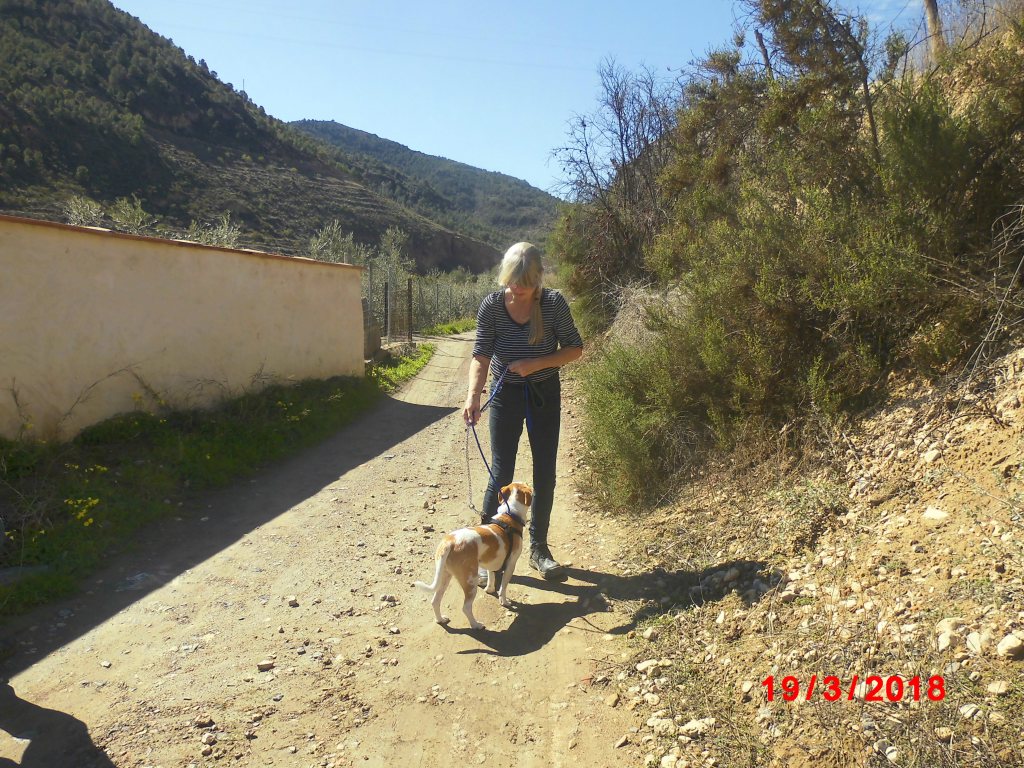
I also trained Spot to “stay” while I walked away from him. This was gradually at increased distances. When I was ready, I would pat my knees and give the “Spot Come” command. He would spring into action and bound towards me as fast as a greyhound for his reward of a little food treat and a big hug human-style, gradually weaning him on to only the hug. I taught Spot these commands for his safety. With just this handful of commands, Pauline could keep Spot safe if there was traffic on the road and be sure he would come to her once any threat was gone. The gate would never be a problem again.
ooOOoo

Even as I was reading it when preparing today’s post I was thinking of how much I was learning from Colette’s advice. Thankfully, all our dogs are incredibly easy to manage. Indeed, if ‘manage’ is the right word for on a day-to-day basis the dogs intuitively know how our/their days pan out.

The final part of this most interesting essay will be along tomorrow!

Spot and Me

An essay on dog training.

A week ago in came this email from Colette:

Hi Paul,

I wonder, given your recent post on adopting rescue dogs, if you would like me to write up an account of my retraining of a housesit pet dog?
The dog in question was a mongrel but similar and cute appearance of a large, energetic Jack Russell. The owners loved him so much, but he was aggressive to strangers, unruly, filled with anxieties and totally out of control in many ways.

He was a challenge, but responded so well to praise and love.

His wild eyes changed and softened and he calmed down so much that when the owners came home, their jaws dropped. They came home to a different dog. She cried at the transformation.
I didn’t charge for the training… We (my husband and I) do housesitting in exchange for free accommodation only. I spent an additional day helping the lady to take on the training schedule and change anything that she needed to…(as in commands she preferred to use)… The little dog responded so well to her that she almost started crying again.
Let me know. I have nothing written up, but could do so. I guess it would be long, but could be a series of three perhaps?

So many times I wonder at the luck I experience when dear friends of this blog offer such great material.

ooOOoo

Here is Part One.

 Spot and Me!

by Colette Bytes, June 3rd, 2018

Chapter One – I’ve told them You’ll Do It!

My hubby and I house sit. This usually involves a pet or two, or more, and mostly dogs and cats.
We had a break in our schedule for a few weeks coming up so our friend, Tom, sort of promised some new friends of his that we would house sit for them to look after their little dog: Spot!

Spot!

Pauline and Mike apparently had to go away unexpectedly and found that the nearest dog kennels had closed down. They had asked Tom to look after their little rescue pup, Spot, but Tom was hedging a little. While he liked animals, he wasn’t really enamoured with caring for Spot for three weeks. So he volunteered our help!

The dates weren’t right as we were already on another housesit, so Tom agreed to do the first four days. We all went to meet Pauline, Mike and Spot a couple of weeks prior to their departure.

Spot was a good looking, if slightly overweight, mongrel of mostly Jack Russell origin, but larger and quite out of control!
He barked and raced around like a maniac. Pauline launched into a description of his routine… “Never open the gate without him on a harness, picked up, or locked inside the house,” she implored. “He’ll run away for sure.

Spot, hearing his name mentioned, ran along the room, sliding on floors, rucking up the rugs and almost taking everyone with him as he launched himself up the sofa onto the back rest and running alongside everyone’s head. He stopped only to lick Mike’s ear before jumping and landing in a puddle on Pauline’s lap.

She petted him adoringly and fed him a bit of cookie which she had just dunked in her tea. Spot eyed the cup of milky tea and yes, Pauline allowed him to take a drink from the cup. He then jumped to the floor to examine my feet. I reached gently down to him. And Spot went in to action mode, his puppy-like bum in the air, shoulders down on the floor, whilst emitting threatening growls and yips.

This dog was definitely the Alpha in this house. “Isn’t he sweet?” Pauline said, “But he’s really hard to walk and we can’t take him anywhere because he won’t behave.” Spot took this opportunity to grab one of his toys and run away with it at high speed, shaking it vigorously.

Pauline went through more procedures…” Let me show you where his harness and lead is… We’ve attached a long rope to it…it is hard to keep him from jumping all over the place on a walk.” Spot immediately leaped up and snatched the harness from her grasp and ran like a demon with it, chewing down on the material and growling if anyone went near! He refused to give it up again. Pauline gave up and left him slowly destroying his walking apparatus. Just as well really, I thought… It was too small for him.

I watched all the behaviour carefully. Spot just did exactly as he pleased…and jumped on every surface possible using high speed acrobatics that left the rest of us feeling dizzy!

This is going to be challenging,” I said to Tom as we left. “Spot is going to need an intensive retrain, and you are going to have to do the first four days!” Tom made a face. “I’m not having him in my car,” he said finally.

That first night of Tom on housesit duties, he sent a message, sounding more than a bit exasperated. It was late. “I can’t get to sleep. I tried shutting Spot out of the room and he just about tore the door down! So I let him in, and now I’ve got a dog on my head that won’t go away.” A moment later, the picture of Spot on my friend’s head appeared on my mobile phone. I couldn’t help but laugh at the image. Tom looked really unhappy.

I sent training video links to Tom so he could try out some of the various techniques until we arrived.

Pauline had tried taking Spot to a trainer, receiving the first half-hour free. But the trainer was expensive, and Pauline couldn’t afford the fees.

In her free half-hour, the trainer had slipped a choke rope over Spot and had him walk compliantly all over her office. “You need one of these!” was all the advice she gave. So Pauline had ordered one.

Tom tried the new choke rope on Spot and had great success in the house following my simple instructions. But Spot had other ideas once outside the home territory and Tom said that wasn’t going so well. “He hates cats, and also frogs, they are all on the walk… he just goes bonkers and pulls like hell. He just has no discipline whatsoever! He’s choking himself on that rope!” Tom sounded like he was at the end of his own rope.

Chapter Two – We arrive in Spot’s world!

True to form, Spot greeted us with barks and raced around us with warning yips and yaps. I ignored him.
This was the first thing to do so he would know that his inappropriate behaviour wouldn’t elicit a reaction. He stopped and looked at us quizzically as we unloaded our bags and food supplies. Eventually, he went to sit on his bed while we had a cup of tea and an update from Tom. “We’ve made some progress,” he reported. “He knows begging for tidbits doesn’t work and he knows that he can’t drink my tea, even when the cup is on the floor!” The latter habit was abhorrent to Tom. Spot eyed us suspiciously. “He chews everything…Pauline told me that he chews her clothes!” Tom shook his head. “I’ve not let him near my stuff, I don’t want it destroyed!

It was late evening, and Spot, used to sleeping on his owners’ bed, and now Tom’s, was not going to sleep on ours (that’s where my husband draws the line)! I knew that Spot could not be allowed into the room as he had no idea how to behave or do as he was told. I would not have any success keeping him away from my husband. I spent some time fussing Spot, and giving him treats for several successfully completed “Spot Sit” commands. He relaxed.

I set up a laundry clothes horse to use as a gate across our bedroom doorway. On the outside, I moved Spot’s large Duvet and Blanket (full of chewed holes), leaving his bed in its place in the living room. He had the choice of both. He followed us as we turned in. Only slightly confused by the gate, he settled down without even a whimper on his Duvet, content at least that he could see us. He slept part of the night there and part of it in his own bed (warming himself next to the dying embers of the woodstove). Success on the first hurdle.

I kept a lot of Pauline’s routine. Whilst I was making the morning coffee, I gave Spot his half doggie stick treat and two dog biscuits. Spot knew what to expect as it is what he was always given first thing, so it was a comfort to him (especially as it involved food rewards). Spot’s world was about to change, but I kept the good stuff.

Pauline happily allowed Spot on the bed and all the furniture, so I wouldn’t interfere or discourage it, except in the kitchen where Spot, standing upright on hind legs, would run his paws along the counter top trying to grab anything in reach. I would focus on the unacceptable stuff. The socially unacceptable behaviours.

All pets miss their people. They feel abandoned by those that care for them and confused as to where they have gone without them. Stress will often exacerbate anxiety behaviours and present itself in all sorts of ways. Spot’s morning ablutions were of concern. He was pooing out huge bits of red fleece. He had made swiss cheese out of his blanket while Tom had been looking after him. Perhaps it was a regular thing as Pauline later reported that it happens a lot.
Chewing is an anxiety behaviour, so poor little Spot was in heightened stress.

Other stressed behaviours included hysterical growling and barking at any kind of disturbance beyond the fenced yard. Constant yawning and lip licking were other signs.
Whilst Spot was eating OK, it was only because we were giving him his favourite food (chicken) to get something into him. Lots of dogs will refuse to eat when stressed.

Spot had an eating disorder too. He would only eat dry dog food if it was mixed with hot dogs or processed ham. It was a poor diet and worsened by the constant hand feeding of cakes and cookies by Pauline and Mike. Spot’s teeth were already showing decay. He was only two years old.

Our first day together was going to be a test of wills. But Spot was already calmer, having discovered that his antics didn’t draw my attention.

Chapter Three – Getting to know each other.

Spot is a rescue dog. Pauline had chosen him from a dog rescue facility that had picked him up from the streets. She didn’t know his history except that he had been abandoned. Interestingly, on our first meeting, we had visited a nearby cafe where two young dogs were making a racket! Peering at them outside below the window, I saw that they had very similar markings to Spot but both were much larger. I calculated it to be a good guess that they were his siblings; the behaviour so similar to Spot’s, that the cafe owner had to shut them outside out of the way. I also determined that Spot was the small runt of this particular original litter.

Alpha dogs in any pack are the ‘strong silent, but confident leader’ types and not all dogs, just like people, make good leaders. Spot was one of these. Having said that, Spot was trying to be an ‘Alpha’ dog. This likely started after he was abandoned. He lost the care of his mother and found himself having to survive by whatever means. When he was rescued by Pauline and Mike, he desperately needed someone to ‘lead’ him.

Many people are very kind and well meaning when they rescue animals, but often lack the skills to deal with the baggage that comes with a rescue animal. Pauline had made Spot into her surrogate ‘baby.’ She even called him ‘Baby Boy,’ and giggled at his antics when she was watching his overly-excited behaviour, which served only to send the message that Spot was doing the right thing!
He was spoiled, indulged and encouraged. He became devoted to them both to the point that he felt he must protect them from every perceived threat, real or imagined. And he picked up on Pauline’s anxieties about strangers, possible burglars, and her propensity to see most things negatively before deciding otherwise, based on evidence.

Spot had taken on board that he needed to protect Pauline, Mike and the house. This also extended to the areas outside the home, but was also where Spot became most highly strung. Without knowing where the threats were, he treated everything as a potential enemy. It was for this reason that Spot couldn’t be taken into public spaces. He fought with other dogs who would overpower and hurt him. He bothered other people, wouldn’t sit still and would constantly bark. He was a problem dog! Pauline elected to leave him at home, on his blanket in the outside porch whenever they went out. “I do need a break from him, he’s just too demanding!

Her rolled eyes and conviction that he was OK there, even when left for hours, sealed my analysis that they could not leave him in the house alone, or he destroyed things because of separation anxiety. He was highly dependent and insecure!

After a short breakfast where I ignored Spot’s begging, I called him for a play session. Armed with lots of training treats that Spot had already learned were very tasty, I found it easy to make friends with him. The games with his toys used up lots of his nervous energy and Spot was soon lollygagging on the hearth rug, offering me his belly for a rub. He was primed for training.

ooOOoo

Colette’s essay continues tomorrow!

Reflections – Day One!

Following in the footsteps of Wibble.

As in:

Now, on to the nominations:

The rules of this challenge are: post a quote on three days, each time nominating three other blogs to pick up the challenge. Or — in the spirit of wu wei — not, as you see fit 🙂

The above was taken from a post published by Colin on the 30th May.

So here’s my quote for today:

Just one of the many aspects of the life of man that underlines the madness that seems to inflict so many societies.

Here are my nominations for today and the other two days of quotes:

Day Two of Reflections will be along in a while!

Please sign this petition!

S. Korea is the only country in the world with large-scale, commercial dog meat farms.

Frankly, I wasn’t planning to publish a post today. But then in came an email from John Zande, he of the blog The Superstitious Naked Ape, and this is what I read: “Paul, hi… Really good news. The following email links to a petition supporting a bill that will end the dog meat trade in Korea. I know you’ll want to sign it. Share it around, too.”

John then linked to a petition over on the Lady Freethinkers blog.

Jean and I have signed the petition and now I am republishing in full what you can read if you go across to that petition page.

ooOOoo

SIGN: PASS NEW BILL TO BAN HORRIFIC DOG MEAT FARMS IN S. KOREA


Living and Learning

I regret the need to refine my approach to accepting guest posts!

On May 18th, I published a guest post that had been sent to me by Susan Combs. Her article was called: Four Essential Tips to Make Your Dog Healthy and Active Round the Year.

What you won’t know is that there was a fair degree of re-writing required by me, primarily to correct grammatical errors. Something that I had not noticed in Susan’s previous submissions.

In addition, Susan had included links back to websites, one of which was a commercial site that sold Pet Meds and Supplies.

I overlooked including the links because of the time I had spent in getting the article ready for publication. Subsequently, I was ‘instructed’ to edit the post and include the links. I chose not to do so simply because I took the view that this is my blog and I will never accept a guest post on condition that it is an ‘advertisement’ for a supplier. Now sometimes that boundary is blurred but if the guest author wants to include a link and it is not a condition of acceptance then that’s fine.

Susan has now insisted that her guest article is removed from the blog, something that I have done, and my guess is that there will be no further guest articles from her.

But it has prompted me to refine the wording under my Get Involved link on the home page. It presently reads:

Want to submit a Post? – just email us the content directly to learningfromdogs@gmail.com Clearly, we reserve the right to edit your contribution or, perhaps, decide that the content is not appropriate to our Vision.

It has now been modified to read:

Want to submit a Post?– just email us the content directly to learningfromdogs@gmail.comClearly, we reserve the right to edit your contribution or, perhaps, decide that the content is not appropriate to our Vision. Please note that guest articles that link to a commercial supplier are likely not to be accepted. Simply because I do not wish to be seen to be favouring a particular supplier about whom I have no personal knowledge.

Let me remind one and all that this blog works very hard to observe and support The Vision. That, in part, proposes:

Our children require a world that understands the importance of faith, integrity and honesty

Learning from Dogs will  serve as a reminder of the values of life and the power of unconditional love – as so many, many dogs prove each and every day

Best wishes to all.

The continuing fallout from Chernobyl

Will you, please, consider taking one of these puppies!

I closed last Saturday’s post with this plea: “If only there wasn’t a single dog in need of adoption in the world!

That plea is being used to introduce today’s post. An article that was recently read on the Smart News section from The Smithsonian magazine website.

I have republished it, hopefully without infringing copyrights, because it’s a story that needs to be circulated as far and wide as possible.

ooOOoo

Chernobyl Puppies Going Up for Adoption in the U.S.

Now in quarantine, the pups are expected to come to the U.S. this summer in search of their forever homes.

Please for to adopt us, Comrade. (Chernobyl Exclusion Zone Authority)
By Jason Daley smithsonian.com , May 16, 2018

In 1986, the Chernobyl nuclear power plant melted down, sending nearby residents fleeing the disaster zone. And sadly, most pets got left behind. Over the last 32 years, the surviving pups have multiplied, creating a community of hundreds that live in the Chernobyl Exclusion Zone and another 250 that live on the grounds of the former power plant itself.

Now, a dozen of those homeless puppies will head to the United States for adoption, reports Matt Novak at Gizmodo.

According to the Russian website Meduza, Ukrainian authorities have captured 200 of the stray Chernobyl puppies. They are currently keeping them in a 45-day quarantine in the city of Slavutych, and then a dozen will be shipped to the United States.

“We have rescued the first puppies, they are now in our adoption shelter going through the quarantine and decontamination process,” Lucas Hixson, co-founder of the U.S.-based Clean Futures Fund, a non-profit created to take care of Chernobyl clean-up workers, their families and the dogs tells Novak. “The goal is 200 dogs but will likely be more in the long run. My hope is to get 200 dogs rescued and adopted in the next 18 months and then go from there.”

The pups have a heartbreaking story, as The Guardian’s Julie McDowell detailed earlier this year. During the evacuation, more than 120,000 people were herded onto buses to escape the meltdown of the Unit 4 reactor, leaving most of their valuables and their pets behind. Many dogs tried to follow their owners onto the buses but were kicked off. People left notes on their doors asking authorities not to kill their animals, but Soviet Army squads were dispatched to put down as many contaminated animals as they could find.

Some of the dogs survived the army and the radiation, rebuilding their community as a pack. The Clean Futures Fund reports that the 250 dogs living on the grounds of the former power plant were likely driven out of the surrounding forests by wolves and a lack of food. Another 225 dogs roam Chernobyl City and hundreds of others live and scrounge at security checkpoints and throughout the woods and abandoned communities in the Exclusion Zone. Most of the dogs around the plant are under the age of 4 or 5, and clean-up workers at the site sometimes feed and tend to sick animals.

But last year, after becoming aware of the animals, The Clean Futures Fund decided the pups needed a more permanent solution. That’s why they’ve implemented a three-year program in the Exclusion Zone to spay and neuter 1,000 animals and vaccinate them against rabies. At their first clinic last August, the Fund spayed and neutered 350 dogs and cats in the area. Each animal was tested for radiation, given antibiotics, vaccinated for rabies and microchipped. Each dog’s vital data was also recorded.

For the next clinic scheduled for June, the Fund has also partnered with researchers from the University of South Carolina. The team will study the dogs for signs of radiation poisoning as well as genetic damage and disruptions to the dogs’ microbiomes, reports Mary Katherine Wildeman at The Post and Courier. The team will sedate the dogs and look for tumors and cataracts, which can signal radiation poisoning.

Understanding the impacts of radiation exposure is becoming increasingly important, says Timothy Mousseau, a researcher who has studied radiation in the birds, insects and small animals of Chernobyl and will lead the project. Exposure rates in daily life from medical treatments and other sources are on the rise, with the average yearly dose Americans receive doubling in the last 20 years alone.

There is no word when or where the dozen Chernobyl pups will go up for adoption. But even if you’re not lucky enough to have one of the reminders of Soviet-era nuclear power at the foot of your bed, it’s still possible to see the place for yourself and hand out treats to some of the remaining pups. There’s a booming tourism industry in the area to visit the eerie ghost towns and surprisingly quiet and beautiful green space that has overtaken the Zone.

ooOOoo

I am going to contact The Clean Futures Fund to see how one can register a potential interest in taking one of these puppies.

In the meantime, is there any reader who would be interested in having a puppy? Send me an email if so.

Picture Parade Two Hundred and Forty

The final photographs sent to me by Dan Gomez.

oooo

oooo

oooo

That last one really does get to the essence of what having a dog in one’s life truly means.

You all have a wonderful week!

Finally, thank you Dan!