On Monday and Tuesday of the week I posted Legitimate Anger and Legitimate Hope. (And please see the footnote to today’s post)
Patrice Ayme left the following comment to the Legitimate Hope post:
It’s hard to live with elephants, especially in poor, crowded conditions. I remember bathing in Africa as a child with a bull elephant 200 meters away, on the other side of a stream, and being extremely worried, with all in attendance.
Europe used to have elephants, and North America, two species. Time to reintroduce them, and live according to our discourse.
Rewilding Euramerica can be done, and should be done, for the deepest philosophical and emotional reasons, and will create new, very productive jobs.
PA
Then on Friday came an email from reader and blogger Martin Lack:
It was but a moment to go across to The Conversation website (rather liked what I saw, by the way) and find the article that Martin linked to. It is republished here within the terms of The Conversation site.
ooOOoo
Restore large carnivores to save struggling ecosystems
By William Ripple, Oregon State University
We are losing our large carnivores. In ecosystems around the world, the decline of large predators such as lions, bears, dingoes, wolves, and otters is changing landscapes, from the tropics to the Arctic. Habitat loss, persecution by humans and loss of prey have combined to inflict great losses on these populations.
In fact more than 75% of the 31 largest carnivore species are declining, and 17 species now occupy less than half their former ranges. Southeast Asia, southern and East Africa, and the Amazon are among areas in which multiple large carnivore species are declining. And with only a few exceptions, large carnivores have already been exterminated from much of the developed world, including areas of Western Europe, and the eastern United States.
Top dogs keep ecosystems in order
Many of these large carnivore species are endangered and some are at risk of extinction, either in specific regions or entirely. Ironically, they are vanishing just as we are learning about their important ecological effects, which is what led us to write a new paper in the journal Science to document their role.
From a review of published reports, we singled out seven species that have been studied for their important ecological role and widespread effects, known as trophic cascades. These are the African lion, leopard, Eurasian lynx, cougar, gray wolf, sea otter and dingo.
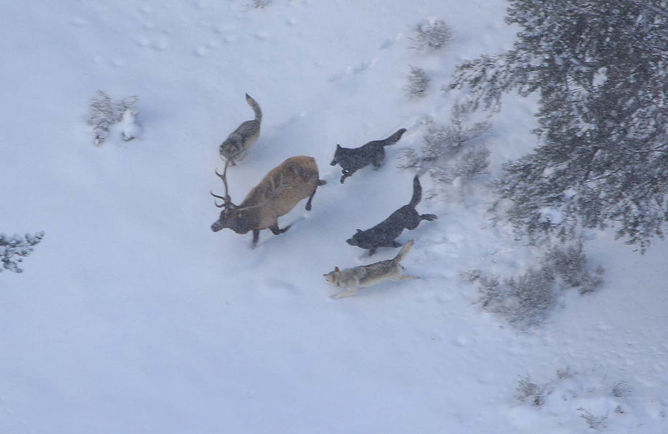
Based on field research, my Oregon State University co-author Robert Beschta and I documented the impact of cougars and wolves on the regeneration of forest tree stands and riverside vegetation in Yellowstone and other national parks in western North America. Fewer predators, we found, lead to an increase in browsing animals such as deer and elk. More browsing disrupts vegetation, reduces birds and some mammals and changes other parts of the ecosystem. From the actions of the top predator, widespread impacts cascade down the food chain.
Similar effects were found in studies of Eurasian lynx, dingoes, lions and sea otters. For example in Europe, absence of lynx has been closely tied to the abundance of roe deer, red fox and hare. In Australia, the construction of a 3,400-mile dingo-proof fence has enabled scientists to study ecosystems with and without dingoes which are closely related to gray wolves. They found that dingoes control populations of herbivores and exotic red foxes. The suppression of these species by dingoes reduces predation pressure, benefiting plants and smaller native prey.
In some parts of Africa, the decrease of lions and leopards has coincided with a dramatic increase in olive baboons, which threaten crops and livestock. In the waters off southeast Alaska, a decline in sea otters through killer whale predation has led to a rise in sea urchins and loss of kelp beds.
Predators are integral, not expendable
We are now obtaining a deeper appreciation of the impact of large carnivores on ecosystems, a view that can be traced back to the work of landmark ecologist Aldo Leopold. The perception that predators are harmful and deplete fish and wildlife is outdated. Many scientists and wildlife managers now recognise the growing evidence of carnivores’ complex role in ecosystems, and their social and economic benefits. Leopold recognised these relationships, but his observations were ignored for decades after his death in 1948.
Top carnivores, at work keeping things in check. Doug Smith
Human tolerance of these species is the major issue. Most would agree these animals have an intrinsic right to exist, but additionally they provide economic and ecological services that people value. Among the services documented in other studies are carbon sequestration, restoration of riverside ecosystems, biodiversity and disease control. For example, wolves may limit large herbivore populations, thus decreasing browsing on young trees that sequester carbon when they escape browsing and grow taller. Where large carnivore populations have been restored – such as wolves in Yellowstone or Eurasian lynx in Finland – ecosystems appear to be bouncing back.
I am impressed with how resilient the Yellowstone ecosystem is, and while ecosystem restoration isn’t happening quickly everywhere in this park, it has started. In some cases where vegetation loss has led to soil erosion, for example, full restoration may not be possible in the near term. What is certain is that ecosystems and the elements of them are highly interconnected. The work at Yellowstone and other places shows how species affect each another through different pathways. It’s humbling as a scientist to witness this interconnectedness of nature.
My co-authors and I have called for an international initiative to conserve large carnivores in co-existence with people. This effort could be modelled after a couple of other successful efforts including the Large Carnivore Initiative for Europe, a non-profit scientific group affiliated with the International Union for the Conservation of Nature, and the Global Tiger Initiative which involves all 13 of the tiger-range countries. With more tolerance by humans, we might be able to avoid extinctions. The world would be a scary place without these predators.
William Ripple does not work for, consult to, own shares in or receive funding from any company or organisation that would benefit from this article, and has no relevant affiliations.
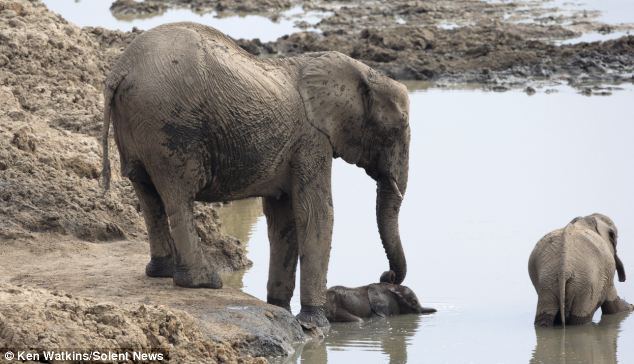
In 2011, more African elephants were killed than any other year in history. The figures for 2012 and 2013 are not yet known, but are likely to be even higher. At current rates, in twelve years, there will be none left.
It is a familiar cause, but it has never been more urgent. Poaching has turned industrial. Armed militia fly in helicopters over jungle clearings, machine gunning down entire herds. Their tusks are then sold to fund war and terrorism throughout the continent and the wider world. Ivory is still illegal, but as China booms, it is more popular than ever.
This campaign will raise money to support rangers on the ground to protect Kenya’s elephants from armed poachers, together with Space for Giants’ longer term work to create new wildlife sanctuaries where elephants will be safe, forever. More can be found about the charity at Space for Giants
The article above includes two videos. A shorter one that can be viewed on the paper’s campaign website. Then there is a longer, five-minute, video also on YouTube and included below.
Jean and I wanted to make a donation but found that without a UK bank account/UK Visa card it wasn’t possible. We contacted Space for Giants and received the following email from Amy.
Hi Paul
Sorry for the difficulties and thank you for your perseverance!
You can donate in USD through our CrowdRise page at www.crowdrise.com/spaceforgiants1. These funds are sent to TUSK USA who will then allocate them to us.
Alternatively, you can make out a cheque to ‘TUSK USA’ and send to TUSK USA, 40 East 94th Street, Apt 3A, New York, NY 10128 – please attach a covering note confirming that you would like your donation to be used to support the work of Space for Giants.
Many thanks,
Amy.
So if there’s anyone else out there not in the UK who would like to donate, here’s another option.
Please, for all our sakes, help these beautiful creatures.
“There IS very intelligent life, but somehow it can’t seem to achieve dominance over the other kind.” Chris Snuggs.
In yesterday’s Part One, I offered three independent essays, about the USA, the UK and Europe, that contained a common message. A message of “the abject failure of modern nation-state democracy — not only in Europe, but across the globe.“ (In the words of one of the essayists: Don Quijones.)
As with Part One, Part Two brings together disconnected commentators offering an interconnected theme.
One of the commentators was Chris Snuggs who writes the blog Nemo Insula Est. It was his post about the slaughter of elephants for their tusks that I featured last Tuesday: Legitimate anger. Chris and I recently exchanged emails on the curious issue of why those who are charged with governing our democratic societies so often fail to do so in a fair and balanced manner; to put it mildly.
Here’s some of that exchange from Chris:
My theory is that intelligent people are too nice. Take you, for example – someone so intelligent, informed and civilised should be in government, but you are not ruthless, nasty and/or ambitious enough!!!
Another way to put it is that people like you – and I on a more modest, brutish and disorganised level – are doing their bit to spread civility in general, but we have NO POWER because we are too nice.
A related theory is that most people are in fact basically nice but that the rest have a disproportionate influence, both because a greater proportion of them have power and because of the “rotten apple” theory – one apple rots the barrel eventually.
I should open a school to teach nice and intelligent people how to be more nasty to nasty people! ………. Indeed, it is our duty to be more ruthless to stand up to the bad guys.
Moving swiftly over the flattery of yours truly, there is a strong message from Chris. The message that nice people are not being sufficiently active in registering their disgust over what is being done in the supposed name of the people.
The next item, as part of this theme, was a recent article on Permaculture News. The article was called Majority Voting is Inadequate and was based around an interview with Peter Emerson. I hadn’t heard of Mr. Emerson before but very quickly established that Peter Emerson is the director of the de Borda Institute in Belfast, Northern Ireland. He is a leading authority on voting systems for use in both decision-making and elections.
Here is a flavour of that interview.
Marcin Gerwin (Poland): There are many divisions and even hostility in the Polish parliament. The ruling coalition currently has 232 votes in a parliament with 460 seats. This slight majority allows them to run all the ministries, and they can pass almost any bill they want. Do you think that creating an all-inclusive government, where all parties have their representatives, could help to tone down the atmosphere and create a more cooperative environment?
Peter Emerson
Peter Emerson: In a word – yes. However, I think I should argue the other point first. There is no justification for majority rule. When I was in Russia, it was quite interesting, because when Gorbachev started perestroika, all sorts of experts rushed over to Moscow, to tell him what to do to be democratic. They advised the system that we have here in Northern Ireland and that you now have in Poland and pretty well everyone else has as well – and that is that you elect your parliament by one of many electoral systems, apparently they all are democratic, even though some are bad and some are worse. But when it comes to what happens in parliament, nearly every parliament in the world debates things and then takes a majority vote.
These experts talked in Russia about majority rule but Mikhail Sergeyevich doesn’t speak English, so they had to use the Russian word. And the Russian word for majoritarianism is bolshevism. It comes from the Russian word for majority which is bolshinstvo, so the member of the majority was a bolshevik and a member of the minority was a menshevik. The decision to split into bolsheviks and mensheviks was taken in 1903 in London by the mathematical accident of just one vote. The whole thing was nonsense. But God, such a dangerous one.
MG: If not a majority vote, what are the other ways that decisions can be made?
PE: There are lots of voting methodologies – Borda count, Condorcet…. One of these could be used. And in fact Dublin City Council recently took a vote by means of a Borda count, which is brilliant. It was partly because they had more than two options on the agenda, so you almost have to move beyond majority voting.
And when you look at it, the majority vote is actually the most inaccurate measure of collective opinion ever invented. It’s over two thousand years old, it was used by the Greeks and the Chinese. But there is no justification to for its use today because it’s so inaccurate.
You did register what Peter said in that last paragraph? “the majority vote is actually the most inaccurate measure of collective opinion ever invented.”
If you have only the slightest curiosity about better methods of voting then do read the interview in full. For the interview contains links to other voting systems, most of which I hadn’t heard of before. There is the Borda count, the Condorcet method, the Ranked voting system (otherwise known as Preferential voting), and the proportional voting process known as the Matrix vote.
Moving on.
The final coincidence was John Hurlburt sending me the following essay, that is published with his permission.
ooOOoo
Apocalypse and Epiphany
Apocalypse, n. [Gr. apokalypsis, from apokalypto, to disclose and to discover.] Revelation; discovery; disclosure. (The New Webster Encyclopedic Dictionary)
Apocalypse is a word which describes a human awakening to change. Change is a constant. Our species has been living through apocalypse for fourteen million years. Conservative groups deny change. For example financial interests spent 14 million dollars to refute the scientific reality of climate change during 2013. We are in the midst of worldwide financial wars, energy wars, cultural wars, and political wars. Has there been progress in emerging human species intelligence?
Perhaps more importantly, has there been progress in human morality? We’ve been around as a species for roughly 14 million years. Have we truly learned anything in the process? For the last two hundred years we’ve been industrially poisoning the environment which sustains our existence at a steadily increasing rate.
We’re needlessly killing ourselves and a significant portion of the life on our shared garden planet in the pursuit of artificial symbols of trust we call money. No one knows for sure how deep and how devastating an impending economic, cultural, political and geophysical collapse may become.
We’ve reached a critical tipping point between species survival and a severely diminished quality of human life. We’re in the process of falling off the edge. The good news is that we know what needs to be done and we know how to do it. So why don’t we do what we know needs to be done?
There are a variety of reasons. The seven deadly sins are a starting point for systemic corruption. The seven deadly sins are pride, greed, lust, anger, gluttony, envy and sloth. Add ignorance, denial and indifference. Serve bread and circuses for dessert. In terms of action, compete more than cooperate. Rush ever faster without reflection, contemplation or meditation. As a final touch, become consumed by “now” without regard for the future.
Epiphany, n. [Gr. epiphaneia, appearance; from epiphanio, to appear] an appearance or a becoming manifest. (The New Webster Encyclopedic Dictionary) Epiphany provides us a way to deal with apocalypse. As what’s going on is revealed, we realize that something needs to be done about it and that we are capable of creating and implementing solutions in concert with Nature.
To paraphrase Shakespeare’s “Hamlet”, “The fault, Dear Brutus, lies not in our stars but in ourselves.” What do we need to personally change both spiritually and practically? Today is the tomorrow – we imagined yesterday.
Considering our steadily increasing demographic and our systemic global failure, it’s half past time to clean house. We begin with our “self”. We take inventory. We honestly look at our thoughts and actions. What do we personally have to offer that’s useful and productive in terms of a resilient tomorrow? What’s standing in our way today?
We accept that we are a very young consciously aware species on a fragile garden planet that’s 14 Billion years old in a universe that’s roughly 33 billion years old. We accept that we are a species component of the matter and energy of Creation. We accept responsibility for sustaining our being and by extension responsibility for the being of life on earth.
We realize our purpose as stewards of Creation.
an old lamplighter
ooOOoo
So put those three perspectives together and the message is clear. This is a period of significant change and, as with previous periods in history, change only comes along when there is dissatisfaction with the present. Ergo, there is widespread acceptance that the present way of life is not working for millions and millions around the world.
Reinforced only this morning (Thursday) by a recent announcement from Gallup regarding the voting intentions of Americans.
January 8, 2014
Record-High 42% of Americans Identify as Independents
Republican identification lowest in at least 25 years
by Jeffrey M. Jones
PRINCETON, NJ — Forty-two percent of Americans, on average, identified as political independents in 2013, the highest Gallup has measured since it began conducting interviews by telephone 25 years ago. Meanwhile, Republican identification fell to 25%, the lowest over that time span. At 31%, Democratic identification is unchanged from the last four years but down from 36% in 2008.
Let me include this section:
Fourth Quarter Surge in Independence
The percentage of Americans identifying as independents grew over the course of 2013, surging to 46% in the fourth quarter. That coincided with the partial government shutdown in October and the problematic rollout of major provisions of the healthcare law, commonly known as “Obamacare.”
The 46% independent identification in the fourth quarter is a full three percentage points higher than Gallup has measured in any quarter during its telephone polling era.
Taking everything into consideration, from yesterday’s evidence and what is presented today, it’s hardly surprising to read in that Gallup report [my italics]:
The increased independence adds a greater level of unpredictability to this year’s congressional midterm elections. Because U.S. voters are less anchored to the parties than ever before, it’s not clear what kind of appeals may be most effective to winning votes. But with Americans increasingly eschewing party labels for themselves, candidates who are less closely aligned to their party or its prevailing doctrine may benefit.
Fascinating times! Thank goodness there’s always a dog to remind us of how to cope!
Many will have read yesterday’s post about the slaughter of elephants by ivory poachers and felt, as I did, a feeling of despair in the pit of one’s soul. We seem to be living in such challenging times with so much madness about us. It’s incredibly easy to feel as if this is some sort of ‘end of times’ period.
Today’s post tells us that there is always hope.
Let’s remind ourselves that elephants are very intelligent animals. As I wrote last November in a post with the title of Smart Animals:
There was a fascinating article on the BBC news website a few weeks ago that went on to explain:
10 October 2013
Elephants ‘understand human gesture’
By Victoria GillScience reporter, BBC News
African elephants have demonstrated what appears to be an instinctive understanding of human gestures, according to UK scientists. In a series of tests, researcher Ann Smet, of the University of St Andrews, offered the animals a choice between two identical buckets, then pointed at the one containing a hidden treat.
From the first trial, the elephants chose the correct bucket.
In 2011, more African elephants were killed than any other year in history. The figures for 2012 and 2013 are not yet known, but are likely to be even higher. At current rates, in twelve years, there will be none left.
It is a familiar cause, but it has never been more urgent. Poaching has turned industrial. Armed militia fly in helicopters over jungle clearings, machine gunning down entire herds. Their tusks are then sold to fund war and terrorism throughout the continent and the wider world. Ivory is still illegal, but as China booms, it is more popular than ever.
This campaign will raise money to support rangers on the ground to protect Kenya’s elephants from armed poachers, together with Space for Giants’ longer term work to create new wildlife sanctuaries where elephants will be safe, forever. More can be found about the charity at Space for Giants
The article above includes two videos. A shorter one that can be viewed on the paper’s campaign website. Then there is a longer, five-minute, video also on YouTube and included below.
Then there is the David Sheldrick Wildlife Trust helping animals in Africa. And, finally, the campaign over at Bloody Ivory where one can sign a petition and donate towards stopping elephant poaching.
Thus, like so many aspects of life, never give up trying to help those less fortunate.
The first of the New Year and dedicated to Sue of Sue Dreamwalker.
A week ago, Sue left a nice comment about our ‘backyard’ here in Oregon. Specifically with regard to the two photographs of deer feeding in front of the house. I replied by saying that today I would offer a selection of views of our property.
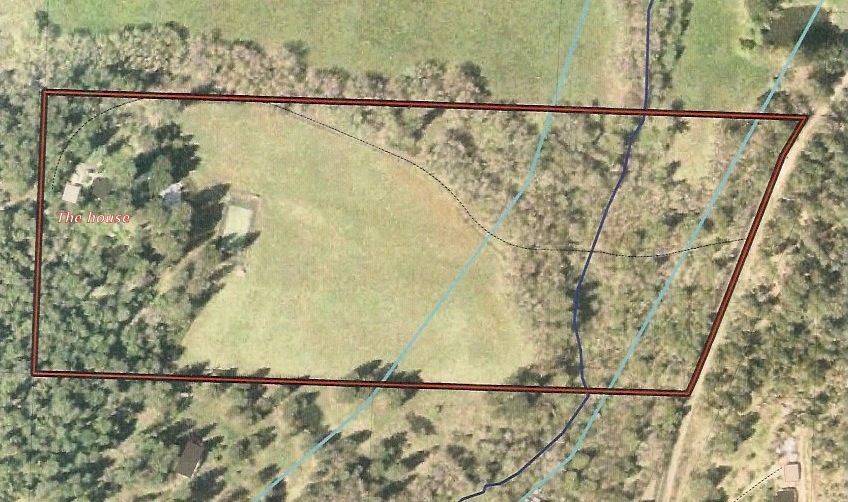
First off, an aerial view with the property boundary line overlaid, taken from the sale particulars. The right-hand, Eastern boundary follows the edge of Hugo Road. We are some four miles from Merlin in Southern Oregon.
Thirteen acres orientated West-East.
The solid blue line is the course of Bummer Creek that flows from top to bottom of the image. The thin, dotted blue line is the driveway that runs from Hugo Road up to the house, a distance of a 1/4 mile. The house is close to the Western boundary almost hidden from sight in this picture by the trees. There is a faint label ‘The House’ just below the building.
From left to right: Pharaoh, Sweeny, Cleo and Hazel.
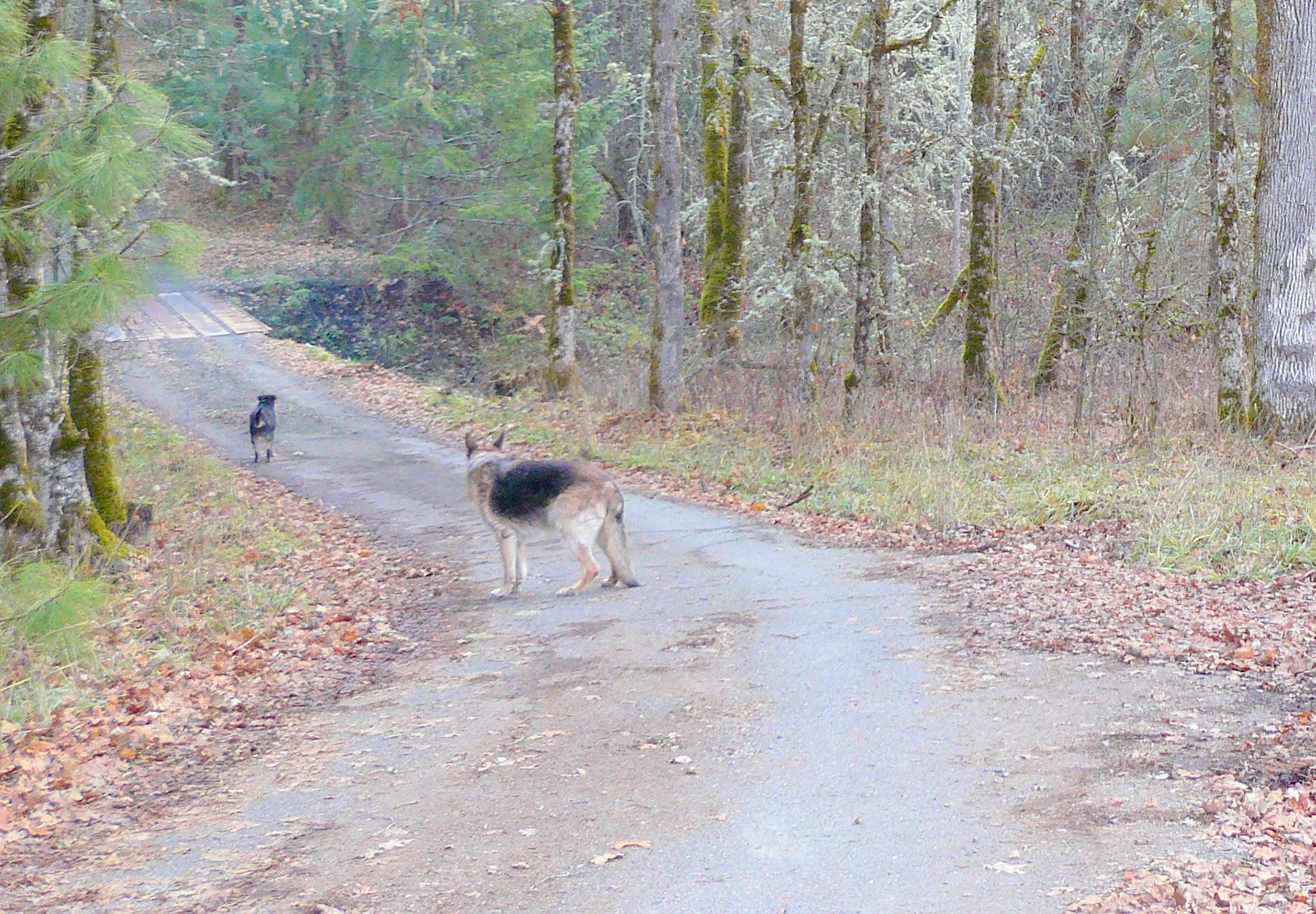
The above photograph was taken from a point about half-way along the driveway, the house being behind the camera. Ahead, the driveway dips down to cross the bridge over the Creek, as the following picture reveals. Luckily the boundary fence is dog-proof!
oooo
Dogs and water!
Pharaoh in Bummer Creek just downstream of the bridge.
Looking further downstream from the bridge.
oooo
Looking upstream from the bridge.
The barrier across the Creek seen in the upper half of the photograph is a flood irrigation dam installed many years ago, presumably for agricultural purposes before the plot was sold for house building prior to 1977. One installs an iron pole on a centre bolt embedded in the dam and then places a stout plank across the flow on top of the dam. The plank can just be seen to the right of the dam, resting on the bank. Never tried the dam but going to some day!
Looking to the West up towards the house.
The above picture was taken close to where the previous one was shot. Simply by swinging around to the left and looking back up. The house is barely visible in the background behind the metal gate and wooden fence posts in the middle of the photograph.
Corinne’s field visible through the trees and undergrowth.
Again, the picture above is taken not far removed from where the previous two were taken. If one looks at the aerial view of the property in the first picture, in the top-right corner there is a small area of grassland; what would have been an offshoot of our neighbour’s grassland in previous times. After my sister, Corinne, died in the Summer of 2013 we named that area of grassland Corinne’s field.
A general view down over the main area of grass.
So now we are back standing just outside the Eastern side of the house looking South-East out over the main area where the dogs are walked twice a day. The picture was taken a little before noon and shows the low mist that has been with us for about two weeks.
Nature’s beauty.
Above, another photograph picking up on the mist that has been with us for some days. Until yesterday!
This is what I call a Winter day!
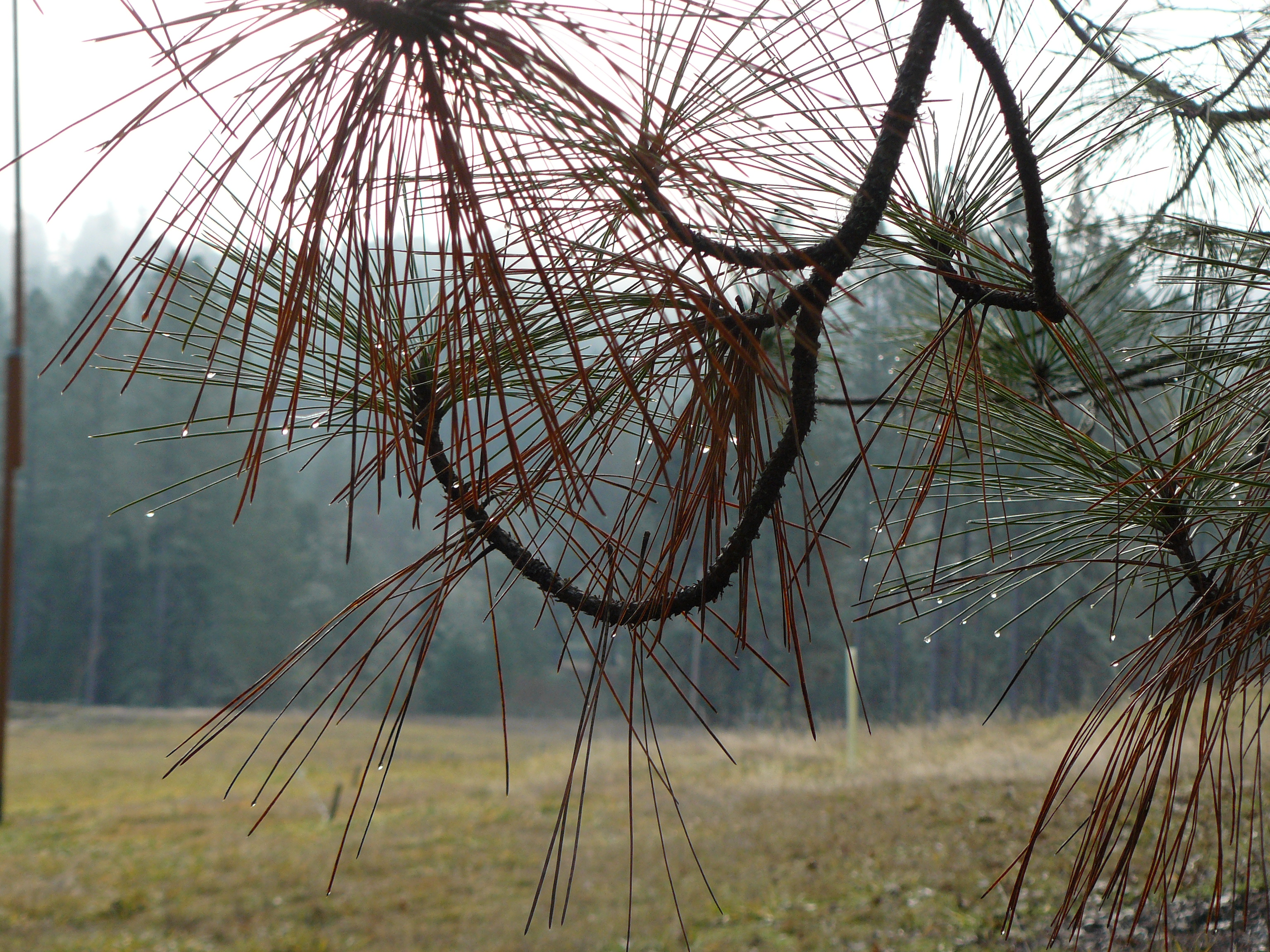
Yesterday dawned cold, clear and frosty. As this picture of one of our tall pine trees so vividly demonstrates. (The tree edges our driveway, about half-way to the house.)
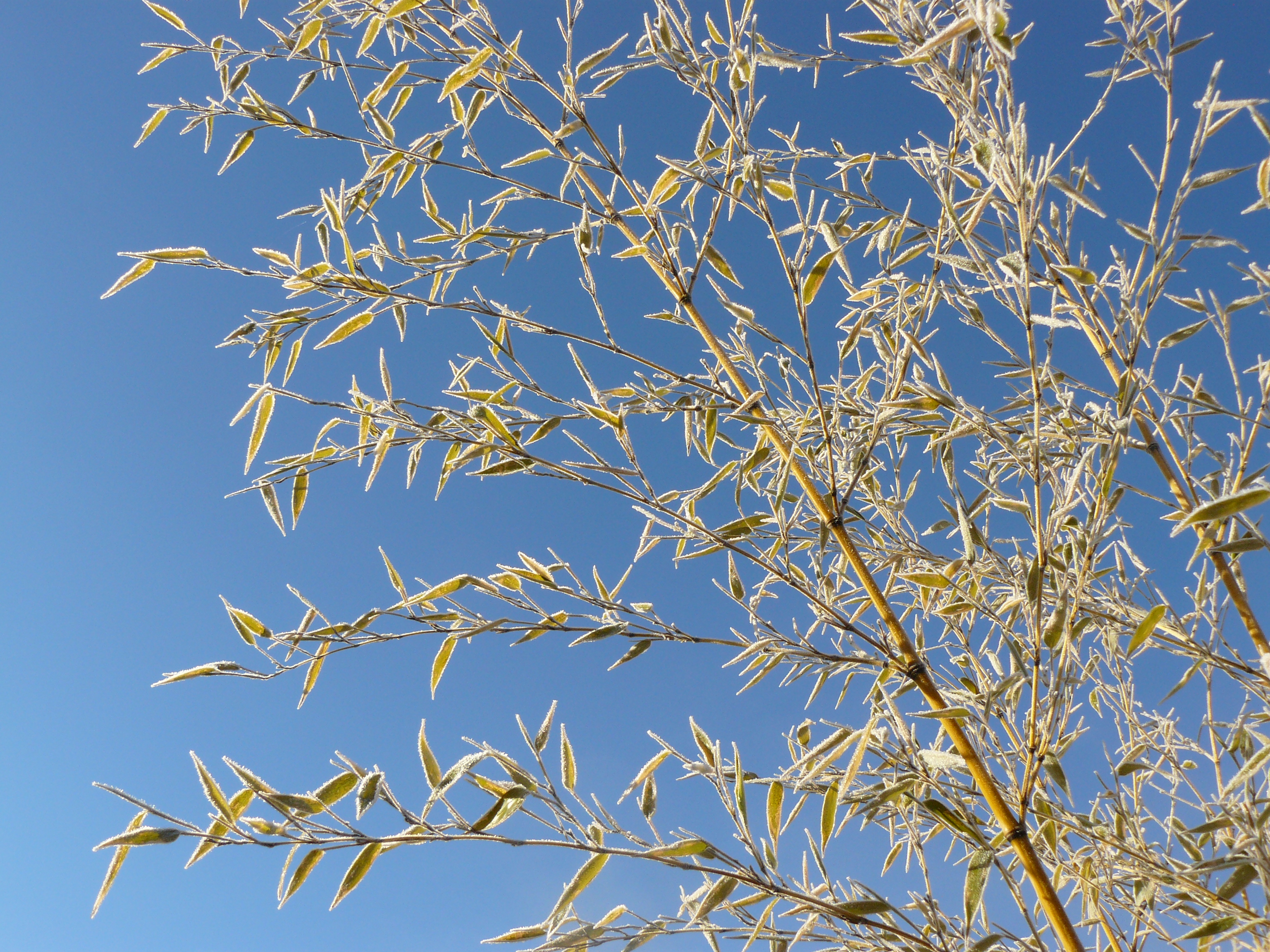
So will close today’s post with three more pictures of a frosty Saturday morning in Merlin, Oregon, USA.
A frosty yet sunny morning.
oooo
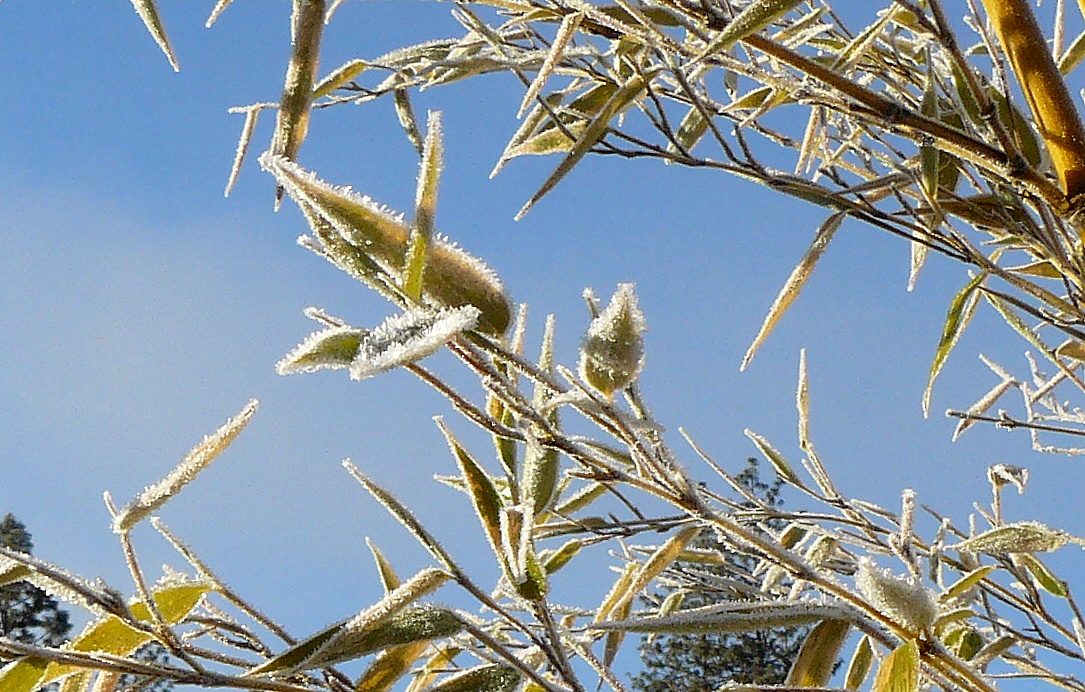
Frost on a bamboo tree.
oooo
It really is a beautiful world at times.
oooo
So there you are, Sue!
Needless to say, Jean and I are reminded almost daily how lucky we and all our animals are at finding such a beautiful place to live. I can’t ever imagine taking it for granted.
Those of you who watched Part One of Awakening the Dreamer that was published yesterday could be excused for thinking that it was a very gloomy window on our world at the start of 2014.
Park those feelings and watch Part Two.
The Hope
[vimeo http://vimeo.com/52496263]
ooOOoo
Tomorrow, Friday, I will complete this run of four days by dropping in on a few of the organisations named in these films plus a few other items.
A very Happy New Year to you and all your loved ones!
Yesterday (I’m tempted to write last year!), I posted a little tale about the donkey in the well; essentially a message about being happy.
My original plan for today was to post a series of photographs of some animals next door that our neighbours, Larry and Janell, have recently adopted.
But then Jean and I watched a documentary two evenings ago that had us both spellbound. The documentary, Awakening the Dreamer, consisted of two 45-minute films. The first highlighting the precarious nature of our present times. The second showing the accelerating pace of people all across the world actively changing things for the better. Hence the title of the post The Pain and the Hope.
So here’s Part One. I do so hope you can find the time to watch it.
Depending on just where in the world you are, the New Year of 2014 is anything from a few to twenty-four hours away. How that year turns out will, to a very great extent, depend on millions and millions of behaviours. In other words, the behavioural choices each of us makes. Because, as millions of us already understand, our world on this, our only, Planet is facing changes potentially beyond our imagination. Caring for our Planet and all of life upon it is meaningless without those behavioural choices being the right ones for our Planet.
A couple of days ago, I read the following on Facebook. It seemed an appropriate tale for the start of 2014.
ooOOoo
Now what?
One day a farmer’s donkey fell down into a well. The animal cried piteously for hours as the farmer tried to figure out what to do. Finally, he decided the animal was old and the well needed to be covered up anyway; it just wasn’t worth it to retrieve the donkey.
He invited all his neighbors to come over and help him. They all grabbed a shovel and began to shovel dirt into the well. At first, the donkey realized what was happening and cried horribly. Then, to everyone’s amazement he quieted down.
A few shovel loads later, the farmer finally looked down the well. He was astonished at what he saw. With each shovel of dirt that hit his back, the donkey was doing something amazing. He would shake it off and take a step up.
As the farmer’s neighbors continued to shovel dirt on top of the animal, he would shake it off and take a step up. Pretty soon, everyone was amazed as the donkey stepped up over the edge of the well and happily trotted off!
MORAL :
Life is going to shovel dirt on you, all kinds of dirt. The trick to getting out of the well is to shake it off and take a step up. Each of our troubles is a steppingstone. We can get out of the deepest wells just by not stopping, never giving up! Shake it off and take a step up.
Remember the five simple rules to be happy:
Free your heart from hatred – Forgive.
Free your mind from worries – Most never happens.
Live simply and appreciate what you have.
Give more.
Expect less from people but more from yourself.
You have two choices … smile and close this page, or pass this along to someone else to share the lesson.
I forget how I came across this editorial in the Chicago Tribune but it was published a month ago, to the day. What is more to the point is that the editorial was inspiring and I vowed to republish it. With the absence of any formal permission to republish the editorial I thought it best to leave it for a few weeks. When you read it you will realise just why it needed to be shared with you.
ooOOoo
Editorial: The cougar killed in Illinois was looking for love
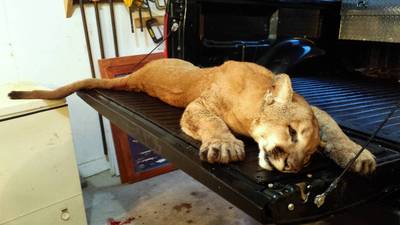
ILLINOIS DEPARTMENT OF NATURAL RESOURCES. This cougar was shot last week by a state conservation officer in Whiteside County. The animal needn’t really have been killed.
He was lean, athletic and had traveled hundreds of miles, most likely from the Black Hills of southwestern South Dakota. He had attacked no one as he passed hundreds of towns and many more farms, each of them a lethal threat to his mission. Yet for lack of a better wildlife management plan in Illinois, the young cougar couldn’t get past a conservation officer armed with a state-issued rifle.
The necropsy says the cougar killed last week as he hid near Morrison, 130 miles west of Chicago, died of gunfire. In truth he died of official neglect: Even though more cougars and possibly wolves likely will be visiting Illinois, state lawmakers and the Department of Natural Resources haven’t forged policies that could allow the tranquilization, capture and survival of animals whose ancestors blissfully roamed the Midwest long before humans intruded on their turf.
Given his hunting skills, the young male could have homesteaded anywhere in the Upper Midwest and dined on the bountiful deer population for the rest of his life. Instead, his four huge paws carried out the imperative that drove him: With larger, older males driving him away from the females on their home ranges, this cougar came looking for love.
A farmer called authorities to report a large cat running from a cornfield toward his farmstead and, sure enough, a responding conservation officer found the cat under a corncrib, probably hiding until darkness would allow it to flee.
We won’t second-guess the officer, who consulted with law enforcement and wildlife personnel before killing the cougar. That said, this was an outcome that didn’t have to be. A magnificent creature might well be headed back to South Dakota if Illinois had learned lessons after Chicago police shot and killed a cornered cougar in the Roscoe Village neighborhood five years ago.
What all of us, legislators included, have to understand is that the return of feline or canine predators to their traditional realms doesn’t mean the animals want to hurt anyone. Even as this episode unfolded, millions of National Geographic readers were receiving the magazine’s December issue, with an 18-page spread: “Ghost Cats … Cougars are quietly reclaiming lost ground.” The relevant passage: “Cougars have attacked humans on about 145 occasions in the U.S. and Canada since 1890. Just over 20 of those assaults — an average of one every six years — proved fatal.”
Yet in this case, with an animal that had threatened no one while bypassing thousands of Midwesterners, a DNR spokesman rationalized that, “Public safety is what we’ll make the decision on every time.” The rest of DNR’s explanation is similarly lame: The department otherwise would have had to find someone to capture and move the animal. This officer thought the situation too unsafe to call a veterinarian to tranquilize the cat. Conservation officers don’t carry tranquilizer guns. That thinking led the DNR to the specious excuse that if the officer had shot the cougar with the wrong dosage of tranquilizer, the animal could have been harmed or killed accidentally. That excuse evokes the February 1968 explanation from a U.S. major to an Associated Press correspondent about the Vietnamese provincial city of Ben Tre: “It became necessary to destroy the town to save it.”
We were struck by sensible comments last week from Bruce Patterson, curator of mammals at Chicago’s Field Museum, who wonders why this animal had to be shot when it evidently was hiding during daylight and hadn’t threatened anyone: “It’s possible to manage wildlife while still keeping it around.”
When we editorialize about humans slaying wild predators, some readers say our concern should be — as it constantly is — directed instead to the needless killings of young people, and not toward one lost, probably frightened animal.
Fair enough, although it’s possible to think about both. Just as we know there will be more homicides, we know that more big predators likely are coming to Illinois. So we’ll look back to what we expressed after the 2008 killing of the cougar in Roscoe Village: We hope Illinois comes away from last week’s episode with more than one dead cougar and a communal sadness. Illinois should develop a reliable protocol that errs on the side of trying to preserve the life of the lost animal — not of making the ad hoc decision to kill it and then resolving the ambiguities in favor of that decision.
That’s what happened here. A logical first step now: Give cougars protection under the Illinois Wildlife Code; they lack that protection now only because there is no known breeding population in this state. But with trail cameras capturing photos of one or more cougars in Jo Daviess, Morgan, Pike and Calhoun counties last fall, the animals evidently are re-establishing themselves in a state where they haven’t been known to live since 1870. In recent years, wolves have dipped into Jo Daviess, the state’s northwest corner. A black bear even visited there, evidently for a few days.
Lawmakers, DNR officials, you can do better. So can the rest of us, first by using sites such as cougarnet.org to offset our visceral fear with scientific knowledge.
Wild animals roam this state. Always have and, we hope, always will. As we urged here in 2008: The same Illinois that was unprepared for the last cougar had better get ready for the next. He’s probably en route.
ooOOoo
As you contemplate your New Year resolutions for 2014 please resolve to protect our animals.
A moving video of the extraordinary recovery — and resilience — of an abandoned dog who was left to die in a trash heap is reminding us this week of the healing power of love, friendship and second chances.
On Nov. 15, when Eldad Hagar first laid eyes on Miley, an abandoned dog living among piles of trash on the outskirts of Los Angeles, his heart broke.
“When I got there, I almost couldn’t believe what I was seeing,” Hagar, the co-founder of animal rescue organization Hope For Paws, told The Huffington Post of his first encounter with the pup. “It’s almost as if this place was struck by a tsunami.”
Miley, covered in mange and infections, was so lifeless and defeated that Hagar, who recorded the dog’s rescue on camera, says she “didn’t even have the energy” to run away from him as he approached her.
Hagar says he rushed to Miley’s side after he heard about the pooch’s plight from a local resident. The tipster told him that Miley had been living in the trash heap for at least a few months. It is believed that she was abandoned by her owners.
Though he knew that Miley wouldn’t be in good shape, Hagar says he was still shocked when he finally made contact with her. Her physical deterioration was “definitely one of the worst cases” he’d ever seen, he said.
He knew he had to get Miley to a hospital right away.
Gaining the pup’s trust was no easy feat, however. Hagar says he offered her food and sat with her in the pile of trash for an hour before she was finally ready to leave with him. Then he got her into his car to be brought to the vet.
“She was very lucky we rescued her when we did, because her condition would have continued to deteriorate until she would have died a miserable and painful death,” Hagar said.
After examining Miley, veterinarian Dr. Lisa Youn discovered that the pooch wasn’t just suffering from mange and bacterial infections, but parasites and malnutrition, as well.
“She was in so much pain,” Hagar said.
Over the next two weeks, Miley got intensive medical care and was treated with antibiotics, medicine for parasites and frequent medicated baths. Slowly but surely, her spirits began to lift.
It wasn’t, however, until Miley found a best friend that her recovery took a dramatic turn for the better.
Miley met Frankie the chihuahua after he was rescued from a sewer tunnel by Hagar and a friend. The tiny dog had almost drowned, Hagar said, because of a spell of heavy rain.
“He was so scared of everything,” Hagar wrote of Frankie in the video. “Miley took Frankie under her wing and they quickly became really good friends.”
Miley and Frankie, who are wonderfully affectionate with each other, are said to be doing well.
The “worst part is behind [them],” Hagar told the HuffPost, adding that Miley should be “100 percent” in a few months.
Watch the adorable duo playing with each other in the video above. To find out more about the work that Hope For Paws does, visit the organization’s website andFacebook page.
ooOOoo
That first YouTube video also had the following comment:
Published on Dec 12, 2013
Please make a small donation to Hope For Paws and help us start 2014 strong with many more rescues. A $5 donation from many people would make all the difference to so many animals: HopeForPaws.org
Hope For Paws took care of Miley’s vet care, but she is now fostered by our friends from The Fuzzy Pet Foundation. Please visit their website to fill an application to adopt her: fuzzyrescue.org
Little guest star – Frankie was also rescued by Hope For Paws (with help from Lisa Chiarelli), and is now being fostered by our friends from The Forgotten Dog Foundation. If you would like to adopt him, please fill an application here: theforgottendog.org
Thanks 🙂
Eldad
The Hope For Paws website is here. Please, please make a small Christmas donation. It makes such a difference. Chapter Twenty-Three of The Book comes out in thirty minutes and, I hope, goes a long way to demonstrate the value of our relationship with dogs over thousands upon thousands of years.